Shared posts

10 Sep 23:48

Attack on Titan: Before the Fall, Vol. 2

by Ken H.
Lostphrack

Self promotion ahoy!

Without further ado, this week’s review of Attack on Titan: Before the Fall, Vol. 2!

Attack on Titan: Before the Fall, Vol. 2Attack on Titan: Before the Fall, Vol. 2
Art by Satoshi Shiki, Story by Ryo Suzukaze, “Attack on Titan” created by Hajime Isayama, Character Designs by Thores Shibamoto
Kodansha Comics, 192 pp.
Rating: Older Teen (16 +)

As Kuklo and Sharle wait and plan their escape from the oppressive and abusive Inocencio family estate, outside forces conspire to force their hand ahead of time. Set some 70 years before the events of Attack on Titan, Attack on Titan: Before the Fall, Vol. 2 continues to expand upon the history of Hajime Isayama’s hit series, and explore a previously unknown breach of wall Maria!

One of the disappointing things about this series, is how bland the characters feel. We’re two volumes in and I don’t particularly care about either Kuklo or Sharle. To make matters worse, they both feel fairly directionless. Yes, Kuklo’s ostensibly looking to find out whether he’s a Titan or not, but beyond that he has no goals or personality. Sharle isn’t much better, seeking only to escape from her oppressive and abusive family and help Kuklo. While it is still early in the series, the blandness of the duo isn’t terribly encouraging and makes it difficult to really get into the story. The most fascinating bits of the manga come with the glimpses of life within the walls, finding out bits and pieces about the Survey Corps history, and what weapons and tactics they use to combat the Titans before the development of maneuvering gear.

Page from "Attack on Titan: Before the Fall, Vol. 2"

The Survey Corp being greeted with cheers.

The art is dark and murky in places, making it difficult to follow some of the action or make out specific details in some of the character designs. Shiki’s rendering of the Titans skews closer to their anime appearances, with weird skin textures depicted through the use of toning and shading, mimicking that of their odd skin texture in the anime adaption. With it’s murky art and the creepy texturing on their flesh, Attack on Titan: Before the Fall feels much closer to a horror series then the original series ever did. The Titans are creepy and the violence and encounters with the Titans come off as more terrifying and less action packed then in either Attack on Titan or the other stain off series, No Regrets.

Attack on Titan: Before the Fall, Vol. 2 tones down the horror that really helped make the first volume stand out from the other Attack on Titan series, but it’s still present and is clearly the book’s strongest selling point. The look into the history of the Isayama’s world is intriguing and offers an opportunity to help flesh out the world in ways the main series can’t, but right now Kuklo and Sharle are just a bit too bland for the book to really sink its hooks into me.

Attack on Titan: Before the Fall, Vol. 2 is available now from Kodansha Comics. Review copy provided by the publisher.


04 Sep 00:46

The Flowers of Evil, Vol. 6

by Ken H.
Lostphrack

Self plug ahoy!

Welcome to another midweek manga review here at Sequential Ink! This week I’ll be taking a look at Shuzo Oshimi’s The Flowers of Evil, Vol. 6, but first some news items that have caught my eye. Apparently, everything’s coming up Yen Press!

And now onto this week’s review of The Flowers of Evil, Vol. 6!

The Flowers of Evil, Vol. 6The Flowers of Evil, Vol. 6
by Shuzo Oshimi
Vertical, 200 pp.
Rating: Mature Readers

Kasuga and Nakamura’s self destructive cycle reaches its crescendo in Shuzo Oshimi’s The Flowers of Evil, Vol. 6! Following the massive fire and the destruction of their base of operations, it would seem that the jig’s up for Kasuga and Nakamura. When the police show up with the notebook full of their plans things go from bad to worse as the duo decide to simply up their already disturbing plans, taking their destructive urges to an all new level.

Part of what’s fascinating about the series, and part of what makes it so successful, is how Kasuga’s feelings of alienation and self loathing come across as real and genuine. In The Flowers of Evil, Vol. 6, Ohsimi has Kasuga verbalize much of what readers have undoubtedly inferred from the previous volumes. Namely his desperation, self loathing, and desire to be and to have something more and greater than the life before him. It’s something that rings true and is a desire that I’m sure many can relate too. Unlike most people, however, Kasuga’s urges are harnessed and focused to a laser edge by the intensely screwed up Nakamura, and as a result things take a distinctly dark turn. Despite having their master plan foiled by the events of volume 5, the duo cook up something that’s disturbing and bears echoes of the school shootings that plague the US. While the plan is violent and apparently suicidal to a point that may be alien to many, the roots of Kasuga’s motivations and the emotions behind them resonate and help display one of the things about this series that makes it so good. Shuzo Oshimi is absolutely fantastic at crafting relatable emotions and motivations for his characters, even when their actions are taken to absurd and disturbing extremes. Whether it was Kasuga’s sexual blossoming in the earlier volumes or the clash between his own desires and those of parents and society, the emotions at the core of it all ring frighteningly true.

Oshimi’s artwork shines, conveying a spectrum of emotions with a beautiful intensity. Whether it’s Kasuga’s rage, or his father’s grim and hurt look as he struggles to save his self destructing son, Oshimi’s depiction of the characters and the emotional states are second to none. Even the minor characters are rendered in such a way that helps convey their mental state with a glance. The awkward and terrified look on the elementary school musician at the festival is adorable and instantly recognizable. Likewise the simmering anger and frustration that Saeki’s friend feels throughout the volume is palpable at first sight. Another nice touch is the way Oshimi sometimes renders Kasuga’s and Nakamura’s eyes to suggest the weird little flower that adorns Kasuga’s copy of Baudelaire’s The Flowers of Evil. It’s not a constant presence, and at times I found myself questioning if I had imagined their appearance. It’s a small visual theme that’s worked its way into the series and it’s appearance often implies a shift or decision within the characters.

The Flowers of Evil continues to be an absolutely fantastic read, and one that I’m eager to continue to its climax. The series has actually wrapped up in both Japan and will be finishing it’s run in the US when Vertical releases volume 11 next month. Clearly I’m a bit behind! At any rate, the series continues to be a disturbing and honest look at adolescent alienation, and I can’t help but feel that there’s a critique about Japanese parenting to be found within these pages by someone more learned and well read in the matter than I.

The Flowers of Evil, Vol. 6 is available now from Vertical.


27 Aug 22:38

Attack on Titan, Vol. 13

by Ken H.
Lostphrack

Pluggy plug plug!

It’s Wednesday, which means it’s time for another midweek manga review! Today I’ll be taking a look at Attack on Titan, Vol. 13. First though, news!

And now this week’s featured review of Attack on Titan, Vol. 13!

Attack on Titan, Vol. 13Attack on Titan, Vol. 13
By Hajime Isayama
Kodansha Comics, 192 pp.
Rating: Older Teen (16 +)

With Attack on Titan, Vol. 13 Hajime Isamaya takes a break from the non-stop action of the last few volumes, and focuses in on the politics within the Walls. Still reeling from their losses while rescuing Eren, Erwin and the heads of the Survey Corp plot their next move. Unfortunately for them their enemy is a bit harder to detect than 15 meter high man eating Titans, as they soon come to realize that there may be no one within the walls they can trust!

This volume serves not only as a breather, but as reminder and refresher of a lot of the machinations within the government that have only been briefly touched upon before now. While the Survey Corp may be battle hardened veterans when it comes to the Titans, just how they’ll handle the conspiracy and intrigue that they’re faced with remains to be seen. As result, much of Attack on Titan, Vol. 13 consists of talking heads and debates over what moves to make next. We’re also treated to the rather tragic backstory of Krista/Historia in a sequence that raises just as many questions as it answers. That’s something that Isayama has become pretty adept at and something he’s done in the past and as a result it just serves to whet our appetite for more of the intrigue and world building revelations that are sure to come. There’s actually some interesting things done with Krista/Historia in this volume, as Isamaya plays with the idea of Krista being a facade built up to help her survive in the world. Eren comments on this directly, claiming that Krista had always felt false but that Historia comes off as genuine. The problem is that it doesn’t actually feel like that at all while reading it. Instead her shift in personality seems less like a facade being dropped and more like something that’s a result of the emotional stress and losses she suffered over the past few volumes, such as Ymir’s decision to leave her. Perhaps the conversation says more about Eren and what he expects from people then it does of the actual change in Krista/Historia, something that’s reinforced by the slightly hurt look that flashes across her face when the observation is made.

Isayama’s artwork is alright, though it’s clear that talking heads aren’t his strong point. The lack of action sequences and the reliance on slow building tension and emotional conversations and confrontations highlights some of the stiffness and awkwardness in his style. He still does a fantastic job at depicting stress and frayed emotional states on his characters faces though. That’s due in large part to the sketchy, thatchiness of his style. When all those little lines are applied around someone’s eyes, there’s little question of how frayed their emotional state is. This roughness also helps imbue everything within the series with a lived in sense of grit, emphasizing the worn down nature of the world and the characters. This is particularly noticeable when Eren and company return to Trost district. The once bustling frontier city is now a shadow of itself and Isayama’s artwork does a fantastic job at depicting the worn down citizens and the sense of decay in the city.

Attack on Titan, Vol. 13 is a quiet break, setting up the next conflict and building up the internal threat that Eren and his friends must face next. The lack of Titan action might leave some folks feeling a little unsatisfied, but the break from the action is needed and really helps connect several disparate threads which have built up throughout the series up until now.

Attack on Titan, Vol. 13 is available now from Kodansha Comics. Review copy provided by the publisher.


27 Aug 18:44

While discussing the internet...

by MRTIM
(Thanks Allan!)
21 Aug 04:49

MPD Psycho, Vol. 11

by Ken H.
Lostphrack

Shameless self plug!

Welcome to another review here at Sequential Ink! This week I’ll be looking at the returning MPD Psycho. First though, some items from the past week that caught my attention

And now onto the review of MPD Psycho, Vol. 11!

MPD Psycho, Vol. 11MPD Psycho, Vol. 11
Written by Eiji Otsuka, art by Sho-u Taijima
Dark Horse Comics, 224 pp.
Rating: Mature Readers

After several years on hiatus, Eiji Otsuka’s and Sho-U Taijima’s bloody and convoluted tale of serial killers and conspiracies returns with MPD Psycho, Vol. 11! After such a long wait we return to the series with a tale set prior to the events of MPD Psycho, Vol. 1, which fills in some blanks, answers certain questions and raises even more. Old faces return as we learn more about Lucy Monostone and the events leading up to start of this twisting and winding series.

Coming back to an extended flashback is actually a nice stroke of luck for Dark Horse and the readers. Instead of dumping us back into the midst of things, we’re allowed to catch our breath and see events and characters we’re familiar with but might have forgotten. It’s almost like a primer, setting off those sparks of recognition and causing readers to remember things they might have forgotten over the intervening years. Otsuka’s story kicks off in the traditional MPD Psycho manner, focusing on the hunt of a mysterious serial killer. The hunt ultimately ties back into the main story and leads us to a number of revelations concerning the Gakuso organization and Lucy Monostone, finally answering questions that long time readers have no doubt been clamoring for. In addition, this flashback serves as a nice way to reintroduce many of the series core characters, primarily the young psychologist Maki Isono, and Yosuke Kobayashi/Kazuhiko Amamiya/Shinji Nishizono.

One of the things that I had forgotten was what a fantastic job Otsuka and Taijuma do in differentiating the different personalities in Shinji/Yosuke. While this is something that Otsuka helps along with different speech patterns, it’s really driven home by the wonderful Sho-U Taijima art. Much like Otsuka, Taijima switches up the visual cues between Shinji/Yosuke. This goes beyond the simple presence of lack thereof of glasses, and beyond the kanji/sound effect cue, as Taijima alters the character’s body posture, facial expressions, and the expressiveness in his eyes as well. In other areas Taijima’s artwork remains as slick and polished as always, with everyone looking like a fashion model whether they’re in business attire or sporting a more urban get up for their planned night of butchering victims. His use of heavy blacks within the clothes and for the blood spatters looks fantastic and really pops out against the bright white paper stock Dark Horse is using for there release of the series.

Be aware though, this series isn’t for everyone. Yes it’s a wonderfully twisting maze of plots within plots, with some lovely looking artwork, but it also contains some of the most brutal and vicious murder scenes in comics. The bodies are usually horrifically mutilated and are depicted in graphic detail. To further narrow down it’s audience, the majority of the victims are women, including those in this volume. Still, it’s fantastic to see MPD Psycho returning after such a lengthy absence, but one has to wonder if it’s too little too late. After so many years, and 11 volumes, is the audience for it still there? Will older readers remember and return to the series? Could it’s return spark interest from new readers? Only time will tell, but this was a pretty solid volume to return on, one that cleared up some lingering questions and reminds readers of what made the series so enjoyable to begin with, off the wall conspiracies, twisting plots, and a dash of splatter punk ultra violence courtesy of the brutal serial killers who populate it’s pages.

MPD Psycho, Vol. 11 is available now from Dark Horse Comics.


20 Aug 18:45

‘JL8′ on hiatus amid Ferguson charity criticism, harassment claims [Updated]

by Kevin Melrose

‘JL8′ on hiatus amid Ferguson charity criticism, harassment claims [Updated]

JL8 creator Yale Stewart announced he’s “stepping away” from his popular fan comic amid sharp criticism of his charity wallpapers, and allegations that he’s sent unsolicited sexual photos to women in the comics industry. Update (10:44 a.m.): Stewart admitted this morning to sending  photos to two women with whom he was involved, writing, in part, […]
17 Aug 05:04

Feedly Friday: August 15, 2014

by manjiorin

Feedly Friday is a weekly round-up of manga-related links from my Feedly/RSS reader and from around the web.

This week we have a pretty even split between interesting publisher Tumblr posts and manga reviews, so let’s dive into the other stuff first.

Over at OASG, Justin triggers a load of childhood manga collecting memories by looking at “The Curious Case of Last Pages For US Manga Editions.” Kuuki looks at recent anime series Samurai Flamenco, while Justin goes the manga route and reviews Seraph of The End vol 1.

I’ve quickly become a big fan of Japanese Tease’s content, and this week they look at how “Dancehall is big in Japan.”

Over at Manga Brog we have another great interview, this time with Vagabond’s Takehiko Inoue.

Now for our publisher Tumblr round-up: Seven Seas has queries ranging from color pages, to licensing yaoi manga — including a clarification on their preference for yuri, and when we can expect more — to who exactly runs the Tumblr account. (Conner is awesome, by the way.)

Shojo Beat does what I love best, posting pretty pictures of new things in from the printer and some sneak peeks.

Reviews this week: Ash has Vinland Saga volume 4, while Sean has one of my most anticipated releases, Black Rose Alice volume 1. Sarah tackles Magi volume 2 and likes it better than volume 1. Astronerdboy looks at A Silent Voice, currently available on Crunchyroll. Over at Manga Xanadu, Lori reviews the first two volumes of Puella Magi Oriko Magica. Helen reviews the shoujo classic Mars, while Manga Test Drive includes a bonus podcast with Megan’s review of Heart of Thomas. Over at Sequential Ink, Ken reviews volume 7 of a series I just started reading, Sankarea. I’m dying to for my order of In Clothes Called Fat to ship but Comics Worth Reading reviews the series in the meantime. To round us out this week, Sean reviews the first volume of Kokoro Connect.

Did I miss anything? Feel free to shoot me links in the comments! Until next week!

The post Feedly Friday: August 15, 2014 appeared first on Manga Connection.

13 Aug 23:11

Sankarea, Vol. 7

by Ken H.
Lostphrack

Plug plug plug!

Welcome! This week I’ll be taking a look at Sankarea, Vol. 7, but before we get to that, let’s have a look at what news, announcements and other manga related tidbits have caught my eye this past week.

Without further ado, my review of Sankarea, Vol. 7!

Sankarea, Vol. 7Sankarea, Vol. 7
By Mitsuru Hattori
Kodansha Comics, 176 pp.
Rating: Older Teen (16 +)

After a few volumes off, it’s time to take a look at what’s happening with the romantic comedy/horror series that is Sankarea! With Bub’s condition worsening and acting as a potential prelude to what could eventually happen to Rea, Furuya and Rea take the plunge and agree to head off to the top secret zombie research facility that his uncle and Kurumiya have worked with in the past known as Zoma. Is this a case of the cure being worse than the disease, or will things go well for our duo?

Things go horribly wrong for our duo and that’s a good thing! A very good thing! The series has done its best to tread the line between out and out horror and cutesy romantic comedy. This volume, thankfully, spends most of its time dealing with the horror aspect and as a result it’s incredibly enjoyable! Hattori does a great job with this volume, mixing in the relationship elements with the horror to wonderful affect. Once again, the area where the story sags is when it tries to be humorous and deal with Furuya’s bizarre zombie fetish. Establishing him as a zombie otaku from the outset was fine, and even his fascination with them is fine, but the way Hattori tries to tease a sexual fascination out of it for comedic purposes is just weird and creepy. In fact it gets even creepier here with the introduction of Rosalie, Zoma’s pet zombie who also happens to be a very young girl. Easily the most humorous moments in this volume come via Rea and Furuya’s interactions rather than the common over reaction zaniness that plagues most manga.

Another thing worth mentioning, and that I found rather fascinating, has been the chapter titles. Throughout the series each chapter title is a reference to another zombie work. It’s nothing major, just a little something extra for horror fans, but in this volume I was pretty surprised to see a reference to Steven Nile’s Remains! I barely even remember that movie existing, so seeing it referenced here along side things like more well known zombie movies and entertainment, like The Walking Dead and Zombie Land jumped out at me. This isn’t terribly surprising, several characters have names which reference famous horror movie directors and the like, but it’s a lovely little Easter Egg for fans of the horror genre. It also has me wondering what Mitsuru Hattori might do if he ever took on a straight horror series. Maybe someday we’ll find out.

A page from Sankarea, Vol. 7

Not funny!

At any rate, Mitsuru Hattori’s artwork is solid, but not terribly amazing. Hattori often injects humor into the series via chibified characters and cartoonish overreactions. It’s one of my pet peeves for manga in general, but when juxtaposed against the subject matter of Sankarea it just feels really out of place and intrusive. Speaking of horror, Hattori does an amazing job with the creepier and more disturbing moments. Whether it’s the medical procedures and examinations performed on Rea, or the nightmarish Fulci-esque sequence of rotted corpses attacking, they’re all handled well. His character designs have generally been nothing to write home about, but in this volume he manages to create a striking and memorable character in the form of Kurumiya Salvo Arciento. The androgynous, heavily scarred Salvo immediately jumps out at the reader, the heavily scarred figured stands out from the rest of the contemporary looking cast, and the body language Hattori employs for Salvo wonderfully creepy and threatening. Definitely the stand out design for the series to date.

With only four volumes left to go, it certainly feels like Sankarea is starting to move into it’s final phase. The visit to Zoma, revelations about Rea’s biology and more all give the story the sense that it’s moving forward and heading towards something big. The weird mix of romantic comedy and horror might not appeal to everyone, but there’s definitely something there for fans of horror who are willing to step outside their comfort zone. It’ll be interesting to see what Mitsuru Hattori does next, and as I mentioned before, I really, really hope it’s a straight horror tale.

Sankarea, Vol. 7 is available now from Kodansha Comics. Review copy provided by the publisher.


08 Aug 04:24

Jack Frost, Vols. 7 – 9

by Ken H.
Lostphrack

plug plug

Welcome and apologies for this slightly belated weekly review! This week I’ll be taking a look a the Yen Press release of Jack Frost, Vols. 7 – 9, but first, a few bits of pieces that caught my attention this past week.

And now, onto this weeks review of Jack Frost, Vols. 7 – 9!

Jack Frost, Vol. 8Jack Frost, Vols. 7 – 9
By JonHo Ko
Yen Press
Rating: Older Teen (16 +)

About five years ago I read and reviewed the first volume of Jack Frost for the now defunct Manga Recon. At the time I was taken by the slick artwork and intense action scenes, but not much else. After all that time I’ve finally returned to the series with Jack Frost, Vols. 7 – 9. After so long and so many volumes, surely things have improved and the story’s developed nicely! For those who don’t know, Jack Frost tells the tale of a world between worlds known as Amityville. Here souls leave the karmic cycle and take part in the struggle for a being known as Mirror Image. This time around it’s young Noh-Ah, and her guardian in this strange afterlife has been the violent and enigmatic man known as Jack Frost.

Initially I thought these volumes might be a nice jumping on point, or a nice point to return to the series. Jack Frost, Vol. 7 starts off with a very angry Noh-Ah flexing her powers and demanding that Jack Frost tell her what happened to her father, and from there readers find themselves trapped in a three volume flashback! During this extended sequence we’re treated to events that lead up to the birth of Noh-Ah and that set status quo for Amityville at the beginning of the series. Unfortunately, not having read the intervening volumes there are several characters and items that are clearly supposed to be important, but ultimately mean nothing to me. These volumes are clearly meant to be full of revelations, but only half of them clicked with me as a returning reader. The story it tells focuses on Jack the Ripper and his struggle against everyone and everything as he attempts to defend the previous Mirror Image in Amityville. Sadly much of this arcs importance hinges on a burgeoning romance between the two, and there’s absolutely no chemistry between them. The Mirror Image is a blank slate, virtually without personality beyond a tragic past. She’s incredibly passive to the point that she feels less like a character and more like a device to move the plot along. Jack the Ripper fairs a little better, coming off as someone who’s trapped between forces he can’t control and only wanting to be done with it all.

Page from Jack Frost, Vol. 7
JonHo Ko’s art is pretty slick. Everyone’s got sharp, angular features and their designs look like they’re trying their hardest to look like fashion models, while dressing and looking like fashion models. The action scenes are ok, and at first glance they look very impressive. Ko does a nice job at depicting motion and impact, but sadly this often comes at the expense of clarity and actual panel to panel flow. The panels are often a cluttered array of speed lines, impact lines, rubble and more in an attempt to distract from it’s lack of flow or story telling. I had also forgotten just how incredibly violent this series was. Limbs and heads go flying on multiple occasions, and people are impaled, run through and otherwise hacked to bits repeatedly. The women are almost entirely designed with an eye towards the sexy, femme fatale cliche, with up skirt panty shots liberally scattered throughout to satisfy those fan service needs.

While Jack Frost, Vols. 7 – 9 form a clearly key arc for the series as a whole, the volumes lack any real hook for newcomers or returning readers. The characters are still fairly flat and one note, but the series’ art is slick and impressive looking enough to warrant a flip through. In the end, it really feels like Jack Frost is coasting on it’s mixture of ultra violence and fan service.

Jack Frost, Vols. 7 – 9 is available now from Yen Press.


31 Jul 18:13

My Little Monster, Vol. 2

by Ken H.
Lostphrack

Plug, plug!

Welcome to the weekly manga review here at Sequential Ink! Before we get this week’s review of My Little Monster, Vol. 2, let’s see what interesting tidbits we can dredge up from the San Diego Comi-Con flood, shall we?

And now, onto this weeks review of My Little Monster, Vol. 2!

My Little Monster, Vol. 2My Little Monster, Vol. 2
By Robico
Kodansha Comics, 168 pp
Rating: Teen (13 +)

When we last left Shizuku and Haru, their relationship had taken an odd turn as Haru rejected Shizuku’s request for a date, causing her to vow to make him love her! Robico’s My Little Monster, Vol. 2 picks up immediately after this and continues to explore the tangled and awkward relationship that Shizuku and Haru’s share, while adding further complications such as a potential romantic adversary, and ominous hint about Haru’s home life.

With it’s first volume My Little Monster was off to a good start, but I’m sad to say that the second one fails to capitalize on what made the initial volume so charming. A large chunk of the volume is spent continuing the will they/won’t they dynamic between Haru and Shizuku, with Shizuku struggling to grasp her feelings for the mercurial Haru. Unfortunately much of it feels like we’re just retreading the same ground from the initial volume. To make matters worse, the little group of friends Haru and Shizuku picked up in the first volume are largely relegated to the sidelines, appearing infrequently throughout the book until the later half. Unsurprisingly it’s this later half of the book where the story starts to come alive once again. It’s during this second half where the wonderful theme of oddballs finding each other and finding themselves through their burgeoning friendship finally returns as Robico introduces Oshima. She’s yet another awkward social outcast that is pulled into Haru and Shizuku’s orbit, and she also seems poised to be Shizuku’s rival for Haru’s affections.

For the most part, Robico does a very good with the visuals. The artwork does a nice job at conveying the characters emotional reactions and driving home their intensity by letting certain moments linger in the air, or allowing images to bleed across panels with toning and other effects emphasizing their import. If that wasn’t enough, Robico’s handle on body language adds another nice layer over emotional resonance to the artwork. The aggressiveness of Haru when he confronts his brother comes through pretty clearly, as does the terrifying and crippling shyness of Oshima. The backgrounds tend to be a bit scarce, forcing the reader to focus solely on the characters and what they’re going through instead. This normally isn’t too bad since most of the book is set in school or a small town, but when they venture outside these areas it does hurt things a bit, as it rarely feels as if they’re elsewhere or out of the element.

My Little Monster, Vol. 2 isn’t a bad book by any stretch, but I expected a little more from it. The emotional heart of the first volume and the group of friends that helped highlight the changes taking place within and between Haru and Shizuku were lacking, and as a result it just felt like a fairly standard relationship drama. Hopefully we’ll be seeing more of the supporting cast and moving the relationship between Haru and Shizuku forward a bit more in volume three.

My Little Monster, Vol. 2 is available now from Kodansha Comics. Review copy provided by the publisher.


24 Jul 15:10

One-Punch Man, Vols. 1 + 2

by Ken H.
Lostphrack

Plug, plug, plug!

Despite the San Diego Comicon begin right around the corner, the reviews just keep on coming! This week I’ll be taking a look at One Punch Man, Vols. 1 + 2, but first a rather anemic look at news stories that caught my attention this past week. No doubt next week’s line up will be more robust in the wake of the con.

With that brief interlude done with, it’s time for this weeks featured review of One Punch Man, Vols. 1 + 2!

One-Punch Man, Vol. 1One-Punch Man, Vols. 1 + 2
Story by ONE, Art by Yusuke Murata
Viz
Rating: Teen (13 +)

ONE and Yusuke Murata’s superhero comedy, One-Punch Man, is something of a critical darling. It’s garnered high praise from many anime and manga fans, but despite this has yet to really breakthrough into the larger anime/manga community. The series tells the tale of Saitama, a young man who’s trained himself to become a nigh unbeatable superhero capable of defeating any foe with a single punch. Unfortunately such training and power has led him to nothing but incredible boredom, and a seemingly unending hunt for a challenge. Lovingly skewering both Western superhero conventions, shonen manga tropes and tokusatsu shows, One-Punch Man has the potential to be a break out hit, appealing to American comic book fans as well as manga readers.

One-Punch Man’s story is fairly straightforward. It’s always a variation of the monster of the week formula, with the conclusion being a single punch. You’re not really here for the plot or fleshed out characters though, if you’re reading One Punch Man it’s probably for one of two reasons; the wonderful sense of humor it has, or the spectacle it puts on. It’s humor usually comes from the satirical elements and how Murata and ONE constantly push the dial up to 11 with each bizarre foe Saitama encounters. Sure, along the way we’re treated to glimpses into his past, seeing the events that drove him to push himself the way he has and, like everything else in the series, it’s suitably ridiculous and hilarious. The series does not take itself seriously at all, and time and time again traditionally superhero elements are introduced and built up, only to fall apart as Saitama continues his one punch knock out streak. Secret organizations dedicated to human evolution, monsters that look they should be squaring off against Kamen Rider and more all appear and are defeated handedly. Much of the humor comes not just from the ease with which they’re defeated, but often with some of the ideas and characters themselves. Saitama worries less about defeating a giant beetle monster than he does about missing the weekly sales at the supermarket. A group of animal/human/cyborg hybrids include the typical fearsome lion, along with moles and slugs as well. At no point does the humor ever feel mean spirited, it always comes off as being a fond send up of the original ideas and genre that inspired them. The second reason you’re probably reading One Punch Man is for the spectacle, and that’s where things get complicated with these digital volumes.

When I first heard about One-Punch Man it was on Twitter when Deb Aoki and others were raving about the amazing visuals, claiming that it was far surpassing any other superhero book out there with it’s jaw dropping action scenes. To reinforce her point she posted several images of these absolutely insane two page spreads that were designed to function like a flip book when viewed in quick succession. These were amazing scenes of a a ninja leaping through the trees around our bald headed hero, or of Saitama sparing with his cybernetic sidekick, Genos, in a sequence that saw them carving a scar across the side of a mountain. The problem is, as absolutely fantastic as these sequences are, and as much as they’ve done to help attract attention to the series, they are not present in the digital collections that Viz is selling. These amazing eye popping scenes are removed and redrawn for the collected editions of the series, meaning the only way for readers to get the full One-Punch Man experience, is to buy a subscription to Viz’s digital edition of Shonen Jump for $25 a year. If you’re a fan of the Shonen Jump series, that might not be a problem, but if you’re like me and only want to read One-Punch Man, well. It seems like a misstep and one that I hope Viz is able to work around if they ever give the series a physical release, but as it is anyone who’s buying these digital volumes for the spectacle promised by such sequences will be sorely disappointed to discover that they’re completely absent in these collected editions.

Original Pages as a Gif

A sequence of 2-page splashes from the original Japanese serialized release compiled as a Gif.

Page from One-Punch Man, Vol. 2

The redrawn sequence from the digital collections.

That said, the artwork is absolutely top notch and it fits the humorous material perfectly. Imbuing the characters, threats and monsters with just the right amount of silliness but rarely to the point where the threats end up feeling like simple punchlines. When they do feel like punchlines, it’s clearly intentional and doesn’t really detract from the overall tone or humor of the book at all. The monster designs are wonderfully weird and threatening depending on what the story and their role requires of them. Saitama himself alternates between these two extremes as needed as well, looking alternately determined and bad ass, or like a very stripped down version of himself with a perfectly oval head with incredibly simplistic facial expressions devoid of any shading or detail. Also, while the huge two-page spread flip book sections are absent from these editions, the action sequences are still fairly dynamic and enjoyable to behold.

One-Punch Man is one of those rare series that truly has the potential to be a crossover hit with American comic fans and manga fans. It’s a nice light and fun take on the superhero genre, something that often seems to be missing in current American comics, but it also deals in the huge over the top spectacle that makes the genre so appealing. With the exception of the loss of the two page spread sequences, One-Punch Man does not disappoint and succeeds in delivering an enjoyable and hilarious superhero tale that any fans of the genre would do well to check out.

One-Punch Man, Vols. 1 + 2 are available digitally from Viz.


17 Jul 18:45

Quentin Tarantino Talking Django/Zorro at SDCC

by Todd Allen

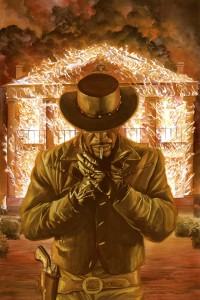
Django-AYou probably already heard, but Quentin Tarantino is co-plotting a Django (Unchained)/Zorro cross-over with Matt Wagner.  If you’ve seen his movies, you’ll find plenty of comics references in him, so it should be no surprise to you Tarantino is into the medium.  He’ll be on Dynamite’s panel at the San Diego Comicon on (Sunday) July 27th at 2:15.

He’s also bringing along Reggie Hudlin, who was co-producer on Django.  Hudlin used to be best known for writing and directing the original House Party movie, before he got in touch with his inner geek.  In Beat circles, he’s now better known for producing the Boondocks cartoon and writing comics.  Black Panther and Spider-Man over at Marvel and then the Django comics adaption at Vertigo.

Full PR follows:


July 15, 2014, Mt. Laurel, NJ:  Dynamite Entertainment is proud to announce that pioneering filmmaker Quentin Tarantino and award-winning writer Matt Wagner will be joining the Dynamite 10th Anniversary Panel at San Diego Comic-Con 2014.  The two master storytellers will discuss bringing two Western icons together in Django / Zorro, the official comic book sequel to the blockbuster film Django Unchained, slated for release in November 2014 from Dynamite Entertainment and DC Entertainment.

On stage, Tarantino and Wagner will join Reginald Hudlin, the co-editor of the Django / Zorro crossover and a producer of the Django Unchained film; Nick Barrucci, CEO and Publisher of Dynamite Entertainment; and Joseph Rybandt, the Senior Editor of Dynamite.

The Dynamite 10th Anniversary Panel will take place on Sunday, July 27th, from 2:15pm to 3:15pm, in Room 6BCF.  The panel will be moderated by Alan Kistler, and is open admission to all ticketed convention attendees.

Dynamite Entertainment released a joint announcement with Zorro Production, Inc. and DC Entertainment on June 18th, announcing the Django / Zorrocomic book series scheduled for release later this year.  Tarantino (perhaps best known for his films Pulp Fiction and Kill Bill) and Wagner (of the acclaimed Grendel and Zorro comic books) share plot duties on the new series, with Wagner providing final dialogue and Esteve Polls (The Lone Ranger) illustrating the work.

Regarding the Django / Zorro crossover, Tarantino says, “I’m very, very excited about both this story and the opportunity to work with Matt.  It was reading his Zorro stories that convinced me what a good idea it was to join these two icons together.  The story idea we came up with is thrilling, and I think it will be an exciting new chapter for both characters.”

“We’re extremely grateful that San Diego Comic-Con was able to give us such a great time slot for our panel to help cap off the show, and excited that Quentin and Matt will help headline the panel.  We cannot wait to interact with our fans, talk about our upcoming projects, and answer questions,” says Dynamite CEO/Publisher Nick Barrucci.

San Diego Comic-Con International is a multigenre entertainment and comic convention held annually at San Diego Convention Center, this year between July 24th and July 27th.  It is the largest convention of any industry in the Western Hemisphere, with over 130,000 attendees and massive media attention.

16 Jul 22:38

The Seven Deadly Sins, Vols. 1 + 2

by Ken H.
Lostphrack

plug plug plug

Another Wednesday means another review! This week I’ll be taking a look at The Seven Deadly Sins, Vols. 1 + 2 from Kodansha. Before we get into that, here are a few news items that have caught my attention over the past few weeks.

A lot of those stories were slated to be linked to in last week’s column, but due to the flood of manga news they got bumped back until now. Better late than never! With that done, it’s onto this week’s featured review of The Seven Deadly Sins, Vols. 1 + 2.

The Seven Deadly Sins, Vol. 1The Seven Deadly Sins, Vols. 1 + 2
By Nakaba Suzuki
Kodansha Comics
Rating: Teen (13 +)

The land of Brittania is in turmoil! A group known as the Holy Knights have overthrown the King, forcing Princess Liones to seek help from the legendary group of knights known as The Seven Deadly Sins. Unfortunately for her, the group has been declared outlaws for nearly a decade following an attempted coup of their own. Struggling to save her kingdom Liones must track down these outlaws and uncover the conspiracy surrounding the Holy Knights actions, in Nakaba Suzuki’s The Seven Deadly Sins, Vols. 1 + 2.

The premise for the series is straight forward enough. To save her kingdom Princess Liones must seek out an even more powerful group that might be even worse than the one she’s currently opposing. As she tracks them down she slowly uncovers the truth behind the events that lead to The Seven Deadly sins becoming outlaw status. The set up offers up plenty of opportunities for exciting super powered fights between various knights, intrigue in the conspiracies behind the different coup attempts, and a classic quest plot line to keep things moving along. Of course along the way we learn a little bit more about the various members of the Seven Deadly Sins as well, including the suggestion that there may be a traitor who set them up to take the fall for a crime they didn’t commit, and that not all of them may be entirely nice and mentally stable to begin with.

Unfortunately things start to get derailed with the characters. While Liones is our heroine and the impetus for the entire story, the actual main character is really Meliodas, the leader of the legendary Seven Deadly Sins. Sadly neither of them are especially likable at this point. Liones is little other than a damsel in distress, with a good heart and desire to help that her physical form simply can’t keep up with, meanwhile Meliodas is… well, Meliodas is about two steps away from being a sex offender, which brings us to the biggest problem with The Seven Deadly Sins. The humor. Much of the comedy relies heavily upon fan service and our hero, Meliodas, being a raging pervert. While this isn’t exactly a new thing or something that’s unique to this shonen series, it’s just off putting here. Meliodas is supposed to be someone we can get behind, but at every opportunity he’s sexually harassing the princess in one way or another. Shoving his head up her skirt, casually groping her as he carries her off to safety, and more. It’s incredibly off-putting, as is her naivety and the way she simply accepts it with a slight blush. It ends up making him unlikeable and had me looking forward to any scene in which he was absent. This kind of thing just isn’t funny or amusing and I really wish it’d stop turning up in shonen action/adventure series.

A page from The Seven Deadly Sins, Vol. 1Despite some complaints about the fan service nature of the humor, Nakaba Suzuki sure knows how to draw. The Seven Deadly Sins has some absolutely lovely looking artwork. It’s a fantastic looking book with a nice, scratchy, thatch heavy style. The level of detail Suzuki crams into every panel and character design is amazing! He creates a fantastic sense of place with the lush, detailed backgrounds. Whether it’s the rustic Boars Hat tavern, or the cold stone walls of a dungeon, or the smoking ruins of a village, you’ll never forget where the story is taking place and what kind of world it’s inhabiting. The action scenes are short but explosive, and once again Suzuki instills an amazing sense of motion and impact into every knock out blow. It’s a gorgeous book and there’s something about the character designs and the style that feels old, something about it makes me think of the 90s, but in a good way.

With the first two volumes, The Seven Deadly Sins is off to a rocky start. An unlikeable lead and non-stop sexual harassment played for laughs taint what could have been a fun little fantasy adventure romp. To make it even more painful, the book looks absolutely fantastic. Hopefully, over the course of the series, things will even out a bit more and the fan service comedy moments will fall by the wayside in favor of the intrigue and action.

The Seven Deadly Sins, Vols. 1 + 2 are available now from Kodansha Comics.


14 Jul 18:11

Ask Chris #203: The Complicated Continuity Of G.I. Joe

by Chris Sims

Q: G.I. Joe: Where do I even begin with their myriad continuities? -- @Eric_R_Wilson

A: I've spent the past few weeks catching up on recent G.I. Joe comics with a stack of paperbacks that I picked up at HeroesCon, and while I've been really interested in seeing all the changes and new characters that set the IDW books apart from the original Marvel series, I'm still pretty surprised by this question. I mean, yes, there's a lot of G.I. Joe out there and a lot of different takes on that core idea, but when you get right down to it, it's no more complicated than your average superhero comic.

Which is to say that it's actually very complicated. Especially when the ninjas start getting involved.

Continue reading…

13 Jul 05:05

WWE press release on KENTA signing

by hsmeltzer@juno.com (Dave Meltzer)
WWE® SIGNS JAPANESE STAR KENTA TO NXT®


STAMFORD, Conn., July 12, 2014 – WWE (NYSE:WWE) today announced it has signed Kenta, one of Japan’s biggest stars, to its NXT division.  The announcement took place during a signing ceremony at a WWE Live Event in Osaka, Japan with WWE icon and Hall of Famer, Hulk Hogan presiding.


Kenta’s intense and straight forward in-ring style has led to his success in Japan, as well as during visits to the U.S.  He is expected to reach new heights of global success with WWE.


“Kenta is an incredible performer who brings the crowd to its feet when he steps into the ring”, said Paul Levesque, Executive Vice President, Talent, Creative and Live Events, WWE.  “WWE’s signing of Kenta reflects our continued dedication to creating a diverse roster that appeals to our global fan base.”


“I am humbled to join WWE’s NXT division and look forward to honing my craft with the global leader in sports entertainment,” said Kenta.


Kenta will relocate to Orlando, Florida where he will train at WWE’s state-of-the-art Performance Center to enhance his talents both athletically and creatively.


09 Jul 22:51

Knights of Sidonia, Vols. 5 + 6

by Ken H.
Lostphrack

Self plug! Reminder, my weekly manga reviews will now be here rather than CSBG.

It’s Wednesday, which means it must be time for another review! With the recent release of Knights of Sidonia on Netflix, I figured now would be a good time to revisit the series with a look at Knights of Sidonia, Vols. 5 + 6. Before we get to the review though, there’s a ton of manga news out of Anime Expo from this past weekend. Below are a few manga highlights from the con.

That’s just a taste of the news that came out of the convention, if you want more I highly recommend swinging by Anime News Network and checking out their full coverage. Before you go running off to do that though, stay and take a look at this week’s featured review of Knights of Sidonia, Vols. 5 + 6!

Knights of Sidonia, Vol. 6Knights of Sidonia, Vols. 5 + 6
By Tsutomu Nihei
Vertical
Rating: T + (Older Teens)

Set in the distant future when mankind has been forced to the stars in massive ships like the Sidonia as they battle for their very existence against the biological nightmare knows as the Gauna, Knights of Sidonia is a sci-fi/horror series from the brilliant Tsutomu Nihei, creator of Blame! and Biomega. As a meteor controlled by the alien Gauna threatens the Sidonia, Tanikaze and the other young pilots of the mecha’s known as Garde’s find themselves facing off against a veritable army of Gauna’s, and even if they can survive the initial wave of Gauna guarding the meteor, can any of them stand against the enigmatic and unique Gauna dubbed the Hawk Moth? All this and looming threat from within awaits in Knights of Sidonia, Vols. 5 + 6.

These two volumes are heavily split between dealing with the Gauna’s external threat and establishing an internal one amongst the crew of the Sidonia. Nihei bounces back and forth between sorties with the Garde’s and the slow arrival and machinations of a threat from Sidonia’s past, one that was introduced in the previous two volumes massive backstory dump. In between the exciting space battles and creepy body horror, Nihei also takes time to further develop the various would be relationships that surround our main character, Nagate. It’s in these quieter moments that we get to see another side of Tsutomu Nihei, namely his playful sense of comedy. Admittedly this usually involves Nagate being beat up, bounced off walls and the like, but I have to admit that it’s pretty damn entertaining. It’s also something that helps give readers a breather from the non stop doom and gloom that would otherwise dominate the story, and also shines a light on humanity and shows how, despite thousands of years worth of genetic engineering and cybernetic implants, people are still prone to the same petty jealousies and desire for love that we encounter in our everyday contemporary life. That said, there’s still no brilliant or shining character work present within the series. Like almost everything Nihei’s done to date, you’re not here for well developed, three dimensional characters, you’re here for the fantastic sci-fi spectacle and the huge, insane ideas that he’s able to churn out. The fact that Nagate’s harem and accident prone nature help to make him likable and a bit more flawed than Nihei’s normal inhumanely perfect and slick protagonists is just a fun little bonus.

Tsutomu Nihei continues to use that stripped down style he’s been using from the start of the series, but his style shifts a bit in volume 6. It’s mostly minor and involves background characters and random personal, but it’s noticeable just the same. Essentially, what happens is that during a battle scene the random background people in the war room and at the computers don’t seem quite as clean and solid as they had in previous volumes. There’s a slightly lighter and looser look to their lines. There also seems to be a slight spike in the use of toning, but that could really just be situational due to certain scenes in volume 6. Even with these minor changes Nihei’s artwork is solid and his penchant for grandiose scale is on display throughout both volumes. Likewise his action scenes continue to improve, though they still never quite reach the insanity of some of his previous works. His handling of the physical humor and is fantastic and unlike many other artists, he never dips into chibified over reactions, letting the slap stick elements share the same art style he reserves for the more intense and serious moments. It really lends the book a nice sense of continuity and keeps you in the story. His rendition of Sidonia continues to be lovely, with the interiors looking warn down and lived in, railings that are barely hanging together, massive open spaces filled with aged looking industrial hardware, miles of piping and cables and more. Given his architectural background, perhaps it’s not terribly shocking that it’s often his settings that are most striking. His tendency to not populate his world too heavily with crowds or random passerby’s also helps create a sense of loneliness and isolation that works well with the plot, reinforcing the notion that you’re witnessing the twilight of humanity.

Knights of Sidonia, Vols. 5 + 6 continue to expand upon the events of the previous volumes, which really got me hooked into the series, and plays with them in exciting and entering ways. Nihei’s sense of humor is a treat, and despite all the action and horror, he still manages to cram in enough humanity to make the characters likable, while peppering the text and his world with enough “hard science” or things that feel like “hard science” to develop a sci-fi world that feels unique amongst it’s manga counterparts due to feeling rooted in real world physics and science. The series continues to grow on me and I’m glad I’ll be able to get in two forms now thanks to its debut on Netflix. So check out the anime, and then pick up the manga, or vice versa. The point is, check out Knights of Sidonia!

Knights of Sidonia, Vols. 5 + 6 are available now from Vertical.


09 Jul 19:33

DC will allow Jeffrey Baldwin statue to bear Superman logo

by Kevin Melrose
Lostphrack

Yays!

DC will allow Jeffrey Baldwin statue to bear Superman logo

Reconsidering its decision, DC Entertainment will allow Superman’s iconic S emblem on a statue memorializing a 5-year-old Toronto boy who died in 2002 following years of abuse by his grandparents. “We are honored by the relationship that our fans have with our characters, and fully understand the magnitude of their passion,” a company spokesperson said […]
09 Jul 19:32

While shopping with his friend...

by MRTIM

07 Jul 21:14

DC won’t permit Superman logo on statue of murdered boy

by Heidi MacDonald
Lostphrack

Stay classy DC.

baldwin_statue.jpg.size.xxlarge.promo.jpg

This may make you cry.

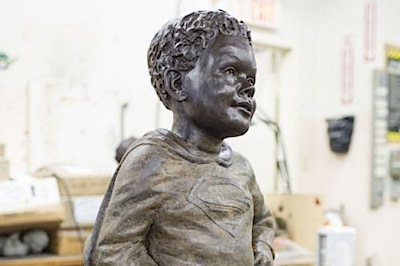
Jeffrey Baldwin is a Toronto child who died of starvation in 2002 after severe abuse at the hands of his grandparents. The grandparents were convicted child abusers but Jeffrey and several siblings were still handed into their care by a children’s “aid” organization. He and a sister were locked in a room and forced to live in their own filth. And worse. In happier days, the boy was a Superman fan who was even photographed wearing the classic uniform.

A Toronto man was so moved by this story—revealed in a long delayed inquest into the death earlier this year—that he comissioned a statue of Jeffrey wearing a Superman uniform.

However, when he asked for permission from DC to include the Superman logo, it was denied.

DC’s senior vice-president of business and legal affairs, Amy Genkins, told Boyce in an email that “for a variety of legal reasons, we are not able to accede to the request, nor many other incredibly worthy projects that come to our attention.”
DC did not immediately return a request for comment.

For Boyce, it was a huge blow, as he felt the Superman aspect was a crucial part of the bronze monument, which will include a bench. The coroner’s inquest heard from Jeffrey’s father that his son loved to dress up as Superman.


Okay I get it. Legal reasons. It’s still kind of sad.

“I’m sort of empathetic to (DC’s) point of view on this, but I feel very strongly that the image of Jeffrey is so powerful,” said Boyce. “It’s the image of a vulnerable boy dressed up as the most invulnerable character in the universe. So I just feel like there’s something lost if we change it.”

Boyce said he was empathetic to DC’s stance because he felt they did not want the Superman character associated with child abuse.


I get that too. But still sad. Superheroes are aspirational character who help get kids through trauma as larger than life figures with larger than life heroism.

Boyce is going to have the “S” on the statue changed to a “J” for Jeffrey.

05 Jul 19:41

Samus Got On The Wrong Train That Night

by Lauren Davis

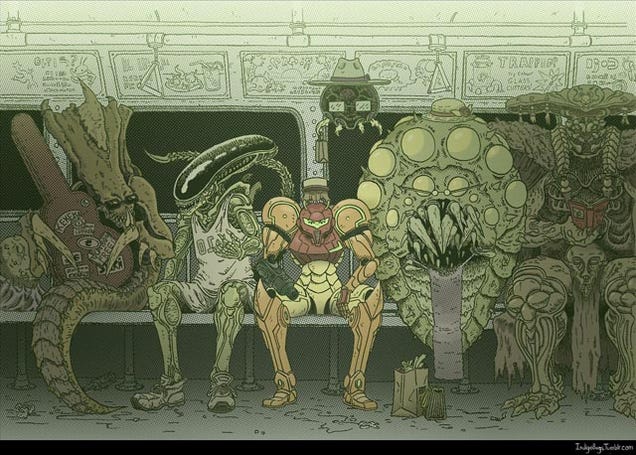
Samus Got On The Wrong Train That Night

Samus should have known that the 14-Ex wasn't an express train, but an extraterrestrial line.

Read more...

02 Jul 22:31

Say I Love You, Vol. 2

by Ken H.
Lostphrack

Shameless self plug!

Welcome to the latest review at Sequential Ink! This week I’ll be taking a look at Say I Love You, Vol. 2, but first, please enjoy some news-y tidbits!

With the news roundup out of the way, it’s onto this weeks featured review of Say I Love You, Vol. 2!

Say I Love You, Vol. 2Say I Love You, Vol. 2
by Kanae Hazuki
Kodansha Comics, 160 pp
Rating: Older Teen (16+)

With volume 2 of Say I Love You, Kanae Hazuki continues to use Yamatao and Mei’s growing relationship and their circle of friends to explore the rocky shores of teenage relationships. With the introduction of several new characters, she takes the opportunity to look at body issues, teen sex, and more in this fascinating shojo series.

Much of the volume is given over to teens and how they handle or view sex. It opens with Mei’s first overnight trip with Yamato and their friends, and the situation quickly becomes one where Mei finds herself struggling to deal with Yamato’s sexual history. Her insecurity comes off as genuine and unforced, resulting in a moment that feels all too real and is bound to resonate with many a reader. It also highlights one of the things that Kanae Hazuki excels at with Say I Love You, which is her ability to infuse these scenes and moments with a tenderness and openness that never feels exploitive or puerile. She mentions, in her afterword, that she’s infused a lot of her life experiences into the story, and despite cultural differences it’s easy to see, imagine and relate to such moments. Oddly enough, this volume also shines a light on what could be a potential shortcoming in Kanae Hazuki’s writing.

A large chunk of the book is spent introducing us to Hayakawa and developing him and his story. He’s a bit of a playboy with a reputation among the women, but is in fact using his desire for no strings attached relationships as a replacement for a meaningful relationship due to poor upbringing. He comes off as fairly creepy and slimy, but as his story progresses we learn that underneath that he’s actually an ok person. The thing is, this isn’t dissimilar to Nakanishi, who’s a fairly decent guy once he’s able to move beyond his slightly creepy and off-putting sex obsessed boneheadedness. Not only that, as we learn later on this isn’t dissimilar to the personality and history of Mei’s romantic rival, Aiko. She initially comes off as a fairly bitchy and cruel character, but the brief glimpse we’re given of her backstory here suggests that she’s secretly a decent person, but that it’s buried behind social expectations and insecurities. There’s nothing wrong with fleshed out characters who are well developed, but we’re only two volumes in and it feels like the formula is already glaringly obvious. Hopefully this will change as the series goes on.

The artwork continues be a bit lacking. While Hazuki imbues her characters eyes with a wonderful expressiveness, her characters’ bodies look so thin that it’s a wonder they don’t break under a strong breeze. While Hazuki does an amazing job at imbuing her characters’ faces and eyes with emotions, and she knows just when to let certain story beats hang in the air, and when to rely on toning and borderless panels to reinforce emotional moments, her figures stand out as the weakest part of her artwork. They’re long, lanky, incredibly thin and one can’t help but wonder how they’re able to walk without snapping their barely their ankles, or how they aren’t blown away with a wind gust, or where they keep their internal organs for that matter.

There’s a lot to like about Say I Love You, Vol. 2 and the series in general so far. The honesty and maturity shown in the handling of incredibly sensitive and touchy subjects is second to none, and I can’t imagine these issues being raised and handled better in any other shojo manga. The characters feel real, their emotions and reactions generally ring true to life as well. It’s shortcomings are in the art, and what appears to be a slowly emerging formula of “damaged person makes a connection and becomes a decent person” for every character we’re introduced to. But placing that and the artwork aside, Say I Love You has been a refreshing and surprisingly powerful read.

Say I Love You, Vol. 2 is available now from Kodansha Comics. Review copy provided by the publisher.


25 Jun 22:54

Battle Royale: Angel’s Border

by Ken H.
Lostphrack

Self plug!

Welcome to the latest review at Sequential Ink! This week I’ll be taking a look at Battle Royale: Angel’s Border, but first some news items and things that caught my eye during the week.

And now onto the featured review of Battle Royale: Angel’s Border!

Battle Royale: Angel's BorderBattle Royale: Angel’s Border
Written by Koushun Takami (with N-Cake), Art by Mioko Ohnishi and Youhei Oguma
Viz, 280 pgs
Rating: T + (Older Teens)

Created in 1999, Battle Royale was the debut novel of Koushun Takami. It’s a brutal tale set in an alternate authoritarian version of Japan which holds a yearly contest known only as “The Program.” Once a year a 9th grade class is picked to take part in “The Program” which forces the students to fight to death until only one remains. Now, for the first time in nearly a decade, Koushun Takami returns to his international sensation with Battle Royale: Angel’s Border. This single volume manga’s a collection of two short stories set around the events of the original Battle Royale novel. In Episode I, Toushun explores the friendship between Yukie and Haruka, the two girls who helped organize the all girl group that hid inside the lighthouse in the original novel. Episode II likewise takes a character from the all girl group, Chisato, and expands upon her relationship with the athletic computer genius, Shinji Mimura.

The opening story, Episode I, jumps back and forth between the ultimate end of the all girl group and scenes of Yukie and Haruka prior to their arrival on the island. A large of chunk of the tale is given to exploring their friendship. Takami also touches upon Haruka’s struggle to come to terms with her sexuality and the fact that she’s in love with Yukie. It’s mainly narrated by Yukie and it may surprise some modern American readers to see a strain of self loathing within Haruka as she comes to terms with who she is, constantly referring to herself as “not normal” or “dirty” for having feelings for Yukie. He does a fantastic job at getting across how close their friendship is though and even manages to touches upon the ultimate purpose for “The Program” in the first place. Bother characters are incredibly likable and knowing their ultimate fate didn’t really soften the climax of the story. Episode II is nowhere near as engaging or emotional as the first story, though it does give Takami a chance to explore the world of Battle Royale a little more by touching upon things such as the secret police, anti-government activities and the way the oppressive regime affects the lives of its citizens beyond “The Program.” Unfortunately Mimura’s never been one of my favorite characters, being a little too perfect and capable in the original novel, and despite being featured here Chisato’s not really developed or fleshed out enough to be terribly engaging or memorable.

Battle Royale: Angel's Border

A panel from Ohnishi’s Episode I

Mioko Ohnishi’s artwork in Episode I is lovely. It’s wonderfully expressive with a hint of sadness and longing that goes beyond simple facial expressions. There’s an almost dream like quality to the images at times thanks to Ohnishi’s skilled use panel borders and toning. Ohnishi knows when to remove backgrounds and let the emphasis on the characters take center stage, something that helps reinforce sad, dreamlike quality of the story. Youhei Oguma’s artwork is a bit of a departure from the almost languid visuals of Ohnishi. It’s far more detail heavy and not just with backgrounds, but with clothing, accessories and the like. It also feels a tad stiffer in places as well, with his characters facial expressions lacking the emotional impact that marked Ohnishi’s work.

Battle Royale: Angel’s Border is literally split down the middle. Episode I is a solid, enjoyable and emotional read, while Episode II is interesting but lacks the heart of the first half of the book. The biggest problem facing this manga is the fact that it’s going to be pretty inaccessible to those who haven’t already read the original novel. It tries to bring newcomers up to speed, but without having read the book certain characters and events will simply fall flat, or worse, be nearly incomprehensible. That said, Battle Royale fans should definitely give the volume a look, as it’s surprisingly cheap, has a surprisingly powerful first story, and also includes some nifty little extras, such as an afterward by Koushin Takami and his scripts for both stories.

Battle Royale: Angel’s Border is available now from Viz.


18 Jun 23:59

Attack on Titan: No Regrets, Vol. 1

by Ken H.
Lostphrack

New home for my reviews! Share and update accordingly please!

Also, plug plug plug...

Welcome back to Sequential Ink, or just welcome for those visiting for the first time. For those wondering, I’ve spent the last year or so writing Manga in Minutes column for Comics Should Be Good, part of Comic Book Resources. My association with them is now at an end, but my review writing isn’t! With that in mind I’ll be dusting off this blog and posting weekly manga reviews every Wednesday night between 6 and 7 PM EST. As time goes on I may expand a bit and return to mixing in American comic reviews and novel reviews as well, but first things first.

Now that that’s taken care of, let’s take a look at a few news items that caught my eye this past week.

Speaking of Attack on Titan, with the news out of the way it’s time to take a look at Attack on Titan: No Regrets, Vol. 1!

Attack on Titan: No Regrets, Vol. 1Attack on Titan: No Regrets, Vol. 1
Art by Hikaru Sugura, Story by Gun Snark (Nitroplus)
Kodansha Comics, 192 pp
Rating: Older Teen (16+)

Adapted from a visual novel included with the Japanese Blu-Ray release of Attack on Titan, Jikaru Sugura’s Attack on Titan: No Regrets, Vol. 1 delves into the history of Levi, one of the more popular characters in the series, and promises to show how he met Commander Erwin, joined the Survey Corps and became the character fans know and love.

Two plot lines entwine throughout this volume. The primary story follows Levi and his friends, a pair of criminals, as they’re forcibly recruited into the Survey Corps, though there are hints that it’s not as forced as we’re lead to believe. The secondary plot focuses heavily on Erwin as he navigates a tricky political landscape to get approval and financing for an experimental mission beyond the wall. We jump back and forth between the two characters as their individual story’s interact and spin off of each other. There’s a sense that both Erwin and Levi are caught up in in larger events as pawns for unseen powers and organizations, and that both desire to be free of them. Levi’s backstory is clearly the big draw here, and it’s not quite what I would have expected. He’s brutal, thuggish, but with a strong sense of loyalty to his comrades, but also someone who’s easily given to threatening the lives of anyone for just about anything. His initial encounter with Erwin is far from positive and as a result he spends a large chunk of this first volume claiming that he’ll murder him, despite the fact that it seems like doing so will ultimately screw up whatever job his group seems to be attempting. This really makes it feel like the series will trace his growth from this vicious selfish punk to the vicious team player we see in the main Attack on Titan series. Erwin’s tale suffers a little from this focus on Levi, which is a bit of a shame as it seems like it would be just as interesting. Political situations are set up and resolved completely off camera, with little to no explanation as to what Erwin actually did. Instead, we simply see the results are left to imagine Erwin’s actions.

Sugura’s art is clean and tight. It’s reminiscent of Isayama’s style, but without the thatching, anatomical mishaps, and stiff, awkward poses that often mar his work. Unfortunately Sugura also lacks the wonderful kinetic feel that permeates Isayama’s action scenes. While this sometimes makes them clearer and easier to follow, it also removes one of the great hooks of the original Attack on Titan series. Despite their lack of impact, the few action scenes are perfectly decent and Sugura manages to fit in a rather snazzy Titan takedown. Under Sugura’s hand Levi, Erwin and several other characters from the original series are instantly recognizable, and the new characters blend in nicely, never feeling out of place as they stick with the already established visual style of the franchise.

Unlike Attack on Titan: Before the Fall, Attack on Titan: No Regrets certainly feels more like a prequel series. It offers up the backstory for one of the series most popular characters, and even gives us a glimpse at the development of certain tactics and maneuvers that we see in the main series. As it result it feels far more connected and should hold more interest to fans of the original franchise. It does seem to be delivering the goods as far as Levi is concerned, and I’ll be curious to see how his relationship with Erwin grows and develops into what we see in Isayama’s series. This is definitely the Attack on Titan spin off that fans will probably most enjoy.

Attack on Titan: No Regrets, Vol. 1 will be available June 24th from Kodansha Comics. Review copy provided by the publisher.


18 Jun 19:33

VIDEO: GUNBLADE Kicks Ass And Blows Things Up!

by Keith Justice

FilmCombatSyndicate: Following last week’s announcement of Tokusatsu auteur Koichi Sakamoto’s latest project, Gunblade, the folks at Ranger Crew have forwarded new footage released online from the upcoming series set for Korean households next year, with air dates to be announced for other parts of Asia, as well as Europe and North America. The footage comprises […]

The post VIDEO: GUNBLADE Kicks Ass And Blows Things Up! appeared first on Henshin Justice Unlimited.

12 Jun 03:48

Manga in Minutes: Rurouni Kenshin: Restoration, Vols. 1 + 2

by Ken H
Lostphrack

Self plugging ahoy!

Welcome to another installment of Manga in Minutes! We’ve got an unexpected license announcement, some live action adaption items, and news from abroad, plus the usual weekly review. So let’s get down to business. As reported by our sister blog, Robot 6, Viz has worked out a deal with Comixology for the digital distribution of […]
05 Jun 02:08

Manga in Minutes: Monster Soul, Vol. 1

by Ken H
Lostphrack

Self plugging!

Another week, another Manga in Minutes! There’s a few interesting pieces that popped up on my radar over the past week, so let’s get to them. Sister blog, Robot 6 dug up this nifty little tidbit about Naoki Urusawa creating a Godzilla print for Legendary Pictures. Blood Blockade Battlefront, the supernatural/sci-fi mashup series from the […]
29 May 19:52

Production Halts on Screen Gems' Remake of The Raid

by John Squires

Production Halts on Screen Gems' Remake of The RaidThough it only came out just a few short years ago, it was nevertheless inevitable that the Indonesian fight flick The Raid would find its head on the ole remake chopping black, and Screen Gems announced recently that they indeed were working on an English-language version of the film.

Those plans, however, have come to a screeching halt, and we've got the latest for ya today. Read on!

Per Variety, Screen Gems has halted pre-production on their remake of The Raid, which was set to begin shooting in September. Insiders add that the film isn’t being put into turnaround and that the plan is now to shoot in the first quarter of 2015.

The film was getting close to a greenlight as execs were zeroing on an ensemble with sources indicating that Luke Evans, Anthony Mackie, Frank Grillo and Ethan Hawke were frontrunners for roles. However, other insiders said no casting decisions had been made and no offers were sent out. It’s possible that one reason for the delay is that producers are seeking a bigger name.

Brad Ingelsby penned the script, and Patrick Hughes is on board to direct. XYZ Films is producing the pic.

In the 2011 original, an elite Indonesian S.W.A.T. team raids a building where a gangster and his thugs are embedded and chaos ensues. The remake will have a similar storyline.

The Raid: Redemption

VISIT THE EVILSHOP @ AMAZON!
Got news? Click here to submit it!
Subscribe to the Dread Central YouTube Channel!
Go on a raid in the comments section below.

29 May 19:51

Manga in Minutes: Blade of the Immortal, Vol. 29: Beyond Good and Evil

by Ken H
Lostphrack

Plug!

Only three news items and tidbits caught my eye this week, along with the omni-present NYT Best Sellers List. Sadly, not every week can be full of license announcements and Sailor Moon. Ah well! Honey and Clover creator, Chica Umino, wins the Tezuka Osamu Cultural Prize for her Shogi based manga, March Comes in Like […]
22 May 19:32

Netflix Sets "Knights of Sidonia" Premiere Date

by Scott Green
Lostphrack

Woot, woot!

This summer, Netflix tries adding some anime to their programming by globally streaming sci-fi anime Knights of Sidonia. While the adaptation of Tsutomu Nihei’s deep space mecha manga is airing in Japan this spring, Netflix has now announced that it hits their service on July 4th. 


So far they haven't indicated whether they will be following the pattern of past programming, offering the entire season at the time of the premiere.


Gauna beware! Mecha sci-fi #anime show Knights of Sidonia to hit Netflix July 4th! pic.twitter.com/vIBchBoKpi

— Netflix US (@netflix) May 21, 2014


Vertical is publishing the original manga in English.


------
Scott Green is editor and reporter for anime and manga at geek entertainment site Ain't It Cool News. Follow him on Twitter at @aicnanime.

21 May 23:43

Manga in Minutes: Say I Love You, Vol. 1

by Ken H
Lostphrack

Plug, plug, plug.

Only a few news bits this week, but they’re pretty interesting! There’s a controversy involving a food manga, and the mother of all anime license announcements! Over at our sister blog, Robot Six, Brigid Alverson has been doing a good job at covering the Oishinbo controversy I mentioned in last weeks news round up. Since […]