Shared posts

02 Dec 17:51

St. Louis Police Claim It's Their 'First Amendment' Rights Not To Protect Football Players Who Supported Protestors

by Mike Masnick
It's been pretty obvious that law enforcement in the St. Louis area has a rather tenuous grasp on the concept of the First Amendment. Obviously, they've done a fairly terrible job recognizing the right to "peaceably assemble" for quite some time, even having a court declare its "5 second rule" approach unconstitutional. They've also ignored the freedom of the press by repeatedly arresting journalists. And, remember, the local prosecutor has claimed that it was really all those people speaking out on social media who were to blame.

But it appears that the misunderstanding of the First Amendment has been taken to new, and even more ridiculous levels, following a brief show of support for the protestors by some players for the St. Louis Rams (the local NFL football franchise for you non-sportsball people). The Rams' wide receivers decided to all put their hands up -- the "hands up, don't shoot" gesture -- in support of Michael Brown and the protestors. It's a small, but meaningful gesture, showing they supported the protestors. And it shouldn't have been taken as anything more than that.

Instead, the St. Louis County police decided to respond... by suggesting that, because of this, the police would no longer protect the Rams. Here's the statement from the St. Louis Police Officers Association, quoting Jeff Roorda, the group's spokesperson, and a local politician (and ex-cop):
Roorda was incensed that the Rams and the NFL would tolerate such behavior and called it remarkably hypocritical. "All week long, the Rams and the NFL were on the phone with the St. Louis Police Department asking for assurances that the players and the fans would be kept safe from the violent protesters who had rioted, looted, and burned buildings in Ferguson. Our officers have been working 12 hour shifts for over a week, they had days off including Thanksgiving cancelled so that they could defend this community from those on the streets that perpetuate this myth that Michael Brown was executed by a brother police officer and then, as the players and their fans sit safely in their dome under the watchful protection of hundreds of St. Louis's finest, they take to the turf to call a now-exonerated officer a murderer, that is way out-of-bounds, to put it in football parlance," Roorda said.

"The SLPOA is calling for the players involved to be disciplined and for the Rams and the NFL to deliver a very public apology. Roorda said he planned to speak to the NFL and the Rams to voice his organization's displeasure tomorrow. He also plans to reach out to other police organizations in St. Louis and around the country to enlist their input on what the appropriate response from law enforcement should be. Roorda warned, "I know that there are those that will say that these players are simply exercising their First Amendment rights. Well I've got news for people who think that way, cops have first amendment rights too, and we plan to exercise ours. I'd remind the NFL and their players that it is not the violent thugs burning down buildings that buy their advertiser's products. It's cops and the good people of St. Louis and other NFL towns that do. Somebody needs to throw a flag on this play. If it's not the NFL and the Rams, then it'll be cops and their supporters."
As many have noted, this certainly sounds like Roorda saying that it's the police's "First Amendment" rights to look the other way should any threats come to the team or the stadium. Update: In the comments, many are arguing that this comment does not reflect the intent not to protect the Rams any more, but rather just to boycott the merchandise offered by advertisers. That's a reasonable interpretation of the comments, though it still seems like he's implying something deeper -- actually involving police response. Note the claim that Roorda is going to speak to other police forces on an "appropriate response.." Separately, Roorda specifically calls out the fact that the Rams had asked police for extra protection, which certainly implies that police would not be as interested in doing so if players keep supporting protestors. It seems clear to me -- though, clearly not to others -- that Roorda is suggesting that if you state a position that the police disagree with, the police will look for ways to punish you. That's troubling.

Of course, that's not how the First Amendment actually works. It's quite the opposite. As Sally Jenkins at the Washington Post points out, the reality is exactly the opposite. The First Amendment protects the public from government officials (including the police) from taking actions based on expression of members of the public. If anything, Roorda's implied threat violates the First Amendment, suggesting that the government will punish people for their expression.
To begin with, the First Amendment only protects free speech against government action. That’s all it does. It doesn’t protect the St. Louis players from NFL owners, or league commissioners, or talk radio hosts who disagree with them. But it does protect them from the government. So the person in danger of abusing the First Amendment here is not the football player with the edgy gesture in a public stadium. Or the NFL owner who might want to tell them to shut up to protect advertising. It’s the governmental agent — like, say, a cop — who seeks to punish someone for expressing certain views.
Of course, the First Amendment now also protects the press digging into Jeff Roorda's own background and reporting what they find. Like the time he was reprimanded for trying "to 'cover' for another police officer filing a report that contained false statements." Or how he's against body cameras because they "sometimes don't reflect exactly what happened" and saying that "cameras have been bad for law enforcement" because "it causes second guessing by the courts and the media." Roorda has also defended an officer who a surveillance video showed was assaulting a handcuffed suspect, claiming the officer was "only defending himself" and saying he was doing "as he's trained to do."

In fact, we actually wrote about that last story and posted the video. You can see it here: As we noted at the time, Roorda then lied about what's in the video. Roorda claimed that the officer was crouched down and the suspect started moving forward at him. But the video shows no such thing. Roorda further claimed that such videos should only be used when it helps the police view of things.

Meanwhile, the St. Louis County Police still seem to think that their First Amendment rights include pretending that the Rams apologized to them when they did not. The official Twitter feed and Facebook feed have both tried to argue that the Rams' COO, Kevin Demoff apologized to the police for the players' actions. On Facebook, they admit that Demoff didn't really apologize, but they still took it as an apology -- and then on Twitter tried to suggest that regretting "any offense that... officers may have taken" was actually an apology, based on their tortured reading of the dictionary: Except, of course, most people recognize that a "I'm sorry if anyone was offended" is not really an apology, and here it appears that Demoff didn't even go that far. But, still, the St. Louis police want to claim it was an apology. And, I guess, they believe that's their First Amendment right to misrepresent what was actually said to them...

Permalink | Comments | Email This Story


01 Dec 18:47

Twitter will soon scan your device to see which apps are installed, here’s how you turn it off

by Chris Chavez
Brindle

Or just uninstall it like I did :X

Twitter_Fail_Whale

Privacy concerns are a huge deal these days, mainly because the more connected you are to the internet, the less it seems your data is actually yours. Today, Twitter announced an upcoming change coming soon to their Android and iOS apps that’s raising concerns from privacy advocates The problem? The Twitter app will soon scan devices to see which apps are installed. Phandroid, BuzzFeed, Pornhub — everything will soon be revealed.

According to Twitter’s support page, it’s so Twitter can better serve promoted content (read: ads), suggestions on who to follow, and bring tweets from others to your timeline. Knowing this is a sensitive subject, the social media giant clearly states that no actual data from these apps is being collected, so no harm, no foul, right? Not so fast.

Although a small invasion of privacy (one Android and iOS developers already have access to), app scanning will be on by default and isn’t opt-in. Thankfully, Twitter is allowing users to turn off the app collecting in the app’s settings, and will even notify users once they changes go into effect via an in-app prompt. To turn it off, simply follow these instructions as detailed by Twitter:

  • Tap the overflow icon (3-dot menu button)
  • Tap Settings
  • Tap the account you’d like to adjust
  • Under Other, you can adjust the setting to Tailor Twitter based on my apps
30 Nov 20:50

LEGO's Inspiring Message To Parents In the 1970's

70s-lego-note.jpg This is the note that was included with some LEGO doll house sets in the 70's, reminding parents that it's okay for girls to want to play with rocketships and boys to build dollhouses. It's weird to think some parents actually needed to be reminded of that. I had a Cabbage Patch Doll growing up. And a My Little Pony. It was pink with blue hair. I bet my mom still has it. Plus a jar full of my baby teeth. Ooh -- and my rat-tail. I know for a fact she has my rat-tail in an envelope somewhere. Thanks to Luis, who agrees there's nothing wrong with a boy wanting a Polly Pocket playset (I had two of those too).
30 Nov 16:56

Ultra Conservative Christian Lady Goes To Museum, Tries To Debunk Evolution, Fails Beyond Miserably

Brindle

whoa

crazy-lady-goes-to-the-museum.jpg This is a video of ultra conservative Christian Megan Fox (not that Megan Fox, trust me) taking a trip to the Field Museum of Natural History in Chicago to debunk their 'Evolving Earth' exhibit and audit it for a liberal (aka scientific, in her mind) bias. It starts off awful and ends worse, and that's even looking past the shoddy camerawork (which wasn't easy). I posted three short teaser highlights for the video first, then the whole 30-minute thing in case you really, really like torturing yourself. Although I'd still suggest you try hanging yourself from the ceiling with some of those giant meat-hooks in your back first. Keep going for the videos while I cross all my fingers and my toes Megan is just a very convincing troll. Thanks to moyer, Jackie and Porterhouse Pete, who are still rubbing their eyeballs really hard and painfully until they see colors.
30 Nov 16:07

DC Police Department Budgets Its Asset Forfeiture Proceeds Years In Advance

by Tim Cushing
Asset forfeiture may be the greatest scam perpetuated on the American people by their government -- and it's all legal. For the most part, assets seized translate directly to monetary or physical gains for the agencies doing the seizing, an act often wholly separated from any American ideals of due process.

The New York Times recently obtained recording of asset forfeiture conferences which showed prosecutors advising cops on how to best exploit these programs to obtain additional funds and goods for their respective law enforcement agencies. In short, it appears that many agencies use asset forfeiture to fill departmental shopping lists, rather than as the criminal syndicate-crippling action it was intended to be.

The Washington Post has been digging into the oft-abused programs for the last six weeks. The latest article in this series comes to similar conclusions about how the programs are viewed by law enforcement agencies.
D.C. police have made plans for millions of dollars in anticipated proceeds from future civil seizures of cash and property, even though federal guidelines say “agencies may not commit” to such spending in advance, documents show.

The city’s proposed budget and financial plan for fiscal 2015 includes about $2.7 million for the District police department’s “special purpose fund” through 2018. The fund covers payments for informants and rewards.
There's a very good reason federal guidelines prohibit the counting of chickens asset forfeiture proceeds before they're hatched "liberated" at badgepoint by law enforcement. It helps curtail the abuse that results from perverted incentives. No one likes a budget shortfall, but very few government entities have the means to immediately impact the bottom line -- at least not in the way a few uniformed officers granted the power to arbitrarily seize the possessions of others can. No proof of criminal intent is needed and, thanks to an agreement with the DOJ, 80% of what it seizes goes directly to the District's law enforcement agencies, rather than into the District's general fund. All it takes to divert these funds to law enforcement is the invocation of federal crimes -- like drug possession.

The very convenient DOJ agreement works out incredibly well.
District financial records show that D.C. police receive about $670,000 annually from the Equitable Sharing Program. About $30,000 in proceeds from forfeitures under District law go into the general fund.
The Justice Department refused to comment on its agreement with DC law enforcement, one that sees nearly 96% of funds derived from forfeitures go directly into the PD's pockets. DC police chief Cathy Lanier defends the program -- and the pre-budgeting of anticipated seizures -- as being essential to "removing the profit gained from facilitating a crime."

But what Lanier portrays as crippling criminal enterprises appears to be equally targeted towards separating users from their next fix -- or simply separating random "suspects" from whatever they happen to have in their wallets.
Since 2009, D.C. officers have made more than 12,000 seizures under city and federal laws, according to records and data obtained from the city by The Washington Post through the District’s open records law. Half of the more than $5.5 million in cash seizures were for $141 or less, with more than a thousand for less than $20.
Because the system is primed for abuse, legislation has been introduced that would overhaul the city's asset forfeiture program, raising the threshold of proof needed to justify a seizure as well as forcing a majority of funds to be routed into the city's general fund. Unsurprisingly, cops aren't fans of the proposed legislation.
[T]he bill has been opposed by law enforcement officials, partly for the same reason other reform efforts across the country have been stymied: money. The officials also said it would create an administrative burden. In addition to tightening oversight and the rules for civil seizures, the District proposal would cut back on revenue.
Also unsurprisingly, officials can pinpoint the presumed revenue loss with stunning accuracy.
In a fiscal impact statement Wednesday, the city’s chief financial officer, Jeffrey S. DeWitt, said that the bill “could reduce federal resources­ received by the District by approximately $670,000” each year if the general fund provision takes effect.
Which is exactly the amount the PD receives from the Share-With-The-DOJ plan. DC's asset forfeiture program is beyond broken. When something starts out with the goal of crippling drug kingpins and ends up as an easy way to seize a mother's vehicle because her son was busted for misdemeanor possession while driving it, it's blatantly obvious that the program is serving no one but its direct beneficiaries.

Permalink | Comments | Email This Story



26 Nov 19:39

WTF ATF: The ATF's Fake Retail Stores, Bad Behavior... And Why It Only Came Out Because They Failed To Pay Rent

by Mike Masnick
Brindle

What the actual fuck?

This past week, on This American Life, the first 20 minutes or so are the incredible story of just how screwed up the ATF continues to be (the Bureau of Alcohol, Tobacco and Firearms). Much of this has been reported on over the past year and a half by reporters in Milwaukee (and investigated by Congress), but it's absolutely worth listening to the details -- which you can do over on the This American Life page (I'd post the embed here, but unfortunately This American Life does not yet appear to support HTTPS, so we can't). The story is all kinds of stunning, including the insane fact that most of the details came out, and the reporters only began their investigation, because some undercover ATF agents in Milwaukee had trashed the property they were renting, and refused to pay the rent or damages to the landlord -- even threatening the landlord, claiming he was harassing federal agents by asking for the rent:
John Diedrich: I get a call. And it was from a landlord, a guy named Dave Salkin. And Dave Salkin owns this place that he, unbeknownst to him, rented to the ATF. Didn't know who they were, they were undercover agents. And they had trashed his place, and they were behind on rent. They had threatened him. And I said, where are you, I'm coming right now.

Ira Glass: While they were undercover, agents from the Bureau of Alcohol, Tobacco, Firearms and Explosives basically ripped up his place. Salkin said at the time that they owed $15,000 in damages and back rent. Later he said it was more. When he tried to collect, they didn't pay up. In fact, an ATF lawyer warned him that if he kept asking for the money, it could be seen as harassing federal agents.
The other thing that becomes clear in all of this is that these "undercover" ATF agents aren't just sloppy and stupid, they seem to go out of their way to be ineffective and dangerous.
Ira Glass: And they were robbed. These agents whose job it was to get guns out of the hands of criminals had three guns that were stolen out of an agent's car while he was parked at a coffee shop. These included a fully automatic rifle. This is a machine gun, the kind that normally only law enforcement and military can legally have.

Not long after that, the store itself was burglarized of $39,000 in clothes, jewelry, and merch, reportedly, because the ATF had not bothered to do much to secure the store and just did not seem to care. Nobody was minding the store, literally.

John Diedrich: The ATF had no working burglar alarm on their building. So it was sort of, instead of a smash and grab, it was just this sort of like slow burglary. The neighbors report at one point, once they were able to get in-- again, no burglar alarm-- they kept the door propped open with a shoe. And they were just kind of taking stuff out.

And the word sort of spread. Hey, this place is just open. Nobody's there. We can just go get stuff. And at one point they just pulled up a U-Haul. And they were just sort of emptying this. And this is over several days. And then even--

Ira Glass: Renting a U-Haul is such a crazy move, because is it means that somebody had to go and decide, I'm going to rent a truck. That's how slow this burglary is, that you can do a rental.

John Diedrich: Yeah, exactly. And there's no sort of concern that you're going to be busted at that point, and just say, OK, I can only carry so much in my arms. Let's get something bigger. Let's get a U-Haul.

Ira Glass: The same day the burglary was reported, an ATF ballistic shield, the kind that they would use to raid a house or something, was turned in by a scrapper at a Milwaukee police station. One item that was just left lying around in the store after the robbery for anybody to pick up and read-- it was there when reporter John Diedrich walked through-- was a secret ATF document listing the names of undercover agents, their undercover vehicles from several law enforcement agencies in Milwaukee.
There's a lot more like this. Including potential copyright infringement:
Ira Glass: And they distributed flyers with the store's logo, which was a skull with angel wings made from assault rifles and knives with the words Buy, Sell, Trade, wink, wink. Federal agents actually ripped off the logo from the Sylvester Stallone film, The Expendables, possibly in violation of their copyright.
The story details just how incredibly counterproductive all these efforts were. Since they were paying super high prices for guns, people would suddenly start stealing guns just because the ATF was making them so valuable. And, despite the ATF pretending otherwise, the case in Milwaukee was hardly a one-off situation.
Raquel Rutledge: And as we started looking, really, truly, we came back to one other-- you're not going to believe this. I mean, we were shocked. I don't think we expected to find this going on. Absolutely not, did we expect to find that it would go on elsewhere, because you can't imagine this would be part of a playbook or an MO of a federal agency. So it was stunning to find. Had they been burglarized? Did they trash the landlord's place?

We found in Portland the lady just said, I am so glad you called. She said, I have not known what to do. She said, they left my place in shambles. She had photos of what they left it like-- I mean, like a college fraternity or something. Just trash everywhere, they tore out some walls and they rewired some stuff and caused a leaky roof. She estimates her damages were probably $20,000 roughly, $20,000, $25,000. So that, you think, how does that happen? Is that, again, part of the playbook?

Ira Glass: Raquel and John looked into ATF storefronts in Wichita, Portland, Oregon, Pensacola, Albuquerque, Atlanta, and Phoenix. Some of the Milwaukee problems they found examples of in those other cities? Agents paying extra high prices for guns, buying stolen goods, criminals committing burglaries in the neighborhoods around the stores and then selling the stuff to the ATF. Raquel and John say that the quality of the convictions from these operations around the country, the kinds of people that the ATF was catching were mostly small fry, just like in Milwaukee. The ATF store in Pensacola was robbed just like the Milwaukee store was, twice.
There's a lot more in the story -- and it's totally worth listening to. But the most fascinating point of all may be the one right up front in the story, and then reinforced at the end. None of this likely would have come out if it were not for the unpaid rent.
It wasn't the squid tattoos or the low-IQ employees or getting robbed over and over. It wasn't the way they caught and charged suspects. It was that landlord in Milwaukee. If they hadn't trashed his place, or if they had just paid him promptly to repair it instead of fighting him over every penny, apparently, he wouldn't have called the newspaper. John and Raquel say the whole thing might never have come to light.
The whole effort has resulted in some attempts to actually disband the entire ATF, which might not be such a bad idea. While we hadn't been following the agency that closely (and hadn't been aware of all of these fake storefronts and the crazy stories behind them), in the past we've reported on how the ATF made up an entire robbery plot in order to entrap a group of poor young men in a "crime" that wouldn't have existed, but for the ATF's fantasy.

It would be nice to trust law enforcement officials, but they keep giving us reasons not to trust them at all.

Permalink | Comments | Email This Story


26 Nov 19:31

After A Temporary Show Of Enthusiasm, Government Lapses Back Into Not Caring About The Militarization Of The Nation's Police

by Tim Cushing
It's an idea that almost makes sense, provided you don't examine it too closely. America's neverending series of intervention actions and pseudo-wars has created a wealth of military surplus -- some outdated, some merely more than what was needed. Rather than simply scrap the merchandise or offload it at cut-rate prices to other countries' militaries (and face the not-unheard-of possibility that those same weapons/vehicles might be used against us), the US government decided to distribute it to those fighting the war (on drugs, mostly) at home: law enforcement agencies.

What could possibly go wrong?

Well, it quickly became a way to turn police departments into low-rent military operations. Law enforcement officials sold fear and bought assault rifles, tear gas, grenade launchers and armored vehicles. They painted vivid pictures of well-armed drug cabals and terrorists, both domestic and otherwise, steadily encroaching on the everyday lives of the public, outmanning and outgunning the servers and protectors.

It worked. The Department of Homeland Security was so flattered by the parroting of its terrorist/domestic extremist talking points that it handed out generous grants and ignored incongruities, like a town of 23,000 requesting an armored BearCat because its annual Pumpkinfest might be a terrorist target.

Then the Ferguson protests began after Michael Brown's shooting in August, and the media was suddenly awash in images of camouflage-clad cops riding armored vehicles while pointing weapons at protesters, looking for all the world like martial law had been declared and the military had arrived to quell dissent and maintain control.

This prompted a discussion that actually reached the halls of Congress. For a brief moment, it looked like there might be a unified movement to overhaul the mostly-uncontrolled military equipment re-gifting program. But now that the indictment has been denied and the city of Ferguson is looted and burning, those concerns appear to have been forgotten.
Lawmakers vowed changes to the Pentagon programs that deliver military-grade equipment to local police after images of cops climbing out of armored vehicles with military-grade weapons filtered out of Ferguson, Missouri, in August.

But months later, the chaotic 1033 program — which sends surplus military gear built for combat to local police forces with little oversight — hasn’t changed at all.

The 113th Congress will end without substantive changes to the program. The White House hasn’t announced the results of its policy review. The flow of billions in technology designed for the battlefield to local police forces will go on unabated.
While some legislators got caught up in the moment, others have been fighting this battle for much longer. Rep. Hank Johnson has been pushing for an overhaul since late last year, when he had the dubious "privilege" of walking behind some repurposed military equipment during a small town Christmas parade. This not being an issue du jour for Johnson has helped his credibility, but has had little real impact. Even those whose legislation pursuits aren't a product of the prevailing winds still find the prevailing winds to be a frustration.
“We were ready to introduce that legislation just before we left for the August break, but my staff and I decided to wait until we returned into session before we actually filed it. So during that time, of course, Ferguson happened,” Johnson told BuzzFeed News. “When Ferguson happened it was a visual display of what my legislation was attempting to stop, and that was the free-flow of military-grade weaponry onto the streets of America. … Then we were able to get some bipartisan interest in this bill.”
From that point, there was a brief period of intense bipartisan momentum to investigate and change the program — before that momentum hit a wall.
Others -- including President Obama -- promised to look into the program. Obama ordered the first top-level review of the Pentagon's 1033 program in over 20 years, but weeks later, there's been nothing reported.

Police organizations have ramped up their support of the program, throwing fear into politicians who know that coming across as anti-police doesn't gain them much support from the demographic that actually votes in large numbers. A mid-term election has also added to the problem, with new membership changing priorities and old supporters finding themselves looking for day jobs.

The government returns to stasis. Police militarization continues to remain on the public's radar, something clearly not reflected by their representatives. And when the representatives do show some awareness of the warlike agencies prowling the nation's cities under the guise of law enforcement, what will they see? They'll see images of Officer Wilson standing over the body of the unarmed man he shot replaced by images of used car lots on fire and looters grabbing essentials like hair care products and Funyuns from local businesses. In short, they'll see all the justification they'll ever need to see.

2,200 National Guard troops are on their way to Ferguson and any appearance of military weapons and vehicles now appears completely justified, even if police officers have handled riots for years without these Pentagon-supplied luxuries. By the time life returns to normal, the difference between "armed occupying force" and "peace officers" will have shrunk even further.

Permalink | Comments | Email This Story


25 Nov 03:09

City Of Baltimore To Create Publicly-Accessible Police Brutality Lawsuit Database

by Tim Cushing

There's not much information symmetry when it comes to the public and their public servants. The public is routinely required to turn over all sorts of personal information, but their governments are rarely willing to return the favor. In particular, police departments tend to be very tight-lipped when it comes to details of officer misconduct or abuse. Most departments are more than willing to provide in-depth crime stats detailing wrongdoing by citizens, but when asked to turn the magnifying glass on themselves, the details provided are, at best, questionable.

We'll almost always know when police officers are shot at, but without issuing a deluge of FOIA requests, we'll never really know how often police officers shot at citizens. Nearly every police website contains a link to a memorial page dedicated to officers killed in the line of duty, but it takes crowdsourced, completely independent efforts to put together statistics on citizens killed by police officers.

The US Attorney's office is supposed to be gathering statistics on excessive force but, for the most part, it has completely washed its hands of this duty. It has allowed a mandatory requirement to become completely voluntary, with law enforcement agencies who do bother to participate providing incomplete and questionable statistics.

The cities that oversee these agencies aren't much better at demanding accountability -- even cities who spend millions of dollars every year paying settlements to citizens harmed by police misconduct and abuse. Worse, cities who do have plenty of evidence that points to a culture of abuse within their law enforcement agencies are willing to spend millions of tax dollars fighting to keep this documentation secret.

The city of Baltimore is looking to become the exception to the rule.

Baltimore officials will begin this month posting the outcomes of all civil lawsuits alleging police brutality and will reconsider their policy of requiring plaintiffs to keep silent after settlements are reached…

City Solicitor George Nilson, who enacted the new policy regarding police settlements and court judgments, said officials also would seek to provide increased training for officers who are most often cited in lawsuits.
This new openness appears to have been prompted by the Baltimore Sun's investigation of the city's police force.
Nilson said the moves were made in response to The Sun investigation, which showed the city has paid about $5.7 million since 2011 over lawsuits alleging police brutality and other misconduct.
While this is a good move on the city's part, the fact that it took an outside investigation to force this openness is still somewhat disheartening. That the city seemed unaware of how much it was spending to settle police-related lawsuits is disheartening as well. This doesn't say much for the city's financial oversight. Nor does it say much for police oversight, as the report notes that the PD's internal tracking of officers accused of misconduct and abuse is just as lax. Apparently, no one in either group had any idea how much was being spent or how many repeat offenders were involved until the Baltimore Sun pointed it out.

This new database, which will be publicly accessible, adds more transparency to the police department and the city itself.

And there's even more transparency on the way. The city council gave preliminary approval for outfitting police officers with body cameras. Baltimore's mayor, however, (Stephanie Rawlings-Blake) is fighting this bill, claiming it's "illegal" -- something that seems at odds with her general push for transparency elsewhere. On the bright side, she has approved the expansion of the PD's Internal Affairs division and given the police commissioner more power to "punish rogue officers." How this will actually play out remains to be seen (expanding power within police departments usually results in more efficient wagon-circling, rather than greater accountability), but these are all moves in the right direction.

Baltimore's move towards better police accountability is one more cities should emulate. And they should do it proactively, rather than waiting for the local media to force the issue. If police departments want to foster better relationships with the public, they need to be more willing to share the details on what they've done wrong. Knowing that every abuse of power may make its way into the public eye is a useful deterrent. And if the public knows who the repeat offenders are, those on the inside can no longer claim ignorance -- which leads to better accountability.

Permalink | Comments | Email This Story


24 Nov 04:38

Automakers Like TOTALLY Promise Not To Abuse The Ocean Of Location Data Their Cars Now Collect

by Karl Bode
Brindle

I want to build a car with no electronics... for science

Hoping to assuage growing fears that vehicle data won't be abused, nineteen automakers recently got together and agreed to a set of voluntary principles they insist will protect consumer privacy in the new smart car age. Automakers promise that the principles, delivered in a letter to the FTC (pdf), require that they "implement reasonable measures" to protect collected consumer data, both now and as the industry works toward car-to-car communications. The principles "demonstrate the industry's commitment to its customers" and "reflect a major step in protecting consumer information" insists the industry.

Should you bother to actually read the principles, the promised revolution in privacy protection quickly become less apparent. While the principles do require that automakers clearly communicate with customers (and by clear they mean "hey, here's some fine print saying we're selling your location data now"), many don't appear to actually do much of anything. Like this particular gem:
"Data Minimization, De-Identification & Retention: Participating Members commit to collecting Covered Information only as needed for legitimate business purposes. Participating Members commit to retaining Covered Information no longer than they determine necessary for legitimate business purposes."
With "legitimate business purposes" being whatever they see fit, that doesn't mean much. Similarly, the industry's "groundbreaking" promises are also heavily peppered with the ambiguous word "reasonable," which can of course mean whatever they'd like it to mean:
"Participating Members commit to implementing reasonable measures to protect Covered Information against unauthorized access or use."
Aka, we'll make some kind of ambiguous effort to secure your data. As with most efforts of this type, the goal is to preempt government from crafting new (or enforcing existing) privacy protections as the industry moves into more aggressive ways of monetizing location data. Said promises unsurprisingly aren't easing the worries of both safety and privacy advocates as we move into the vehicle black box age, notes the Associated Press:
"Industry officials say they oppose federal legislation to require privacy protections, saying that would be too "prescriptive." But Marc Rotenberg, executive director of the Electronic Privacy Information Center, said legislation is needed to ensure automakers don't back off the principles when they become inconvenient. "You just don't want your car spying on you," he said. "That's the practical consequence of a lot of the new technologies that are being built into cars."
With many parts of this technology DRM locked, users won't have much control over or access to their own data (something the EFF is trying to fix with their latest slate of DMCA exemption requests). It's also worth noting this supposed circle of automotive trust was already quite rusted before cars became more intelligent; most car dealerships and garages are paid by Carfax to report vehicle mileage and accident repair, with Carfax in turn being paid for that data by insurance companies. Similarly most of the in-car infotainment systems rely on cellular chipsets from companies like AT&T and Verizon, who quite happily sell any and all location data that isn't nailed down, and consistently experiment with creative new privacy violations (despite very similar promises they'd be on their best behavior).

So while it's very sweet that the auto industry is promising to respect your privacy as they push into brave new data snoopvertising and location data tracking territory, like so many self-regulatory promises before it they likely aren't worth the paper they're printed on.

Permalink | Comments | Email This Story


24 Nov 04:36

Bill Aimed At Shutting Off NSA's Water Starts Moving Forward Again

by Tim Cushing

The attempt to nerf the NSA's new data center in Utah continues. As we covered here at the beginning of this year, legislators and activists began pushing a bill that would cut off the NSA's water supply if it continued to gather data on American citizens. It's an interesting move, one that leverages the states' abilities to combat overreaching federal laws, but one that has gone nowhere so far. The bill was discussed and then tabled indefinitely, supposedly for "further study."

Apparently, some sort of studying has gone on during the intervening months, because it appears the bill is moving forward again.

On Wednesday, the Public Utilities and Technology Interim Committee discussed the bill that "prohibits cooperation between a federal agency that collects electronic data and any political subdivisions of the state."
The Salt Lake Tribune has more details.
Committee members expressed some concerns with the bill but no outright opposition. They asked the bill’s sponsor, Rep. Marc Roberts, R-Santaquin, to better define who would be impacted by the bill.

The members also asked questions on whether Utah taxpayers are supporting the NSA.

"I just don’t want to subsidize what they’re doing on the back of our citizens," said Rep. Roger Barrus, R-Centerville.
As is par for the course in legislative discussions, the prevailing public wind was checked. Apparently, it still blows in the direction of shutting down the NSA's water supply. Rep. Barrus' stated concerns about taxpayer subsidies are admirable, if a bit on the tardy side. As it stands now, the NSA is receiving cut rates on both electricity and water -- both of which are expected to be used heavily. (The data center is projected to use four times as much electricity as the entire town of Bluffdale and over a million gallons of water a day.)

If the bill does pass, the effect won't be felt immediately.
Roberts’ bill would grandfather in Bluffdale’s financial agreements with the Utah Data Center, but when those agreements expire, his bill would prohibit further cooperation with the NSA. It also would prohibit any other cities or water districts from signing new agreements with the NSA.
Not that grandfathering in old agreements would ultimately matter if the bill passes. Uprooting a large-scale data center doesn't happen overnight. The NSA would be back out shopping for real estate while simultaneously attempting to have the new law overturned. It buys the agency some time but doesn't eliminate a possibly waterless future.

Jokes were made during the meeting that the NSA had not only read the bill but was listening in to the session, something that seems to indicate a new-found wariness of the agency's power -- something that obviously wasn't present when Bluffdale approved the data center… or any time prior to Snowden's leaks.
Pete Ashdown, the founder of the Internet service provider XMission, toured the Utah Data Center before the leaks from Edward Snowden. He said an NSA administrator told him the data center came to Utah because of low energy prices and people who were patriotic.

Ashdown believes the latter implied Utahns would not question what the NSA does.
Whether or not that was the NSA rep's insinuation, there can be no question that many surveillance apologists believe the same thing: patriotism means unquestioning support of your government. This attitude completely ignores the founding of this country: the violent overthrow of the standing government and the installation of principles based on the government deriving its power from the people -- not just demanding it, along with the public's devotion.

Permalink | Comments | Email This Story


22 Nov 02:33

Telecoms Fulfilled 90+ Illegitimate Subpoenas from New Mexico

by Dave Maass
Brindle

yes. Please more

New Mexico law is so devoid of any established authority for this practice, a reasonable prosecutor, upon the exercise of diligent research could determine that the practice was very probably unlawful.

- Judge John Paternoster, Eighth Judicial District of New Mexico

The National Security Agency isn’t the only agency that’s willing to flout the laws of the land in order to obtain your telephone records. As we’re learning from a case out of New Mexico, local prosecutors may be to willing to ignore rights enshrined in the Constitution for an unfair advantage in criminal cases.

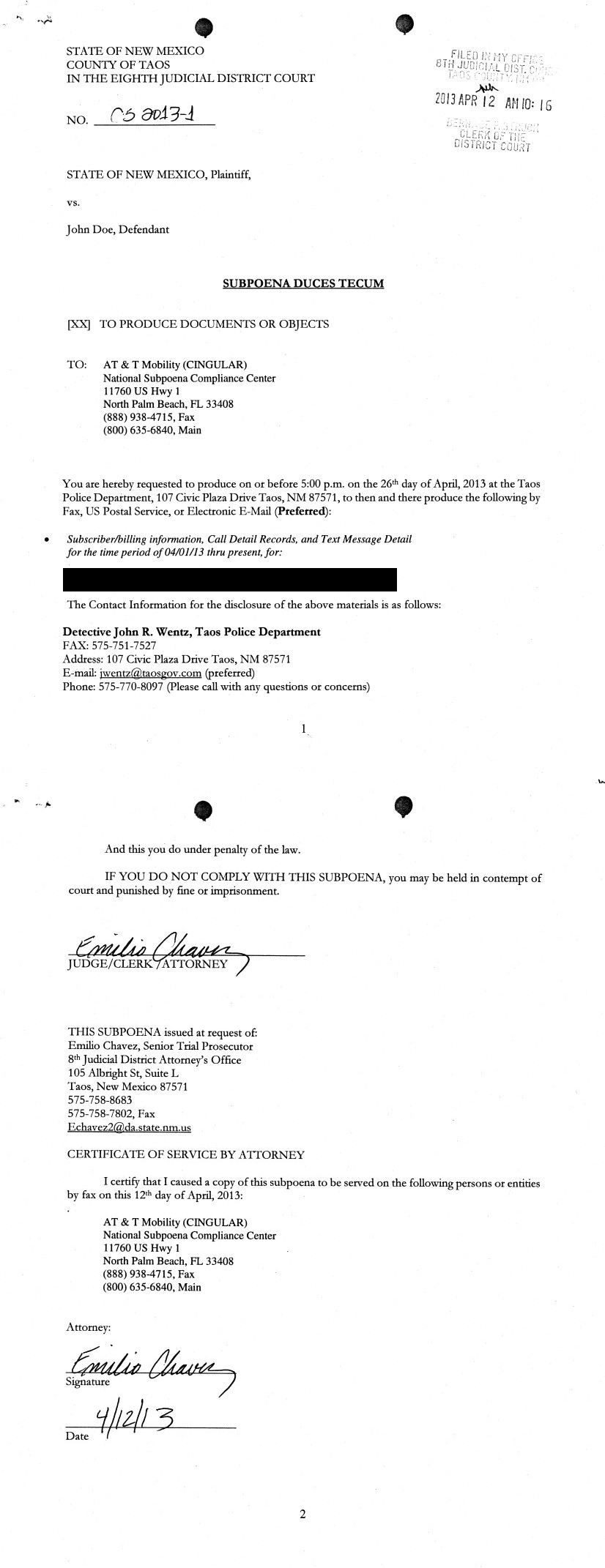
The case at hand involves the office of the District Attorney for the Eight District of New Mexico, which covers three counties in Northern New Mexico, including Taos. D.A. Donald Gallegos and one of his subordinates are facing disciplinary charges after they were caught issuing at least 91 bogus subpoenas to eight telephone companies for customer call records. 

The subpoenas came to light during the prosecution of a 2013 armed robbery at an electric cooperative. Suspecting it was an inside job, the Taos police department worked with the prosecutor’s office to begin issuing subpoenas to telecoms for records related to dozens of phone records. Several batches of subpoenas were discovered related to other cases.

The problem is the District Attorney had no authority to issue “stand-alone subpoenas” under court rules, state law, or the New Mexico Constitution [PDF, PDF]. Prosecutors are only allowed to subpoena records when they represent a party in a case, (i.e. a grand jury has been convened or a criminal case has been filed) and they cannot use subpoenas during the police investigative process. Instead the prosecutor attached a generic case number—the kind usually reserved for miscellaneous court matters, such as bond forfeitures and oaths of office—not cellphone records requests.

The subpoenas weren’t signed by a judge or authorized by a grand jury. They weren’t even the right form [PDF] for issuing requests for records. As such, the subpoenas did not include the "essential" language alerting the recipient of remedies and protective measures. Rather, the documents threatened contempt of court sanctions for any telephone provider that failed to hand over the records.

Judge John Paternoster threw out the indictment of one of the robbery suspects in April due to “gross prosecutorial misconduct,” issuing the following damning conclusions [PDF]: 

A stand-alone subpoena, in improper form, issued and signed by a prosecutor in aid of police investigation, before a criminal cause is properly commenced, as in the instant facts is simply without precedent, analogy or lawful authority in New Mexico law.

And

The subpoenas in question were issued by the prosecutor without any judicial oversight, and allowed the police to obtain evidence during a criminal investigation without meeting the requirements of Article II 10 of the Constitution of New Mexico.

And

It is objectively unreasonable for the prosecutor to believe that his conduct was lawful.

And

The prosecutor had no reasonable basis in law for issuing the subpoenas and had no reasonable basis in law to present the evidence to the grand jury, and therefore acted in objective bad faith, and tainted the grand jury with evidence.

Judicial smackdowns don’t come much harder than that. The district attorney is appealing, but at the same time the oversight body authorized by the New Mexico Supreme Court to review allegations of attorney misconduct has completed its own investigation. The Disciplinary Board is now pursuing formal professional misconduct charges against the lawyers [PDF, PDF].

That process will play out over the next few months, but in the meantime there’s another piece of the puzzle worth addressing. If the subpoenas were so obviously illegal, why didn’t a single one of the telecommunications company question their legitimacy?

According to the filings, eight telecommunications providers complied with the questionable subpoenas and handed over customer call records. They are:

Verizon AT&T (Cingular)
T-Mobile
CommnetCricket (since acquired by AT&T)Level 3 CommunicationsMetroPCSSprint/Nextel

As we told each of these providers in a letter [PDF], EFF strongly believes that part of a telecommunication company’s cost of doing business in any particular state is to ensure that local law enforcement requests for customer data comply with state law. That is particularly true when state laws, such as New Mexico’s, contain stronger legal protections than those that exist under the Fourth Amendment to the U.S. Constitution or the federal Stored Communications Act.

We are asking the involved companies to take a few concrete actions in response to the bad-subpoena scandal:

First, they should go back and review all subpoenas that the district attorney’s issued, determine if other subpoenas it received were similarly defective and release the actual numbers of subpoenas they processed that may have been illegal.

Second, they should review their own legal process to identify how the company’s legal compliance team assesses the validity of subpoenas under state law. Then they should institute new polices to make sure it doesn’t happen again. 

Finally, they should confirm whether the customers targeted by the subpoenas were informed of the existence of these subpoenas. If not, customers should be informed immediately.

So far, T-Mobile is the only provider to respond to our letter. While Senior Corporate Counsel Patricia Cauldwell indicated that they were unaware of the controversy until we brought it to their attention, she argued that T-Mobile acted in good faith and defended the company’s practice of rejecting requests when they appear to be defective.  

“[W]e would not expect to see a prosecutor in New Mexico use subpoenas like these again in a criminal investigation before convening a grand jury and we expect that the judicial system in New Mexico is well capable of correcting the problem,” Cauldwell wrote [PDF].

We’re not convinced that’s a safe bet. The telecommunications industry is very well aware that the public is becoming more and more skeptical of how these companies interact with intelligence and law enforcement agencies.  But for all the NSA and FBI’s questionable practices, local law enforcement agencies are just as prone to shenanigans.

Phone companies need to not only tell cops to come back with a warrant or subpoena, but come back with one that’s actually legal.

Related Issues: 

Share this: Share on Twitter Share on Facebook Share on Google+ Share on Diaspora  ||  Join EFF
21 Nov 02:42

FISA Judge To Yahoo: If US Citizens Don't Know They're Being Surveilled, There's No Harm

by Tim Cushing
A legal battle between Yahoo and the government over the Protect America Act took place in 2008, but details (forced from the government's Top Secret file folders by FISA Judge Reggie Walton) are only emerging now. A total of 1,500 pages will eventually make their way into the public domain once redactions have been applied. The most recent release is a transcript [pdf link] of oral arguments presented by Yahoo's counsel (Mark Zwillinger) and the US Solicitor General (Gregory Garre).

Zwillinger opens up the arguments by questioning the government's methods of determining who should be placed under surveillance.
Why I show this to you is because I think it's a perfectly fair question for you to ask the Solicitor General of the United States how a name gets on this list. This isn't reviewed by a -- the FISA Court. These names aren't reviewed by the Attorney General of the United States. The difference between surveilling an account and exposing someone's most private communications and not is how a name gets on this list; and all we know about it from page 47 of their brief, is that an intelligence analyst puts it on the list.
From this arbitrary beginning springs a wealth of errors.
[REDACTED] of the accounts we have been given do not exist. They aren't accounts at Yahoo. Whether the government is misinformed, or using stale information, we don't know; But the fact that [REDACTED] accounts do not exist raises a serious possibility that some of those accounts have already been recycled and are used by other Yahoo users, or that the information that the government has is just wrong, and the wrong is being placed under surveillance.
Zwillinger points out that Yahoo is just one provider and yet has (the number is redacted, but is at least 4 digits with a comma) a large number of accounts under surveillance. He then refers to the multiple errors again, stating that when the government screws up, it's very likely that American citizens will be mistakenly placed under surveillance.
The difference between a U.S. person and a non-U.S. person in this context could be a letter or a digit in an email address; and if they have it wrong, the consequences will likely be felt here, because more Yahoo users are from the United States than any other single country.
The judges claim minimization procedures eliminate the problem of inadvertent collections, but Zwillinger points out that the surveillance carried out under the Protect America Act actually doesn't contain protections against use of wrongly swept up US persons' communications and data.

The government's response begins by denying that US persons' data is retained. "There is no database," says Gregory Garre, before having to admit a few sentences later, that incidental data is retained (and distributed) if there is evidence of other, non-national-security-related criminal activity.

Garre then goes on to explain why the government feels it should have warrantless access to US persons' communications, routed through and stored at US servers. He refers to satellite communications -- something in use when FISA was enacted in 1978. Garre says that even though these communications may have been captured by domestic satellite receivers, it's the point of origin that matters. Outside the US? No warrant needed, even for US persons. Likewise for emails stored on Yahoo servers.
MR. GARRE: I don't think anybody would argue that the Fourth Amendment would apply to that communication, even though the email communications go to account in Sunnyvale, California. I haven't understood Yahoo to argue that the Fourth Amendment would be implicated by that.

And, similarly, the Fourth Amendment isn't --

JUSTICE SELYA: You mean the interception there by you and Yahoo would not implicate the Fourth Amendment?

MR. GARRE: That Certainly would be the government's view.
Garre also blames the large number of dead accounts in the court orders on Yahoo's refusal to immediately comply, while simultaneously spinning it as the unavoidable collateral damage of "efficient" surveillance.
So the fact that accounts have been closed is not significant, and that's particularly true given that the large number of email accounts here is reflected by the fact that Yahoo is in noncompliance for several months. So, if you go back several months, it's not surprising that several accounts have been closed.
Garre asserts that if anyone deserves the benefit of a doubt in this situation, it's the US government. He states that the Executive Branch and the intelligence community have a long-standing history of not violating the rights of US citizens -- a statement that wasn't even mostly true prior to the 9/11 attacks, and is almost laughable in the wake of what's been uncovered since then. He also points to Congressional oversight and suggests its legislative powers would have been used to rein in the NSA and others if it had actually seen signs of abuse.

In his rebuttal, Zwillinger punches holes in Garre's narrative.
You know, the Solicitor General talks about Congress spoke here, but to the extent Congress has spoken, then they turn around and admit they misspoke. And now they have a Senate report that says we failed to provide adequate protections for U.S. persons, and we are going to pass new legislation. They intentionally let the Protect America Act lapse. So to the extent congressional oversight even exists after February 16, 2008, which I'm not sure it does, it provides no check. Congress can't do anything differently. The statute has passed. The directives continue all the way until the expiration date, but the statute doesn't exist any more. It's not Congress's current view of how surveillance should he conducted.
But the most surprising assertions made in these oral arguments don't come from the Solicitor General. They come from Judge Morris S. Arnold, who shows something nearing disdain for the privacy of the American public and their Fourth Amendment rights.

In the first few pages of the oral arguments, while discussing whether or not secret surveillance actually harms US citizens (or the companies forced to comply with government orders), Arnold pulls a complete Mike Rogers:
If this order is enforced and it's secret, how can you be hurt? The people don't know that -- that they're being monitored in some way. How can you be harmed by it? I mean, what's --what's the -- what's your -- what's the damage to your consumer?
By the same logic, all sorts of secret surveillance would be OK -- like watching your neighbor's wife undress through the window, or placing a hidden camera in the restroom -- as long as the surveilled party is never made aware of it. If you don't know it's happening, then there's nothing wrong with it. Right? [h/t to Alex Stamos]

In the next astounding quote, Arnold makes the case that the Fourth Amendment doesn't stipulate the use of warrants for searches because it's not written right up on top in bold caps… or something.
The whole thrust of the development of Fourth Amendment law has sort of emphasized the watchdog function of the judiciary. If you just look at the Fourth Amendment, there's nothing in there that really says that a warrant is usually required. It doesn't say that at all, and the warrant clause is at the bottom end of the Fourth Amendment, and -- but that's the way -- that's the way it has been interpreted.
What's standing between US citizens and unconstitutional acts by their government is a very thin wall indeed.

Permalink | Comments | Email This Story


21 Nov 02:32

New House Intelligence Boss Doesn't See The Need For Any Surveillance Reform

by Mike Masnick
Brindle

ugh.

Mario Trujillo, over at The Hill, has highlighted how the incoming House Intelligence Committee boss, Devin Nunes, doesn't believe any surveillance reform is necessary, based largely on an opinion piece he wrote back in July entitled "don't shackle the NSA now."

The article is the typical FUD from surveillance state supporters, talking about terror threats and ISIS up front to keep you scared, followed by insults directed at Ed Snowden, and finishing off with a "we need this information to keep us safe" conclusion. Straight out of the classic surveillance state apologists' handbook. The attack on whistleblowing by Snowden is particularly ridiculous:
But for the last year, various groups have sought to curtail our intelligence activities based on selectively presented, maliciously leaked documents about anti-terror programs that are widely misunderstood and whose effects have been wildly exaggerated.

These programs, which are subject to multiple levels of oversight by all three branches of government, have been crucial in stopping dozens of terror attacks, including plots against the New York Stock Exchange and the New York City subway system.
First of all, the groups have actually been looking to protect Americans' Constitutional rights and freedoms. And, the job of the head of the Intelligence Committee is supposed to be to protect those rights -- not to defend the NSA. But Nunes appears to see himself in the mode of his predecessor, Mike Rogers, who always viewed his key job as defending the NSA, rather than overseeing it. Second, the "oversight" claims have all been shown to be exaggerated in the past -- and all three branches of government have also presented evidence of both widespread abuse and that these programs were illegal and/or unconstitutional.

Finally, the programs have not been shown to be crucial in stopping terror attacks, and each of the claims made saying that have been largely debunked -- including the bomb plots Nunes names (which were debunked within days of first being claimed).

Shouldn't we be concerned that the guy in charge of "oversight" of the NSA is spreading debunked arguments in favor of the NSA spying and unconstitutional privacy violations? Shouldn't that disqualify him from the job?

Permalink | Comments | Email This Story


21 Nov 02:27

Small Change To National Archivist's Powers May Keep Government Agencies From Destroying Embarrassing Documents

by Tim Cushing
Brindle

" necessitated the actions of the SSCI staff in exfiltrating a copy from the CIA to a Senate vault" ... why isn't the leadership at these agencies being dismantled again?

There may be some better news on the way for those of us who like free-as-in-FOIA information and an accountable government. Professor and attorney Douglas Cox points out that an amendment to the statutes governing the National Archive may give that agency the power to keep records of public interest from being deleted, destroyed or otherwise hidden.

Having passed every step but presidential approval, H.R. 1233 (Presidential and Federal Records Act Amendments of 2014) [pdf link], makes the following small, but important, change to the Archivist's powers and duties. Here's the portion Cox highlights at Document Exploitation:

DETERMINATION OF DEFINITION.—The Archivist’s determination whether recorded information, regardless of whether it exists in physical, digital, or electronic form, is a record as defined in subsection (a) shall be binding on all Federal agencies.
As Cox explains, this single paragraph allows the Archivist to determine what is or isn't a record -- something that must be retained -- and makes it binding across all federal agencies. If that passes, government agencies will no longer be able to exploit the law to bury embarrassing or incriminating documents.
[T]his authority allows the Archivist to close up - or at least tighten up considerably - the horrible loophole in the law that has been manipulated in a long line of cases of government document destruction or alienation.
Cox goes on to note that this isn't a theoretical harm. It's something that has happened time and time again over the past several years.
[F]rom the State Department's indefensible decision to allow Henry Kissinger to remove (and treat as his personal property) the transcripts of his official telephone calls as the Secretary of State all the way up to the CIA's destruction of the interrogation tapes. This is the same loophole that could legitimately endanger the long-term survival of the CIA's "Panetta Review" and necessitated the actions of the SSCI staff in exfiltrating a copy from the CIA to a Senate vault (as I described at length here - it is not a conspiracy theory), which is further complicated now by fears that new leadership at the SSCI will return the Panetta Review to the exclusive custody of the CIA.
The loophole isn't in the "record" language. That's still very broadly defined and (unfortunately) rather malleable. The loophole is which records are "appropriate for preservation," something that has been left up to each agency to determine. And "determine" they did, right up to the point that DC circuit court judges pointed out that government agencies have a "built-in incentive" to destroy records related to "mistakes."

Cox notes that while this amendment is promising, it doesn't fix everything -- especially some records-related circular reasoning that has made its way into the definition of "records" with the assistance of the National Archives and Records Association itself. But it is a step forward.
To be clear, the Archivist neither has the funding, nor the personnel, nor the appetite to look over the shoulder of every federal employee to micromanage whether each email is, or is not, a record, but this bill, once signed by the President, will give the Archivist an important power that should not be left to rot on the vine.
Cox recommends the first action it should take with its new powers (should the President sign it into law) is ensure the Panetta Review is designated a permanent federal record to keep the CIA from performing any extra "editing."

Permalink | Comments | Email This Story


20 Nov 22:15

Former Top NSA Exec Claims He Challenged The Bulk Phone Records Program... And Was Rebuffed

by Mike Masnick
The AP has a big story out claiming that, back in 2009, a "now-retired" but "senior NSA official" found out about the Section 215 program collecting bulk phone records from the telcos and argued that it went too far and should be stopped:
Years before Edward Snowden sparked a public outcry with the disclosure that the National Security Agency had been secretly collecting American telephone records, some NSA executives voiced strong objections to the program, current and former intelligence officials say. The program exceeded the agency's mandate to focus on foreign spying and would do little to stop terror plots, the executives argued.

The 2009 dissent, led by a senior NSA official and embraced by others at the agency, prompted the Obama administration to consider, but ultimately abandon, a plan to stop gathering the records.
The "former official" apparently found the whole program to be problematic and correctly predicted that if it ever became public it would be a problem:
The former official, who spoke only on condition of anonymity because he didn't have permission to discuss a classified matter, said he knows of no evidence the program was used for anything other than its stated purpose — to hunt for terrorism plots in the U.S. But he said he and others made the case that the collection of American records in bulk crossed a line that he and his colleagues had been taught was sacrosanct.

He said he also warned of a scandal if it should be disclosed that the NSA was storing records of private calls by Americans — to psychiatrists, lovers and suicide hotlines, among other contacts.
The article notes that these concerns did lead the Justice Department, Congress and the White House to take a closer look at the program -- and then choose to keep it going. This contradicts the narrative that some have suggested that the White House didn't fully understand the program in the past because it was preoccupied with other issues. Now it seems clear that not only were officials well aware of the program, they chose not to rein in the program when they had the chance.

The article further notes that this official and others within the NSA who were concerned with the program had offered up some suggested changes, not unlike what was actually in the USA Freedom Act that was just rejected. Perhaps more interesting, the article concludes by pointing out that if this change had been put in place, there's a decent chance that Ed Snowden never would have revealed everything else -- because this was the main program that so concerned Snowden, and which has been the centerpiece of most of the discussions since the Snowden revelations.

Permalink | Comments | Email This Story


20 Nov 21:54

Yet Another Study Shows US Satire Programs Do A Better Job Informing Viewers Than Actual News Outlets

by Karl Bode
By now it's sadly clear that the nation's satirical news programs do a significantly better job at reporting the news than most of the nation's actual news outlets, despite a fraction of the budget and experience. John Oliver's recent analysis of Miss America scholarship claims, for example, contained more original reporting in a fifteen minute segment than most Apple regurgitation blogs manage to stumble through in an entire year's worth of gadget lust. Not only are satirists now doing a better job unearthing the truth, they're doing a better job explaining complex issues. Case in point: a study earlier this year out of the University of Pennsylvania suggested that Stephen Colbert explained campaign financing more effectively than most beat reporters. Of course a 2012 Pew study suggested many cable news viewers were less informed than those who watched no news at all, suggesting it's not too difficult to beat many modern news outlets at their own game when the standards bar is set ankle height.

Satire's continued rise as one of the country's most effective and influential original reporting platforms was again on display courtesy of John Oliver's fantastic net neutrality rant, which not only explained the issue in effective detail, it captured the attention of the dingo-staffed FCC itself (as these recent FOIA-obtained internal FCC memos indicate). It also helped spur the lion's share of the four million net neutrality comments filed with the agency, blurring the line between not only satire and journalism, but consumer advocacy and activism.

This month a new study (pdf) out of the University of Delaware once again highlights how viewers of satirical programs are significantly better informed on the subject of net neutrality than those who watch traditional news programs:
"The survey also reveals that viewers of satirical shows such as John Oliver's Last Week Tonight and The Colbert Report are far more aware of the issue than consumers of traditional news sources...Opposition to the creation of "fast lanes" is strongest (86%) among those who say they have heard a lot about the proposed rules, but most Americans say they have heard little or nothing about the topic. The University of Delaware research found that only 10% of Americans have heard a lot about how "the U.S. government is considering new rules for ISPs." Another 39% have heard a little, whereas fully half (50%) have heard nothing at all about the topic."
Of course a big reason major news outlets aren't adequately informing their viewership on net neutrality is because they're simply not mentioning it. A Pew study from earlier this year studied net neutrality coverage among twenty-three major newspapers and cable news networks, and found most simply didn't discuss the issue this year. That trend continued this month when the President's clear support of Title II rules barely made a dent on major networks like Fox News and CNN, and when it did -- often saw either misleading and inaccurate analysis, or an over-emphasis on inane aspects of the discussion (like what Donald Trump has to say about the issue).

Traditionally, folks like Jon Stewart have denied that satire can be journalism, largely because while clinical presentation of facts easily offends the nation's roaming partisan-cheerleader zombie hordes, a humorous presentation of those same facts magically defuses, creating a narrow-minded stupidity firewall through which truth can function (or as my less verbose grandmother used to say, honey makes the medicine go down). In a New York Times article posted over the weekend, Oliver follows Stewart's lead, stating that what his show is doing is not journalism:
"So, I asked Mr. Oliver: Is he engaging in a kind of new journalism? He muttered an oath, the kind he can say on HBO for comic emphasis, but we don’t say here, adding, "No!" "We are making jokes about the news and sometimes we need to research things deeply to understand them, but it’s always in service of a joke. If you make jokes about animals, that does not make you a zoologist."
While Oliver's presentation of the facts utilizes satire and humor, Oliver's staff has had previous stints at New York Times Magazine and ProPublica, and what they're doing is absolutely and undeniably investigative journalism. Unless of course you're an iron-headed, old guard news industry employee who still believes only Walter Cronkite's talking head has been mystically ordained with the authority to inform the lowly plebeians.

In the end though who really cares if you call this flavor of reporting "journalism," "investigative comedy," or "donkey walnuts." The sole purpose of journalism is to accurately inform and deliver the truth. That's something that has been increasingly lost with the rise of tepid, he said, she said news reporting that sacrifices truth for the bland, unoffensive illusion of balance -- in the process helping to make stupidity fashionable and facts negotiable. It really doesn't matter if it's satirists, comedians, or male strippers stepping up and trying to fix the broken news industry -- just as long as somebody, somewhere is trying to.

Permalink | Comments | Email This Story


20 Nov 18:07

Tennessee Drug Interdiction Officers Stomp All Over Traveling Couples' Rights En Route To Seizing Nothing At All

by Tim Cushing
Brindle

don't drive through Tennessee :\

More asset forfeiture to report on, albeit of the rarely-reported "attempted robbery forfeiture" variety. (via Overlawyered)

A couple (Lisa and Ronnie Hankins) traveling through Tennessee on their way home (to California) from a funeral was stopped by Tennessee drug interdiction agents as they traveled west on I-40 out of Nashville. What followed was a long fishing expedition, during which officers separated husband and wife in hopes of getting permission to search their vehicle without a warrant.
"You say there's not anything illegal in it. Do you mind if I search it today to make sure?" the officer asked.

Lisa responded, "I'd have to talk to my husband."

[...]

The agent continued, "I am asking you for permission to search your vehicle today -- and you are well within your rights to say no and you can say yes. It's totally up to you as to whether you want to show cooperation or not."

[...]

"You have to either give me a yes or no," he continued. "I do need an answer so I can figure out whether I need a dog to go around it or not."
Because the agent was unable to obtain consent from the couple, he decided to ask a dog. A drug-sniffing dog was brought in to examine the vehicle and, go figure, it alerted near the driver's side window (after ignoring the open passenger's side window). Finally having obtained "permission" for a warrantless search, the two agents went to work. An hour later -- and having disassembled the dashboard of the couple's new car -- they were unable to recover anything incriminating. But hey, no one's rights were violated because the drug dog told officers the car contained drugs, even though it didn't.

It also didn't contain any cash, which one agent told the Ronnie Hankins was far more likely to be hidden somewhere in the vehicle.
[W]hen Ronnie insisted there were no drugs, the agent confided he wasn't really expecting any.

"Well, I'll be honest with you, with you going this direction, I wouldn't think you'd have drugs in the car -- you would have a large amount of money," he said.
Apparently, drug interdiction agents are far less interested in stopping the flow of drugs than they are in intercepting outgoing cash. Otherwise, as Nashville's News 5 (which has been investigating the state's out-of-control asset forfeiture program for years) points out, it wouldn't be performing a majority of its stops on roads leading out of the state.
While drugs generally come from Mexico on the eastbound side of Interstate 40 and the drug money goes back on the westbound side, the investigation discovered police making 10 times as many stops on the so-called "money side."
The frustrated officers finally let the Hankins go, but not before making a last-ditch effort to redeem their futile efforts. The police report claims the interdiction agents found "marijuana debris" or "shake" on the floorboards of the vehicle. The Hankins claim the only thing on the floorboards was grass from the cemetery where Ronnie Hankins' grandfather was buried. Whether it was "grass" or grass, neither of the Hankins were charged or cited.

Tennessee's asset forfeiture laws are far worse than those in many states. 100% of the proceeds of any seizures go to the department that performed it. Legislative attempts to overhaul these laws have been mostly fruitless. A bill introduced in early 2013 aimed to eliminate this abuse by making seizures contingent on convictions. By the time the House and Senate had amended the bill, the only net gain was the prohibition of ex parte hearings. If Tennesee interdiction officers seize your money or other property, they now (the law went into effect at the beginning of this year) have to give you a date when you can show up and defend "forfeited" property from the accusations of law enforcement -- something of limited utility considering these officers tend to prey on drivers with out-of-state plates. Depending on what has been seized, it may be cheaper to allow the state to claim its ill-gotten goods rather than spending even more money to participate in a largely ceremonial process that often results in the state paying out only pennies on the dollar.

Permalink | Comments | Email This Story


20 Nov 17:17

Hello from a Human

Send handwritten notes in seconds.

By writing a handwritten note.

"Writing helps people engage with each other in many different ways."

Learn more about writing

What is Hello from a Human?

Hello from a Human is a personal messaging service. Starting on December 1st 2014 I will personally write a note for you and put it in the mail.

How do I access the service?

You simply email me what you want me to write and I will write it on a piece of paper. Then I will mail it where you want me to send it.

Who is behind this?

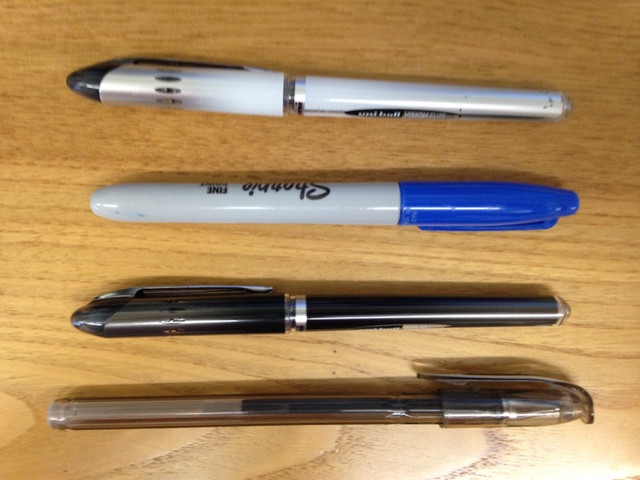
Here is a picture of me, the person who will write your note:

I don't look very attractive in it. I took it with my phone camera. But it shows that I am a human and not a robot. I didn't have time to embed a movie of me writing but you can imagine that part.

How does this technology scale?

It doesn't scale at all. I can probably do about one of these a day, at best. I'm pretty busy at work during the day, and the moment I get home it's dinner time and then bath and bedtime for the girls and by the time all that's done there isn't a lot of time left over before I need to go to bed myself. I mean, the 11-month-old sleeps really well but she still gets up at 6:30 so you know how that goes.

That's all to say that I'll do one of these each day, for the month of December. I probably will skip a few days, like Christmas.

How do I sign up for one of the days?

Email me with your proposed note and I'll fill the slots in roughly the order they are received. However I reserve the right to pick the interesting ones instead of the boring ones, and filter for length.

How long can each note be?

Well, you know, I can be flexible. We don't have to set a strict character count or something. If it's too long I probably can't do it, so think about how long it might take me to write out by hand, and aim for something I can manage. That said, there are no hard rules here.

How can there be no hard rules?

Friend, that's the joy of being human.

Do you have beautiful handwriting?

Not particularly. I mean, it's totally legible but I'm not going to claim it's beautiful. I like to think it has a certain charm. It's not chicken scratches or something.

How long does it take?

I will try to do one note a day, and put it in the mail the next day. So each one will probably take three, or four, or even five days from the time I start to the time your recipient receives the note.

When will you start mine?

I'll let you know when I mail it.

But when will you start it?

Dunno. One of the days in December.

Can I pick a day to make sure it gets to my recipient in time for a religious event or other important date?

You can certainly tell me about your preferences! I can't promise anything but I'll see what I can do.

How much does this cost?

Nothing!

Really?

Yes!

Not even, like, the cost of postage?

Nope!

Why aren't you charging a fee for this service? How will you make money?

Eyeballs!

I think you might be teasing me.

Is it okay if this is not about making any money?

I mean, I guess.

Cool, I appreciate that. I'll be honest, for a minute or two I was thinking about whether I should charge $10 ("personal, artisanal service!") or $1 or something, I mean I am an entrepreneur, I like making money! But then I got tired thinking about setting up some stupid payment form for all that, or PayPal link, or whatever. I would really like to do this just as a fun, silly little project, and I'll spend a little money on it and it's not going to be a huge deal. If you send me the words you want to share with another person, it will make me happy to write them down on a piece of paper and put them in the mail for the other person to read.

What kind of paper stock will you use?

Jesus, you're full of questions today. I don't really know. Look, to be totally honest I'll probably use whatever is handy at the time. Like, my company stationery, or a piece of printer paper, or some scrap paper from the recycling bin. I won't put a ton of effort into getting really nice paper, that's not really the point. If you want me to make this difficult by getting fancy paper it's probably not going to happen. But if we just make this about taking a moment where one person spends a little time to think about, and write to, another person, that's not so hard.

But... Really?

Yes, really. I will use a nice pen, though. It's so unpleasant to write with crappy pens.

Here are some pens I might use:

So you're clearly joking about all of this.

I am dead serious.

But, I mean, this obviously is completely ridiculous.

Is it?

Yes.

I disagree.

This isn't a product, this is a farce! Unreliable service? Bad handwriting? Junky paper? No guarantees you'll even mail my note? Give me one reason I shouldn't just use Bond?

Because, friend: I'm a goddamn human.

...

All I'm saying is: You'd pay for a robot to give your writing a personal touch? And you're calling my service a farce?

So you're really serious about doing this.

Dead serious.

Assuming I decide I'm interested, how do I sign up?

Glad you asked! It's easy: Email me at hello@hellofromahuman.com

And you write it, and send it, and that's it?

Pretty much. If you give me permission I'll probably share an anonymized photo of what I wrote on this site somewhere, or at my Twitter account.

What if my note isn't accepted for one of the days you're doing this?

Your chances are good. Probably like ten people will ever see this page.

But what if it shows up on reddit or something?

It won't.

Okay but just assume, what if you get a lot of submissions?

Well, that's easy, we have a backup service.

A backup service?

Yup!

How does it work?

In the case that I can't write your note and mail it for you, you can do it yourself.

And that part of the service, my friend, scales beautifully.

18 Nov 14:36

Ted Cruz Doubles Down On Misunderstanding The Internet & Net Neutrality, As Republican Engineers Call Him Out For Ignorance

by Mike Masnick
Last week, we mentioned Senator Ted Cruz's nutty tweet comparing net neutrality to "Obamacare." It was widely mocked -- even by many Republicans -- as it showed Cruz's ignorance of the subject at hand. In fact, one report detailed a number of comments on Ted Cruz's Facebook page from Republican/conservative engineers disagreeing with Cruz and pointing out that he's uninformed about net neutrality. Here's a sampling:


There's a lot more like that, but it highlights what we've seen before -- that while Congress likes to pretend that Republicans are against net neutrality while Democrats are for it, the reality is that net neutrality is a non-partisan issue with voters of both parties overwhelmingly supporting net neutrality.

Rather than recognize this fact, Cruz has decided to double down on it with a rambling and misguided opinion piece in the Washington Post that repeats the "Obamacare for the internet" line, and lumps in a variety of other tech issues in a confusing (and often self-contradictory) jumble. He warns against taxing internet access (good), but then joins in the total overreaction to the Commerce Department's decision to officially relinquish its (barely existent) control over ICANN, falsely claiming that this will allow the Russians, Chinese and the Iranians to control the internet. This is not true. In fact, by giving up the Commerce Department's link to ICANN, it helps cut off the path the Russians, Chinese and Iranians are trying to use to do an end run around ICANN, by giving more power to the ITU. In other words, Senator Cruz (once again) seems to not understand this policy issue at all, and is recommending a policy that is more likely to lead to the world he fears.

Then he gets back around to net neutrality, once again showing he doesn't understand it:
In short, net neutrality is Obamacare for the Internet. It would put the government in charge of determining Internet pricing, terms of service and what types of products and services can be delivered, leading to fewer choices, fewer opportunities and higher prices.
Not a single part of that is accurate. Under the proposed plan, the government would not be in charge of determining any of those. Rather, it would make it so that no one (including the internet access providers) could block what types of products and services can be delivered. It takes a special kind of wrongness to look at a plan that is focused on making sure that no one can be blocked and argue that it means the government gets to pick what services can be delivered.

Even more bizarre, Cruz's final point is to celebrate the victory over SOPA and PIPA as a great example of protecting free speech online, ignoring the fact that it's the very same people who made the victory possible who are now fighting for net neutrality.
In 2012, those who care about Internet freedom were shocked as bills such as the Stop Online Piracy and Protect IP acts, which would regulate speech on the Internet under the guise of protecting property rights, started gaining popularity in Washington. Thankfully, online activists were quick to mobilize to protect their free-speech rights. But we must remain vigilant. Intellectual property must be defended, but any threat to quell speech on the Internet must be treated seriously and subsequently defeated.
Yes, and it's the very same online activists now trying to "protect free speech rights" by making sure that the internet stays open via net neutrality rules. And, yes, it is a free speech issue, because letting internet access providers block or discriminate against certain companies, individuals, services or types of content (such as encrypted content) will stifle free speech.

So, Cruz claims to support online activists and their push to guarantee free speech online... but at the same time opposes those very same activists and their push to protect free speech online by calling it "Obamacare for the internet"? I don't know who Ted Cruz's tech staffers are, but they might want to educate themselves a bit -- and not from the lobbyists at AT&T and Verizon.

Permalink | Comments | Email This Story


18 Nov 03:09

Feds Indict Another Person For Teaching People How To Beat Polygraph Tests

by Tim Cushing
Brindle

must protect the pseudoscience of polygraphs...

Polygraph technology is far from infallible and has been for so long that it's practically common knowledge. And yet, the federal government still wants everyone to believe polygraphs tests separate the honest from the liars with incredibly high accuracy. So, it cracks down on those who claim to be able to help others beat the tests.

In 2012, federal agents began investigating Chad Dixon and Doug Williams, two men who sold books, videos and personal instruction sessions on beating polygraph tests. Late last year, Dixon was sentenced to eight months in prison for obstruction and wire fraud charges. The government claimed his actions jeopardized national security, pointing to a client list that included intelligence employees, law enforcement agents and sex offenders.

The government has just handed down an indictment [pdf link] of its second target -- former Oklahoma City police polygraph administrator Doug Williams.
The 69-year-old Norman, Oklahoma, man is the owner of Polygraph.com and charged customers thousands of dollars for instructions on how to beat lie detector tests administered for federal employment suitability assessments, federal security background investigations, and internal federal agency investigations, court documents show.
The government wants to see Williams locked up for fraud, claiming his polygraph-beating business allowed unqualified applicants to "obtain and maintain positions of Federal employment" and the "salary attendant to such positions."

The 23-page indictments details the fed's sting operation, which utilized two undercover agents posing as potential government employees with shady pasts. In both cases, the agents made Williams aware of past wrongdoing (over his initial objections) that should disqualify them from positions in the DHS or Border Patrol. Williams, unfortunately, decided to follow through with personally training both agents, despite his initial hesitance to knowingly assist admitted criminals with obtaining government jobs.
The indictment said that, during a telephone call with an undercover federal agent, Williams said, "I haven't lived this long and fucked the government this long, and done such a controversial thing that I do for this long, and got away with it without any trouble whatsoever, by being a dumb ass."
Well, if the indictment is legit, Williams made some dumbass moves. The unanswered question, though, is if providing instructions on how to beat polygraph tests is illegal or protected speech. The judge handling the conviction of Chad Dixon had a hard time finding a "bright line" between the two.
O’Grady acknowledged “the gray areas” between the constitutional right to discuss the techniques and the crime of teaching someone to lie while undergoing a government polygraph. “There’s nothing unlawful about maybe 95 percent of the business he conducted,” the judge said.
Despite this, Judge O'Grady still gave the government what it wanted: a prison sentence to "deter" activities that were "95 percent" free speech. Obviously, the government is hoping for the same outcome here.

The real weakness here is the government's reliance on polygraph testing, but no one's interested in addressing that. The government farms out employee vetting to private contractors who can't be bothered to do the job properly. Negative results are ignored by government agencies when they stand in the way of hiring the people they want to hire.

A system that can be successfully gamed shouldn't be afforded as much deference (bordering on reverence) as the government gives to polygraph testing. It's a method that's just as likely to reject legitimate candidates as it is to be duped by criminals. Prosecuting those who show others how the test can be beaten is nothing more than punishing the symptom because it's so much easier than dealing with the disease.

Permalink | Comments | Email This Story


18 Nov 02:56

GOP set up Twitter "numbers stations" to get around Super PAC rules

by Cory Doctorow

Super PACs are allowed to raise unlimited funds to support election campaigns, but can't coordinate with those campaigns; this especially means that campaigns can't share expensive private poll data with PACs to help fine tune their campaigns -- which is exactly what Republicans did with their cryptic, unlabelled Twitter accounts that acted as dead-drops with messages like "CA-40/43-44/49-44/44-50/36-44/49-10/16/14-52-->49/476-10s" to let affiliated PACs know what the polls had shown. Read the rest

17 Nov 18:07

U.S. Gov Insists It Doesn’t Stockpile Zero-Day Exploits to Hack Enemies

by Kim Zetter
U.S. Gov Insists It Doesn’t Stockpile Zero-Day Exploits to Hack Enemies

For years the government has refused to talk about or even acknowledge its secret use of zero-day exploits to hack into the computers of adversaries and criminal suspects. But this year the Obama administration finally acknowledged what everyone already knew, that the National Security Agency and law enforcement agencies keep information about software vulnerabilities secret so they can be exploited for purposes of surveillance and sabotage. But in a new interview, Michael Daniel, special adviser to the president as the National Security Council cybersecurity coordinator, denies to WIRED that the government stockpiles zero days and says that a program for disclosing zero-day vulnerabilities by default, aside from special-use cases, has been in place since 2010.

The post U.S. Gov Insists It Doesn’t Stockpile Zero-Day Exploits to Hack Enemies appeared first on WIRED.


15 Nov 13:49

Sexual Relationship With A Minor, Theft Of Services And Destruction Of Evidence Nets Police Officer One-Year Prison Sentence

by Tim Cushing
There are multiple levels of effed-upness in this story but we'll start from the top.

Cincinnati police officer Darrell Beavers appears to have used his power and position to effect and perpetuate a sexual relationship with a minor. This went far beyond simply relying on the innate "trustworthiness" of the position.
Beavers, a Cincinnati police officer since 2002, set up a scheme, using his job as a police officer as bait, to send and receive 650 sexually explicit photos and texts with a minor and destroying an incriminating [police] cell phone once he knew he was being investigated.
Add to this the use of his position to coerce a local landlord into handing him over an apartment to use for his sexual trysts -- free of charge -- by claiming he was setting up a department "substation" to "fight crime in the area."
Once Beavers, 45, had the apartment, it was adorned with an official Cincinnati Police logo as well as beds, bedding, personal lubricants, pornographic videos and a police-owned night-vision camera to record events that were happening in the dark.
Beavers is now an ex-officer and has been sentenced to prison. Thanks to a friendly plea deal and a recent law change, he will be facing a maximum of one year behind bars. That seems awfully low considering Beavers committed a sexual offense, destroyed evidence and falsely procured an apartment to be used solely to commit illegal acts with a minor.

But that's not the only thing screwed up about this. Cue Beavers' attorney, Carl Lewis:
Beavers' attorney, Carl Lewis, believed the incident was a one-time "lapse of judgment" of an otherwise upstanding, respected police officer, husband, father of three and football and basketball coach.

"He said if this same activity had occurred with his daughter with another police officer, he would be angry, he would be upset," Lewis said of Beavers.
No. A "one-time lapse of judgment" is having sex with an underage person by accident (or possibly on purpose) ONE TIME, and then NEVER DOING IT AGAIN. It is not stealing an apartment to use as a sex pad, sending and receiving 650 texts/photos over a period of three months, and then destroying evidence when investigators start closing in.

All the follow-up comment about Beavers being "upset" means is that his moral compass is as flexible as anybody's. Double standards are distressingly common. They are not, however, indicators of latent "goodness."

On to the next level of effed-upness.
A theft in office charge that would have resulted in Beavers losing any police pension was dropped as part of the plea deal.
Beavers will do some time, most likely return to his current employer (an oil pipeline) and his $70,000 salary, and still draw a pension when he hits retirement age.

Even more layers:
Beavers also fears the humiliation of being labeled a sexual predator, having to report his address for the next 15 years to the sheriff in the county where he will live.
Well, gee, former Officer Beavers. That sucks. But that's what the system requires of other sex offenders, including the ones that don't have access to favorable plea bargains and a taxpayer-funded pension to fall back on. Don't forget, the list of sexual predators also tends to include teens who had consensual sex [statutory rape] and teens who passed around sexual photos of other teens [sexting] -- teens who begin their trip through the "justice system" accompanied by officers like yourself. So, try to keep that chin up, Darrell.

And there's still more. This wasn't the only so-called "substation" under police officer control.
[Detective] Schofield noted police also found a previous fake substation in West Price Hill and wanted to ask Beavers about it but he refused.

"It was their belief," Lewis said of police investigators, "that there are other Cincinnati police officers (who) have used, were using the so-called substations for other activity other than police work."
So, there will be more indictments in the future?
Cincinnati said they aren't investigating possible involvement by other officers.
Apparently, one officer being (minimally) punished is enough. Everything else can simply be ignored, for morale's sake... or whatever. It wouldn't do to have the Cincinnati PD portrayed by the media as a bunch of amoral jerks strong-arming landlords into providing them with rent-free crash pads from which to pursue their illicit aims.

By all other accounts, Beavers appeared to be an exemplary officer. But he used his position to take advantage of a 17-year-old member of the Cincinnati Police Explorer program. Even if the sexual contact was consensual, it was still illegal. Everything else he did -- destroy evidence, commandeer an apartment -- was far outside any legal or moral gray area. In the end, he'll serve less than a year and enjoy a full pension. Other officers who may have abused their power or simply looked away while Beavers took advantage of his will emerge from this incident unscathed. And if they aren't held accountable, there will be no reason for them to alter future behavior.

Permalink | Comments | Email This Story


14 Nov 18:32

David Cameron Says People Aren't Radicalized By Poverty Or Foreign Policy, But By Free Speech Online, So ISPs Agree To Censor Button

by Mike Masnick
A few years ago, we mocked then Senator Joe Lieberman's request that internet companies put "report this content as terrorist content" buttons on various types of online content. The plan went nowhere, because it's a really bad idea, prone to massive abuse. Yet, over in the UK, some apparently think it's such a grand idea that they're actually moving forward with it. This isn't a huge surprise -- the current UK government has been going on for quite some time about banning "extremist" content, and just recently ramped up such efforts.

And now it appears that a bunch of big UK broadband access providers have agreed to play along:
The UK’s major Internet service providers – BT, Virgin, Sky and Talk Talk – have this week committed to host a public reporting button for terrorist material online, similar to the reporting button which allows the public to report child sexual exploitation.

They have also agreed to ensure that terrorist and extremist material is captured by their filters to prevent children and young people coming across radicalising material.
I love the term "radicalising material" as if it's the material itself that has the power to magically turn mild-mannered Brits into violent jihadis just by appearing on their screens. That's not how it works. Yet some have such an irrational fear of the power of words we disagree with that it must be prevented from anyone ever seeing it.

Also, the comparison to child porn is a common one, but wrong. Images of sexually exploited children are not a judgment call issue, for the most part. It's an obvious thing. "Extremist" material or "terrorist" material, on the other hand, is almost entirely subjective. And, over time, the definition of what counts always seems to expand, rather than contract. And that doesn't even take into account how many people will simply choose to use such buttons to try to censor any sort of content they dislike.

David Cameron seems quite excited about turning an open and free internet into a closed and censored space, where only content he likes is allowed:
Addressing a special sitting of federal parliament, Cameron said: “We must not allow the internet to be an ungoverned space”.
Why? What's wrong with letting people speak their minds? The whole "terrorism!" claim is overplayed:
“In both our countries we have seen some of our young people radicalised, going off to fight in Iraq and Syria, and even appalling plots to murder innocent people back in our own countries.”
Yes, but perhaps you should look at the root causes of why that's happening? But Cameron insists it can't possibly be poverty or UK foreign policy:
“And let us be frank. It’s not poverty, though of course our nations are united in tackling deprivation wherever it exists. It’s not exclusion from the mainstream. Of course we have more to do but we are both successful multicultural democracies where opportunities abound.

“And it’s not foreign policy. I can show you examples all over the world where British aid and British action have saved millions of Muslim lives, from Kosovo to Syria – but that is not exactly the real point. In our democracies, we must never give in to the idea that disagreeing with a foreign policy in any way justifies terrorist outrages.”
Hmm. So disagreeing with foreign policy cannot justify terrorist outrages... but, apparently it can justify blatant censorship. Because, apparently, the only possible reason why people are radicalized is because they read something on the internet. David Cameron insists that's the case:
The root cause was in fact the “extremist narrative”, Cameron said.

This meant “we must ban extremist preachers from our country, we must root out extremism from our schools, universities and prisons”, as well as dealing with the internet.
So he presents no actual evidence, but completely waves off poverty and disagreements over UK foreign policy as being non-factors -- and then automatically assumes that the problem is "extremist" speech online? Incredible.

And the end result is pure censorship. How long until calling it censorship is considered an "extremist" position as well?

Permalink | Comments | Email This Story


14 Nov 14:29

High School Kids Staring Down Child Porn Charges In Sexting Scandal

by Timothy Geigner
Brindle

*sigh*

Even as we recently discussed yet another case of law enforcement getting involved in cases of teens sexting, a behavior that is likely more common than we prudish adults can even fathom, it seems that a group of teens in the Chicago suburbs just weren't getting the message. This isn't to say, of course, that sexting is a recommended behavior. Still, it's common enough that the existing laws and punishments in place are often more harmful than the behavior they're trying to curtail.

In this recent case, teens in a Gurnee, Illiniois highschool were passing around suggestive photos of a freshman girl. None of the accounts I've read to date have even hinted that this photo was not taken by the freshman girl herself. I say this not to demonize her behavior in any way, nor to recommend it, but only to set the facts up for when we discuss the potential punishments involved. The photo apparently spread as a result of three freshman boys passing it around. This was likely quite traumatizing for the young lady in question. She was likely mocked and/or bullied due to the photo. Those actions warrant severe action by the school and the parents of the children involved. The situation might even serve as an opportunity for the community to learn what might happen should a young person allow these photos to spread.

Instead, Johnny Law came in to clean up the O.K. Corral.

The Gurnee Police Department said three freshman boys at Warren Township High School were arrested and may face charges of distributing child pornography after they allegedly texted an explicit photo of a freshman girl, which ultimately spread throughout the school's O’Plaine campus. School officials said the investigation was handled exclusively by Gurnee Police and could not offer any information on the case because it is “an active investigation involving juveniles.”
So, what might have once been a family and school matter has transformed into a police situation. Three arrests, so far, have been made. The talk is of child pornography charges. Why is this such a big deal?
If the boys are charged and convicted in the incident, authorities say they may need to register as sex offenders. “It can affect you lifelong, it’ll follow you around,” [Cmdr. William] Meyer said.
Here's where we all have to take a big, deep breath and figure out if we're really going to allow our compassion for the young lady in this story cause us to permanently brand 3 young boys for life with the stigma of a sex offender's mark. Don't get me wrong, there can be punishment here. I have no problem with that. But we're way too intelligent a nation to simply throw up our hands and say, "The law's the law," without making even a minor effort to create some kind of subtlety where lessons can be learned without the torching of entire futures. Come on, 'Merica. You can do it.

Permalink | Comments | Email This Story


14 Nov 14:27

Feds Put Fake Cell Towers On Planes, Spied On Tons Of Innocent Americans

by Mike Masnick
The Wall Street Journal broke the news that the DOJ has been spying on tons of innocent Americans by putting fake mobile phone towers on airplanes and scooping up all sorts of data from people who thought they were connecting to regular mobile phone towers.
The U.S. Marshals Service program, which became fully functional around 2007, operates Cessna aircraft from at least five metropolitan-area airports, with a flying range covering most of the U.S. population, according to people familiar with the program.

Planes are equipped with devices—some known as “dirtboxes” to law-enforcement officials because of the initials of the Boeing Co. unit that produces them—which mimic cell towers of large telecommunications firms and trick cellphones into reporting their unique registration information.

The technology in the two-foot-square device enables investigators to scoop data from tens of thousands of cellphones in a single flight, collecting their identifying information and general location, these people said.
We have, of course, reported for a while now on so-called Stingray devices, which mimic mobile phone towers on the ground (and have noted that Stingray is just one brand of a few such devices, known as IMSI catchers), but putting them on special planes and flying them around would allow law enforcement agencies to get a lot more information on a lot more people. Given that law enforcement efforts like this are supposed to be narrowly targeted towards those actually suspected of breaking the law, this seems like a massive 4th Amendment abuse, creating mass surveillance programs for law enforcement with little real oversight or control.

While it may not be entirely surprising that this is happening, it is yet another surveillance program being done with zero public transparency, zero public debate and zero public input. That's a huge concern as we've seen time and time again how such programs get abused.

And, while the WSJ doesn't come out and say it, it certainly sounds like it got this info from a concerned whistleblower inside the US Marshals Service:
Within the Marshals Service, some have questioned the legality of such operations and the internal safeguards, these people said. They say scooping up of large volumes of information, even for a short period, may not be properly understood by judges who approve requests for the government to locate a suspect’s phone.

Some within the agency also question whether people scanning cellphone signals are doing enough to minimize intrusions into the phone system of other citizens, and if there are effective procedures in place to safeguard the handling of that data.
As such programs keep getting disclosed, think of how many such other programs there are that we just don't know about?

Permalink | Comments | Email This Story


14 Nov 14:26

Michigan University Claims Its Public Records Retention Period Is Whatever Each Employee Wants It To Be

by Tim Cushing
Brindle

huh?

Michigan University has come up with a novel approach to "complying" with the state's Freedom of Information Act: the Highly-Subjective Document Retention Schedule.

Here's Michigan University spokesman Rick Fitzgerald responding to the Michigan Daily's inquiries.

“It’s our policy that it’s up to individual users to determine their own document retention. The University doesn’t have a set schedule.”
That's right. Anyone employed by the University can hold onto public records (like internal emails) for whatever time period they deem personally appropriate, whether it's one day… or one year… or "aging off" documents the moment they're requested.

This lack of a set schedule runs contrary to state law.
State law stipulates that public records be kept and disposed of in accordance with a formal schedule, which requires that correspondence be retained for two years after the date of its creation before it can be destroyed.
This retention free-for-all explains why the Michigan Daily hasn't had much success in obtaining documents from the school this year during its attempts to investigate the athletic director's forced resignation and the expulsion of a football player over violations of the school's sexual misconduct policies.

The University's spokesman claims the school is exempt from state law because it's not a state agency. But the law says otherwise.
While the penal code does not explicitly define the University as an “office or agency of the state of Michigan,” the Freedom of Information Act does, stating: “All state agencies, county and other local governments, school boards … and public colleges and universities are covered.”
In fact, as the Michigan Daily points out, the University itself has made the same claim spokesman Rick Fitzgerald is now denying.
The University has argued in court multiple times that it is a state agency, including the 1994 case of Moore v. University of Michigan, regarding the firing of a whistleblower in the school’s information technology department. The case centered on “whether (the University) can be characterized as an arm or alter ego of the state,” according to the case brief. The University prevailed in court on the back of an argument that it is “an extension of the State.”
Inquiries sent to other local colleges show that Michigan University is an anomaly in its refusal to adhere to the state's FOIA law. The school's "do what thou wilt" retention policy may result in it being fined. State law provides for a $500 fine plus compensatory damages for "arbitrary and capricious violations" of the Act, as well as an additional $1,000 fine and/or two-year prison sentence if it can be proven that University employees willfully destroyed records. Unfortunately, for a university of its size and wealth, these fines clearly aren't much of a deterrent.

Permalink | Comments | Email This Story


14 Nov 14:25

Two Dudes Prove How Easy It Is to Hack ATMs for Free Cash

by Kevin Poulsen
Brindle

123456...

Two Dudes Prove How Easy It Is to Hack ATMs for Free Cash

When a small-time Tennessee restaurateur named Khaled Abdel Fattah was running short of cash he went to an ATM. Actually, according to federal prosecutors, he went to a lot of them. Over 18 months, he visited a slew of small kiosk ATMs around Nashville and withdrew a total of more than $400,000 in 20-dollar bills. The only problem: It wasn’t his money.

The post Two Dudes Prove How Easy It Is to Hack ATMs for Free Cash appeared first on WIRED.


12 Nov 20:21

Samsung throws Velocity under the bus in “unconscionable” lawsuit says CEO Randy Copeland

by Rob Jackson

velocity-micro-vs-samsung

We’re all familiar with the Apple vs. Samsung legal battles, but a new rivalry is brewing between industry juggernauts, and it seems some small businesses may get decapitated by the shrapnel. First NVIDIA sued Samsung, then Samsung retaliated with a lawsuit of their own to which NVIDIA boastfully responded. While these two companies spar it seems a small company in Virginia is being used as a pawn in their legal chess match.

Velocity Micro CEO Randy Copeland took to their company’s blog to acknowledge the situation:

“Samsung has decided to drag us in to its legal battle with Nvidia purely for the purpose of claiming that the Federal District Court for Virginia’s Eastern District here in Richmond, also informally known as “the rocket docket” by some, is a reasonable jurisdiction for their litigation. They tactically need Velocity, a Richmond company, to be part of this new suit so they can have a faster time to trial to counter their lawsuits with Nvidia that are pending in those other courts. They are trying to beat Nvidia to the punch on other fronts, but they are all too willing to throw a private company under the proverbial bus for their own strategic reasons. It’s simply wrong, and a shining example of what’s broken in big corporate America.”

Phandroid cannot speak to the validity of these claims; patents are complicated things which is why it will take full legal teams months of diving through hundreds of pages of literature to concoct arguments and defenses. Maybe Velocity Micro is right and it’s just about geographical strategy. Maybe Samsung is right and Velocity has violated patents. That’s for the courts to determine.

What we are sure of, though, is that Samsung’s legal team is much larger than that of Velocity Micro’s (and that may be the understatement of the year). Whereas it’s just another day in court for Samsung, defending against Samsung can and will effect smaller businesses dramatically as Copeland explains:

“precious company resources and energy will be diverted from our core business and wasted to fight one of the world’s largest companies, just so they can play legal games with Nvidia and the court system.”

We sincerely hope that Samsung isn’t systematically using Velocity as a stepping stool to get to NVIDIA, disregarding the dramatic effect it could have on their business, but Velocity’s CEO insists that’s exactly what’s going on:

“Comparatively, we are a small private business, and have absolutely nothing to do with the disputes between these business giants. This is not our fight, and it’s unconscionable that Samsung is willing to completely disregard the effects and financial fallout this legal tactic will have on the undeserving employees of Velocity Micro and our local community.”

We love technology, but with billions of dollars at stake, this is one of the unfortunate realities that rears its ugly head. Once again, Phandroid has absolutely no opinion on who is right or wrong in this particular situation, we’re merely extending the opinion of Velocity CEO Randy Copeland whose complete statement can be read here.

But we know you – our readers – always have an opinion and always have something to say, so enlighten us. Vote in the poll below and head to the comments to explain your opinion on the NVIDIA, Samsung, Qualcomm, Velocity Micro spat and the state of patent lawsuits in tech in general.

Take Our Poll
12 Nov 18:54

Americans Want More Privacy from Companies and Government

by Mark Jaycox

Pew released a report today detailing the extensive privacy concerns of Americans. The report, which surveyed a nationally representative sample, highlighted their skepticism towards both corporate and government data collection, Americans' enthusiasm for privacy, and Americans' need for more privacy protective tools.

The study follows from previous polls showing the majority of Americans are deeply concerned about their online privacy and specifically concerned about the NSA's activities. In the newly released polls, Pew shows that close to eight in ten American adults are concerned about the government’s monitoring of phone calls and Internet communications.

Strong Concerns About Advertisers and Companies

The concerns detailed in the report aren't exclusive to government data collection: users in the survey also fear private companies’ data collection. In general, only 12% of respondents believe that advertisers can be trusted to do what is right. And 80% of social networking site users said that they are at least somewhat concerned about third parties such as advertisers or businesses accessing some of the information they share on those sites without their knowledge.

These results underlie one of the survey's more important results:

Fully 91% of adults 'agree' or 'strongly agree' that consumers have lost control over how personal information is collected and used by companies.

This loss of control is reflected in 64% of survey respondents believing the government must do more to regulate advertisers.

Security Community Must Also Do more

The survey also finds that security and privacy advocates need to provide more education about privacy tools. The study reveals that six in ten adults feel as though they “would like to do more” to protect the privacy of their personal information online. And nearly 70% of mobile Internet users and social media users polled "feel as though they 'would like to do more' to protect the privacy of their personal information online." These numbers are why we develop tools to encrypt your communications and fight back against advertisers.

Pew's Numbers Don't Lie

The Pew study should inform the current debate around the NSA's activities as well as the data collection by data brokers and online advertisers. For now, the Pew study is valuable as it confirms what many privacy advocates already believe, but does so with a clear explanation and valuable statistics.


Share this: Share on Twitter Share on Facebook Share on Google+ Share on Diaspora  ||  Join EFF