Shared posts

26 Jan 18:52

Government Pays Up To Settle With Traveler Who Was Detained By TSA For Trying To Learn Arabic

by Tim Cushing
In 2009, Nick George was arrested in the Philadelphia airport because the TSA seems to equate certain First Amendment activity with terrorism. George, who was flying out to California to start his senior year at Pomona College, was carrying with him two items that caught the screeners' attention: Arabic-language flash cards and a book critical of the US government. It was as ridiculous as it sounds.
After a half-hour delay at the security line, the supervisor showed up, and things turned from annoying to surreal. After looking at the book and flashcards, the supervisor asked me: "Do you know who did 9/11?" Taken totally aback, I answered: "Osama Bin Laden." Then she asked me if I knew what language Osama Bin Laden spoke. "Arabic," I replied. "So do you see why these cards are suspicious?" she finished.
The other "suspicious" item, a book critical of US foreign policy, was written by a former Secretary of Commerce who served under President Reagan -- hardly "The Anarchist's Cookbook." But it isn't the TSA's job to deploy logic or critical thinking. It's here to pretend the skies are safer with it around. Instead, the TSA brought in the Philly police, who cuffed him in the airport for carrying Osama Bin Laden flashcards and subversive literature.

The police left George cuffed for hours and refused to inform him of its reasons for detaining him. The only police officer to respond to George's question ("Why am I being held?") shrugged and flipped his query into a presumption of guilt: "I don't know. What'd you do?" Between the TSA's presumption that Arabic = terrorism and the PD's willingness to continue the ignorant farce, George was stuck in a rights-less limbo. As he points out, there's an ugliness inherent to the government's long-running security theater, one that crosses over to the law enforcement agencies who are asked to detain travelers.
It's that attitude that is so problematic. Even after searching my luggage without probable cause of a crime and finding nothing out of the ordinary, TSA agents and the police felt they had the authority to detain and then arrest me, purely on ignorant assumptions about a language spoken by 295 million people worldwide.
You can't fix stupid. You can't even get it to talk to you.

Fortunately, George now has some closure on the 2009 incident. The government has settled George's lawsuit (filed with the assistance of the ACLU), paying him $25,000 for stripping him of his rights over some foreign language flashcards and a book on US foreign policy. In addition, the settlement [pdf link] includes instructions to be delivered to the Philadelphia Police in hopes of preventing a repeat of this debacle.
The City shall communicate to Philadelphia Police Department officers assigned to the Airport the following:

Investigative detentions may be made only on reasonable suspicion of criminal conduct and any arrest must be based on probable cause. A referral by TSA agents is not grounds for arrest unless an officer makes a judgment of probable cause; similarly, referral by TSA agents is not grounds for detention unless an officer makes a judgment that there is reasonable suspicion of criminal conduct. Any detentions or arrests should be documented on appropriate police paperwork consistent with PPD Directives.
The underlying message is that the US government's airport security force isn't a very good judge of threats or illegal behavior. Rather than just take the TSA's word that a traveler is a potential threat, the police will need to assess the situation on their own and actually come up with something resembling "probable cause" before effecting an arrest.

And, of course, as is the case with nearly every government settlement, the defendants are shelling out tax dollars while taking no responsibility for their actions.
This Stipulation is not, is in no way intended to be, and should not be construed as an admission of liability or fault on the part of the United States, OHS, TSA, DOJ, FBI, the City, or their principals, agents, servants, or employees, including William Rehiel and Edward Richards, Jr., and it is specifically denied that they are liable to Plaintiff.
Oh, but it will be "construed" as an "admission of liability." If these entities had done no wrong, they certainly had the (nearly limitless) means to continue fighting George in court.

Unfortunately, the lawsuit hasn't resulted in any mandated guidance directed at the TSA. In fact, it includes a declaration from Sarah Tauber, a deputy in the TSA's "Threat Assessment Division," that basically states, "Hey, the police don't need to arrest everyone we refer to them. This is all on the Philly PD." Between this declaration and the boilerplate "NO WRONGDOING HERE" paragraph, the government allows itself room to further abuse travelers' rights and hand over other people's money to make it all go away.

Permalink | Comments | Email This Story


26 Jan 15:19

Proposed Changes to 529 Plans Would Dampen Their Appeal

by Kristen Kuchar
Brindle

hrm

State of the Union address 2015

In his State of the Union address Tuesday, President Obama proposed changes to 529 college plans that may force the 7 million families using them to rethink their college financial game plan.

Currently, you can make contributions to a 529 plan, invest those funds, and eventually withdraw the earnings tax-free as long as the money is used for education expenses such as tuition, room and board, or books. That makes it one of the more appealing ways to save for your child’s education. Plus, some states offer income-tax deductions on contributions.

But under the new proposal, investment gains in a 529 college savings plan would be considered ordinary income and subject to capital-gains taxes.

This would eliminate perhaps the most attractive feature of the mostly state-run plans. And as The New York Times points out, it would also impact how much federal financial aid a family would qualify for, because their income would be greater in a year when they withdraw funds from their 529 plan.

Why Eliminate a Popular Tax Break?

The White House says its goal is to simplify the tax code and consolidate education-related tax breaks to help the middle class pay for college. The president estimates that ending the 529 tax break would generate about $2 billion in revenue, and he wants to use that money to expand and make permanent the American Opportunity Tax Credit, according to the Times.

That refundable credit, as discussed in our Tax Guide for College Students, is available to undergraduates during their first four years of college. The maximum annual credit is currently $2,500 toward the cost of tuition, fees, and course materials, and $1,000 of the credit is refundable — meaning even if you have no tax obligation (for example, you only earned a few hundred dollars working part time freshman year), you can receive a $1,000 refund toward education expenses.

Obama’s plan would make the credit available for five years, open it up to part-time students, and increase the refundable portion to $1,500.

Why get rid of one educational tax break to expand another? Some critics argue that 529 plans disproportionately benefit wealthy families.

A reported 70% of 529 accounts are held by families with incomes greater than $200,000. And according to a report by Sallie Mae, 49% of families who plan to send a child to college aren’t even sure what a 529 savings plan is.

However, as Time points out, anyone is able to open a 529 account. In fact, 14 states are offering matching grants for contributions,  aimed at encouraging low-income families to save.

And there are other ways to beef up that 529 account regardless of your income. We’ve covered other programs to help fund your child’s education, such as the Gift of College or LEAF, which allows family members and friends to give a gift directly to your child’s 529 plan. There are also credit cards that pay rewards directly into your college savings account.

What Does This Mean for You?

Good question. First of all, according to the Times, none of this is likely to pass with a Republican-controlled Congress. A spokesman for Rep. Paul Ryan, R-Wis., told The Wall Street Journal, “You don’t produce a healthy economy and an educated workforce by raising taxes on college savings.”

However, even if the plan somehow were to pass, it would not affect any prior contributions or investment gains you have already accumulated in a 529 plan. It would only affect new contributions.

An alternative way to achieve similar results is to save for college using a Roth IRA, which allows you to withdraw investment gains penalty- and tax-free for qualified education costs. The catch is that annual contributions to a Roth IRA are capped, currently at $5,500 per year, and subject to maximum income limits.

The post Proposed Changes to 529 Plans Would Dampen Their Appeal appeared first on The Simple Dollar.

25 Jan 02:55

I2P: The Super-Anonymous Network That Silk Road Calls Home

by Kate Knibbs
Brindle

i2p isn't actually anonymous, it is a mixing network. https://en.wikipedia.org/wiki/I2P

I2P: The Super-Anonymous Network That Silk Road Calls Home

The infamous Silk Road resurrected itself like a junkie phoenix this month, leaving its long-time residence on Tor for a new anonymizing service called the Invisible Internet Project, or I2P. News of the high-profile dark market's new address nudged the little-known I2P into the spotlight. Now, after a decade in the dark, the project is emerging as an alternative destination for cybercrime, and a strong complement or even alternative to its older sibling Tor.

Read more...


23 Jan 19:41

Missouri Auto Dealers Sue State For Letting Tesla Sell Directly To Consumers

by Ashlee Kieler
Brindle

The same reason most states don't allow distilleries to sell directly to consumers. To protect the distributors from the big mean ol' manufacturers. Heavy handed economic regulations FTW.

While many states have essentially banned the sale of Tesla vehicles, Missouri appeared to welcome the electric car company with open arms. Of course, not everyone is as pleased to have the car maker tallying sales in the Show Me State. And so to show its displeasure, the Missouri Auto Dealers Association filed a lawsuit against the Missouri Department of Revenue and its director for allowing the electric car company to sell vehicles directly to consumers.

The St. Louis Post-Dispatch reports the Missouri Auto Dealers Association (MADA) alleges that the state’s department of revenue was in violation of state law when it issued a dealers license to Tesla in 2013.

MADA, which represents 381 franchise car dealers, asserts that state law requires manufacturers to sell motor vehicles through dealers holding a valid franchise agreement with the manufacturer.

For those not initiated with Tesla, the company eschews the traditional dealership model and instead sells its pricey cars directly to consumers through store fronts or online.

According to the Post-Dispatch, Tesla, which has sold about 200 Model S cars in Missouri, opened a $2 million service center in University City, MO, in 2013 after it was issued a dealer license by the revenue department. The company has since added numerous charging stations and a store in Kansas City, MO, last month.

MADA claims that by allowing Tesla to sell cars without a proper dealership, the revenue department and director Nia Ray have “created a non-level playing field were one entity – Tesla – is subject to preferential tremens and all bona fide dealers are discriminated against.”

Lowell Pearson, MADA’s attorney and former revenue department deputy director, says Missouri “disadvantages hundreds of Missouri car dealers who have been doing business for many, many years.”

He says the group is asking the court to bar the revenue department from renewing Tesla’s license for the University City location and bar it from receiving other dealer licenses elsewhere in the state.

“It’s quite well established that a car manufacturer cannot sell vehicles directly to the public and they must be sold through a licensed dealer,” Pearson tells the Post Dispatch.

A spokesperson for the revenue department tells the Post-Dispatch that the department does not comment on pending litigation.

However, last year the department’s acting director, John Mollenkamp, said in a statement that automakers with existing franchise agreements with dealers are barred from competing directly with them, however the law does not apply to companies that never had such agreements – such as Tesla.

Thursday’s lawsuit isn’t the first time MADA has attempted to end direct-to-consumer sales by Tesla. Last year, an amendment to a bill in the Missouri Legislator would have banned the sales, however that provision was ultimately pulled from the bill.

Still, that setback wasn’t enough to make those opposed to Tesla’s practices pack up and go home.

“We feel it’s a violation of the law,” MADA’s president and CEO, Doug Smith, says of the electric car company’s sales model. “The law … clearly states that a manufacturer cannot sell vehicles to consumers.”

Tesla vice president of corporate business development Diarmuid O’Connell tells the Post-Dispatch that the Missouri lawsuit is an attempt by dealerships to limit consumers’ ability to choose.

“The goal of both this lawsuit and anti-Tesla legislation is to create a distribution monopoly that will decrease competition, hurt consumer choice, and limit economic investment in Missouri,” he says.

While Tesla has drawn the ire of many in the auto sales business for its refusal to use traditional franchised dealership models, the company’s CEO Elon Musk admitted last week that the company might not always employ the same sales practices.

Musk said Tesla might consider franchised dealers at some point in the future when the company has increased its production and sufficiently educated consumers about its products via storefronts.

But Musk cautioned that the company would only enter into partnerships with dealers that haven’t been “jerks to us.”

If the MADA lawsuit is successful in banning Tesla sales in the state, Missouri would join Michigan, Texas, Arizona, Colorado, North Carolina and Virginia on the list of states with laws banning the direct sale of automobiles.

In September, the Supreme Judicial Court of Massachusetts threw out a lawsuit aiming to block Tesla from selling directly to customers and using a retail storefront to display model vehicles.

Last summer, the Georgia Automobile Dealers Association filed a complaint with the state’s Department of Revenue, claiming that Tesla sold too many through its one retail store in the state.

While most states don’t have active bans on direct sales, a recently passed law in New Jersey expressly allows Tesla and others to sell directly to consumers.

Auto dealers sue Missouri over Tesla car sales [The St. Louis Post-Dispatch]

23 Jan 16:19

President Obama Drops His Promise To Take Phone Metadata Away From NSA... But Perhaps That's Fine [Updated]

by Mike Masnick
Brindle

No! This is shocking and I can't even,,,

Update: After talking to a few people about this, it's beginning to look like we may have overreacted to Reuters overreacting. The Reuters report focused on just one aspect of the proposal -- taking the data out of the NSA and giving it to a "trusted" third party. The problems that almost everyone pointed out at that time was that it's unclear how that "trusted third party" would actually be any safer than the NSA -- and many had assumed that idea was dropped long ago. Instead, everyone -- including the White House -- shifted the focus to just letting the telcos hang onto the data, like they do already, and hand it over when required by law. And the White House still supports that plan. In short, the only thing that was dropped was the bad idea of creating some new third party -- and that's an idea that most had assumed was dropped months ago for being nonsensical. We apologize for being misleading and not digging deep enough to understand the details. Original post below

As you may recall, about a year ago, President Obama gave a speech pledging some fairly weak NSA reforms in response to the Snowden revelations. There were some good things proposed, but he could have gone much further. One specific promise: the NSA would stop hoarding metadata on every phone call. As he said, it was time to "transition away" from using Section 215 of the Patriot Act to collect all those phone calls for the NSA to snoop through. Of course, he left the details up to Congress. And, Congress, in true Congress-like fashion, completely dropped the ball and failed to approve any of the proposed legislative changes that would have ended the metadata collection program.

So, President Obama is giving up. He apparently is breaking his promise to take the metadata away from the NSA:
President Barack Obama's administration has quietly abandoned a proposal it had been considering to put raw U.S. telephone call data collected by the National Security Agency under non-governmental control, several U.S. security officials said....

[....]

The Obama administration has decided, however, that the option of having a private third party collect and retain the telephone metadata is unworkable for both legal and practical reasons. "I think that's accurate for right now," a senior U.S. security official said.
It is neither unworkable for legal nor practical reasons. It's only unworkable because of political reasons in that Congress couldn't get its act together to bar the practice.

Furthermore, if President Obama had ever actually been serious about ending the program, he could have easily done it himself. That's because his administration has to go back to the FISA Court every few months to renew the program -- and he could have simply not had them do so. But, instead, the DOJ has just kept on renewing over and over again since then.

And thus, the NSA gets to keep on collecting all that metadata -- unless the courts magically put a stop to it or Section 215 isn't renewed by Congress in June of this year...

Permalink | Comments | Email This Story


23 Jan 02:30

New Senate Intelligence Boss Demands That White House 'Return' CIA Torture Report Copies

by Mike Masnick
We had mentioned in the past, that once Senator Richard Burr took over the Senate Intelligence Committee, it seemed likely that the CIA torture report, prepared by the Committee's staffers, would be buried. That was before the redacted version of the executive summary was released, and it was written to explain why an agreement needed to be reached to release the report before the new Congress took over. However, what we didn't expect was that Senator Burr, upon taking office, would then take the rather unprecedented step of trying to bury the report anyway.

But that's exactly what he's doing.

Specifically, he has freaked out and demanded that the White House return every copy of the full 6,600 page report, saying that Senator Feinstein never should have delivered that full report to anyone in the administration:
Burr, upon taking charge in January, wrote to the executive branch and the federal agencies in receipt of the document, and asked that it be returned to the committee, as he did not feel it was a valid disclosure.

“It gets pretty technical,” Burr said, confirming he sent the letter. The full document, he explained, had been voted complete in the 112th Congress, and the release of the executive summary was voted on by the 113th Congress.

But what wasn’t ever agreed upon, said Burr, was the disclosure of the full report to several arms of the federal government, which prompted his letter demanding all copies be returned.
And, that's not all he's asking for. He's also demanding back the so-called "Panetta Review," which was the internal review, done by the CIA of the torture program, with findings that largely mirrored the Senate Intelligence Committee's report. The Panetta Review had been done, on the orders of then director Leon Panetta, and the CIA insists it was only meant for internal use at the CIA. At some point, however, according to the Intelligence Committee staffers, the CIA gave a draft of that document over to the those staffers. That resulted in then Senator Mark Udall asking the CIA for the final review -- leading the CIA to freak out that a Senator knew of the existence of the Panetta Review in the first place.

That, of course, resulted in the CIA then spying on the Senate staffers' computers to find out how they got the document and the CIA ridiculously claiming that the staffers had violated criminal laws in removing the document from the network and storing it in a safe place. Udall, before leaving Congress, argued that the Panetta Review should be released, but Burr has (not surprisingly) demanded the document back.

Once again, this raises some serious questions about what Senator Burr thinks his role is. Is it oversight of the CIA -- or is he the CIA's protector? Because the demands for both of these reports to be "returned" so that he can more or less destroy them, certainly suggests the latter, rather than the former.

And, as ridiculous as it may sound to demand the return of these reports, it's more than just a gesture of solidarity with the CIA. The ACLU is currently suing the CIA over its refusal to release the Panetta Review under a FOIA request and also the federal government for refusing to release the full CIA torture report. Having that information in other parts of the government make it more likely that a court could order it to be turned over. But Burr seems to be focused on making sure that it's only held by "friendly" parties who might destroy this important historical document, detailing the CIA's abuses. As the ACLU noted in a statement:
“Senator Burr is supposed to be overseeing the CIA, not covering up its crimes. The full Senate torture report was given to Executive Branch agencies to be widely used to make sure that the federal government learns its lesson and never uses torture again. Senator Burr’s attempt to recall the report seems like a bid to thwart Congress’s own Freedom of Information Act, which protects the rights of the American people to learn about their own government. Americans should ask, if Senator Burr isn’t going to serve his role in the Constitution’s system of checks and balances, then why did he want to be chairman of the intelligence committee? This is a poor start to a chairmanship.”


Permalink | Comments | Email This Story


22 Jan 23:46

Barrett Brown Sentenced To 63 Months In Jail For Daring To Do Journalism On Hacked Info

by Mike Masnick
We've written a few times about the ridiculous case against Barrett Brown, a journalist who took a deep interest in Anonymous and various hacking efforts. As we noted, a key part of the initial charges included the fact that Brown had organized an effort to comb through the documents that had been obtained from Stratfor via a hack. The key bit was that Brown had reposted a URL pointing to the documents to share via his "Project PM" -- a setup to crowdsource the analysis of the leaked documents. Some of those documents included credit card info, so he was charged with "trafficking" in that information. Brown didn't help his own cause early on with some immensely foolish actions, like threatening federal agents in a video posted to YouTube, but there were serious concerns about how the government had twisted what Brown had actually done in a way that could be used against all kinds of journalists.

While the feds eventually dismissed the key "linking" claim (equating linking to trafficking), they still got Brown to agree to a plea deal on other charges. After many months, he was finally sentenced today to 63 months in prison, more than double the 30 months that his lawyers asked for (30 months being the time he's already served in prison). He also has to pay $890,000 in restitution. For linking to some files he didn't have anything to do with leaking.

Before the sentencing, Brown made a statement to the judge that is well worth reading. He admits that the threatening videos were "idiotic" and apologizes for it, but delves more deeply into what's really at stake in his case. Here's just a tiny bit:
Every journalist in the United States is put at risk by the novel, and sometimes even radical, claims that the government has introduced in the course of the sentencing process. The government asserts that I am not a journalist and thus unable to claim the First Amendment protections guaranteed to those engaged in information-gathering activities. Your Honor, I’ve been employed as a journalist for much of my adult life, I’ve written for dozens of magazines and newspapers, and I’m the author of two published and critically-acclaimed books of expository non-fiction. Your Honor has received letters from editors who have published my journalistic work, as well as from award-winning journalists such as Glenn Greenwald, who note that they have used that work in their own articles. If I am not a journalist, then there are many, many people out there who are also not journalists, without being aware of it, and who are thus as much at risk as I am.

Your Honor, it would be one thing if the government were putting forth some sort of standard by which journalists could be defined. They have not put forth such a standard. Their assertion rests on the fact that despite having referred to myself as a journalist hundreds of times, I at one point rejected that term, much in the same way that someone running for office might reject the term “politician”. Now, if the government is introducing a new standard whereby anyone who once denies being a particular thing is no longer that thing in any legal sense, then that would be at least a firm and knowable criteria. But that’s not what the government is doing in this case. Consider, for instance, that I have denied being a spokesperson for Anonymous hundreds of times, both in public and private, ever since the press began calling me that in the beginning of 2011. So on a couple of occasions when I contacted executives of contracting firms like Booz Allen Hamilton in the wake of revelations that they’d been spying on my associates and me for reasons that we were naturally rather anxious to determine, I did indeed pretend to be such an actual official spokesman for Anonymous, because I wanted to encourage these people to talk to me. Which they did.

Of course, I have explained this many, many times, and the government itself knows this, even if they’ve since claimed otherwise. In the September 13th criminal complaint filed against me, the FBI itself acknowledges that I do not claim any official role within Anonymous. Likewise, in last month’s hearing, the prosecutor accidentally slipped and referred to me as a journalist, even after having previously found it necessary to deny me that title. But, there you have it. Deny being a spokesperson for Anonymous hundreds of times, and you’re still a spokesperson for Anonymous. Deny being a journalist once or twice, and you’re not a journalist. What conclusion can one draw from this sort of reasoning other than that you are whatever the FBI finds it convenient for you to be at any given moment. This is not the “rule of law”, Your Honor, it is the “rule of law enforcement”, and it is very dangerous.
The judge didn't seem to care, however. Judge Sam Lindsay claimed that Brown was "more involved than he wants the court to believe" despite no such evidence being presented. Furthermore, it appears that even though the charges related to the link sharing were dropped and the plea was over other charges, sharing that link is part of why his sentence was so high.

This is a very dangerous ruling for those who believe in freedom of the press. Rulings like this put anyone reporting on any hacked or leaked info at risk. While some don't like it, reporters need to be free to report on things, from the Stratfor documents to the Sony Hack documents to the Snowden revelations. A sentence like this puts a massive chill over journalism and the First Amendment in general.

Permalink | Comments | Email This Story


22 Jan 15:33

States seize cash, property from motorists

  • Local authorities have seized property from motorists not charged with anything
  • Two poker players sued after they had $100,000 in winnings seized
  • Department of Justice recently said it was backing away from civil asset forfeiture actions

Watch the second part of Gary Tuchman's special report Thursday at 8 p.m. ET.

Before that stop was over, the officers had seized $100,000, which the men said was money to play poker. The troopers also called ahead to California authorities, who raided the men's homes and ultimately indicted one of them, John Newmerzhycky, on a charge of illegal possession of drug paraphernalia.

If this sounds unusual and way out of the ordinary, it isn't. The seizure is just one of thousands of highway stops that state and local authorities call "interdictions:" Roadside stops aimed at catching drug dealers or even terrorists, but which can also result in cash seizures alone with no criminal charges attached.

It's called Civil Asset Forfeiture, and it was started in the early 1980s by the Justice Department. It has since migrated to thousands of state and local jurisdictions nationwide. The program, when it originated, was meant to target and take money authorities believed was connected to crimes.

A legal advocacy group based in Washington called the Institute for Justice has been battling Civil Asset Forfeiture for years.

"It violates due process for Americans," said Larry Salzman, an attorney for the group. "It's wrong. It's a simple premise that the government should not be taking money from people who have done nothing wrong. It shouldn't be taking money from people who have not been charged, let alone convicted, of any crime."

In the case of the two poker players in Iowa, months after their money was taken, they reached a settlement in which most of the money —$90,000 — was returned. They told CNN they believed it was the best deal they could have made at the time. Now, however, they are suing to get the rest of the money back and have asked for unspecified damages. The state of Iowa isn't giving it back and is not backing down.

"It has had widespread and deep impacts on my life," said William "Bart" Davis, one of the two poker players. "It's my primary focus right now. It's made me aware of the things I was unaware of. And made me angry."

Other examples are rife.

In a small Nevada county two hours driving time east of Reno, a single deputy sheriff has been responsible for more than a dozen cash seizures in 2014 alone, according to a lawsuit filed on behalf of motorists whose money was taken.

That deputy, Lee Dove, asks one motorist in a dash-cam video how much money he has on hand. When the driver answers, Dove said, quote, "It's not counted is it? Well, I'm seizing it."

Dove was so proud of his cash seizures that he autographed photos of himself with a bundle of money at his feet, accompanied by his K-9 dog.

Sheriff Lee Dove autographed photos of himself with a bundle of money.

Sheriff Lee Dove autographed photos of himself with a bundle of money.

EXPAND IMAGE

CNN wanted to ask him about the seizures but he didn't answer when our team approached his security gate just after nightfall. As we were driving away a few minutes later, two Humboldt County Sheriff's deputies pulled us over even though we hadn't done anything wrong. One of them said their colleague, Dove, "had been going through a tough time" and had called them to complain about our presence. The newly elected sheriff in Humboldt County, Mike Allen, said Dove is still with the department but has been placed on administrative leave pending the outcome of a state investigation.

Allen said the entire program is suspended pending that investigation and that any future stops must have a clear connection to criminal activity.

"I want to know what crime they're investigating, and what evidence do they have to substantiate that crime before any property is seized, " Allen said.

The Justice Department recently said it was backing away from the civil asset forfeiture actions it had been taking for nearly three decades. Its records show it seized more than $6 million in the most recent fiscal year. Now, the department says it won't benefit from most seizures any longer.

"With this new policy, effective immediately, the Justice Department is taking an important step to prohibit federal agency adoptions of state and local seizures, except for public safety reasons," said Attorney General Eric Holder.

Critics like the Institute for Justice, however, say that doesn't mean the elimination of the practice. The institute's president, Scott Bullock predicted it will continue in most states around the country.

22 Jan 02:21

What You Can Learn from Oakland's Raw ALPR Data

by Dave Maass and Jeremy Gillula

mytubethumbplay
Privacy info. This embed will serve content from youtube-nocookie.com

Police cars mounted with automatic license plate readers (ALPRs) wind their way through the streets of Oakland like a “Snake” game on an old cell phone. Instead of eating up pixels of food, these cameras gobble down thousands of license plates each day. And instead of growing a longer tail, ALPRs feed into a giant database of locational data as they conduct surveillance on every driver within the city limits, and sometimes beyond.

This is the portrait that emerged when EFF analyzed eight days of ALPR data provided by the City of Oakland in response to a request under the California Public Records Act. 

As cities and counties across the country pursue new law enforcement technologies, EFF is on a mission to use transparency as a counterbalance to mass surveillance. Since May 2013, EFF and the ACLU of Southern California have been engaged in a legal battle with two Los Angeles law enforcement agencies who are refusing to hand over a week’s worth of ALPR data. San Diego County, another jurisdiction, has similarly fought efforts by citizens to obtain access to data that law enforcement has collected on them using ALPRs. Both claim that the records are exempted under the California Public Records Act because they are records of law enforcement investigations. The agencies also argue the public interest in maintaining secrecy in ALPR data outweighs the public interest in learning how and where ALPR systems are being used.

The rub here is that law enforcement agencies like those in LA, San Diego, and Oakland aren’t using ALPR for targeted investigations, but rather running a dragnet on all drivers in their jurisdictions. As states across the country become more and more concerned about ALPRs and take steps to limit their use, we believe the disclosure of a limited amount of license plate records will help to inform public debate on this mass surveillance tool.

Events in other jurisdictions support our position. After Muckrock and the Boston Globe obtained Boston Police ALPR data, the city suspended the program in the wake of the privacy concerns raised by the data. When the Minneapolis Star-Tribune obtained ALPR data that it used to track the whereabouts of the mayor, it kicked off debate in the legislature about how to balance the privacy of innocent drivers against the ability of police to fight crime. As a Minneapolis city official noted at a public hearing on ALPRs after the data release, “now that we see someone’s patterns in a graphic on a map in a newspaper, you realize that person really does have a right to be secure from people who might be trying to stalk them or follow them or interfere with them.” A state legislator and former police chief noted at that same hearing, “even though technology is great and it helps catch the bad guys, I don’t want the good guys being kept in a database.

Not all California law enforcement agencies have followed Los Angeles and San Diego’s lead in ALPR secrecy. Whereas Los Angeles cops have stalled for more than two years, Oakland provided raw ALPR data in just under two months.

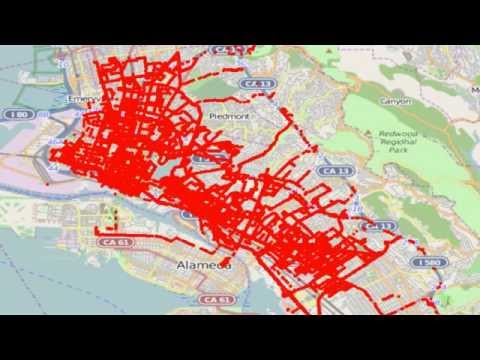
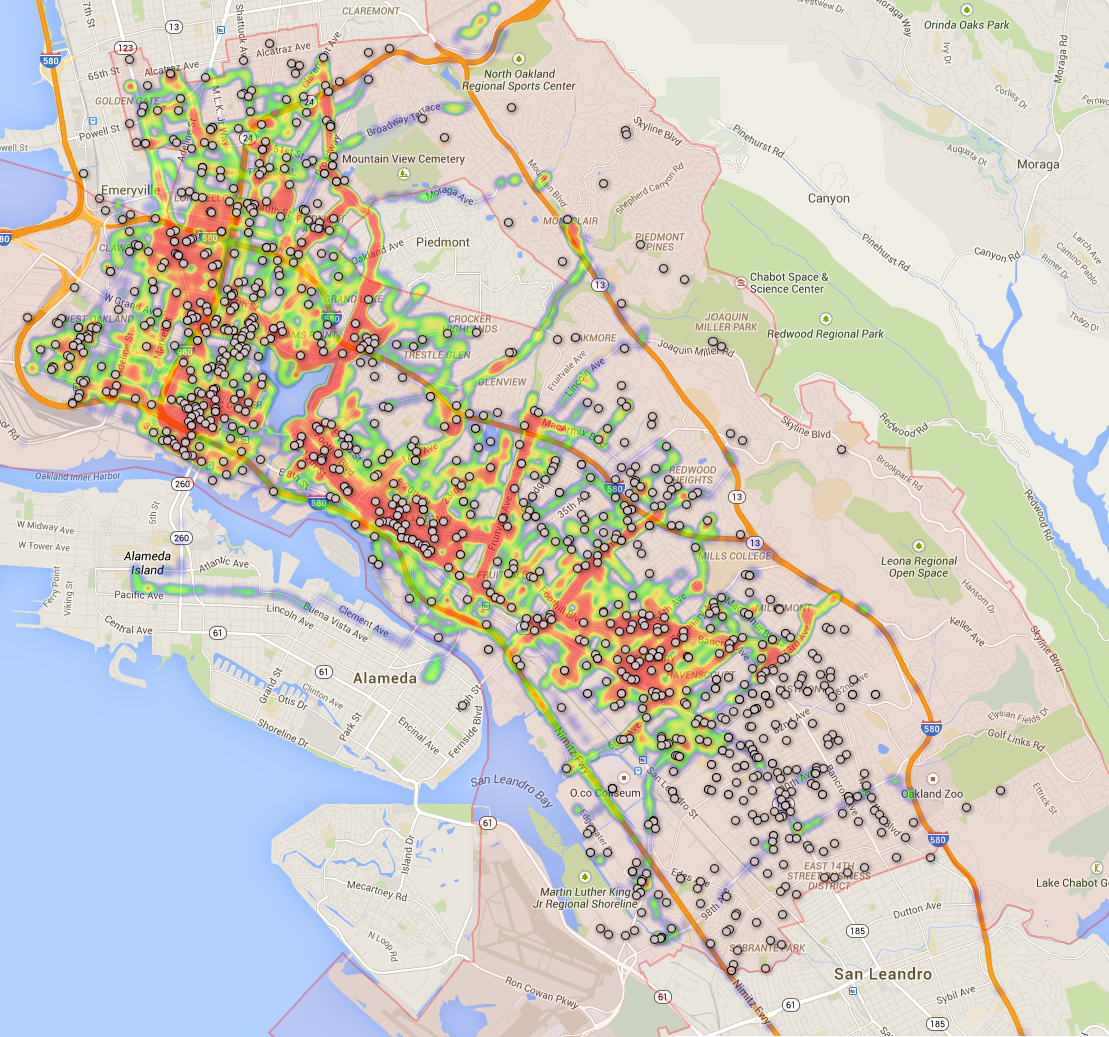
Click to open interactive map.

With more than 63,000 data points, it’s a lot of information to process. We dug into the Oakland data to show many of the ways ALPR can be broken down and visualized to help ensure police accountability. It immediately became clear that with just a few ALPR vehicles—as few as two cars—Oakland is able to capture plate data from across the city, with a particular focus on lower income neighborhoods. The data also shows that police cars pick up license plates when making the journey to county jail (that's the long tail extending to the east). The data does not seem to indicate that Oakland has any ALPR cameras mounted in fixed locations. 

Today we’re releasing the data to the public, with the individual license plate numbers removed to protect the privacy of drivers captured by these cameras. (While LAPD and LASD also claim the public’s right to privacy as a reason for withholding the records, the data can be anonymized easily with a few clicks, either by deleting a column for the spreadsheet or replacing the plates with random numbers.) We've also done some preliminary analysis of the data, which we present below. (If you just want the raw data, the links are at the end of the post.)

The Numbers

63,272

Total number of data points collected by Oakland Police ALPR cameras 

48,717

Number of unique individual plates captured by Oakland Police ALPR cameras

39,274

Number of vehicles that were captured only once 

4,571

Number of ALPR reads within one mile of Oakland Police headquarters

589

Number of captured plates that were likely assigned to government vehicles (i.e. police cars, buses, county vehicles, etc., which generally receive plates that are seven numeric digits)

150

Number of entries that were obvious bad reads (e.g. the cameras picked up road signs such as “CAUTION” or the plate had more than seven digits)

24

Number of times the single most-captured plate was hit (a government vehicle, likely a police vehicle, captured multiple times at the same locations over a short period of time) 

1.3

Average number of times an individual plate was captured

ALPR by the Hour
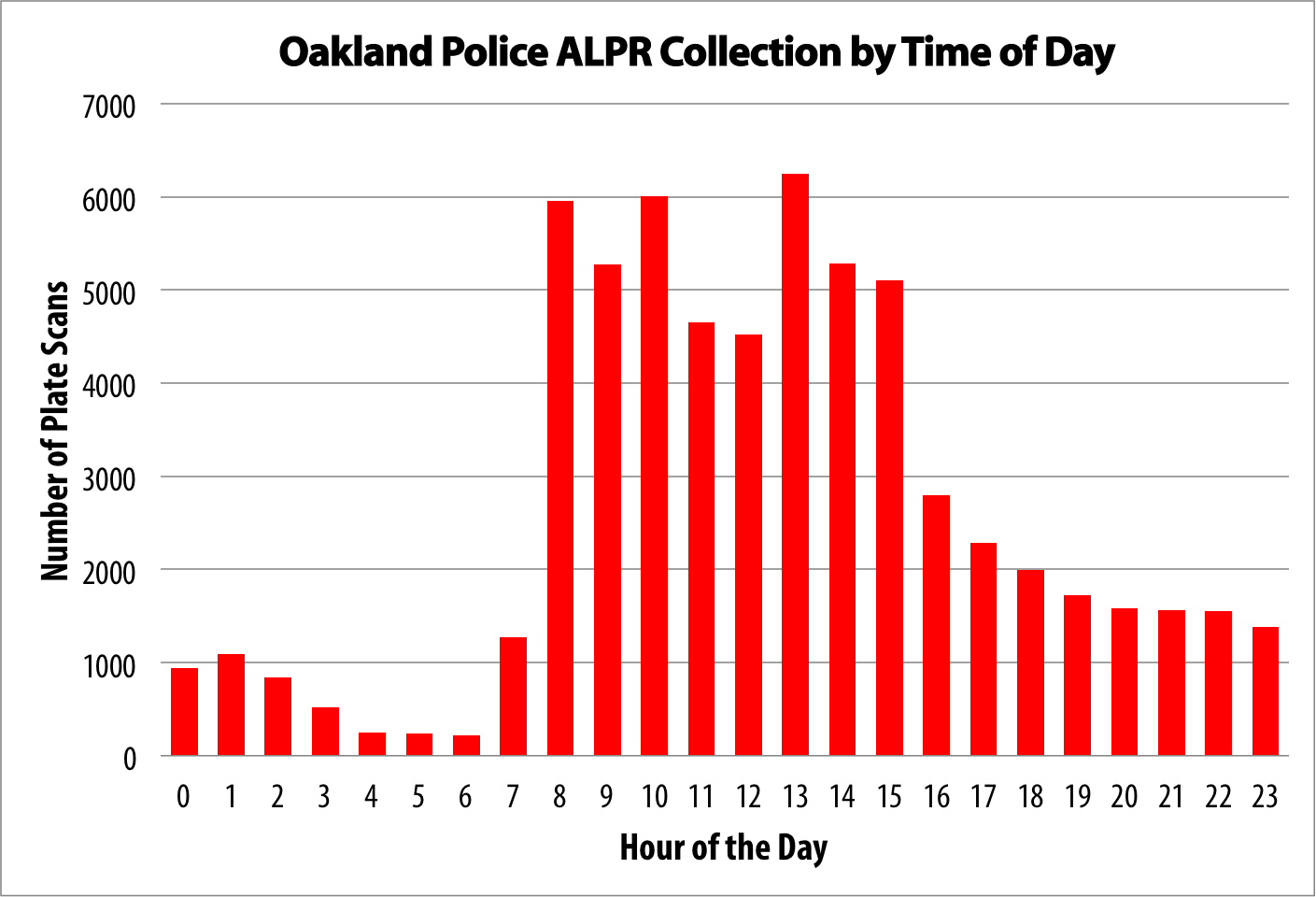
The data indicates that Oakland’s ALPR program may mirror the normal workday, picking up like clockwork around 8 am, waning slightly at lunchtime, then picking up again in the afternoon. Plate captures dropped off significantly during the overnight shifts, with ALPR vehicles mostly going dark between 4 am and 7 am. 

ALPR by Frequency
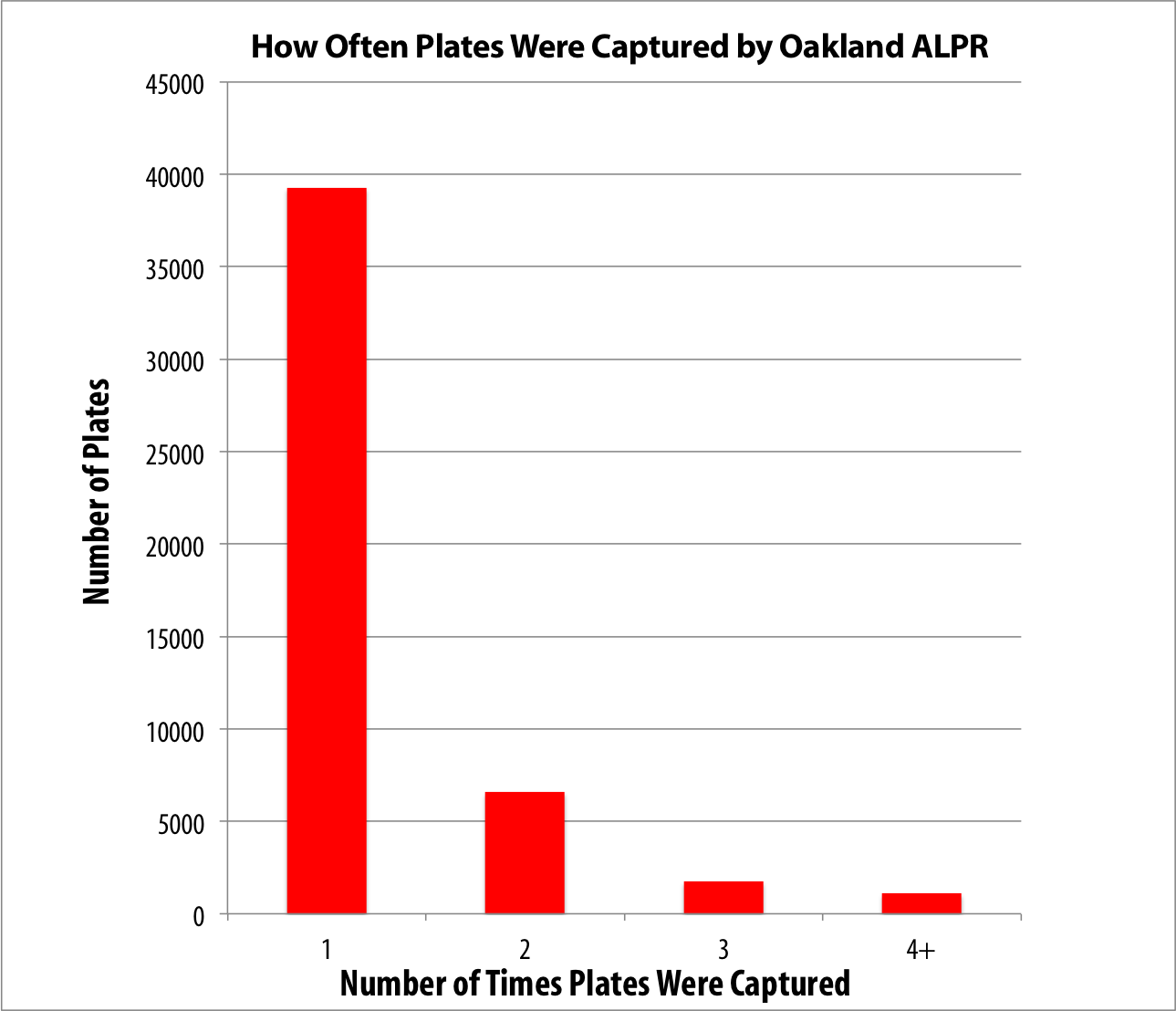
This chart shows how frequently individual plates were captured multiple times. The vast majority of plates were seen only once.

Heat Maps

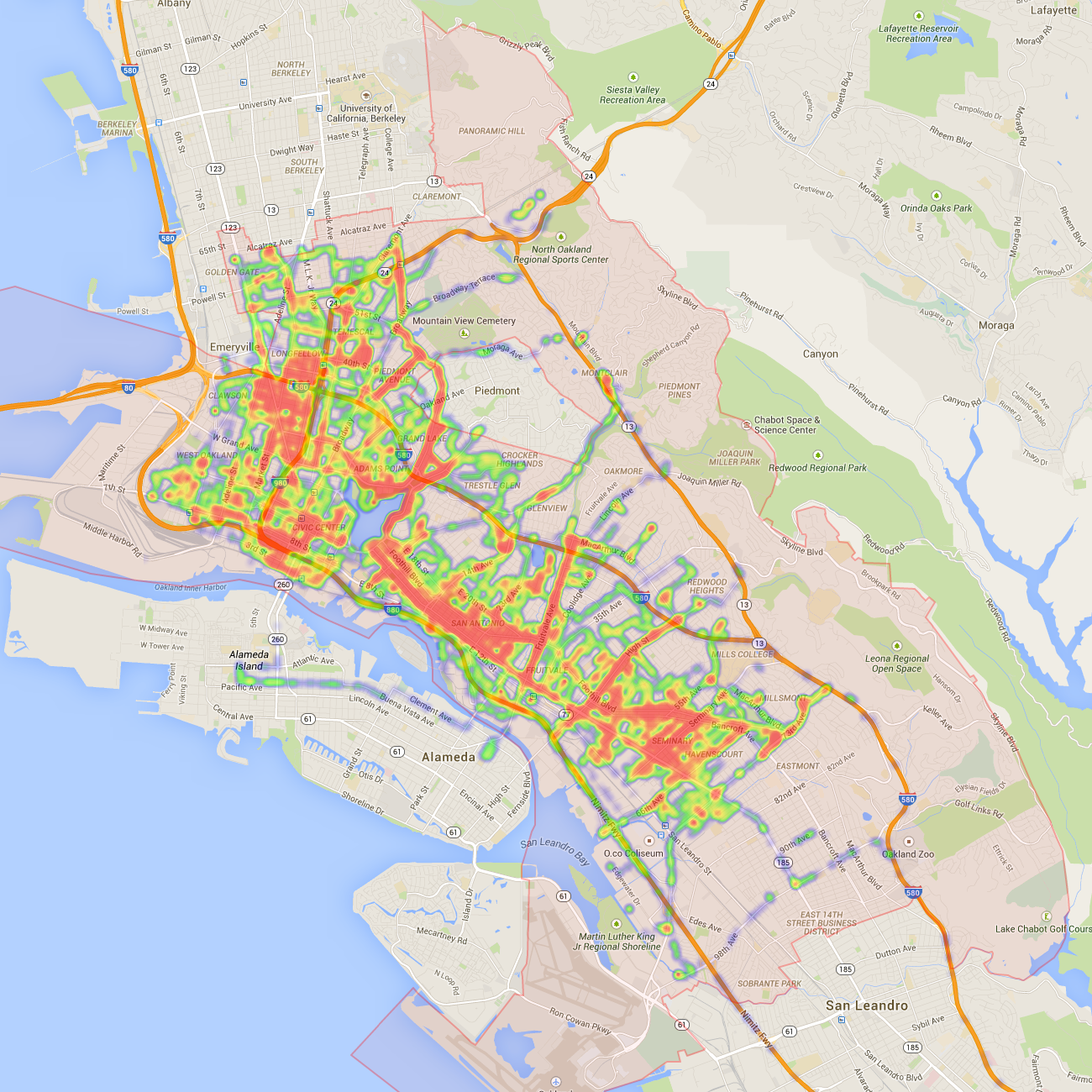
Click to enlarge. The shaded area shows the boundary of the City of Oakland.

Your plate is more likely to be caught on camera in a few specific locations. For example: 

Downtown: Oakland PD headquarters is located near the corner of 7th St. and Broadway, so the increased number of hits in this area are likely due to patrol cars traveling to and from police headquarters.

Northwest Oakland: Have a car in northwest Oakland? Prepare to be scanned and recorded. 

International Blvd. and Fruitvale: The same holds true for International Blvd. and Fruitvale Ave. (though some neighboring areas don’t seem to be targeted at all).

Surveillance and the Census 

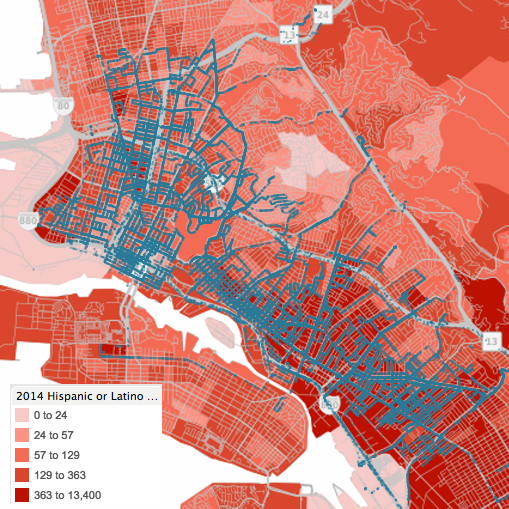
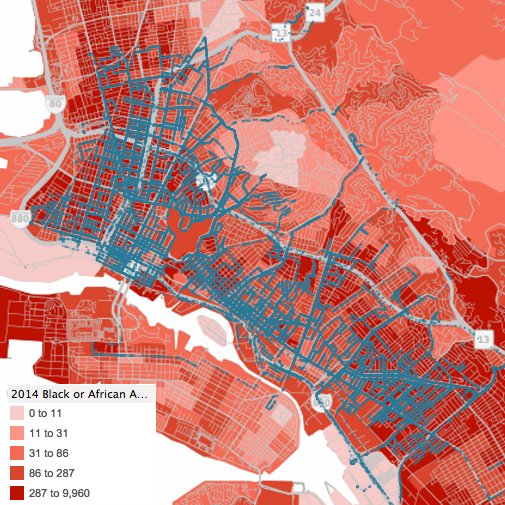
Using Tableau Public mapping software, we mapped the ALPR data over various layers of data from the U.S. Census Bureau. In each of these images, the darker the color, the higher the intensity. 

Per Capita Income: The data indicates lower-income neighborhoods are disproportionately captured by ALPR patrols, with police vehicles creating a grid of license plates in the city's poorest neighborhoods. 

White Population: Perhaps unsurprisingly, the per-capita data and the white population data significantly overlaps. If you are driving through or parking your car in a neighborhood with a higher density of white families, you are less likely to be picked up by ALPR cameras, particularly northwest of State Highway 13.


Click images to enlarge.

Black and Hispanic Populations: Overlaying Census data for African-American and Latino populations shows the converse of the white population. 

ALPR Data vs. Crime Data

We also filed a California Public Records Act request to obtain the Oakland Police Department's crime data for the same period. Each white dot here indicates a recorded crime. It's not much of a shocker that ALPR use doesn’t correlate very well with crime. For example, OPD did not use ALPR surveillance in the southeast part of Oakland nearly as much as in the north, west, and central parts of Oakland, even though there seems to be just as much crime.

To see if perhaps OPD was just focusing its ALPR use in areas with high incidents of automobile-related crime, we decided to map only the auto-related crime:

The result is the same—ALPRs are clearly not being used to deter automobile-related crimes.

ALPR and Mosques

In filing requests for ALPR data, we chose one week of the Islamic holy month of Ramadan to see whether police were using ALPRs to gather intelligence on Muslim populations. When we plotted out mosques on the map, we discovered several were near ALPR hotspots, but there was little in the data to indicate that any particular focus was placed on these places of worship. Future inquiries worth looking into might include gun shops, medical marijuana collectives, abortion clinics, and protests. 

ALPR Anomalies 

Oaklanders aren't the only citizens who should be worried about OPD surveillance. The ALPR data we received also contained instances of ALPR collection outside Oakland's city limits. 

City of Alameda: Alameda is the island to the bottom of the map, and is an independent city. Apparently at least one officer decided to go spy on its citizens.

Emeryville: Emeryville is a city that borders Oakland, and is the portion of the map outside the light-pink shaded area. Obviously Oakland PD doesn’t think twice about surveilling its citizens when they cut across it.

Piedmont: Piedmont (the central unshaded area) is actually bordered on all sides by Oakland. As with Emeryville, apparently Oakland PD has not been directed to turn off their ALPR surveillance devices when they take shortcuts across other jurisdictions.

Mall Parking Lot: Apparently an Oakland PD officer left his ALPR on while taking a trip outside the city (likely to or from the Santa Rita jail) and stopped at the Hacienda Crossings Mall in Dublin, nearly 20 miles away from Oakland.

False Positives

ALPRs aren't foolproof. For example, California currently limits vanity plates to seven characters, but many plates with eight characters showed up in the data, including "CROSSWAL," "ROSSWALK," "ROSSINGS," "CAUTIC1N," "CAUTICJN," and "DRIVEWAY." Obviously none of these were actual license plates—in fact, 96 of the entries in the data were simply not possible due to being eight or more characters long. Instead, they were likely read (or misread) from traffic signs.

We also found other likely misreads from signs, including "PLUMBING," "AHEAD," "PRIVATE," "PARKING," "PARKIMG," "ALLOWED," "ORTOWED," "DORTOWED," "ONLEFT," "CAUTON," "CAUT10N," and four more variations of "CROSSWALK" as well as "ONE WAY." All told, there were 76 entries that were likely misreads from road signs (22 of which were over-length).

In another 95 instances, ALPR cameras captured the license plates, but failed to record any geographic coordinates. Plotted out on a map, it looked like Oakland police were patrolling the ocean off the coast of Africa. 

Don't Take Our Word for It

Want to take a look at the data yourself? Do you have a better analysis method? Want to draw your own conclusions? Please do! You can find the ALPR data here and the crime data here, both in CSV format, or here in a Google Fusion Table.

Special thanks goes to Ari Isaak of Evari GIS Consulting for his help managing the data. All heatmaps were created using the awesome open source heatmap.js project on top of Google Maps.

Updated 1/22/2014: After publication of this post, we found a couple of off-by-one errors in our analysis. A manual inspection also found many more likely misreads from road signs, increasing the number from 134 to 150. The post was updated to reflect the correct numbers. We have also made small adjustments to the text for clarity that did not affect the facts of the post. 

Related Issues: 

Share this: Share on Twitter Share on Facebook Share on Google+ Share on Diaspora  ||  Join EFF
21 Jan 15:31

If The DOJ Gets Its Way, Tweeting Out A List Of The 'Worst Passwords On The Internet' Will Be A Felony

by Tim Cushing

Retweet if you want to go to jail! And not regular county jail, but federal prison!

Under the DOJ's CFAA proposal, this article (and this tweet linking to it) could be a 10 year felony. That's insane. http://t.co/njE8368lxU

— Nate Cardozo (@ncardozo) January 20, 2015

In case you can't read/see the tweet, it says:
Under the DOJ's CFAA proposal, this article (and this tweet linking to it) could be a 10 year felony. That's insane.
(The link goes to a Techcrunch article featuring SplashData's list of the "worst passwords on the internet.")

The DOJ has offered up its preferred version [pdf link] of the CFAA (Computer Fraud and Abuse Act) -- under the ridiculous name of "Updated Law Enforcement Tools" -- and it indeed would make this sort of thing an instant felony.

Here's the wording change that does it [strikethrough for deletions; bold for additions]:
(6) knowingly and with intent to defraud willfully traffics (as defined in section 1029) in any password or similar information, or any other means of access, knowing or having reason to know that a protected computer would be accessed or damaged without authorization in a manner prohibited by this section as the result of such trafficking; if—

(A) such trafficking affects interstate or foreign commerce; or

(B) such computer is used by or for the Government of the United States;
The DOJ removes intent and replaces it with feelings. Sharing a list of common (and stupid) passwords could be construed as "willfully trafficking" passwords while "knowing" a "protected computer" could be "accessed without authorization."

And that thing about federal prison I opened the post with? That's the way the DOJ wants it. The CFAA currently allows for misdemeanor charges under certain circumstances. But this proposal does away with that. Instead of a misdemeanor-to-3 year sentence range, punishments start at 3 years and escalate to a 10-year cap. Unless, of course, your hacking is part of the commission of another felony, in which case the government proposes it should get to double dip (at minimum). Here's Orin Kerr's take on that part of the proposal:
Under the proposal, breaching a written restriction is a crime if the user violated the written condition in furtherance of a state or federal felony crime, “unless such violation would be based solely on obtaining the information without authorization or in excess of authorization.” On one hand, this might seem kind of harmless, or at least redundant: The proposal makes it a felony to break a promise on a computer in furtherance of a felony. One wonders what the point is: Why not just punish the underlying felony?

But the real problem is the double-counting issue. Federal and state law is filled with overlapping crimes. Congress might enact three crimes that do the same basic thing, giving prosecutors the choice of which to charge or allowing them to charge all three. State criminal codes often mirror the federal criminal code. That raises a question: If Congress makes it a crime to commit an act “in furtherance of” a different crime, does the existence of overlapping crimes mean that a person’s conduct violates the first crime because it was “in furtherance of” the second? This is a particular problem because every state has unauthorized access crimes a lot like the CFAA. We saw this in the Auernheimer case, where prosecutors argued that the misdemeanor federal unauthorized access alleged in that case should be a felony because it was “in furtherance of” New Jersey’s nearly identical state unauthorized access law.
As if we didn't have enough people in prison already, the DOJ proposal mandates felony charges and provides prosecutorial options to ensure very few defendants walk away with short sentences.

The proposal also asks users to perform mind-reading when accessing anything computer-based.
(6) “exceeds authorized access” means to access a computer with authorization and to use such access to obtain or alter information in the such computer—

(A) that the accesser is not entitled so to obtain or alter; or

(B) for a purpose that the accesser knows is not authorized by the computer owner;
Going back to the Weev case, Andrew Auernheimer obviously knew AT&T would not "authorize" his access of supposedly private information, even if all he did was alter URL components to achieve this. Now, companies' security failures can be weaponized against those who discover them -- making it highly unlikely that flaws and holes will be pointed out to those who can actually close them. Why risk a few years in federal prison (remember: no misdemeanors) just because some entity decided to shoot the messenger rather than thank them for their help?

Permalink | Comments | Email This Story


21 Jan 13:45

Chris Christie, Port Authority Official Abused E-ZPass Data For Their Own Ends

by Tim Cushing

What data is harmless in the hands of the government? Apparently, not much. Case in point: the data collected by E-ZPass transponders. While the system helps alleviate traffic congestion, it also tracks drivers' movements. If you thought it just triggered toll payments, you're drastically underestimating the government's desire for data.

Back in 2013, Mike covered one NYC driver's experience with his E-ZPass device, finding it was triggered all over the city -- not just on toll roads. The company claimed the signal was scrambled and travel data collected in aggregate. Whether or not that remains true is open for debate, but even the data collected where drivers are expecting data collection can be revealing. E-ZPass data has been used in divorce cases to prove a spouse's whereabouts as well as against a city official, who falsified time sheets.

It's also been used in political fights to disparage opponents. The IBTimes reports that two New Jersey government officials obtained Senator Frank Lautenberg's EZPass records and used them as political fodder in a battle over toll increases.

"Respectfully, Senator, you only started paying tolls recently," [Port Authority Deputy Chief Bill] Baroni said, according to a transcript of the exchange. "In fact, I have a copy of your free E-ZPass," he continued, holding up a physical copy of the toll pass Lautenberg had received as a benefit from his tenure as a Port Authority commissioner. "You took 284 trips for free in the last 2 years you had a pass."
Governor Chris Christie himself disclosed further information about Lautenberg's driving habits.
At a press conference, he alleged that the senator didn't "pay for parking at Port Authority facilities" and said Lautenberg went "through the tunnel to New York three or four times a week in 2005 and 2006."

I find it interesting, too, by the way, in 2005 and 2006, that he went over the Hudson River 284 times. Where was he going?... I think he needs to answer that. 'Cause he's supposed to be the senator from New Jersey. So what's he doing going over the bridge or through the tunnel to New York three or four times a week for 2005 and 2006?... Did he ever spend any time in New Jersey?
Obviously, this is an abuse of government-collected data. Bill Baroni admitted during the 2013 Bridgegate scandal investigation that he possessed driving data on those interrogating him. To add insult to injury, the governor's office claimed it had no records on Lautenberg's driving habits in response to IBTimes' 2012 open records request -- the same records he used to criticize Lautenberg in an earlier press conference.

The ACLU points out that not only is this a misuse of private records, but this sort of situation is completely avoidable.
EZ Pass and other electronic toll booth systems should have the option for anonymous use, where money on the devices is treated like cash, for users who prefer privacy to the convenience of having named accounts. A driver, in other words, should be able to buy a transponder for cash, and use cash to store and re-load value on it. The Washington DC Metro system, for example, offers this option for users of its contactless transit passes.
Obviously, whatever protections the state of New Jersey affords these data are inadequate. Sure, driving in public isn't necessarily private, but the use of travel data to attack political opponents is still an abuse of state-collected data. Supposedly, the data is exempt from public record laws, which locks citizens out of acquiring the data without a subpoena. But nothing's stopping the Port Authority from using it for its own political ends and passing it on to the governor to do the same.

Driving on public roads may not be private, but there's a lot that can be ascertained about a person simply by looking at this data -- information that could only otherwise be acquired by nonstop physical "tailing." When collected and stored, it runs the risk of being abused. The Port Authority already grants police open access to the records (limited only to "purposes of discharging their duties," whatever that actually means in practice) and has shown its willingness to puts its self-interest ahead of state law when it comes to disseminating this information. Better policies and practices are in order, and Governor Chris Christie should be waist deep in investigators (a belated call for a DOJ investigation of Christie and Baroni has been issued by NJ Congressman Frank Palone) rather than considering a 2016 presidential run.

Permalink | Comments | Email This Story


21 Jan 03:05

Regular Exercise Not Enough To Make Up For Sitting All Day

by Soulskill
Brindle

standing desk FTW

An anonymous reader writes: Toronto researchers have found the amount of time a person sits during the day is associated with a higher risk of disease and death, regardless of regular exercise. The paper, published Monday in the Annals of Internal Medicine (abstract), found that prolonged sedentary behavior was associated with a 15 to 20 per cent higher risk of death from any cause; a 15 to 20 per cent higher risk of heart disease, death from heart disease, cancer, death from cancer; and as much as a 90 per cent increased risk of developing diabetes, said Alter. And that was after adjusting for the effects of regular exercise. ... Engaging in 30 to 60 minutes of moderate to vigorous daily exercise does not mean it's OK to then "sit on your rear" for the rest of the day.

Share on Google+

Read more of this story at Slashdot.


19 Jan 22:35

HOA Sues Homeowner For Parking Pickup Truck In His Driveway

by Laura Northrup
Brindle

I would certainly be all over it :X Especially since my truck doesn't even fit in a standard garage

What is a passenger vehicle? Is an extended-cab pickup truck a commercial vehicle, or a passenger vehicle? A man and his homeowners association in upstate New York disagree on this point, with the HOA suing the truck owner in county court, seeking an injunction to force him to stop parking his truck in his own driveway.

The truck in question is a Ford F-150 with an extended cab. That model of truck is the most popular vehicle in the United States, but it is apparently not as popular in Manlius, one of the more wealthy suburbs of Syracuse, NY.

The Syracuse Post-Standard reports that the homeowners association claims to own the driveways of all homes in the development. Garages belong to homeowners, and they are allowed to park any vehicle in the garage, but only “private, passenger-type, pleasure automobiles” can be parked in driveways.

The problem with this is that the pickup truck is registered as a regular passenger vehicle with the state DMV, not a commercial vehicle.

The homeowner counters that other homes in the neighborhood have pickup trucks parked in their driveways, which the Post-Standard’s reporter also saw reports seeing on her visits to the neighborhood.

Each of the development’s single-family homes is allowed two parking spaces: one in their own garage, and one in the driveway that is considered the property of the homeowners association.

This is all very baffling to people who own pickup trucks. Back in the ’80s and ’90s, my father drove an extended-cab pickup truck to commute to his job as an accountant, and used the bed of his truck mostly for personal tasks like hauling his all-terrain vehicle to hunting camp, hauling deer back from camp to the butcher, and bringing my mini-fridge to me at college. That’s a family vehicle, not a commercial vehicle.

CNY homeowners sued, told they can’t park pickup truck in driveway [Syracuse Post-Standard]

18 Jan 19:03

The Belfie Stick: The Smartphone Stick For Butt Selfies

butt-selfie-stick.jpg Fun for all ages?! This product should be 18+ only! Also, that guy has no ass and it looks like his butthole is trying to eat his jeans. The Belfie Stick is allegedly a real product you can pre-order for $80 that helps up your ass-selfie game. Personally, I don't have an ass-selfie game. The stick clamps onto any smartphone and has a Bluetooth enabled controller so you don't have to rely on your camera's timer to take a picture. I imagine it's equally well suited for artistic shots of taints, ballsacks and hoo-has. Personally, I've never taken a picture of my ass, but that's only because I bent over naked in front of a full-length mirror once and peeked at it between my legs and I did NOT like what I saw. I swear it winked at me. Thanks to Laura, who informed me they'd have to turn the Hubble Space Telescope around to be able to take a picture of my ass anyways.
17 Jan 19:47

Man Sues City After Arrest For Dropping F-Bombs In A Local Restaurant

by Tim Cushing

Just because something offends a person (or someone is offended on behalf of someone else -- more on that in a moment) doesn't mean it's illegal. And just because you're eating a meal in full uniform doesn't mean you can use your law enforcement powers to magically turn non-criminal acts into criminal ones. (via Legal Juice)

Tye Trujillo was arrested at IHOP, 3546 E. Main St. in Farmington [New Mexico], by three Farmington police officers after allegedly saying the word "F---" several times shortly before midnight on June 11, 2013, according to an arrest report.

The officers — Dennis Ronk, Albert Boognl and Tamara Smith — were eating dinner at the restaurant in full uniform when the offensive language was used, the report states.

Trujillo, 32, was at the restaurant with several friends. A family with three small children were seated near them, the report states.

According to the report, Ronk approached the men and told them that if they said the word one more time, he would arrest them.

Trujillo allegedly used the word again and Ronk followed through on his threat, the report states.

Trujillo was cited for disorderly conduct and was found guilty of violating city code in Farmington Municipal Court on April 10.
Not noted in the coverage of the story, but included in the complaint [pdf link] is this bit of information that indicates the officer wasn't personally offended, but was acting on behalf of someone he assumed to be offended. From the arrest report:
I noticed a young couple sitting at a table directly behind the male subject's and there was a family of three small children (approximately 3 to 8 years of age) and two adults sitting near my location.
Officer Ronk tried to gather more damning darning incriminating evidence to back up his "you must be offended" arrest, but the person he took offense on behalf of provided no help.
After placing Plaintiff into cuffs, Officer Ronk contacted a family, which included young children, who was also patronizing the restaurant at this time and sitting near Plaintiff's table. One of the female adults at the table told Officer Ronk that she could hear the males using the "f word" but she kept the children busy and did not wish to provide information or get involved in the matter.
And why would she? Presumably she knew that loud swearing in public is something that happens from time to time and, at worst, reflects negatively on the person doing it, but is not actually a criminal act. Officer Ronk painted himself into a corner by issuing a "direct order" (no, really -- that's what it says in the arrest report) to Trujillo to stop saying "Fuck" and backing it up with the threat of an arrest. Trujillo called his bluff, leaving him no choice but to follow through.

Of course, the charges didn't stick. The judge acquitted the plaintiff of the charges because saying the word "fuck" in a public space -- even a public space containing children "approximately 3 to 8 years of age" -- does not rise to the level of "disorderly conduct." The Farmington city code states that disorderly conduct (in terms of speech) must be:
"...obscene, indecent, profane challenging or other words which are inherently likely to provoke an immediate violent reaction in an average person."
Seeing as the mother's immediate reaction was to distract her children rather than punch Trujillo in his foul mouth, it stands to reason that the "average person" would not be "provoked into an immediate violent reaction" by the indiscriminate use of profanity. (On the other hand, directed profanities can provoke "immediate violent reactions" in some police officers, so be aware of that when combining the two.)

Because Officer Ronk couldn't resist the urge to make a public space "safe" for someone else's kids, the City of Farmington will likely be handing over a settlement to Trujillo in the near future. And once it does, constituents will be left holding the tab for a very expensive "fuck" they neither asked for nor enjoyed.

Permalink | Comments | Email This Story


17 Jan 19:38

Eric Holder Cuts Off Program That Helped Spur Police Asset Seizure 'Shopping Sprees'

by Mike Masnick
Well, here's a bit of a surprise. For years we've been highlighting the ridiculousness of police asset seizure and asset forfeiture laws (and, actually, were working on another post on some new such laws that we may now need to revisit...). These laws have basically become a legalized way for local police to steal cars and money without ever charging anyone with a crime. And then... they get to keep the money and sell off the cars. Some have even admitted the process is basically the police going "shopping" for stuff they want. They can seize anything, claiming that it was used in a crime, even if no one is ever charged with a crime. Effectively, they're "charging the thing" which is why you get crazy case names like the (actual case): United States v. Article Consisting of 50,000 Cardboard Boxes More or Less, Each Containing One Pair of Clacker Balls.

However, on Friday, somewhat unexpectedly, outgoing Attorney General Eric Holder announced that he was massively limiting a federal program that helped make these seizures so valuable to police:
“With this new policy, effective immediately, the Justice Department is taking an important step to prohibit federal agency adoptions of state and local seizures, except for public safety reasons,” Holder said in a statement.

Holder’s decision allows some limited exceptions, including illegal firearms, ammunition, explosives and property associated with child pornography, a small fraction of the total. This would eliminate virtually all cash and vehicle seizures made by local and state police from the program.

While police can continue to make seizures under their own state laws, the federal program was easy to use and required most of the proceeds from the seizures to go to local and state police departments. Many states require seized proceeds to go into the general fund.
There's still more to be done to fix bad asset seizure and forfeiture laws, but this is a really big step forward.

Of course, just watch as police departments start to protest that they can no longer go "shopping" for "toys" that they can steal:
The policy will touch policing and local budgets in every state. Since 2001, about 7,600 of the nation’s 18,000 police departments and task forces have participated in Equitable Sharing. For hundreds of police departments and sheriff’s offices the seizure proceeds accounted for 20 percent or more of their annual budgets in recent years.
Either way, kudos to Holder for making this move.

Permalink | Comments | Email This Story


16 Jan 13:23

Regulating Synthetic Biology: Does Freedom Of Speech Apply To DNA Letters?

by Glyn Moody
Brindle

well this is probably the end of the world...

Techdirt has written often enough about applications of DNA sequencing -- the elucidation of the four chemical "letters" A, C, G, T that go to make up genomes. But things have moved on: the new frontier is not just analyzing DNA, but synthesizing it. A fascinating article on SFGate describes the activities of one company working in this area, Cambrian Genomics, and some of the tricky ethical issues it raises:

In Austen Heinz's vision of the future, customers tinker with the genetic codes of plants and animals and even design new creatures on a computer. Then his startup, Cambrian Genomics, prints that DNA quickly, accurately and cheaply.

"Anyone in the world that has a few dollars can make a creature, and that changes the game," Heinz said. "And that creates a whole new world."

The 31-year-old CEO has a deadpan demeanor that can be hard to read, but he is not kidding. In a makeshift laboratory in San Francisco, his synthetic biology company uses lasers to create custom DNA for major pharmaceutical companies. Its mission, to "democratize creation" with minimal to no regulation, frightens bioethicists as deeply as it thrills Silicon Valley venture capitalists.
Printing the new DNA is the easy bit; increasingly, the hard bit is deciding what should -- and shouldn't -- be printed:
Right now, employees check each order to make sure that a customer isn't printing, say, base pairs of Ebola. But staff won’t have time to do that if, as Heinz predicts, orders dramatically increase in the next two years. In that case, he said, Cambrian might first ship the plates to an independent facility where experts would put the DNA inside cells, film and analyze it, and make sure that it is safe before releasing it.

This facility, he envisions, could be run by another company, not necessarily the government. Because Cambrian wants to keep government interference to an absolute minimum, its CEO insists that behaving well is in the company’s best interest.
That may be true, but as this technology spreads, and becomes cheaper, more and more companies around the world will start to offer similar services, making it harder to oversee their working. And then there will be the backstreet labs that intentionally try to avoid any kind of control. Soon, if you can model it, you will be able to synthesize it. Cambrian Genomics is already helping to drive the spread of its tools and ideas:
Cambrian will also share its technology with startups in which it holds a 10 percent equity stake. One is Petomics, which is making a probiotic for cats and dogs that makes their feces smell like bananas. Another is SweetPeach, which hopes to take samples of users' vaginal microorganisms and send back personalized probiotics to promote vaginal health. (Contrary to Heinz's description of SweetPeach at a recent conference, the products will not make vaginas smell like peaches.)

Heinz seeks to help create "thousands" more startups in this vein. On top of that, he wants to replace lost limbs, fight viruses and develop alternatives to antibiotics. Maybe someday, he said, scientists will even print DNA on Mars. "It’s going to be an amazing next few hundred years."
Given the rapid advances in synthetic biology, that certainly seems likely. The question is: will the next few hundred years be good amazing, or bad amazing? Where -- and how -- do we draw the line here?

Follow me @glynmoody on Twitter or identi.ca, and +glynmoody on Google+


Permalink | Comments | Email This Story


15 Jan 15:14

Report: Samsung Galaxy S6 to be unveiled next month with 2 variants and smartwatch

by Quentyn Kennemer
Brindle

Project zero next month...

Talk about the Samsung Galaxy S6 (and Edge) at AndroidForums.com!

Samsung Logo CES 2015 DSC07883

Not that we didn’t already hear murmurings of Samsung’s plans for Mobile World Congress, but another report suggests Samsung will look to bring more than just one big device to the show. Alongside the metal-built Samsung Galaxy S6 we’re expecting, Samsung is also expected to introduce a version of the Samsung Galaxy S6 with a curved display, ala the Samsung Galaxy Note Edge.

If you haven’t read our Note Edge review, that device uses the curved portion of the display to independently show notifications, information and mini apps that the user can use alongside the main viewing area of the display. It’s a bit of a novelty feature right now, but it’s something Samsung seems committed to testing to see if there’s a real market interest for it.

Alongside the phones, they will also reportedly be toting a smart watch. While today’s report doesn’t suggest any details about that watch in particular, a rumor from last week says to expect Samsung’s first circular smart watch.

Unfortunately that report also told us to expect Tizen instead of Android Wear, so unless you own a Samsung phone and don’t mind using Samsung’s operating system instead of Google’s then it probably won’t be the most exciting announcement. Regardless, it’ll all be very interesting and you can bet we’ll be tuned in once all the mobile tech giants converge on Berlin next month.

15 Jan 14:42

You can now help cure diseases like Alzheimer’s while you sleep using your phone

by Quentyn Kennemer
Brindle

folding on your phone... we should set up all the spare ones at work to do this :P

folding at home

Interested in the prospect of contributing to disease study and research for doing nothing but owning a smartphone? Sony’s making that a reality for owners of their Xperia phones thanks to the launch of the new Folding@Home mobile app.

If you’re not aware, Folding@Home began as a project that would help supplement the protein folding simulations being carried out by Stanford’s research teams to try and cure diseases like Alzheimer’s. The purpose of the study is to simulate and analyze the process of a protein folding in order to understand what goes wrong in the folding process that leads to the unfortunate development of these diseases in people.

It’s their hope that the project will help speed up research without having to spend tons of money on supercomputer farms or having to spend countless man hours inside a research lab to study actual organisms (which is quite difficult due to how quickly the folding process for a protein takes place — less than millionths of a second for most proteins).

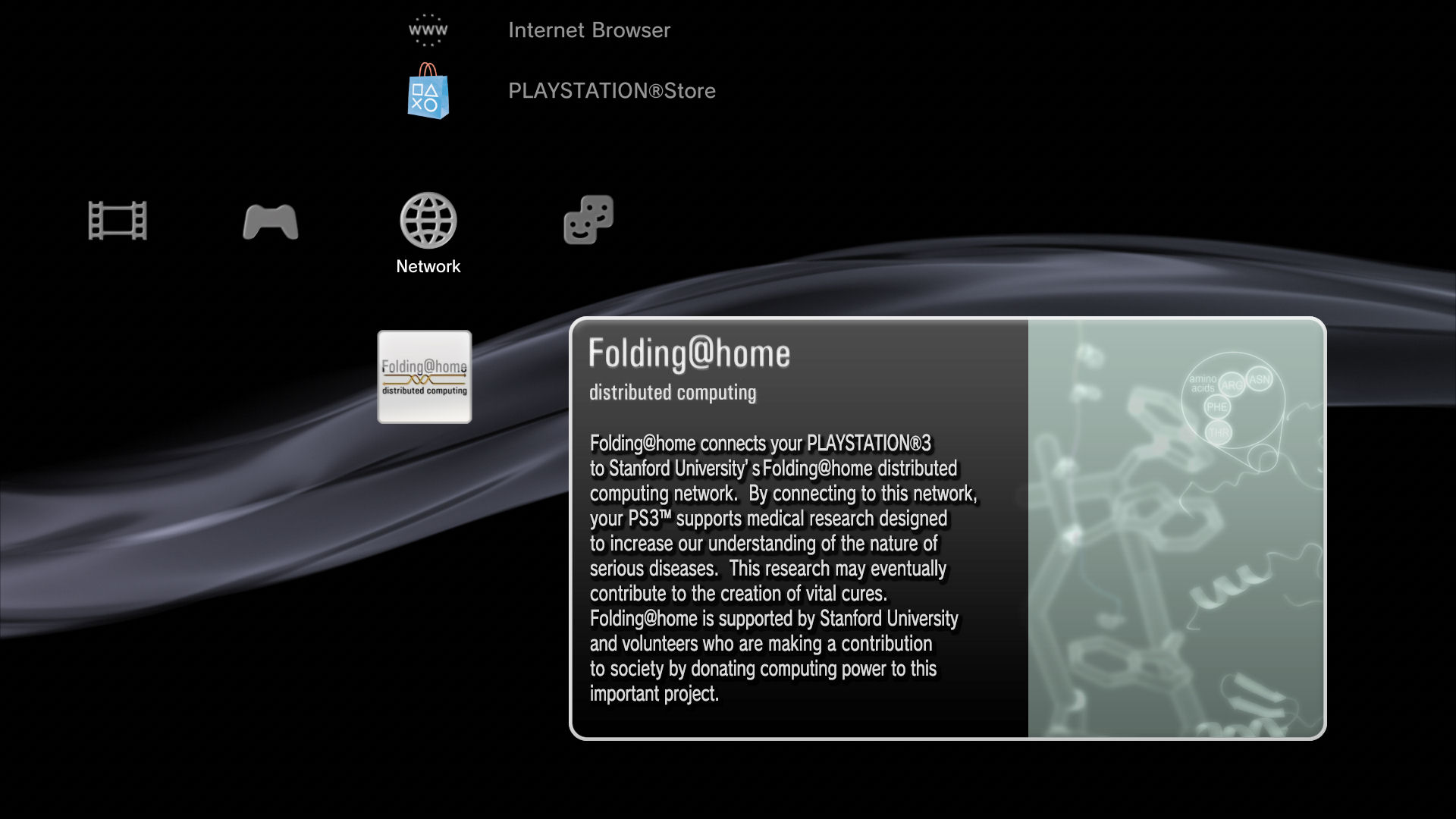
folding at home ps3

Sony first showed support for the project with their PlayStation 3 gaming console. The app — dubbed Folding@Home — allowed users to “donate” processing time to the cause. The data would then be uploaded to a central database for the Stanford team to collect from. This gave them far more processing power than they could hope for and allowed them to break records for folding simulations.

Now they hope to do it all over again in mobile. The team has been working on the app for a couple of years now, and are comfortable enough with the powerful processing capability of smartphones and the stability of their app to release it in beta form.

A member of the Folding@Home team — Dr. Vijay Pande — says they would need about 150,000 “phone days” to be able to publish the next big paper on protein folding and Alzheimer’s research. A “phone day” is described as one phone running 24 hours per day, 7 days per week in a year. With just 10,000 phones contributing a full phone day, he says that mark could be reached in a matter of just a couple of weeks.

folding at home app screenshotOf course, it will likely take much longer for that to happen as the Folding@Home simulation requires a few different conditions for it to do its thing:

  1. The phone has to be connected to a charger and fully charged to 100%
  2. The phone must be connected to a WiFi network
  3. The phone must meet the previous conditions with a specific set of time which you set.

Then, and only then, will Folding@Home siphon off some of your phone’s processing power to carry out the simulation.  Those aren’t the most ideal stipulations for most folks. That’s why Sony suggests letting your phone carry the simulations out as you sleep every night. Your phone is plugged in, after all, and you probably aren’t going to be needing your phone for much of anything else while you’re in your nightly temporary coma.

Sony also stresses that they and Standford University have looked into potential security risks, and have assured us that Folding@Home does not, in any way, interface with any other app’s data, the phone’s memory or anything other than raw processing power and your WiFi connection for transmitting data.

Heard enough? Sony Xperia owners can head to the Google Play Store right now for their download, though those outside of the Sony camp will have to wait until the app exits beta at some point in early 2015 before they can contribute some processing time to a very important cause (granted they have a phone with an ARM processor and at least Android 4.4 KitKat).

[via Sony]

14 Jan 19:32

UK prime minister Cameron wants to ban encrypted communication

David Cameron could block WhatsApp and Snapchat if he wins the next election, as part of his plans for new surveillance powers announced in the wake of the shootings in Paris. The Prime Minister said today that he would stop the use of methods of communication that cannot be read by the security services even if they have a warrant. But that could include popular chat and social apps that encrypt their data, such as WhatsApp. Apple's iMessage and FaceTime also encrypt their data, and could fall under the ban along with other encrypted chat apps like Telegram. Part of Cameron's speech has been posted on YouTube.
14 Jan 02:11

What happens when you install the top 10 Download.com apps

We installed the top 10 apps from Download.com, and you'll never believe what happened! Well... I guess maybe you might have a good guess. Awful things. Awful things are what happens. Join us for the fun! Braver women and men than I.
13 Jan 22:30

Pro-ISP Bill To Block FCC From Using Title II For Internet Introduced In Congress

by Kate Cox

2014.05.15-FCC-protestLawmakers have been happy to opine about the net neutrality fight since the old rule got tossed out a year ago. Now that the FCC is not only set to vote on a new proposal next month, but also likely to take the Title II approach in that proposal, the window is closing for Congress to act, and lawmakers are feeling the urgency. And that is how we find ourselves once again with a bill on the floor seeking to remove the FCC’s authority to classify broadband how it sees fit.

The bill in question, HR 279, doesn’t so much have a catchy name as a lengthy descriptor: “To amend the Communications Act of 1934 to limit the authority of the Federal Communications Commission over providers of broadband Internet access service.”

The bill seeks to do exactly what it says: it would forbid the FCC from classifying broadband services as telecommunications services, which are regulated under Title II of the Communications Act, and would instead force internet services to remain classified as they currently are, as information services.

The difference between the FCC’s regulatory scope over information and telecommunications is basically where the whole mess began. If the FCC moves to reclassify broadband services as communications, and not as information, then broadband services can be regulated under Title II of the law and can be made subject to the same non-discrimination, common carrier regulations as other utilities.

Rep. Bob Latta of Ohio introduced the bill, which is co-sponsored by Reps. Walter Jones (NC), Charlie Rangel (NY), and Randy Weber (TX). In a press release, Latta hailed the bill as “bipartisan legislation to ensure the internet remains open and free” before repeating the ISPs talking points about Title II being anachronistic 20th century “monopoly-era telephone rules” that would stifle innovation, dynamism, and progress.

As Ars Technica and others have pointed out, Rep. Latta has received a significant amount of campaign funding from the major ISPs and their trade (lobbying) groups. In the leadup to the 2014 election, that included $15,000 from the NCTA, $13,000 from AT&T, $10,000 from Time Warner Cable, $8500 from Comcast, and $8000 from Verizon, among others.

This is the second time Latta has put forth this proposed amendment to the Communications Act. The previous version went to Committee in May, 2014 and was never heard from again. At the time, the FCC was not leaning toward the Title II approach and there were months yet to go in the proceeding’s pleading process, so lawmakers focused their attention on other things.

However, Congressional interest in net neutrality and the FCC surged around the holidays, after President Obama very publicly called for the Title II approach. The response was instant, political, and predictable, with a tidal wave of mostly-Republican Representatives and Senators showing up to oppose the move.

With the new Congress sworn in and an actual date for the vote on the FCC’s calendar, it’s now-or-never for the opposition. Wheeler will be circulating the new proposal among the other commissioners’ offices on February 5, and the FCC is scheduled to vote on it on February 26.

[via Ars Technica]

12 Jan 18:24

NYPD Pouts And Refuses To Do Their Duty; Residents Split Between Applauding And Failing To Notice

by Timothy Geigner

As you may be aware, things have gotten weird with the NYPD over the past several weeks. In what amounts to the police force in our nation's largest city throwing a temper tantrum over either the brutal murder of 2 officers or the sudden attention being paid to how police officers treat the city's minority residents in the wake of the stop and frisk scandals and the death of Eric Garner, the NYPD's numbers are all down. Arrests are down somewhere in the neighborhood of 50%, and citations appear to have plummeted to a fraction of the norm, resulting in arraignment numbers dropping by nearly a third. While the NYPD has denied that this is any kind of coordinated lack-of-effort, that claim is laughable and it's obvious that the police officers have banded together to show us how much New York City needs them and how horrible life will be when they stop performing the duties they swore to perform.

Too bad most people are barely noticing and that those who have noticed are thrilled.

Few managers in the court system expect the current downturn to last. Many public defenders, however, said they hope the steep decline in minor arrests will become permanent. They noted felonies did not rise over the last three weeks as arrests for low-level crimes plummeted.

"This proves to us is what we all knew as defenders: You can end broken-windows policing without ending public safety," said Justine M. Luongo, the deputy attorney-in-charge of criminal practice for the Legal Aid Society.
Those who have been arrested are getting better service from public defenders, while the courts themselves are free from the clutter of the massive arrests the police usually perform. You might be tempted to think that this means low-level criminals are getting away with their crimes. That might be true to some extent, though nobody seems to want to put forth any actual empirical data to support the claim, but what's plainly obvious thanks to the lack of clutter is how silly NYPD arrests can get.
Those arrested for relatively minor offenses now stand out. On Wednesday morning in Manhattan, William Talen, 64, who calls himself Reverend Billy, awaited arraignment. He had been arrested on Tuesday afternoon as he gave a sermon in Grand Central Terminal — protesting police brutality.
If the drop in arrests resulting from the NYPD refusing to do their jobs is made up of these kinds of arrests, good riddance. And it isn't just public defenders with more free time that appreciate the police taking a walk on their duty. The citizens are happy about it as well.
Charles Franklin, a 27-year-old student wearing a Shepard Fairey hat that reads “OBEY,” is also enjoying the latest trend in policing.“This is how it’s supposed to be,” he says, referring to the “quiet” he’s been sensing, the “lower volume” of cops he’s been seeing on local corners. “I’m not talking about guys getting away with nothing, I’m talking about feeling safe. The police driving up on us, because of some hearsay, and jumping out, that don’t make us feel safe. The police smelling every drink I drink, looking in my bag every time I come out the store, that don’t make me feel safe. This is how it’s supposed to be,” he reiterates. “We feel safe. And for once, we're not running late – usually we always be running late because of having been hassled.”
Those sentiments are accompanied by wry quotes affirming that some of the police force's biggest money-making habits, such as parking citations on the one block where they make lots of money are still going strong even as overall tickets are way down,

That said, the reaction to the police sitting on their hands and refusing to do their duty is pretty clear: shrugs and applause. As one person noted, it's somewhat revealing:
To many of us from these communities, the past two weeks have amounted to a vacation from fear, surveillance and punishment. Maybe this is what it feels like to not be prejudged and seen as suspicious law breakers. Maybe this is a small taste of what it feels like to be white.
If the NYPD was trying to teach the city's citizens a lesson, it appears to have taught one unintentionally: there are too many police on staff arresting too many people most of the time. Nice job, union bosses!

Permalink | Comments | Email This Story


12 Jan 18:19

Baltimore PD Hides Its Stingray Usage Under A Pen Register Order; Argues There's Really No Difference Between The Two

by Tim Cushing
Another case involving Stingray devices has made its way into the federal court system, prompting the ACLU to join the battle on behalf of the defendant. A murder-for-hire sting conducted by the Baltimore police and the FBI involved the use of a Stingray device, but the paperwork used to justify the deployment says nothing about an IMSI catcher. The order obtained by the Baltimore PD is for a pen register/trap and trace device. [pdf link]

Uncharacteristically, the Baltimore PD disclosed its use of a Stingray device to locate a suspect's phone during court proceedings. Even more uncharacteristically, the government is fighting to keep the evidence from being suppressed, rather than opting to protect its means and methods at the expense of collected evidence.

How the evidence was obtained matters, even though the government's lawyers are arguing that it doesn't.
The government said the court order obtained by authorities, called a pen register, covers the technology because it refers to cellular tracking device and GPS location information.

But the ACLU argues that the state's statute for such pen register orders "makes no provision for, or even mention of, a 'cellular tracking device' " and is commonly understood to only include the "trapping" of call log information.

"In addition, there is absolutely no indication in the application or the order that the authorization will subject potentially unlimited numbers of innocent third parties to dragnet surveillance, none of whom will ever receive notice that their phones were tracked and that the search will intrude into constitutionally protected spaces," the ACLU wrote.
The government argues that no Fourth Amendment violations occurred, even if the court order said nothing about the device used to locate the phone. It asserts that everything was legit, and even if it wasn't, it was an honest mistake and it would have just found the suspect and his phone sooner or later -- perhaps even by using the method it actually requested. [pdf link]
[T]he Government argues that the search was not in violation of the Fourth Amendment for three reasons: (1) the search was authorized by the February 5, 2014, Order (the “Order”), which was a valid warrant; (2) even if the warrant was deficient, law enforcement acted in good faith reliance on it; and (3) even without a warrant, the evidence obtained would not be subject to exclusion because the inevitable discovery doctrine applies.
Wrong, wrong and wrong, according to the defendant's (Robert Harrison) counsel.
The Order was not a valid warrant for at least three reasons. First, the Application in support of the Order was purposefully misleading. The Government crafted the Application as if it were a routine application for a pen register or a trap and trace device, citing the applicable Maryland statutory authorization. It did not mention the term “cell site simulator,” nor did it describe the novel technology in a manner that the judge would understand its intrusiveness on the privacy rights of Harrison or others. Second, although the Government now seeks to treat the Order as a warrant, it failed to comply with the statutory temporal requirements for the execution of warrants, which impacts probable cause. Third, the Order fails the particularity requirement because it specified that it was authorizing a search of only the target phone, but, instead, the cell site simulator searched the phones of infinite third parties in the vicinity. As such, if it was a warrant, it was an illegal general warrant.
The "good faith" exception -- the benefit of a doubt the government frequently extends to itself -- is also addressed.
Further, the Government cannot rely on the good faith exception or the inevitable discovery doctrine. The good faith exception cannot apply here because the purported warrant was facially invalid, and the affiant knowingly or recklessly misled the magistrate with material omissions concerning the cell site simulator. The inevitable discovery doctrine likewise does not apply because the Government’s argument is predicated on an alternative plan that is latent with speculation and conjecture, instead of historically verifiable facts.
Going beyond this, the government attempts to claim the Pen Register order is no different than an actual search warrant -- something it didn't have in its possession when it used the cell site spoofer to "search" Harrison's premises (as well as anyone else's within range) for the cell phone. The filing points out that the statute under which the order was obtained doesn't provide for the issuance of warrants. Even if the government wanted to treat the order like a warrant, it was missing all sorts of specifics crucial to search warrants -- like the particularity of the search, time limitations and probable cause findings.

Not only that, but by obtaining a Pen Register order rather than a search warrant, the government deliberately hid its methods from the courts. The particulars of the technology being deployed were never presented to the magistrate. All of this adds up to one thing: even if the government wants to pretend the order was a warrant, at the very best, it was in possession of a general warrant -- the sort of thing that the Fourth Amendment is in place to safeguard against.

The government also blew past temporal limits normally found in warrants. In its arguments, it wants to have it both ways -- the leniency of the 60-day window provided for Pen Register orders and the powers granted to those in possession of actual search warrants, which are only good for 15 days after issuance. The deployment of the Stingray didn't occur until 50 days after the Pen Register order was obtained.

Addtionally, the phone sought by the FBI and Baltimore PD was no longer in possession of the sting target by the time it went "searching" for it. Within a day of obtaining the Pen Register order, the phone was answered by an unknown male, who told the informant that the suspect (Smith) would call him back on his personal phone. Further records submitted as evidence note that every call between Smith and informants occurred on personal phones, rather than the phone the government was looking for. As the filing points out, had the government sought a warrant to locate this phone, it would have been unable to provide probable cause findings. As things stood nearly a month after the Pen Register order was obtained, the government didn't know much about who actually had the phone, much less whether the phone was still being used as part of the murder-for-hire plot.

By covering up its use of a Stingray device, the government availed itself of the less stringent standards inherent to Pen Register orders. But when it comes to defending itself against complaints of Fourth Amendment violations, the government attempts to portray the order as indistinguishable from a search warrant -- except for all the stuff it's supposed to do on its end to ensure rights aren't violated.

Permalink | Comments | Email This Story


12 Jan 15:38

Dianne Feinstein, Strong Advocate of Leak Prosecutions, Demands Immunity For David Petraeus - The Intercept

If it wasn’t already clear that the US government was unhappy with National Security Agency leaker Edward Snowden—and the feds want him extradited, President Obama denounced him—it is now. Today, the chairwoman of the Senate Intelligence Committee, Dianne Feinstein (D-CA), and her House counterpart, Mike Rogers (R-MI), both emphasized there would be no mercy coming from Washington.

“He was trusted; he stripped our system; he had an opportunity—if what he was, was a whistle-blower—to pick up the phone and call the House Intelligence Committee, the Senate Intelligence Committee, and say I have some information,” Feinstein told CBS’ Face The Nation. “But that didn’t happen. He’s done this enormous disservice to our country, and I think the answer is no clemency.”

The New York Times, 3 days ago:

The F.B.I. and Justice Department prosecutors have recommended bringing felony charges against David H. Petraeus, contending that he provided classified information to a lover while he was director of the C.I.A., officials said, and leaving Attorney General Eric H. Holder Jr. to decide whether to seek an indictment that could send the pre-eminent military officer of his generation to prison.

The Huffington Post, yesterday (“Dianne Feinstein Urges Government Not To Seek David Petraeus Indictment”):

Sen. Dianne Feinstein (D-Calif.) urged the Department of Justice not to bring criminal charges against former CIA Director David Petraeus over his handling of classified information.

This man has suffered enough in my view,” Feinstein said on CNN’s “State of the Union” on Sunday, explaining why she doesn’t think Attorney General Eric Holder should seek an indictment.

Petraeus “made a mistake,” added the senator, who is vice chairwoman of the Senate Intelligence Committee. “But … it’s done, it’s over. He’s retired. He’s lost his job. How much does the government want?”

David Petraeus, the person whom Feinstein said has “suffered enough,” was hired last year by the $73 billion investment fund KKR to be Chairman of its newly created KKR Global Institute, on top of the $220,000/year pension he receives from the U.S. Army and the teaching position he holds at Harvard’s John F. Kennedy School of Government. Let us all pause for a moment to lament the deep suffering of this man, and the grave injustice of inflicting any further deprivation upon him.

In 2011, I wrote a book, With Liberty and Justice for Some, that examined the two-tiered justice system prevailing in the U.S.: how the U.S. imprisons more of its citizens than any other country in the world (both in absolute numbers and proportionally) often for trivial transgressions, while immunizing its political and economic elites from even the most egregious crimes. Matt Taibbi’s book, The Divide, examines the same dynamic with a focus on the protection of economic elites and legal repression of ordinary citizens in the wake of the 2008 financial crisis.

This latest example from Feinstein is one of the most vivid yet. She wanted Julian Assange – who isn’t even a U.S. citizen and never served in the U.S. Government – prosecuted for espionage for exposing war crimes, and demanded that Edward Snowden be charged with “treason” for exposing illegal eavesdropping which shocked the world. But a four-star general who leaked classified information not for any noble purpose but to his mistress for personal reasons should be protected from any legal consequences.

Long-standing mavens of DC political power literally believe that they and their class-comrades are too noble, important and elevated to be subjected to the rule of law to which they subject everyone else. They barely even disguise it any more. It’s the dynamic by which the Obama administration prosecuted leakers with unprecedented aggression who disclose information that embarrass them politically while ignoring or even sanctioning the leak of classified information that politically glorifies them.

It is, of course, inconceivable that someone like Dianne Feinstein would urge the release of ordinary convicts from prison on the ground that their actions are “in the past” or that they have “suffered enough.” This generous mentality of mercy, forgiveness and understanding - like Obama’s decree that we Look Forward, Not Backward to justify immunity for American torturers - is reserved only for political officials, Generals, telecoms, banks and oligarchs who reside above and beyond the rule of law.

Photo by Mark Wilson/Getty Images

08 Jan 15:58

Sorry iPhone Users: Apple’s Dev Agreement Means No EFF Mobile App for iOS

by corynne mcsherry

Today we launched a new app that will make it easier for people to take action on digital rights issues using their phone. The app allows folks to connect to our action center quickly and easily, using a variety of mobile devices. 

Sadly, though, we had to leave out Apple devices and the folks who use them. Why? Because we could not agree to the outrageous terms in Apple’s Developer Agreement and Apple’s DRM requirements.

As we have been saying for years now, the Developer Agreement is bad for developers and users alike. Here are a few of the terms that we are worried about:

Ban on Public Statements: Section 10.4 prohibits developers from making any "public statements" about the terms of the Agreement. This is particularly strange, since the Agreement itself is not "Apple Confidential Information" as defined in Section 10.1. So the terms are not confidential, but developers are contractually forbidden from speaking "publicly" about them.

Ban on Reverse Engineering: Section 2.6 prohibits any reverse engineering (including the kinds of reverse engineering for interoperability that courts have recognized as a fair use under copyright law), as well as anything that would "enable others" to reverse engineer, the software development kit (SDK) or iPhone OS.

App Store Only: Section 7.3 makes it clear that any applications developed using Apple's SDK may only be publicly distributed through the App Store, and that Apple can reject an app for any reason, even if it meets all the formal requirements disclosed by Apple. So if you use the SDK and your app is rejected by Apple, you're prohibited from distributing it through competing app stores like Cydia.

No Tinkering with Any Apple Products: Section 3.2(e) is the "ban on jailbreaking" provision that appears to prohibit developers from tinkering with any Apple software or technology, not just the iPhone, or "enabling others to do so."

Apple Owns Your Security: Section 6.1 explains that Apple has to approve any bug fixes or security releases. If Apple does not approve such updates very quickly, this requirement could put many people in jeopardy.

Kill Your App Any Time: Section 8 makes it clear that Apple can "revoke the digital certificate of any of Your Applications at any time." Steve Jobs once confirmed that Apple can remotely disable apps, even after they have been installed by users. This contract provision would appear to allow that.

We have some other concerns as well, but these top the list.

Lots of developers hold their nose and sign the agreement despite these onerous conditions, and that’s understandable. The Apple App store is a huge market and hard to ignore if you want your business to succeed. And sometimes, developers have to weigh these onerous restrictions against not just their ability to survive financially, but also their ability to reach and protect users from snooping and censorship.

We thought about those competing concerns too. We’re proud of the tool we’ve developed and we think it offers a great new way for people to speak up and take action. We want it to be available and used by as many people as possible, including iPhone users. We hate that we can’t make that possible right now.

Contract restrictions aside, the final barrier was knowing that we’d be required to include a form of Digital Rights Management (DRM). DRM means that Apple is putting technical restrictions on what you can and can’t do with your app. When we create tools for EFF, we want them to be broadly available to others to use, adapt, and customize. That’s why we work to make our technical projects based on free software, and avoid DRM. 

So we are not releasing an iPhone app at this time. As we’ve been saying for years, “Developers should demand better terms and customers who love their iPhones should back them.” At EFF, we walk our talk. We will not agree to contract terms that we couldn’t endorse for others, and we certainly will not wrap our app in DRM.

We’ve asked Apple to revisit their terms and conditions; perhaps they will do so. You can join us by signing your name on a petition to Apple. Note: you can sign on any browser, including mobile browsers on an iPhone

And if you have an Android device, download the EFF mobile app

Related Issues: 

Share this: Share on Twitter Share on Facebook Share on Google+ Share on Diaspora  ||  Join EFF
08 Jan 01:40

In 1985, Top UK Government Law Official Knowingly Shared Pirated Document With Prime Minister's Office; Asked For 'Discretion'

by Glyn Moody
Brindle

lol.

Copyright and hypocrisy seem to go hand in hand, judging by the numerous stories here on Techdirt about copyright maximalists being found with infringing materials. A tweet by Graham Smith points out that in the UK, this has been going on for decades at the highest levels of government. He links to a copy of a 1985 letter from a senior official in the UK's Royal Courts of Justice (pdf), who is forwarding a document to the Prime Minister's team at 10 Downing Street in London:

In case you can't read that, here's the rather extraordinary admission it contains:

May I point out that what you are getting is a "contraband copy", made in this Department, of another "contraband copy" made by the DPP [Director of Public Prosecutions, the official responsible for prosecuting criminal offenses] from a copy which he legitimately obtained from the shorthand writers on the usual commercial basis. The making of extra copies in this way is, I think, a breach of the shorthand writers' copyright and I think that they would be aggrieved if they knew about it. I should therefore be grateful if you would use the enclosures with discretion.
That is, one of the UK's top legal officials admits to making an infringing copy of an existing infringing copy made by another top legal official, and writes to ask that the Prime Minister's office keep this bit of governmental piracy quiet. After all, who cares about what the law says when you are the law?

Follow me @glynmoody on Twitter or identi.ca, and +glynmoody on Google+


Permalink | Comments | Email This Story


07 Jan 20:55

Knife Thrower Hits Assistant Twice, Almost Stabs In Face

knife-throwing-suckage.gif This is a video from a Lithuanian talent show of some guy who claims his skill is knife throwing, although I suspect his real talent is killing assistants. When attempting to knife giant playing cards out of his assistant's hands, he manages to hit him with the knives both times (1:17 and 1:30). Then, when trying to slice a melon above his head, he nearly scalps the poor bastard. That's when the assistant calls it quits, and rightfully so. Apparently both his hands are bleeding by the end and there's a pool of blood gathering at his feet around 4:45. No word how many women Stabby McAimless has actually sawed in half trying to perform magic tricks, but my guess is enough to get comfortable having to change his name and spend some time out of the country after every performance. Keep going for a video of the my God, you suck at that. Thanks to SD, who's convinced there's no better way to learn how to throw knives than having to throw them at someone you love.
06 Jan 20:46

FBI Says It Has A Warrant Requirement For Stingray Use; Has Exception Broad Enough To Ensure It Never Needs A Warrant

by Tim Cushing

As Mike covered here earlier, Sens. Grassley and Leahy are asking the FBI for more answers on its Stingray usage. Not that anyone should be holding their breath in anticipation of a response. The government's use of Stingray devices has been actively hidden from the public (and criminal defendants) for years. Local law enforcement's use has also been hidden, thanks to a bizarre set of non-disclosure agreements, both with the manufacturer (Harris) and the FBI itself.

So, while we wait for the heavily-redacted responses to the senators' queries to eventually arrive at an undetermined point in the far future, let's take a closer look at what the FBI has actually gone on record with about its Stingray use.

The good news (that actually isn't) is this: the FBI now has a warrant requirement for Stingray deployment. But there are (of course) exceptions.

[W]e understand that the FBI’s new policy requires FBI agents to obtain a search warrant whenever a cell-site simulator is used as part of a FBI investigation or operation, unless one of several exceptions apply, including (among others): (1) cases that pose an imminent danger to public safety, (2) cases that involve a fugitive, or (3) cases in which the technology is used in public places or other locations at which the FBI deems there is no reasonable expectation of privacy.
A Stingray device is rarely deployed from the comfort of the suspect's living room. In fact, it's safe to say this never happens. What does happen is that Stingrays are deployed from vehicles on public streets or flown overhead in aircraft. It would probably be safe to say that there has not been a Stingray deployment that didn't occur in a public place.

So, there's really no need to ever seek a warrant. The FBI can point proudly to its new warrant requirement as evidence of its respect for privacy, just as long as no one asks if there are any exceptions. Grassley and Leahy, however, have asked. And they have mastered the art of the understatement. They continue:
We have concerns about the scope of the exceptions.
The rule is demolished by the exception. There is no rule. There is no need for the FBI to ever seek a warrant for Stingray usage. If some weird situation does manage to crop up, it will probably involve some other exception (including ones that aren't listed here), and we're back to square one.
If and when the answers arrive, the numbers following these questions will be highly illuminating.

2.   From January 1, 2010, to the effective date of the FBI’s new policy:
a.   How many times did the FBI use a cell-site simulator?
b.   In how many of these instances was the use of a cell-site simulator authorized by a search warrant?
c.   In how many of these instances was the use of the cell-site simulator authorized by some other form of legal process? Please identify the legal process used.
d.   In how many of these instances was the cell-site simulator used without any legal process?
e.   In how many of the instances referenced in Question 2(d) did the FBI use a cell-site simulator in a public place or other location in which the FBI deemed there is no reasonable expectation of privacy?
Given the scope of the "public place" exception, the answers to (d) and (e) should be nearly identical. All that remains to be seen is how close those numbers are to 2(a).

Permalink | Comments | Email This Story


06 Jan 20:42

The Government Spent a Lot of Time in Court Defending NSA Spying Last Year: 2014 in Review

by Nadia Kayyali

EFF was suing the NSA before it was cool. We filed our first lawsuit against the NSA for mass spying in 2008, after the NSA butted into our lawsuit against AT&T for helping the NSA do mass spying.  We’ve also been doing Freedom of Information lawsuits trying to ensure you know what the NSA is up to for many years before that.  But when it comes to fighting unconstitutional spying, the more the merrier. And 2014 was awfully merry: litigation challenging NSA surveillance moved forward in multiple cases, giving the government plenty of time to demonstrate exactly how outrageous its arguments in defense of mass spying are.

EFF continued litigation in our mass spying cases Jewel v. NSA for several spying methods and First Unitarian Church of Los Angeles v. NSA for the mass telephone records collection. We also joined the legal team in Smith v. Obama when the case went to the Ninth Circuit on appeal, and joined Klayman v. Obama and ACLU v. Clapper as amici. Finally, we sued the Department of Justice for failing to respond to multiple Freedom of Information Act requests.

Jewel v. NSA: We closed the year out with a bang, with EFF Special Counsel spending 4 hours on December 19, arguing before the court that the government’s access to your Internet communications via tapping into the fiberoptic cables of AT&T  violates the 4th Amendment as both a seizure and a search. The court has not yet ruled.

Smith v. Obama:  EFF joined forces with ACLU, the ACLU of Idaho, Peter Smith, and Idaho State Rep. Luke Malek in Smith v. Obama, helping Idaho nurse Anna Smith appeal her challenge to bulk telephone record collection. The Ninth Circuit in Seattle heard oral argument on the appeal on December 8, and the court has not yet issued an opinion.

Klayman v. Obama:  The D.C. Circuit Court of Appeals granted us time during oral argument in Klayman. EFF and the ACLU filed an amicus brief in the case on August 20, 2014. We made slightly different arguments from the plaintiff (more on our arguments below), and so we asked for time to elaborate on those in court. You can listen to the oral argument here. No decision has been issued in Klayman yet either.  

ACLU v. Clapper: EFF also filed a brief arguing that “metadata matters,” on behalf of a large number of computer scientists in ACLU v. Clapper, which was heard in early September, 2013.  No decision in that case either.

In Smith and Klayman and ACLU we attacked the applicability of the outdated “third party doctrine” to NSA spying. The “doctrine” says that no one has an expectation of privacy in information they convey to a third party, such as telephone numbers dialed. It comes from the 1979 case Smith v. Maryland. In that case, law enforcement collected numbers from a criminal suspect for three days using a rudimentary pen register. But, as we pointed out, that decision certainly doesn’t encompass bulk collection—and sophisticated analysis—of the detailed telephone records of millions of people suspected of nothing at all.

We also explained in both those cases why collection of metadata is not trivial, pointing out the incredibly sensitive information that can be revealed by collecting and collating such data. We emphasized that aggregation provides context and information to that wouldn’t otherwise exist, and allows analysts to create “social graphs” that map webs of relationships between individuals and groups. And even one phone call, such as an “hour-long call at 3 A.M. to a suicide prevention hotline” can be incredibly revealing.

In First Unitarian and Jewel v. NSA: we also had an intense Spring in our two landmark cases, since we had to rush in to court multiple times to stop the NSA from destroying evidence. The NSA had failed to tell the secret FISC court about our cases, resulting in the FISC court ordering them to destroy some of the telephone records they have collected.  We were able to get that order reversed and the records preserved.  Questions remain, however, about how the NSA is preserving records of its collection from the Internet backbone between 2007 and 2012 and its admitted destruction of the Internet metadata it collected from 2004-2011.

Finally, many of the documents released by the government about the NSA’s spying programs and posted on its Tumblr IContheRecord were released in response to lawsuits brought by EFF—including its most recent release of documents pertaining to President Bush’s “terrorist surveillance program.”

After all of the oral arguments that have happened in the last several months, 2015 promises to be an exciting year, since we’ll likely see opinions in multiple cases.

This article is part of our Year In Review series; read other articles about the fight for digital rights in 2014. Like what you're reading? EFF is a member-supported nonprofit, powered by donations from individuals around the world. Join us today and defend free speech, privacy, and innovation.

Related Issues: 

Share this: Share on Twitter Share on Facebook Share on Google+ Share on Diaspora  ||  Join EFF