Shared posts

09 Apr 12:45

Glute Activation

by Dr. Quinn Henoch

Glutes are fucking great.  They really are.  Hip extension and rotation are paramount in many athletic endeavors, as well as functions of daily life.  A simple internet search will yield many peer reviewed articles showing a relationship between the strength of this muscle group and athletic performance, as well as low back pain, hip pain, knee pain, etc.

“Glute activation” has become a bit of a buzz term that can be overused or used incorrectly.  However, in relatively complex movement patterns like sprints, loaded squats, and deadlift variations, a well timed and effective glute contraction can be hard to come by; especially if you haven’t put some work in an unloaded and less demanding position.

The following are some very simple drills that can be used to attain a solid gluteal contraction, slowly correct some dysfunction (such as restricted hip extension range of motion), while reinforcing proper movement patterns.

1.  Sidelying Clam

This one is about as simple as it gets.  With so much ground contact, one can really focus on isolated motion at the hip, without having to focus so much on trunk control.  In this position, you can hone in on your breath while maintaining a slight abdominal contraction throughout the entire movement.  Relaxed breath + stable trunk + plus glute activation = movement pattern training and the beginning of something spectacular.  This drill is a great place to start for absolutely anyone, and I really like to progress people to burning out to failure multiple times on each side.

2.  Half Kneeling Hip Flexor Stretch With Glute Set

I discussed the common faults of the half kneeling hip flexor stretch in a previous article:  Mobility Gone Wrong

What I did not discuss was how this stretch can turn into a glute activation drill.  Once you’re in a proper half kneeling hip flexor stretch with lengthening occurring across the thigh and hip, simply perform light glutes squeezes or holds of the side that’s down.  What you may find is that it is much more difficult to squeeze the glute when the hip is fully extended like that.  Do tight hip flexors cause inhibited glutes, or do inhibited glutes lead to restricted hip flexors?  Doesn’t matter which came first, we address both here, as well as practicing breath and trunk control in a less stable position than the previous drill.

3.  Tall Kneeling Holds

I discussed the utility of the tall kneeling position as an assessment tool in a previous article:  The Bottom Position of the Squat: A Defining Characteristic of Your Human Existence

Attaining a proper tall kneeling position is surprisingly difficult for some people, especially those prone to overextending their lumbar spine by going into anterior pelvic tilt.  By being down on both knees, you have fully lengthened the anterior hip/thigh musculature.  If you have restriction here, it will be a challenge for you to attain a straight line from your shoulder to your hips to your knees.  Your hips will feel crouched and will sit slightly behind your knees and shoulders.  The key here is to squeeze your glutes and abs to attain a relative posterior pelvic tilt in order to get your hips in alignment with the shoulders and knees.  Hold your glute contraction and breathe.  It’s simple but surprisingly difficult when done correctly.  Once again, we are firing the glutes while achieving length in the front of the hip, and reinforcing a stable trunk.  From here, you can hold a weight in your hand, perform a banded upper extremity exercise, etc.  As with the tall kneeling position, the activity is secondary to the fact that you can hold your position by using your glutes and abs.

4.  Single Leg Balance Progressing to Single Leg Deadlift

The single leg deadlift is a phenomenal exercise.  It requires intrinsic stability at major joints that you just don’t get when you have two feet on the ground.  Unfortunately, it’s an exercise that is often times performed poorly, and as a result reinforces bad habits.  For most, I regress to a static single leg balance in a quarter squat position.  Start with two feet on the ground and perform an RDL movement until you feel a stretch in both hamstrings.  Very slowly and controlled, shift your weight to one side and balance on that foot, without changing any of your body angles.  You should immediately feel the glute of the stance leg kick on.  From here you hold that position, while keeping your low back and pelvis level.  Once you’ve mastered this, then you add movement, depth, load, etc.  Mastering a hip hinge on one leg yields some powerful rewards in the movement game.

This is obviously not an exhaustive list of glute activation drills.  There are many great ones out there, and many that I use that were not included here.  Activation work does not need to be complicated.  The more gimmicky it gets, the less carry over it will have to sport and life.  Feel free to post some of your favorite drills in the comments.

Quinn Henoch has a Doctorate of Physical Therapy from the University of Indianapolis.  He is the head of rehabilitation for Darkside Strength and Core Sports Performance in Louisville, KY.  He also works for the Kentucky Orthopedic Rehab Team managing orthopedic and sports related dysfunction.  Quinn played football at the Div 1-AA level at Valparaiso University as a defensive back.  He has also competed in track and field, Crossfit, and powerlifting.  Currently, he trains full time as an Olympic weightlifter and has qualified for the 2014 American Open, as a 77kg lifter. 
WebsiteFacebookTwitter

The post Glute Activation appeared first on Juggernaut Training Systems.

03 Apr 17:01

The Community of the Future

by Padraig
IMG_8030

Remember Utopia? You know, where everyone is equal, needs have been dispatched with all the relentless force used to stamp out smallpox, and disease and suffering are as alien as Ugandan at the U.S. border? Yeah, practically speaking it’s more laughable than a Bill Cosby routine. The only place we seem to be willing to entertain even the faintest fantasy of utopian society is Star Trek: the Next Generation. And if that’s the very best we can muster, it may say less about cynicism than it does about our real understanding of human nature. We just know not to expect perfect. Not even from Apple.

But we also appreciate that there’s no reason not to attempt to make our communities better. All the strides we’ve made in bicycle advocacy work in the last few years—from bike paths to bike lanes to sharrows—demonstrate that we do understand that the communities we live in can at least be incrementally more livable.

IMG_8028

Remember Pla d’Adet? That was the gated community that was supposed to happen just outside Greenville, South Carolina, where George Hincapie lives. A bunch of his rich-guy buddies (if memory serves they were really buddies of Thom Weisel). It was going to have a clubhouse much like a country club, but this one was going to be focused on cycling. The hundred or so acres all that was going to sit on is still a field.

While I was in Charlotte for NAHBS, the folks at Gita Sporting Goods were pretty excited to take me by the Girodana Velodrome. I’ll admit that I was more excited to see Gita’s headquarters and warehouse. I was anticipating all the killer ancient stock they had hanging on their walls. And I had good reason to, right? A velodrome with no racing is only marginally better than a theater with no movie showing.

IMG_8027

Or so I thought.

First, the Giordana Velodrome is an outdoor, concrete 250-meter track with 45.-degree banking in the turns and 17-degree banking in the straights. It was designed by German velodrome designer Ralph Schürmann who comes from a family of velodrome designers responsible for more than 100 velodromes around the world. It’s a true world-class facility that has already hosted multiple national championships. It offers a variety of racing and training schedules, plus certification classes and even youth programs. It’s a busy facility, which is what you want to see if you hope not to observe bulldozers knocking the thing down after ten years.

IMG_8032

If that’s all I’d seen, this post would have been over by now.

The Giordana Velodrome is but one piece of the 250-acre Riverwalk development in Rock Hill, South Carolina. Once we were finished with 25-cent tour, Thad Fischer, the velodrome director asked if we wanted to see the BMX track. Whaaa?

IMG_8042

As it turns out there’s more to both Riverwalk and Fischer. The latter is an employee of the city of Rock Hill and serves as the town’s Cycling Coordinator. Think about that a second. This town employees a capable guy to manage their community’s cycling programs. Yes, the have enough cycling programs (or will have) that they’ll need a full-time employee to oversee them all. The former is built around the promise of raising families with a range of shopping and recreation close enough that you can keep your car parked at least some of the time.

When I saw the map with all the different facilities they were planning, I felt like I’d been brained with a backhoe.

IMG_8043

Above is the facilities center for the Novant Health BMX Supercross Track. I shot this image from the top of the start ramp.

In addition to the velodrome and the BMX track, there will be all the other amenities you’d expect to see—baseball diamonds, tennis courts, parks with swing sets and jungle gyms. But the cycling doesn’t end with those two facilities; the development will host a permanent criterium course. Yes, permanent. I got chills typing that. When not used for racing it will remain closed to cars and serve as a bike path. There will even be a permanent cyclocross course plus mountain biking trails.

IMG_8037

The development will be years in construction as the velodrome is the only piece of the project that is completed. The first homes in the development are slated for move-in this month. Property values are likely a bit higher than in neighboring communities, but it’s hard to argue with a new, three-bed home for $250k. The commute to downtown Charlotte is but a half hour.

IMG_8041

The development takes it’s name from the Catawba River than wraps around the development. The Catawba is popular with area paddlers. Plans for the town center portion of Riverwalk include enough shopping that a stay-at-home parent could manage with a bakfiets. There will be a YMCA near the velodrome and (better yet) a microbrewery just yards from the bleachers.

The only reason I haven’t already started packing is because this place is damn flat. It may not be bowling alley-flat, but from the top of the BMX ramp there wasn’t a single lump of ground identifiable in any direction. I just don’t see how I can live without mountains.

There’s a kind of tragedy to the Riverwalk development. Why is a vision like this so rare as to merit a post? Utopia may be as unachievable as world peace—sorry, same thing—but there’s no reason we can’t dream larger than we have. It was the dreams of our forebears that gave us the lives we have, lives free of smallpox and polio (so long as you get your vaccinations) and that include plasma-screen TVs and the Internet. Riverwalk is a dream we can replicate, a dream of a better kind of community, not just for cycling, but living more locally, a dream I’d like to pass on to my kids.


28 Mar 17:40

Con Artist

Bird unties man's shoe to steal his food - AnimalsBeingDicks.com

You see Frank, it’s all about the art of misdirection. 

27 Mar 16:32

Here’s something I learned from Terry Crews, who’s...

by jessethorn
Jeffrey.bramhall

Reminder to self to listen to this episode of Bullseye!


Here’s something I learned from Terry Crews, who’s on my NPR show Bullseye this week: if you are the fittest man in the world, just wear a tight black shirt and black pants all the time because seriously what the heck is anyone gonna say about it answer not nothing because holy crap muscles.

(If you wondering, Terry Crews not only overcame incredible adversity to earn an art scholarship to Western Michigan, walk on to the football team, earn a football scholarship, become an NFL player and become an actor, he’s also one of the kindest, most eloquent and sensitive men you’ll ever meet. Furthermore: holy crap muscles.)

24 Mar 16:27

Thoughts on life, crap, training, and stuff

by noreply@blogger.com (Paul Carter)
Jeffrey.bramhall

Because Richard Hawthorne is awesome.
"The psych you want is an empty mind with one objective which is to move the bar, the weight is out the pic."

Someone left this on my Facebook page today.  I found it interesting because the myth about lifting heavy at a young and stunting your growth is still flying around.  Especially by the media.

It's amazing to me some of the myths about lifting or steroids or any other "facts" tossed around by people in the news or by the media without anything to back their claims up.

Anyway, check it out.

World's strongest kid

"I need feminism, because..."

So these pictures of dudes holding signs as to why they need feminism are popping up all over the net now.  And I gotta say, I'm appalled.  I really am.


I remember quite some time back writing several articles about how masculinity in today's society is being killed off, and made to be seen as something barbaric, unneeded, and unworthy of having.

With a caveat.  Masculinity is barbaric, unneeded, and unworthy of having....BY MEN.

I think it's clear that, regardless of what you read on social media, or in some article on the net, or see on some video, that masculinity has become devalued in America today.

From sitcoms to movies, to the feminist led agenda to devalue a mans role in society.

Testosterone driven males that exhibit traits such as competitiveness, dominance, aggressiveness, and hyper sexuality are demeaned with words like "neanderthal" or "troglodyte".  They are called "outdated" or be said to have backwards thinking, you know, because the "progressive movement" has ideologies about how males should behave.  And those particular traits are now frowned upon by people that deem themselves "progressive".

When women exhibit these traits they are called headstrong, savvy, strong, intellectual, and independent.  When a man exhibits them, well he's a douche bag.

The entire gender neutrality movement is really about neutering males and empowering women over them.  It has ZERO to do with equality.  Nothing.  Zip.  Women now want to exhibit the same traits that a dominant male does, and be applauded for it, but the man can't exhibit those traits without being called a bigot, sexist, misogynist, caveman, etc.  If a male embraces qualities more closely related to feminine behavior, he's embraced by them and seen as introspective, insightful, and far more intellectually advanced than those knuckle draggers.

For those that don't think this is an issue, it can and will become one.  No different now than how bullying is seen as something kids should never go through.  Yet for centuries it was used to establish a male pecking order, and essentially weed out the mentally and physically weak.  It was something many of us, including myself, look back on as something we needed to learn how to overcome.  Because sometimes life itself witll bully you, and mommy and daddy aren't always going to be there to hold your hand or scream at a principle about it.

Masculinity isn't about not crying or now showing emotions.  The strongest men that I know have no problems with these things.  It's generally the very emotionally stunted and immature that exhibit a lack of growth in these areas.  That's not an issue with "masculinity" that's an issue with emotional growth and development.  There are plenty of females that suffer from this as well.  But because they can cry or be overly emotional we see those qualities and being assigned to something that is of feminine quality only.  I'm not sure why, they are just human emotions.

A lack of ability to display or accept them has nothing to do with a man suppressing feminine traits.  It's his inability to convey his own natural human emotions.  If males need to work on developing that ability, and some do, then it's a human condition.  Not something related to not embracing feminism.

Base Building and less qualified athletes - 

One thing I need to address for weaker guys using base building is that you probably need to adhere to the beginner routine in base building FIRST.  CAT squats using 165 pounds aren't needed.  You need to focus on building your base through heavier movements because you have not developed the ability to be efficient enough in a movement to make this style of training work.  Not only that, you just aren't strong yet.

There is a clear difference in a guy using 315 for 8 sets of 5, being as explosive as possible, and a guy using 185 trying to do the same.  I still have days where I squat with tons of volume at 315, despite the fact that my squat right now, is probably within the 660+ range, beltless.

But I have the ability to move 315 so fast that I have to hold the bar on my shoulders to keep it from flying off.  That is because of the fact that I can transfer that much power into the bar.  Novice lifters have not developed this particular trait, and need to really focus on simply adding weight to the bar, and pushing the envelope in terms of setting rep PR's.  Not fucking around with 165 on squats.

I am training a ton of intermediate guys that are having massive amounts of success using these theories, however because it's personal coaching I know how to wave their loads back and forth each week to make it work for them.

More on getting psyched for lifts - 

Richard Hawthorn just summed up, in very few words, something I have been trying to convey to guys about getting psyched up for a lift.

"The psych you want is an empty mind with one objective which is to move the bar, the weight is out the pic."

I've written a lot about guys getting overpsyched for a lift, and then losing focus, and inevitably missing the lift.

Frothing at the mouth and yelling and screaming isn't going to move a bar for you. Either you're strong enough to move the bar, or you're not. Psyche is important, but it has to be controlled and then unloaded on the bar. Not on the empty space around you.
Death is winning...do something
21 Mar 00:58

The Way You Do Anything…

by elisabethakinwale

During week one of the CrossFit Games Open I had a little conversation with myself about movement quality. Maybe allowing for some degraded form on those 55lb power snatches was actually an indication of performing at higher intensity- in other words, should I be more willing to let my form break down?  It may sound a bit like heresy to even bring this up (given the controversy over last weeks workout and form).  If work capacity is force times distance over time, does it matter how the work gets done, provided you’ve met the movement standard?  If you find a little compromise in form makes you faster than your opponent, you win.  Good, right?  However, all my training is based on what I want to believe about the sport, which is that good form is an aid to increased work capacity.   This is why I love Rich Froning (besides his abs and adorable disposition), he let’s me believe what I want to believe.  Unequivocally the most successful athlete CrossFit has ever seen, and the way he completes his work makes a case for efficient movement.

photo-46

Yet, I keep seeing exceptions to the rule (there always are some, aren’t there?), so I considered whether I’m too cautious in how I move and approach CrossFit.  Generally speaking, one of my biggest challenges in the sport is being willing to really take it there and find my true physical limits.   After three years of training I still have what might be a bit too much desire for self-preservation.  Maybe it’s life experience or having a long injury history pre-CrossFit.  Maybe I just want to make sure I can go home and pick up my too-big-for-being-picked-up kid.  Maybe it’s being groomed in a sport that directly rewards quality of movement (gymnastics).  Whatever the reason, I decided I like the quality approach.  Yes I want to win.  At the same time, we each have to draw our own line when it comes to differentiating between commitment and having an ‘at all costs’ mentality. It’s easy to come up with examples of people who achieve success by any means necessary, right or wrong.  What about the  Bernie Madoff’s and Lance Armstrong’s who are never caught and get to enjoy their unfairly attained victories/prosperity/fame?  Extreme examples to be sure, and I’m not trying to portray poor form as a moral failing, but on some level it matters how we choose to pursue our goals- not just whether or not we attain them.

Pursuit with excellence and integrity in mind becomes incredibly important in athletics because we’re putting our bodies on the line.  In the heat of competition it’s easy to take for granted that our health will always be there for us.  Personally, I want the students at Bulls College Prep, my son, or anyone else, to be able to watch me perform a workout and not have to explain to them why they shouldn’t move how I move. Vince Lombardi said, “practice does not make perfect, only perfect practice makes perfect.”  While I don’t subscribe to perfectionism, I do believe in striving for that standard every day in the gym.  Diligent practice.  From warm ups to conditioning to skill work,  what we do in training will be reflected when competition time comes- and more importantly, reflected in the impact on our bodies.


05 Mar 19:17

"Living here [in Los Angeles] and having a car, I can drop home real quick and change clothes and..."

by jessethorn
“Living here [in Los Angeles] and having a car, I can drop home real quick and change clothes and then go back out… What happens is, like a witch, you can dictate how people see you—you get to organize how they interpret your own energy. And then their energy, reflected back at you—or me—becomes hypnotic. I felt like Superman to my everyday Clark.”

- RuPaul on the power of clothing
12 Feb 13:51

Testing the waters

Jeffrey.bramhall

Because pepper

Snuggles knew that she would be in real hot water if she fell in the tub again. [Guys, I can’t stop making shitty jokes :(  ]

06 Feb 18:12

Gym work for cyclists? An interview with Adrie Van Diemen

by Matt de Neef
Jeffrey.bramhall

interesting about incorporating resistance training into regular cycling and that greg lemond was into it!

It’s been an impressive return to form for Nathan Haas. After a couple years of struggling to find his feet at Garmin-Sharp, Haas has started 2014 with a second-placed finish on stage 3 of this year’s Tour Down Under, fifth overall at that race and, just today, a win on stage 1 of the Jayco Herald Sun Tour.

We spoke with Haas last week to find out more about his return to form and in that interview he gave all the credit to his coach Adrie van Diemen. In this post Jono Lovelock speaks to van Diemen himself to find out how a focus on gym work can be of real benefit to cyclists.

Click here to see Jono Lovelock’s interview with Nathan Haas from last week.

Nathan Haas gave you full credit for his return to top form. What were the biggest changes that you made?

He got more serious, that was the biggest change! [Laughs] No, you have to spend time and attention on him and look back and see what type of rider he is. See what his strong and weak points are, and if the weak points are so weak he cannot use his strong point, it is of no use to work on strong points.

He can sprint quite well but if he is dropped uphill, he cannot use his sprint. So it is only of use to spend time focusing on his sprint when he can make it to the finish, because then he can use his sprint.

The use of strength work for cyclists is a contentious topic. Was Nathan already doing some strength work before or did you introduce it to him?

I worked with him last year, not so close, but I worked with him last year as well and he had started doing it also. But strengthening for bike racers? I’ve been doing that for 25 years with bike racers already. At the time when I started they just thought I was a lunatic! “What the hell are you doing? It is an endurance sport; you don’t need big muscles…”

They are right, you don’t need big muscles, especially not as a climber. So you must get strong, but not big muscles. All the load you have to carry with you, it takes oxygen, it can produce lactate, so you don’t need big fat muscles. But what you need is leanness, strength and capillarisation of the muscle. I’m convinced that you need do to strengthening. It doesn’t matter so much how you do it, on the bike or in the gym, but I chose normally to do it in the gym and on the bike.

Obviously you can’t give away all your secrets, but the one thing of most interest is what actual work do you have riders do in the gym? Does strength work for you mean high weight, low repetition, five-sets-of-five-style work?

No, if you do high-weight low-reps, that is in principle strengthening based on weightlifting or body-building. Like I said if you start a training program looking to get stronger you have two main effects; one is an increase in cross-sectional area of the muscle and the other is an increased coordination of the muscle fibres in the muscle.

The better coordination comes from your neural system and you can acquire more motor units by concentrating and by doing a big effort. The other part is that your muscles grow and get thicker, but that is not such an advantage in cycling so I try to find a combination where you get stronger but not have so much muscle growth.

Nearly all professional racing now has a lot of climbing so you must try to get stronger without an increase in body weight. That means the strength must come from better coordination and more motor units.


Glad to see @NathanPeterHaas and Jack Bauer from @Ride_Argyle in such a good condition at the #TDU. All the hard work in training pays off.

— Adrie van Diemen (@webtrainer) January 23, 2014

In terms of exercises, would you be looking at tradition squats and deadlifts or something more dynamic?

We try to keep it dynamic. For example if you look to the movement of cycling, if you push your pedal, your hip, your knee and your ankle all move at the same time. The angles all get bigger at the same time.

What you often see is people will be doing the strengthening exercise like the calf raise, to make your ankle stronger, so you can push harder with your foot. Then they do leg extension to get the quadriceps stronger, then they do hip flexion to make the hips stronger. But they are three separate exercises, they are all three involved with cycling but they are no way working together.

Cycling is an easy movement, but if you see a bike rider passing by you can see if it is a really well trained endurance athlete or not because of the smoothness of the movement, so there is quite a lot of coordination involved even when your foot is connected to the pedal and you’re sitting on the saddle.

You just can’t separate the cycling movement into three different parts; ankle, knee and hip. So when I’m doing exercises with the bike racers for getting stronger, it’s always a complete movement. Then if you ask, do you have to do a few reps, or a lot of reps? Like I said low reps drives too much muscle growth so I don’t do that… Well once every now and then but it’s not a regular part of the program.

Nathan says Dan Martin is someone he looks up to, but I’ve always wondered with Dan — he’s strong but he tends to bounce around a lot on the bike! Do you think you can correct that with strength work or is that just the way he moves?

No, that’s Dan Martin! Just the way he is. He does not bounce when it is going easy, but once he starts pushing he always goes [Adrie does a phenomenal Dan Martin head-bobbing impression] but as long as he is winning, no problem for me!

Nathan said the other day that he was doing roughly 12-15 hours on the bike and 6-7 hours in the gym. As he gets closer to the Giro will his hours on the bike increase?

No, but we’re going to reduce the gym for sure. What you can find in the literature — I try to do all the things I do based on literature and experience — but if you look at the literature you can find that if you do weight training as a professional bike racer as you build up to the season that you can improve your time trial [in this instance, threshold].

If you go on doing the weights during the season in the right way you can see that your time trial improves … but if you stop with the weights, it doesn’t increase anymore. So what I try to do with the guys is we start a strengthening weight training program — mind you just because it has weights doesn’t mean it is always in the gym — and the strengthening program we try to keep on doing that the whole season, but it is difficult.

If you have done a Grand Tour you are completely fried after three weeks, then you have to start over again. It takes two, three, four days to get over the real big fatigue and then you start doing your weights. If you cannot do it, that’s OK, we pick it up in the off-season or in a big break between two big events.

In your early days you worked with the Rabobank junior and amateur teams?

Yeah …

So you’ve been around for a while and …

Well my first pro was Greg LeMond!

There goes my next question!

1993, or 1994. A long time ago, when I showed up it was the end of his career [laughs]. Where does the time go?


The difference people have been asking?I think it's @webtrainer my wonderful coach. Great guy, great friend and awesome coach. Thanks Adrie

— Nathan Haas (@NathanPeterHaas) January 26, 2014

In that time, how much of your coaching style has come from literature versus experience?

I guess as you get older you take more from experience. When you have coached for a long time you have seen so many things going good and going wrong, and you keep that in your mind. You then recognise guys; there’s an ADHD guy, or there’s a ‘too-relaxed’ guy, or there’s a guy that wants to have a coach but doesn’t want to listen to the coach. So dealing with all types, that’s experience.

The literature — that develops and develops and you must keep reading to stay up to date. But you combine them for the best. Sometimes you read a really nice article but you think “yeah but we tried and we tried in the past and it did not work.” Then we try to think why in the research they might find a positive result but why it may not have worked for us.

Then the real experience is finding what you should do with each guy, because for Dan Martin I don’t do the same things as with Dave Millar or Tylar Farrar or even in the past with Christian Vande Velde. And I train Ryder [Hesjedal] as well. I do different things with all of them.

Do you have any riders who don’t do any strength training?

Yeah, but they don’t do it in the gym, they do it on the bike. If you look to cycling it is primarily an endurance sport but you also need strength. You cannot push 400w of power without a reasonable amount of strength. Having said that, if you look at the absolute strength you need to do 400w, it’s not so high.

Where the strength training becomes useful is if you look at the accelerations you have to do out of the corners, or in the sprints or at the top of the climb, that’s when you still need a decent amount of muscle strength.

Do you use TrainingPeaks?

Yes, but in the past I had my own Excel files. I broke down the power file and put it in my Excel file and and then in the other columns I would add all kinds of calculation models … they were huge those files! [cackles]

Most people reading this would be more time-pressed than the pros. For someone with just eight hours a week to train, would you still recommend strength training?

My conclusion is that if you have just eight to ten hours for training each week and it is winter time — like for example here in the Netherlands were it is f**king bad, freezing cold, rainy and windy weather — well it’s not so bad to be in the gym. But there are also guys who just hate being in the gym, and then you really shouldn’t do it, because you have to have fun and love what you do.

About the author

Jonathan ‘Jono’ Lovelock has raced with a variety of Australian national teams, various continental teams and travelled the world a few times over, and is still just 24 years of age.

While trying to find constructive ways of procrastinating during his commerce degree Jono discovered the art of blogging and the rest is history. When not busy riding he was writing and what started as nothing more than a fleeting foray has snowballed into regular features with RIDE Cycling Review and full-time employment with Cyclingnews.com.

Now a free agent again Jono is busily preparing himself for a return to racing, but not without the odd story in between.

Disclosure statement: Jono Lovelock is a former teammate of Nathan Haas’, the two having ridden together at Genesys Wealth Advisers.

04 Feb 16:53

Surfin' Safari

"Waiter, I didn’t ask for this meal to go" *rimshot*

25 Jan 01:26

CrossFit Foundations

by Ryan Brown
Jeffrey.bramhall

I liked this when Eric Cressey wrote it. JECS instead of JTS?

Squat, Front Squat, Overhead Squat, Press, Push Press, Push Jerk, Deadlift, Sumo Deadlift High Pull, and Med Ball Clean.

Those were taught to me as the 9 fundamental movements when I began in CrossFit. The real question is, if they are so fundamental then why do so many people butcher the hell out of them. While I will agree that every person should be capable of performing these movements (wether they should or not is another discussion), I would have to argue that none of the movements are very fundamental.

I know that the practice in many CrossFit gyms is to teach these movements first, since they are called fundamental. This is how we end up with such a large number of people who are incapable of performing movements correctly. People who’s knees always cave in, or people who always slide forward, let their back round when it shouldn’t, etc.. No matter how many times you shout knees out to them, their knees dive in. Advancing too quickly into less stable, multi joint movements slows progress and sets the overall ceiling a little lower. Sure, basically everyone should be able to back squat, but very few clients I have ever seen walk through the door are ready to do it on day 1.

Squatting should be simple. Sit down and stand up. It is not a highly technical exercise. If you have poor form, or poor “mobility” then the odds are that you need to move down to an easier movement and master that, rather than trying to force yourself into squats that suck. This just leads us into the question of what are fundamental movements. They are pretty simple.


Click the picture to learn more about Ryan's online programming and consultation services.

Click the picture to learn more about Ryan’s online programming and consultation services.

1- Breathing

I talk about this all the time, but it is for a great reason. If you aren’t teaching every single person that you know how to properly breathe, then you are probably going to hell. Yes, it is that serious. If you notice, every single movement that we coach at Darkside Strength starts with the breathing cue. It prepares your body to move. If you do it wrong. You do everything wrong.

2- Glute Drills

You can almost bet that anyone coming in to work with you, even good athletes, will benefit from some direct glute activation work when they first start working with you. The glutes are very important in the mobility and stability in your hips and low back. Master glute activation and your older clients will love you for what you do for their low back pain, and your athletes will love you for their performance.

3- Half Kneeling

This is where I like to focus most of a beginner’s training. The average person walking into the gym can achieve a good half kneeling position. It places them in a stable enough position that we can load patterns to build them. We will do presses, pulls, split squats, etc… The sets and reps for a beginner are really irrelevant. They should load them as heavy as they can perform perfectly, and do them until they get tired.

4. Hip Hinge

We use several different movements to make sure that our clients/athletes can properly hing at their hip. The band good morning, rdl, db rdl, or just simply having them hold a pvc pipe and focus on maintaining three points of contact with it as they bend forward. Again, sets and reps are insignificant. Just do a bunch until you are tired and you really feel like you are getting the hang of it.

5- Goblet Squat

There are very few people who can’t do a really awesome goblet squat, especially after utilizing steps 1-4. If you can’t, then you probably need to go back and revisit some things.

Example beginner workout

Curl up breathing- 10×5 breaths

Side lying clam shell 10×5 breaths

Supine glute bridge 10 reps each side (2 sec pause)

Chest supported Y  2×6 reps (2 sec pause) http://youtu.be/OWGekqDiYxQ

a. Half kneeling split squat 10×5 reps each side

b. Half kneeling press 10×6 each side

Tabata goblet squat/air squat/box squat


Go more in depth with Ryan on these topics in his webinar, Breathe Your Way To Better Movement.

Go more in depth with Ryan on these topics in his webinar, Breathe Your Way To Better Movement.

I would vary the sets and reps based on the preparedness of the people I was working with, but the point is to focus on doing simple things perfectly, so that they happen automatically when you start to do harder things. Don’t be afraid to make someone do the same thing over and over as long as they are getting quality reps. Doing things again and again allows you to learn it.

The moral of the story here is that we need to use these things and go back to master the fundamentals of movement before the fundamental movements. For 90% of the people who walk through the door, you can make this the focus of 1 week of workouts. Use these simple movements, force them to perform them perfectly, select the heaviest weight that they are capable of and focus on getting quality reps of good movements. After a week of the fundamentals of movement, move them into your fundamental movements and watch how much easier they are to coach. Sure, you on ramp will cost more and take longer, but it will be better.

Ryan Brown is the owner of Darkside Strength and the Head Physical Preparation Coach at Core Performance in Louisville, Ky. Ryan got his start in the field while in the Marine Corps, after being introduced to CrossFit as an alternative to morning PT. Along the way Ryan has competed in CrossFit at the regional level, Weightlifting, Powerlifting, Strongman, and even did one of those races where you run through mud and fire and stuff once.
Ryan’s focus is improving an athlete’s ability to move effectively to improve their performance. He achieves those results through a variety of drills and exercises to improve posture and range of motion. Ryan has worked with World Record holding Powerlifters, National Level Weightlifters, Pro MMA fighters, Pro Strongmen, CrossFitters, as well as the everyday Joe/Jane who just wants to look and feel better.
Online TrainingWebsite, Facebook, YouTube, Twitter

The post CrossFit Foundations appeared first on Juggernaut Training Systems.

24 Oct 17:19

J. Crew are masters of branding, and they’ve done a superb...

by jessethorn


J. Crew are masters of branding, and they’ve done a superb job rolling out their women’s brand Madewell. In almost all areas. Above: a shirt my friend Nate’s wife ordered from their website. (It has large buttons.)

23 Oct 12:43

How to Compost in Your Apartment [infographic]

by Lindsey Lawrence
Jeffrey.bramhall

Seems like so much work!

Composting is somewhat of an abstract idea to me, but in reality it’s a very straight forward process: rather than throwing out all leftover once-living food, mix it together and make nutrient-rich soil. The infographic I am featuring today walks you through the steps of making and maintaining a composting bin that can remain in your apartment (and not stink up the place).

A quick composting story for those of you that haven’t rushed off to make your own compost. My roommate and I are lucky enough to live in a cute little home with a decent-sized composting bin in the yard, so naturally when we moved in we got very excited about the prospect of composting, producing little waste, and maintaining an adorable little garden with fresh herbs and possibly a tomato or two. We talked about how we would then take all these lovely home-grown goods and make delectable meals out of them. None of that has happened yet, and the compost bin that resides in our freezer is three-fourths coffee grounds one-fourth egg shells–that is until yesterday when a friend came over, put some rotten asparagus on top of the overstuffed bin, took it out of our freezer, and set it on the counter top.

Now we are well on our way. And if you haven’t guessed, I am posting this infographic to hold my roommate and I  accountable for our composting duties. It’s such a simple and awesome thing that us humans can do. Don’t be like me; don’t make it harder than it has to be. [via]


© Lindsey Lawrence for Daily Infographic, 2013. | Permalink | One comment | Add to del.icio.us
Post tags: apartment composting, composting, environment, gardening, no waste, organic food

02 Oct 12:26

Open Enrollment

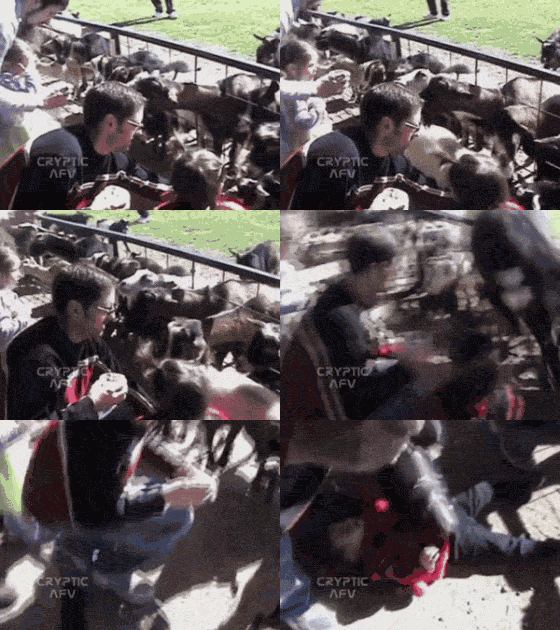
Cow forces it's way inside a door while squeezing a girl - AnimalsBeingDicks.com

"Where’s my affordable healthcare? I herd (lulz) there was healthcare in here!”

26 Aug 16:05

11 Untranslatable Words From Other Cultures [Infographic]

by J.P. Blackard

Language is, without a doubt, one of the most fascinating things about the human race. Most languages can be translated into other languages and cultures, but in today’s infographic we find out that there are eleven words that do not have a direct English translation.

Waldeinsamkeit is a German word that means the feeling of being alone in the woods. Waldeinsamkeit in English could mean scared, worried, or happy. Being in the woods alone can either be a blessing or a curse. Maybe Germans culturally view the woods as a peaceful place–who is to say but a German person?

For the Spanish word listed, sobremesa, directly translated as “about table” (possibly about the table) refers to the instance in which the party who has just eaten together converses with one another. In English, “table talk”–a word that dictates what is appropriate to talk about at the table, and what is not–could be the translation for many.

The Russian word pochemuchka is also listed. No one wants to be a pochemuchka. This word signifies a level of insecurity in a given situation and its surroundings (unless its your job to ask a lot of questions).

Language is beautiful in every aspect. It should be encouraged more often that we all get to know someone else’s culture and language. It can benefit you, those in your community, and those you may meet in the future. [via]

Don’t forget to enter our Infographic Poster Sweepstakes on Facebook! Enter here!

11-untranslatable-words-from-other-cultures_52152bbe65e85


© J.P. Blackard for Daily Infographic, 2013. | Permalink | 12 comments | Add to del.icio.us
Post tags: converse, culture, English, fascinating, human, language, signify, translation, words

17 Aug 17:31

‘The Sports Gene’ Explores The Science Of Success

by Doug Tribou
Jeffrey.bramhall

For Lo reading and listening.

While researching his new book The Sports Gene: Inside the Science of Extraordinary Athletic Performance, David Epstein traveled the world to talk with elite athletes and the scientists who study them. He found a complicated web of athletics, training, ancient folklore and debates about nature versus nurture.

Highlights From Doug’s Interview With David Epstein

DT: There’s a long list of people offended by research into genetics in sports. You’ve got people who don’t want to hear their race is at an advantage, people who don’t want to hear they’re at a disadvantage, and there are elite athletes who don’t want a genetic fluke to get the credit for their hard work. How is that hindering the efforts of scientists who are trying to learn more?

DE: In two main ways. Some of the scientists I spoke with told me they would actually drop the word “genetics” from their scientific grant proposals and substitute it with something like “molecular biology and protein synthesis,” which is the exact same thing. It just doesn’t have that sort of deterministic air about it. And also, of course, there’s the tie to race, and some of the scientists are concerned that documenting any physical difference between ethnicities can somehow be taken to support the idea of innate intellectual differences even though the two have nothing to do with one another.

DT: There’s an old basketball adage that you can’t coach height, and that certainly still proves true in the NBA. But maybe a better adage would be, “You can’t coach wingspan?”

DE: When I analyzed data from the NBA combines next to [Centers for Disease Control] data on American height, I found an American man between the ages of 20 and 40 who’s at least 7-feet tall has about a 17 percent chance of being in the NBA right now, so that shows you how important height is. At the same time, most of these guys have extraordinarily long arm spans, even compared to their heights. So I’m about to 1:1 exactly – my arm span is the same as my height. Most people are a little longer than that, 1.01:1. In the NBA, the average is 1.05:1. So not only are these guys ludicrously tall, they’re preposterously long.

DT: According to one researcher’s projections, one in every 20 million men in the world have innate, world-class running talent. In Kenya, 1,600 in every 20 million have it. How do nature and nurture collide in Kenya’s Kalenjin region?

DE: I think Americans think of Kenyans as being great distance runners and marathoners. In Kenya, they think of the Kalenjin tribe as being the great runners. They only represent 10 – 12 percent of the population, but they happen to have very long, thin limbs. That’s an adaptation for cooling – same reason your radiator has long coils, to increase the surface area to the volume. And because the leg is a pendulum, having long, thin limbs makes it much more energy efficient to swing.

So you have this group of people, the Kalenjin, who have, on average, not talking about any individual, a body type conducive to running. And then you have this environment where they’re growing up at altitude, which increases the surface area of your lungs. They’re running to and from school, so they’re staying fit, they’re staying lean, they’re learning if they’re good at it. When I would go to the dirt tracks there, someone would walk off of a subsistence farm and try to run right alongside a guy with a gold medal, you know, on a dirt track with sheep grazing on the infield. So, you have this huge number of people who are basically giving it a shot, and not by jogging, really by training. There are no joggers in Kenya. There are only people who are running for transportation, people who are killing themselves in training to be an Olympian, and people who aren’t running at all. So you have a good talent pool and a great talent-sifting mechanism with a large group of people training.

'The Sports Gene' by David EpsteinDoug’s Review of The Sports Gene

David Epstein logged a lot of miles to do the research for his new book, The Sports Gene: Inside the Science of Extraordinary Athletic Performance, and the results are fascinating. From an ophthalmologist who used eye exams to predict which baseball prospects would become major league stars to the amazing story of a somewhat disinterested endurance athlete who couldn’t help but become the best female competitor in Ironman history, Epstein delves into compelling stories from around the globe that tie into state-of-the-art genetic research.

Epstein likens the human genome to a 23,000-page recipe book that’s found in every human cell. Explaining the challenge of trying to figure out which genes lead to specific traits, he writes: “If one page is altered or torn out, then some of the other 22,999 pages may suddenly contain new instructions.”

The Sports Gene examines the value of intense training versus genetic good fortune. In his influential book, Outliers Malcolm Gladwell writes about a theory that 10,000 hours of practice could turn anyone into an elite performer in their chosen field. The idea has been so widely quoted since that there’s even a golfer who took up the game trying to make the PGA Tour after 10,000 hours of practice. Epstein reveals that the researcher behind that theory blames a chapter title in Gladwell’s book for creating a misunderstanding about the research. It turns out 10,000 hours is an average, not a hard and fast number, meaning some people might need more time – a lot more time – to achieve their goals.

In one chapter, Epstein explores the science behind Jamaican folklore that credits the island’s warrior-slave history for the current dominance of the nation’s sprinters. The next chapter, titled “Malaria and Muscle Fibers,” details connections between malaria in western Africa, the sickle-cell trait, and elite short-distance runners. After that Epstein, looks at the phenomenon of Kenyan long-distance runners, noting that, according to one estimate, 80 in every 1 million Kenyan men have the foundation for world-class running talent. That figure is 1 in 20 million in the rest of the world. Those three chapters alone make reading The Sports Gene  worthwhile.

To Epstein’s credit, in a book loaded with documentation and detail, there are only a couple of spots where the momentum lags with a bit of extended explanation. One example is the concept of “chunking,” which boils down to an elite athlete’s ability quickly assess a sports scenario after seeing just a glimpse of the situation. The research into the concept is certainly noteworthy, but not difficult to understand.

But that’s a minor blip in an immensely accessible and enjoyable book. One of Epstein’s strengths is his ability to remain devoted to a fair and thorough explanation of the science while weaving in great stories about athletes who exemplify the concept at hand. The Sports Gene is also dotted with funny, clever turns of phrase. In an excellent chapter, Epstein explains why having a wingspans greater than their respective heights is nearly as important for NBA players as being tall. He describes sharpshooter J.J. Reddick’s perfectly normal wingspan (6’3¼” compared to Reddick’s height: 6’4”) as “downright Tyrannosaurus Rex-ian” by NBA standards.

Dog-earing interesting pages left my copy of The Sports Gene well worn. It’s a book that will give you a different way to think about the sports you watch and play.


14 Aug 21:31

HEY BITCHCAKES, HOW D’YOU LIKE THAT HOARDING?


HEY BITCHCAKES, HOW D’YOU LIKE THAT HOARDING?

05 Aug 16:57

Family portrait


Family portrait

02 Aug 23:38

Boycott Sochi?

by Dave Zirin
Russia's crackdown on gay rights and the increasingly loud calls to skip the Winter Olympics.
29 Jul 14:53

Goal Line Stand

Goat jumps over fence and into unsuspecting little girl - Animals Being Dicks

Looks like Reggie is super excited that football season is almost here.

19 Jul 02:25

Chasing Le Tour: Riblon wins the Double Alpe

by cyclingtips
Jeffrey.bramhall

Tour de Beer hand up

It took 18 stages but the French fans can finally celebrate one of their countrymen winning a stage at the 100th edition of the Tour de France. Christophe Riblon got in the breakaway on the first climb of the day – the Col de Manse which topped out just 13km into the stage. He was still at the head of affairs 160km later, taking a famous victory on the first one-day double-summit of Alpe d’Huez in the Tour’s history.

The win certainly wasn’t without its hiccups for the Frenchman from Ag2r. On the technical and much-discussed descent of the Col de Sarenne Riblon overshot a left-hand turn and found himself in a drainage ditch while his breakaway companion Moreno Moser continued on down the road. But Riblon managed to stay upright as he left the bitumen and eventually caught back on with Moser as the final climb of Alpe d’Huez approached.

And when Tejay van Garderen distanced Riblon on the the final climb, the Frenchman dug deep and in an amazing display of tenacity, reeled van Garderen in with just 2km to go before soloing to victory by nearly a minute.

A few minutes behind the leaders the fascinating battle continued between overall leader Chris Froome and the rest of the GC contenders. Contador and Kreuziger had attacked Froome on the Col de Sarenne descent and got a gap, before being brought back before the final climb. The Saxo Tinkoff pair would later pay for their exertions, being dropped by the leaders and losing even more time to Froome.

We saw Quintana attack unsuccessfully and, eventually, succesfully, finishing more than a minute clear of Froome. We saw Rodriguez attack, opening up a gap that took Quintana and Froome a few minutes to shut down. We saw Porte playing the role of super-domestique with never-say-die determination, shutting down attacks and clawing his way back to Froome after being distanced by attacks from Froome’s rivals. Porte even ended up back at the front, driving the pace for Froome after being dropped.

And at one stage Porte looked back and even had to wait for Froome, reminiscent of Froome himself having to wait for Wiggins last year. However, you can feel the camaraderie between Porte and Froome that didn’t exist between Froome and Wiggins.

We now know that Froome hunger-flatted on that final climb, sending Porte back to the team car for gels. Both riders were docked 20 seconds for the incident — riders aren’t allowed to refuel from the team car in the final 20km — but the infringement was worth it; Froome picked up more time on his nearest rival, Alberto Contador, with his overall lead now beyond 5 minutes.

Like last year, the race is destined to end with victory for a Sky rider; a victory that was locked in early in the Tour. But this year’s race is leagues apart from Wiggins’ win in 2012, at least from a fan’s perspective. We’ve seen the yellow jersey of Froome attack often and with conviction — look no further than Mont Ventoux for a perfect example. And while Froome’s moves today lacked the bite they had in Provence, it was still a joy to watch the race leader animating the race.

We spent most of the race today down on Dutch Corner which was just as exciting as the race up Alpe d’Huez. It was estimated that between 700,000 and one million fans lined the road from the town of Bourg d’Oisans up to the finish. But the main attraction was on corner number 7 where thousands of orange t-shirts danced to cheesy Euro techno having an absolute ball.

For all the nationalities in this world who think they’re “king of the party”, the Dutch will eat you for breakfast. It was one of the craziest things I’ve ever seen on the side of a mountain.

The degree of enthusiasm was made all the greater thanks to the success of Dutch duo Laurens Ten Dam and Bauke Mollema on this year’s Tour, with Mollema sparking a new craze in the country, coined “Mollemania”.

Until tomorrow, thanks for reading, turn up some Dutch party music, and enjoy the photos we took from today’s spectacular stage.


fans1 There were more Aussies on Alpe d'Huez today than I've ever seen before. Perhaps we should get our own corner? froomie Jens Voigt made the early breakaway of nine riders and received massive support on the first ascent of Alpe d'Huez, as seen here. The moment this inflatable couch was left unattended, it was bounced and paraded all over Dutch Corner. As hard as they tried, the Dutch fans were unsuccessful in destroying it. Every so often the Dutch fans would crouch down and wave their fingers like they were casting a spell while the music slowed down. When the music sped up again Dutch Corner turned into one giant disco. Madness! Top Left: I'm not sure what party game they were playing on the road, but the gendarmes certainly weren't happy. Top Right: The Harlem Shake was a popular dance on the day. Bottom Left: Despite all the shenanigans, there was still a man sweeping the course clean of all the plastic cups, wrappers, and other debris. Bottom Right: The Smurfs were originally a Belgian cartoon, but even they ended up on Dutch Corner. According to Wikipedia, the word “Smurf” is the original Dutch translation of the French "Schtroumpf", a word invented when, during a meal with fellow cartoonist André Franquin, Peyo could not remember the word salt. Thomas Voeckler tries to bridge to the front group on the first ascent of the Alpe. 2N4A2990-2 Richie Porte leads Quintana, Froome and Rodriguez up the second ascent of the Alpe. Tejay comes through Dutch Corner alone on his second ascent on his way to the finish. Tejay van Garderen makes his way alone through corner number 7. 2N4A3127 Riblon in close pursuit of van Garderen. The fans on Dutch Corner greeting the television helicopter. Tejay van Garderen grits his teeth a few kilometers from finish. I think we now know how much of an effect post-Giro fatigue has had on Cadel's 2013 Tour de France and it's a shame to see him so far off the pace. It will be interesting to see what happens with his leader's role next season. I'm always quick to write off Cadel, but he keeps bouncing back ... Tour de France 2013 stage-18 The moment where Froome realises he's gone hunger flat and calls for help. Richie went back to the team car to get him a gel but both of them got penalised 20 seconds for taking a feed from the car within the final 20kms. Froome said, " It wasn't a huge setback. Richie was feeling a lot better than I was today and I was running out of sugars towards the end. I had to ask him to go back and grab me some sugars from the car. I was just getting in as best I could in those last few kilometres. I'm not sure if it made any difference at that point in the race." Quintana attacks Froome but is brought back. Team Sky leads the peloton through Dutch Corner on the first of two ascents of Alp d'Huez. Christophe Riblon gets France's first victory in this year's Tour and is only the third Frenchman to win on Alpe d'Huez. Tour de France 2013 stage-18 There was an attack from Contador and Kreuziger on the Col de Sarenne but it never gained any more than 20” on Froome. The peloton descents the Col de Sarenne. As it turns out, there was much ado about nothing on the Col de Sarrenne. Tour de France 2013 stage-18 Tejay approaches the final kilometers with Riblon closely behind only to get caught in the final kilometre. Rodriguez, Quintana and Froome after Porte and Contador fell off the pace, but once again Porte fought his way back and rejoined Froome to bring him home to the finish. van Garderen moments after getting overtaken by Riblon and chased by a naked man. After the race Tejay said, "It was painful to lose, but at the same time it was kind of surprising we were even in the hunt for the  win. When I did my first attack the first time up Alpe d'Huez, when we only had seven minutes, I didn't actually think at that moment we were going to stay away. I was just doing it to show my presence in the race." Dutchmen Lars Boom (left) and Koen de Kort get a warm greeting on corner number 7. Once Riblon caught Van Garderen he immediately attacked and would go on to claim AG2R La Mondiale's first victory in the 100th Tour de France and the first for France. Chris Froome and Richie Porte cross the finish together. Richie Porte saved Chris Froome's GC lead after Froome hit the wall and lost contact with his rivals Quintana and Rodriguez. Froome said, "“I was low on sugars and Richie saved me. Richie’s a really great guy; he put all of his ambitions aside in this race to keep the jersey on my shoulders.” Behind the GC contenders, other riders in the race had a bit of fun on Dutch Corner. Jens Voigt left it all on the road making the early break but finishing 15 minutes down. The groupetto crosses the last switchback of Alpe d'Huez 30 minutes down. Tom Veelers was the last rider to cross the finish line at over 33 minutes down, but he had thousands of Dutch supporters helping him get to the top.

Race Results Summary

Tour de France (2013) - Stage 18

Gap to Alpe d'Huez (173km)
18 Jul 2013

View the full race results
Stage 18  |  Stage 17 (ITT)  |  Stage 16  |  Stage 15  |  Stage 14  |  Stage 13  |  Stage 12  |  Stage 11 (ITT)  |  Stage 10  |  Stage 9  |  Stage 8  |  Stage 7  |  Stage 6  |  Stage 5  |  Stage 4 (TTT)  |  Stage 3  |  Stage 2  |  Stage 1


Stage
Position Name Nationality Team Time
1 RIBLON, Christophe FRA AG2R LA MONDIALE 4:51:32
2 VAN GARDEREN, Tejay USA BMC RACING 59
3 MOSER, Moreno ITA Cannondale Pro Cycling +1:27
4 QUINTANA ROJAS, Nairo Alexander COL MOVISTAR +2:12
5 RODRIGUEZ OLIVER, Joaquin ESP KATUSHA +2:15
6 PORTE, Richie AUS SKY PROCYCLING +3:18
7 FROOME, Chris GBR SKY PROCYCLING
8 VALVERDE, Alejandro ESP MOVISTAR +3:22
9 NIEVE ITURALDE, Mikel ESP EUSKALTEL - EUSKADI +4:15
10 FUGLSANG, Jakob DEN ASTANA

General Classification
Position Name Nationality Team Time
1 FROOME, Chris GBR SKY PROCYCLING 71:02:19
2 CONTADOR VELASCO, Alberto ESP Saxo Tinkoff +5:11
3 QUINTANA ROJAS, Nairo Alexander COL MOVISTAR +5:32
4 KREUZIGER, Roman CZE Saxo Tinkoff +5:44
5 RODRIGUEZ OLIVER, Joaquin ESP KATUSHA +5:58
6 MOLLEMA, Bauke NED Belkin +8:58
7 FUGLSANG, Jakob DEN ASTANA +9:33
8 ROGERS, Michael AUS Saxo Tinkoff +14:26
9 KWIATKOWSKI, Michal POL OMEGA PHARMA-QUICKSTEP +14:38
10 TEN DAM, Laurens NED Belkin +14:39

Points Classification
Position Name Nationality Team Points
1 SAGAN, Peter SVK Cannondale Pro Cycling 380
2 CAVENDISH, Mark GBR OMEGA PHARMA-QUICKSTEP 278
3 GREIPEL, André GER LOTTO BELISOL 227
4 KITTEL, Marcel GER ARG 177
5 KRISTOFF, Alexander NOR KATUSHA 157

Mountains Classification
Position Name Nationality Team Points
1 FROOME, Chris GBR SKY PROCYCLING 104
2 QUINTANA ROJAS, Nairo Alexander COL MOVISTAR 97
3 RIBLON, Christophe FRA AG2R LA MONDIALE 77
4 NIEVE ITURALDE, Mikel ESP EUSKALTEL - EUSKADI 63
5 VAN GARDEREN, Tejay USA BMC RACING 62

Youth Classification
Position Name Nationality Team Time
1 QUINTANA ROJAS, Nairo Alexander COL MOVISTAR 71:07:51
2 KWIATKOWSKI, Michal POL OMEGA PHARMA-QUICKSTEP +9:06
3 TALANSKY, Andrew USA Garmin-Sharp +10:52
4 BARDET, Romain FRA AG2R LA MONDIALE +25:13
5 VAN GARDEREN, Tejay USA BMC RACING +1:01:50

18 Jul 16:30

Be a B+ Coffee Snob

by Seth Colter Walls

Mocking people who care about coffee is a proud American tradition dating back approximately to the birth of Starbucks. The same jokes about coffee-dandyism that filled up many a half-hour of the ’90s-era sitcom Frasier still work for The New Girl. (And Portlandia. And Funny or Die.) The attitude has become so commonplace that it infects journalism about contemporary coffee appreciation. Glance at the New York Times’ recent item on the latest high-market brew outfit to open a glitzy showcase space in Manhattan. There is a faint but unmistakable note of derision in lines like, “If you want to learn how grind size affects extraction, here’s your chance.”

17 Jul 18:31

Real People: Bold Dressers I consider myself a fairly...

by derekguypto


Real People: Bold Dressers

I consider myself a fairly conservative dresser, but I don’t think one has to dress conservatively in order to look good. Niyi from New York is a perfect example. He has a very strong, bold sense of personal style. What he wears might not suit everyone, but it works excellently for him.

Pictured above are two of his recent summer ensembles. The first combines charcoal trousers with a tan sport coat (the best combination for charcoal trousers, in my opinion), and plays a bit with proportions. The jacket’s gorge is higher, lapels narrower, and collar points shorter. I’d normally think such proportions look affected on most guys, but Niyi carries it off here exceptionally well. I also like the soft fit of the jacket along the shoulder line, and think it helps him look natural and relaxed.

The second ensemble is deceptively more complicated than it seems. Here, Niyi is mixing four patterns without any of them clashing. There are the narrow stripes on the suit, the wider stripes on the shirt, the boldly patterned tie, and the complementary (but not matching) patterned pocket square. To go with the summery shirt and suit, he’s picked chestnut shoes instead of your regular dark brown. I think it looks fantastic.

Incidentally, like our friend Rob, Niyi is also putting together his own men’s accessories label. It’s called Post Imperial, and the two ties you see here are actually from his line. I’m told that the shell fabric is made of a cotton treated in “adire” – an old hand dying process developed by the Yoruba people in the southwest region of Nigeria. These ties will be available in Spring of 2014. 

17 Jul 13:47

jessethorn: Here’s an Outshot I did about Chance the Rapper’s...

by jessethorn
Jeffrey.bramhall

FOR MAKE LISTEN BY LODRINA BECAUSE LOTS OF TALK ABOUT GROWING UP IN THE MISSION.


jessethorn:

Here’s an Outshot I did about Chance the Rapper’s remarkable song Paranoia, from his mixtape Acid Rap (which is available free on his site). This one is pretty personal for me, and was a bit tough to write, but I’m very proud of it.

Once in a while, I like to share a piece from my NPR show Bullseye here at Put This On. I hope you’ll give this one, about Chance the Rapper, a listen. It’s short, and meaningful whether or not you’re a hip-hop fan.

15 Jul 15:47

Patience and Belief

by Paul Carter

“The two hardest tests on the spiritual road are the patience to wait for the right moment and the courage not to be disappointed with what we encounter.”
― Paulo Coelho

When I started lifting weights at fourteen years old I could barely bench press the bar.  By “the bar” I mean the empty bar.  45 pounds.  If I could bench it, it was with some “bro spotting”.

“All you man!  You’re owning that bar!”

I was 5’9″ and 98 pounds of pure depression and self loathing.  I do not believe my condition in that regard was unique to me as a teenager.  Lots of young men struggle with puberty and trying to find balance in the early years of hormonal wreckage.  Cracked voices, zit riddled faces, and an awkwardness with those of the opposite sex so horrifying that it can only be observed and not described, are often the things that make up our youth.  These conditions often make for shaky confidence, to put it mildly.

For many males that hoist the iron, their genesis in the weight room started to help overcome these conditions.  To combat them by putting on a shield of “armor” and add some confidence and stability to a shaky foundation.

I did not love the weights at first.  I hated the soreness.  I hated the gym and the effort I was being asked to give by my coach at the time.  However as my strength increased and my body started to look more like that of a teenage dude instead of a teenage chic, my love for the iron grew.  I learned to love the effort.  I appreciated the struggle.

And boy did I struggle.

It took me almost two years from that point in order to hit a plate on each side.  Yes, it took me damn near two years to bench press 135 pounds.  And though progress in my later teenage years were far more substantial than my early years (I never had that “noob gain” phase like most guys do), I was certainly not a natural mutant or freak.

Since those early days I’ve close grip bench pressed 445 pounds, incline pressed 425 pounds, and doubled 315 pounds in the press behind the neck.

It took me more than two decades of struggle to climb to those numbers.  Regardless of how they compare to anyone else’s, they are mine, and I’m proud of them.  I put in a lot of time and effort to reach them.  I do not apologize for not “measuring up” to what someone else can do.  The only person I need to measure up to each day, and get better than, is the competition I see in the mirror.  That guy needs to be better today, than he was yesterday.  And tomorrow, he needs to be a little bit better than he was today.

Was my attitude always like this?

Hell no.

I went through many years of struggling with doubts and self loathing in regards to my lifting.  I did in fact compare myself to other lifters I saw that were bigger and stronger than me.  I would often times get depressed because I didn’t measure up to this guy, or that guy in that regard.  A belief resonated constantly in me that I had been training too long and too hard to have such a modicum of results in return for my efforts.  Especially compared to others I knew that either hadn’t been training as long, or that I saw weren’t working as hard as I was.

The reason these thoughts plagued me is because I had not come to the realization that I needed to understand the two most important concepts behind success in training.

Patience, and belief.

Patience -

The four virtues of self-efficacy are courage, perseverance, persistence  and patience.

Of those four, I believe that for the majority of us patience is the hardest to understand and accept.

Understanding patience is the first step in accepting it, and the difference in knowing something and understanding something, are two very different things.

Knowing is the act of having knowledge.

Be definition, knowing is the expertise and skill acquired by an individual through his experiences and education.

Understanding, by definition however, means a psychological process related to a person, object, situation, or messages which require an individual to think and use concepts to deal with.  Understanding involves conceptualization and association.

“I know I have to be patient.”  

I may “know” this….however I may not understand it.  A lack of understanding means that I may not have any way to associate the time frame that is required for my dreams, goals, aspirations, etc, to come to fruition.  It requires you to have an association with it personally somehow, through experience, and a deeper understanding of a process.

Understanding means you have a fundamentally deeper level or grasp of something, than knowledge.

You can’t take a class in college to obtain knowledge on how to be patient.  Or understand what patience really is, because conceptually it means something different to everyone.

If I do not understand the process behind reaching my goals I will not come to an understanding of patience.  I may whine and cry about how long it’s taking, or I may believe that I am in fact doing enough, and that my efforts feel as though they are in vain.

“I work hard!  It’s not happening as fast as it should be!  I’m obviously doing something wrong, or I’m not cut out for this.”

Even if you are working hard, and doing everything to the maximum of your genetic abilities, it still may take longer than you wish.  The body can only move as fast as the physiological motor will allow.  The “wanting” or “desire” of your mind cannot change that function.  It can certainly fuel your efforts.  However the fruits of your labor will always be limited to how fast your body can process all of the variables involved with training, diet, and recovery to make you bigger/stronger.

“I do everything right.  I have sacrificed everything in my life to make this dream become a reality.  I deserve to get what I want!”

I understand that.  However the universe does not care about your sacrifices and wishes.  There isn’t a God of powerlifting/bodybuilding/strongman/athletic-abilities that can acknowledge your sacrificial atonement and bless you with the abilities you so desperately desire.

The only thing you deserve is what you can earn or take, and retain as your own.

If the fulfillment of your aspirations and goals have not been realized, then the difficulties that are beset upon you, still need to be conquered.

To put it plainly, you still have work to do.

You still have more time to put in.  Regardless of how you “feel” about it, those conditions still haven’t been met.  That means you have NOT come to an understanding and association that more time and/or more effort is required.  There’s simply no getting around that concept.

The enemy of patience – Entitlement 

A jigsaw puzzle will never put itself together for you, no matter how long you work on it.  The pieces will only be put in place by the hand that picks them up, figures out where they are supposed to go, and places them there.  Some people put these pieces together faster than others, and some people put them together slower than others.  Some people never finish putting together the puzzle at all, and simply resign themselves to being “wishful” or an “I once…” person.  ”I once thought about finishing that jigsaw puzzle….but then it got to be more tedious than I felt like the effort was worth.”

As the saying goes, you can wish in one hand and shit in the other and see which one fills up first.

Entitlement is quite often the enemy that unstitches our efforts to eventually develop an understanding of patience.

When one finally understands that something will take time, and develops an association with that concept, then being patient becomes accepted.

The great thing about understanding patience in one area is that it often transcends into other areas of your life seamlessly.  Then you find that the ability to deal with and weather storms, plateaus, and setbacks effectively becomes a part of who you are.  You grok patience.  You accept it as part of the journey because you eventually understood what it meant.  It isn’t just about a time frame alone, but about doing the right things over and over again in that time frame.

That is the only way that our goals and dreams can manifest themselves into our reality.

A major key facet in understanding patience is to appreciate every step forward, no matter how insignificant it may appear.  Inching forward is still better than not moving at all.  Learn how to appreciate every small step forward/  After all, you just got a little bit closer to your goal.  Even the smallest of goals attained add up to very big things over time.

Think in terms of creating the single best moments that you can.  Not the best week, or month, or year.  Because none of those things are promised to us.  Just the here and now.  By focusing on the here and the now, patience will eventually be something understood and accepted.  Eventually, you’ll realize that you’ve traveled very far from where you first started.  And the “time” associated with that journey will never been a part of the burden.

Belief - 

“If you stumble about believability, what are you living for? Love is hard to believe, ask any lover. Life is hard to believe, ask any scientist. God is hard to believe, ask any believer. What is your problem with hard to believe?”
― Yann Martel

All of us sling the iron because we want so desperately to become something more.  There’s no getting around that.  We desire to become a better/bigger/enhanced version of what we currently are physically.  This is in fact, why we do the things we do in and out of the gym.

When I was trying to “understand” patience and long periods of stagnation or regression would occur, I would often immerse myself into those pools of despondency I wrote of earlier.  Sometimes succumbing to the belief that I would never ever “measure up” to anything I felt was worthy of being called strong or muscular.  Often times the worst thing about the present is that it always feels so permanent; so lasting.

But if you take just a moment of proper reflection, you will realize, it never is.  The only constant is change.

If you keep applying enough force, eventually the pendulum will swing back in the other direction, and momentum can be seized.  If you immerse yourself in all the things you need to do to improve, it will eventually happen.  It just may not happen at the rate that keeps a smile on your face.

As I noted about patience, it’s up to us to make the best of the present in order to inch forward.

When you waste that time in the doldrums of disbelief then your gifts go unappreciated, and belief is snuffed out.

“I took my bench from 300 to 315.  It’s not elite, but….”  

Always be proud of your accomplishments.  You worked for them.  Believe in yourself and your ability to get to that next level.  If you don’t believe you can, no one else will believe for you.  And even if they did, it wouldn’t matter.  They aren’t the one who has to put in the work.  So it’s up to you to take it upon yourself to instill the unyielding belief that you are a force to be reckoned with.  You have to make the decision to stop dwindling in the darkness of self doubt.

There has to come a point in your mind, a moment where you indubitably believe…..you UNDERSTAND, that you can.  That you will.  That all doubt has been eviscerated and replaced with that of determination and unwavering perseverance.  Doubt has to be conquered so that belief can begin its reign.

“I hope” is replaced by “I will.”

“I might” is replaced by “I can.”

Since this is for JTS, then their motto is very fitting for understanding this mindset.

“Become unstoppable.”

However, without understanding that patience and belief work hand in hand with each other, you might eventually find yourself in those awful places of doubt and despondency.  Perhaps you already have at times.

You must understand that the journey you are on is in fact a marathon, and not a sprint.  Even the most elite of lifters struggle for years, and often decades at a time to climb up to the next rung on the ladder.  The first time Andy Bolton stepped foot in a gym he deadlifted 600 pounds.  He didn’t pull his 1,000 world record deadlifting until 20 years later.

Here are some undeniable facts about every training journey that has endured a significant test of time.

There will be times of struggle.  You may go long periods without much to show in the way of progress.  You must hold steadfast to the belief that they will pass, and that you will eventually push through them.

There will be times of doubt.  You must fight this off with the force of 10,000 Vikings.  It is imperative that you find a way to stay positive and hold on to the belief that nothing will stop you from attaining the things you desire most.

Every lifter worth his salt, that has paid his dues and put in his time share similar stories of struggle and doubt.  However the ones that survive those times long enough will also be able to share with you that the two words written about here, will serve you better than any two other words you will ever need on your journey to becoming what you envision.  Patience, and belief.

Understand patience.

Accept the process.

Believe with an undying will.

You will arrive.  It will happen.

“Never stop just because you feel defeated. The journey to the other side is attainable only after great suffering.” 

― Santosh Kalwar

Paul Carter works as the president, general manager, and CEO of the blog Lift-Run-Bang.com. He is the author of Strength, Life, Legacy and competes as a raw (rare-no belt or wraps) powerlifter.  Website, Facebook, Twitter


The post Patience and Belief appeared first on Juggernaut Training Systems.

11 Jul 14:07

Beet and Carrot salad

by noreply@blogger.com (gewilli)
it is hot out, a good cold salad is always nice, no?

grab the food processor cause you ain't gonna wanna shred this by hand.

1-2# of raw peeled beets and carrots

run em through the food thing.
finely slice an onion or two
soak sliced onions in some cold water for a few minutes, rinse repeat

dress it

put it over the top then mix:
celery seed
apple cider vinegar
splash of balsalmic vinegar
olive oil
dijon mustard
salt
black pepper

mix completely... let rest... mix up again... rest... mix... rest...

until you give in to the awesomeness of the flavors and devour the whole thing.

or at least a small bowl with whatever else you happen to be eating with your meal.

Simple.  Quick.  Super flavorful.

heddwch
G
08 Jul 15:42

Yoga for Athletes-Part 1

by Stacy Schaedler
Jeffrey.bramhall

mostly sharing to you, Lo, because she's from boston area, is fitness and yoga instructor and also former figurelady.

Want to improve performance AND up your game? It’s time for you to try YOGA.

There are so many benefits to yoga…here are my top 3:

  1. Recovery + Injury Prevention
  2. Mobility, Flexibility + Stability
  3. Mind Body Connection to Breath

1.     RECOVERY + INJURY PREVENTION

An athlete’s job is to train, eat, sleep and repeat.  Performing at such high intensities can leave you out of balance. Getting underneath 400+ lbs of steel and squatting for reps is an impressive feat!  It will also leave you with some tight adductors, glutes, hips and core.

Yoga is different from other methods of recovery because it requires your active involvement.  It falls under the blanket of “steady state cardio” because of its duration and intensity, while at the same time allowing for the development of kinesthetic awareness. Unlike massage, ART or hydrotherapy, moving through your full range of motion, barefoot, in a room without mirrors, is sure to enhance your body awareness.

Repeat after me:  “EVERYTHING YOU DO, YOU MUST UNDO.”

Yoga is a tool used by the self to identify deficiencies. The more you are aware of your asymmetries from left to right within your body, the more aware you will be underneath the bar. Next time you go to squat you’ll be spreading your feet beneath you, using your breath to back your lifts and hitting PR’s you never thought possible!

Oh and there are FEW things that feels better the day after an intense training session than active recovery with YOGA. It just feels so DAMN good.

 2.     MOBILITY + FLEXIBILITY + STABILITY

Mobility and flexibility are often lumped together but in reality are two very different things.  And then stability comes in and really complicates things.

Mobility pertains to the motion we are able to CONTROL around a joint.

Flexibility is the movement that is POSSIBLE around a joint.

Stability is established with both active and passive influences.

As an athlete you need something to balance out your strength and explosive power. Yoga does just that.

It boosts flexibility while challenging stability at the same time. Take your hamstrings for example.  They may feel tight, simply because your body is attempting to create stability where it’s missing. Doing just a static stretch will not engage the core and will actually cause more instability and possibly injure you.

A warrior III with a slightly bent knee and square hips will lengthen the hamstrings while training the musculature around the hips and torso to keep you stable.

securedownload-6

securedownload-5


WIN- WIN

Mobility of your joints should be seen as general maintenance for your body.  Keep the body oiled before the squeaky wheel makes its first appearance. For anyone with a prior history of shoulder, hip, or ankle injury, mobility is of the utmost importance.  All great strength coaches incorporate a mobility and stability section in their athletes programs. I would be willing to bet that it’s the first thing to get dropped when you are short on time.  Adding just ONE yoga class a week or ANY of these simple yoga flows will increase your hip, shoulder, ankle and thoracic mobility.

Yoga classes can range from 60 to 90 minutes in length. For some peoples schedules this can simply not be a priority. But 3-10 minutes can fit into anyone’s day. Whether you choose to practice the basics on your own or you muster up the courage to go to a yoga class YOU WILL BENEFIT from incorporating yoga into your weekly routine. Granted your first few classes will be challenging, but isn’t that what life is all about? Step outside your comfort zone!

3. MIND BODY CONNECTION to BREATH

Breathing is fundamental, but many of us do it all wrong. The purpose of yoga is breath control through movement. Athletes are kinesthetic learners; as such addressing breath control through the outside physical body( i.e. moving through yoga poses) gives the athlete TANGIBLE  access to something that can balance them from the OUTSIDE, IN.

I see the enhancement of the mind body connection as a psychological tool and advantage for any athlete!

Get it out of your head that you need a yoga mat or props. You have access to your breath anywhere anytime!

Give these easy exercises a try.

Start by lying on your back with your knees bent and knocked together (at least one hand on your stomach), or seated upright in a chair or bench.

Inhale through your nose for three counts, hold at the top for two counts and exhale through your mouth for three counts. Repeat this for 8-10 rounds.

Gradually increase the count of the inhale and exhale as you see fit, eventually an eight count in-breath will feel like nothing!

This conscious attention to breath carries over to the weight room, the field and your LIFE. Controlling the breath calms the nerves and allows you to recover faster after intense effort. Do not expect this to be easy, it takes continuous cognizant effort, the results will come with practice. This is especially desirable for those set to compete under pressure.

Get more great information from Stacey including recipes, corrective exercise training and yoga at StaceySchaedler.com

Still think yoga is just for women and hippies? Think again. The biggest benefits that yoga offers athletes are recovery and injury prevention, mobility, flexibility and stability, as well as the mind- body connection to breath. There are so many common threads between yoga and your sport, whether it be power-lifting, running, strongman, football, basketball or just general strength training.  As a trainer, I strongly emphasize mobility of ankles, hips, shoulders and upper back as well as stabilization of knees, hips, low back and shoulder girdle, all of which parallel the benefits received from a GOOD yoga class. Yoga offers a ton of isometric as well as eccentric quasi-isometric holds, which provides core strength benefits as well as a stretch for those who need it. Developing this balance between strength and flexibility will lessen the likelihood of injury.  Connecting consciously to breath as well as bodyweight movement will result in a body awareness you never knew possible.  Trust me give yoga a shot, it might just change your life.

Stacey Schaedler runs her own personal training business within the largest yoga studio in Boston.  Stacey is an ACSM CPT, RKC as well as RYT through the National Yoga Alliance.  Her focus is strength training with a strong emphasis on postural integrity and alignment. This, paired with solid nutritional education for her clients creates the foundation for their success.  Not only do her clients learn to move properly, gain strength and eliminate pain, they learn to start listening to their bodies. As a result of her diverse fitness experience as a collegiate athlete, avid yogi and former professional figure competitor, Stacey is a wealth of knowledge for those looking to attain their ultimate fitness and nutrition goals.


The post Yoga for Athletes-Part 1 appeared first on Juggernaut Training Systems.

05 Jul 12:48

Intervention Helper, Chapters 23 and 24

by Dan John
Jeffrey.bramhall

Because training doesn't have to be complicated.

Let me summarize the basic points of Chapter 23 here:

My philosophy for strength training, and no surprise here, is based on three concepts:

1. Movements, not muscle
The Fundamental Human Movements

Push
Pull
Hinge
Squat
Loaded Carries
The “Sixth Movement” This is everything else from rolling, to half kneeling work, to lunges, and one arm. It also included torque, twisting, rotational and antirotational work.

2. “If it is important, do it every day, if it isn’t, don’t do it at all.” This is a quote attributed to wrestling Olympic Gold Medalist Dan Gable
If we know the moves, how do we decide “when” to do them? I argue: every day. In my approach, we will explore the basic movements in nearly every workout. With most athletes, the movement needs repeating far more than most people think. At the elite levels of track and field and Olympic lifting, the total number of full movements is simply staggering.

3. Repetitions…lots of repetitions.
I can’t say it any better than what I learned from a hearing impaired discus thrower that I worked with a few years ago. He had become very good and I asked him his secret. He took his right middle finger and twisted it over his right index finger. and then slapped it into his left palm. In sign language, it means “repetition.”

This chapter can stand alone, I believe.

Chapter 24 is a “learn by doing” chapter. I have noted, by the way, about where to find Ellington Darden throughout here, but the term Metabolic Conditioning was NOT invented in the past ten years like many think. Truthfully, nothing much new has been invented in fitness recently. We have been mastering “copy and paste,” perhaps.

More Swing/Push Up Combos:
Workout Option #1

Swings for 20 seconds
Pushups 6
Rest – 30 seconds
Repeat for 15 mins

* Per workout, increase pushups by 1

Workout Option #2

Swing 30 seconds
Rest 30 seconds

Repeat up to 15 minutes

Workout Option #3

At the top of the minute:

20 swings, 10 pushups, rest the remainder of the minute.
20 swings, 9 pushups, rest … and so on down to
20 swings, 1 pushup.

If you want to do 15 minutes start with 20 swings, 15 pushups.

Next time do 21 swings each time…

Workout Option #4

Swings 20
Gather yourself
Pushups 10

Finisher — Farmer walks

* Note: Instead of time, add sets

Workout Option #5

In your own time:

10 swings, 10 Goblet Squats (GS), 10 Pushups
10 swings, 9 GS, 9 pushups.

10 swings, 1 GS, 1 pushup

Workout Option #6

Drive to a park you and …

On the minute:

1 Swing and 1 Push Up, then carry the weight to the top of the next minute
2 Swings – 2 Push Ups, carry the weight to the top of the next minute
Continue until you’re finished

Workout Option #7

Goblet Squat: “comfortable stop”***

Rest (length up to you)

Swing to comfortable stop -> Push Up to comfortable stop

Rest 45 seconds

Swing to comfortable stop-> Push Up to comfortable stop

Rest 45 seconds

Swing to comfortable stop-> Push Up to comfortable stop

Rest until you catch your breath

Goblet Squat to comfortable stop

Rest/Cool Down

(Optional Farmer Walk)

Workout Option #8
1 Push Up
1 Goblet Squat
10 Swings

2 Push Ups
2 Goblet Squats
10 Swings

3 Push Ups
3 Goblet Squats
10 Swings

4 Push Ups
4 Goblet Squats
10 Swings

5 Push Ups
5 Goblet Squats
10 Swings

Workout Option #9

5 Goat Bag Swings
5 Goblet Squats
5 Push-Ups
1 Ab-Roller Roll Out

Lather, rinse, repeat.

The point on Vitamin A will be a major part of my next book, working title “Reasonableness.” I constantly think “enough is enough,” but to get there is so hard to pin down.

01 Jul 14:28

The smallest shop in London, circa 1900: a shoe salesman with a...

by jessethorn


The smallest shop in London, circa 1900: a shoe salesman with a 1.2 square meter shoeshop.

(via, ht)

21 Jun 17:51

Three Ways Brush Factories Are Surviving In America

Three Ways Brush Factories Are Surviving In America

by Marianne McCune

Fourth-generation owner of Braun Brush, Lance Cheney, stands next to a special-order brush his company made for the artist Richard Artschwager.

Marianne McCune/NPR

Brushes are pretty simple: a bunch of flexible fibers sticking out of something stiff. Not surprisingly, Chinese manufacturers have grabbed a big share of the U.S. brush market. But several hundred small U.S. brush factories are still hanging on. Here are three strategies they're using to survive.

1. Compete On Quality

In an old-fashioned factory building in the South Bronx, Izzy Kirschner's half dozen employees are making paintbrushes. They're stuffing bristles from slaughtered boars into metal casings, using machines that once belonged to Kirschner's dad. But unlike his dad, these guys try to make every brush perfect.

"My father was more interested in mass production," Kirschner says.

When Kirschner took over the business about 15 years ago, he saw he wouldn't survive if he made mediocre brushes whose bristles came out in the paint. Chinese factories could make the same brushes much more cheaply.

Instead, Kirschner decided to sell expensive brushes to high-end, professional painters who are willing to pay a premium to get exactly the brush they want.

2. Find Niche Markets

"We're making brushes now for the top of the Freedom Tower to keep pigeons out," says Lance Cheney, the fourth-generation owner of Braun Brush on Long Island. His company also made a tiny brush for NASA's Mars Rover, to sweep away the Martian dirt.

"That's the key to being able to manufacture in this country," Cheney says. "If you have a machine that spits out all the same thing over and over and over again, that's right for China. For us, the machine has to be able to be extremely flexible. So it's still automation, but I'm gonna make one brush in the morning, another brush between the lunch and the break, and then a completely different brush the rest of the day on the same piece of equipment."

This allows Cheney to set prices based not on how much the bristle and block cost, but on how much time and effort went into it and how much it's worth to the customer.

3. Build personal relationships

While Cheney keeps building relationships with the next generation, many of Kirschner's clients are from the past. Kirschner's daughter Deborah says they love her dad because he's a constant.

"They can all get my dad on the phone," she says.

But Kirschner is 69. What happens when he and his customers start to retire?

"I do think that there's probably a little danger in that," Deborah says. "There's a lot of loyalty, and that dies out with people and companies."

For More: See Adam Davidson's New York Times Magazine column, What Paintbrush Makers Know About How To Beat China.

Copyright 2013 NPR. To see more, visit http://www.npr.org/.