I’ve had this debut single by emerging NYC mystery duo ASTR on repeat all day. “Operate” is a brilliant fusion of hip-hop, indie R&B and electronica styles that just oozes cool.
Listen to ASTR on Soundcloud.
I’ve had this debut single by emerging NYC mystery duo ASTR on repeat all day. “Operate” is a brilliant fusion of hip-hop, indie R&B and electronica styles that just oozes cool.
Listen to ASTR on Soundcloud.
It's time for another round of The Food Lab. Got a suggestion for an upcoming topic? Email Kenji here, and he'll do his best to answer your queries in a future post. Become a fan of The Food Lab on Facebook or follow it on Twitter for play-by-plays on future kitchen tests and recipe experiments.

Can you start cooking pasta in cold water? If not, why?
—Sent by Robis
If you're a long-time reader of The Food Lab, you might remember an article I wrote that addresses this very question a few years back. I feel it's important enough to warrant a recap.
It's a great question, and one that I've got a personal history with. One of my very first jobs in a restaurant was as a cook at No. 9 Park, a modern Italian/French restaurant in Boston. I spent a good nine months or so working the pasta station, where it was drilled into my head that the water in the pasta machine better be boiling before I put the pasta into it or it won't cook properly and will stick together all mush-like, creating a disturbance in the forza as if millions of Italian grandmothers suddenly cried out in terror and were suddenly silenced.
I never questioned it because it wasn't my place to. It wasn't until about a decade later, when I saw how my not-yet-wife cooks her pasta, that I started realizing that maybe the rule wasn't so hard and fast as it was made out to be. Her method? Cover pasta with cold water in a relatively small pot. Put it over a burner. Stir it a few times as it heats up, then leave it alone.
And it comes out perfectly fine.

Why is this? It's because cooking pasta is actually a two-phase process: Hydration and cooking. Normally, the two go hand in hand—the pasta absorbs water as it cooks. But it doesn't have to be.
Turns out that whether you start with hot or cold water, pasta will still absorb just about the same amount. To prove this, I cooked a few batches of pasta side-by-side in various amounts of water, and starting at various temperatures. No matter how I did it, the pasta all ended up soaking about 75 percent its dry weight in water, and the pastas were indistinguishable from each other in a taste test.
Indeed, the pasta cooked in a small volume of water had a distinct advantage: the pasta water contains more starch, making it more effective at tightening up a sauce and getting that sauce to cling to the cooked pasta.
The fastest, most energy-efficient way I know to cook dry pasta is to place it in a medium saucepan, cover it with salted water by an inch or two, place it over a burner set on high and heat it, stirring every few minutes. Once it comes to a boil, put a lid on the pot and turn the heat to the lowest setting. Even if it loses its boil, the pasta will still continue to cook so long as it's kept above 180°F or so. Follow the back of the box for timing, starting the timer as soon as it comes to a boil, and subtracting a minute or two from the recommended time.
Want some more cool info? Read on!
Want to hear something even more interesting? Folks will occasionally say that "using a large volume of water will help the water come back to a boil more quickly."
Back up a minute there, because you know what? This is untrue. In fact, in most real world cases, the exact opposite is the case.
But how is this so? Doesn't adding a fixed amount of pasta to a small pot cause the temperature in that post to drop more than it does in a large pot? Therefore doesn't the large pot come back to a boil more quickly? Let's examine the ideal scenario first.
You have two pots of water. One has 1 quart of water, the other has 1 gallon—four times as much. Both are sitting on top of identical burners and are at a full, 212°F boil. Now add a cup of dry pasta to each one. Because the pasta is at room temperature, it will cause the temperature of the water in each pot to drop, and the water in the quart-sized pot will drop four times more than the one in the gallon-sized pot.
Ah ha!, you say. If the temperature fell four times lower in the small pot, it must take four times longer for it to come back up to a boil!
The problem with this line of reasoning is that it doesn't take into account the fact that it takes four times less energy to raise a quart of water by one degree as it does to raise a gallon of water. Since a burner puts out energy at a constant fixed rate, the small pot, which needs to cover a temperature gap four times as great as the large pot, serendipitously also heats up four times faster. This means that the two pots of water return to a boil at the exact same time!*
* For the record, it's also the same amount of energy and time required to bring a cup of dry pasta from room temperature to 212°F.
In the real world, the "big pots boil faster" camp is even more wrong. See, the larger a pot, the greater its surface area. And the greater the surface area of a hot body, the more rapidly it can lose heat to the outside environment. How does this affect heating?
Let's say your burners put out heat energy at a very respectable 10,000 Btu. Meanwhile, your small pot might be losing heat energy to the air in the kitchen at, say, 1,000 Btu, giving you a net energy input of 9,000 Btu. A large pot, on the other hand, will lose heat more rapidly due to its larger surface area. Let's say, 2,000 Btu. Your burner is still exactly the same, putting out 10,000 Btu, which means that with a large pot, the net energy input is only 8,000 Btu.
Thus, a large pot will actually return to a boil more slowly than a small pot.**
** This doesn't even take into account the heat loss from evaporation, which again compounds the case against large pots.
Surprised?
The folks over at Ideas In Food have written about "1 minute pasta." The trick? Soak dried pasta in water until it is fully hydrated. Once that's done, all you've got to do is cook the pasta—say, by tossing it in hot sauce—and it comes out as if it had been cooked and hydrated all at the same time. The beauty in this method is that by pre-soaking pasta and having it sitting in your fridge, you don't have to bring a pot of water to a boil every time you want to eat it. Pasta prep becomes almost immediate.
It's how I generally cook my pasta these days: start the pasta soaking while I prepare a sauce or other ingredients. By the time the sauce is hot and ready, the pasta is hydrated, and all I've got to do is drop it in the sauce and let it finish cooking. Easy!

I also use this method whenever I'm putting together a lasagna, like this Creamy Spinach and Mushroom version.
There are times when you do want to start with a large pot of already-boiling water. The first is when cooking fresh pasta. Because fresh pasta is made with eggs, if you don't start it in boiling water, it won't set properly, causing it to turn mushy or worse, disintegrate as it cooks.
The second exception is with long, skinny pasta shapes like spaghetti or fettucini. Because they stack together so easily, it's more likely than with other pasta shapes that they will stick together. As the pasta heats and absorbs moisture, starches on its surface gelatinize, becoming sticky, If the strands are stuck together when this happens, they'll fuse together permanently, especially in a smaller pot where you have less room to maneuver them.
So to cook long, skinny pasta, you've got two real options. First is the traditional method: A large pot of salted boiling water gives you plenty of room to move the pasta around, limiting the risk of it sticking together.
Your other option is to use the pre-soak method. Because starch needs to be heated to gel properly, soaking pasta in cold water will allow you to hydrate it without worrying about it sticking together. Once it's fully hydrated, you've just got to finish it off in your sauce and you're ready to serve.
For a more detailed answer to this question, check out my old article A New Way To Cook Pasta.
Email your questions to AskTheFoodLab@seriouseats.com, and please include your Serious Eats user name in your email. All questions will be read, though unfortunately not all can be answered.
About the author: J. Kenji Lopez-Alt is the Chief Creative Officer of Serious Eats where he likes to explore the science of home cooking in his weekly column The Food Lab. You can follow him at @thefoodlab on Twitter, or at The Food Lab on Facebook.

“If I have seen further it is by standing on the shoulders of giants.” – Sir Isaac Newton
TED is one of my favorite organizations on the planet.
What their 2-18 minute-long talks have done for the distribution of ideas, disruptive thinking and creativity is something I’ll never fully be able to get my head around.
I credit TED for much of the inspiration and ideas that have come to life through Live Your Legend – and just about everything else I do.
They’ve helped me launch businesses, run ultra marathons, connect with world-changers and even kept me from having a breakdown from time to time…
Aside from ideas and inspiration, I believe a good TED Talk is one of the fastest ways to start surrounding yourself with passionate world-class experts.
That is priceless.
I often watch at least a few a week and always have some saved on my iPad or iPhone for bus rides to the office, flight delays, whatever.
The below list was very hard to make, as I’ve seen hundreds of talks and so many deserve our attention.
So please look at this list as merely a starting point.
Every one of the below have had a profound effect on my career and approach to the world – and for our purposes today I’ve only chosen the ones that cover the various steps of making the transition to doing work you love.
Why more people aren’t taking advantage of this stuff will forever baffle me.
If TED hasn’t been a part of your daily life before now, I hope that one of the people below will cause that to change.
These are some of the best story tellers in the world (a skill that one is never done mastering). Pick one for now and follow up with the rest throughout the week.
Enjoy the show… and share your own favorite talk in the comments so we can keep learning!
“People don’t buy what you do, they buy why you do it.” This single sentence of Simon’s has been the most profound concept I’ve learned in at least a few years, if not ever. I built LYL from the ground up based on his idea of starting with Why. I literally take it into account with almost every interaction I have – business or personal.
He lays out a blueprint for finding purpose and building a movement around your vision. I’ve watched this at least 15 times. He also did an interview on LYL last year: Simon Sinek Shares the #1 Business Principle that Changes Everything.
I believe this is hands down the best career talk ever given. Ever. I’ve watched it over a dozen times. Not originally a TED talk, but now one of their top videos.
Whether you want to land your dream job or attract the hottest guy or girl at the bar, Amy’s ideas are gold. A huge part of our Connect with Anyone course. “Fake it until you become it.”
It’s impossible to find and do work you love if you don’t represent who you actually are – both to yourself and to the world. This is the foundation of any genuine connection or passionate career. No more puffing your chest out. Let it all hang out (or at least most of it…).
Harnessing creativity can be terrifying, especially as an artist or entrepreneur. Elizabeth’s alternative approach to this is brilliant.
There’s going to be fear no matter what – and even more of it when you’re pursuing what matters. Jonathan turns that on its head. This and his book, Uncertainty, saved me more than once. His stories also give me chills.
Most school systems are set up to kill a passion long before it has a chance of becoming a career. If we’re going to seek out the solution, it helps if we better understand the problem. Ken offers both.
This dissects the problem of why I believe the Live Your Legend movement is so damn important. Hilariously told too. As Charlie Munger says “Tell me where I’m going to die, that is, so I don’t go there.”
Every world-changing career involves plenty of marketing, selling, persuasion and influence. I’ve never seen a more genius approach (or comical delivery) for positioning your product, service or yourself in a way that actually interests people.
When transitioning to passionate work, it helps to see people who have already found it. This is one of the most brilliant displays of a man deeply in love with the work he does. I never thought classical music could make me cry.
On par with Zander, the passion Jamie has for the revolution he’s leading proves that anything is possible when your Why, purpose and passion are deep and congruent enough. Jamie won the TED Prize in 2010. I watch this and Simon’s before every talk I give.
Doing work you love is not just about you or me. It’s about the people who look up to us whom we can inspire to take a path they actually care about. That is all of our role as mentors, friends and parents. I believe Cameron’s approach will be a huge part of the solution. I look forward to raising my future children with this as the blueprint.
Chip Conley - Measuring what makes life worthwhile (and how to love jobs that most people would hate)
Daniel Pink – The puzzle of motivation (and how to incentivize yourself and others for peak performance and fulfillment)
Ben Dunlap – The life-long learner & talks of a passionate life
Jason Fried – Why work doesn’t happen at work
Nigel Marsh – How to make work life balance work
*****
I owe these people (and many others) more than I’d probably care to admit. They are responsible for much of what exists today, and their ideas certainly served as my foundation when I got the chance to give my own TEDx talk in 2012 on How to Find & Do Work You Love. None of that would have been a dream, let alone a reality, if it weren’t for my surroundings.
The resources, ideas and people available to us today are priceless. Yet they also happen to be 100% free.
The question is, what are we all doing with it?
-Scott
P.S. Thank you all who chimed in with your favorites over Facebook and Twitter this week – I so wish I could have listed all of them!
For the comments: What did I miss – what talk is a must for the LYL community? Please share the link in the comments and teach us something new! I plan to watch them all…eventually  .
.
They're working on human trials designed to make it easier to attack AIDS-causing virus, according to published reports
“She had remarkable eyes, very large and lively, the kind that seem to send off sparks, that sometimes look glowing with an inner fire.”
 Alice B. Toklas, born on April 30, 1877, is remembered for two things: being Gertrude Stein’s great love and writing her unusual, revered memoir-disguised-as-cookbook chronicling their life together. On September 8, 1907, her first day as an American expat in Paris, Toklas met Stein. The two fell instantly in love and remained together for the next 39 years, until Stein’s death. Stein often referred to Toklas as her “wifey” and addressed her as “baby precious.” Writing late into the night, the author liked to leave notes next to the pillow for Alice to find in the morning, signed “Y.D,” short for “Your Darling.” In an ideal, civilized world of human rights and equality, theirs would have been a marriage — and it would have been one of the happiest and most exemplary in literary history.
In her memoir, What Is Remembered (public library), Alice relays the fateful encounter, conveying with admirably few words the immense, intense mesmerism of their relationship:
It was Gertrude Stein who held my complete attention, as she did for all the many years I knew her. I knew her until her death, and all these empty ones since then. She was a golden brown presence, burned by the Tuscan sun and with a golden glint in her warm brown hair. She was dressed in a warm brown corduroy suit. She wore a large round coral brooch and when she talked, very little, or laughed, a good deal, I thought her voice came from this brooch. It was unlike anyone else’s voice — deep, full, velvety, like a great contralto’s, like two voices.

In the foreword to the Folio illustrated edition of The Alice B. Toklas Cookbook, M. F. K. Fisher paints an expressive portrait of Toklas, which seems to begin rather ungenerous but quickly turns lovable, bewitching even:
Her face was sallow, her nose was big or even huge, and hooked and at the same time almost fleshy, the kind that artists try not to draw. And she had a real moustache, not the kind that old women often grow, but the sturdy kind, which started when she was first going into adolescence. I don’t think she ever tried to shave it, or have it plucked out or removed chemically or with hormones, as a woman might do today. She wore it unblinkingly, as far as I can tell, although of course as a person of unusual awareness she must have known that some people were taken aback by it. A friend of mine who admired her greatly, and often traveled with her in her last years, wrote that Miss Toklas wore her close-cropped hair, which stayed black well into her eighties, in bangs “faintly echoed by a dark down on her lip.” This amuses me. It is typical of the general reaction to something that would have been unnoticed except for her obvious femaleness. Another friend said more aptly, or at least better for my own picture, that her strong black moustache made other faces look nude.
She had remarkable eyes, very large and lively, the kind that seem to send off sparks, that sometimes look glowing with an inner fire. Probably people who were intimidated at first by her fixed upon them with relief … that is, until they forgot their shyness in the deft, supple way she moved and talked.
She was a tiny person, not five feet tall, I think, and she dressed with a studied daintiness, except for the clunky sandals on her pretty feet. … She loved dramatic hats, and after Miss Stein’s death she wore them oftener in rare gaddings … big extravagant creations with feathers and wide brims, and always the elegant suits and those clunky sandals. Nobody has ever written, though, that she looked eccentric. Perhaps it was because of her eyes. . . .
Slim and simply worded yet incredibly moving, What Is Remembered endures as a projection of Toklas herself, one that stays with you long after the lights have gone out.
Donating = Loving
Bringing you (ad-free) Brain Pickings takes hundreds of hours each month. If you find any joy and stimulation here, please consider becoming a Supporting Member with a recurring monthly donation of your choosing, between a cup of tea and a good dinner:
| ♥ $7 / month♥ $3 / month♥ $10 / month♥ $25 / month |

You can also become a one-time patron with a single donation in any amount:

 Brain Pickings has a free weekly newsletter. It comes out on Sundays and offers the week’s best articles. Here’s what to expect. Like? Sign up.
Brain Pickings takes 450+ hours a month to curate and edit across the different platforms, and remains banner-free. If it brings you any joy and inspiration, please consider a modest donation – it lets me know I'm doing something right.

Fifty-four seconds on the outermost fringes of our moral comfort zone.
 On April 27, 1945, Italian Fascist dictator Benito Mussolini was captured by Communist partisans while attempting to flee to Switzerland with his mistress, Clara Petacci. He was executed the following day, shot alongside the other members of his 15-person train of Socialist officials. His body was taken to Milan as public proof of the dictator’s death, hung upside down on meat hooks, then stoned by spectators. On April 30, the day that Mussolini’s comrade Hitler committed suicide in his bunker, American TV station Universal broadcast a short newsreel about Mussolini’s gruesome execution, deeming it “a fitting and glorious end.” More than half a century later, as we grapple with new punishment dilemmas surrounding the age-old dichotomy of good and evil, the footage pushes us to the most uncomfortable precipice of our moral tolerance, raising the difficult question of whether even a bloodthirsty despot deserves the very inhumanity for which he is being punished, and what that makes of his executioners.
For a dimensional exploration of what turns a human being into an inhumane tyrant, see R. J. B. Bosworth’s biography, Mussolini.
Donating = Loving
Bringing you (ad-free) Brain Pickings takes hundreds of hours each month. If you find any joy and stimulation here, please consider becoming a Supporting Member with a recurring monthly donation of your choosing, between a cup of tea and a good dinner:
| ♥ $7 / month♥ $3 / month♥ $10 / month♥ $25 / month |
You can also become a one-time patron with a single donation in any amount:
Brain Pickings has a free weekly newsletter. It comes out on Sundays and offers the week’s best articles. Here’s what to expect. Like? Sign up.
Brain Pickings takes 450+ hours a month to curate and edit across the different platforms, and remains banner-free. If it brings you any joy and inspiration, please consider a modest donation – it lets me know I'm doing something right.

    
|
North Carolina is asking families to participate in Screen-Free Week, a time when they're encouraged to unplug and play, read, daydream and explore.
An article from a mother who was anti-vaccine until her daughter (and then the rest of the family) got the whooping cough. And still she feels "funny" about vaccination.
And yet I still wondered about that list of things that I would now, I suppose, have to surrender to and immunise my child against. Polio, for one -- a couple of my parents' pensioner friends still carry the limp left by their childhood polio, but none of my friends do, because it isn't around any more. And diphtheria -- what was that, even? I knew it had killed one of Queen Victoria's daughters, but that wasn't our reality.
The reason it wasn't our reality was, of course, due to a continuous programme of immunisation. Duh. Diphtheria is a disease that still kills one in five infants it meets, even if they get treatment, their necks swelling up until they can no longer breathe. I have now seen a picture of a child whose neck was ravaged by diphtheria, bloated like a foie gras goose about to burst. I wish I could unsee it.
Duh, indeed. This anti-vaccination nonsense is an instance in which the public's lack of knowledge about how science works (and not just their lack of recall of scientific facts) is truly harmful. (via @CharlesCMann)
Tags: medicine science vaccinesCars were moving too fast through an intersection in the town of Poynton in England, so they took out the stoplights & walk signals and replaced the intersection with an unusual double roundel design. The result is a mixed-use space with slower moving car traffic and safer pedestrian traffic.
(via digg)
Tags: cars traffic videoToday's much-needed levity: an accordion that plays when you resize the browser window. (via waxy)
Tags: musicT.S. Eliot's "The Waste Land" begins, "April is the cruellest month." And you know? Maybe he was right. Consider these terrible April events. Warning: They're really terrible.

|
|
NPR's Planet Money talked to Ed Herr of Herr Foods about how potato chip manufacturing has changed since 1946, when the company was housed in a barn on his family's land.
Herr estimates that if they currently made chips the way they did back in the 1940s, they'd cost about $25 a bag.
Tags: food how to videoReasons My Son Is Crying is a new tumblr that will make you delight in the misery of a child. Here are some reasons its creator's son is crying:
I wouldn’t let him drink bath water.
I wouldn't let him down in this pond.
The milk isn't juice.[via]
---
See more posts by Bobby Finger
Netflix has announced that the 15 episodes of the new season of Arrested Development will be released, all at once, on May 26th. Netflix did not announce that later that day, all 15 episodes will be available on BitTorrent.
Tags: Arrested Development Netflix TV

As a California girl by way of New England, I had yet to taste the wonder-inducing substance that is pimento cheese till a few weeks prior. Let's just say that since that first sharp, creamy, and all-around mind-bogglingly delicious bite, I've been making up for lost time and then some. Luckily, I live with a Southern lady who shares a passion for all things culinary related, and - as luck would have it - comes from a family that's involved in the restaurant and catering business. So, when I decided to re-create this revelatory retro treat I knew exactly who to turn to.
Tangy, twangy, sharp but smooth, and studded with chunks of sweet pimento peppers, this classic, no-frills recipe comes courtesy of my roommate's stepmother - who happens to own a catering business - and is pretty darn perfect. If you've yet to become acquainted with this Southern luncheon staple, there's no time like the present - whip up an addictive batch today.
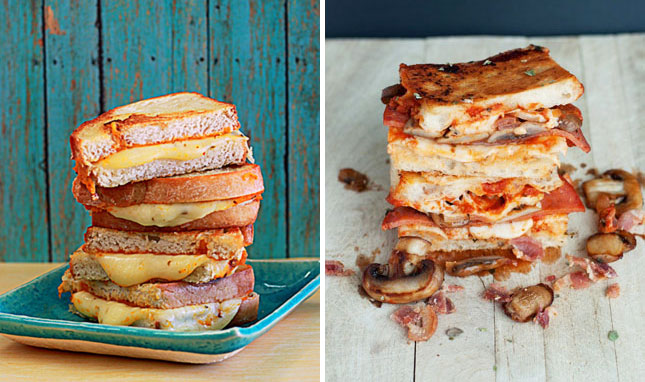 Who doesn't love a good grilled cheese? Whether you're peddling the tried and true white bread and American cheese combo or getting fancy with gruyere, pancetta, and figs, very few things beat melted cheese in between two slices of bread. And guess what? April is National Grilled Cheese Month! Here are 12 more (yep, we got into this last year too) ways to grill your cheese.
 You Might Also Like
Despite progress in recent years on causes and cures, colony collapse disorder has wreaked havoc on honeybee colonies across the country.
A mysterious malady that has been killing honeybees en masse for several years appears to have expanded drastically in the last year, commercial beekeepers say, wiping out 40 percent or even 50 percent of the hives needed to pollinate many of the nation's fruits and vegetables.
Which is like, yeah, big whoop, it's just bees, right? Except that:
Tags: bees biology colony collapse disorder food scienceThe Agriculture Department says a quarter of the American diet, from apples to cherries to watermelons to onions, depends on pollination by honeybees.
Bwel1985frenchie!