Shared posts

07 Jul 00:10

Looking at pictures of cute animals makes you work more carefully and deliberately

by Tyler Cowen

Or so we are told:

A new study by Japanese researchers now shows there are more benefits to looking at pictures of these universal delights than just getting a case of the warm and fuzzies. Afterwards, we concentrate better.

Such is the “Power of Kawaii”, as a paper documenting the research is appropriately titled. The Japanese word “kawaii” means cute. The paper was published in the online edition of the U.S. journal Plos One on Thursday. Through three separate experiments a team of scientists from Hiroshima University showed that people showed higher levels of concentration after looking at pictures of puppies or kittens.

For the pointer I thank Mark Thorson.

28 Aug 15:06

Sentences to ponder

by Tyler Cowen

Real earnings for young college grads have fallen by over 15% since 2000, or by about $10,000 in 2011 dollars

Michael Mandel’s tweet is here, and link to the underlying material is here.

Don’t be misled by claims of a “high” or “rising” college premium, that is indeed true relative to high school (or less), but many of those wages are down even more.  In absolute terms the return to college is not doing well.

03 May 19:49

Biz Stone: How I Faked My Way Into Google | Wired Magazine | Wired.com

by blog
03 May 18:30

Government is shrinking, and that's good

by Scott Grannis
The U.S. economy grew at a somewhat disappointing 2.5% annualized rate in the first quarter. However, if we exclude the first quarter decline in government spending (mostly related to cuts in defense spending), the increase was a more respectable 4%. This is an under-appreciated story: the private sector is doing reasonably well (much better than the GDP number suggests), even though the public sector is shrinking. In fact, it's probably more accurate to say that the private sector is doing OK because the public sector is shrinking.


The advance estimate of GDP growth for the first quarter was less than the economy's long-term average growth rate of about 3%. As the chart above shows, the economy is thus slipping further and further below its trend. This continues to be by far the weakest recovery in modern history. 


As this next chart above shows, federal government spending has been flat for the past several years, and it has declined in the past several months, mainly due to declining defense spending. This has contributed to  reported GDP growth coming in below expectations, but is that really a bad thing?


The first of the two charts above shows how much federal spending relative to GDP has declined in the past 3-4 years.  The second chart shows the dramatic reduction in the federal deficit that has resulted from flat to lower spending and increasing tax revenues: the federal deficit has collapsed, from a high of 10.5% of GDP to only 5.75% today. These are arguably the biggest under-appreciated economic facts of recent years. Since federal spending is not growing, the federal government is shrinking relative to the economy at a fairly rapid pace. Since the economy is growing, especially the private sector, tax revenues are rising much faster than overall economic growth. Combined, these two developments have resulted in a major decline in the burden of the federal deficit.

Four years ago, no one forecast that this would happen, much less to this extent. What we see here is not only unprecedented but totally unexpected, and that is a big—and very positive—change on the margin.

There are more lessons here. The huge increase in spending that began in late 2008 and continued through 2009 utterly failed to stimulate economic growth. As I've pointed out before, that's because the stimulus spending was all about income redistribution:

Fully 63% of the "stimulus" spending was income redistribution in disguise (i.e., tax benefits and entitlements). And if you reclassify things such as education, housing assistance, and health as transfer payments, then over 75% of the $840 billion allocated to "stimulus" was essentially income redistribution. Only 8%—$65.5 billion—went for transportation and infrastructure (i.e., the "shovel-ready" projects that would put American back to work). Not a dime went to increase anyone's incentive to work harder or invest more.

Since spending all that extra money failed to stimulate growth, it should not be surprising that the reduction in government spending relative to the size of the economy in the past few years has failed to materially weaken growth. We've been on a growth path of roughly 2% per year for the past several years, despite the big swings in spending relative to GDP:


Why the slow growth? I think the recovery has been very sub-par for a variety of reasons. For one, government transfer payments and government spending in general do little if anything to grow the economy. The government is an inefficient allocator of economic resources, and big spending inevitably entails crony capitalism (e.g., Solyndra), corruption, and waste. Transfer payments create perverse incentives, rewarding those who don't work and penalizing those who do. In other words, one reason the economy has been expanding slowly is because we've been wasting scarce resources in a big way, starting with the big "stimulus" spending of 2009. Two, the expansion of the size and scope of government has also entailed huge new regulatory burdens (e.g., Frank-Dodd), and the looming introduction of Obamacare has created great uncertainty among many small businesses since it threatens to significantly increase their costs. For example, small businesses with fewer than 50 employees face huge marginal cost increases if they expand, since they would be forced to either pay a stiff penalty or provide costly insurance to their employees. With businesses unwilling to expand, millions of the unemployed have confronted the dearth of new jobs and decided to drop out of the labor force, hence the relatively high level of unemployment.

Unfortunately, even though the burden of government (i.e., spending relative to GDP) is declining—thus giving more breathing room to the more productive private sector—government-induced headwinds are scheduled to increase significantly next year if Obamacare is fully implemented, and that has already been holding the economy back. Also, it's likely that entitlement spending will increase in the next several years due to aging baby-boomers. So while the recent and ongoing decline in the burden of government spending augurs well for future economic growth, the gains are likely to be muted unless regulatory burdens are reduced and entitlement programs are reformed.

If there is a silver lining to this big-government cloud, it's the growing realization that Obamacare is not going to work as advertised. Max Baucus' decision to not run for re-election in Montana next year is likely due at least in part to his fear that Obamacare will be a train wreck. Since I don't see how Obamacare can work well, much less be implemented on time, I think there is a reasonable chance that before the end of this year Congress could decide to postpone its implementation for at least a year. That could be a very positive development.
02 May 14:31

The President as Financial Planner

by Greg Mankiw
He and Michelle seem inattentive to their own finances:
The Obamas paid $45,046 in mortgage interest in 2012, which appears from the disclosure statement to be at a 5.625% interest rate with Northern Trust. That suggests an outstanding principal balance of about $800,000. 
On the other hand, the bulk of their investments are in Treasury notes. Based on the disclosures, I estimate they hold about $3 million in Treasury notes (also held by Northern Trust), yielding 0.71% if averaging a five-year maturity. 
By selling some of those Treasuries and paying off the mortgage, they would effectively be getting five more percentage points on the amount; they would also be about $40,000 better off each year before taxes, not to mention being less exposed to notes that could take a hit from possible rising rates. 
The Obamas would pay more in taxes but make much more after taxes -- especially since they aren’t getting the full deduction anyway, due to the AMT. That's more money going to the U.S. Treasury and more money for them; Northern Trust would be the loser.
26 Apr 20:00

Your life in 2033 | Technology | The Guardian

by blog
Bjorno

I can't wait.

26 Apr 18:40

Chart showing declines in median net worth by education, via...

Bjorno

I bet 100% of the decline is home values.


Chart showing declines in median net worth by education, via this San Francisco Fed report

(Cardiff)

26 Apr 15:10

On sleep, in my email, from Asher Meir

by Tyler Cowen

I don’t think we economists have quite gotten to the bottom of sleep. To the extent we think of it at all, I think we are inclined to think of it as an input in a kind of Gary Becker way. More sleep = less time for production and consumption, but too little sleep harms the productivity of both production and consumption. Solve for the optimum (in which you will be slightly over-tired all the time). In this model the objective function is to maximize the present value of all future WAKING consumption. Adopting this approach, studies showing that more sleep = longer life are not very persuasive, because the effect would have to be huge before more total hours would translate into more waking hours, particularly since the old-age hours are highly discounted. (Of course some people believe the decades-away future may bear huge positive shocks – new therapies, new kinds of experiences, etc.- and this would offset the discount.) I don’t find this model very convincing. Many people don’t view time spent sleeping as time wasted. Is enjoying a good nap merely a synonym for enjoying subsequent consumption more intensively, or do we perhaps actually enjoy a good nap? (My 17 year old son is adamant that he enjoys sleeping and sometimes it seems to be his favorite activity.)

And he follows up with this:

…My conjecture is that these wake drugs will mostly change the intertemporal substitutability of sleep. It will be easy to “borrow” wakefulness the night before an exam, during an extended battle, etc. But the total amount of lifetime sleep will be little affected. Qui vivra, verra. Could also be related to the frequency and pleasantness of dreams. I have frequent and sometimes quite interesting dreams so giving up on sleep would be more of a sacrifice for me than for someone who has few dreams or frightening ones.
25 Apr 21:21

Sorry, that text wasn’t for you

by Jim Dalrymple

Experiment: text your parents “got 2 grams for $40″ then right after “Sorry ignore that txt. Not for you” Then tweet pic of their response.

Holy shit, I giggled my ass off.

∞ Read this on The Loop

25 Apr 18:35

Fractions Are Hard

22 Apr 14:45

Jeremy Grantham on population growth, China and climate sceptics | Leo Hickman | Environment | guardian.co.uk

by blog
Hate this guy.  Scares the crap out of me.
"Go and read Limits to Growth, which I did recently. They pretty much predicted doom and gloom 20 years from now. They have been grossly misinterpreted and are pretty much on schedule. "

Jeremy Grantham on population growth, China and climate sceptics | Leo Hickman | Environment | guardian.co.uk: "Go and read Limits to Growth, which I did recently. They pretty much predicted doom and gloom 20 years from now. They have been grossly misinterpreted and are pretty much on schedule. "

'via Blog this'
22 Apr 14:18

Absurd pitches (pull out the Hayek and Polanyi lesson)

by Tyler Cowen

  • Facebook - the world needs yet another Myspace or Friendster except several years late. We’ll only open it up to a few thousand overworked, anti-social, Ivy Leaguers. Everyone else will then join since Harvard students are so cool.
  • Dropbox - we are going to build a file sharing and syncing solution when the market has a dozen of them that no one uses, supported by big companies like Microsoft. It will only do one thing well, and you’ll have to move all of your content to use it.
  • Amazon - we’ll sell books online, even though users are still scared to use credit cards on the web. Their shipping costs will eat up any money they save. They’ll do it for the convenience, even though they have to wait a week for the book.
  • Virgin Atlantic - airlines are cool. Let’s start one. How hard could it be? We’ll differentiate with a funny safety video and by not being a**holes.
  • Mint - give us all of your bank, brokerage, and credit card information. We’ll give it back to you with nice fonts. To make you feel richer, we’ll make them green.
  • Palantir - we’ll build arcane analytics software, put the company in California, hire a bunch of new college grad engineers, many of them immigrants, hire no sales reps, and close giant deals with D.C.-based defense and intelligence agencies!
  • Craigslist - it will be ugly. It will be free. Except for the hookers.
  • iOS - a brand new operating system that doesn’t run a single one of the millions of applications that have been developed for Mac OS, Windows, or Linux. Only Apple can build apps for it. It won’t have cut and paste.
  • Google - we are building the world’s 20th search engine at a time when most of the others have been abandoned as being commoditized money losers. We’ll strip out all of the ad-supported news and portal features so you won’t be distracted from using the free search stuff.
  • Github - software engineers will pay monthly fees for the rest of their lives in order to create free software out of other free software!
  • PayPal - people will use their insecure AOL and Yahoo email addresses to pay each other real money, backed by a non-bank with a cute name run by 20-somethings.
  • Paperless Post - we are like Evite, except you pay us. All of your friends will know that you are an idiot.
  • Instagram - filters! That’s right, we got filters!
  • LinkedIn - how about a professional social network, aimed at busy 30- and 40-somethings. They will use it once every 5 years when they go job searching.
  • Tesla - instead of just building batteries and selling them to Detroit, we are going to build our own cars from scratch plus own the distribution network. During a recession and a cleantech backlash.
  • SpaceX - if NASA can do it, so can we! It ain’t rocket science.
  • Firefox - we are going to build a better web browser, even though 90% of the world’s computers already have a free one built in. One guy will do most of the work.
  • Twitter - it is like email, SMS, or RSS. Except it does a lot less. It will be used mostly by geeks at first, followed by Britney Spears and Charlie Sheen.

That is all from Quora, hat tip goes to James Crabtree.

17 Apr 19:19

BBC News - Super-powered battery breakthrough claimed by US team

by blog
16 Apr 18:32

Dove Real Beauty Sketches (by tvmamamia)


Dove Real Beauty Sketches (by tvmamamia)

16 Apr 13:39

News is bad for you – and giving up reading it will make you happier – By Rolf Dobelli

by Joe Koster
16 Apr 00:45

How are American parents different?

by Tyler Cowen
Bjorno

we're european.

The biggest difference between American parents and their counterparts in Europe might be that they are far more relaxed about enrichment than we are, according to a study released this week by Sara Harkness and Charles M. Super at the School of Family Studies at the University of Connecticut.

Not only are Americans far more likely to focus on their children’s intelligence and cognitive skills, they are also far less likely to describe them as “happy” or “easy” children to parent.

“The U.S.’s almost obsession with cognitive development in the early years overlooks so much else,” Harkness told Slate .

For part of their research, the authors focused just on parents in the United States and the Netherlands. The differences are stark: American parents emphasized setting aside “special time” with each of their children, while Dutch parents spent a few hours each day together with their kids as an entire family.

…American parents were the only ones to consistently mention their children’s advanced intellect, while other countries focused on qualities like “happiness,” being “easy” to manage, or the even more zen-like “well-balanced,” in Italy. (Italians also used the word simpatico, a group of characteristics suggesting social and emotional competence).

The article, by Olga Khazan, is interesting throughout and for the pointer I thank an excellent and loyal MR reader.

15 Apr 03:19

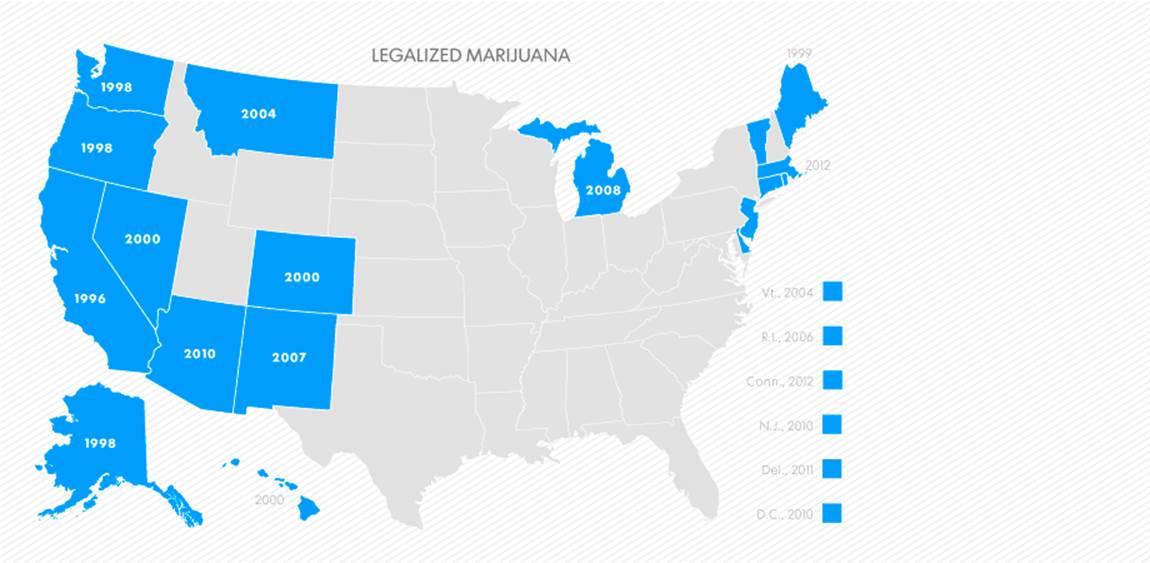
Medicinal marijuana markets: Weed goes legit

by Barry Ritholtz

Medicinal marijuana markets: Weed goes legit

Source: USAToday

15 Apr 03:19

Iraq War Could Have Paid For 100% Renewable Power Grid

by Washingtons Blog

For the Price of the Iraq War, The U.S. Could Have a 100% Renewable Power System

Posted on April 11, 2013 by WashingtonsBlog

What Are We Choosing for Our Future?

Wind energy expert Paul Gipe reported this week that – for the amount spent on the Iraq war – the U.S. could be generating 40%-60% of its electricity with renewable energy:

Disregarding the human cost, and disregarding our “other” war in Afghanistan, how much renewable energy could we have built with the money we spent? How far along the road toward the renewable energy transition could we have traveled?

The answer: shockingly far.

Cost of the Iraq War

The war in Iraq has cost $1.7 trillion through fiscal year 2013, according to Brown University’s Watson Institute for International Studies. That’s trillion, with a “t”. Including future costs for veteran’s care, and so on, raises the cost to $2.2 trillion.

Because the war was financed with debt, we should also include a charge for interest on the debt. The Iraq war’s share of cumulative interest on the US debt through 2053 will raise the total cost of the war to $3.9 trillion.

To weigh what opportunities we lost, we’ll consider two conditions: the direct cost, and the direct cost plus interest.

Renewable Energy Assumptions

*** For this evaluation, I will use a mix of wind and solar.

Why a mix? Because if we want to develop an integrated system that will replace the mix of fossil fuels and nuclear power we use today, we will need a mix of renewable resources as well. Ideally, we would develop our wind, solar, geothermal, and biomass resources simultaneously. However, it is wind and solar that will provide the bulk of new generating capacity. So I’ve simplified this analysis by only considering a mix of wind and solar.

***

While the cost of solar has declined dramatically, it remains far more expensive than wind generation. Including solar as part of a mix of resources reduces the effective penetration of renewables, but is more realistic and, hence, more conservative than simply estimating how much wind could have been built.

***

Robert Freehling, a renewables consultant in California, has pointed out that these assumptions are much too conservative.

Wind Yield

***

Today, yields can range from less than 2,000 kWh per kW for inland locations like those in Germany, to more than 2,500 kWh per kW for windy locales like those in Ireland and Great Britain.

***

Freehling suggests 2,250 kWh per kW is a more representative yield.

Solar Yield & Cost

Solar yields in Germany vary from a low of 900 kWh per kW of DC capacity in the north to nearly 1,100 kWh per kW in the south.

Similarly, yields in the US vary widely from 1,000 kWh per kW in rainy Seattle to 1,800 kWh per kW in the blistering sun of the desert Southwest. Freehling believes a more representative yield for the US market is 1,200 kWh per kW.

Solar costs continue to plummet. If the US market ever becomes as competitive as the German market, we can expect that average installed cost of ground mounted and roof-mounted systems across the country will fall far below the $5,000 per kW I’ve assumed. Freehling suggests that the cost for a representative cross-section of installation types over the next decade is $3,350 per kW of DC capacity.

What We Lost in Renewable Opportunities

Based on a conservative estimate, the US could have built between a quarter-million to nearly a half-million megawatts of wind energy, and 300,000 to 600,000 megawatts of solar capacity.

For comparison, today there are only 60,000 MW of wind in the US, and a paltry 7,000 MW of solar.

If we had invested the $2.2 trillion in wind and solar, the US would be generating 21% of its electricity with renewable energy. If we had invested the $3.9 trillion that the war in Iraq will ultimately cost, we would generate nearly 40% of our electricity with new renewables. Combined with the 10% of supply from existing hydroelectricity, the US could have surpassed 50% of total renewables in supply.

However, this is a conservative estimate. If we include the reasonable assumptions suggested by Robert Freehling, the contribution by renewables would be even greater.

Freehling’s assumptions raise to as much as 60% the nation’s lost potential contribution by new renewables to US electricity supply by going to war in Iraq. With the addition of existing hydroelectric generation, the opportunity to develop as much as 70% of our nation’s electricity with renewable energy was lost.

And unlike the war in Iraq, which is an expense, the development of renewable energy instead of war would have been an investment in infrastructure at home that would have paid dividends to American citizens for decades to come.

But Nobel prize winning economist Joseph Stiglitz estimated in 2008 that the Iraq war could cost America up to $5 trillion dollars.

And the Brown University study actually concluded that the Iraq war could end up costing $6 trillion dollars over the next 40 years.

Since $6 trillion is one and a half times as much as the $3.9 trillion estimate used by Gipe and Freehling, that means that the Iraq war money could essentially convert 100% of U.S. power to renewable energy.

True, comparing future interest payments to present renewable energy costs may be comparing apples and oranges.

But given that the nation’s top energy experts point out stunning breakthroughs in energy production, distribution, storage and conservation will drastically lower the costs of alternative energy, that $5-6 trillion could perhaps fund 100% renewable energy production:

~~~

~~~

And see this, this, this and this.

Moreover, given that war is very harmful for the economy, the costs of the Iraq war including the drag on the economy raises the price tag well above $6 trillion. So 100% of renewable energy funding may be realistic.

It is ironic, indeed, that the Iraq war was largely about oil. When we choose subsidies for conventional energy sources – war or otherwise – we sell our future down the river.

12 Apr 03:46

» Pentagon to Build Robots With ‘Real’ Brains Alex Jones' Infowars:

by blog
Bjorno

terrifying. or the best thing ever. not sure yet. Stefan? what did robopacalypse tell you?

12 Apr 00:01

best two articles of the day.

by blog
Bjorno

First try at setting up a blog, sending an article to it and then sharing from that. Very easy workaround for sharing things without a special link. I'm back to being an old reader fan I think. It's probably good for me that their mobile site sucks.

09 Apr 03:32

Also...this.....

by blog
07 Apr 13:27

Why the U.S. helps defend South Korea and what can go wrong

by Tyler Cowen

It is not because we need to subsidize their defense per se, to cite one argument which some non-interventionist critics have attacked.  It is so, when North Korea behaves in a ridiculous manner, the South can respond (not respond) with great restraint.  What we are subsidizing is a) a feeling of security, and b) not building nuclear weapons in response.  We do something broadly similar for Japan.

The potential problem is when the same U.S. acts which produce a feeling of security in South Koreans produce a feeling of insecurity in North Korean leaders.  And the broader game we are playing, with numerous allies, means we might end up pushing some individual confrontations  beyond an optimal point (e.g., how would Israel respond with Iran if we wavered on South Korea?)  Might we have to overinvest in the South Korean feeling of security — from a strictly Korean peninsula point of view — to keep Japan, Israel, Taiwan, the Saudis, and others “in line”?

It would be good if the North Korean leadership would read this blog post, as they would then realize that what to their eyes appears to be American “overstepping” is done for the sake of other audiences.  It is problematic for the American government to itself communicate this point.  Imagine announcing “we don’t stand by South Korea as much as it appears, we are just doing this because Israel faces a signal extraction problem and we can somewhat sway their inference toward relaxing about their own security situation.”

It would be bad if the Saudi leadership would read this blog post (or understand this to begin with).  The American government would then have to produce a feeling of security for South Korea all the more.

07 Apr 13:21

Buried treasure in clickthrough agreements

by Tyler Cowen

Do you know anyone who stops to read “click-through” agreements on websites in the middle of performing a task? One company, PC Pitstop, deliberately buried a clause in its end-user license agreement in 2004, offering $1,000 to the first person who emailed the company at a certain address. It took five months and 3,000 sales until someone claimed the money. The situation hadn’t improved by 2010 when Gamestation played an April Fools’ Day joke by embedding a clause in their agreement saying that users were selling them their souls.

Here is another good bit:

Ponder the fact that a dermatologist must sign his name to forms almost 30,000 times a year, according to a 2008 article in the Southern Medical Journal.

The article is here and for the pointer I thank Olaf.

05 Apr 01:55

Expensive batteries are holding back electric cars. Can that change?

02 Apr 17:56

"Euros now make up only 24 per cent of their reserves, the lowest since 2002, and down from a peak of..."

“Euros now make up only 24 per cent of their reserves, the lowest since 2002, and down from a peak of 31 per cent as recently as 2009. The dollar has held steady at about 60 per cent.”

-

Robin Harding, “Emerging markets dump euro reserves”

(Cardiff)

29 Mar 14:56

Why It Makes Zero Sense For Facebook To Do A Smartphone Operating System (FB, AAPL, GOOG)

by Jay Yarow
Bjorno

Then there's Facebook's brand. Facebook has a billion users, so everyone loves it, right? Not exactly.

The public has a weird relationship with Facebook. They use it all the time, which makes them sort of hate Facebook. It often pops up in "most hated company" lists.

Would people really get all that excited about a Facebook-branded phone? Is that a brand they really want to latch on to?

facebook phone mark zuckerberg

Facebook is doing its own smartphone operating system.

No, seriously. This time we mean it. Maybe. Possibly.

Anyway, that's what people are saying. So, we suppose it's worth talking about it.

We can't envision a circumstance where a Facebook phone makes any sense.

The story goes that Facebook is doing a phone with HTC. HTC makes the hardware, Facebook does the software using a heavily modified version of Android.

Making a smartphone operating system is hard, even if you use Android. Amazon's Kindle Fire operating system is based on a forked version of Android. It's not as good as full-on Android.

Perhaps Facebook could do a better job than Amazon, but we have our doubts. Facebook's mobile app was pretty bad for a long time. It would be difficult to make an entire operating system good.

Besides, the operating system would have to be better than good. iOS and Android are extremely advanced operating systems, so Facebook has to have a compelling reason for users to buy a Facebook phone.

Microsoft, which knows a thing or two about operating systems, is still behind iOS and Android. (No notification center, weak maps, no built in turn-by-turn directions.) We don't see how Facebook is going to do a better job than Microsoft.

Then there's Facebook's brand. Facebook has a billion users, so everyone loves it, right? Not exactly.

The public has a weird relationship with Facebook. They use it all the time, which makes them sort of hate Facebook. It often pops up in "most hated company" lists.

Would people really get all that excited about a Facebook-branded phone? Is that a brand they really want to latch on to?

Finally, there's the unanswered question of why? Hopefully Facebook has a good answer to this one.

Just last September CEO Mark Zuckerberg said it didn't make sense. He pointed out that Facebook has a billion users. Even if it managed to get 10 million Facebook phones in the market, that's nothing for Facebook.

He said, "We want to build a system which is as deeply as possible integrated into every major device people want to use."

Making a smartphone operating system that rivals iOS and Android isn't going to help it get deeper into those platforms. If anything, it's just going to make Apple inclined to toss Facebook out of iOS.

Please follow SAI on Twitter and Facebook.

Join the conversation about this story »


28 Mar 21:39

Learning and Exhaustion...

by Joe Koster
Bjorno

so true.

“But when it comes to learning, the science is clear: Exhaustion is the enemy. Fatigue slows brains. It triggers errors, lessens concentration, and leads to shortcuts that create bad habits. It’s no coincidence that most talent hotbeds put a premium on practicing when people are fresh, usually in the morning, if possible. When exhaustion creeps in, it’s time to quit.” –Daniel Coyle, The Little Book of Talent: 52 Tips for Improving Your Skills
Support Value Investing World
16 Mar 20:17

Unexpected day: what are we gonna do about Google Reader death? Keep calm and carry on.

Bjorno

test

Hello everyone!

This morning I have mixed feelings: I am happy that we have the possibility to bring our beloved The Old Reader to a new level, and I am sad that Google Reader soon will be completely over. It was a large part of my daily internet life. We even started making The Old Reader because no one could stand my whining anymore.

News came unexpected (mind you, we are living in GMT, so it was literally the middle of the night), but we are doing out best. We tripled our user base (and still counting), and our servers are not amused so far. We will be deploying more capacity shortly, so things should get better by the end of the day. Please, be patient with us.

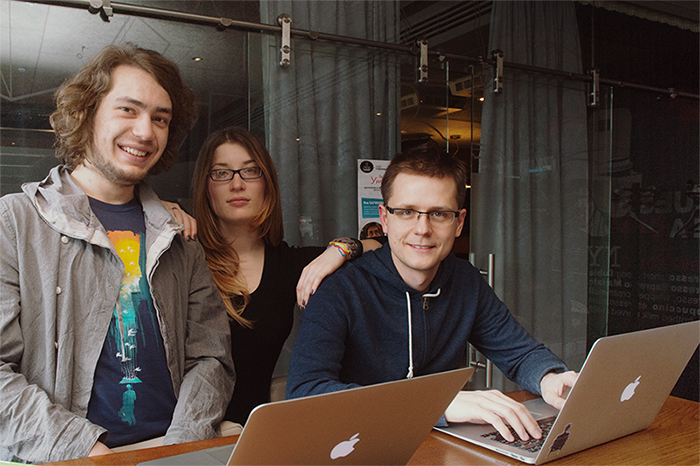
image(The Old Reader’s team before March 13, photo by repor.to/shuvayev)


This is overwhelming. When we started this as something for us and our friends to use, we never expected so many of you to join us in our journey. Thank you very much for your kind words and support, we appreciate this.

Seeing Google Reader go, many of you are asking whether The Old Reader is going to stick around. Also, quite a lot of people would like to donate to keep our project running. We have been discussing this quite a lot recently, and we decided that paid accounts (the freemium model) are the way to go. We want to keep making a great product for our users, not cater it for advertisers’ needs.

We are going to be honest, we have not even started coding this yet. However, we would like to get this news out as soon as possible for everyone to know the way we will be going. Paid accounts will have some additional features, but the basic free accounts will still be 100% usable. We are not in this game to make money, but we want to give something special back to the people who are going to be supporting us.

We have our daily jobs, so we can’t promise that new features will be ready tomorrow or next week. We have no investors or fancy business plans, but we are open about everything we do, and we want to do it the right way.

We reworked the plans according to the news today. Creating an API for mobile clients is the number one priority in our roadmap. We would love to collaborate with any developers who were making Google Reader clients. Please, spread the word about this if you can.

For those of you who are posting feedback and creating new feature requests - please, double-check for existing items in Uservoice. We hate answering the same questions multiple times and removing duplicate requests.

Most asked questions are:
- “When will OPML import be working again?” As soon as we launch more capacity to handle this. Hopefully, later today.
- “Why are you asking for access to my Google contacts when I log in via Google account?” We don’t anymore.
- “When will you make an iOS app? How about Android?” We will start with API as soon as we can and see how it goes.
- “Why is there no way to login without Google or Facebook accounts?” We cover that one in our knowledge base, but we plan to implement own login code. The demand is high.
- “How do I rename a feed?”. Just browse the Tour page, please? 
- “Shut up and take my money!”. Will work on that, stay tuned.

We have lots of things to do, and it will probably take us several days to reply to all emails and tickets. Also, Twitter keeps reminding us about daily tweet limits, so there might be delays as well.

Some other news: last week our developer (on the left) turned 21, and we have implemented PubSubHubbub support. Many of you asked us to make feed updates faster, and PubSubHubbub makes compatible feeds refresh almost instantly. Yay!

Thank you very much for your support. We will do our best during next three months to prepare for the day Google Reader will no longer be around.