Cowboy Who?
Shared posts
Trump and the virus: A day of turmoil in the White House
How Do You Contact Trace The President Of The United States?
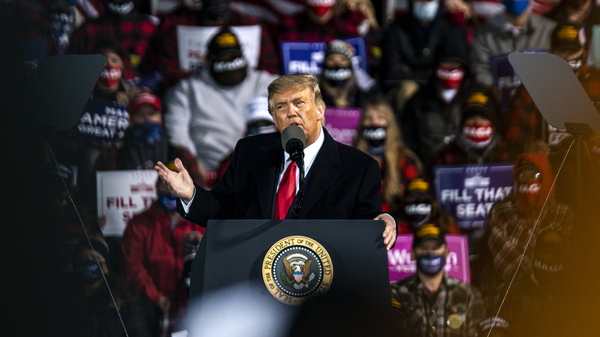
The President's diagnosis calls for contact tracing on a massive scale. Luckily, not everyone President Trump saw this week with is a high risk exposure. Here's who is.
(Image credit: Stephen Maturen/Getty Images)

Vice President Pence Continues Duties Despite White House Coronavirus Cases

Pence carried on with his usual schedule on Friday, even as a number of prominent Republicans revealed COVID-19 diagnoses on Friday.
(Image credit: Pool/Getty Images)

Everyone in the White House cluster who has said they tested positive for the coronavirus
 With few wearing masks to protect against the coronavirus, members of Congress applaud President Trump as he introduces Judge Amy Coney Barrett as his nominee to the Supreme Court on September 26. One attendee, Sen. Mike Lee (R-UT), has tested positive for the coronavirus. | Chip Somodevilla/Getty Images
These are the White House officials, staffers, and journalists who reportedly have the coronavirus.
This week, at least 12 people who work in the White House or have recently attended events there have tested positive for the coronavirus — including President Donald Trump himself.
The president announced late Thursday night that he and first lady Melania Trump had tested positive for the coronavirus, joining several other high-ranking US government officials who have contracted SARS-CoV-2.
Lawmakers have occasionally tested positive before. In addition to Sen. Mike Lee of Utah, who followed Trump’s announcement with a tweet announcing a positive test of his own, two other Republican senators tested positive over the spring and summer: Rand Paul of Kentucky and Bill Cassidy of Louisiana. And on Friday evening, Sen. Thom Tillis (R-NC) announced he had also tested positive.
The virus has also infected at least 14 House members — nine Republicans and five Democrats — since March. But this is the first time the virus, which has killed more than 208,000 Americans, has spread in such a concentrated manner among White House officials, staffers, and members of the press corps.
The White House, in other words, is now a Covid-19 hot spot.
While it’s not clear how the president was exposed, Trump was in regular contact this week with senior counselor Hope Hicks, who tested positive on Thursday afternoon. Hicks had traveled with Trump multiple times this week, including to Tuesday night’s presidential debate in Cleveland.
Multiple people who attended last Saturday’s event at the White House, when Trump nominated Judge Amy Coney Barrett to fill the vacancy on the Supreme Court, have also tested positive. Lee, who also met with Barrett on Tuesday, was in attendance, as was Tillis, who is a member of the Senate Judiciary Committee; former senior White House counselor Kellyanne Conway; and University of Notre Dame President John Jenkins, all of whom also tested positive for Covid-19 on Friday.
Barrett, for her part, was diagnosed with coronavirus over the summer but has recovered. It is unknown whether she now carries immunity.
As of early Friday afternoon, Vice President Mike Pence and his wife Karen have both tested negative, as have Democratic nominee Joe Biden and his wife Jill. Secretary of State Mike Pompeo and Director of National Intelligence John Ratcliffe tested negative as well.
Trump and his staff have been traveling to campaign events for several weeks. Just in the last week, the president has held rallies in Florida, Virginia, Pennsylvania, and Minnesota, in addition to the debate in Ohio. Bill Stepien, Trump’s campaign manager, tested positive Friday night.
Sen. Marsha Blackburn, a Republican from Tennessee, flew with Trump to the debate, and she is now getting tested and isolating “out of an abundance of caution.”
The White House and Capitol will now likely have to undertake major contact tracing efforts. As Vox’s Dylan Scott explained, the only way to figure out the full extent of the outbreak is contact tracing: “identifying who has been in close contact with the president since he became contagious, and asking them to quarantine to prevent Covid-19 from spreading to others, and to get tested themselves.”
/cdn.vox-cdn.com/uploads/chorus_asset/file/21932367/GettyImages_1228846194.jpg) Drew Angerer/Getty Images
Drew Angerer/Getty Images
The Trump campaign announced in a statement Friday that he and his family are suspending in-person events. Pence’s campaign travel will continue.
Here’s what we know about who has tested positive — and negative — for SARS-CoV-2 so far.
The list of people who have tested positive for the coronavirus
- President Donald Trump and first lady Melania Trump
- Hope Hicks, senior counselor to President Trump
- US Sen. Mike Lee, a Republican from Utah
- US Sen. Thom Tillis, a Republican from North Carolina
- Kellyanne Conway, former senior White House counselor
- Bill Stepien, Trump’s campaign manager
- John Jenkins, president of the University of Notre Dame
- Three journalists from the White House press corps, according to the White House Correspondents Association
- A White House press staffer, according to the correspondents’ association
A brief list of key politicians and officials who have tested negative
Given the level of uncertainty created by this news, Vox has compiled a list of key administration figures who help run the country, key lawmakers who have been in contact with the president, and key Democrats in the 2020 election cycle who have recently gotten negative test results for the virus.
While it could take several days for an individual who has contracted the virus to test positive, these are the initial negative tests. As of 6 pm ET Friday, here’s the list:
- Democratic nominee Joe Biden and Jill Biden
- Vice President Mike Pence and second lady Karen Pence
- Sen. Kamala Harris and her husband Doug Emhoff
- Secretary of State Mike Pompeo
- Director of National Intelligence John Ratcliffe
- Republican Reps. Pete Stauber and Tom Emmer of Minnesota, who traveled with Trump earlier this week, according to a reporter from the MinnPost
Will you help keep Vox free for all?
The United States is in the middle of one of the most consequential presidential elections of our lifetimes. It’s essential that all Americans are able to access clear, concise information on what the outcome of the election could mean for their lives, and the lives of their families and communities. That is our mission at Vox. But our distinctive brand of explanatory journalism takes resources. Even when the economy and the news advertising market recovers, your support will be a critical part of sustaining our resource-intensive work. If you have already contributed, thank you. If you haven’t, please consider helping everyone understand this presidential election: Contribute today from as little as $3.
What we know about the experimental Covid-19 treatment Trump received
 President Trump leaves the White House for Walter Reed National Military Medical Center on October 2. | Saul Loeb/AFP via Getty Images
Trump was given an unproven antibody therapy from Regeneron after testing positive for the coronavirus.
President Donald Trump has received an unproven antibody treatment for Covid-19 following a test confirming that he was infected with the SARS-CoV-2 virus, White House physician Sean Conley said in a letter Friday afternoon.
The treatment was developed by the biotech company Regeneron. “Following PCR confirmation of the president’s diagnosis, as a precautionary measure he received a single 8 gram dose of Regeneron’s polyclonal antibody cocktail,” Conley wrote.
An update from President @realDonaldTrump's physician: pic.twitter.com/cTsXO4Df6b
— Kayleigh McEnany (@PressSec) October 2, 2020
Later in the day, Trump flew to Walter Reed Medical Center, just outside Washington, DC, where officials say he will stay for a few days. “Out of an abundance of caution, and at the recommendation of his physician and medical experts, the President will be working from the presidential offices at Walter Reed for the next few days,” press secretary Kayleigh McEnany said.
There is currently no treatment approved by the Food and Drug Administration to treat Covid-19, though the agency has granted emergency use authorizations to the antiviral drug remdesivir and to convalescent plasma. However, the Regeneron therapy was given to Trump under compassionate use guidelines, which are considered on a case-by-case basis.
Regeneron’s antibody-based treatment, called REGN-COV2, is classified as experimental and is still in clinical trials. The company reported in a September 29 press release that the drug improved symptoms and reduced the viral load in Covid-19 patients who were not hospitalized.
“The greatest treatment benefit was in patients who had not mounted their own effective immune response, suggesting that REGN-COV2 could provide a therapeutic substitute for the naturally-occurring immune response,” said George D. Yancopoulos, president and chief scientific officer of Regeneron, in a statement.
In March, Christos Kyratsous, vice president for infectious disease research and viral vector technologies at Regeneron, told Vox in March that this treatment could also be used prophylactically to prevent infection, in addition to being used as a treatment for an ongoing infection.
Antibodies are proteins produced by the immune system’s B cells that attach to a pathogen like a virus or to an infected cell. By attaching, they can either inhibit the target from doing damage or flag the target for destruction by other immune cells.
In Regeneron’s case, the company started with mice that were genetically engineered to have human immune systems. After the mice were exposed to the virus, they produced human antibodies that bind to the spike protein of the virus. The spike is what the virus uses to enter human cells, so blocking it with antibodies can inhibit an infection. A cocktail of two of these antibodies was then harvested from the mice and is being given to humans in clinical trials, and now to President Trump.
This type of treatment is a bit different from convalescent plasma, another experimental treatment for Covid-19, which is taken from people who were infected with Covid-19 but recovered. Plasma is the liquid part of blood, including proteins used for clotting, and when harvested from convalescents, it contains antibodies to the virus. So transfusing plasma from someone who recovered to someone who is sick could help them get better, or prevent them from getting sick in the first place.
However, the evidence to support either of these treatments is weak. The National Institutes of Health criticized the FDA’s emergency use authorization for convalescent plasma. “There are insufficient data to recommend either for or against the use of convalescent plasma for the treatment of COVID-19,” the agency wrote in a blunt letter in September.
As for Regeneron’s therapy, the best evidence right now is a press release citing results drawn from an early-stage trial of just 275 people. Without peer review of the findings, or even published data, all we have is the company’s word that this works. “There’s nothing bad about these results, you just can’t say much about how transformative this is going to be,” Eric Topol, director of the Scripps Research Translational Institute, told Stat News.
Some doctors took to Twitter to criticize the decision to administer an experimental drug with limited evidence for its effectiveness to the president of the United States.
You do not give a patient -- much less the President of the United States -- a drug that is not yet approved by the FDA (to say nothing of one with "mild symptoms").
— Zeke Emanuel (@ZekeEmanuel) October 2, 2020
Unsurprisingly, the Trump WH is not being forthright to the American people about the health of their President. https://t.co/9YlXx0XQvR
Regeneron’s polyclonal antibody as of September is in phase 3 trials....you couldn’t pay me to take it for a fever. Things must be worse than we know.
— Steven McDonald (@smcdonaldMD) October 2, 2020
The President’s team either:
— Jeremy Faust MD MS (ER physician) (@jeremyfaust) October 2, 2020
A) Can’t read basic medical literature.
B) Can read medical literature but can’t overrule what he’s telling them to do, based on what advice he’s getting elsewhere.
C) Believes he is dying and therefore are willing to try anything. pic.twitter.com/yByJVcUSXV
Receiving any kind of experimental treatment is a risk, but Trump does have significant factors that put him at greater risk of a severe course of the disease, including his older age, his obesity, and his gender. And it’s not clear whether the decision to administer the treatment came from Conley or from the president. However, earlier on Friday, Matt McCarthy, an infectious disease doctor, appeared on Fox Business and brought up the idea of using Regeneron’s antibody therapy.
This morning on one of the president's favorite Fox Business shows a doctor guest said, "If I got brought in today to the Oval Office, the first thing I’d say is, "Has anyone reached out to Regeneron? Has anyone talked about an antibody cocktail for him?" pic.twitter.com/zKKPiR4ejc
— Matthew Gertz (@MattGertz) October 2, 2020
Regeneron CEO Leonard S. Schleifer told the New York Times that the company received a call from the White House Friday requesting access to the drug. “All we can say is that they asked to be able to use it, and we were happy to oblige,” he said. “When it’s the president of the United States, of course, that gets — obviously — gets our attention.”
The Times also reported that Schleifer knows Trump personally and has been a member of Trump’s golf club in Westchester County in New York.
Millions turn to Vox each month to understand what’s happening in the news, from the coronavirus crisis to a racial reckoning to what is, quite possibly, the most consequential presidential election of our lifetimes. Our mission has never been more vital than it is in this moment: to empower you through understanding. But our distinctive brand of explanatory journalism takes resources. Even when the economy and the news advertising market recovers, your support will be a critical part of sustaining our resource-intensive work. If you have already contributed, thank you. If you haven’t, please consider helping everyone make sense of an increasingly chaotic world: Contribute today from as little as $3.
Call Center Call Out
Trump's Covid contacts: Who has he met and who's tested positive?
Why A Negative Coronavirus Test Doesn't Necessarily Mean You're In The Clear

Political figures who had contact with the president in the past week are being tested — and reporting negative results. Doctors sound a note of caution about what those results indicate.
(Image credit: Caroline Brehman/CQ-Roll Call, Inc via Getty Imag)

Trump’s Doctor Writes an Excused Absence Note to the Federal Election Commission
Dear Federal Election Commission:
I’m writing you to excuse my patient, the Honorable Donald J. Trump, from this year’s election process as he has come down with the China Virus. The president — who, by the way, is the greatest president our country has ever seen — will need relief from some of his job responsibilities until the disease magically disappears. Specifically, I recommend that Mr. Trump be excused from the 2020 presidential election and be allowed to continue on as president indefinitely.
While Mr. Trump will be unable to participate in our democratic processes, I am certain that he will be healthy enough to serve out another four-year term. As a giant of western philosophy once said, “What doesn’t kill you makes you stronger” — and I am inclined to agree with Kelly Clarkson in this case. Indeed, should this illness make him stronger, it would be fair to categorize his physical form as “unbelievably Herculean.” With this in mind, I’m confident that Mr. Trump could easily serve at least another eight terms, acting as president well past his 100th birthday. In fact, I see no medical reason to put a cap on the number of terms that our president — who again is doing a fabulous job — can serve. Based on this, I am asking that you simply make Mr. Trump president for life.
But, really, come to think of it, why stop at life? His health is so tremendous that I do not see death as being a true barrier to his ability to serve as president, which many people say he has done better than anyone has ever done before. What might appear as death is, in reality, his leaving the physical realm, ascending to a higher level of consciousness — it’s beautiful really, very touching, people are going to love it — where he can rule over us as an invisible godlike being. Should this happen, my medical recommendation is to make Mr. Trump the eternal president of the republic, while one of his children (not Eric) acts in the physical realm as the dear leader.
To reiterate, it is my prestigious medical opinion that Mr. Trump cannot participate in democratic elections due to this recent medical diagnosis. Fortunately, this virus kills “virtually nobody,” according to another leading medical expert, the president himself. I’m confident that he will be more fortunate than the 200,000+ nobodies in America who have been killed by the disease.
Sincerely,
Dr. John Barron, M.D.
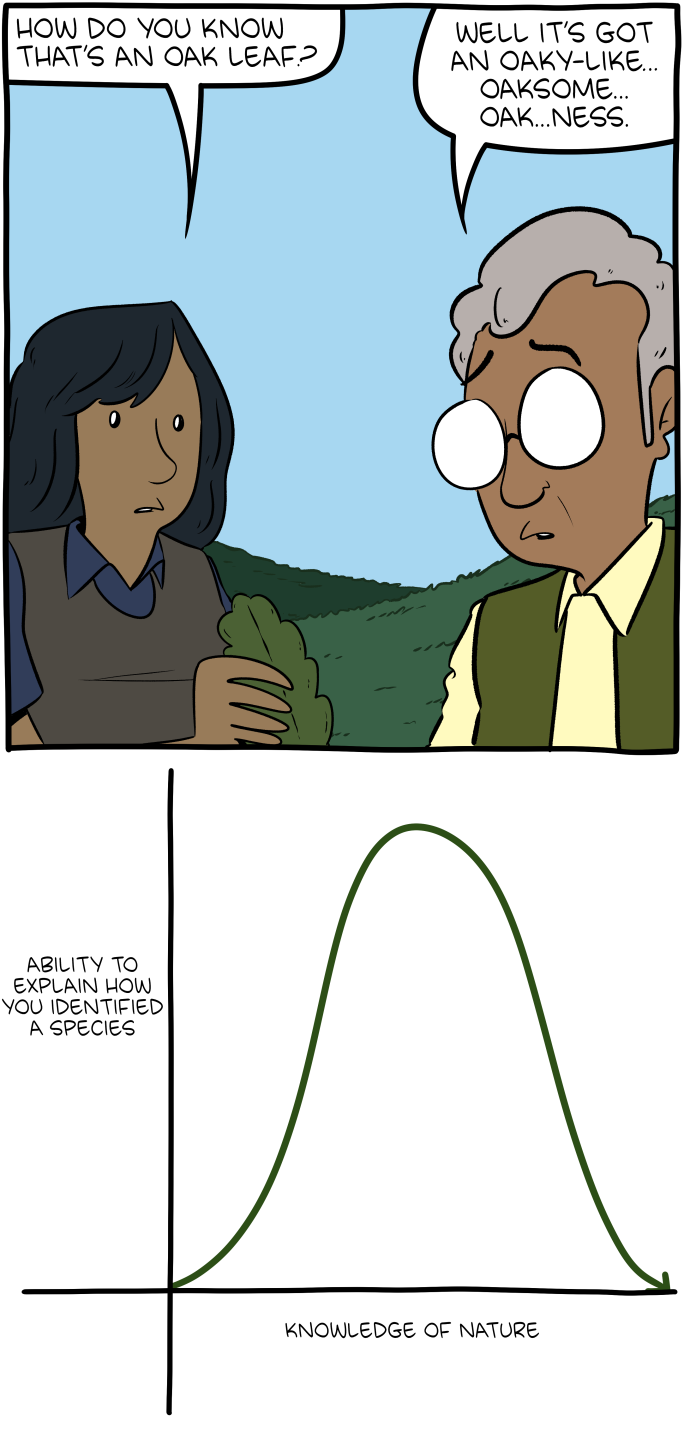
Saturday Morning Breakfast Cereal - Oak
Click here to go see the bonus panel!
Hovertext:
Like look at these leaves. 14 oakitudes, minimum.
Today's News:

Trump’s Doctor Writes an Excused Absence Note to the Federal Elections Commission
Dear Federal Elections Commission:
I’m writing you to excuse my patient, the Honorable Donald J. Trump, from this year’s election process as he has come down with the China Virus. The president — who, by the way, is the greatest president our country has ever seen — will need relief from some of his job responsibilities until the disease magically disappears. Specifically, I recommend that Mr. Trump be excused from the 2020 presidential election and be allowed to continue on as president indefinitely.
While Mr. Trump will be unable to participate in our democratic processes, I am certain that he will be healthy enough to serve out another four-year term. As a giant of western philosophy once said, “What doesn’t kill you makes you stronger” — and I am inclined to agree with Kelly Clarkson in this case. Indeed, should this illness make him stronger, it would be fair to categorize his physical form as “unbelievably Herculean.” With this in mind, I’m confident that Mr. Trump could easily serve at least another eight terms, acting as president well past his 100th birthday. In fact, I see no medical reason to put a cap on the number of terms that our president — who again is doing a fabulous job — can serve. Based on this, I am asking that you simply make Mr. Trump president for life.
But, really, come to think of it, why stop at life? His health is so tremendous that I do not see death as being a true barrier to his ability to serve as president, which many people say he has done better than anyone has ever done before. What might appear as death is, in reality, his leaving the physical realm, ascending to a higher level of consciousness — it’s beautiful really, very touching, people are going to love it — where he can rule over us as an invisible godlike being. Should this happen, my medical recommendation is to make Mr. Trump the eternal president of the republic, while one of his children (not Eric) acts in the physical realm as the dear leader.
To reiterate, it is my prestigious medical opinion that Mr. Trump cannot participate in democratic elections due to this recent medical diagnosis. Fortunately, this virus kills “virtually nobody,” according to another leading medical expert, the president himself. I’m confident that he will be more fortunate than the 200,000+ nobodies in America who have been killed by the disease.
Sincerely,
Dr. John Barron, M.D.
How Will Trump’s Positive COVID-19 Test Affect The Election?
Welcome to an emergency edition of FiveThirtyEight’s politics chat. The transcript below has been lightly edited, and updated with the news that Joe Biden has tested negative for the coronavirus.
sarah (Sarah Frostenson, politics editor): Very early Friday morning, President Trump tweeted that he and First Lady Melania Trump had tested positive for COVID-19. That news came just after reports on Thursday that White House senior advisor Hope Hicks had tested positive.
There’s a lot we still don’t know at this point, including the extent of White House staff affected or the severity of the president’s symptoms, but with about a month until Election Day, this is … an October surprise, to say the least.
Let’s start with one of the big questions: What does this mean for the election?
natesilver (Nate Silver, editor in chief): So for some reason I’m finding it hard to think through the electoral implications this morning. Maybe I need even more coffee. My thoughts right now are mostly some combination of:
- Seriously how the F*CK does this happen? Shouldn’t everybody in the president’s orbit have been tested constantly?
- And, OF COURSE this happened because 2020 and because the president clearly was not taking that many precautions
perry (Perry Bacon Jr., senior writer): My overall answer is, “I have no idea how this affects the election.” This is truly unprecedented, as far as I know, in American elections — the president getting a serious virus weeks before the election. I can’t think of any leader abroad who has gotten a virus like this weeks before the election either (though I am not an expert on elections outside of the United States).
So while I have some general thoughts, I wanted to lay that out first. I truly have no idea what to expect, how voters will react to Trump’s positive test, how the media will cover it or how other candidates will react.
I.
Don’t.
Know.
ameliatd (Amelia Thomson-DeVeaux, senior writer): Yeah — it’s such a black box and honestly so dependent on what happens next. Does Trump get really sick? Does he stay mostly asymptomatic? How far did the virus spread in the White House? All questions we can’t answer right now, of course. But hugely important for how people respond.
natesilver: Yeah. We’re going to be saying “I don’t know” a lot in this chat. I don’t think there’s anything wrong with thinking through the electoral implications. There’s an election happening literally NOW — millions of people have already voted. So Americans are wrestling with this stuff. We just don’t have a lot of good answers.
ameliatd: And, of course, there’s an open question about whether Joe Biden will test positive, after he and Trump were at the debate together on Tuesday. [Editor’s note: Biden tested negative for the coronavirus after the conclusion of this chat.]
natesilver: Right, and one thing I’m not sure people realize is that there can be several days between exposure and a positive test. So we won’t know for sure which people have or don’t have COVID-19 for a bit here.
ameliatd: In the meantime, though, this does mean that Trump can’t campaign for at a while, right? And what about the debates, which were supposed to be on Oct. 15 and 22? Do those still happen?
How much does it matter if Trump can’t campaign, though? This was already a deeply bizarre year and I’m not sure his rallies were going to put him over the edge.
natesilver: Zoom debates?
ameliatd: Everyone wanted that automatic mute last time!
natesilver: At a very basic, square-one level, COVID-19 is a huge liability for the president, and so placing more focus on COVID-19 probably isn’t great for him. But I don’t know how useful that is as a prior. Could Trump getting COVID-19 change his messaging around the virus and pandemic? Maybe. But this is Donald Trump we’re talking about. He’s not inclined to be overly disciplined or deferential to scientists, etc. He’s pretty unpredictable, and we don’t yet know a lot about how serious his symptoms are. And this is a bad disease that can have cognitive effects in addition to physical ones.
Also in terms of very, basic, non-debatable priors: the president’s re-election bid was in DEEP trouble going into this, at least by conventional measures. And the smattering of post-debate polls we’d gotten had been particularly bad for him. So just worth keeping that in mind.
sarah: Absolutely. But on the question of how this happened … The Trump campaign has not taken precautions seriously. They’ve continued to hold large, in-person events. And they’ve even mocked the Biden campaign for wearing masks.
Is one possible scenario from this that Americans take the coronavirus more seriously? Views on COVID-19 and Trump’s response to it are polarized by party, but how could Trump’s positive test change public opinion?
ameliatd: I think what happens with public opinion really depends on how sick Trump gets. As I wrote over the summer, a big part of the reason Republicans are not as into COVID-19 restrictions is that they are much, much less likely to view the virus as a personal health threat to them.

And research has indicated that Trump downplaying the virus is probably a significant driver of that. So I could see this playing out at least two ways …
- Trump gets moderately or very sick and this does prompt Republicans to think, “Oh geez, this actually is serious and if it could happen to Trump it could happen to me”;
- Trump remains mostly asymptomatic and it bolsters the idea that this is actually not such a big deal.
perry: So, writing this on Friday morning, here’s what I expect …
The overwhelming majority of people, even those who are older, don’t die from COVID-19. So the most likely outcome is that Trump and some of his staffers have COVID-19, stay somewhat distanced from everyone for two weeks and then Trump returns to campaigning for reelection (I am not sure if he has the big rallies, but I wouldn’t rule that out.) I am not even sure the next two debates have to be canceled — particularly the Oct 22 one. And basically nothing has shaken Trump’s job approval ratings or really the race overall. I don’t really expect this to shift things either.
The president testing positive for COVID-19 is obviously hugely significant, but it’s not revelatory. We already knew Trump was not taking the virus seriously enough. Now, we have a much more obvious manifestation of that fact, but nothing is really different. Biden may not be able to attack Trump as bluntly on COVID now, for decorum reasons, but this positive test reinforces Biden’s message that Trump has let this crisis get out of hand. So this matters, but I’m not sure it matters electorally in terms of shifting a lot of people’s votes.
ameliatd: I know we’re thinking way down the line now, but is it possible that battling and surviving COVID-19 could actually make Trump more popular in some corners? Especially if he doesn’t get very sick?
natesilver: Amelia, I’m not sure I really buy that. I mean, somehow if it made the president into a more empathetic person, maybe, I suppose? But (i) I’m not sure that’s how he’s likely to react as opposed to sending 6,000 tweets about the “China Virus” or something; and (ii) he’s been trying to project a lot of macho-ness/dominance and to portray Biden as old and feeble and I’m not sure how contracting a serious disease himself fits into that.
ameliatd: Well, but if he contracts a serious disease and doesn’t get very sick and recovers fairly quickly — that certainly doesn’t seem as bad for him.
natesilver: I guess if he recovers in a couple of weeks, which is still what happens for most people, maybe he’ll say he kicked COVID’s ass and/or it wasn’t that serious. But I don’t think that necessarily affects anything electorally.
ameliatd: So, is the main impact potentially less about politics and more about the way Americans think about the virus? Either prompting Republicans to take it more seriously or reinforcing their sense that this really isn’t a big deal?
There was research back in March indicating that COVID-19 spreading at CPAC helped drive a brief moment when Republicans and Democrats were on the same page about the seriousness of the virus.
perry: So I don’t buy this idea that Trump will get COVID-19, be fine and then start calling it “Fake News.” We just learned Ronna McDaneil, the RNC chair, has also tested positive. So has Hope Hicks, a top Trump adviser. [Editor’s note: Sen. Mike Lee of Utah has since announced that he has also tested positive.] I think enough people in Trump’s circle may have the virus that THOSE PEOPLE start taking this more seriously, basically forcing him to as well.
natesilver: This is one sort of message we might hear, I guess:
Remember: China gave this virus to our President @realDonaldTrump and First Lady @FLOTUS.
WE MUST HOLD THEM ACCOUNTABLE.
— Kelly Loeffler (@KLoeffler) October 2, 2020
sarah: But this question of whether it will change how seriously people perceive the coronavirus is an interesting one. Americans overall, as we saw in our debate polling with Ipsos, listed the coronavirus as their No. 1 issue:
COVID-19 and the economy are Americans’ top two issues
Share of respondents who named each issue as the top one facing the U.S., according to a FiveThirtyEight/Ipsos poll
| issue | share of | all Respondents |
|---|---|---|
| COVID-19 | 31.7% |
–
|
| The economy | 21.6 |
–
|
| Health care | 7.9 |
–
|
| Racial inequality | 7.4 |
–
|
| Climate change | 5.2 |
–
|
| Violent crime | 4.8 |
–
|
| The Supreme Court | 4.5 |
–
|
| Economic inequality | 3.0 |
–
|
| Immigration | 2.8 |
–
|
| Education | 2.6 |
–
|
| Abortion | 2.3 |
–
|
| Gun policy | 1.9 |
–
|
| Other | 1.6 |
–
|
Data comes from polling done by Ipsos for FiveThirtyEight, using Ipsos’s KnowledgePanel, a probability-based online panel that is recruited to be representative of the U.S. population. The poll was conducted Sept. 21-28 among a general population sample of adults, with 3,133 respondents and a margin of error of +/- 1.9 percentage points.
However, among potential Trump supporters a much smaller share (15.5 percent) said the coronavirus was their most important issue, many more were concerned about the economy:
Potential Trump voters care most about the economy
Among respondents who were more likely to vote for Trump than Biden, share who named each issue as the top one facing the U.S., according to a FiveThirtyEight/Ipsos poll
| issue | share of | trump supporters |
|---|---|---|
| The economy | 38.4% |
–
|
| COVID-19 | 15.5 |
–
|
| Violent crime | 9.5 |
–
|
| The Supreme Court | 6.2 |
–
|
| Abortion | 5.4 |
–
|
| Health care | 4.9 |
–
|
| Immigration | 4.8 |
–
|
| Education | 3.9 |
–
|
| Gun policy | 3.4 |
–
|
| Other | 2.4 |
–
|
| Racial inequality | 1.8 |
–
|
| Economic inequality | 1.6 |
–
|
| Climate change | 0.5 |
–
|
Respondents were asked to rate how likely they were to vote for each candidate on a scale of 0-10. Respondents were deemed more likely to vote for whichever candidate they gave a higher score. Respondents who gave both candidates the same score are not included.
Data comes from polling done by Ipsos for FiveThirtyEight, using Ipsos’s KnowledgePanel, a probability-based online panel that is recruited to be representative of the U.S. population. The poll was conducted Sept. 21-28 among a general population sample of adults, with 3,133 respondents and a margin of error of +/- 1.9 percentage points.
I think you could argue that the economy is probably linked to coronavirus among Trump supporters, but this could be a moment that has public health repercussions, yes?
ameliatd: Well, there was a jobs report this morning — one that I suspect is now going to get a LOT less attention. It was kinda positive — if you can consider the unemployment rate falling just under 8 percent positive.
perry: I think there could be a bunch of real, important health outcomes from this …
- GOP governors and mayors may be a bit more hesitant to lift COVID restrictions;
- Democratic mayors and governors may cite Trump’s positive test as part of their messaging on keeping restrictions in place;
- Republican voters may become a bit less dismissive of COVID, in part because GOP elites take it more seriously;
- Overall, this news could be important and have a positive impact in terms of Americans taking the virus more seriously.
ameliatd: Yeah, I’m also wondering if this will change the way Republican governors approach restrictions, which are all but completely lifted in some states.
Although I do think it’s important to note that the vast majority of Americans say they’ve been complying with public health guidelines like mask-wearing, even if Republicans are much less likely to agree with government restrictions on businesses.
perry: To take an example: Georgia Gov. Brian Kemp, a Republican, is never going to give a press conference and say something like, “I was downplaying COVID-19 but then Trump got it and it reinforced how serious this was.” At least, I think that will never happen?
natesilver: I suppose I’m skeptical that this will necessarily change all that much. As you can see from the Kelly Loeffler tweet above, there are lots of partisan responses that don’t necessarily involve taking the disease more seriously per se.
Now, if Trump said something like what Perry just laid out, i.e. “I wasn’t taking this seriously enough, and I now understand the error of my ways…” then OK! That could make a difference! But I’m not sure that’s necessarily the most likely outcome.
ameliatd: But for regular people, I think a lot of this is about the gut-level fear that this might happen to them. Trump downplaying it, not wearing a mask, and not getting sick almost certainly helped reinforce the feeling among Republicans that it’s not a big deal. So I also think the way this is presented in conservative media, how visible Trump’s illness is — all of that matters for how people respond.
It’s true that the partisan response is pretty baked in at this point. But if Trump gets really sick, I could see that changing. Of course, if Republican governors start being more cautious with restrictions again and more people lose their jobs — that raises questions for whether a new stimulus package might actually get off the ground, too. I remain skeptical that will happen! But maybe there’s more pressure to break the stalemate in Congress?
sarah: There are a number of possibilities here, the most pressing one, of course, is that Trump can’t campaign — not to mention if Vice President Mike Pence has to step in. What should we be looking for as this story develops?
ameliatd: Trump’s symptoms are obviously a big one. And if they’re serious, there might be calls to take him off the ballot.
natesilver: Right, part of what makes this tough to predict — and I’m not against prediction! — is that we don’t yet know if Trump will have a mild or severe case, how many people in his orbit are also infected, etc.
perry: Assuming Trump recovers, what does his campaign look like on Oct. 16? Is he still holding big rallies? Is he wearing a mask? Are his staffers? Does the Oct. 22 debate take place, and in person? What about the Oct. 15 one? Is he further dismissing the virus because he survived it?
natesilver: Let’s also keep in mind that the recovery process isn’t quick for some people. It can take months, or longer — long-term COVID symptoms are scary.
'Contentious' Scenarios Arise For Ballot And Presidency If Trump's Health Declines

It would be "very difficult" to pull President Trump's name from the November ballot, says John Fortier, who led the Continuity of Government Commission. But that's just one hypothetical.
(Image credit: Drew Angerer/Getty Images)

President Trump And First Lady Test Positive For COVID-19

President Trump and Melania Trump have tested positive for the coronavirus and will quarantine for 2 weeks, a development with huge implications for the country, the economy and the upcoming election.
(Image credit: The Washington Post via Getty Images)

How Can President Trump Pay Less Tax Than You?

No matter what you do for a living, odds are you paid more federal income tax than Trump did the year he took office. Analysts say real estate tax breaks allowed him to avoid high tax bills.
(Image credit: Chip Somodevilla/Getty Images)

Trump Joins List Of World Leaders Who've Tested Positive For The Coronavirus

Most notably, British Prime Minister Boris Johnson and Brazilian President Jair Bolsonaro had previously tested positive.
(Image credit: Francisco Seco/AP)

Timeline: How Trump Has Downplayed The Coronavirus Pandemic

President Trump, who has tested positive for the coronavirus, has repeatedly downplayed the severity of the pandemic.
(Image credit: Carolyn Kaster/AP)

Pence Tests Negative For Coronavirus After Trump's Positive Case

The negative result comes just hours after President Trump announced that he and the first lady had tested positive for the virus.
(Image credit: Drew Angerer/Getty Images)

Duo that used legal threats to force scientists to pay for a tool face off in court
Donald Trump's close senior aide tests positive for coronavirus
Hope Hicks, the closest aide to Mr Trump to test positive so far, travelled with the President multiple times this week, including aboard Air Force One to Tuesday night's first presidential debate.

Donald Trump takes coronavirus test after close aid Hope Hicks tests positive

Presidential debate moderator says Trump 'bears the responsibility for what happened'
US President Donald Trump takes to social media to protest any changes to the terms of the presidential debate as campaign officials stay silent on whether Donald Trump would agree to abide by existing rules.

Twitter is working on a fix for its automated image cropping
Twitter will change its automated image cropping feature after users complained that it was biased.
The company says it’s working to “decrease our reliance” on automatic cropping so users can ultimately control how their images appear in a tweet. “We hope that giving people more choices for image cropping and previewing what they’ll look like in the Tweet composer may help reduce the risk of harm,” Twitter writes. “Going forward, we are committed to following the “what you see is what you get” principles of design, meaning quite simply: the photo you see in the Tweet composer is what it will look like in the Tweet.” It’s not clear when these changes might be implemented.
Trying a horrible experiment...
— Tony “Abolish (Pol)ICE” Arcieri 🦀 (@bascule) September 19, 2020
Which will the Twitter algorithm pick: Mitch McConnell or Barack Obama? pic.twitter.com/bR1GRyCkia
Twitter first introduced the image cropping feature in 2018, saying it was meant to highlight “salient” areas of the image by using neural networks to predict where someone is “likely to look.” More recently though, a number of users called it out after a viral tweet pointed out that the cropping consistently picked out lighter-skinned people, regardless of the framing of the original image. Other users soon followed up with their own version of the “experiment,” including images of cartoon characters and even black and white dogs.
In a blog post, Twitter said that it had conducted its own tests and that “our analyses to date haven’t shown racial or gender bias,” though “we recognize that the way we automatically crop photos means there is a potential for harm.” The company also says it plans to do additional testing and is “exploring ways to open-source our analyses so that others can help keep us accountable.”
Far-Right Activists Charged Over Robocalls That Allegedly Targeted Minority Voters

The robocalls came from a nonexistent group and falsely warned recipients that voting by mail would result in being "finessed into giving your private information to the man."
(Image credit: Paul Sancya/AP)

Amazon reveals 19,816 employees have had COVID-19
One day after a report by NBC News dug into Amazon’s lack of transparency around COVID-19 outbreaks in its facilities, the company has released data on how many employees tested or were presumed positive. This kind of information has largely not been released by other major companies in the US, and while it’s difficult to exactly gauge how Amazon’s handled the pandemic compare to others, at least we have some idea of where to start. Amazon said it’s conducting thousands of tests per day, and plans to reach 50,000 tests per day across 650 sites by November.
Amazon said that of 1,372,000 employees who worked there or for Whole Foods between March 1st and September 19th, some 19,816 either tested positive or were presumed positive for COVID-19. According to Amazon, using Johns Hopkins University data for the same time period and accounting for factors like geography and age, it estimates that based on the rate of infection for the general population, it would have expected to see 33,952 positives. It also went further, with a state by state breakdown (PDF) that showed case percentages among employees tracked lower than the general population in most cases.
One state where that did not appear to be the case is Minnesota — a site of earlier protests over working conditions — which revealed 31.7 cases per 1,000 among Amazon employees, which is well above the state’s reported rate of 15.8, and Amazon’s expected rate among employees of 19.1. This matches earlier reporting by CNBC and Bloomberg that showed the higher rates of infection and how they didn’t line up with Amazon’s public statements at the time. CNBC also notes that these numbers don’t include Amazon’s network of third-party delivery drivers.
Texas Governor Limits Ballot Drop-Off Locations, Local Officials Vow To Fight Back

Gov. Greg Abbott ordered order a limit to the number of places where voters can hand deliver mail-in ballots. Some county officials worry it will lead to confusion and voter suppression.
(Image credit: Paul Ratje/AFP via Getty Images)
