Oh my goodness ... Uh, sorry about that little partners! We don't know what's happening here or who all those people you're seeing there are, but it's even got that old hombre Mr. Technician kinda stumped. #CowboyWho
A senior French government official said Monday the memory of the French soldiers who died in Afghanistan should not be tarnished following U.S. President Donald Trump's false assertion that troops from non-U.S. NATO countries avoided the front line during that war.
The Trump administration seemed to shift its tone on Monday as it rushed to contain the political fallout after the latest shooting in Minneapolis. Liz Landers reports from the White House.
The structured corset was a part of dress for most women in the 19th century. However, throughout the century quite a couple distinct groups fought against them, for three primary reasons: health, practicality, and aesthetic. These movements to reform women’s dress focused on corsets, but extended to other issues in fashion, either due to similar health concerns or aesthetics.
Women’s rights activists were significant in dress reform. The expectation of the corset and long trailing skirt was seen as a safety hazard, but also as limiting in women’s ability to achieve serious business practically and comfortably. In 1851, the Lily, an early suffragist and temperance newspaper, began reporting on and encouraging a new style of dress, which would become known as the bloomer costume, after Lily journalist Amelia Bloomer.
Liberty & Co tea gown from 1887. E. W. Godwin had died by 1886, however, this tea gown represents a slight reform while still conforming to standards of fashion in the 1880s. It could be worn with a light corset, has tight sleeves, and would require an underskirt. (WikiMedia Commons)
The bloomer costume consisted of a shortened dress, with pants underneath (typically gathered at the cuff, also sometimes referred to as turkish trousers). Most notably–it was designed to be worn without a corset. The bloomer costume was fairly short-lived, mostly because it simply failed to enter the mainstream. Some women did adopt it, but they were in the minority and faced significant backlash from the general public for wearing the costume. It never became fashionable, primarily because it was never intended to be fashionable, but rather a practical solution to a problem that women could solve easily at home.
Some dedicated feminist dress reformers did continue to wear the costume. However, early adopters such as Elizabeth Cady Stanton abandoned the bloomer costume, primarily because it was a major detractor from other issues, such as temperance and accomplishing political equality.
While the bloomer costume may have been largely abandoned, the issues integral to the arguments of feminists against women’s popular fashion persisted. Artistic dress reform, driven primarily by members of either the arts and crafts, aesthetic or pre-raphaelite movements, focused both on health and on the aesthetic value of popular dress as a whole. Artistic dress reformers argued against aspects of both men’s and women’s popular fashion, primarily based on a lack of “picturesque-ness.” They expounded on their own opinions towards popular design in Aglaia: the journal of the Health and Artistic Dress Union, which, though it only published three issues between 1893-94, provides a fairly clear picture of their issues with their contemporary dress–primarily a lack of beauty, romance, picturesqueness.
Types of Artistic Dress from Walter Crane’s Ideals in Art. (WikiMedia Commons)
Walter Crane, writer for the Aglaia and socialist assigned this lack of beauty to the fact “we allow ourselves to destroy [beauty’s] sources in nature, in the beauty of our own land, by ruthless destruction or vulgarization”, a fundamental issue in society as a whole, rather than solely in the taste of individuals. Interestingly, this tying fashion back to an issue the observer sees in society is also the basis for the rational dress reform movement. Artistic dress designs were not, for the most part, utilitarian. They were based on design principles and inspired by both the classic Greeks and the Middle Ages.
Perhaps most importantly, artistic dress was high fashion, rather than something made at home (or ordered from a hospital, like many rational dress undergarments). Liberty & Co, and their designer Edward W. Godwin produced elaborate dresses, which could be worn without a corset. Many of these were tea gowns, which were meant for less formal occasions, and featured picturesque embroidery and smocking.
The ultimate end of the corset was simply the tide of popular fashion turning to obscure it from expectation. That isn’t to say that nobody wore corsets after they went somewhat out of fashion during the first world war–corsets are still worn today–but it is to say that popular fashion shifting towards a silhouette which allowed the wearer to choose, rather than one which forced the wearer into a specific undergarment, meant that women could make that choice.
And most women did choose, eventually, to allow the corset to continue to languish in obscurity. The dress reformers of the 1850s were correct in their estimation that many would depend on popular fashion before making decisions for themselves, but they were also correct in their estimation that the corset and trailing skirt were simply not feasible or comfortable for most women. These objects teach an interesting lesson in change through fashion. Sometimes the mainstream simply has to wait–or have a more attractive alternative.
I don’t know what to say about what’s happening that won’t sound performative, but business as usual doesn’t feel okay right now. It’s not okay.
I’m honestly not sure how to meet this moment with a blog about work. But I’m here, and I’m horrified. If you are, too, here are some ways you can help.
1. Is it reasonable to ask teams to “host” coffee hours?
My new-ish boss implemented division-wide monthly coffee hours when he started a couple years ago, and it’s been a nice way to get out of your office and talk to others (our division is spread out on a college campus). Due to cost-cutting measures, he is no longer able to spend the small amount of money for these events. Instead, we are asking teams within the division to “host” coffee hours by bringing food in. The administrative assistant is able to help brew coffee, set up, and clean up. This does not seem unreasonable to me, and I signed my team up to host, imagining people could bring whatever was simple for them (some will bake, some will purchase on the way into work).
I received a lot of blowback! Some complain they don’t go to the coffee hours and don’t want to be forced to by hosting, some don’t eat due to dietary restrictions or other reasons, some don’t think it’s fair to ask them to spend their own money on a work-related event, and some preemptively complain that the same people will bring the food/do the work and others will do nothing (I suspect they refer to gender roles, something I am very aware of and plan to mitigate).
Is this too much to ask? I really am trying to support my boss’s idea of building community, while also making it accessible to those on my team.
Some teams like this sort of thing and are happy to participate. Others really don’t — and when that’s the case, asking people to spend their own time and money to fund a work activity that they’re not interested in is likely to grate. Where that’s the case, it’s really not a good idea to do it; the point is to build morale, and you risk doing the opposite. It’s not going to build community if half the people there are annoyed and resentful.
It’s also really not reasonable to try to shift the cost of a business activity on to employees, and doubly so when they’re actively telling you they don’t want to participate. If it’s serving a necessary business purpose, the employer should pay for it. If there’s no money for it, that means it can’t happen — not that the employer should draft employees into funding it themselves.
2. How to deal with a more senior coworker who demands that I do things “right now!”
We wear uniforms at my workplace, and recently our director implemented new uniform shirts.
About a week ago, we received the new shirts. (They’re ugly! But that’s not the point.) A team lead (not mine) who I’ll call Lee demanded that I put on the uniform immediately. I told them that I would like to wash the pieces before I wear them, and I would wear the new shirt tomorrow. Factory chemicals, ewww! (The chemicals used in manufacturing causes me to break out, and a trip through the laundry usually helps.) This was apparently unacceptable, and they stated the demand again.
I looked at the shirts that I received. They were all the wrong size. Lee told me to try it on and show them, so I did. The snap-down front stretched so tight over my chest that I felt uncomfortable wearing it. Lee tried to convince me to wear it anyway. I refused, and told my team lead how Lee was treating me. My team lead, Jane, was surprised, because she hadn’t heard of the immediate uniform change, and I was informed that my correct size would be ordered.
Nothing happened after that; it was a normal day. I’ve had some time off, and haven’t heard anything further.
Lee has a history of overstepping their authority. I think this happens because they see the director every day. My team works out of a different building, and the director rarely comes back there.
I need some scripts for Lee, when they try to pull me away from my (extremely time-sensitive) tasks to do something “right now!”
“I’ll need to check with Jane because she told me to prioritize X.”
“Sure, let me check with Jane.”
“I need to finish X right now, but you could check with Jane if you want this to bump that.”
With something like the shirts, where it’s not about competing tasks: “Let me talk with Jane, since she’s normally fine with me doing X instead.”
You can also just go talk with Jane on the spot, explain what Lee is asking, and ask if she wants you to do that or not (and explain why you think you shouldn’t, when that’s the case). It sounds like it would be worth talking to Jane about the pattern, too: “Lee often asks me to do things that I don’t think you’d agree with like X or Y, wants them done immediately, and is pretty aggressive if I push back. How should I be handling that when it happens?”
3. Can your company make you say the Pledge of Allegiance?
I was watching an episode of The Office, and it started with the entire office reciting the Pledge of Allegiance to start their day. It struck me that I would have a real problem with being told to do this and would likely refuse. Hypothetically, could your employer force you to recite the Pledge? Would you have any legal recourse if you faced repercussions for refusing?
It would be extremely odd and unusual for them to do that — which is why it was used as a source of comedy on The Office — but in general a private employer could require you to do it, as long as they made exceptions for people who wanted to opt out for reasons covered by Title VII of the Civil Rights Act, such as national origin (like if you were from another country) or religious objection (some religions object to pledging allegiance or saluting a flag).
4. Should the alternate contact listed in an out-of-office reply actually be available?
What is customary for out-of-office replies — is it important to be sure the person you list as a contact while you are out will be available during your absence? We are required to say in our out-of-office reply who can be contacted for urgent matters. In most cases, it is our supervisor.
Last spring, when I had an out-of-office reply that said to contact my boss while I was out for a week, my grandboss noticed that my boss was also out during most of my trip and pointed out that I should give someone else’s name for immediate assistance. So I changed my out-of-office to say to contact one of my boss’s peers for urgent matters before I returned.
Now I’m not sure whether to apply this same standard to those I manage. I was off for about a week again and totally disconnected from work email. My boss and direct reports have my cell number and can text me if needed. It is rare that someone has an urgent matter that needs a response from me when I’m out, but that is the arrangement and it works well. The day before I came back, one of my direct reports texted that they’d be out sick and asked me to make some quick changes to their calendar. In that process, I emailed her and one other person. They both still had out-of-office replies on for the holiday that had been the day before, and both said to contact me for immediate assistance. Before I tell them that they should have listed someone else (my boss, for example), I want to make sure this is really a customary expectation.
Yes, it is. If your out-of-office message tells people to contact someone else in your absence, that person should actually be available. Otherwise, you’re setting people up for a frustrating chase where they they’re told “X will help you” and then X does not in fact help them. Obviously there are times when this system will fail; you might set up an out-of-office assuming Person X will be available, but then Person X is unexpectedly out sick that day — but as a general rule, you shouldn’t list people without checking that they’ll actually be around and available.
5. My job is planning around me because they don’t know I’ll be leaving soon
I recently accepted a job offer that I’m extremely excited about. It is pending final HR approval, so I haven’t put in my notice or anything, but I have been given a start date almost two months ago. I was told that my new job was hoping to have the approval in place sooner, but, it sounds like there’s a batch of positions that HR is going to approve around the same time.
My concern is that I have a leadership role in my current job, and my office is going through some changes. My direct supervisor is very much planning on me taking an active role in training new people who are going to be brought on. I can’t give notice yet, but I’m feeling guilty about not being able to give any kind of heads up to him. Is there anything I can do, or do I just need to hope I’m able to let him know soon about my future plans?
You need to proceed as if you’re not leaving until the other job is completely finalized. While it probably won’t fall through, sometimes that does happen (or the start date gets pushed back further than you were anticipating). You don’t want to give notice until you’re actually ready to give notice, and while that can make things less convenient for your employer, it’s just the way this stuff goes because you can’t be expected to jeopardize your own financial security to mitigate that for them.
But this happens! People leave jobs all the time when those jobs were planning around them for all sorts of things, and people figure it out. Your current job will too.
I hold a leadership role and report to the co-founders of a small company, which has both an office hub and a remote workforce. The co-founders work in the office, and my team and I work remotely.
Lately, a fitness tracking device that also monitors sleep and stress levels became popular in the office. It seems like nearly everyone in the office got one, and they started a global group that compares performance and it became a friendly competition. My boss, one of the co-founders, asked me to buy one so I can be part of the competition. When I refused to pay $240 for something I didn’t intend on buying, they offered to pay for it.
I feel pressured to say yes, but I really don’t want to wear it or share my stress / sleep levels with the team.
This is being brought up every time we talk, and my boss states I should be part of it to encourage the team and set an example.
Neither our company nor my role are related to fitness, health, or mental health. That said, the vibe in the company is very health and fitness conscious, and the employees in the office tend to work out together.
Should I agree to let them buy it and participate or should I stand my ground on this one?
Keep declining.
There are lots of job-appropriate ways for you to encourage the team and set an example: having a good work ethic, being warm and approachable, doing what you say you’re going to do, acting with integrity, mentoring others, being inclusive, offering public praise, taking responsibility for mistakes, and on and on. Buying a fitness tracking device and sharing your stress and sleep levels? Not a necessary component.
In fact, if your boss wants you to “set an example,” why can’t that example be that’s it’s okay to have boundaries and enforce them respectfully? I’d bet there’s at least one person in that office who feels pressured to participate in the fitness tracking and would appreciate someone in leadership reinforcing that it’s okay not to.
Of course, this is all about the principle and not the practicality of actually dealing with a boss who’s pressuring you. Since she’s bringing it up every time you talk and not taking no for an answer, you’re going to need to be pretty direct: “You’ve brought this up a few times, and I really don’t want to use a device like that. I know you’ve mentioned setting an example for the team, but I actually think it’s important that people know they don’t have to participate if they don’t want to, especially since this risks getting into health and privacy issues.”
If she’s confused by what you mean by that, you could say, “At some point we’re going to have an employee with medical issues that will make it rough for them to be pressured to participate in this — if we don’t already, which we might! It’s great that people who want the group bonding element of this can participate if they want to, but when we’re dealing with something health-related, we’re asking for trouble if we don’t make it easy for people to opt out without pressure.”
(Alternately, you can let them buy the tracking device for you and just put it on your dog.)
I’m a 20-year-old woman working at a locally owned company. I joined when I was 19 and currently hold the role of marketing director. I am the youngest person in the office by a wide margin; most of my coworkers are in their 60s or older and have been with the company for several years.
I take my work seriously. I have a relevant degree, prior experience (I graduated college early at 18 and started working in marketing jobs while still studying) and a strong work ethic. In the day-to-day office environment, I’m quieter and focused, but still friendly, professional, and social when appropriate. I don’t engage in office gossip, especially when it involves criticizing coworkers or the owner, which has sometimes left me on the outskirts socially.
The company owner, “Mark,” works in the office daily. He can be blunt and occasionally raises his voice when major, avoidable mistakes occur. While I don’t agree with that approach, I understand the frustration behind it. I’ve made minor, easily fixable mistakes, but nothing severe, and so he has never spoken to me harshly. We work closely together and get along well professionally.
One coworker, “Linda,” is a part-time administrative assistant. She frequently gossips and pries into personal matters. In the past, she has made repeated comments about how I’m “all alone” or “quiet in the corner” or seems concerned that I don’t socialize more despite the fact that I’m usually working when others are chatting. These remarks feel unnecessary and slightly patronizing, but I’ve brushed them off.
Recently, when Linda and I were alone in the office, she brought up an incident where Mark had scolded another employee. I responded neutrally, expressing understanding for both sides. She then pointed out that Mark has never spoken to me that way and referenced my interview last year, saying she thought he would “eat me alive.” This comment struck me as odd, given that I was confident, prepared, and assertive during my interview process.
She then added that I’m simply Mark’s “shiny new penny,” and that eventually I won’t be, and he’ll treat me very differently.
I laughed it off in the moment, but the comment has stayed with me. I can’t tell whether this was meant as a genuine warning, a projection based on her own experiences, or an attempt to undermine my confidence. It’s made me question whether I should anticipate a shift in how I’m treated or whether this says more about Linda’s perspective than my performance.
I don’t want to gossip or escalate the situation, but I also don’t want to accept remarks that feel subtly diminishing. I’m concerned this won’t be the last comment of this nature.
How should I interpret the “shiny new penny” remark? Is there likely any truth to it, or is it best ignored? And how can I respond calmly and professionally if similar comments arise again, without feeding office gossip or creating unnecessary tension?
There are two possibilities here: Linda is correct about Mark, or she’s not. My money is on probably not, but time will tell.
If she’s correct about Mark and he’s being nice to you because you’re new but eventually that will wear off and he’ll start speaking to you harshly … well, you’ll know that when it happens and you can decide how you want to handle it at that point. (Here’s some advice that might help if that happens, and here and here too.)
But I suspect that Linda isn’t a particularly reliable judge, because of all the other details in your letter. For starters, Linda has shown that she doesn’t have great professional judgment (she frequently gossips and pries into personal matters, and her harping on you being “so quiet” when you’re working indicates she doesn’t read people well and that her priorities at work are off). Further evidence is her comment about how Mark would “eat you alive” when you came in for your interview, which I’d bet money was based on your age rather than your demeanor. People who don’t read other people well — and who don’t have mature judgment themselves — often use a kind of flawed mental shorthand, where someone young can’t have any gravitas and thus will be “eaten alive” by a boss like Mark, someone older will be “stuck in their ways,” and other forms of lazy stereotyping. And to someone several decades older, 20 can look really young; my guess is that she only sees that and overlooks that you’re smart, competent, and accomplished (again, because she’s not a good judge). And she might lack the ability to connect the dots from “LetterWriter does her work capably and professionally / doesn’t make major mistakes” to “and that’s why her relationship with Mark looks different than mine does.”
If she makes more comments like that in the future, bland and neutral responses are the way to go, like “Hmmm, okay” or “I guess I will cross that bridge if I come to it.” Or better yet, just change the subject (“Hey, do you know if the mail came yet today?”). You’re not required to engage on the topics she raises, and work itself can provide endless subject changes.
All that said, who knows, maybe Mark does have a pattern of treating newer employees well and then, once they’ve been around for a while, he starts speaking to them harshly. But again, if that happens, you’ll know! There’s nothing really actionable to do right now — and since Linda isn’t a particularly reliable source for that kind of insight, you shouldn’t let what she said get in your head.
WASHINGTON—Urging locals to “fully cooperate” with federal agents, Department of Homeland Security Secretary Kristi Noem called on Minneapolis residents Monday to stop obstructing murders. “The brave men and women of ICE and the U.S. Border Patrol are doing their best to carry out these executions in a safe and professional manner,” said Noem, who emphasized that public safety depended on the ability of federal immigration officers to kill unimpeded. “These are official, state-sanctioned murders, and it’s not your place to interfere. Our agents need to be able to do the job they were hired to do. And if you do choose to resist being murdered, well, you shouldn’t be surprised by what comes to you.” The DHS secretary went on to condemn the media for “depicting these murderers as Nazis.”
WASHINGTON—Claiming that no one would realistically devote their life to serving others without being funded by nefarious actors, President Donald Trump alleged Monday that Democrats had secretly paid Alex Pretti, the 37-year-old Veterans Affairs nurse killed by U.S. Border Patrol agents in Minneapolis, to be a model citizen. “What they don’t want you to know is that George Soros and his far-left billionaire friends hired Alex Pretti to act as a dependable, beloved pillar of his community for decades,” said Trump, adding that there was no way a man could be so universally beloved by every member of his family, community, and workplace unless some kind of “Democratic dark money” was at play. “Nowadays, people like Alex Pretti get a lot of money to live virtuous lives, follow the rules, and stand up for what’s right. This guy was paid a pretty penny to help war veterans, own a legal firearm but have no criminal record, and use his last words to ask a woman who had been thrown to the ground by federal agents if she was okay. And believe me, he laughed all the way to the bank. If the radical left have their way, we’ll have kindness like this taking over the country.” Trump added that federal immigration officers had no choice but to fatally shoot Pretti when they discovered millions of dollars in cash from Democrats on his body.
Previously quarantined cans of yellowfin tuna that were recalled due to a defective pull tab which could introduce botulism, a potentially fatal form of food poisoning, were mistakenly reshipped to stores in at least nine states. What do you think?
Some humans (I think? Hard to tell) in masks and vests showed up this morning and took Manny and Kumal away. As you may have noticed, those two were the only staff—despite this place being open from 7 a.m. to 10 p.m., truly lazy, shiftless drains on society, those fellas—but nobody turned around the sign or locked the door, so if you all want that pack of cigarettes you tell your kids you don’t smoke or a good-enough bagel with a schmear, you’re gonna have to deal with me.
The entirety of my scope of work here at the bodega is mouse control and napping, so please bear with me as I figure out the complexities of the point-of-sale system. As I understand it, the stickers on the items bear some relation to the buttons on the cash register, but I’m as fuzzy on the details as I am on my little tummy (which you MAY NOT TOUCH). If I happen to be snoozing when you get to the front, do not wake me. Sleep is important, even though Manny and Kumal never seemed to get any. And if they didn’t have time to sleep, I can’t imagine they had time to do the kind of crimes that Noem woman is using as a pretext for all the people-snatching, but what do I know? I’m just a cat. Also, as a cat, I will not be filing or paying any taxes, unlike the human workers of this establishment.
Stock levels may vary as I sort out how to place orders with our vendors. Manny and Kumal took meticulous notes on which products their customers liked best and took pains to make sure those items were kept in stock. I am a cat, so I simply do not give a shit. I have, however, emailed the Purina wholesaler to request several skids of salmon flavor, so if that’s your bag, you’re in luck.
By the way, do you have any idea what the margins are on any of this stuff you buy? How Manny and Kumal managed to make ends meet is beyond me, but I can tell you right now they sure as shit couldn’t afford an immigration lawyer.
Tobacco products seem to have an age requirement of twenty-one—I only recognize cat years, so I will need to see proof that the purchaser is over three human years of age. Some of the vapes come in fun flavors. Oh, are we not supposed to sell those? Shame your law enforcement seems tied up with other matters, like blinding protesters by shooting them in the face.
Listen, I am aware that this represents a huge disruption and inconvenience, especially to me. I shouldn’t have to point out that I can’t vote, despite my family having been in this country for at least 112 generations. Even when I can get through to my (your, really) representatives in Congress, all I get is: “Is this that meowing guy again? Jesus Christ” and the sound of a government-issued phone hitting the cradle. As a native-born American cat, I would like nothing more than to return to my little bed and leave the actual work to the Mannys and Kumals of the world. Maybe you all should have thought of that before you decided to vote in the goons intent on ripping out the spine of this country, just because it happens to be made of imported bones.
Speaking of bones, can one of you work the can opener before I turn into a bag of them? I can’t hunt AND work the till at the same time, guys. That kind of multitasking requires the work ethic of… well, you get it.
WASHINGTON – Following the killing of Alex Jeffrey Pretti in Minneapolis, FBI director Kash Patel has advised American citizens participating in anti-ICE demonstrations to leave their firearms at home, while reiterating how guns are still welcome and encouraged in schools across the country. “Bringing a loaded gun to an anti-ICE protest is a recipe for […]
President Donald Trump signed the charter for his “Board of Peace” Thursday, establishing himself as presiding chairman of a new international body aimed at resolving global conflicts. The Onion shares everything you need to know about the organization.
Q: What is the board’s stated aim?
A: To finally end the impending threat of global cooperation.
Q: What is the organization’s first order of business?
A: To stabilize real estate markets in conflict-affected areas.
Q: How does one become a member?
A: Paying the $1 billion fee for permanent membership and submitting letters of recommendation from three different war criminals.
Q: Which countries have declined to join?
A: A handful of soon-to-be U.S. colonies.
Q: Can any sort of Board of Peace expect to be taken seriously without the inclusion of former British Prime Minister Tony Blair?
A: Don’t worry, he’s part of it!
Q: Will Israel join?
A: It would be rude to finish bulldozing Gaza without them.
Q: What will happen to the countries who do not participate?
A: They will be dealt with by the Board of War.
Q: Does the charter really make Trump chairman for the rest of his life?
A: Yes, Trump will remain chairman for the next few months.
Q: What would be the consequences of replacing the United Nations?
The Trump administration is planning touse artificial intelligenceto write federal transportation regulations, according to U.S. Department of Transportation records and interviews with six agency staffers.
The plan was presented to DOT staff last monthat a demonstration of AI’s“potential to revolutionize the way we draft rulemakings,” agency attorney Daniel Cohenwrote to colleagues.The demonstration, Cohen wrote, would showcase “exciting new AI tools available to DOT rule writers to help us do our job better and faster.”
Discussion of the plan continued among agency leadership last week, according to meeting notes reviewed by ProPublica. Gregory Zerzan, the agency’s general counsel, said at that meeting that President Donald Trump is “very excited about this initiative.” Zerzan seemed to suggest that the DOT was at the vanguard of a broader federal effort, calling the department the “point of the spear” and “the first agency that is fully enabled to use AI to draft rules.”
Zerzan appeared interested mainly in the quantity of regulations that AI could produce, not their quality. “We don’t need the perfect rule on XYZ. We don’t even need a very good rule on XYZ,” he said, according to the meeting notes. “We want good enough.” Zerzan added, “We’re flooding the zone.”
These developments have alarmed some at DOT. The agency’s rules touch virtually every facet of transportation safety, including regulations that keep airplanes in the sky, prevent gas pipelines from exploding andstop freight trains carrying toxic chemicals from skidding off the rails. Why, some staffers wondered, would the federal government outsource the writing of such critical standardstoa nascent technologynotorious for making mistakes?
The answer from the plan’s boosters is simple: speed. Writing and revising complex federal regulations can take months, sometimes years.But, with DOT’s version of Google Gemini, employees could generate a proposed rule in a matter of minutes or even seconds, two DOT staffers who attended the December demonstration remembered the presenter saying. In any case, most of what goes into the preambles of DOT regulatory documentsis just “word salad,” one staffer recalled the presenter saying.Google Gemini can do word salad.
Zerzan reiterated the ambition to accelerate rulemaking with AI at the meeting last week. The goal is to dramatically compress the timeline in which transportation regulations are produced, such that they could go from idea to complete draft ready for review by the Office of Information and Regulatory Affairs in just 30 days, he said. That should be possible, he said, because “it shouldn’t take you more than 20 minutes to get a draft rule out of Gemini.”
The DOT plan, which has not previously been reported,represents a new front in the Trump administration’s campaign to incorporate artificial intelligence into the work of the federal government.This administration is not the first to use AI; federal agencies have been gradually stitching the technology into their work for years, including to translate documents, analyze data and categorize public comments,among other uses. But the current administration has been particularly enthusiastic about the technology.Trump released multipleexecutive orders in support of AI last year.In April, Office of Management and Budget DirectorRussell Voughtcirculated a memocalling for the acceleration of its use by the federal government. Three months later, the administration released an “AI Action Plan”that contained a similar directive.None of those documents, however, called explicitly for using AI to write regulations, as DOT is now planning to do.
Those plans are already in motion.The department has used AI to draft a still-unpublished Federal Aviation Administration rule, according to a DOT staffer briefed on the matter.
Skeptics say that so-called large language models such as Gemini and ChatGPT shouldn’t be trusted with the complicated and consequential responsibilities of governance, given that those models are prone to error and incapable of human reasoning. But proponents see AI as a way to automate mindless tasksand wring efficiencies out of a slow-moving federal bureaucracy.
Such optimism was on display in a windowless conference room in Northern Virginia earlier this month, where federal technology officials, convened at anAI summit, discussedadopting an “AI culture” in government and “upskilling” the federal workforce to use the technology. Those federal representatives included Justin Ubert, division chief for cybersecurity and operations at DOT’s Federal Transit Administration,who spoke on a panel about the Transportation Department’s plans for “fast adoption” of artificial intelligence.Many people see humans as a “choke point” that slows down AI, he noted. But eventually, Ubert predicted, humans will fall back into merely an oversight role, monitoring “AI-to-AI interactions.” Ubert declined to speak to ProPublica on the record.
A similarly sanguine attitude about the potential of AI permeated the presentation at DOT in December, which was attended by more than 100 DOT employees,including division heads, high-ranking attorneys and civil servants from rulemaking offices.Brimming with enthusiasm, the presenter told them that Gemini can handle 80% to 90% of the work of writing regulations,while DOT staffers could do the rest, one attendee recalled the presenter saying.
To illustrate this, the presenter asked for a suggestion from the audience of a topic on which DOT may have to write a Notice of Proposed Rulemaking, a public filing that lays out an agency’s plans to introduce a new regulation or change an existing one.He then plugged the topic keywords into Gemini, which produced a document resembling a Notice of Proposed Rulemaking.It appeared, however, to be missing the actual text that goes into the Code of Federal Regulations, one staffer recalled.
The presenter expressed little concern that the regulatory documents produced by AI could contain so-called hallucinations — erroneous text that isfrequently generated by large language modelssuch as Gemini — according to three people present. In any case, that’s where DOT’s staff would come in, he said.“It seemed like his vision of the future of rulemaking at DOT is that our jobs would be to proofread this machine product,” one employee said.“He was very excited.” (Attendees could not clearly recall the name of the lead presenter, but three said they believed it was Brian Brotsos,the agency’s acting chief AI officer. Brotsos declined to comment, referring questions to the DOT press office.)
A spokesperson for the DOT did not respond to a request for comment; Cohen and Zerzan also did not respond to messages seeking comment. A Google spokesperson did not provide a comment.
The December presentation left some DOT staffers deeply skeptical. Rulemaking is intricate work, they said,requiring expertise in the subject at hand as well as in existing statutes, regulations and case law.Mistakes or oversights in DOT regulations could lead to lawsuits or even injuries and deaths in the transportation system.Some rule writers have decades of experience.But all that seemed to go ignored by the presenter, attendees said.“It seems wildly irresponsible,” said one, who, like the others, requested anonymity because they were not authorized to speak publicly about the matter.
Mike Horton, DOT’s former acting chief artificial intelligence officer, criticized the plan to use Gemini to write regulations, comparing it to “having a high school intern that’s doing your rulemaking.” (He said the plan was not in the works when he left the agency in August.) Noting the life-or-death stakes of transportation safety regulations, Horton said the agency’s leaders “want to go fast and break things, but going fast and breaking things means people are going to get hurt.”
Academics and researchers who track the use of AI in government expressed mixed opinions about the DOT plan.If agency rule writers use the technology as a sort of research assistant with plenty of supervision and transparency, it could be useful and save time. But if they cede too much responsibility to AI,that could lead to deficienciesin critical regulations and run afoul of a requirement that federal rules be built on reasoned decision-making.
“Just because these tools can produce a lot of words doesn’t mean that those words add up to a high-quality government decision,”saidBridget Dooling, a professor at Ohio State University who studies administrative law.“It’s so tempting to try to figure out how to use these tools, and I think it would make sense to try. But I think it should be done with a lot of skepticism.”
Ben Winters, the AI and privacy director at the Consumer Federation of America, said the plan was especially problematicgiventhe exodus of subject-matter experts from government as a result of the administration’s cuts to the federal workforce last year.DOT has had a net loss of nearly 4,000 of its 57,000employees since Trump returned to the White House, including more than 100 attorneys, federal data shows.
Elon Musk’s Department of Government Efficiency was a major proponent of AI adoption in government.In July, The Washington Post reported on a leaked DOGE presentation that called for using AI to eliminate half of all federal regulations,and to do so in part by having AI draft regulatory documents.“Writing is automated,” the presentation read.DOGE’s AI program “automatically drafts all submission documents for attorneys to edit.” DOGE and Musk did not respond to requests for comment.
The White House did not answer a question about whether the administration is planning to use AI in rulemaking at other agencies as well.Four top technology officials in the administration said they were not aware of any such plan.As for DOT’s “point of the spear” claim, two of those officials expressed skepticism.“There’s a lot of posturing of, ‘We want to seem like a leader in federal AI adoption,’” one said.“I think it’s very much a marketing thing.”
This page took a bit of wrangling. A group of four characters who move as one are a bit of a chore. A lot of little details to keep in line. Anyway, what’s going on with Glenn and Claire?
In brief: So the great ice-apocalypse forecast by some did not happen in Houston. We explain why not, and why most Houston roads are good to go. Also, we take a peek at lows tonight and Monday night.
So what happened?
If you’ve been carefully reading Space City Weather for the past week—and you have, haven’t you?—we’ve talked ad nauseum about the uncertainty surrounding air temperatures on Sunday morning, and what that would mean for freezing rain and ice accumulations. Back on Thursday, for example, I outlined a couple of scenarios that were possible; a faster freeze and a slower freeze. In the end we got lucky, and the “slower freeze” happened.
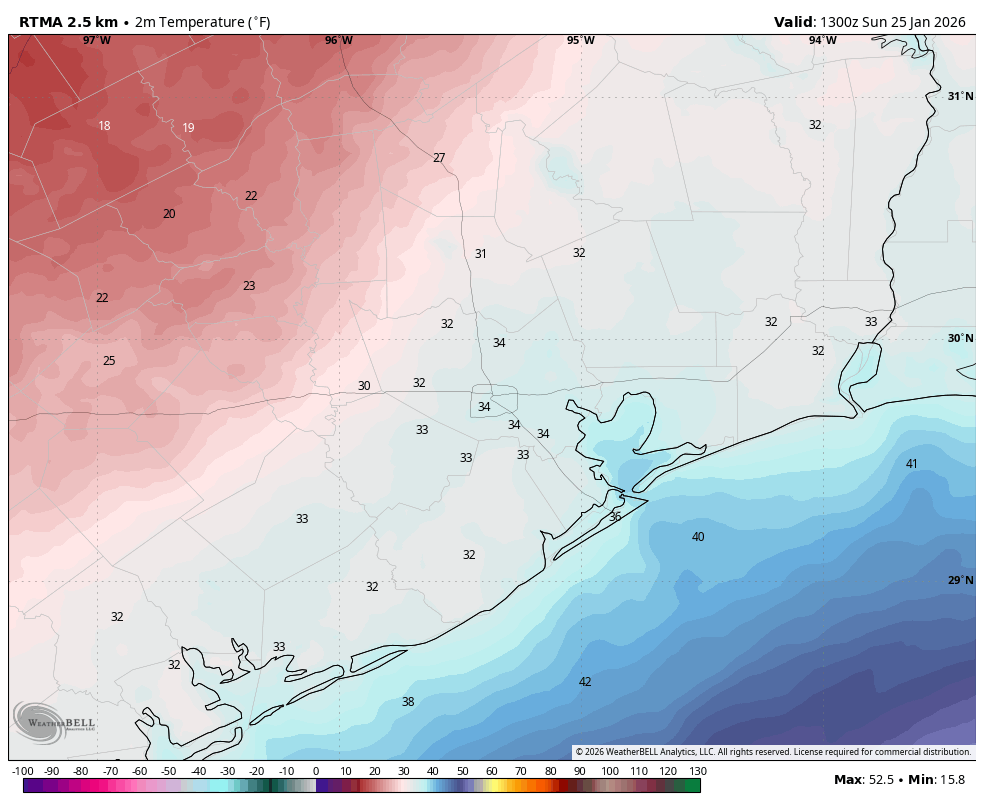
Surface temperatures at 7 am CT on Sunday. (Weather Bell)
Basically, temperatures during the key moments of precipitation this morning across most of the Houston area remained in the 32 to 35 degree range. (The map above shows air temperatures at 7 am CT). We actually saw surface temperatures warm very slightly when the stronger showers moved through this morning as this heavier precipitation dragged some of the warmer air higher in the atmosphere down to the surface. These couple of degrees helped ensure that a lot of precipitation feel in Houston as cold rain or sleet. Moreover, because surfaces were still well above freezing (it’s been warm for the last week) there was not enough time for these surfaces to cool down to support sticking ice.
We received about 0.25 to 1 inch of precipitation this morning. Had that been snow, we would have had inches of the white stuff laying around. Had it been freezing rain, our roads would be an icy nightmare. Because it was what it was, our roads have had some time to dry out before temperatures plunge tonight.
Are there issues with driving?
Things are fine for the most part out there in metro Houston. As of noon on Sunday there are just about a dozen icy locations on area freeways, and these are largely where you would expect them: to the west, northwest, and north of Houston, mostly on overpasses. But by and large the rain has evaporated from streets before it could freeze, and a lot of area roads are clear. Locations that are dry now will be fine from now on.
There are still some locations with patchy ice, and areas with standing water will freeze tonight. So I’m not saying you should drive without caution. But getting around Houston should be fine if you drive with care tonight and on Monday.
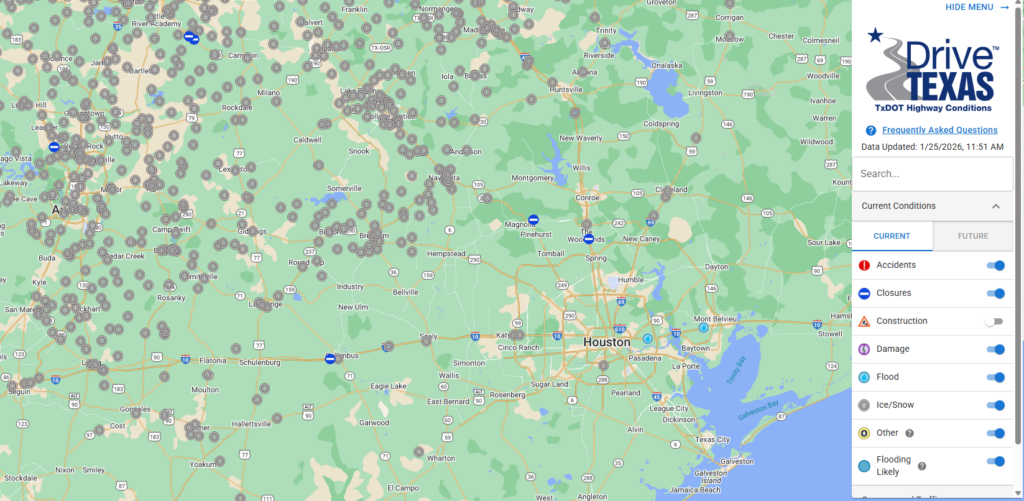
A snapshot of the Drive Texas dashboard at noon CT on Sunday.
But boy oh boy, when you get outside of Houston conditions deteriorate pretty quickly. If you browse over to Drive Texas there are hundreds of reported incidences of ice and snow on Texas highways. So if you need to get from Houston north to Dallas, or west to Austin and San Antonio, travel is not recommended. (I-10 east into Louisiana is fine). Neither Austin nor Dallas will be comfortably above freezing until Tuesday, but road conditions may improve before then due to treatment.
So how about power issues?
Houston has dodged the first of two potential bullets when it comes to electricity. Because we never recorded much in the way of freezing rain this morning, ice never accumulated on tree limbs and power lines. Therefore, CenterPoint and other utilities never had distribution issues.
The second bullet is power generation, especially tonight into Monday morning when the state faces some of its coldest weather. If you peruse supply and demand projections from ERCOT, a possible crunch remains from 6 am to 10 am on Monday morning. So far ERCOT has not issued a call to conserve energy usage, so my sense is that things will be more or less OK on Monday morning from a power generation standpoint. But we’ll keep a close eye on things, and update Space City Weather if this projection changes.
Sunday and Monday nights
Our main remaining concern with this winter system is temperatures tonight and on Monday night, when the coldest air mass will be in place. Temperatures have trended slightly warmer of late, and I believe this is due in part to a lack of ice on the ground in and near Houston. This would have lead to more efficient cooling of air near the surface. I expect lows of generally 20 to 28 degrees in Houston on both nights, with slightly cooler temperatures possible north and west of the city. Below is a forecast for lows on Tuesday morning, which now should be the coldest of the period due to clear skies and light winds.
Forecast low temperatures for Tuesday morning. (Weather Bell)
Our next update will be posted around 7 am CT on Monday morning.




 ALT
ALT![comic strip with 4 panels in a 2x2 grid showing a character that says 'somewhere right now... someone online... is creating an amazing demo. [looking to the reader] ...And I can't wait to see it!'](https://comicss.art/comics/233/somewhere-someone.png)