Cowboy Who?
Shared posts
Hostages freed after stand-off at Texas synagogue
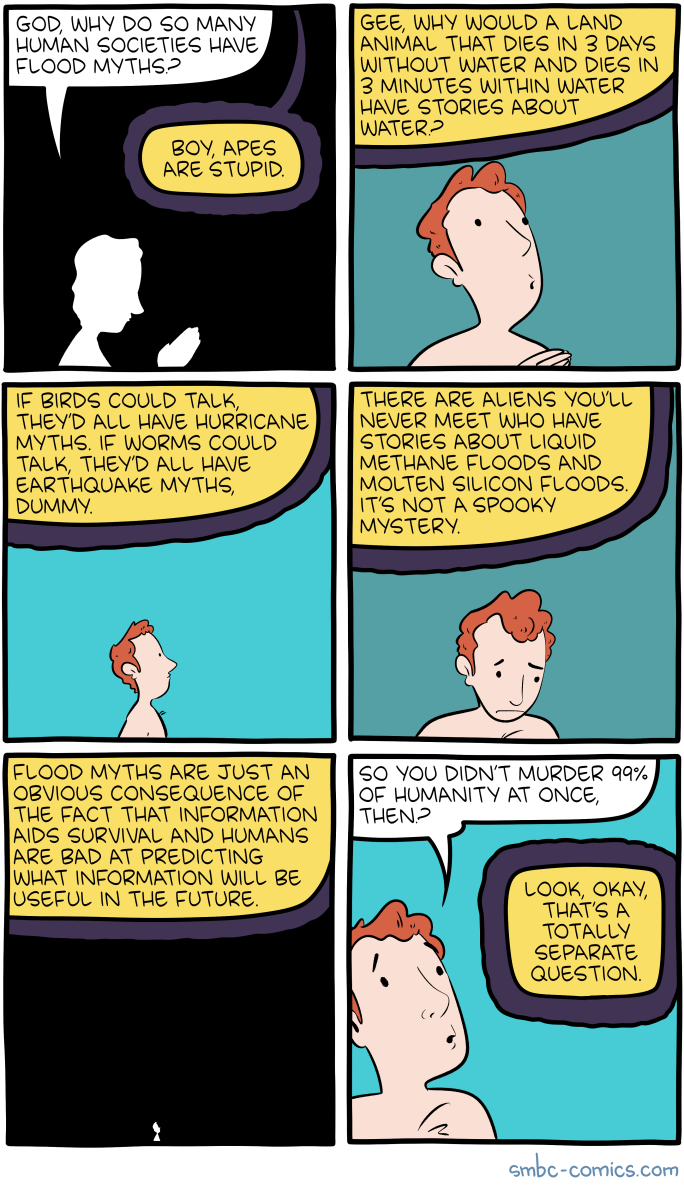
Saturday Morning Breakfast Cereal - Flood
Click here to go see the bonus panel!
Hovertext:
Sounds like someone's askin' for an ass fulla lightning.
Today's News:


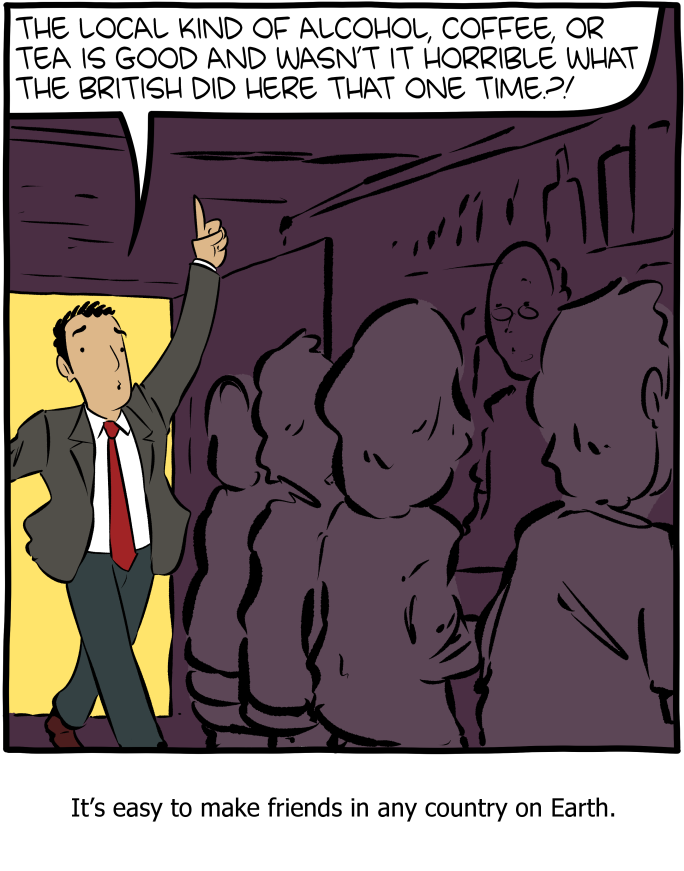
Saturday Morning Breakfast Cereal - Local
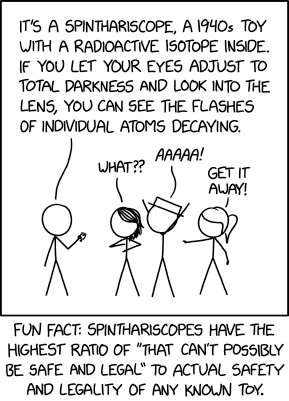
Here’s How Time Works in 2022
Here at Time, we have made a number of changes over the last couple years. Now that 2022 is here, we’re announcing several major updates.
A Minute
We’re pleased to announce that minutes go by quickly again. You’ll put something in the oven, forget to set a timer, and BEEP, just like that: the smoke alarm is going off. Isn’t that exciting? Have fun, and buy a fire extinguisher.
A Day
You may recall that, in the last couple of years, days have gone by far too fast. Well, we’re happy to say we’ve fixed that. Days now go by at a much more normal speed.
However, in order to make this fix, we were forced to make it impossible to remember exactly which day it is. Each day will now feel like every other day, to the point that you will never remember when, exactly, anything ever happened.
Yesterday
After some focus-group testing, it’s become clear that people don’t like how long ago yesterday felt. “That was yesterday? I thought that was two weeks ago!” your mom yells, somehow upside-down, over FaceTime.
Well, we took that into consideration, and we made a big adjustment. Now everything will feel like it was yesterday. The boat that got stuck in the Suez Canal? That was a year ago. But doesn’t it feel like it was yesterday? Exactly.
A Week
A week has always given us trouble. No matter what we try to do, it’s always lasted too long: a year, a month—we even got it down to ten and a half days at one point. But we just can’t figure out how to make a week feel like a week. So we’ve decided to get rid of weeks.
No more weeks now. Just months. Sorry!
A Weekend
We’ve had our best people working weekends to figure out how to make a weekend feel like a weekend.
It’s not perfect, but we have a temporary solution: we’ve managed to make a weekend feel like two Sundays. On Saturday, you’ll have that feeling of dread about the coming week that you usually feel on Sunday. Then, on Sunday, you’ll get to have that feeling all over again. Enjoy.
A Month
A month is now equal to how long it feels it’s been when you finally look up from scrolling through TikTok.
Tomorrow
Tomorrow is now reserved exclusively for things you’re expecting. Your package will always be arriving tomorrow. The weather will be better tomorrow. Your boss will pay you tomorrow. We’ll fix this version of tomorrow, tomorrow.
A Year
Based on our data, last year felt much shorter than the year before. We’re hoping this year we can beat that. Our experts believe that with our cutting-edge technology, we’ll be able to make this year last only five to ten years. That’s many years quicker than the last couple years have felt. Incredible!
That’s all for our updates—see you again in what will hopefully feel like less than a decade.
Fact check: The theory that SARS-CoV-2 is becoming milder

A look at the data that omicron is less severe. What does that mean for the future of SARS-CoV-2 — and the pandemic?
(Image credit: Science Source)

Yellowstone Manufacturing is Go!

The i’s are dotted, the t’s are crossed, and Yellowstone manufacturing is underway! I want to say something satirical like “I never thought I’d live to see this day”, but truthfully this has been a long, long, loooooooong time in the making. General availability of Yellowstone is expected sometime around the middle of March. Development started in the summer of 2017, so you can do the math on total development time.
I’ve created a Yellowstone product page. This will be the official home for everything Yellowstone, including an overview of what it is and why you might want it, compatibility information, links to the instruction manual, firmware updates, and more.
Yellowstone is a universal disk controller card for Apple II computers. It supports nearly every type of Apple disk drive ever made, including standard 3.5 inch drives, 5.25 inch drives, smart drives like the Unidisk 3.5 and the BMOW Floppy Emu’s smartport hard disk, and even Macintosh 3.5 inch drives. Yellowstone combines the power of an Apple 3.5 Disk Controller Card, a standard 5.25 inch (Disk II) controller card, the Apple Liron controller, and more, all in a single card.
Need to attach a disk drive to your Apple II? Yellowstone should be your first choice, because it does virtually everything that every other Apple disk controller can do, plus more. The retail price for Yellowstone is planned somewhere in the mid-$100s range. This is a nice value, given that an Apple 3.5 Disk Controller Card costs $200+ and used Liron cards sell for $300+ on eBay, and Yellowstone can do much more than either of those cards.
Apple Disk Controller Card Comparison
| Disk Controller | Supports 3.5 inch drives | Supports 5.25 inch drives | Supports smart hard drives | Supports Macintosh drives | 20-pin ribbon connector | DB-19 connector | Number of connectors |
| Disk II Controller Card |
✔ | ✔ | 2 | ||||
| Disk 5.25 Controller Card |
✔ | ✔ | 1 | ||||
| Apple 3.5 Disk Controller Card | ✔ | ✔ | ✔ | 1 | |||
| Apple Liron Card | ✔ | ✔ | 1 | ||||
| Yellowstone | ✔ | ✔ | ✔ | ✔ | ✔ | ✔1 | 2 |
[1] optional DB-19F connector
Since I know people are going to ask, I’m not taking pre-orders at this time, but you can sign up for the BMOW Newsletter if you want to be informed when Yellowstone is ready for sale. There should be plenty of Yellowstone cards to meet demand for at least a few months, so there’s no worry of an immediate sell-out. But in the medium to long term, the global semiconductor shortage and general meltdown of supply chains will be a problem. I couldn’t build additional Yellowstone cards right now, even if I wanted to, because the necessary parts just aren’t available anywhere. So if you want one of these, maybe don’t wait too long beyond March to grab one.
Want all the nitty-gritty usage details? You can read the Yellowstone instruction manual here. Now the waiting begins…
Top Five: January 13, 2022
Glasstire counts down the top five art events in Texas.
To see our 2022 Spring Preview picks, please go here.
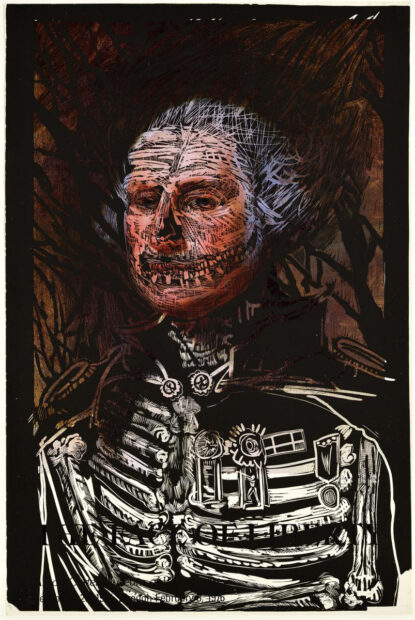
Eric Avery, “The New Face of Liberty,” 1983, Linocut over offset print, 35 1/6 x 23 1/4 Inches. Blanton Museum of Art
1. Pop Crítico/Politcal Pop: Expressive Figuration in the Americas, 1960s-1980s
Blanton Museum of Art (Austin)
October 31, 2021 – January 16, 2022
Read our review here.
From the Blanton Museum:
“In the 1960s Pop art in the Americas took a turn to the dark side. Artists working in both the United States and Latin America increasingly manipulated Pop’s colorful and flashy representation of the familiar into a tool for social and political critique. Juxtaposing works by American and Latin American artists in the Blanton’s collection, this exhibition explores how artists adopted Pop artistic language to voice a political conscience, often veiling messages within their art.”

Angela Faz, “Feeling Tender might go on Grindr later,” 2021, Plush and embroidery thread, 12 x 6 Inches. Image: 500X Gallery
2. 2021 500X Annual LGBTQIA+ Exhibition
500X Gallery (Dallas)
December 18, 2021 – January 16, 2022
From 500X:
“This year’s Annual LGBTQIA+ Exhibition is juried by Odyssey Studios, an artist-run event space and collective studio. The exhibiting artists are: Addie Rule, Angela Faz, Christopher Sonny Martinez, Christopher Nájera, Darren Dobson, Derrick Hamm, Dre Burciaga, Enrique Nevarez, Gibson Regester, Henry Thomas, Jesus Lopez, Joey Brock, Krista Chalkley, Matthew Weimer, Morgan Grasham, Sean McGuire, and Teresa Foster.”

Nómada Lab, “El Regreso Responsible,” 2021. Image: Rubin Center
3. The Fund for Ethical Practices of Transborder Art
UTEP Rubin Center for the Visual Arts (El Paso)
November 12, 2021 – February 25, 2022
From the Rubin Center:
“This exhibition documents the inaugural projects funded by The Fund for Ethical Practices of Transborder Art. The fund itself emerged out of Rafael Lozano-Hemmer’s Border Tuner | Sintonizador Fronterizo in 2019. It was created to give voice and visibility to transborder projects produced by artists living in Ciudad Juárez, Chihuahua and El Paso, Texas. This exhibition features the six projects currently supported by the Fund, with work-in progress videos highlighting the artists’ voices as they talk about their experience creating work on the MX-US border during the global pandemic, which has greatly limited the cross-border movement of fronterizos.”
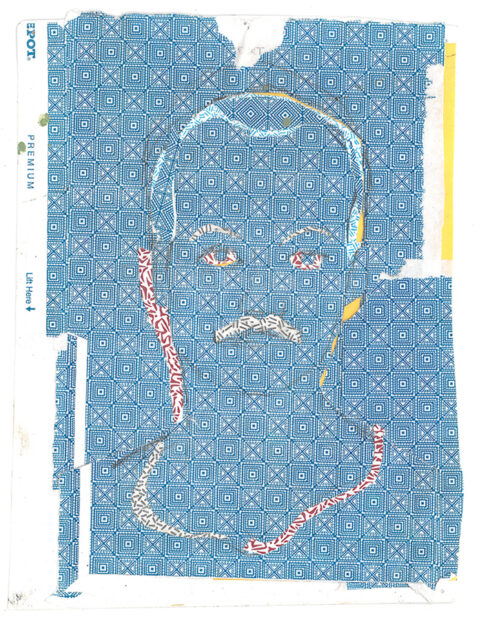
Nick Barbee, “Believers: Rudolph,” 2018, Cut paper, 9 x 7 Inches.
4. Nick Barbee: Undeniable
Galveston Arts Center
January 15 – April 17, 2022
From the Galveston Arts Center:
“The exhibition, a ten-year survey of Galveston-based artist Nick Barbee, will open in conjunction with Galveston ArtWalk on Saturday, January 15, 2022 from 6 to 9 PM. Barbee describes his work as an examination of ‘the role of representation in the construction of culture and meaning.’ His studio practice centers around historical figures and narratives, often through mundane objects and with some personal connection to these histories.”

A painting by artist Ray Smith
5. Ray Smith: Pansy Pensamientos
Brownsville Museum of Fine Arts
December 29, 2021 – January 28, 2022
Read our review here.
From the Brownsville Museum of Fine Art:
“Ray Smith is a trans-border artist, migratory in every way, Texan-Mexican, resident in NYC and Cuernavaca (Mexico) for more than three decades, forged in the arduous waters of postmodernity and the transition from the analog universe to that of the late twentieth century and early twenty-first century, what sociologists call ‘the hybrid generation’, who experienced the Cold War and the birth of the virtual universe, he is an artist who, migrates with great ease from one language to another, from pictorial to sculptural, from sculpture to drawing, and from drawing back to pictorial, in an infinite loop, perhaps due to the transitory juncture in his DNA.”
The post Top Five: January 13, 2022 appeared first on Glasstire.
Big Numbers
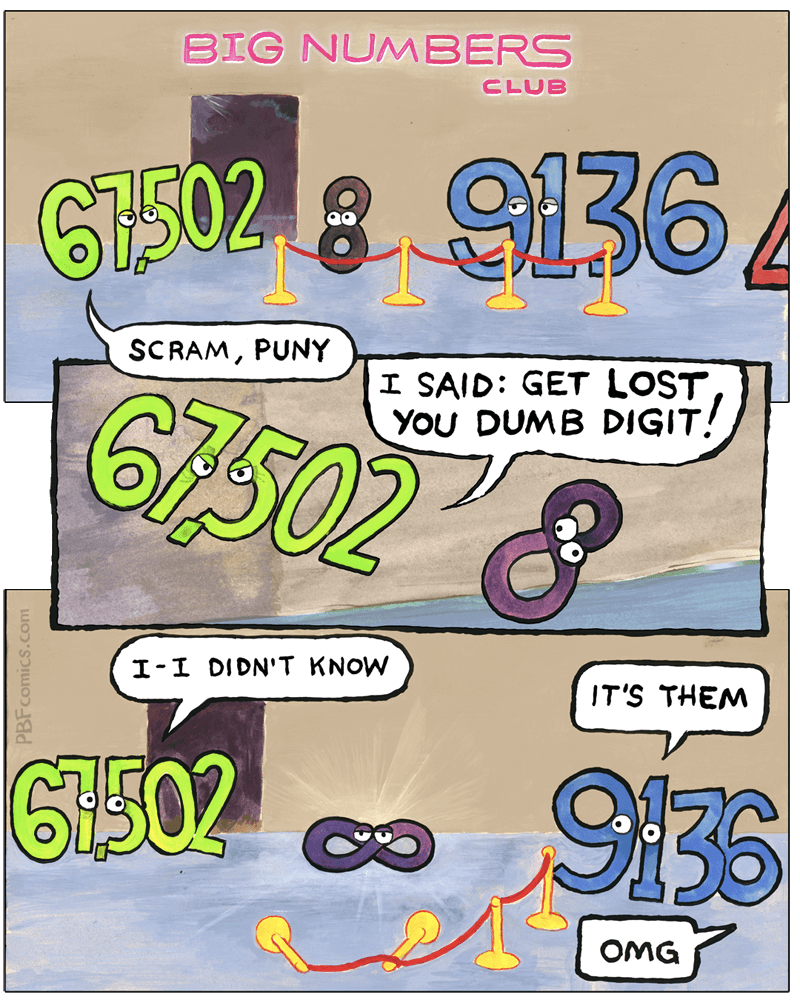
The post Big Numbers appeared first on The Perry Bible Fellowship.
strangetrek_20220106_431-61d75172e0858__700.jpg...
strangetrek_20220106_431-61d75172e0858__700.jpg (700×700)

New 'TLDR' Bill Requires Companies Provide Synopsis Of Overlong, Predatory Terms Of Service
This week saw the introduction of the The Terms-of-service Labeling, Design and Readability Act, or "TLDR Act," for short. The bill, which, for now, has bipartisan support, would require the FTC to create rules mandating that websites must offer a truncated version of obnoxiously long and predatory terms of service (TOS) nobody actually reads. The "summary statement" websites would be obligated to provide would not only lay out the legal requirements in terms normal humans could understand, it would also require a website disclose any major data breaches that have occurred in the last three years.
A breakdown (pdf) of the bill also states it will require websites to disclose what data is collected upon a user's visit, and what kind of control a user has over that data. Any violation of the new law would be declared to be within the realm of "unfair and deceptive" under the FTC Act, giving the agency the authority to act on it. Rep. Lori Trahan had this to say about the need for such a law:
"For far too long, blanket terms of service agreements have forced consumers to either ‘agree’ to all of a company’s conditions or lose access to a website or app entirely. No negotiation, no alternative, and no real choice,” said Congresswoman Trahan, a member of the House Subcommittee on Consumer Protection and Commerce. “To further slant the decision in their favor, many companies design unnecessarily long and complicated contracts, knowing that users don’t have the bandwidth to read lengthy legal documents when they’re simply trying to message a loved one or make a quick purchase."
Yes, most TOS are overlong and that length is often used to obscure bad behavior or quietly erode consumer rights (see: binding arbitration). But many TOS are also overlong because U.S. law and compliance are complicated as hell. The idea that you can always simplify everything a company needs to get across to a user to comply with the law and reasonably cover your ass in a sentence or too is probably a little simplistic. At the same time, I'm not sure the American consumer, many with the attention span of a goldfish, would even read the truncated version of a TOS anyway.
While "more transparency" is certainly good, it also only goes so far if you're not willing to tackle the deeper problem(s). For example the FCC is pondering a transparency label on broadband connections outlining all the sneaky ways you're getting ripped off by your internet service provider. And while knowing the precise parameters how you're getting ripped off is nice, users in monopolized markets can't switch ISPs anyway because the FCC generally isn't willing or able to combat monopolization and limited competition. So transparency only accomplishes so much.
Here too, websites, apps, and services use overlong TOS to obfuscate all manner of behaviors U.S. regulators either don't have the resources to police (the FTC has 8% of the staff dedicated to privacy issues as the UK, despite the UK having one-fifth the consumers to protect) or are apathetic to because of revolving door corruption (see: telecom, banking, adtech, etc.). Expecting the FTC to do a whole lot more stuff without notably expanding funding seems a bit short sighted. And this is all assuming the bill is actually well written and doesn't cause new, unforeseen problems via sloppy language.
So while well intentioned, this feels like a bit of a band aid on problems policymakers can't or won't tackle head on. Like limited competition. Or the complete and total lack of anything even vaguely resembling accountability in telecom, adtech, or the data broker space. Or privacy reform. Or antitrust reform. All of these problems lead to bad behaviors companies are hiding in their TOS, and making those bad behaviors clearer to the end user is only part of a process. Knowing you're getting screwed or spied on is only helpful if you have the recourse to do something about it, and regulators willing to stand up for you when push comes to shove.
I was kicked out of a work lunch because I couldn’t eat, attracting employees when we can’t pay more, and more
This post, I was kicked out of a work lunch because I couldn’t eat, attracting employees when we can’t pay more, and more , was originally published by Alison Green on Ask a Manager.
It’s four answers to four questions. Here we go…
1. I was kicked out of a work lunch because there was nothing I could eat
This happened a few years ago, pre-Covid, but I would still appreciate your input on it. I was a part of the voluntary team that helped to plan, organize, and set up for events, celebrating things like holidays and the completion of major deadlines, which was run by someone from HR. At one point HR set up a lunch to show their appreciation for us. However, the planning for this was delegated to a non-HR member of the team, Daphne, who chose a barbecue restaurant. I am vegetarian and can find something to eat 99% of the time — but here the only vegetarian option was the coleslaw. I decided not to complain, and when Daphne emailed me to ask for my order, I politely responded explaining that I could not eat anything from the restaurant she chose, but not to worry about it. The day of, I decided to join the lunch for the social aspect; food was delivered and we got together to eat in a conference room. I had already eaten, so I just sat. The head of HR joined us, and on seeing that I was not eating, politely asked me to leave; I don’t remember the reason he gave. So I missed out completely.
Was the HR head right to ask me to leave? Should I have handled this differently, such as by pushing back immediately when I saw there was nothing I could eat at the restaurant, or holding off on eating my own food until the team lunch?
You were asked to leave an appreciation lunch because you weren’t eating? That’s so bizarre, and frankly rude, that I don’t know what to do with it.
You didn’t do anything wrong. If you’d wanted to, you could have asked earlier on if they could choose a restaurant that didn’t exclude the vegetarians of the group. Or you could have brought your own food to the lunch if you’d wanted to. But what you did was perfectly fine too. Not only should they have welcomed you rather than kicking you out, they should have offered to order you something from another restaurant once they realized you couldn’t eat (in fact, Daphne should have offered that as soon as she saw your earlier email).
2. How can we attract more employees when we can’t pay more?
I run a medical practice in the U.S. We’re a small clinic, with two locations and 12 employees when appropriately staffed (we are experiencing labor shortages just like everyone else).
In this time of employees demanding better pay, we’re struggling to attract candidates. We meet or exceed the median wage for the area, but I can’t really go above that. We only get paid per patient we see, and our rates are set by the insurance company and have barely changed in the last 16 years. The easiest way to make more money is to see more patients, but the only way to do that is to shorten treatment times further, which isn’t fair to my clinicians or the patients, and is even less attractive when discussing the job responsibilities.
We offer decent benefits (15 days PTO, 10 paid holidays, subsidized health insurance and dental insurance, free life insurance, free short-term and long-term disability insurance, a tuition reimbursement/student loan repayment program — we even started offering a sign-on bonus which I’ve had to claw back twice because people left for higher paying jobs) but can’t offer the other perks that the management books talk about like flextime and work from home, for obvious reasons (we are a type of medicine that is very hands-on, so we don’t have many telehealth appointments). We try to treat our employees well by buying lunch, surprising them with gift cards, handwritten thank-you notes, casual dress days, team building days (think escape rooms and dinner out) — things that fit into a small budget but still say “we appreciate you.”
It’s not that I don’t want to be able to offer more, but I need to more than double our size in order to do so. I’m willing to do that, and we were on our way pre-pandemic, but now I can’t attract enough candidates to get there, so I’m stuck in this terrible loop! (And it would still take some time, it wouldn’t happen overnight). So, how can we be more attractive without increasing our payroll?
The thing that immediately jumps out is that you’re offering very bare-bones time off — assuming your 15 days of PTO is combined vacation and sick leave, that’s the equivalent of two weeks of vacation and one week of sick leave, which is the absolute minimum considered acceptable for most professional jobs in the U.S. If you’re looking for low-hanging fruit, it’s definitely your PTO. I know offering more means people will be out more, which might sound like it will compound your staffing issues — but offering more would help you attract more people in the first place.
Beyond that, I’d talk to your staff about what they want (you might find that they don’t care about the escape rooms but would really like more back-up dealing with difficult patients, or who knows what) and their thoughts on what would attract more applicants. And if you haven’t already, make sure you look at what other options are available to your candidate pool in your area, and what those jobs are offering. But the PTO is the thing I’d tackle first.
3. I interviewed for a role that was open because someone died from Covid, and they still aren’t mandating masks
I wanted your thoughts on this job I interviewed for. The job was open because someone died of Covid, which the HR rep let me know. I was very grateful to have been reading your blog all along because when she didn’t tell me about the Covid safety procedures afterwards, I immediately asked.
Masks are not mandated. Vaccines were not mandated either. This role could be done from home but they are making people come in office.
I turned it down, but she kind of made it seem weird that I even brought up the Covid safety procedures. Did I do the right thing?
Yes. Any employer who acts like you’re odd for wanting to know their measures for keeping people safe in a deadly pandemic is not an employer you want to work for. And that’s before we even get into their apparent utter lack of safety precautions, despite having someone die.
4. My interviewer asked me what questions they should have asked me
I had a final-round interview recently, and things seemed to be going okay when, at around the 40-minute mark, I got a question I’ve never had before: “What questions haven’t we asked, that you think we should have?” I quipped that that seemed like a trick question, which was met with some light chuckles, but then a silent pause descended over us.
I wouldn’t say I’m an inexperienced interviewer, but in my surprise I had a hard time putting all the pieces together – what had/hadn’t they asked; what hadn’t I told them; what wouldn’t be a horrible question to answer; what would my answer be to the question I asked myself by proxy. I did my best to pull from hints in previous questions to go deeper on specific concerns/skill sets to the work, but I obviously didn’t wow anyone and the remainder of the interview had a “let’s get this over with” tone.
Afterward, I consulted the internet to see what others said about this question and didn’t really find much. Have I been living under a rock while everyone has been out there asking this back-handed question? Is this the new, mind-bending way to ask “Anything else you’d like to share with us”? How would you recommend formulating a graceful answer?
You’re over-thinking it! It’s generally just a way to ask if there’s anything else you want to share. Ideally you’d think about whether there’s anything else that would be useful to discuss about your qualifications, experience, or approach to your work — and then with any reasonable interviewer, you don’t need to formulate it as a question like you’re on Jeopardy or something but should just be able to say, “I saw the role involves sometimes dealing with frustrated clients, and I’d love to tell you about my approach to that” or so forth.
And I almost took this next part out of my answer because it won’t apply a lot of the time and also is a whole separate topic, but I’m leaving it in case people find it useful:
Alternately, if there’s a piece of the role that you’re not sure is that right fit for you, I might ask about that — for example, “I was curious about how much X expertise you need for your Y project — could we talk through how I’d approach that and make sure it’s in line with what you need?” (You might think you should never highlight potential weaknesses in an interview, but if you’re worried you might be ill-suited for part of a job, it’s far better to find that out at this stage, rather than after you start … and good employers will respond well to an honest conversation about your fit for the role, as long as you’re coming across with confidence and thoughtfulness.)
What Your Favorite Sad Dad Band Says About You
Our 2nd most-read article of the 2022.
Originally published January 14, 2022.
The War on Drugs
You make your own paella and take super long naps on Saturday. Like over two hours, consistently. You prefer the smallest possible hardware store with the oldest possible employees. You used to sincerely call male friends “brother,” but you stopped.
The National
You should have moved to Brooklyn when you had the chance. You never had the chance. At what point does the artisanal whiskey interest become just alcoholism with a higher word count? You used to think you were once great at soccer, but now you’re not so sure you were ever good at soccer. This is causing a very low-level existential crisis that will vanish in three years.
Wilco
What if your own sad dad had more shirts and more of a beard and more debt and more fun, and there was just more of him in general? Your Charles Bronson knowledge doesn’t need to be acknowledged. Your son’s friends know not to get you started on amps. You’ve never figured out your relationship with the idea of camping.
Pavement
Your son’s friends like you and worry about you but they don’t tell your son this. You point out where things used to be when you drive around town, but all the things you point out are somewhat shady and confusing. Was that place a dance club? A friend’s house? Were there parties there or just a drug dealer? You may have misplaced your David Foster Wallace books in the last move, or your spouse quietly donated them. You like walnuts now.
Pearl Jam
You have a lot to say about the little restaurant on the coast where you’ve actually become good friends with the owner. He let you come by in the afternoon once and learn about cooking shellfish. You shake your head at the word “crypto.” Four of your friends are named Josh, and one dead friend is named Josh. You’re glad you don’t work in “business development” anymore. You wake up screaming sometimes.
Bright Eyes
Someone hurt you. Multiple someones, actually, and at some point, you just said fuck it and made a spreadsheet to keep track, deleted the spreadsheet, undeleted it, and stored it in a file titled PAST. You’re nearing a point where you like making pesto more than eating pesto. Never been a sports fan but might give hockey another try.
Father John Misty
You and your friends still drop Mr. Show references to each other over text. You haven’t had as many Zoom calls with them as you all said you wanted to have. You’ll inevitably watch any movie The Rock is in. Kayaks.
Arcade Fire
Look, you know that the term “PTA” puts a lot of people off but what if we could remake it in a way to really benefit the school AND the kids? Maybe there could be parents-only events at night, like at the brewpub, like a low-key fundraiser—I mean, hell, maybe your band can play. You also refer to Paul Thomas Anderson as “PTA,” and sometimes people don’t know which PTA you’re talking about.
Bon Iver
Perhaps the most accurate term to apply to your situation is “seriously injured and lost in the woods.”
Modest Mouse
What are you on? What are YOU… ON? You’re on LIFE, man. Life and energy drinks. No, you haven’t heard from Jen in many years now. You heard she might have moved back to town, actually. You’re not on Facebook, because, yeah, that’s all you need, THOSE people listening in. Your bike is transportation to and subject of the protests you attend.
My Morning Jacket
You know how to cook an eel.
Pixies
You’re fine working in software development. You’ve been there a long time, your friends are there, no one else in the company knows what the fuck you do all the time, but that’s because their brains can’t handle it. You don’t even like IPAs anymore. Your daughter moved back home.
Everclear
You died seven years ago.
Death Cab for Cutie
Academia isn’t nearly as much fun as people think it is, but it’s nice being on the other side of the tenure process. You joined a rowing crew but your shoulder is all fucked up so you had to stop, for now anyway. Clearly, your fandom for The Bachelor can no longer be considered to be ironic. As you sit in the Adirondack chair in the backyard, an hour after sunset, you fire up a joint and a dissociative disorder.
The Mountain Goats
You have received sensible health care. You drive Toyota cars and your dalliance with a used domestic pickup that had character did not end well. Your tolerance for people telling you a lot about building a computer ends at the nineteen-minute mark, at which point you politely excuse yourself. Without explanation, you decline the escape room team-building event at work.
The New Pornographers
You’re pretty good at building fences, enough so that people ask you for help building their fences and then pay you a little something despite your protests. Should you just become a fence guy? Eh, you’ll stay with this finance thing for now. You are reading a book about naval mishaps.
LCD Soundsystem
You received a stand for your keyboard for Christmas. You can ski pretty well. Stephen Sondheim’s death hit you harder than you expected. You have mentally composed but never posted an OkCupid profile.
Counting Crows
Turns out that if you really want to get anywhere in the commercial cannabis industry, it’s all about who you know.
R.E.M.
Can someone really know all this stuff about cucumbers? You are proof that someone can. You have more of a comment than a question. You are giving the Catholic Church another chance. High-top Chuck Taylors hurt. You remember what making out felt like when you were seventeen years old, and you’re writing it down so you always will. Your sister had friends named Connie and Tracy that your dad called “Bonnie and Stacy,” and everyone in the house got audibly mad at him about it. You have a favorite sock brand.
Read a short interview with John Moe about writing this piece over on our Patreon page.
A very common virus may be the trigger for multiple sclerosis
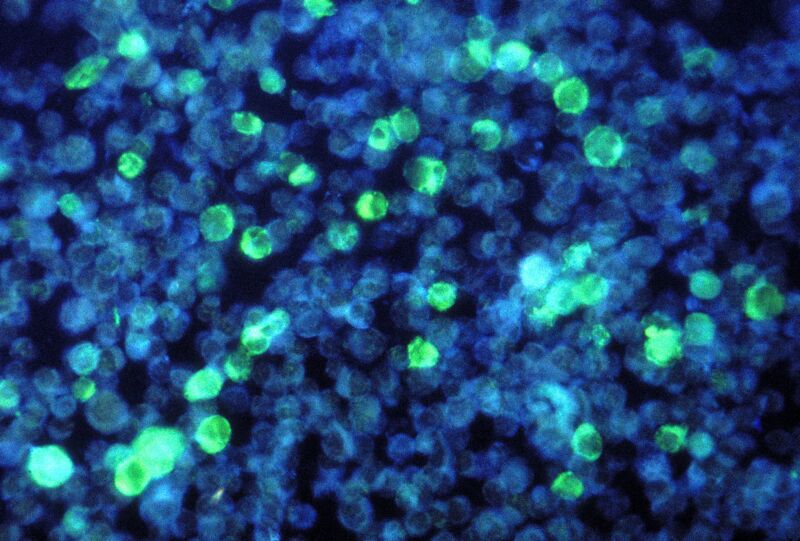
Enlarge / This photomicrograph depicts leukemia cells that contain Epstein Barr virus using an FA staining technique, 1972. Epstein-Barr virus, EBV, is a member of the Herpesvirus family and is one of the most common human viruses. (credit: Getty | CDC)
Evidence is mounting that the garden-variety virus that sometimes causes mono in teens is the underlying cause of multiple sclerosis, a rare neurological disease in which the immune system attacks the brain and spinal cord, stripping away protective insulation around nerve cells, called myelin.
It's still unclear how exactly the virus—the Epstein-Barr virus (EBV)—may trigger MS and why MS develops in a tiny fraction of people. About 95 percent of adults have been infected with EBV, which often strikes in childhood. MS, meanwhile, often develops between the ages of 20 and 40 and is estimated to affect around one million people in the US. Yet, years of evidence have consistently pointed to links between the childhood virus and the chronic demyelinating disease later in life.
With a study published today in Science, the link is stronger than ever, and outside experts say the new findings offer further "compelling" evidence that EBV isn't just connected to MS; it's an essential trigger for the disease. The study found, among other things, that people had a 32-fold increase in risk of developing MS following an EBV infection in early adulthood.
Read 15 remaining paragraphs | Comments
The most consistently botched part of the US pandemic response

Why are public health officials so bad at talking to us?
The fierce backlash to the CDC’s recent decision to shorten the recommended isolation period for people who test positive for Covid-19 was the latest in a series of communications blunders so severe that they have now become a meme.
Communication is an essential part of any public health response. But US health agencies have struggled with it since the very beginning of the pandemic, when government officials initially advised against wearing masks in early 2020 before reversing themselves to recommend nearly universal masking.
It appeared the initial guidance may have been issued in order to preserve enough masks for health care workers. Government officials were warning at the time that hospitals’ supplies could be depleted at a critical moment if there was a run on masks. It was the first of the pandemic’s “noble lies,” The Week’s Ryan Cooper wrote in a blistering essay on the paternalistic treatment of the US public that has undermined the country’s Covid-19 response.
America’s public health institutions have failed to communicate effectively with the US public throughout the pandemic for two reasons: either they have been left trying to defend poor policies, or the messaging has taken the place of creating any kind of coherent policy at all.
“I don’t think any federal or state agency has done a great job communicating policy during the pandemic,” Briana Mezuk, co-director of the Center for Social Epidemiology and Population Health at the University of Michigan School of Public Health, told me. “The CDC should have been setting the example, and I guess in a way it did: a less-than-great example.”
In those early days of the pandemic, a more explicit policy decision would have been to ration masks, telling the public that masks could be protective but that high-quality supplies would be reserved for health care workers. Instead, authorities sidestepped the issue and planted the seeds for the backlash.
“We cannot pretend that communication can get us out of policy answers,” Michael Mackert, director of the Center for Health Communication at the University of Texas Austin, told me.
The problem of unsound or indecisive policy creating bad messaging has been repeated over and over again throughout the pandemic, which has deepened skepticism about the agency’s recommendations and created a fertile environment for disinformation to flourish.
A year after the first masking flip-flop, the CDC stumbled on masks again. In April 2021, the agency urged vaccinated people to continue wearing masks in most indoor settings to reduce transmission before reversing itself and saying that vaccinated people could feel free not to wear masks indoors unless it was required by a local or state government.
Many public health experts believed the decision to relax the masking guidance for vaccinated people was premature and, just a few months later when the delta variant drove up cases, the CDC changed course again and recommended everyone, including vaccinated people, wear masks when indoors in public.
Contrast the whiplash in the US with the approach in Canada, which issued a much more limited change to its masking guidance around the same time and didn’t need to quickly revise it. Canadians were urged to keep masking, with the one exception of small indoor gatherings with other vaccinated people. Those recommendations remain more or less the same to this day.
Other crucial pivots in the US response were undermined in the following months. President Joe Biden announced in August that booster shots would soon be available for everyone. But some of the federal government’s scientific advisers balked at that idea in public meetings, sowing confusion about whether additional doses were really necessary for everyone.
Pubic health authorities faced serious obstacles to communicating effectively with the public. The American people are divided, consuming different information from different sources, motivated by different ideologies. Social media allows “alternative” sources of information to flourish. The world had never seen a virus quite like SARS-CoV-2 and scientists were learning more about the virus in real time. It was inevitable some of their early assumptions would be wrong and guidance would have to change.
But some of the confusion that has undermined the American response was avoidable. Prevailing attitudes inside the medical establishment prior to Covid-19 and specific mistakes made during the pandemic itself have contributed to the disconnect between public health authorities and the public they are trying to protect.
“Our institutions are failing us with the lack of coordination, the lack of clarity,” Scott Ratzan, editor-in-chief of the Journal of Health Communication: International Perspectives and a CUNY lecturer, told me. “This is a case clearly that shows our 21st-century institutions are not prepared.”
Why America’s public health institutions failed at pandemic messaging
The initial mistake in the messaging around masks — in effect, misleading the American people, seemingly to preserve the supply of masks — set the stage for what would follow: a pattern of public health authorities adopting a patronizing attitude toward the public they are supposed to serve.
/cdn.vox-cdn.com/uploads/chorus_asset/file/23161443/GettyImages_1215578709.jpg) Steve Pfost/Newsday via Getty Images
Steve Pfost/Newsday via Getty Images
Mezuk voiced her frustration with phrases like “follow the science” that were used to justify various policies. Individual people have to account for all kinds of other variables in their daily decisions — making money, educating their kids, caring for loved ones — as they make risk assessments regarding Covid-19, she said.
The government had more to consider than the public health ramifications of the Covid-19 response. There were economic and social consequences to weigh when it came to closing restaurants or mandating remote learning. An acknowledgment of that complexity might have engendered more trust when the pandemic persisted and some of those calculations began to change, rather than pretending the science had been settled.
“Some amount of backtracking, revision, etc., of policies was inevitable. That should have been stated early, often, and repeatedly,” Mezuk told me.
Several experts told me public health officials should have better prepared their audience for inevitable policy changes, making it clear from the beginning that scientists were still learning more about the virus and policies would need to adjust.
“Instead, they went with ‘we are following the science,’ which was interpreted by the public as, ‘so if you disagree with our decision, you must not be following the science,’” she said. “That is just a false dichotomy, and people knew that. And so the CDC and other leaders lost a lot of credibility that I think the public would have freely given them had they not latched onto that simplistic narrative.”
In some ways, the battle to win hearts and minds during the pandemic was lost before Covid-19 ever arrived. Several experts pointed out that most people are not nearly as fluent in interpreting statistics or assessing risk as public health experts are trained to be, and public health officials have often failed to find simple but effective ways to convey complex ideas to the masses.
The debate over booster shots is perhaps the most important example of how the government can muddle the messaging around its own policies. Biden got out ahead of the government’s science advisers when he announced boosters for everybody in the late summer. The government’s scientific advisers and many public health commentators ended up being divided on the merits of boosters.
The CDC was left to try to craft recommendations in the middle of this chaotic debate. The agency initially attempted to split the difference, urging all people over 65 and people over 50 with underlying medical conditions to get boosters. It also said people under 50 who either have preexisting conditions or work in high-exposure settings could get an additional dose if they chose to.
Who the boosters were actually for (older people? essential workers? everyone?) got confused. By December, even after the CDC had revised that guidance to urge everyone over 18 to receive three doses of the vaccine, one in five vaccinated adults were unclear on what the agency had recommended, according to a Kaiser Family Foundation survey.
The US is now lagging behind the United Kingdom in administering third doses, particularly among the older people who benefit most from a booster. The UK had been more direct in its initial vaccine guidance: Certain people (adults over 50, front-line workers, immunocompromised people) should get the booster, full stop.
In the US, a messy policy process led to poor messaging. Several experts I spoke to contrasted the confusion over vaccines with the simple rubrics used to communicate the risk of an incoming hurricane. People don’t need to know the intricacies of meteorology to understand that a Category 5 hurricane is going to be bad. But we have failed to find the same effective shorthand to communicate basic facts about Covid-19.
“I don’t know the drop in barometric pressure. We don’t need to give people all the technical information that can be misconstrued and turned into misinformation,” Ratzan said. “The scientists might think they have to explain all the reasons. But, in the end, we need scientific consensus that is not only data-driven but also reflects a social science base of how people are going to respond.”
What it takes to effectively communicate in a public health emergency
There will be a lot of work to do to prevent a repeat of these mistakes in the future. In a December 2021 review published by the National Academy of Medicine, public health researchers advocated for a policy of “radical transparency” that attempts to meet people at all levels of health literacy.
/cdn.vox-cdn.com/uploads/chorus_asset/file/23161268/AP21173284096033.jpg) Eugene Hoshiko/AP
Eugene Hoshiko/AP
Messages should be simple. The Japanese government’s “three Cs” — urging people to avoid closed spaces, crowded places, and close-contact settings — is seen as one of the more effective messages of the pandemic. This Vietnamese hand-washing PSA went viral in the spring of 2020, driven by a catchy song and a dance.
Suzanne Bakken, who has contributed to the National Academy’s work on Covid communications, told me that “flatten the curve” had been the most effective message deployed in the United States. It managed to communicate an important public health goal in an intelligible fashion and, for a time, gave people a shared goal to work around.
“That really spoke to people,” she said. “It was a pretty simple visualization.”
Academics such as Bakken are also thinking about how to empower local health authorities and nongovernmental groups, in which people might place more trust in the current polarized political environment. The National Academy of Medicine review contemplates some kind of national infrastructure that would disseminate information to local actors and allow them to decide how to tailor the message based on their particular community:
Communications should be adapted at the individual and community levels and take into account how centrally developed communications methods can be rooted in patriarchy, colonial oppression, and structural racism. Without this understanding, communications cannot be appropriately adapted to local contexts, and therefore may be rejected by many communities.
This is a lesson that other countries more accustomed to public health emergencies have already learned. In Vox’s Pandemic Playbook series, reporter Jen Kirby traveled to Senegal and spoke with community health workers who were integral to that country’s response, as the point of contact and primary communicator in their own villages and towns.
Given how diverse the US is, and how much trust in some of its national institutions has eroded, such a model would offer one way to begin repairing the relationship between the American public and its public health institutions.
“It’s not only getting the message right,” Ratzan said, “but having the right messenger, with the right dosage.”
Congressmen who enslaved people
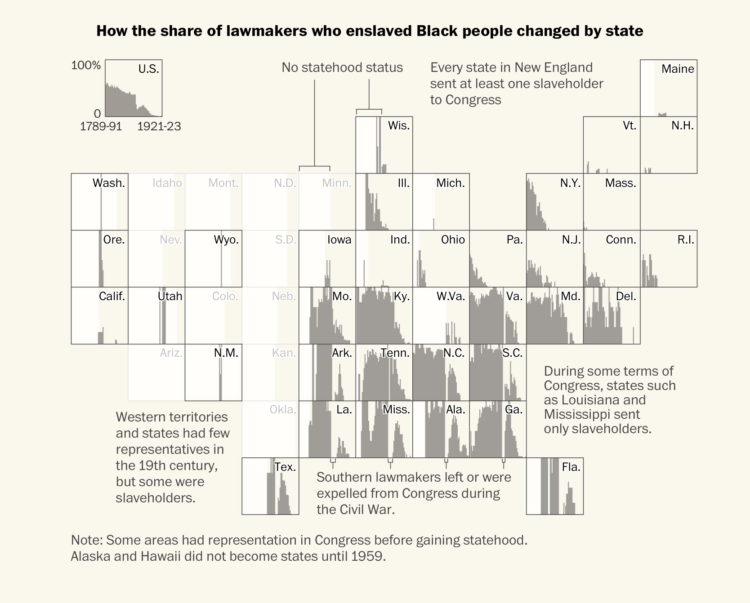
Using old Census records and documents, Julie Zauzmer Weil, Adrian Blanco and Leo Dominguez for The Washington Post tallied the congressmen who enslaved people over time. There were more than 1,700 enslavers over Congress’s first 130 years.
The grid (or tile) map above shows the timeline for each state, showing the percentage of officials who were enslavers from 1789 to 1923. Periods before states gained statehood status are faded out.
Tags: government, slavery, Washington Post

Saturday Morning Breakfast Cereal - Free
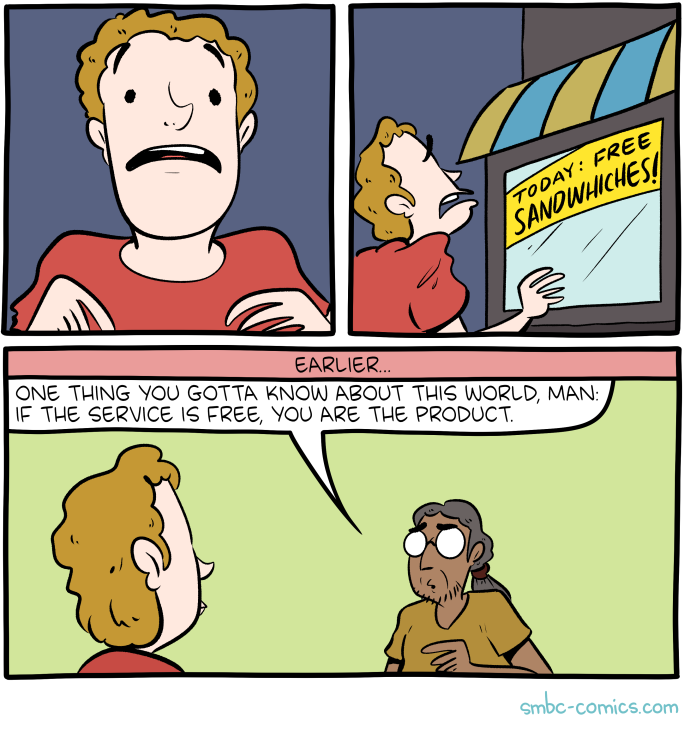
Click here to go see the bonus panel!
Hovertext:
Free Hugs being the quintessential example.
Today's News:
my coworker tried to film her pregnancy announcement and now there is chaos
This post, my coworker tried to film her pregnancy announcement and now there is chaos , was originally published by Alison Green on Ask a Manager.
It’s the Thursday “ask the readers” question. A reader writes:
So this is an enragingly dumb breach of basic manners and I need to know I’m not crazy. I’m technically in an executive role but I don’t have authority over people, just finances, but I was told I should have “acted like a better manager” during this whole fracas. I kind of can’t believe someone would do something like this, especially since our office finally got 100% vaxxed (group decision, everyone pulled together, very cool) and we’ve had to be so careful about even breathing near one another for the last two years.
My coworker, “Jessie,” is pregnant and decided she wanted to film a reaction video announcement telling everyone in our office. This is a marketing firm, but we’re a small satellite office so corporate encourages us to do a lot of “meet the staff” and “it’s Tiffany’s Birthday” type sharing posts to attract clients. We’ve had problems before with the higher-ups encouraging some oversharing, and just a LOT of bad personal boundaries in the office. I feel like this inspired Jessie and another coworker, “Daniela,” to do this pregnancy announcement by tossing people a positive pregnancy test so they could film the reactions.
Two quick things:
A positive pregnancy test is a used pregnancy test, which means it was urinated on. I used to be a lab tech before I made a career switch so yes, even if it was wiped down with the cap on, it still has urine on it, and if it was a test from home that she brought with her it, bacteria and other unpleasantness could be incubating inside the plastic.
We just spent two years disinfecting our mail.
Jessie started by tossing the used pregnancy test to “Abby,” who flung it when she realized what it was and yelled “oh gross,” which got a lot of people’s attention and “ruined” Jessie’s announcement. It’s kind of office knowledge that Abby is a germophobe so while part of me gets that Jessie was excited and maybe didn’t think things through, the rest of me feels like this was a really unfair position to put Abby in, along with all the other staff she was planning to throw a used peed-on pregnancy test at.
Jessie and Daniela got super upset and offended and everyone in the cubicle block started arguing. Because there were no managers or HR on site that day, and I would be the next “ranking” executive, I stepped in and defused the situation as best I could.
I pulled Jessie and Daniela aside and congratulated Jessie. But here’s the part everyone’s mad at. I told them it’s never okay to hand someone something they urinated on, regardless of if they wiped it down and put the cap back on it. I said we’re excited for Jessie but that wasn’t okay and to throw the test out or take it home.
By the time the managers and HR got back in office, they were told multiple versions of the whole thing. For the record, they’re also all men. I got called in to explain what I saw. HR told me they’re considering disciplinary actions for Abby and anybody else who “reacted poorly” unless they publicly apologize to Jessie. I told them that was a terrible idea and, not knowing what else to do, I called corporate HR and relayed the situation to our female head of HR, outlining what I saw, who said what, and the low-level bullying that Abby’s been subjected to now. (If someone asks Jessie about her pregnancy and she knows Abby’s in earshot, she’ll say loudly, “Oh, well I guess my baby is GROSS according to SOME PEOPLE.”) Corporate HR (which is separate from our on-site HR) was horrified and put out a company-wide memo about keeping bodily fluids to yourself.
Nobody’s really doing anything about how badly Abby’s getting bullied, and several of us (me included) are still being encouraged to write Jessie an apology letter, which I won’t do. I get that a lot of people feel like they need to perform for social media, but I’m still stuck on the science and the double standard of it all. If I threw anything with my urine or bodily fluids on it other than a pregnancy test at coworker, people would be livid. So I guess my question is: WTF do I do?
Readers?
No such thing as a free return
Georgia O’Keeffe, Photographer at the Museum of Fine Arts, Houston
Georgia O’Keeffe spent 30 years with the legendary American photographer Alfred Stieglitz. She worked alongside him, posed for him, and even spotted prints for him. But she knew not a lick about taking photographs. “Stieglitz used to say I knew less about photography than anybody he ever knew,” she told a journalist in 1962. “Yet, he’d trust my judgment of a print.” No doubt she’d laugh to see herself newly proclaimed as Georgia O’Keeffe, Photographer, the title of an exhibit now on view at The Museum of Fine Arts, Houston (MFAH).
O’Keeffe took a handful of incidental photographs over the years, and during her 1939 Dole-sponsored junket to Hawaii she produced a roll of what she labeled “snaps.” It wasn’t until the late 1950s that O’Keeffe owned her own camera. First, a 35mm Leica, and later a Polaroid.

Todd Webb, “Georgia O’Keeffe with Camera,” 1959, printed later, Inkjet print. Todd Webb Archive. © Todd Webb Archive, Portland, Maine, USA
“I have a little camera — a Leica a friend found for me — but I haven’t learned to use it. I never have the time. I’ve been wanting to photograph the dogs, and I haven’t got around to it,” O’Keeffe told journalist Ralph Looney. That friend was the photographer Todd Webb. He and his wife, Lucille, spent summers in New Mexico from 1957 through 1960, and moved to Santa Fe in 1961. You can see from the photos they took during that time that photography was part of their friendship, something fun they did together. O’Keeffe never did commit the camera’s technical details to memory. She relied on Webb and made herself a set of crib notes on Waldorf-Astoria memo paper. Three of them are on display at the MFAH, a great bit of O’Keeffe memorabilia. My favorite one begins: “Check to see if sprocket engages holes in film — Pull spool up & down — shake spools till it does.”
As for the Polaroid Land camera, O’Keeffe first encountered the instant camera when her longtime friend Frances O’Brien came to visit. The artist was fascinated with it, used it, and was very good at it, as O’Brien recalled later, and said she would get one. When Webb brought one along to O’Keeffe in July 1964, she was, he wrote in his journal, “like a kid with a fine new toy.” “Todd came yesterday with the Polaroid camera,” she reported back to O’Brien. “I must laugh that the film costs more than the machine but I have a lot [of film].”
The snaps weren’t anything O’Keeffe planned to exhibit. She wrote to a friend, the journalist Edith Evans Asbury, that she intended them as a way of making records. Nevertheless, O’Keeffe had no illusions about the veracity of photography: “Many people think photography is realistic. I think it lies. I am often astonished to see something after I have seen a photograph of it. Often it isn’t accurate. It can be quite a bit different from the real thing.”
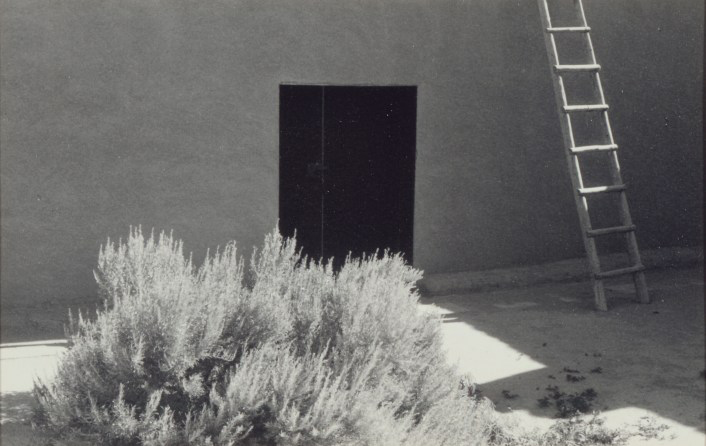
Georgia O’Keeffe, “Salita Door, Patio,” 1956–57, Gelatin silver print. Museum of Fine Arts, Boston, the Lane Collection. © Georgia O’Keeffe Museum. Image © Museum of Fine Arts, Boston)
At most, O’Keeffe tucked the snaps into letters to friends. Like when she sent one of that famous patio door to the art critic Henry McBride. “This is what made me buy the house I live in – this door in the wall.” The photographic image gave her another way of sharing the wonder of her world.
With this show, curator Lisa Volpe makes an art historical pivot: from O’Keeffe the photographic subject to O’Keeffe the photographer. Despite the artist’s remarks to interviewers that she’d only taken “about 20” snaps, or only what you could count “on one hand,” Volpe has identified more than four hundred of them, found among the artist’s own possessions, along with seven that made their way anonymously into the collection of the Metropolitan Museum of Art.
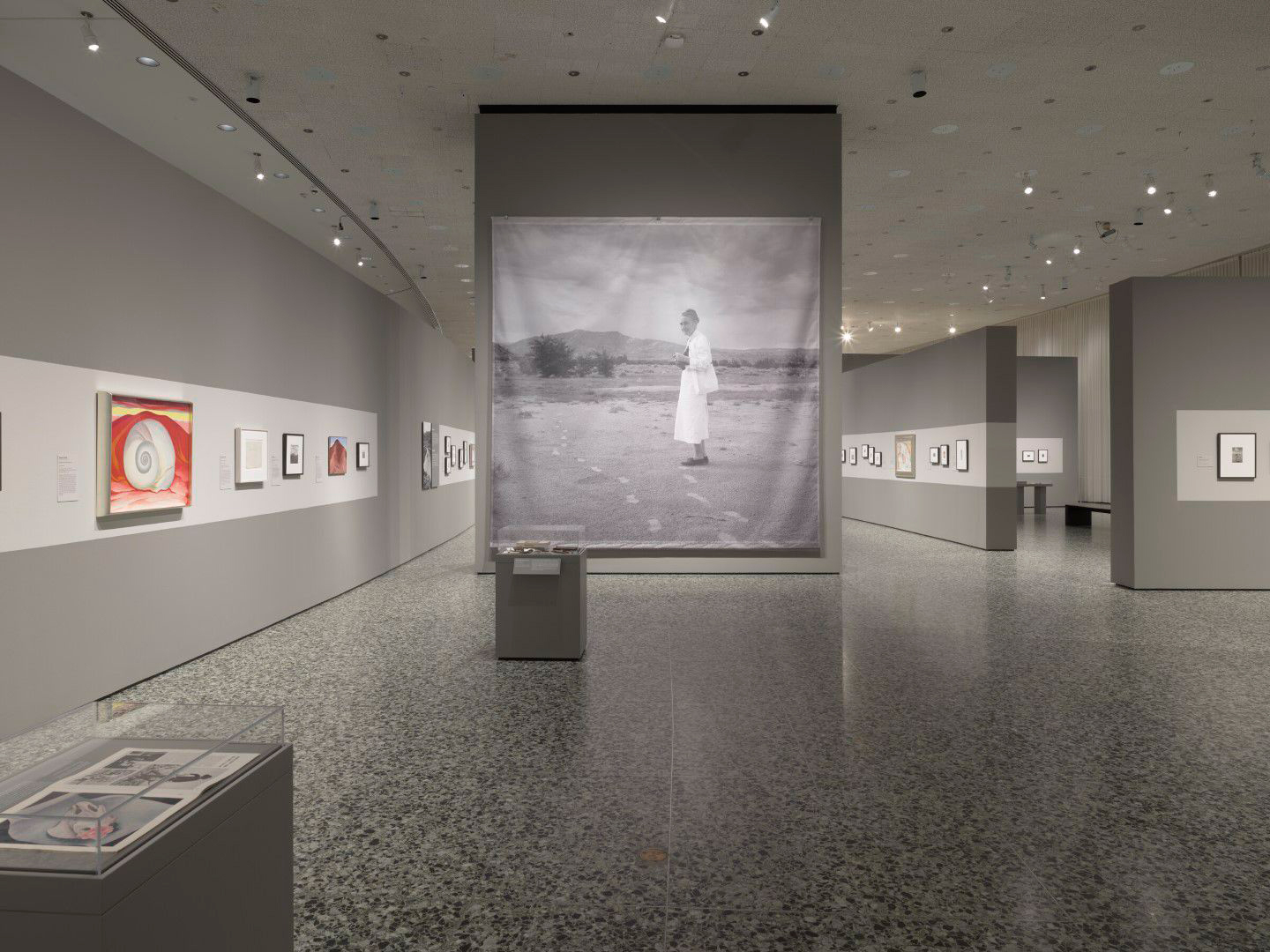
Installation view of “Georgia O’Keeffe, Photographer” at the Museum of Fine Arts, Houston
The exhibit is engagingly installed: positioning nearly 100 photos by O’Keeffe alongside photos of O’Keeffe, juxtaposing her photos with related paintings, and displaying archival objects (most notably, the artist’s cameras and her spotting equipment). But knowing how incredibly particular and protective O’Keeffe was about her art (she unblinkingly destroyed paintings deemed unworthy and let major sales fall through if she couldn’t control the work’s display and care), I couldn’t help feeling a bit uneasy. As if I were reading an obviously unfinished manuscript retrieved posthumously from the bottom drawer of some famous novelist. The vast majority of the prints on view are nothing remarkable in themselves, no better or worse than what you or I would take. (The portraits are surprisingly clumsy.) After all, she pointedly called them “snaps” and not “photographs.” But for scholars and historians and O’Keeffe fans, they are fresh finds, and therefore irresistible.

Georgia O’Keeffe, “Jimsonweed (Datura stramonium),” 1964–68, Black-and-white Polaroid. Georgia O’Keeffe Museum, Santa Fe. © Georgia O’Keeffe Museum
Mostly we find the usual subjects — flowers, trees, skulls, adobe walls, the Chama River, and the patio door. O’Keeffe’s immediate world. The same world she limned as a painter. The biggest takeaway? O’Keeffe was relentlessly single-minded. The same concerns she had in painting are here in the photographs, and they are the troika of compositional concerns that she learned at the very beginning, from the teachings of Columbia University art professor Arthur Dow. From start to end, she never stopped exploring line, notan (light/dark), and color. But for O’Keeffe, these were only tools, deployed to discover that holy grail of modernism: a unique, radical point of view. She succeeded over and over again: flowers the scale of skyscrapers, a tree turned upside down and roundabout, landscapes collapsing near and far, bones as viewfinders, rivers like tree branches, and a runway of clouds like stepping stones.
O’Keeffe resisted acknowledging any impact on her work from photography. (Though she did once admit to an interviewer that “I must have been influenced by photography. I saw so much of it. [ . . . ] I can’t think specifically how. Perhaps the clarity of the print influenced me.”) The way she was treated, it’s no wonder she worked so assiduously to establish her autonomy. As she wrote to a friend and colleague about Stieglitz: “It often sounds as if I was born and taught to walk by him — and never thought of painting till he worked on me.” Clement Greenberg, in his scathing review of her retrospective at the Museum of Modern Art, dismissed “the greatest part of her work” as “little more than tinted photography.” O’Keeffe worked to disassociate herself from photography, and Surrealism, and Precisionism — from anybody or any -ism. Why would she try to out-Sargent Sargent, as she once put it. O’Keeffe considered (and constructed) herself as an artist sui generis.
And yet we know that photography was a formative influence. “Part of my searching,” as she put it, for a definition of what art was. Photography, she wrote with seeming envy in 1922, did not suffer the same burden of tradition as painting. Photography was unencumbered by the history and expectations of genre and style. The camera emphasized the act of seeing rather than the production of an object. Modern photography had a point of view — the direct expression of the self. And that’s what O’Keeffe sought to do in paint.
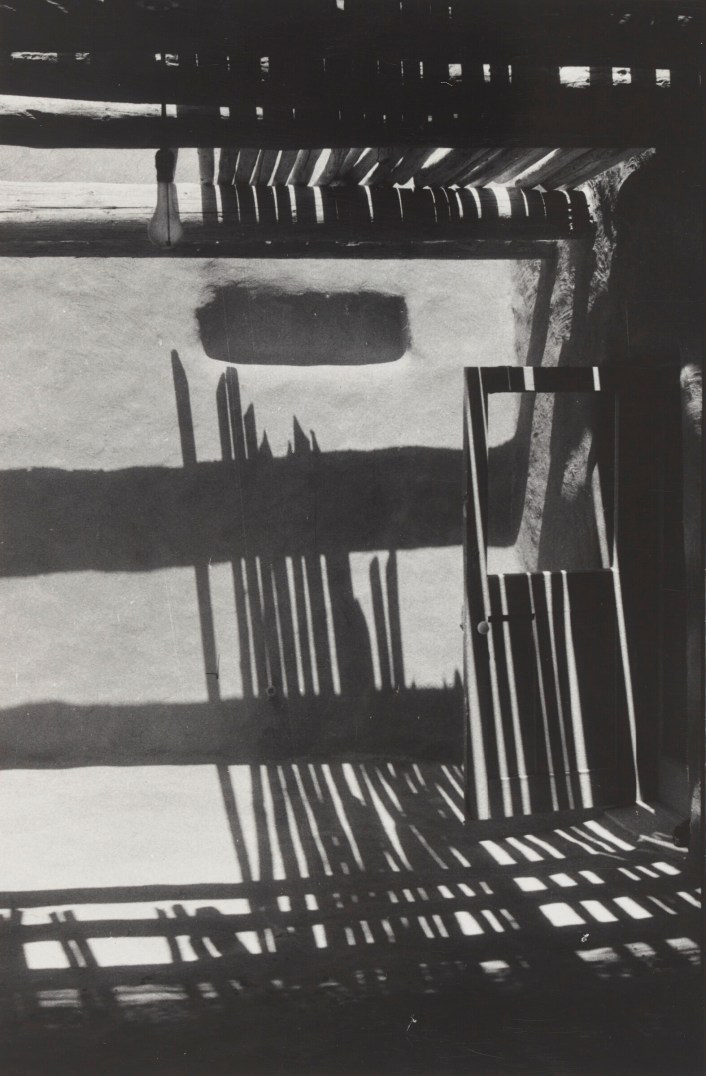
Georgia O’Keeffe, “Roofless Room,” 1959–60, Gelatin silver print. Georgia O’Keeffe Museum, Santa Fe. © Georgia O’Keeffe Museum
From Stieglitz, O’Keeffe learned about color. She was impressed by the subtle tonal range he managed to create in a platinum or palladium prints. Renowned for her own use of color, O’Keeffe nevertheless described his as “a very refined color sense, much more refined than mine,” which “made me think a little differently about my color.”
From Paul Strand, she learned two things. First, he showed her an elegant elaboration of Picasso’s modernist space, which rejected the illusion of realistic perspective. O’Keeffe would go on to invent her own radical approach to scale and distance and depth, guided only by a logic she called “painting sense.” “I have always thought,” she wrote, “that in those things like ‘Dishes’ [sic] — that Strand was the first to consciously use in photography the abstract idea that came to us through cubism.”
Second, in a less concrete but more profound way, Strand showed her what it meant to make art as a subjective act. Soon after meeting him in New York in 1917, she wrote to him on the train back to Texas, breathless about the prints he had shown her. “And I’ve been wanting to tell you again and again how much I liked your work[.] I believe I’ve even been looking at things and seeing them as I thought you might photograph them — Isn’t that funny — making Strand photographs for myself in my head.”

Georgia O’Keeffe, “In the Patio VIII,” 1950, Oil on canvas. Georgia O’Keeffe Museum, Santa Fe, gift of the Burnett Foundation and the Georgia O’Keeffe Foundation. © Georgia O’Keeffe Museum.
What distinguished Strand’s art wasn’t his subject matter or technique. It was his unique way of looking at the world, literally. That was O’Keeffe’s ambition: to make art so recognizably hers that no signature was needed. O’Keeffe was her “eye,” whether taking a photograph or making a painting. She was her own “viewfinder.” I’m reminded of that wonderful, whimsical, very meta portrait by Tony Vaccaro. She’s sitting in the back of a car, holding up a slice of swiss cheese to one eye as if it’s a camera. She looks out from behind that large hole, knowingly returning the photographer’s (and viewer’s) gaze.
O’Keeffe did acknowledge that several early 1960s paintings, including The Winter Road (1963), were the direct result of a photograph. In order to capture an image of the entire road, which swooped up and below her Abiquiu home, she “had to turn the camera at a very odd angle.” As always, she was interested in an extreme point of view. But that sinuous line was hardly a new one for her. It resembles the kind of Japanese brushwork she was playing with in the 1910s. And you can see that unfurling line show up as early as Abstraction IX (1916), and again in the ribbons of rivers that she sketched from airplanes in the 1950s.
Photographs were one of the first things I looked at when I started archival research on O’Keeffe. What a good way, I thought, to gain additional insight into her “eye.” What did she choose to look at? And how did she choose to look at it? The most telling images I found were 1964 snaps of Forbidding Canyon, which is located in Glen Canyon in Utah; five of these pieces are included in the show. Each image is of the sky between two cliffs, forming a “V.” It’s essentially a mass-and-void, one of O’Keeffe’s most familiar visual themes. Over the course of nine exposures she explores Dow’s principle of notan, from the Japanese word meaning “dark, light,” referring to how light and dark spaces (whether in color or not) are used in relation to each other. Then you can see how she carries the experiment over into a painting like Canyon Country, White and Brown Cliffs, c. 1965, where the configuration of light and dark color fields confound which triangular area is mass and which is void. Another riff on the dynamic ambiguity of cubist-inspired space.

Georgia O’Keeffe, “North Patio Corridor,” 1956–57, Gelatin silver print. Georgia O’Keeffe Museum, Santa Fe. © Georgia O’Keeffe Museum
O’Keeffe took advantage of what shadows could do to a form or add to a scene. A ladder comes alive alongside its shadow on the wall, like a cheerful doppelganger. A roofless room in deeply etched shadow makes for gorgeous abstraction. On a patio, a shadow spreads across the wall like a veil.
It’s always a pleasure to see anything that O’Keeffe did with her Abiquiu patio. For her, it was the primal canvas, providing the minimal elements needed to make a picture: wall and door. That’s what she taught her art students in Canyon, Texas, back in the late teens: how to place a door on a wall. I like how the door becomes a recessed frame for twin portraits on view in the show, one of O’Keeffe by Webb, and one of him by O’Keeffe.
Garage Vigas and Studio Door (1956) is one of the photos in the Met’s collection, and the very best of O’Keeffe’s photographs. It’s a stunning notan success story, beautifully textured and starkly composed as a horizontal diptych. If you resist the temptation to make wholistic sense of the picture, it becomes a vertiginous pleasure. Can I reach out across that deep black night sky? Am I falling into an abyss? Can I run my hand over that wall? Can I bear such a tight spot? Blink, and it’s back to being a piece of paper covered in shades of black and white. O’Keeffe framed the world in unexpected ways, often placing the viewer in an untenable position. True, we may have no solid ground to stand on, but — even better — she gives us lots of room to move.
One last aha moment for me: the still lifes. When you see how rather awkward her photos are of skull and chair — you can sense O’Keeffe trying to compose a picture — you realize just how remarkable her painted still lifes are. They look so . . . inevitable. Grand, iconic, magnificent. Even though they’re just a skull.
The exhibit runs through January 17, 2022. If you can’t make it to Houston, not to worry. O’Keeffe herself suggested that photographs may be better viewed and appreciated “in the hand like a book” rather than hung on the wall. So get ahold of the catalog, which gives you the full exhibit, along with an inventory of her 400+ photos, with the added bonus of curator Lisa Volpe’s exhaustive research.
Ann Daly, PhD is writing a book on the art and art-making of Georgia O’Keeffe. You can follow her at @mygeorgiaokeeffe. On February 22, 2022, she’ll be giving an online reading from the work-in-progress, Digging for Stars: The Art of Georgia O’Keeffe, via Book Woman bookstore.
The post Georgia O’Keeffe, Photographer at the Museum of Fine Arts, Houston appeared first on Glasstire.
Five-Minute Tours: Greg Edmondson at The Cole Art Center, Stephen F. Austin State University, Nacogdoches
Note: the following is part of Glasstire’s series of short videos, Five-Minute Tours, for which commercial galleries, museums, nonprofits and artist-run spaces across the state of Texas send us video walk-throughs of their current exhibitions. This will continue while the coronavirus situation hinders public access to exhibitions. Let’s get your show in front of an audience.
See other Five-Minute Tours here.
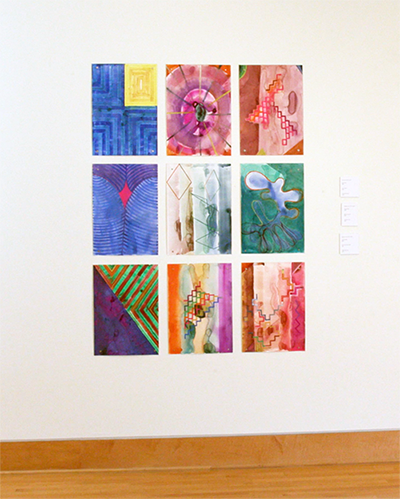
Greg Edmondson: The Impermanence of Objects – works on paper, 2014 – 2021 at The Cole Art Center, Stephen F. Austin State University, Nacogdoches. Dates: October 25, 2021 – January 21, 2022.
Via the art center:
“Works on paper by artist and educator Greg Edmondson will be exhibited through January 31 at The Cole Art Center @ The Old Opera House in downtown Nacogdoches. This exhibition spans over seven years and includes a wide range of Edmondson’s works from four artist residencies and three published books. The works reveal a significant shift in the artist’s practice, begun in a period of upheaval, and still evolving today. The exhibition presents works on paper ranging in scale from 8.5 inches by 11 inches to nearly 8 feet by 6 feet. Admission to the exhibition is free. Website: https://art.sfasu.edu/galleries
This video is an excerpt from Edmondson’s one hour artist talk/gallery walk-through on November 15, 2021. The Impermanence of Objects exposes a significant and ongoing shift in Edmondson’s practice. Begun in a period of personal upheaval, this shift has continued evolving through the current global pandemic. From studio exercises based in simple generative systems, toward less constrained but still formal explorations of structure and color, his interest in the patterns of organic growth and decay remains constant. “I’ve come to view the more recent works as a kind of bashful Modernism”, he writes in the Exhibition’s essay… “formal and abstract, but without certainty or authority.”
Greg Edmondson earned a BFA from the University of Tennessee, Knoxville, and MFA from Washington University in St. Louis, MO. He is the recipient of numerous fellowships and awards including Fulbright and DAAD fellowships to Germany, and residency grants to Artpark, Künstlerwerkstatt Lothringerstrasse, the Virginia Center for the Creative Arts and the Santa Fe Art Institute. His upcoming exhibitions “Before Language”, the Blanden Art Museum, Ft. Dodge, Iowa, and “DARK MATTER”, (a collaboration with physicist and poet Agnes Vojta), The Smalter Gallery, Kansas City, Missouri, are scheduled for Spring of 2022. He may be reached here.”
The post Five-Minute Tours: Greg Edmondson at The Cole Art Center, Stephen F. Austin State University, Nacogdoches appeared first on Glasstire.
Please Listen Carefully, As Your School’s COVID-Reporting Menu Options Have Not Changed
Thank you for calling East Hill Elementary’s absentee reporting and contact tracing hotline. Please listen carefully, because our menu options have not changed since the development of the Omicron variant.
- To report your child’s non-COVID-related absence, press 1.
- To report that your child has tested positive for COVID, press 2.
- To report that your husband has tested positive, is currently isolating in the basement, and complaining about the weak Wi-Fi signal while you manage three children under six, only some of whom have elected to wear pants today, press 3.
Thank you for not concealing your child’s exposure to COVID.
- To request a series of tangentially related handouts that you will struggle to understand and your child will refuse to complete at home during her ten-day, or seven-day with a negative test, or, um, we mean, five-day quarantine period with or without a test, press 1.
- To demand access to the nonexistent virtual learning option that you recently signed an online petition protesting, press 2.
- To refuse to quarantine, press 3.
Thank you for sharing that our district does not care about children.
- To report that we have discriminated against your child by requiring quarantine of unvaccinated children who have been exposed to the virus, press 1.
- To report that we have discriminated against your healthy, vaccinated child by placing him in a class with healthy, unvaccinated children, press 2.
- To leave a message about the microaggression committed by the principal when he moonlighted as a contact tracer and mispronounced your family’s last name on a voicemail, press 3.
Thank you for sharing your opinion on the district’s educational priorities and progress.
- To make a data-free claim in which you extrapolate from your child’s five-minute struggle with question number three on this afternoon’s math homework that learning loss is rampant in our suburban, predominantly white, affluent district, press 1.
- To place your order for Falafel Friday, press 2.
If you would like to contact the nurse’s office, please listen for the following options.
- To leave a message with details specific to your child’s current health condition, press 1.
- To leave a message in which you question the nurse’s education, training, and basic understanding of science, press 2.
- Press 3 to listen to a recording of our nurse sobbing in the early hours of the morning.
If you wish to be connected with one of the burgeoning special-interest groups across the district, please listen carefully.
- To join the I’m Not the Parent Who Ever Complains But group, press 1.
- To join the We Know That In-Person Instruction Has Been Going On Since September 1, 2020, but We Demand That You Reopen the Schools group, press 2.
- To join the I’m Not Really Angry at You, I’ve Just Been Completely Abandoned by Society’s Institutions and Every Time I Look My Child in the Eye I Think, “I’ve Failed You, We’ve Failed You, I’m So Sorry, What Can I Do?” and I Just Want to Connect with Another Person Even If That Means Railing Against Anything and Everything the District Has on Offer group, press 3.
To repeat these menu options, press 1. To howl into the void, press 2.
Thank you for calling East Hill Elementary.
VICTORY: Google Releases “disable 2g” Feature for New Android Smartphones
Update: This feature is only available on certain phones running Android 12. So far we have only confirmed it is available on the Pixel 6.
Last year Google quietly pushed a new feature to its Android operating system allowing users to optionally disable 2G at the modem level in their phones. This is a fantastic feature that will provide some protection from cell site simulators, an invasive police surveillance technology employed throughout the country. We applaud Google for implementing this much needed feature. Now Apple needs to implement this feature as well, for the safety of their customers.
What is 2G and why is it vulnerable?
2G is the second generation of mobile communications, created in 1991. It’s an old technology from a time when standards bodies did not account for certain risk scenarios such as rogue cell towers and the need for strong encryption. As years have gone by, many vulnerabilities have been discovered in 2G.
There are two main problems with 2G. First, it uses weak encryption between the tower and device that can be cracked in real time by an attacker to intercept calls or text messages. In fact, the attacker can do this passively without ever transmitting a single packet. The second problem with 2G is that there is no authentication of the tower to the phone, which means that anyone can seamlessly impersonate a real 2G tower and a phone using the 2G protocol will never be the wiser.
Cell-site simulators sometimes work this way. They can exploit security flaws in 2G in order to intercept your communications. Even though many of the security flaws in 2G have been fixed in 4G, more advanced cell-site simulators can downgrade your connection to 2G, making your phone susceptible to the above attacks. This makes every user vulnerable—from journalists and activists to medical professionals, government officials, and even law enforcement.
What you can do to protect yourself now
If you have a newer Android phone (such as a Pixel 6, or some new Samsung phones) you can disable 2G right now by going to Settings > Network & Internet > SIMs > Allow 2G and turning that setting off.

Here by default 2G is enabled.

Now 2G is disabled
If you have an older Android phone, these steps may or may not work. Unfortunately due to limitations of old hardware, Google was only able to implement this feature on phones running Android 12 and supporting version 1.6 of the radio HAL, so far this is limited to the Pixel 6. If you have a newer Samsung phone you may also be able to shut off 2G support the same way, unfortunately this is not supported on all networks or all Samsung phones. For iPhone owners unfortunately Apple does not support this feature, but you can tweet at them to demand it!
Tell apple: Let us turn off 2G!
We are very pleased with the steps that Google has taken here to protect users from vulnerabilities in 2G, and though there is a lot more work to be done this will ensure that many people can finally receive a basic level of protection. We strongly encourage Google, Apple, and Samsung to invest more resources into radio security so they can better protect smartphone owners.
how long should you wait if someone is late to a virtual meeting?
This post, how long should you wait if someone is late to a virtual meeting? , was originally published by Alison Green on Ask a Manager.
A reader writes:
How long do you need to wait if someone is late to a virtual meeting? I’m not really talking about big group meetings because it’s not too likely that *everyone* will be late, but if you’re booked with one or two others, and in a situation with no or minimal power differential to factor in, when can you reasonably log out and send an email? Five minutes? Ten? Does it change inside or outside your organization? I wouldn’t just ghost someone who’s late for a meeting, but there’s only so long I’m willing to sit on Teams/Zoom/whatever waiting for someone else to show up.
I’d give it 10 minutes and then disconnect and send a message saying something like, “I’m guessing you had a conflict come up with our 2 pm call. Let me know when we can reschedule for.” Or sometimes it makes sense to say, “I’ll be available until 2:20 if you get this but otherwise let’s reschedule.”
That assumes relatively equal power on both sides. If it’s your boss or a client, I’d give it a little longer (but not more than 15 minutes, unless there’s a specific reason to handle it differently — like if they mentioned they might be late and asked you to wait). If it’s a big VIP, I might hang around even longer, especially if it’s someone outside your organization and you need to talk to them a lot more than they need to talk to you.
On the flip side of that, if you’re doing someone a favor by carving out time for them at all (like an informational interview or a vendor who wants you to buy something you’re not yet sold on), I wouldn’t wait more than five minutes before dropping off.
In all these situations, ideally you’d have something you can work on while you wait so that you’re not just wasting that time … although sometimes it’s hard to do that, if you need to keep your focus on staying prepped for the meeting that you’re still hoping is about to start.




my new coworker keeps staring at my breasts
This post, my new coworker keeps staring at my breasts , was originally published by Alison Green on Ask a Manager.
A reader writes:
I am an attractive, large, 50+ woman working in academia. I have large-ish breasts and wear a bra that makes them look appropriate — no hanging, jostling, or nipples. Even though I do hate these restrictive, thick bras. But I found that I had to sacrifice my comfort for peace of mind in this case. I also don’t ever wear clothes that show any cleavage.
For many years, I was fortunate to have male coworkers who did not stare at my breasts. They might briefly stare inadvertently once in a blue moon (like, no more than once a season or so), especially when my shirt happened to be thinner than usual or something like that, but they would always take the gaze right off and not stare again. I am totally fine with that level of staring – we are all human, and it’s not like I have never found myself occasionally briefly staring at attractive parts of other people’s anatomies either.
We have recently hired a middle-aged guy who stares at my breasts for much too long, much too often. Almost every day, when I am talking with him (and I have to do that a lot), he will lock his gaze on my breasts for a full second or so. He does look away after that, but then will do the same thing again in a few minutes.
Now, I am not at all shy, so I am perfectly capable of hitting him with any of the response gems in the gamut of “I’m sure you haven’t noticed but..,” “excuse me? [WTF face],” “please try to control your gaze when you talk to women,” or even the old “my eyes are up here.” I am also perfectly capable of escalating the issue to my boss and the HR, who I am quite sure will act on it immediately.
However, I am pretty sure the guy does not realize that what he is doing is bad. He is from a developing country, although he has worked in the U.S. for at least a decade now. Still, it is possible he never learned this aspect of being polite in the U.S. He is also extremely, almost ridiculously straight-laced, not even a hint of any creepiness other than the gaze issue. On top of that, he is very knowledgeable, smart, and well-adjusted other than this one issue, and a really valuable acquisition for our team.
I really have to do something about this as soon as possible, because I find the staring not harmless at all — it makes my hair stand totally on end every time. My male partner, who is wonderfully understanding and not at all sexist usually, says that I should just grin and bear it. Because this is just how men are, and the poor guy doesn’t know any better, so putting him on the spot would cause eternal animosity between us that would make my life a worse kind of hell.
My partner is, sadly, wrong in asking me to protect the guy’s feelings while mine are being trampled. I am planning to try a response that sort of saves face for him a bit while still possibly putting him on notice: saying “Is there something wrong with my badge? I noticed you keep looking at it…” next time he stares. But I am not sure if that’s the best way. What do you think?
I am pretty sure that it’s impolite to stare at a woman’s breasts in developing countries too … and I am highly skeptical that your coworker wouldn’t have picked up on the fact that it’s not okay here after 10 years. It’s more likely that he thinks you don’t notice or he doesn’t realize how often he’s doing it or … who knows what, it’s too exhausting to second-guess what might be going on in these guys’ minds and ultimately it doesn’t matter. He’s doing it, he needs to stop, the end.
(That said, there’s an interesting conversation to be had with your partner about his beliefs that “this is just how men are” and “the poor guy doesn’t know any better,” although I wouldn’t blame you at all if you are too exhausted to bother having it.)
Anyway, since you want to let the coworker save face while also making it clear the behavior is (a) noticed and (b) not okay, your “is something wrong with my badge, you keep looking at it” idea is worth trying. Similar options are “is something on my shirt?” or “what do you keep looking at?” (The latter is a little more confrontational but prevents you both from the awkwardness of a direct boob-related statement.) I have sometimes pointedly crossed my arms across my chest, which kind of calls out the issue without explicitly calling it out, and usually they get the point. If they’re embarrassed afterward, so be it — sometimes embarrassment is how people learn.
I think a lot of people will tell you that you shouldn’t go that route, and instead should call it out more directly (with the classic “my eyes are up here” or similar). And if you want to do that, you have every right to! But often people feel the way you do — you don’t want to be that confrontational if you can get the outcome you want in a different way, and letting him save a little bit of face can be better for you since you have to keep working with him and you otherwise like him and would prefer a comfortable relationship with him.
But it’s frustrating as hell that women have to do that dance all the time, looking for softer, more socially acceptable ways to push back on unacceptable behavior … generally from men who definitely aren’t stressing about whether they are offending you.