Cowboy Who?
Shared posts
A federal tool to check voter citizenship keeps making mistakes. It led to confusion in Texas
After a stunning Presidents’ Day, Houston will see some of its warmest weather so far this year
In brief: In today’s post we discuss temperature trends so far this year as we look ahead to the warmest weather so far of 2026. Also, we help readers with the proper way to spell Presidents’ Day in Texas. It varies from state to state!
A warming trend on tap
The warmest day of 2026 occurred just a single day into the new year, back on January 2, when the high temperature in Houston peaked at 84 degrees. If you’ll recall, the entire first week of January was extraordinarily warm before a series of fronts culminated in an exceptionally cold end to the month. February, on average, has so far run about 5 degrees above normal. But we have yet to experience any days this month with a high temperature above 80 degrees. That will change this week, thanks to a persistent southerly flow of warmer air. Just how warm we get will depend upon cloud cover during the afternoon, but most locations should reach the mid-80s for a few days.

Monday
A lot of people have work off today due to Presidents’ Day, a holiday originally intended to celebrate the life and contributions of George Washington, which is marked on the third Monday of February. Different states celebrate and even spell it differently (it is Presidents’ Day in Texas by law), but regardless if you’re off today you’ll have some fine weather at your disposal. After a chilly start around 50 degrees in most locations, we’re going to rise into the lower 70s today with partly sunny skies. Winds will generally be light, from the southeast. Low temperatures tonight will be warmer, in the upper 50s in most locations.
Tuesday
We’ll see a more pronounced southerly flow by Tuesday, and this will start to bring humidity levels up further. High temperatures will range from the upper 70s to about 80 degrees, with partly to mostly sunny skies. Afternoon winds may gust up to 20 or 25 mph. Lows will only fall into the low- to mid-60s.

Wednesday, Thursday, and Friday
These will be the warmest days of the week (Thursday likely the warmest of all) with high temperatures ranging from around 80 degrees into the mid- (and possibly even upper-80s) across Houston. Actual highs will depend on how far you are from the coast (warmer) and how much cloud cover there is during the afternoon hours (cooler). Anyway it’s going to feel fairly warm and humid, with mild nights in the 60s. Some sort of front may arrive by Friday or so, brining a chance of rain. We’ll see.
Saturday and Sunday
At some point we will see a decent front move in, perhaps with a delay in cooler and drier air afterward. Given uncertainty in the timing I can’t offer a firm prediction on this weekend’s weather yet. A reader mentioned that there’s a big custom car and truck show in Conroe this weekend, and I think the weather will generally be fair, with partly sunny skies, and highs in the 70s. At some point there may be a chance of rain associated with the front, although I don’t anticipate anything like we experienced with the storms that passed on Saturday evening. We’ll try to get you some better weekend details soon.
Next week
We should see a few cooler days to start next week, in the wake of this weekend’s front, before another warmup to around 80 degrees or so.

For many Texans, memories of deadly winter blackouts still linger
Baby Fails To Change New Father In Any Way
VERNON HILLS, IL—Lacking the ability to transform her father’s personality to the same extent as his leather couch or riding lawn mower, newborn baby Amber Gilroy reportedly failed this week to change new parent Eric Gilroy in any conceivable way. “Eric was always nice but just kind of floating through life, and then as soon as he had Amber you could really see how exactly the same he was,” said Gilroy’s sister Taylor, who revealed she noticed the amazing lack of growth from the moment Gilroy first held his daughter in his arms and shifted her to check on a DraftKings alert on his phone. “Look deep into his eyes, and you could tell this baby was just another random human being passing in front of him. We always suspected Eric had this well of love and emotion that was right beneath the surface waiting to burst out, and then Amber comes along and you realize, nah. He came back from the hospital and the first time my boyfriend talked to him he said Eric was just head-over-heels, going on and on about this new smoker he bought. For years, Eric was this punch-in, punch-out guy at work who mostly cared about the Bears, and now he does that stuff while also changing diapers sometimes. I asked him what it felt like being a new dad, and he just paused for a minute, as if searching for the words. But then I realized he hadn’t heard me and was concentrating on a Bud Light commercial.” At press time Gilroy was staring gratefully at his newborn daughter after starting to grasp that he could use his four-week paternity leave to take a hunting trip in Wisconsin.
The post Baby Fails To Change New Father In Any Way appeared first on The Onion.
Bookseller Scrambles To Hide All The Classics After Seeing Emerald Fennell Approaching Door
LONDON—Calling for all hands on deck as he seized an armful of paperbacks, local bookshop owner Colin Mueller was reportedly scrambling to hide the classics Monday after he spotted filmmaker Emerald Fennell approaching the door. “For the love of God, please, someone grab the Jane Austens!” said Mueller, who jumped on top of a chair and began shoving the beloved works into the drop ceiling tiles as cries of “Quick!” and “She’s here!” rang out among the store’s panic-stricken employees. “All other Brontë titles go into the safe now, do you hear me? Go! Go! Go! If she asks for Middlemarch, remember our training: Distract, delegate, delay! Or just toss her a copy of Tess Of The D’Urbervilles. No one likes that one anyway.” At press time, sources confirmed Mueller was on his hands and knees pleading with the Wuthering Heights director to check out their vast array of Colleen Hoover titles.
The post Bookseller Scrambles To Hide All The Classics After Seeing Emerald Fennell Approaching Door appeared first on The Onion.
Tips For Observing Lent
Catholics around the world will soon enter the Lenten season, an annual 40-day period of sacrifice, prayer, and repentance that ends on Easter Sunday. The Onion shares tips for observing Lent.
Try starting with something shorter like Yom Kippur and working your way up.
Check Google Maps for the nearest wanderable desert.
Remind your children that they’re fasting because of the Lord and not because you can’t afford groceries.
Don’t be too hard on yourself if you slip up and worship Baal once or twice.
God’s usually pretty busy on Wednesdays, so you can cheat all you want and He won’t notice.
Have an excuse ready for when your wife suggests giving up alcohol.
Remember that you’re not competing with anyone except God.
Convert to Islam before Lent starts, then convert back before Ramadan rolls around.
When it is almost over, think of something you haven’t done for the past 40 days and say that’s what you gave up.
Don’t give up your big cowboy hat. That thing rules.
The post Tips For Observing Lent appeared first on The Onion.
The Voracious Vine That ‘Ate the South’ Can Also Fuel Wildfires
By Jaylan Sims
Nearly every Monday morning, five restorationists with Conserving Carolina guide volunteers through the steep hills of Norman Wilder Forest in Tryon, North Carolina. Armed with chainsaws, thick gloves and a pickaxe-like mattock, the group goes hunting for a wily prey: kudzu.
Awkward Zombie - Name and Shame

New comic!
Today's News:
I realize we're talking about a Hideo Kojima game, but I cannot stress enough how much Tomorrow is not a name. It makes Die Hardman sound normal by comparison.
News Publishers Are Now Blocking The Internet Archive, And We May All Regret It
Last fall, I wrote about how the fear of AI was leading us to wall off the open internet in ways that would hurt everyone. At the time, I was worried about how companies were conflating legitimate concerns about bulk AI training with basic web accessibility. Not surprisingly, the situation has gotten worse. Now major news publishers are actively blocking the Internet Archive—one of the most important cultural preservation projects on the internet—because they’re worried AI companies might use it as a sneaky “backdoor” to access their content.
This is a mistake we’re going to regret for generations.
Nieman Lab reports that The Guardian, The New York Times, and others are now limiting what the Internet Archive can crawl and preserve:
When The Guardian took a look at who was trying to extract its content, access logs revealed that the Internet Archive was a frequent crawler, said Robert Hahn, head of business affairs and licensing. The publisher decided to limit the Internet Archive’s access to published articles, minimizing the chance that AI companies might scrape its content via the nonprofit’s repository of over one trillion webpage snapshots.
Specifically, Hahn said The Guardian has taken steps to exclude itself from the Internet Archive’s APIs and filter out its article pages from the Wayback Machine’s URLs interface. The Guardian’s regional homepages, topic pages, and other landing pages will continue to appear in the Wayback Machine.
The Times has gone even further:
The New York Times confirmed to Nieman Lab that it’s actively “hard blocking” the Internet Archive’s crawlers. At the end of 2025, the Times also added one of those crawlers — archive.org_bot — to its robots.txt file, disallowing access to its content.
“We believe in the value of The New York Times’s human-led journalism and always want to ensure that our IP is being accessed and used lawfully,” said a Times spokesperson. “We are blocking the Internet Archive’s bot from accessing the Times because the Wayback Machine provides unfettered access to Times content — including by AI companies — without authorization.”
I understand the concern here. I really do. News publishers are struggling, and watching AI companies hoover up their content to train models that might then, in some ways, compete with them for readers is genuinely frustrating. I run a publication myself, remember.
But blocking the Internet Archive isn’t going to stop AI training. What it will do is ensure that significant chunks of our journalistic record and historical cultural context simply… disappear.
And that’s bad.
The Internet Archive is the most famous nonprofit digital library, and has been operating for nearly three decades. It isn’t some fly-by-night operation looking to profit off publisher content. It’s trying to preserve the historical record of the internet—which is way more fragile than most people comprehend. When websites disappear—and they disappear constantly—the Wayback Machine is often the only place that content still exists. Researchers, historians, journalists, and ordinary citizens rely on it to understand what actually happened, what was actually said, what the world actually looked like at a given moment.
In a digital era when few things end up printed on paper, the Internet Archive’s efforts to permanently preserve our digital culture are essential infrastructure for anyone who cares about historical memory.
And now we’re telling them they can’t preserve the work of our most trusted publications.
Think about what this could mean in practice. Future historians trying to understand 2025 will have access to archived versions of random blogs, sketchy content farms, and conspiracy sites—but not The New York Times. Not The Guardian. Not the publications that we consider the most reliable record of what’s happening in the world. We’re creating a historical record that’s systematically biased against quality journalism.
Yes, I’m sure some will argue that the NY Times and The Guardian will never go away. Tell that to the readers of the Rocky Mountain News, which published for 150 years before shutting down in 2009, or to the 2,100+ newspapers that have closed since 2004. Institutions—even big, prominent, established ones—don’t necessarily last.
As one computer scientist quoted in the Nieman piece put it:
“Common Crawl and Internet Archive are widely considered to be the ‘good guys’ and are used by ‘the bad guys’ like OpenAI,” said Michael Nelson, a computer scientist and professor at Old Dominion University. “In everyone’s aversion to not be controlled by LLMs, I think the good guys are collateral damage.”
That’s exactly right. In our rush to punish AI companies, we’re destroying public goods that serve everyone.
The most frustrating bit of all of this: The Guardian admits they haven’t actually documented AI companies scraping their content through the Wayback Machine. This is purely precautionary and theoretical. They’re breaking historical preservation based on a hypothetical threat:
The Guardian hasn’t documented specific instances of its webpages being scraped by AI companies via the Wayback Machine. Instead, it’s taking these measures proactively and is working directly with the Internet Archive to implement the changes.
And, of course, as one of the “good guys” of the internet, the Internet Archive is willing to do exactly what these publishers want. They’ve always been good about removing content or not scraping content that people don’t want in the archive. Sometimes to a fault. But you can never (legitimately) accuse them of malicious archiving (even if music labels and book publishers have).
Either way, we’re sacrificing the historical record not because of proven harm, but because publishers are worried about what might happen. That’s a hell of a tradeoff.
This isn’t even new, of course. Last year, Reddit announced it would block the Internet Archive from archiving its forums—decades of human conversation and cultural history—because Reddit wanted to monetize that content through AI licensing deals. The reasoning was the same: can’t let the Wayback Machine become a backdoor for AI companies to access content Reddit is now selling. But once you start going down that path, it leads to bad places.
The Nieman piece notes that, in the case of USA Today/Gannett, it appears that there was a company-wide decision to tell the Internet Archive to get lost:
In total, 241 news sites from nine countries explicitly disallow at least one out of the four Internet Archive crawling bots.
Most of those sites (87%) are owned by USA Today Co., the largest newspaper conglomerate in the United States formerly known as Gannett. (Gannett sites only make up 18% of Welsh’s original publishers list.) Each Gannett-owned outlet in our dataset disallows the same two bots: “archive.org_bot” and “ia_archiver-web.archive.org”. These bots were added to the robots.txt files of Gannett-owned publications in 2025.
Some Gannett sites have also taken stronger measures to guard their contents from Internet Archive crawlers. URL searches for the Des Moines Register in the Wayback Machine return a message that says, “Sorry. This URL has been excluded from the Wayback Machine.”
A Gannett spokesperson told NiemanLab that it was about “safeguarding our intellectual property” but that’s nonsense. The whole point of libraries and archives is to preserve such content, and they’ve always preserved materials that were protected by copyright law. The claim that they have to be blocked to safeguard such content is both technologically and historically illiterate.
And here’s the extra irony: blocking these crawlers may not even serve publishers’ long-term interests. As I noted in my earlier piece, as more search becomes AI-mediated (whether you like it or not), being absent from training datasets increasingly means being absent from results. It’s a bit crazy to think about how much effort publishers put into “search engine optimization” over the years, only to now block the crawlers that feed the systems a growing number of people are using for search. Publishers blocking archival crawlers aren’t just sacrificing the historical record—they may be making themselves invisible in the systems that increasingly determine how people discover content in the first place.
The Internet Archive’s founder, Brewster Kahle, has been trying to sound the alarm:
“If publishers limit libraries, like the Internet Archive, then the public will have less access to the historical record.”
But that warning doesn’t seem to be getting through. The panic about AI has become so intense that people are willing to sacrifice core internet infrastructure to address it.
What makes this particularly frustrating is that the internet’s openness was never supposed to have asterisks. The fundamental promise wasn’t “publish something and it’s accessible to all, except for technologies we decide we don’t like.” It was just… open. You put something on the public web, people can access it. That simplicity is what made the web transformative.
Now we’re carving out exceptions based on who might access content and what they might do with it. And once you start making those exceptions, where do they end? If the Internet Archive can be blocked because AI companies might use it, what about research databases? What about accessibility tools that help visually impaired users? What about the next technology we haven’t invented yet?
This is a real concern. People say “oh well, blocking machines is different from blocking humans,” but that’s exactly why I mention assistive tech for the visually impaired. Machines accessing content are frequently tools that help humans—including me. I use an AI tool to help fact check my articles, and part of that process involves feeding it the source links. But increasingly, the tool tells me it can’t access those articles to verify whether my coverage accurately reflects them.
I don’t have a clean answer here. Publishers genuinely need to find sustainable business models, and watching their work get ingested by AI systems without compensation is a legitimate grievance—especially when you see how much traffic some of these (usually less scrupulous) crawlers dump on sites. But the solution can’t be to break the historical record of the internet. It can’t be to ensure that our most trusted sources of information are the ones that disappear from archives while the least trustworthy ones remain.
We need to find ways to address AI training concerns that don’t require us to abandon the principle of an open, preservable web. Because right now, we’re building a future where historians, researchers, and citizens can’t access the journalism that documented our era. And that’s not a tradeoff any of us should be comfortable with.
How a Planned Disney World Vacation Turned Into Four Months in Immigration Detention
This week, ProPublica published a story I wrote based in part on interviews with parents and children being held at the nation’s only operating detention center for immigrant families in Dilley, Texas. I had asked some of the parents to see if their children would be willing to write to me about their experiences inside. More than three dozen did.
One of those letters came from 9-year-old Maria Antonia Guerra Montoya from Colombia. Her letter was written on a piece of notebook paper. She decorated it with rainbows and hearts. And she drew a portrait of herself and her mom wearing their detention uniforms and government-issued ID badges.
I had initially met Maria a few weeks earlier, when I managed to get inside the Dilley Immigration Processing Center. It’s just south of San Antonio. Maria Antonia, her mother and more than 3,500 people, half of them minors, had cycled through there since the Trump administration reopened it early last year. I went in mid-January, before the facility burst into public view when Liam Conejo Ramos — the 5-year-old in a blue bunny hat detained with his father in Minneapolis — was sent there, with the aim of hearing about the conditions in which children were being held, from the children themselves.
After signing in, I passed through a metal detector and a series of locked doors to get to the visitation room. Maria Antonia and another girl her age were quietly playing fast-moving hand games, when her mother, Maria Alejandra Montoya, called her over to introduce me.
Maria Antonia, wearing her long brown hair in a ponytail, didn’t hesitate. She scooted forward to the front edge of her chair, pushed her thick white-framed glasses up on her nose and dove right in.
I asked her how she and her mom had ended up there.
Well, she said, we had a plan to go to “Disneylandia” but instead ended up in “Dilleylandia.”
Then she told me the story. She lived in Colombia with her grandmother and regularly traveled back and forth to the United States to visit her mother, who had been in the U.S. since 2018. (Maria Alejandra had overstayed a visa but since married a U.S. citizen and was applying for a green card.) In August, the whole family had vacationed together in Disney World. It was so fun, Maria Antonia said, that she begged her mom to go back for the park’s annual Halloween celebration.
They booked tickets for a 10-day vacation during her school holidays. She lit up telling me about how she had planned out a “101 Dalmatians” costume — she would be Cruella de Vil and her mom and stepdad the spotted dogs. The whole getup was so bulky it basically filled her entire suitcase.
But everything started going wrong as soon as she arrived at the Miami International Airport on Oct. 2. She was supposed to be dropped off with her mom by the flight attendant accompanying her. But she said was intercepted by immigration officers who took her into a room to be interrogated while her mother was taken to be questioned in a separate room. They were asking me all kinds of questions I had absolutely no idea how to answer, I recall her telling me (I was not allowed any notebooks or voice recorders inside the detention facility). I kept just saying over and over again: “I can tell you my name and my birthday and my mom’s name and her birthday and that I am from Colombia. That’s about it.” I didn’t know what else to tell them.
After what they both said were hours of questioning, they were put in a cold room together. Maria Alejandra’s phone was confiscated. They had no way to contact her stepdad, who was waiting for them in the airport. Maria Antonia said they had no idea why they were being detained if her mother was applying for a green card and she had a valid tourist visa.
Maria Antonia had learned English at her private school in Medellin. She overheard one immigration officer tell another that if she had been 10 years old, they would have been able to keep her separated from her mom. That, she said, is when the real fear set in.
Then it was 42 hours of waiting in the airport holding rooms. Eventually they were put on a plane — then a minivan — to the facility in Texas. Maria Antonia said she didn’t really understand where they were going until they saw the center out the window.
![A drawing on lined paper of an unsmiling woman and a girl wearing gray sweatshirts with long hair. The woman wears blue pants and the girl wears gray pants. Handwriting appears above and next to the drawing in Spanish: “No me dan mi dieta yo soy vegetariana, no como bien, no hay buena educacion y extraño a mi mejor amiga julieta y a mi abuela y a mi escuela ya quiero llegar a mi casa. Yo en dilei [Dilley] no estoy feliz por favor saquenme de aquí a colombia. Antonia.”](https://www.propublica.org/wp-content/uploads/2026/02/2026-ice-kids-dilley-letter-06_maxHeight_3000_maxWidth_3000.jpg?w=752)
By the time I met them, they had been detained for nearly four months. I asked Maria Antonia what being stuck in Dilley was like. She told me she had fainted two times since she got there; she is vegetarian and said she ate mostly beans. She felt like she had nothing to do all day and she missed her school, echoing concerns of many of the other kids I spoke with over the course of my reporting. She said she had made some new friends inside Dilley, but it was hard. She and her mom had been detained for so long that new people she met would often leave when they were released or deported.
Her mother, Maria Alejandra, had told me in long, vivid emails about some of more serious concerns about her and her daughter’s deteriorating mental and physical health during their prolonged detention. She said Maria Antonia would wake up in the middle of the night crying, fearful she would never leave detention or alternatively that she would be separated from her mom.
Read More

I asked the Department of Homeland Security and U.S. Immigration and Customs Enforcement, which DHS oversees, about what Maria Alejandra and Maria Antonia told me. In an email, they said Maria Alejandra overstayed her tourist visa and had been previously arrested for theft, a charge that according to court documents was dismissed. DHS said that during her time in detention, Maria Antonia was seen by medical professionals twice and also had weekly check-ins with mental health professionals, “where she stated she was calm and well-nourished.” DHS said everyone held at the facility is “provided with 3 meals a day, clean water, clothing, bedding, showers, soap, and toiletries” and “certified dieticians evaluate meals.” DHS also said “children have access to teachers, classrooms, and curriculum booklets for math, reading, and spelling” and no one is denied medical care. CoreCivic, which operates the facility, said it is subject to multiple layers of oversight and that health and safety are top priorities.
Soon we all said goodbye. But I remained in touch with her mother and stepdad and attorneys following the case. They shared documentation about what happened to them and their legal pleas to be released.
I learned an immigration judge had granted them “voluntary departure” on Jan. 6, allowing Maria Alejandra to pay their own way back to Colombia, avoid having a formal deportation order on her record and continue her green card application from abroad. But it wasn’t until Feb. 6 that they were finally sent back to Colombia.
A few days after they returned, her mother told me the first thing Maria Antonia wanted to do was throw out the government-issued sweatsuit she had been wearing for months. Then I received a video.
It showed Maria Antonia, wearing pink leggings and a T-shirt with a teddy bear on it, running to embrace her teachers one by one outside her school. One of the teachers leads her by the hand into her classroom: “Look who I brought you!” the teacher says. Another young girl, Maria Antonia’s best friend, leaps out of her desk to wrap her arms around her. Another friend rushes to join the hug. She was finally home.
The post How a Planned Disney World Vacation Turned Into Four Months in Immigration Detention appeared first on ProPublica.
ACORN ICE CREAM? What am I, a squirrel? (I wish 😞)
Oh Look! Here's Jerome! Friendly giant Jerome, ...
Oh Look! Here's Jerome! Friendly giant Jerome, remember? I do! #CowboyWho

AISD FFA show celebrates $242k for students at auction
Another One Gone: On Sebastian Smee’s Layoff from “The Washington Post”
Last week, Jeff Bezos’ Washington Post announced that the paper is cutting about 30% of its staff, including more than 300 journalists from its approximately 800-person newsroom. Clearly, there is much to lament: Both the paper’s sports and books sections have been eliminated. The staff photography team, which in many ways is the heart of a major newspaper’s identity and visual sensibility, has also been zeroed. This seems to be the natural conclusion for that department — Marvin Joseph, who was a photographer at the paper for almost 30 years, said that when he started his tenure there were around 35 photogs on staff. At the time of the cuts, that number had been reduced to eight.
And that’s not all. Along with the above came cuts to international bureaus, a complete dismissal of the paper’s Middle East journalists, and a newly shrunken metro section. One reporter was apparently laid off while working in Ukraine, a war zone, and another was sacked while in Italy on Olympics duty. (This reporter is protesting, saying that they will continue to file stories.)

A less resounding, underexposed part of the cuts, in mainstream publications, at least, is the layoff of The Post’s cultural critics: Michael Andor Brodeur, who covered classical music; Naveen Kumar, the publication’s theater critic; and Jada Yuan, who was part of The Post’s style section. Yuan posted a tearful video to Instagram, in which she notes, “arts coverage that doesn’t involve Trump has been eliminated.”
According to reporting from Hyperallergic, “Senior Art and Architecture Critic Philip Kennicott will remain on staff, as will two arts reporters, Janay Kingsberry and Kelsey Ables, and National Arts Reporter Geoff Edgers.” But visual art criticism ultimately wasn’t spared: The Pulitzer Prize-winning critic Sebastian Smee, who had been at the paper for eight years, was let go.
When those of us invested in art writing, in the proliferation of criticism throughout an art community, talk about inflection points, this is the type of moment we mean. With millions in audience and reach, legacy magazines and newspapers like The Post are the last bastions of art writing in mainstream media. And now, as budgets are sliced all the way down to the bone, and also as critics age out, their positions are falling by the wayside. For example: Christopher Knight retired from the Los Angeles Times, but the paper has yet to announce who will be taking over as art critic; Jackson Arn, Peter Schjeldahl’s successor, lost his New Yorker job 11 months ago and, to my knowledge, has not been replaced. Holland Cotter’s bio still says he is the “co-chief art critic” at the New York Times, but I don’t know who his co is, as Roberta Smith is now retired. Or, more locally — Molly Glentzer’s beat at the Houston Chronicle hasn’t been properly taken up since she stepped down five years ago.
In many ways, pining that a legacy paper will have just one full-fledged critic on staff feels like a nominal ask — while the rest of the newsroom is fighting over yards, we just want half of half of an inch. And while I’m aware that art criticism isn’t the be-all and end-all of the world, or even of journalism, employing a single full-time critic has potential to make an outsized impact on the paper’s readers and the way (and perspective from which) it covers contemporary life and culture.
This might not be overt in Smee’s writing. He wasn’t writing about Trump iconography like Carolina A. Miranda (who herself only occasionally writes for The Post after having been ousted from the LA Times), or the reconsideration of monuments and the President’s construction projects, like Philip Kennicott, who is keeping his job. Instead, Smee opted for a more delicate, measured form of criticism, which often looks close and considers smartly. You can tell by reading him that he loves both art and writing — his extensive output made that clear. His “Great Works, In Focus” series took him around to museums across the U.S., a national spotlight on pockets of creativity housed in corners of the country. This, a fitting mandate for a critic working at a paper headquartered in our nation’s capital.
If Smee was let go because his writing “doesn’t deal with” our contemporary times, because the paper feels that criticism of art is unimportant, expendable, then their shortsightedness is expected, but still shocking. The sustaining power of art and the way it changes in and responds to our world, when it is engaged with by contemporary humans, is as relevant and political (albeit sometimes subtly) as you can get. One critic’s job to cover and respond to the explicit moves of a political administration (Kennicott’s architecture writing) needs to live in symbiosis with criticism that is looking back to look forwards. Smee’s writing isn’t just responsive to what’s happening now — instead, it has a longer view of our collective history.
If Smee, a Pulitzer and Rabkin Prize-winning author and career art critic, can’t make it, what does that mean for us as readers, as audiences, as citizens? We’re poorer for it. And while we can get into arguments about budget cuts, readership, profit margins, the use of AI, the open secret of how no one really reads art writing (comparatively), etc., to me, all of this is extraneous to the civic duty our most important publications have to document, record, respond to, and preserve all elements of what’s happening right now. To be a primary source for future generations.
When media outlets excise coverage of literature, sports, international affairs, local affairs, and art from that picture, we’re left with gaping, in-credible holes. Moreover, it impacts the long haul: What we (and our larger power structures and institutions) collectively shine a light on and invest in dictates our values as a society. Leisure, pleasure, recreation, local involvement, and being a citizen of the world are essential elements of a life lived. The Post cut coverage related to all of these. I don’t know how we compensate or recover. So the motto goes, “Democracy Dies in Darkness.”
Myriad publications, like the one you’re reading now, are independently picking up the pieces in all of their own regions, trying to patch the localized cracks. Will our individual work rebuild the collective dam? And will our legacy institutions ever resume their larger duty of not only political, but also social and cultural responsibility? Only time will tell.
A note from the author: this feels like as good a time as any to humbly ask you to support us and our work. Glasstire is a nonprofit and is funded by readers just like you. Every donation, no matter the amount, makes an impact. Go here to make a one-time gift, or show your support by becoming a monthly, sustaining donor.
The post Another One Gone: On Sebastian Smee’s Layoff from “The Washington Post” appeared first on Glasstire.
Sir Andrew Lloyd Webber playing chess with Tim Rice?

Sir Andrew Lloyd Webber playing chess with Tim Rice?
Saturday Morning Breakfast Cereal - Warrantless

Click here to go see the bonus panel!
Hovertext:
The bound and gagged stripper also gets weird after the first amendment goes away.
Today's News:

Saturday Morning Breakfast Cereal - Moral

Click here to go see the bonus panel!
Hovertext:
Why are Adam Sandler movies not perceived as moral cataclysms?
Today's News:
And Earl Anthony’s got a 7-10 split he’s got to pick up here…

And Earl Anthony’s got a 7-10 split he’s got to pick up here…
 ALT
ALTFinnish Ski Jumping Team Caught Tampering With Earth’s Gravitational Field
PREDAZZO, ITALY—Calling the incident a flagrant violation of both the rules of the event and the fundamental constants of the universe, International Olympic Committee officials confirmed Saturday that the Finnish ski jumping team had been caught tampering with Earth’s gravitational field in an attempt to gain a competitive advantage at the Winter Olympics. “During a routine equipment inspection, we discovered a number of small objects levitating around a strange, toaster-oven-sized device with a glowing core that appears to have been used during competition to favorably alter Earth’s rotation for Team Finland’s ski jumpers,” said IOC spokesman Mark Adams, noting that suspicions had also been raised after Finland’s Vilho Palosaari serenely floated for almost a mile during his jump in the first round of the men’s large hill finals, shattering numerous world records. “Further, our investigation found that the apparatus had been deployed in reverse against opponents, increasing gravitational forces so that athletes could only get several inches off the ground. Using supernatural technology to alter the laws of physics does not in any way align with the spirit of the Games, and we have therefore decided to disqualify the Finnish ski jumpers for the remainder of the Winter Olympics.” The Finns have denied any wrongdoing, claiming that the device was a traditional Finnish kitchen implement used to prepare rye bread.
The post Finnish Ski Jumping Team Caught Tampering With Earth’s Gravitational Field appeared first on The Onion.
Doubles Luge canceled as Olympics runs out of condoms
CORTINA, ITALY — Following the news that the 2026 Milano Cortina Winter Olympics had run out of condoms, the International Olympic Committee was forced to call off the doubles luge event. “Today is a sad and unsexy day at the Cortina Sliding Centre,” said Einars Fogelis, the Director of the International Luge Federation (DILF for […]
The post Doubles Luge canceled as Olympics runs out of condoms appeared first on The Beaverton.

I should’ve asked if they offered a 401(k).

I should’ve asked if they offered a 401(k).

FBI Announces They Have Located Savannah Guthrie
WASHINGTON—Praising the tireless efforts of the hundreds of agents who worked around the clock on the case, FBI director Kash Patel announced Friday that after almost two anguishing weeks, Savannah Guthrie had at last been located. “This morning before dawn, a hostage rescue team stormed a New York City townhouse and freed Savannah, who miraculously did not appear to be injured or even malnourished in any way,” said Patel, adding that cooperation from state and local law enforcement had been instrumental in leaving no stone unturned in the search for the missing Today show anchor. “Analysis of thousands of hours of recent footage positioned her repeatedly at NBC Studios at Rockefeller Center in Manhattan, and we were able to further pinpoint her whereabouts with the help of many, many ordinary Americans who called our tip line to report seeing her enter and exit the building where she was eventually found. I wish we had rescued her sooner, of course, but at least we can all celebrate this happy ending today.” Patel added that he had not yet spoken with Guthrie but assumed she was recovering from her ordeal with her husband, Michael, her two children, and her mother, Nancy.
The post FBI Announces They Have Located Savannah Guthrie appeared first on The Onion.
Elon Musk downgrades empty Mars Colony pledge to empty Lunar Colony pledge
BROWNSVILLE, TX – Tech visionary Elon Musk astounded observers when he set aside more than a decade of unfulfilled vows to colonize the Red Planet in favour of the seemingly more modest goal of failing to colonize the Moon. “We can iterate much faster to never complete a Moon city, than a Mars city that […]
The post Elon Musk downgrades empty Mars Colony pledge to empty Lunar Colony pledge appeared first on The Beaverton.

Shutdowns, Sanctions, and Texas Showdowns
Roses are red, violets are blue, some Valentine’s storms are in Houston’s view
In brief: We expect some showers and thunderstorms on Saturday in Houston, a couple of which could be on the stronger side. Outside of that, we have nice weather to close the weekend, and another warming trend in store next week.
Got Valentine’s (or anti-Valentine’s) Day plans on Saturday? Be sure to include an umbrella as part of your fancy attire. We’ve got the details on some storms this weekend.
Today
Keep your eyes open for fog this morning. It’s a prevalent pest across the southeast half of the area, and it’s locally dense in spots. It will slowly lift through morning, but fog may cling to Galveston Island or around the bay for much of Friday. Otherwise, it’ll be warm and humid today with highs in the 70s to near 80 inland and cooler at the coast.

Saturday
Through midday Saturday, all looks well. A few sprinkles or showers, as well as some continued fog is a possibility but otherwise it’ll be fine. Round one of showers or a few thunderstorms may arrive around mid to late afternoon. None of these are expected to be significant. It’s the second round that arrives in the evening, probably between 6 and 10 PM or so that may have some noisy, stronger storms.
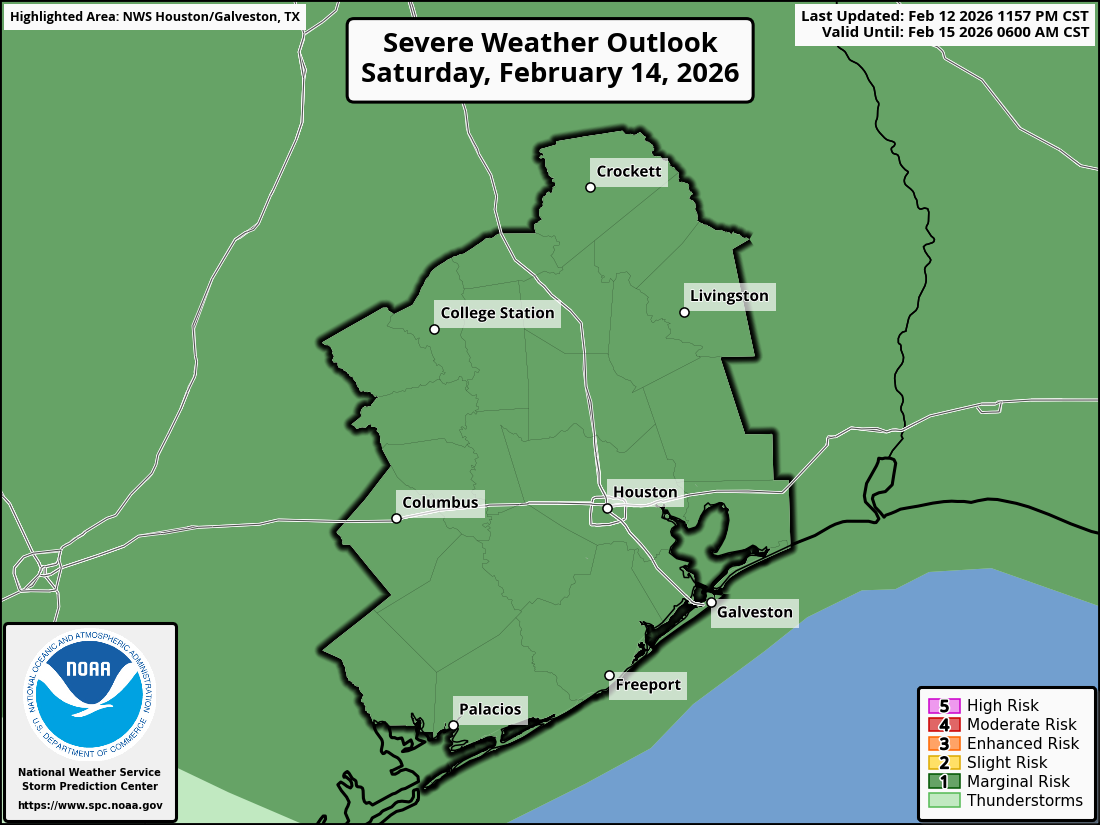
The entire region is carpeted in a marginal risk, level 1/5, for severe weather tomorrow, which generally means lower-end coverage of severe storms. Many locations will hear thunder, but only one or two may see a severe storm with gusty winds. Storms should exit the coast around or before midnight, ending any severe threat, The chance of a severe storm may be highest north of I-10 tomorrow.
In addition, some locally heavy rain is likely tomorrow, with a few spots perhaps seeing 2 inches of rain, while others see a quarter inch. Basically, have an umbrella, and if you hear thunder, retreat to a safe indoor location.

Otherwise, look for clouds, some sun, and some fog with highs in the 70s.
Sunday & Washington’s Birthday
We should clear out and have a picture-perfect Sunday and Presidents’ Day Monday. Sunday looks glorious with sunshine and highs in the low-70s, although a bit on the breezy side at times with north winds gusting to 20 to 25 mph or so. Monday morning will start in the 40s and 50s, warming into the 70s again with pleasant humidity and sunshine.
Rest of next week
To be honest, next week looks a bit like this week, with temps warming up again into the 80s probably, along with slowly building humidity. We will probably see our next front sometime near next weekend or just beyond. Timing is suspect right now. That next front could have a tinge more punch of cooler air behind it, but nothing like a freeze or anything.
Bondi Spying On Congressional Epstein Searches Should Be A Major Scandal
Yesterday, Attorney General Pam Bondi appeared before the House Judiciary Committee. Among the more notable exchanges was when Rep. Pramila Jayapal asked some of Jeffrey Epstein’s victims who were in the audience to stand up and indicate whether Bondi’s DOJ had ever contacted them about their experiences. None of them had heard from the Justice Department. Bondi wouldn’t even look at the victims as she frantically flipped through her prepared notes.
And that’s when news organizations, including Reuters, caught something alarming: one of the pages Bondi held up clearly showed searches that Jayapal herself had done of the Epstein files:
A Reuters photographer captured this image of a page from Pam Bondi's "burn book," which she used to counter any questions from Democratic lawmakers during an unhinged hearing today.It looks like the DOJ monitored members of Congress’s searches of the unredacted Epstein files.Just wow.
— Christopher Wiggins (@cwnewser.bsky.social) 2026-02-11T23:06:45.578Z
The Department of Justice—led by an Attorney General who is supposed to serve the public but has made clear her only role is protecting Donald Trump’s personal interests—is actively surveilling what members of Congress are searching in the Epstein files. And then bringing that surveillance data to a congressional hearing to use as political ammunition.
This should be front-page news. It should be a major scandal. Honestly, it should be impeachable.
There is no legitimate investigative purpose here. No subpoena. Nothing at all. Just the executive branch tracking the oversight activities of the legislative branch, then weaponizing that information for political culture war point-scoring. The DOJ has no business whatsoever surveilling what members of Congress—who have oversight authority over the Justice Department—are searching.
Jayapal is rightly furious:
Pam Bondi brought a document to the Judiciary Committee today that had my search history of the Epstein files on it. The DOJ is spying on members of Congress. It’s a disgrace and I won’t stand for it.
— Congresswoman Pramila Jayapal (@jayapal.house.gov) 2026-02-12T01:14:57.174494904Z
We’ve been here before. Way back in 2014, the CIA illegally spied on searches by Senate staffers who were investigating the CIA’s torture program. It was considered a scandal at the time—because it was one. The executive branch surveilling congressional oversight is a fundamental violation of separation of powers. It’s the kind of thing that, when it happens, should trigger immediate consequences.
And yet.
Just a few days ago, Senator Lindsey Graham—who has been one of the foremost defenders of government surveillance for years—blew up at a Verizon executive for complying with a subpoena that revealed Graham’s call records (not the contents, just the metadata) from around January 6th, 2021.
“If the shoe were on the other foot, it’d be front-page news all over the world that Republicans went after sitting Democratic senators’ phone records,” said Republican Sen. Lindsey Graham of South Carolina, who was among the Republicans in Congress whose records were accessed by prosecutors as they examined contacts between the president and allies on Capitol Hill.
“I just want to let you know,” he added, “I don’t think I deserve what happened to me.”
This is the same Lindsey Graham who, over a decade ago, said he was “glad” that the NSA was collecting his phone records because it magically kept him safe from terrorists. But now he’s demanding hundreds of thousands of dollars for being “spied” on (he wasn’t—a company complied with a valid subpoena in a legitimate investigation, which is how the legal system is supposed to work).
So here’s the contrast: Graham is demanding money and media attention because a company followed the law. Meanwhile, the Attorney General is actually surveilling a Democratic member of Congress’s oversight activities—with no legal basis whatsoever—and using that surveillance for political theater in a manner clearly designed as a warning shot to congressional reps investigating the Epstein Files. Pam Bondi wants you to know she’s watching you.
Graham claimed that if the shoe were on the other foot, it would be “front-page news all over the world.” Well, Senator, here’s your chance. The shoe is very much on the other foot. It’s worse than what happened to you, because what happened to you was legal and appropriate, and what’s happening to Jayapal is neither.
But we all know Graham won’t speak out against this administration. He’s had nearly a decade to show whether or not the version of Lindsey Graham who said “if we elected Donald Trump, we will get destroyed… and we will deserve it” still exists, and it’s clear that Lindsey Graham is long gone. This one only serves Donald Trump and himself, not the American people.
But this actually matters: if the DOJ can surveil what members of Congress search in oversight files—and then use that surveillance as a weapon in public hearings—congressional oversight of the executive branch is dead. That’s the whole point of separation of powers. The people who are supposed to watch the watchmen can’t do their jobs if the watchmen are surveilling them.
And remember: Bondi didn’t hide this. She brought it to the hearing. She held it up when she knew cameras would catch what was going on. She wanted Jayapal—and every other member of Congress—to see exactly what she’s doing.
This administration doesn’t fear consequences for this kind of vast abuse of power because there haven’t been any. And the longer that remains true, the worse it’s going to get.