Cowboy Who?
Shared posts
Houston Public Library to become a “fine free” system by discontinuing overdue fees
Two Reviewers Provide Contradictory Feedback on Your Nietzschean Study of Early Mario Bros. Games
First Submission
Reviewer #1
I enjoyed reading your article “Man, Superman, Super Mario,” a Nietzschean study of the early Mario Brothers games. I found myself especially compelled by your argument that the raccoon suit represents the Übermensch form of the Mario character.
However, your paper is not even remotely publishable unless you add another three thousand words discussing Benderman’s brilliant argument from his book Super Marxio Brothers (2007) about how the plumber protagonists symbolize the exploitation of the proletariat.
Also, after listening to the first four episodes of a seventeen-hour WNYC podcast on the history of fonts, I insist that all authors format papers in Helvetica Neue.
Reviewer #2
I loathe your piece, which is not only wrong but indicates severe moral failings in you as a human being. The ultimate problem with your scholarship is that I do not enjoy the Super Mario games. I prefer you write a Nietzschean analysis about Link called “Thus Spoke Zelda.” If you insist on continuing down this ill-advised scholarly path, you must change your argument about raccoon Mario, as fireball Mario clearly represents the Übermensch form of the character.
Although your paper does not exceed our length requirements, please cut exactly 796 words. At the same time, add significant discussion of Morales’s (2017) argument that Princess Zelda is the superior feminist character when compared to Princess Peach. But under no circumstances should you cite Benderman (2007), who is an academic imposter (plus he took the last shrimp canape at the 2012 Games+Learning+Society Conference closing reception).
Lastly, without spoiling my anonymity, I’m a distant member of the Garamond dynasty, so please format your paper in our signature font.
Revise and Resubmit #1
Reviewer #1
I am incredibly disappointed to see that you cited Morales (2017), who once called me a “charlatan” during my presentation about the phallic symbolism of Mario’s Toad character. And while you followed my recommendation to cite Benderman, I do not appreciate the footnote indicating that some scholars consider him a “fraud” and a “canape thief.”
Likewise, I am disappointed that you replaced your raccoon Mario analysis with an argument that fireball Mario provides a direct analogy to Nietzsche’s identification with the element of fire. Further, I just realized that you never mention Luigi, so definitely add an extensive examination suggesting that Luigi’s mustache was inspired by Nietzsche’s.
I see that you formatted half your paper in Helvetica Neue and half in Garamond. However, after learning that Helvetica Neue was originally created by inhumanely harvesting octopus ink, I insist you use Verdana.
Reviewer #2
Since you only formatted half your paper in Garamond, I read only that half. But from what I read, your sole productive revisions were citing Morales and adding images from the original Legend of Zelda game. Please also add pictures of Madam MeowMeow from The Legend of Zelda: Link’s Awakening, as these would add tremendous complexity to your interpretation of Mario.
Even though you include an important footnote problematizing the existence of Benderman, this journal will not publish a paper in which you cite him. He once called me “haughty” and “supercilious” after I brilliantly refuted his idiotic conference presentation about Toad, as Nintendo’s Eggplant Wizard is clearly their most phallocentric character.
I’m unclear why you added references to fireball Mario; replace that material with a dissection about how the Mario/Bowser rivalry perfectly enacts Nietzsche’s aphorism “Be careful, lest in casting out your demon you exorcise the best thing in you.” However, I must begrudgingly compliment you on avoiding the temptation to discuss Luigi, whose mustache greatly displeases me.
Revise and Resubmit #2
Reviewer #1
First and most importantly, it appears you have created a brand-new font that blends elements of Verdana and Garamond. I will need documentation that no octopuses (which is the correct plural!!) were harmed while creating this font.
Secondly, the new material on Bowser comes out of nowhere (like the Legend of Zelda pictures you continue adding). But your additions got me thinking that you should add an entirely new conclusion about how Yoshi represents Nietzsche’s dragon called “Thou shalt,” but only if you learn Japanese and travel to the Nintendo headquarters in Kyoto for one to two years of ethnographic and archival research to prove this hypothesis that I formulated just now.
And if you don’t remove any and all references to that haughty, supercilious scholar Morales, I will set future versions of your manuscript on fire.
Reviewer #2
You failed to formulate the Bowser/Mario material the way I would have if I had written it, which I would not have, because that idea is beneath me. What if you delete everything in the existing article and instead write about how the ability to play Zelda games repeatedly enacts Nietzsche’s doctrine of eternal recurrence? (This will make the Zelda images you insisted on including much more relevant.)
Also, it is a personal affront to me that you still reference Benderman, despite the fact that you wrote and submitted an entirely new paper to our journal refuting his Toad phallicism thesis. Please remove the Benderman references and submit a voodoo doll of Benderman with your next revision that I can use for undisclosed reasons.
Revise and Resubmit #3
The Editor
Thank you for your continued submissions to Game Theory (But Not the Economic Kind of Game Theory): A Journal for the Self-Serious Study of Fun Things. In the five years since you submitted the first version of your article, our journal has changed its focus to printing work that reinforces the conclusions of the gambling industry. Therefore, your paper no longer fits our publication. However, we invite you to serve as a reviewer for the upgraded version of the journal. I need a peer reviewer for a fascinating paper that uses Benderman’s and Morales’s scholarship to argue that the memory card game in Super Mario Bros. 3 suggests productive learning outcomes for children exposed to gambling at a young age.
Kamala Harris Pops By Office To Print Out Concert Tickets
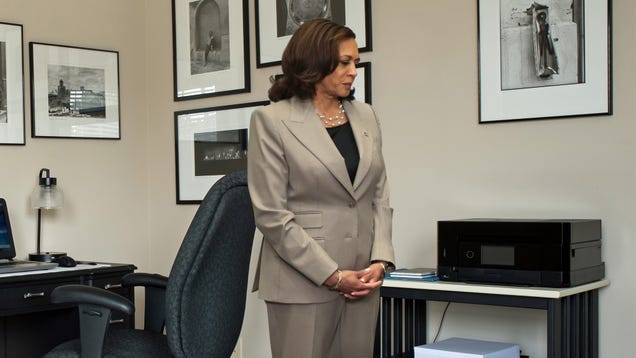
WASHINGTON—Peeking around corners and ducking past doorways in an effort to get in and out of her workplace unseen, Vice President Kamala Harris reportedly popped by the Eisenhower Executive Office Building late Wednesday to print out concert tickets. Upon confirming all members of her staff, who she had allegedly not…
Atari 2600 Hardware Design: Making Something out of (Almost) Nothing
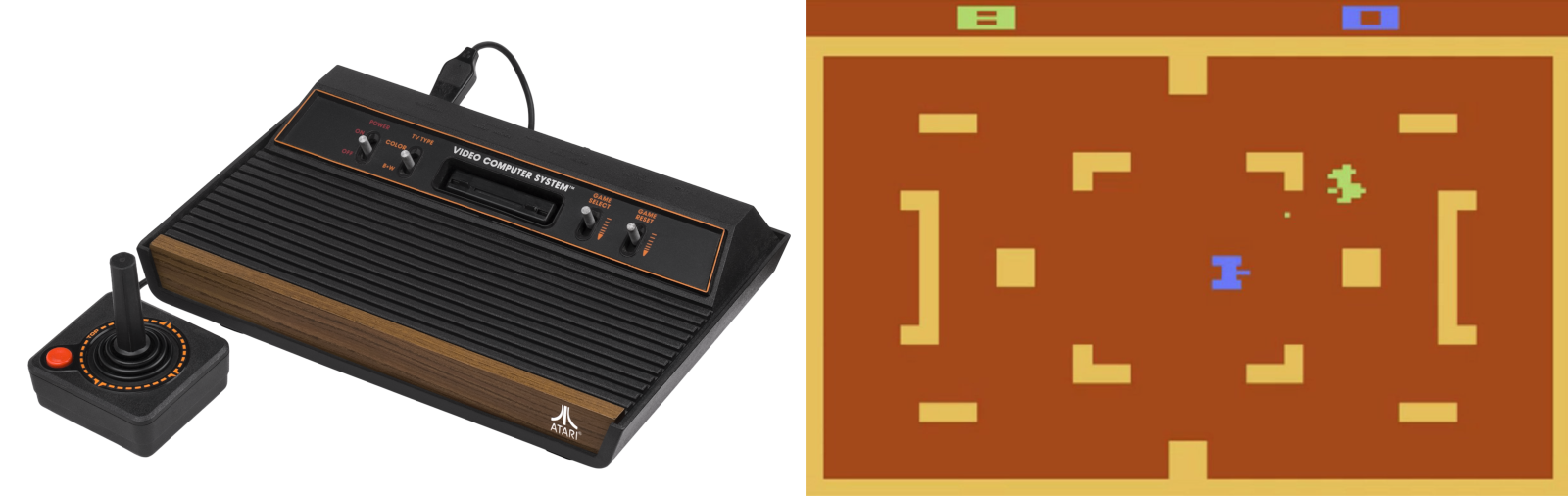
Atari Combat, 1977
The Atari 2600 wasn’t the first home video game console with replaceable games, but it was the first to be widely successful. Introduced in 1977 as the Atari VCS (Video Computer System), and later renamed Atari 2600 in 1982, it eventually sold over 30 million units and established a new market that still endures today in the PlayStation and Xbox. Prior to the 2600, most video game systems were either coin-operated machines found in bars, or fixed-function devices limited to a few built-in games like Pong. Atari’s first home system was the beginning of a new age.
This wood-grained block of electronics preoccupied my young mind. I wanted one badly, but never succeeded at convincing my parents. I was eleven years old in 1982 when my friend Fred got an Atari, and I was sick with jealousy:
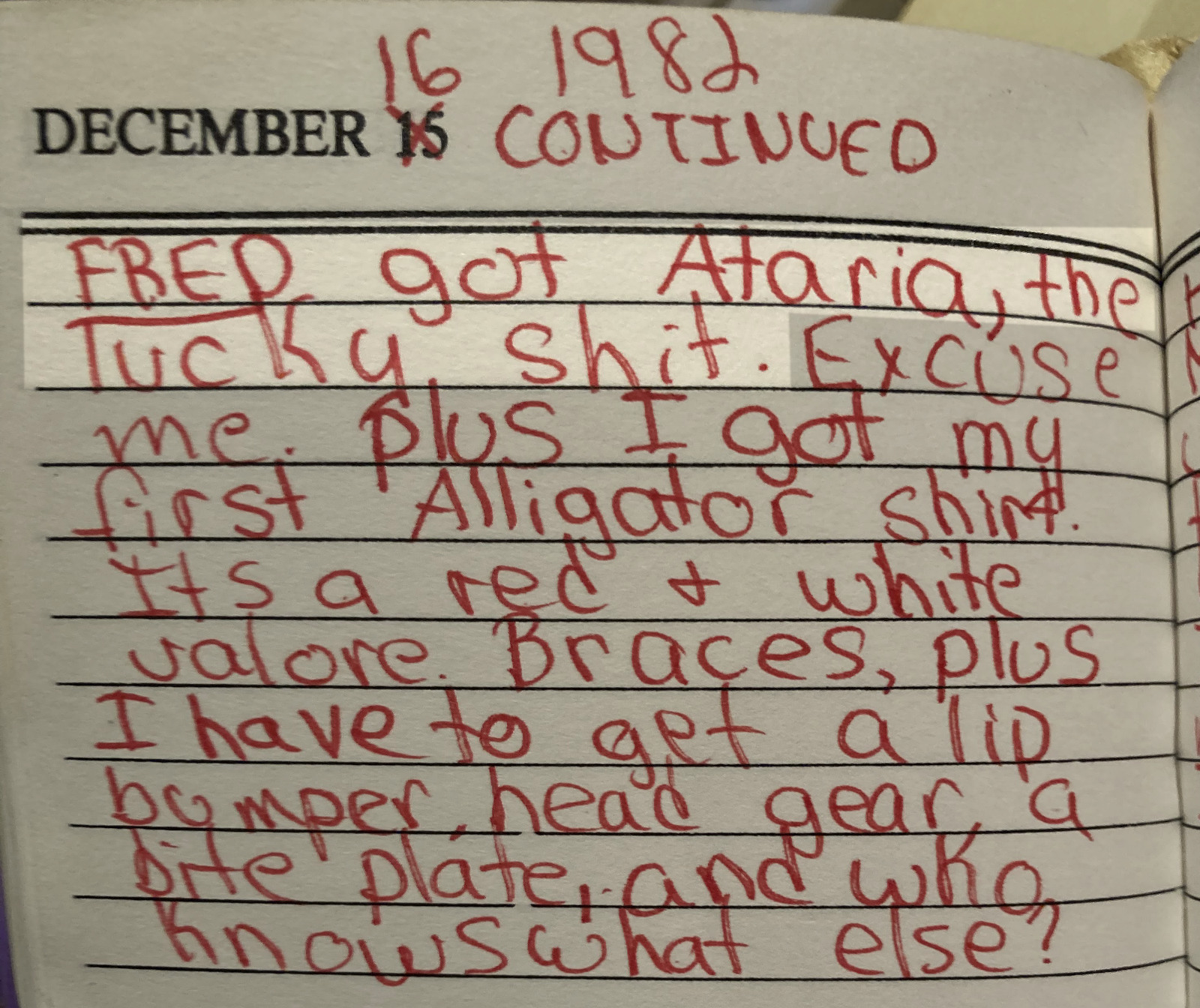
December 16 1982, arrival of Ataria (sic)
What a day! Not only did Fred get an Atari system, but I got braces and an Izod Lacoste alligator shirt.
Atari 2600 Hardware Overview
Recently over the holiday break, I became interested in the 2600’s hardware architecture and started reading everything that I could find about it. I knew that it was some kind of 6502-based system, and I’d heard mentions of “racing the beam”, but that’s as far as my knowledge went. I was shocked to discover how primitive the 2600 hardware was, even compared to contemporary 6502 systems like the Apple II, Commodore PET, and even Atari’s own 8-bit computers.
Inside that wood-grained box there were only three digital chips:
- 6507 CPU (pin-reduced version of the 6502)
- 6532 RIOT
- TIA (Atari custom IC)
Notably absent from this list was any RAM or ROM! The ROM came from whatever game cartridge was inserted – there was absolutely no built-in I/O helper routines or operating system, so it was up to the game programmer to provide everything. Game cartridges were limited to 4 KB and many early games were only 2 KB. Any of the photos on this page are vastly bigger than that.
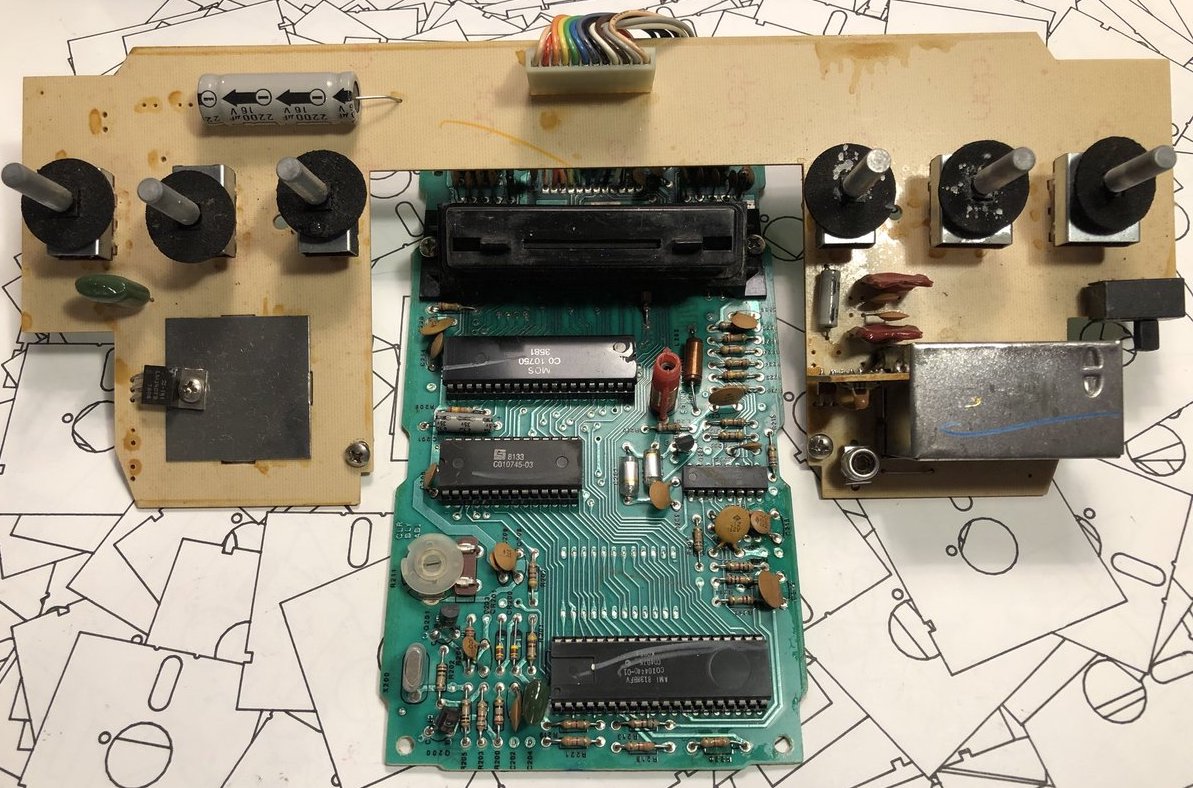
early version of Atari VCS circuit board
RAM was limited to the tiny amount of storage space built-into the 6532 RIOT chip – just 128 bytes. 128 bytes! That is… I don’t even… that is small. Like really, really small. I might have guessed 1 KB or 2 KB RAM, but 128 bytes is just in another category entirely. What’s worse, this tiny amount of RAM had to serve as both the scratchpad/heap and as the stack! Programmers got a few bytes for things like player and item locations, strength, score, and that’s all.
But hold on, because it was even worse than you think. This pin-reduced 6507 eliminated the 6502’s NMI and IRQ pins, so there was no hardware interrupt capability at all. Everything had to be accomplished with software timing and polling. For a real-time system built around the concept of racing the beam, this was just masochism.
And for the final kick in the nuts, there was no framebuffer. There wasn’t even a line buffer. The programmer only had a few TIA registers to play with and nothing more. Most graphics had to be generated by the CPU on the fly, at the very moment that the television’s electron beam was scanning past the pixels of interest. Even the VSYNC signal for the television had to be handled in software. With hardware like this, I’m surprised the Atari 2600 didn’t require a coal-fired steam engine or a wooden crank handle to boot the games! It’s crazy. I love it.
Inside the TIA Chip
The heart of the 2600 is Atari’s custom-designed TIA chip – the Television Interface Adapter. You can find the hand-drawn TIA schematics on the web if you’re curious how it works. The TIA internals look very strange to modern eyes, beginning with the extensive use of linear feedback shift registers where you would expect to find binary counters, for things like the horizontal sync counter or the sprite position registers. I’ve seen LFSRs used as random number generators in other 8-bit designs, but never as a general-purpose counter. These LFSRs also use two separate clocks, 180 degrees out of phase, which seems equally strange. Here’s the six bit horizontal sync counter:
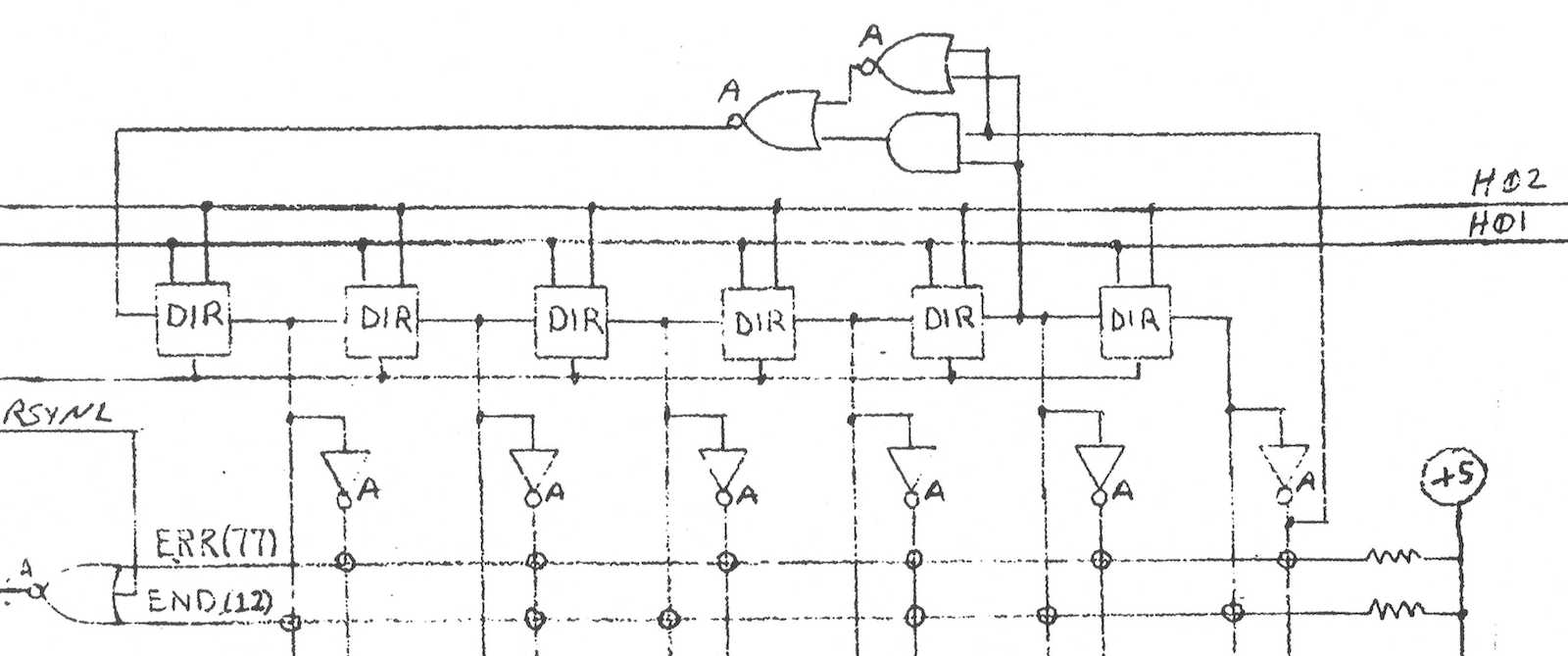
The chip designers must have had their reasons: maybe LFSRs were cheaper to implement or required fewer transistors than regular binary counters? If you just need a six bit counter, then ultimately it doesn’t really matter if it counts 64 states from 000000 sequentially up to 111111, or if it follows some other random-looking but deterministic sequence of states. Either way you can add logic to check for the terminal state and reset the counter when needed. If anyone has an idea why the TIA’s designers used LFSRs for this stuff, I’d love to hear about it. Fortunately the Atari 2600 programmer is mostly insulated from this LFSR funny business.
So how do games actually draw stuff? The simplest place to begin is with what Atari calls the playfield, and is effectively a background pattern on the screen. The TIA has 20 bits of register state which the programmer can modify, and which is used to create a one-dimensional low-resolution monochrome bitmap on the left half of the scan line. The right half of the line is either a copy of the left, or a mirrored copy. Want something completely different on the right side? Too bad. Want multiple colors? Too bad. The same 20 bits of playfield register state are used on every horizontal scan line, too. Want to display something different on each line? That requires constantly modifying the playfield registers, before each new scan line is drawn. There are only 76 CPU clock cycles during each scan line, and with most CPU instructions requiring 2 to 5 clock cycles, that doesn’t leave much time to do… basically anything.
This playfield behavior explains why so many Atari games have left-right symmetry in their backgrounds, walls, or similar content. Look at this image of Pitfall, and notice how the tree canopy, tree trunks, ground, pit, and underground cave all show left-right symmetry. These are all built from the playfield (plus additional tricks to be described later). The only sprites are Pitfall Harry, the vine he’s swinging from, the rolling log, and the scorpion.
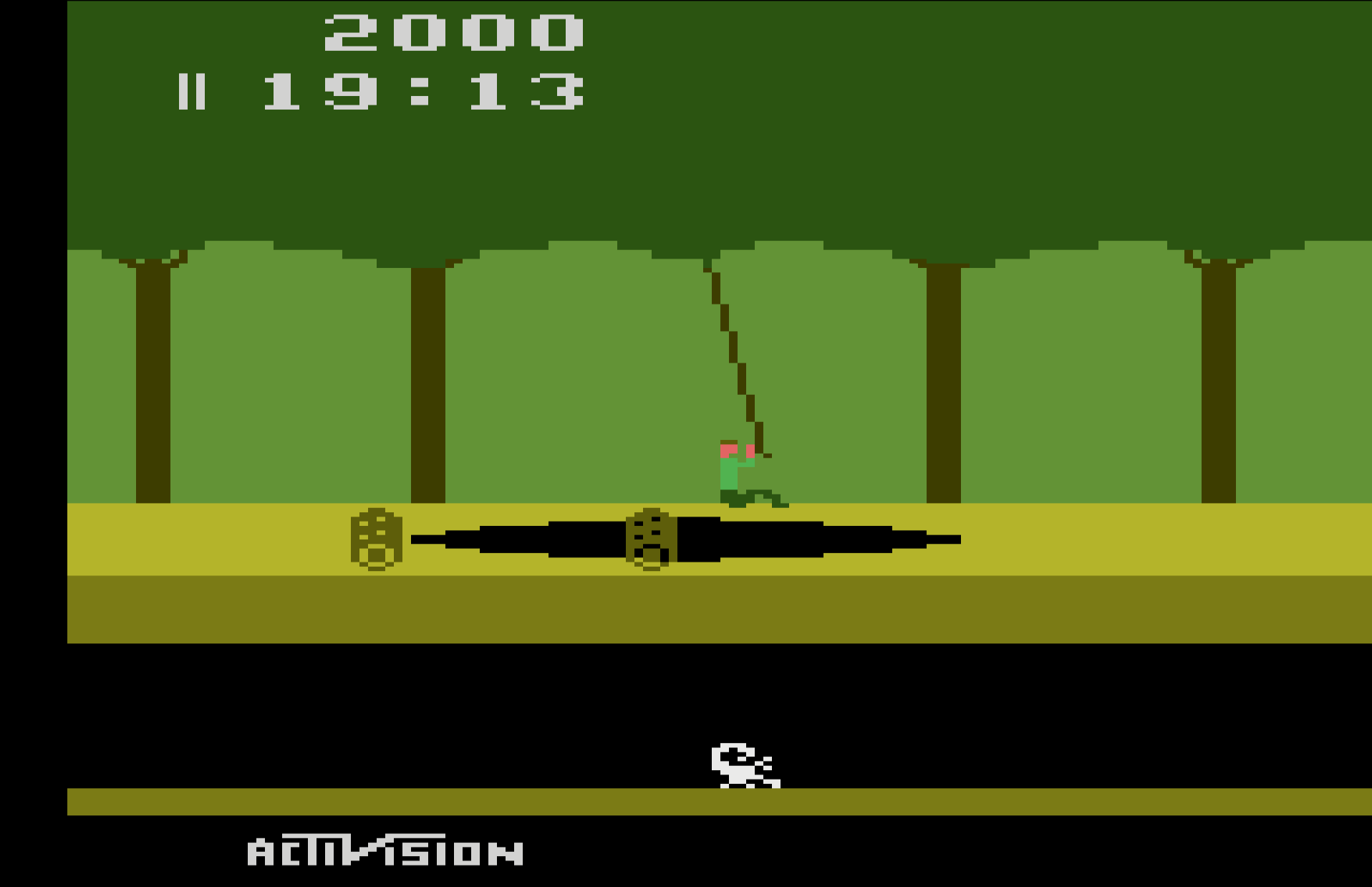
What about those sprites? Atari called them players and missiles, but the concept is the same. Players are sprites eight bits wide, and the pixels are smaller than playfield pixels. They can be positioned anywhere on the scan line, but like the playfield, they’re one-dimensional monochrome bitmaps. If the programmer wants 2D sprites (which they certainly do), then the code must constantly modify the player graphics register, updating it before each new scan line is drawn, including setting the register to zero for the areas above and below the player sprite where nothing should be drawn. Does that sound incredibly tedious? You bet!
Missiles are only one bit wide instead of eight, but are otherwise identical to players. The TIA provides two players, two missiles, and a ball that’s like a third missile. If the programmer wants more sprites than this, or wants multi-colored sprites, or anything else that the hardware doesn’t provide, then they’ll need to get fancy by combining multiple players and missiles, or else make lots of precisely-timed updates to the TIA registers to create the illusion of additional sprites and colors.
One common technique was to design games with distinct horizontal bands of activity, like Pitfall here. That allowed the same player sprite to be reused multiple times as the screen was painted from top to bottom. For Pitfall, player 0 might first be used to draw a score digit at the top of the screen. Then the same player 0 hardware resource would be used to draw part of Pitfall Harry, then to draw the rolling log, and finally to draw the scorpion. Since none of these overlapped each other horizontally, there was no conflict as long as the software could update the player graphics and position quickly between scan lines.
Atari Hardware Tricks
Under a one-dimensional hardware system like this one, collision detection would have been extremely difficult if it were left up to the software to provide. The necessary degree of bookkeeping would be too much: checking all the sprites and the playfield for collisions with each other would be virtually impossible with only 76 clock cycles per scan line, on top of all the CPU’s other critical tasks. Fortunately the TIA provides the very cool feature of hardware collision detection, at the pixel level! Any time a non-zero pixel overlaps another non-zero pixel of the playfield, a player, a missile, or the ball, a corresponding collision bit is set in the TIA, which software can later check and clear. With a total of six graphics objects there are (6*5)/2 = 15 possible collisions (an application of the Handshake Problem) to be tracked by the TIA. Nice!
Horizontal positioning of players and missiles is notoriously difficult. Most programmers would expect that the TIA has registers to specify the horizontal position of each sprite, but no. That would be too easy. On the Atari 2600, the horizontal position of a player or missile is set by writing to a special TIA register at the exact moment the electron beam passes the desired position. Think about that for a minute. The specific value that’s written to the register doesn’t matter. The program isn’t telling the TIA “put player 0 at position X”, it’s telling the TIA “put player 0 at… (wait for it) RIGHT HERE!” Thanks to this design, horizontal positioning requires synchronizing a software loop to the start of a scan line, delaying some amount of time dependent on the desired horizontal position, and then writing to the TIA register. Rather than setting a specific value for the horizontal position, the software is actually resetting one of those LFSRs in the TIA.
With the standard technique for this timing-based horizontal positioning, it’s only possible to get a horizontal resolution of five CPU clock cycles, which is equivalent to 15 pixels. To help the programmer get fine-grained control, the TIA provides additional registers that enable each sprite to be adjusted between -8 to +7 pixels from its ordinary position. It’s clumsy, but the combination of timing-based positioning plus fine-grained adjustments enable sprites to be positioned at any horizontal coordinate.
The fine-grained horizontal control involves writing to a TIA register named HMOVE, and its use leads to one of the Atari 2600’s most notorious graphical flaws: an irregular series of black lines on the left side of the screen, obscuring part of the playfield. This is often called the HMOVE comb. Here’s an example from Space Invaders:
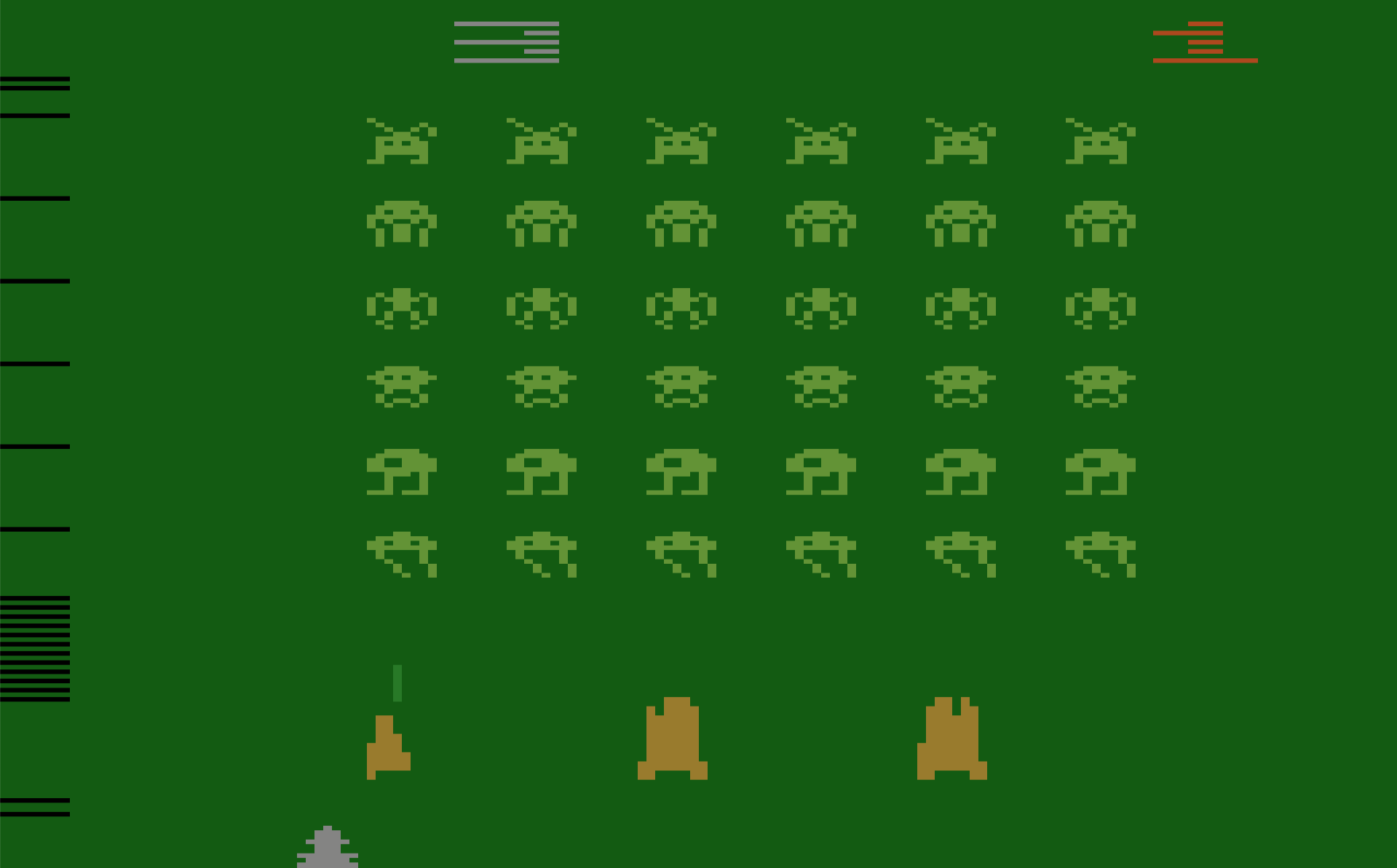
This is a side-effect of the way the TIA performs fine-grained adjustment of sprite positions, and many games exhibit this problem. Any time HMOVE is written to during a scan line, the horizontal blanking interval will be extended by eight pixels on that line, cutting off the left edge of the line. Is it a bug? An unintended feature? The exact details are much too complex to describe here, but Andrew Towers has written a very thorough explanation of TIA behavior which you’ll find at http://www.atarihq.com/danb/files/TIA_HW_Notes.txt. See the heading Playing with the HMOVE Registers.
Why do only some games display this HMOVE comb effect, and others apparently don’t? It only appears when games reuse the same sprite at different vertical positions on the screen, which requires adjusting the sprite’s horizontal position mid-frame. Space Invaders does this extensively, but simple games like Combat don’t do this. Combat is limited to the two built-in players and two built-in missiles, with no mid-frame repositioning, and therefore no HMOVE comb.
Pitfall takes a different approach, with a solid black bar at the left edge of the screen instead of a comb. This is the result of writing to HMOVE on every scan line, even when it’s not needed. Activision used this technique in many games, apparently having concluded that a solid black bar looked nicer than a partial black comb.
There are many more software tricks necessary for creating a high-quality Atari game. A non-symmetrical playfield or multi-colored playfield can be created by modifying the playfield graphics and color registers at precisely the right times, but it’s not easy! Color registers can also be modified between lines, to provide more total colors on the screen even when the number of colors on a single line is limited. Sprites can be reused and repositioned at different vertical positions, or can even be reused at the same vertical position with careful timing and attention to TIA behavior. Atari 2600 programming is a very deep topic, and it’s a long journey from bouncing ball demos to a high-quality game like Pitfall.
Atari 2600 Development Today
Want to try your hand at writing some Atari game demos? Yes you do, and it’s much easier today than it was in 1977. Start with this Atari 2600 Programming for Newbies tutorial written by Andrew Davies. Software is written in 6502 assembly language, and if you’re reading this blog, then there’s a good chance you already know it. To assemble your software, use DASM, a venerable and feature-filled cross-platform assembler for the 6502 and other 8-bit CPUs. If you’ve got a real Atari 2600 console, you can write your assembled program’s binary image to an EPROM and make your own game cartridge. If that sounds like too much bother, try the Z26 or Stella software emulators.
Did I butcher some technical explanation here, or omit important details? Please let me know! I’m just a beginner on this Atari hardware journey, with much still to learn. Look for my first 2600 game, coming soon?
Austin and San Antonio Museums Announce Spring 2023 Exhibitions
As we begin 2023, museums in Austin and San Antonio, including The Contemporary Austin, the Mexic-Arte Museum, the Blanton Museum of Art, the San Antonio Museum of Art, and Ruby City, have announced a handful of major exhibitions that will open throughout the spring.

Installation view: Eamon Ore-Giron, “Competing with Lightning / Rivalizando con el relámpago,” 2022. Museum of Contemporary Art, Denver, Artwork © Eamon Ore-Giron. Courtesy the artist and James Cohan, New York. Image courtesy Museum of Contemporary Art, Denver. Photograph by Wes Magyar.
On March 3, The Contemporary Austin will debut two new exhibits, which each run until August 20. Eamon Ore-Giron: Competing With Lightning/Rivalizando Con El Relámpago will feature paintings made over the past twenty years by artist, musician, and DJ Eamon Ore-Giron. According to the bio on his website, Mr. Ore-Giron’s abstract paintings reference “indigenous and craft traditions, such as Native American medicine wheels and Amazonian tapestries, as well as 20th-century avant-gardes, from Russian Suprematism to Latin American Concrete Art.” Born in Tucson, Arizona, he has a BFA from the San Francisco Art Institute and an MFA from the University of California, Los Angeles. The exhibition was curated by Miranda Lash of the Museum of Contemporary Arts Denver, where it premiered last year. Contemporary Austin curator Julie Le is organizing the Texas version of the show.
In the Contemporary’s other new show, Mexico City-based collaborative duo Celeste (María Fernanda Camarena and Gabriel Rosas Alemán) will present works from their cross-disciplinary practice which, according to the Contemporary’s website, “conducts a negotiation that expands concentrically in order to gradually encompass other collaborators and spectators within the workings of an intimate exchange.” The museum goes on to announce that the exhibition will bring viewers in contact with “transient moments of proximity and familiarity,” which blur “the commonplace structures that define how artworks can be appreciated or how museums can function as physical and social spaces.”
The duo’s Instagram shows off examples of some of their recent projects, mostly large-scale installations of works on fabric harmonizing with exterior and altered interior spaces. The show in Austin will follow a London exhibition, A Portable Landscape, which will run through online art collecting platform Canopy Collections at Wing Gallery later this month.

An arte popular work from the Mexica-Arte collection
Just a bit down the road, the Mexic-Arte Museum has its own host of shows opening this spring. This year’s rendition of Totally Cool Totally Art, the Mexic-Arte’s annual student exhibition, is up first. That show, which has been recurring at least since Glasstire first mentioned it in 2009, is presented in conjunction with the City of Austin Parks and Recreation Department and features a cross-media array of artworks from local middle and high schoolers. The exhibition opens on February 14 and runs through February 28.
Next is Mix ‘n’ Mash: Alimento para el alma / Food for the soul, which opens on March 3. Another recurring show, formerly titled just Mix ‘n’ Mash, this is an art sale fundraiser for Mexic-Arte, where participating artists receive a 40% commission from the sale of their works. The theme this year is food, which the museum states “has as much creative potential as any traditional media (painting, drawing, sculpting, etc.).” Artists who wish to participate in the show can find a call for entries, complete with instruction, on the museum’s website. Each work in Mix ‘n’ Mash will be made on a 12 by 12-inch piece of gessoboard that was donated by Ampersand Art Supply. The show will be on view from March 3 through 19.
Then, in April, Mexic-Arte will present an exhibition titled Making Tradition—Selections from Arte Popular Collection. As the museum explains, arte popular, or Mexican folk art, “represents a broad variety of traditions and specificity dependent on the region of creation and individual maker.” The exhibition will run from April 7 until June 25.

Violette Bule, “Dream America,” 2015, two framed photographs, 36 x 30 inches (each). Courtesy of the artist
Elsewhere in Austin, the Blanton Museum of Art will present an exhibition titled Day Jobs from February 19 until July 23. The group show will present artworks that highlight the ways in which artists’ day jobs have influenced their creative practices. In support of the idea, the Blanton offers this quote from artist and lawyer Ragen Moss:
Typologies of thought are more interrelated than bulky categories like ‘lawyer’ or ‘artist’ allow. . . Creativity is not displaced by other manners of thinking; but rather, creativity runs alongside, with, into, and sometimes from other manners of thinking.
The exhibition will feature roughly 75 works in total from a range of artists, including Emma Amos, Genesis Belanger, Larry Bell, Mark Bradford, Lenka Clayton, Jeffrey Gibson, Jay Lynn Gomez (formerly Ramiro Gomez), Tishan Hsu, VLM (Virginia Luna Montgomery), Ragen Moss, Howardena Pindell, Chuck Ramirez, Robert Ryman, and Fred Wilson. It was organized by former Blanton curator Veronica Roberts, with former curatorial assistant Lynne Maphies.

“Relief with a herdsman and cow before a sanctuary,” Roman, late 1st century B.C.-mid-1st century A.D., marble, 11 3/4 x 13 1/4 inches. State Collection of Antiquities and Glyptothek Munich, Photograph by Renate Kühling
Meanwhile, there will be myriad exhibitions at San Antonio institutions as well. The San Antonio Museum of Art (SAMA) will present Roman Landscapes: Visions of Nature and Myth from Rome and Pompeii from February 24 until May 21. According to a press release from SAMA, this will be “the first exhibition in the United States to explore landscape scenes as a genre of ancient Roman art.” It will be organized around five thematic sections, titled, Garden Landscapes, Coastal Views and Cultivated Landscapes, Sacred Landscapes, The Dangerous Landscapes of Myth, and Landscapes in the Tomb. Each of these will delve into different pockets of Roman landscape art, representing a variety of methods and sources.
The exhibition Roman Landscapes is exclusive to San Antonio, where it was developed by SAMA Interim Chief Curator Jessica Powers and Gilbert M. Denman, Jr., who is Curator of Art of the Ancient Mediterranean World. Ms. Powers, via a press release, said, “the artistic innovation of showing human figures within visually dominant natural settings began during the tumultuous final decades of the Roman Republic, as civil war in Italy resulted in changes in land ownership and territorial expansion continued in the eastern Mediterranean.” She went on to explain that “there have been few museum exhibitions focusing on this type of ancient art. Roman Landscapes addresses this, demonstrating how artists, patrons, and viewers in Roman Italy embraced landscape depictions over several centuries.”
The show features more than 65 works and will be accompanied by a comprehensive catalog published by the museum, with essays penned by Ms. Powers and a slew of other experts that includes Trinity University’s Timothy M. O’Sullivan, Professor of Classical Studies. Relevantly, Trinity will focus their annual Lennox Seminar Lecture Series on subjects highlighted in SAMA’s exhibition.
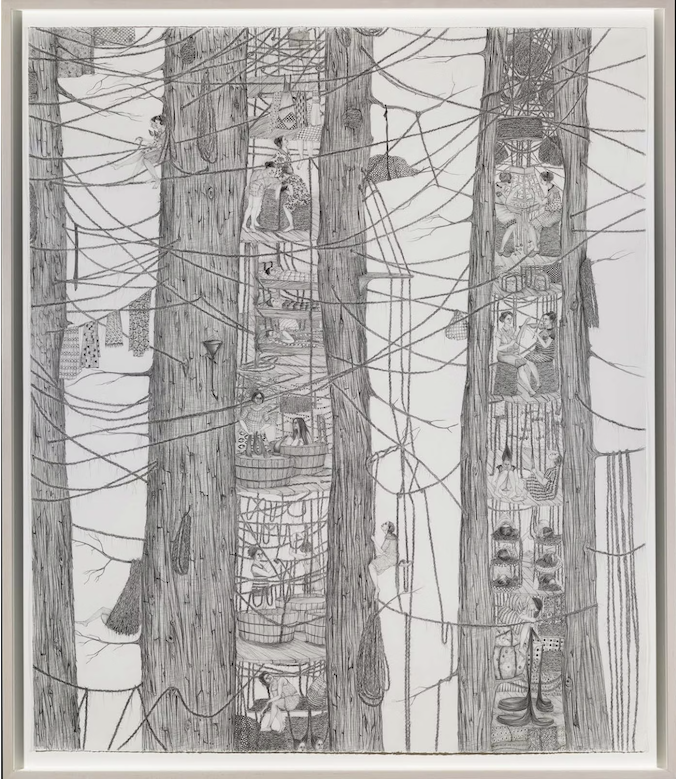
Amy Cutler, “Fossa,” 2016, graphite on paper, 55 1/4 x 47 inches. Courtesy of Leslie Tonkonow Artworks + Projects.
Finally, the San Antonio contemporary art center Ruby City will feature a solo exhibition by New York-based artist Amy Cutler. Ms. Cutler recently gifted Ruby City her 2015 multi-media installation titled Fossa. This work will be the centerpiece of her exhibition, which is called Amy Cutler: New Acquisitions. A large drawing to be featured in the exhibition is also titled Fossa. Additional work will be on view in Ruby City’s Chris Park. The installation Fossa was created for SITE Santa Fe as a collaboration with musician Emily Wells and hair stylist Adriana Papaelo. It is a whole-room installation, resembling what the museum describes as “an old-fashioned parlor” and complete with ambient sound and over 800 feet of synthetic and human hair.
Amy Cutler: New Acquisitions will be on view from April 6, 2023 until February 25, 2024.
The post Austin and San Antonio Museums Announce Spring 2023 Exhibitions appeared first on Glasstire.
2023 Spring Preview: Texas Exhibitions to See this Year
Jessica Fuentes, William Sarradet, and Brandon Zech discuss their anticipated exhibitions in Texas, including an outdoor sculpture show just north of Houston, a group exhibition examining artists’ day jobs in Austin, an exhibition exploring five decades of screen-inspired art in Fort Worth, and more.

A Gift from the Bower
Organized by DiverseWorks, on view at the Locke Surls Center for Art and Nature @ Splendora Gardens (Cleveland)
April 22, 2023 – October 31, 2023
From DiverseWorks:
“Conceived by nationally-renowned artist James Surls, A Gift From The Bower is a sculpture exhibition that takes place in a series of natural galleries formed by small clearings in the woods of Southeast Texas. Curated by Surls, Jack Massing, and Xandra Eden, new works by thirteen artists and artist teams are being created for the project in collaboration with musicians, performers, and writers to create a unique, outdoor experience.
This highly anticipated project is produced by DiverseWorks and the Locke Surls Center for Art and Nature @ Splendora Gardens (LSCAN). Opening festivities are scheduled to take place on Earth Day Weekend, April 22-23, 2023.”

Violette Bule, “Dream America,” 2015, chromogenic prints, 36 x 30 in. (each), Collection of the artist
Day Jobs
Blanton Museum of Art (Austin)
February 19, 2023 – July 23, 2023
From the Blanton Museum of Art:
“One of the typical measures of success for artists is the ability to quit their day jobs and focus full time on making art. Yet these roles are not always an impediment to an artist’s career. This exhibition illuminates how day jobs can spur creative growth by providing artists with unexpected new materials and methods, working knowledge of a specific industry that becomes an area of artistic interest or critique, or a predictable structure that opens space for unpredictable ideas.
Day Jobs, the first major exhibition to examine the overlooked impact of day jobs on the visual arts, is dedicated to demystifying artistic production and upending the stubborn myth of the artist sequestered in their studio, waiting for inspiration to strike. The exhibition will make clear that much of what has determined the course of modern and contemporary art history are unexpected moments spurred by pragmatic choices rather than dramatic epiphanies. Conceived as a corrective to the field of art history, the exhibition also encourages us to more openly acknowledge the precarious and generative ways that economic and creative pursuits are intertwined.”

Nam June Paik, “Video Flag Y,” 1985, 84 ten-inch television sets, three Plexiglas cases, fans, LaserDisc players, LaserDiscs, and video tapes, 72 x 144 x 50 inches. Collection of the Modern Art Museum of Fort Worth, Gift of JPMorgan Chase & Co. © Estate of Nam June Paik
I’ll Be Your Mirror: Art and the Digital Screen
The Modern Art Museum of Fort Worth
February 12, 2023 – April 30, 2023
From the Modern Art Museum of Fort Worth:
“The Modern Art Museum of Fort Worth presents the landmark I’ll Be Your Mirror: Art and the Digital Screen, a thematic group exhibition that examines the screen’s vast impact on art from 1969 to the present. This exhibition surveys more than sixty works by fifty artists over the past five decades. The artists included examine screen culture through a broad range of media such as paintings, sculpture, video games, digital art, augmented reality, and video.
Screens affect nearly every aspect of life today. Their pervasiveness has bred a 24/7 breaking news cycle, the looming corporate-sponsored virtual-reality ‘Metaverse,’ unlimited accessibility and content, and an ease in how ideas and images are distributed, undoubtedly shaping culture in profound ways. This exhibition starts in 1969—the year of the televised Apollo moon landing and the launch of the internet’s prototype, ARPANET—as this was the watershed year where collective connectivity through screens was first mobilized in mainstream culture. This era forged what the media theorist Marshall McLuhan presciently deemed in the 1960s a ‘global village,’ a place where distance is collapsed and people from across the world readily interact. Following this trajectory, contemporary life is hybrid and increasingly mediated through screens. These flat and finite surfaces embody more than what meets the eye—they hold up a mirror to society and contribute to forming meaning in life and mainstream culture.”

Gray Foy, “The White Flower,” 1949, graphite on paper, 10 x 6 3/4 inches. The Menil Collection, Houston, Anonymous gift. © Estate of Gray Foy. Photo: Caroline Philippone.
Hyperreal: Gray Foy
Menil Drawing Institute (Houston)
April 21, 2023 – September 3, 2023
From the Menil Drawing Institute:
“Between the 1940s and 1970s, American artist Gray Foy (1922–2012) created a body of extraordinarily meticulous drawings, most often rendered in graphite on paper. This exhibition celebrates two recent gifts that have been made to the Menil Collection the foremost repository of Foy’s work. Intrigued by Surrealism and Magic Realism as a young artist, Foy characterized his artistic method as ‘hyper-realism.’ His exacting technique—which required intense concentration and even months to complete a single drawing—rewards sustained looking. The exhibition spans the entirety of Foy’s career, from his early Surrealist compositions to his later inventive botanical and geological renderings. Also included are a selection of the artist’s commercial illustrations, which will be displayed publicly for the first time.”
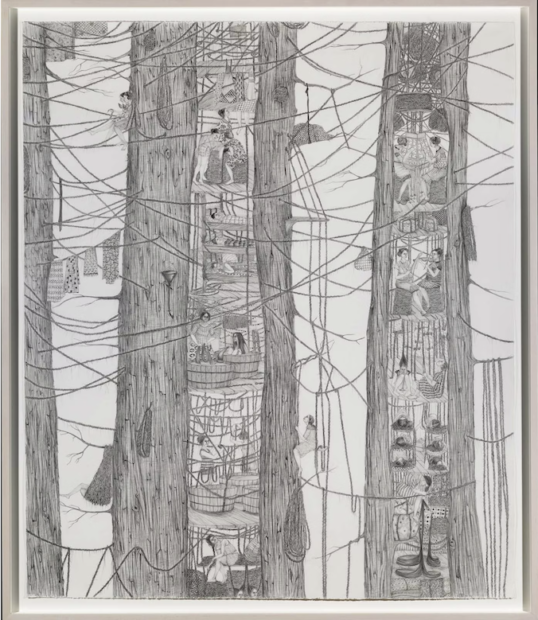
Amy Cutler, “Fossa,” 2016, graphite on paper, 55 1/4 x 47 inches. Courtesy of Leslie Tonkonow Artworks + Projects.
Amy Cutler
Ruby City (San Antonio)
April 6, 2023 – February 25, 2024
From Ruby City:
“The surreal work of artist Amy Cutler will be the subject of an exhibition at Ruby City from April 6, 2023, through February 25, 2024. At the center of the exhibition will be Cutler’s interactive, multi-media installation Fossa (2015), a recent gift from the artist. Cutler is known for her finely detailed paintings, drawings and prints of women working at domestic or mysterious tasks in intimate, magical settings, and Fossa creates the experience of walking into one of her works. Also included in the exhibition will be Cutler’s large drawing of the same name, acquired by Ruby City earlier this year, along with a selection of loaned works from two other series. Amy Cutler’s exhibition will be on view in Studio, in Chris Park on Ruby City’s campus.”

Image courtesy of Museo de Arte Zapopan.
Cerámica Suro: A Story of Collaboration, Production, and Collecting in the Contemporary Arts
Dallas Contemporary
April 20 – December 31, 2023
From dallas contemporary:
“cerámica suro: a story of collaboration, production, and collecting in the contemporary arts will be the first comprehensive american presentation of the studio’s influence on contemporary art vis-à-vis the collection amassed by josé noé suro and his wife marcela. selections from this collection, which is made up of over 700 pieces, are curated into the exhibition by executive director and chief curator of guadalajara’s zapopan art museum (maz), viviana kuri, who also organized the previous iteration of the exhibition at maz.
cerámica suro: a story of collaboration, production, and collecting in the contemporary arts features three thematic elements that together tell a single story of a personal collection: pieces produced in the cerámica suro workshop by artists who have used high-fired ceramic or other techniques or materials; productions aimed at the fields of industrial design and architecture; and a representative survey of the history of contemporary art from the late twentieth century to the present day, with pieces by both mexican and foreign artists who have been associated with the workshop through collaborative efforts and exchanges.”

Elizabeth Catlett, “There is a Woman in Every Color,” 1975, color linoleum, cut, screen-print, and woodcut. El Paso Museum of Art. Museum Purchase, Lloyd O. Marjorie Strong Coulter Fund, Bowdoin College Museum of Art. © 2021 Catlett Mora Family Trust / Licensed by VAGA at Artists Rights Society (ARS), NY. Photo by Luc Demers.
There is a Woman in Every Color: Black Women in Art
El Paso Museum of Art
February 3 – May 14, 2023
From the El Paso Museum of Art:
“There Is a Woman in Every Color: Black Women in Art examines the representation of Black women over the past two centuries. Featuring more than forty works of art from the Bowdoin College Museum of Art’s collection, the show will confront the history of marginalization and make visible the presence of women of color in the history of American art. The show will feature works by a number of important 20th and 21st century artists, including Emma Amos, Elizabeth Catlett, Alma Thomas, Carrie Mae Weems, Betye Saar, Faith Ringgold, Barbara Chase-Riboud, Kara Walker, Mickalene Thomas, LaToya Ruby Frazier, and Nyeema Morgan. Supporting these works will be a selection of 19th century works of art that highlight the continuity of experiences of Black women in America.”
The post 2023 Spring Preview: Texas Exhibitions to See this Year appeared first on Glasstire.
Everything You Need to Know About DC Fast Charging
Merchandise: https://crowdmade.com/collections/agingwheels
Planet Money Movie Club: It's a Wonderful Life
Subscribe to Planet Money+ in Apple Podcasts or at plus.npr.org/planetmoney
The NEW SCIENCE of Moon Formation
PBS Member Stations rely on viewers like you. To support your local station, go to:http://to.pbs.org/DonateSPACE
Sign Up on Patreon to get access to the Space Time Discord!
https://www.patreon.com/pbsspacetime
Einstein once asked whether “the moon exists only when I look at it?". It was rhetorical objection to the idea that measurement in quantum mechanics causes reality to become real. But there was a time when the moon didn’t exist, and then hours later suddenly did. At least, according to the latest simulations of its formation.
Check Out Matt on the Theories of Everything Podcast:
https://youtu.be/T6xLFRHW-IY
Check out the Space Time Merch Store
https://www.pbsspacetime.com/shop
Sign up for the mailing list to get episode notifications and hear special announcements!
https://mailchi.mp/1a6eb8f2717d/spacetime
Search the Entire Space Time Library Here: https://search.pbsspacetime.com/
Hosted by Matt O'Dowd
Written by Matt Caplan & Matt O'Dowd
Post Production by Leonardo Scholzer, Yago Ballarini, Pedro Osinski, Caique Oliveira, Adriano Leal & Stephanie Faria
Directed by Andrew Kornhaber
Associate Producer: Bahar Gholipour
Executive Producers: Eric Brown & Andrew Kornhaber
Executive in Charge for PBS: Maribel Lopez
Director of Programming for PBS: Gabrielle Ewing
Assistant Director of Programming for PBS: John Campbell
Spacetime is produced by Kornhaber Brown for PBS Digital Studios.
This program is produced by Kornhaber Brown, which is solely responsible for its content.
© 2023 PBS. All rights reserved.
End Credits Music by J.R.S. Schattenberg: https://www.youtube.com/user/MultiDroideka
Special Thanks to Our Patreon Supporters
Big Bang Sponsors
Tim O’Rourke
Ryan Salsamendi
Steffen Bendel
Gautam Shine
Bryce Fort
Peter Barrett
David Neumann
Leo Koguan
Alexander Tamas
Morgan Hough
Juan Benet
Vinnie Falco
Fabrice Eap
Mark Rosenthal
Quasar Sponsors
Glenn Sugden
Alex Kern
Ethan Cohen
Stephen Wilcox
Christina Oegren
Mark Heising
Hank S
Hypernova Sponsors
Ryan Moser
David Giltinan
Ivari Tölp
Vyce Ailour
Ken S
Kirk Honour
drollere
Joe Moreira
Bradley Voorhees
Marc Armstrong
Scott Gorlick
Paul Stehr-Green
Ben Delo
Scott Gray
Антон Кочков
John R. Slavik
Mathew
David S. Cerutti
Donal Botkin
John Pollock
Edmund Fokschaner
chuck zegar
Jordan Young
John Hofmann
Daniel Muzquiz
Gamma Ray Burst
Joe Pavlovic
Jswcp
Ryan McGaughy
Mark West
Hypothasies
Justin Lloyd
Chuck Lukaszewski
Edward Hodapp
Kevin Tillery
Cole
Marc Forand
D. Delair
Walter Montalvo
Andrea Galvagni
Jerry Thomas
Nikhil Sharma
Alexander Gruber
Jonathan Cordovano
John Anderson
Scott Hannum
Paul Widden
Bradley Ulis
Craig Falls
Kane Holbrook
Ross Story
teng guo
Mason Dillon
Harsh Khandhadia
Thomas Tarler
bsgbryan
Sean McCaul
Susan Albee
Frank Walker
Matt Q
MHL SHS
Terje Vold
James Trimmier
Anatoliy Nagornyy
comboy
Andre Stechert
Paul Wood
Kent Durham
jim bartosh
Nubble
Ramon Nogueira
The Mad Mechanic
Ellis Hall
John H. Austin, Jr.
Diana S
Faraz Khan
Almog Cohen
Alex Edwards
Ádám Kettinger
MD3
Endre Pech
Daniel Jennings
Cameron Sampson
Geoffrey Clarion
Russ Creech
Jeremy Reed
David Johnston
Web Browser
Michael Barton
Mr T
Isaac Suttell
Devon Rosenthal
Oliver Flanagan
Bleys Goodson
Robert Walter
Mirik Gogri
Mark Delagasse
Mark Daniel Cohen
Nickolas Andrew Freeman
Shane Calimlim
Tybie Fitzhugh
Robert Ilardi
Eric Kiebler
Craig Stonaha
Graydon Goss
Frederic Simon
Tonyface
John Robinson
Jim Hudson
A G
David Barnholdt
David Neal
justahat
John Funai
Tristan
Bradley Jenkins
Daniel Stříbrný
Luaan
Cody Brumfield
Thomas Dougherty
King Zeckendorff
Dan Warren
Patrick Sutton
John Griffith
DFaulk
Sam Long
Fight for Change Where You Live
Watching the national media’s reaction to last fall’s midterm elections made my head spin.
While the cable news pundits and legacy media headlines spoke of the failure of a “red wave” to materialize, we here in Texas had to swallow the fact that our neighbors had chosen to reelect a governor who took no meaningful action to shore up our energy infrastructure after more than 200 fellow Texans died in an ice storm; who made guns easier to carry after the mass shootings in Sutherland Springs, at Santa Fe High School and the El Paso Walmart and leading up to the Uvalde elementary school tragedy; and whose version of “securing the border” meant sending busloads of migrants to faraway states with false promises. Oh, and we also reelected an attorney general who’s been under indictment for the past seven years.
And in Tarrant County, where I live, Tim O’Hare was elected county judge. As a Farmers Branch city councilmember, he had tried to make it illegal for undocumented persons to work or even rent a place to live. In the GOP primary, he won by running to the right of a conservative and popular former Fort Worth mayor.
It reminded me of how I felt in the summer of 2020, when two years of activism on the part of myself and hundreds of others in Fort Worth seemed to have done nothing for those we were trying to help. But it also made me want to tell people what I’ve been doing here in North Texas rather than throwing in the towel.
In May 2018, as the Trump administration’s policy on family separations at the border took shape, I led an effort to get my representative in Congress to halt it. As the son of immigrants and a bilingual teacher, I care deeply about the issue.
U.S. Representative Kay Granger, a Republican in Congress since 1997, had worked her way into senior leadership positions on various committees and task forces. I felt if anyone was going to be able to get the White House to listen to our pleas for humanitarian action, it would be her.
I started a weekly sidewalk protest near her office that grew from six people to a couple dozen, then 40, then 80. The press covered our actions and more people joined each week, culminating in more than 200 protesters during the week of the Texas State Democratic Convention that June. It was remarkable to get that kind of consistent turnout in Tarrant County, where for decades Republicans have run unopposed in far too many local races.
We kept at it for two more years. But then we had to stand down. The COVID outbreak made it too dangerous to get together in such groups, and our numbers dwindled. We faced a heartbreaking reality: All those hours of trudging up and down in all weather, visiting her office and logging our complaints with her staff hadn’t reunited a single child with their parents nor nudged Granger into action.
I knew I had to do something beyond marching in the streets. I wasn’t ready to give up fighting for real change in Tarrant County.
What’s more, by 2020, progressives and people of color in Fort Worth were seething over two police abuse cases that seemed to show nothing had changed here, including one in which a black woman, Atatiana Jefferson, had been killed by a police officer responding to a request for a wellness check at her home. Then came the murder of George Floyd in Minnesota, and the Summer of Justice, and protests through downtown Fort Worth, outside City Hall, and in the popular West 7th Street district. By the end of that summer, I knew I had to do something beyond marching in the streets. I wasn’t ready to give up fighting for real change in Tarrant County.
About that time, a young science educator and nonprofit leader named Jared Williams announced his candidacy for Fort Worth City Council in my district in southwest Fort Worth.
Donald Trump won a little less of the vote in my precinct in 2020 than he did in 2016: 49 percent to 54 percent. But John Cornyn won reelection to the U.S. Senate with 52 percent of the vote in my precinct, and Granger took 54 percent on her way to another term.
My precinct is not blue.
So I reached out to Jared directly and offered to volunteer for his campaign. That’s where I thought I could have an impact on my community: the city council race in my district.
Over the next several months, we phone banked, we texted voters, and we knocked on doors—virtually every door in the district.
Despite being outspent 4-to-1, we forced a runoff in the three-way general election.
So we kept knocking on doors and calling and texting voters.
And despite being outspent 6-to-1 in the month leading up to the runoff election, we finished the job and made a little Fort Worth history, unseating 16-year incumbent Jungus Jordan and electing the first person of color to the District 6 seat in the city’s history.
Elsewhere, Tarrant County has become ground zero in the school board culture wars. Opponents of racial and gender equity work, backed by the resources of political action committees, have gone after superintendents, school board trustees, and teachers who seek to improve policy and curriculum for underrepresented students. They have organized and drawn media attention—at times flattering coverage. These PACs are laser-focused on school boards.
But while awful things have happened in Southlake and Grapevine, to say nothing of some rural school districts in neighboring counties, the Fort Worth Independent School District has held steadfast in its commitment to equity work, replacing its ousted superintendent with one who has a track record of championing such work.
That is due in no small part to the support that citizens showed for those values through emails to trustees and speaking up at forums and school board meetings.
The ultimate takeaway for a progressive such as myself—a husband, dad, teacher, and advocate—is this: In order to create the world we want, the one we envision, we have to find allies and encourage them to get in the fight. Right here, where we live.
In order to create the world we want, we have to find allies and encourage them to get in the fight. Right here, where we live.
Our efforts can’t be limited to complaining on our social media accounts.
If you have the means financially, pick a candidate or cause and support them. Donating has never been easier. Make regular contributions every few weeks.
If you can’t give money, find time to devote to the candidate or cause. Get involved. Stay involved. Go to city council meetings or school board meetings. Sign up to speak or give words of support to those who do. Write your local leaders and tell them what matters to you, how you want them to govern.
Make these things part of your weekly or monthly routine.
Little by little, we’re making it happen in Fort Worth with small victories. Doing that across the state, we could build a Texas that is a model of progressivism for the nation. If that sounds unlikely, remember that nothing in Texas politics should be taken for granted. The Republican margins of victory in Texas are getting smaller. Democratic strength is growing in many major cities.
This is the struggle of our lives. We have to spend our lives winning it.
The post Fight for Change Where You Live appeared first on The Texas Observer.
State office may not challenge broadband maps, risking hundreds of millions of federal funds for Texas
600,000 Americans Go Missing Every Year: Here’s Why You Still Aren’t Seeing Cheaper Kidney Prices

Look to the night sky in 2023
Astronomer Jackie Faherty outlines the most exciting sky events you can put on your calendar in 2023, from eclipses to meteor showers and more.

Dr. Dre Serves Marjorie Taylor Greene Cease-And-Desist Order For Using Song

Rapper Dr. Dre has sent a cease-and-desist letter to U.S. politician Marjorie Taylor Greene, after she used his song “Still D.R.E.” in a promotional video. What do you think?
Sherlock Holmes Enters Public Domain

Copyrights on works from 1927, including Arthur Conan Doyle’s short story collection The Case-Book of Sherlock Holmes, have expired, making the works open to the public to legally share, perform, reuse, repurpose, or sample without permission or cost. What do you think?

A Corrupt File Led To the FAA Ground Stoppage


Read more of this story at Slashdot.
One More Year Until Steamboat Willie’s Mickey Mouse Enters The Public Domain: Will Mickey Really Be Free?
As you’re probably aware, now that it’s January, we’re running our annual public domain game jam, for games based on works from 1927. This is the 5th year we’ve done this, ever since the public domain (finally) returned to the US after decades with no works ever reaching the public domain, due to never-ending copyright term extension. Many people have noted that the terms seemed to extend just as Disney’s Mickey Mouse was about to enter the public domain. And while some scholars dispute the claim that Disney was the main lobbying force behind extensions, it’s uncanny how often the extensions seemed timed to Mickey’s unshackling.

A few years ago, though, it became clear that even Disney had given up on the idea of copyright term extension in the US (elsewhere, however…). After all, even one of the most extreme pro-copyright Copyright Registrars had suggested that perhaps it was time to scale back copyright terms (though only in the slightest of ways). The battle over the Sonny Bono Copyright Term Extension Act, followed by the battle over SOPA has (at least) taught the legacy copyright industries that they can’t just slip through never-ending extensions any more.
That didn’t stop a weird flood of articles last summer bemoaning the horror that would come from Disney losing the copyright on the Steamboat Willie version of Mickey Mouse, as it’s set to do on January 21st, 2024. Right before the New Year, the NY Times had a slightly more balanced article looking at what to expect on the freeing of Steamboat Willie Mickey in one year’s time.
For the first time, however, one of Disney’s marquee characters — Mickey himself — is set to enter the public domain. “Steamboat Willie,” the 1928 short film that introduced Mickey to the world, will lose copyright protection in the United States and a few other countries at the end of next year, prompting fans, copyright experts and potential Mickey grabbers to wonder: How is the notoriously litigious Disney going to respond?
As the article notes, this definitely isn’t a free-for-all for Mickey. The Steamboat Willie version is quite different from the Mickey most people know of today. It is true that Disney won’t be able to stop people from showing or sharing the original animation, but the company itself put it up on YouTube well over a decade ago anyway, so it’s free for all to see.
But there are other parts of the article that clearly suggest that Disney is prepping itself to use trademark law to scare off would-be adapters. This has always been something of a concern, and the article suggests that Disney itself has been quietly getting things ready for this kind of legal attack. As we’ve explained dozens of times, trademark and copyright law are different. Trademark law is really about not confusing or tricking the consumer into believing a product was made by someone else. So, really, the issue is in not making content that anyone might think would have come from Disney, which might wipe out a fair bit of content, but still leave plenty of open space.
But, also, trademark is about commerce, and the trademark holder has to be making use of the trademark in commerce in order for it to remain valid. But, as the article notes, over the past fifteen years or so, Disney has been gradually ramping up its commerce related to the Steamboat Willie version of Mickey.
In 2007, Walt Disney Animation Studios redesigned its logo to incorporate the “Steamboat Willie” mouse. It has appeared before every movie the unit has released since, including “Frozen” and “Encanto,” deepening the old character’s association with the company. (The logo is also protected by a trademark.) In addition, Disney sells “Steamboat Willie” merchandise, including socks, backpacks, mugs, stickers, shirts and collectibles.
My sense is that Disney will be cautiously litigious around Mickey. That is, I’m guessing that the aggressive IP enforcement team will be told not to go after just random uses of the Steamboat Willie version of Mickey, but anything borderline will bring down the lawyers screaming trademark infringement.
Of course, there’s another side to this not covered in the NY Times piece, which is that it’s unlikely Disney’s copyright in the Steamboat Willie version of Mickey is even valid in the first place. Beyond the fact that Steamboat Willie was a parody of Buster Keaton’s Steamboat Bill Jr. (which came out just a few months earlier, and will also be going into the public domain next January), a bunch of researchers have found pretty strong evidence that Disney screwed up the copyright filings for the film anyway, meaning it likely technically went into the public domain decades ago. It’s just that no one wanted to fight Disney’s litigation team on it.
New Cosmology Anomaly Confirmed, Particle Physics Anomaly Vanishes
Welcome back everyone, I hope you had a good holiday break. We have quite a lot to talk about today, so buckle up. First, we have an anomaly in particle physics that disappeared and an anomaly in cosmology that was confirmed. Then we have some amazing footage from the surface of the sun, disks that defeat the second law of thermodynamics, we learn how you can see something without looking at it, talk about a new method of cooling, the demise of science, the technology of 6G, what offshore windfarms do to marine life, and of course, the telephone will ring.
The channel with the sun footage is here: https://www.youtube.com/@daviddayag
👉 Transcript and References on Patreon ➜ https://www.patreon.com/Sabine
💌 Sign up for my weekly science newsletter. It's free! ➜ https://sabinehossenfelder.com/newsletter/
🔗 Join this channel to get access to perks ➜
https://www.youtube.com/channel/UC1yNl2E66ZzKApQdRuTQ4tw/join
00:00 Intro
00:44 B-Meson Anomaly Disappeared
02:41 Cosmological Dipole Anomaly Confirmed
03:37 Sun Footage
04:35 Disks That Defeat the 2nd Law
05:58 Seeing Without Looking
08:09 New Cooling Method
11:00 Science Isn't What It Used To Be
13:42 TeraHertz Sender for 6G
15:33 Offshore Windfarms Affect Marine Life
16:50 Learn More With Brilliant
#science #sciencenews
Hole In Ozone Will Mend By 2066, U.N. Report Finds
A recently released United Nations assessment found that the hole in the Earth’s protective ozone layer is on track to fully mend by 2066, following measures taken by world governments in the late 1980s to phase out ozone-depleting substances. What do you think?
should we give extra sick days to employees who can’t work from home?
This post, should we give extra sick days to employees who can’t work from home? , was written by Alison Green and published on Ask a Manager.
A reader writes:
Long-time avid reader with a question I’d love your take on before I bring it to my manager.
I’m a manager for an eight-person team for a position that requires 100% of work to be done in-person, on-site, at set times. It’s worth noting that this in-person team is typically the lowest paid and most blue collar in our organization. Almost everyone else in my organization has some flexibility in terms of where and when they work, ranging from full-time remote to one day a week WFH. For those WFH positions, our organization is super flexible with things like appointments, flex schedules, occasionally working with sick kids at home, and working from home when you’re sick enough to not come in, but not so sick you need a sick day.
Lately I’ve been seeing our on-site team coming to work sick with cold and flu symptoms. We do offer sick time and PTO, but I know some of them are running low on sick time due to family illnesses and this horrible cold and flu season.
Would it be reasonable and/or legal to offer full-time non-remote staff more sick leave than people who have remote flexibility? It seems reasonable since I, as someone who can work from home as needed, can choose to work for a day with my sick kid or mild cold symptoms, but they have no option but to burn through a sick day or come to work sick.
YES.
Yes, yes, yes, yes.
Please advocate for this. It’s the solution to multiple things:
• First, it addresses the very real reality you pointed out, that on-site workers end up needing to use more sick days because they don’t have the option of working from home while sick that some of their colleagues have. (They also might be more likely to get sick in the first place, since they’re coming to work and getting exposed to other people who are in the same situation they are.)
• Second, it will help keep germs out of your workplace, thereby keeping other people able to come to work and continue doing their jobs. That’s a win for the everyone, including your employer.
• Third, it recognizes the different burden put on on-site workers, and could be a real step toward easing some of the understandable resentment some on-site workers have developed toward remote colleagues over the last few years. (Hell, if you really want to show appreciation to your on-site staff, you could go a step further and offer them some Life Happens days too, which they can use for the life management stuff that requires being at home — cable guy, broken washing machine, whatever it is — but which their WFH coworkers are able to work through.)
Every employer with a mix of workers where some can work from home and some can’t should offer extra paid days off to their on-site employees. Suggest it!
my employee blows up my phone with memes and videos — even in the middle of the night — and refuses to stop
This post, my employee blows up my phone with memes and videos — even in the middle of the night — and refuses to stop , was written by Alison Green and published on Ask a Manager.
A reader writes:
I own a small business (10 staff). One of our employees, Lisa, does wonderful work and has a bright future ahead. Her responsibilities and pay reflect her outstanding performance.
Unfortunately, she is very socially and emotionally needy and time-consuming outside of work. I don’t mind the occasional meme or video, but she sends them literally every day multiple times a day, even in the middle of the night. I’ve stopped checking my phone altogether because most of my notifications each day were from her, literally more than all my friends and family and other colleagues combined.
One morning I had like seven DMs from Lisa via various accounts, I just set my phone in the other room while I got dressed and, naturally, there was a rare emergency at work. Two other employees called quite a few times before I noticed and I felt terrible I kept them waiting.
It is important to me that everyone knows they can count on me to respond in a timely manner, that’s my job. It’s not my job to have to watch 35 “humorous” TikTok videos per day. I don’t even have that app and I don’t like noise on my phone and I don’t like constant interruptions and I feel so frustrated I keep directly telling Lisa over and over and over to please respect my space and time and boundaries and she never does! She never even tries to see my side, she always just pushes her own selfish preferences and I feel disrespected and annoyed and frustrated.
I value her as an employee and the last thing I want is to snap at her and upset her, or to do anything to make her want to quit. I can see she has no idea what a burden she is, but I’ve literally been awake nights trying to figure out how to get her to back off and it is really affecting my ability to do my job. How do I make it stop without losing my valued employee?
Before we get into the rest of this: Great employees with bright futures don’t make you lie awake at night because their behavior is so over-the-top that it’s impeding your ability to do your own job. By definition, that’s not a great employee. We’ll come back to that in a minute.
As for what to say, make it about work: “Lisa, I am getting so many messages from you that I’m missing crucial work messages that I need to see. Starting today, I need you to only message me if it’s work-related — no memes, no videos, nothing at all that isn’t about work — no exceptions.”
She doesn’t need to “see your side,” as you put it — she just needs to hear a clear instruction from her manager and follow it.
(Also, does she ever need to text you about work? If not, you should seriously consider just blocking her on everything but email. You’re not required to keep every possible line of communication open if she’s abusing them, as long as she has another way to contact you about work things.)
However, it sounds like you’ve told her in the past to stop and she’s argued with you about it and refused to stop! That’s not normal behavior.
Any chance you haven’t been entirely direct with her — perhaps sugarcoated or softened the message? You’re very concerned about not wanting to upset her (despite how much she is upsetting you), which always signals a strong possibility that you haven’t been clear enough because you’re worried about hurting her feelings. Have you explicitly said the words, “You cannot keep messaging me and I need you to stop, no exceptions”? Or has it been more like, “I’m really busy and can’t always respond to this many messages”? If it’s closer to the latter, that’s actually good news — because it means that there’s still a chance you can fix this just by being clearer, firmer, and more direct. (It’s bad news in a different regard — because it would mean that you’re letting an employee run roughshod over your boundaries rather than delivering a message that doesn’t feel nice, and valuing the comfort of a severe boundary violator above your own — but that’s a separate issue!)
But if you’ve truly been very direct with her, with no sugarcoating or softening the message, and she’s refused to comply, then you really need to reconsider your assessment of Lisa as someone who does wonderful work and has a bright future with your company, because that behavior would be so disruptive and obnoxious/recalcitrant/outrageous (and frankly just off-the-charts weird) that there’s no way those traits aren’t coming out in other ways at work. “I refuse to stop blowing up your phone with memes at all hours even when you’ve clearly and directly ordered me to stop” — if indeed that’s the situation — is so bizarre that you’re going to find other problems if you dig deeper.
Speaking of which … have you checked on whether she’s doing this to other employees? If she is, and if she argues about stopping that too … and if she continues to be unmanageable even after clear and firm instructions … I’d be really skeptical that the advantages to keeping her outweigh how disruptive she is.
Record warmth is possible today before a cold front arrives late tonight
Good morning. We’re going to see a real pop in temperatures this afternoon with a warm, southwesterly flow in place that will push high temperatures to around 80 degrees. It’s quite possible that Houston (81 degrees), Galveston (75 degrees), and College Station (81 degrees) will match or even break existing records for daily highs. Please clap. A cold front will arrive around sunrise on Thursday morning to cool us down.
Wednesday
I’ve included a short satellite loop (below) this morning because it clearly shows the rapid southwesterly flow in place over Texas this morning. This influx of warmer and somewhat drier air will lead to highs of around 80 degrees today, despite an increasing preponderance of clouds. Surface winds today will be out of the southwest at 10 to 15 mph, with higher gusts. Low temperatures tonight will only drop into the mid-60s ahead of the cold front on Thursday morning.

Thursday
The front should push into Houston around sunrise, perhaps earlier the further inland you live, and perhaps a bit after if you live near the coast. We cannot rule out a thin line of moderate showers with the front, but it’s unlikely, and if it does rain, the showers will end soon. Temperatures will drop into the low 60s after the front’s passage, with highs only climbing into the mid-60s despite lots of sunshine. Winds will be brisk on Thursday, with gusts out of the north at 20 to 25 mph. Lows will drop into the low 40s on Thursday night, with colder conditions further inland of Houston.
Friday
A fine winter day, with sunny skies and highs in the low 60s. Winds will be out of the north at about 10 mph. Lows Friday night will be the coldest of the week, dropping to around 40 degrees in Houston, with outlying areas seeing the 30s.
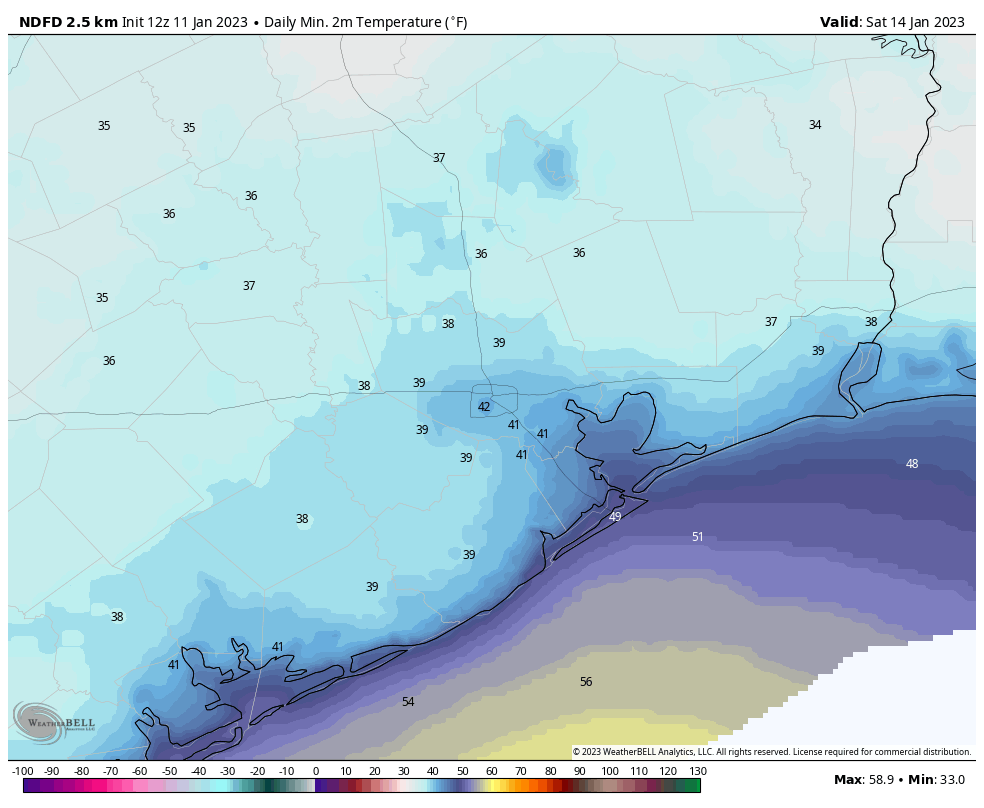
Saturday
Another cool day, with sunny skies and highs in the low to mid-60s. However, as winds turn to come from the south, we’ll start to see an increase in dewpoints. Lows on Saturday night will only drop to around 50 degrees in Houston.
Sunday
If you’re running the Houston Marathon, look for start line temperatures in the low 50s. But with sunny skies and a southerly flow, look for things to heat up fairly quickly, with highs climbing into the mid-70s. Winds will be gusty, out of the south, up to 20 mph. Dewpoints will be such that it will start to feel a bit sticky by late morning. Lows on Sunday night will only drop into the mid-60s.
Next week
The first half of next week looks warmer, with partly cloudy skies and highs of around 80 degrees. Lows probably will only drop into the 60s. Some rain chances return around Wednesday, when the first of a few fronts arrives to start cooling the region back down. Next weekend probably will have us back down in the low 40s for lows, with the potential for even colder weather near the end of the month. We shall see.


Biden now has his own classified documents problem. Here’s how it compares to Trump’s.

And what impact it might have on the Trump investigation.
Just as former President Donald Trump is in the midst of investigation and facing possible indictment for keeping classified documents at Mar-a-Lago after he left office, news has broken that classified documents from President Joe Biden’s time as vice president were found at the University of Pennsylvania center set up for Biden in his time out of office, and at his home in Wilmington, Delaware.
There were 10 classified documents at the Penn Biden Center, among them Obama-era “intelligence memos and briefing materials that covered topics including Ukraine, Iran and the United Kingdom,” CNN reported, citing a source familiar with the matter. The White House said in a statement Monday that Biden’s personal attorneys discovered the documents in a locked closet there in November 2022. They then searched other locations and found a “small number” of additional classified records in a storage space at Biden’s residence in Wilmington, per another White House statement Thursday.
Unlike Trump, who refused repeated government requests to return his own, larger set of documents, Biden’s team returned them to the government without being asked. But that still leaves the question of how and why they got there in the first place.
Attorney General Merrick Garland initially tasked John Lausch, a US attorney based in Chicago — and a Trump appointee — with investigating the Biden matter further. Then, on Thursday, Garland announced Lausch had advised further investigation from a special counsel and that he’d appointed Robert K. Hur to the position. Hur was appointed by Trump as US Attorney for Maryland, and returned to private practice in the firm Gibson Dunn after Biden took office.
In theory, this investigation should proceed entirely separately from special counsel Jack Smith’s investigation into the documents at Mar-a-Lago. Practically, though, politics may intrude. For months, journalists covering the Trump investigation have reported on some skepticism within the FBI about whether Trump’s behavior merits indictment. This news adds pressure to ensure that any case brought by the DOJ against Trump is truly bulletproof.
The Biden documents investigation, briefly explained
Soon after Trump took office in 2017, the University of Pennsylvania announced that former Vice President Joe Biden would lead “a new center focused principally on diplomacy, foreign policy, and national security” — the Penn Biden Center for Diplomacy and Global Engagement. The center secured office space in Washington, DC, near the Capitol and opened in 2018.
According to an intern interviewed by UPenn’s student newspaper, the Daily Pennsylvanian, about 15 people worked there early that year, on matters such as speechwriting for Biden and helping him arrange public conversations with former world leaders to be held on Penn’s campus. The American Prospect also interviewed an intern, who said that Biden had his own office but “was never there.” Longtime Biden aides (and current administration officials) Steve Ricchetti and Tony Blinken ran the center at various points. But Biden took a leave of absence from the center once he announced his presidential campaign in April 2019, and did not return.
Then, in November 2022, according to a statement by White House attorney Richard Sauber, Biden’s personal attorneys were preparing to vacate the center’s office space, when they found “what appear to be Obama-Biden administration records” in a locked closet, “including a small number of documents with classified markings.” Per Sauber, Biden’s team notified the National Archives of the discovery that same day and gave back the documents the next morning.
As to what the documents were, a source told CNN’s Jamie Gangel, Marshall Cohen, and Evan Perez that there were 10 documents with dates between 2013 and 2016, and that they included “US intelligence memos and briefing materials that covered topics including Ukraine, Iran and the United Kingdom.” Personal Biden family documents dealing with such matters as Beau Biden’s funeral were also in those boxes, per CNN’s source, and some were in “an envelope with markings indicating they were the former vice president’s personal documents.”
Biden’s team subsequently searched “other locations where files from his Vice-Presidential office might have been shipped in the course of the 2017 transition,” per another statement by Sauber, and found “a small number” of additional records at Biden’s residence in Wilmington, Delaware. Most of these were in storage space in the garage, and one page was with stored materials in an adjacent room, according to the statement.
So at this point there are a variety of possible explanations, from benign to less benign, depending on what exactly the documents are, how they got there, and evidence of Biden’s personal involvement. But the early reports on the Penn Biden Center documents suggest they deal with intelligence about politically sensitive countries.
Biden said on Tuesday that he was “surprised to learn that there were any government records that were taken there to that office” and that he did not know what they were. But Garland in November asked US Attorney Lausch to investigate this further. Lausch was a Trump appointee, but both Democratic senators from Illinois previously asked Biden to keep him in the US attorney post so he could complete ongoing investigations. In a statement Thursday, Garland said that last week Lausch advised him “that further investigation by a special counsel was warranted.” Garland announced Robert Hur would serve as that special counsel Thursday.
News of this situation has only just become public, and so far there hasn’t been reporting about whether Justice Department investigators think there might have been criminal lawbreaking. So right now, we’re still missing many facts about what happened and have only speculation to go on for much of it.
The Trump Mar-a-Lago documents investigation, briefly explained
The Trump documents controversy, on the other hand, began when the National Archives realized, a few months after Trump left office, that various documents from his administration that should be archived under the Presidential Records Act were missing. A lengthy back-and-forth ensued: Trump eventually returned some boxes that contained classified material, the Archives thought he was still holding some back and asked the FBI to get involved, and Trump appeared to defy a grand jury subpoena to turn over the documents.
So in August, the FBI got a warrant to search Mar-a-Lago, and they found dozens more documents with classified markings there, per prosecutors. We still don’t know exactly what was in those documents — that’s a bit of a problem with publicly assessing the strength of cases like this, since the information remains classified.
But the Washington Post reported that some documents had “highly sensitive intelligence regarding Iran and China,” including a description of Iran’s missile programs, and prosecutors have expressed concern that the information could jeopardize human intelligence sources.
Yet reports have suggested the DOJ prosecutors and FBI agents working on this investigation are not in full agreement about the strength of the case.
According to a Washington Post report in December, the FBI initially wasn’t sure it wanted to take up the case at all, and some agents “weren’t certain” they had probable cause for a search. And back in October, Bloomberg News reported that some “internal critics” in the FBI were questioning why Trump would be charged when Hillary Clinton wasn’t in her own classified information investigation. (Clinton had some classified information in email chains sent to her personal email account that she had used for work; Trump had paper documents in boxes at Mar-a-Lago.)
Furthermore, another Washington Post story suggests that the more ominous and speculative theories about Trump’s motives in keeping classified documents weren’t founded, in investigators’ eyes. They’ve come to believe, instead, that his motive was “largely his ego and a desire to hold on to the materials as trophies or mementos.”
That would not get him off the hook for violating classified information law, but it’s certainly less of a clear-cut threat to national security than, say, the attempted selling of documents would be.
The differences between the two cases so far
There is a core similarity here in that classified documents were found at both the Penn Biden Center and Mar-a-Lago. There are also many differences, as well as other issues where we lack sufficient information to know what’s similar and different:
- There were purportedly 10 documents with classified markings at the Penn Biden Center and a “small number” at Biden’s Wilmington residence; over 300 were at Mar-a-Lago.
- Some of the Mar-a-Lago documents were reportedly very sensitive, involving intelligence about Iran and China. Some of the Biden Center documents were intelligence briefing materials about politically sensitive countries like Iran and Ukraine.
- Biden’s team claims to have returned the documents as soon as they discovered them, volunteering them to the National Archives without being asked. Trump, when asked by the Archives to return missing documents, gave back some but fought hard against returning others, including reportedly ordering some boxes moved to hide them from visiting government officials.
- Trump insisted the classified documents be kept at Mar-a-Lago. Biden’s level of involvement in keeping the documents is unclear, but they were reportedly found among other personal documents of his.
- Investigators believe Trump’s motive in retaining the documents was his “ego,” while it’s still unclear how the Biden Center documents got there.
Prosecutors will weigh all these topics in determining whether to bring charges. But the politics will be tough to avoid, too. There were already internal skeptics of the Trump case before the Biden news broke, and they were already going to have powerful subpoena-equipped allies in the GOP-led House of Representatives. Now they will surely be more active in criticizing any perceived double standard — and Garland and Smith may well think even harder before charging Trump.
Update, January 12, 1:45 pm ET: This story was originally published on January 10 and has been updated to include the White House disclosure Thursday that additional documents were found at Biden’s Wilmington residence and the appointment of Robert Hur as special counsel.
It rather involved being on the other side of this airtight hatchway: Administrator attacking a domain account on the local system
A security vulnerability report came in that said that a local administrator can attack the system and sign in on the local system as a domain account without knowing the account’s password.
So far, no security boundary has been crossed. The attacker is a local administrator, and a local administrator already has full control over the local system.
While it’s true that the administrator has compromised a domain user account, this ability to act as the user does not extend outside the local computer. You have control over the domain user account on the local system, but other computer systems will recognize you for the fraud that you are.
In other words, the attacker has gained nothing. They started as a local administrator, which gives them full control over the local system. They then attacked a domain account, which gives them all the powers of that domain user on the local system. But this is a subset of the powers they had as an administrator! Nothing was gained.
This compromise of the domain account on the local system does not extend to other systems, so the attacker gained no privileges on other systems.
The finder even acknowledged in their report that the compromised account is not recognized by other computers on the network. I’m not quite sure what vulnerability they were reporting. I mean, maybe they’re just saying that they found something interesting, but “interesting” doesn’t mean that you have a security vulnerability. Really, all they did was find a way to do something the hard way. The easy way is to just use your existing administrator powers.
The post It rather involved being on the other side of this airtight hatchway: Administrator attacking a domain account on the local system appeared first on The Old New Thing.
The Men / Small-Penises / Fast-Cars Research Study
“We found evidence that when men were manipulated to feel that they had a relatively small penis, they ranked sports cars as more desirable than when they felt relatively well endowed and that this effect was most pronounced in men 30 and over,” say the authors in this new study:
 “Small Penises and Fast Cars: Evidence for a Psychological Link,” Daniel C. Richardson [pictured here], Joseph Devlin, John S. Hogan, and Chuck Thompson, https://psyarxiv.com/uy7ph, January 10, 2023. (Thanks to Richard Stephens for bringing this to our attention.)
The authors, most of them at University College London, report: “In this experiment, we manipulated what men believed about their own penis size, relative to others. We gave them false information, stating that the average penis size was larger than it in fact is, reasoning that, on average, these males will feel that relatively and subjectively their own penis was smaller; compared to those told that the average penis size was smaller than true average. We then asked them to rate how much they would like to own a sports car. These facts and questions were buried amongst other items giving information and asking for product ratings, so that our hypothesis was masked from participants. We found that males, and males over 30 in particular, rated sports cars as more desirable when they were made to feel that they had a small penis.”
Jump for Joy!

Jump Rope!
Skolnik
1974
This ancient artifact was only recently weeded from a public library. Given the publication date, I very well could have checked this out as I was teen in 1974. Even if the information isn’t “wrong”, this just is so old, it’s embarrassing. Check out the array of fashion choices. Just yikes!
When I was thumbing through the book, I was really disappointed in the pictures. I am not referring to the fact they are black and white, but how they are just bad pictures and add nothing to the narrative. It wasn’t just the ones posted here, but all through the book. It was like someone’s mom grabbed their Kodak Instamatic and just pressed the button in the general direction of some jump rope action.
Jumping rope was a pretty standard fare during my elementary school days. Everyone did it. Now I only see jumping rope as part of a fitness routine. Do kids even jump rope any more?
Mary


The post Jump for Joy! appeared first on Awful Library Books.