1. My coworker is in a cult and it’s affecting my work
A new junior staff person joined my department about a year ago. About six months in, they asked if they could start working remotely because they had been asked to help start a new church across the country. This employee is quite young and this is their first job after college. They were initially very dedicated to their work, but since moving, they have dropped the ball on multiple projects, frequently ask for time off and don’t make up their hours, and have just generally been performing poorly.
I was starting to think they had just checked out and weren’t committed to their job, but another coworker recently discovered that this “church” is really more of a cult known for preying on college students. Church members have to pay in and are expected to do countless hours of free labor. Ex-members have complained online about being taken advantage of and isolated from their friends and family.
I really feel badly that my coworker is probably being manipulated and, at the same time, their life outside of work is impacting my job. I have had to pick up the slack repeatedly, and their performance is giving our department a bad reputation. Should I tell our supervisor what I know? Or talk to this junior coworker privately? I am old enough to be their parent and I could give them some kind advice. If they were just bad at their job, I would probably wait for my supervisor to deal with their obvious performance issues. But I feel like this situation is more nuanced, and I wonder if my supervisor needs this extra information.
Unless you’re quite close to this coworker (and it doesn’t sound like you are), I don’t think you’re well-positioned to get through to them about the reality that they’re in a cult … since even friends and family are notoriously unable to reach people in that situation, and cults operate that way by design.
But what you are well-positioned to do is to make sure your manager knows about the specific problems you’re seeing because she might not know the extent of everything you’re aware of. As part of that, there’s no reason you can’t discreetly share your concerns; it might provide some useful background about what’s going on, although ultimately there’s not much your boss can do either other than to address the habits that are showing up at work. (Someone might argue that it’s not really your manager’s business, but there’s no particular expectation of privacy around this sort of thing; it’s info you have and there’s no reason you can’t share it with your boss as context for your concerns.)
2. My coworker acts like people are late to a meeting if they aren’t early
My office has a meeting culture of starting meetings 1-2 minutes past the time, so pretty close to on time. People are often going from back-to-back meetings. We are a hybrid office, and virtual joiners aside from the host usually show up on the dot unless they are delayed.
We have a couple people who are always early to join said virtual meetings, and one who is really rubbing me the wrong way.
Arya will start getting antsy several minutes before meeting start time, and then at, for example, 9:59 will say, “I guess we’re waiting on Sansa” or “Well, we better get started. Hopefully Sansa can join us” and often sends people “are you able to join us?” messages the moment the time hits the hour (literally within seconds).
The lack of alignment with the office culture is getting to me. It’s literally true that we are waiting on her, but only because Arya started the meeting early. Sansa and several other people will almost never be able to join early. People in Arya’s role have 1-3 meetings a day, while people in Sansa’s role have at least 5 meetings most days. It affects nothing but I want to know if I’m weird for finding this rude!
I don’t know that it’s rude exactly, but it’s unreasonable and certainly impatient. If you’re quite junior to Arya, there’s probably nothing you can do, but if you’re not you should feel free to say, “We’re not quite at the start time yet so I’d give her a minute or two” or “She’s often in back-to-back meetings; I’m sure she’ll join in a minute or two.” (And if you were her boss, I’d tell you to tell her more directly to chill out about it.)
3. Should I raise this in an employee’s performance review?
I oversee four employees who work at several facilities throughout our city. On the first Thursday of every month at 9 am, we have an in-person meeting at the main office where I am located. I send out an email the Monday before as a reminder and include any other pertinent information.
I am having a minor issue with “Paul.” I am guessing he has our meeting on his calendar so feels he does not need to read the reminder email I sent. I came to this conclusion because several months ago a person from corporate wanted to speak to the group, and to fit her schedule the meeting was moved to 9:30 and Paul showed up at 9 as normal. Another time we had to meet in a different room than our normal one, and he went to the old one (but found our new room before the meeting started). This information was in the reminder email.
His one-year review is coming up. How big of a deal do I make of this? He hasn’t ever been late for the meetings, and he really doesn’t need to prepare anything for the meeting so he isn’t unprepared. Technically he hasn’t done anything wrong, but I feel I need to address the issue somehow before not reading the reminder emails causes an issue.
This doesn’t rise to the level of something to discuss in a performance review; it’s just a normal conversation completely outside of the review. Just name what you’re seeing and want him to do differently: “I noticed you’ve missed some of the info I include in the emails I send out for our meeting prep, like changes to the meeting time and location. Can you make a point of reading those so you see what I’ve included?”
The fact that you haven’t done that but are thinking about addressing it in his review makes me wonder if you shy away from giving routine, fairly low-stakes feedback throughout the normal course of work! It’s worth asking yourself whether corrections (even small ones) feel like a big deal to you and, if so, whether people aren’t getting routine feedback as often as they should. Not only would that mean they’re not getting the chance to do better in their work, but it can mean that when feedback conversations do happen, they feel like Big Deals with high stakes rather than just a normal part of work.
4. Accommodating Tourette’s at work
The recent event at the BAFTAs reminded me of something that happened years ago at work. I used to work with a lovely person who had Tourette’s, the kind with coprolalia (the involuntary outburst of inappropriate words). He was a very kind person who did a lot of educational work about his condition and clearly felt horrible about what his condition made him say. That said, we were in an open office space, and I can’t say it wasn’t hard to hear slurs said — I’m Jewish, for example, and sometimes he would shout Jewish slurs.
At some point, a woman (also a lovely person) complained to HR that she found his slurs triggering; he would sometimes say slurs about her gender and race. As a workaround, they offered her a seat away from him. But then he felt so horrible about it that he started working in a conference room and avoiding his coworkers. He left for a new job shortly after, and it was hard not to read the incident as a cause.
I guess my question is: was this an appropriate solution? What would you have done as a manager or HR in the same situation? On one hand, no one should have to hear slurs all day, but on the other, this person had a disability they had no control over.
When you have two competing needs for an employer to accommodate — in this case, one employee’s medical condition and other employees’ right not to be harassed on the basis of sex, race, or religion — it’s what the law calls “dueling accommodations” and the employer is required to enter into an interactive process with each side to see if they can solve it. Accommodations cannot violate the rights of other employees (so an accommodation couldn’t be “just deal with it because you know it stems from a medical condition”), so in this case you’d typically need to look at having the person work from a more private space or from home.
5. AAM columns in outside publications
When your answers to reader questions only appear in other publications such as the Cut, will they eventually be available in Ask a Manager archives too? Purchasing several subscriptions to access only your content isn’t an option on my fixed income.
Some of them! My columns for Slate only appear in Slate, but my agreement with The Cut lets me publish my columns here 90 days after they’re originally printed there. I don’t create fresh posts for them here when that happens, but I do go back and add the full columns to the existing posts once those 90 days have passed (for example, like this). I am admittedly sometimes delayed in doing this, but I try to stay on top of them.
With Inc., it’s a little different; my columns for them are all reprints from the archives here, so they appear here long before they appear there (and you can usually find the original by using the site’s search function to search for the headline).
The friends are reunited as their legal troubles cease to bubble and slip down back into the cracks in the pavement. Poor Claire needs a rest, but as is so often the case, as she sinks, Lottie is on the up, and the slack can be taken up.
MILAN – After the devastating loss to Team USA in the men’s hockey gold medal game on Sunday afternoon, it would appear that CBC broadcast cameras at the 2026 Winter Olympic Games captured the very moment the ancient eldritch spirit of Astaroth connected with a Canadian Olympian and entered his body through his eyes. This […]
I supervise two employees, Charlie and Lucy, and share a third, Linus.
Lucy has strong weeks and weaker weeks, overall fine, but needs regular reminders and is far from perfect.
Charlie is new but a really solid employee. He has been having some personal issues that were affecting some of his reliability at work — coming in late and falling asleep. (He would stay late to compensate, and I have zero concerns with the quality of his work.) He and I have met about it a couple of times and we had discussed some possible aids and solutions. Overall, I believed it would be a fairly temporary issue, so I had given him some slack.
HR was aware of it, and I had expressed to Lucy and Linus that I was aware of the issues and working with Charlie. (They had observed the issues, so I felt it was necessary to say something.)
While I was on vacation, Lucy went to HR and expressed that she didn’t feel I was dealing with it, which led to HR pushing me to issue more formal discipline. Their perspective is then we would have a paper trail that we are addressing it. (HR didn’t tell me it was Lucy who complained, though I suspected it, but later Linus mentioned it to me and said that he didn’t feel it was necessary, since he was aware that I had been working on it.)
Honestly, I’m annoyed. One, that Lucy did this while I was on vacation and didn’t bring it to me. Two, Lucy has had issues I have handled in the same way and I’ve not pushed the discipline, feeling like her overall performance was sufficient to give her leeway. For example, we have a real early start time, and she has been late her fair share early on.
Should I be annoyed? Is it appropriate for me to speak with Lucy? Should I have been more formal earlier like HR wanted?
It’s hard to say without more info.
It’s possible that Lucy is right to think that you haven’t been doing enough — that the issues with Charlie are significant enough that they do need to be addressed more seriously, and it’s possible that the impact on her was worse while you were gone (or even that Charlie got worse while you weren’t there to see it). If the issues with Charlie affect Lucy directly — like if her workload goes up because he’s late, or if she needs him to handle something but he’s asleep (!) — she’s right to be aggravated. And if it’s been happening enough that her frustration is boiling over and you weren’t there to deal with it, she’s not wrong to have gone over your head to try to get it handled.
On the other hand, if the issues with Charlie don’t affect Lucy’s work or the team’s effectiveness in general, then I’d be more inclined to think she overstepped.
Ultimately it comes down to how much her work or the team’s work is being impacted, and potentially the specifics of what was going on with Charlie while you were out.
Either way, though, you shouldn’t chastise her for going to HR — your team needs to be free to do that when they have a concern about how you’re managing them, and that means being okay with that occasionally happening even when you don’t think it was warranted. But you can certainly ask her about what happened while you were out, and it’s fair to point out to her that you’re giving Charlie the same sort of grace you’ve given her in the past.
The Houston Police Department is currently investigating the incident. The Lewis family has not yet shared details regarding a possible memorial service.
French authorities had summoned Kushner for a meeting on Monday evening over comments from the Trump administration; French diplomats said Kushner did not show up.
I work for a company of about 40 employees that says they “don’t give raises.” It’s in a field that is traditionally freelance, so having a full-time salaried position with benefits while doing this work is slightly unusual, but not unheard of.
When asked, management says explicitly that because of how well we’re compensated, they don’t do raises. The salary range is $80-95K — on the high-ish end for our field but not wildly above what freelancers in our field can earn. The hourly rates of freelancers tend to increase $5 every 2-3 years.
My question is how bananas is this and do you have any suggestions for how we can push back? I was shocked when I heard this line from management about simply “not doing raises” after I was hired. I would have negotiated much harder for my starting salary if I knew there was no chance of it increasing when I’d like to stay here for years.
Incidentally, the no raises thing seems to only be partially true. From lots of chatting with colleagues, it seems many long-time (highly qualified, respected) employees have indeed never received a raise, meaning in many cases newer less qualified employees earn more because they asked for more when they got hired. A very few employees have received raises. Unfortunately, the only two we can identify who received it unprompted were men. Others were very long-time employees who had to really fight for it and go through a lot of back and forth individually with management.
They don’t “do” raises means that they’re actually cutting your pay in real dollars every year, because of inflation.
They’re also saying that you’re no more valuable to them after five years than you were on your first day.
And it’s particularly galling that they don’t warn people that the salary they come in at will be their salary forever.
So yes, it’s bananas. It’s also terrible management.
It’s also quite possibly illegal, if they’re paying men and women differently for the same work because the men negotiated more and the women didn’t. To be illegal, you don’t need to prove that your employer intended to discriminate against women; just the fact that men and women are being paid differently for the same work violates the law.
To push back, make all those points — particularly that you’re being paid less in real dollars now than when you were brought on, despite your experience making you more valuable to them now.
That said, when you’re doing your calculations, make sure you’re accounting for the financial differences between freelancers and employees. Freelancers need to pay their own payroll taxes (and health insurance and other benefits) so typically charge around twice what a salaried employee would charge in order to break even. So if you and your coworkers are earning $80,000 – $95,000, a freelancer earning $5 or even $10 an hour more that than that (so around $90,000 – $116,000) is actually coming away with less after-tax income. That doesn’t mean you shouldn’t still advocate for raises that at a minimum keep up with the cost of living — you should — but don’t lean on the freelancer comparison.
With the snow storm that hit much of the eastern part of the U.S. this week, you might be wondering whether you get paid when your office is closed, if your employer can require you to work despite the storm, and other questions that arise when weather intersects with work.
Can my employer require me to come into work even if the weather is making it hard for me to get there?
Yes. Your employer can require you to come to work despite severe weather, although a decent employer will make allowances for employees who can’t reasonably make it in.
If your employer is requiring to come in and you don’t believe you can safely travel, or if authorities are telling people in your community to stay inside and off the roads, you should push back and point out the safety hazards. Say something like, “The roads I’d need to travel on are not safe for driving right now, and I don’t think I can safely make it in. Authorities are telling people not to drive.”
Can my employer can penalize me for not coming into work if transit is shut down or the government is telling people to stay off the roads?
They shouldn’t, but in most states they can. Here’s one example, from North Carolina’s department of labor: “It does not matter if state officials have declared a state of emergency and are advising people to stay off of the roads. The decision to stay open or to close, for its employees to remain at work or leave early, or for its employees to report to work or not during adverse weather conditions, is entirely up to each individual employer to make on its own.” (If you are thinking that’s bananas, I agree.)
I wouldn’t be surprised if there’s a state where it’s illegal, though.
If my company says we should use our own judgment about whether to come in during snow, does it look bad if I stay home?
Reasonable employers don’t expect people to put themselves in harm’s way to get to work during serious storms (assuming that your job isn’t to provide life-saving services). If you judge the situation to be dangerous and/or if authorities are telling people to stay inside and off the roads, you should stay inside and off the roads. Those warnings are issued for a reason.
If my employer shuts down the office for a snow day, do they still have to pay me?
If you’re a nonexempt employee (someone who is required to be paid overtime when you work more than 40 hours in a given week) and your office closes because of the storm so you don’t work on those days, your employer is not required to pay you for those days. Some employers will pay you anyway, but the law doesn’t require it; it will depend on your employer’s policy.
If you’re an exempt employee (salaried and not required to be paid overtime) and if you work any portion of the week, your employer must pay you your full salary for the week, even if your office closes because of the weather.
If my employer shuts down for a snow day, can they make me use a vacation day for the time?
Yes. It might seem unfair, especially if you would have gone into work if your office had been open, but your employer can indeed charge you a vacation day if they close for snow. That said, many employers choose to cover the day off for everyone rather than forcing people to use their vacation time.
If I’m on scheduled leave when my company shut down for snow, do I still have to use up a vacation day for that time, even though my company was closed?
This is up to your employer’s own policies. Some companies won’t require you to use the vacation time, but others will. If you’re unsure, the best thing to do is to simply ask your manager. Say something like, “I’m uncertain how my planned leave works with the snow day. Should I still count the day we closed as a vacation day?”
What if I work from home?
If you’re working a full day from home, that’s a work day, and you shouldn’t need to use a vacation day for it. If you’re working sporadically from home, between shoveling, drinking hot chocolate and lounging on your couch, it will depend on how much of the day you’re really working, and on your employer’s internal policy for this kind of thing.
Following a Monday, February 16, morning protest march on the University of North Texas (UNT) campus, a dozen students in the College of Visual Art & Design (CVAD) staged a sit-in in the union building during a Board of Regents meeting on Thursday, February 19.
The ongoing protests are over the sudden and unexplained cancellation of the Victor “MARKA27” Quiñonez exhibition, Ni de Aqui, Ni de Allá, in the school’s main art gallery. The show, which included clear acrylic and resin large-scale, melting paleta sculptures with embedded handcuffs and guns, was fully installed and opened to the public on Tuesday, February 3. Within days, students noticed that the gallery windows were papered over and the gallery doors locked, and contacted the artist, who had not been notified that his show and concurrent events had been canceled until receiving an email from Stefanie Dlugosz-Acton, CVAD Galleries Curator and Director, on Friday, February 11. The email offered no reason for the closure of the show, which was scheduled to run through Sunday, May 1.
“Art Walk” protest march and sit-in at UNT on Thursday, February 19
On Thursday, a student protest march, termed an “Art Walk” on notices disseminated via social media, took place from Noon to 2 p.m. Social media posts from the event indicate that 50 students engaged in the march. The event was described as, “A peaceful celebration of the freedom for young artists to express themselves amid tumultuous times,” and encouraged participants to bring artworks to show UNT leadership. The student sit-in followed the march, with between 10 to 15 students present at various times throughout the Board of Regents meeting.
A statement regarding the protest sent to Glasstire by students, who chose to remain anonymous, described the purpose of their protest. “The topics within the Ni de Aqui, Ni de Alla exhibition were not suggestive of ensuing violence, but were doing the opposite; [the exhibition] was creating an artistic space that showed the ways in which Hispanic lives have been affected by the ongoing racist events in the United States. We hope that anyone who attended and anyone who saw the Art Walk leaves questioning how their rights are being affected by the censorship of major institutions and how anyone being silenced affects everyone.”
UNT is designated as a Hispanic-Serving Institution, and states on its website that it is “one of only 22 universities with this designation and a Tier One research institution, proudly serving as a founding member of the Alliance of Hispanic Serving Research Universities.”
The student statement also referenced an email sent on Tuesday, February 17, by Harrison Keller, UNT President, to all UNT students, that cited looming budget cuts. “Not only are students outraged and confused about the exhibition, but also anxiety-ridden due to the risk of CVAD programs being cut as a result of the budget.” The anticipated cuts have been widely attributed to a decline in international graduate student enrollment related to recently expanded federal travel restrictions, which Mr. Keller acknowledged in a Saturday, February 21, Denton Record-Chronicle article.
Protest posters hung by students outside the canceled Victor “MARKA27” Quiñonez exhibition
During the Art Walk march and sit-in, the Board of Regents was in executive session, a closed portion of the meeting inaccessible to the public, from 1 to 4:25 p.m., when the Board emerged into open session to allow CVAD graduate student Kael Alford to read aloud a letter penned by students. The regents then immediately returned to executive session without comment.
As read by Ms. Alford, the letter addresses “a crisis that is unfolding in the wake” of the cancellation, which has “raised alarm and outrage in both the local and international arts community.” The letter continued, “We’ve gathered here at your meeting to illustrate the depths of the crisis and to seek your help in moving forward.” Among student requests was “greater transparency regarding the process and decision making of exhibitions at the university and in general,” stating that the lack of an explanation “contributes to what’s been a growing climate of silence and fear in our community. People are afraid to speak up. They’re afraid to talk to each other, and that’s very concerning for us in a place where what we do is expression, and we are dependent on free speech and the protection of free speech. We are concerned that this cancellation, in violation of UNT’s own thoughtfully negotiated exhibition policy, is a blow to academic freedom and freedom of speech and expression.”
The letter concludes, “We came to the university to wrestle with ideas, even controversial ones, and heavy handed top-down censorship only undermines that mission. … We are concerned that the damage to UNT’s reputation will discourage our school’s alumni and donor base, make recruitment and retention of both faculty and graduate students more difficult, and tarnish the value of our degrees as we launch upon our careers.”
A protest placard for the “Art Walk” march and sit-in at UNT on Thursday, February 19
The sit-in is the latest in a string of protests, including an open letter from CVAD faculty, an open letter from CVAD graduate students, an official statement from the UNT Student Government Association condemning the university’s actions, and a joint letter from the National Coalition Against Censorship (NCAC) and the American Civil Liberties Union of Texas (ACLU-TX) sent to Mr. Keller and Rachel Barone, Board Secretary of the UNT Board of Regents, emailed on Friday, February 20.
That NCAC and ACLU-TX letter states, “Absent any credible reason, it would appear that the decision [to cancel the exhibition] was made in response to the political viewpoints expressed within the exhibition, in violation not only of the school’s exhibition policies, but of the guiding principle of academic freedom and the constitutional principle of free expression. Being a public university, UNT is bound by the First Amendment, which prohibits it from silencing speech based on its viewpoint. We urge UNT to apologize for its error, and publicly recommit to its own existing exhibition policy and the imperatives of academic freedom and the First Amendment.”
On Wednesday, February 18, Hyperallergic reported that nine of 11 CVAD graduate students have arranged to relocate their thesis exhibitions to off-campus sites. The Eclectika in Irving responded with an agreement to host several of the exhibitions, and in its social media post sought additional venues to host the remainder of the shows.
The autonomous vehicle company is expanding its ride-hailing services to Houston, Dallas, and San Antonio. Select riders will receive invitations to ride on Tuesday, with other new riders admitted on a rolling basis.
From Austin to Lubbock to Houston, we asked Texans what's motivating them to vote early in Texas' 2026 party primaries — plus the biggest issues on their minds this election year.
In brief: Today starts with a lot of statistics recapping the blizzard. We then jump into a more nuanced narrative showing how these types of storms unevenly distribute snowfall. After, model performance in the 1-2 days ahead of the storm is assessed, and the results are fascinating.
Blizzard recap
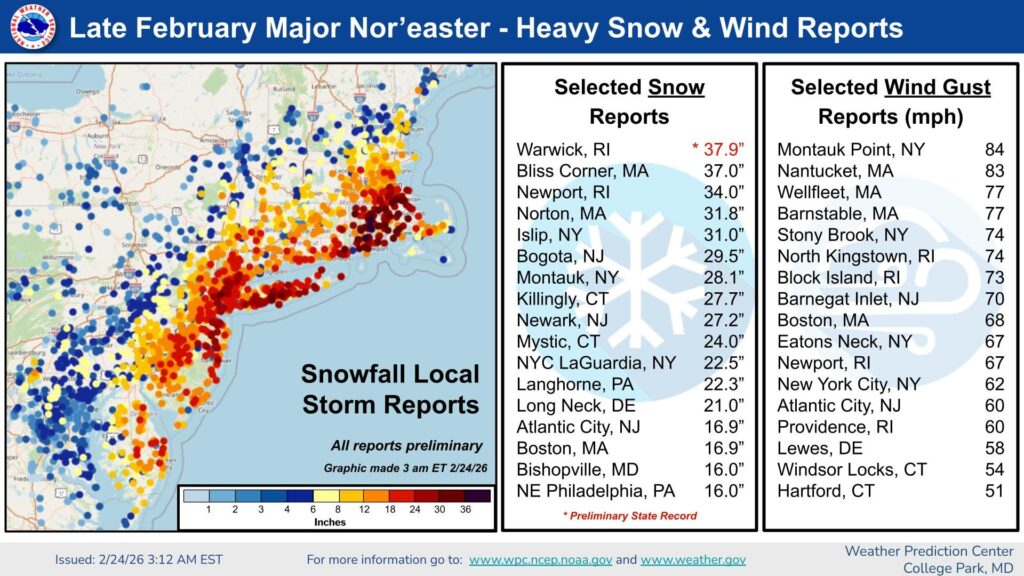
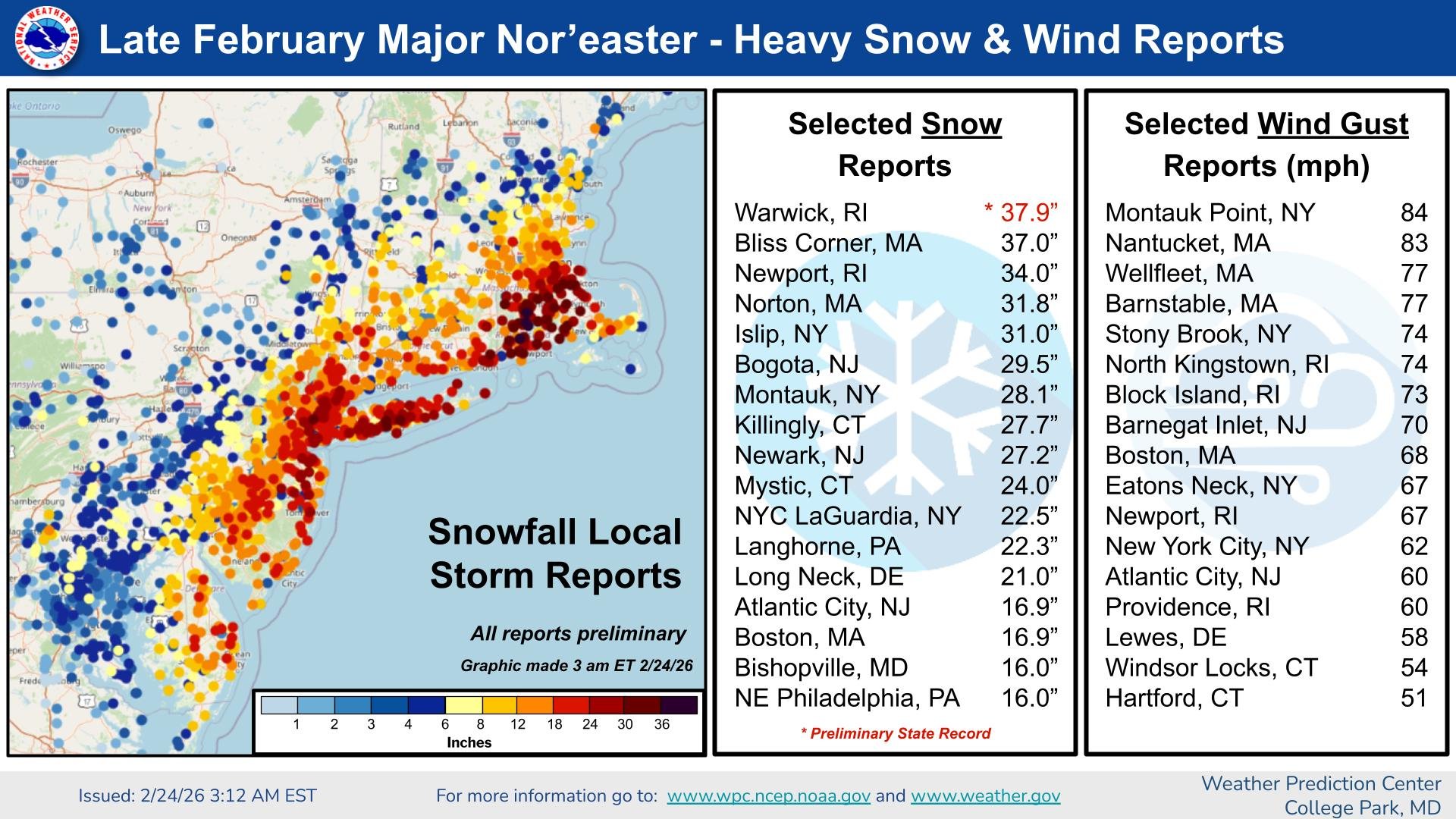
The blizzard that raked the Northeast and parts of the Mid-Atlantic will go into the history books as a first-ballot hall of fame storm. For southeastern New England, this storm rewrote the records. Prior to yesterday, Providence, Rhode Island’s biggest snowstorm came in the Blizzard of ’78 (which if you recall we mentioned before this storm). In that one, they received 28.6 inches of snow. Going forward, the bar has been raised 9 inches higher. Providence finished with 37.9 inches of snow yesterday, a single day and storm record going back into the early 1900s. Incredible. They weren’t alone.
(NWS WPC)
The 37.9 inch total in Warwick (TF Green Airport, Providence’s official obs site) is a preliminary state record for Rhode Island. The current record is 30 inches in Woonsocket from the Blizzard of ’78. Before a state record is certified, it needs to undergo a pretty rigorous investigation on how measurements were obtained, quality of siting, quality of measurement, timing, location, etc. The last certified state record snowfall occurred in 2013 in Connecticut, when Ansonia had 36 inches. A more recent candidate from Milton, Florida’s 9.8″ in January 2025 has not yet been certified to my knowledge.
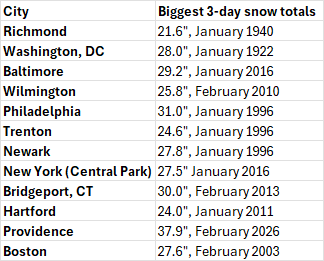
I figure it’s as good a time as any to take a second and look at the all-time record snowfalls in the Northeast Corridor.
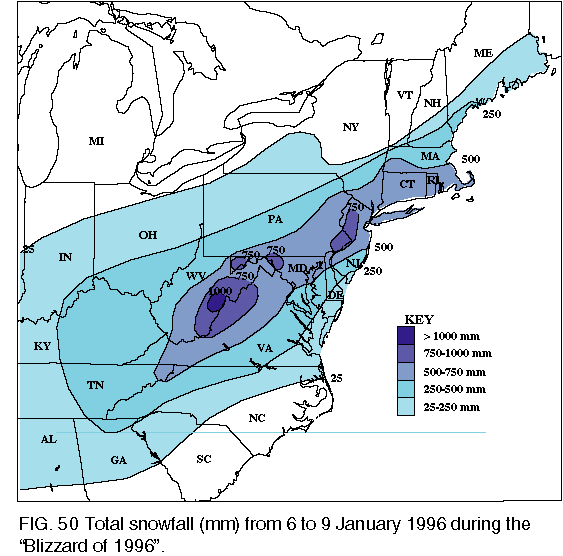
Richmond’s record has been established since 1940. Washington’s biggest storm remains the Knickerbocker Storm of 1922. Baltimore established their record in 2016’s “Snowzilla” storm. Wilmington, DE set their record in 2010’s Snowmageddon. Philly through Newark remains Blizzard of ’96 territory. Central Park also set their record in 2016. Bridgeport, CT won their record in the 2013 storm The Weather Channel dubbed “Nemo.” Hartford’s record was established in January 2011. Providence has a new benchmark, and Boston set theirs in Presidents’ Day II in 2003. Interestingly, every major city north of DC had their record established in the last 30 years (one notable exception is Albany, which is still led by the Blizzard of ’88…1888).
Snow disparities and model performance
We often think about nor’easters and East Coast storms as monoliths. The big storms were the Blizzard of ’96, the Presidents’ Day blizzard of ’78, Snowmageddon, the March 1993 Superstorm, etc. But as our technology has improved to be able to analyze these systems, we’ve learned so much more about how complicated they are. We’ve always known storm track was important; that much is obvious. But in the last 20 years, we’ve really latched on to understanding how banding and gradients, these finer-scale features within nor’easters can really amplify snow totals in some spots. You can see that in this storm too.
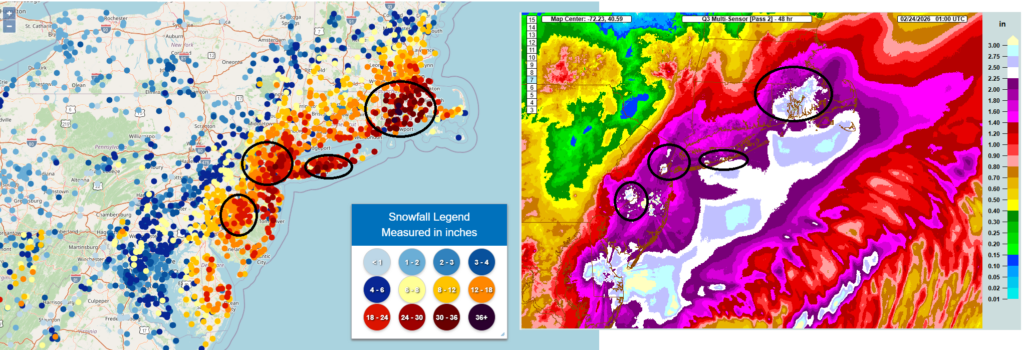
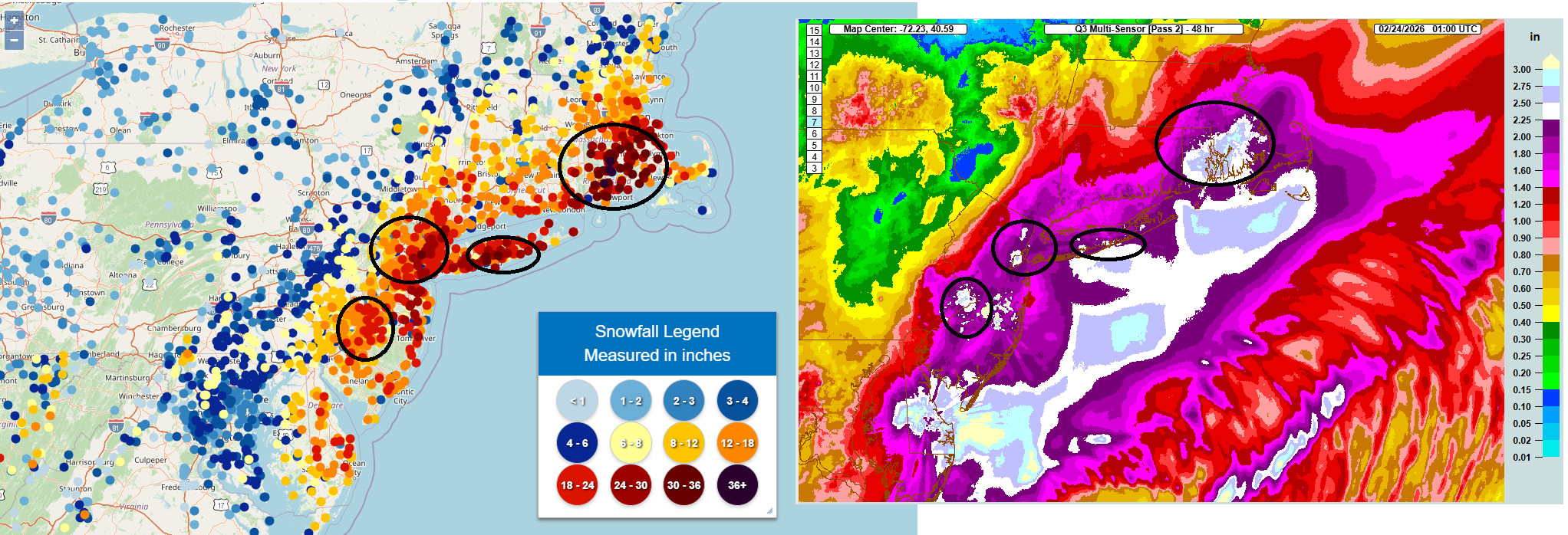
Click to enlarge the image above comparing radar precipitation estimates to snow totals. (NOAA/NSSL/NWS)
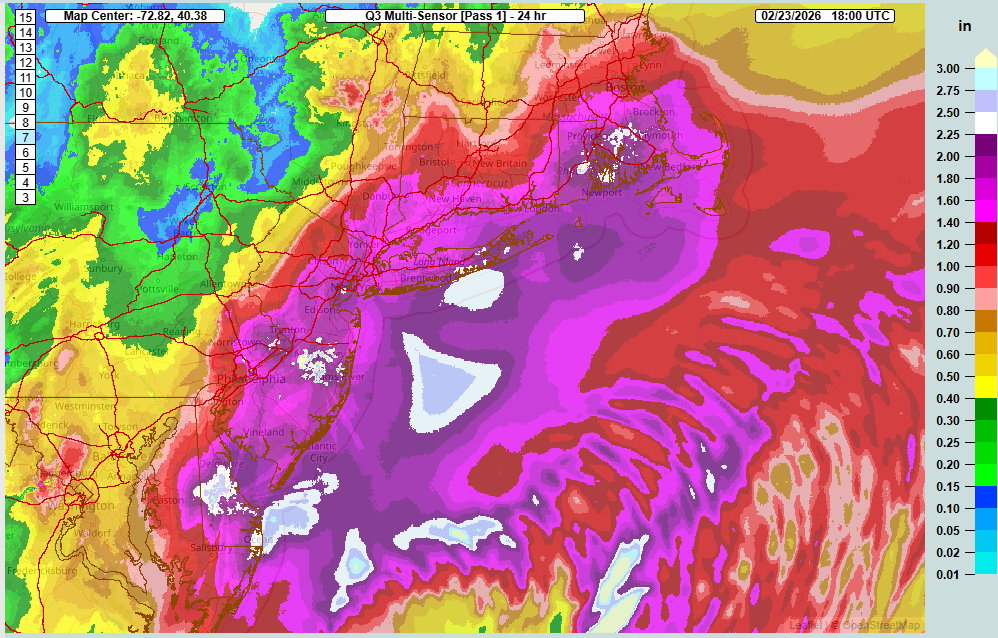
In the maps above, which you can enlarge by clicking on the image, I compared a few areas of relatively higher snow totals compared to areas around them. That’s the map on the left. It’s imperfect because reports are not evenly or equitably distributed or entirely finalized, but there is enough there to give you the general picture. To the right is the radar estimated precipitation. I narrowed the scale to exaggerate the differences and to try and tease out some relatively higher values. If you look at the overlap between the higher totals we saw in southeast New England, Long Island, the NYC Metro, and between Trenton and Philly, those do correspond to higher radar estimates as well. The location and “noise” from the Doppler sites makes this a little more challenging, but there’s enough “there” there. Those areas were more likely to trip 2.25 inches of radar estimates than in other areas. Delaware could also be included here I think as well, and the radar totals there are much higher due to warmer temps and some mixing.
So within the storm, these mesoscale banding features establish and sometimes pivot, and you get these corridors of amplified snow totals, not a monolithic slew of snowfall. You can see that in 1996 as well, though with somewhat less clarity than you can see today.
(NOAA CPC)
You can see the terrain effects in Maryland and the Virginias, as well as where the “megaband” setup along the Northeast Corridor between Philly and Morristown.
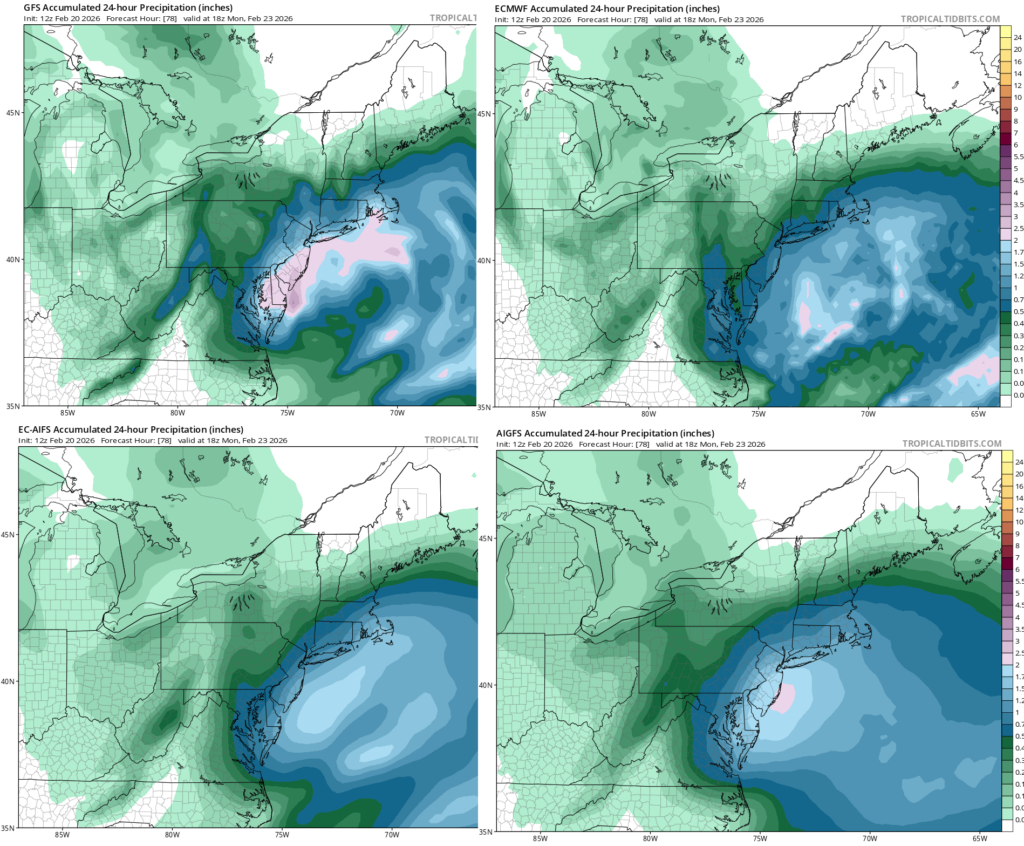
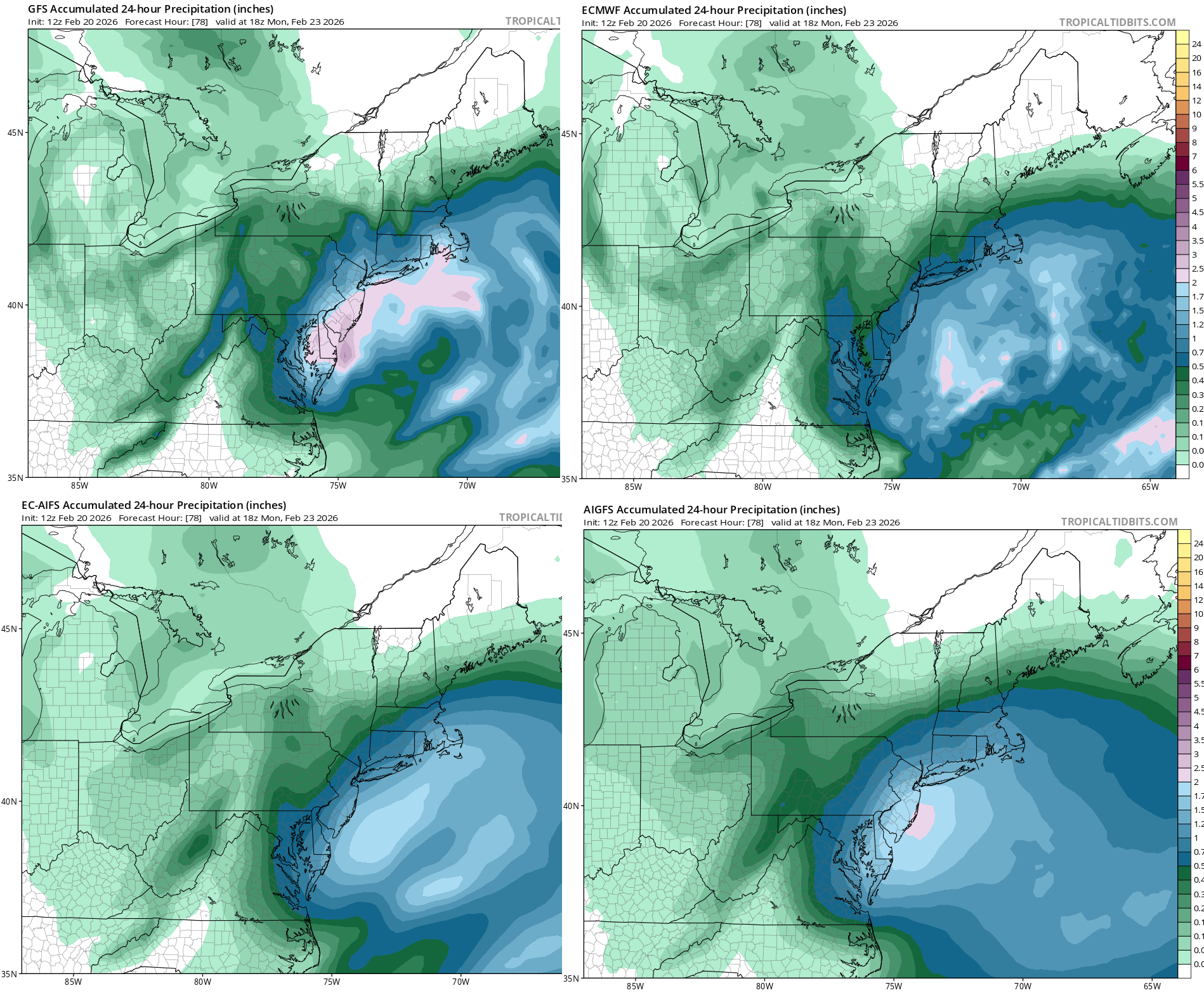
So with all this nuance, how did the models perform this go around? It’s tough to say who “won” per se, but clearly this was a general GFS victory, as it sniffed it out and kept it held even as the Euro got wishy washy. But, let’s focus on precipitation totals. Here were the global model forecasts from Friday morning’s model runs.
24 hour precipitation from 18z Sunday through 18z Monday for (clockwise from top left) the GFS, Euro, AIGFS and Euro AIFS. (Tropical Tidbits)
I had to take 24 hour precipitation in this case because there was consequential precipitation Friday that would have polluted this map. But you can see that the GFS, although somewhat overdone in terms of total liquid did correctly pick up on the relatively higher totals we saw in Delaware, Long Island, and southeast New England. The Euro was much too dry. Their AI counterparts did similarly, though in the Euro’s case, it looks like the AI model somewhat outperformed the physics-based model. Again, here was the total precip in that same 18z-18z 24-hour period.
Total liquid precipitation estimates from the Blizzard of 2026. (NOAA NSSL)
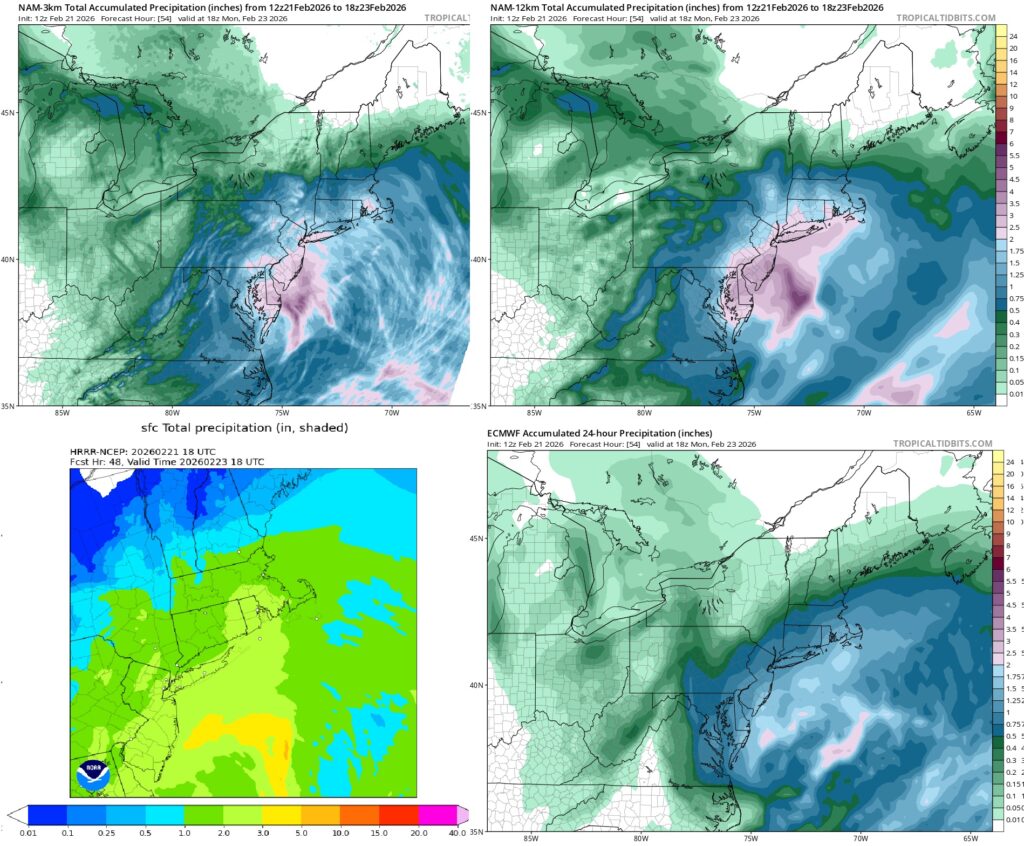
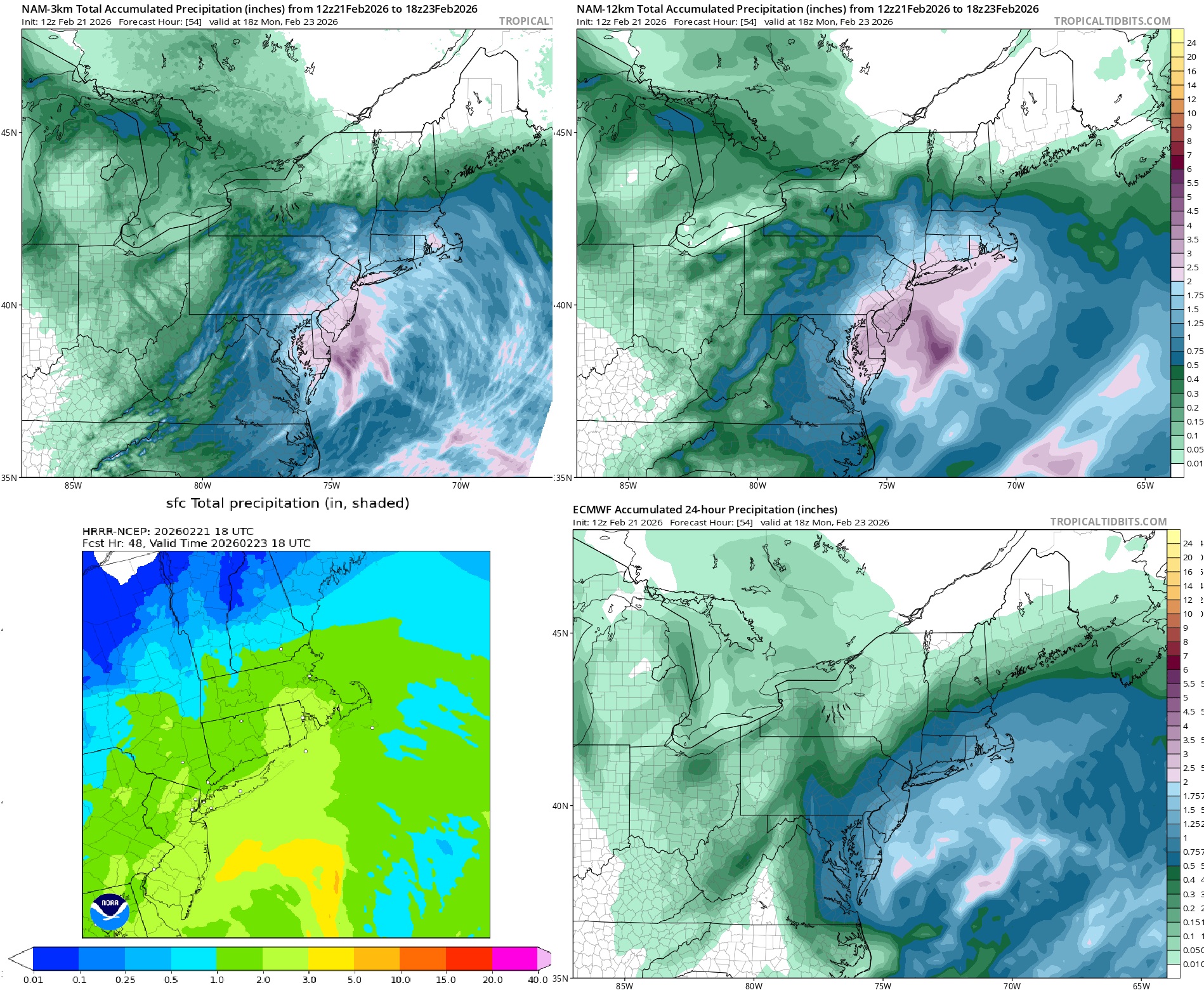
If we look at how some of the shorter-range models (NAM, HRRR) did on Saturday morning/afternoon, as well as the Euro, in a time you’d expect to have the storm nailed down, we see some interesting things.
24 hour precipitation from 18z Sunday through 18z Monday for (clockwise from top left) the hi-res NAM, classic NAM, Euro operational, and HRRR. (Tropical Tidbits, NOAA)
First, I had to struggle to find an adequate HRRR image, so I settled on the one from NOAA. Secondly, let’s assess this. The NAM’s hi-res 3km version? Not terrible. It highlighted southeast New England, Long Island, and the heavier stuff near Delaware. The classic NAM? A little overdone in Jersey. Recall, we saw the peak totals showing up ahead of the storm in Ocean and Monmouth Counties in NJ. In reality, those locations did about as well as the whole corridor from there into New York City and Long Island. But overall, it did okay. The HRRR is a little tougher to lean into with poor granularity, but generally speaking it handled itself ok, though it slightly overdid the 2-inch totals. It nicely highlights Rhode Island relative to the rest of New England though. And the Euro continued to struggle here.
It will be interesting to see why the Euro floundered with this event so much more than some other modeling. Even with a 6-hour lead time on Sunday it still dropped the ball on precip totals and was outdone by the GFS in most cases and even by its own AIFS model. On that last point, it is encouraging to see the AI modeling handle a storm like this fairly well.
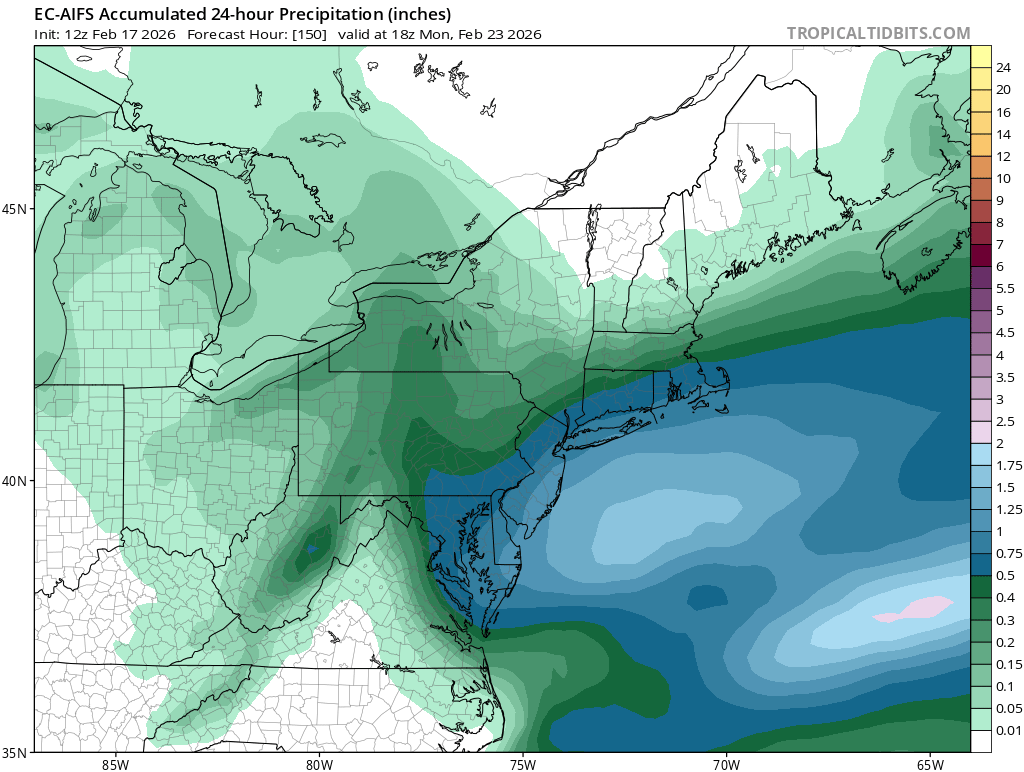
The same 24-hour precipitation forecast as the ones above except from last Tuesday from the European AIFS model. (Tropical Tidbits)
You can see that the signal was quite robust on the AIFS with that Tuesday morning run. Now, to be fair, it did lose it that night and did not really fully recover til Friday, though it showed correct trends in the runs between. Still, it stabilized faster than the Euro operational. I’m not going to call this one a “win” for AI modeling, but it was an encouraging overall performance that shows where it has strengths and value when used in conjunction with other model output, even at short lead times. Had you noticed this, noticed the Euro wavering, and noticed the consistency in the NAM modeling, any questions of uncertainty would have been allayed somewhat on Saturday. Easier said than done however, and Northeast snowstorms remain one of forecast meteorology’s most difficult challenges.
In brief: After our cold start this morning, warmer weather will come roaring back today and Wednesday, which will be characterized by strong onshore flow. Thursday looks particularly warm, but conditions turn more pleasant this weekend.
Onshore flow returns in a big way
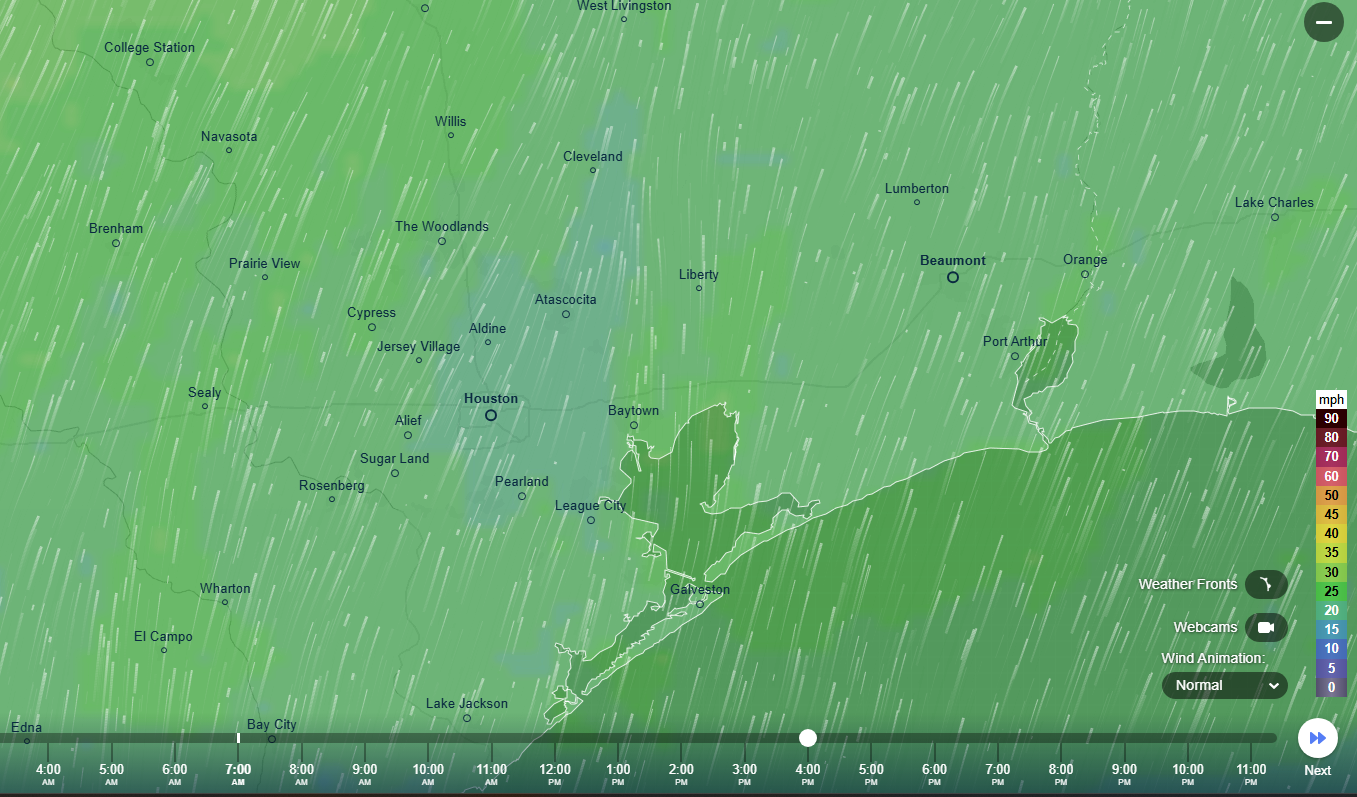
It is quite cold across the region this morning, with temperatures generally in the mid- to upper-30s across the region. The other thing to note is that winds are calm. That will start to change by mid morning as southerly winds start to pick up, bringing in warmer and more humid air in from the Gulf. By this afternoon we could see gusts up to 25 mph or higher, and the warming trend will be full on. Overnight lows tonight, as a result, will generally be 20 to 30 degrees warmer than Monday night.
By this afternoon wind gusts will reach about 25 mph from the south. (Ventusky)
Tuesday
For those of us up at this hour, it’s a beautiful and clear morning, with a lovely sunrise. Those clear skies will persist through the afternoon hours, and we are going to see high temperatures rise this afternoon to between 70 and 75 degrees. As noted above, winds will be gusty, from the south. As moisture levels in the atmosphere increase, we’ll see some clouds develop this evening and during the overnight hours.
Wednesday
If you liked the onshore flow on Tuesday, you’re in luck. It could be even more frisky on Wednesday, with gusts up to 30 mph from the south. Skies, otherwise, will be mostly sunny with high temperatures of around 80 degrees. Lows on Wednesday night will drop into the upper 60s, and it will feel modestly humid.
Thursday
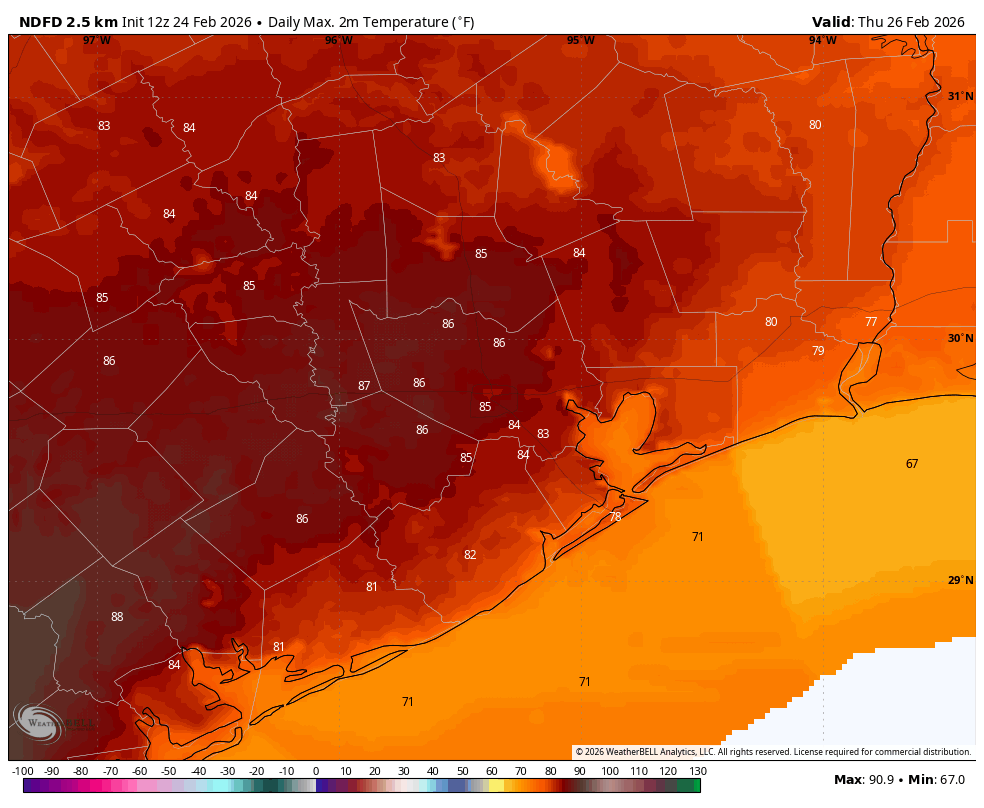
This will be the warmest day of the week, with most of the area pushing into the mid-80s (possibly upper 80s for a few areas well inland) along with mostly sunny skies. Some parts of South Texas will be sizzling, and well into the 90s. A weak front will push through on Thursday night, allowing lows to drop to around 60 degrees for inland parts of Houston, with conditions a bit warmer near the coast.
Thursday’s forecast high temperatures. (Weather Bell)
Friday, Saturday, and Sunday
A generally wonderful weekend awaits us. Those strong winds we are going to see on Tuesday and Wednesday should be gone. Skies should be mostly sunny. And temperatures will be pleasant, with highs in the upper 70s to the low 80s, and lows in the 50s to around 60 degrees. Dewpoints won’t be super low, but they should be low enough such that it doesn’t feel particularly humid outside. In short, this should be a pretty spectacular weekend for any outdoor plans to have.
Next week
The forecast starts to turn fuzzy after Sunday. Another modest front could push through early next week, bringing a few nights in the 50s, or maybe it will stall before reaching Houston. Mostly we should remain in the vicinity of daytime highs around 80, and lows around 60. Unfortunately we probably are at least 10 days away from seeing any meaningful rainfall.
SYDNEY—Responding to backlash following the release of Netflix’s America’s Next Top Model docuseries, supermodel and television personality Tyra Banks stated Tuesday that taking abuse from Tyra Banks is simply how the modeling industry works. “You can ask hundreds of models around the world, and they’ll all tell you that getting emotionally abused by Tyra Banks is par for the course at any model call or runway show,” said the 52-year-old Banks, who noted that being forced by Tyra Banks to change one’s body, hair, or teeth for a photoshoot was “practically a rite of passage.” “If anything, what people saw on America’s Next Top Model was a toned-down version of the level of degrading comments from Tyra Banks that most young models in the industry actually receive. It’s unfortunate, but I don’t make the rules.” Banks went on to say that she herself had endured countless demeaning remarks from Tyra Banks when she was an up-and-coming young model.
GRAND RAPIDS, MI—Despite ample opportunity for the troubling realization to occur to him in the long hours he spent staring at his laptop, sources reported Tuesday that local man Aaron Semple at no point recognized during his recent rewatching of every Planet Of The Apes film that he might, in fact, be depressed. “I thought it could be fun but also kind of a challenge to watch the whole series from start to finish,” said Semple, who reportedly failed to perceive the seriousness of his mood disorder even once as he binged the dystopian sci-fi franchise, including in the short breaks he took between installments when the concerning reality of his mental health had a better chance of surfacing. “Obviously, some of the older ones, aside from the very first, don’t quite hold up, and the Mark Wahlberg remake is pretty shaky. But the newer Ape movies are really good, and either way, I’m kind of proud I stuck it out. Yeah, I gotta say, all in all, it’s been a pretty awesome day.” At press time, reports confirmed Semple was on the verge of comprehending how deeply sad he was at all times when he discovered a Planet Of The Apes television series from 1974 that he still hadn’t checked out.
Brands like Chipotle, Dunkin, and Starbucks have started offering new protein-dense menu items. Here are more companies making exciting protein-based revamps.
Jamba Juice This sweet smoothie brand is branching out into savory, high-protein options. Try the “shepherd’s pie” shake, which boasts sixty grams of protein and over 200 percent of your daily recommended value of gravy. Or make your own! Choose your base—minestrone, Italian wedding, or clam chowder—and throw in any of your favorite high-protein add-ins, like hard-boiled eggs, jerky, or branzino. Perfect on a hot summer day. Just make sure you ask for your shake deboned.
IKEA With IKEA’s new line of high-protein furniture and household goods, even sitting on the couch can help you achieve your ideal physique. Cushions are filled with a mix of protein powder and beef bouillon, and each is outfitted with a mouthpiece so you can drink your pillows whenever you need to build muscle while you’re reading or watching TV. IKEA offers an easy monthly broth subscription service, so you’ll never forget to refill your pillows. As an added bonus, IKEA’s traditional instructions are printed on thin slices of lamb chops. Simply eat your lamb-structions after you’ve built your beef-case.
CVS Pharmacy Your medications will now be coated in peanut butter, like the kind you give a dog. For even more of a protein fix, CVS is offering the “Rx+” service, which replaces all your pills with pistachios. If your heart gets swole enough, you won’t need blood pressure medication.
Oral-B For something you put in your mouth twice a day, toothpaste has a shockingly low protein content. Oral-B has switched from a glycerin base to a ceviche base to increase the shrimp in your toothpaste exponentially. You can brush normally, just make sure you swallow every last drop. Wash your savory toothpaste down with a glass of minty fresh beef pho. Sometimes a whole shrimp gets caught in the toothpaste tube’s opening, so make sure you press firmly. Plus, Oral-B has announced it will soon branch out into high-protein tooth whitening, from a slurry of all-white-meat chicken breast.
ExxonMobil Exxon has mixed a delectable blend of gasoline and egg whites for some of its select stations. Simply fill your own water bottle after you’ve filled up your car and chug. Comes in both “Denver omelette” and “unleaded” flavors.
Boeing No one wants to experience an air travel emergency, but if you have to, you might as well get a dose of protein at the same time. Instead of flavorless and low-macro oxygen, the face masks that drop down during a cabin pressure emergency will be filled with cottage cheese. Make sure to let a flight attendant know if you are lactose intolerant—they can provide you with an alternative mask filled with flank steak instead.
USPS Since their debut in 1971, the adhesives on stamps and envelopes have always had the same flavor. While absolutely delicious, the USPS has recognized this as a missed opportunity. So it’s introducing a new line of stamps with thin layers of tuna salad as a new glue base. Getting your daily value of protein will be as easy as sending 4,015 letters to your parents. Or Santa.
Nvidia Nvidia has had a huge year, but they are not satisfied to rest on their laurels. For all of the tech capabilities, its processing chips have next to no protein content. Every Nvidia GPU will now have a core of raw turkey chili. As you use your computer for work or to play video games, the heat from the processing unit will boil the chili. As soon as the turkey is cooked through, the GPU goat-based intestinal casing will melt, allowing the chili to seep through your keyboard and USB ports. Collect the turkey chili on the Nvidia-branded chili mat that you’ve put under your computer and simply lick the chili right off. Then eat the mat—it’s made of kidney loaf. Each chili mat comes with a fifteen-dollar rebate toward the next computer you’ll have to buy, since yours is now destroyed. For just one computer a day, you’ll look and feel like a brand-new person.
One of the more perplexing questions in all of the coverage I’ve done on RFK Jr. has been whether or not Kennedy is some misguided true believer or if this is all some grift for power, influence, and/or money. While most people who watch how RFK Jr. has operated on the topic of vaccines, for instance, both before and after he entered government, they assume he’s a real, if stupid, crusader. But they will tell you the same when it comes to processed foods and pesticides, two topics on which Kennedy has also crusaded for years, and two topics that have been noticeably absent or reversed now that he’s in government.
The pesticide topic was recently thrust back into the news. Trump signed an executive order that essentially demanded that two chemicals be produced in higher quantities: phosphorus and glyphosate. Kennedy then came out to cheerlead the executive order as well, which was odd when you consider what glyphosate is chiefly used for.
Trump on Wednesday night signed an executive order invoking the Defense Production Act to compel the domestic production of elemental phosphorus and glyphosate-based herbicides. Glyphosate is the chemical in Bayer-Monsanto’s Roundup and is the most commonly used herbicide for a slew of U.S. crops. Trump, in the order, said shortages of both phosphorus and glyphosate would pose a risk to national security.
Kennedy backed the president in a statement to CNBC Thursday morning.
“Donald Trump’s Executive Order puts America first where it matters most — our defense readiness and our food supply,” he said. “We must safeguard America’s national security first, because all of our priorities depend on it. When hostile actors control critical inputs, they weaken our security. By expanding domestic production, we close that gap and protect American families.”
Bayer-Monsanto has been the defendant in a number of lawsuits over its Roundup product. Specifically, those suits have been powered by claims that glyphosate causes non-Hodgkin’s lymphoma, a form of cancer primarily impacting blood cells. Whether or not you or I think those claims are true, Kennedy sure said he did, since he acted as counsel in some of these suits.
The MAHA crowd is understandably pissed. Building a career on these very concrete health stances, only to reverse course while in government to appease Dear Leader, is a fairly horrible look. And it’s actually a worst of both worlds situation, as his MAHA crowd is pointing to his failed promises and hypocrisy, while those who are generally his opponents are pointing out that this might be a stance in which he was actually acting rationally before pulling a u-turn.
“This was one of the few issues where Secretary Kennedy actually embraced credible science,” said Kayla Hancock, Director of Public Health Watch, a project of Protect Our Care. “But RFK Jr. tossed out his years of anti-pesticide advocacy and conviction like a used tissue to stay in the good graces of Donald Trump, who cares more about making his chemical company donors happy than protecting the public’s health. This makes it clear, Secretary Kennedy has no problem selling out his supposed value if there’s a quick buck to be made for special interest donors, or political points to be scored.”
This seems as close to a solid answer to the question I posed at the start of this post as we’re likely to get. Kennedy, whatever else he might be, is not a true-believing crusader willing to hold firm to his beliefs. He simply does and says whatever will propel his influence and revenue. That’s it.
You’ve been lied to, MAHA people. Lied to and used to put in office the very people who have betrayed you. Let that sink in.
“The Diary of a Young Girl” is a Dutch language diary written by the young Jewish writer Anne Frank while she was in hiding for two years with her family during the Nazi occupation of the Netherlands. Although the diary and Anne Frank’s death in the Bergen-Belsen concentration camp are well known, few are aware that the text has a complicated copyright history – one that could have important implications for the legal status and use of Virtual Private Networks (VPNs) in the EU. TorrentFreak explains the copyright background:
These copyrights are controlled by the Swiss-based Anne Frank Fonds, which was the sole heir of Anne’s father, Otto Frank. The Fonds states that many print versions of the diary remain protected for decades, and even the manuscripts are not freely available everywhere.
In the Netherlands, for example, certain sections of the manuscripts remain protected by copyright until 2037, even though they have entered the public domain in neighboring countries like Belgium.
A separate foundation, the Netherlands-based Anne Frank Stichting, wanted to publish a scholarly edition of Anne Frank’s writing, at least in those parts of the world where her diary was in the public domain:
To navigate these conflicting laws, the Dutch Anne Frank Stichting published a scholarly edition online using “state-of-the-art” geo-blocking to prevent Dutch residents from accessing the site. Visitors from the Netherlands and other countries where the work is protected are met with a clear message, informing them about these access restrictions.
However, the Anne Frank Fonds was unhappy with this approach, and took legal action. Its argument was that such geo-blocking could be circumvented with VPNs, and so its copyrights in the Netherlands could be infringed upon by those using VPNs. The lower courts in the Netherlands dismissed this argument, and the case is now before the Dutch Supreme Court. Beyond the specifics of the Anne Frank scholarly edition, there are important issues regarding the use of VPNs to get around geo-blocking. Because of the potential knock-on effect the ruling in this case will have on EU law, the Dutch Supreme Court has asked for guidance from the EU’s top court, the Court of Justice of the European Union (CJEU).
The CJEU has yet to rule on the issues raised. But one of the court’s advisors, Advocate General Rantos, has published a preliminary opinion, as is normal in such cases. Although that advice is not binding on the CJEU, it often provides some indication as to how the court may eventually decide. On the main issue of whether the ability of people to circumvent geo-blocking is a problem, Rantos writes:
the fact that users manage to circumvent a geo-blocking measure put in place to restrict access to a protected work does not, in itself, mean that the entity that put the geo-blocking in place communicates that work to the public in a territory where access to it is supposed to be blocked. Such an interpretation would make it impossible to manage copyright on the internet on a territorial basis and would mean that any communication to the public on the internet would be global.
Moreover:
As the [European] Commission pointed out in its written observations, the holder of an exclusive right in a work does not have the right to authorise or prohibit, on the basis of the right granted to it in one Member State, communication to the public in another Member State in which that right has ceased to have effect.
Or, more succinctly: “service providers in the public domain country cannot be subject to unreasonable requirements”. That’s a good, common-sense view. But perhaps just as important is the following comment by Rantos regarding the use of VPNs to circumvent geo-blocking:
as the Commission points out in its observations, VPN services are legally accessible technical services which users may, however, use for unlawful purposes. The mere fact that those or similar services may be used for such purposes is not sufficient to establish that the service providers themselves communicate the protected work to the public. It would be different if those service providers actively encouraged the unlawful use of their services.
The hope has to be that the CJEU will agree with its Advocate General’s sensible and fair analysis, and will rule accordingly. But there is another important aspect to this story. The basic issue is that the Anne Frank Stichting wants to make its scholarly edition of Anne Frank’s diary available as widely as possible. That seems a laudable aim, since it will increase understanding and appreciation of the young woman’s remarkable diary by publishing an academically rigorous version. And yet the Anne Frank Fonds has taken legal action to stop that move, on the grounds that it would represent an infringement of its intellectual monopoly in some parts of Frank’s work, in some parts of the world. The current dispute is another clear example of how copyright has become for some an end in itself, more important than the things that it is supposed to promote.