
Click here to go see the bonus panel!
Hovertext:
Weirdly, bing ai won't generate this story for me, so we may be OK.
Today's News:
Hovertext:
Weirdly, bing ai won't generate this story for me, so we may be OK.


Young tech nerds in Seattle are trying to preserve the mysterious machines — many of them almost lost forever — that made America's landline telephone system work before the age of computers.
(Image credit: Brian Mann/NPR)

Billionaire Facebook founder Mark Zuckerberg competed in his first local jiu-jitsu tournament, announcing on Instagram that he won gold and silver medals. What do you think?

If you’re unable to leverage your spawn for cash, then frankly, your kid’s probably an uggo. The Onion asked momfluencers how they defend using their children for clicks, and this is what they said.
NEW YORK—Becoming the latest victim in a string of similar incidents taking place near the fast food franchise, local man Brandon Turner reportedly died Wednesday after being pushed by a stranger into a Subway restaurant. “You could see the horror in his eyes as he tumbled backwards toward the foot-long Sweet Onion…

CAMDEN, NJ—The entire executive team of the Campbell Soup Company held a press conference Wednesday morning to announce that soup will set you free. “Campbell’s soup will cut the shackles! Campbell’s soup will make you whole!” CEO Mark Clouse proclaimed as the rest of the Campbell’s C-suite wailed, rended their…
On May 6, a man wearing tactical gear left his vehicle in the parking lot of a mall in Allen and began shooting innocent bystanders. His vest bore a shield-shaped patch with the letters RWDS—an acronym for “Right Wing Death Squad,” a common signifier among far-right ideologues. The gunman used multiple weapons, including an AR-15, to kill eight people and wound at least seven others. Although the motive for the killings is still unknown, authorities confirmed he was a neo-Nazi.
At a press conference the day of the shooting, state Representative Jeff Leach—elected to represent most of Allen, who authored a permitless carry bill allowing citizens to have a handgun in public without a license—announced that a vigil would be held the next day at Cottonwood Creek Church. I attended that vigil as well as a much smaller interfaith one at nearby Christ Throne Church. The two offered competing visions on how the Allen community is dealing with and talking about the mass shooting.
When I checked in as a member of the media at Cottonwood’s sprawling campus, a staff member handed me a piece of paper that said we were not allowed to interview or take photos inside the building, citing attendee privacy. But with reporters at a safe distance, Governor Greg Abbott nevertheless managed a photo opportunity, which his staff promptly posted to his social media accounts.
“Jesus, just please take the wheel. … I think prayer is what we are going to need going forward.”
Not a seat was empty in the massive Cottonwood Creek auditorium. Executive Pastor Scott Sanford—a former Republican state representative whose term ended in January—began by giving a brief overview. Then he named the more than 30—mostly Republican—elected officials in attendance.
“We will hear from Ken Fulk, mayor of Allen, as well as the Mayor-Elect Baine Brooks,” Sanford said. “We also have [other] esteemed guests with us this evening. First and foremost, we have Governor Greg Abbott. Welcome Governor, glad that you’re here.”
“I just want you elected officials to know that we’re praying for you,” Sanford continued. “We know events like yesterday weigh on you. You are in our prayers. Now, may we give a round of applause for them.”
The standing-room-only crowd erupted in applause, which echoed off the vaulted ceiling.
But not everyone was clapping. Two people stood up. “What about the gun laws?” one shouted. Both were escorted off the premises by police.
Guided prayer and worship songs were interspersed between speeches from elected officials and Cottonwood faith leaders. After a brief prayer for the victims, the mayor of Allen, Ken Fulk, and the mayor-elect, Baine Brooks, addressed the crowd.
“We are praying for you, and we share your grief,” Fulk said. “Our hearts were broken yesterday, and we are here to offer you our full support.”
“Jesus, just please take the wheel,” Brooks added. “I think prayer is what we are going to need going forward.”
Outside the Cottonwood building, however, protesters demanded more than “thoughts and prayers.” At the driveway entrance to the church parking lot, a group held signs demanding action. “My kids are worth more than your guns,” one read. “Well-regulated militia murders 8 people in Allen for your thoughts and prayers,” read another.
After the vigil, a small group of protesters wearing orange shirts stood outside the exit holding paper signs that read “Enough is enough.” After a man ripped one of their signs, security and Allen police told the protesters to leave the property or be arrested for trespassing.
No such protests accompanied the interfaith vigil at Christ Throne Church, which drew a fraction of the audience at Cottonwood. A little under two dozen people gathered in the humble church. I was the only member of the media there. The organizers did not prevent me from taking photos or conducting interviews.
The rhetoric at Christ Throne was very different from that at Cottonwood.
“Our world needs to change now,” Reverend Irvin Lynn Barrett said. “Not down the road. Now, so that this epidemic of mass killings does not continue.”
The small, yellow building where Barrett spoke was unassuming. When I first arrived, I wasn’t sure I was at the right place. Inside, a diverse group of attendees, including members of the local Jewish and Hindu communities, listened as Barrett led the vigil from a small red-carpeted stage. The mood was somber. No worship songs or cues for applause.
“We can’t expect or wait for somebody else to do it,” Barrett said. “We must start and begin doing it ourselves.”
At the conclusion of his sermon, Barrett asked each attendee to introduce themself and say why they were there. State Representative Mihaela Plesa, a Democrat who represents a portion of Allen, spoke about the need for reform.
“As the scripture says, faith without works is dead.”
“My heart goes out to all of you,” Plesa said. “I got back to the district as soon as I could. We will be on the floor of the House tomorrow, and I will hold my colleagues accountable. It’s not just that we can pass gun control; it’s that we must.”
Also in attendance at the interfaith vigil was Collin County NAACP President June Jenkins, who echoed the calls for action: “As the scripture says, faith without works is dead.”
The next day, Leach—who had originally announced the vigil at Cottonwood on live television—said in a press conference that such mass killings are “happening way too much.” But he conceded that he doesn’t intend to do much about it.
“I don’t have the answers,” Leach said. “I don’t have a bill in front of you. I’m not sure there are any bills in front of us this morning, this session, that could have prevented this.”
That afternoon, a bill that would raise the legal age to purchase a semi-automatic rifle to 21 advanced out of a Texas House committee by a vote of 8-5. It faces an uphill climb. Shortly after the committee voted on the bill, gun advocacy group Texas Gun Rights cast it as a “kneejerk” response that would not have prevented the Allen mass shooting, which was perpetrated by a 33-year-old man. Meanwhile, Abbott told Fox News there would be “no gun control” after the shooting.
Consider that the executive pastor of Cottonwood, Sanford, sponsored a bill in the 2021 legislative session that allows school marshalls to have more ready access to their guns. Or that, in 2022, the church hosted the True Texas Project for a screening of 2000 Mules, a debunked conspiracy film about the 2020 election. This was just a few months after the Southern Poverty Law Center designated the True Texas Project an anti-government hate group.
“Cottonwood Creek Church does not endorse or oppose any candidate for political office,” reads the last paragraph of the document members of the media received at Cottonwood. “Instead, any information, videos, appearances, posts, etc. related to any political topic are provided for informational purposes only and represent the personal views or opinions of the individual expressing them, but do not necessarily represent the views or opinions of Cottonwood Creek Church.”
The post How (Not) to Mourn a Mass Shooting appeared first on The Texas Observer.

Paramount Global, the parent company of networks including Showtime, CBS and Nickelodeon is cutting some 25% of its staff. Among the units being shutdown as a result of the downsizing is MTV News.
(Image credit: Igor Golovniov/SOPA Images/LightRocket via Getty Images)

As is often the case with these kinds of storms, Tuesday’s rainfall totals were hit or miss. Some southern parts of the region barely saw any rainfall, whereas a few locations around town picked up 2 to 4 inches of precipitation today and saw some street flooding. Things will now quiet down for the evening, and a few hours after midnight. However, after this time we expect an additional pulse of showers and thunderstorms to move into this area on Wednesday morning.
While this is subject to change, generally a fat line of storms should move into areas west of Houston a few hours before sunrise, push into the central part of the region just before, or during sunrise and the morning commute, and slowly continue moving to the east. The storm system will probably be clear of the area by around noon, or shortly thereafter.
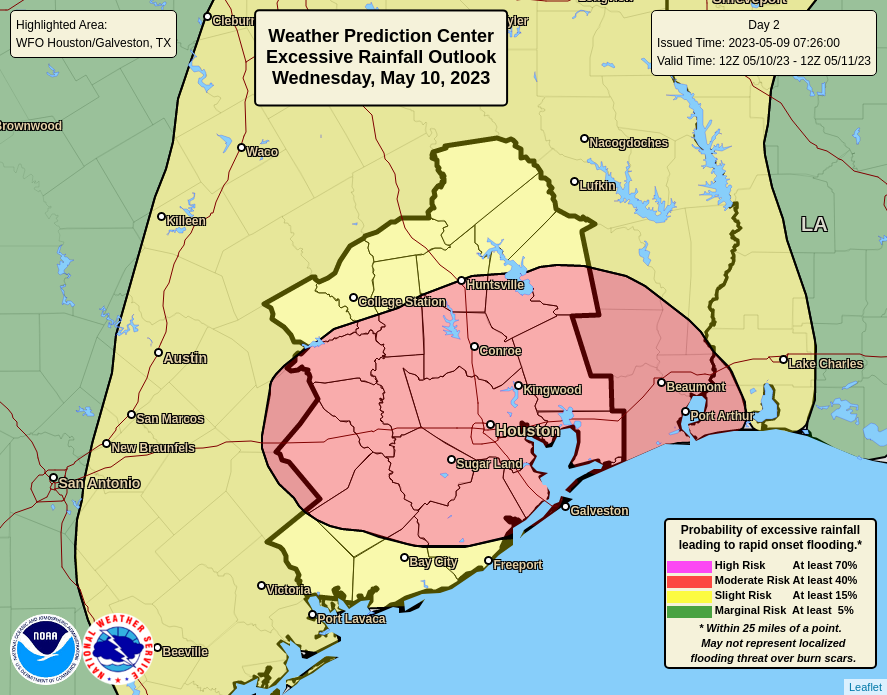
The bottom line is that these storms will be pushing into Houston around the time of the morning commute, the time you’ll be dropping kids off at school or daycare, or both. Some locations will see heavy rainfall that, briefly at least, floods streets and creates traffic issues. Please be aware of weather conditions tomorrow morning, checking the radar before you leave home or work, and so on. Please also do not drive into high water.
Most of the area probably will see an additional 1 to 2 inches of rain through tomorrow afternoon, which is fine for roads. But we’re concerned about more isolated areas that see bullseyes of 4 or more inches. For this reason we’re keeping a Stage 2 flood alert in place through noon tomorrow, after which time we expect to be able to lift it. Although rain will be possible for the remainder of the week, this should be the end of the particularly threatening, heavy rainfall.


This post was written by Alison Green and published on Ask a Manager.
A reader writes:
For the past 1.5 years, I’ve worked in health care in a very rural area where it is hard to recruit (this is more related to the rurality than to salaries and benefits; salary could be higher but is mid-range, and benefits are good to very good). Due to our service/population, in-person care is important, so I can’t hire remote providers.
I’m the clinical supervisor for several providers, including Grover (they/them), who has been in their position for 10 years and has a very serious issue with documentation timeliness. At its worst when I started, Grover was 300+ notes behind. This is a big billing issue (we can’t bill until a note is completed) and can also quickly become a clinical issue (e.g., if Grover hasn’t completed their last three notes for a patient and something urgent arises, another provider would be in the dark about what’s been going on).
Grover and I discuss/set goals for their progress every single week in our standing meeting. Grover does not minimize this issue, but instead is struggling with (self-disclosed) ADHD and anxiety, and then procrastination related to both. They have made progress at various times: the year before I started, this included eliminating the backlog while on a PIP before backsliding. For the last month, however, they have kept their backlog at around 50 notes. Grover isn’t on a PIP right now, but I have made clear that two weeks of annual leave for a trip this July won’t be approved if they still have a backlog then.
Here’s my issue: I don’t think I would fire Grover in our current circumstances. This was the issue with the old PIP: it was enough motivation for them to reduce the backlog, but not permanently, because we are so short-staffed. Grover provides good clinical care to our very underserved population (although not as good care as care that is appropriately documented!), and I know from an opening we have from another clinician’s retirement that Grover’s position could be open for a year or more. In that time, people’s health will suffer due to lack of access, and that’s not catastrophic thinking on my part. I think Grover will work through the current 50-something backlog, and I don’t think they would take leave that hadn’t been approved, but I still find myself wondering. Do I have options I’m not thinking of? Can Grover’s salary be withheld for failure to complete an essential component of their work?
I am working on the recruiting/staffing issues so that no one is “unfireable,” but those fixes are slow, and this situation leads me to be hesitant to hire anyone I’m not extremely enthusiastic about, because the last thing the clinic needs is another person I’d be hesitant to fire.
The options available to you aren’t great ones.
You can’t legally withhold part of someone’s salary for not completing their work (especially since I’m guessing Grover is exempt, which means you can’t dock pay at all except in very narrowly defined circumstances).
If firing is off the table, all you can really do is micromanage the hell out of Grover to ensure their documentation gets done. For example, rather than just telling them to eliminate their backlog, can you require them to complete a minimum of X notes per day, which you spot-check? Have them spend the last hour of every day in your office, working on notes in your presence? Tell them to notify you each morning of how many notes they plan to complete that day, and report on their progress at the end of the day?
If you’re thinking this sounds horrible for both of you … it really does. But it might be the only way the work reliably gets done — and more reliably than tying it to Grover’s vacation in July, since they might continue to procrastinate until then and then throw up their hands and accept they can’t take the vacation, which would still leave you with the backlog unsolved.
You could also ask Grover what to do. You could say, “I don’t want to fire you, but this isn’t acceptable and nothing we’ve tried so far has worked. What do you think will help?” Or, “I want you to take a week and think about specific systems and practices we can put in place that will help solve this; when we meet next week, please come with at least two ideas.” (For example, what if Grover had 10 minutes scheduled after each appointment ends to use to immediately write up notes? That might affect how many patients they can see in a day … but would that trade-off be worth it if it solved the problem? You’d need to monitor it pretty closely to make sure they were really using the extra time that way; if they’re not, there’s no point.) It might even be interesting to ask, “If you were in my shoes, what would you do?” or “If you could put any policy in place to help fix this, what would it be?”
But yeah. In general I strongly discourage managers from feeling like they “can’t” fire an employee because you can’t manage effectively with no accountability — and after all, Grover could quit tomorrow and presumably you’d move forward somehow — but it sounds like you’re making the calculation that Grover doing 80% of the job is better than no one doing any of the job. I would lean really, really hard into working on those recruitment/staffing issues though.
HEAVEN – On a short Zoom call with stakeholders, today, God informed those present that the most recent mass shooting in the United States was the result of a too-broad junk filter in Heaven’s prayer software. The Lord began with an explanation of how he discovered his recent oversight. “I was going through my usual […]
The post Gun violence grinds to a halt after God finds prayers in spam folder appeared first on The Beaverton.

The post Gordrag’s Bane appeared first on The Perry Bible Fellowship.
This post was written by Alison Green and published on Ask a Manager.
A reader writes:
We have a coworker (we’ll call her Serena) who does. Not. Shut. Up. I don’t want to be rude, but there’s really no other way to put it. I’ll explain.
She has information, a story, or life experience for EVERYTHING. We haven’t discussed nuclear fission yet, but I’m certain Serena would have done it. Every conversation within earshot, she butts into. She offers advice at every turn, often unsought, and physically can’t stop interjecting something into every conversation. It doesn’t help her voice is loud and carries throughout the entire building.
She also comes across as a know-it-all and tries to explain some of our jobs to us, though she’s new to our industry and each of us are experts in our various fields with years of experience.
It’s exhausting.
Serena’s coworkers (I’m a different department) have brought it up to their manager who says, “I expect people to manage their issues between themselves.” He works off-site so is not subjected to it. For clarity, he didn’t hire her, a previous manager did. The grandboss was also informed, and has done nothing. He “knows it’s an issue, but hopefully she’ll find another position somewhere else.” But Serena is not the type to find another job. She says this is the best job she’s ever had so she’ll stay until retirement. And we’re a long ways away.
Our HR is new and young and knows she won’t get backed up by the manager or grandboss if she were to say something to Serena.
It’s gotten so bad that people are starting to take very late lunches just so they won’t have to be in the same room as Serena. Not that it matters, as her office 20 feet from the break room and she’ll “casually” walk into the break room to fill a glass of water to eavesdrop or come out of her office to join in on a conversation if she hears one that interests her. If we close the doors, she’ll prop them back open so she doesn’t “feel cut off from the break room.”
I legitimately feel bad for her department coworkers. They can’t have work conversations lest she come out of her own office to join in. They can’t escape. At least the rest of us are in separate parts of the building.
One of her coworkers has mentioned that it sounds like her husband isn’t the greatest of supports, and maybe she is trying to create what she lacks at home. If she were neurodivergent we would be sympathetic (many of us are), but when we’ve had conversations about neurodivergence, she’s been quite derisive of these diagnoses (although she has plenty of advice!), so we’re assuming she’s at least never been diagnosed.
We’re at our wits’ end, and our mental health is struggling. Our work is stressful, and the camaraderie that used to make it bearable has all but evaporated.
Other tactics we’ve tried:
• Keeping up pace of conversation so she can’t break into it (she’ll wait for you to take a breath to interject, or she’ll interrupt)
• Giving short answers. But she doesn’t take the hint (not sure if she is unable to recognize hints or just ignores them)
• Going outside for breaks (not feasible in winter and we can’t all be outside)
• Pointedly and silently looking at our phones (she does this too and then starts reading posts out loud to everyone)
• Going as a group to lunches/breaks (she gets louder to dominate the conversation)Is there any way we can help her to help ourselves?
It’s interesting that your list of tactics doesn’t include saying something directly to Serena!
I get why — it feels rude to tell someone you want them to stop talking or to butt out of a conversation. And often hints like the ones you’ve used do work with people. But when the hints fail — and especially when the problem is this severe and you’re this desperate for a solution — the next step has to be to say something directly. For example:
When she interrupts a private conversation:
When she tries to tell you how to do your job:
When she’s monopolizing a meeting:
When she interrupts:
Other situations:
You are going to feel unkind doing that, because we are socialized to use a much softer approach or even not to speak up at all when someone is being rude. But a softer approach doesn’t work with Serena and no one with any authority is willing to intervene, so it’s this or continue to let her drive you all bananas. In the bluntest terms: you need to choose between (a) feeling slightly rude in the moment but having a chance of improving things or (b) nothing changing.
Frankly, I’d argue that as awkward as you might feel setting these boundaries, doing so is a kindness to Serena in the long-term. Right now everyone dreads having her around; if she changes some of her behavior, she’ll have a much better chance of getting some of the connection she’s presumably looking for. It’s a kindness to clearly state what you want her to do differently.
In fact, if someone is willing to have a big-picture conversation with Serena about the pattern, they’d be doing her a favor.
As for Serena’s boss saying people should “manage their issues between themselves,” are the issues with Serena at the point where they’re affecting people’s work? If so, that’s not an interpersonal issue that people should manage among themselves, and they might try saying, “This is impacting the team’s productivity and we’re at the limits of what we can address ourselves.”
By the way, your grandboss sucks. “Hopefully she’ll quit at some point” is not a management strategy; it’s negligence.
The year of 1963 was cataclysmic. Medgar Evers, Field Secretary for the NAACP, was fatally shot in front of his Jackson, Mississippi home, the day after President John F. Kennedy delivered his nationally televised address on the state of civil rights. Then, four months later, President Kennedy was assassinated in Dallas. At the beginning of the year, George Wallace was elected governor of Alabama, proclaiming in his inaugural speech, “segregation now, segregation tomorrow, and segregation forever,” and later he literally blocked the front door of the University of Alabama with his own body to protest against integration. This was also the year Martin Luther King, Jr. issued his Letter from Birmingham Jail, declaring that “injustice anywhere is a threat to justice everywhere.” Meanwhile, members of the Klu Klux Klan bombed the 16th Street Baptist Church in Birmingham, killing four young Black girls. This is the year that inspired singer Nina Simone to compose the song Mississippi Goddam: “My country is full of lies. We’re all gonna die, and die like flies. I don’t trust nobody anymore.”
Keep this in mind when you discover that 1963 is also the year the first modern art collection in the state of Mississippi developed. While this may seem like ordinary news, it’s where the art collection is housed that’s the real story. Nestled just twenty minutes north of the state’s capital of Jackson sits Tougaloo College, a small, historically Black liberal arts school. Can we just stop a moment to reflect on this? At a time when many of the faculty and students attending Tougaloo College were banned from entering public libraries and galleries in segregated Jackson, they gained access to the modern art styles of Europe and New York, right there on campus.
Adding another layer to this is that Tougaloo was at the heart of the civil rights movement, as it was where many of the movement’s leaders would convene. Tougaloo was an integrated college; the civil rights movement was an integrated movement. So when their leaders and participants intersected, Tougaloo was one of the few, if only, public places the group could meet in the area. The college’s staff and students were also active members of the movement. A segregated public library in Jackson was the site of one of the first acts of civil disobedience in Mississippi, when nine students from Tougaloo College, who became known as the Tougaloo nine, did a read-in. The founding year of the art collection — 1963 — was also the year of the now-famous Woolworth’s lunch counter sit-in in Jackson. The participants of that sit-in were students and professors from Tougaloo College.
What sparked my journey through this part of our nation’s history? Just a few hours north of Dallas-Fort Worth, at the Oklahoma City Museum of Art, I had the opportunity to view a traveling exhibition highlighting works from the Tougaloo art collection. Art & Activism at Tougaloo College features thirty-five pieces, and although the exhibit is small, it represents a large, powerful story. A story that was completely new to me, and I imagine new for many of my fellow Texans as well.
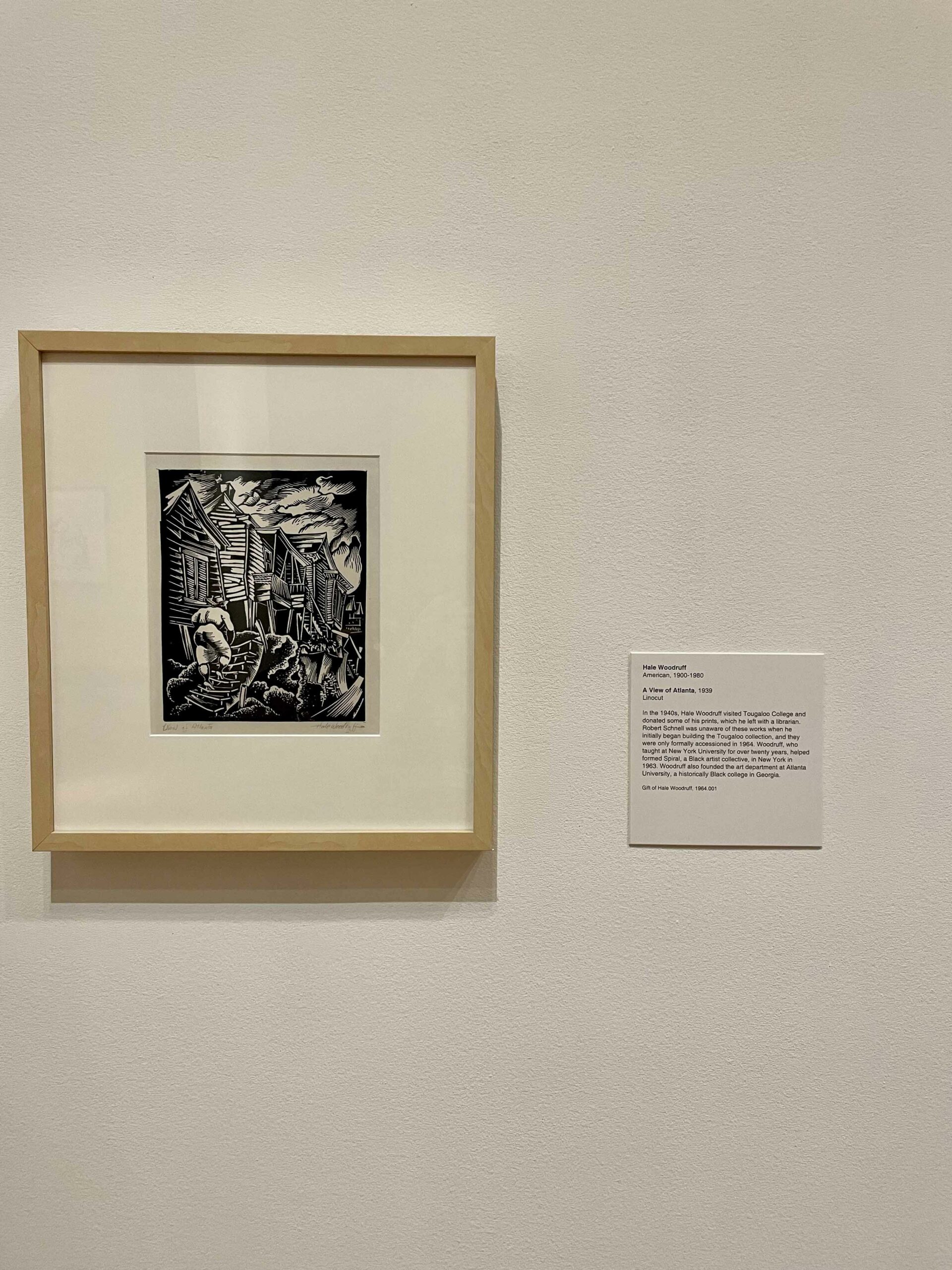
Hale Woodruff, “A View of Atlanta,” 1939, linocut, Tougaloo College Art Collections
So how did the first modern art collection of the state of Mississippi develop at Tougaloo? First, understand that the college was founded by the abolitionist-led American Missionary Association in 1869 to educate recently freed enslaved people and their descendants (other colleges they helped to establish include Fisk University, Hampton Institute and Howard University), and the fight for equality has been central to Tougaloo’s mission ever since. By 1963, a group of artists, art collectors, and art critics, like Jeanne Reynal and Dore Ashton, formed the New York Art Committee for Tougaloo College to create an art collection as a means to bridge racial divisions, viewing art as a tool for social justice.
What were some of the first artworks collected? Well, you’ve got works by Pablo Picasso, Henri Matisse, Francis Picabia, and Philip Guston, among many other established names of modern art. By the end of the 1960s, the students and faculty at Tougaloo pushed for acquiring artists and artworks that better represented themselves and their African American community, leading to the development of relationships with artists like Romare Bearden and David Driskell. Dr. Ronald O. Schnell, an art professor and the first curator of the Tougaloo College Art Collections, initiated the African American Collection with two prints donated to the college by Hale Woodruff, who had first visited the campus in 1943 to paint and lecture.
By 1971, thanks to a grant from the National Endowment for the Arts, the collection expanded to living artists of color like Beaden, Jacob Lawrence, Alma Thomas, Robert Blackburn, Emma Amos, and Elizabeth Catlett, who believed that “art is only important to the extent that it aids in the liberation of our people. I have always wanted my art to service my people — to reflect us, to relate to us, to stimulate us, to make us aware of our potential.”
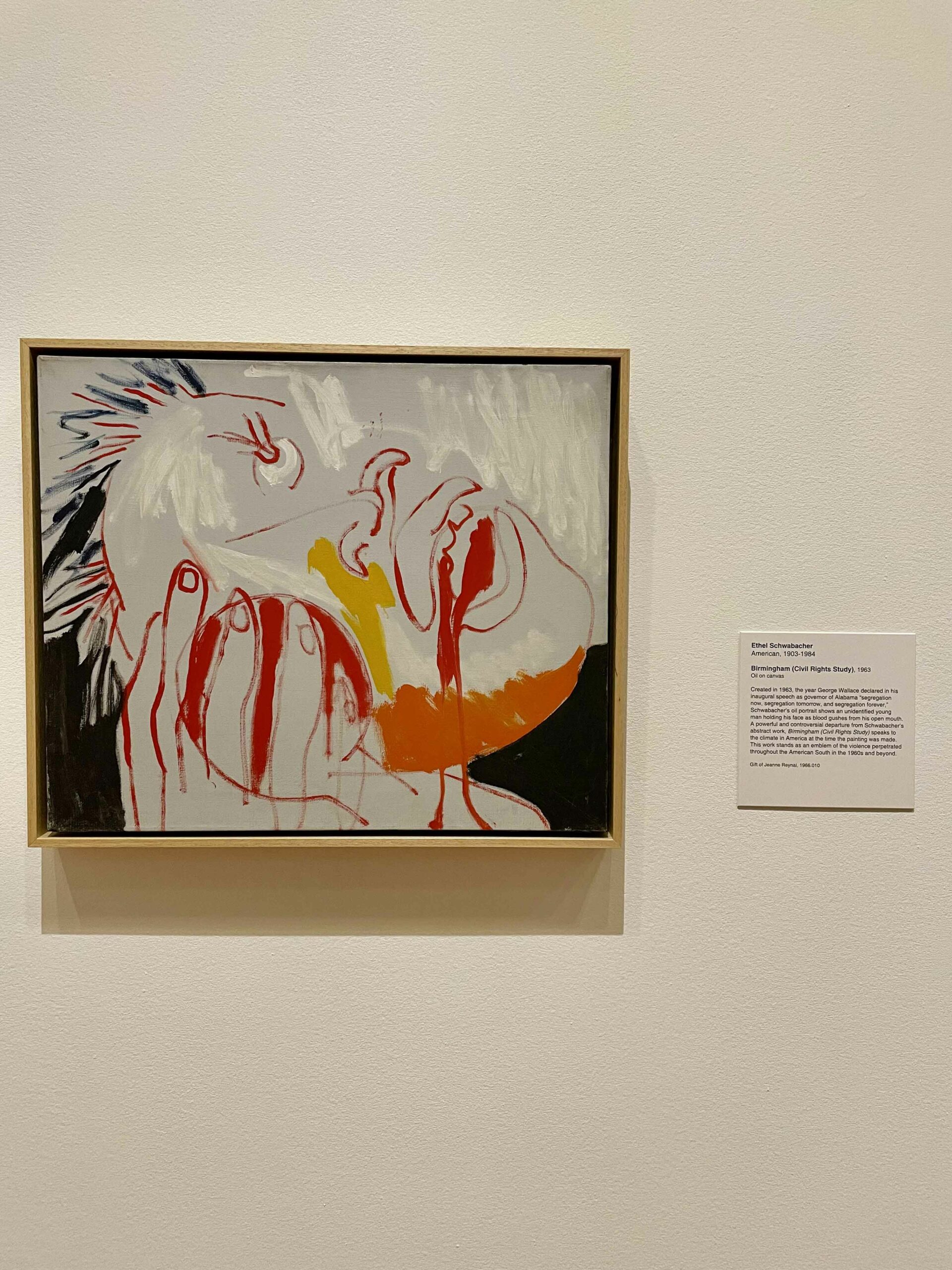
Ethel Schwabacher, “Birmingham (Civil Rights Study),” 1963, oil on canvas, Tougaloo College Art Collections
For some of the artists represented in the Tougaloo collection, modern art offered possibilities to incorporate principles of social reform and the ideals of civil rights. For example, Ethel Schwabacher departed from abstraction and turned to figuration in her artwork Birmingham (Civil Rights Study). The painting depicts the face of a man as he holds his bloody head, speaking to the political and social climate in America as images like this proliferated through the media covering civil rights marches and demonstrations. Although completed in 1963 and intended to represent the contemporary violence perpetrated throughout the American South, the subject of this artwork resonates 60 years later, as our country continues to witness the brutality many citizens of color face today at the hands of the police.
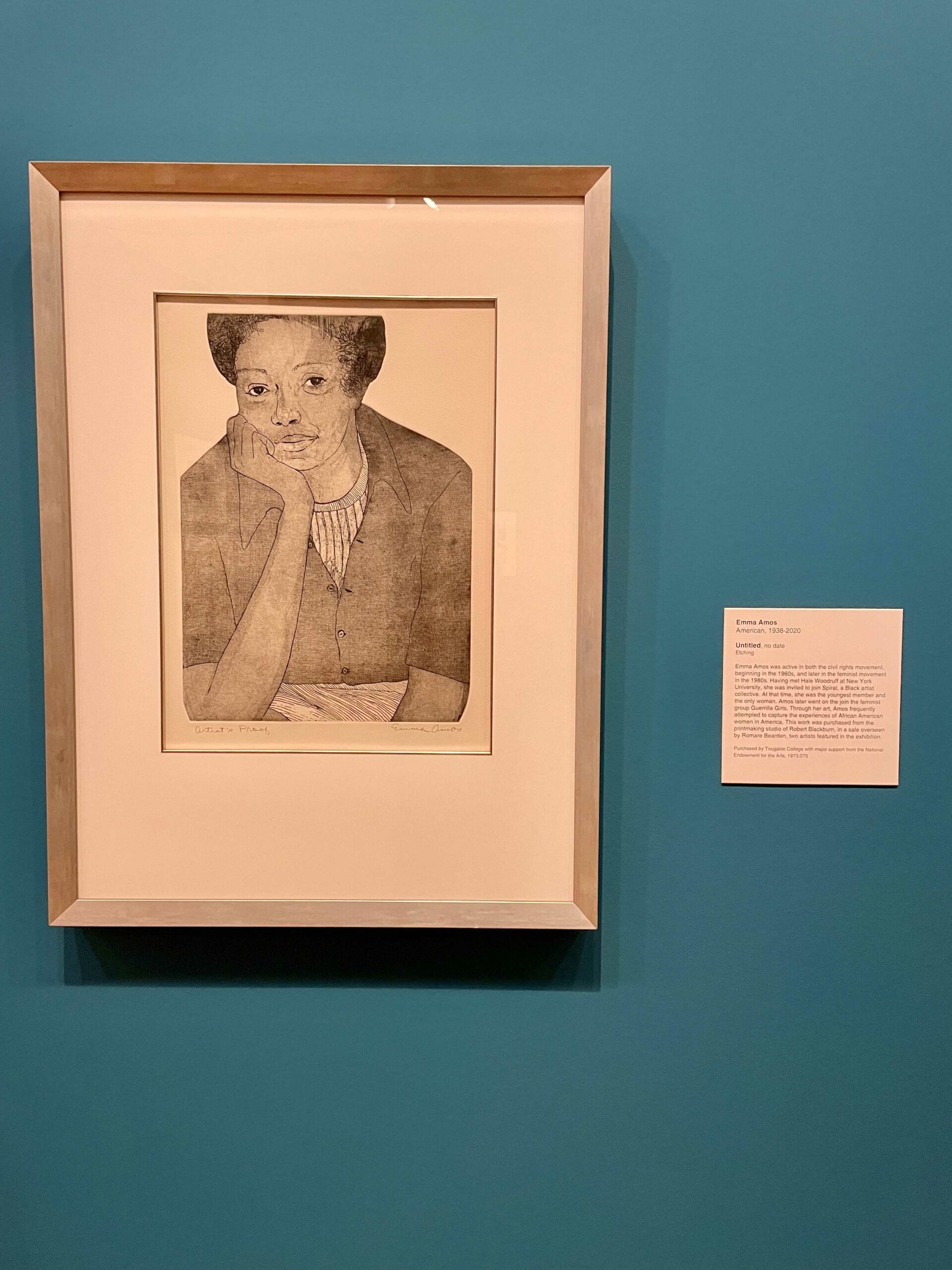
Emma Amos, Untitled, no date, etching, Tougaloo College Art Collections
Included in the collection is an early, undated etching (purchased in 1973) by the Atlanta-born Emma Amos, made when she was focusing on scenes of Black middle-class domestic life. Amos was active in the civil rights movement in the 1960s. In 1964, Woodruff — also represented in the Tougaloo collection — had invited Amos to join Spiral, a Black artist collective in New York City, making her both its youngest member and the only female member.
Artists like Woodruff and Bearden organized the group in response to the 1963 March on Washington advocating for racial equity. Spiral artists wrestled with questions like: what relationship should artists have with the social and political concerns of Black Americans? How do artists continue making work in this divisive moment? I think these questions are still pertinent for today’s artists as well. For Amos, “It’s always been my contention that for me, a Black woman artist, to walk into the studio is a political act.” Today, Amos is known for her brightly colorful figurative paintings, which weave her love for textiles directly into her canvases, and she has long been recognized as an important figure in American art.
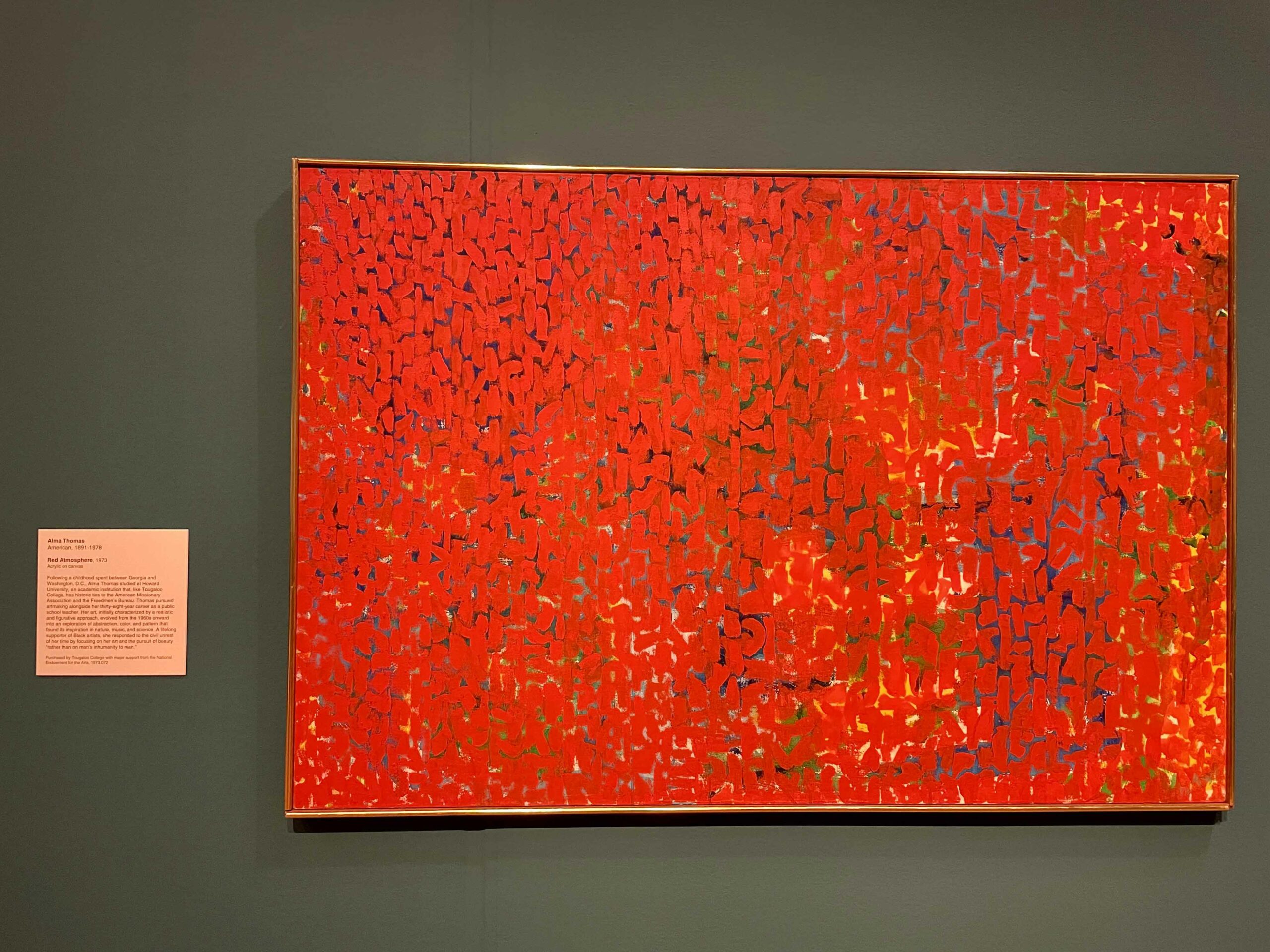
Alma Thomas, “Red Atmosphere,” 1973, acrylic on canvas, Tougaloo College Art Collections.
Another Georgia-born artist included in the Tougaloo collection is Alma Thomas. Though her early work was initially realistic and figurative in approach, by the 1960s Thomas identified with Color Field painters. With their explosive color and form, her luminous abstract paintings, like 1973’s Red Atmosphere, may seem incongruous with the political climate of the era. Living in Washington, D.C. in the 1960s, Thomas witnessed the many protests taking place in the nation’s capital. In fact, she herself attended the 1963 March on Washington for Jobs and Freedom. The first woman to earn a degree in art from Howard University, as a Black woman artist, Thomas encountered many barriers. However, she did not like the label of “Black artist”; she instead saw herself as simply a painter and an American. She chose to find meaning beyond racial and gender constraints and focused on the pursuit of beauty “rather than on man’s inhumanity to man.” In 2015, one of her works became the first piece of art by an African American woman to enter the White House collection, when the Obamas hung Resurrection (1966) in the White House dining room.
In his 1962 talk “The Artist’s Struggle for Integrity,” James Baldwin argued that, “your pain is trivial except insofar as you can use it to connect with other people’s pain; and insofar as you can do that with your pain, you can be released from it, and then hopefully it works the other way around too; insofar as I can tell you what it is to suffer, perhaps I can help you to suffer less.” There was a lot of pain experienced and witnessed by many of the artists represented in the early formations of the Tougaloo College Art Collections. Having lived during the age of the Civil Rights Movement, these artists digested the constant proliferation of visual imagery of anger and resistance moving across the country.
Although today we live in the 21st century, the battles of the 1960s don’t feel so distant. Started in 2013, the efforts of the Black Lives Matter movement continue to reverberate across the nation, as people seek to highlight racism, combat race-based police brutality, and campaign against hierarchies of racial inequality. Likewise, at a time when the country is in distress and history is being rewritten by lawmakers who are trying to restrict access to healthcare for women and transgender people, manipulate the foundations of our democracy by limiting access to voting (primarily affecting people of color), and whitewash the textbooks with which we educate our children, the stories that Tougaloo’s collection represent seem more relevant than ever.
With over 1,500 works, today the Tougaloo collection is divided into three areas: the American Collection, the European Collection, and the African & Oceanic Collection. If you plan on traveling beyond the borders of Texas this year, a selection of works from the collection is on display in the exhibition Art & Activism at Tougaloo College. It will travel to Harrisburg, Pennsylvania at the Susquehanna Art Museum (June 10 – September 10, 2023) and then on to Davenport, Iowa at the Figge Art Museum (October 7, 2023 – January 28, 2024). For those unable to view the exhibit or visit Tougaloo College, check out the accompanying publication of the same name that was published last year (2022), with essays by Turry M. Flucker, the former the Director and Curator of the Tougaloo College Art Collections, as well as contributions from Michael Neumeister and Asma Naeem, the first person of color to direct the Baltimore Museum of Art.
Art and Activism at Tougaloo College is on view at the Oklahoma City Museum of Art through May 14, 2023.
The post The Intersection of Art and Social Justice in Small Town Mississippi appeared first on Glasstire.
If you live south of Interstate 10, you may be wondering what all the fuss is about in terms of the potential for heavy rainfall this week. Much of the southern half of Houston did not see any rainfall Monday, whereas some locations near Tomball received as much as 4 inches of rainfall in a short period of time. This is a pattern we expect to continue today. Not everyone is going to see heavy rainfall, but the areas that do likely will see high rainfall rates that can quickly back up streets.
For today and tonight I expect that most of the area will receive 1 to 2 inches of rainfall, which is more than manageable. What concerns me is that the atmosphere is primed for heavy rainfall, and some locations within the Houston metro area may quickly pick up 4 to 6 inches through this evening, and this may cause more than nuisance street flooding. For this reason we are upgrading to a Stage 2 flood event for today. Please understand that most of the Houston region likely will not see serious flooding, but the potential exists and you need to be weather aware today and tomorrow.
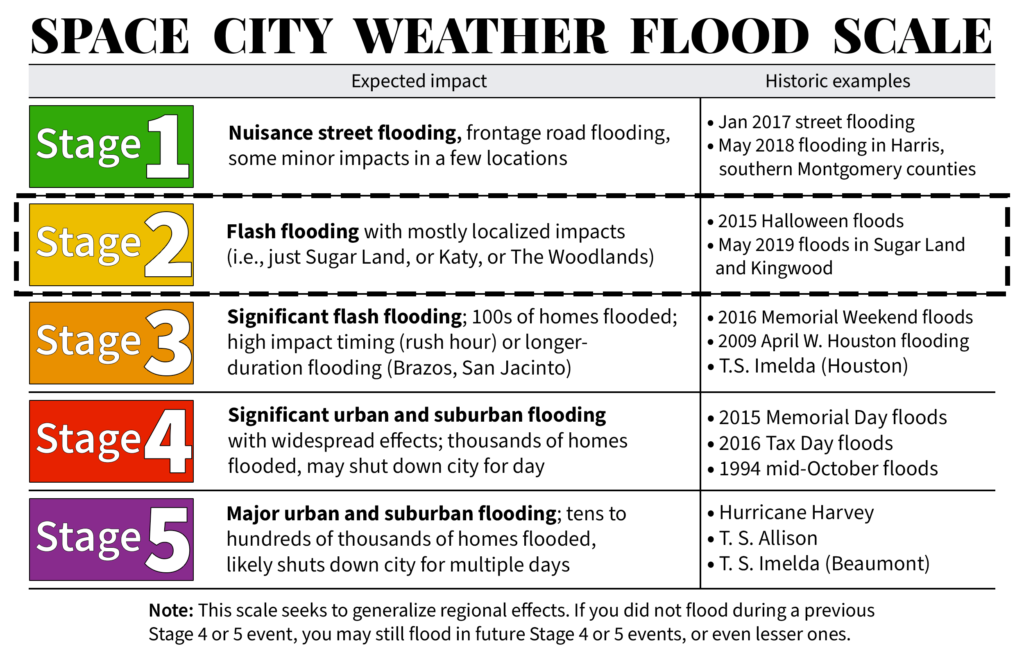
This storm activity will be driven by a combination of a very moist atmosphere as well as upper-level disturbance over southern Texas that will produce the kind of lift needed for heavy rainfall. Storms have already developed near Victoria and Port Lavaca this morning, and they should steadily build toward the Houston metro area from the southwest. By mid-morning these storms should move into the central Houston area. The greatest threat appears to be from mid-morning to mid-afternoon for Houston.
Highs, otherwise, will reach about 80 degrees in the metro area with cloudy skies. Winds will be out of the south at 5 to 10 mph. Rain chances will probably slacken this evening and into the overnight hours. Lows will drop to around 70 degrees in the city tonight, with slightly cooler conditions inland.
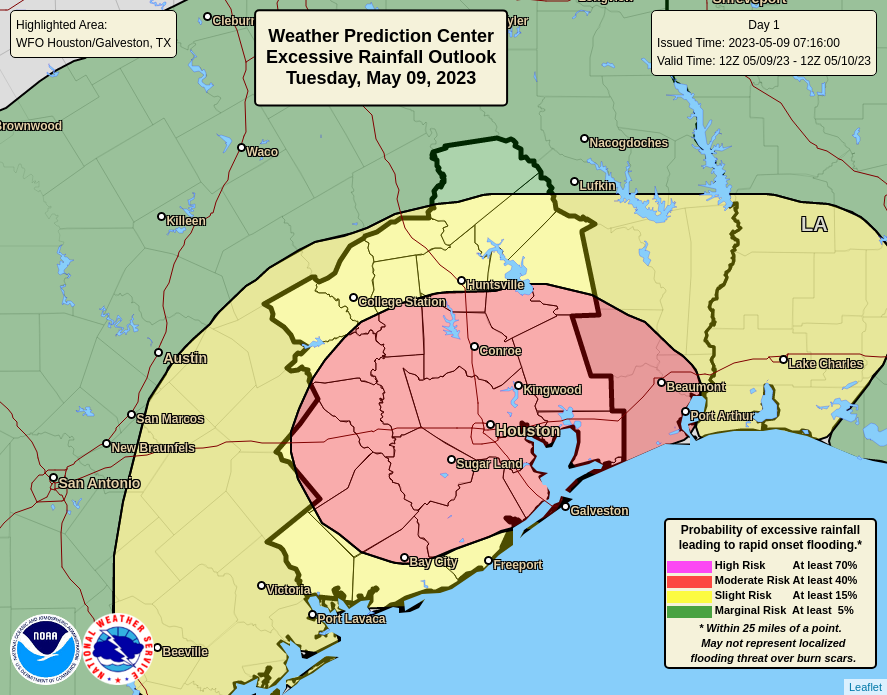
This will be another day with the potential for heavy rainfall and widespread showers, with perhaps an earlier start during the morning hours than on Tuesday. This may be a repeat of Tuesday in terms of a flooding threat, or not quite as bad. In any case, we’ll be watching things closely and publish an update this evening if warranted. Highs should again reach about 80 degrees, with light southeasterly winds. Lows should drop into the low 70s.
As the aforementioned upper-level low pressure system starts to lift away from the Houston area, the threat of heavy rainfall should start to ease somewhat. That’s not to say rain chances will be zero, as they’ll still be in the 30 to 50 percent range each day. Both afternoons may see a bit of sunshine, allowing highs to reach the mid-80s. Lows remain warm and sticky.
So the weekend does not look ideal for outdoor activities. Saturday, in particular, should be cloudy with a healthy chance of light to moderate rainfall. I’m not concerned about flooding, but we may see some thunderstorms. Highs likely will be in the mid-80s. Sunday has a chance to be more favorable for outdoor activities, with lower rain chances and the possibility for partly sunny skies. Rain chances are still going to be at least decent, however, for some sprinkles or showers.
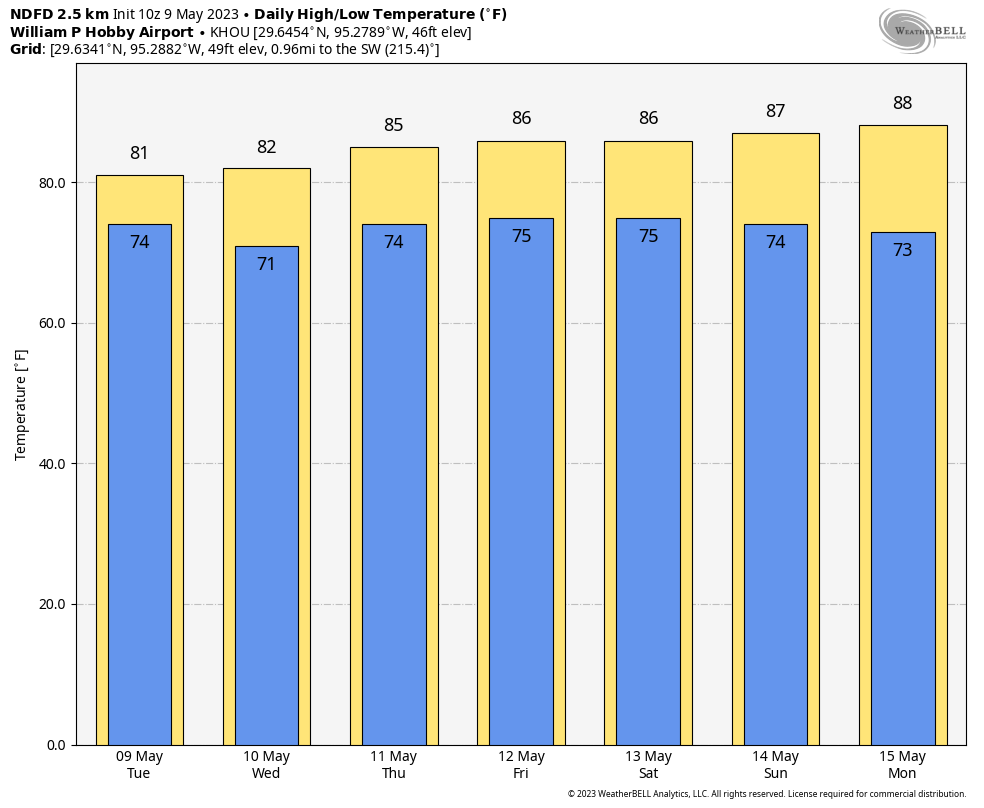
Modest rain chances likely will continue into next week as some sort of front—not a very strong one, alas—works its way toward the region. This may give us a few days with somewhat sunny skies and slightly drier air by Tuesday or Wednesday of next week. But that forecast, for now, is a mix of data and hope on my part. We’ll see.
This post was written by Alison Green and published on Ask a Manager.
It’s five answers to five questions. Here we go…
1. How can we be less drinking-focused when we socialize?
I’ve read a few of your old posts about drinking culture and none of them seemed to get at this thing exactly. Socializing with coworkers is a big part of corporate culture at my workplace, but it’s always been happy hour or drinks-focused. We’re growing and our team is getting more diverse in terms of religion, sobriety, and ability to attend after work social hours due to children, but leadership hasn’t really changed their approach to team building beyond “drinks at the pub.”
I’d like to push back on this attitude but also offer resources to solve this problem or ideas on how to make team-building more attainable. We’re also in a nationally distributed remote/hybrid situation with most people being able to get to a few centralized locations during the week for work, but able to work from home. When folks fly in for meetings or workshops and there is an opportunity to connect, the go-to meet-and-greet suggestion is happy hour and I’m just looking for more options to propose but am wary of leaning into the sorts of team gathering that is heavily sports-focused. Any ideas?
Yep, happy hours can exclude a lot of people — people who don’t drink for health or religious reasons, recovering alcoholics, people who need to get home to care for kids, and people who just don’t like it. You want activities that (a) aren’t so alcohol-focused and (b) take place during work hours. What about a late afternoon in-office mixer with snacks and beverages (including non-alcoholic ones)? Ice cream social? Lunchtime taco truck? Coffee and tea tasting? You still may have people who can’t or don’t want to eat ice cream, tacos, or coffee, but mixing it up and using a bunch of different options over the course of the year will be a lot more inclusive than just drinks every time.
You can also look at non-food options too, but those depend on what the majority of your employees would enjoy. Silly talent show? Video game challenge? Pictionary tournament? There’s no one idea that everyone is guaranteed to like (and with any single activity, you will almost certainly have some people who don’t like it) but, again, if you’re mixing it up and not using the same activity every time — and not making any of this mandatory, officially or unofficially — you’ll be more inclusive over time than you are right now with everything centered around drinking.
2. Can I complain about a bad interview a year ago?
About one year ago, I had an interview with a very disrespectful hiring manager. He started with lies, continued with belittlement and ended with insult. Of course I didn’t want the job and half assed the interview (I did not think I could leave an interview).
Now I want to complain about him to the higher-ups. I don’t want anything, I just want to stand up for myself, because I felt that I let him walk all over me. Disrespect does not have expiration dates. What do you think?
It’s going to come off strangely if you contact them a year later. Job applicants are already at a disadvantage in complaining about interviewers even right after the fact (you’re an unknown quantity with no capital with them, rejected candidates sometimes complain simply because they were rejected so you’re associated with a weird group, etc.). When it’s a year later, you’re going to have even less influence.
Instead, use this as resolve to cut short any interview in the future where you’re treated that way. You can walk out of an interview where you’re being mistreated — for that matter, you can politely cut short an interview where you’re not being mistreated but just know the job isn’t for you — and if you use this situation as impetus to do that next time, it won’t be a wasted experience.
3. Can my job applications somehow convey “I’m better in person”?
I’m doing the digital application slog that precedes the interview portion. In a subversion of the usual interview woes, I am actually very good at interviews! Is there any way to convey in the “tell us more” section of the online applications that I pop more in person and that even a brief chat would help them see the benefit I can bring? Obviously it won’t get me in anywhere I’m not qualified, but for positions where I’m mostly qualified, I can often count on my charisma and interviewing skills to carry me to a “yes.” I want capitalize on that if I can, but I can’t think of a way to relay this information without coming off as a braggart. (It’s hard enough not sounding like it now!)
Not really. A ton of job applicants try to convey some version of “if we could just meet, I think you’d want to hire me” (and often, although not always, the people saying this are not especially strong candidates) so even if it’s more-than-typically true in your case, there’s no way to say it that is more credible than the rest. That’s especially the case because your reason for wanting to meet in person is about charisma and interviewing skills — things employers don’t like to think of themselves as being swayed by, even when they are.
Focus on writing a resume that shows a track record of achievement and an engaging cover letter that explains why you’d excel at this particular job.
4. Why do gift cards feel better than cash for a teacher gift?
A question came up at work today that I wanted your perspective on. One of my coworkers recently transitioned his son from family childcare to a daycare center. He was asking today if it would be appropriate to give a cash tip for teacher appreciation week (and in the future for Christmas) and if so how much? The general consensus was that he should give a gift card, rather than cash, but none of us could quite put a finger on why giving cash to a daycare or preschool teacher felt wrong. We generally agreed that if he had a nanny, a cash bonus would be the best option. He compared it to leaving a cash bonus at Christmas for the mailman or the garbage collector and was struggling to explain why this felt different.
For reference, we are teachers ourselves, and felt that while we appreciate gift cards, getting a cash tip from a parent would feel weird. While he accepted our answer, none of us were really able to explain why it felt wrong to give daycare workers or teachers cash as a thank you. Is there some actual reason we’re missing?
Hmmm! I think it’s a combination of (a) the difference between a gift and a tip, and (b) tradition. We don’t typically tip teachers, but we do give them gifts — so while a gift card is ultimately money, it doesn’t say “tip” the way pure cash does.
I think your use of the word “bonus” might also be tripping you up — a bonus is something added on to your salary by the person who pays for your work. So your employer can give you a bonus, but when you give cash to the mail carrier that’s a tip, not a bonus.
5. Do our hourly employees need to be paid for this?
I work at a clinic that is corporate-owned. We recently hired a new full-time doctor. This doctor is not getting enough clients to keep them busy. As a result, we were trying to come up with ways to get clients in the door. One of those ideas was to have a table, representing the clinic, at the local dog expo. The dog expo was held on a Saturday and Sunday, during non-office hours. The table was manned, in shifts, by the new doctor, the office manager, and two technicians. The new doctor and the office manager are salaried, whereas the technicians are paid by the hour. One of the technicians asked to be paid for her time at the expo. Corporate said it would not be fair to pay the techs and not the doctor or the office manager. The compromise was to buy a nice dinner for the office manager, new doctor, and the two techs.
Is it legal not to pay hourly staff for working on their weekend to try to drum up business for the new doctor? I get not paying salaried staff, but what about the hourly staff?
Nope, it’s not legal. Unlike exempt staff (which definitely includes your doctor and may or may not include the office manager, depending on their job duties), hourly/non-exempt staff are required to be paid for all hours they work, including overtime (time and a half) for any hours over 40 that week. And they have to be paid in money, not dinner.
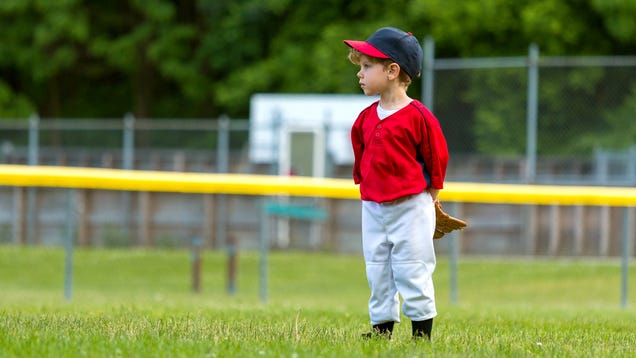
WILLIAMSPORT, PA—Officials have reportedly been dealing with a high volume of player complaints in the first weeks of the season as Little Leaguers express concerns that introducing a pitch clock would cut into their grass-picking time. “I get that they want to speed up the pace of play, but this pitch clock is going…

Yeah, sex is cool, but have you tried being an incel? If you happen to know an incel or are currently being harassed by one, here are things you should never say.

The Ajax, Ont. group first formed in 1996, later becoming one of pop-punk's biggest acts in the early 2000s.
OTTAWA – The Government of Canada confirmed this week that images of Charles Mountbatten-Windsor, an unpopular foreign billionaire, will soon be placed on Canada’s coinage and $20 bills in the hopes that this will hasten Canada’s transition to a cashless society. “The government has tasked the Royal Canadian Mint to design and place an effigy […]
The post Canada to discourage use of physical money by putting images of Charles on it appeared first on The Beaverton.
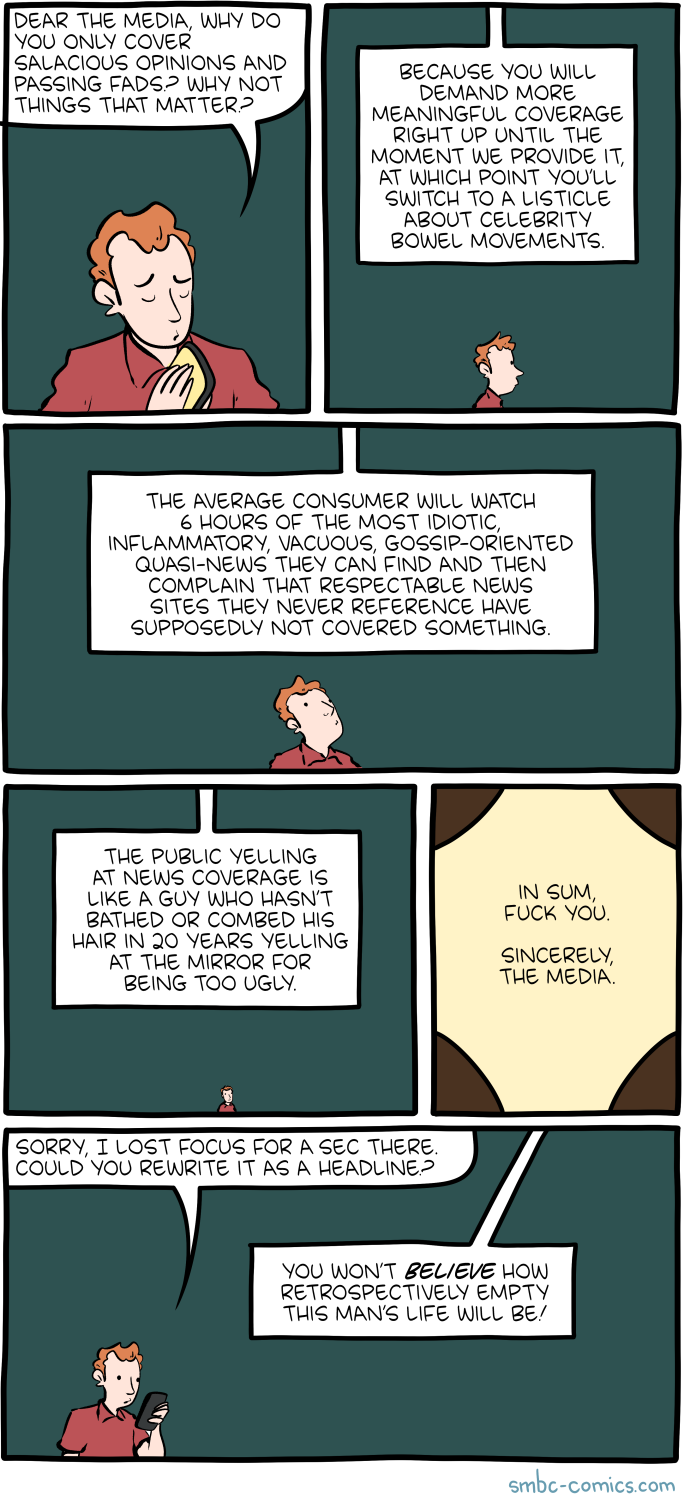
Hovertext:
This has been episode 429 of Zach Personally Antagonizes His Paying Customers
/https://static.texastribune.org/media/files/860f0173af2979a8972e8823f948cf3f/0425%20House%20Floor%20File%20TT%2003.jpg)