Twins are used to fielding all sorts of questions, like "Can you read each other's minds?" or "Can you feel each other's pain?" Two of our Planet Money reporters are twins, and they have heard them all.
But it's not just strangers on the street who are fascinated by twins. Scientists have been studying twins since the 1800s, trying to get at one of humanity's biggest questions: How much of what we do and how we are is encoded in our genes? The answer to this has all kinds of implications, for everything from healthcare to education, criminal justice and government spending.
Today on the show, we look at the history of twin studies. We ask what decades of studying twins has taught us. We look back at a twin study that asked whether genes influence antisocial behavior and rule-breaking. One of our reporters was a subject in it. And we find out: are twin studies still important for science?
The history of Texas, in the way it is taught, researched, and presented to the public, has reached a crisis point. Since 1897, the principal organization in the presentation, teaching, and researching of Texas history has been the Texas State Historical Association (TSHA). For 126 years, the TSHA has welcomed academics, lay historians, and anyone else at its meetings. On May 1, 2023, the interim executive director of the TSHA, J.P. Bryan, a retired oil billionaire, filed suit against the organization’s board of directors to block the board from meeting, and also threatened to sue the current president of the TSHA, Nancy Baker Jones, for defamation. The allegations in the lawsuit are important to this story, but when Bryan and his compatriots reached out to reporters regarding the controversy, it became clear that they have a much broader agenda. In short, they framed their dispute over the composition of the TSHA board as an ideological conflict, painting academic historians as “leftists, Marxists,” and worse, and Bryan and his supporters as defenders of “true” Texas history.
Given their published statements, Bryan and his supporters consider “true” history to be the perniciously persistent Texas mythology that uses white supremacy as a guiding principle. They favor triumphant tales of Anglo males conquering and defending a vast wilderness while ignoring the contributions and treatment of minority groups. The danger of returning to a whitewashed triumphalist history of Texas lies in erasing the contributions of minority groups. Such erasure would give us a warped sense of the past and lead to racist policies and politics in the present. Maintaining a mythic, triumphalist Anglo history would lead to increased discrimination and exclusion of minority groups in Texas today.
The writing and teaching of history never have been—and never can be—fully neutral. The way history is presented always tells the audience more about the present than about the past. History consists of two elements: historical facts and interpretation to provide a context, and a narrative to explain what those facts mean. Yet even the topics historians choose belie neutrality. As James Baldwin wrote in a powerful essay in the 1960s: “White man, hear me! History, as nearly no one seems to know, is not merely something to be read…The great force of history comes from the fact that we carry it within us, are unconsciously controlled by it in many ways, and history is literally present in all that we do.” At best, historians must attempt to discover narratives while inevitably viewing topics from different and often competing perspectives.
This does not suggest that accurate or quality history cannot be achieved, but its creation requires confronting and attempting to overcome forces that have silenced or influenced the record. Michel-Rolph Trouillot describes how silences enter the historical record in four phases: during fact creation by the sources themselves, during fact assembly in the making of archives, during fact retrieval in the assembly of a narrative, and during retrospective significance in the making of history in its final expression. Minority groups suffer greatly in these silences. They often have had fewer sources created about them, received less attention in the assembly of archives, were included in fewer narratives, and therefore were often assigned less retrospective significance by historians. Other than silence, the force that influences history most is the personal. As Baldwin noted, “It is with great pain and terror … that one enters into battle with that historical creation, Oneself, and attempts to recreate oneself to a principle more humane and more liberating: one begins to attempt a level of personal maturity and freedom which robs history of its tyrannical power, and also changes history.” Trouillot wrote that “[W]e are never so steeped in history as when we pretend not to be, but if we stop pretending we may gain in understanding what we lose in false innocence.”
For decades, textbooks glorified figures like Stephen. F. Austin while erasing or demonizing the experiences of others. Wikimedia Commons/Billy Hathorn, Creative Commons Share Alike license
The popular historical narrative of Texas that J.P. Bryan and his compatriots seek to revive was created after the American Civil War in a process that paralleled the birth of that war’s “Lost Cause” mythology. In 1888 Anna Pennybacker published A New History of Texas for Schools, which became the standard textbook for decades. Her scholarship placed outsized importance on the Texas Revolution—in particular the Alamo—and on glorifying the Texas Rangers. Of the defense of the Alamo, Pennybacker wrote that the “Texans stood” on the walls “like gods.”… With slavery and the Black experience in general erased, Mexicans demonized, and enslavers and Texas Rangers glorified, this textbook set the tone for the mythologizing of Texas history. Historian Gregg Cantrell in his article “The Bones of Stephen F. Austin: History and Memory in Progressive Era Texas” uses Austin’s 1910 reinterment in the Texas State Cemetery as a way to explain the creation of the popular historical memory of Texas. Cantrell asserts, correctly, that in the early 20th century, “Texans began distancing themselves from the memories of the Civil War era—memories associated with slavery, defeat, military occupation and poverty. … The result was a new public view of Texas history that emphasized Texas as both a Western and quintessentially American state whose identity sprang from the hardy pioneers who tamed the wilderness and defeated the Mexicans in the Texas Revolution.” He concludes: “While this may have been a very ‘usable’ past, at least for Progressive Anglo male elites, the triumphalism of the heroic Revolutionary past also left Texans with a highly sanitized collective memory in which Texas’s Hispanic past was largely forgotten and the state’s subsequent stake in slavery, secession, and racial injustice was glossed over.”
These views of Texas history held on throughout the vast majority of the 20th century, and only in the 1970s and 1980s did professional historians begin to challenge this collective memory. Texas historians began bringing narratives of forgotten and neglected groups to light, narratives that, over the last 30 years, the Texas State Historical Association, through the Handbook of Texas and the Southwestern Historical Quarterly, has continued to expand on. Still, many Texans continue to suffer under narratives constructed in the late 19th and early 20th centuries. Not until 2012, barely a decade ago, did any minority group have a monument, the Tejano Monument, dedicated to them on the grounds of the Texas State Capitol, and not until 1980 did the State of Texas recognize the enforcement of the Emancipation Proclamation and the end of slavery in Texas on Juneteenth as a state (and as of 2021), a national holiday.
All this brings me back to the lawsuit against the Texas State Historical Association. Bryan and his attorneys allege that the TSHA board is improperly constituted because the bylaws call for an equal balance between academics and nonacademics. He specifically objected to the election of Mary Jo O’Rear to the board by describing her as an “academic.” However, the TSHA bylaws provide the definition of academic “as an active or retired employee of an accredited academic institution whose position at that institution materially involves (or involved) the teaching and/or research of history.” Unless we are to include all current or retired public school teachers under this heading,
O’Rear is not an academic. Despite this, Judge Kerry Neves of the 10thJudicial District in Galveston issued an injunction on May 30, preventing the TSHA board from meeting and setting a trial for September 11, 2023. This court decision has resulted in Bryan governing the TSHA without oversight. With his stated ideology, it is not unreasonable to fear that Bryan is at this very moment erasing from the Handbook of Texas and elsewhere any Texas history he does not like.
Putting aside the fact that the future of the TSHA should not be decided by a lawsuit, once again Bryan and his defenders have used the composition of the board of directors as a façade to push their agenda. In a letter to the board, Bryan accused Jones of “promoting a version of history that totally ignores a large body of our membership.” Bryan has also publicly compared himself to the defenders of the Alamo and stated, “I don’t like their history,” as if he could wish away historical facts.
The TSHA should serve all the people of Texas. J.P. Bryan and his compatriots clearly want to return to Pennybacker’s whitewashed narrative, but today’s Texas is more diverse than ever, and our scholarship and scholarly organizations must reflect this diversity. TSHA’s own diversity statement reads: “As we enact our mission, our responsibility is to recognize, include, and preserve the histories of Texas people and cultures, all of whose stories are an essential part of Texas history.” We cannot return to the white supremacy of the Progressive Era.
As a seventh-generation Texan and an Anglo male, my own history and that of my family and forebears is already fully represented by the TSHA and its publications, and my goal is to make sure that all other Texans feel the same way.
In his writings, Baldwin included a stark warning about people who put themselves at the center of the historical narrative. He wrote that “people who imagine that history flatters them … are impaled on their history like a butterfly on a pin and become incapable of seeing or changing themselves, or the world.” Just as Texas cannot stand still, neither can our historical narratives. We have two paths in front of us: Either we can return to an Anglo-centric, triumphalist, white supremacist narrative, or we can break free and write new chapters in the historical narrative, chapters that include and reflect the glorious diversity of this state. We are at a crisis point, and I hope that you will join in a defense of the history of ALL Texans.
Not such a comfort — To see how a man’s stress levels and diet might alter his shape, one might give comfort food to a stressed rat and study its penis. Researchers at the State University of Rio de Janeiro in Brazil did exactly that, but with a larger number of rats (32 in total, though not all were given comfort food and only some were stressed)….
Somewhat missing stuff — … A Polish journalist tells Feedback that during those four months from December to April, everyone was aware that the object was somewhere in Poland, but the government apparently made no effort to find it or acknowledge its existence. The journalist says, “It was probably a missile sent into Poland by mistake in a typical Russian army screw-up. It was unarmed.” The horseback rider’s discovery forced the government to officially stop not noticing the object’s existence….
Unskilled and unaware — … One group, psychologists, sometimes tries to use mathematical tools to analyse human behaviour that can be difficult, maybe impossible, to analyse using only mathematical tools. The other group, mathematicians, also sometimes tries to use mathematical tools to analyse human behaviour that can be difficult, maybe impossible, to analyse using only mathematical tools. Each group tends to see itself as more competent than the other at analysing human behaviour….
Distance learning — Having surveyed Feedback’s list of trivial superpowers, Mandi Brooker adds one that is educational. She says: “I am a high school maths teacher with absolutely no sporting/throwing/ kicking ability whatsoever, but when I find that a whiteboard marker is getting irritatingly faint, I can hurl it right across a big classroom unerringly into the bin, every time. It impresses the kids no end, which is all there is to teaching, really”.
In the lead-up to today’s Nintendo Direct, rumors have swirled that, among whatever else might be announced during the presentation, we’d be seeing a remake of a beloved Super Nintendo classic. Just which game it might be, however, remained unclear, so fans on Twitter took the opportunity to drum up hype around their own favorites potentially getting the remake treatment, with legendary games such as Chrono Trigger, Earthbound,and Super Mario RPG being among the most clamored for. Now, the announcement has been made and it is, in fact, Super Mario RPG, which is slated to launch on November 17.
A SNES Mario Classic For The Modern Era
Nintendo revealed during its 40-minute Direct presentation that the SNES classic Super Mario RPG will soon make its modern-day debut on the handheld-console hybrid. This was after rumors began swirling on June 19 when Twitter user Pyoro_ND, who accurately predicted Everybody 1-2 Switch and Sonic Superstars before they were revealed, posted that “a remake of a SNES classic” would get announced during the Nintendo Direct livestream.
The trailer started with the classic game rendered in its 2D pixel art form before transitioning into full 3D animation. It’s cute and bubbly in the best way. But despite the new coat of paint, this is still Super Mario RPG through and through. The game finds Mario and Peach join forces with Bowser and a few newcomers—Geno and Mallow—to save the Mushroom Kingdom from a new threat, the vile Smithy. Defined by endlessly charming dialogue, involving turn-based combat that incorporates turn-based inputs, and endless touches that bring the world of Mario to life in a whole new way, the game’s reputation as a beloved SNES title and a wonderful RPG is well-earned.
The game launches this November on Nintendo Switch and preorders are now available. But this isn’t the only Mario game Nintendo revealed during its Direct livestream. After styling on Mario in the Super Mario Bros. Movie, the company revealed that Princess Peach will get her own game as well.
This post was written by Alison Green and published on Ask a Manager.
It’s a special “where are you now?” season at Ask a Manager and I’m running updates from people who had their letters here answered in the past. Here are three updates from past letter-writers.
First, it was nice to hear from you and the commentariat that I was basically on the right track. Second, it was exceptionally helpful to hear from the people who said that having a memento might be problematic (when would I get rid of it? how would that make feel? etc.). And it also encouraged me, when I moved, to leave behind a memento from the first colleague who’d died. So thank you all for that.
Other things that happened:
– I think I mentioned that I was planning to call the EAP (employee assistance program) – I am now a huge fan. I called them, they responded really quickly, and I met with someone (over the phone) once who was a great match for me. That was very helpful and we actually started a second session but we agreed that I just didn’t need it.
– I think I also mentioned that I was planning to speak to my supervisor who was lovely about it but said that there were no other spaces so she said I should try it out and then we’d see how it was working.
– Big thanks to the person (people?) who suggested moving the furniture around. In the end, I couldn’t move the desk because of outlet access — but! I got a new desk that looks really different (both color and style) from the old one so that was a huge help. I also cleared out (what felt to me like) excess furniture, moved the location of the bulletin board, yadda yadda yadda and, overall, the office just feels really different.
– One thing that the EAP therapist helped me with was to stop calling it Deceased Friend’s office and start making the transition to calling it my office.
Lesson to be learned? Coming at a problem from multiple perspectives — mental re-framing, physical redecorating, consulting with supervisor, getting a little mental health support, and consulting with you all is a great plan!
I’m still sad of course, and there are times I still look around and can see her sitting in it but, overall, things really are fine.
I have a nice update – everything worked out fine!
I stopped worrying too much about finding a “good moment” to correct my coworker on my name and just said it the next time it happened – he used the diminutive while asking me a work-related question, I answered the question and then added “By the way, I prefer to be called Carmen, not Carmenita” (borrowing the names from a comment). He apologized and started using my first name.
And to speak of the comment section… Many people shared their anecdotes about names, nicknames, shortened versions and so on. A fun read (and I learned some stuff), but much of it wasn’t applicable to my situation. I really should have mentioned in the letter that these conversations were not in English, and that a diminutive is not a shortened version. Diminutives are a grammatical function that modifies nouns, with the literal meaning being to indicate smallness, and a very wide range of figurative meanings. And regardless of the intent, one shouldn’t pick a name for someone else that is different from the name they presented, especially at work.
I wrote back in August last year about my friend who works at a secondhand store and has intense jealousy issues.
The situation has become extremely… weird. They pushed back on getting therapy vehemently (to the point where when both my significant other and I suggested online therapy to try to alleviate their concerns, they were outright gleeful when the site we suggested ended up not being the best). But professionally, it’s… even weirder, somehow.
Recently, they were working on the shop floor and very stressed out when they dropped something and ended up swearing in front of a customer. The customer complained, and so they ended up having to have a disciplinary meeting. They proceeded to complain about the disciplinary meeting every single time we spoke (and they contact me at least every other day) for the whole two weeks leading up to the disciplinary meeting. Not only that, all of the complaining was phrased as if the entire incident wasn’t their fault at all. They got mad at their managers and outright called one of them “fake” (not to her face) because she was usually pretty nice, but was “harsh” when she spoke to them about the incident.
The problem with their statement that it was “harsh” is (as mentioned last time) they have a bad habit of negatively perceiving EVERYTHING. Once when a coworker told them they were improving at a task, they accused him of saying they were bad at the task. It’s very hard to believe any statements where they say something is harsh or mean when they have a habit of twisting it into their being the victim.
Honestly, the friendship is very unhealthy, and it took evaluating it from a much more professional standpoint to fully realize that.
Authorities are investigating nearly 100 letters containing a mysterious white powder that were addressed to several Republican lawmakers in Kansas, with the sender referring to themselves in the letters as “your secret despirer.” What do you think?
Mike Miles has wasted no time in restructuring schools and proposing administrative layoffs. The changes are designed to pay teachers at struggling schools more if their students show improvement.
After the post, I took my concerns to HR, and we agreed to draw up a document with the exact steps that Annie needed to take when she was out of office, outline the consequences, and ask her to sign that she’d read and understood them. As well, I told Annie that I would no longer be reminding her of anything via chat, and instead she should expect consequences should the appropriate steps not be taken when she’s OOO. So far so good. After my meeting with Annie, I sent the document over via email and asked her to have it back to me by the next Wednesday.
She missed the deadline, so I put an appointment with me and our HR person on her calendar. Immediately she called me to ask why; when I said it was because she’d missed the deadline, she told me, “I only read the document. I didn’t read your email. Everyone in this company communicates via chat, you can’t expect me to read emails.”
Insert mind-blown emoji here.
As a result, we gave her an official warning during the HR meeting. She found that exceedingly unfair. In her view, any time I’d asked her to stop doing anything, she’d immediately stopped and never done that same thing ever again. Also, it wasn’t fair that I hadn’t told her about the warning when she’d called me. She then was trying to rules-lawyer the document because one part I had outlined wasn’t in her contract or the employee guide – HR had to tell her that as her boss, I was also allowed to request her to do things not specifically written down somewhere else.
She found all this so unfair that she set up an individual meeting with every manager-level member of our team and at least one of her peers, and tried to talk to the CEO, to the facilitator who had been at the original workshop, and to my boss – all this after we had explicitly told her that the way to appeal was through HR. The CEO, who was on her way to a meeting, declined – and Annie popped back with “Well of course you don’t have time for me.” The facilitator contacted me to ask what was going on, because they had the feeling that Annie was trying to manipulate them.
A few hours before our regular one-on-one the next week, right after my boss had called in sick and canceled the meeting she’d put on his calendar that morning, she told me she was not in a mental state to talk to me and that she would not be attending. When I offered to move the meeting, she said she would just wait for the next one. I told her I hadn’t offered skipping as an option. Annie promptly called in sick for a week and a half.
When she came back, it was with a letter from her lawyer demanding that we retract the warning. Aside from accusations about retaliation on my part and saying that she’d been forced to sign the document, she also doubled down on it being unreasonable to expect her to read emails – in her version, I was laying a trap by sending the document via email.
Rather than spending time and money on lawyers, we offered to accept her resignation with some severance pay, which she’s agreed to. Hopefully that’s the end of the saga.
P.S. Here’s the script I used to respond to the mom thing as part of this:
Thank you for your openness last time we talked.
I did want to follow up with you on one piece of what you said — the ‘mom thing.’ You’re not a child, you are a capable adult professional; and what I am doing is managing you, not parenting you.
Framing it that way undermines you, it sounds like you don’t understand the difference between a manager who is setting expectations and a parent who is scolding you. It also plays into harmful stereotypes about women and authority – a woman isn’t recognized as an authority, a leader, a manager – instead she gets called a “mom”, and that doesn’t happen to men. I know you didn’t intend it that way and didn’t realize how it came across, so I wanted to flag it for you.
3. Chocolate cake, ice cream, a pickle, swiss cheese, salami, a lollipop, cherry pie, sausage, and a cupcake.
4. Five sausages, three chicken wings, four slices of watermelon, mashed potatoes, one pancake, sixty-four fries, four Jello cups, and an experimental lychee.
5. A dollop of chicken jalfrezi, a handful of green olives, a blob of moussaka, and a glob of something that turned out to be marmalade.
6. Second helpings of dessert, even with breakfast.
7. Just whipped cream in a bowl.
8. Dogged determination to eat one’s money back.
9. Stomach ache.
10. Regret.
11. Acid reflux.
12. Mammoth constipation.
13. Two-week food coma.
14. Substantial weight gain.
15. Suddenly too much bum and not enough underwear.
16. A pleasing conclusion to the narrative in which the protagonist ultimately learns portion control, and becomes a better Lepidoptera for it.
17. Cankles.
- - -
The Very Hungry Caterpillar: 2, 13, 16 Me at a hotel buffet: 4, 5, 6, 7, 8, 10, 11, 12, 15, 17 Both: 1, 3, 9, 13, 14
SEATTLE—Debuting a new, streamlined classification system, librarians at the Seattle Central Library announced Wednesday that they have officially dropped the Dewey Decimal System in favor of organizing all titles under “B” for books. “This is going to make things so much easier for staff, as well as for patrons who…
Illinois has become the first state to legislate against the banning of books in public libraries, a practice that has been on the rise across the United States as conservatives look to suppress some books dealing with race, history, and LGBTQ topics. What do you think?
This post was written by Alison Green and published on Ask a Manager.
It’s five answers to five questions. Here we go…
1. Can I use an improvement plan for an employee who lies?
At the start of the year, I discovered that one of my direct reports had gone out of their way to disguise a behavior that has been their ongoing performance development need. Say, for example, that they needed to hold fewer accounting meetings with sales. They have been given this feedback for a couple of years running on an ongoing basis and in performance reviews. Instead, I found out that they kept holding the meetings, but marking them private so that I wouldn’t see them. The behavior itself (the meetings) isn’t the end of the world, but obviously the deception I took incredibly seriously.
Given that this came to light just after year-end bonuses had been decided, in talking it through with HR, we decided not to change their bonus for the past year, because all the meetings had been scheduled in the new year. While we also discussed a PIP, we decided to see if the behavior happened again. However, you can imagine that this has affected our (previously strong, dozen-year) working relationship, and I no longer fully trust this person.
In working on our mid-year reviews, I’ve just discovered a discrepancy. I had marked down a number of accounting reports for Q1 back in April, but now my employee is reporting a different number. I am digging into the figures to get to the bottom of this. However, if it turns out that this is a second deliberate falsification, my question is: Is it even possible to structure a PIP around trust and honesty? This person fulfils a critical function. I recognize they may move on at some point and everyone is replaceable, but this would be the single hardest person to replace in a staff of 50. But I also can’t imagine how to coach someone through a PIP to stay when the issue is lying.
You can’t create a performance improvement plan around trust and honesty. PIPs are useful for things like work quality issues, where you need to see if the person is able to raise the quality of their work or not. They’re not at all suited for issues of character and integrity.
I’d be really wary of keeping someone on your team who lied about something significant even just once. But if you do choose to give them another chance, it makes sense to have a very serious conversation about your expectations of honesty and transparency and to explicitly make that conversation the final warning. If there’s a second occurrence, it really needs to be game-over at that point. Realistically, at that point you just can’t trust them at all, and the amount of checking you would need to do to ensure their work really is what they say it is would be impossible.
2. Awkward comments after getting carded at a business lunch
I’m a 32-year-old female attorney in big law. I’ve been practicing for six years, and am now a year or two into getting to handle things like examining witnesses in court and oral arguments. This is a bit on the early side, and sort of a big deal, but I am pretty good at my job and always get good feedback from partners and clients. However, apparently I look very young. Almost every time I go to court, I get some kind of comment (usually from security) about how I must be too young to be a lawyer. Fortunately this has not, until recently, been in front of clients.
I recently concluded a trial and went to lunch with clients and the partner. We were all in suits and everyone but me was a man and at least 45 years old. We ordered wine and I was carded. No one else was. I was a little shocked and just handed over my ID; a few of the men said something about how it was a compliment. But it isn’t: it undermines my authority. It’s already difficult enough to get speaking experience as an associate, and it really doesn’t help to have a client doubting whether I can handle the work. It’s also sexist – I note that there was a clear gender divide in reactions when I told this story to my friends and family. And I am so sick of being infantilized.
Is there a script you can suggest? To be clear, not for the waiter: he was just doing his job. But after he left, it would have been great to have some kind of witty comment that reminds everyone that I am actually an attorney, not a 20-year-old intern. I don’t know, maybe “oh yes, I graduated [Ivy League] law school when I was 14.” Or should I just put up with it? My father, who usually has good advice but is not a woman, said that the classiest thing to do would just be to smile and say thank you. But that doesn’t sit right with me.
Yeah, don’t say “thank you” — that’s playing into the idea that women should be thrilled to be told they look young, and that’s the opposite of how you feel. I like your “graduated when I was 14” remark, especially if you can deliver it with a single raised eyebrow. (For that matter, the single raised eyebrow might also work as a response on its own with no accompanying script necessary.) Everything else I can think of sounds defensive, which risks making it into a bigger deal, which makes the problem worse. Ultimately, the less time and energy you and others at the table are spending on it, the better (which points me back to the eyebrow reply, if you are lucky enough to have eyebrows you can control independently of one another).
3. If we raise problems, we’ll be assigned to solve them
I work at a place that is very solutions-focused. During non-stressful times, this can be very good as it often pushes people to be proactive and come up with creative solutions instead of assuming something isn’t their job to fix. However, at the moment, the whole department is under a great deal of stress. We’re under pressure to save money, deliver projects, and also work on replacing some legacy business-critical systems (which is a delicate and volatile process which can and does affect other departments). People are being asked to work weekends and I often see people logging in late at night, working very long hours. In short, stress is very high.
The solutions-focused culture often means that, when people raise problems or concerns with managers, they’re told “well, what do you think we should do to fix this?” We’re often told we need to come up with a solution as soon as we’ve raised a concern and sometimes, on talking about a particular issue, a person can get the total responsibility for fixing it placed on their shoulders (which is especially hard at a time when workloads are already very high). We’re constantly pushed to give open and honest feedback, but it’s starting to feel like a poisoned chalice because every time we open our mouths we’re running the risk that we’ll end up responsible for fixing the thing that is causing us stress. Is there a reasonable pushback to this “you need to fix this” assertion from management?
Yep, this is bad management. It’s great to encourage people to think about solutions when they see problems, but not every person will be well-positioned to have a solution to every problem they see — and that doesn’t make the problem less of a problem or something they shouldn’t speak up about. And it certainly doesn’t make it their responsibility to fix!
What your company is doing incentivizes people to stay quiet when they see an issue, lest it be added to their plate. That means that managers will learn about problems much less frequently than they otherwise would, and in some cases those delays will compound the damage.
Why not propose a solution to this problem — with the solution being a change in practice? You could say, “I’m concerned we’re creating a dynamic where people won’t speak up about problems if they don’t have a solution to accompany it, or if they don’t want to risk the work of fixing it getting added to their plate, especially now when people are already stretched so thin. Since it’s in our interests to be aware of problems even when people don’t have the time or expertise to fix them, I propose we move to a system where solving any given problem is assigned to the person best positioned —in both expertise and available bandwidth — to address it.”
4. Can I elaborate on an interview question after the interview?
Is it ever okay to elaborate on an interview question, after the interview? I am having a serious case of regret when I realized how poorly I answered a question that should have come easily (I skipped past some basic concepts and then rambled my way through). They’ve asked me to email my references. Do you think I could acknowledge in that email that my response was weak and give a clearer answer in writing? I think I know you are going to tell me to let it go, but it could be the difference between an offer or not, because it is a pretty core question to the job. Everything else felt like it went really well.
Yes, you can do that! Don’t make your focus the weakness of the first response, though; just say, “I realized after our meeting that a more useful answer to your question about X would have been…”
Caveat: you can only do this once. You shouldn’t send multiple re-do’s. But we all flub the occasional question and it’s fine to revisit it (briefly!) in your follow-up note.
5. A process question
Do you ever look at question-askers’ LinkedIns to help answer a question? Or is the universal answer more important than answering the query for that specific person?
For example, if someone writes to you saying, “I applied to be the CEO of Google and I’m super qualified but they turned me down,” do you ever go to their LinkedIn, see that they are fresh off an MBA with no work experience, and answer them using that information? Because you could do an answer specific to them (i.e., school experience isn’t the same as job experience, if you’re applying for stretch jobs your cover letter should address XYZ, etc.) or you could do a universal answer (i.e., here’s why a hiring manager might reject a perfectly qualified candidate).
Obviously you don’t have time to read all our resumes before you answer, but do you ever get curious (perhaps based on your perception of their delusion) and go digging?
Nope, never. It’s never occurred to me to! Partly that’s the implicit agreement with people who write in (they trust that I’m not going to go digging into their lives beyond what they choose to share), and partly that’s just the nature of advice columns: there’s always more context that could help, and which might change the advice dramatically if it were known, but the nature of the gig is to work with the info I’m given.
EDMONTON – A local woman who has made hating Canada her entire personality has become Premier of Alberta after winning the provincial election. Danielle Smith, a lifelong Canadian citizen born in Calgary, has spent decades carefully crafting every aspect of her personality, interests, opinions and daily activities around hating Canada and everything it stands for, […]
After weeks of speculation, Republican state Senator Angela Paxton announced Monday what many had come to suspect—that she would not recuse herself as a de facto juror in the impeachment trial of her husband Attorney General Ken Paxton. “As a member of the Senate, I hold these obligations sacred and I will carry out my duties, not because it is easy, but because the Constitution demands it and because my constituents deserve it,” Senator Paxton said.
This news came amid growing suspicion that perhaps the attorney general, who was impeached by the state House last month, would find a political escape hatch in the Texas Senate. Besides his dubiously impartial spouse, other walking conflicts in the Capitol’s upper chamber include Senator Bryan Hughes, who is alleged to have served as a cutout in one aspect of Paxton’s corruption, and another member who once employed the AG’s former mistress. As of Tuesday afternoon, Lieutenant Governor Dan Patrick had said the rules of the coming impeachment trial will likely be made public sometime this week.
These pre-trial machinations come on the heels of other developments that suggest Paxton’s impeachment saga, which came in a surprising fit of accountability by Texas Republicans, will quickly unveil the worst of the state’s ruling party too. At the least, political watchers are unlikely to be bored.
Earlier this month, in front of a backdrop of Republican Party of Texas logos at the state party headquarters in downtown Austin, the famously enigmatic Houston trial lawyer Tony Buzbee addressed a room full of TV cameras and reporters about his newest client: the freshly impeached Paxton.
One could be forgiven for dismissing the prior three weeks as a prolonged fever dream. The Texas House had voted to impeach a statewide officer for the first time since Governor James “Pa” Ferguson over a century earlier, delivering the sort of political and legal wallop that Paxton had been shrewdly ducking at the ballot box and from courts, prosecutors, judges, and the FBI for the past eight-plus years.
One could be forgiven for dismissing the prior three weeks as a prolonged fever dream.
Now Buzbee—with a Trumpian tan and a neon-pink tie—was counterpunching on Paxton’s behalf, railing against the Texas House’s sudden hearing and vote to approve 20 articles of impeachment—ranging from bribery to obstruction of justice—against the state’s long-imperiled top lawman, calling it a “kangaroo court.”
“The speaker’s followers and himself thought that they could pull off what could only be described as a drive-by shooting on a holiday weekend,” Buzbee said. “Ken Paxton will never be convicted in the Senate.”
News of the House’s investigation into Paxton broke in the final week of the regular legislative session after the attorney general—presumably upon learning of the inquiry himself—launched a preemptive attack against Speaker Dade Phelan, accusing him of legislating while drunk.
The House General Investigating Committee had a team of investigators conducting a panoramic review of Paxton’s alleged lawbreaking and ethical improprieties, from his near-decade-old indictment for securities fraud to the more recent allegations that he was using his office as a personal concierge service for friend and embattled Austin real estate magnate Nate Paul. At Paxton’s request, Paul also gave a job to a woman with whom Paxton, a social conservative notably married to a sitting state senator, was having an affair.
This all prompted several of Paxton’s top deputies in 2020 to drop a dime to the FBI, igniting a political firestorm in Texas and prompting an ongoing federal investigation. A handful of those deputies were summarily fired, prompting them to file a lawsuit alleging that the AG had violated state whistleblower protection laws. This came with new details about Paxton’s alleged corruption, including that he routinely used burner phones and that Ken and his senatorial spouse Angela’s house in Austin got an expensive remodel courtesy of Nate Paul.
In typical fashion, Paxton fought to delay and defuse the lawsuit by appealing the case up to the Texas Supreme Court—on the grounds that the state whistleblower law didn’t apply to him because he was an elected official, not a government employee. Before the high court had the chance to make its ruling, a $3 million settlement was reached between the AG and his fired deputies. But the Legislature first had to approve funding for the payout, and lawmakers made clear they had no interest in doing so.
That appeared to be the end of that. With Paxton arguing that the whistleblower case settlement could hang in perpetuity until the Lege approved funding for the settlement—in the next session or the one after—it looked like he might yet wriggle out of another tight corner.
But unbeknownst to almost everyone in the public and the Capitol, Paxton’s $3 million settlement request prompted a secret House investigation to dig through Paxton’s cemeterial closet. Perhaps more shocking than the fact itself is that, in the gossipy funhouse that is the Texas Capitol, this was kept under wraps.
House investigators presented their findings to the committee, a broad accounting of Paxton’s alleged crimes and wrongdoings. Most of the material had already been covered by the press at one time or another, but there were some new allegations: that Paxton’s extramarital dalliance had not ended as finally as believed and that the AG got his paramour the job with Nate Paul so she could be close to him in Austin, that Paxton had his executive aide personally deliver a manila envelope of documents to Paul suspected to have contained unredacted records regarding the FBI’s investigation into the real estate mogul, and that Paxton was heard telling a contractor that his wife wanted an upgrade “to the granite countertops” in their kitchen, to which the contractor, citing a cost of $20,000, replied: “I’ll have to check with Nate.”
Paxton and his defenders have not denied the factual thrust of the findings but rather sought to dismiss it as ancient history known to the public and litigated in high-profile primary and general election campaigns that Paxton handily won. His defense has largely focused on the quick-fire House impeachment process and the nature of the investigation.
“The Attorney General’s countertops are tile, not granite.”
Except for the whole countertops thing. In what will surely go down as one of the greatest lines in the history of Texas politics, the AG’s chief of litigation Chris Hilton vied to correct the factual record at a press conference: “The Attorney General’s countertops are tile, not granite.”
Weeks later, Buzbee returned to the matter, showing a picture of Paxtons’ kitchen and, zooming in on the countertops, asking, “Is that any sort of granite you’ve ever seen?” He also showed receipts for around $120,000 that Paxton paid for the renovations in an attempt to disprove the charge that Nate Paul had paid—though this only raised different questions since the name of the company on the wire transfer from Paxton was owned by a known business associate of Paul.
In classic Texas fashion, the Paxton impeachment has become a showdown between the most high-powered legal titans in the state. The House has hired two of Houston’s storied defense attorneys, Rusty Hardin and Dick Deguerin. In their first pronouncements on the case, Hardin said the scope of Paxton’s corruption is “10 times worse than what has been public.”
Paxton’s political fate is now in the hands of the Texas Senate, where the ultra-conservative body will hold a trial and vote whether to convict. Conflicts abound there, with concerns about whether his wife will recuse herself. Patrick has said the Senate will draft the rules of the trial this summer and begin proceedings by late August.
Unlike his other legal troubles, Paxton’s impeachment means that he is suspended from his powerful office until the Senate trial is over—while Governor Greg Abbott’s appointed replacement John Scott keeps his seat warm.
Even with friends in Texas’ upper chamber, Paxton’s (allegedly) incessant criminality has left him in a deep hole—one that may yawn even wider in the weeks to come. Just a day after Buzbee’s press conference, Nate Paul was arrested in Austin and charged with eight counts of financial crimes. As the AG’s defense attorney told the Dallas Morning News, “You don’t have to be Nostradamus to assume that they’re going to try to flip Nate Paul to testify against Ken.”
The East Texas university says the FBI is investigating the cyberattack, which drew the school to a halt about 10 days ago, shutting down the internet and disrupting summer classes.
AUSTIN—Expressing astonishment at the new mind-blowing revelation, podcaster and former Fear Factor host Joe Rogan was reportedly stunned Tuesday after a 5-year-old told him that horseys come from outer-space. “Whoa, this is huge, man—nobody in the mainstream media is talking about this,” said Rogan, speaking to his…
I want to particularly thank you, as well as commenters Dark Macademia, Bagpuss, and Megan C for your collective advice. I spoke with my boss on the afternoon of the 25th, the day your answer was posted; I’m pleased to share that the resolution was quite harmonious. I approached my boss as you suggested, in the spirit of genuine concern that my reputation might not be what I want it to be, and he was quick to assure me that he did not genuinely think I might be a drug user.
My boss explained that he had originally made the joke in a lighthearted spirit, but later realized that if I really had been partaking, he might have been blowing off a symptom of serious stress on my part. As I mentioned in a comment, he’s relatively new to the team and to management in general, and we have been under tremendous pressure over the last few months. His later conversation with me he frankly admitted to be a rather awkward attempt to both offer a listening ear if I needed to share any unusual stressors with him as well as a warning that he did not want me to jeopardize my licensure by partaking in an illegal substance. Our industry is very tightly regulated and losing one’s professional certifications will obliterate an entire career.
I also carefully checked in with one of my coworkers, and she laughed and told me openly that I was considered the last person in the office to ever do anything even slightly untoward, and that my boss’s joke was seen as nothing more than that.
So I think the moral of the story is my boss and I are two well-meaning, awkward, and very square people with a tendency to make intoxicating mountains out of food poisoning molehills :)
DORAL, FL—In response to a missing submersible intended to take tourists to the site of the Titanic wreckage, a new Carnival Cruise Line advertisement released Tuesday claimed “we don’t look so bad now, do we? “Everyone always said that our ships are floating, disease-ridden hellholes, but with everything going on, it…
WASHINGTON—Eyes welling up with tears as their time together came to an end, federal agents reportedly gazed at a photo of Hunter Biden’s penis one last time Tuesday before officially closing the pertinent investigation. “I suppose that’s the end of things between you and me, old friend,” said Justice Department…
BOSTON, MA—Ramping up search and rescue efforts to locate the missing OceanGate tourist vessel, the U.S. Coast Guard told reporters Tuesday they sent out another submersible full of billionaires after the first one. “We’ve enlisted another team of wealthy explorers to take part in a once-in-a-lifetime opportunity to…
A customer had an 8-core system with 16 logical cores, and they noticed in Task Manager that Windows was using only the even-numbered cores. Are even-numbered processors faster than odd-numbered processors? Do odd-numbered cores have cooties? Does Windows simply dislike odd numbers?
Hyperthreading works by having two threads of execution running on a single CPU core: When one thread stalls, say, because it is waiting for data to arrive from memory, the CPU can execute instructions from the other thread. Basically, you are taking advantage of computational capacity that would otherwise go wasted because the CPU is stuck twiddling its thumbs waiting for some external resource to respond. The CPU has a tiny pre-emptive scheduler inside itself, so it can act like two virtual processors.
Windows understands the relationship between logical and physical cores, and it will try to spread work out among physical cores. If you have two threads, putting them both on the same physical core will cause them to compete for shared resources, like processor execution units and caches. If you have two physical cores available, then you want to put each thread on a separate physical core so they don’t have to share these CPU resources with each other.
Suppose you have a dormitory with eight floors, two rooms on each floor: Rooms 1 and 2 on the first floor, rooms 3 and 4 on the second floor, and so on. Suppose that each floor has a single kitchen that is shared by the two rooms on that floor. If you have only eight occupied rooms, you would probably put one person on each floor, so that each one has exclusive access to a kitchen. Somebody who didn’t understand that pairs of rooms share a kitchen would wonder why you are assigning people only to odd-numbered rooms.
That’s what the Windows scheduler is doing. If there are only eight threads that need to run, the scheduler will spread them out so that each one goes onto a separate physical core.
Bonus chatter: Now, there are other factors in play. For example, if a core is parked to save energy, it is taken out of consideration for scheduling, at least until the system decides to unpark it to add additional computing capacity.
In our dormitory analogy, that would be like leaving the top floor empty and doubling up two occupants on a lower floor so you can turn off the electricity on the top floor.
Elizabeth Gilbert, the bestselling author of Eat, Pray, Love, announced that she is halting the release of her next book following a “massive” backlash about its setting in Russia. What do you think?
We finally cornered our employee who was calling our meetings “non-consensual.” She showed up at the meeting absolutely furious and ready to fight. However, we were prepared, and kept the conversation to less than a minute– just “Here is your termination letter, please go collect your things.” We were all so worried she would attempt a nuisance lawsuit, or show up the next Sunday and cause a scene, or something, but she actually just disappeared.
We had a plan in place that if talking to her that day (Friday) didn’t work, we were going to overnight a termination letter to her, to arrive at her home Saturday. We were also going to post “guards” (i.e., church members) at the doors on Sunday morning to intercept her before she came into the building … but thankfully, it didn’t come to that.
As a final act of pettiness, though, she sent a text message to one of the church members, who shared it with me. It said, “I’ll miss you; I’ve really enjoyed working with the children! Especially–” and then she listed the names of every child in the church’s program, except my child. Classy.
Thank you for the reality check needed. I want to be a good manager, I want to be able to make this bakery a good place to work, and a successful business. The owner has been talking about retiring in the next few years, and I would like to be able to buy my bakery and succeed. And I can’t let my insecurities hold me back. It also was a sign that I needed to think about my mental health, and what I actually want for my life. I have very much been in survival mode since I was fifteen.
Jane no longer works at the bakery; her company bought another big company and she was called back to lead her new department, she has also become a senior director now. Before she left, Jane and I talked about the future. She suggested that potentially there were bigger opportunities if I went back and finished high school (I had to drop out when I got pregnant), but also told me about some bookkeeping certifications I could get that would be recognized anywhere nationally, that do not need a high school diploma. It’s still 2,000$, but that’s something I had never thought about.
Something that I hadn’t put in the letter was that my husband is learning to program, and when Jane found out about that, she asked to see what he had built. It impressed her a lot and she had advised my husband to apply to jobs in her company and use her name. He got to the second round, but was eventually unable to be hired because neither of us completed high school, and they couldn’t waive that requirement.
However, it has made my husband go back to night school, and Jane and her husband have been very helpful in finding resources for programing bootcamps, and networking opportunities for my husband. She even managed to get my kid into her company’s free virtual private coding summer camp so my daughter can get a heads up in coding, and see if she likes it.
Things are better. Helped a lot because Jane went back to her real job, and I had to deal with my insecurity.
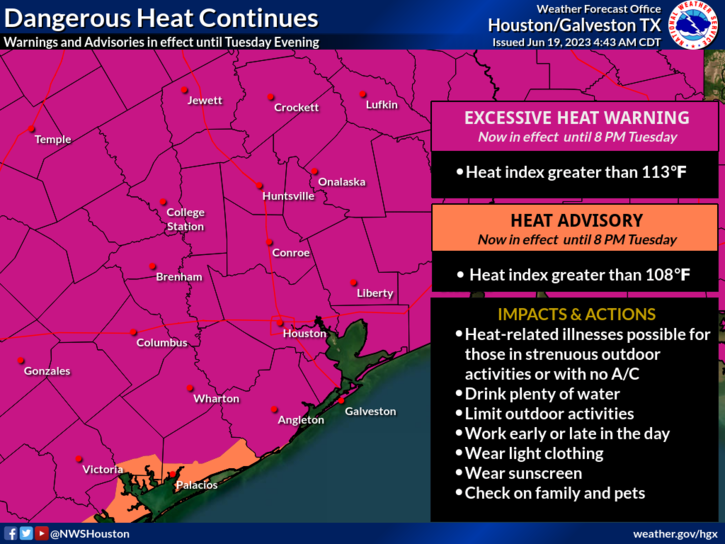
Houston turned up the heat to extreme levels this past weekend, and we’ve got one more day of highs near 100 degrees with humidity pushing the heat index above 110 degrees. After that temperatures will back off slightly for a few days. Unfortunately it now appears likely that this hotter-than-normal pattern will persist through the remainder of June. And after June comes July and August, which is really pleasant to contemplate, you know?
While there is not too much going on with our local weather besides the heat, the Atlantic tropics are unusually active for June. We’ve got all of that covered on The Eyewall. While there are definitely no near-term concerns for the Gulf of Mexico, this is not exactly a great trend for what we might expect later this summer when the Atlantic hurricane season typically get really cranked up.
Everybody gets an excessive heat warning today. (National Weather Service)
Tuesday
Like the last three days, today will be very hot and mostly sunny. Highs should reach about 100 degrees, with a heat index necessitating an “excessive heat warning” from the National Weather Service. If you must go outside during the middle of the day for a prolonged period of time, please drink plenty of fluids and avoid strenuous outdoor activities. Wear lightweight and loose fitting clothing when possible. South winds, at just 5 to 10 mph, will provide little relief. Lows tonight will not drop below 80 degrees.
Wednesday
Temperatures may be a degree or two cooler on Wednesday, but it’s still going to be brutally hot and mostly sunny. I’d say there’s about a 10 percent chance of rain showers for the eastern half of the area.
Thursday and Friday
These will be the most “moderate” days of the week as the high pressure system backs off slightly. Look for highs in the mid- to upper-90s, with nighttime temperatures perhaps a degree or two cooler. The big thing I’m watching for is rain chances. I don’t want to get anyone’s hopes up, because we’re only talking about a 20 or 30 percent chance of rain as instability works its way into the atmosphere. But this is the best chance of rain for the rest of the month, probably.
Saturday and Sunday
As high pressure builds again, temperatures should climb back to about 100 degrees each day. Sunny and hot, rinse and repeat.
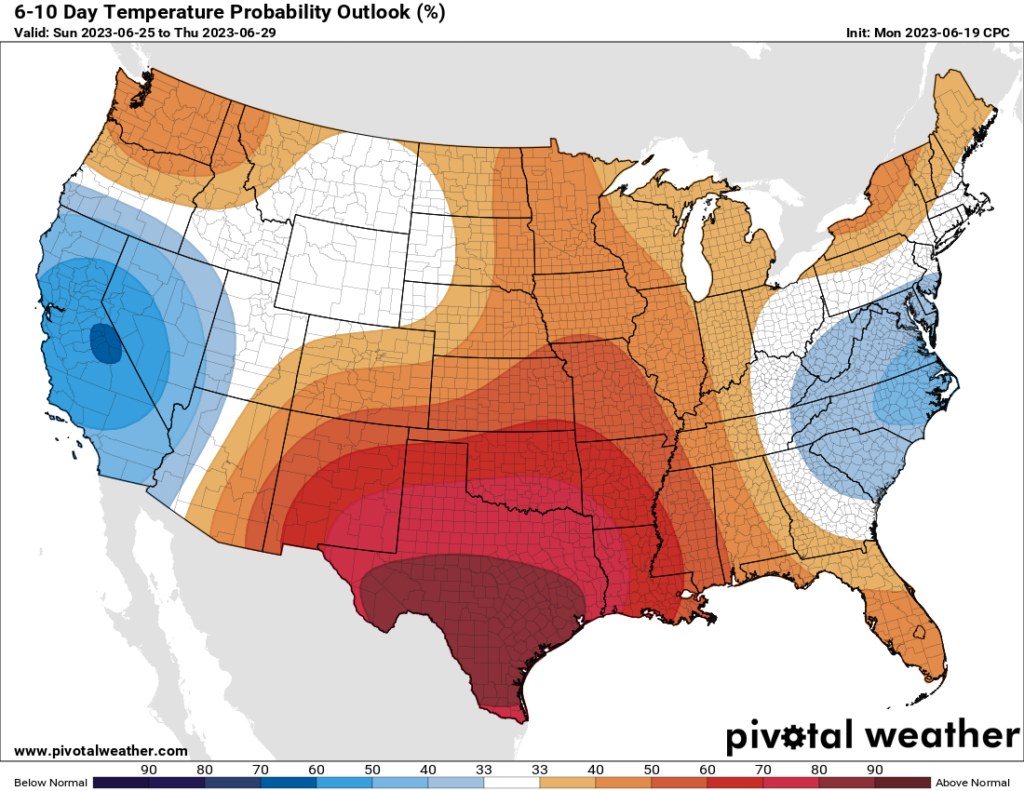
The outlook for next week looks pretty hot, too. (Pivotal Weather)
Next week
Hey Eric, does it look like we’re finally going to get a break from this heat wave next week?
No.
Don’t do that to me man.
Ok, at least not during the first half of the week as high pressure remains entrenched over South Texas and Mexico. Maybe by Thursday or Friday of next week? Possibly. Sorry folks, it’s pretty grim.
Plastic surgery What You Need to Know- Before, During and After Marfuggi 1998
Last time I was at the dermatologists office, I saw so many before and after examples of fillers or other treatments. Most of these treatments, I had never heard of. Sadly, I couldn’t really tell the difference. Part of me thinks this is reasonable. Surgery should enhance, not completely change how someone looks. On the other hand, if I am going to drop some serious cash, I would want it to be worth it.
This one is still floating around the shelves in a small library. Clearly this one is way out of date. For the time, it wasn’t too bad. The advice is conservative and realistic in terms of outcomes. The pictures featured are reasonable and very basic. However, I do know that over 20 years have passed since this was published, so I am quite sure that information needs updating.
When I saw this book, I thought it was much older. I guess the book itself could use some work as well.




/https://static.texastribune.org/media/files/7d40396de84324cbbd01e87fd8fc5ec2/Wheatley%20HISD%20PY%20TT%20352.jpg)



/https://static.texastribune.org/media/files/fa0232b0cb4c5f98b04fcdc3f0ae7f0c/Stephen%20F%20Austin%20MF%20TT%2011.jpg)