
Customs officials intercepted a pickup truck transporting four large wheels of cheese from Mexico that were hiding 17.8 pounds of cocaine. What do you think?
Customs officials intercepted a pickup truck transporting four large wheels of cheese from Mexico that were hiding 17.8 pounds of cocaine. What do you think?

DEARBORN, MI—Touting the new acquisition as “a major upgrade,” the Henry Ford Museum of American Innovation confirmed Thursday that it had traded in its original Model T for a 2008 Subaru Outback. “The Model T was invaluable in its own way of course, but in the end, it simply wasn’t practical,” said museum…
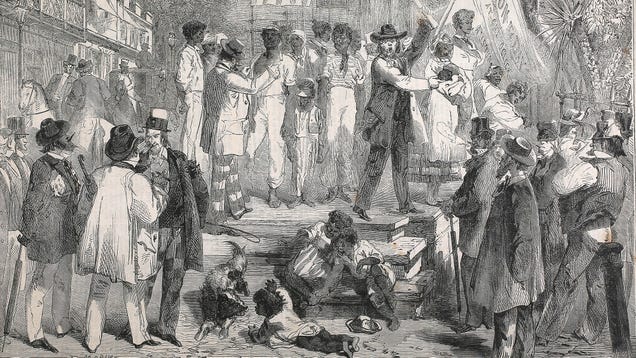
Following Florida’s decision to release new standards for teaching African American history in schools, The Onion examines the biggest benefits slaves got from slavery.

Giuliani submitted this declaration as part of the ongoing civil lawsuit filed in 2021 by election workers Ruby Freeman and Wandrea "Shaye" Moss. The two women sued Giuliani for defamation.
(Image credit: Bloomberg/Bloomberg via Getty Images)


Joy Alonzo was suspended and investigated after she allegedly criticized Texas Lt. Gov. Dan Patrick at a lecture on the opioid crisis. Free speech advocates call the probe "blatantly inappropriate."
(Image credit: Dave Einsel/AP)

Good morning. Houston’s very hot, but not extremely hot, weather pattern will continue for the rest of this week, and well into next week. Truth be told, as we slide into August in a few days, this is the warmest time of the year in Houston. So we’re probably not going to see any significant relief, temperature-wise, for awhile. The best we can do is cloudier days with some rain-cooled air. There is a chance we may see a little bit more of that in a week or so.

This week we’ve seen a pattern of isolated-to-scattered showers and thunderstorms developing during the afternoon hours, most commonly south of Interstate 10, and this will continue today. Rain chances are about 30 percent for southern parts of Houston, and just 10 percent or so further inland. Otherwise we’re going to see highs in the mid- to upper-90s with mostly sunny skies. Winds will be light, from the south, and lows tonight will drop into the upper 70s.
A day that will be a lot like Wednesday, except that rain chances will be just a bit lower.
Rain chances drop to about 10 percent area wide, as highs push into the upper 90s. Skies remain sunny.
High pressure will strengthen a bit over Texas this weekend, and this should lead to a pair of hot and sunny days with highs near or at 100 degrees. Rain chances both days will be on the order of 10 percent; which is to say very low.

The aforementioned high pressure system should start to retreat to the east next week, and this may open us up to the possibility of at least scattered showers, if not more widespread rainfall. To be clear, I’m not predicting any kind of washout. But we may get to the point where we’re seeing daily chances on the order of 40 percent by mid-week. Highs probably will remain in the mid- to upper-90s.

This post was written by Alison Green and published on Ask a Manager.
A reader writes:
I have a small cultural issue at work that is driving me crazy and takes a not-insignificant amount of bandwidth out of my busy schedule. My workplace is comprised of 70% EU employees, 30% US. We are a mid-sized company with a high volume of work in an industry that bridges the gap, culturally, with another — it is the mid-point between a more formal industry and one that can afford to be a little more casual in its communication.
My colleagues demand closed-loop responses to every single email regardless of responsibility or content, to a point where the formality of it borders on the obsequious. A very common example reads like this:
Colleague writes to me and cc’s two members of my team and two members of their team.
1: Colleague: I have a request for X type of documentation template, can you send it to me? Here are the details.
2: Me: Sure, here’s the prepared document.
3: Colleague: Thank you very much!
4: Me: You are very welcome, and please don’t hesitate to let me know if you have any questions.Of those four lines, 1 and 2 are obviously imperative to the ask, but if 3 and 4 are not met, I receive endless inquiries from people on the thread. If Colleague doesn’t respond to 2 after I have sent the document and the ball is in their court, my team will reach out to me to ask if I have followed up with Colleague and their team to see if they have received the document and if they need any additional support. If I don’t respond to 3 in response, someone will invariably reach out and ask if I have offered additional support or responded to the thank-you email in kind with a “you’re welcome.” This happens at least four times a week.
I come from a work environment where a ‘TY!’ via ping is as meaningful as a formal thank-you note, and have always had it normalized that sometimes you don’t need to continue a thread past the ask and deliverable, especially if the workflow is fast-paced and high in volume. Being reminded to constantly thank employees for responding to an email makes me feel belittled, although it’s worth stating that this is coming from both lateral and managerial colleagues across the org. In my daily written communication, I am friendly, polite, prompt, and exhaustive in providing my guidance, and I would describe myself as very well-liked among my colleagues. But this keeps coming up and it is really bugging me.
I have tried several tactics to remediate this: One, I have told colleagues that I will not participate in this practice myself, and that as a matter of habit and my job role (which is senior), I trust my colleagues to complete the necessary tasks that I have outlined as a contribution in my response. Two, I have asked colleagues what they believe needs to be responded to — I ask if they noticed something I missed in the initial inquiry, because I feel confident that the original ask has been satisfied. Each time, their response effectively rests on “it’s not polite to ignore an email,” to which I respond that it isn’t ignoring the email. Finally, I have explained to them that culturally, this is how I communicate.
It has gotten to the point where my manager, a person who routinely ignores most emails, has started telling me that I need to close the loop on every single inquiry. This is a role that receives ~10-20 complex, detailed daily requests with limited delegation opportunities. I’m at a loss here. Should I start sending a boilerplate or automatic response? This is so trivial but it honestly screws up my day a little when someone holds me at Outlook gunpoint for an obsequious, irrelevant reply to a long-completed thread.
This is incredibly bizarre. When you don’t reply to a “thank you” email with “you’re welcome,” your coworkers nudge you to do it? And ask if you’ve offered additional support on top of that?
WTF!
This is extremely odd.
Look, I’m fine with a cultural expectation that people should close the loop with a “thank you” when they receive an item they requested (#3 in your list), so that the person who sent it is confident that it was received and the transaction has been completed. However, it would still be incredibly weird for your coworkers to follow up with you to remind you to do that, unless you were an intern or perhaps a high school student doing a summer apprenticeship. You are in a senior role. WHY why why are your coworkers checking in to ensure you’ve responded with not just thank-you’s, but you’re-welcome’s too?
And to be clear, if it was just that your office in general sent and expected “you’re welcome” emails, that wouldn’t in itself be a big deal. Organizations develop all sorts of mildly odd cultural norms around email. What’s strange here, though, is that your coworkers are so invested in it that they’re policing you to this degree and reminding you and calling you out when you don’t do it.
How are they getting any work done if they are monitoring and micromanaging email exchanges to this extent? And again, you are in a senior role.
I’m not sure I’ve had this much trouble getting my head around a weird office practice since the office that didn’t permit humor.
Anyway, if your boss is telling you that you need to do it and hasn’t been responsive to your counter-arguments, then you probably need to do it unless you have the capital and the will to take a firmer stand. Feel free to set up short email templates that you can dispatch with a couple of clicks to minimize the amount of time and energy it takes.
Two caveats to that, though: First, you have made your case to your boss for not doing it, right? If not, try that first. Second, what would happen if you just … declined to engage with this weirdness? Like when your coworkers ask you whether you’ve closed the loop with someone, could you just ignore that? Or say yes, because you’ve closed the loop in the way you define it, even if they don’t agree? Or respond with, “I’ve got it covered; no need to check in on this sort of thing”? Or even, depending on the politics of the relationships, “I’ve got it covered; please don’t check in on this sort of thing since it creates a lot of additional back and forth”? Would those options use up a ton of capital in your office and with your boss … or would it just annoy people but ultimately be fine?
Also, for the record, it’s particularly bizarre that your boss is ordering you to do it when she herself full-on ignores most emails … and I wonder if it’s because your coworkers have taken their extreme concern about your email habits to her and, rather than standing up for email sanity, she’s decided it’s easier to just appease them? I don’t know, but your office is officially Very Strange.

Microwave Cooking For One
Smith
1985
Submitter: What first got my attention while perusing the shelves was the taped together cover. Then I saw the date – 1985. Seems pretty old for a microwave cookbook. Some of the recipes seem doable, but I question the wattage and size of modern microwaves to be able to make most of the recipes in this book. Note the many seafood options that your coworkers would love to smell if you whipped up one in the staff office.
Holly: Oh good, it’s also spiral bound, the kiss of death for library materials.



BOCA RATON, FL—Promising hours of relief from common period symptoms, Bayer-owned brand Midol introduced Wednesday its first over-the-counter leather strap for menstrual-pain sufferers to bite down on while experiencing cramps. “Midol’s new 100% genuine cowhide strap lets you grit your teeth through all the cramping,…
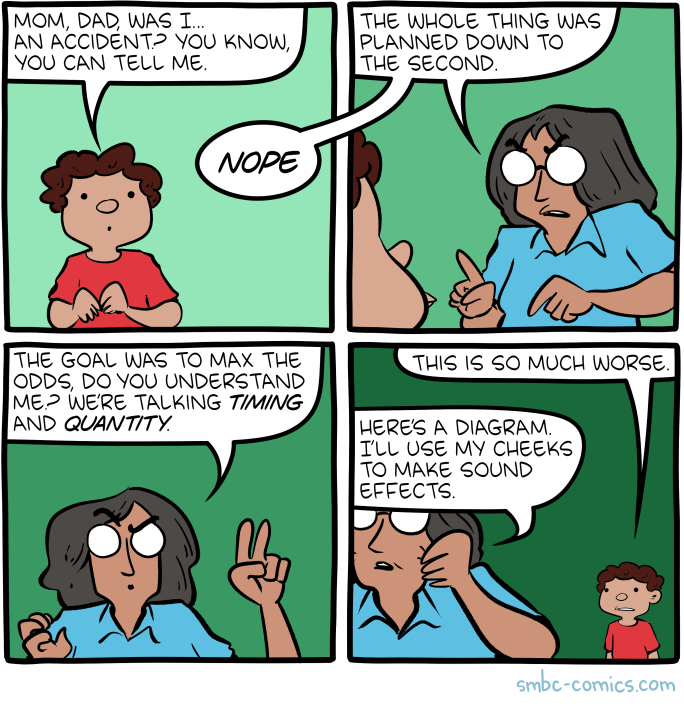
Hovertext:
The really distressing part wasn't the 3 hours spent yanking her cheeks, but the variations in pace from time to time.

Here's the "dictator's dilemma": they want to block their country's frustrated elites from mobilizing against them, so they censor public communications; but they also want to know what their people truly believe, so they can head off simmering resentments before they boil over into regime-toppling revolutions.
These two strategies are in tension: the more you censor, the less you know about the true feelings of your citizens and the easier it will be to miss serious problems until they spill over into the streets (think: the fall of the Berlin Wall or Tunisia before the Arab Spring). Dictators try to square this circle with things like private opinion polling or petition systems, but these capture a small slice of the potentially destabiziling moods circulating in the body politic.
Enter AI: back in 2018, Yuval Harari proposed that AI would supercharge dictatorships by mining and summarizing the public mood – as captured on social media – allowing dictators to tack into serious discontent and diffuse it before it erupted into unequenchable wildfire:
https://www.theatlantic.com/magazine/archive/2018/10/yuval-noah-harari-technology-tyranny/568330/
Harari wrote that "the desire to concentrate all information and power in one place may become [dictators'] decisive advantage in the 21st century." But other political scientists sharply disagreed. Last year, Henry Farrell, Jeremy Wallace and Abraham Newman published a thoroughgoing rebuttal to Harari in Foreign Affairs:
https://www.foreignaffairs.com/world/spirals-delusion-artificial-intelligence-decision-making
They argued that – like everyone who gets excited about AI, only to have their hopes dashed – dictators seeking to use AI to understand the public mood would run into serious training data bias problems. After all, people living under dictatorships know that spouting off about their discontent and desire for change is a risky business, so they will self-censor on social media. That's true even if a person isn't afraid of retaliation: if you know that using certain words or phrases in a post will get it autoblocked by a censorbot, what's the point of trying to use those words?
The phrase "Garbage In, Garbage Out" dates back to 1957. That's how long we've known that a computer that operates on bad data will barf up bad conclusions. But this is a very inconvenient truth for AI weirdos: having given up on manually assembling training data based on careful human judgment with multiple review steps, the AI industry "pivoted" to mass ingestion of scraped data from the whole internet.
But adding more unreliable data to an unreliable dataset doesn't improve its reliability. GIGO is the iron law of computing, and you can't repeal it by shoveling more garbage into the top of the training funnel:
When it comes to "AI" that's used for decision support – that is, when an algorithm tells humans what to do and they do it – then you get something worse than Garbage In, Garbage Out – you get Garbage In, Garbage Out, Garbage Back In Again. That's when the AI spits out something wrong, and then another AI sucks up that wrong conclusion and uses it to generate more conclusions.
To see this in action, consider the deeply flawed predictive policing systems that cities around the world rely on. These systems suck up crime data from the cops, then predict where crime is going to be, and send cops to those "hotspots" to do things like throw Black kids up against a wall and make them turn out their pockets, or pull over drivers and search their cars after pretending to have smelled cannabis.
The problem here is that "crime the police detected" isn't the same as "crime." You only find crime where you look for it. For example, there are far more incidents of domestic abuse reported in apartment buildings than in fully detached homes. That's not because apartment dwellers are more likely to be wife-beaters: it's because domestic abuse is most often reported by a neighbor who hears it through the walls.
So if your cops practice racially biased policing (I know, this is hard to imagine, but stay with me /s), then the crime they detect will already be a function of bias. If you only ever throw Black kids up against a wall and turn out their pockets, then every knife and dime-bag you find in someone's pockets will come from some Black kid the cops decided to harass.
That's life without AI. But now let's throw in predictive policing: feed your "knives found in pockets" data to an algorithm and ask it to predict where there are more knives in pockets, and it will send you back to that Black neighborhood and tell you do throw even more Black kids up against a wall and search their pockets. The more you do this, the more knives you'll find, and the more you'll go back and do it again.
This is what Patrick Ball from the Human Rights Data Analysis Group calls "empiricism washing": take a biased procedure and feed it to an algorithm, and then you get to go and do more biased procedures, and whenever anyone accuses you of bias, you can insist that you're just following an empirical conclusion of a neutral algorithm, because "math can't be racist."
HRDAG has done excellent work on this, finding a natural experiment that makes the problem of GIGOGBI crystal clear. The National Survey On Drug Use and Health produces the gold standard snapshot of drug use in America. Kristian Lum and William Isaac took Oakland's drug arrest data from 2010 and asked Predpol, a leading predictive policing product, to predict where Oakland's 2011 drug use would take place.

Then, they compared those predictions to the outcomes of the 2011 survey, which shows where actual drug use took place. The two maps couldn't be more different:
https://rss.onlinelibrary.wiley.com/doi/full/10.1111/j.1740-9713.2016.00960.x
Predpol told cops to go and look for drug use in a predominantly Black, working class neighborhood. Meanwhile the NSDUH survey showed the actual drug use took place all over Oakland, with a higher concentration in the Berkeley-neighboring student neighborhood.
What's even more vivid is what happens when you simulate running Predpol on the new arrest data that would be generated by cops following its recommendations. If the cops went to that Black neighborhood and found more drugs there and told Predpol about it, the recommendation gets stronger and more confident.
In other words, GIGOGBI is a system for concentrating bias. Even trace amounts of bias in the original training data get refined and magnified when they are output though a decision support system that directs humans to go an act on that output. Algorithms are to bias what centrifuges are to radioactive ore: a way to turn minute amounts of bias into pluripotent, indestructible toxic waste.
There's a great name for an AI that's trained on an AI's output, courtesy of Jathan Sadowski: "Habsburg AI."
And that brings me back to the Dictator's Dilemma. If your citizens are self-censoring in order to avoid retaliation or algorithmic shadowbanning, then the AI you train on their posts in order to find out what they're really thinking will steer you in the opposite direction, so you make bad policies that make people angrier and destabilize things more.
Or at least, that was Farrell(et al)'s theory. And for many years, that's where the debate over AI and dictatorship has stalled: theory vs theory. But now, there's some empirical data on this, thanks to the "The Digital Dictator’s Dilemma," a new paper from UCSD PhD candidate Eddie Yang:
https://www.eddieyang.net/research/DDD.pdf
Yang figured out a way to test these dueling hypotheses. He got 10 million Chinese social media posts from the start of the pandemic, before companies like Weibo were required to censor certain pandemic-related posts as politically sensitive. Yang treats these posts as a robust snapshot of public opinion: because there was no censorship of pandemic-related chatter, Chinese users were free to post anything they wanted without having to self-censor for fear of retaliation or deletion.
Next, Yang acquired the censorship model used by a real Chinese social media company to decide which posts should be blocked. Using this, he was able to determine which of the posts in the original set would be censored today in China.
That means that Yang knows that the "real" sentiment in the Chinese social media snapshot is, and what Chinese authorities would believe it to be if Chinese users were self-censoring all the posts that would be flagged by censorware today.
From here, Yang was able to play with the knobs, and determine how "preference-falsification" (when users lie about their feelings) and self-censorship would give a dictatorship a misleading view of public sentiment. What he finds is that the more repressive a regime is – the more people are incentivized to falsify or censor their views – the worse the system gets at uncovering the true public mood.
What's more, adding additional (bad) data to the system doesn't fix this "missing data" problem. GIGO remains an iron law of computing in this context, too.
But it gets better (or worse, I guess): Yang models a "crisis" scenario in which users stop self-censoring and start articulating their true views (because they've run out of fucks to give). This is the most dangerous moment for a dictator, and depending on the dictatorship handles it, they either get another decade of rule, or they wake up with guillotines on their lawns.
But "crisis" is where AI performs the worst. Trained on the "status quo" data where users are continuously self-censoring and preference-falsifying, AI has no clue how to handle the unvarnished truth. Both itts recommendations about what to censor and its summaries of public sentiment are the least accurate when crisis erupts.
But here's an interesting wrinkle: Yang scraped a bunch of Chinese users' posts from Twitter – which the Chinese government doesn't get to censor (yet) or spy on (yet) – and fed them to the model. He hypothesized that when Chinese users post to American social media, they don't self-censor or preference-falsify, so this data should help the model improve its accuracy.
He was right – the model got significantly better once it ingested data from Twitter than when it was working solely from Weibo posts. And Yang notes that dictatorships all over the world are widely understood to be scraping western/northern social media.
But even though Twitter data improved the model's accuracy, it was still wildly inaccurate, compared to the same model trained on a full set of un-self-censored, un-falsified data. GIGO is not an option, it's the law (of computing).
Writing about the study on Crooked Timber, Farrell notes that as the world fills up with "garbage and noise" (he invokes Philip K Dick's delighted coinage "gubbish"), "approximately correct knowledge becomes the scarce and valuable resource."
https://crookedtimber.org/2023/07/25/51610/
This "probably approximately correct knowledge" comes from humans, not LLMs or AI, and so "the social applications of machine learning in non-authoritarian societies are just as parasitic on these forms of human knowledge production as authoritarian governments."
(Image: Cryteria, CC BY 3.0; Raimond Spekking, CC BY-SA 4.0; “Soldiers of Russia” Cultural Center and Russian Airborne Troops CC BY-SA 3.0; modified)

retract this proposal https://groups.google.com/a/chromium.org/g/blink-dev/c/Ux5h_kGO22g/m/5Lt5cnkLCwAJ
Lawsuit From Hell: The Battle Over a Kids’ Gym https://www.washingtonian.com/2023/07/24/how-a-battle-over-a-kids-gym-turned-into-the-lawsuit-from-hell/ (h/t John Barnes)
#20yrsago Verisign will have to pay for sex.com mistake https://web.archive.org/web/20031203030438/http://www.wired.com/news/business/0,1367,59788,00.html
#15yrsago On the absurdity of “maximizing shareholder value” https://crookedtimber.org/2008/07/25/what-obligation-maximise-what/
#15yrsago Jack Womack’s underappreciated masterpiece, “Random Acts of Senseless Violence” https://www.tor.com/2008/07/25/randomacts/
#15yrsago Great opening lines from sf https://gizmodo.com/great-opening-sentences-from-science-fiction-5027128
#10yrsago Limited-edition Makie toys come to Selfridges https://web.archive.org/web/20130730061115/http://makie.me/forum/topic/474-makies-in-selfridges-from-5th-august/
#10yrsago Lies I’ve Told My 3 Year Old Recently https://www.mexicanpictures.com/headingeast/2008/03/lies-ive-told-my-3-year-old-re.html
#10yrsago Which Congresscritters voted for infinite, permanent, all-pervasive NSA spying? https://www.techdirt.com/2013/07/24/217-representatives-who-voted-to-keep-nsa-spying-all-your-data/
#10yrsago Wired Love: a novel from 1880 that could have been written last week https://www.collisiondetection.net/mt/archives/2013/07/wired_love_a_ta.php
#10yrsago Panopticon for royals https://www.antipope.org/charlie/blog-static/2013/07/monarchy-versus-the-panopticon.html
#10yrsago ANCHORY: NSA’s 1990s catalog of spook assets https://www.muckrock.com/news/archives/2013/jul/25/anchory-documents-offer-glimpse-90s-era-nsa-intell/
#10yrsago UK Serious Crimes Agency buried evidence of massive criminality by major corporations, rich people — wouldn’t even tell the cops https://www.independent.co.uk/news/uk/crime/exclusive-bigger-than-phone-hacking-soca-sat-on-bluechip-dirty-tricks-evidence-for-years-8730861.html
#10yrsago Iain Banks’s The Quarry, his final novel https://memex.craphound.com/2013/07/26/iain-bankss-the-quarry-his-final-novel/
#10yrsago What EFF learned at Comic-Con https://www.eff.org/deeplinks/2013/07/what-we-learned-san-diego-comic-con
#10yrsago PIN-punching $200 robot can brute force every Android numeric screen-password in 19 hours https://www.forbes.com/sites/andygreenberg/2013/07/22/pin-punching-robot-can-crack-your-phones-security-code-in-less-than-24-hours/
#10yrsago UK censorwall will also block “terrorist content,” “violence,” “circumvention tools,” “forums,” and more https://www.openrightsgroup.org/blog/sleepwalking-into-censorship/
#10yrsago No, Mr Cameron, you can’t solve porn with a hackathon https://www.theguardian.com/science/political-science/2013/jul/24/anti-porn-hackday-cameron
#10yrsago Teachers open camping kid’s sealed letter home; eject kid for confessing to eating chocolate https://www.telegraph.co.uk/education/10190649/Child-banned-from-school-trip-for-eating-chocolate.html
#10yrsago David Cameron’s favourite censorware is built and maintained by Huawei https://www.bbc.com/news/technology-23452097
#10yrsago Jane Austen to grace £10 notes https://www.theguardian.com/business/2013/jul/24/jane-austen-appear-10-note
#5yrsago Bloom County’s second reboot collection: the election of 2016 and beyond https://memex.craphound.com/2018/07/26/bloom-countys-second-reboot-collection-the-election-of-2016-and-beyond/
#5yrsago Big Tech’s active moderation promise is also a potential source of eternal commercial advantage over newcomers https://memex.craphound.com/2018/07/26/big-techs-active-moderation-promise-is-also-a-potential-source-of-eternal-commercial-advantage-over-newcomers/
#5yrsago Facebook shares plummet on tiny shortfall in predicted growth https://www.wired.com/story/facebook-just-learned-the-true-cost-of-fixing-its-problems/
#5yrsago Appeals court kills the dirty trick of using Indian tribes as a front for patent trolls and claiming sovereign immunity https://arstechnica.com/tech-policy/2018/07/court-native-american-tribe-cant-be-a-sovereign-shield-during-patent-review/
#5yrsago What it’s like when Nazis infiltrate your conference https://twitter.com/JairusKhan/status/1021576115670933511
#5yrsago Watchdog: UK spies engaged in illegal surveillance from 2001-2012 https://www.bbc.com/news/technology-44936592
#5yrsago Equifax says it’s spent $200m on security since the breach, so everything’s OK now https://www.wired.com/story/equifax-security-overhaul-year-after-breach/
#5yrsago Student blocks deportation of Afghan asylum-seeker by refusing to sit down and let the plane take off https://www.theguardian.com/world/2018/jul/25/swedish-student-plane-protest-stops-mans-deportation-afghanistan
#5yrsago Facebook forced to drop “feature” that let advertisers block Black people, old people and women https://www.theverge.com/2018/7/24/17609178/facebook-racial-dicrimination-ad-targeting-washington-state-attorney-general-agreement
#5yrsago A/B testing tools have created a golden age of shitty statistical practices in business https://papers.ssrn.com/sol3/papers.cfm?abstract_id=3204791
#5yrsago Rockstar: a programming language whose code takes the form of power ballads https://github.com/dylanbeattie/rockstar
#5yrsago EFF has published a detailed guide to regulating Facebook without destroying the internet https://www.eff.org/deeplinks/2018/07/facing-facebook-data-portability-and-interoperability-are-anti-monopoly-medicine
#1yrago Sarah Gailey's "Just Like Home": A haunted house novel that made the hairs on the back of my neck stand up https://pluralistic.net/2022/07/25/can-you-hear-me-now/#crowder-house
#1yrago Why none of my books are available on Audible: And why Amazon owes me $3,218.55 https://pluralistic.net/2022/07/25/can-you-hear-me-now/#acx-ripoff
#1yrago "A Half-Built Garden": Ruthanna Emrys's stunning First Contact novel https://pluralistic.net/2022/07/26/aislands/#dead-ringers
Currently writing:
Picks and Shovels, a Martin Hench noir thriller about the heroic era of the PC. FIRST DRAFT COMPLETE, WAITING FOR EDITORIAL REVIEW
The Bezzle, a Martin Hench noir thriller novel about the prison-tech industry. FIRST DRAFT COMPLETE, WAITING FOR EDITORIAL REVIEW
Vigilant, Little Brother short story about remote invigilation. ON SUBMISSION
Moral Hazard, a short story for MIT Tech Review's 12 Tomorrows. FIRST DRAFT COMPLETE, ACCEPTED FOR PUBLICATION
Spill, a Little Brother short story about pipeline protests. ON SUBMISSION
Latest podcast: Let the Platforms Burn: The Opposite of Good Fires is Wildfires https://craphound.com/news/2023/07/16/let-the-platforms-burn-the-opposite-of-good-fires-is-wildfires/
Upcoming appearances:
Armadillocon (Austin), Aug 4-6
https://armadillocon.org/d45/
Defcon (Las Vegas), Aug 10-13
https://defcon.org/
An Evening with VE Schwab (Des Moines), Oct 2
https://www.thecabinidaho.org/all-events/ve-schwab
Recent appearances:
Techdirt Podcast
https://www.techdirt.com/2023/07/25/techdirt-podcast-episode-359-red-team-blues-part-two-with-cory-doctorow/
Cannibal Corp (New Models podcast)
https://soundcloud.com/newmodels/private-cannibal-corp-w-cory-doctorow-nm66
Latest books:
"Chokepoint Capitalism: How to Beat Big Tech, Tame Big Content, and Get Artists Paid, with Rebecca Giblin", on how to unrig the markets for creative labor, Beacon Press/Scribe 2022 https://chokepointcapitalism.com
"Attack Surface": The third Little Brother novel, a standalone technothriller for adults. The Washington Post called it "a political cyberthriller, vigorous, bold and savvy about the limits of revolution and resistance." Order signed, personalized copies from Dark Delicacies https://www.darkdel.com/store/p1840/Available_Now%3A_Attack_Surface.html
"How to Destroy Surveillance Capitalism": an anti-monopoly pamphlet analyzing the true harms of surveillance capitalism and proposing a solution. https://onezero.medium.com/how-to-destroy-surveillance-capitalism-8135e6744d59 (print edition: https://bookshop.org/books/how-to-destroy-surveillance-capitalism/9781736205907) (signed copies: https://www.darkdel.com/store/p2024/Available_Now%3A__How_to_Destroy_Surveillance_Capitalism.html)
"Little Brother/Homeland": A reissue omnibus edition with a new introduction by Edward Snowden: https://us.macmillan.com/books/9781250774583; personalized/signed copies here: https://www.darkdel.com/store/p1750/July%3A__Little_Brother_%26_Homeland.html
"Poesy the Monster Slayer" a picture book about monsters, bedtime, gender, and kicking ass. Order here: https://us.macmillan.com/books/9781626723627. Get a personalized, signed copy here: https://www.darkdel.com/store/p2682/Corey_Doctorow%3A_Poesy_the_Monster_Slayer_HB.html#/.
Upcoming books:
The Lost Cause: a post-Green New Deal eco-topian novel about truth and reconciliation with white nationalist militias, Tor Books, November 2023

This work – excluding any serialized fiction – is licensed under a Creative Commons Attribution 4.0 license. That means you can use it any way you like, including commercially, provided that you attribute it to me, Cory Doctorow, and include a link to pluralistic.net.
https://creativecommons.org/licenses/by/4.0/
Quotations and images are not included in this license; they are included either under a limitation or exception to copyright, or on the basis of a separate license. Please exercise caution.
Blog (no ads, tracking, or data-collection):
Newsletter (no ads, tracking, or data-collection):
https://pluralistic.net/plura-list
Mastodon (no ads, tracking, or data-collection):
Medium (no ads, paywalled):
(Latest Medium column: "When the Town Square Shatters: Once again, sf fandom shows us how to use the internet" https://doctorow.medium.com/when-the-town-square-shatters-a7377ed4eff)
Twitter (mass-scale, unrestricted, third-party surveillance and advertising):
Tumblr (mass-scale, unrestricted, third-party surveillance and advertising):
https://mostlysignssomeportents.tumblr.com/tagged/pluralistic
"When life gives you SARS, you make sarsaparilla" -Joey "Accordion Guy" DeVilla
When building a new thing, a good first step is to build a thing that does nothing. That way, you at least know you are starting from a good place. If I’m building a component that performs an action, I’ll probably do it in these steps:
Invoke method merely print the message “Yay!” to the debugger without doing anything else. This makes sure I know how to get the component to run at the proper time.Invoke method with enough code to identify what action to perform and which object to perform it on, print that information to the debugger, and return without actually performing the action. This makes sure I can identify which action is supposed to be done.Invoke method to perform the action on the desired object. For this, I can copy/paste the already-debugged code from step zero.Too often, I see relatively inexperienced developers dive in and start writing a big complex thing: Then they can’t even get it to compile because it’s so big and complex. They ask for help, saying, “I’m having trouble with this one line of code,” but as you study what they have written, you realize that this one line of code is hardly the problem. The program hasn’t even gotten to the point where it can comprehend the possibility of executing that line of code. I mutter to myself, “How did you let it get this bad?”
Start with something that does nothing. Make sure you can do nothing successfully. Only then should you start making changes so it starts doing something. That way, you know that any problems you have are related to your attempts to do something.
The post Before you try to do something, make sure you can do nothing appeared first on The Old New Thing.

This post was written by Alison Green and published on Ask a Manager.
It’s five answers to five questions. Here we go…
1. Director secretly hired her daughter’s boyfriend
I recently found out a former director hired her daughter’s boyfriend but went to great lengths to hide it from me (the CEO) and their team for over two years. The boyfriend was originally hired on a short-term contract through a wage subsidy program and there was no formal recruitment process. The boyfriend reported to the director before being assigned to another manager, and the director became the grandboss of the boyfriend. They were in the same team throughout the boyfriend’s employment. From all accounts, not just the director’s, the boyfriend performed well. But still.
I signed off on the director’s recommendations for the boyfriend’s contract extensions, promotions, salary increases, and bonuses but had no idea of the relationship. We only found out when the boyfriend resigned and the director revealed it to a colleague.
Unfortunately, we don’t have any kind of policy around hiring family members or friends. But is a boyfriend relationship perhaps different than a son-in-law relationship? I don’t think it meets the usual strict definition of family. Still, I would have thought that someone in a senior leadership role would have wanted to ensure there was no conflict of interest or perceived conflict and would have revealed the relationship prior to hiring.
And what about the boyfriend himself? Did he have a duty to disclose? It seems that he and the director decided they would not share this information. The team was blindsided when they found out who his girlfriend was.
Going forward, I know we need a nepotism policy that outlines what kinds of relationships need to be disclosed and who can report to whom. However, would a girlfriend/boyfriend of an adult child of an employee fit into the kinds of relationships that would be covered by such a policy? Or is this something that a conflict of interest policy might cover? We don’t have that either.
I also feel like the standard for the duty of care for the organization that a senior staff member (who also had HR in her portfolio) holds should be higher. I expect more from a senior leader but should we also spell that out?
Yep, you need a nepotism policy and a conflict of interest policy. You’ll never be able to spell out absolutely every situation that might arise under either of them, but after naming specific categories (parents, siblings, etc.), you can include language like “and other close, personal relationships that could raise concerns about bias or favoritism.” You can also include, “If you’re unsure whether a situation could fall under this policy, we expect you to proactively raise it for consideration.”
And yes, a senior staff member (particularly one overseeing HR!) should be expected to have raised this on her own without a written policy … and if she went out of her way to conceal it, that’s a big enough red flag about what else might have happened on her watch that it’s worth digging in to see what else might be there. (In fact, even if she didn’t go out of her way to conceal it and instead it just never occurred to her as a potential issue, that’s a different kind of problem, and also might indicate a need to dig around further.)
The boyfriend himself is far less culpable. He’s likely to have assumed the director knew what she was doing and disclosed whatever she needed to disclose. The director is the one who bears the fault here.
2. How to deal with a needy customer when I answer the phones
I work for a company that ships goods out to other companies to use in their machines. That is the type of thing that takes months if not years, with the supply chain the way that it is right now. Orders come in, they are processed, and then it can be six months to a year before materials are found, items are forged, and six months to a year beyond that for items to actually come to us to be sent to customers.
We have a customer who works with us on a yearly basis. At any time he may have four or five orders in the pipeline, but they aren’t overdue and they aren’t due anytime soon … and he will call us a minimum of every single day trying to get an update. There are no updates. He will disappear for a week or a month, but then invariably appear to annoy the same few people, long before he should be asking anything at all.
I am the front desk person in this situation and I only know about this customer because when he can’t reach his sales representative directly at their extension, after already emailing three separate times and often leaving voicemails, he will call me and demand to be transferred. It’s as if he doesn’t realize I’m transferring him to the same location that just chose not to pick up for him. Other times he will call and demand that I use a paging system that we don’t have, to get him a manager who he’s already tried calling. I can’t force my coworkers to answer their phone calls and deal with this guy, because they’re all much higher ranking than I am. But it’s really starting to grate on me that I have nothing to tell this person to get him to just … patiently wait.
We have thousands of other clients who have no problem waiting for their “your items have gone through production and will ship (when)” emails. I know we live in a world of instant gratification and overnight shipping on a lot of things, but the products we ship are not among those. There is no situation where this can be sped up for this customer.
What do I do about him? Do I tell him that people are avoiding him because of the frequency of his calls? Is there a script for this?
Some of this just goes with the territory when you’re on the front lines of the phones. There will always be annoying callers, and there will always be this particular brand of annoying caller, where a person struggles to accept the policies or timelines of the organization they’re doing business with.
I think you’re getting too invested in solving the problem of … him. He probably can’t be solved by you. It’s possible that his sales rep could try to solve it with a direct conversation — but it’s also possible his sales rep has tried that repeatedly, it doesn’t work, and this is what they’ve settled on instead. Do you know if they have? If not, you could certainly urge them to lay that out to him … but there are customers who are repeatedly told what timelines to expect and behave like this anyway.
Your company probably wants you to just continue handling him like any other caller — transferring him when he requests it, etc. If you think that might not be the case, you could check in with your manager to see if they have different guidance where he’s concerned. And if he’s abusive to you or takes up large amounts of time, that’s something you should raise with either his sales rep or your manager. But if it’s more just that it’s annoying, it doesn’t sound like it’s part of your job’s scope to try to fix that, and you’re better off detaching emotionally. Pretend it’s your first time hearing from him that month, if it helps, or that you don’t recognize him. But he’s not your problem to solve (again, unless he’s abusive or getting in the way of you doing your job, or unless your manager asks you to handle him differently in some way).
3. How to write an improvement plan for critical thinking skills
I manage a team of nine. Because the role is so specialized, we tend to hire people who don’t have much direct experience. We aim to find folks who have potential to learn the role and have the right temperament. My interview process includes problem-solving tasks, which has really helped to find those who have the right skills to be able to learn the position. There is intensive training, documentation, and shadowing available for new employees. By six months, team members should be handling their own clients, with assistance. It takes at least a year to learn the role.
Last year, for several reasons, we decided to prioritize experience over problem-solving skills when hiring. This hasn’t worked out. “Jane” has been in the role for about 10 months and it is becoming clear that she can’t handle this role. I need to craft an improvement plan for her, with the likely outcome either reassignment to a lower role in the organization or termination. Jane’s attitude and demeanor are friendly and, for the most part, professional.
I am having trouble writing the improvement plan. We need to set measurable, achievable goals, but when the problem is critical thinking, I’m not sure how to frame the goals. If she was coming in late or being rude to clients, I would know what to do. But I’ve already tried talking to her about “thinking things through” before deciding on an action plan, and I’ve walked her through my thought process in problem solving many times. She works with two other senior members of the team as well. She hasn’t been able to investigate situations, solve problems, or identify issues. She doesn’t seem to know how to think about a problem, and she has a difficult time determining what is a serious, urgent matter and what is not an issue. How do I write an improvement plan for critical thinking skills and problem solving?
Look at this language from your letter: “She hasn’t been able to investigate situations, solve problems, or identify issues. She doesn’t seem to know how to think about a problem, and she has a difficult time determining what is a serious, urgent matter and what is not an issue.” That gets to the heart of it, and that’s what you build the plan around.
For example, you could write that you need to see her:
* identifying issues like XYZ
* proposing and implementing solutions that quickly and effectively solve those problems
* correctly identifying and prioritizing serious, urgent issues
Another way to think about it: when you see someone who is displaying the necessary critical thinking for the job, what specific actions are they taking — and what specific outcomes are they achieving — that Jane currently is not? Write it around that. In particular, try to focus on outcomes — when someone is doing this job at the level needed, how are their outcomes different from Jane’s? Sometimes with certain types of work, that’s going to be the most effective way to capture it.
4. Should I tell a potential employer this is my last time applying?
There is a long-standing two-year program (not an internship, but I’m being purposefully vague) with a local company, and applications typically open up late summer. I have applied twice in the past; in 2021, when interviews were paused and no one was hired due to the pandemic, and in 2022, when I made it to the final round of interviews but ultimately didn’t get the job.
I want to apply for a third and final time this year. I’m comfortable with my reasons for calling it after three attempts — they’re not something I feel I need to get into here, but your typical life circumstances where the program would not make sense for me after a certain point in my career.
If I get an interview, should I tell the employer that this is my final attempt? It’s a little more complicated because I work with this company a lot in my role now, and I want to keep my good reputation. At the same time, I feel they should know that this is my last time applying for this job, and if they want to hire me, they should do it now. I obviously wouldn’t be aggressive or phrase it as an ultimatum, I’m just thinking more of a “heads-up” kind of way. Do you think this is worth mentioning, or should I keep it to myself?
Don’t mention it. There’s too much risk of it coming across strangely, and they don’t really need to know this is their final shot at hiring you — employers will always assume that if they pass on you this time around, you might not be available in the future. It’s pretty rare for employers to think, “Eh, not this time, but we’ll definitely grab her up in the fall.” They know the risk they’re taking by not hiring you now is that they might not be able to hire you later.
5. Payroll messed up my taxes — who pays to fix it?
The company I work for employs an external agency to complete payroll for myself and the other members of my team. Both the company and the external agency that performs our payroll are located in the same state, but our team works remotely and none of us live in the same state as either the company or external agency.
We recently discovered that the agency has been making errors in our state taxes for all but one member of our team. The agency has been taking taxes for the state in which it and the company are located; an accountant one of the team members hired for her personal taxes advised her the agency should have withheld taxes from the state in which each of us resides. This team member had to pay thousands of dollars in back taxes to her home state and now has to wait months before receiving thousands of dollars she mistakenly paid to the company and agency’s “home state” — all thanks to the external agency’s error. The agency has not been apologetic at all about the error.
Other team members are wondering if our one team member’s accountant is correct and we all need to hire our own accountants to review our taxes. For some of us, this would mean an error going back several years; for others “just” one year. The agency advised each of us to simply call each state’s treasury department, but I am wary of accepting tax advice from whatever random person answers the phone. Isn’t fixing this the agency’s responsibility? Or, if they can’t file the necessary paperwork on our behalf, do they have a responsibility to reimburse us for extra funds expended to hire professional help to resolve this complex mess? I am no good at numbers, the company we work for will not pay for the external agency’s error, and I am very concerned about all the money involved in this mess.
That is a major, major thing for a payroll company to mess up; it’s so fundamental to their line of work. The fact that people owe taxes to the state they live in is so basic that it’s pretty shocking that they messed it up, and messed it up for so many people. And then for them to not even be apologetic about it is just ridiculous.
Unfortunately, though, it’s pretty standard for companies not to cover the costs of fixing this kind of error. The assumption is that you should be reviewing your own paystubs and making sure they’re correct — and that if you don’t do that and an error is discovered later, they’re not accountable for not catching it earlier. It’s pretty normal that you’re getting stuck with the burden of that (although that really sucks, obviously). It would be a good will gesture for your company to pay for you all to get help with it … but not one I’d expect.
For what it’s worth: You don’t need an accountant to look at it to tell you that you do definitely owe taxes for the state in which you were living while performing the work. That’s the way the tax laws work in all 50 states (excluding the small number without state income tax). You’ll be able to file for a refund from the state to which you mistakenly paid taxes for that time, but — as happened to your colleague — it’ll take a while before that money is returned to you. You might choose to hire an accountant to do the refiling for you, but you can also do it yourself if you’re comfortable filling out the two states’ forms yourself.

VINCENNES, IN—Lavishing their coworker with admiration for his new look, office sources confirmed Wednesday that local man Hank Schafer was racking up the compliments after taking a shower. Receiving a “Wow!” and several whistles from fellow employees, the usually unkempt Schafer was the subject of numerous flattering…

CHICAGO—As the situation continued to unfold Wednesday, experts confirmed there was still plenty of time for someone to jump onto the train tracks to grab an unclaimed quarter. “Come on, the train light is barely visible yet,” said a source on the scene, peering down the tunnel and urging local bystander Ted Granger…
Turns out Canadians have some extremely specific tastes. Read this list to find out what people in every province are getting down to. Newfoundland: “Cum From 5 feet Away” Nova Scotia: “Lobster Style” P.E.I.: “anything other than redheads” New Brunswick: “bisexual bilingual babes” Quebec: “Quebec” Ontario: “Niagara Falls squirter” Manitoba: A tie between “bear on […]
The post Most popular Porn searches by Province appeared first on The Beaverton.
“X is the future state of unlimited interactivity—centered in audio, video, messaging, payments/banking—creating a global marketplace for ideas, goods, services, and opportunities. Powered by AI, X will connect us all in ways we’re just beginning to imagine.” — Linda Yaccarino, CEO of Twitter, which has now rebranded to X.
Here at the Louvre, we’re proud of our storied 230 years of history, and rightfully so. But we don’t rest on our considerable laurels. We’re constantly innovating, disrupting, and activizationizing words that signify things in a dynamic and optimal way, unlocking new synergies that provide users with a transformative experience that will recalibrate their very perceptions of quantum possibility—to the nth degree.
That’s been our mission statement since we were briefly rebranded as Musée Napoleon in the early nineteenth century in honor of the OG disruptor Napoleon. We’ve always moved toward the next frontier, even though we’ve been right here on the right bank of the Seine for centuries. Yes, we’re a world-class destination for art, but now we’re so much more. We strive to be something for everyone or nothing for anyone, we forget.
If there’s one thing we’ve concluded from the millions of visitors who pass through our doors every year, it’s that art is passé. Art is stale in an age of content—unlimited content you can hardwire to your cerebellum with maximum connectivity, allowing you to upload videos with your smart shoe, get a crappier version of the cable television you cut the cord on years ago, and watch reality shows transpire in real-time in reality with no scripts, no actors, no directors, no cameras, no crews, no catering, and no pesky union wages that make it impossible to hoard all the profit for yourself for work someone else did.
You see, in the future of tomorrow’s today, we’re visioneering. You can do banking with a flicker of your eye, communicate with your dead loved ones with incoherent AI that regurgitates gibberish that sounds nothing like them, and record audio with your mind before it’s swiftly forgotten unless you order our memory-enhancement supplements—be sure to sign up for a subscription, fam, for the best deal and assurance you’ll never run out, lest all your cherished memories be erased. Memories are content, and content is here for its coronation, baby. After all, we once hosted French kings, so we’re an authority in telling you there’s a new king in town, and that king is content, beautiful, sweet, sweet content—oh, content, my love, how I long for thee, how my aching loins quiver for thy sweet embrace.
The Mona Lisa is content. The Venus de Milo is content. Twelve-Thousand-Pound Kissing Cousins in Bitchin’ Monster Trucks is content. Pimple Lickers is content. Big Azz Alligators is content. Big Azz Alligators vs. Son of Mecha-Tetrahedron is content. Big Azz Alligators vs. Existential Ennui is content. The Raft of the Medusa is content. The Sleeping Hermaphroditus is banned in Florida.
Our brand is globally recognized, trusted, envied, admired, celebrated, festooned with countless accolades, and worth more than Scrooge McDuck had in his golden swimming pool. So that’s why we’re arbitrarily changing it to some random crap for inscrutable and head-scratching reasons. We’re now UVR. Is that an acronym? Maybe. Is it a meaningless assemblage of letters? Perhaps. Is it memorable? Searchable? Do we even own the IP? I’m not telling. Doesn’t UVR already mean “ultraviolet radiation”? Won’t that just confuse people? Shut up, nerd.
Here at UVR, we’re all about taking something you somewhat enjoy, or at least at one point might have enjoyed, and ruining it for everyone out of spite, just because we can. The near-infinite amount of mockery you’re subjecting us to won’t deter us. Nothing can deter us. We’re too strong and powerful. We get so many visitors you can’t shift your balance to the other foot without bumping into someone. We got this on lock.
What, you’re going to go to the Paris Polytechnic College of Louche Day Drinking and the Butter Arts campus gallery where little François drew a still-life of a freaking croissant and a sketch of his cat with laser eyes? I don’t think so. Go ahead and mock us. It just makes us stronger and angrier. You won’t like us when we’re angry. As you see, that’s one of the many synergistic crossovers we can unleash now that we’ve evolved into a twenty-first-century content interactivity pioneer where you can come for ideation, inspiration, soul-crushing despair, incongruent financial services, completely redundant messaging, auto loans, home security, fitness trackers, digital assistants, digital overlords, low-budget shows that don’t pay union-negotiated residuals, and perhaps even paintings, the original analog NFTs for the retro-nostalgia generation, which remains a key demographic for at least the next few fiscal quarters.
We’ll be your one-stop shop for the visual, paravisual, conceptual, reconceptual, and accumulating fat stacks with crypto and AI-generated blockchain pea soup solutions in the metaverse, y’all. We’re a focused brand that knows exactly what we are and exactly what our consumers want, and that’s why we’re proud to step into the future of unbridled contenticity. Sign up today, and we’ll throw in unlimited streaming of Mona Lisa Smile, a Venti Odalisque, and nebulous features we won’t even bother to explain since we don’t have to.
UVR goes beyond the tired museum interface of the past. UVR is the future. UVR is everyone’s future in ways you could never even conceive, and we already assassinated all the time travelers who tried to stop us thirty-five minutes ago.
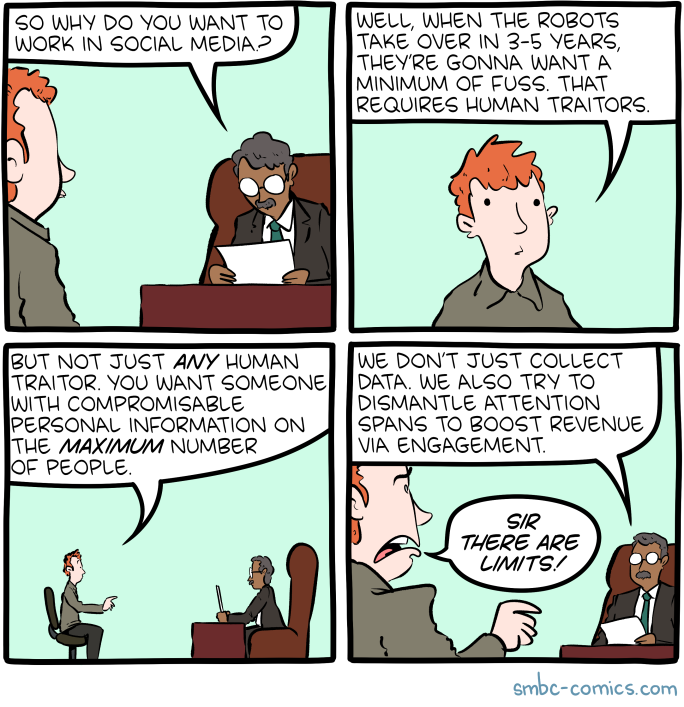
Hovertext:
I'm just saying, when the robots take over, if you're an SMBC reader I think you'll get a little leeway.

OVERLAND PARK, KS—Noting that things were clearly different back when her grandmother was growing up, local granddaughter Jessica Thomas told reporters Tuesday that all of the 83-year-old’s relationship advice seemed to be predicated on getting married at 15. “She was obviously trying to help, but so much of what she…
Twitter has officially rebranded to X after owner Elon Musk changed its iconic bird logo Monday, saying the change was to “embody the imperfections in us all that make us unique.” What do you think?

Sick of slumping from room to room? Why slump when you can bounce? Springboards of various size/bounce guide you from one room to the next in this five-story townhouse. And for easy transition between floors: trampolines! Bounce insurance not included in asking price.
This post was written by Alison Green and published on Ask a Manager.
It’s five answers to five questions. Here we go…
1. Applicant used mom as a reference
I manage a small team that often includes Americorps volunteers. Americorps members commit a year of their time to service doing capacity-building at nonprofits or within government. They receive a stipend that is decent for our area and an education award that can be used towards student loans or future education.
Many are very recent grads or don’t have much work experience. For this reason, combined with their position as volunteers, I manage them a little differently than our regular employees; I take on more of a mentorship role and we have regular conversations around norms, expectations, and their future aspirations.
While interviewing for the next cohort, we had an applicant whose personal statement was a little wacky; they used a lot of personal, emotionally charged language to describe their desire to do the kind of work we do. The application includes a place for recent work experience and the reason for leaving each position, and theirs included a lot of disagreeing with managers over labor conditions or “leadership narcissism.” As someone who has had rough times in the nonprofit sector, I totally relate, but found the forthcoming nature of their application a little nerve-wracking.
They interviewed well, better than I anticipated, but their first and only reference with a phone number (of the two listed) turned out to be their mom. Apparently, they worked for her as part of a family business, which wasn’t included in their application or mentioned in their interview. I was so thrown I rushed through my typical reference questions. She gave a glowing reference.
For now, I’ve sent a note thanking them for interviewing and expressing that we’re interested in moving forward with their application, but I would like them to provide another reference, and I gave a list of folks who would be appropriate to ask.
I’m not sure how to proceed. Should I give them some leeway as this would only be their third role out of college and most of that work was during Covid, when there wasn’t as much chance to absorb office norms? Or is the emotionally charged language and mom simply too much to overlook for a pretty good interview?
If everything else were good, I’d be willing to overlook the mom reference for an inexperienced candidate, figuring that it reflects the applicant’s inexperience with job norms. But the judgment that led to writing “leadership narcissism” on a job application as their reason for leaving is … startling. To be clear, I’d have no issue with them writing something calm and factual like “concerns over wages and hours” or “problematic labor conditions” (although I’d ask about the latter in an interview to learn more about what they were classifying that way). But — while it’s not that “leadership narcissism” isn’t a real thing — that’s such emotionally charged language to include in this context that I’m concerned this person is going to be Quite A Lot and require too much from you in coaching, oversight, and expectation-setting.
They could end up being fine, of course. But whenever you’re hiring, you have limited data and need to extrapolate based on what you see. What I see here is someone with a much-higher-than-average likelihood that they’ll end up requiring large, unrealistic amounts of energy from you — so I’d turn to other candidates instead.
Related:
why is it bad to sound naive when applying for jobs?
And speaking of leadership narcissism…
2. Can I tell my boss I’m not considering her availability anymore?
My boss is the second-highest ranking person in our organization, and I report directly to her in a senior level position. She has a habit of demanding that meetings be scheduled with outside partners and then at the last minute (10-15 minutes before the meeting starts) texting to say she can’t make it so someone should record the meeting and she’ll watch it later.
The problem with this is that she is an extremely busy person with a packed calendar, so these meetings are always squeezed into the most inconvenient time slots to accommodate her availability, and we have to schedule weeks out. If we did not consider her schedule, we could hold these meetings much sooner and have them at times that work better for the rest of the team (think, NOT at 8:30 am on a Monday).
I’m sympathetic to how busy she is and the fact that last-minute issues do come up because of the nature of her job, but this pattern is causing a lot of irritation and loss of enthusiasm around the projects that involve her. People, myself included, think she’s being disrespectful of our time, and her reputation is taking a hit (there are other reasons for that, but this is part of it).
She does not take criticism well, so is there a polite and professional way of telling her that when she requests these meetings, I’m not going to bother looking for a time that works for her since it’s unlikely she’ll show up anyway? What can I do here?
“Because your schedule is busy, I’m finding that we’re frequently scheduling meetings at times that are difficult for the rest of the team in order to make it possible for you to attend, but then you end up not being able to join us anyway. I’m picking up on some frustration from people when they contort their schedules to be available when you can attend but then you’re not able to participate — so I’d like to begin scheduling things like X and Y at times that are easier for other attendees.”
You can also try it meeting by meeting — “There wasn’t a time that worked for everyone, and since I know you’re likely to get pulled into other things at that time anyway, I slotted it for Tuesday afternoon, because I know I can get everyone else there then.”
3. Avoiding my abusive ex at industry conferences
My ex and I work in the same niche industry. We have a similar network and it’s not uncommon for us to know the same people. Our roles are such that we both have to attend several industry conferences each year, either as a speaking engagement or to meet with customers, so my declining to attend can be tricky.
My ex was abusive, a fact that few people know or would believe. My ex is well-known in our niche field and has a reputation as being a nurturing and compassionate person. When we both attend industry gatherings, my ex will approach me when I’m speaking to mutual acquaintances to say hi and ask how I am. Others see the semi-celebrity being friendly, but I see my abuser knowing that I’m afraid.
The professional response is to say hello and make an excuse to leave the conversation. Do you have any tips on how to do that without drawing the attention of our mutual acquaintances? Is there anything else I should do?
I’m so sorry you’re dealing with this. There are a lot of professionally approved responses for quickly extracting yourself from a conversation at networking events, and you could make liberal use of them. For example:
* “Excuse me, I see someone I’ve been looking for today.”
* “Excuse me, I need to take care of something.”
* “Excuse me, I’ve been meaning to find the coffee.”
* “Excuse me, I’m going to find the restroom.”
* “Excuse me, I need to talk to the host.”
* “Excuse me, I see someone trying to get my attention.”
* “I’ll leave you two to catch up — I’ve need to duck out for a minute.”
You can say any of these and then immediately exit the conversation.
4. Should I apologize for laughing at my coworker’s language slip?
I work for a nonprofit that shares a building with other nonprofits. The receptionist for one of the other agencies, Sally, sometimes pops into my workplace to share news and that sort of thing. She is delightful, good-humored, and we get along well. When Sally comes into my agency’s office area, she uses a door to which the public doesn’t have immediate access. (It’s a seldom-used stairwell.)
She popped into my agency’s office today, and when I stuck my head out to see who it was, she said “Don’t worry, it’s just me … ‘backdoor Sally.’” Then immediately she said, “That didn’t sound right!”
By the time my brain caught up to my ears, I let out a full-body laugh. She hadn’t realized the sexual overtones of her self-assigned nickname at first, then tried to back-peddle. My laugh was instinctual, and I really couldn’t help it.
I should obviously not have laughed, as funny as it was. She was totally embarrassed, and I definitely made it worse. Somewhat fortunately, I was the only one who heard the comment, and she was the only one who heard my laugh. My question now: should I apologize for my laugh outburst? Or does that just draw further attention to her embarrassing slip?
You don’t need to think about this any further at all. She said something unintentionally funny, you laughed because it was indeed funny (probably made even more so by her acknowledgement of it), and that is a normal reaction to have in those circumstances. You didn’t do anything wrong, she didn’t do anything wrong, language is funny, humans are amusingly human, and no embarrassment or apology is required on either side.
5. How do I keep cat fur off all my work clothes?
I’m hoping you can help me with a “hairy” situation. My office “uniform” is black slacks and usually a dark-colored blouse. As it happens, I have fallen in love with a person who has a long-haired, fluffy, white cat. Her fur consists mostly of these cloud-like, ethereal fibers that either float in the air with the slightest breeze or attach themself to any surface with a static cling deathgrip. “Zsa Zsa” is banned from the closet. I brush her daily. I lint roll my clothes before and after the wash. I use a chomchom roller on the furniture and bedding (love this thing). Cat hair eradication has become a second job. But still: Cat fur. Everywhere. I can’t afford to replace my wardrobe with lighter colored clothing. As a cat mom can you recommend any products, tips, or tricks you’ve found helpful keeping your work clothes (relatively) fur-free?
I have six cats and two foster cats. At this point people probably think I’m wearing a light fur garment over all my clothing. Cat fur is my second skin.
I’m happy to throw this out for suggestions from readers with a more manageable fur situation though.
This post was written by Alison Green and published on Ask a Manager.
A reader writes:
I’ve always loved horses and owned two for several years. A few years ago, after my last horse died of natural causes, I reached out to a local not-for-profit that provides therapeutic horseback riding lessons for veterans, physically challenged children and adults, etc. to donate leftover feed, saddles, etc. I was really impressed with the volunteer coordinator and the program, and I volunteered to help out with lessons. I went through the training and was looking forward to getting my “horsey” fix in after missing my boy for several months, and worked for exactly five lessons before one of the newer therapy horses was assigned to me. I had been told during my training that the horse’s trainers weren’t confident he’d be a good fit for the program but never told why. Well, I soon found out because this new horse spooked, bolted, tossed his rider, and ran me into a fence. Very bad scene — fortunately the rider wasn’t hurt, but since my responsibility was controlling the animal, I felt terribly guilty, even though I did everything I could think of the try to stop him, literally throwing my body in front of him. I was in a lot of pain, noticeably limping back to the barn, and was later diagnosed with a torn ACL and a minor fracture.
The volunteer coordinator, Lydia, called me right after the accident to get my statement for the insurance, and I mentioned that I had initially been assigned to a different horse, but was taken off him and put on the newer one. She said, “I thought you’d be able to handle him.” This hit more like, “With all the experience you’ve had, we figured you could control this maniac.” I told her I’d injured my knee, but didn’t realize the extent of the injury at the time and never told her. She never contacted me directly again.
I stayed on the volunteer emails but didn’t respond to volunteer requests for a couple of years while my knee healed. I’ve recently retired and was thinking of reaching out again for a different role, maybe cleaning stalls or working on the ground with the horses, until this past week. My inbox has been blowing up with emails starting with Lydia’s sudden resignation over “several changes to the program” that she did not agree with. Volunteers and teachers expressed surprise and confusion.
Finally the new president of the board emailed to explain the changes that were being made, which seemed … not unreasonable (staffing the office in-person, having more than one person on-site at a time, using a lift for students unable to mount the horse independently). But then Lydia sent a message through one of the remaining volunteers to give her side of the story and the stuff hit the fan! She’d been working a hybrid situation for 10+ years and her family situation prevented her from being in-person in the office full-time, but she was given an “ultimatum” to be in person four days per week and didn’t agree with other program changes, such as servicing certain students but not others with different abilities who had previously always been in the program. Again, not unreasonable, but long-tenured volunteers and teachers began rage quitting. I’ve never seen so many hysterical emails, obviously written under much emotion.
But the kicker was the final email from the president of the board, sent early yesterday morning after no teacher or volunteers showed up for lessons the night before. She “wanted to make sure (she) congratulated (volunteers) on not making this about the population (the program serves) but about (Lydia).” Her tone was obnoxious and hostile (i.e., “thank you for disappointing these families” and accusing volunteers of not caring about the families and students). More rage quitting emails followed.
I suspect today’s email to the volunteer group has been written by someone else, because it is more business-like and less emotional. While I still believe in the value of this program, and I don’t have a lot of skin in the game over Lydia’s resignation, red flags are flying about ever reaching out again. I’m not wrong about this being incredibly toxic, am I? Should I sit back and wait to see how things shake out, or write (privately) to the president of the board with my own experience? There will obviously be a lot of newer faces and maybe this is a chance to help this program grow in a new direction, but the reaction of the president is alarming.
Oh no. You’re not wrong: it is indeed incredibly toxic all around.
I’m sure the president is very frustrated — by Lydia using the organization’s email list to rile up the volunteers (and more than once!) (and why did she even have access after the first email?), by the rage quitting, by the drama swirling around all of this, and by teachers and volunteers not showing up for lessons — but part of her job is to handle that frustration professionally and privately. Her email “congratulating” volunteers on “making this all about Lydia” is over-the-top inappropriate for her position, and was like throwing kerosene on a fire. Her job is to minimize drama, not add to it. But she chose to add to it.
So just … bad choices all around in this organization, and no sign of mature or steady leadership.
Given all that, I don’t think there’s a ton of value in you contacting the president with your own experience. The president comes off poorly here, and there’s no reason to assume she’s a thoughtful steward who would benefit from hearing your experience and perspective. I do think there could have been value in sharing your concerns right after your injury. But since it’s been a few years and there’s capital-D Drama imploding right now, I’d leave it alone. She’s also probably not currently in a position to make good use of whatever feedback you offer; at this particular moment, it’s all likely to feed into one agenda or another, and you won’t be able to tell from the outside if that’s a good thing or a bad thing.
Sit back and wait to see how things play out before you consider staying involved. If new leadership steps up, or maybe if this president seems to right things in time, you could consider being involved again. But there are tons of other volunteer causes that are well-equipped to use your time and skills; unfortunately, right now this isn’t one of them. Which sucks, because they have a great mission (and I assume they might be the only such organization local to you). But wait for the drama to die down and then assess if you want to stick even a toe back in.
This post was written by Alison Green and published on Ask a Manager.
A reader writes:
I manage a small team of remote, non-exempt employees. One of them, Jane, recently resigned, right before being put on a formal improvement plan for performance issues. On her last day told the rest of the team how she was able to take care of personal matters (e.g. attend happy hours, nail appointments) while on the clock and her “hacks” for getting away with it. I know this because the team told me.
I checked in with my team to do damage control. I communicated that this was not acceptable, that I understand any frustration that their peer was able to get away with this, and that I strive to hold everyone accountable to performance goals and timekeeping policies so things like this don’t happen. Everyone seemed to understand Jane was misguided and still be confident in my management.
Overall, I think I’m a good manager and I strive to get even better. I hold my team accountable to clear performance goals, don’t micromanage, and provide generous guidance and support. I’ve gotten lots of positive feedback about my management from current and former employees.
This situation has me feeling like I’ve been taken advantage of and it’s dinged my confidence as a manager. I’m frustrated that this happened under my watch and am feeling like a bit of a fool for not catching it. How can I bounce back after my confidence has been shaken?
Have you figured out how Jane’s “hacks” for using work time for personal things flew under the radar for so long? I think your answer lies there.
In some cases you might not have noticed it because Jane was great at her work and finished things quickly so she had extra time — in which case, generally I’d think that wasn’t a big deal.
But since she had performance issues, it’s not fine that she was surreptitiously using work time for nail appointments and happy hours, and the fact that she was able to do it undetected could be a sign that you weren’t managing her closely enough.
Maybe.
How were you managing her? When you saw she wasn’t performing at the level you needed, even before the improvement plan, did you talk to her about that forthrightly, explain the bar she needed to meet, and dig into what might be getting in the way? Did you check in more frequently to provide coaching and guidance — a sort of scaffolding to minimize problems while she was attempting to improve?
In theory, you could do all those things and someone struggling with their work but determined to sneak out for a 2 pm happy hour without you knowing could still find a way to do it — depending on how your office functions and how much autonomy people have in their work. If you were managing her appropriately closely for her performance and this was still happening, it could be that Jane was simply determined to take advantage of you/your employer. Sometimes that happens, and it’s not necessarily a sign that you messed up — it could just be a sign about Jane. (In fact, in that case, what you learned about Jane at the end might simply confirm that your instincts were good — you were right to see that she wasn’t doing well and that she might not be someone you should keep in the job.)
It’s worth interrogating your own practices to figure out how much of this, if any, you should have spotted it earlier or not, in case there’s a lesson for how you manage in general. But it’s also true that some people just suck. It makes me think of a letter a while ago from a manager who extended a lot of good will and flexibility to a new hire who was missing tons of work due to what they claimed were family problems, and it later came out that no, they were just working a second job during their hours for the first one. I don’t want that manager to over-correct and not offer flexibility to employees who need it in the future … and I also don’t want you to over-correct just because you encountered someone determined to deceive you. But it’s still smart to look as critically as you can at whether you could have spotted it earlier, or not.
I do wonder if you were surprised by the gleeful “look what I got away with” tone Jane took with the rest of your team. Does that seem in character or out of character? If out of character, do you still think that now, looking back over the totality of her employment? Were there signs you missed that you can now see in retrospect? I don’t know what you’ll find when you look at that — again, there’s no surefire way for catching out someone who’s determined to fool you, at least not without forcing you into lots of really bad practices that won’t make sense for 99% of situations — but it’s worth reflecting on too.



/https://static.texastribune.org/media/files/58f85e4fae78c5757c40c85368b3f833/Joy%20Alonzo%20TAMU%20TT%2001.jpg)