Shared posts

14 Sep 21:18

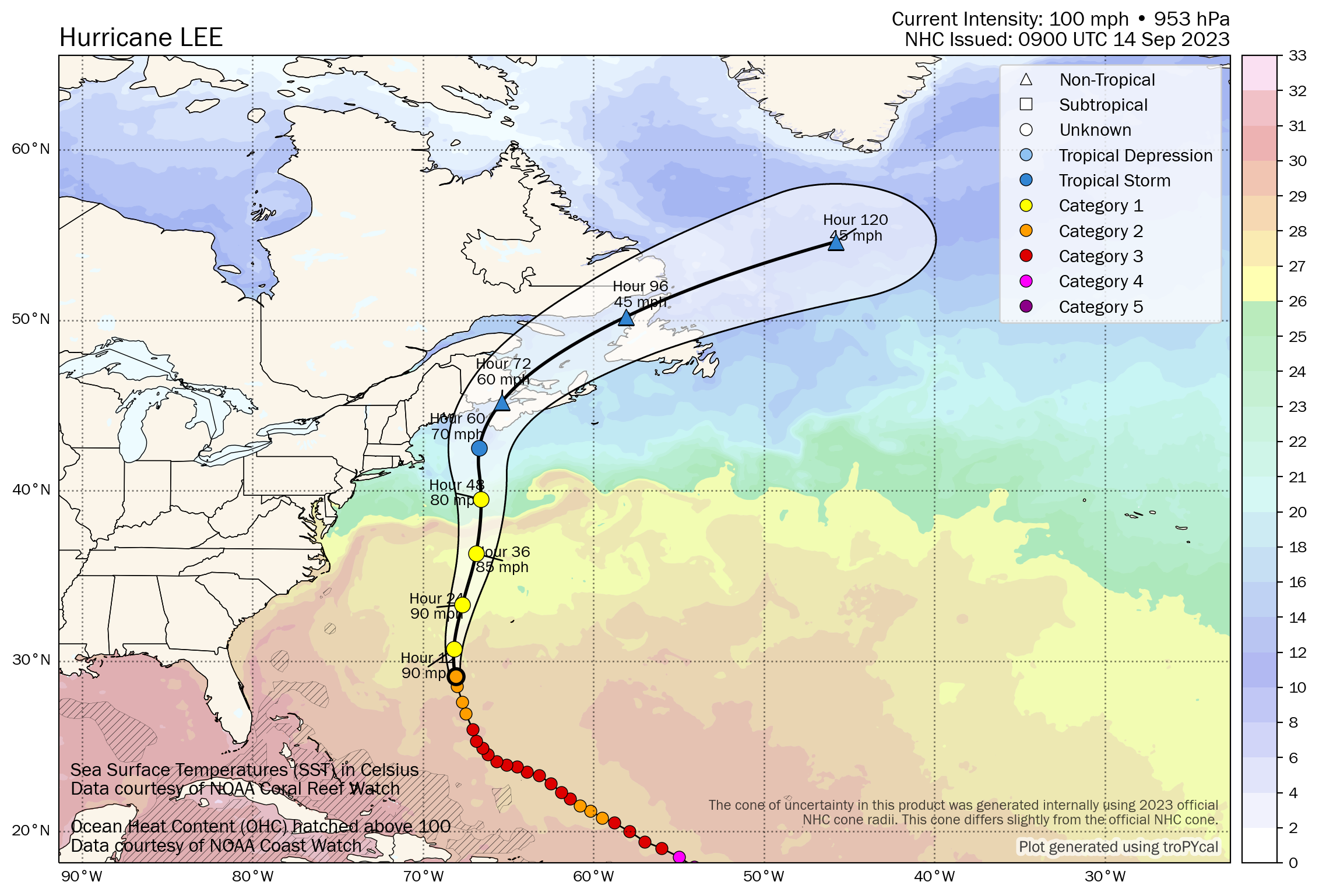
Hurricane Lee continues on its path toward New England and Atlantic Canada

by Matt Lanza

One-sentence summary

Hurricane Lee is on track to impact New England and Atlantic Canada this weekend, a significant storm capable of a serious storm surge and widespread winds.

Hurricane Lee’s forecast track continues to narrow some, with a path into the Bay of Fundy or Nova Scotia most likely at this point, although impacts will spread very, very far from the center. (Tomer Burg)

Hurricane Lee: 100 mph, moving N 9 mph

What’s changed since Wednesday evening?

A Hurricane Watch is now in effect for portions of extreme southwestern New Brunswick, as well as southwestern Nova Scotia. Tropical Storm Watches connect the two Hurricane Watches and also extend east across Nova Scotia past Halifax.

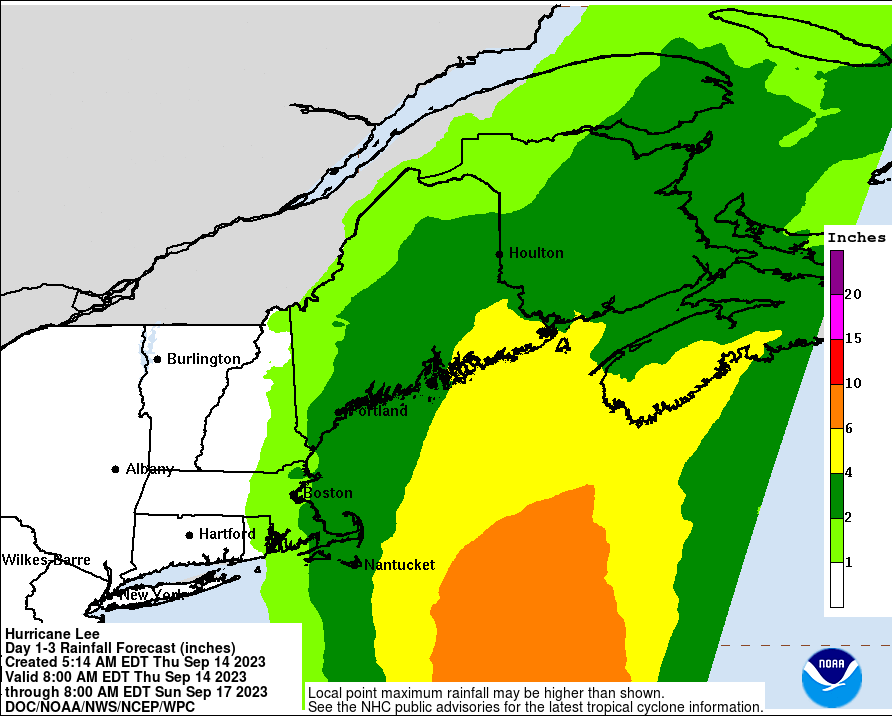
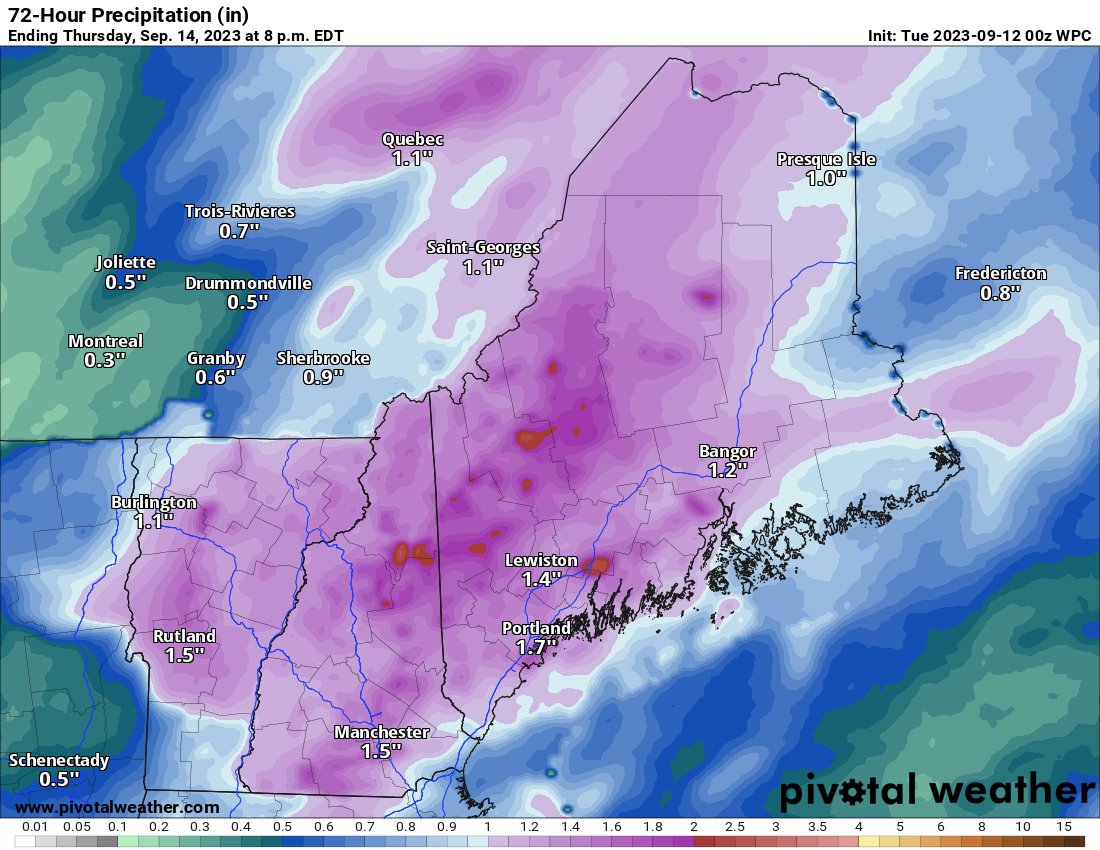
The rainfall forecast was nudged up a little for southeast Maine, southern New Brunswick, and southwest Nova Scotia.

Lee’s forecast track

For the most part, the track forecast is now baked in up to landfall. There may be some wobbles in terms of exactly where Lee ends up, but it’s narrowed to most likely between Eastport, ME and about Cape Sable Island.

Atlantic Canada surge impacts update

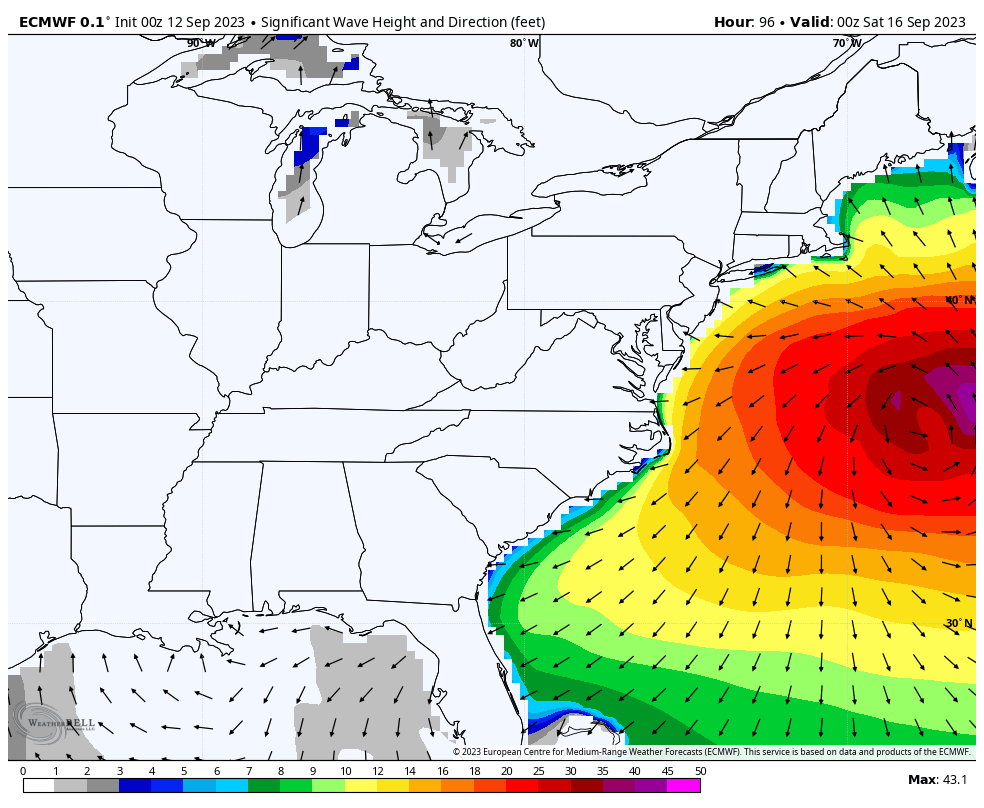
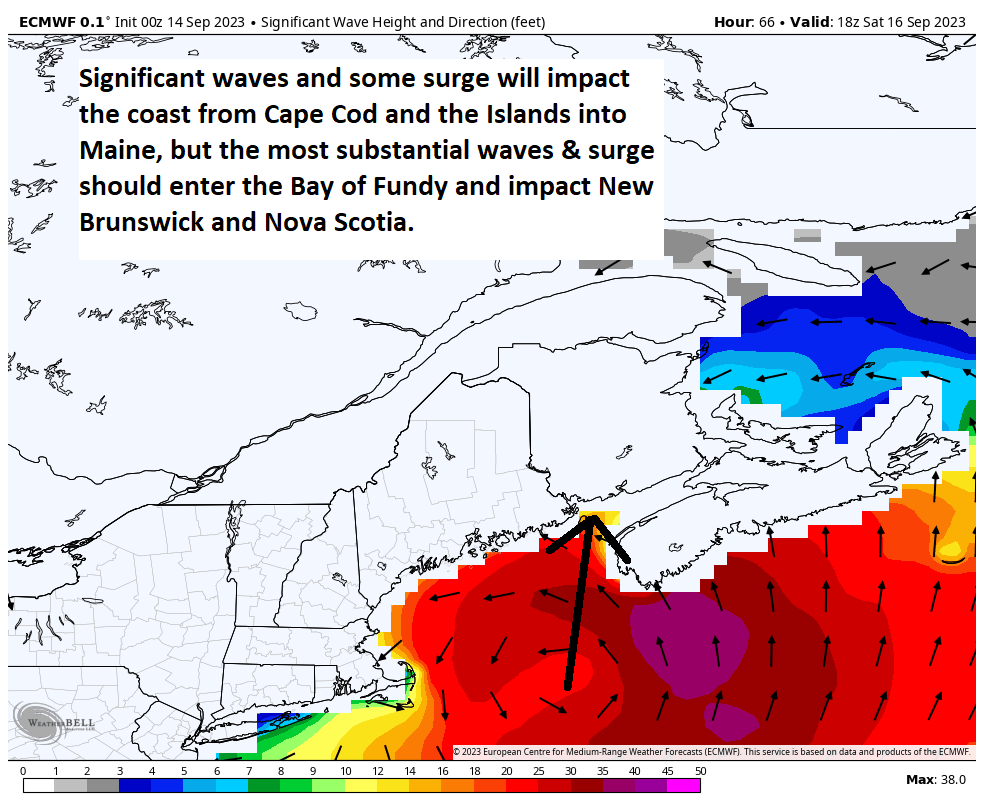
For Canada, we continue to worry most about surge, particularly with a storm that would come right into the Bay of Fundy, without making landfall on Nova Scotia. Essentially, large amounts of water would be funneled into the Bay. Saturday’s low tide in the bay is around 7:30 local time, with the subsequent high tide at 1:45 AM Sunday. That high tide may be the worst tide of the event for the Fundy coast of New Brunswick. Surge will extend far to the east of the center though, and a substantial surge may occur along much of Nova Scotia’s coast as Lee comes in.

The most significant waves will come into the southwest portion of Nova Scotia and perhaps into the Bay of Fundy, with considerable storm surge impacts on the Fundy coast of New Brunswick and in Nova Scotia (Weather Bell)

Again, it’s important to note that the most significant hazards will differ from those of Fiona last year, which tracked into eastern Nova Scotia. And the surge impact from this storm and the wind field of this storm will be broader and wider spread than most storms. This is a serious storm and should be treated as such.

Massachusetts outlook

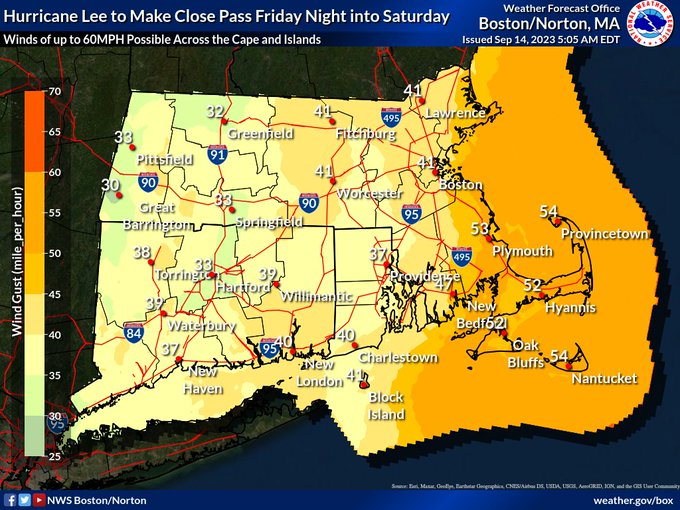
Yesterday we noted that the one primary area of uncertainty may have been Cape Cod and the Islands, as the approach of Lee from the southeast would determine how much wind, rain, and surge we saw there. Lee is now expected to pass about 100 miles or so east of the Cape and Nantucket. This should offer up tropical storm force wind gusts, as well as at least some heavy rainfall to those areas.

The wind gust forecast for southern New England shows gusts of up to 60 mph possible on Cape Cod and the Islands, as well as south of Boston. (NWS Boston)

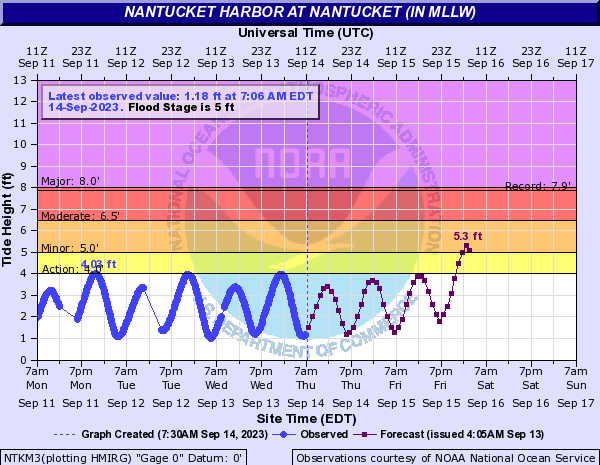
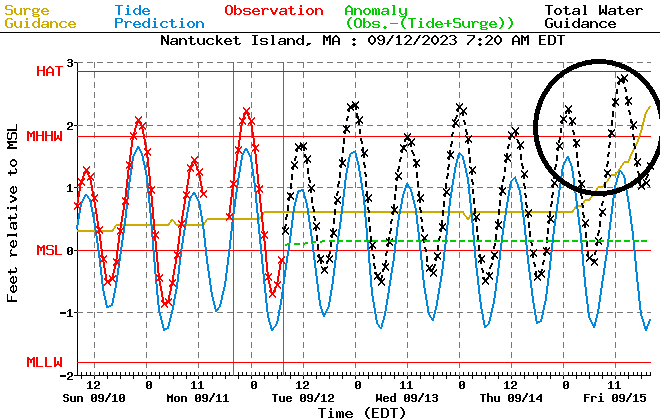
The strongest winds should stay offshore, and aside from the 2 to 4 foot surge and moderate coastal flooding, this will likely behave more like a strong nor’easter than anything for southern New England.

The tide forecast for Nantucket shows minor to perhaps moderate coastal flooding possible by Saturday. (NOAA)

Still, folks in these areas should continue to monitor forecast changes, particularly around the surge forecast to ensure that they’re up to speed on the latest. We’ll have a little more detail on the Maine and coastal New Hampshire outlook later this afternoon.

Lee’s wind and rainfall outlook

Changes to the wind and rainfall sections of our post yesterday were minimal. We are still expecting broadly the same outcomes from those regardless of whether Lee is a hurricane, tropical storm, or post-tropical. The rainfall forecast was nudged up a bit, however, with some areas now seeing more like 4 to 6 inches of rain.

Rain totals have been nudged up just a little across Maine, southern New Brunswick, and Nova Scotia with up over 4 inches possible in some of those areas. Flash flooding will be a concern. (NOAA)

We will have another post with the latest on any changes late this afternoon or evening.

Elsewhere in the tropics

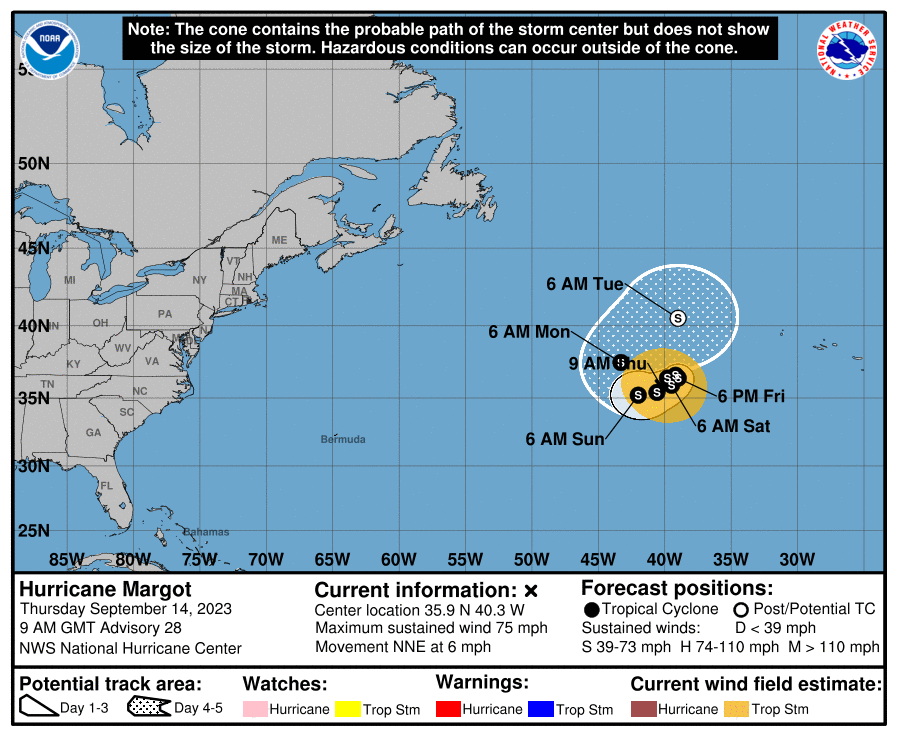
Hurricane Margot has had a bit too much Sauvignon blanc and is basically doing loops southwest of the Azores. It remains no real threat to land for some time, though at some point I suppose it could approach the Azores.

Margot is confused. (NOAA NHC)

Invest 97L continues to look poised to soon develop and track out over the open ocean. Perhaps eventually Bermuda will need to watch this one, but that’s a long way off yet.

There are no other concerns beyond those systems.

14 Sep 21:15

Widespread rain showers are inbound for Houston today

by Eric Berger

Good morning. As anticipated, much of the area on Wednesday along and south of Interstate 10 recorded rainfall. Today, widespread showers will extend across most of the rest of the region as an atmospheric disturbance moves in from the west. This will provide lift for the very moist air at the surface, and should lead to some healthy showers and thunderstorms.

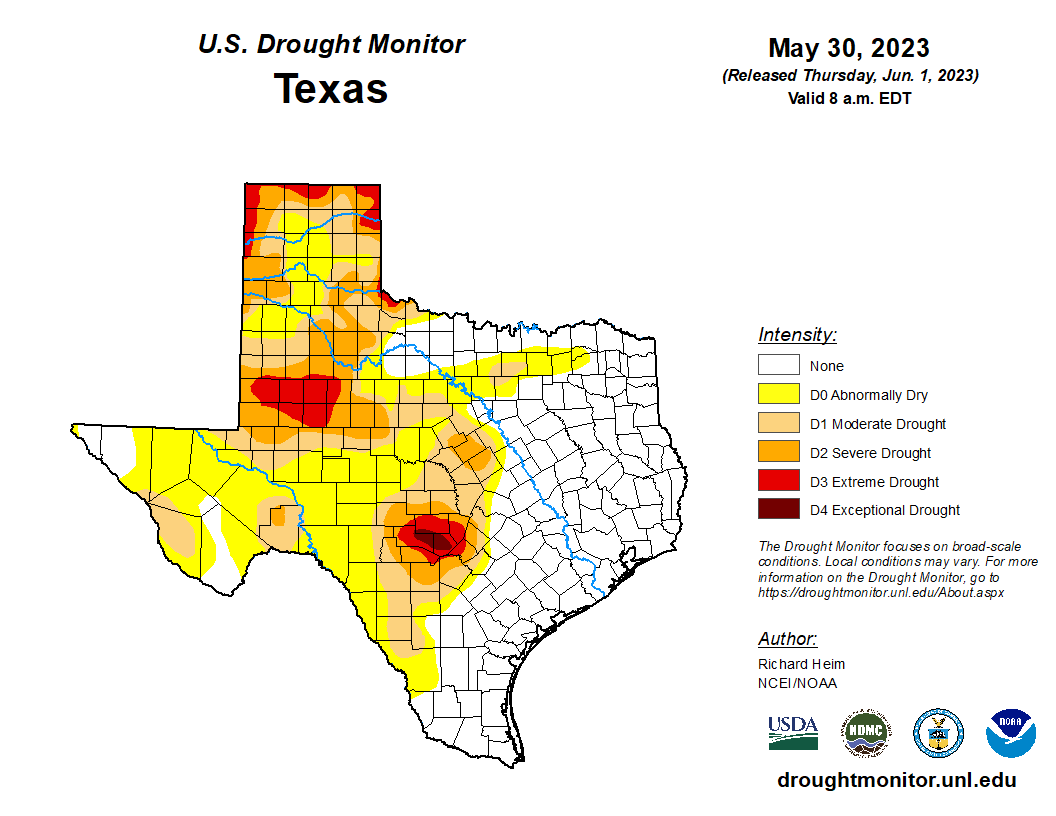
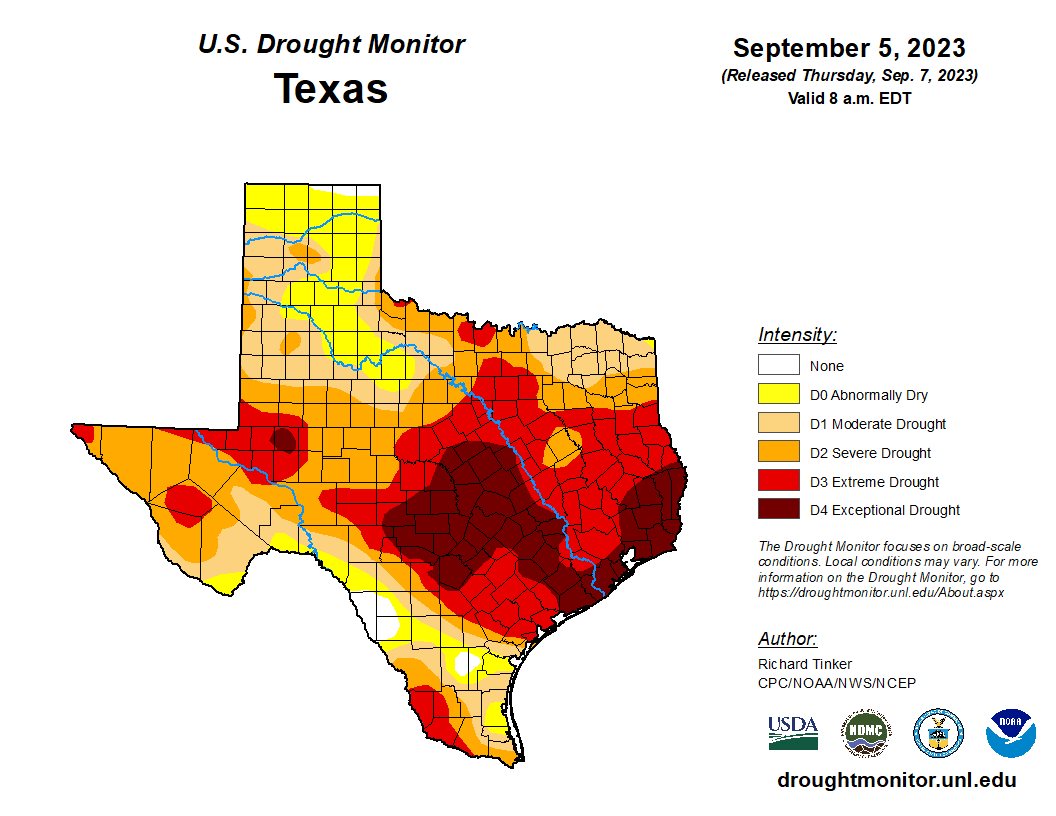
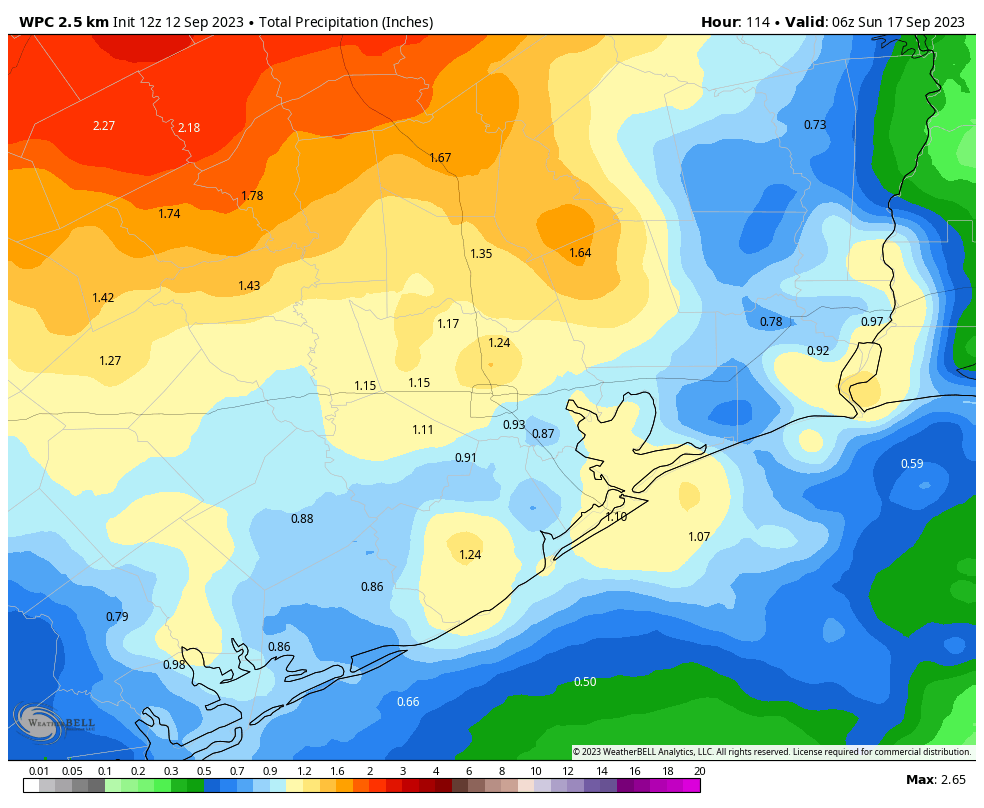
We’ll see some additional rain chances on Friday and Saturday, but all indications are that today will probably be the main event. I would expect that most (but not all) of the area will pick up 0.5 to 2 inches of rainfall today, with lesser accumulations possible on Friday and Saturday. Although a few intense downpours may briefly produce street flooding, these rains will, by and large, be very much welcome after our summer of heat and drought.

NOAA rain accumulation forecast for now through Saturday. (Weather Bell)

Thursday

Overall rain chances will be about 80 percent today given the favorable environment. Based upon the latest modeling I expect showers and thunderstorms to start developing by mid- to late-morning, with the greatest coverage during the afternoon hours. With mostly cloudy skies and rain cooled air, much of the region probably will record highs today in the mid- to upper-80s. Rain chances will slacken some overnight, but additional showers are possible.

Friday and Saturday

As of this point, both Friday and Saturday look to have similar weather conditions. We can expect partly cloudy skies and perhaps a 50 percent chance of rain both days. In terms of accumulations, both days may see rain totals measured in tenths of an inch, with a few higher isolated totals. Rain chances will persist into the evening and overnight hours. Both days should see highs of around 90 degrees.

Sunday

It now looks like a lesser chance of rain will persist into Sunday, probably something like 30 percent. Skies will be mostly sunny otherwise, with highs of around 90 degrees or a bit higher. Sometime on Sunday a weak front will push offshore, ushering in some slightly drier air into the region. This will effectively end rain chances, and should allow lows on Sunday night to drop into the low 70s for most of the area.

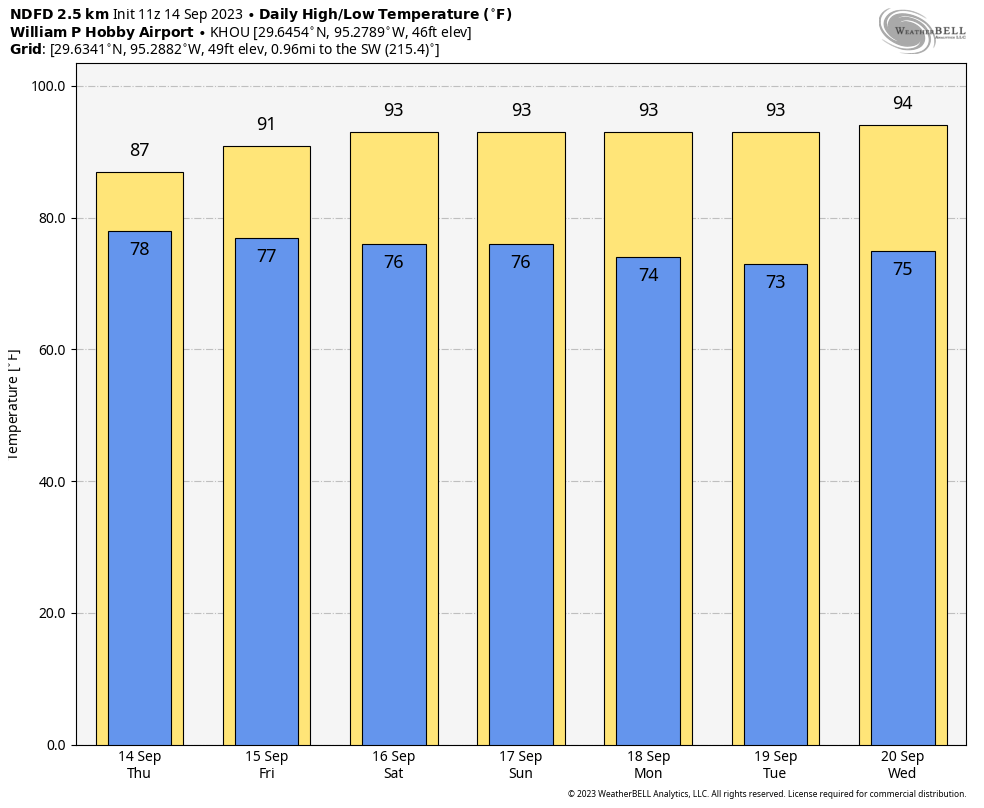
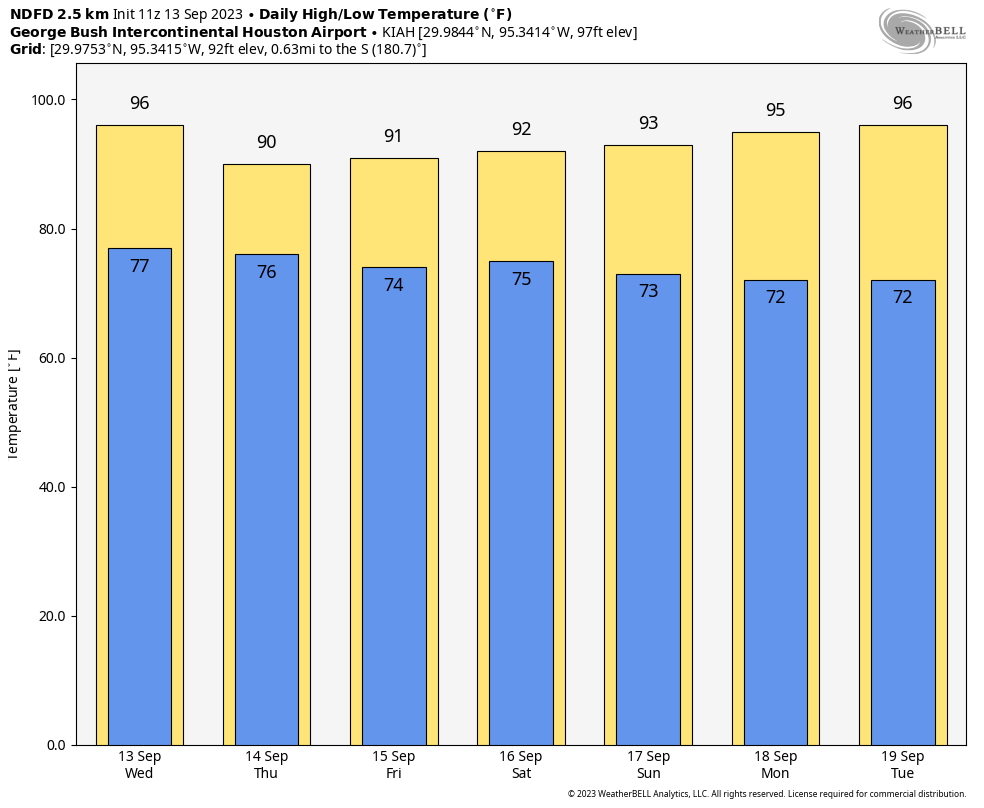
Summer is not going away over the next week, but we will be stepping back to a more acceptable level. (Weather Bell)

Next week

The slightly drier air should hang around for Monday and Tuesday, leading to some decently pleasant mornings and evenings. Highs will likely top out in the vicinity of the low 90s for most of next week, perhaps reaching the mid-90s toward week’s end. As the humidity returns in full force by around midweek, we should start to see the return of a few clouds and rain chances of perhaps 20 percent each day. This is about how mid-September should feel as we await the true onset of fall in the form of a strong-ish cold front. (For which there is nothing in sight, I’m afraid).

14 Sep 21:13

Top Five: September 14, 2023

by Glasstire

Glasstire counts down the top five art events in Texas.

For last week’s picks, please go here.

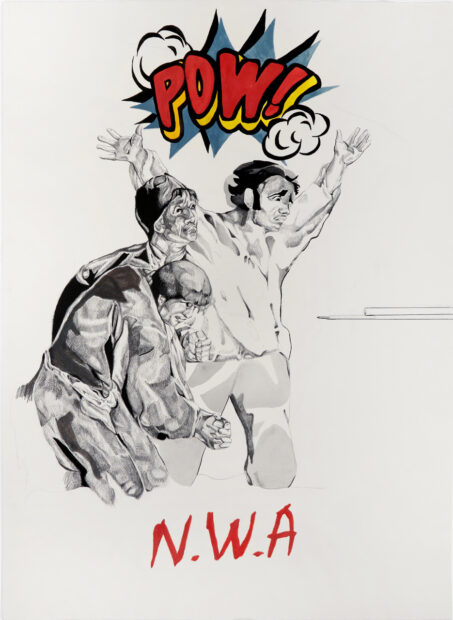
A watercolor on paper featuring three figures that appear to be surrendering with text above their heads that reads "POW" and text below them that reads "N.W.A."

David McGee, “POW N.W.A.,” 2022, watercolor on paper, 30 1/4 x 22 inches.

1. David McGee: The Tarot Cards and The Gloria Paintings
Inman Gallery (Houston)
September 16 – November 1, 2023

From Inman Gallery:

“Inman Gallery will present David McGee: The Tarot Cards and The Gloria Paintings, on view September 16– November 1, 2023. For McGee’s first exhibition at Inman Gallery, we will exhibit selections from distinct yet interconnected bodies of works: a large grouping of works on paper from The Tarot Cards series, multiple abstract works from his Gloria Paintings series, and four large figurative watercolors on paper that are born from the Tarot Cards.”

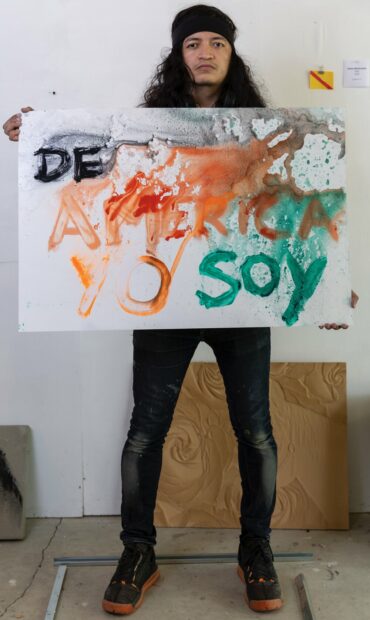
A photograph of artist Jesus Benavente with a text based artwork that reads, "De America Yo Soy."

Jesus Benavente, “De America Yo Soy,” gouache on galvanized sheet metal, 24 x 36 inches.

2a. La Pulga Fresa: Jesus Benavente
Southwest School of Art Russell Hill Rogers Gallery- Navarro Campus (San Antonio)
September 8 – October 28, 2023

From UTSA:

“Jesus Benavente, originally from San Antonio but now living in Brooklyn, offers us La Pulga Fresa, an interactive installation inspired by the flea market in Poteet, a farming community well-known for growing strawberries, just south of the metropolitan area. Using diverse and often non-traditional media, Benavente directs our attention to consider elements of popular culture as being significant opportunities for engagement and reflection. In his work, Benavente references elements of popular visual culture in video artworks, paintings, artist blankets, an abstracted bounce house, and in collaborations with UTSA School of Art students and turns them into installations that help us see the art in Mexican-American and South Texas heritage.”

A photograph of a sculpture by Alicia Eggert featuring the word "Future."

Alicia Eggert, “The Unimaginable Future,” 2020-21, steel rebar and tie wire, 93 x 185 x 41 inches.

2b. Alicia Eggert: Monumentous
Southwest School of Art Russell Hill Rogers Gallery- Navarro Campus (San Antonio)
September 8 – October 28, 2023

From UTSA:

“Alicia Eggert’s exhibition Monumentous includes text-based visual artworks, neon signs, paintings, sculptures, interactive installations, photographs, and video art that embrace the power and poetry of language. In work like We Observe the Universe From Within It, Eggert puts into words what many of us often forget: that we are always active agents in even the smallest endeavors in our everyday busy lives. Eggert explains, ‘If Time is a construct, my goal is to determine exactly how it’s constructed and how our perception of Time is shaped by personal, cultural, and geographical factors. I derive my inspiration from reading about Time as it’s defined by physics and philosophy, but I focus on the words and phrases we use in our everyday language — words like ‘now’ and ‘then’ — as points of entry into more complex ideas.’”

A painting by Patrick Quinn featuring six bottles of Chardonnay and a plate of flan.

Patrick Quinn, “Woodbridge (VA),” 2023.

3. PATRICK QUINN: LIGHTNING IS AN ANGRY RAINBOW
McLennon Pen and Co. Gallery (Austin)
September 9 – October 15, 2023

From McLennon Pen Co. Gallery:

“McLennon Pen Co. Gallery is thrilled to announce Patrick Quinn as the gallery’s first Artist-in-Residence. He will be living and working this summer for the month of August at the gallery in Austin, Texas. The residency will culminate in an exhibition of airbrush paintings made exclusively during the duration of his stay.

Each painting Quinn makes informs the next one. He describes his succession of paintings as memes in a different format, a long-form version, an exercise in how we process images and a ‘cool space’ to spend time with silly, stupid, and absurd contemporary thoughts. These ideas spring up from looking online and scrolling his phone, often browsing Instagram and Google’s Image Search on Page 1 until a photograph is discovered that would ‘look so good in airbrush.’”

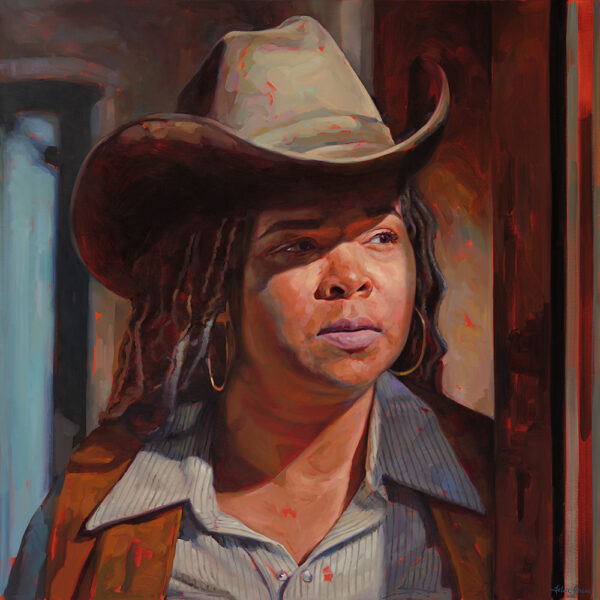
A painting by Felice House of Shanielle Dean.

Felice House, “Shanielle Dean in Giant.”

4. The Peacemakers: Works by Felice House and Dana Younger
San Angelo Museum of Fine Arts
July 20 – October 8, 2023

The San Angelo Museum of Fine Arts:

“The San Angelo Museum of Fine Arts presents College Station-based husband and wife duo, sculptor Dana Younger and painter Felice House, celebrating the Western landscape and reimagining the Western narrative in their thought-provoking artwork.

‘For more than a century the West has occupied a special place in the imagination of Americans, with perhaps only one foot in reality,’ the artists write. ‘By subverting expectations, House and Younger are questioning a genre, not only in its historical context, but as a contemporary fantasy with roots so deep in American culture that they are quite possibly inexorable.’”

A collagraph print by Cat Rigdon featuring objects like coins and vessels.

“Cat Rigdon: The Carillon Dig-Site”

5. Cat Rigdon: The Carillon Dig-Site
Carillon Gallery – Tarrant County College South (Fort Worth)
August 24 – September 21, 2023

From the artist:

“Cat Rigdon is a multi-disciplinary artist based in Dallas, Texas. She grew up on the island of Cyprus during the late 1990s and early 2000s. Rigdon and her siblings sneak into ancient archeological sites such as Tomb of the Kings in Paphos and rummage through abandoned monasteries and hotels, sometimes under their parent’s supervision. These strong memories along with the island’s strong folk art, naturalism, and archeological relevance is reflected in Rigdon’s work through her depictions of ancient funerary goods.”

The post Top Five: September 14, 2023 appeared first on Glasstire.

14 Sep 21:12

A Preview of Museum Exhibitions Opening in North Texas this Fall

by Jessica Fuentes

In August, Glasstire announced its top exhibitions to see across the state this fall, including Groundswell: Women of Land Art at the Nasher Sculpture Center and Afro-Atlantic Histories at the Dallas Museum of Art. Below, learn more about those exhibitions and others coming to the North Texas region this fall, including shows at the Meadows Museum, The Kimbell Art Museum, and the Amon Carter Museum of American Art.

A self portrait by painter Abraham Ángel.

Abraham Ángel, “Self-Portrait / Autorretrato,” 1923, oil on cardboard, 31 7/8 x 28 1/4 inches. Museo Nacional de Arte. INBAL / Secretaría de Cultura, Mexico City

Earlier this week, the Dallas Museum of Art (DMA) debuted Abraham Ángel: Between Wonder and Seduction, the first major survey of the artist’s work in more than 35 years. A modern Mexican painter, Mr. Ángel was a leading artist of his generation before his untimely death at the age of 19. In the three years that he produced art, 1921-1924, he created 24 paintings, four of which still remain lost. The exhibition will contextualize Mr. Ángel’s work alongside pieces by his contemporaries, including Adolfo Best Maugard and Manuel Rodríguez Lozano.

In a press release, Dr. Agustín Arteaga, the DMA’s Eugene McDermott Director, said, “We are thrilled to present the first full retrospective of a magnificent artist whose life was cut tragically short just as his works were taking the Mexican art scene by surprise in the 1920s. Living in a society that was not ready for him, Ángel suffered harassment and discrimination during his lifetime, but his art embodies joy and vivacity while tracing Mexico’s transformation from rural to modernized. This exhibition reveals to the world the artistic qualities which had no precedent and no comparison within his times. Ángel’s life story continues to resonate, and his art will captivate audiences of today as it did a century ago.”

Abraham Ángel: Between Wonder and Seduction will be on view at the Dallas Museum of Art through January 28, 2024.

A painting of three women standing near each other and talking.

Barrington Watson, “Conversation,” 1981, oil on canvas. National Gallery of Jamaica, Kingston, Gift of Workers’ Savings & Loan Bank. © Estate of Barrington Watson

In October, the DMA will host the traveling exhibition Afro-Atlantic Histories, which was originally presented as Histórias Afro-Atlânticas in 2018 by the Museu de Arte de São Paulo and the Instituto Tomie Ohtake in Brazil. The exhibition consists of approximately 100 works of art and documents that together chart the transatlantic slave trade and its legacies in the African Diaspora. This presentation marks the second time the exhibition has been in Texas; in 2021 the Museum of Fine Arts, Houston hosted the show.

Afro-Atlantic Histories will be on view at the DMA from October 22, 2023 through February 11, 2024.

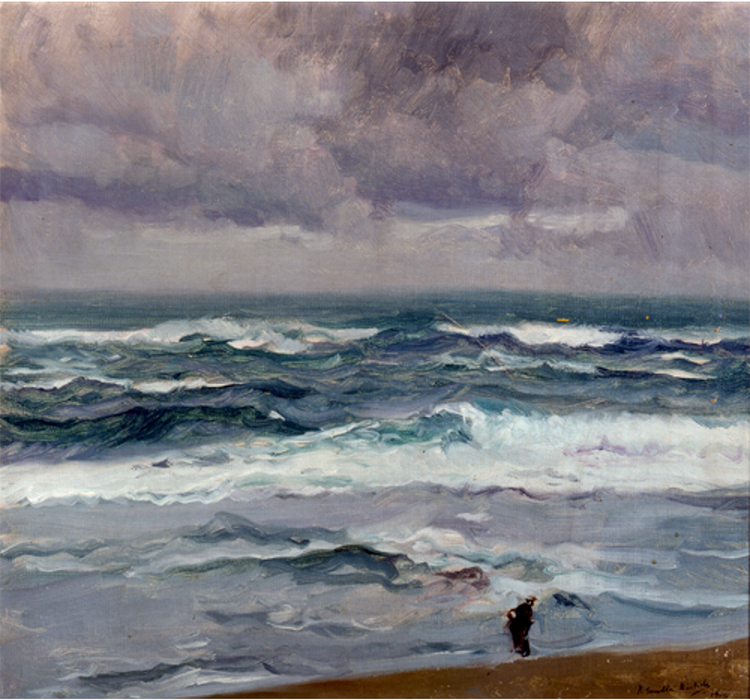
A painting of an ocean scene by Joaquín Sorolla y Bastida.

Joaquín Sorolla y Bastida, “Beach of Valencia (Playa de Valencia),” 1904, oil on canvas, 24 1/2 x 26 inches. Karen W. Davidson. Photo: Personal Archive, Blanca Pons-Sorolla, Madrid.

In mid-September, the Meadows Museum at the Southern Methodist University in Dallas will present Spanish Light: Sorolla in American Collections. The exhibition is part of a larger celebration, initiated by the Spanish government, of the centennial of the death of Spanish painter Joaquín Sorolla y Bastida. Curated by Blanca Pons-Sorolla, the artist’s great-granddaughter and a renowned scholar, the exhibition features 27 rarely seen paintings from private collections in the U.S. 

Amanda W. Dotseth, the Linda P. and William A. Custard Director of the Meadows Museum, noted, “Spanish Light: Sorolla in American Collections, reveals Sorolla’s continued popularity in this country, which can be traced back to the American collectors who supported him during his lifetime. By participating in the Sorolla Centennial, the Meadows joins other institutions in Spain and elsewhere to introduce or reengage audiences with the work of this important artist.”

Spanish Light: Sorolla in American Collections will be on view at the Meadows Museum from September 17, 2023 through January 7, 2024.

A photograph of a land art work by Lita Albuquerque featuring red pigment placed in concentric circles in a desert.

Lita Albuquerque, “Spine of the Earth,” 1980, pigment, rocks, and wood sundials, El Mirage Lake, Mojave Desert, CA. Destroyed. Courtesy of the artist © Lita Albuquerque

Later this month, the Nasher Sculpture Center will present Groundswell: Women of Land Art, curated by Nasher Associate Curator Dr. Leigh A. Arnold. The exhibition features 12 female American artists working in land art in the 1960s and 1970s who have received less recognition and representation than their male peers. 

Nasher director Jeremy Strick explained, “This exhibition presents a fuller, truer history of this pivotal movement. In our time of deepening environmental crisis, Groundswell: Women of Land Art gathers work by 12 artists whose art powerfully provokes consideration of our relationship to the land, through both ephemeral and grand gestures. We are proud of how this exhibition presents their critical, profoundly relevant contributions.”

Groundswell: Women of Land Art will be on view at the Nasher from September 23, 2023 through January 7, 2024.

A photograph of a large assemblage sculpture by Louise Nevelson.

Louise Nevelson, “Lunar Landscape,” 1959-1960, painted wood. Amon Carter Museum of American Art, Fort Worth, Texas, Purchase with funds from the Ruth Carter Stevenson Acquisitions Endowment

Last month, The World Outside: Louise Nevelson at Midcentury opened at the Amon Carter Museum of American Art in Fort Worth. The exhibition examines Ms. Nevelson’s sculptures and works on paper and reveals new scholarship on the artist’s dialogue with postwar America. 

Shirley Reece-Hughes, the Carter’s Curator of Paintings, Sculpture, and Works on Paper, and organizer of the exhibition, noted, “Challenging perceptions that Nevelson falls among the tide of abstract expressionists working in the postwar period, The World Outside invites visitors to rediscover the artist’s iconic sculptures as fusions of diverse media, histories, and ideas that uniquely capture the vitality of their moment. With fresh insight on Nevelson’s prescient vocabulary — from her rejection of gendered hierarchies to her environmental consciousnesses to her experimentation with raw materials — we hope the exhibition gives scholars and art lovers alike a new appreciation for the artist’s endless creativity and legacy as a forecaster for the art world.”

The World Outside: Louise Nevelson At Midcentury will be on view at the Carter through January 7, 2024.

Later this month, the Carter will debut Trespassers: James Prosek and the Texas Prairie. The exhibition features more than 20 new works by artist and naturalist James Prosek, including a large-scale silhouette painting, watercolor portraits of plants, and trompe l’oeil clay and bronze sculptures of wildflowers. For the past two years, the artist has explored the Texas grasslands, documenting its diversity of plant and wildlife. 

Trespassers: James Prosek and the Texas Prairie will be on view at the Carter from September 16, 2023 through January 28, 2024.

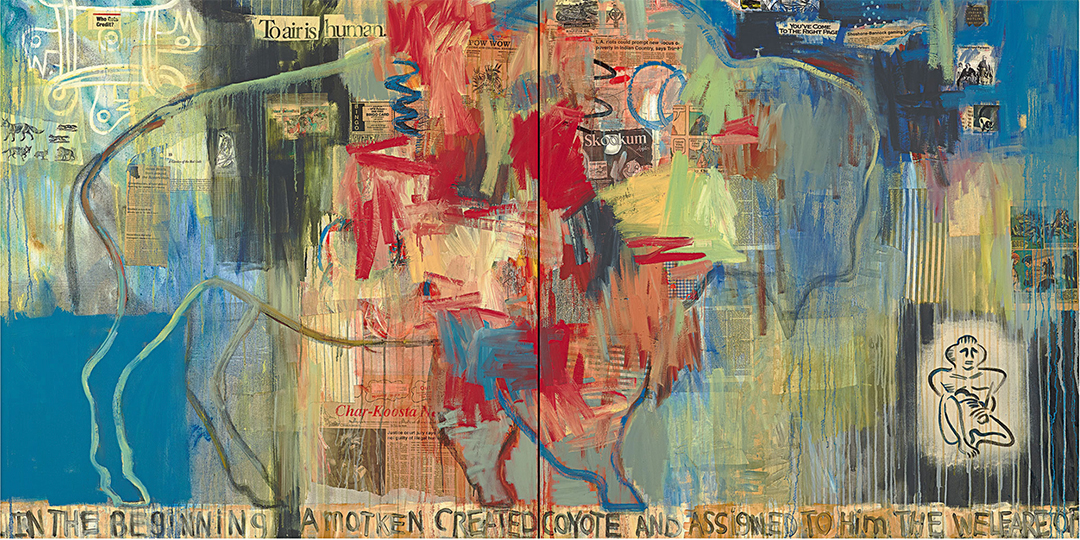
A large abstract painting by Jaune Quick-to-See Smith.

Jaune Quick-to-See Smith, “Genesis,” 1993, oil, paper, newspaper, fabric, and charcoal on canvas, two panels: 60 × 100 inches. High Museum of Art, Atlanta; purchase with funds provided by AT&T NEW ART/NEW VISIONS and with funds from Alfred Austell Thornton in memory of Leila Austell Thornton and Albert Edward Thornton, Sr., and Sarah Miller Venable and William Hoyt Venable 1995.54 © Jaune Quick-to-See Smith. Photograph courtesy the artist and Garth Greenan Gallery, New York

In October, the Modern Art Museum of Fort Worth will host Jaune Quick-to-See Smith: Memory Map, a retrospective of the artist’s work organized by the Whitney Museum of American Art. The exhibition is one of the largest and most comprehensive of Ms. Smith’s work to date, bringing together 50 years of drawings, prints, paintings, and sculptures. 

According to the Modern’s website, “The retrospective will offer new frameworks in which to consider contemporary Native American art and show how Smith has led and initiated some of the most pressing dialogues surrounding land, racism, and cultural preservation — issues at the forefront of contemporary life and art today.”

Jaune Quick-to-See Smith: Memory Map will be on view at the Modern from October 15, 2023 through January 21, 2024.

A painting by Pierre Bonnard of a figure standing in a dining room.

Pierre Bonnard, “Dining Room on the Garden,” 1935, oil on canvas. Solomon R. Guggenheim, New York, Solomon R. Guggenheim Founding Collection, by gift. © 2023 Artists Rights Society (ARS), New York / ADAGP, Paris

In November, Bonnard’s Worlds will debut at the Kimbell Art Museum. The exhibition was inspired by the museum’s 2018 acquisition of the artist’s Landscape at Le Cannet and includes approximately 70 works created across his artistic career. The show will feature landscapes of Paris, Normandy, and the South of France, as well as paintings of interior scenes, and brings together works held in museum collections in Europe and the U.S., as well as pieces in private collections around the world.

Bonnard’s Worlds will be on view at the Kimbell from November 5, 2023 through January 28, 2024.

Learn more about other current and upcoming exhibitions in the Dallas/Fort Worth area via Glasstire’s event listings.

The post A Preview of Museum Exhibitions Opening in North Texas this Fall appeared first on Glasstire.
14 Sep 21:12

can you negotiate a raise if your boss knows you won’t leave if you don’t get it?

by Ask a Manager

This post was written by Alison Green and published on Ask a Manager.

A reader writes:

Is it possible to negotiate a raise at the one-year mark if your manager knows you won’t leave the company over not getting it?

I started at Company 1 in 2019, my first job in my new field, and was promoted in 2021. In 2022, a recruiter I know personally contacted me with an amazing job/growth opportunity at Company 2. At the time, I was being told my salary was going to be raised to a certain amount and the offer from Company 2 was slightly above that, but truly the money was not the object and it was the learning.

I made my reasons for leaving clear when I left. Cut to starting at Company 2, and the head of department left unexpectedly just before I started. Now the work plans are changing significantly, the close mentorship I was promised went out the window, and my role looks a lot different than what I signed on for. Once again, I feel like I’m not growing fast enough or broadly enough in my new career. At least at Company 1 I could occasionally stretch into new projects.

Long story short, I spilled my woes to someone at Company 1 who I knew and considered a friend and mentor before either of us worked there, he asked around, and both my direct manager and the CTO welcomed me back with open arms after I’d been at Company 2 for about four months. I was prepared to return at my previous salary, but they brought me back with a higher title and a pay bump equivalent to what I was making at Company 2. Since then I have been thriving and involved in a much large scope than before.

It’s now coming up on one year since I’ve been back, and along with that a one-year review. I feel like I deserve a small raise because I’ve taken on a lot more responsibility and initiative since returning (although I wanted to do exactly that). Also, not relevant to the company but just the facts: my partner is out of work with no job in sight, our rent is going up next month, and financially we’re going to be cutting it close on my existing salary. At the same time, Company 1 has already been so generous, and I’m definitely never leaving unless it’s forced financially, which at this point it isn’t (barely). Should I even ask at all? If so, how?

Yes, you should still ask for a raise if you think your work warrants one!

A raise is recognition that your contributions to the company have increased since the last time your salary was set — you’re better at your job now, have taken on new responsibilities, or so forth. That’s the case even when you were happy to take on those new responsibilities, and even when you specifically asked to take on those responsibilities. Your salary should reflect what your work is worth to the company and the market, not how glad you are to be doing it.

It’s true that raises are retention devices (a method to ensure good people don’t leave for better pay elsewhere) but that doesn’t mean that companies see no use for them if they don’t think you’re likely to leave. Well-run companies want to compensate people appropriately, so they don’t have their loyal star performer earning less than others just because they know she’s not going anywhere, and also so salaries throughout the organization are part of an overall structure that makes sense across roles and levels of performance. Plus, they know that “not interested in leaving” doesn’t mean you couldn’t be tempted by an offer that fell in your lap for more money somewhere else, even if you didn’t actively go seeking it.

I think you’re thinking of this as, “Well, they knew I really wanted to come back and maybe they’ll think I should be grateful they let me, and asking for more money will make it seem like I don’t recognize the history.” But that’s not how salaries work, and it’s really unlikely your manager will think that.

And speaking of gratitude … Company 1 didn’t hire you back at a higher title and with a pay bump as a favor to you! They did it because it made business sense — they wanted you to come back, they thought you’d do well in the job they offered you, and they bumped your pay because it was a higher level role (and your salary at Company 2 gave them some data on the market). I’m sure they like you — managers don’t generally hire people back if they don’t like them — but they weren’t doing you a favor or giving you a gift, even if it felt like that to you because you were so glad to get out of Company 2.

So you don’t need to approach this any more delicately than you would any other raise request. All you need to say is, “As part of my review, I’d like to talk about adjusting my salary to reflect the work I’ve been doing.”

14 Sep 21:04

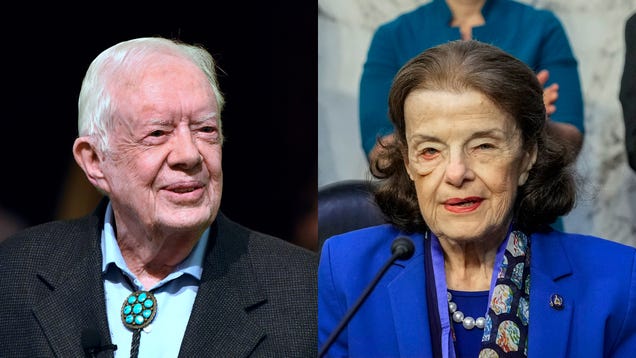
Jimmy Carter Makes Pact With Dianne Feinstein That If Both Single In 50 Years They’ll Marry Each Other

PLAINS, GA—Saying they had no way of knowing where these crazy lives of theirs would take them, former President Jimmy Carter reportedly made a pact Thursday with Sen. Dianne Feinstein (D-CA) in which the pair agreed that if they were both single in 50 years, they would marry each other. “Look, I know we’ve had our…

Read more...

14 Sep 19:43

my boss wants me to check in every day while I’m on vacation

by Ask a Manager

This post was written by Alison Green and published on Ask a Manager.

A reader writes:

I (a 27-year-old woman) am on vacation for a week using PTO. My work phone has been off since Saturday and my boss has access to my work computer and email. He just called my personal phone at 4:58 pm to tell me I need to check my work phone at least once a day to forward all calls/texts/emails to him. To me, PTO is a chance to disconnect from work and relax and recharge. Having to check my work phone daily means I am not able to fully disconnect from work. Am I off-base with my thinking?

This is my first “real” job out of college due to graduating right before the pandemic so I’m just trying to make sure I have my norms calibrated correctly before making any decisions.

I’ve been with the company for two years and have been thinking about moving on due to inconsistent raises across the board (I found the budget spreadsheet with everyone’s salaries by accident), being expected to be available 24/7/365, and some new internal policies (can’t do next-day doctor appointments anymore and any appointments during business hours require a provider’s note, effectively making it very difficult to do job interviews) so combined with this information that I can’t take a true vacation, it has me wanting to really put my job search plans into high gear.

No, it’s not normal to be expected to check your work phone and/or email daily while you’re on vacation.

There are some situations where you might decide to do that. For example, if you’re in the middle of a high-profile project and the other key person working on it is in the hospital and the only way you can take this week off is if you check in periodically to handle anything urgent, you might decide that trade-off is worth it. But that shouldn’t be the default or the norm; that’s an unusual arrangement for unusual circumstances.

And your boss’s request is particularly bizarre since he just wants you to do it so you can forward everything to him. If that’s the goal, it’s very easy to set up automatic forwarding before you leave so that it happens on its own while you’re gone (or the more typical way of handling this, which is an out-of-office reply that tells people who to contact while you’re away).

Combined with the fact that you’re expected to be available 24/7 the rest of the time, this is a boss who simply doesn’t care about people’s ability to have real time away from work.

Other things that are very much not normal that are happening in your workplace: no next-day doctor’s appointments (why not?! sometimes things are urgent, or you need to take the only appointment you can get this month) and needing notes for any appointments during business hours. The latter is particularly weird — if you have time off, you shouldn’t need to “prove” you’re entitled to use it. That’s definitely not a standard practice, and it’s invasive and overstepping.

So yes, high gear on the job search. Your company is deeply out of sync with professional norms, as well as just basic humanity. (Also, until you find a new job, all your future vacations will just happen to be somewhere without reliable internet or cell service, what a shame.)

14 Sep 19:42

husband’s coworker is horrible to me, how do I tell my boss I can’t afford to live in our town, and more

by Ask a Manager

This post was written by Alison Green and published on Ask a Manager.

It’s five answers to five questions. Here we go…

1. My husband’s coworker is a jerk to me

At my husband’s company party, a colleague of his got quite drunk and started asking me really demeaning questions. I shut it down politely and quickly, and chalked it up to a one-off irritation. Yet every time I go into the office now, this person seems to come at me in some mean-spirited way.

My husband has been with his company for over 10 years and is otherwise quite happy there. The company has a strong retention rate in part because they love sponsoring events for the whole family, and they encourage family members to participate in fundraising or outreach campaigns- think “come in and help wrap presents for shelters,” etc. I’ve happily attended and been a part of these activities for a long time, and will often chat with his coworkers when I pick my husband up at the end of his day to go to dinner or a nearby show.

I am, however, now reluctant to go into the office, and events I was once looking forward to I am now dreading and will probably back out of.

I know the first question is “is your husband having an affair?” and I can say for certain that he is not, and I don’t feel threatened by this coworker in that way. I don’t know why they’ve decided to basically bully me, and I am really confused and saddened by it.

But this isn’t my workplace, and their behavior isn’t directed at anyone in the company. Is there anything I can do, or do I just resign myself to missing the party until my husband gets a new job?

There’s nothing you can do since you don’t work there, but there are potentially actions your husband can take. It depends on exactly what the coworker is saying to you, though. How subtle or flagrant is the rudeness? The closer it is to the “flagrant” end of the scale, the more standing your husband has to report it to someone (like his boss or HR); some companies have anti-bullying policies and even if those don’t explicitly apply to non-employees, his company would probably be unhappy to hear an employee is waging a campaign of hostility against an coworker’s spouse at work events. Otherwise, though, is your husband up for saying something to the coworker directly? Whether or not to do this depends on things like their seniority relative to each other and the workplace politics there, but in a lot of cases your husband could (and should) tell them they need to leave you alone at future work events.

2. How do I tell my boss I can’t afford to live in our town?

I live in a town that is considered a very trendy destination for outdoor sports like hiking and mountain biking. When we moved here 10 years ago, it was mostly locals and folks from the nearby major city who came to enjoy our beautiful town, but thanks to marketing, making several “Best Places” lists, and a lot of aggressive real estate development, our town is now filling up with high-priced condos. Real estate prices have skyrocketed, and rentals, when they are available at all, are triple what they were when we moved here. We were lucky to rent an affordable place eight years ago, with modest increases in rent each year. And now our luck has run out.

The house we live in is being sold and we will have to move. We have been looking like crazy for a new place but it is pretty much impossible. Our rent was $2,000 a month for three bedrooms for my husband, daughter and I, and we had a roommate to share costs. Now we can’t get even a one-bedroom at that price and three-bedroom units are going for $5,000. I am the only one employed in our house (husband is unable to work due to health issues, daughter is a student) and I am making $62,000 a year. The kicker? I work for our local municipal government. (We live in Canada.)

Right now I am able to work remotely two days a week. I do not want to quit my job! Especially since we are trying to find a new place to live and will most likely have to move a couple of hours away (other cities close by are just as expensive). My ideal would be to go entirely remote, with maybe a few on-site visits a couple of times a year, depending on where we end up. Most of my job can be done remotely (records management) and we recently hired a clerk who could take up the on-site work. How do I frame this to my boss? Can I just say that I can no longer to afford to live in our town but I’d like to keep my job? How do I make this sound like it’s not all about me? I’ve been here four years and am the lead on a large scale project that will last at least a few more years and am the only one in our department with the knowledge to implement the system I’m working on.

Yep, be straightforward about it: “I’ve been priced out by the increase in rents and I can’t afford to keep living here. I’ll most likely need to move, but I like my work and don’t want to leave it. Would you be open to me moving to full-time remote with occasional on-site visits, so that I’m able to both afford housing and stay in my job?”

If your boss isn’t already aware of the situation (which is unlikely), she needs to be.

Some municipal governments have residency rules where you need to live in the city/county you work for, but I’m guessing you’d know if that were the case (and if yours does, this is probably going to hit them in a big way pretty soon).

3. Our gift to a retiring manager was a pile of cash

When I joined my current employer, I joined a team of 15 people, with Bob as the boss. Half a year later, the group was split, and Bob went with the other half. So for the two years since the split, I haven’t reported to him, but I work closely with some of his team members.

Recently, Bob retired. The groups wanted to surprise him with a gift. I would have been okay with donating for a gifted item — like a comfy folding chair since he loves fishing, or a fine wine, something like that.

However, the gift organizer decided the gift should be cash. Just a wad of cash with a bow around it. And honestly, it irked me when they asked me to donate cash for someone who earned way more than me, and who owns a home, travels a lot, and is set up for a comfy retirement (Bob told us about his plans often.)

I managed to sneak out of donating. But should I have spoken up? The whole situation felt icky. What can I say if something similar comes up again?

A pile of a cash with a bow around it is really, uh, laying bare what gifting up sometimes is. And yes, it’s tacky!

Whether to speak up depends on how much capital you felt like spending and how much you think it would have taken to convince your coworkers to change course … but all else being equal, it would be a good thing to speak up about! Sample language: “I’d be willing to contribute to a gifted item like X or Y, but I don’t think we should give cash to people above us in the hierarchy, and I think it’ll make Bob uncomfortable too! How about doing X or Y instead?” Chances are good that at least some of your coworkers would agree with you; sometimes, though, it takes one person speaking up first for others to be willing to say something themselves.

4. Do I need to reply when my boss texts me after I have called in sick?

I work in a cafeteria in a hospital and called off work sick according to policy. I was surprised to get a text from my boss “reminding” me that she is checking attendance and asking if I know how many times I have missed work this year. She did not ask me why (although there has been a cold/flu virus going around our department). Is it okay for her to do that? I feel like she is trying to force me to come in without even knowing what my reason was for staying home. And do I need to answer her?

It’s only “okay” in the sense that it’s legal and there’s nothing preventing her from doing it, but it’s not actually okay; it’s a crappy thing to do and bad management. If she has concerns about how many days of work you’re missing, she should raise that with you when you’re back at work, not while you’re home sick.

You don’t need to respond until you’re back at work. Once you are, you should say, “Do you have concerns about the number of days off I’ve taken this year? As far as I know, I’m within our regular allotment.”

5. What’s up with this rejection?

I applied for an administrative assistant job with a big university. It was in a job newsletter and you had to apply through their website, so everything was normal. I interviewed in person where you had to drive downtown and find parking in a huge construction area. The interview was with five people, and they said it might take two weeks to go through the HR bureaucracy before they could say anything. Two weeks come and go, and I checked in each week with the director who was in the interview each week, who seemed to not have any new info.

Then I got an email that said in part, “Due to unforeseen circumstances, it has been determined that this position will not be filled as advertised. We apologize for the inconvenience this may have caused.”

It was budget-approved, posted online, in-person interview with five people, and this is what they say? Not “While your qualifications were great, we went with someone who was a better fit” or something? I’ve never heard of an HR response like that before. Do you have an idea what might be going on?

It’s almost certainly exactly what they said: They’ve decided not to fill the position. It’s probably for budget reasons, but it could be a different kind of internal change too — a reshuffling, a hiring freeze, a decision to do something different with the role, all sorts of possibilities. It’s actually not that weird — it happens sometimes. They went through the whole process because they intended to hire, and then something changed and now they aren’t.

They were reasonably transparent — about the upshot, at least, which is the part that’s relevant to you — and that’s a good thing! There’s no reason for them to make up a cover story about hiring someone else when they didn’t.

14 Sep 18:32

RITTER HATES YOU!

by noreply@blogger.com (JerryMaguire)
14 Sep 18:31

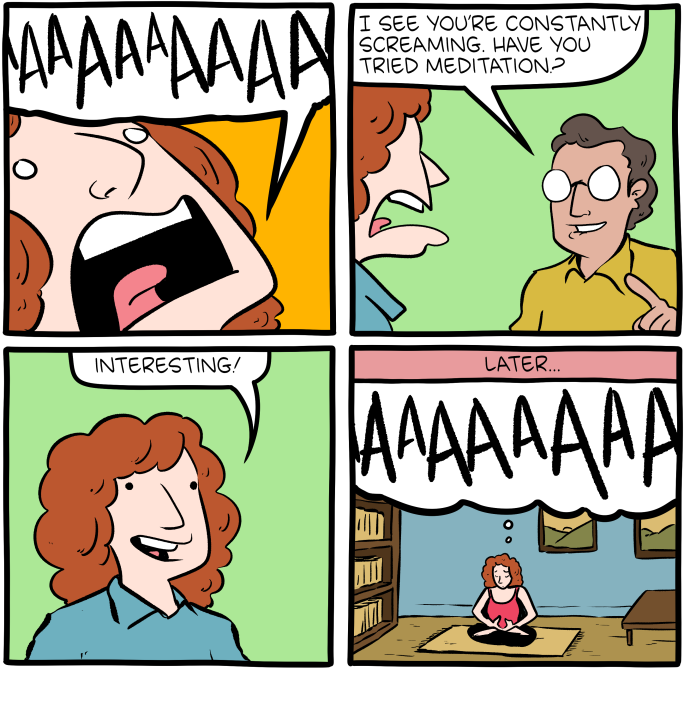
Saturday Morning Breakfast Cereal - AAAAAAAAAAA

by Zach Weinersmith


Click here to go see the bonus panel!

Hovertext:
Have you tried tuning out all your coping mechanisms and focusing entirely on your unresolvable problems?


Today's News:
14 Sep 18:30

Exoplanet Observation

NASA prefers to say that their rovers are 'looking for signs of past life on Mars' and not 'ghost hunting.'
13 Sep 13:05

Tuesday PM Lee Update: Bermuda under a Tropical Storm Watch, as Lee’s wind field grows larger

by Matt Lanza

One-sentence summary

Hurricane Lee will impact Bermuda with tropical storm conditions in a couple days, as Lee’s wind field now extends out nearly 250 miles from the center.

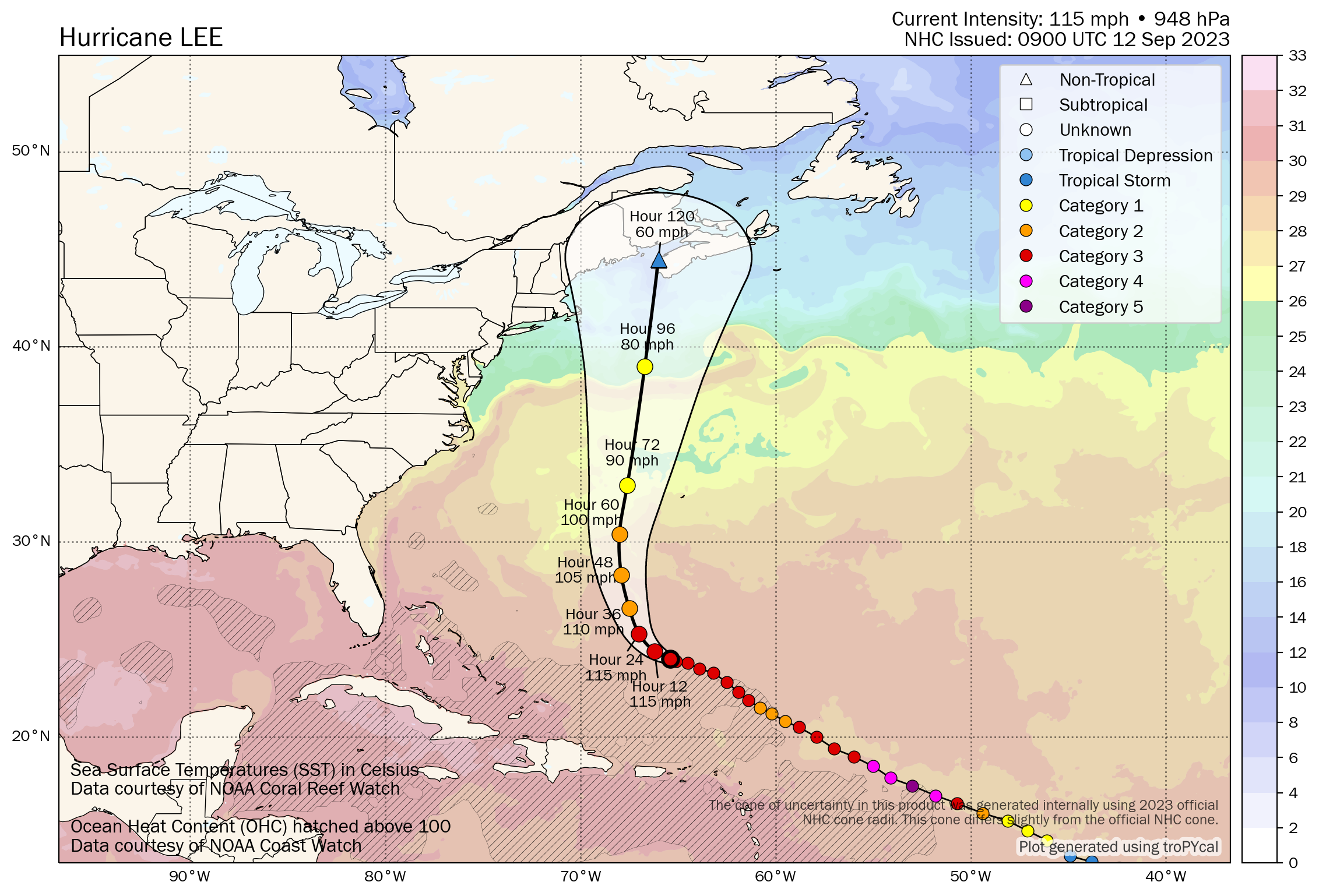
Lee will turn northward tomorrow or Thursday, passing west of Bermuda and tracking toward eastern New England or Atlantic Canada. (NOAA NHC)

Hurricane Lee: 115 mph, moving NW 7 mph

What’s changed since this morning?

Bermuda is now under a Tropical Storm Watch, with Lee expected to bring some impacts to the island in a couple days.

The forecast track this weekend continues to wobble a bit between Maine and Nova Scotia. While impacts will extend far from the center of Lee, the actual track does matter in terms of what to expect from storm surge. This will need further fine tuning.

Lee is growing in size, with tropical storm force winds extending out nearly 250 miles from the center.

Bermuda impacts

Expect very rough surf, a period or periods of rain, and gusty tropical storm force winds on Bermuda. Tropical storm force winds should arrive Thursday afternoon at the latest I’d think with rain reaching Bermuda by late Thursday morning or early Thursday afternoon.

Lee’s forecast focus: Rain

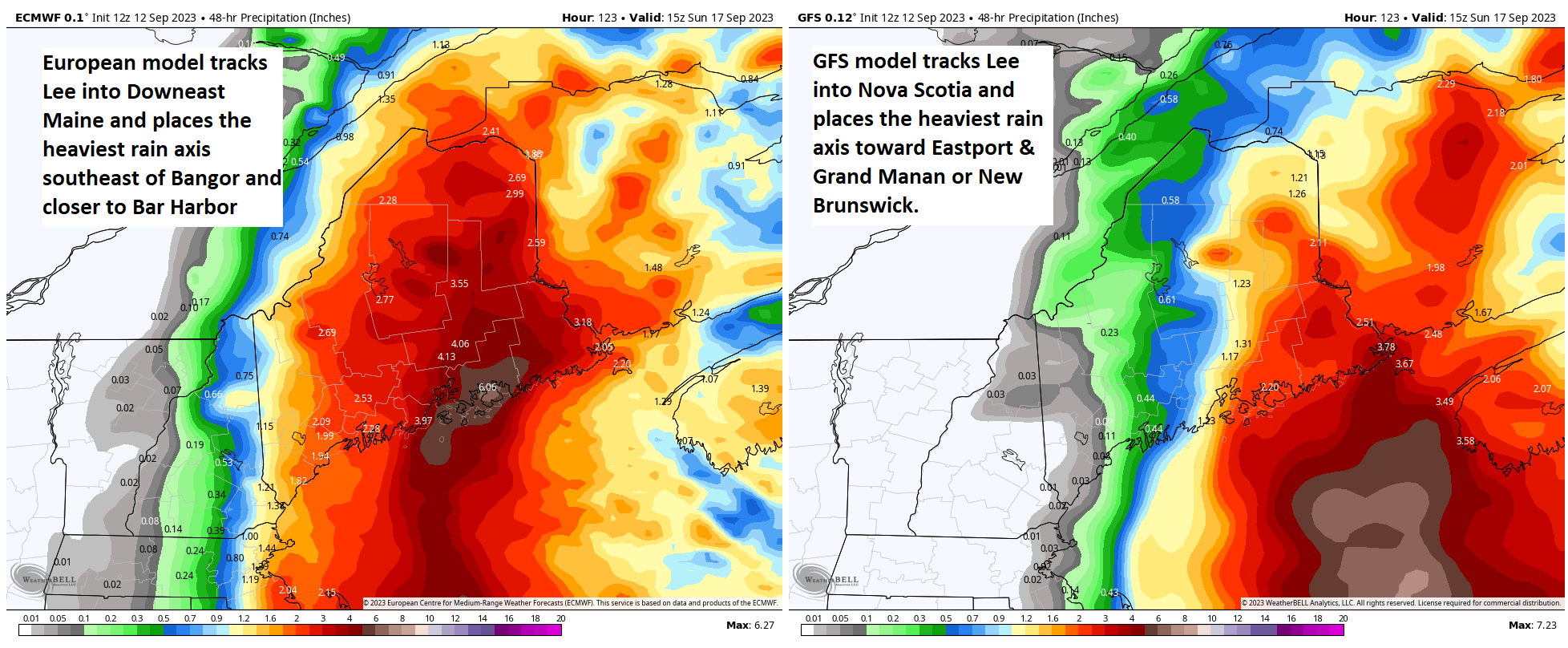
Let’s talk a little about rain. The good news with Lee is that it will be moving quickly. There have been and will continue to be some rains in Maine and portions of eastern New England this week, as well as in New Brunswick. When Lee marches into Maine or Nova Scotia, there will be rain spread all over, but there will be a core of rain that could be a bit troublesome. The GFS, which tracks Lee into Nova Scotia brings that 4 to 8 inch (100-200 mm) core of rain mostly toward Nova Scotia or into the Bay of Fundy. The European model, which tracks Lee into Downeast Maine brings it toward Acadia National Park and Bar Harbor. Also notice on the maps below that there are significantly different rainfall forecasts between the Euro and GFS for Massachusetts as well. The Cape, Islands, and Boston see heavier rain from the Euro, while the GFS delivers only some rain to the Cape. New Hampshire also sees differences here too.

Click to enlarge the rainfall forecast (from Lee, not including rain this week) for Maine and New Brunswick which shows the differences between two operational models in terms of where the heaviest rain may fall, relative to track. (Weather Bell)

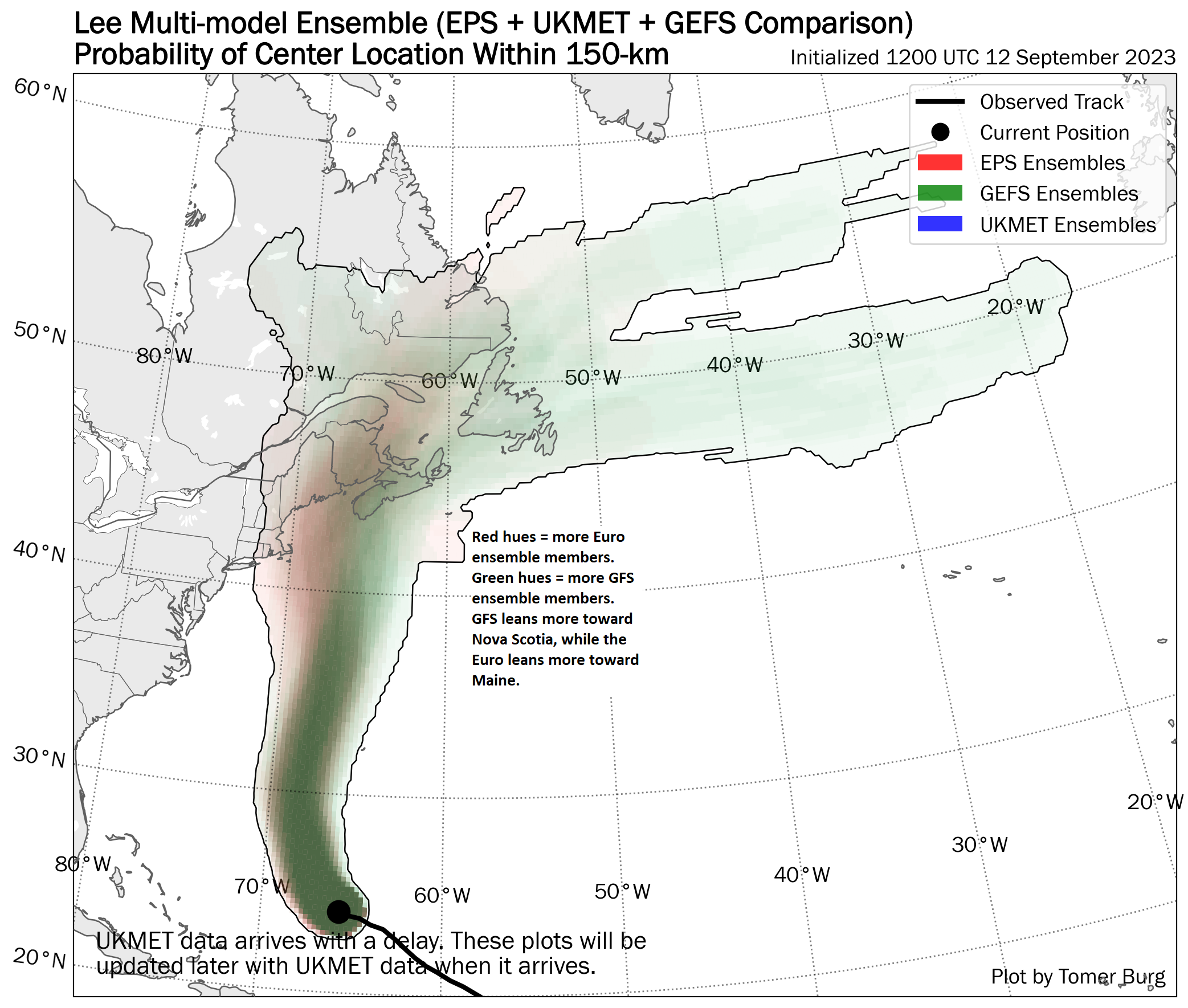
This trend actually holds up within the model ensembles right now as well. The European model tends to bend back to the west a bit toward Maine and New Brunswick, while the GFS ensembles are placed more to the east, aiming at Nova Scotia.

Click to enlarge a map showing the spread between the European and GFS ensemble model members. The red hues on the left indicate that the European model ensemble has more members suggesting a track that could lurch toward Maine or New Brunswick, while the GFS is focused more on Nova Scotia. (Tomer Burg)

Interestingly, the European model has the support of the new HAFS-B hurricane model, which does currently show the storm clipping Massachusetts before coming in over Bar Harbor. The HWRF, our previous top hurricane model shows the storm coming in near Yarmouth, NS. So to say we’re confident in which camp is right would be lying. However, the HAFS-B has had a bit of a hot hand lately, and when I see the Euro and a top hurricane model on the same page, it makes me believe a track closer to Maine may be slightly more likely than the alternative. We’ll see.

The bottom line in all this remains that folks on Cape Cod, Nantucket, Downeast Maine, New Brunswick, and Nova Scotia should be preparing for heavy rain, wind, and tidal impacts from a hurricane this weekend. Please, again, don’t assume that just because Lee is weakening on approach that that makes it worth downplaying. As I noted this morning: Lee will punch well above its weight class when it comes ashore. The size of Lee means that it will be bringing a significant amount of water north with it, and that will cause surge/coastal marine impacts equivalent to a much stronger storm than Lee may be classified as.

We’ll have more in the morning.

13 Sep 13:03

The likelihood of Houston receiving significant rainfall in the next few days is increasing

by Eric Berger

Good morning. For the upcoming period when we expect Houston to see better rain chances, Wednesday afternoon through Saturday, we’re now within the forecast range of high resolution models. This is important, because these models are better able to resolve the convective processes that produce rainfall. Typically, therefore, they tend to provide us with better insight into the timing, duration, and extent of rainfall.

If you recall, in our earlier posts this week, we spoke about accumulations of 0.5 to to 1 inch of rain, but based upon the latest modeling it now appears likely that many locations will receive more than this. Generally, that should be an excellent thing, because so much of the region remains in an exceptional or extreme drought.

NOAA rainfall outlook for now through Saturday. (Weather Bell)

So how much rainfall are we talking about? Well, it’s still too early to have great confidence, because our best high resolution models are still only looking out to Friday, not all the way through the high-rainfall chance period. But based upon the latest data, the current expectation is that much of the area will receive 1.5 to 3.0 inches through Saturday.

All of this is being driven by the absence of high pressure, and a weak front drifting toward the area that will help perturb the atmosphere. Our confidence in some of the fine details remains uncertain, but overall the pattern is supportive of widespread, on-and-off rainfall. We cannot rule out some flooding, but conditions are not optimal for very heavy, sustained rainfall, so I don’t expect significant issues on area roadways.

Wednesday

Today should be the last day that the region sees high temperatures in the mid-90s for a little while. Expect highs, generally, in the range of 93 to 97 degrees, with partly sunny skies. Rain chances are low today before the late afternoon and evening hours, at which point the favored locations will be between Interstate 10 and the coast. Rain chances will persist into the overnight hours, albeit with lesser coverage. Winds will be light, generally from the northwest. Lows tonight will drop into the upper 70s.

Thursday and Friday

It still appears that these days will offer the best rain chance for the entire metro area, likely around 70 percent. Skies on both days should be partly to mostly cloudy, and this should help to limit highs to around 90 to 92 degrees. Both days should see widespread, intermittent showers. Winds will be light, from the northeast. Rain chances will be less overnight, but still non-zero.

Daytime highs of 90 degrees, is such a thing even possible? (Weather Bell)

Saturday and Sunday

The first half of the weekend will see a continued chance of rain, with highs again in the low 90s. However, by Sunday morning we should start to see the influence of a weak front that will bring drier air into the region and largely end our rain chances. Highs on Sunday will probably be in the low 90s, with overnight lows dropping pleasantly into the low 70s.

Next week

With the influx of drier air, we’re likely to see highs in the mid-90s on Monday and Tuesday. However, humidity will be slightly lower, with nights a bit cooler. The front’s influence will dissipate pretty quickly, however. Therefore, most of next week probably will see highs in the low- to mid-90s, with some slight rain chances maybe returning by Wednesday or Thursday. Still no sign of a strong fall cool front yet, I’m afraid. We’re still at least 10 days out from that.

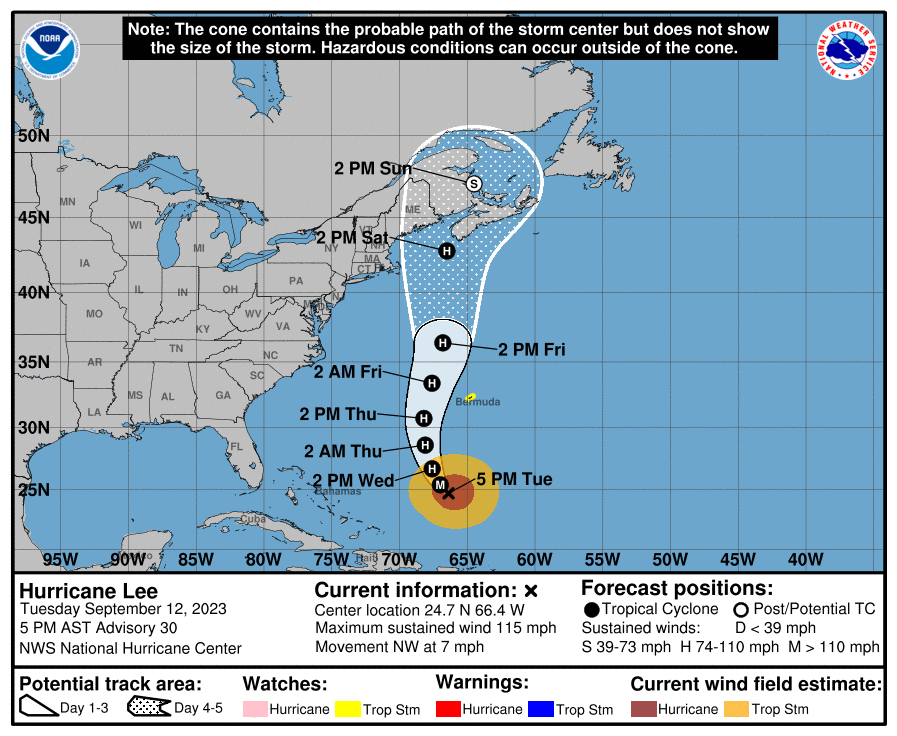
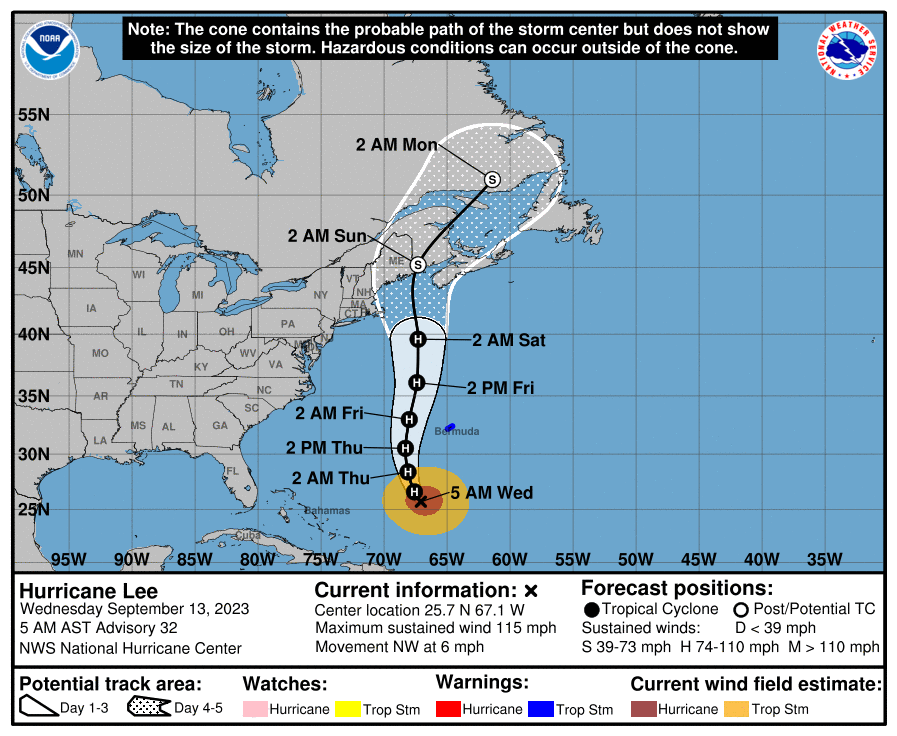
Track forecast for Hurricane Lee as of Wednesday morning. (National Hurricane Center)

Tropics

The good news is that the Gulf of Mexico is completely quiet, and likely to remain so for at least the next week or 10 days. Wind shear is really ripping out there, and that’s lovely to see in September, especially with sea surface temperatures so warm. Hurricane Lee, however, is increasingly a concern for New England and Nova Scotia. We’ll continue to have full details on Lee, and all the rest of the Atlantic basin, on our sister site The Eyewall.

13 Sep 12:56

coworker keeps sending out questionable Covid advice, a director’s out-of-tune guitar, and more

by Ask a Manager

This post was written by Alison Green and published on Ask a Manager.

It’s five answers to five questions. Here we go…

1. My coworker keeps sending out questionable Covid advice

I work for a completely remote team but we have our annual all-staff retreat coming up next month, and with Covid cases rising again, it’s been coming up in conversation. For context, we are not in the medical field and no one I work with has any medical training. I’m also fully vaxxed and boosted and completely support Covid safety measures, including masking when needed and frequent testing.

But a coworker of mine, Lee, has taken it upon themself to be the Covid advice person, sending recommendations and reminders in both our team and all-staff Teams chats in advance of the retreat. They’ve recommended folks get their bivalent booster if they haven’t gotten one recently, getting their flu shot in August, using nasal sprays and taking zinc to prevent Covid spread. I have a few issues with this!

1. They’re recommending folks who haven’t gotten another bivalent vax in the last six months get one now, without acknowledging it is less effective than the monovalent vax that could be made available as soon as this week! And that may limit people from getting a more effective vax this season. (Note from Alison so this doesn’t confuse anyone: The CDC did announce a new booster shot on Tuesday; this letter was received before that happened.)
2. The largely accepted medical guidance recommends getting your flu shot at the end of September/October to be most effective.
3. Nasal sprays and zinc have been found effective at preventing Covid in a few small studies, but neither the FDA nor the CDC have officially recommended these because there is simply not enough evidence.

What really threw me off was that today, the head of my department said, “Listen to Lee on all things Covid prevention and health guidance!” It came off as a joke but just like — no! I think Lee might be high-risk or live with high-risk family, so I completely understand taking as many precautions as possible. But that is a personal decision and I don’t think I should be encouraged to take measures that aren’t currently FDA- or CDC-approved. How can I bring this up and with who, without sounding like I’m resistant to safety measures? FWIW, we are required to test before arriving at the retreat, and every day before activities. Masks are optional but I plan on masking!

Two options: The first, and best, is to talk to whoever’s in a position to intervene (and who you trust to have the judgment to do it well). That might be your boss, Lee’s boss, or an HR type, depending on your workplace. Say something like, “I strongly support Covid safety measures, but some of the recommendations Lee has been sending out contradict the advice from the FDA and CDC, and some could even make people less safe, like recommending they get vaxxed last week, which could have made them ineligible for the more effective vax that’s about to be released. I think we’d be better off limiting all-staff medical advice to what’s being put out by official sources, rather than letting one person send out their own medical advice to the whole staff. It’s starting to feel like what Lee sends is semi-sanctioned by the company and I don’t think the company would actually stand behind some of it.”

If that doesn’t work or doesn’t feel like an option, the other option is to say something similar to Lee themself. In theory you could also reply to some of the most egregious messages (“getting boosted right now may make people ineligible for the updated vax that’s coming out this month”) … but it shouldn’t be your job to do that and it risks getting into a war of facts, which isn’t what you want.

2. I play in a church band and the director’s guitar is always out of tune

I have a problem that has never ceased to perplex and torment me. I volunteer as an instrumentalist in a relatively small church band. I love playing in it, but I am defeated by one issue: The band’s director (my boss — he gets paid, I volunteer) has an electric guitar that is ALWAYS out of tune. And not in an ordinary way. It’s so noticeable that I sometimes glance at the congregation as he hits a chord, only to see looks of barely stifled horror on some faces. I don’t really know what to do. It’s like the emperor’s new clothes. Everyone knows how bad the guitar sounds, but nobody says anything. It’s not my place to tell him that his guitar regularly tortures people (including myself), but we simply cannot go on like this. Any ideas?

I don’t know, I think this is awesome and would leave it alone just to watch people’s faces and to see how long it would take someone in the congregation to speak up.

But if you do want to address it, just being really straightforward is the way to go: “Hey, I think your guitar needs to be tuned.”

I suspect you’re making it more complicated than that in your head, because you know how ridiculously bad the guitar sounds and so it feels like you can’t bring it up without including “the congregation is literally in physical pain from your instrument” and implying “it’s astonishing that you yourself don’t hear this” … but really, you can just keep it quick and matter-of-fact, similar to the way you could say “there’s something on your shoe” without adding “and the smell is making everyone hate you.”

Updated to add: Musicians on Twitter suggest, “Something sounds off” or “Do you have a tuning app on your phone?” or “Can we check our tuning?”

3. How to describe mostly remote work in job postings

You’ve answered several questions about remote jobs that aren’t really remote. I am struggling with how to describe the opposite situation in my job postings — jobs that are in-substance fully remote, but where we want candidates to live within 1-2 hours of our headquarters and reserve the right to ask people to come in occasionally.

Most of our experienced staff members on our team of 12 only come to the office once every few months. We have some folks who haven’t been to anything in-person in over a year! At the same time, there are some tasks that require in-office work such as checking the mail each week, but we have always had several employees who prefer a hybrid format who handle that when they are in the office. Also, when we hire new staff, in-person training for the first few weeks is often more effective than remote training over screenshare, so the team will usually rotate who comes in each day to work with the new staff, with each experienced staff member spending 1-2 days with the new hire.
It seems misleading and harmful to our recruiting efforts to describe the position as “hybrid” in the job posting when most of the team is in-person less than five business days a year. Candidates would read the posting, assume the in person requirement is closer to a specific days per week requirement, and pass on applying. In my mind, the job is accurately described as remote, in the same way that I wouldn’t feel the need to disclose in a job posting that a job required visiting a nearby warehouse every December for year-end inventory. At the same time, I don’t want to have candidates apply from out of the area or have them feel misled when we do ask for a few in-person days per year.

What is the best way to describe a job that is in-substance remote, where the term hybrid would be misleading?

“Mostly remote” — and then explain what you mean. “While this position is mostly remote, we’re seeking candidates based within two hours of our headquarters in Souptown because of occasional in-office work (including your initial training and occasionally training others — generally about five days per year).” If you’re advertising somewhere that only offers remote/hybrid/on-site as options for categorizing the job, pick “remote” and then include the explanatory text in the posting itself.

4. When does “this fell in my lap” not work?

I know you’ve frequently recommended using the “this fell in my lap and was too good of an opportunity to pass up” phrasing when you are resigning for a new job at a time that’s inconvenient for your employer or soon after accepting a promotion/raise/big new project/etc. at work. I’ve always assumed that the unspoken subtext is that “this fell in my lap [since I accepted that promotion/raise/project].”

Does this work, or is there another formula you’d suggest, in cases when, for whatever reason, people will know that you must have been in the hiring process for the new position for longer than that? I’m thinking small industries where everyone knows what jobs are posted when, or something like higher ed where everyone knows that a hiring process will have taken months.

It still works! You’re not really saying, “I was just minding my own business, not interviewing at all, when a stranger on the street walked up to me and offered me a job.” The implication is more, “I wasn’t actively looking but an opportunity came across my path and it made sense for me to talk with them, and they ended up offering it to me.” The idea is, “I wasn’t actively doing everything in my power to leave, but this specific job was too compelling for me to pass up” and a bit of “and I didn’t know they’d offer it to me when I accepted the promotion with you” (which might be especially plausible in fields with long hiring processes).

5. How much do I need to suffer before an accommodation is considered ineffective?

I have a disability that cannot be objectively measured. At what point can I tell my employer that the accommodation they’ve offered me is ineffective? I’ve lived most of my life with pain and fatigue, so I am used to pushing myself to the point of making me miserable, but I would much rather not.

Related to that, is it my responsibility to come up with an accommodation they like? What happens if we can’t come up with one that is both effective and that they approve of? Can they fire me or refuse to let me come back to work until I and/or a doctor says that it’s fine?

Ideally, employers would want to work together to find the most effective one, but we all know that often doesn’t happen in real life. For this question, please assume a hostile HR and upper management, because that’s what many of us people with disabilities deal with.

The law says your employer needs to engage in an “interactive dialogue” with you, meaning that they can propose an accommodation and you can say “that won’t work because of X, but what about Y” (and vice versa) and they need to engage in that process in good faith. The law also says they can’t simply reject all the accommodations that would work (or fire you over it or refuse you let you return to work) unless they can show accepting would cause them “undue hardship” (the bar for which is pretty high and the burden of proof for which is on the employer).

Now, obviously in real life things don’t always work the way the law says they need to — and if they’re not working that way, that’s a good time to talk to a lawyer, who can do anything from advising you behind-the-scenes to negotiating with the company on your behalf to pursuing legal action if that becomes necessary.

There’s no clearly defined answer to “how much do I need to suffer before an accommodation is considered ineffective?” but in general the law doesn’t say you need to suffer at all. You might need to tolerate a little inconvenience (for example, a shift that isn’t your ideal but doesn’t aggravate your condition) but that’s a different thing than pain and suffering.

13 Sep 12:30

Musk: Monkeys Implanted With Neuralink Brain Chips Were Already ‘Close To Death’

Elon Musk has denied reports that his brain-implant startup Neuralink killed monkeys during research experiments, claiming instead that tests were only done on “terminal” primates. What do you think?

Read more...

13 Sep 12:25

Comic for 2023.09.12 - Gender Rolls

New Cyanide and Happiness Comic
13 Sep 12:24

Comic for 2023.09.13 - Temple

New Cyanide and Happiness Comic
13 Sep 12:22

MATTHEW FREAKIN’ MCCONAUGHEY!

by noreply@blogger.com (JerryMaguire)
13 Sep 12:21

Your ACIP cliff notes

by Katelyn Jetelina

Today ACIP—an external advisory committee to CDC—had a much-anticipated meeting with one goal: determine who is eligible for an updated Covid-19 vaccine this fall in the United States.

This 6-hour meeting was information-packed.

Here are your cliff notes.


Bottom Line Up Front (BLUF)

Everyone over 6 months is eligible for an updated Covid-19 vaccine this fall. I strongly agree, as the benefits of vaccines outweigh the risks across all age groups.


First up, Novavax.

Yesterday, the FDA approved mRNA vaccines for this fall, but did not include Novavax. FDA isn’t allowed to comment on why. (My guess is Novavax faced delays in approval for manufacturing—they’ve had trouble with this in the past).

CDC recognized the concern on the ground (for the record, this is a fantastic way to build trust) and clarified today’s recommendation was intentionally designed to be broad enough to cover Novavax when the FDA gives the “okay.”

Novavax stated:

  • A fall vaccine is still planned. I’m optimistic.

  • A vaccine will be available to those who previously had an mRNA vaccine.

Severe disease for kiddos is similar to flu.

One of the biggest questions was whether vaccine benefits continue to outweigh the risks for kids. Updated stats were presented:

  • More than half of children hospitalized for Covid-19 do not have a co-morbidity.

  • Behind adults 75+ years, infants (<6 months) had the highest rate of Covid-19 hospitalization. The burden of severe illness is lowest among children ages 5–17 years compared to other age groups.

  • For kids, hospitalization rates were lower or comparable to flu. Once hospitalized, though, more kids went to the ICU for Covid-19 than for flu.

    Percent of COVID-19- and Influenza-Associated Hospitalizations with ICU Admission among Infants, Children, and Adolescents by Age Group — COVID-NET and FluSurv-NET*, October 2022– April 2023. Source here.
  • Covid-19 hospitalization rate is higher than other vaccine-preventable diseases.

    Other pediatric vaccine-preventable diseases: Annual hospitalizations per 100,000 population prior to recommended vaccines compared to COVID-19. Source here.
Myocarditis was not a safety signal last fall.
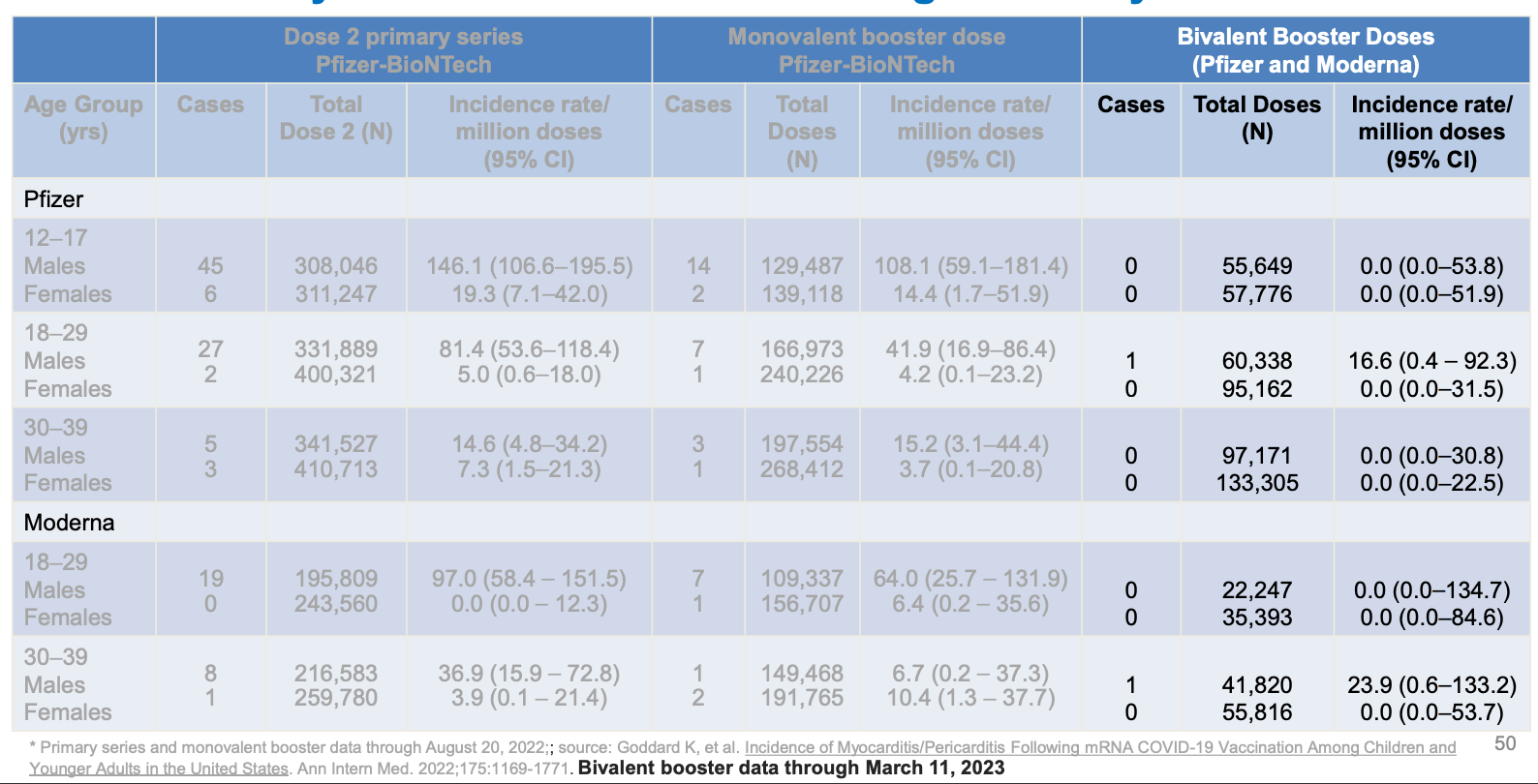
After last fall’s updated Covid-19 vaccine, 2 myocarditis cases were verified out of ~650,000 doses. This is a much smaller rate for than the primary series. (We think this is because the increased time interval between doses reduces risk.) However, there is limited data, so this estimate has some uncertainty.

Incidence Rates of Verified Myocarditis or Pericarditis in the 0–7 Days After Bivalent Booster in Ages 12–39 years. Source here.

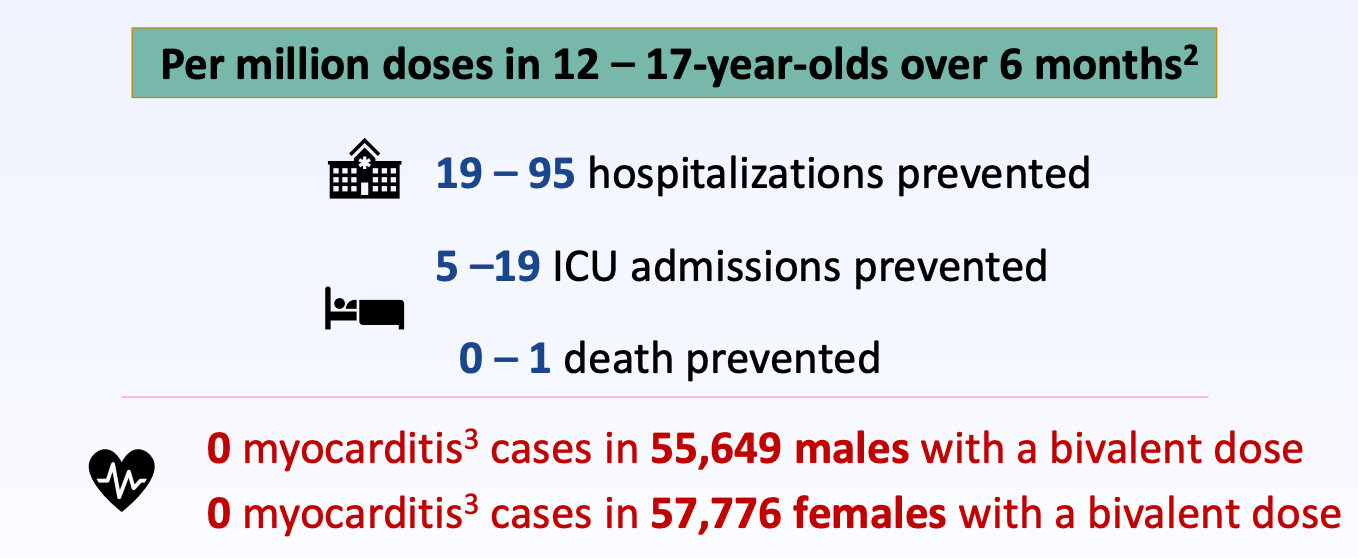
The benefits of a vaccine for severe disease among adolescents outweigh the risks.

Estimated COVID-19 hospitalizations prevented vs. potential myocarditis cases for every million mRNA COVID-19 vaccine doses: 12 – 17-year-olds. Source here. Vaccines reduce long Covid.

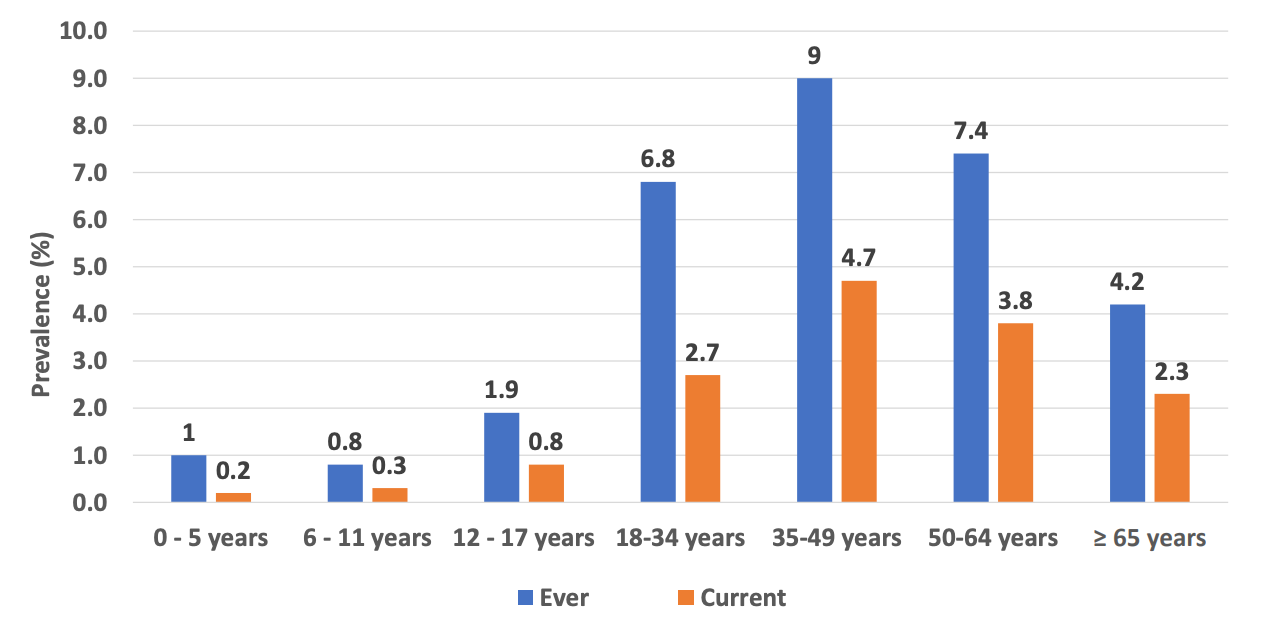
Long Covid remains a risk.

Long Covid is a driving factor for many to remain vigilant. I was happy to see CDC presented data on this. One ACIP member noted: “This is the first time we’ve discussed a vaccine preventing acute and chronic health problems.”

  • Prevalence has declined (thanks to immunity and virus changes) but remains a risk. Prevalence is highest among young adults.

    Prevalence of ongoing symptoms lasting at least 3 months after COVID-19 by age. Source here.
  • Vaccines reduce long Covid, particularly among those who stay up-to-date. This applies to adults and children.

Updated vaccines worked last fall.

How well? Pretty darn well.

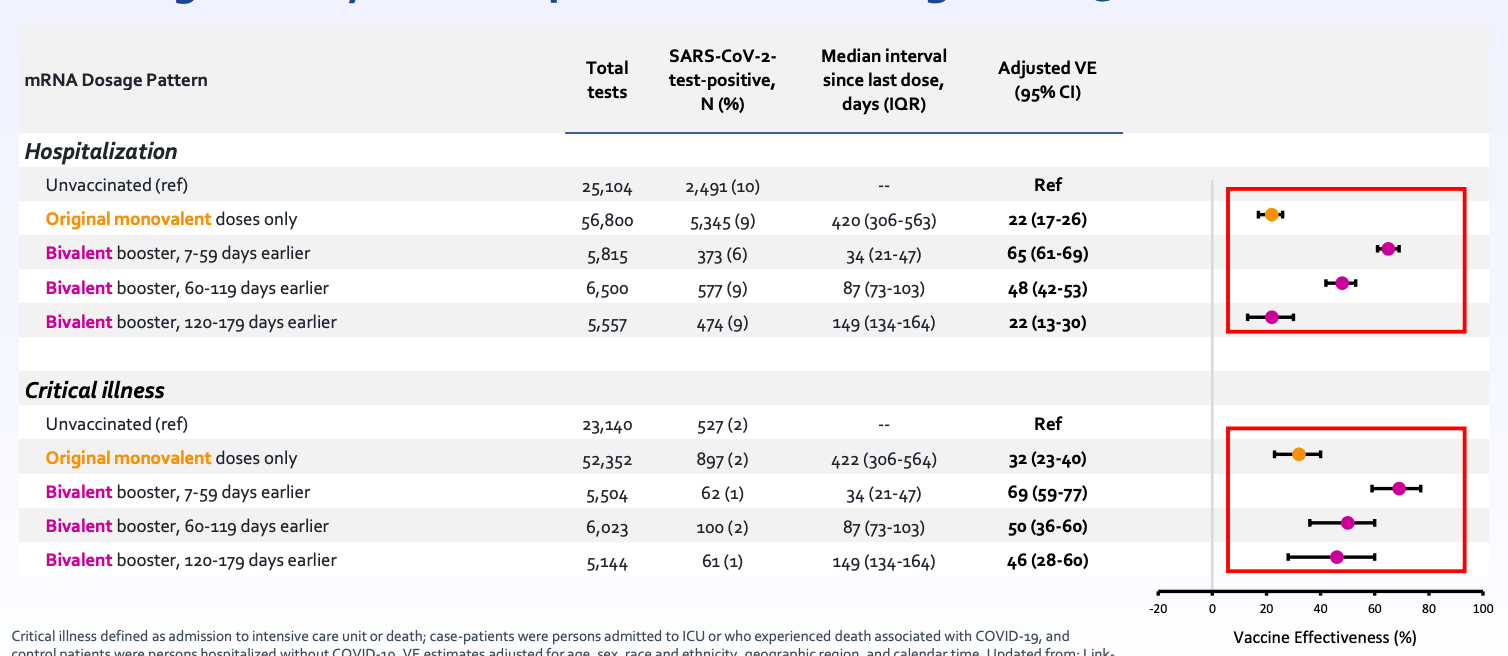
  • Emergency department and urgent care visits: 60% effectiveness among kids and adults. (As a comparison, this effectiveness is higher than for the flu vaccine.)

  • Hospitalizations: 65% effectiveness, but this waned over time (→ 22% six months later). There is sustained protection against ICU admission.

    • Remember, effectiveness is “relative” to some combination of prior vaccination, prior infection, or both. This means the 65% benefit is above and beyond an individual's underlying immunity.

Absolute VE of original monovalent and bivalent booster doses against hospitalization and critical illness among immunocompetent adults aged ≥18 years – September 2022 – August 2023. Source here.

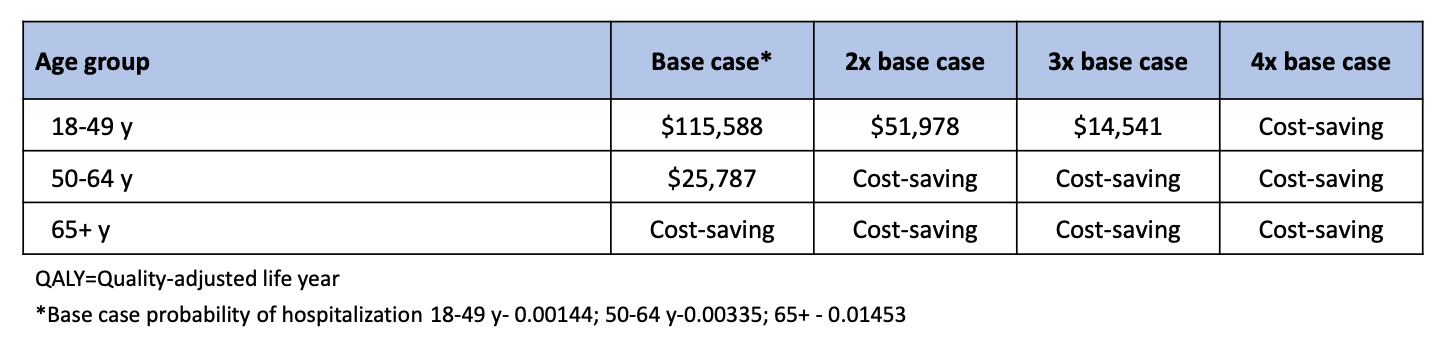
Vaccines are cost-effective for those >65 years old.

This is the first time the government is not paying for Covid-19 vaccines. Pfzier/Moderna is charging ~$120-129 per dose and Novavax is ~$130. (I think the cost of these vaccines is absurd given taxpayers funded Operation Warp Speed.)

Nonetheless, is the bang worth the buck? The University of Michigan conducted an analysis and found:

  • 65+ years old: Vaccines provide cost-saving in every scenario.

  • 18-64 years: There was an average societal cost ($33,000) for every 1,000 quality life-years gained from the vaccine. This decreases if we get a surge of cases or the virus mutates to become more severe. In addition, it’s likely cost-effective among those with risk factors like comorbidities, but data wasn’t presented.

Scenario analysis: Probability of hospitalization preliminary estimates. Source here.
  • <18 years: Unable to estimate given low numbers and high uncertainty.

Updated vaccine formula remains a good choice.

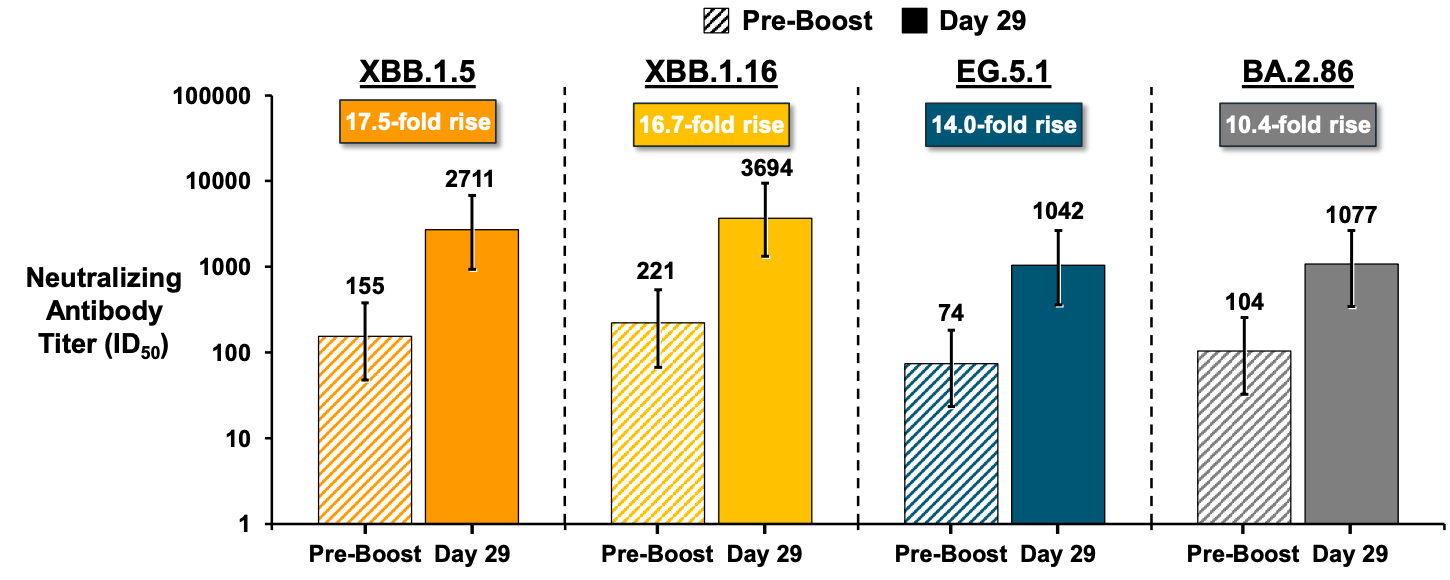
Pharma companies showed increased antibodies against currently circulating variants, including the newer BA.2.86.

Cross Neutralization Results (Day 29) After XBB.1.5 Vaccine in Adults – Duke Assay. Source: Moderna.

Discussion

Three noteworthy items were brought up:

  1. Access may be challenging because this vaccine is now privatized. For example, pharma requires pediatricians to purchase at least 200 virals. This is a risk to providers and will unintentionally drive inequities.

  2. Timing after previous vaccine/infection. This was not covered in presentations, which was incredibly disappointing. During the discussion, committee members asked and CDC’s answer was:

    1. Previous vaccine: Wait at least 2 months.

    2. Previous infection: No specific requirements, but 3 months was suggested.

      (I think this is too short; I’ll pull some evidence for a future YLE post.)

  3. Universal vs. targeted. One ACIP member preferred a recommendation for specific groups— like those over 65 years— or words like “should” vs. “may” to communicate urgency. Other members (and I) strongly support universal recommendations because of four reasons:

    1. More lives saved. “Compared with only vaccinating those 65+ years, universal vaccine recommendations projected to prevent about 200,000 more hospitalizations and 15,000 more deaths over the next 2 years.”

    2. Close loopholes for private insurance. They must now cover the vaccine for all.

    3. Promotes equity among those who don’t have a physician.

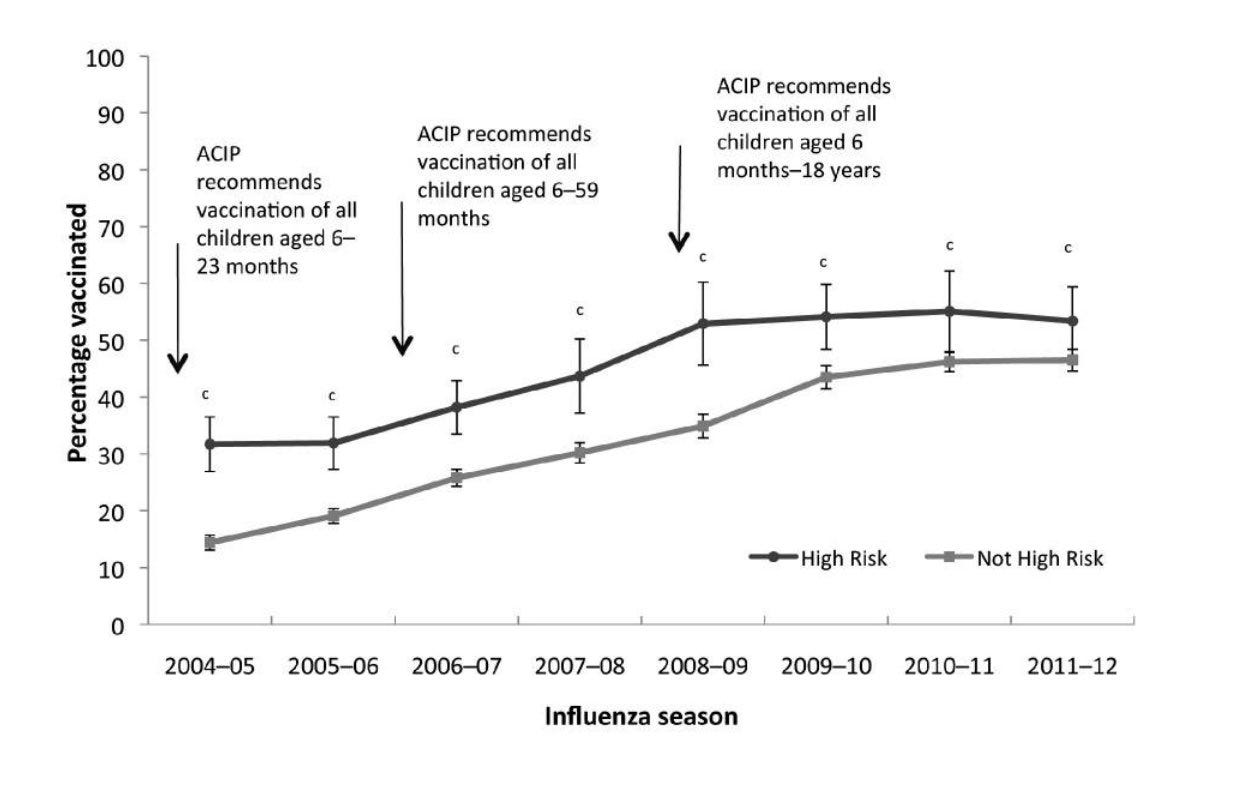
    4. Increases uptake among *vulnerable* people. It’s less confusing. We’ve already learned this lesson from the flu.

ACIP voted (13-1) to recommend Covid-19 vaccines for everyone >6 months old. While the benefit profile differs significantly across age groups and time, risks of vaccination and infection remain outweighed for all ages.

What’s next?

This goes to the CDC Director for approval. Then, technically, you’ll be able to get a vaccine. However, access may be delayed or challenging, and waiting may make sense for some (more on this later).

My family will be getting a fall Covid-19 vaccine this fall. I hope you’ll join.

Love, YLE


“Your Local Epidemiologist (YLE)” is written by Dr. Katelyn Jetelina, M.P.H. Ph.D.—an epidemiologist, wife, and mom of two little girls. During the day, she is a senior scientific consultant to several organizations. At night, she writes this newsletter. Her main goal is to “translate” the ever-evolving public health world so that people will be well-equipped to make evidence-based decisions. This newsletter is free, thanks to the generous support of fellow YLE community members. To support this effort, subscribe below:

Subscribe now

13 Sep 12:20

Gilead Delayed Introduction Of New Version of HIV Drug, With Fewer Side Effects, Maximizing Its Patent Monopoly And Profits

by Glyn Moody

Techdirt has been writing about “evergreening” for many years. It refers to the practice by pharmaceutical companies of making small changes to a drug, often about to come off patent, in order to gain a new patent that extends its manufacturer’s monopoly control over it. The New York Times has a story about the Big Pharma company Gilead Sciences that involves evergreening, but with a twist.

It concerns the drug tenofovir, which is used for treating HIV. Its patent expired in 2017, and Gilead naturally worked on a replacement that would extend its patent monopoly beyond that date. But Gilead stopped work on the new version in 2004. At the time, the company’s press release explained this was because it didn’t have “a profile that differentiates it to an extent that supports its continued development.” That’s a rather implausible excuse, since the technique of patent evergreening is based on the idea that even tiny changes to a drug justify granting a new patent. Drawing on “a trove of internal documents made public in litigation against the company,” The New York Times says there was another reason why work on the new version was halted:

The promising drug, then in the early stages of testing, was an updated version of tenofovir. Gilead executives knew it had the potential to be less toxic to patients’ kidneys and bones than the earlier iteration, according to internal memos unearthed by lawyers who are suing Gilead on behalf of patients.

Despite those possible benefits, executives concluded that the new version risked competing with the company’s existing, patent-protected formulation. If they delayed the new product’s release until shortly before the existing patents expired, the company could substantially increase the period of time in which at least one of its H.I.V. treatments remained protected by patents.

Despite those 2004 concerns over its “profile”, Gilead did introduce the new version, but just a couple of years before the 2017 expiry of the patent on the original version. As The New York Times notes, that was nearly a decade after it could have been made available had work on the new version not been paused. Because of this delay, Gilead has patents on its HIV drug that will run until at least 2031.

The delayed release is now the subject of state and federal lawsuits in which around 26,000 patients, who took Gilead’s older version of tenofovir, claim that the company exposed them to kidney and bone problems that could have been avoided. The company denies this:

In court filings, Gilead’s lawyers said that the allegations were meritless. They denied that the company halted the drug’s development to increase profits. They cited a 2004 internal memo that estimated Gilead could increase its revenue by $1 billion over six years if it released the new version in 2008.

But that makes no sense. Why would a canny Big Pharma company forgo an estimated $1 billion in revenue for apparently no reason? It certainly wasn’t because the new version’s “profile” was unsuitable, as its subsequent successful launch proves. Its hard not to see this as a calculated move to maximize sales and profits based on the (correct) assumption that drug prices would continue to rise strongly, making an extended patent monopoly even more valuable than a truncated one.

The move has certainly paid off for Gilead, but not for people with HIV. If the new version had been patented back in 2004, it would be coming off patent soon, which would mean cheap generics would be available, widening access to the drug. Moreover, as the lawsuits note, people would have been spared the serious consequences of taking a drug for years that had toxic effects on their bodies.

This is not the first example of Gilead behaving badly with its HIV drug. Back in 2019 Techdirt wrote about how Gilead was charging $24,000 annually per patient for a treatment, based on tenofovir, that was developed with US taxpayer money, and even patented by the US government. The cost of producing the treatment? Just $60 annually per patient.

Follow me @glynmoody on Mastodon.

12 Sep 20:56

September 12, 2023 Outlook: Lee will take aim at New England and/or Atlantic Canada this weekend

by Matt Lanza

One-sentence summary

Although Hurricane Lee is expected to weaken as it comes north, it will be expanding in size and capable of punching above its weight class as it brings impacts to eastern New England and/or Atlantic Canada this weekend.

Hurricane Lee: 115 mph, moving WNW 7 mph

What’s changed since yesterday?

Lee’s track forecast is slowly clearing up, with confidence increases in both timing and broad track today. We can now say that Lee will likely take aim at New England or Atlantic Canada or both regions this weekend.

Hurricane Lee will slowly weaken over the next few days as it turns and accelerates to the north, however it should run into coastal New England or Atlantic Canada as a large storm this weekend. (Tomer Burg)

Lee’s track forecast

The forecast for Lee’s path is becoming a bit more straightforward now, but there are still some modest differences we need to sort out.

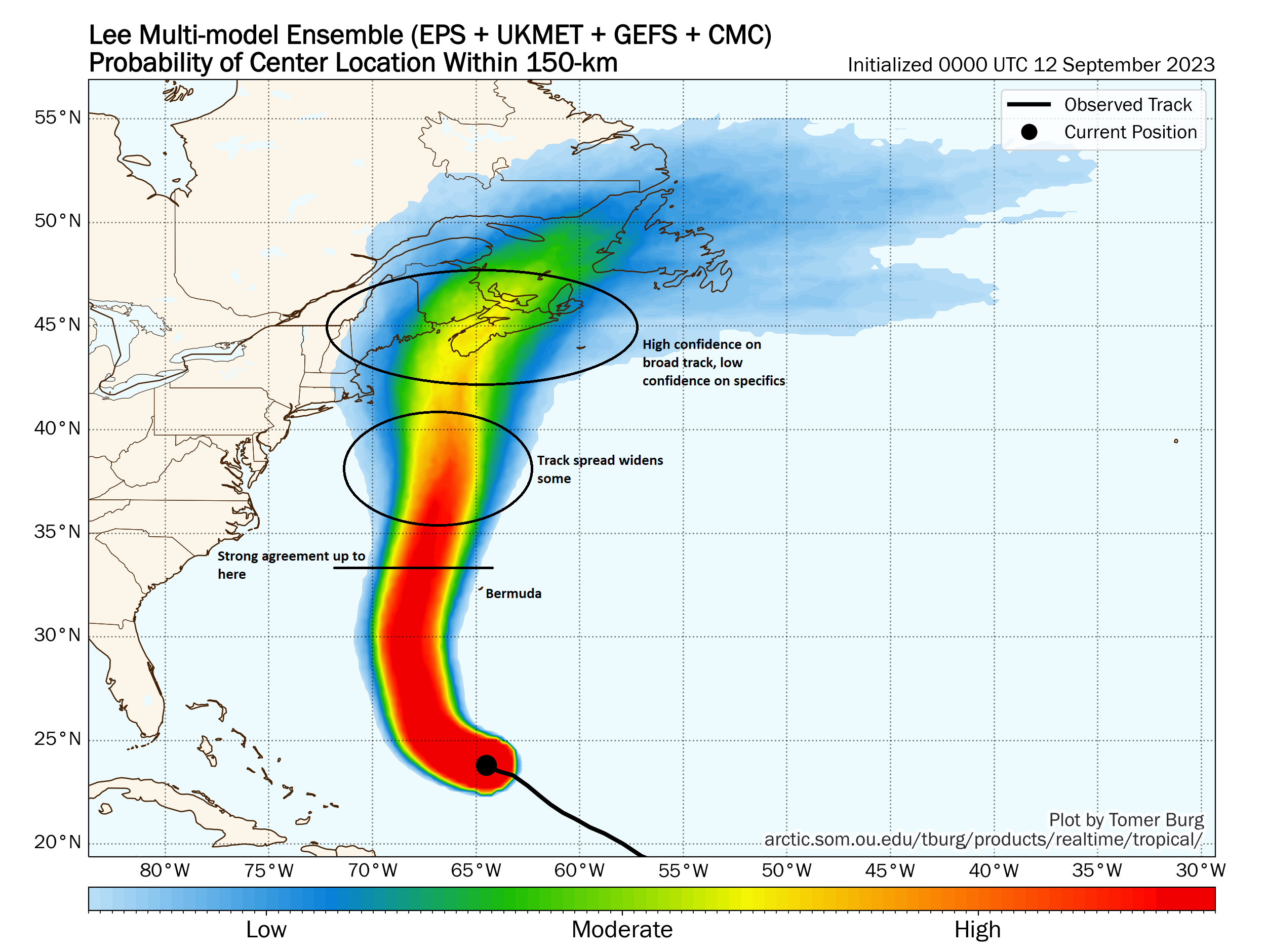
Click to enlarge the track density forecast. Good agreement through about days 3-4 which brings Lee west of Bermuda. Then, although we expect Lee to broadly track to New England or Canada, the specifics are more challenging. (Tomer Burg)

There are two camps now, with one generally proceeding straight north or north-northeast toward Nova Scotia and the other straight north or even bending back northwest toward Maine. These differences may seem minor, and they are to some extent, but they will determine where the worst of Lee’s surge goes and where the worst weather will occur. Historically, there is little precedent for a storm striking the Maine coast from the due south or southeast. Most either arrive from southwest, paralleling the coast or make landfall from the south-southwest. Unique storms have unique impacts. So sorting out the finer details of Lee’s track will allow the impacts to become clearer. If Lee tracks toward Nova Scotia, that’s a more frequent impact zone, and while Lee would certainly be a significant storm there, there is at least some precedent for that.

Lee’s intensity forecast

This part of the forecast is actually a little easier I think. Lee should slowly weaken in the coming days to either a category 1 hurricane or strong tropical storm as it makes landfall wherever. However, because of Lee’s size and intensity and its transition from a tropical storm to more of an extratropical feature (think: very large nor’easter), it will act stronger than what it actually is. In other words, it’s important to recognize that a weakening storm is still a serious storm in this part of the world. And Lee checks the boxes for a potential serious hazard to folks in Canada and New England, even in a weakened state. Tropical Storm force winds extend out almost 200 miles from Lee’s center, so while the exact landfall point will matter for some aspects of Lee, the impacts will extend far from the center.

Lee’s impacts

We’re still honing in a bit on this area of things, but let’s share what we know today.

For Bermuda, it seems that Lee will pass to the west by 100 miles or so, which should be plenty close to deliver tropical storm impacts, and I’d expect Tropical Storm Watches to be issued there today. Additionally, Bermuda will probably see some heavy rain, very rough surf, beach erosion, and rip currents as Lee approaches.

Looking elsewhere at impacts: First, beach erosion, rough surf, and rip currents are a lock for the East Coast and Atlantic Canada. Swimming probably won’t be recommended this weekend anywhere from the Mid-Atlantic northward.

Significant wave heights will be substantial up and down the East Coast this week, leading to dangerous surf, rip currents, and potentially some beach erosion. The forecast above is for Friday evening, with Lee due east of Norfolk, VA. (Weather Bell)

Second, and one area of concern: Rain. Lee’s exact track will determine who sees the heaviest rainfall from the storm. However, with periods of heavy rain likely this week across New England, and some antecedent ground conditions in coastal Maine, New Hampshire, and Massachusetts already wetter than normal, tropical rainfall won’t be ideal.

The rain forecast through Thursday evening in northern New England shows anywhere from 1 to 2 inches of rain or a bit more in spots, meaning additional 2 to 4 inches or so of rain from Lee may cause some flooding issues, particularly in Maine and New Brunswick. (Pivotal Weather)

Flooding is one concern obviously, but so will downed trees due to saturated soils and gusty winds. In other words, it won’t take a hurricane in some spots to knock down trees or power lines. The good news in all this is that Lee should be accelerating north as it passes through which will limit the rainfall potential a bit and hopefully avoids serious freshwater flooding concerns.

Wind, as noted, will be an issue as well for obvious reasons. We’ll hone in on that aspect of things as we get closer.

And last but not least, storm surge. Lee will be bringing a fair bit of water north with it as it heads toward Canada or New England. As a result, depending on the exact track of the storm, this could come roaring ashore on the coastline near and right/east of the center. It’s a bit soon to talk about how bad that could be, but given Lee’s larger size, it seems reasonable to think a pretty significant coastal surge event could unfold in Canada or New England.

Guidance based on the GFS model shows about 2 feet of surge arriving in Nantucket on Friday. We can hone in on more specifics for this as we get closer to the weekend. (NOAA)

We will fine tune these impacts as we get closer to the storm. In the meantime, it’s the right time to begin preparations in coastal eastern New England and coastal Atlantic Canada. While the details are still a bit uncertain, the likelihood of potentially significant impacts is increasing.

We will have a brief update later this afternoon, followed by a full update Wednesday morning.

Elsewhere: Margot makes five

Meanwhile, congratulations are in order for Margot, which became the season’s fifth hurricane. It remains unlikely to impact land. Winds are 85 mph this morning.

Behind Margot, we continue to see signs that the next wave will develop in the coming days. Invest 98L is expected to form and track west, then northwest across the Atlantic. It appears likely to go north of the Caribbean islands, but given how much time we still have ahead of us for this one, it remains worthy of continued watch. This one has ruffled a few feathers as some operational guidance shows it getting close to the U.S. at times in the 11 to 15 day period. Frankly, that’s way too far out to proclaim anything one way or the other, but when looking at ensemble guidance, it appears those dramatic solutions are presently significant outliers and unlikely to materialize. Plenty of time to watch.

12 Sep 20:53

Houston is finally looking at a few days of pretty healthy rain chances

by Eric Berger

The region’s drought has steadily worsened this summer, with unrelenting heat and only very isolated to scattered rain showers in July and August. At the start of summer there were virtually no dry or drought conditions anywhere near the greater Houston region. Now half of the area is is an exceptional drought, and the other area is in an extreme drought. (They’re both bad, but exceptional is worse).

While the rains we’re going to receive in the next several days aren’t going to break the drought, they can at least start to put a dent in it. And psychologically, for a lot of us, they’re going to feel oh so good. Beginning Wednesday, and persisting through Saturday, we’re going to see daily rain chances on the order of 40 to 60 percent as a disturbed pattern stalls overhead and helps to generate lift in the atmosphere. Most of the area probably will see, on average, 1 inch of rainfall, but there will be a wide variance in totals. Daytime highs will be cooler with the rainfall.

Use the slider to compare drought conditions at the start of summer, May 30, with where they were late last week. (U.S. Drought Monitor)

Tuesday

It probably won’t rain today. Oh, there’s perhaps a 15 percent chance of showers this evening, but for the most part we’re going to be sunny and hot, with highs in the upper 90s. A few far inland areas may touch 100 degrees. Skies will be partly to mostly sunny, with only very light winds. Slight rain chances will continue tonight, with lows in the upper 70s.

Wednesday

This will be another partly to mostly sunny day, but highs are likely to top out in the mid-90s. Rain chances on Wednesday afternoon and evening are probably on the order of 30 to 40 percent. Some stronger thunderstorms will be possible, but for the most part these showers should be fairly light.

Thursday and Friday

These two days will likely carry the best potential for rain, with a healthy 60 percent chance each day. With partly to possibly even mostly cloudy skies, highs likely will top out in the low 90s. (Some locations may actually top out in the upper 80s, if you can believe that). Afternoons will be the most favored time period for showers and thunderstorms, although they will be possible overnight as well.

NOAA rain accumulation forecast for now through Saturday. (Weather Bell)

Saturday and Sunday

The first half of the weekend will offer one more healthy chance of rainfall, with highs in the low 90s. After this time a weak front will be moving toward the area, and this should bring slightly drier air and mostly end the potential for rainfall. So we should be back to mostly sunny skies on Sunday, with highs in the low- to mid-90s. Nighttime temperatures to start next week should be a bit cooler with the drier air. I’ll go with lows around 70 degrees in Houston, but there is definitely some wiggle room to go a little bit cooler or a little bit warmer.

Next week

I’d love to tell you that we’re going to slip even further into fall next week, but it looks like Houston will fall on the periphery of another high pressure system, and this is likely to bump our high temperatures back into the mid-90s for awhile. The worst of summer is over, but alas, summer is not over.

12 Sep 20:52

customers are ignoring our male receptionist

by Ask a Manager

This post was written by Alison Green and published on Ask a Manager.

A reader writes:

I am the co-owner of a small business which previously had two receptionists, Alice and Becky, both women. Recently, Becky has gone to part-time, and we have hired a new male receptionist, Charlie. The problem is, members of the public consistently fail to recognize that Charlie is the receptionist.

The receptionists work a staggered schedule so we usually have only one, but during busy times we will have two at the same desk. When both Charlie and Alice are working, customers most often approach Alice first, and usually will only go up to Charlie if Alice is already speaking with someone else. In several cases, they have started to form a line to wait for Alice unless Charlie waves them down and calls them over. When Charlie is alone, we have a much higher rate of people being unable to figure out who to speak to (this almost never happens when Alice and Becky are alone). In two cases, we had people walk past the desk into the back office area and approach the nearest woman for help.

Potentially relevant information:

* They are located at a desk across from the entrance, so in order to pass through the area people must pass by the desk.
* In addition to gender, Charlie is black and both Alice and Becky are white.
* The receptionists also do admin work and help with paperwork when they’re not assisting customers. Because the customers approach them inconsistently, Charlie ends up doing more of this work and less customer assistance despite having the same job title.
* The desk is labeled “Receptionist.” I moved the label to a more prominent position, but it hasn’t seemed to help.

Obviously I would like to prevent this, but am not sure where to start. Most of our customers are not regulars, so this isn’t something I can approach with them individually.

Yeah, people are socialized to see women as helpers and in support roles — but it’s pretty amazing that Charlie is right there behind the receptionist desk and people are still queuing up to wait for a woman or can’t figure out where to seek help at all. Charlie’s situation is the inverse of the women who are assumed to be support staff when they aren’t! It would almost be funny if it weren’t so exhausting.

As is so often the case with sexism, you’re going to have to look for work-arounds. The two that seem likely to have the most impact:

1. How big is your Receptionist sign? If it’s a small nameplate (like the sort that sits atop a desk), can you get much larger signage — something measured in feet, not inches — that says “help desk” or “please check in here” or similar? “Help desk” might even be a useful switch in language because “receptionist” is still female-coded in a lot of brains.

2. Talk to Charlie about what you’re seeing and ask for his ideas. At a minimum — and this will probably do more than anything else will — you should ask him to be more assertive about saying “I can help you over here” or “I can help the next person in line” or “good morning, how can I help?” and so forth. But he might have other ideas too, and it’ll be good to enlist him in helping to solve the problem.

I wouldn’t be surprised if race is playing a role too — with people finding white women more approachable than a black man, subconsciously or otherwise — and hopefully the above strategies will help there as well.

12 Sep 17:29

my employee says she has “pregnancy brain”

by Ask a Manager

This post was written by Alison Green and published on Ask a Manager.

A reader writes:

My lead administrative assistant, who is normally fantastic, is pregnant. In the past few weeks, she has made some very significant errors, two of which in particular have ended up causing a good bit of drama, increasing workload for others in my department, and also costing our organization a not-insignificant chunk of money. She has been profusely apologetic about these errors, and blamed them on her “pregnancy brain.”

I know this is a real physiological thing! But I also need her to be more careful about detail work. I’ve talked with her about slowing down and taking time to double-check the projects she’s working on, but things are still slipping through the cracks.

I obviously need to have another talk with her, but I’m concerned about how to frame that conversation. While she’s blaming her issues on “pregnancy brain,” I am deeply uncomfortable doing so myself (and in fact suspect it might be actively discriminatory!). As a woman myself, I have no wish to attribute performance issues to something that is still, unfortunately, used to discriminate against women in the workforce, or to pathologize pregnancy. I feel like it might be important to mentor her around using such language to explain performance issues, but I’m not sure if that’s even appropriate for me to do, especially when there really is a physiological issue here. Do you have any advice for 1) being supportive but firm in talking with her about these things; 2) staying on the right side of discrimination issues when I do?

I answer this question over at Inc. today, where I’m revisiting letters that have been buried in the archives here from years ago (and sometimes updating/expanding my answers to them). You can read it here.

12 Sep 17:28

Suspicious Resident Doesn’t Recall Ever Seeing Black Man On This Planet Before

ROCHESTER HILLS, MI—Peering out her kitchen window with concern after noticing the pedestrian across the street, suspicious resident Barbara Hill reportedly told her husband Tuesday that she didn’t recall ever seeing that Black man on this planet before. “Hon, I don’t want to be overly nosy, but I just don’t…

Read more...

12 Sep 17:24

New iPhone 15 Includes 12 Animal Sounds And Colorful Lever

CUPERTINO, CA—In a stunning conclusion to the highly anticipated keynote address, Apple announced Tuesday that the new iPhone 15 will include 12 animal sounds and a colorful lever. “The next sea change in personal electronics has arrived, and it goes moo,” said CEO Tim Cook, explaining to a crowd of cheering fans that…

Read more...

12 Sep 17:23

Police Talk Man Down From Edge Of Climaxing

CLEVELAND—Rushing into action mere moments before the situation reached a point of no return, heroic police officer Samuel Esposito reportedly talked a man down Tuesday from the edge of climaxing. “Sir, before you do something drastic that we all regret, I’m asking you put down your penis and step away from the…

Read more...

12 Sep 17:23

Prison Abolitionist Must Want Rapists To Just Freely Frolic In Field Around Maypole

CHICAGO—Deriding the man’s views on criminal rehabilitation as hopelessly idealistic, sources reported Tuesday that local prison abolitionist Aaron Eichinger must want rapists to just freely frolic in a field around a maypole. “According to your position, if someone commits violent sexual assault, then we let them put…

Read more...

12 Sep 11:42

should you lie and say you have an NDA to get out of explaining a gap on your resume?

by Ask a Manager

This post was written by Alison Green and published on Ask a Manager.

A reader writes:

I have seen this TikTok going around that basically says when you are asked about a gap in your resume, you should say that you are under an NDA, no matter what the gap was for.

A coworker recently repeated this advice to me, and said that the interviewer can’t ask any follow-up questions.

I think this is terrible advice for a lot of reasons, and that any sane hiring manager would discard someone doing this. What do you think?

Yes, it’s terrible advice.

First, it’s not true that the interviewer couldn’t ask any follow-up questions. Even if there were a real NDA, the interviewer wouldn’t be bound by it since they’re not a party to it. They can ask whatever they want.

Second, if you really were under an NDA, you’d normally provide some sort of context — “I was at a job from February to June that’s governed by an NDA so I can’t discuss details, which is why it’s not on my resume, but very broadly speaking I was doing X type work.” And then your interviewer still might have questions: Is there an NDA because of the circumstances under which you left? Something else? In other words, there still might be a conversation because you’ve just thrown some surprising information into the conversation and they’ll need to make sense of it. You wouldn’t just say, “Oh, top secret NDA, can’t answer” and then move right on.

Third, an NDA that prevented you from acknowledging even the existence of the job (as opposed to, for example, specific trade secrets) is so unusual — not impossible, but highly unusual — that this is likely to strike the interviewer really oddly, unless you navigate the conversation about it pretty skillfully. And if you don’t — and I’m guessing anyone taking advice from this TikToker is unlikely to — then you’re going to seem shady, and your interviewer is going to view your whole candidacy with a lot more skepticism than they otherwise would have (or yes, just reject you).

Fourth, and most important, there’s no point to any of this! It’s not that hard to talk about a gap on your resume. Gaps aren’t some grievous sin that you must cover up at all costs. Gaps are normal. They’re usually not big deals. The fact that someone misunderstood this to the extent that they think you need a asinine lie to cover it up says they have no idea how interviewing works or how to interview effectively.

If anyone ever tries to convince you they have This One Weird Trick To Get Hired, it’s usually a sign to ignore them on job stuff entirely.

12 Sep 11:40

saying I won’t give rides to work, coworker complains about her family non-stop, and more

by Ask a Manager

This post was written by Alison Green and published on Ask a Manager.

It’s five answers to five questions. Here we go…

1. How to tell a coworker I won’t give her rides to work

How do I politely tell a coworker I don’t give anyone rides?

I work in a cafeteria in a factory, it’s not on a bus route and I’m not even sure you can legally walk here since it’s off the expressway. We got a temp worker on afternoons and she’s asked me about sometimes giving her rides.

I don’t want to be rude, but I point blank don’t give rides. I sometimes need to stay later than she’s allowed to, I don’t want to have to worry about plans before or after work and honestly I’m a little late to work a lot (getting better at that though) and my car isn’t the most reliable; it’s broken down three times in the last year. And to be quite honest, I’m a firm believer that you need to know how to get to and from work before you take the job. Do you have any advice on how to say this without being rude?

“My schedule is so unpredictable that I don’t give rides — sorry I can’t help!” That’s it.

If she pushes after that: “I’m really not able to. Sorry!”

2. Should I keep pushing for a resolution to my coworker’s complaint about me?

I need advice on if I should keep chasing after an informal complaint about me was made to HR and my division boss in June. The complaint came from Fergus, who is more senior than me and has a long history of mental health issues. We had been friendly, doing things outside work (I organized a small trivia team; sometimes we had lunch; he had been to my house) and at work I was doing a lot of emotional labor to help him feel more comfortable. The complaint was that because of me, Fergus felt too uncomfortable to come into work and that I was impacting his mental health. I was devastated and mortified.

We don’t work directly together, but he had recently blown up at me in a meeting and said things I was uncomfortable about in the all-work Slack, relating to my work, so I stepped back from the friendship. He had been avoiding me since then; he would walk into the break room, see me, and walk out. I have not organized the trivia team since (although nothing is stopping the others from organizing it) and while I am being professional-friendly, I have not gone out of my way to do things for him or seek out his company.

In the meeting about his complaint, mediation was suggested. I said I didn’t think it would be helpful, but if my boss wanted it for the good of the division, I would — but only if the parameters were about work only and I wouldn’t be asked to do things other colleagues aren’t asked to do (for example, make sure Fergus feels comfortable socially). I also asked for a list of the things that made him uncomfortable, because of course I would stop if possible. I was told we’d touch base at the end of the week.

Since then, Fergus has been blowing hot and cold — actively seeking out my company (without ever referring to this) and actively avoiding me. I have been polite and professional, but I can’t trust him because he chose not to use any of the lines of communication we had (email, text, whatsapp, and more) and instead took this nuclear option, especially as I am on a fixed-term contract.

I have chased my boss and HR for an update five times now. The last time I asked HR for a resolution, especially for the things I’m doing that make Fergus uncomfortable, she said it was at the top of my boss’ list to email me, but two weeks later, nothing has happened (my boss is ridiculously busy).

I think maybe I’ve been making a tactical error in chasing. Part of me thinks maybe they realized this was someone upset about a friendship ending and were hoping it would quietly go away. But if that’s the case, I just want to know it’s resolved, not just have it disappear. I am angry that I had to go through this really anxious few months, especially as I still don’t know what it is I am doing that is making Fergus too upset to come into work. I will not re-start the extra emotional labor for him, and I don’t want to be friends outside work, but I am also scared that if we disagree in the one meeting we are in together, he will go back to HR. Should I keep chasing? Or should I just never mention it again?

You deserve a response! If your employer brings you a complaint that you’re making someone too uncomfortable to come into work — which is a serious thing — of course you deserve to understand what they mean and what they want you to do differently. It’s ridiculous that you’ve asked for follow-up five times without any response.

But regardless of how it should be handled, it’s looking highly likely that you’re not going to get any substantive follow-up. You may indeed be right that they realized there’s no actionable substance to the complaint. If so, they should tell you that, or at least close the process with you in some way so you’re not left hanging. But at this point you’ve done your due diligence in trying to resolve it, and probably need to let it drop. That said, assuming you’re in regular contact with your boss, it would be reasonable to ask about this the next time you’re meeting (as opposed to trying to chase him down about it separately or continuing to ask HR)— but otherwise the complete lack of response from your company is probably a message that they’re done with it.

About your fear that Fergus will revive the complaint in the future if you disagree with him — he could! But you’re on record as being responsive to the first complaint and repeatedly trying to resolve it … and if they’ve figured out the first complaint didn’t have a lot of merit, that context will be there for the second one too.

3. Candidate was rude to the assistant on our interview panel

One of our departments (marketing) has only two employees: a marketing manager, and a marketing assistant. Recently, the manager position was vacant and the assistant was not interested in it. I discussed it with her and made sure she didn’t want to apply. Once I knew she was certain, I invited her to be on the interview panel for the manager. She will be the person working most closely with the new hire, and she has a track record of sound and thoughtful judgment. The other panelists were management and HR staff (four total on the panel).

One candidate we interviewed had an impressive educational background but an inconsistent work history. Still, she had the skill set we were looking for and there are all kinds of legit reasons a person might have gaps in their resume.

At the beginning of the interview, all the panelists introduced themselves and explained how their positions interface with Marketing. When the assistant introduced herself and stated her position, the candidate openly scoffed. I mean, complete with eye roll and head shake. Clearly she was insulted that a subordinate had input into the selection process. For me, the interview was over at that moment. It was so crass and disrespectful, there’s no way I would put this person in a supervisory position over one of my best employees. Or anyone, for that matter. However, I pressed on and we completed the interview, which had plenty of other red flags. Obviously, I didn’t hire her, and I have no regrets. We did end up with an outstanding hire.

My question is: is it that uncommon to include a subordinate on the interview panel? I feel like the assistant’s judgment and perspective were useful in evaluating the candidates. Being a small-ish organization, interpersonal dynamics matter. Most of what we do is collaborative, and we’ve often included a variety of positions on interview panels. This is the first time we’ve had that particular reaction from a candidate, though maybe others were better at hiding it?

No, it’s not uncommon! It’s not the most common way to do it, but it’s certainly not a weird thing to do and it’s especially smart in a two-person department. But even if it were unusual, a candidate openly scoffing at that would be the reddest of red flags. It’s incredibly snotty and disrespectful, and being rude to someone she perceives as having less power than her is a terrible sign about her character. And in an interview, when she’s presumably on her best behavior? Imagine how she treats people with less power than her when no one else is watching.

Frankly, if you had a time machine, I’d encourage you to ask about it in the moment — “Can I ask about the response you just had when Jane introduced herself as our marketing assistant?” — and then perhaps talk a bit about your culture and the importance you place on respect toward colleagues regardless of where they fall in the hierarchy, and especially in people you’re considering for management roles. That’s not everyone’s style, of course (and it’s hard to think to do that in the moment when you’re reeling from unexpected rudeness!) but it would have been satisfying, and likely further illuminating.

4. My coworker complains about her family non-stop

I work in a school, fairly closely with a colleague. Our professional relationship is great and we’re able to collaborate to support our scholars. But personally, I’m at my wit’s end. Every conversation turns to complaints about her husband, frustrations with her parents, or concerns about her children. She’s not interested in solutions, just in complaining. Included in her list are complaints about people who won’t listen to her complain.

We have the same lunch period this year. Aside from hiding in the bathroom, how do I nicely ask her to lay off the moaning? I need a break to recharge, chit chat with adults, or just browse reddit. It’s not that I want to be alone, I just can’t listen to her complain every day for the next year. Do you have a good script I can use to shut down the personal talk but maintain a good working relationship?

“I’m trying not to complain at work anymore. I’ve realized it puts me in a more negative head space, and it’s better for my mental health not to do it. So I can’t be your sounding board for this stuff, but did you see (insert subject change here)?”

She might be annoyed and think you’re aggravatingly pollyanna-ish, and that’s fine. Let her.

Alternative 1: “Sorry, I’ve got so much stuff going on myself that I’m not the right sounding board for this. But I’d love to talk about (different topic).”

Alternative 2: “I’m not in a head space for this, sorry!”

And then when she tries to shoehorn it back in, be ready with: “I really meant it — it’s not a conversation I’m up for, sorry.”

5. Time off for plastic surgery

I was wondering how you would recommend approaching my boss to request time off for an elective surgery. I am planning to get a rhinoplasty in the next year. It is purely cosmetic (no deviated septum, etc.) but I don’t really want to share what I’m taking time off for because I know people have different views on plastic surgery. I’m thinking of just requesting the time and sharing that I’ll be having a medical procedure, but that it’s nothing to worry about. Would you add anything else? Especially since my appearance will obviously change.

You don’t need to (and shouldn’t) disclose any details at all. It’s your private business!

Something like this is the way to go (not just with elective cosmetic surgery but with anything, really): “I’ll be out on (dates) for minor surgery. It’s nothing to worry about, just something I need to get taken care of.”