When contract negotiations between Alaska Airlines and their flight attendants' union broke down in 1993, the union had a choice to make.
The union — The Association of Flight Attendants-CWA — knew that if they chose to strike, Alaska Airlines could use a plan. While Alaska Airlines technically couldn't fire someone on strike, they could permanently replace the striking flight attendants with new workers. Essentially, if the union went on strike, they could risk thousands of people's jobs. The flight attendants knew they needed a counter-strategy.
They went with a strategy they called CHAOS: "Create Havoc Around Our System."
The strategy had two phases. Phase one: The union kept Alaska guessing about when, where, and how a strike might happen. They kept everyone, even their own members, in the dark. And in turn, Alaska Airlines had to be prepared for a strike at any place and any time. Phase two was to go on strike in a targeted and strategic way.
The havoc that the flight attendants created set off a sort-of labor-dispute arms race and would go on to inspire strikes today. And, it showed how powerful it can be to introduce a little chaos into negotiations.
ERIE, CO—With its muddled storyline lacking the details necessary to justify the actions of its character, a local haunted maze failed to explain narratively why someone would jump out from around a corner screaming like that, sources reported Thursday. “So we turn a corner and a man is running at us with a axe, but…
WASHINGTON—Noting that there was no excuse for the first dog’s most recent instance of bad behavior, the White House confirmed Thursday that Commander Biden had gnawed the Washington Monument down to a slobber-covered stub. “We turn our backs for two minutes, and boom, we find Commander sitting there on the National…
It’s today: your first lab meeting. You’ve got your slides together, tested the animations and so long as that one video loads, everything should be smooth sailing. But you’re probably still worrying, “What about Professor Knowsitall and the inevitable question? What if someone interrupts me? What if I forget what I’m talking about? What if they realise I’m an imposter?!!”.
It’s okay.
Breathe.
It really is okay. It’s just a talk. But we’ve been there and yeah, it can be scary. Thankfully, we’ve also done it loads and so we’re armed with tried and tested words of wisdom.
So sit back because it’s time for your (almost) complete guide on how to not only survive but crush your first lab meeting.
1. No one expects you to present a breakthrough
It might be daunting up there in front of your lab members, but no one’s waiting for you to deliver groundbreaking studies (not yet, anyway). This isn’t your Nobel speech, this is you giving your first-ever lab meeting so you’ll mainly just be explaining what you’ve got planned (and what’s gone wrong so far). You build your research up bit-by-bit and right now you’re laying the foundations and everyone knows that. Relax. You’ve got this.
2. Interruptions are a chance to clarify things
Rather than panicking when you see the dreaded hand go up mid-way through your talk, see it as a chance to explain something you already know. Most interruptions are just to clarify minor points. It’s because the listener is interested, and they want to hear from you – it’s your lab meeting. This a good thing. You also don’t need to know all the answers to those questions: just be honest, “Sorry, I’m not sure about that but I’d love to look into it.” Don’t rush to answer, either. Pause. Think. Give a measured response.
3. Slow and steady wins the race
Nerves are going to make you want to race through your slides. Don’t give in to them: talk through each slide at a leisurely pace – even at a pace you feel is too slow. It’ll come across much clearer and more thoughtful. It’s also a chance for you to be very clear on what you’re saying rather than possibly stumbling over concepts. Maybe even take a casual stroll over to the whiteboard to sketch out an idea you’re trying to explain. Better to go too slow than too fast.
4. Less is more
Don’t pack your lab meeting slides with text as you’ll only end up reading them off word-for-word – no one wants to read a dissertation up there. Have a title, a sentence or two, and then some interesting data that you can discuss. You don’t need to outline every step of every assy you’ve done or intend to do. Take it easy. Keep it simple.
5. Even negative results are results
Don’t feel the need to only include successful experimental data. You’re going to have your fair share of failed experiments and lab meetings are often a great place to show that data and come up with a solution as a group. And right now you might now have much at all. But your lab members want to help you. Honestly. This might be the only time a ‘brainstorm’ is any use at all! Embrace it.
6. Everyone hates PowerPoint
It’s going to happen so just accept it now: PowerPoint will freeze, fail to load a slide or just plain old crash. That’s okay , we all expect it to happen at some point. No one will blame you. Just apologize, lament about Microsoft, and pick up where you left off. It’s almost over by now anyway.
7. “Any questions?”
Try not to wince when you say this as there will be questions. No one’s trying to trip you up. Instead, they’re trying to understand your methodology to ultimately make you better. If you don’t know a term, some reference in an obscure paper, or even what the bloody question question was in general, just say so. There’s no shame in not knowing something – that’s how we learn stuff, after all. However, if you try to pretend you know something – you try to blag it, then you’re going to fall short at some point and then you’ll look like a right plonker. They’re the experts at this point so don’t pretend you know things. You can also ask questions here: ask them for input. I’ve yet to meet an academic who didn’t have something to suggest about my work.
8. BONUS: bring snacks to placate the room
You know it makes sense.
Even though lab meetings – and especially your first one – can seem scare-you-out-your-pants terrifying, no one’s out to get you. It’s a chance to troubleshoot, discuss ideas, and hopefully, focus the direction of your work. Think of your lab meetings as brainstorming sessions rather than interrogations!
When I think about how the old, good internet turned into the enshitternet, I imagine a series of small compromises, each seemingly reasonable at the time, each contributing to a cultural norm of making good things worse, and worse, and worse.
Think about Unity President Marc Whitten's nonpology for his company's disastrous rug-pull, in which they declared that everyone who had paid good money to use their tool to make a game would have to keep paying, every time someone downloaded that game:
The most fundamental thing that we’re trying to do is we’re building a sustainable business for Unity. And for us, that means that we do need to have a model that includes some sort of balancing change, including shared success.
"Shared success" is code for, "If you use our tool to make money, we should make money too." This is bullshit. It's like saying, "We just want to find a way to share the success of the painters who use our brushes, so every time you sell a painting, we want to tax that sale." Or "Every time you sell a house, the company that made the hammer gets to wet its beak."
And note that they're not talking about shared risk here – no one at Unity is saying, "If you try to make a game with our tools and you lose a million bucks, we're on the hook for ten percent of your losses." This isn't partnership, it's extortion.
How did a company like Unity – which became a market leader by making a tool that understood the needs of game developers and filled them – turn into a protection racket? One bad decision at a time. One rationalization and then another. Slowly, and then all at once.
When I think about this enshittification curve, I often think of Google, a company that had its users' backs for years, which created a genuinely innovative search engine that worked so well it seemed like *magic, a company whose employees often had their pick of jobs, but chose the "don't be evil" gig because that mattered to them.
People make fun of that "don't be evil" motto, but if your key employees took the gig because they didn't want to be evil, and then you ask them to be evil, they might just quit. Hell, they might make a stink on the way out the door, too:
Google is a company whose founders started out by publishing a scientific paper describing their search methodology, in which they said, "Oh, and by the way, ads will inevitably turn your search engine into a pile of shit, so we're gonna stay the fuck away from them":
Those same founders retained a controlling interest in the company after it went IPO, explaining to investors that they were going to run the business without having their elbows jostled by shortsighted Wall Street assholes, so they could keep it from turning into a pile of shit:
And yet, it's turned into a pile of shit. Google search is so bad you might as well ask Jeeves. The company's big plan to fix it? Replace links to webpages with florid paragraphs of chatbot nonsense filled with a supremely confident lies:
How did the company get this bad? In part, this is the "curse of bigness." The company can't grow by attracting new users. When you have 90%+ of the market, there are no new customers to sign up. Hypothetically, they could grow by going into new lines of business, but Google is incapable of making a successful product in-house and also kills most of the products it buys from other, more innovative companies:
Theoretically, the company could pursue new lines of business in-house, and indeed, the current leaders of companies like Amazon, Microsoft and Apple are all execs who figured out how to get the whole company to do something new, and were elevated to the CEO's office, making each one a billionaire and sealing their place in history.
It is for this very reason that any exec at a large firm who tries to make a business-wide improvement gets immediately and repeatedly knifed by all their colleagues, who correctly reason that if someone else becomes CEO, then they won't become CEO. Machiavelli was an optimist:
With no growth from new customers, and no growth from new businesses, "growth" has to come from squeezing workers (say, laying off 12,000 engineers after a stock buyback that would have paid their salaries for the next 27 years), or business customers (say, by colluding with Facebook to rig the ad market with the Jedi Blue conspiracy), or end-users.
Now, in theory, we might never know exactly what led to the enshittification of Google. In theory, all of compromises, debates and plots could be lost to history. But tech is not an oral culture, it's a written one, and techies write everything down and nothing is ever truly deleted.
Time and again, Big Tech tells on itself. Think of FTX's main conspirators all hanging out in a group chat called "Wirefraud." Amazon naming its program targeting weak, small publishers the "Gazelle Project" ("approach these small publishers the way a cheetah would pursue a sickly gazelle”). Amazon documenting the fact that users were unknowingly signing up for Prime and getting pissed; then figuring out how to reduce accidental signups, then deciding not to do it because it liked the money too much. Think of Zuck emailing his CFO in the middle of the night to defend his outsized offer to buy Instagram on the basis that users like Insta better and Facebook couldn't compete with them on quality.
It's like every Big Tech schemer has a folder on their desktop called "Mens Rea" filled with files like "Copy_of_Premeditated_Murder.docx":
Right now, Google's on trial for its sins against antitrust law. It's a hard case to make. To secure a win, the prosecutors at the DoJ Antitrust Division are going to have to prove what was going on in Google execs' minds when they took the actions that led to the company's dominance. They're going to have to show that the company deliberately undertook to harm its users and customers.
Of course, it helps that Google put it all in writing.
Last week, there was a huge kerfuffile over the DoJ's practice of posting its exhibits from the trial to a website each night. This is a totally normal thing to do – a practice that dates back to the Microsoft antitrust trial. But Google pitched a tantrum over this and said that the docs the DoJ were posting would be turned into "clickbait." Which is another way of saying, "the public would find these documents very interesting, and they would be damning to us and our case":
The document is described as "notes for a course on communication" that Google VP for Finance Michael Roszak prepared. Roszak says he can't remember whether he ever gave the presentation, but insists that the remit for the course required him to tell students "things I didn't believe," and that's why the document is "full of hyperbole and exaggeration."
OK.
But here's what the document says: "search advertising is one of the world's greatest business models ever created…illicit businesses (cigarettes or drugs) could rival these economics…[W]e can mostly ignore the demand side…(users and queries) and only focus on the supply side of advertisers, ad formats and sales."
It goes on to say that this might be changing, and proposes a way to balance the interests of the search and ads teams, which are at odds, with search worrying that ads are pushing them to produce "unnatural search experiences to chase revenue."
"Unnatural search experiences to chase revenue" is a thinly veiled euphemism for the prophetic warnings in that 1998 Pagerank paper: "The goals of the advertising business model do not always correspond to providing quality search to users." Or, more plainly, "ads will turn our search engine into a pile of shit."
And, as Roszak writes, Google is "able to ignore one of the fundamental laws of economics…supply and demand." That is, the company has become so dominant and cemented its position so thoroughly as the default search engine across every platforms and system that even if it makes its search terrible to goose revenues, users won't leave. As Lily Tomlin put it on SNL: "We don't have to care, we're the phone company."
In the enshittification cycle, companies first lure in users with surpluses – like providing the best search results rather than the most profitable ones – with an eye to locking them in. In Google's case, that lock-in has multiple facets, but the big one is spending billions of dollars – enough to buy a whole Twitter, every single year – to be the default search everywhere.
Google doesn't buy its way to dominance because it has the very best search results and it wants to shield you from inferior competitors. The economically rational case for buying default position is that preventing competition is more profitable than succeeding by outperforming competitors. The best reason to buy the default everywhere is that it lets you lower quality without losing business. You can "ignore the demand side, and only focus on advertisers."
For a lot of people, the analysis stops here. "If you're not paying for the product, you're the product." Google locks in users and sells them to advertisers, who are their co-conspirators in a scheme to screw the rest of us.
But that's not right. For one thing, paying for a product doesn't mean you won't be the product. Apple charges a thousand bucks for an iPhone and then nonconsensually spies on every iOS user in order to target ads to them (and lies about it):
John Deere charges six figures for its tractors, then runs a grift that blocks farmers from fixing their own machines, and then uses their control over repair to silence farmers who complain about it:
Fair treatment from a corporation isn't a loyalty program that you earn by through sufficient spending. Companies that can sell you out, will sell you out, and then cry victim, insisting that they were only doing their fiduciary duty for their sacred shareholders. Companies are disciplined by fear of competition, regulation or – in the case of tech platforms – customers seizing the means of computation and installing ad-blockers, alternative clients, multiprotocol readers, etc:
Which is where the next stage of enshittification comes in: when the platform withdraws the surplus it had allocated to lure in – and then lock in – business customers (like advertisers) and reallocate it to the platform's shareholders.
For Google, there are several rackets that let it screw over advertisers as well as searchers (the advertisers are paying for the product, and they're also the product). Some of those rackets are well-known, like Jedi Blue, the market-rigging conspiracy that Google and Facebook colluded on:
But thanks to the antitrust trial, we're learning about more of these. Megan Gray – ex-FTC, ex-DuckDuckGo – was in the courtroom last week when evidence was presented on Google execs' panic over a decline in "ad generating searches" and the sleazy gimmick they came up with to address it: manipulating the "semantic matching" on user queries:
When you send a query to Google, it expands that query with terms that are similar – for example, if you search on "Weds" it might also search for "Wednesday." In the slides shown in the Google trial, we learned about another kind of semantic matching that Google performed, this one intended to turn your search results into "a twisted shopping mall you can’t escape."
Here's how that worked: when you ran a query like "children's clothing," Google secretly appended the brand name of a kids' clothing manufacturer to the query. This, in turn, triggered a ton of ads – because rival brands will have bought ads against their competitors' name (like Pepsi buying ads that are shown over queries for Coke).
Here we see surpluses being taken away from both end-users and business customers – that is, searchers and advertisers. For searchers, it doesn't matter how much you refine your query, you're still going to get crummy search results because there's an unkillable, hidden search term stuck to your query, like a piece of shit that Google keeps sticking to the sole of your shoe.
But for advertisers, this is also a scam. They're paying to be matched to users who search on a brand name, and you didn't search on that brand name. It's especially bad for the company whose name has been appended to your search, because Google has a protection racket where the company that matches your search has to pay extra in order to show up overtop of rivals who are worse matches. Both the matching company and those rivals have given Google a credit-card that Google gets to bill every time a user searches on the company's name, and Google is just running fraudulent charges through those cards.
And, of course, Google put this in writing. I mean, of course they did. As we learned from the documentary The Incredibles, supervillains can't stop themselves from monologuing, and in big, sprawling monopolists, these monologues have to transmitted electronically – and often indelibly – to far-flung co-cabalists.
As Gray points out, this is an incredibly blunt enshittification technique: "it hadn’t even occurred to me that Google just flat out deletes queries and replaces them with ones that monetize better." We don't know how long Google did this for or how frequently this bait-and-switch was deployed.
But if this is a blunt way of Google smashing its fist down on the scales that balance search quality against ad revenues, there's plenty of subtler ways the company could sneak a thumb on there. A Google exec at the trial rhapsodized about his company's "contract with the user" to deliver an "honest results policy," but given how bad Google search is these days, we're left to either believe he's lying or that Google sucks at search.
The paper trail offers a tantalizing look at how a company went from doing something that was so good it felt like a magic trick to being "able to ignore one of the fundamental laws of economics…supply and demand," able to "ignore the demand side…(users and queries) and only focus on the supply side of advertisers."
What's more, this is a system where everyone loses (except for Google): this isn't a grift run by Google and advertisers on users – it's a grift Google runs on everyone.
"Chokepoint Capitalism: How to Beat Big Tech, Tame Big Content, and Get Artists Paid, with Rebecca Giblin", on how to unrig the markets for creative labor, Beacon Press/Scribe 2022 https://chokepointcapitalism.com
"Attack Surface": The third Little Brother novel, a standalone technothriller for adults. The Washington Post called it "a political cyberthriller, vigorous, bold and savvy about the limits of revolution and resistance." Order signed, personalized copies from Dark Delicacies https://www.darkdel.com/store/p1840/Available_Now%3A_Attack_Surface.html
The Lost Cause: a post-Green New Deal eco-topian novel about truth and reconciliation with white nationalist militias, Tor Books, November 2023
The Bezzle: a sequel to "Red Team Blues," about prison-tech and other grifts, Tor Books, February 2024
Picks and Shovels: a sequel to "Red Team Blues," about the heroic era of the PC, Tor Books, February 2025
Unauthorized Bread: a graphic novel adapted from my novella about refugees, toasters and DRM, FirstSecond, 2025
This work – excluding any serialized fiction – is licensed under a Creative Commons Attribution 4.0 license. That means you can use it any way you like, including commercially, provided that you attribute it to me, Cory Doctorow, and include a link to pluralistic.net.
Quotations and images are not included in this license; they are included either under a limitation or exception to copyright, or on the basis of a separate license. Please exercise caution.
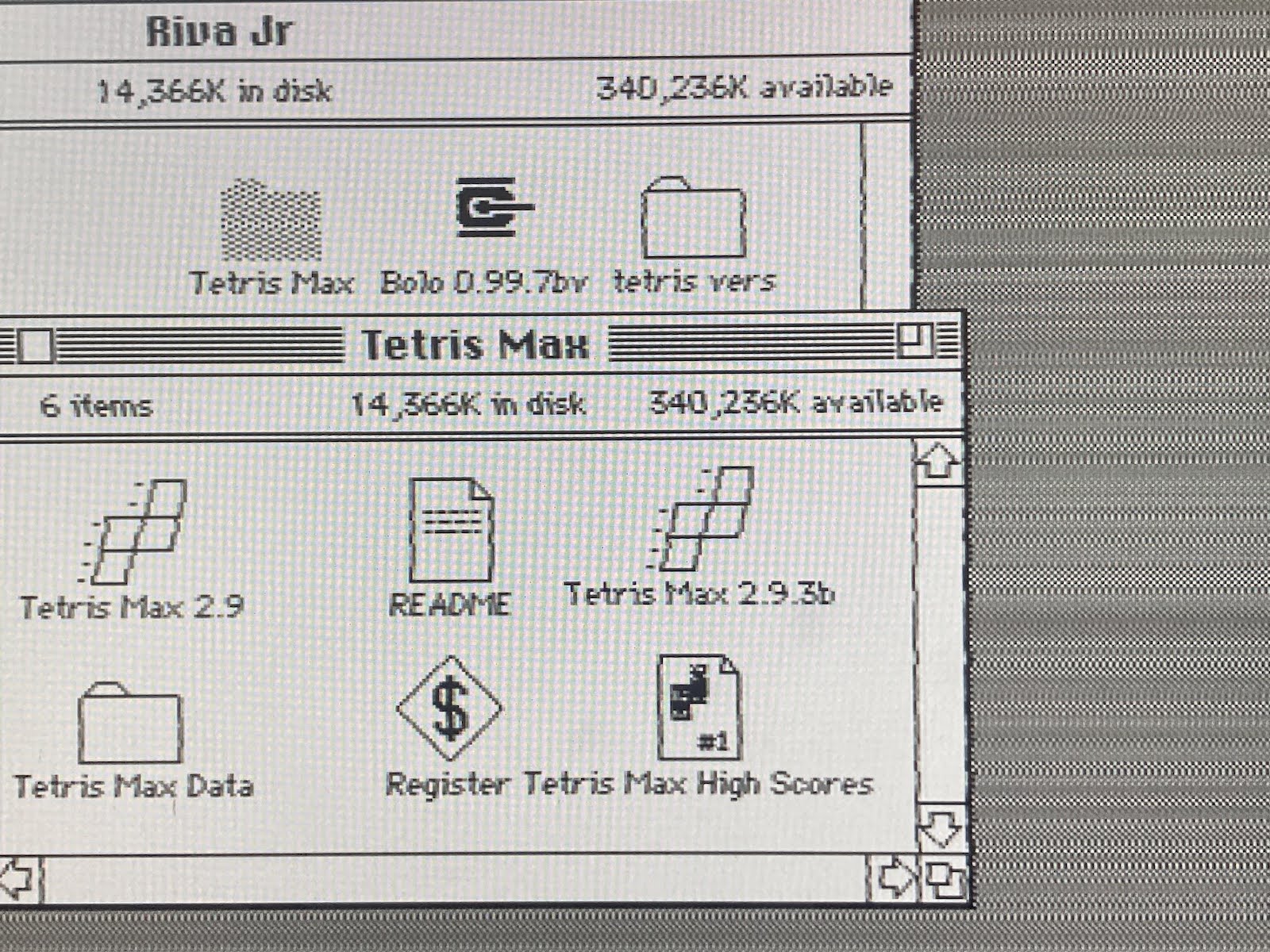
In the late 1980s When Apple released its first Macintosh models supporting external color monitors, the company made some design choices that continue to cause trouble even today. Computers like the Macintosh IIci supported 640 x 480 video resolution, the same resolution as the VGA standard that was common in the PC world, but they used a different physical connector for the monitor cable, a different vertical refresh rate, and a different method of encoding sync information. It’s those sync differences that have proven to be most problematic over the years. Let’s look at what all is required to use my Macintosh IIci with a modern LCD monitor. Grab some coffee and get comfortable, because this will be a long one.
Monitor Connector Comparison
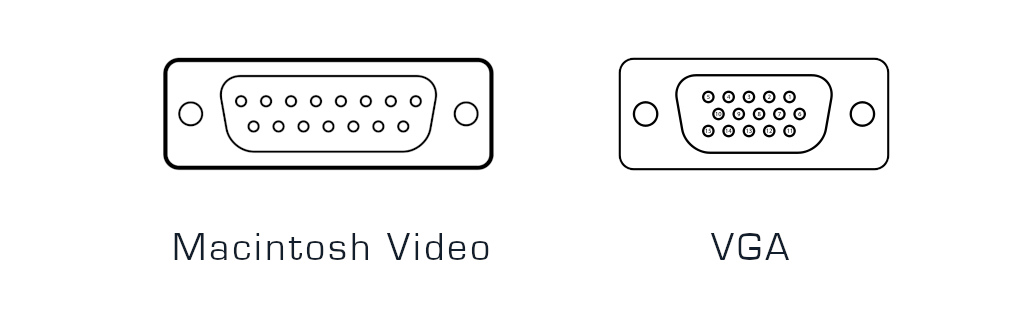
The classic Macintosh video connector is a DB-15, with two rows of pins. The correct name for this is actually DA-15, but nearly everybody calls it DB-15 and we’ll follow that convention. The VGA connector is a DE-15 with three rows of pins. This is sometimes called HD-15 owing to its “high density” arrangement of pins. Despite the physical differences, the video signals on the two connectors are mostly the same: (pinout data from sfiera)
Signal
Mac
VGA
Red video
2
1
Red ground
1
6
Green video
5
2
Green ground
6
7
Blue video
9
3
Blue ground
13
8
HSYNC
15
13
HSYNC ground
14
5
VSYNC
12
14
CSYNC
3
NC
VSYNC/CSYNC ground
11
10
Sense 0
4
NC
Sense 1
7
NC
Sense 2
10
NC
Ground
shell
shell
This difference in physical connectors is fairly easy to solve with an adapter. During the 1990s and 2000s you could find a Mac-to-VGA adapter at any computer store. Today they’re more rare, but still available from surplus electronic suppliers or eBay.
Signals and Sync
A very brief primer on video signal formats: A video signal is composed of a series of lines, organized into frames. The lines are output from the video hardware one by one, at a fixed rate, and the timing of each line is indicated with an HSYNC pulse from the video hardware. After all the lines in a frame have been output, there’s a VSYNC pulse before the start of the next frame. The monitor needs these sync pulses to keep its display operating in lockstep with the video signal.
The 640 x 480 VGA standard uses 60 frames per second – its vertical refresh rate is 60 Hz. But Apple chose a 67 Hz refresh rate for its 640 x 480 video format (actually 66.666666…), which could be argued is slightly better than 60 Hz because the higher rate results in reduced flickering on CRTs. The difference is negligible, however, and the 67 Hz rate only serves to complicate things. Fortunately most modern moderns support a fairly wide range of vertical refresh rates, where a range like 50-75 Hz is common. This means that the 67 Hz refresh rate usually isn’t a problem. If you know of a counter-example, please tell me.
What about those sync signals? In the VGA standard, HSYNC and VSYNC are provided as separate input signals on VGA pins 13 and 14. It’s nice and simple, end of story. But in the classic Macintosh video world, sync is… complicated. There’s a fair amount of misunderstanding and myth about this topic floating around the web, so I’m here to explain the truth. From the table above we can see that the Mac has outputs for HSYNC and VSYNC, but also for CSYNC composite sync (HSYNC xor VSYNC). Many people have also heard about sync on green, where composite sync is mixed directly into the green video channel. So what exactly is the Mac video sync standard? Does it output separate HSYNC and VSYNC, or CSYNC, or sync on green?
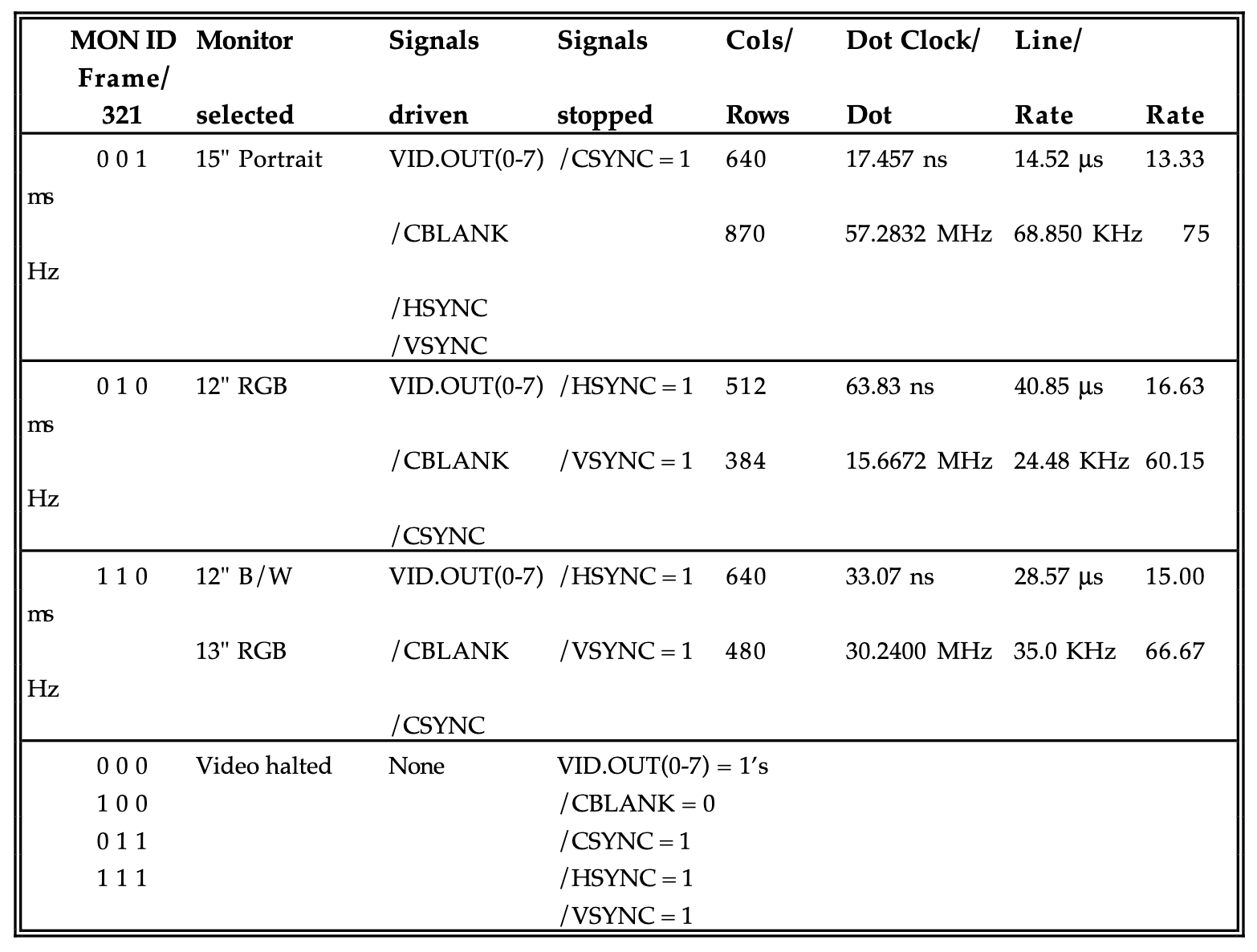
The answer is yes, the Mac generates all of those sync standards at different times, depending on what type of monitor it thinks is connected. But it doesn’t generate all of them all of the time. The video hardware checks the voltages on the connector’s three sense pins, which form a 3-bit monitor ID for the connected monitor type. If it’s a supported monitor type, the video hardware configures itself for an appropriate output signal and sync method. If it’s not a supported monitor type, the video hardware shuts off and outputs nothing.
We can see that four different types of monitors are supported, but two of them share the same monitor ID and signal format. For a 15 inch portrait monitor, the Mac outputs separate HSYNC and VSYNC signals exactly like VGA requires, but at the mostly-useless portrait resolution of 640 x 870. For the 13 inch RGB monitor standard that we’re interested in, with 640 x 480 resolution, HSYNC and VSYNC are stuck high and the sync information is provided via CSYNC.
What about sync on green? Although it’s not mentioned anywhere in the developer note, the Mac also outputs sync on green any time it outputs composite sync. It outputs both CSYNC and sync on green. In fact, it also outputs sync on red and sync on blue too – all three color channels have embedded sync information when composite sync is used. This was recently proven conclusively with a video hardware schematic analysis followed by a series of tests by dougg3 (Doug Brown), who kindly gave me permission to reproduce his oscilloscope captures here.
Doug hotwired his IIci’s monitor connector, grounding pin 4 (sense 0) to produce the monitor ID for 640 x 480 RGB. He made this scope capture showing the Mac’s CSYNC output (yellow trace) and red video signal (cyan trace). On CSYNC you can see the shorter HSYNC pulses and the longer VSYNC pulse combined with the HSYNC pulses during it. On the red channel, you can see some red video data on the left, with the sync info clearly also present in the lower voltage range.
Looking at the green channel also showed the same thing – embedded composite sync in the green video data. Doug then looked at the VSYNC output (cyan trace):
Nothing. VSYNC was just a constant high voltage. Nothing to see here. This confirms the information from the developer note: when CSYNC is output, VSYNC and HSYNC are turned off.
DIP Switch VGA Adapters
Now we know enough to begin peeking inside the common Mac to VGA adapters, with their confusing arrays of DIP switches, to understand how they work. If you’ve been around classic Macintosh computers for a while, you’ve surely seen many variations of these:
Obviously they are physical adapters from DB-15 to HD-15, but what do all those DIP switches do? For nearly all such adapters, the guts are simply a passive switch matrix, controlling how the Mac pins are connected to the VGA pins. There’s no signal processing of any kind. The DIP switches typically perform two functions:
Monitor ID – Configure how the sense pins are connected to ground, or to each other, to set the desired monitor ID. This tells the Mac what kind of video signal to generate.
Sync mapping – VGA VSYNC can optionally be connected to Mac VSYNC. VGA HSYNC can be connected to Mac HSYNC or Mac CSYNC.
They’re pretty simple devices. Maybe you’re wondering why you’d ever want to connect the Mac’s CSYNC to the VGA monitor’s HSYNC. Many newer monitors are able to accept composite sync as an alternative to HSYNC and VSYNC, and if they have that capability, they will normally expect CSYNC on their HSYNC input. Providing a DIP switch mapping for this will enable the Mac to work directly with such monitors.
Note that there are no DIP switch settings related to sync on green. If the monitor supports sync on green, it will use the sync info in the green video channel with no extra configuration needed. If the monitor doesn’t support sync on green, too bad.
The Sad Tale of One Macintosh IIci, Four Monitors, and No Joy
Are you still awake? With all of this background exposition finished, we’re finally ready to tell the story that inspired this whole investigation. It’s the story of my Macintosh IIci, four different monitors, a host of different Mac-to-VGA adapters, and a lot of frustration leading to eventual understanding and the design of a new video adapter.
For several years I’ve been using my Macintosh IIci with the Griffin Mac PnP adapter pictured above and a Dell 2001FP LCD monitor, and it’s worked great. This particular monitor also has a composite video input that works with Apple II and other classic computer hardware, so it’s an excellent tool for computer collectors. As to exactly how the Mac IIci video worked with this monitor, I never gave it any thought. I just plugged it in and got a picture.
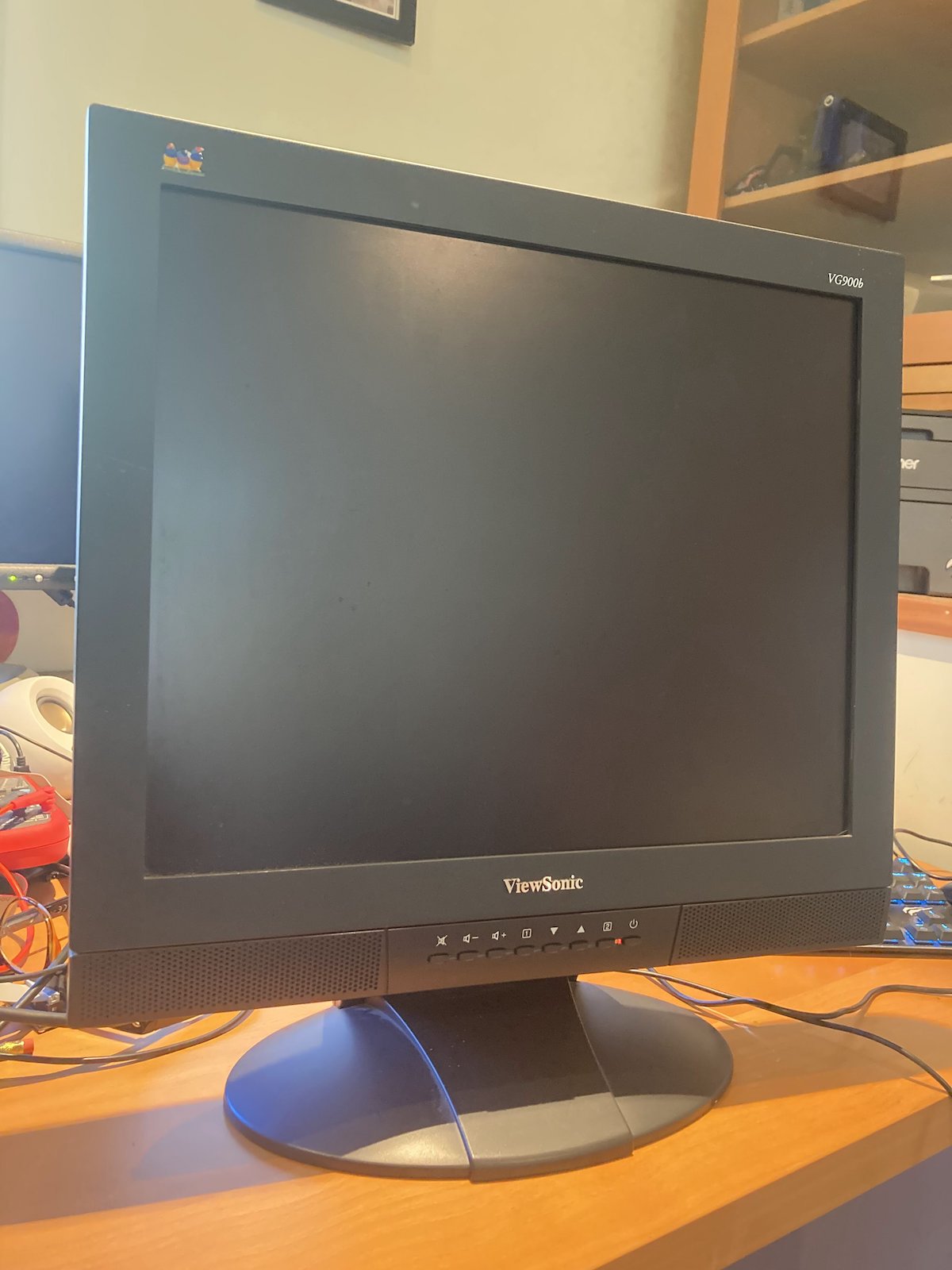
A couple of weeks ago I went on a shopping spree and purchased a ViewSonic VG900b 19-inch LCD, a Viewsonic 6 TX-14H30 14-inch CRT, and an E-Machines ColorPage T16 II 1108DT16MR 16-inch CRT. These are all multisync displays, with a max resolution of 1024 x 768 on the CRTs and 1280 x 1024 on the LCD. But when I connected them to my Mac IIci with the Griffin adapter, I got no picture from any of them. I tried zillions of DIP switch settings, I tried different adapters, but nothing helped. All three of these fussy monitors simply refused to show any image from my IIci. They behaved as if nothing were connected.
Now that we understand the video signals and the inner workings of the DIP switch adapters, we can see the likely reason that nothing worked. In 640 x 480 mode the Mac IIci outputs composite sync and sync on green. My 2001FP must support one or both of those sync standards, but the new monitors probably don’t support them. In the case of the VG900b this was confirmed in the hardware specifications listed in its manual, where it lists support for “H/V Separated (TTL)” video sync. Other Viewsonic LCDs from the same era specifically mention composite sync and sync on green in their specifications, so this isn’t likely just an accidental omission from the documentation. I haven’t been able to find detailed specifications for the two CRT monitors, but I’m guessing it’s the same issue. These monitors require separate HSYNC and VSYNC signals, and won’t support any other sync format.
LM1881 to the Rescue
What do you do when your computer outputs composite sync, but your monitor requires separate HSYNC and VSYNC? Say hello to the Texas Instruments LM1881 Video Sync Separator.
This chip is designed to extract composite sync from composite video, a video standard in which composite sync is mixed with RGB color data. In our case the composite sync is already separated from the color data and doesn’t need to be extracted, but the LM1881 has another feature we can take advantage of: synthesis of a separate VSYNC signal from the composite sync input. Unfortunately the LM1881 doesn’t have a complementary HSYNC output. There are other rarer and more expensive chips that can extract both HSYNC and VSYNC, but I haven’t investigated these.
Fortunately for us, I’ve learned that many (most?) monitors will accept CSYNC as a substitute for HSYNC, so long as a separate VSYNC signal is also provided. So all we really need is VSYNC, and the LM1881 can do the job.
Armed with this information, I set out to build a Mac to VGA adapter with an integrated LM1881 that would enable my Macintosh IIci to work on those three fussy monitors. I would use the LM1881 to extract VSYNC from CSYNC, passing the VSYNC to the VGA monitor, and I would pass CSYNC to HSYNC with my fingers crossed.
I began with a DB-15 breakout. I connected up all the grounds, and grounded pin 4 (sense 0) to request Mac 13 inch 640 x 480 mode. I plugged the breakout into my Macintosh IIci, and connected a logic analyzer to all three sync outputs. CSYNC showed the expected composite sync with a period of 15 ms (66.67 Hz), while HSYNC and VSYNC remained high.
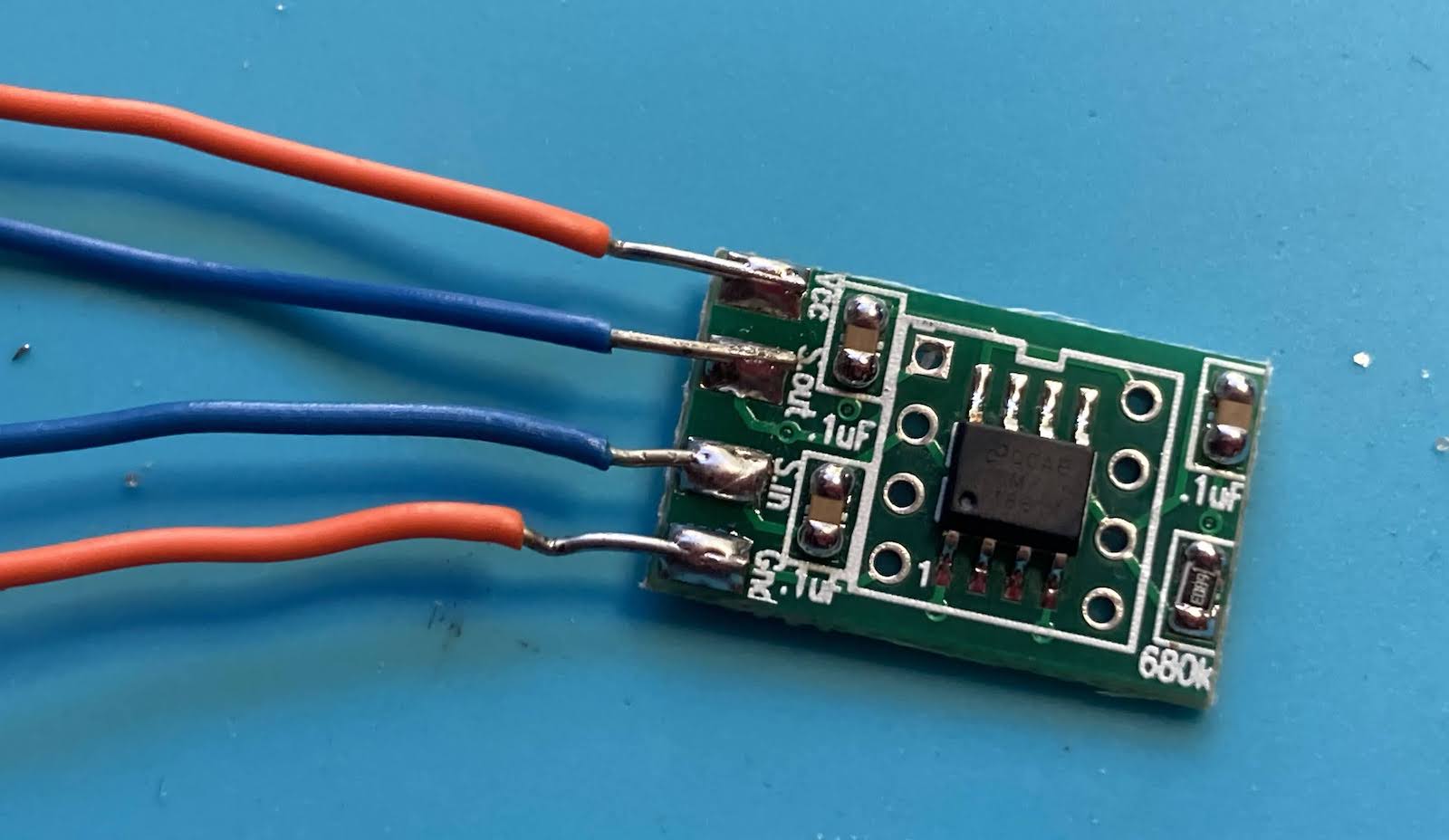
Next I soldered some wires to an LM1881 breakout PCB. The LM1881 requires a 5V supply, which isn’t present on the monitor connector, so I stole 5V from the floppy disk port. Later I intend to try self-powering the LM1881 using the (otherwise unused) VSYNC and HSYNC signals as a power source.
Examining the LM1881 composite sync output, I saw that the output followed the input as expected.
But zooming in, the signals were not quite the same. The LM1881 output lagged the CSYNC input by about 100ns, and included a very short low pulse before going high and low again, for each pulse on the CSYNC input. This might have been an artifact of using a logic analyzer to view the signal, rather than an analog oscilloscope.
Then I soldered another wire to LM1881 pin 3, the synthesized VSYNC output. It worked! But the extracted VSYNC lagged the input VSYNC by a whole line, and extended several lines past the end of the input VSYNC. This was unexpected, but I believe the exact timing and duration of the VSYNC signal isn’t critical, so long as the refresh frequency is correct.
So far, so good. I finished the adapter by adding an HD-15 breakout. I connected the LM1881’s VSYNC output to VGA VSYNC, and LM1881 CSYNC output to VGA HSYNC. Remember, this second connection isn’t really correct – CSYNC is not HSYNC – but we’re relying on the premise that monitors will accept CSYNC on their HSYNC input as long as they also have a separate VSYNC signal. Thanks to the LM1881, we now had that missing VSYNC signal.
Here’s the finished adapter, including the floppy port adapter for stealing 5V: it really is a big mess o’ wires, and something so ugly that only a mother could love it.
I’ve mentioned that I have one monitor that’s worked with my IIci’s built-in video all along: the Dell 2001FP. And three monitors that do not work, no matter what settings I have tried on the VGA adapters: the Viewsonic VG900b LCD, Viewsonic 6 CRT, and E-Machines CRT.
As a sanity check, I tried the Dell first:
It still worked, but the video quality was lousy: there was all kinds of shimmering and noise in the image. Maybe it was a result of my messy nest of wires snaking everywhere? At least there was a usable image.
Next I tried the Viewsonic VG900b LCD. This was the real test, since this monitor had refused to sync with my IIci video before. Would it work now?
Whomp whomp, so sorry. There was no love from the VG900b, which still complained there was no video signal and then went to sleep. That was disappointing. Maybe the VG900b doesn’t like CSYNC as HSYNC substitute, or maybe it’s confused by the CSYNC that’s also still present on the RGB channels.
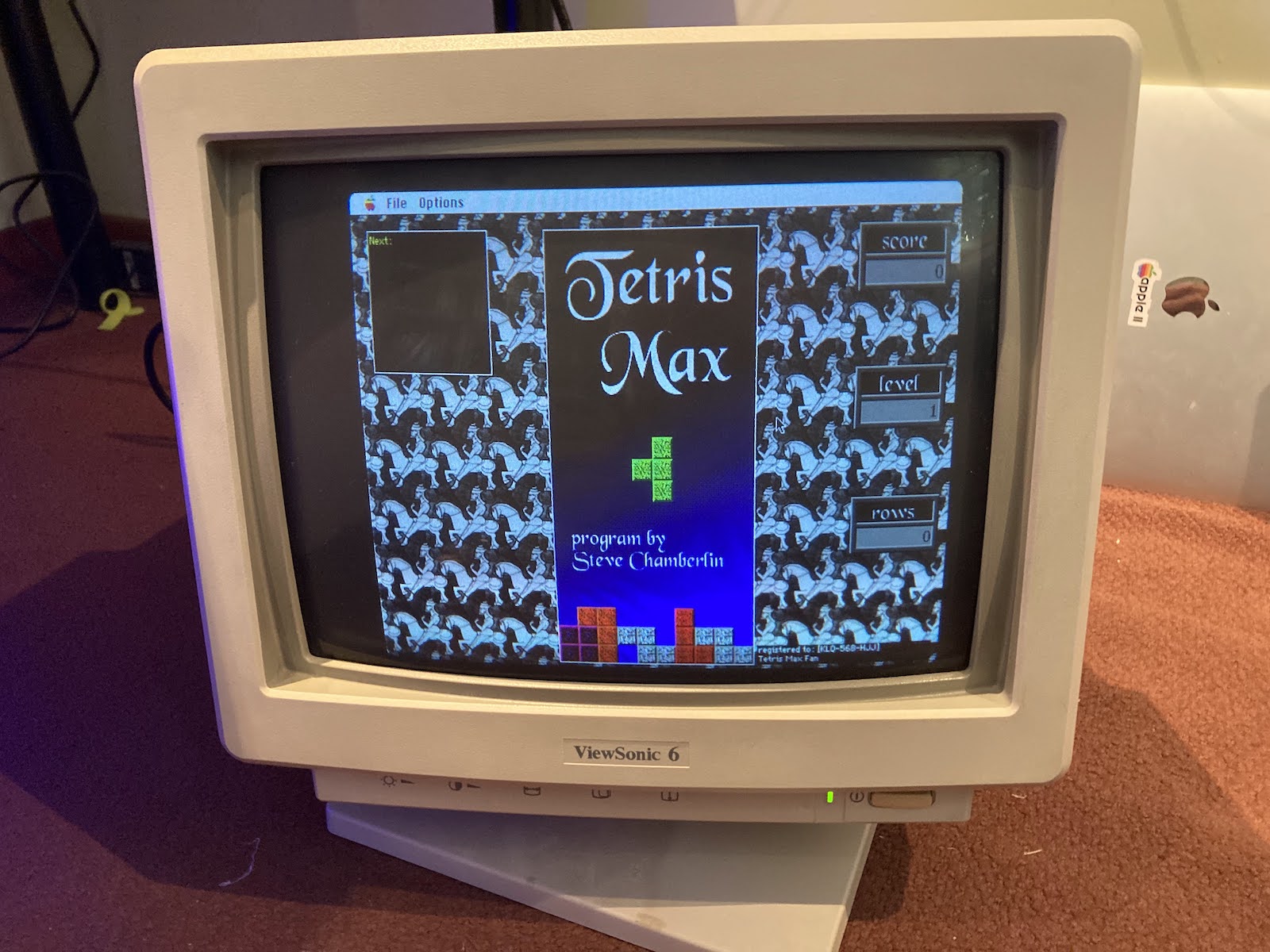
OK, how about this Viewsonic 6 CRT? It never worked with the IIci video before, but how about now?
Success, it worked! The image quality was pretty good too. There was still a little bit of shimmer, but much less than with the Dell 2001FP. I’m not sure why there was such a difference, maybe something about digital versus analog video circuitry?
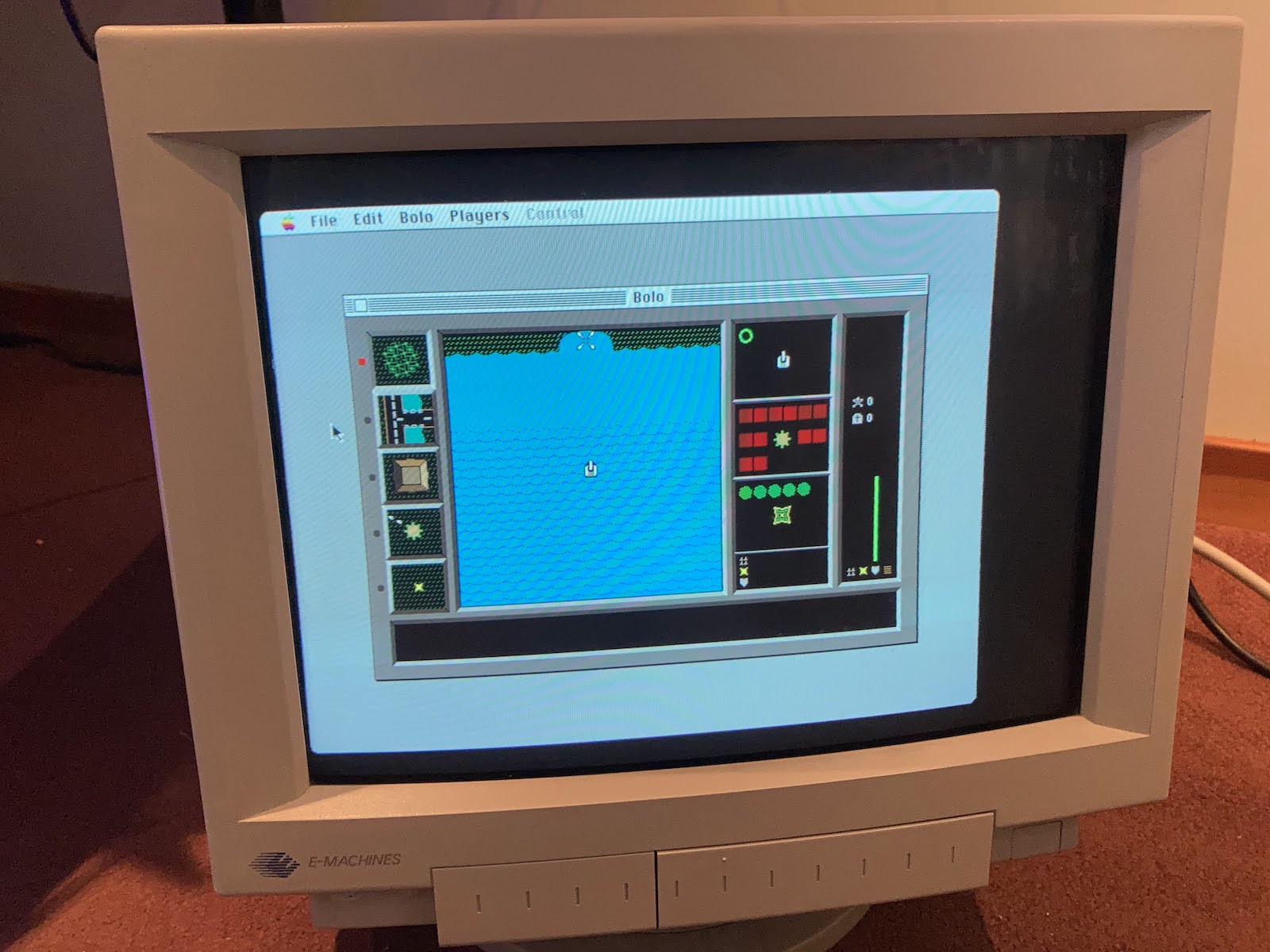
The final test was the E-Machines 16 inch CRT. This was the third member of the fussy trio that had refused to work with my IIci built-in video before:
Huzzah! It also worked (minus some image centering). The image quality was similar to the Viewsonic CRT: some shimmer, but not too bad.
Design of a New Mac-to-VGA Adapter
That’s a score of 2 out of 3 for this Mac-LM1881 adapter. I think that’s useful enough to deserve being made into a proper PCB kit, for other classic Macintosh computer owners who’ve faced the same monitor challenges. Since it’s such a simple circuit, I’ll probably share the whole PCB design for anybody who wants to make their own, and also stock a few in the BMOW store for anybody that wants a pre-built adapater.
To assist with troubleshooting, I’d also like to include some LEDs in the adapter to show which of the Mac sync outputs have activity, and maybe also which of the RGB outputs have activity. I haven’t quite figured out how to do this. The RGB outputs are only 0.7V, and may have negative voltage swings if sync on green is used. The sync outputs are standard TTL levels with 0 to 5V swing. I’ve been brainstorming how to build an “activity detector” circuit to turn on an LED without involving a microcontroller. Maybe something with a flip-flop where the sync signal is used as the clock input, and there’s an RC circuit with appropriate time constant connected to the flip-flop’s asynchronous clear. If you have any great ideas for this, please share them.
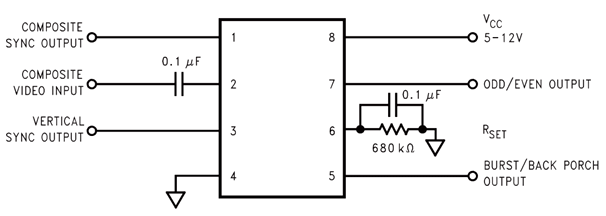
Some questions about the LM1881 remain. I belatedly read the chip’s data sheet only after I’d finished my experimentation, and realized that I may be using it incorrectly, and that many of the similar circuits seen on the web are using it incorrectly. Referring to the canonical LM1881 circuit diagram shown above:
Why didn’t the Viewsonic VG900b work with the LM1881 sync signals? Is there something simple I could do to fix it?
The datasheet says the recommended input voltage on pin 2 is 1.5V and the absolute max is 3V, but I’m feeding it a 5V sync signal from the Mac.
A different RC filtering scheme on input pin 2 may be needed – the 0.1 uF blocking capacitor is just an example. “Typical Applications” in the datasheet shows an alternative design with an RC lowpass filter on pin 2.
The value of the R-set resistor may need to be adjusted, depending on video timing. The default value of 680 kOhm may be inappropriate for this.
The LM1881 output pins can only source a few mA of current, but if I’m putting 5V into a 75 ohm terminated monitor input, won’t that be 67 mA? Do I need to buffer these signals? 67 mA is a pretty large amount of current, and more than even most buffers can provide. Perhaps I’ve misunderstood this. Do I also need a 75 ohm resistor at the source? Does 75 ohm termination even apply to the sync signals, or is that only for the RGB signals?
The investigation continues. More updates soon, I hope!
OTTAWA – Newly-elected Speaker of the House Greg Fergus has moved quickly to correct the errors made by his predecessor by taking the brave step of immediately canceling all planned events in which Canada was to honour former Nazis. “I want all Canadians to know that we have heard you and we are listening!” said […]
HOUSTON—In what many were calling the most exciting day of the whole school year, a group of Texas fifth-graders reportedly spent their science class Wednesday executing real-life inmates. “It was so cool! We each got to put on rubber gloves, strap our guy to the chair, and then inject him with a lethal dose of…
Some time ago, I shared some feedback submitted to the developer documentation team about the removal of the Office cat assistant. I turned it into a reminiscence about Earl the Cat, but let’s return to the most likely Office assistant cat: Links the Cat.
A bug was submitted about Links the Cat complaining that it was “licking itself suggestively”. I don’t know which specific animation the complaint was about, but maybe it was this one, where Links grooms its leg.
I don’t know long it took to investigate, but the bug was eventually resolved as “By Design” with the comment, “My cat does this.”
This post was written by Alison Green and published on Ask a Manager.
A reader writes:
My coworker, Craig (mid-40s, male), chronically interrupts discussions in meetings, ostensibly to “help” me (mid-50s, female) by explaining obvious things.
Typical example: Other Coworker is proposing a plan to use to our advantage a quirk in the way our state categorizes, say, UFO sightings. I’m well aware of this quirk, because I developed our company’s internal UFO tracking documents. In the midst of this perfectly clear discussion, Craig interjects, “Hold up, let’s make sure everybody’s following. Jane might be a little lost. Jane, do you know what ‘UFO’ stands for?” As usual, I assure Craig that I’m thoroughly versed in this subject. … and yet he ignores me and proceeds to deliver Today’s Rudimentary Lesson on the Thing We All Already Know.
Craig and I are both in senior roles, with different specialties in which we’re competent and qualified. I have all the customary degrees and licenses, and have been in the industry several years longer than Craig, while he’s been at this company a few years longer (and has been talking to me as if I’m brand new ever since I was actually new, more than eight years ago.)
Craig has a reputation for dismissive and contentious behavior toward other female coworkers, so my read is that his interruptions are intended to keep getting the idea into colleagues’ heads that I’m lacking basic understanding of our work, while simultaneously demonstrating that he’s the expert who can translate complicated things into one-syllable bite-sized pieces for the edification of the tiny-brained. I find this sad and tiring, and my coworkers’ reactions suggest they’re also super annoyed.
What’s the best way to address this next time it happens? I’ve already tried many variations of “Yes, I do know all about that. Please let Other Coworker continue” — yet it never staves off the remedial lecture.
It would be a difficult and perhaps too trivial thing to take to HR: it would sound like I’m complaining about Craig for trying to be helpful, or he would spin it that way.
Of course, it would be fun to start preemptively interrupting meetings myself to explain wildly basic stuff for Craig’s benefit, but is there some more professional response that would stop this “help” once and for all?
Craig is an ass.
And wow, he is an unusually flagrant ass. He’s stopping meetings to provide remedial lectures to you, in front of people who are all well aware that of course you don’t need them? He’s obtained a special level of dickishness that we don’t normally see.
A couple of options:
First, when Craig interrupts a meeting to “explain” a basic comment to you, choose from the following menu in the moment:
* “Are you really explaining what UFO stands for? How could I not be aware of that?”
* “What a bizarre thing to halt a meeting for. Obviously I’m aware of what a UFO is.”
* “Obviously all of us here are well aware of that.”
* “I can’t figure out why you thought I would need that explained!”
* “Why are you explaining that to me?”
These are all more irritable-sounding than what I normally recommend, but that’s because Craig’s behavior is so outrageously over the top. It’s appropriate for him to hear how utterly ridiculous he’s being; he should receive a clearly frustrated, somewhat baffled response. It’s also fine for others at the meeting to see that you’re aggravated — what he’s doing is aggravating, and your similarly annoyed coworkers will probably be grateful that someone is calling it out.
In addition to or in place of that, you could also talk to Craig one-on-one and say, “It’s really weird that you keep pausing meetings to explain rudimentary concepts to me. Stop doing that.” If he argues or tells you that you’re misinterpreting, say, “The upshot is you need to stop.” Do not be wishy-washy here or soften the message; Craig is relying on people women not to bluntly call him out; show him that you will.
For what it’s worth, I don’t agree that this isn’t worth escalating (maybe not to HR, but possibly to Craig’s boss). The message isn’t “Craig is being too helpful.” The message is, “Craig has a pattern of undermining and questioning women’s knowledge and expertise.”
STANFORD, CA—Offering a concise explanation for the complex interaction of economic forces that gave rise to the widespread enslavement of Africans, a Black conservative scholar argued Wednesday that the transatlantic slave trade was the result of fatherlessness in the Black community. “The lack of strong role models…
Welcome to a new school year. In the coming days, a cohort of cadets will begin arriving on campus, and I look forward to continuing our centuries-long tradition of preparing students to explore strange new worlds, seek out new life and new civilizations, and boldly go where no one has gone before.
There was much positive news for the Academy over the summer break. In the newest QS rankings, we improved by two positions and are now in a three-way tie for sixty-third in the Alpha Quadrant with the Pakled Institute of Technology and Cornell. We also broke ground on the construction of a new dormitory and satellite campus to serve students in the growing Borg Collective market, thanks to the generosity of a record number of anonymous donors.
But despite living in a post-scarcity utopia, in which all of our material needs are satisfied by replicators and the infinite energy supplied by dilithium reactors, recent increases in the price of antimatter, declining domestic enrollments, and intensifying competition for intergalactic students mean that we are facing some tough economic headwinds. Last year, we forecasted student growth of over 50 percent, but in hindsight this was optimistic. The expected influx of students from the Gamma Quadrant never materialized, as tensions rose between the Federation and the Dominion, and young people are taking advantage of the tight labor market by becoming plumbers or joining the Maquis rebellion.
We now face a budget shortfall of forty-five million bars of gold-pressed latinum this year, and we will need to make some difficult choices as we embark on a new mission: to return the Academy to financial sustainability.
I have been working closely with members of senior leadership and consultants from Ferenginar to identify opportunities for positive transformation, and we’ve developed an action plan, which we will be progressing with the utmost urgency and transparency over the next month.
Under the action plan:
Due to falling enrollments, we can no longer offer courses in Romulan, Klingon, or Vulcan. Staff teaching in these languages and Classical Greek will be let go, and resources reallocated to more profitable subjects, because the needs of the many outweigh the needs of the few, or in the case of Greek, the one. (Sorry, Leonard.)
The Departments of Intergalactic Diplomacy, Xenobiology, Space Exploration, and other areas now secondary to our core mission will be placed under review.
We can no longer provide staff with Transporter Accident Insurance, including Heisenberg compensation.
The annual end-of-year celebration for staff will now be a potluck.
But it’s not all bad news. Our plan also calls for:
A new look for the 25th century: We are retiring the traditional “delta” and adopting a sleek logo that reflects who we are today: “Starfleet Academy.” in bold Helvetica. (Don’t forget the period!)
Better tools for teaching: The LMS will be updated to the newest version of Canvas, which uses advanced warp field coils to alter the local space-time manifold, letting you finish grading your students’ essays on time. (We’ve also reorganized the staff intranet again. Good luck.)
Better work-life balance: Last year’s pilot project to improve staff well-being will be expanded, allowing all faculty the option to use the transporters to create twins to share teaching and administration duties. TAs can be duplicated as needed.
Recognizing staff excellence: All Emergency Medical Holograms activated to teach pre-med courses last year will be promoted to the new rank of “Visiting Assistant Ensign.”
Reaching new students and fostering diversity: The Federation Council has approved exemptions to the Prime Directive, which will allow students from pre-warp civilizations to take courses with us for the first time. We will offer new revenue-generating micro-credentials in subjects popular with non-spacefaring species, such as deflector shield engineering and photon torpedo design, regardless of the risks to their societies or possible disruptions to their species’ natural paths of evolution.
We are entering a time of many challenges, but through our efforts and sacrifices, I am confident we will live long and prosper. Feedback on the action plan will be accepted on the staff intranet until this Thursday.
This post was written by Alison Green and published on Ask a Manager.
A reader writes:
I work in a fairly specialized field in the nonprofit sector, but one which sometimes features in the news and which many people not in the industry therefore take a passing interest in (think something like promoting women’s soccer). My field is not one which has a fixed route to get into, such as needing to go to law or medical school. But there are no entry-level roles — you have to have relevant skills and experiences gained elsewhere. To take the women’s soccer example: some people have previously been women’s soccer players; some have extensive experience organizing amateur soccer teams or volunteering with girls’ soccer charities; some have specialized skills and qualifications like being a sports physical therapist; and some have previously worked in different-but-adjacent nonprofit sectors.
Which brings me to my current situation. A close friend keeps asking me to get him a job in the industry, but he has absolutely no relevant knowledge, skills, or experience. He is one of those who will read and be interested in news articles when they appear, but beyond that really does not know much. When he first asked, I assumed he was joking, and that it was just a nice way of telling me my job sounded interesting. But then he kept asking, over and over again. This has gone on for … a long time.
When I point out that he knows nothing about women’s soccer and has no experience of nonprofit work (or anything which that entails such as project and grant management), he says that he can learn that on the job. When I point out that there are no entry-level roles and that nobody would hire somebody with no relevant background just because the applicant thinks they can learn the required skills on the job, he says I could recommend him.
One thing making this stranger is that he already has a successful career in his (totally different) field, in the private sector. I have suggested that if he really does want to work in my industry, he could transition to nonprofit work in his current field (there are a lot of opportunities to do so), then after a few years use that experience to try and move into mine. When I suggest that, he asks why I can’t just get him a job.
I will soon be moving to a new role, and he has now started asking if he can have my current job when I leave it. Aside from the fact that I won’t be the hiring manager, the answer is unsurprisingly no. But he is continuously asking and getting annoyed and frustrated when I keep saying no.
I’m not sure if this stems from a genuine naïveté about how people get jobs (he basically fell into his current field and then just stayed with it, so maybe he thinks that is the case for every job) or if he’s just trying to be an opportunist because he thinks my industry pays more, or a mix of both. Is there any way to shut his questioning down once and for all?
I think your error may be that you’re still trying to reason him into understanding why you’re not going to find him a job. That made sense in the beginning, when it was reasonable to assume he just didn’t understand how hiring in your industry works, but at this point you’re throwing good effort after bad in trying to logic him into understanding.
Instead, you probably need to just be blunt: “Dude, no. I’ve already explained that isn’t how my field works. There is zero chance I could do what you’re asking. Stop asking!”
If he keeps asking after that and since he’s a close friend: “It’s really frustrating that you keep asking this after I’ve told you it’s impossible. I’m calling a permanent ban on the subject so it doesn’t start affecting our friendship.”
Frankly, it might be worth adding that his certainty that he could step right into your field with no qualifications is pretty insulting to you: he’s devaluing your work, whether he intends to or not. (He’s also making himself look pretty delusional at the same time, which is a weird — although strangely common — combination.)
This post was written by Alison Green and published on Ask a Manager.
It’s five answers to five questions. Here we go…
1. My boss never apologizes for being late
My manager is always late. Always. Especially in the mornings. She’s acknowledged that it’s a problem and that she’s working on it, but it keeps happening. She’s even off-handedly said she thinks she should be put on a PIP because of her tardiness.
However, she rarely apologizes for it! She’ll send a message a couple minutes before a 9am meeting saying “Good morning! Let’s push to 9:15am” and then still not walk in the office or join the virtual call until 9:30 or later. She never offers an explanation in the moment, but often later in the day she’ll admit that she was having stomach issues, or her dog was sick, or something. I don’t need the explanation. I don’t care. She’s my boss and can do what she wants. But it grates on me that she can’t just apologize for the inconvenience and disruption.
Sometimes, when it’s meetings outside our immediate team, not only does she come in late, but she also grinds the meeting to a halt by asking us to review everything that had already been said and asking several questions on it, preventing us from getting through the whole meeting agenda.
I know it’s popular to tell women in particular not to apologize when it’s not warranted. I get that! I’m all for it! But we are a small team of all women. We are all on good terms with one another and respect each other. But! The regular tardiness with no regard for the other people on the team is frustrating to me. A quick acknowledgment with an apology would mean the world to me. Am I putting too much into this? How should I handle the frustration?
I think this is in the category of “frustrating, but nothing you can do about it.”
Yes, she should be apologizing. When you throw off someone else’s schedule or delay a meeting, it’s just good manners to apologize. But you can’t really ask your manager to apologize; it’ll come across as focused on the wrong thing. You could ask for something else more logistical, like if for more advance notice if she needs to delay a meeting or to talk about how to avoid repeating the whole agenda when she’s late (for example, should the meeting not start until she’s there?). But if it’s really just the non-apology that’s grating on you, all you can do is accept that this is how she is and try to let it roll off you.
2. My employee announces her time off rather than requesting it
I have an employee who has told me when she is taking time off. I think she should have put in a request for the time off. She also texts the same day as her doctor appointment to tell me that she’ll be in around noon because the provider is running late; however, I had no knowledge that she had a doctor’s appointment on that day. Not that her appointments are my business, but when your scheduled start time is an hour after your scheduled appointment, I feel as though fair warning should have been given. She always seems to want to have the last word as well, when it will not have any effect on the outcome of the situation. Am I being too picky?
Different offices do it differently: in some offices the culture is very much to simply let your manager know when you’re taking time off, and they’ll let you know if it’s a problem. Other offices expect people to get approval first. But unless you oversee jobs with a heavy coverage component (where you need to ensure coverage as part of approving any time-off request), I’m a strong believer in the first system; to the extent that people’s work allows it, treat them as adults who can manage their own schedules while keeping you in the loop, unless and until that becomes a problem. But if you have good reason for wanting her to request the time first — and it’s not just the principle of it — have you clearly told her you want her to do it that way? If you’ve explained that and she’s ignoring you, that’s a problem. But if you haven’t, then just be direct about what you want her to do differently.
The same applies when she’ll be late because of a doctor’s appointment. Tell her clearly that you want to know in advance when she’s likely to be late. If you’ve already done that, remind her of the policy and ask why she’s not following it.
Wanting to have the last word is a completely different issue (and you lumping them together makes me wonder if there are other problems with this employee too; sometimes when there are a bunch of problems, it gets harder to parse each one out individually). That’s something you can and should give direct feedback on (explaining that it’s disruptive, harming her relationships with coworkers, coming across as adversarial, or whatever the case may be).
I’ve been hearing something my whole life from a really wide range of places: that skilled professionals generally know other, similar skilled professionals, and if they can’t help you, they can probably refer you to someone who can.
I’ve been in the workforce for 11 years, and I do not have this network of similarly skilled professionals. I honestly don’t even know how to get one. I have met two or three people who could potentially do my type of work whom I might trust with a referral, but they have other interests and probably wouldn’t accept.
I do mostly employee onboarding, which is a mix of HR and admin responsibilities. Since I’m the only person most of the people in my life know with any kind of connection to HR, I get a lot of questions from my friends and family about resumes, cover letters, career path options, and how to handle problems at work. I think these people might be looking for that referral to someone with more experience than me (or would benefit from expertise I don’t have), but I just don’t have that network.
Maybe this has to do with my background. I’m the first person in three generations to get a bachelor’s degree in my family. So maybe other people’s parents are connecting them with this network? But my friends from school didn’t end up in similar work to mine either. I have an English degree, so maybe that’s different if you go into a field with a more defined career path, like chemistry or computer science?
Is it true that most professionals have a network like this? And if so, how can I get one?
Usually the type of professional network you’re describing comes from working with other people who are doing similar or adjacent work. Over time, you build up a group of people you’ve worked with, either coworkers or people in other companies who your work brings you into contact with. It’s not typically a network that comes from your parents (unless your parents are in your same field, but that’s not the case for most people); it’s one that comes directly from the people you work with over the years.
If your employers have been big enough to have someone dedicated solely to onboarding, I’m guessing you’ve worked with a fair number of other HR people — not ones necessarily doing exactly what you do, but doing other pieces of HR. This is where building relationships at work comes in — talking to coworkers, grabbing the occasional coffee with them, bouncing ideas off each other, and so forth. Those are all people who should become part of your network, even after you or they move on to other jobs. So I wonder if (a) you’re keeping to yourself at work and not building those relationships (in which case your network would definitely suffer for it) or (b) you’re just not defining “network” this way and thus don’t see that you already have one.
People who don’t have that kind of built-in potential network at work (usually because their jobs are very siloed) often go to conferences and other industry events to build it, or they might find industry communities online.
All that said, I don’t think the friends and family who ask you about HR stuff are looking for a referral to someone with more experience than you. It’s more likely that they just lump all HR people into one broad HR category and don’t realize that at large companies the work can be split into lots of separate functions — and you can have a compliance person who knows nothing about resumes, a benefits person who has no particular expertise in the interpersonal bits of HR, and so on.
4. Which internship should I choose?
I’ve been fortunate to secure interviews for two different internship opportunities, and I’m at a crossroads in making a decision.
The first option is with a relatively young but highly promising company. If I join, I would be the youngest employee on the team. The company is incredibly growth-oriented, and there are many young leaders, which I find appealing. However, the downside is that it’s entirely remote.
The second option is with a more established and older company, located locally. This internship would be a hybrid role, with some in-office work. They have a structured internship program in place, which is a positive aspect. However, there’s no guarantee of employment after the internship program concludes.
Currently, I’m leaning towards the fully remote internship due to its growth potential and the opportunity to work with a young and dynamic team. However, I’m also aware of the benefits of the local internship with a more established company. I would greatly appreciate your advice on this matter.
Absent any other information, I’d recommend the second one. Especially when you’re early-career, a ton of learning happens simply by being around more experienced colleagues in person, and it’s much, much harder to get those same benefits if you’re fully remote. I’m all for remote work when it makes sense for your job and career stage, but one of the most valuable things about internships is all the learning that happens by osmosis — by being in an office and overhearing calls and conversations, watching your coworkers do their own jobs, and generally just learning how to be in an office. As an intern, that stuff is often, or even usually, more important than the actual work tasks you’re doing.
I also think you might be overestimating the benefits of a young team. There are a ton of advantages to working with a more established company and more experienced colleagues; in many cases (although not all) you’ll find things are more organized (and thus you’ll be better positioned to get meaningful experience) and your coworkers have more expertise for you to learn from. That’s not to say there aren’t advantages to the opposite — there can be. But between these two options, the non-remote internship sounds a lot more useful.
5. Boss makes me turn around to see her while we’re eating
My coworker and I take lunch together each day, at the communal table in our break room. We sit directly across from each other, me with my back to the break room door, with my coworker facing it. Each day, our supervisor comes into the break area to chat with both of us but always stays at the door, behind me. She never walks all the way to be in an area where my coworker and I can both see her. This makes it so that for me to view her, I would have to spin my chair at least 90 degrees, no longer facing my food or my coworker who I’m eating with. Additionally, her interruption always starts as small talk but then inevitably turns into a work conversation between her and my coworker.
If you haven’t already guessed, this drives me crazy. Am I wrong for not turning around? Am I being irrational for thinking the least she could do is walk to the center of us if she is going to interrupt our lunch?? Argh!!!
I don’t think you’re irrational for being annoyed, but it does sound a little irrational that you don’t just switch up where you’re sitting, since you know it’s going to happen! I wonder if you’re digging in your heels on that a bit since you don’t think she should be interrupting your lunch in the first place — but that’s just keeping you mired in the annoying thing.
It’s also probably not even registering to your boss. Any reason not to say, “Would you come further inside so I don’t have to crane my neck to see you?” A few days of saying it might solve the problem.
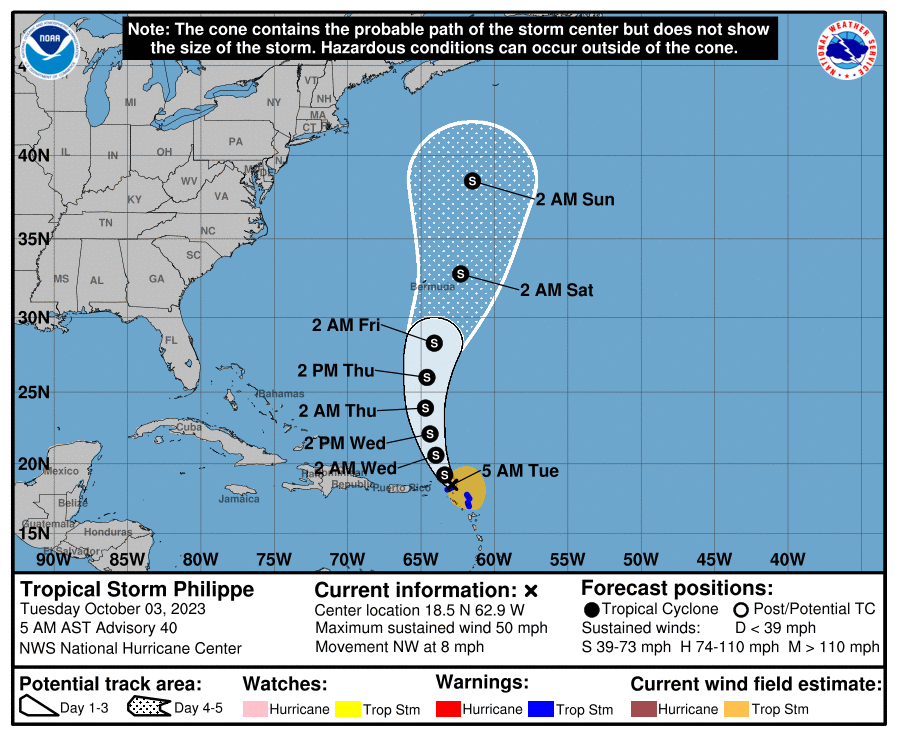
Philippe is dumping rain in the northern Lesser Anilles today before it heads out of town, leaving behind a quieter picture in the tropics.
Philippe impacting Anguilla, Antigua, and Barbuda with heavy rain & wind
Tropical Storm Philippe is moving north of the Leeward Islands this morning, but the worst of the weather really just arrived there overnight.
An extremely lopsided Tropical Storm Philippe is bringing very heavy rain and gusty winds to the northern half of the Lesser Antilles this morning. (Weathernerds.org)
Philippe is terribly organized, with its center displaced well north of all the thunderstorms. This is what will continue depositing several inches of rain on the Leeward Islands through tonight. Philippe will lift northwest and eventually north, albeit slowly over the next two days, before conditions begin to improve in the islands. Anywhere from 3 to 8 inches of rain will be possible when all is said and done particularly between Barbuda and Dominica. Flash flooding is certainly possible. The Virgin Islands should see closer to 1 to 3 inches of rain, with even a bit less in Puerto Rico.
From here, Philippe should head out to sea, passing close but east of Bermuda, where it has a puncher’s chance to become the season’s seventh hurricane. There is a slight chance it could bring some modest impacts to portions of Atlantic Canada next week, but that’s still a bit of a ways out to get too specific. It’s probably worth monitoring at least.
Beyond Philippe: Pacific action & low-level noise in the Atlantic
Outside of Philippe, the Atlantic looks quiet for the next 5 to 7 days before perhaps we’ll watch the southern Gulf or northwest Caribbean for signs of life. There’s nothing specific to focus in on right now, just a general low-level hum of static within the models. Often that’s a precursor to something, but not always. We’ll keep tuning in to see if we can decipher things.
In the Pacific, Tropical Storm Lidia has formed. The track forecast has gotten a little better together since yesterday (when it was Invest 98E). It now appears that Lidia is most likely to turn west into the open Pacific rather than impact land.
Tropical Storm Lidia is expected to become a hurricane and now appears likely to turn west into the open Pacific. (Tomer Burg)
Another system may develop closer to Mexico later this week or weekend as it gradually tracks west as well.
U.S Weather Notes: Texas rain & severe storms in the Plains; chilly weekend!
The severe weather risk today is highest in the central Plains today. The Storm Prediction Center bumped up today’s risk to enhanced (level 3 of 5) in portions of Oklahoma, Kansas, and Nebraska.
Today’s severe weather risk is highest in Kansas, where all forms of severe weather will be possible late today into tonight. (NOAA)
Hail seems to be the biggest risk today, with some golf ball to hen egg size hail possible in the strongest storms. Tornadoes are possible with a few storms, and there should also be a fairly broad damaging wind threat.
We’ll continue to see pockets of heavy rain in Texas over the next few days which keeps the risk of localized flooding in play. That said, the dryness of the last few months will certainly mitigate any real serious flooding concerns in most of the state. We mentioned the heavy rain chances near Houston today. The Dallas area will probably get involved in some of this heavier rain tomorrow and tomorrow night.
The heaviest rain over the next few days will fall on the east side of the DFW Metroplex into eastern Oklahoma and western Arkansas. Isolated heavy rainfall is possible south into the Brazos Valley and Houston areas. (NOAA)
The first real cool air mass of the season continues to look likely for late this week and weekend, bringing at least a slight chance of frost or a freeze to parts of the northern Plains Friday or Saturday.
Morning lows on Saturday should be near or below freezing across portions of the Plains, leading to areas of frost or a freeze. (Pivotal Weather)
Low pressure will spin up along the front somewhere between Lake Erie and Quebec which will enhance rain over portions of Upstate New York or New England this weekend. As much as 3 or 4 inches of rain is possible for portions of Maine and New Hampshire, particularly in the White Mountains. We’ll have to keep an eye on this area for localized flooding this weekend.
We’ll leave you with a scene from Brighton Resort in Utah yesterday. A taste of winter.
Good morning. Houston will see a significant pattern change over the next few days, as a weakening ridge of high pressure allows for the influx of tropical moisture that will increase cloud cover and rain chances. This should bring cooler weather—some areas may have seen their last 90-degree days for awhile—and some much needed rainfall.
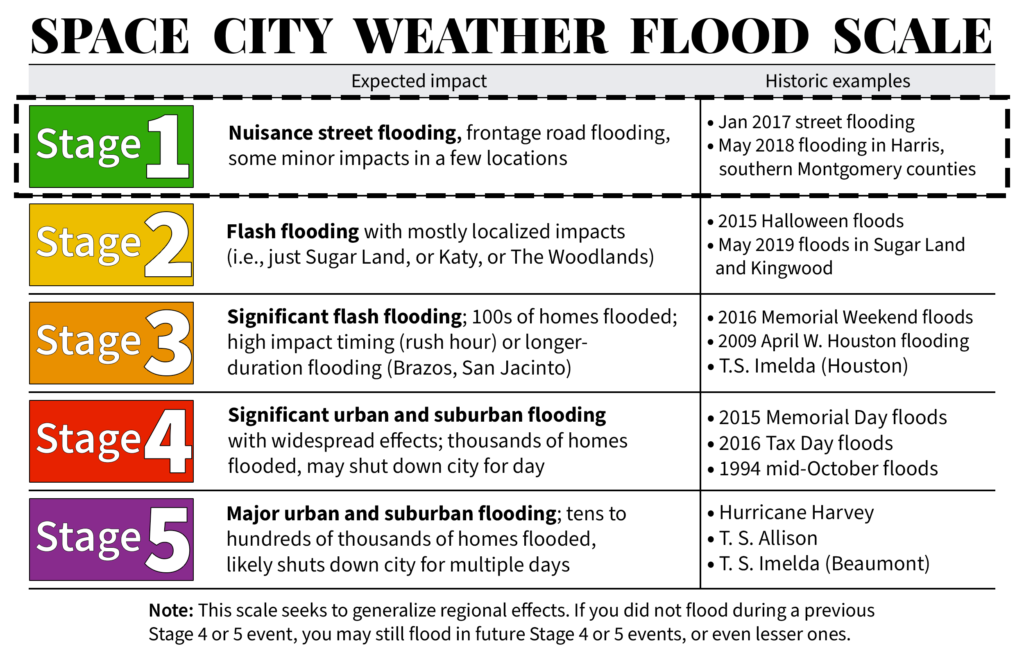
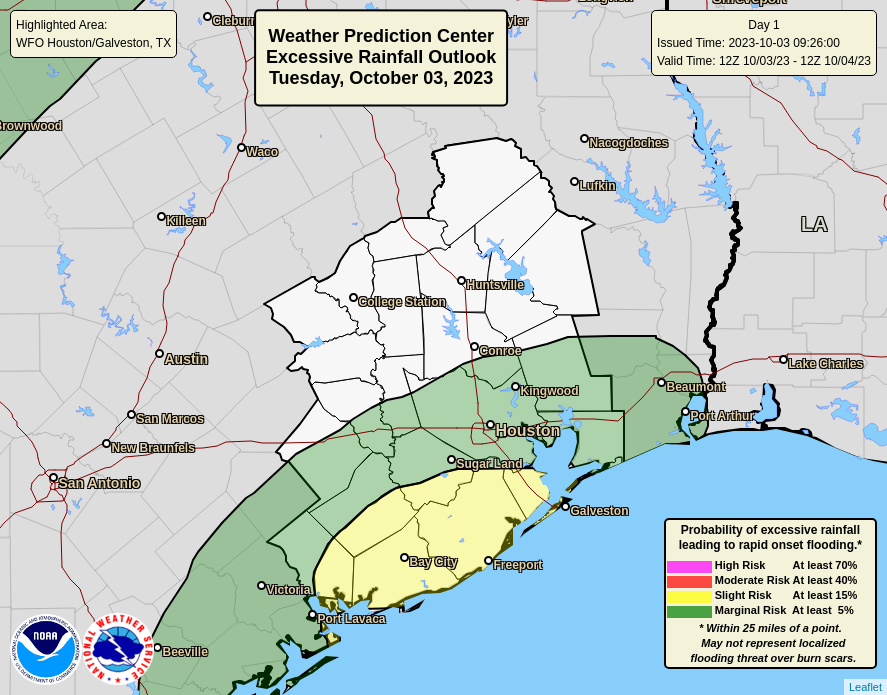
Given the tropical nature of this rainfall, some locations may see in excess of 4 inches, and this could lead to street flooding. For that reason, we are instituting a Stage 1 flood alert for areas south of Interstate 10 through Thursday. As usual in Houston, rainfall totals will be highly variable from location to location. So while you may not see heavy rainfall at your house, a neighborhood a few miles away may well be. A Stage 1 flood alert simply means that you should be aware of the potential for street flooding, not to expect widespread mayhem.
The overall pattern will also favor heavy rainfall across other parts of the state this week, including the Dallas-Fort Worth metroplex later on Wednesday and Wednesday night. Matt will be covering the threat of rains and flooding across other parts of Texas, including San Antonio and Austin, on The Eyewall this morning.
Tuesday
We’re starting to see showers move in from the coast this morning, and most of the area has about a 60 percent chance of rainfall today. The threat of heavy rainfall is higher closer to the coast and source of moisture, which is why we’ve put in a State 1 flood alert for areas south of Interstate 10. Highs today will be dependent on local cloud cover and rainfall amounts, but I suspect that much of the area south of I-10 will top out in the upper 80s, while areas further inland have the potential to reach the lower 90s. Rain chances will slacken some on Tuesday night, but not go away entirely.
There is a slight risk of excessive rainfall south of Interstate 10 today. (NOAA)
Wednesday and Thursday
The region will remain in a favorable environment for rain showers on Wednesday and Thursday, with plenty of atmospheric moisture to work with and an unstable environment. Showers may be especially pronounced on Thursday afternoon or evening as a cold front pushes down into the area and slows down. In any case, we’ll continue to see the threat of some street flooding in areas where the heavier rains setup. Rain accumulations will likely vary between 1 and 5 inches across the region this week, with the highest totals to the southwest of Houston. Highs will probably top out in the upper 80s with partly to mostly cloudy skies for most areas.
Friday
The front will push into the area later on Thursday and Thursday night, but we’re not going to feel its effects right away. However, with mostly cloudy skies on Friday, I do think highs will top out in the mid-80s. Some decent rain chances will remain on Friday as drier air will lag behind the front’s passage somewhat. Lows on Friday night will drop into the upper 60s.
Saturday and Sunday
The drier air you’re all waiting for should finally start to arrive with a reinforcing front on Friday night into Saturday morning. Some rain showers will linger on Saturday, and skies will likely remain mostly cloudy throughout the day. Would you believe me if I said highs may top out in the upper 70s? Well, I think that’s possible. Moreover, most of the area inland of Interstate 10 probably will drop into the upper 50s on Saturday night. Sunday looks to be the pick of the litter, in terms of weather, with highs in the mid-70s and partly to mostly sunny skies. No kidding. Lows on Sunday night will be modestly chilly again.
Check out that low temperature forecast for Monday morning. (Weather Bell)
Next week
By Monday or Tuesday of next week our weather should be back into the 80s, with increasing humidity. But I don’t think we’re going back into full-on summer, and there are some hints of another front by around next weekend. That’s not something I’m fully confident in, however.
This post was written by Alison Green and published on Ask a Manager.
It’s five answers to five questions. Here we go…
1. Company says they’ll sue if you lie on your resume
Here’s an unusual line that I found in a job description: “Any candidate who misrepresents their identity and/or skills may be subject to civil damages, penalties, and criminal prosecution.”
Have you ever heard of a company suing a candidate for “misrepresenting” his or her “identity and/or skills,” or trying to get a prosecutor to file charges? What would the charges even be — fraud?
From the candidate’s side, I am struggling to imagine an employment attorney taking the case if I were to reach out and say that some company lied to me when they were interviewing me or offering me a job.
Theoretically you could be charged with fraud or other crimes, depending on the specific lies. In practice, it’s very, very unlikely that you’d be sued — successfully or otherwise — for lying on your resume, unless the lie created legal issues for your employer, like if you lied about your medical credentials and your employer was sued due to your mistakes. There are some other subcategories of criminality here too, like lying about military service or lying when you’re applying for a job with the government. But those are serious lies, not just inflating your expertise with Excel or claiming your conflict resolution skills are better than they really are.
It does work the other way, too — employers can be sued if they knowingly hire you under false pretenses and you make decisions based on their promises and suffer damages as a result (it’s called “promissory estoppel”), although in practice that happens all the time and employers are rarely sued for it.
2. My boss doesn’t care when employees violate liquor laws
I work for an alcohol manufacturing business that has a tasting room — think winery or distillery. Sometimes the owners can be pretty free-wheeling about serving people in off-hours or giving product away, both of which are against liquor laws. They got a lot more disciplined after a big fine a couple of years ago, but that compliance has started to slip.
I recently observed a younger employee serving their friends and family after hours when the owner was not there. I feel like the risk is pretty significant, since the business could lose its manufacturing license (and thus shut the whole thing down) if a liquor inspector happens to catch this happening.
I don’t have an official role in any of this — I don’t work in or have authority on either the manufacturing or the tasting side — but I spoke privately about it to the employee I saw doing this, saying this is a bad idea, there are big risks, don’t do this. Word has gotten back to me that the owner was informed and pooh-poohed the issue.
The owner came to me yesterday and said, “You know, if you ever have any concerns you can come to me,” but did not reference anything directly. I don’t actually want to discuss it with them, since they don’t see it as an issue. I feel like I’m the Debbie downer.
I’ve worked there for a long time and I enjoy my work, but I’m so uncomfortable with this. Generally I have a pretty good rapport with the owners but this level of risk is too much for me. I think I am answering my own question and that I probably have to look for a new job, but do you have any suggestions about changing the culture if it comes from the top?
Are you absolutely sure the owner doesn’t see it as an issue? It sounds like you heard that through the grapevine, but the grapevine doesn’t always get nuance right (or even basic facts, for that matter). Before you decide to leave a job you like, I’d urge you to talk to them — so that if you do end up deciding to job search over it, you’re basing it on direct, firsthand information.
If you talk to the owner and they are indeed cavalier about the possibility of losing their license and having the business shut down, that’s a good reason to start searching; that would mean the business is a ticking time bomb. But given the consequences for them personally, I’d think there’s a decent chance that something got lost in translation — either about the owner’s stance on illegal behavior or about what they heard you saw your coworker doing. Talk to the owner and find out for sure.
As for changing the culture if it comes from the top — that’s about real enforcement of rules and consequences, which in a situation like this would usually mean a one-strike or maybe two-strike policy for employees who violate liquor laws. (Given the level of risk here, you’d almost certainly want it to be one strike.)
3. Is my last job turning off hiring managers?
Following a reduction in force at my company, I’ve spent several months on the hunt for a new role. At my last organization, I spent a decade and a half gaining one promotion after another until I had risen to a senior technical role with significant oversight and influence. While the results I drove, the trajectory of promotions I received, and the effusive positive references about my personality, leadership style, and hard skills should, I think, grab at least a few recruiters’ attention, I have had only a very small handful of first interviews and no seconds. I’m actually starting to feel envious of people going through the hell of seven rounds of interviews only to be ghosted by the hiring team!
I’ve tried countless versions of my resume, I’ve written personalized-to-hell cover letters, I’ve had consultations with a career coach who said I seem to be doing everything right. I’m worried that the problem is the industry I was in—think in the vein of companies that rhyme with “Rulaloe.” I’m not a believer in the business model and feel that the poor reputation is largely earned. However, with a chronically ill family member, I desperately needed the stability of my roles, and I found aspects of the job to genuinely feel good about.
Is it possible that the reputation of my last company carries so much ill will that I can’t be taken seriously? And if so, how do I overcome it?
There’s a good possibility that your last company is an obstacle in your job search; multi-level marketing schemes (MLMs) have a bad reputation for a reason and a lot of hiring managers are queasy about seeing them on a resume. But that doesn’t mean it will be impossible to find a new job, just that it may take longer than it might have otherwise — that you’ll need more applications and more interviews to get your next role.
It’s also possible that the length of your search has nothing to do with that! You’re getting first interviews, after all, and those are from people who see the MLM before issuing the invitation. But I’d put a lot of thought into how you’re talking about your last job in interviews; there’s a really tricky line you’ve got to walk between highlighting legitimately relevant achievements and not seeming oblivious to the shadiness of the entire business.
(It’s also worth noting that people in more mainstream employers with deep ethical problems built into the business model — see tobacco, oil and gas, etc. — get hired without issue all the time. But for a lot of people, MLMs do occupy a very specific place on the shadiness map … and they’re not as entrenched in the culture in the same way.)
4. Asking to be exempted from in-person attendance at large department meetings
I work every weekday in my company cubicle by choice. Until recently, the rest of my department has been allowed to work zero to five days in the office. Those choosing three or less days had their desks turned into hoteling cubicles.
Recently the company decided employees can no longer work fully from home, and the department schedules quarterly “anchor days” when anyone closer than 150 miles must come in and attend an all-hands meeting in person. We are talking 100+ bodies.
I and my wife are both over 65. She has asthma and other medical issues. We have both had cancers. I have had Covid once; she has so far avoided it. I mask in public areas, run a HEPA filter at my desk, and mask if desks around me are occupied.
I asked for an exemption from physical meeting attendance (it is already zoomed for offshore employees). My supervisor and his boss have no problem with this. The department HR person bumped it to real HR, who want to discuss with me.
Is requesting no in-person meetings an Americans with Disability Act (ADA) issue? A Diversity, Equity, and Inclusion (DEI) issue? Given medical offices have stopped masking, I’m not sure I can get a doctor’s note. I do have 50+ vacation days accrued so could say I will take one each meeting day and watch from home. I do have a “nuclear option” of retiring any time, but that will reduce healthcare coverage for us both so I’d rather not.
If they can insist and skipping via vacation isn’t allowed, my only other option is to attend while standing as far from people as possible wearing an N95, then masking at home and testing until I can be fairly certain I’m safe.
I’d argue it’s both an ADA and DEI issue, although companies generally treat it only as an ADA one. However, don’t assume you can’t get a note from your doctor just because their office has stopped masking; there’s a very good chance that your doctor will be willing to give you one. So start there — and if you have to meet with HR before that happens, let them know if it’s in the works if they need it. (They may not.)
You should also point out that you’re already in the office full-time and your concern is solely about these 100-person meetings. (That could help if they’re used to looking at remote accommodations through the lens of whether someone is trying to avoid coming in at all.) Stress too that your manager and his manager have affirmed that the accommodation you’re requesting will not interfere with your work.
5. Should I follow up on my job application?
I submitted my resume and cover letter for a job on a Thursday. That Sunday, I received a response email that Sunday saying, “Thank you for your interest in the X position at CompanyName! This email is to say hello and to acknowledge that we’ve received your resume and cover letter. We’re so glad you joined the pool! We’ll be in touch in the next week about next steps.” I responded with a thank you email.
Today marks one week since this email. Should I follow up with them and how?
Nope. You applied, they know you’re interested, and the ball is in their court. Plus, it’s always smart to at least double (if not triple) any hiring timelines you’re given; hiring almost always takes much longer than the people involved anticipate.
If you absolutely must follow up, wait until it’s been two weeks — or better yet, three — since their email. At that point you can send one email reiterating your interest. But after that, put it out of your mind and move on; they’ll get in touch if they want to talk further.
This post was written by Alison Green and published on Ask a Manager.
A reader writes:
I work at a library in a two-party consent state for recording people. Recently people have been coming in and harassing the staff and filming their reactions. Some of these videos have ended up on social media websites, giving our library a minor amount of fame (much to the staff’s dismay).
In response, we no longer wear name tags at the desk, so if our faces do end up online we still have some amount of privacy. Our director has told us that we are not allowed to ask the people filming us to stop or call the police. We are allowed to tell patrons who are uncomfortable that they can call the police if they don’t want to be filmed, though. My first question is … is this even legal? Are they allowed to tell us that we can’t ask the people filming us to stop doing so? We are allowed to walk away, and if possible enter a staff area where we cannot be followed. I do think that the rule was made as an attempt to prevent escalation, but I’m really not okay with some random person filming me and then posting it online and calling me a groomer.
My second question is, is it legal to tell us we’re not allowed to call the police? And finally, I suppose the most important question, how do I navigate asking for more protections from these sorts of incidents?
Some other libraries in the area have been receiving bomb threats and having to shut down so it feels a bit silly to be complaining about middle-aged men with tripods, but I feel like we all deserve to feel safe when coming to work.
With the (large) caveat that I am not a lawyer and you might want to consult with one familiar with your local laws:
It sounds like your library is saying that their policy is that they permit filming of their staff by the public. If that’s indeed what they mean, they’re allowed to do that; they can set their own policies about filming on their premises and filming of their employees and make it a condition of your job to comply with those policies.
The majority of states do have laws that protect employees’ right to call the police in emergency situations and/or report a crime to the police, but I wouldn’t think those would apply here. Since your employer has chosen to permit people to film you, the filmers are complying with the policies of the property they’re on.
It’s possible that those laws would protect your ability to call the police when a patron is being filmed, but you’d need to look at the wording of the specific state law and how it defines an emergency (and again, probably consult a local attorney).
Your best bet is likely to band together with your coworkers and together ask for policies that better protect you. It sounds like currently your library is trying to take the path of least resistance — they don’t want to risk more aggression from the people filming (even though they obviously have ill intent against the library and its workers and patrons) — and you might be able to get movement by adding more resistance on that path.
Also, to make sure I wasn’t missing anything, I ran this by employment lawyer extraordinaire Donna Ballman, author of the excellent book Stand Up For Yourself Without Getting Fired, and she pointed out that you might have some legal rights regarding how your image is used once the filming is done (more here).
STOCKHOLM—Lauding the man as one of the greatest minds working in medicine today, the Royal Swedish Academy of Sciences reportedly awarded 54-year-old Facebook user Darren Weston the Nobel Prize Monday for his own extensive internet research into the dangers of Covid vaccinations. “We are proud to announce that the…
More than 25 years after the killing of Tupac Shakur, a self-described gang member who has repeatedly proclaimed that he participated in the drive-by shooting of the rapper has been indicted on a murder charge. What do you think?
WASHINGTON—Rolling out a new initiative to provide the financial restitution long advocated for by the Black community, the federal government announced Tuesday that it had hidden a briefcase full of slavery reparations somewhere in the continental United States. “Get ready to look far and wide, because we’ve placed…
Profoundly warm and inviting, this perfect residence has everything you desire. Sounds expensive, right? Well, rejoice, for your true home is not an opulent building of brick or wood, but rather a state of mind: comfortable, secure, and forever welcoming.
Elon Musk has reportedly fired the election integrity team at X, formerly known as Twitter, less than a month after pledging to expand the safety and elections teams. What do you think?
SAN FRANCISCO—Touting the on-demand service as a great convenience for anyone who finds themselves exhausted at the end of a long day, a widely hyped new startup unveiled an app Tuesday that connects users who are too tired to get out of bed with a gig worker who will turn off their lights for them. “With the Flip…
DAYTON, OH—In an effort to provide those suffering from substance-use disorder with the resources they need most, a drug clinic that opened its doors Tuesday in downtown Dayton confirmed it now provides drug users with free scolding. “This clinic offers anyone using drugs a safe place to speak with someone trained to…