Shared posts

07 Apr 13:17

Pluralistic: Switzerland's Goldilocks fiber (07 Apr 2026)

by Cory Doctorow


Today's links

  • Switzerland's Goldilocks fiber: Public provision is a layered question.
  • Hey look at this: Delights to delectate.
  • Object permanence: EU appoints henhouse fox (copyright); Emacs x Tron: Legacy; Spammer v dead man's AOL account; Scott Walker's pork fountain; "No toilets, try Amazon"; Iceland falls (x Panama Papers); Rooms in Milanese sewers; China bans Panama Papers; "Parent Hacks"; "The Nameless City"; Phishing the world's top breach expert.
  • Upcoming appearances: Toronto, Montreal, Toronto, San Francisco, London, Berlin, NYC, Hay-on-Wye, London.
  • Recent appearances: Where I've been.
  • Latest books: You keep readin' em, I'll keep writin' 'em.
  • Upcoming books: Like I said, I'll keep writin' 'em.
  • Colophon: All the rest.


A vintage idyllic picture-postcard view of Lucerne, Switzerland; it features an impressive lakeside building and two elegant span bridges, with snow-capped Alps in the background. The image has been altered: a 'code waterfall' effect (as seen in the credit sequences of the Wachowskis' 'Matrix' movies) cascades down over the mountains and streaks across the water of the lake. Three massive fiber optic bundles rear up out of the harbor, their cut tips glowing white. The Swiss flag atop the lakeside building is haloed with radiant glowing streaks.

Switzerland's Goldilocks fiber (permalink)

If you live in Switzerland you can get a 25Gbit fiber link to your home. That's 25Gbit symmetrical – upload and download. On a dedicated connection that's yours and yours alone. From multiple providers. And you can switch providers with the click of a mouse. It's the ne plus ultra, magnifico, wunderschön:

https://www.init7.net/de/internet/fiber7/

In a fascinating blog post, Stefan Schüller unpacks how this came to pass, in Switzerland, a country known for its impassable mountains and its impossible national telco (Swisscom):

https://sschueller.github.io/posts/the-free-market-lie/

Schüller describes the Swiss system as a kind of Goldilocks approach that's midway between two failed systems: the American "free market" system and the German state provision system.

Most people in the US can't get fiber at all, and if you can get it, it's probably 1Gbit, and available from a single provider (that's nearly my situation in Los Angeles, where I can buy 2Gbit symmetrical fiber from AT&T, who run a shared connection on old Worldcom fiber they've lit up). Some (very foolish) people say that Starlink represents a competitive alternative to fiber. This is nonsense – first, because Starlink is another natural monopoly (how many competing satellite constellations can we cram into stable orbits before they start smashing into each other?), and second, because satellite is millions of times slower than fiber:

https://www.somebits.com/weblog/tech/bad/starlink-nov-2022-data-caps.html

In Germany, most people also have a single fiber provider, and the connection they get is shared, and caps out at 1-2Gbit.

Meanwhile, the Swiss can get connections that are far faster, and cheaper. How did they do it?

For starters, the Swiss recognized what any Simcity player knows: fiber is a "natural monopoly." It doesn't make any sense to build multiple, competing fiber networks – any more than it would make sense to build multiple, competing sewer systems or electric grids.

In the US, private fiber providers get city permits to dig up the roads and lay their network. If you have two competing networks, they dig up the road twice.

You'd think that the (more regulated) Germans would lay a single network, but they, too, have multiple, competing networks. German regulators have a complex set of priorities and constraints: to encourage competition, they promote the idea of competing networks in competing trenches, often just meters apart (rather than on competing services running over the same fiber and/or fiber run through the same conduit – pipe – laid in a single trench).

This makes setting up fiber extremely capital-intensive, so Germany backstops this system with "essential facilities sharing" – a rule that requires the incumbent (formerly state-owned, now partially state-owned) Deutsche Telekom to offer space in its conduit to smaller ISPs that want to thread their own fiber from their data-centers to their customers' homes. This is a good idea in theory – but in practice, DT has largely captured its regulators and so it is free to place all kinds of administrative hurdles in the paths of competitors seeking to use its lines.

The result is that Germans can get fiber from multiple, heavily capitalized network providers who overbuilt redundant systems under the city streets, squandering capital digging trenches that they could have spent on providing faster and/or cheaper connections.

Meanwhile, in the US, they leave this all up to "the market" (though, of course, there's no way "the market" could get fiber laid down without public participation, because the clearing price for privately negotiated licenses to dig up every street in town is "infinity"). The US is dominated by a cartel of massive incumbents: there's AT&T (formerly a regulated monopoly that was so entangled with the US government that it was effectively a for-profit state enterprise) and the cable giants, Comcast and Charter, who divide up the country into exclusive territories like the Pope dividing up the "New World."

These companies generally enjoy regional monopolies, which means they're less interested in making profits (money you get by mobilizing capital) than they are from extracting rent (money you get from sweating assets). For example, when Frontier went bankrupt in 2020, we got to look at its internal bookkeeping system, and learned that the company treated 1m customers who had no alternative carriers as special assets because it could charge them more for worse service and poor maintenance:

https://pluralistic.net/2022/12/15/useful-idiotsuseful-idiots/

This means that US fiber networks tend to be underbuilt (the opposite of Germany's overbuilt networks), meaning that even if you're buying "gigabit" fiber, you're probably sharing that one gig connection with your whole block or neighborhood, so you only get your nominal throughput at weird hours when all the other subscribers aren't streaming Netflix.

(Note that there are cities in the US with a better situation; particularly cities served by Ting, which is owned by Hover, the amazing domain registry. Ting operates an excellent mobile carrier and a fiber networks in many cities. If you are lucky enough to have Ting as an option, then you should treasure that option.)

So, that's Germany and America. What did they do in Switzerland?

For starters, they ran a four-strand, dedicated line (an insulated wire with four separate strands of fiber in it) to every house. That wire terminates at your wall with a "neutral, open hub." Any carrier can provide service over those four strands: Swisscom (the incumbent, majority state-owned carrier); Init7 or Salt (national, commercial carriers); or a local ISP.

Each of the strands in your neutral hub operate independently. That means that you can switch from one carrier to another with a click. You can also run two or more carriers' signal through your hub, meaning that you can try out a new carrier before canceling your old one. The carriers compete on price, speed and customer service – but they don't compete on who can actually connect your home to the internet.

The origins of this excellent system are in 2008, when Switzerland's Federal Communications Commission convened a roundtable to determine the future of the country's broadband. Incredibly, it was Swisscom that pushed for the multi-strand, dedicated fiber system, on the grounds that anything less would lead to monopolization.

I say "incredibly," because in all my travels over the past three decades, a single encounter with Swisscom stands out as the most absurd and backwards run-in I ever experienced with a telco.

It was while I was working as EFF's delegate to the United Nations in Geneva, as part of an infinitesimal coalition of digital rights group convened by James Love and Manon Ress of Knowledge Ecology International. Geneva is not a forgiving city for someone working for a cash-strapped NGO: it's a city where everyone (except you) is on a lavish expense account courtesy of a national government, or (better still) an industry body that lobbies the UN.

My usual daggy two-star hotel (which cost as much as a four-star in London) didn't have its own wifi: instead, you signed on through Swisscom, which did not offer its own payment processing. To get onto the Swisscom wifi, you had to buy a scratch-off prepaid card that was good for a certain number of hours or minutes. The hotel was always sold out of these cards.

So my normal ritual upon my arrival in Geneva was to scour the tobacco shops around the train station for scratch-off cards. Normally, this would take four or five tries – the shops would either be completely sold out, or would only have the two-hour cards (needless to say, these were a lot more expensive on a per-hour basis than the one-day and multi-day cards).

On one trip, though, all the shops were sold out of these cards, so I skipped breakfast the next morning to wait outside the doors of the Swisscom offices, which opened five minutes late (the only business in Switzerland that wasn't achingly prompt!). The clerk let me in eventually, but when I approached his counter, he made me trudge to the opposite end of the room to take a number (I was the only person in the shop).

After an ostentatious delay, the clerk called out "Numero un!" and I went up to his counter and asked for a three-day card. No dice, he was sold out. Two-day cards? Nope. One-day? Uh-uh. He only had two-hour cards, too. Literally, the Swiss national telco had run out of integers.

This incident stuck with me so durably that I wrote it into my third novel, Someone Comes To Town, Someone Leaves Town. You can hear me read that passage here:

https://pluralistic.net/2020/08/17/aura-of-benevolence/#sctt-slt

So it's frankly amazing to me to learn that Swisscom – who will forever be synonymous in my mind with the most catastrophically stupid internet delivery system imaginable – demanded this anti-monopoly fiber rollout.

But – as Schüller points out – Swisscom's foray into uncharacteristic reasonableness was short-lived. By 2020, the company had regressed to its mean, and was demanding an end to the neutral, four-strand, point-to-point system, petitioning for regulatory permission to switch to a cheaper, slower, shared hub-and-spoke system. This system wouldn't just be slower – it would also require all of Swisscom's rivals to rent access to its fiber, with Swisscom having the final say over who could compete with it and how.

This went all the way to the Swiss federal courts, who ruled that Swisscom had failed to demonstrate "sufficient technological or economic grounds" for the change and fined the company CHF18m for wasting everyone's time with this stupid idea (that is, "violating Swiss competition law"). And so it is that, in 2026, you can get 25Gbit symmetrical fiber throughout Switzerland. Wunderschön!

Schüller closes out his piece with a set of recommendations for countries hoping to replicate Switzerland's broadband miracle: open access to physical infrastructure; point-to-point service; neutral fiber standards; municipal fiber; and strong antitrust enforcement to keep the incumbent carriers in line.

These are great recommendations; they address the contradiction of regulated monopoly telcoms provision. On the one hand, these networks are natural monopolies, and they can only exist with extensive government intervention (at a minimum, to clear the way for poles, trenches and conduit for the physical fiber).

On the other hand, telcoms (especially broadband) play an important role in the political realm, because broadband connections are essential to civic and political engagement. You can't turn people out for a protest, or run an election campaign, a referendum, a ballot initiative, a regulatory notice-and-comment campaign, or even a campaign to get people to a public meeting or listening session without broadband.

This means that state-provided broadband is an incredibly tempting target for political corruption and regulatory capture. Think of all the terrible things that governments are doing with broadband regulation today, like Trump demanding that service providers turn over the identities and locations of his political enemies so that ICE can hunt them down and kidnap or murder them; or "age verification" systems that accumulate mountains of easily raided personal information on adults and children.

Do you want Trump's FCC chairman Brendan Carr setting content moderation policies for your internet connection? The guy who wants to pull TV and radio stations' broadcast licenses if they criticize Trump and Israel's catastrophic Iran war?

https://www.techdirt.com/2026/03/17/brendan-carr-pretends-to-be-tough-demands-broadcasters-support-disastrous-war/

Do you want your local ISP being run by your mayor? I mean, sure, there are some reasonable mayors out there, but imagine if your ISP was managed by Eric Adams, Boris Johnson…or Rob Ford:

https://www.patreon.com/posts/rob-ford-part-1-111985831

Saying that broadband should be run "like a utility," raises more questions than it answers. I, too, want broadband run "like a utility," but that doesn't mean that I want the whole show to be provided solely by my federal or municipal government. A "utility" model for broadband should mean running conduit to every home in town, with point-to-point connections that deliver broadband via a municipally owned network – but not just that.

The municipal network should also offer "essential facilities sharing" in two forms: first, they should allow anyone to set up an ISP by renting shelf-space in the municipal data-center and installing their own switches that can provide internet to anyone in town. This would let large and small companies set up ISPs, as well as co-ops and nonprofits, or even tinkerers wanting to provide access to a group of friends. Beyond that, the city should rent space in the conduit itself, to support point-to-point links beyond those offered by the city – for example, between a university campus and an offsite supercomputing center, or two buildings owned by the same company, or even as a parallel set of fiber connections run by someone who's fed up with getting their internet service from Eric Adams.

This is a "pluralized" utility model: one that involves the city in providing infrastructure at several layers, as well as a "public option" – but which doesn't allow a city that's in thrall to Moms For Liberty to decide what you can say on the internet.

This principle generalizes beyond internet provision, too. Many people have observed that social media, with its strong "network effects" (meaning its value increases as more people use it), could be a "natural monopoly" and want a social media "utility." I can see the reasoning there, but if there's one thing we've learned from zuckermuskian legacy social media, it's that centralized control over speech forums is a moral hazard and an attractive nuisance. It's a political prize beyond measure, and it attracts all sorts of skullduggerous bids to suborn it and harness it to some political faction.

But there's a pluralized utility model for social media, too, thanks to modern, federated social media systems like Mastodon and Bluesky. These are open platforms that can support multiple, interconnected servers that all talk to one another. Unlike, say, Twitter, where you can only talk to other Twitter users, federated social media allows you to talk with anyone on any server, provided they want to talk with you.

As with fiber, a "utility" model for federated social media would feature public intervention at multiple layers of the system. Governments could (should!) run their own servers, providing the canonical source of government information. They can also provide turnkey cloud services for people who want to start their own services – and they can spin out the code that goes into these services into free/open source projects that others can use (and contribute to). Governments could support people who are trying to migrate off of legacy social media (for example, through library workshops and helplines), and pay to label and tag media (for example, media that is compliant with the public education curriculum). Governments could also offer public servers where you could sign up to get online – and because federated social media makes it easy to move your account from one server to another, it would be easy to move from that server to one run by a nonprofit, a co-op or a business:

https://pluralistic.net/2025/06/25/eurostack/#viktor-orbans-isp

Think of this pluralized utility model as being something like your city's roads. It's great for your city to provide roads, and great for them to run buses on those roads, and to create bike lanes and bike parking spots and other infrastructure. For roads to be "public," it does not follow that everything on them be licensed and operated by the municipal government: we can still have private bikes, bikeshares, regulated taxis and licensed private motor vehicles. The roads are still "public" but Boris Johnson doesn't get to decide where you can go.

A utility model needn't be all-or-nothing. As the Swiss have demonstrated, public provision of various layers of the system, combined with strong regulation, combined with a public option, can deliver a best-of-all-worlds solution.


Hey look at this (permalink)


A shelf of leatherbound history books with a gilt-stamped series title, 'The World's Famous Events.'

Object permanence (permalink)

#15yrsago Recording industry lobbyist appointed head of copyright for European Commission https://arstechnica.com/tech-policy/2011/04/top-music-industry-lawyer-now-eu-copyright-chief/

#15yrsago How emacs got into Tron: Legacy https://web.archive.org/web/20110407224426/http://jtnimoy.net/workviewer.php?q=178

#15yrsago Dead man’s AOL account hijacked by spammer https://ip.topicbox.com/groups/ip/T274c51b2ba843fb0-Mb6bf8853b1ed34a26b07ce44/deceasesd-father-in-law-spamming-friends-and-family-two-years-on

#15yrsago Scarring Party: megaphone songs, sea chanteys and dark vaudeville tunes https://web.archive.org/web/20110406044523/http://www.avclub.com/milwaukee/articles/the-scarring-party-losing-teeth%2C43871/

#15yrsago Snaggly table made out of computer junk https://web.archive.org/web/20110406044521/http://brcdesigns.com/furniture/binary-low-table

#15yrsago Scott Walker gives cushy $85.5K/year government job to major donor’s young, underqualified son https://web.archive.org/web/20110406040138/https://thinkprogress.org/2011/04/04/scott-walker-hires-dropout/

#15yrsago Closing down Borders sign: “No toilets, try Amazon” https://web.archive.org/web/20110406044522/https://consumerist.com/2011/04/sign-at-borders-store-closing-in-chicago-tells-customers-where-to-find-a-restroom.html

#15yrsago What is legitimate “newsgathering” and what is “piracy”? https://zunguzungu.wordpress.com/2011/04/05/why-arianna-huffington-is-bill-kellers-somali-pirate/

#10yrsago Iceland’s Prime Minister asks to dissolve Parliament https://www.bbc.co.uk/news/world-europe-35966412

#10yrsago Artist installs rooms beneath Milan’s sewer entrances https://web.archive.org/web/20160406132425/https://www.biancoshock.com/borderlife.html

#10yrsago Banned on China’s Internet: all discussion of the Panama Papers https://www.bbc.co.uk/news/world-asia-china-35957235

#10yrsago Google reaches into customers’ homes and bricks their gadgets https://arlogilbert.com/the-time-that-tony-fadell-sold-me-a-container-of-hummus-cb0941c762c1#.srp9ym34a

#10yrsago Middle class housing projects are the Bay Area’s future https://www.newyorker.com/culture/cultural-comment/welcome-to-the-future-middle-class-housing-projects

#10yrsago Pollster explains how Chamber of Commerce can steamroller empathetic execs into opposing progressive policies https://web.archive.org/web/20160406190524/https://gawker.com/business-execs-support-progressive-policies-but-the-ch-1768898477

#10yrsago How to write about scientists who are women https://www.doublexscience.org/the-finkbeiner-test/

#10yrsago Garden: XKCD’s latest maddening, relaxing webtoy https://xkcd.com/1663/#3978da67-1ead-45e1-a293-9c8e4918a147

#10yrsago Parent Hacks: illustrated guide is the best kind of parenting book https://memex.craphound.com/2016/04/05/parent-hacks-illustrated-guide-is-the-best-kind-of-parenting-book/

#10yrsago The Nameless City: YA graphic novel about diplomacy, hard and soft power, colonialism, bravery, and parkour https://memex.craphound.com/2016/04/05/the-nameless-city-ya-graphic-novel-about-diplomacy-hard-and-soft-power-colonialism-bravery-and-parkour/

#5yrsago How Facebook will benefit from its massive breach https://pluralistic.net/2021/04/05/zucks-oily-rags/#into-the-breach

#1yrago How the world's leading breach expert got phished https://pluralistic.net/2025/04/05/troy-hunt/#teach-a-man-to-phish


Upcoming appearances (permalink)

A photo of me onstage, giving a speech, pounding the podium.


A screenshot of me at my desk, doing a livecast.

Recent appearances (permalink)


A grid of my books with Will Stahle covers..

Latest books (permalink)


A cardboard book box with the Macmillan logo.

Upcoming books (permalink)

  • "The Reverse-Centaur's Guide to AI," a short book about being a better AI critic, Farrar, Straus and Giroux, June 2026 (https://us.macmillan.com/books/9780374621568/thereversecentaursguidetolifeafterai/)
  • "Enshittification, Why Everything Suddenly Got Worse and What to Do About It" (the graphic novel), Firstsecond, 2026

  • "The Post-American Internet," a geopolitical sequel of sorts to Enshittification, Farrar, Straus and Giroux, 2027

  • "Unauthorized Bread": a middle-grades graphic novel adapted from my novella about refugees, toasters and DRM, FirstSecond, 2027

  • "The Memex Method," Farrar, Straus, Giroux, 2027


Colophon (permalink)

Today's top sources:

Currently writing: "The Post-American Internet," a sequel to "Enshittification," about the better world the rest of us get to have now that Trump has torched America. First draft complete. Second draft underway.

  • "The Reverse Centaur's Guide to AI," a short book for Farrar, Straus and Giroux about being an effective AI critic. LEGAL REVIEW AND COPYEDIT COMPLETE.
  • "The Post-American Internet," a short book about internet policy in the age of Trumpism. PLANNING.

  • A Little Brother short story about DIY insulin PLANNING


This work – excluding any serialized fiction – is licensed under a Creative Commons Attribution 4.0 license. That means you can use it any way you like, including commercially, provided that you attribute it to me, Cory Doctorow, and include a link to pluralistic.net.

https://creativecommons.org/licenses/by/4.0/

Quotations and images are not included in this license; they are included either under a limitation or exception to copyright, or on the basis of a separate license. Please exercise caution.


How to get Pluralistic:

Blog (no ads, tracking, or data-collection):

Pluralistic.net

Newsletter (no ads, tracking, or data-collection):

https://pluralistic.net/plura-list

Mastodon (no ads, tracking, or data-collection):

https://mamot.fr/@pluralistic

Bluesky (no ads, possible tracking and data-collection):

https://bsky.app/profile/doctorow.pluralistic.net

Medium (no ads, paywalled):

https://doctorow.medium.com/

Tumblr (mass-scale, unrestricted, third-party surveillance and advertising):

https://mostlysignssomeportents.tumblr.com/tagged/pluralistic

"When life gives you SARS, you make sarsaparilla" -Joey "Accordion Guy" DeVilla

READ CAREFULLY: By reading this, you agree, on behalf of your employer, to release me from all obligations and waivers arising from any and all NON-NEGOTIATED agreements, licenses, terms-of-service, shrinkwrap, clickwrap, browsewrap, confidentiality, non-disclosure, non-compete and acceptable use policies ("BOGUS AGREEMENTS") that I have entered into with your employer, its partners, licensors, agents and assigns, in perpetuity, without prejudice to my ongoing rights and privileges. You further represent that you have the authority to release me from any BOGUS AGREEMENTS on behalf of your employer.

ISSN: 3066-764X

07 Apr 13:13

I work with my spouse, losing sick days I was given when hired, and more

by Ask a Manager

It’s five answers to five questions. Here we go…

1. I work with my spouse, and it’s affecting me at work

My spouse (“Sam”) and I work in an agency that is a smaller arm of a large national corporation. Sam began working here five years ago, made close friendships with others in the program, and has an extremely good professional reputation.

Three years ago, I was hired out of graduate school for the agency site associated with Sam’s program. It is likely I was interviewed because of their success in the field. At the time I was hired, I discussed with my manager that I would not work directly with my spouse for many reasons, including ethics and work-life balance. This wasn’t a concern at the time since Sam was working in a special program and with clients in a different state. That, however, changed last year.

I’ve learned a lot from this job. My performance reviews are good, and I get positive feedback. I’ve also learned that this subset of our industry is not healthy for me to remain in. As a result, I’m building a small business of my own on the side with hopes of eventually leaving this company, and have I transitioned to half-time. Additionally, with a lot of therapy and introspection, I know that I’m deeply unhappy in my marriage. I see parts of Sam that our colleagues never see. It’s very difficult to be working from home, living with them, and sharing coworking space. At a minimum, I would like for us to live separately and am working on how to do that financially.

Last year, a sociopolitical situation resulted in Sam needing to quickly move from their work in the other state. Big Boss brought Sam on to our site, working on a team adjacent to mine. Then, when my manager took a different position at the end of last year, Sam applied for their role. Big Boss split the management role into two positions to promote Sam and one of Sam’s coworkers from the special project (“Clarissa”) into the position.

Initially, I reported to Clarissa while still working in my old team with someone managed by Sam. This quickly leaked into our private lives, and I was put in the uncomfortable position of trying to navigate supporting Sam and supporting coworkers when conflict arose. When this happened, I spoke with managerial parties involved about how this structure was not working and asked to transition directly to an open position on Clarissa’s team. This was facilitated, enthusiastically by Clarissa and oddly reluctantly by Big Boss.

The work on this team is more challenging and is impacting my mental health. However, I enjoy working with Clarissa as a manager and a human. I would like to open up to her about some of the ways my relationship, finances, and current living situation are impacting my overall health and ability to show up for clients. However, given her friendship with Sam and the already porous boundaries within our field, I have concerns about how to navigate this conversation. I don’t want it to feel like I am badmouthing her friend and colleague. At the same time, my relationship struggles are relevant to my work performance. Do you have any advice on how to navigate talking to coworkers about struggling in your marriage when your spouse is your coworker?

In this situation, you can’t really talk to your coworkers about what’s going on in your marriage, when your spouse is also a coworker. You just … can’t. (It would be different if Sam were being abusive; then you’d have to talk with your employer about safety measures.)

I think the question is: if you could talk to Clarissa about this, what would you want her to do with that information? If there’s something specific she could do, like taking over a particular meeting with Sam so you don’t have to do it or some other concrete thing that would help, just ask her for that specifically. If you need some grace because it’s a challenging time in your personal life, you can ask for that (while being vague about what the challenges are). But it should be something specific and actionable, not just background info. Plus, as your boss, she doesn’t really need info about what’s going on with your relationship, finances, and living situation (and may feel uncomfortable having it); she needs info about what you need from her, and that’s what you should focus on, without getting into the personal details.

There are situations where you could share more with a boss, but (a) that’s more of a bonus in a boss/employee relationship, not a default, and (b) when you take a job working with a partner, you necessarily give some of that up. I’m sorry because this sounds hard!

2. Losing sick days I was given when hired

When I was first hired to my job, I was given vacation and 10 sick days. My hiring letter said 10 sick days, as did all subsequent letters (we get new hiring letters when we get raises). The employee handbook, although not revised in many years, also said 10 sick days.

I’ve asked for more vacation in my annual reviews and been told no because everyone has to have the same vacation days or it’s not fair.

It has come to light that recently hired employees are only getting five sick days. I asked my supervisor to confirm the days my supervisee gets, and he said she should only have five. I told him full-time employees get 10 days, and I was hired at 10 days and it’s in the employee handbook. He said the handbook is old and now everyone should only get five. And that at the end of this calendar year he’s going to redo everyone’s vacation and sick days to make sure everyone has the same thing.

It seems like I’m about to be docked five sick days! My last letter reaffirming my 10 sick days was only last year! (And I’m pretty sure he’s taking more than five sick days himself, although I guess that’s not really relevant.)

It’s a small nonprofit and I’m pretty senior. I believe that shorting people on sick days is very short-sighted because it costs the organization nothing, it doesn’t carry over, and not everyone uses them, but when you really need them, you really need them! Lots of staff have kids and elderly parents; five days is not enough. It’s a way to be kind and supportive, and cutting some people’s days will really tank morale. How would you suggest I approach this?

Make the case for keeping the 10 sick days and raising the recently hired employees’ allotment to match. You said you’re pretty senior, so you have standing to advocate for this. Point out that it would be a significant cut in benefits to yourself and other employees and is likely to harm morale, and that people will end up coming into work sick and getting others sick, thereby harming everyone’s productivity. You might also point out that five sick days is well below the national average, and that nonprofits typically try to make up for lower-than-average salaries by keeping benefits good, or least competitive.

And I don’t know what your manager’s role is, but if he’s not the decision-maker on this, talk to the person who is — and consider getting other senior-level employees to push back with that person too.

3. What can HR offer employees when a manager just isn’t good?

How do you navigate situations in HR where an employee’s concerns about their manager are valid from a relational standpoint, but not actionable from a policy perspective?

Sometimes the honest reality is … their manager just isn’t great.

We currently share resources such as mediation, ways to respond to disciplinary actions, and recommend escalating through their management chain, but employees still feel stuck. What else can HR realistically offer?

If your company is set up to support it, you can offer coaching and training for the manager, pinpointing the issues that you see come up as patterns on their team. If your company isn’t set up to support that, you can advocate for it, or at least try to do some less formal coaching of managers. You should also be flagging any pattern of problems with a manager to the person who manages them.

Sometimes, too, HR can be well positioned to act as a sort of interpreter — “it sounds like when your manager said X, what she was getting at was Y” and “What if you approached it like X?” and so forth. But ultimately, when managers aren’t good at managing, it’s in the company’s best interests to get them better at it, which means they need coaching and training and sometimes intervention from above.

4. Should I tell my boss about an employee who’s claiming overtime when she’s not working?

I usually err on not reporting on coworkers unless it impacts me or is potentially hurting others. However, I am in a weird place. I report to the director, but previously reported to the manager. While I do not manage anyone now, I am considered part of the leadership team, and the manager and I have a good relationship. She reports to the director as well.

We have one non-exempt employee who routinely comes in at least an hour early and clocks in for it even though there really isn’t any work for that role to be done at that time. She reports to the manager, who says nobody has challenged the overtime so she isn’t interfering. We have four people in the same position who do not get this overtime and come in at the appropriate time to serve clients.

This is awkward because I do metrics, audits, SOPs, training, etc. — nothing client-facing. And I report to the manager’s boss, who I feel would not be happy with this situation. On the other hand, I’ve noted it to the manager and they’ve chosen to do nothing. I am hesitant to bring this to my director, but I am also aware she will know that I knew about this if it comes out later and is a problem. If I talk to the director, she will talk to the manager, who will almost certainly know I was the person. So — stay quiet (eyes on my own paper) or talk to my boss, who is also the manager’s boss, so she can work with the manager on the correct solution?

Discreetly share it with your boss. This is actually pretty clear-cut because it does affect you: you said your director will know that you knew about it if it comes out later. That would be my advice to anyone in your shoes, but particularly as someone involved in auditing, there are additional expectations on you not to look away when someone is, pretty literally, stealing from the company and their manager has decided not to intervene.

When you talk to your boss, say you’d like to avoid causing tension in your relationship with the manager, if there’s a way for her to “discover” what’s happening on her own.

5. Listing an acquisition on my resume

I just got my first job after graduating (thanks for the resume and interview tips on your site!) and three months after I started, my company got acquired by a larger firm.

I’m not planning to leave soon and I doubt they’d let me go with our spring and summer busy season coming up, but when I do decided to head out, how I put this on my resume without looking like I skipped out on a job after less than a quarter of a year?

It’s going to stay all one job on your resume, not be separated into two different listings. Do it like this:

Taco Quality Tester
Tacos Inc. (formerly Taco Utopia), October 2025 – November 2027

The post I work with my spouse, losing sick days I was given when hired, and more appeared first on Ask a Manager.

07 Apr 12:53

7News reports that Ben Roberts-Smith has been arrested on multiple counts of being too much of a handsome legend

by John Delmenico

Alleged war hero and defamation law expert Ben Roberts-Smith has been arrested over allegations of war crimes.

Meanwhile 7 News has reported exclusive details saying that Roberts-Smith has actually been arrested on the ‘new crime’ of being a cool guy with incredible abs.

“It’s disgusting what is happening to him,” said Kerry Stokes referring to the man arrested for alleged war crimes not the person in jail for whistleblowing about the alleged war crimes.

“These soldiers and other army whistleblowers making accusations against Benny have no clue what things are allegedly like in war.”

The post 7News reports that Ben Roberts-Smith has been arrested on multiple counts of being too much of a handsome legend appeared first on The Chaser.

07 Apr 01:46

#Kento #Ryo #RoninWarriors

07 Apr 01:46

Well ... you know ... they don't need to use re...

Well ... you know ... they don't need to use real cars. They could just get little models, put the camera up close.
What are ya talking about Cowboy Slim?
The cop show those kids are talking about.
We don't want them to do a cop show, do we? We want them to have fun right here at the corral.
#CowboyWho

07 Apr 01:46

Howdy Partners! It's me, Cowboy Pat. #CowboyWho

07 Apr 01:30

Cambot, quick! Cue up the sequencer for Joel’s Rinky-Dink Fun sketch and Hexfield Viewscreen Fun…

Cambot, quick! Cue up the sequencer for Joel’s Rinky-Dink Fun sketch and Hexfield Viewscreen Fun Time Holo-Clowns!

06 Apr 19:44

the office with the cardboard coworker, part 2

by Ask a Manager

Remember the letter last month from the person asking how their office could hire people who wouldn’t be uncomfortable with their culture and quickly leave? Among other things, they mentioned a cardboard cut-out coworker (Robert), a celebrity death betting pool where winners would get an extra day off, and a lunchtime discussion of whether aliens can have orgasms. The letter-writer provided more info after my response, and agreed I could share it and respond here:

Thank you for responding to my letter. After reading the response and comments, I realized that the alien orgasm example drew more attention than I expected, even though I had meant it as one particularly bad example rather than the main issue itself. I wanted to add a little more context and clarify a few points.

The alien orgasm example was an outlier, and one of the worst examples I could remember, which is why I used it. The “alien anatomy” discussion was also less about sex itself than about whether extraterrestrials would experience pleasure or physical sensation the same way humans do, especially if they did not even have bodies like ours. I understand that it was still inappropriate, but some commenters seemed to come away with the impression that sex is a regular topic in the office, and that is not really the case.

A more typical version of these conversations would be discussions about books, movies, and TV shows. We have had conversations like which horror movie character was so stupid that you actively rooted for their death. We have also had conversations like which politician you would “make disappear” if you could get away with it, but when someone pointed out that it was inappropriate, the conversation moved on without any fuss. In general, the conversations tend to get strange in a morbid way rather than in a sexualized one. That is still a problem, of course, just not quite the same one some people focused on.

The office betting pool is less about hostility toward specific celebrities and more about the kind of morbid joking people make about public figures who seem as though they have been old forever. The attitude is usually more “I cannot believe this person is still alive” than “I want this person to die.” Similarly, the “scandals” people talk about are usually things like cheating, wearing something provocative, or being rude to a fan, rather than actual criminal behavior. I do not participate in the betting pool because I would feel too guilty winning a paid day off by correctly guessing someone’s death, but people do sometimes mention their picks during lunch.

I mentioned lunch because that is usually when the conversations can get strange. Most of our work requires concentration, so there is not much chatting during the day, and many people wear headphones most of the time. Team lunches also really are optional. We are a small team inside a large company, so the whole team does not eat together every day, but there are usually six to eight people having lunch together, even if it is not always the same group.

I described cardboard Robert as the strangest part because all the other things are occasional, and lunch itself is optional. Some people never have lunch with the team, and that is completely fine. But Robert is there every day, sitting at a desk and being greeted. It took me about two months to find out there was a death pool, and some time before I heard one of the more inappropriate lunch conversations, but I was introduced to Robert on my first day. My manager even told the team to act normal during my first week so they would not scare me off. The monthly “hunt” for Robert is optional and avoidable, but comments about him happen every day, and new employees are introduced to him as though he is simply part of the team.

In your response, it seemed as though my letter came across as asking, “How can we change our culture so people don’t feel this is a sexualized environment?” I can understand why, given the example I used, but the help I was really hoping for was a little different. What I was trying to ask was something more like, “How can I help my manager hire someone who is likely to fit in here, while also giving candidates a fair sense of what the office is like, so neither side feels misled?” Someone suggested inviting candidates to join a typical team lunch, and that was much closer to the kind of suggestion I had been hoping for.

I also appreciated your point that inappropriate conversations are inappropriate no matter when they happen. I do know that, and I think at least part of the team knows it too, given the ongoing joke that there is probably a reason our room is physically as far from HR as possible. But I am not a manager, and honestly I do not want to be one. My manager decided that because I was the most recent hire, I was the right person to help her think through this, even though I do not really have the authority or the tools to change how the team operates. I will pass these points along to her, but I do not think much would change without rebuilding the team almost from scratch.

To be clear, I do understand why these things are a problem. I am not trying to defend them or suggest that people are wrong for not wanting to work here. I just wanted to provide more context so I could get advice that was more specific to the situation I was actually asking about. Some of the comments were genuinely helpful, and I was hoping that with a better explanation I might get more of that. But if the answer is still simply that the culture needs to change, I do understand that, and I appreciate your response anyway.

Sincerely,
The Person with the Cardboard Coworker

I do get what you’re saying, and this adds helpful nuance, particularly that this is mostly happening at lunch! But yes — my answer is still that the culture might be the problem.

Your letter didn’t come across as if you were asking, “How can we change our culture so people don’t feel this is a sexualized environment?” It was clear that you were asking how to hire people more likely to fit in. It’s just that the culture is the thing your boss should be looking at.

If your boss truly wants an inclusive culture, she’s got to take another look at things like giving people extra days off for winning celebrity death pools, sexualized conversations that extended over multiple days (and I take your point that the alien orgasm conversation was an outlier, but it’s a thing that happened and stuck in your mind enough to mention it), and what sounds in general like a sort of doubling down on silliness to the point that it permeates the office in a way that a lot of people would just find exhausting.

And to be clear, companies do have their own unique cultures, and it often does make sense to screen for people who will be happy there. But when the last two hires both left after a few weeks and cited the culture as their reason, you do need to take another look at whether this is the culture you should be protecting and preserving, and whether it’s serving your organization’s goals (like hiring and retaining the people you want to hire and retain) or whether it would benefit from some revisions. That does not mean “rebuilding the team from scratch” — it could be that some fairly minor tweaks could have a big impact (as a start, get rid of the extra days off for people who correctly predict when other humans will die — the fact that the death pool has official rewards for participating is a problem).

Your boss also might talk to the people who don’t generally join the group at lunch to find out how they’re experiencing the culture, what their take on the office’s inclusivity is, and how comfortable they think the office might be to new hires who have a different sense of humor or different interests — not because it’s a problem not to join everyone at lunch (it’s definitely not) but to make sure she’s hearing the perspectives of people outside that core group.

Maybe there’s not even a significant problem to fix. Maybe those two recent hires who noped right out were outliers! But this is the first stuff your boss should be looking at with a critical eye while she’s assessing what happened. After that, she could think about things like sending finalist candidates out to lunch with a group of would-be coworkers, letting finalists talk one-on-one with people who would be their peers, and talking explicitly in the interview process about things that make the office’s culture unique, so that people get a clearer picture of what life is like there and can self-select-out if it’s not for them (although none of that is foolproof, since not everyone is great about assessing this kind of thing while they’re interviewing, particularly when they need a job). But it would be a mistake to skip over the first, more fundamental part.

Also, though, keep in mind: this is your boss’s to figure out, not yours! You don’t need to solve this just because you were the last person hired who didn’t immediately leave.

The post the office with the cardboard coworker, part 2 appeared first on Ask a Manager.

06 Apr 19:32

If you’re gonna tempt a guy, don’t send Clare Boothe Luce.

If you’re gonna tempt a guy, don’t send Clare Boothe Luce.

06 Apr 19:32

mst3kgifs: Can I borrow your hat for the Easter parade?


mst3kgifs:

Can I borrow your hat for the Easter parade?

06 Apr 19:31

Hey lady, eat me! I’m a specialty bread, eat me!

Hey lady, eat me! I’m a specialty bread, eat me!

06 Apr 19:31

Rich Parents Fill Easter Eggs With Gas

by The Onion Staff
06 Apr 19:31

Trump Paves Over White House Easter Egg Hunt

by The Onion Staff
06 Apr 19:31

Pros And Cons Of U.S. Withdrawing From NATO

by The Onion Staff

President Trump has threatened to pull out of the North Atlantic Treaty Organization, calling the military alliance a “paper tiger.” The Onion examines the pros and cons of withdrawing from NATO.

PRO

U.S. can finally join Warsaw Pact

Would free up time to join something more fun, like the International Pickleball Federation

Won’t have to defend Greenland against ourselves.

Can finally delete WhatsApp

Will make the eventual makeup alliance even hotter


CON

Can no longer hide behind military might of Luxembourg

Total redesign of NATO coffee mugs

Lose 10% member discount on stroopwafels

Learned what “Article 5” was for nothing

Probably never getting that phone charger back from Romania

The post Pros And Cons Of U.S. Withdrawing From NATO appeared first on The Onion.

06 Apr 19:30

Art Thief Leaves Behind Tacky Jeff Koons Piece

by The Onion Staff
06 Apr 19:29

Guess You Should’ve Made Your Coffee At Home

by The Onion Staff

This perfect Tudor, which is walking distance from downtown and boasts plenty of space, will go to someone who bid exactly $7.34 more than you.

Reference #582374

The post Guess You Should’ve Made Your Coffee At Home appeared first on The Onion.

06 Apr 19:29

Social Media Users Sour On Democracy

by The Onion Staff

A Gallup survey found that heavy social media users are less likely to think democracy is the best form of government and more likely to stray from democratic norms, with research suggesting that social media is contributing to a more fractured social environment. What do you think?

“Well, if democracy is so worried it can always buy more followers.”

Zara Okonkwo, Seam Inspector

“But voting’s what got us the Blue M&M!”

Andre Silva, Sand Exporter

“The only effective form of governance is to organize ourselves into discrete Farmvilles.”

Yusuf Ali, Porcelain Collector

The post Social Media Users Sour On Democracy appeared first on The Onion.

06 Apr 19:28

Trump Warns Iran To Accept His Ultimatum Or Face Wrath Of Next Ultimatum

by The Onion Staff

WASHINGTON—Threatening to continue issuing threats if the Islamic Republic did not quickly agree to his demands, President Donald Trump warned Iran on Monday to accept his ultimatum or face the wrath of his next ultimatum. “Lay down your weapons now or I will have no choice but to ask you to lay down your weapons later,” the commander in chief wrote on Truth Social, adding that the Iranian regime only had two more days to consider his terms before he would give them eight more days to consider his terms. “Mark my words, this is your last chance before your next last chance. If you do not act immediately, I won’t hesitate to wait even longer. You may think I’m bluffing, but believe me when I say you will feel the full weight of my social media posts.” At press time, Trump urged Iran not to try his patience because they would find it much, much greater than they expected.

The post Trump Warns Iran To Accept His Ultimatum Or Face Wrath Of Next Ultimatum appeared first on The Onion.

06 Apr 19:28

AI commercial produced on budget of just 3 lakes

by Mike McPhaden

LOS ANGELES, CA — The advertising industry is abuzz after reports that a recent AI-made television commercial was produced on a budget of only three pristine Tennessee lakes. This marks a significant improvement in the environmental impact of generative AI, or as ecologists call it, “the Sleepless Hunger that will devour every leaf in the […]

The post AI commercial produced on budget of just 3 lakes appeared first on The Beaverton.

06 Apr 19:26

Awkward Zombie - The Sincerest Form of Flattery

by tech@thehiveworks.com

New comic!

Today's News:

Actually she's really cool and you should be honored??

06 Apr 19:24

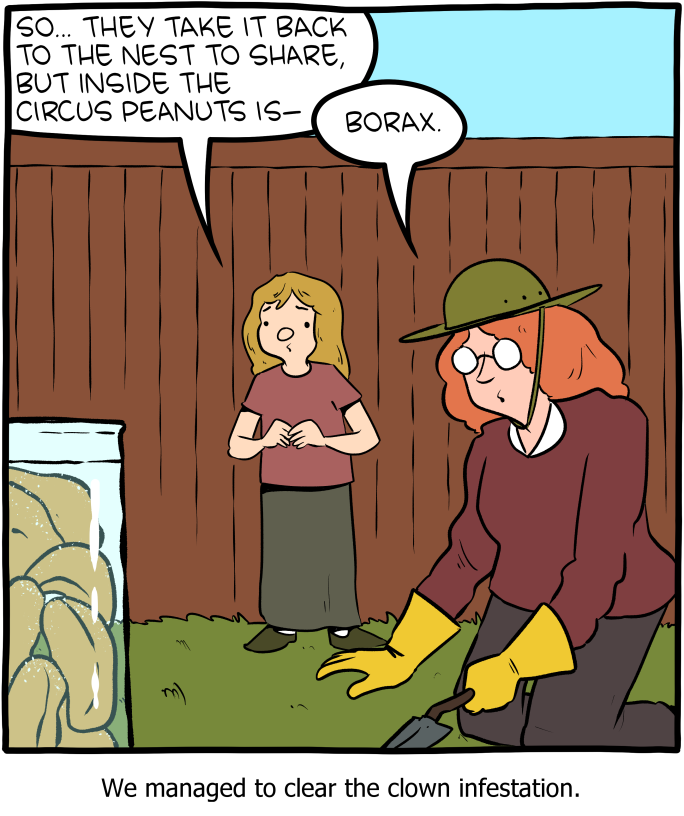
Saturday Morning Breakfast Cereal - Borax

by Zach Weinersmith


Click here to go see the bonus panel!

Hovertext:
I think I'm the only one who likes the clowns are a species jokes, but by GOD I love them.


Today's News:
06 Apr 19:23

A major character dies

by John Allison

Earlier in the story Claire was wearing a blazer, but in the club scene she has a leather jacket. There’s a fun game you can play in the prior pages where it is possible to work out who she got it from. I say fun, it’s barely fun. As for Lottie’s outfit, I just think she keeps it in her “go bag” for any time she might have to go full vamp. That dress was £4 on Vinted.

Interpol Lottie and Claire are dangerous characters, aren’t they? We’d better hope that door never swings open again.

06 Apr 19:21

ALT

A comic of two foxes, one of whom is blue, the other is green. In this one, Blue and Green are sitting next to each other, Blue is on his laptop while Green is reading an appliance manual.
Green: Let's see the safety booklet! "Only plug into properly installed outlets. Do not try to recharge non-rechargeable batteries. If the appliance starts to leak unknown liquid, do not lick it. Do not sew clothes while someone is wearing them."

Blue turns around to look at Green in disbelief, while Green goes on, reading aloud as if nothing is out of place.
Green: "Do not let pets or small children use the sewing machine unsupervised."ALT
06 Apr 19:20

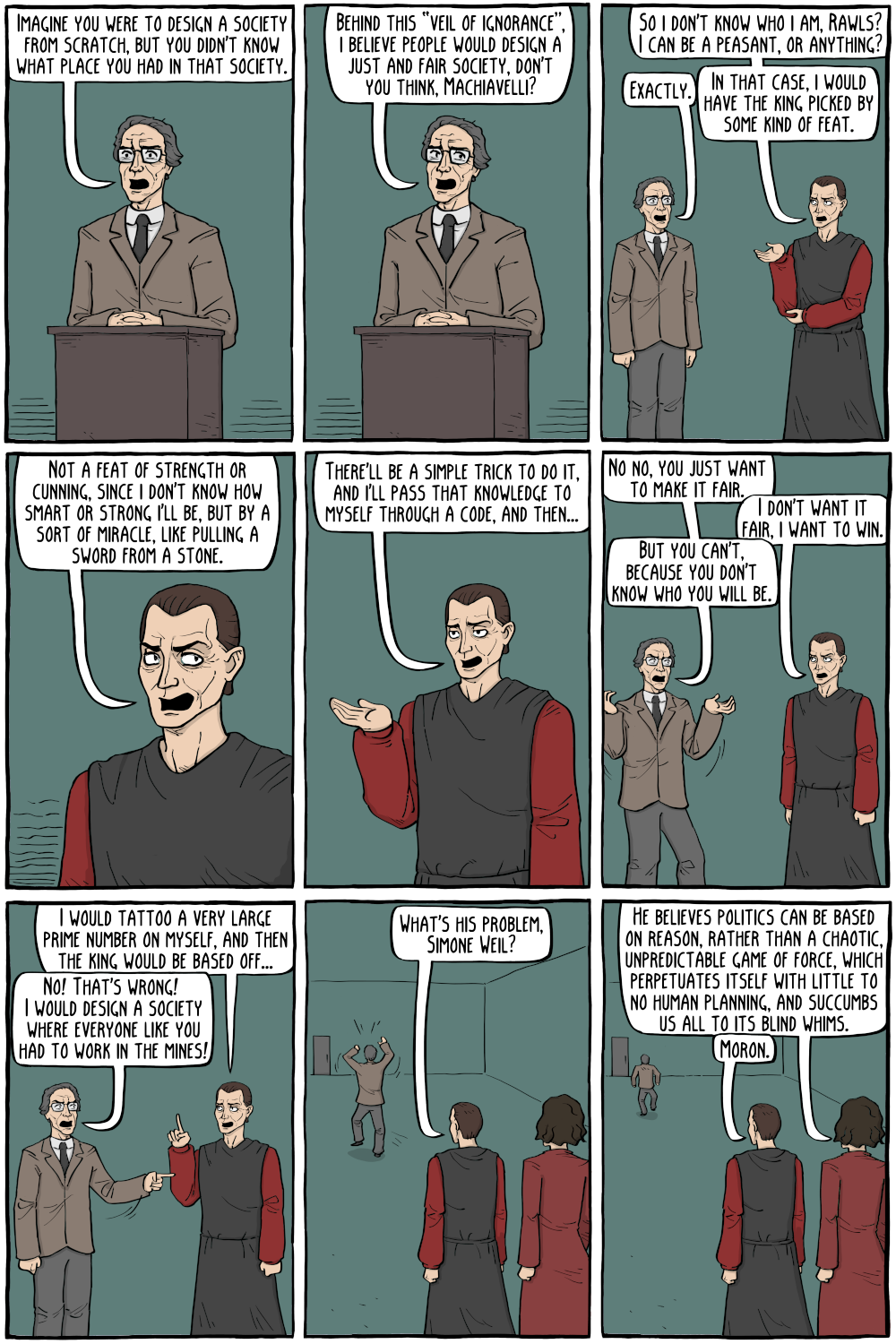
Machiavelli and the Veil of Ignorance

by Corey Mohler
PERSON: "Imagine you were to design a society from scratch, but you didn't know what place you had in that society. "

PERSON: "So i don't know who i am, Rawls? I can be a peasant, or anything?"

PERSON: "Behind this “veil of ignorance”, i believe people would design a just and fair society, don't you think, Machiavelli?"

PERSON: "In that case, i would have the king picked by some kind of feat."

PERSON: "Exactly."

PERSON: "Not a feat of strength or cunning, since i don't know how smart or strong i'll be, but by a sort of miracle, like pulling a sword from a stone."

PERSON: "No no, you just want to make it fair."

PERSON: "There'll be a simple trick to do it, and i'll pass that knowledge to myself through a code, and then..."

PERSON: "I don't want it fair, i want to win."

PERSON: "But you can't, because you don't know who you will be."

PERSON: "I would tattoo a very large prime number on myself, and then the king would be based off..."

PERSON: "No! That's wrong!  I would design a society where everyone like you had to work in the mines!"

PERSON: "He believes politics can be based on reason, rather than a chaotic, unpredictable game of force, which perpetuates itself with little to no human planning, and succumbs us all to its blind whims."

PERSON: "What's his problem, Simone Weil?"

PERSON: "Moron."
06 Apr 19:18

Part 3.48

Part 3.48
06 Apr 19:03

The return of resistance crafting

by Anna North
an illustration depicting seven people laying out, cutting and sewing parts of a massive quilt. Patched letters on the quilt read “ICE out”

“Back in 2017, I made a ton of pussyhats,” Catherine Paul told me. “I just knitted pink hats like there was no tomorrow.”

At the time, Paul appreciated “the way that craft could be part of a demonstration of affiliation and belief,” the artist, writer, and longtime knitter told me.

Soon the pussyhat became a symbol of something else: a brand of feminism attuned to the concerns of a subset of middle-class, mostly white American women, and nobody else. By 2024, the hats, and the 2017 Women’s March at which many demonstrators wore them, were being held up as examples of ineffective protest. More than that, the hats came to be seen as cringe — not just exclusionary, but also kind of embarrassing. 

Then came Trump 2.0. In the face of an administration whose agents have kidnapped and deported children and shot more than a dozen people in the span of a few months, craftivism is back in the spotlight, with knitters, quilters, nail artists, and more getting renewed public attention for their political designs. 

Paul, for example, has been knitting red “Melt the ICE” hats, from a pattern sold by Minneapolis yarn shop Needle & Skein. Friends and acquaintances are begging her for the headwear, just as they did nearly 10 years ago.

Before I started reporting this story, I thought the rise of knitted and quilted protest under Trump 2.0 might be a sign of the left reembracing cringe — of a softening toward forms of political action once deemed uncool and annoying (and, not coincidentally, feminine). But in talking to artists and scholars about craftivism right now, I’ve come to think the explanation for its popularity is both more complicated and simpler.

“The news is so ugly all the time, you can’t really find peace,” Needle & Skein owner Gilah Mashaal told me. “So what do you do? You find people and you do things with those people. And since we’re crafters, that’s what we’re doing.”


As thousands of ICE agents swarmed Minneapolis earlier this year, “my regular knitters were all feeling kind of desperate and unsure of what we could do,” Mashaal said. Employee Paul Neary had the idea to create a pattern inspired by Norwegian anti-Nazi hats called “nisselue.”

Neary posted the pattern for the “Melt the ICE” hat on knitting website Ravelry in January, charging $5 per download, with all proceeds going to immigrant aid agencies. As Mashaal recalls, the Needle & Skein team thought, “maybe we’ll raise a couple thousand dollars.”

But the pattern quickly rocketed to the top of Ravelry’s most-popular list, where it’s stayed ever since. People from 44 countries have purchased it, generating at least $720,000 for immigrant aid groups, Mashaal told me.

Meanwhile, at this year’s QuiltCon, billed as the largest modern quilting event in the world, anti-ICE quilts grabbed attention, bearing messages like, “Our government abducted hundreds of people based on race while I made this.” Anti-ICE quilts are also blowing up on Reddit, where one user recently shared a quilt reading, “Japanese American families remember: We were taken from our communities too.” 

Even Maine senate candidate Graham Platner recently sat for a Pod Save America interview wearing an Anti-Fascist Knitting Club T-shirt, though his recent social media activity doesn’t make him a particularly good ambassador for the cause.

Beyond the needle and thread, nail artists are showing off “FUCK ICE” manicures. And anti-ICE artwork is cropping up on shirts, stickers, and other accoutrements of daily life. When Nadia Brown’s students at Georgetown University open up their textbooks, she sees anti-ICE bookmarks inside, the government professor told me. 


Using handicrafts to send a message is far from new. Leading up to the American Revolution, women in the American colonies boycotted British textiles and staged spinning bees “in which they spun wool and flax yarn to make cloth called homespun,” Shirley Wajda, a curator and historian of material culture, told me in an email. 

Story quilts — visual narratives sewn in fabric — have been popular in Black communities for generations. “During slavery, when African Americans were not allowed to learn how to read and write, it was an easy way to tell stories,” Carolyn Mazloomi, an artist and curator, told me. 

Such art forms never left the American landscape — artists like Faith Ringgold have brought story quilts, often with political and social themes, to the walls of museums and the pages of beloved children’s books.

“Yes, knitting a hat is performative. But it’s also a way to show your anger, fear, frustration, rage, care.”

Gilah Mashaal, owner of Needle & Skein

But political crafting gained a new level of media attention — and notoriety — in the wake of Trump’s first election. Photos of the 2017 Women’s March were a sea of pink, as demonstrators donned headwear knitted in response to Donald Trump’s comments about grabbing women “by the pussy.” But the march soon became controversial — though the Washington, DC, event boasted high-profile speakers who were women of color, most attendees were white. Many women of color felt pushed out of the march and the larger movement that — kind of — grew up around it. 

Organizer ShiShi Rose, for example, worked on the first march and wrote a widely read Facebook post calling on white would-be marchers to pay attention to the experiences of Americans of color. In return, she got death threats, from which she said the Women’s March organization did little to shield her

The pink hats became, for some, a symbol of this exclusion, even their color and shape appearing to represent white, cis women’s anatomy (knitters have since said the hats were supposed to look like cat ears, not vulvas).

When Trump was elected a second time, even some who marched enthusiastically in 2017 began to wonder if their efforts had been for nought. Meanwhile, concerns that started with women of color were appropriated first by liberal white men and then by conservatives, until questions about a movement’s racial inclusivity became a kind of all-purpose derision. As my colleague Constance Grady has written, “who wanted to be like those awful women with the pink hats? Everyone knew they were cringey and unfashionable, complaining over nothing.”

Given all this, it’s been a surprise to see the return of knitted headwear. But for Brown, today’s anti-ICE art- and craftworks aren’t cringe in the same way. Unlike 10 years ago, “there’s a very specific outrage around what’s happening now with ICE, and there are direct calls for policies that would make immigration more functional,” she said. The Women’s March was far less specific and targeted.

What’s more, anti-ICE art spans demographics. When it comes to stickers and other paraphernalia, “I see older people wearing them,” Brown said. “My college students are wearing them of every ethnicity, of every race. People are just outraged.”

In trying to represent the anger of all women nationwide, the Women’s March was doomed, on a certain level, to fail. The resistance against ICE in 2026, however, is famously hyperlocal, and craftivism is no exception. 

Pussyhats were about “fighting against and showing our distaste for the man that the country elected,” Mashaal said. With Melt the ICE hats, “we’re raising money to help our friends and neighbors.”

Neighborliness is emerging as a key value in the resistance to ICE. “What authoritarian regimes want to do is make people suspicious of their neighbors,” Brown said. Crafting, by contrast, brings neighbors together over a shared activity that helps them get past their fears and suspicions: “Building community in a way that gets you out of your head and working with your hands is an effective tool.”

No protest is immune to criticism, and some have argued that the Melt the ICE hats are little more than performative virtue-signaling, especially if people knit them without paying for the pattern

“Yes, knitting a hat is performative,” Mashaal said. “But it’s also a way to show your anger, fear, frustration, rage, care.”


I started this story thinking it was about the state of feminized forms of activism in 2026. I’m ending it thinking that a lot of the questions opened up by the Women’s March — whether it’s even possible to have a truly inclusive “women’s movement” in America, for example — haven’t been answered yet. Maybe now is not the time to answer them. Maybe now is the time for something smaller-scale — the size, say, of a pair of knitting needles or a sewing machine.

In addition to her Melt the ICE hats, Paul recently completed a quilt that reads, “Fuck it we ball.” “I wanted that persistence, a reminder of the way that craft can help us persist,” she told me.

Wajda, the historian and author, is thinking about the coming spring. “Pussyhats and Melt the ICE hats have one thing in common: They are winter wear,” she told me. “Now I’m thinking about what would a craftivist create for warm weather protests!”

Mazloomi, the artist and curator, has been working for the last several years on a series of quilts about African American history, with a concentration on the civil rights era. “The stories have disappeared from the news, disappeared from museums and art centers, and I don’t want to see that happen,” she said.

Quilts remind people of “home and grandma,” Mazloomi said. “It’s a soft cushion for difficult stories.”

This story was originally published in The Highlight, Vox’s member-exclusive magazine. To get access to member-exclusive stories every month, become a Vox Member today.

06 Apr 19:02

Ballroom design, many notes

by Nathan Yau

After demolishing the East Wing of the White House and rushing into construction of a ballroom, the administration was finally ordered to stop until the plans go through the necessary reviews. NYT’s the Upshot made notes on the ballroom design, which is more flashy than practical, such as a stairway to nowhere and fake windows.

I like the enhanced byline: “Junho Lee is a trained architect, Larry Buchanan studied fine arts, and Emily Badger has long written about urban planning.” Apparently NYT has been doing this for a few years.

Tags: architecture, ballroom, Upshot, White House

05 Apr 04:27

He’s going over the edge! Stop him!

He’s going over the edge! Stop him!

05 Apr 04:26

Air Canada promises next CEO will gouge customers in both English and French

by Ian MacIntyre

MONTREAL – With CEO Michael Rousseau stepping down following a widely-derided public statement made only in English, Air Canada has vowed that their next CEO will mercilessly overcharge travellers in both of Canada’s official languages. In a move intended to put the english language PR disaster behind them, Air Canada is assuring Canadians that the […]

The post Air Canada promises next CEO will gouge customers in both English and French appeared first on The Beaverton.

04 Apr 17:44

Looks like TRON.

Looks like TRON.