Shared posts

19 Mar 17:59

Vincent Valdez’s “Just a Dream” Dazzles at Contemporary Arts Museum Houston

by Ruben C. Cordova

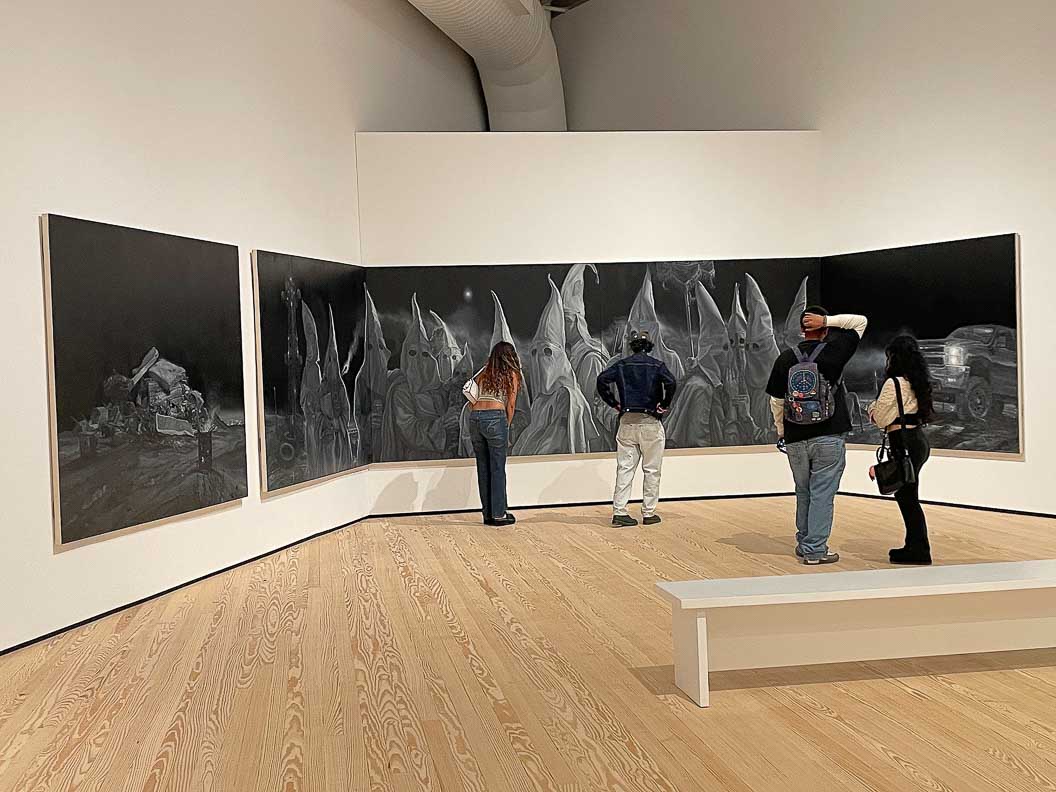
Installation view of “Vincent Valdez: Just a Dream…,” with “The City I and II.” Photo: Ruben C. Cordova

In a mid-career survey exhibition that fills both floors of the Contemporary Arts Museum, Houston (CAMH), Vincent Valdez’s (b. 1977) “Just a Dream…” demonstrates a dazzling mastery of the human form, keen sensitivity to social and political injustices, and – with his finger always on the pulse of American culture – a remarkable handling of allegorical narratives and political reportage. Showcasing over 200 works that span a quarter century, this exhibition is the most comprehensive outing to date of the San Antonio native who now splits his time between Houston and L.A. 

Introduction

Valdez burst onto the artistic scene with Kill the Pachuco Bastard! (2001), a large oil painting that dealt with the Zoot Suit riots of 1943, when U.S. servicemen (and others) attacked flamboyantly-dressed Mexican Americans in Los Angeles. Created when he was a senior at The Rhode Island School of Design (RISD), the painting was one of the highlights of “Chicano Visions: Painters on the Verge,” the exhibition of entertainer Cheech Marin’s collection that opened at the San Antonio Museum of Art in 2001. In 2016, Valdez completed The City I, a stark, monumental painting of robed, contemporary Klansmen assembling on the outskirts of a city. The painting’s relevance was demonstrated by a succession of events: on July 17, 2015 (before the painting was begun), a white supremacist who had posed with the Confederate flag murdered nine black parishioners in Charleston, South Carolina; former Klu Klux Klan (KKK) Grand Wizard David Duke endorsed Donald Trump’s 2016 presidential campaign; the 2017 “Unite the Right” white supremacist rally in Raleigh, North Carolina (countering demands for the removal of Confederate monuments), erupted in violence, shining a lurid light on racist extremism, its perseverance in U.S. history, and the dangers posed by contemporary white supremacists. 

Valdez made art almost from the crib. His first preserved drawing dates from when he was three years old (illustrated in the exhibition catalog, p. 65). An image of an ugly duckling, it was already a work of social commentary, rendered by someone who considered himself an outsider. When Valdez was five or six, after flipping through 90 TV channels and not finding anyone who looked like him, he became confused: “I asked my mom… if I was American” (“Video interview with Vincent Valdez,” Vincent Valdez, The City, 2018, The Blanton Museum of Art).

Valdez painted his first politically engaged mural in San Antonio when he was in the fifth grade (at the Esperanza Peace and Justice Center). See a film clip of this mural, on the topic of nature, which features bombers dropping napalm. The eleven-year-old artist queries whether people (including himself) “will still be around” to experience nature in the near future (see: “Vincent Valdez – Tuesday Evenings with the Modern Lecture Series,” Modern Museum of Fort Worth, March 8, 2022). 

When Valdez was nine or ten, he was mentored by an eighteen-year-old Alex Rubio (who now goes by the name Rubio Rubio). Together, the duo (Valdez often referred to himself and Rubio as a kind of “Batman and Robin”) completed numerous murals in housing projects through the Community Cultural Arts program. After high school, Valdez won a scholarship to RISD, and he proved himself to be a formidable artist during his undergraduate days. 

Remembering, 1999
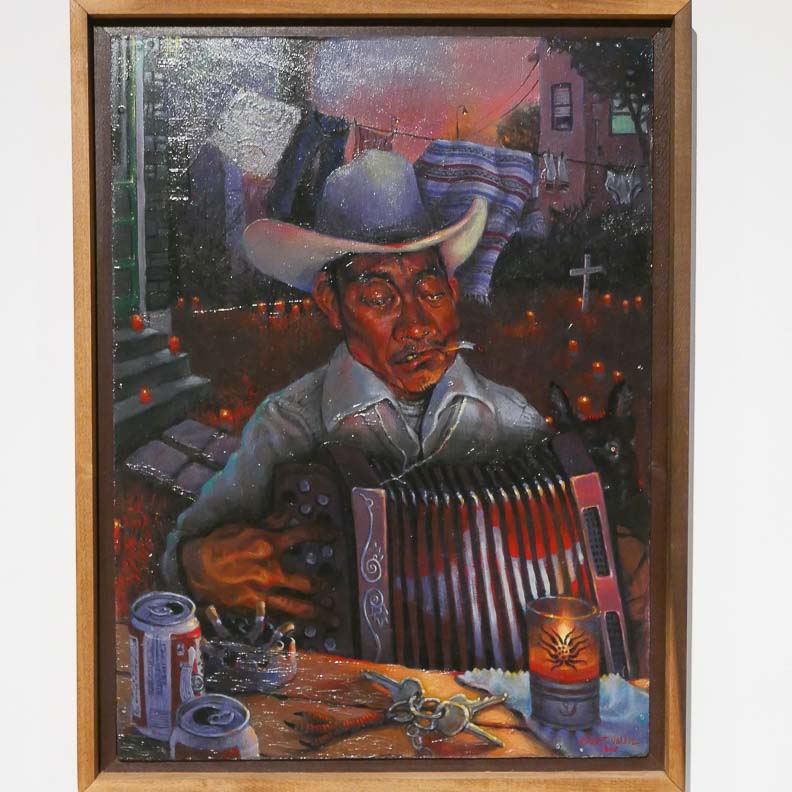
Vincent Valdez, “Remembering,” 1999, house paint on board, collection of Joe A. Diaz. Photo: Ruben C. Cordova

Remembering (1999), Valdez’s earliest painting in the exhibition, was done during his junior year at RISD, when – despite his longing – he could not return to San Antonio for Thanksgiving. College was Valdez’s first extended period away from San Antonio, and it was this absence – as well as the cultural shock of living in New England – that led the artist to conceive and produce an image of “what home was.” Before RISD, he did not know that other states were unlike Texas, and that breakfast tacos and conjunto music were not national norms.

Valdez depicted an elderly man (inspired in part by his grandfather) in a South-side-of-San Antonio backyard who is smoking, drinking Budweiser, and playing an old accordion with gnarled hands, while the cross hanging from his neck rests on the bellows. (Valdez is himself an avid musician who has played in several bands). The man’s keys are attached to a chicken’s foot, laundered clothes are drying on the line, and a white cross marks his loyal dog’s final resting place. Valdez, in fact, characterizes the dog as the man’s “only true friend.” Therefore, this is particularly hallowed ground. The man’s eyes are rather blank, and his face is twisted as he reminisces about his departed dog. Memory, emotion, and particular, personalized objects serve to create a unique sense of place, a vivid world, a tiny universe that is whole unto itself. 
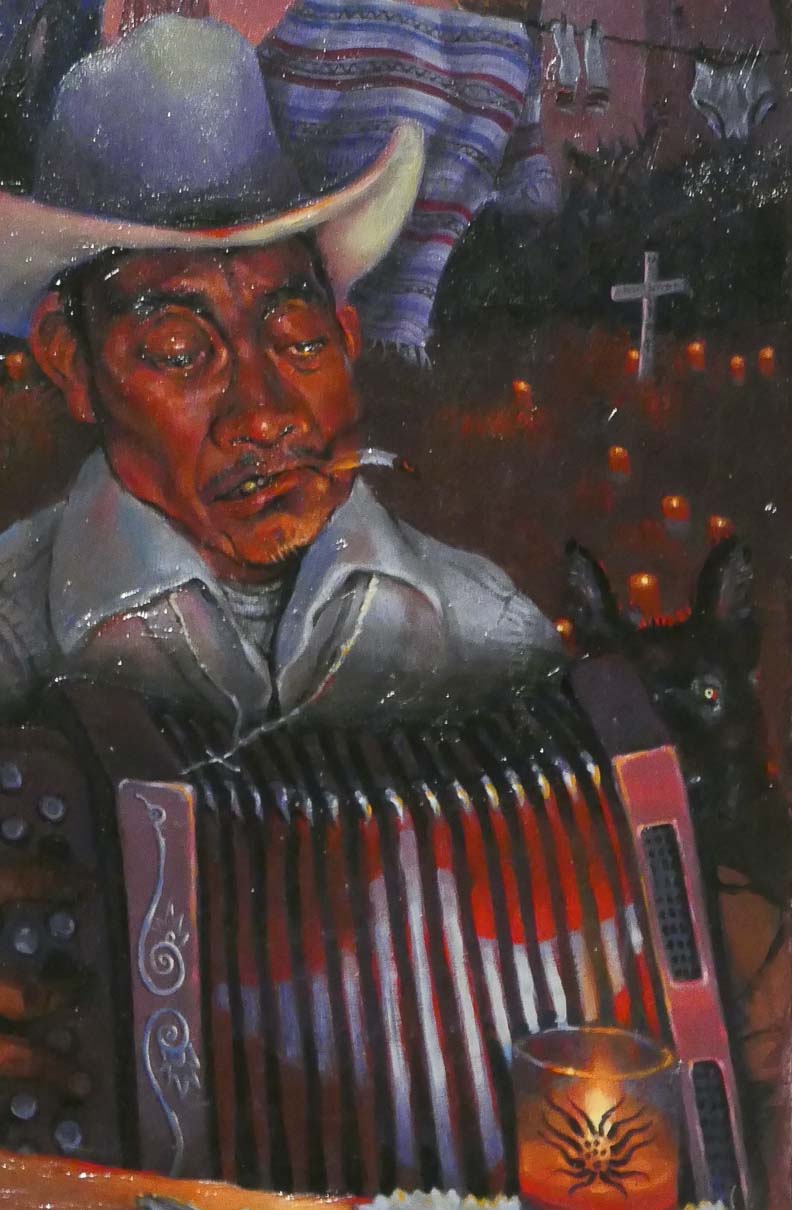
Vincent Valdez, “Remembering” (detail), 1999, house paint on board, collection of Joe A. Diaz. Photo: Ruben C. Cordova

Drinking, smoking, and music-making are likely daily rituals in this backyard. The votive candles, Valdez explains, are not real – they are hallucinatory. Sprinkled throughout the backyard, there are multiple points of light that commemorate and honor the departed canine, creating marvelous painterly effects (to which reproductions do not do justice). The dog itself is thereby resurrected. It sits attentively behind the accordion, ears perked in rapt attention. Upon close inspection, the eyes of the man and the eyes of the dog are quite similar. This uncanny resemblance underscores their unique kinship. It also suggests that we are seeing the dog through his mind’s eye. The man’s deep feelings – and his music – have both altered the landscape and summoned the dead, bridging the gap between the quotidian and the supernatural. In a furious two weeks of painting day and night with ordinary house paint, Valdez thereby bridged the gap between Providence, Rhode Island and San Antonio, Texas. (For Valdez quotes, see my text in ¡Arte Caliente! Selections from the Joe A. Diaz Collection, Corpus Cristi, TX: South Texas Institute for the Arts, 2004, p. 40.)
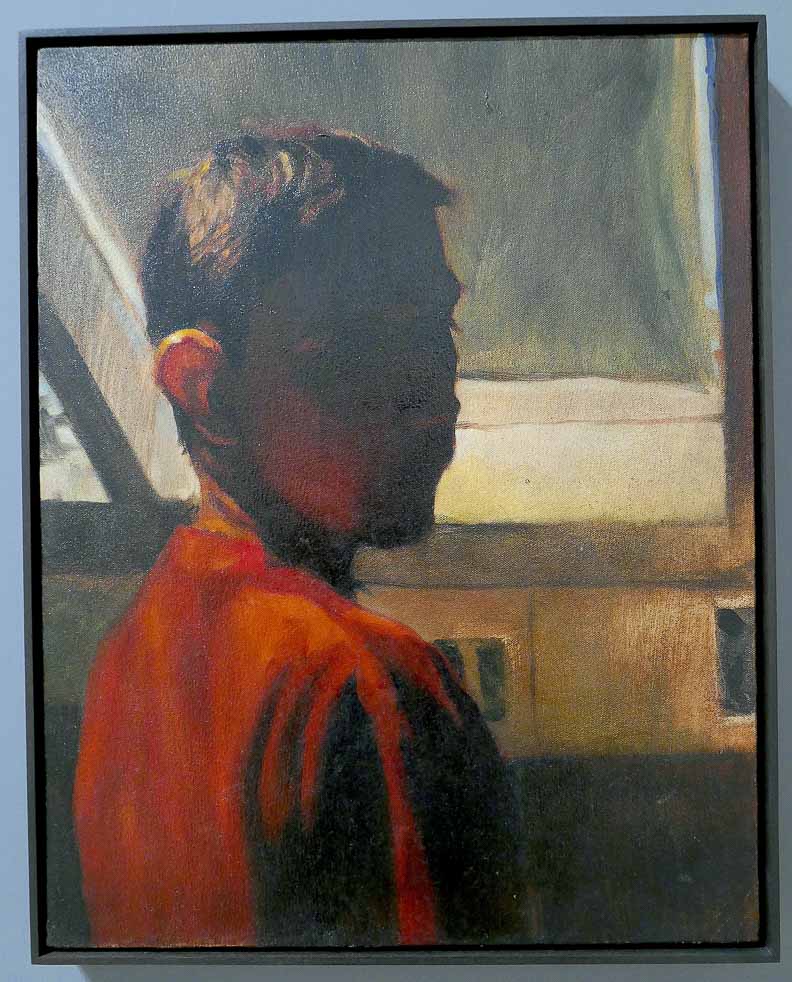
Vincent Valdez, “Red Ear (Twenty-One Years),” 1999, oil on canvas, collection of the artist. Photo: Ruben C. Cordova

The artist presents himself here, at a mere twenty-one-years-old, in a rather comic vein, with light striking and highlighting a cartoonishly projecting ear. His forms are simplified, his face lost in shadow. Deliberately or not, the background reminds me of a Diebenkorn, while the figure itself recalls summary forms found in works from the Bay Area Figuration group. Valdez appears more like a young David than a Goliath, though, unlike conventional images of David, his eyes, his expression, and his thoughts are shielded from us, with shadow serving as armor against the viewer’s inquisitorial scrutiny. Perhaps the David analogy is apt: soon, the artist would take his best shot (in the form of Kill the Pachuco Bastards!) at the artistic establishment that had long denigrated figural art. The harsh criticism he received from an antagonistic professor that upheld “the RISD creed” also served as motivation. 

Kill The Pachuco Bastards, 2001
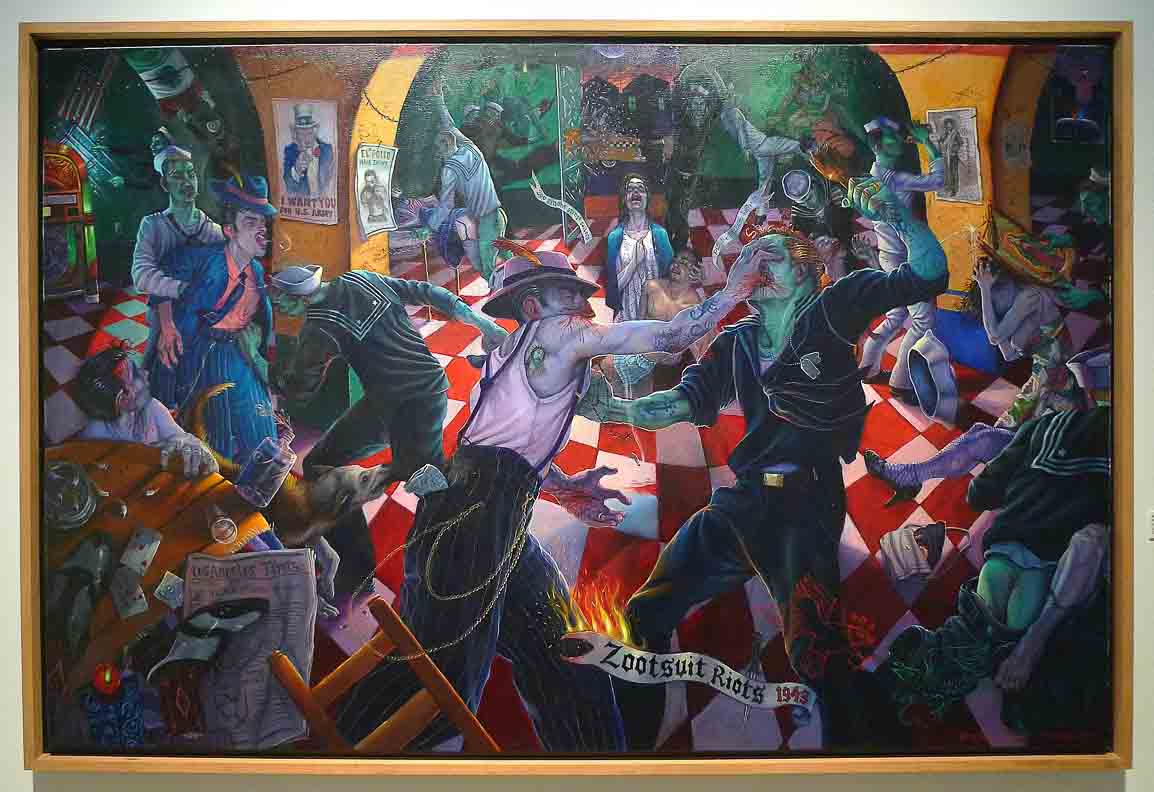
Vincent Valdez, “Kill the Pachuco Bastards,” 2001, oil on canvas, collection of Cheech Marin and The Cheech Marin Center for Chicano Art & Culture of the Riverside Art Museum, California. Photo: Ruben C. Cordova

Valdez was inspired by the depiction of the Zoot Suit Riots at the beginning of the film American Me (1992, dir. Edward James Olmos), which is how Valdez learned of this historical event. In American Me, Esperanza (Hope) travels to a tattoo parlor, where her boyfriend Pedro has just tattooed his arm with her name and the phrase por vida (for life). Suddenly, sailors burst into the shop and separate the couple. They take the Pachucos outside. Along with soldiers and police, they beat the young men, cut their hair, and strip their clothes off. One of the zoot suiters is tossed through the shop window. In the meantime, sailors gang-rape Esperanza inside the parlor. 

In Valdez’s painting, multiple Pachucos are being beaten (or have already been beaten) while two women (in the left background and the right foreground) are being raped. In the center background, recreating an event from the film, a Pachuco is being thrown through the window. All the violence in Valdez’s painting, however, is taking place within a Mexican American bar, which has essentially been invaded by sailors. (For a lengthier treatment of the riots and of Valdez’s painting, see my 2023 Glasstire review “Texas in Riverside: ‘Cheech Collects’ at the Cheech Marin Center for Chicano Art and Culture, Riverside, California”).

In my review of the Chicano Visions exhibition at the San Antonio Museum of Art, I referred to Kill the Pachuco Bastards as

… surely the show’s edgiest work. It depicts a no-holds barred bar-fight in which rapacious sailors savage a Pachuco joint in 1943. They violate every Chicano body and cultural emblem with unremitting barbarity. The painting is remarkable for: the dynamic expressiveness and superb characterizations of its varied protagonists, the lurid lighting effects, the complex space (including a tile floor that “rolls” like waves on an ocean) and the undeniable mastery that makes it possible to pack such dense (and meaningful) iconographic details into a compelling, clearly legible narrative (Voices of Art, vol. 10, #1, 2002, p. 16-18).

With this painting, Valdez proved himself to have the rarest of talents: he is a history painter, one capable of carefully placing each and every protagonist in the most telling pose, pregnant with symbolism, political meaning, and high drama. The careening perspectives, the garish colors, the jagged forms, and the degree of sheer physical torment recall signal German Expressionist works. From a wealth of artistic sources, including several leading Chicano artists, and a whole host of American painters from the first half of the twentieth century, Valdez has created compelling, expressive theater. He could easily have made a photorealistic work, but what he has created is far more compelling because of its mix of strange accents, distinctive characterizations, superb stylizations, and its air of macabre horror.

Valdez has underscored the racism, sadism, and xenophobia of the invading sea-farers. On the left, a sailor smashes a jukebox while another tears down a Mexican flag. On the right, a sailor smashes an image of the Virgin of Guadalupe on the head of a desperate, partially-stripped woman. The sailors explicitly attack race, culture, and religion. Their goal is to dominate through humiliation and degradation by beating, stripping, breaking, and raping. The savagery of these actions belie their putative pretext, that zoot suits wasted fabric during wartime austerity. Pachuco patriotism is expressed through the display of the American flag, and James Montgomery Flagg’s Uncle Sam Wants You for the U.S. Army recruitment poster. In refutation of the offer made in the poster, the sailors clearly regard Pachucos as internal enemies, rather than potential conscripts.  

It was quite a stupendous feat, for an artist as young as Valdez to make something like Kill the Pachuco Bastards! The painting is as remarkable for its technique as for its political content. Nothing quite like it existed. It answered the challenge posed by Leonard Long, his RISD professor, to create something great for his senior project. Kill the Pachuco Bastards! enthralled visitors to the Chicano Visions exhibition. Additionally, on the basis of this work, the other artists featured in the exhibition immediately regarded Valdez as a peer rather than an emerging or neophyte artist.

Valdez traveled with Chicano Visions during its run from 2001-2007, during which time he had occasion to speak with many communities about the Zoot Suit Riots. 

Installation view of “Vincent Valdez: Just a Dream…” (with studies for “Kill the Pachuco Bastards!”), courtesy of Contemporary Arts Museum, Houston, 2024. Photo: Peter Molick

I am very appreciative of the studies for Kill the Pachuco Bastards! that were on view in the exhibition. They include 42 polaroids, with Valdez serving as the primary model (even for the robed  Madonna-like figure in the center of the painting), and the sketches visible on top of the black flat file in the above photograph. 

Valdez utilized newspaper articles for research, such as the one from the Los Angeles Times illustrated in the lower left corner of the painting. It’s an interesting psychological phenomenon that Valdez put himself in the place of these various figures. Perhaps imagining and pantomiming their actions enabled him to depict them with more credible agency. If he made a full-scale study for the painting, I would love to see it.

The flat file (most of the drawers can be opened) holds many of the artist’s earliest drawings and press clippings, as well as an assortment of later works. I am disappointed that CAMH did not include more early works in the “Just a Dream…” exhibition, especially since this period includes some of Valdez’s greatest achievements. The charcoal drawing With a Little Luck, Faith, God, and a Six Pack (2001) foregrounds a punkish boxer within a 1940s tableaux. As in many of the artist’s best works, surreal elements have a powerful effect, including fighting cocks that spring from the skinny boxer’s mohawk, as well as several floating signifiers (including beer cans, a disembodied heart, and an image of Christ) that populate the top of the drawing. In I Lost Her to El Diablo, an oil painting from 2003, Valdez perfected the bar room lighting effects we saw in Kill the Pachuco Bastards! While addressing “The Devil at the Dance” folklore, he also made a psychological and symbolic leap by transmuting and externalizing his troubled protagonist’s thoughts into neon signs. (For these two works, see ¡Arte Caliente!, cover, and p. 42-43).   

Stations, 2001-4
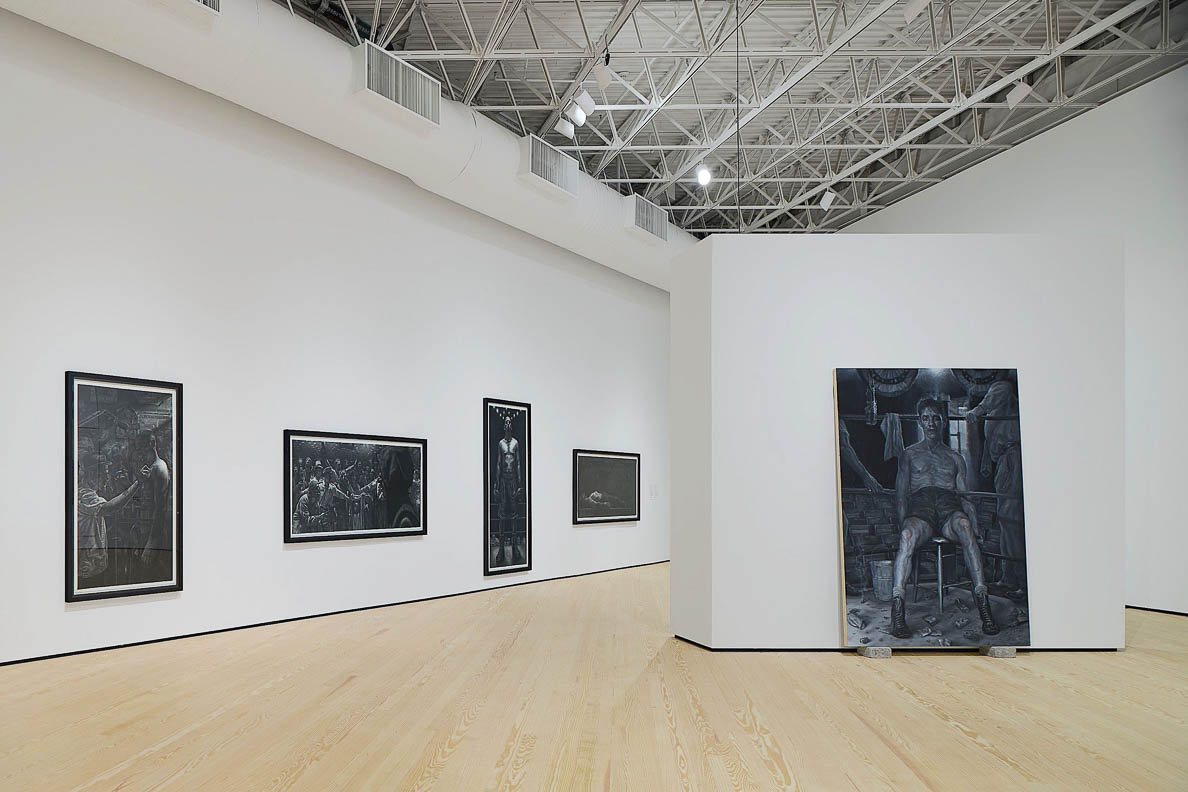
Installation view of “Vincent Valdez: Just a Dream…” (with four drawings from “Stations” on the left, and the painting “Just A Dream (In America)” on the right), courtesy of Contemporary Arts Museum, Houston, 2024. Photo: Peter Molick

The CAMH venue features four of Valdez’s 13 graphic works from his remarkable Stations (2001-4) cycle. They were born of the artist’s short-lived participation in a sparring club with no weight classes (when he was at RISD), one in which the artist’s only goal was to survive each bout. This experience provided the imagery for Valdez to narrate the “story of the underdog,” the quixotic man who struggles against all odds simply because he can, undaunted by the prospect of almost certain defeat.
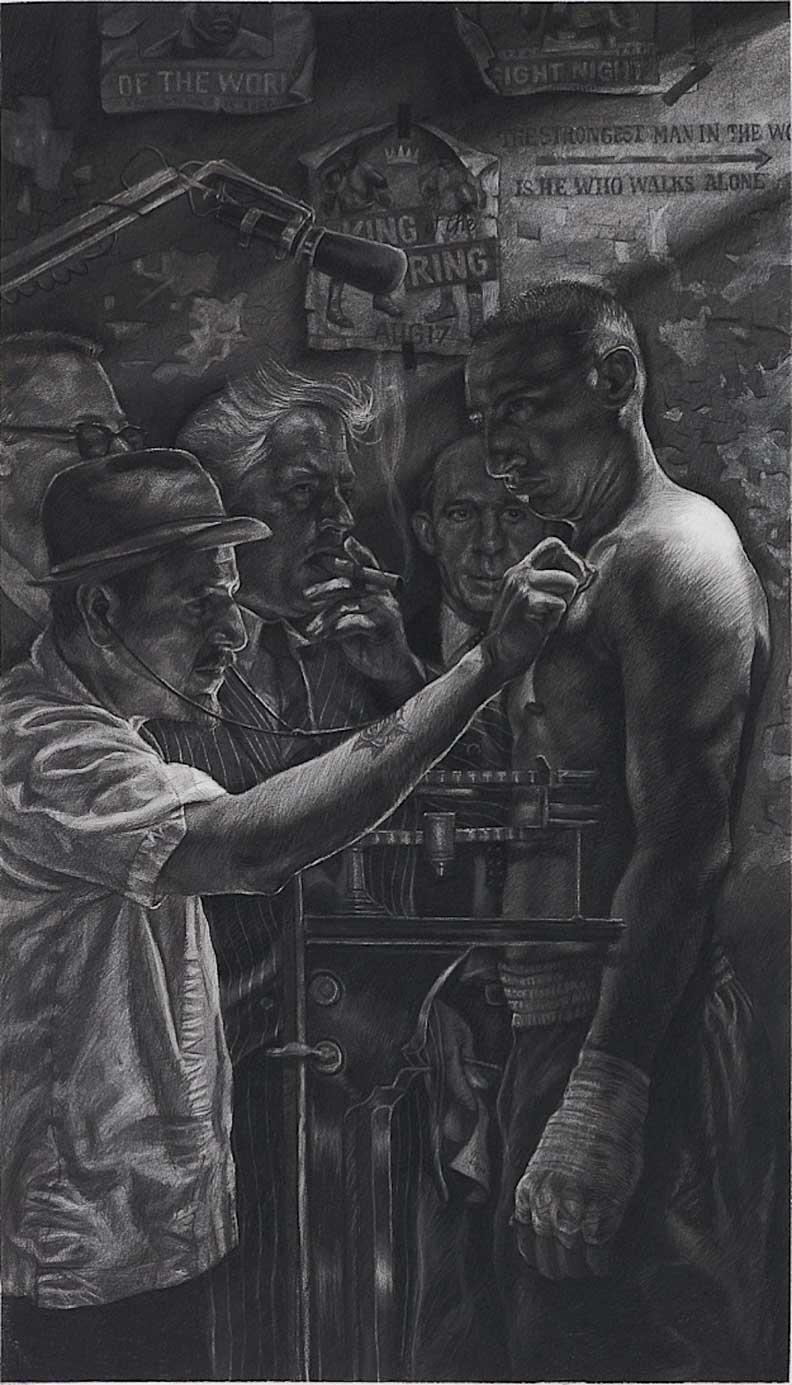
Vincent Valdez, “Stations: Weigh In, Coming in at 140lbs, 8oz,” 2001-4, charcoal on weave paper, collection of Mike Loya. Photo: Vincent Valdez website

Boxing is the most solitary and dangerous of sports. The boxer risks serious injury – and even death – every second between bells. Each of his opponent’s swings has malevolent intent, and every blow is potentially lethal. Brain damage and impaired motor function are among the sport’s deleterious long-term effects. In her essay titled “On Boxing” (reprinted in the catalog), the poet Joyce Carol Oates points out the self-sacrifice boxing requires, “the punishment – to the body, the brain, the spirit – a man must endure…” Boxing is an accelerator of mortality: Oates notes that the toll of punishment in the ring “in even a young and vigorous boxer is closely gauged by his rivals…” (p. 99). 

But boxing’s pageantry and the high drama of its rituals – precisely because it is an individual sport that poses mortal risks at every outing – are unmatched. Oates emphasizes that boxing is at heart “a story – a unique and highly condensed drama without words” (p. 82). 

She adds that boxing is “not a metaphor for life, but a unique, closed, self-referential world, obliquely akin to those severe religions in which the individual is both ‘free’ and ‘determined’ – in one sense possessed of a will tantamount to God’s, in another totally helpless” (p. 96). Boxing is an intensification of life, marked by the bell and dosed out in three-minute intervals. 

Valdez recognized parallels between boxing narratives and the central narrative of Western art: The Passion of Christ. The weigh-in functions as boxing’s Ecce Homo moment, the ring itself is its Golgotha. 
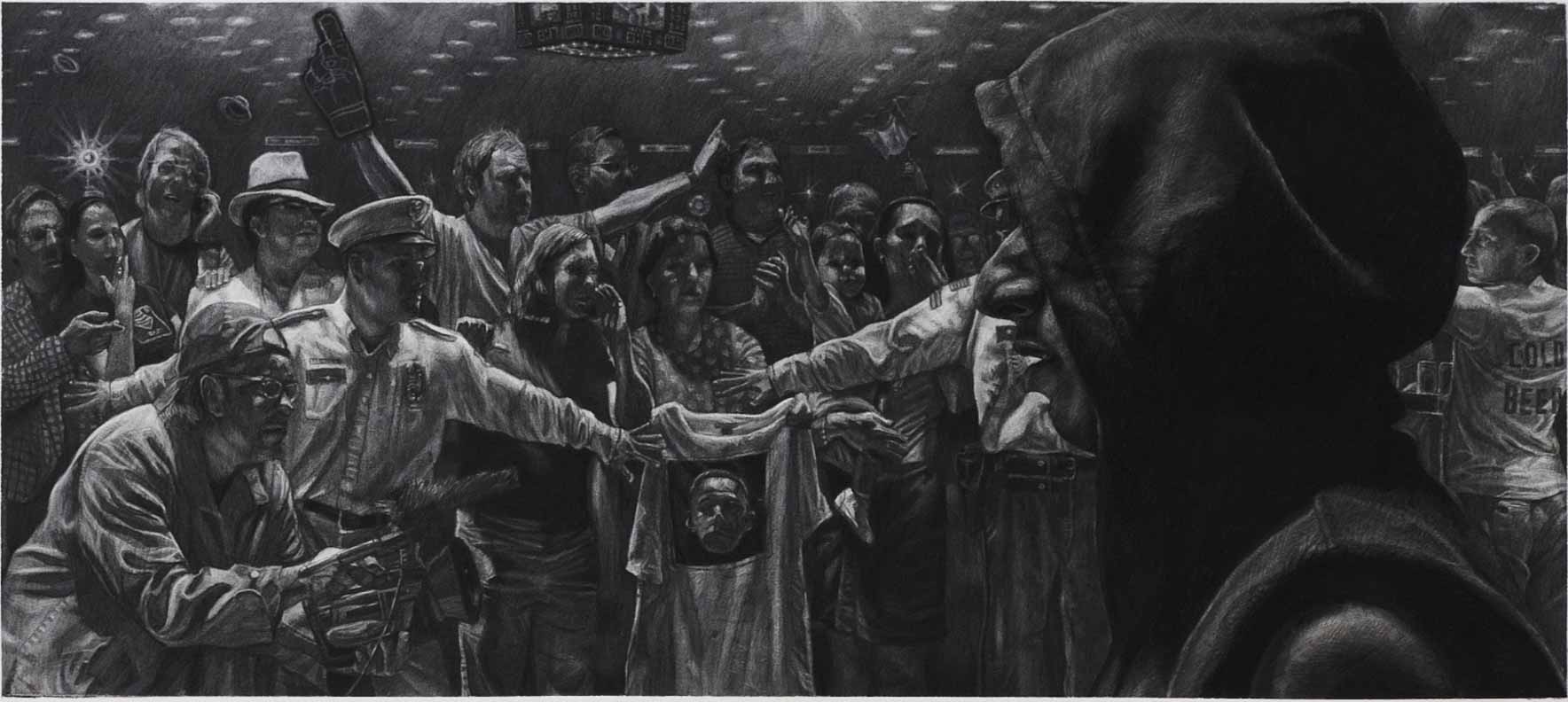
Vincent Valdez, “The Strongest Man is He Who Walks Alone,” 2001-4, charcoal on paper, collection Mike Loya. Photo: Vincent Valdez website

In the above image, the hooded boxer encounters his own image on a T-shirt, echoing the miraculous image of the Sudarium, the bloody, sweaty face of Christ captured by Veronica on her veil, after one of Christ’s falls. Valdez thereby dramatizes the boxer’s walk to the ring.
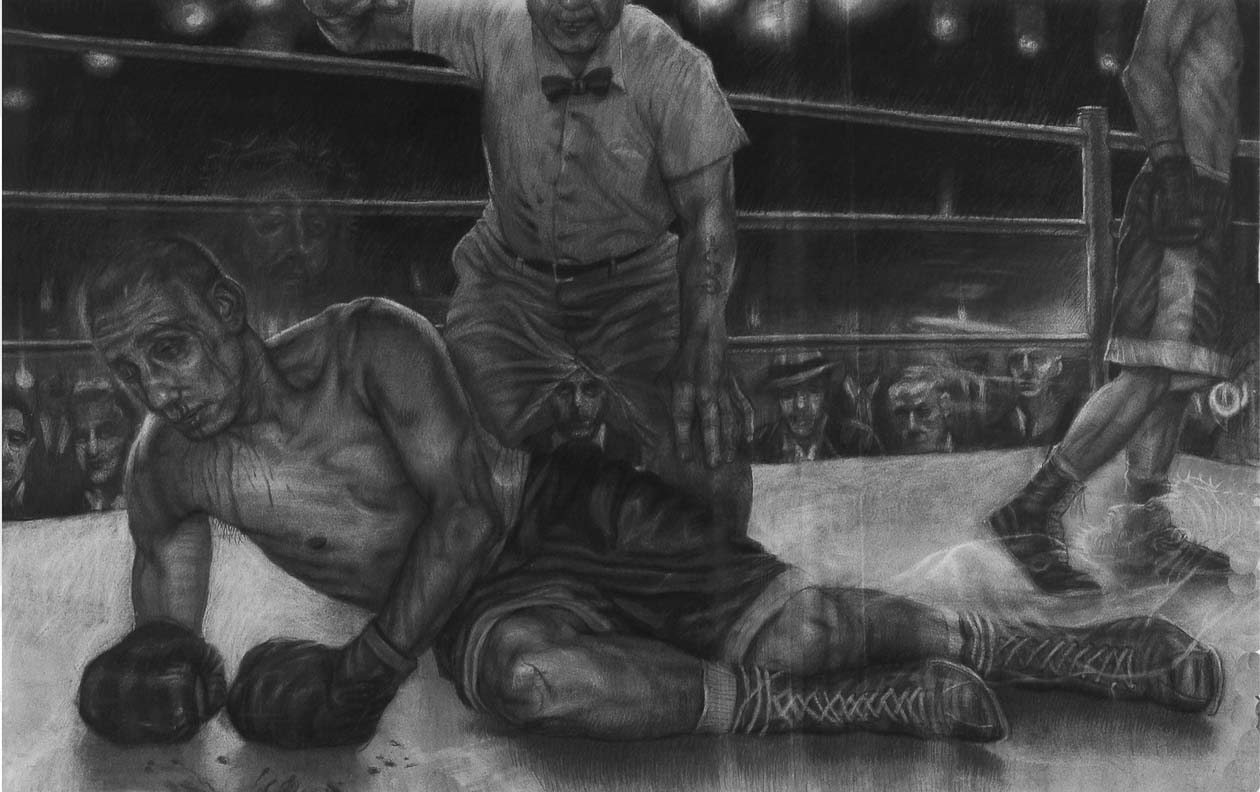
Vincent Valdez, “They Say That Every Man Must Fall,” 2001-4, charcoal on paper (not in CAMH exhibition). Photo: Vincent Valdez website

The boxer’s falls can be likened to Christ’s falls (when carrying the cross). In the above image, ghostly images of Christ appear twice: directly behind the boxer’s head, he is upright, wounded and bloodied, but living; at the boxer’s feet, he is supine, apparently dead on the cross. The dazed boxer visualizes these two possibilities while he struggles to resurrect himself. 

A knock-out is a boxing death; rising up from the canvas is analogized to Christ, who rose up multiple times on his path to Golgotha. Valdez is not simply equating the boxer with Christ, rather, the two grand narratives (those of boxing and those of the Passion) are fused to dramatize the story of the indefatigable underdog. Valdez’s boxer (modeled on his brother Daniel) is no god. He is just a man – and one of low status at that. But his bout is a chronicle of resistance per se, and Valdez here elevates and sanctifies that resistance by reference to religious tradition. 
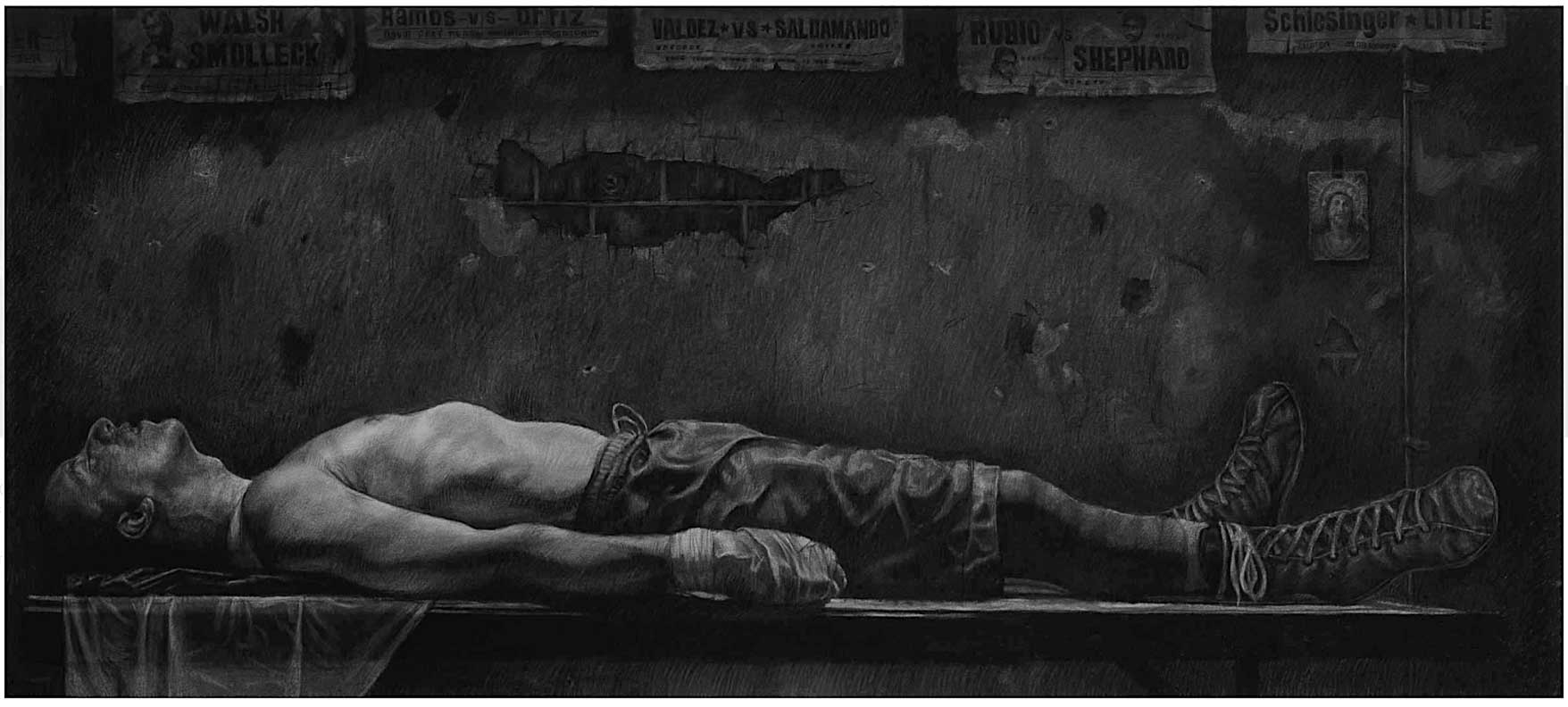
Vincent Valdez, “Stations IX: Laid Out,” 2001-4, charcoal on paper, collection Museum of Fine Arts, Houston. Photo: Vincent Valdez website

The fighter is knocked out, temporarily stilled, momentarily dead to the world. In this state, he resembles some images of the Dead Christ, though Christ is rarely rendered from this perspective (most memorably by Hans Holbein the Younger in 1521). The small photograph of Christ taped above the boxer’s feet underscores Valdez’s Christological parallel. The image is based on a head of Christ painted by Valdez’s great-grandfather, Jose Maria Valdez, in 1898 (illustrated in the exhibition catalog, p. 64). 

Oates declares, rather tendentiously, that “boxing is about being hit rather more than it is about hitting, just as it is about feeling pain, if not devastating psychological paralysis, more than it is about winning” (p. 111). Whether or not that is the case for boxers in general, it is certainly true for Valdez’s K.O.-ed underdog. He has fought the good fight, and he has paid the price. It is for that reason that he lies here before us. 

“Stations” was the subject of Valdez’s first one-person show, held at the McNay Art Museum in San Antonio in 2004. The exhibition wowed the public and had the great advantage of being exhibited without glass (the highly reflective glass at CAMH made these drawings impossible to see well).

Made Men, 2002
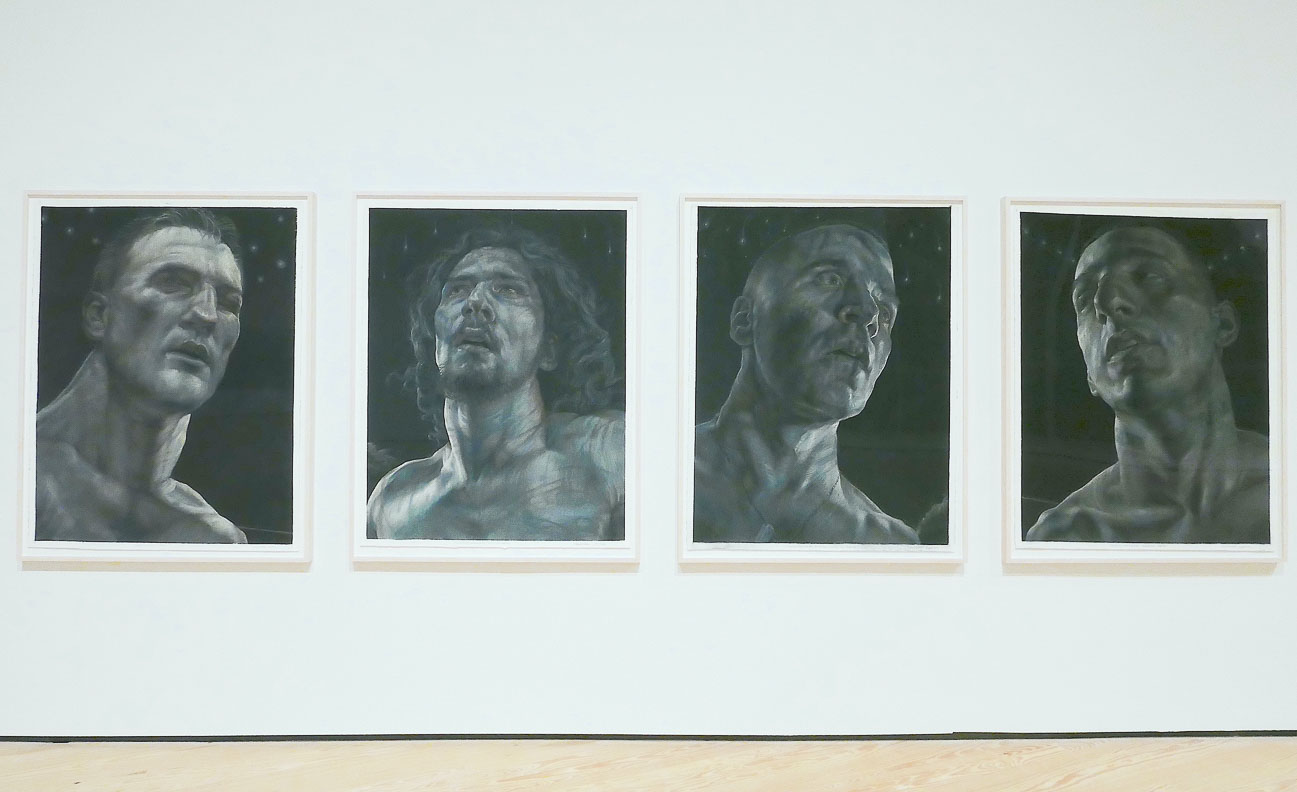
Vincent Valdez, “Made Men: They Say Every Man Must Need Protection,” “Made Men: They Say Every Man Must Fall,”  “Made Men: Yet I Swear I See My Reflection,” “Made Men: Any Day Now, I Shall Be Released,” all four 2002, pastel on paper, collection of the Modern Art Museum of Fort Worth, Texas. Photo: Ruben C. Cordova

Near the beginning of the lengthy interim in which he made “Stations,” Valdez also created what may be his most remarkable series: the “Made Men” (2002). It consists of four enormous male busts, which are highly particularized, based (partially at least) on real people, and symbolically resonant. The four monumental heads are archetypal figures in Western art and culture. The first three are paradigms of heroic masculinity.

Let us consider what the term “made men” meant for Valdez in the context of this series. As noted in the 2022 “Tuesday Night” lecture, the artist came to this term through rap music, where it signified someone whose life, like that of a “made” mafioso, “was assured.”

Here we might also think of the first three “Made Men” as referring to social constructs. They are men who are fitted into pre-existing patterns, and these archetypes subsume them, forcing them to conform and to perform. 

Vincent Valdez, “Made Men: They Say Every Man Must Need Protection” (detail). Photo: Ruben C. Cordova

The first of these men is a musclebound boxer, one that recalls examples of heads in mid-century American works. (On the basis of Sharky, painted in 2000 – illustrated in catalog on p. 68 – we can trace this figural type back to George Bellows.) This boxer’s neck is itself a bulging muscle. His face is a gnarly landscape – direct evidence of his chosen profession. His left eye has been punched shut. His nose has been broken numerous times. His ear is “cauliflowered” from multiple blows that have hammered down on it.

Vincent Valdez, “Made Men: They Say Every Man Must Need Protection” (detail). Photo: Ruben C. Cordova

Upon closer inspection, there is blood on the swollen left eye. By implication, the red-orange tint on other parts of his face could also represent blood. This face is a battleground, one that has survived a number of grueling campaigns. Notwithstanding the man’s hulking physique, his one open eye conveys trauma, pain, and fear. Since his left eye is not bandaged, we can assume that he is still in the ring, warily eyeing his opponent – and perhaps an incoming punch. 
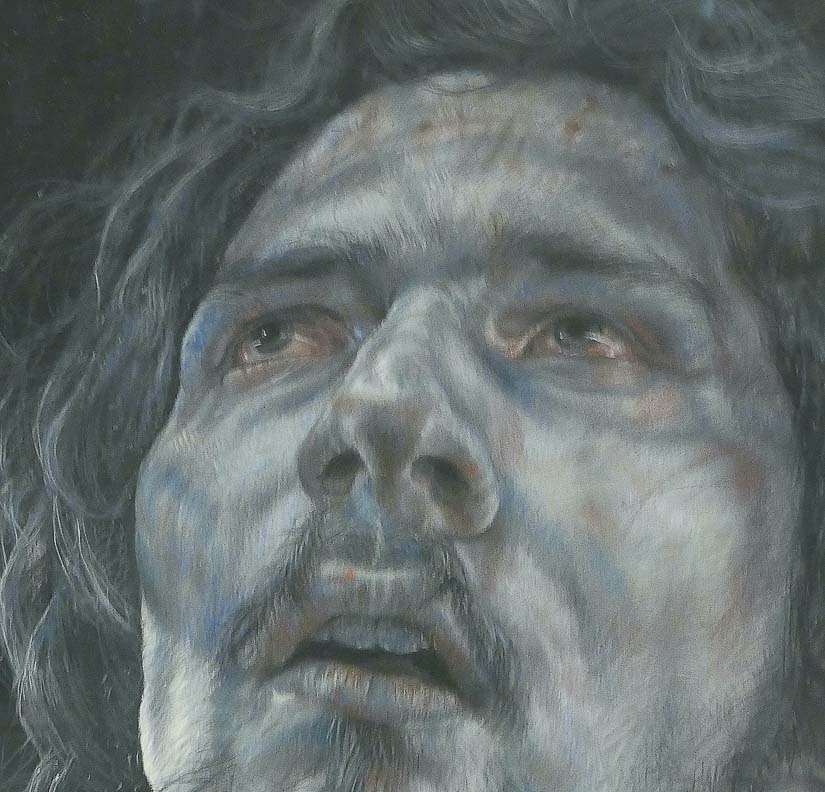
Vincent Valdez, “Made Men: They Say Every Man Must Fall” (detail). Photo: Ruben C. Cordova

The second of Valdez’s Made Men is a martyr, represented by a typically Euro-American Christ figure (with European rather than Middle Eastern features). The fact that this is an image of Christ in particular is evidenced by the puncture wounds in his forehead, left by the crown of thorns that was mockingly thrust onto his head. His lips are parted, and his bloodshot eyes gaze heavenward. Fluid flows from his right nostril, a sign that he is on the cross, and unable to wipe it. From his look of despair, this could be his “Why hast thou forsaken me?” moment.

Vincent Valdez, “Made Men: Yet I Swear I See My Reflection” (detail). Photo: Ruben C. Cordova

The third of these men is a soldier with a dirty face and a severe crew-cut. He is sweaty and tense. The dark form in the center of his right cheek seems to mimic or reflect an explosion. Tracers light up the sky, perhaps aiding the course of a bullet that will bear his name. His fearful eyes and countenance are wholly appropriate for the moment in which he is situated. 

It was, in fact, a documentary film on the Vietnam War that, more than anything else, gave rise to this series by causing the artist to reflect on masculine role models. As a child, Valdez was vexed and confused about the fact that his father was drafted into the Vietnam War and compelled to serve against his will. War – and issues related to it – weighed heavily on the young man. Valdez taped – and obsessively rewatched – a documentary film called Dear America: Letters Home from Vietnam (dir. Bill Couturié, 1987). 

When it came time to create the Made Men series, Valdez reflected on a sequence in Dear America that included a furious firefight (with artillery and machine guns), massive fires in urban and jungle areas, and a soldier’s harrowing description of attempting to identify the body of a fallen friend. The musical accompaniment was The Band’s haunting and elegiac rendition of Bob Dylan’s “I Shall be Released.” Valdez was deeply moved by this combination of words and images (see the 2022 “Tuesday Evenings” lecture at the 25-minute mark). Moreover, Valdez wanted to wed image and text in his work. His solution was to embed text on the neck of the last of the four men. 
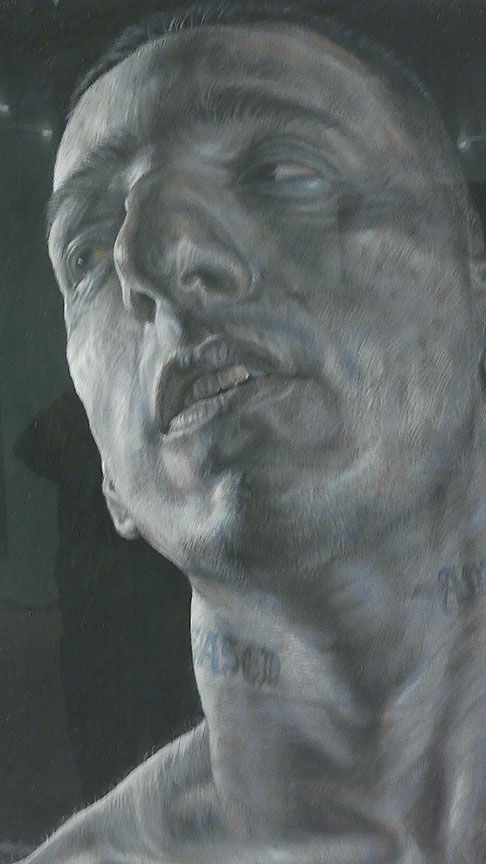
Vincent Valdez, “Made Men: Any Day Now, I Shall Be Released” (detail). Photo: Ruben C. Cordova

The last of the “Made Men” is a contemporary urban male, “a street kid, or homie,” as Valdez describes him. He is also modeled by the artist’s brother, Daniel. At least on the surface, he may seem insouciant. But he is anxious about how to behave in a changing world governed by uncertainty, with the concomitant loss of traditional directives and norms. He looks to the left, surveying the three archetypal male role models with skepticism. He desires to find his own path. 

Valdez’s verbal commentary is the final line from the chorus of Bob Dylan’s “I Shall Be Released” (1967), which appears as a tattoo on the young man’s neck: 

I see my light come shinin’

From the west down to the east

Any day now, any day now

I shall be released


In the context of this series, the verse before the final chorus also appears to be particularly relevant to this young man’s situation:

Now, yonder stands a man in this lonely crowd

A man who swears he’s not to blame

All day long I hear him shouting so loud

Just crying out that he’s been framed


He’s a young man, in a lonely urban crowd, who does not want to be “framed:” he refuses to be boxed into one of the conventional male archetypes.

We might also note the relevance of other lyrics as commentary on all four of these monumental drawings, particularly the second verse:

They say every man needs protection

They say that every man must fall

Yet I swear I see my reflection

Somewhere so high above this wall

Significantly, the lights above the heads of these men carry individualized symbolic meanings. The boxer is framed by arena lights, where he must make his solitary stand within the ring. The martyr witnesses falling stars, commonly associated with end times and terrestrial apocalypse. As noted above, the tracers above the soldier could be the death of him. The young man’s head is framed by street lamps. Alone in the crowd, he does not yet know where to go, or how to act. 

These four men represent masculine options. Though male archetypes are, by tradition, exemplary figures of strength and invulnerability, Valdez has depicted these representatives of manhood at their most vulnerable and their least confident. 

Valdez provides an analysis of the series in which each man has an epiphany, a moment of truth, a flash in which he grasps his individual, unique fate, which he desperately seeks to escape:

They become Frankenstein men. They are the new Frankenstein modern-day creations. Products of a society. Created by society for the use of society – until society is finished with them. [Then] they are discarded and forgotten. Even though each one realizes that all odds are stacked against them, that the fix is already in, they stand defiant… and with a bit of spark in their eye, thinking that they may still… find a way out (“Tuesday Night” lecture). 

These modern ‘monsters” are created by society in order to be used and destroyed. 

Valdez excels in exploring (often quirky) aspects of contemporary masculine identity. One of the most interesting is a pastel titled Yo Soy-ee Blaxican (2003, illustrated in the catalog, p. 69). The title stems from Daniel’s response when Vincent asked him what racial category he utilized at school. Daniel had no experience of Mexico or of the Chicano movement, and he did not identify with the terms Hispanic or Latino. On the other hand, Daniel revered rap music and Tupac Shakur, so he spontaneously invented his own category, which became the title of the piece. Valdez also created a sardonic series called “Flirting Tips for the New Millennium Male,” that spoofed 1950s etiquette books he encountered in a used bookstore. Modeled by Daniel (the artist’s quixotic protagonist in many early works) and his circle, the series drew heavily on Catholic iconography, transposed into modern-day San Antonio. Valdez also created works that explored racial and youth profiling by the police. A sampling of these works would have greatly enhanced the exhibition.

Expulsion, 2002

Vincent Valdez, “Expulsion From the Great City,“ 2002, charcoal on paper, collection of Mollie Middleton. Photo: Ruben C. Cordova

Expulsion From the Great City is part of the “Made Men” series. It can symbolize a potential (and very unhappy) path taken by the final made man. Riffing on the Christian theme of the expulsion of Adam and Eve from paradise, Valdez renders an anonymous, modern-day Adam and Eve, who, naked to the world, are making a forced exit from a great metropolis. Modeled on the artist and his partner at the time, this twenty-first century Adam and Eve stand on the edges of weathered, board-like ledges, as if they were convicts on a ship, condemned to “walk the plank.” 

Perspectival traces of a great boulevard – in the form of streetlights – manifest themselves as triangular wedges behind their heads, which are cropped at the top. This cropping serves to deny specificity and individual identity. These are not foundational mythic figures, like the Biblical Adam and Eve, whose actions reverberate throughout Christian history. They are not bearers of curses. Nor – despite their great scale – are they founders of a new nation.

Vincent Valdez, “Expulsion From the Great City“ (detail), 2002, charcoal on paper, collection of Mollie Middleton. Photo: Ruben C. Cordova

That is not to say that these two figures are not allegorical. They are an Everyman and an Everywoman. They are everyone, but they are no one in particular. They are modern misfits, retreating (against their will) from the city, each of them, judging from their gestures, blaming the other for their loss of home and habitat. 

They are not situated on the edge of a lush, mythic paradise, but rather on detritus-filled ledges. The woman’s feet are framed by McDonald’s french fries, an apple core, crumpled pieces of paper, cigarette butts, and a couple of pennies. And, in this story, a partially eaten apple is no more significant than an unconsumed french fry. 

The man’s feet are framed by an empty beer can, a used condom, cigarette butts, and a newspaper. Like that paper, he is “yesterday’s news.” At least he also has a couple of pennies for his thoughts. 

Similar to the other depicted articles, this pair of humans also serve as discarded objects of little value. They, too, have been swallowed up and spit out by the Great City. This couple is without means, without concord, and without destination. They have no place. Not in the modern world, and not in the one that preceded it.  

And Now for Something Completely Different: El Chavez Ravine, 2005-7
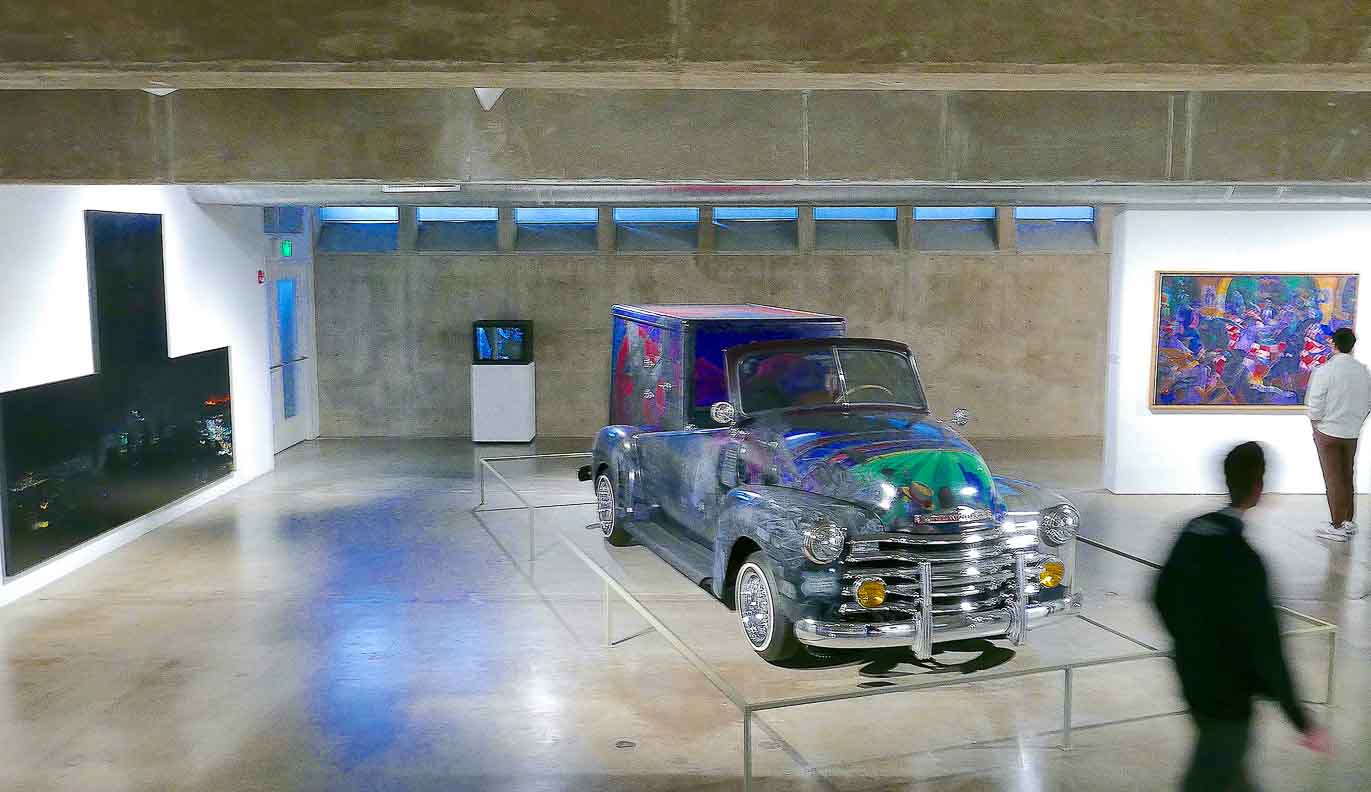
Installation view of the bottom floor of “Vincent Valdez: Just a Dream…,” with “Burn Baby, Burn,” “El Chavez Ravine,” and “Kill the Pachuco Bastards!” Photo: Ruben C. Cordova

The musician Ry Cooder had been looking for someone who could tell the story of Chavez Ravine on the body of a vintage ice cream truck. Because of its scale (larger than a car), its interesting shape (better than a van), its legacy of mobility (ice cream trucks went into every neighborhood), he imagined such a truck would make an ideal, ambulant surface for his vision, since it would be bigger than an easel painting and more mobile and less vulnerable than a static mural. But who could bring this vision to fruition in paint? 

Artist Rubén Ortiz Torres recommended Valdez, saying he was the only person in the world who could do justice to this project. When Ortiz Torres showed Cooder the reproduction of Kill the Pachuco Bastards! in the Chicano Visions catalog, he knew that he had found his man. Cooder couldn’t locate a vintage ice cream truck, so he had Duke’s So. Cal build one out of a 1953 Chevy “three-window job” and customize it into a lowrider. 

After ignoring Cooder’s phone messages for six months (he was working incessantly on the Stations show for the McNay), Valdez called him back. “I thought he was completely insane,” recalls Valdez, “but I thought that I was able to match his insanity in terms of challenging yourself to tackle challenging subjects.” In 2005, Valdez moved to Los Angeles, where he spent two years collaborating with Cooder on the project (see: “In Conversation: Vincent Valdez and Ry Cooder,” Los Angeles County Museum of Art, August 9, 2024).
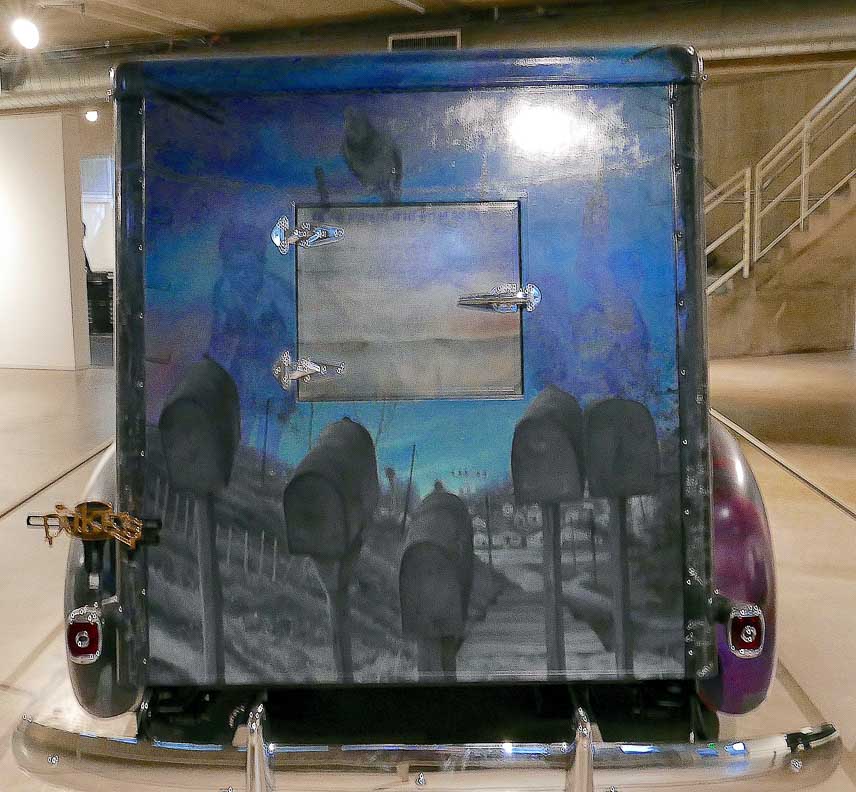
Vincent Valdez and Ry Cooder, “El Chavez Ravine” (rear view), 2005–7, oil on 1953 Chevy Good Humor ice cream truck, collection of Los Angeles County Museum of Art. Photo: Ruben C. Cordova

Cooder wanted a critical history of Chavez Ravine, one that showed how predominantly  Mexican American neighborhoods (Bishop, Palo Verde, and La Lloma), known as a “poor man’s Shangri La,” had been destroyed by the city of Los Angeles. New housing projects were approved in 1949, and residents received notification shortly thereafter. On the rear of the truck (illustrated above), the eviction notice of July 24, 1950, from the Housing Authority of the City of Los Angeles is written on the door, above the depicted mailboxes. As Valdez notes in the “In Conversation Valdez/Cooder” video cited above, he even matched the fonts on the bilingual notices (see detail of the door in catalog, p. 139).

Utilizing eminent domain, the city condemned and ultimately razed Chavez Ravine, ostensibly to build a public housing project to be called Elysian Park Heights. Displaced residents were to have first choice of the new housing. But the project was never built. Public housing – condemned by many in the 1950s as Communistic – became a victim of the Red Scare. A chief proponent of the Elysian Park Heights project had to appear before the House Un-American Activities Committee in 1952, and he was subsequently fired and jailed. 
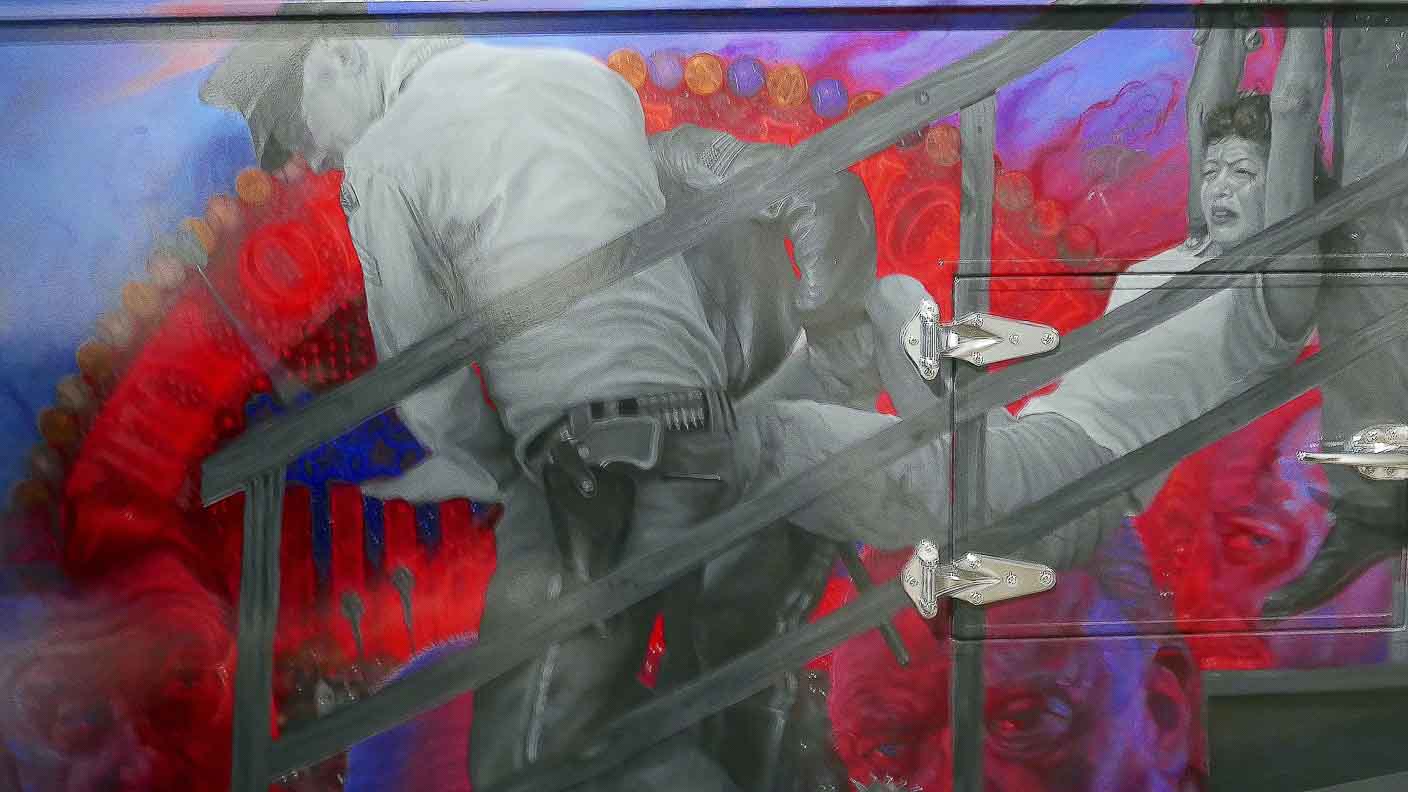
Vincent Valdez and Ry Cooder, “El Chavez Ravine” (right rear view), 2005–7, oil on 1953 Chevy Good Humor ice cream truck, collection of Los Angeles County Museum of Art. Photo: Ruben C. Cordova

Characterizing public housing as “un-American” in his 1953 electoral campaign, the new mayor of Los Angeles later bought the land (steeply discounted) back from the federal government. In 1958, he sold it to the owner of the Brooklyn (New York) Dodgers, who moved his team to L.A. and built Dodgers Stadium on the site. The remaining families were forcibly displaced from Chavez Ravine in 1959, and Dodger Stadium opened in 1962 (see Zinn Education Project).

The above detail spans a decade, with giant faces of key politicians and other officials framed by a wheel-like arch with the City of Los Angeles writ large in neon. Inside of the arch, one catches a hallucinatory glimpse of the imaginary high-rises in the never-built housing complex. The black-and-white section features police forcibly removing a member of the Arechiga family on May 8, 1959 (televised nationally at the time, and screened at CAMH on the TV monitor adjacent to the truck). The family matriarch threw stones at the police, who oversaw the destruction of the Arechiga possessions and house. The next day, a Los Angeles Times headline blared: “Chavez Ravine Family Evicted, Melee Erupts” (see Janice Llamoca, “Remembering The Lost Communities Buried Under Center Field,” CODE SW!TCH: Race in Your Face, NPR, October 31, 2017). 
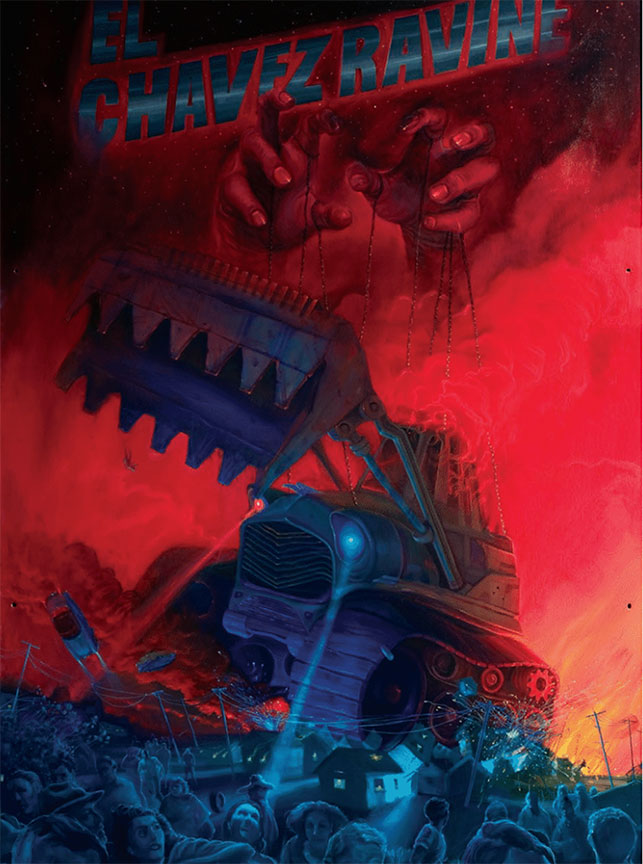
Vincent Valdez and Ry Cooder, “El Chavez Ravine” (top of truck), 2005–7, oil on 1953 Chevy Good Humor ice cream truck, collection of Los Angeles County Museum of Art. Photo: Elon Schoenholz, exhibition catalog, p. 138

In the above view of the top of the truck, which can be viewed at CAMH – as at other venues – via a mirror on the ceiling (albeit in reverse), Valdez has created an image akin to a monster movie poster. Below the title “El Chavez Ravine,” two nefarious, supernatural-looking hands hold chains that function like puppet strings. They can also be interpreted as a critique of the eighteenth-century economist Adam Smith’s theory of the “invisible hand,” which held that the self-interest inherent in market forces generally and inadvertently benefited society.  

The hands operate the infernal machine below. It’s just a bulldozer, but it seems like an other-worldly death machine, like something out of The War of the Worlds, operated by the devil himself. Like a giant tank, it crushes the tiny, matchbox-like houses as if they were mere toys (or Monopoly game pieces), and it sends cars and bodies tumbling into the air. In the foreground, people rush away from this scene of annihilation. The insubstantial houses pose no challenge, so the mighty, crushing claw reaches out for the panicked populace, who we hope will flee a little faster, before it is too late. 

In his inimitable fashion, Valdez captures the horror of eminent domain, as it is utilized by politicians, who habitually employ it to crush communities of color. In the “In Conversation Valdez/Cooder” video linked above, Valdez recalls his father’s account of the eminent domain letter informing him that the family home would be destroyed for the construction of Highway 90 in San Antonio. Valdez also notes the destruction of the Aztlan and Victoria Courts housing projects in San Antonio, which were cleared to make way for the Alamodome sports stadium. 
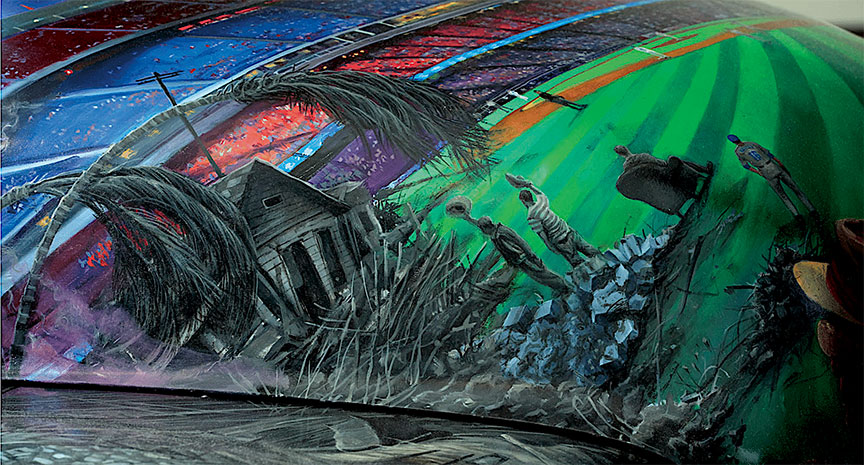
Vincent Valdez and Ry Cooder, “El Chavez Ravine” (detail of hood), 2005–7, oil on 1953 Chevy Good Humor ice cream truck, collection of Los Angeles County Museum of Art. Photo: Elon Schoenholz, exhibition catalog, p. 140-41

In this phantasmagoric detail, Dodger Stadium is already built, and filled to the brim with spectators, in curving stands that are colored red, blue, and purple. Players and umpires are on the field. Yet, on the left, a rickety (evidently partially bulldozed) house, some half-collapsed palm trees, and rebar-reinforced concrete rubble are also on the field. It’s a Field of Dreams in reverse. Instead of an “if you build it, they will come” scenario, some determined residents refuse to leave – ever. In surreal fashion, the neighborhood – or what is left of it – and the stadium coexist.

The rubble is accompanied by three inhabitants of Chavez Ravine. Two of them stand and wave their hats, as if they were greeting a distant friend – but here they seem to be perpetually saying goodbye to their former home. Even more bizarre, a third man is seated in a large easy chair, in front of an outfielder wearing number 16. He appears to be watching the game. As the NPR article cited above notes: “For the next week, the Arechigas camped in front of the rubble that was once their home.” These “out of time” people are family members who still refuse to be displaced by the stadium.

On the hood of the truck, the family members are engaged in an eternal vigil, rather than a short-term one. Since Valdez illustrated a luxury edition of Kurt Vonnegut’s Slaughterhouse Five (1969), I will use a term from that novel. These three people have become “unstuck in time.” In the eternity of time, in order to pass some time, one man turns from wreckage to ballgame. The man on the far right in the above detail is a man watching the ruins more than the game.
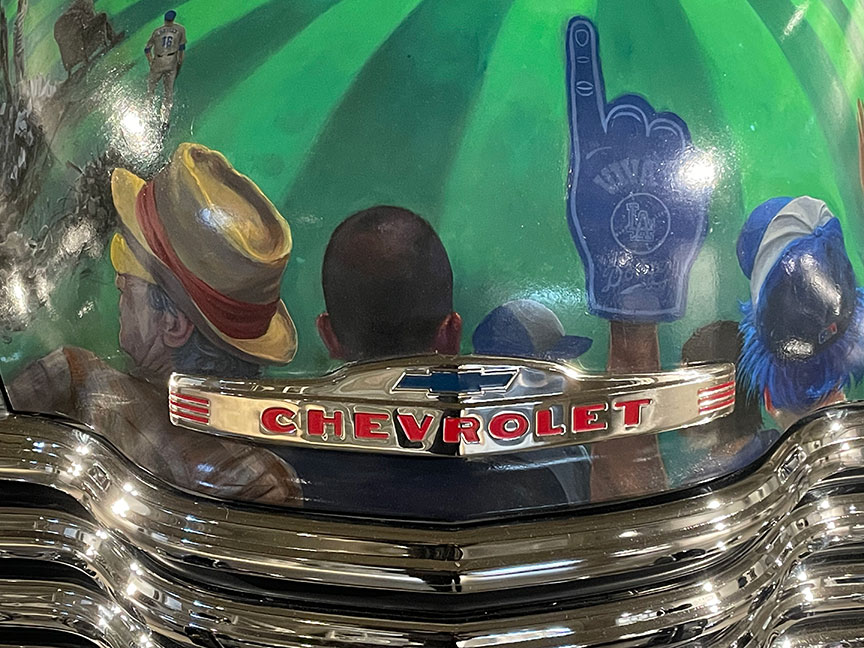
Vincent Valdez and Ry Cooder, “El Chavez Ravine” (detail of hood and bumper), 2005–7, oil on 1953 Chevy Good Humor ice cream truck, collection of Los Angeles County Museum of Art. Photo: Ruben C. Cordova

In the above detail, one can see a man who looks like he is from the past (he is Ry Cooder) looking to the left. The person with the closely cropped hair is the artist himself. One fan to his right (with a brown arm) holds a giant “VIVA LA Dodgers” foam finger, which identifies him as a contemporary Latinx viewer (presumably with no memory of the area’s history). Fictively, the museum visitor is also one of the spectators at Dodger Stadium. But – like Valdez and like the ghosts of Chavez Ravine who inhabit the surface of this vehicle – we see far more than most fans.
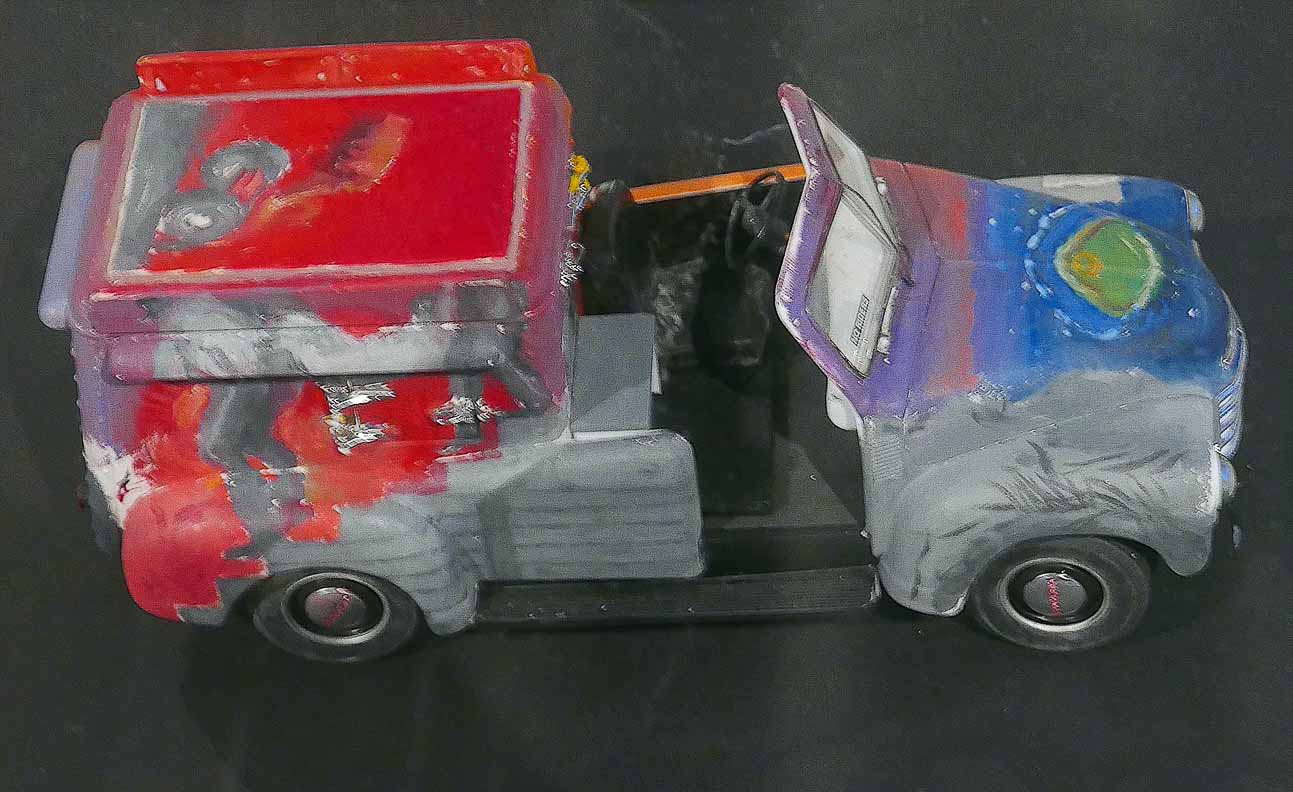
Vincent Valdez and Ry Cooder, “Study for El Chavez Ravine,” partially painted toy truck, collection of the artist. Photo: Ruben C. Cordova

The exhibition included a toy truck (on top of the black flat file), on which Valdez made some preliminary sketches. Over time, his treatment of the ball park became much more complex and sophisticated. On the body of the actual truck, Valdez is at his best when he is at his most surreal, when he brings together multiple realities and combines them with fantasy and/or nightmare. Other portions of the truck are less interesting.  
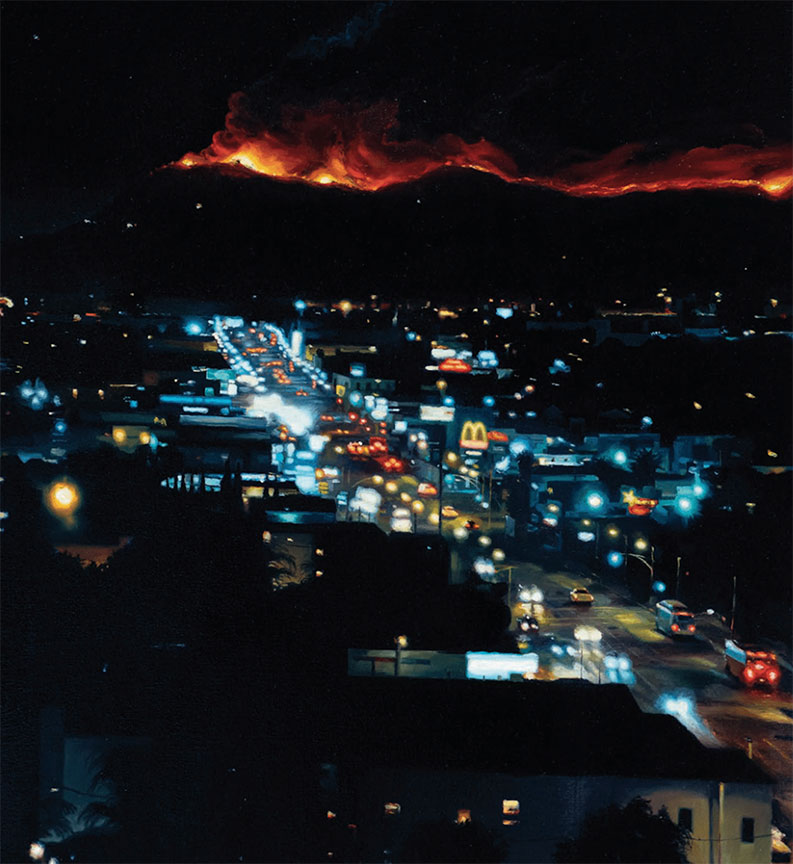
Vincent Valdez, “Burn, Baby Burn!” (detail of right panel, with view of Los Angeles hills on fire), collection of the artist. Photo: Elon Schoenholz, exhibition catalog, p. 204

In the “In Conversation Valdez/Cooder” video linked above, Valdez recalls sitting at a taco restaurant, watching a  woman jog and a man walk his poodles, “and right behind, the entire time in broad daylight, the hills [are] on fire. I just remember thinking ‘this is not normal.’ Nowhere else would this be normal!” 

He mentions Mike Davis’ book The City of Quartz: Excavating the Future in Los Angeles (1990), that, “in many ways, echoes what the future of America will become,” which, for Valdez, is part of L.A.’s appeal. 

In Burn, Baby Burn!, Valdez has presented the hill fire in a nocturnal setting, where it dazzles like a flaming curtain on the mountainous perimeter of the city, a small taste of the dangers always lurking in the hills, which exploded in the horrific, uncontrollable fires that consumed so much of L.A. earlier this year.   

Excerpts for John, 2012
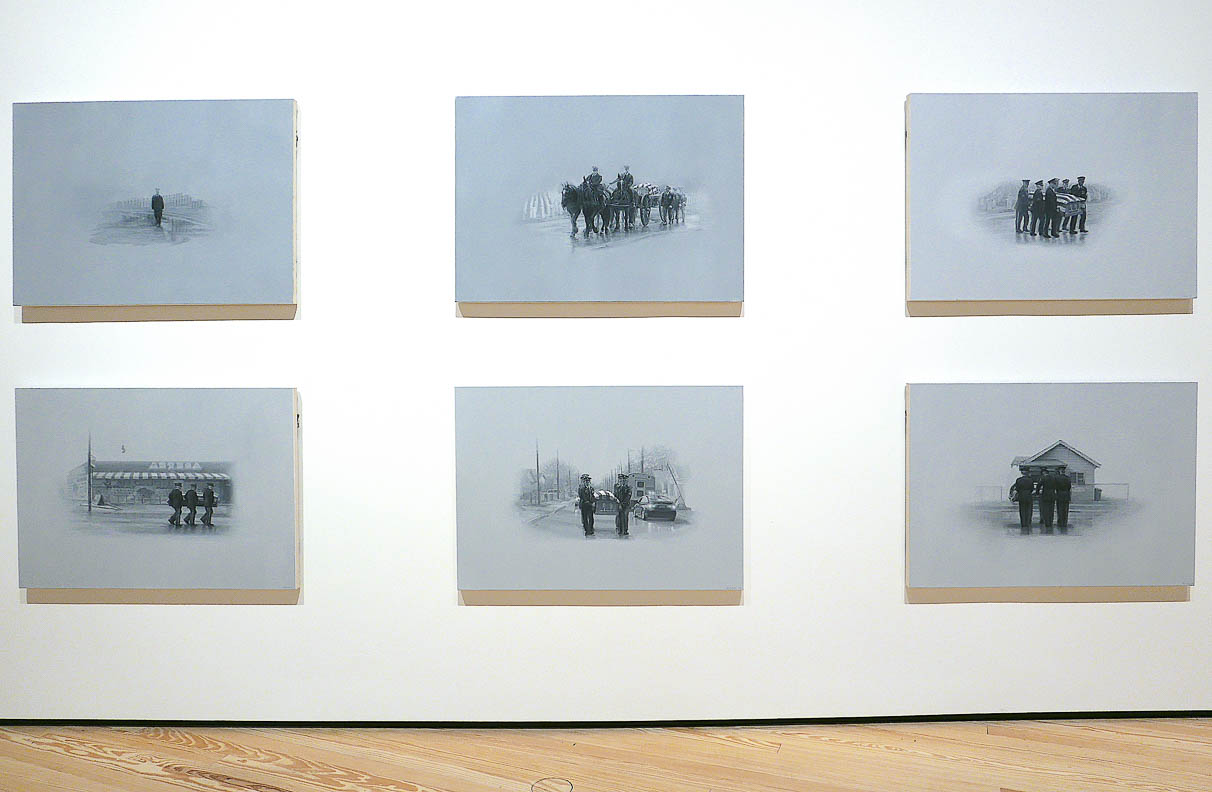
Vincent Valdez, “Excerpts for John,” 2012, oil on canvas, set of six, collection of the Lucas Museum of Narrative Art, Los Angeles. Photo: Ruben C. Cordova

Excerpts for John is an homage to Valdez’s best friend Robert Holt, Jr. (1978-2009), who joined the military in order to attend college. Holt served as a combat medic in Iraq but suffered from PTSD and killed himself. The six paintings in this series “translate” the artist’s emotions on the cold, rainy day of his funeral. 

Such a constrictive project – with so much white space and a severely restricted palette – is extremely self-limiting. It’s like Superman choosing to paint with a Kryptonite brush. I wish there were more parts to this story, such as six dream-like paintings of Holt imagining his career after college, and another set depicting the hellish experiences he encountered in Iraq (though he didn’t want to talk about these experiences). Were this the final set of a longer series, it would have more impact. 

Valdez did a large portrait of Holt in action called John (2010-12, not in CAMH exhibition), which he donated to the Smithsonian American Art Museum in 2019. Wally films made a short film called Vincent Valdez: Excerpts for John (2012) that treats both John and Excerpts for John.

The Strangest Fruit, 2013
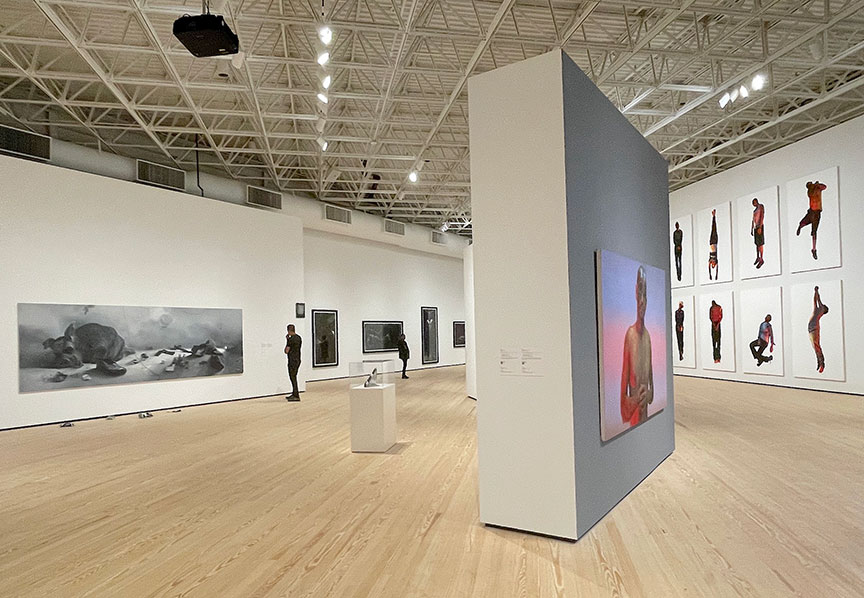
Installation view of “Vincent Valdez: Just a Dream…,” with “Eaten (In America)” left; “Goodbye Marianne” (on gray wall); and “The Strangest Fruit” (right). Photo: Ruben C. Cordova

In 2013, Valdez created a series whose title is inspired by the song Strange Fruit, which was made famous by Billie Holiday. The anti-lynching song was written by Abel Meeropol, a member of the Communist Party, in 1937. Its three verses are as follows: 

Southern trees bear a strange fruit

Blood on the leaves and blood at the root

Black bodies swinging in the Southern breeze

Strange fruit hanging from the poplar trees


Pastoral scene of the gallant south

The bulging eyes and the twisted mouth

Scent of magnolias, sweet and fresh

Then the sudden smell of burning flesh


Here is a fruit for the crows to pluck

For the rain to gather, for the wind to suck

For the sun to rot, for the tree to drop

Here is a strange and bitter crop

The U.S. government, in particular Federal Bureau of Narcotics commissioner Harry Anslinger, persecuted Holiday simply for singing the anti-slavery song. Her cabaret license was revoked, and she was prevented from receiving medical attention, which led to her death (see: Liz Fields, “The story behind Billie Holiday’s ‘Strange Fruit,’” American Masters, PBS, April 12, 2021).

Whereas Meeropol’s song addresses the lynching of blacks, in this series, Valdez wanted to call attention to the much lesser-known lynching of Mexican Americans, particularly in Texas (see Nicholas Villanueva Jr., The Lynching of Mexicans in the Texas Borderlands, Albuquerque: University of New Mexico Press, 2017). At the same time, Valdez also wanted to comment on ongoing forms of oppression against Mexican Americans/Chicanos, Latinx, and people of color in general. 

Therefore, Valdez had his models (which, as usual, were friends or family members) dress in contemporary clothes. He consulted with his models, and he showed them historic photographs of lynched black men, primarily from the book Without Sanctuary: Lynching Photography in America (James Allen, ed., Santa Fe: Twin Palms, 1999), which were utilized as rough templates to give a sense of the appearance of lynched corpses. 

Valdez explained this series in a 2013 lecture:

… metaphorically speaking, these dangling males are equivocal of both the past and the present. They symbolize the estimated thousands of brown bodies that have been erased throughout Texan and American history during the lynching era of the 1800s, and into the present. Most importantly, these portraits [also] represent the contemporary brown minority male, who continues to struggle free from the invisible noose in modern-day America (“The Strangest Fruit: A Symposium: Vincent Valdez,” Brown University, October 18, 2013).

In this 2013 lecture, Valdez listed contemporary, ongoing forms of oppression that constitute the “invisible noose:”

Oppressive methods and institutions, which are implemented to target and confine young males in society, such as mass incarceration, [for] profit prison systems, biased justice systems, defunded education, racial profiling, stereotyping, police brutalities, poverty, drug wars, military wars, assimilative measures, mass deportation, and immigration hysteria are just a few of the insurmountable measures that loomingly threaten young minority males at an early age.  
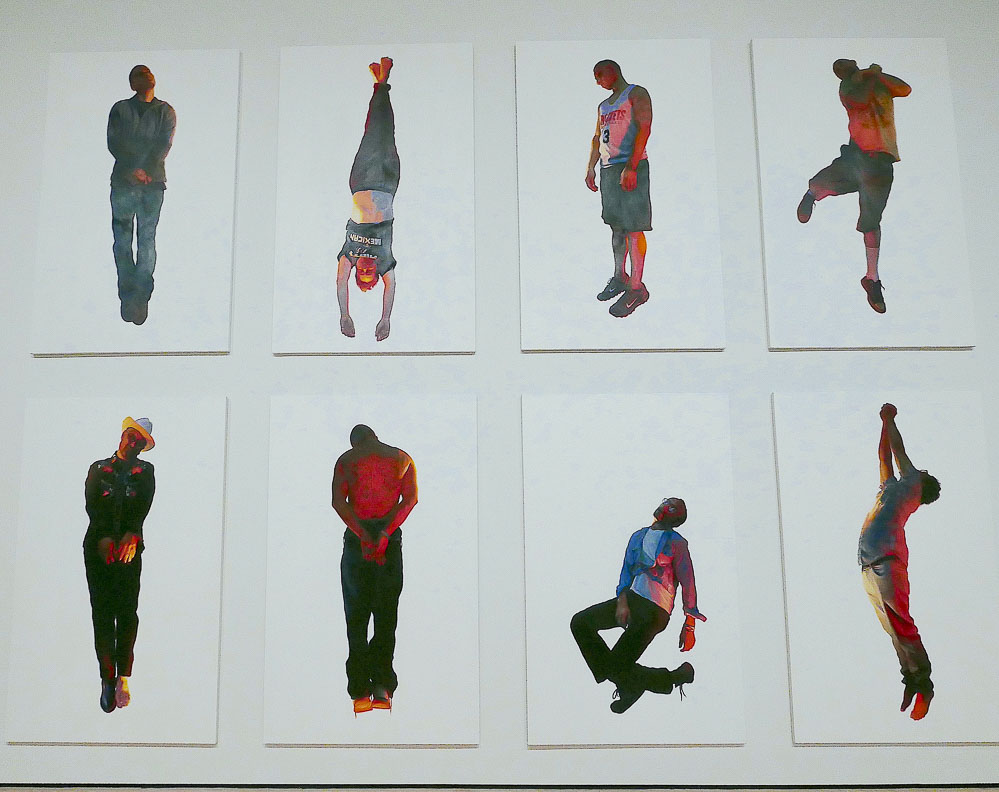
“Vincent Valdez: Just a Dream…,” installation view of “The Strangest Fruit.” Photo: Ruben C. Cordova

Valdez also explained his rationale for isolating his figures, which stripped them of context. By eliminating the nooses, trees, white spectators (who often picnicked at lynchings, which had a celebratory, carnival atmosphere in the South), etc., he made the contorted bodies a site of singular focus. These bodies struggle, continues Valdez, not only to disentangle themselves from the physical noose, but also “the mental noose that is ever-present, and prevents them from ever becoming truly free.” 

Valdez has blended the historical and the contemporary, and in so doing, he has endowed the lynching theme with a double meaning: on the one hand, literal historical lynching (the physical noose), and, on the other, oppressions that continue to this day (the mental noose). Moreover, he likens these lynched, floating, or resurrected men to the boxers, soldiers, and persecuted martyrs who are “struggling to become free, facing all odds.” Consequently, they are a continuation of his earlier themes. 

Moreover, in these paintings, the stripping-down of subject matter to the forms of the solitary bodies produce deliberate ambiguity. It is for the viewer, says Valdez, “to decide whether these male bodies are descending or dangling from a tree… Or… doing quite the opposite… ascending into the heavens… being resurrected from the past once again.” Consequently, these bodies, which bear the marks of suffering and death, can also signify release, and a resurrection of sorts, in the form of release from the “mental noose.” Eliminating backgrounds also permitted Valdez to produce the series quickly. In a year’s time, he was able to complete a dozen canvases.
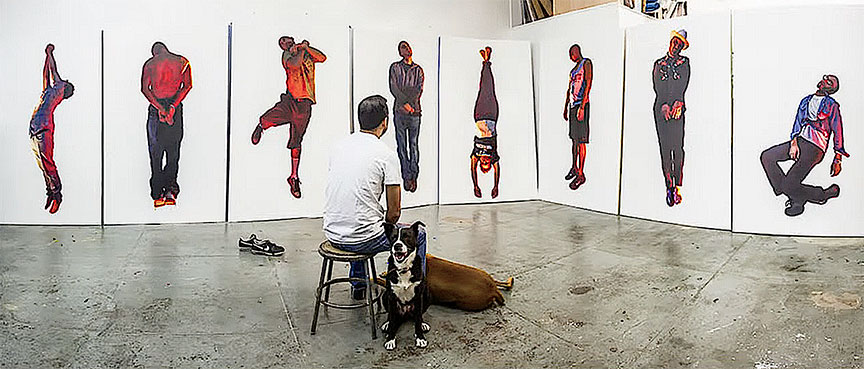
Vincent Valdez, in studio with “The Strangest Fruit,” 2013. Photo: Vincent Valdez website

Ironically, in practice, Valdez found that he had to rely on physical nooses in order to make sufficiently compelling photographic studies for these paintings. All previous efforts had failed, until he not only tied the hands and feet of his models but also had assistants pull on nooses affixed around their living necks. Only the deployment and tightening of actual nooses enabled him “to capture” the characteristic contortions of the tongue, the bulging of the eyes, the spastic, desperate extensions of the fingers, and the precise, twisted facial expressions caused by asphyxiation. The physical nooses that had been so necessary in the studio were subsequently eliminated in his paintings. The colorful Texas skies that had dominated the backgrounds of so many of his paintings and pastels were projected onto the bodies themselves.

The City I & II, 2015-16
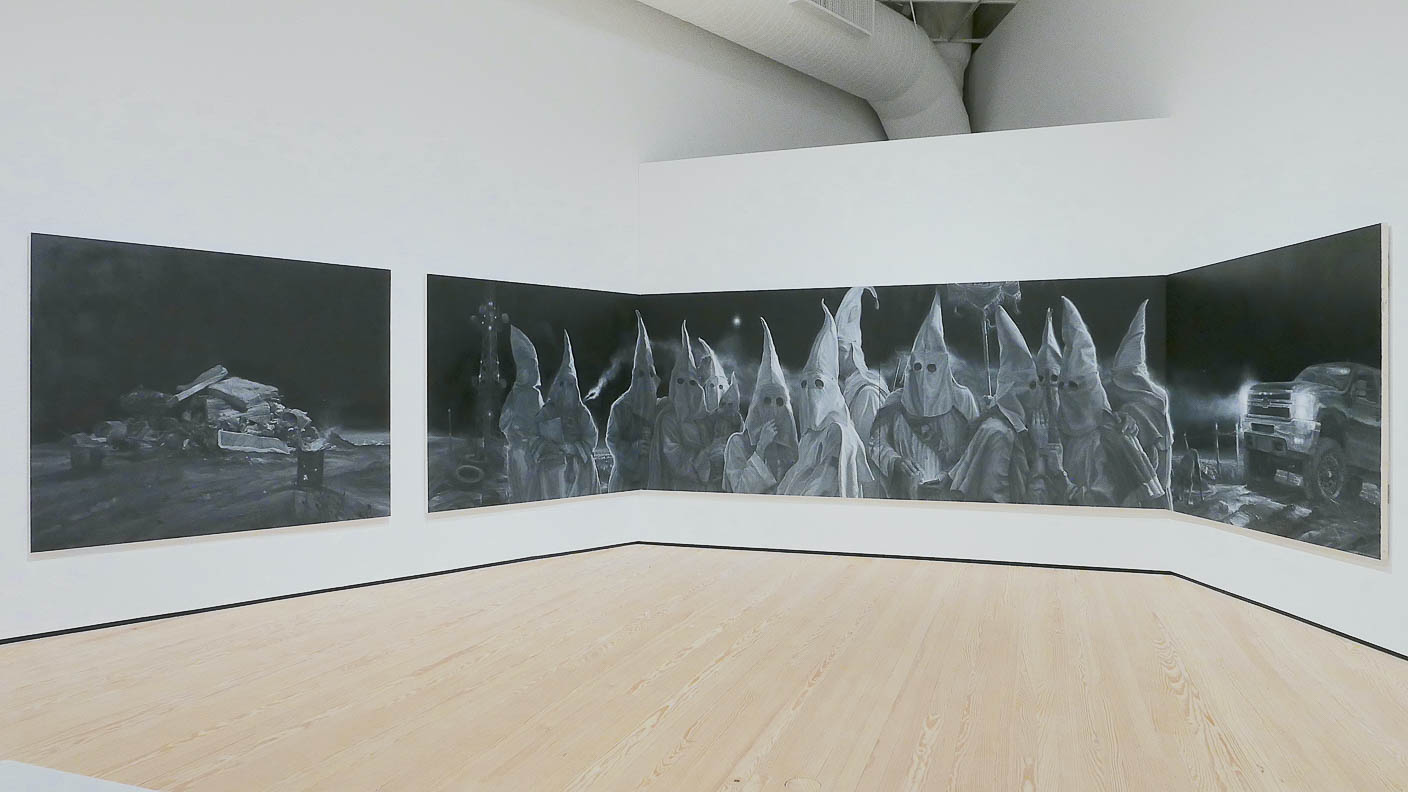
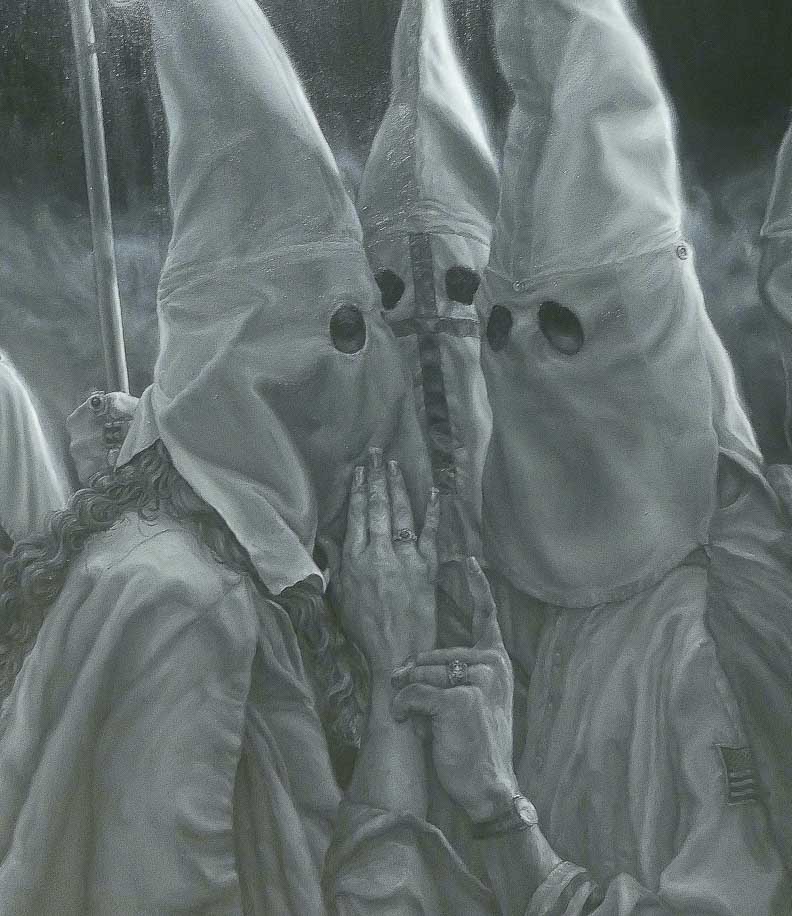
Vincent Valdez, “The City I & II,” 2015-16, oil on canvas, collection of the Blanton Museum of Art, University of Texas at Austin. Photo: Ruben C. Cordova

Encountering Philip Guston’s The City (1969) at the Blanton Museum in Austin provided Valdez with the spark to make these two paintings. He made connections with other works of cultural commentary when he was driving home, especially Gil Scott-Heron’s song The Klan (1980). (Valdez dedicated these two paintings to Guston and Scott-Heron.) When Valdez got home, he began sketching men in Klu Klux Klan (KKK) robes (see “FAQs,” Vincent Valdez, The City, 2018, The Blanton Museum of Art, which includes an illustration of the Guston).

Below the surface, an encounter Valdez had with the KKK had been festering for years. When he was sixteen, Valdez inadvertently passed through police tape at the Alamo on his way home from work. Suddenly, he came face-to-face with a KKK Grand Dragon, whose headpiece revealed his face. What must have been a speedy stare-off seemed like an eternity to the artist. Valdez noticed men in white marching, and a group of counter-protesters, amid a considerable amount of shouting. He had stumbled upon a Klan rally, right at the Alamo. Valdez noticed a line of policemen (all black or brown) who had interposed themselves between the KKK and the counter-demonstrators. The experience made Valdez reflect on his place in his native city, and it engendered a sense of anomie. Valdez recalls having the feeling, for the first time in his life, that “I don’t belong here” (see “Maria Hinojosa & Vincent Valdez Conversation,” Vincent Valdez, The City, 2018, The Blanton Museum of Art). 

Valdez’s setting for these two paintings is nonspecific, and the human encounter is imagined. As he explains: “This could be any city in America. These individuals could be any Americans. There is a false sense that these threats were, or are, contained at the peripheries of society and in small rural communities” (see “About the Art,” Vincent Valdez, The City, 2018, The Blanton Museum of Art).

The black-and-white palette blurs the separation between documentary photography and art, and between time periods. The artist intended to create a degree of confusion and instability, and thereby to bind past and present, as he did in The Strangest Fruit. This vision of the KKK and of the garbage heap (the latter is the subject of The City II) is a cumulative, totalizing indictment of U.S. history. “The image is twenty-first century America,” explains Valdez, “but it also reveals all of the previous American centuries before it” (“FAQs”). 

Valdez has always been critical of the naive assertion that Barack Obama’s election to the presidency demonstrated that the U.S. had become a “post-racial society,” and The City I constitutes “push-back” against that view. Instead, Valdez views racism and inequality as national constants, as American as apple pie. In fact, on these shores, they were firmly established as national traits before apple pie became a national symbol, because, as the expression goes, racism and white supremacy were baked into the Constitution. 

Valdez enumerates the possible roles and professions of the KKK members: “It is possible that they are city politicians, police chiefs, parents, neighbors, community leaders, academics, church members, business owners, etcetera. This is the most frightening aspect of it all” (“About the Art”). Historically, civic leaders and authorities were at the center of Klan activities, which is why they were able to terrorize and murder with impunity. 

Today, if anything, white supremacists (though no known KKK members) are likely to have higher positions within the Trump administration than they have enjoyed on the national scene in a century or more. 

In Valdez’s fictive scenario, the KKK members are in the process of assembling. They have not yet commenced their secret rituals. Essentially replaying Valdez’s encounter at the Alamo, the visitor to the museum looks at the Klanspeople (Valdez has pointedly included women and a child), and they in turn look at the visitor who stands before them. 

19 Mar 13:19

We Regret to Inform You We Will No Longer Sponsor Your Pride Parade

by Sam Stone

“San Francisco Pride loses $300,000 after sponsors drop out: ‘The tone has changed in this country.’” — Them, 3/17/25

- - -

Dear Queer Organization,

This isn’t an easy letter to write, but after so many years together, we owe you honesty and transparency, so we will say this as plainly as we can: We, a multinational corporation, will no longer be funding your pride parade or any of its associated homosexual activities. We know that for years we donated funds, shamelessly appropriated rainbow branding for the month of June, and gave away countless branded T-shirts at pride parades, but now, we think it’s best that we go our separate ways.

We realize everyone says this, but it’s not you, it’s us—well, it’s not so much us as it is our shareholders who demand that we take any action, regardless of its inhumanity, so long as it leads to profits. In fact, the shareholders have helped us understand that we’re in different places. Your rights are being threatened in new and unprecedented ways. And us? Well, we’re just ready to try new things.

Maybe we’ll experiment with some kind of hellish AI chatbot. Maybe we’ll give our C suite a raise while keeping employee wages flat. Maybe we’ll do some performative fascist bootlicking in the form of eliminating programs aimed at bolstering diversity within our organization—the point is, it’s time for us to spread our wings and fly.

We want you to know that this doesn’t take away the incredible times we’ve had together. Remember that year we featured a single attractive white gay couple chastely holding hands in one of our ads? It was you and us against the world. And what about when you and your community spent millions of dollars on our products over years and years, believing that we were somehow more ethical and equitable than our competitors? And—gosh—we’ll never forget that time our corporate account tweeted “What’s tea?” and someone replied “Mother.” We were unstoppable together!

We think we owe it to each other to be radically honest. We’ll go first: You are a marginalized community, and as a bloodthirsty corporation desperate for profits, we’re just being honest when we say you will never be enough for us. We need to be with customers that are—how do we say this?—less… politically inconvenient? Less… likely to upset the conservative oligarchs sitting on our board of directors? You know what we mean.

We’ve been talking to the shareholders a lot—and before you say anything, because we know you guys never liked each other—they’ve actually been really supportive through this whole thing. They were saying that you were a suppressive presence in our life. Like, you never even tried getting into a single one of our hobbies. Would it have killed you to try price gouging even once?

Listen, we loved “us.” We loved counting you as a profitable demographic. We loved publicly performing our allyship in the loudest way possible, and we love how that ultimately hollow performance distracted from all the FTC regulations we must keep breaking to remain profitable. But the fact is, that time in our life is over. It’s dead. And it’s never coming back. Unless, of course, the political and cultural landscape radically changes in a few years, which is why we’d love to find a way to stay friends.

We really do want to stay in touch. We’d love for us to find a way to be part of each other’s lives. We don’t want you to think we’re just abandoning you at the exact moment when allyship would actually count for something tangible in this world.

Sure, that’s what this is, but we don’t want you to think that.

Sincerely,
A Multinational Corporation

19 Mar 12:49

Pluralistic: You can't save an institution by betraying its mission (19 Mar 2025)

by Cory Doctorow


Today's links


The Columbia University library, a stately, columnated building, color-shifted to highlight reds and oranges. The sky behind it has been filled with flames. In the foreground, a figure in a firefighter's helmet and yellow coat uses a flamethrower to shoot a jet of orange fire.

You can't save an institution by betraying its mission (permalink)

Paula Le Dieu is one of the smartest, most committed archivists I know. Many years ago, she shared a neat analogy with me about the paywalling of public archives, a phenomenon that has become rampant as public institutions have been pushed to seek private funding to close the gaps left by swingeing cuts.

Closing up these archives in order to give these new "investors" a chance to make their money back is pitched as just "good business." But – as Paula pointed out – this isn't how business works at all! If you are an early-stage investor to a startup, providing patient capital in its early stages, then later investors don't get to zero out your shares. If a museum or public broadcaster is a business, then the public is the early investor, and their share is access. Taking away free access is tantamount to wiping out our investment.

But of course, public institutions aren't businesses, and they don't exist to make profits. They exist to serve the public interest. If your public health system, public education system, public archives, public museum or public parks are making a profit, then something is desperately wrong.

Managers of these public institutions forget this lesson at their peril. Every public institution eventually faces an existential funding crisis, and when that crisis strikes, the only thing that will save you is public support. Back in 2014, I got to speak to a group of curators about this when I keynoted the Museums and the Web conference in Florence:

https://mwf2014.museumsandtheweb.com/paper/glam-and-the-free-world/index.html

Since then, I've had many chances to talk with Paula about her views on archiving in these apocalyptic times. She's come up with a crisp formulation of the point I tried to make in that speech – when archives trade access off for preservation, they sign their own death warrants. As I said in my speech, if you don't maximize public access to your archive, then there will come a day when they take away your funding and the public won't care because you locked them out of their own collection. When that happens, all your careful preservation work will be used to prepare the auction catalog for the sale of your collection to the "philanthropic" billionaires who insisted that you lock up the collection in the first place. Your meticulous documentation will become the manifest for a shipping container full of formerly public treasures that will henceforth reside in a lightless, climate-controlled warehouse in the Geneva Freeport.

My conversations with Paula came back to me this weekend when I listened to Corey Rubin talking with Brooke Gladstone on NPR's On the Media, about the universities that are seeking to avert Trump's attacks by sacrificing students and faculty who spoke out against Israel's genocidal attacks on Palestine:

https://www.wnycstudios.org/podcasts/otm/articles/mahmoud-khalil-and-a-new-red-scare-plus-press-freedom-under-threat

From Columbia's complicity in the kidnapping of green card holder Mahmoud Khalil, a grad student now held in immigration detention in Louisiana; to Yale professor Helyeh Doutaghi, suspended because an AI-driven pro-Israel site hallucinated a connection between her and Hamas:

https://coreyrobin.com/2025/03/15/mccarthyism-at-yale-then-and-now/

These institutions – and others, like the LA Children's Hospital, which halted gender-affirming care for trans kids – aren't merely "complying in advance." They are betraying their mission in order to save their bacon:

https://www.latimes.com/california/story/2025-02-04/childrens-hospital-to-stop-initiating-hormonal-therapy-for-trans-patients-under-19

This will come back to bite them in the ass. This is like firefighters doing a bit of arson on the side to make ends meet, and thinking that the townsfolk will continue to vote to maintain their budget.

I get it: it's damned easy to convince yourself that you need to destroy the village to save it. By "living to fight another day," you will get more chances to serve the public. Rationalization is a hell of a drug:

https://pluralistic.net/2023/07/28/microincentives-and-enshittification/

Trump and his fascist movement wont't let up on their assault against institutions that support free inquiry, care, justice and openness. Rolling over for them now will not keep you safe tomorrow. But with every betrayal, these institutions alienate more and more of the public, without whose support they are ultimately doomed. Supporters will get you through times of no money better than money will get you through times of no supporters.

(Image: AJ Suresh, CC BY 2.0, modified)


Hey look at this (permalink)


A Wayback Machine banner.

Object permanence (permalink)

#20yrsago Yahoo! bought Flickr! https://web.archive.org/web/20050328011033/http://blog.flickr.com/flickrblog/2005/03/yahoo_actually_.html

#10yrsago Suspicious people, American Airlines edition https://flickr.com/photos/doctorow/16690196059/

#5yrsago Republican senators told us everything was fine as they secretly panic-sold their stocks https://pluralistic.net/2020/03/20/pluralistic-20-mar-2020/#senate-selloff

#5yrsago Right to Repair during pandemics https://pluralistic.net/2020/03/20/pluralistic-20-mar-2020/#r2r

#5yrsago Judge overturns terrible copyright decision against Katy Perry https://pluralistic.net/2020/03/20/pluralistic-20-mar-2020/#fair-use

#5yrsago Patent trolls spin their shakedown of covid testing tech https://pluralistic.net/2020/03/20/pluralistic-20-mar-2020/#pandemic-profiteers

#5yrsago Dafoe's plague diaries https://pluralistic.net/2020/03/20/pluralistic-20-mar-2020/#dafoe-knew

#5yrsago Open source hardware ventilator enters testing https://pluralistic.net/2020/03/20/pluralistic-20-mar-2020/#oshw-breathing

#5yrsago Ifixit's new database of med-tech repair guides https://pluralistic.net/2020/03/20/pluralistic-20-mar-2020/#youfixit

#5yrsago Simon Pegg's coronavirus Sean of the Dead remake https://pluralistic.net/2020/03/20/pluralistic-20-mar-2020/#the-plan

#5yrsago Trump is outbidding state agencies for medical supplies https://pluralistic.net/2020/03/20/pluralistic-20-mar-2020/#heckuvajob-brownie

#1yrago Working class Dems who campaign on economics beat Trumpists in elections https://pluralistic.net/2024/03/20/actual-material-conditions/#bread-and-butter


Upcoming appearances (permalink)

A photo of me onstage, giving a speech, pounding the podium.


A screenshot of me at my desk, doing a livecast.

Recent appearances (permalink)


A grid of my books with Will Stahle covers..

Latest books (permalink)


A cardboard book box with the Macmillan logo.

Upcoming books (permalink)

  • Enshittification: Why Everything Suddenly Got Worse and What to Do About It, Farrar, Straus, Giroux, October 7 2025
    https://us.macmillan.com/books/9780374619329/enshittification/
  • Unauthorized Bread: a middle-grades graphic novel adapted from my novella about refugees, toasters and DRM, FirstSecond, 2026

  • Enshittification, Why Everything Suddenly Got Worse and What to Do About It (the graphic novel), Firstsecond, 2026

  • The Memex Method, Farrar, Straus, Giroux, 2026


Colophon (permalink)

Today's top sources:

Currently writing:

  • Enshittification: a nonfiction book about platform decay for Farrar, Straus, Giroux. Status: second pass edit underway (readaloud)
  • A Little Brother short story about DIY insulin PLANNING

  • Picks and Shovels, a Martin Hench noir thriller about the heroic era of the PC. FORTHCOMING TOR BOOKS FEB 2025

Latest podcast: With Great Power Came No Responsibility: How Enshittification Conquered the 21st Century and How We Can Overthrow It https://craphound.com/news/2025/02/26/with-great-power-came-no-responsibility-how-enshittification-conquered-the-21st-century-and-how-we-can-overthrow-it/


This work – excluding any serialized fiction – is licensed under a Creative Commons Attribution 4.0 license. That means you can use it any way you like, including commercially, provided that you attribute it to me, Cory Doctorow, and include a link to pluralistic.net.

https://creativecommons.org/licenses/by/4.0/

Quotations and images are not included in this license; they are included either under a limitation or exception to copyright, or on the basis of a separate license. Please exercise caution.


How to get Pluralistic:

Blog (no ads, tracking, or data-collection):

Pluralistic.net

Newsletter (no ads, tracking, or data-collection):

https://pluralistic.net/plura-list

Mastodon (no ads, tracking, or data-collection):

https://mamot.fr/@pluralistic

Medium (no ads, paywalled):

https://doctorow.medium.com/

Twitter (mass-scale, unrestricted, third-party surveillance and advertising):

https://twitter.com/doctorow

Tumblr (mass-scale, unrestricted, third-party surveillance and advertising):

https://mostlysignssomeportents.tumblr.com/tagged/pluralistic

"When life gives you SARS, you make sarsaparilla" -Joey "Accordion Guy" DeVilla

ISSN: 3066-764X

19 Mar 12:42

HR changed our performance reviews, do I have to announce my pregnancy at work, and more

by Ask a Manager

This post was written by Alison Green and published on Ask a Manager.

It’s five answers to five questions. Here we go…

1. Should I say something about past allegations against a colleague?

I started a new position about six months ago, working with partner organizations across the state on community projects. On a recent call, I was surprised to see someone I’ll call Brad.

I knew Brad from my time teaching in a different city, where he was an activist in the reproductive health rights space. A few years ago, Brad had to leave that work and relocate after being accused of grooming minors. Two friends who work in that space told me about it at the time.

Now, Brad is working in a different community-focused role, and while it’s unrelated to reproductive health, they are still in a position of influence. My role is to provide technical assistance to help make a project feasible for the community Brad works with. Brad is actively facilitating conversations with our partners. It feels surreal to be in meetings with someone who had to leave their previous job due to allegations of being a sexual predator. However, everything I know is secondhand. I don’t know if Brad’s new role involves minors.

Do I have an obligation to say something to my boss? Should I bring this up, even if I don’t have firsthand knowledge? Or is this one of those situations where I just have to compartmentalize and move on?

I don’t think you have an obligation to say something to your boss since (a) Brad isn’t working for your organization and (b) you heard about the allegations secondhand. But I don’t think think you’d be wrong to have a quiet word with your boss about it either — framed as, “I only have secondhand knowledge of this and no idea if his current job involves minors, but given that minors were involved previously, I felt uncomfortable keeping it to myself. Is this something you think we need to do anything with?”

2. HR unilaterally changed our performance reviews

During our most recent performance review period, managers were told that they had to score 75% of employees as 3s on the overall 1 through 5 rating scale (5 being the best), with the remainder split between 1/2/4/5s. Apparently, despite this, there were too many high scores given so HR went in and — seemingly randomly since they most certainly don’t have insight into people’s day-to-day performance — knocked people down to 3s. They also asked managers to change their comments on the reviews of people who had this happen to reflect the new scores. I was among this lucky demoted group, and since confirming that neither my manager or grandboss had any input on this change, I’ve felt increasingly frustrated by this situation since it has the potential to affect future promotions as well as this year’s salary increase and bonus.

Ranting about it to a friend who works in a different industry I found that his company had done the same thing! Is this a new trend? Can you think of any way to push back against this? One further complication is that it’s unclear if HR realizes that everyone knows what they did (a lot of managers were not happy with the changes).

This is not a new trend, but it’s a ridiculous practice. There have always been companies that insist on a certain distribution of performance evaluation ratings, which has always caused problems for managers and teams whose performance didn’t line up with the required distribution of scores. But the idea of HR randomly changing ratings and then demanding managers rewrite their comments to justify those ratings is an extra level of ridiculous; typically they’d just tell managers that they need to change their ratings and leave it to them to decide how to do that.

I do wonder whether it’s true that HR chose the new ratings randomly or whether it was based on anything (including conversations with managers). Managers wouldn’t necessarily disclose the latter to you, and might even prefer to let HR take the blame.

As for pushing back — if you’ve had glowing feedback all year (especially if it’s documented, but even if it’s not) and/or if you’ve met/exceeded the goals that were laid out for you, you could certainly highlight that and ask how your rating squares with your performance and the feedback you’ve received from your manager. They might not care, but it’s a reasonable avenue to pursue.

3. Do I have to announce my pregnancy at work?

Would it be extremely weird if I just didn’t widely announce my pregnancy at work? My boss and grandboss know, and a few other individuals I chose to tell, but I just really don’t want to make a big email announcement. I have a lot of anxiety about this pregnancy and it feels like a jinx (even though logically I know it’s not). But people will be able to tell I’m pregnant soon. Will it be weird if I go around with an obviously pregnant belly without ever having said anything? Am I inviting gossip and/or nosy questions? Do I just need to get over myself and send the darn email?

In some office cultures it might be a little weird. That doesn’t mean you have to announce if you don’t want to, though, and it sounds like the people who need to know already do.

For what it’s worth, in the offices where it would be unusual, I do think you could be inviting more speculation and gossip by not sharing it with the people you work with the mostly closely. Again, you don’t have to if you don’t want to, obviously it’s no one’s business, etc. etc., but realistically on closer-knit teams, people may notice and wonder if they missed an announcement. In fact, an advantage of sending a brief announcement is that if you want to, you could explicitly say, “I’m nervous about the pregnancy and would prefer not to be asked about it at work, thanks for understanding.”

Related:
my employee didn’t tell anyone she was pregnant until she was about to give birth

4. Was this training’s explanation of discrimination correct?

I had to take a training on workplace discrimination and harassment that was mandatory for all employees at my company. As part of the training, we were asked a series of hypothetical questions and had to answer whether they constituted discrimination or harassment. One example involved a graphic design company that had a project to design a logo for a football team, and gave the project to a male employee over a female one because “men know more about football then women.” The explanation given was that it was discrimination because whether someone knows about football is not relevant to their job performance.

It seems to me that if you’re designing a logo for a football team, your knowledge of football is indeed relevant to your ability to do so. The issue here is that they assumed the male employee must know more about football than the female employee solely because of his gender. Therefore, it does indeed constitute discrimination but the provided explanation is wrong. Whose explanation is correct?

Yours. It’s illegal discrimination to assign a project based on gender (“men know more about football than women do”) but not to assign a project based on a specific person’s knowledge or interest (“Lucas knows the most about football”).

Whoever presented this training (a) doesn’t have a good grasp of the material and (b) probably got sidetracked by the gendered nature of the sport and hopefully would recognize that “I’m assigning X to Lucas because he knows a ton about frogs” would be fine.

5. Are non-competes still legal?

I had a recruiter reach out to me for a job at a direct competitor. I’m not looking to leave, but I also mentioned that I have a non-compete.

He told me those “aren’t a thing anymore” and it wouldn’t hold up in court anyway. But I’ve been tracking them and saw that the FTC was trying to pass a law in September to stop non-competes nationally but it was being challenged by two different Texas courts and now the law is in limbo.

The recruiter said I was wrong, so I wanted to ask you since I know you have reported on them in the past. Can you give us an update? Again, I’m not looking to leave, but if I was I wouldn’t be comfortable with “it wouldn’t hold up in court.”

Yes, non-competes are still legal at the federal level.

In April 2024, the Federal Trade Commission announced it would ban them for most U.S. workers, saying they stifle wages. But before that could take effect, two federal courts (one in Texas and one in Florida) issued injunctions blocking it, saying the agency lacked the authority to issue the rule. The FTC was originally expected to appeal those rulings, but that’s much less likely to happen under the new administration.

In addition, in 2023 the National Labor Relations Board’s (NLRB) general counsel issued a memo stating that non-competes violate the National Labor Relations Act in most circumstances. However, that general counsel has been removed by the new administration, and that directive is very likely to be rescinded.

So for the time being, non-competes remain legal federally.

However, four states ban non-competes completely (California, Minnesota, North Dakota, and Oklahoma), and 33 more plus Washington, D.C. restrict them (generally via banning them for hourly wage workers or workers below a salary threshold).

19 Mar 00:50

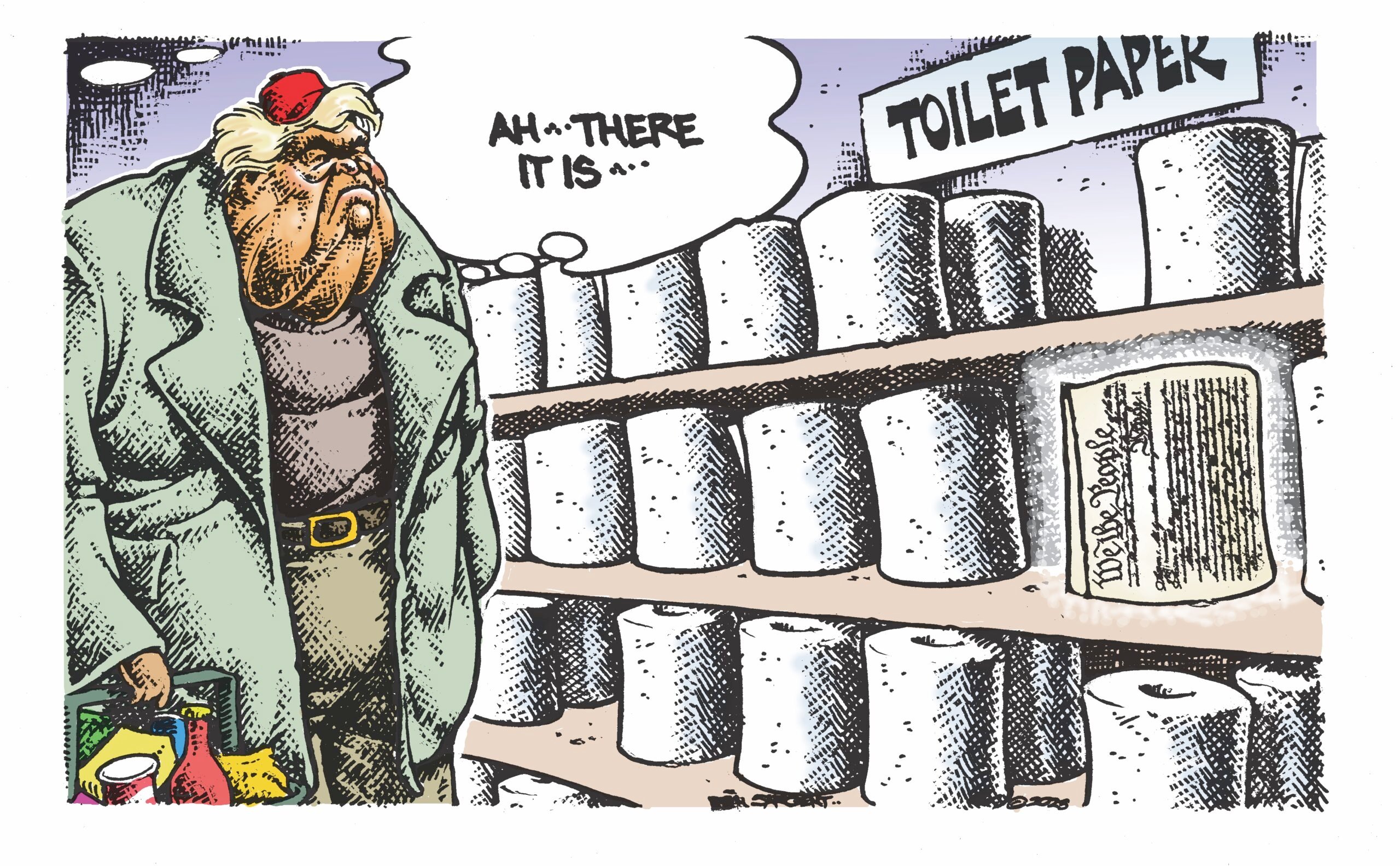
Loon Star State: Trump’s Grocery Run

by Ben Sargent
(Ben Sargent)

To see more political cartoons from Ben Sargent, visit our Loon Star State section. Find Observer political reporting here.

The post Loon Star State: Trump’s Grocery Run appeared first on The Texas Observer.

19 Mar 00:50

They’ll probably die quite soon

by John Allison

Claire is a kind soul who has space in her heart for anyone even slightly deserving. This is a rare misfire for her charm school.

The post They’ll probably die quite soon appeared first on Bad Machinery.

19 Mar 00:48

Senator Schumer Votes to Let the Big Wooden Horse into Troy

by Ryan Wolin

“In the wake of votes by a handful of key Democrats, led by Senate Minority Leader Chuck Schumer, to pass a GOP-led continuing resolution funding federal operations through the end of September, fissures have expanded within the Democratic Party on how best to counter Donald Trump and Elon Musk’s ongoing assault on government agencies.” — Mother Jones

- - -

SCHUMER: My fellow Trojans, we are gathered to discuss what to do with the big wooden horse statue that the Greeks left behind.

TOWNSMAN: It’s a ruse to kill us all! I say we burn it, then uncork some wine—and enjoy centuries of peace and prosperity.

SCHUMER: Yes, there’s danger in opening our gates to this statue. But there’s also danger in keeping it out… the danger of eroding the sanctity of the gift-giving process. Now, what do we know about this thing?

GUARD 1: We found it two days ago, along with a note that reads: “Please take this statue as a gift. It would look especially good in an unguarded plaza with easy access to your main thoroughfares. P.S. Try not to block the air holes—for artistic reasons.”

SCHUMER: Was there anything on the back?

GUARD 1: A blueprint for a gigantic horse that can fit thirty men inside.

SCHUMER: Well, I—for one—am touched by this act of generosity. Perhaps one day, all of humanity will know the saying “Be welcoming of Greeks bearing gifts.”

GUARD 2: Senator, there’s more… as we approached the horse, we heard what sounded like dozens of soldiers sharpening daggers inside. At one point, baklava fell out—and one of the soldiers said, “Great. That was the last of the baklava. Now we have to kill a thousand Trojans on an empty stomach.”

SCHUMER: Has anyone actually seen these supposed soldiers?

GUARD 1: No, but we hear them plenty. They whistle every time a maiden walks by. And this morning, we heard a voice say, “Dammit, I spilled the pee bucket,” then the horse almost tipped over as they all scattered to get away.

GUARD 2: The statue also has a secret hatch—one of them opened it to let out all the hookah smoke. Senator, let’s just destroy it.

SCHUMER: But what of decorum?

GUARD 2: Is he one of the Greeks hiding in the horse?

TOWNSMAN: I have an idea—let’s weigh the pros and cons of letting in the horse. I’ll start. Pros: none.

SCHUMER: My brethren, soldiers may leap out of that statue tonight and kill me, but what’s leaping out at me right now is our total disregard for norms. What you see as an enemy threat, I see as a one-of-a-kind statue of a mare.

GUARD 1: Oh, it’s not a mare—that horse is packing. We think that’s where they’re storing the shields.

GUARD 2: And I have to push back on “one of a kind.” This is the third one they’ve built—their soldiers fell through the bottom of the first two.

SCHUMER: Look… I know everyone’s worried about this statue facing our gates. But I see this as a chess match between us and the Greeks—and I know chess. Our best play is to move the horse straight forward.

TOWNSMAN: Are you sure you know chess?

GUARD 1: Maybe we can compromise. What if we let in the horse—but surround it with men ready to stab anyone who jumps out?

SCHUMER: No dice. We’ll need everyone capable of wielding a blade to get to work on the thank-you sculpture we send back to Greece.

TOWNSMAN: Senator, this is a real quagmire—perhaps we should sleep on it?

SCHUMER: Fine. But we’ll sleep on it with the horse inside the gate, so no one can steal it.

TOWNSMAN: (indecipherable muttering in Trojan)

SCHUMER: People of Troy, long ago, you vested me with the power to make big decisions. Do you remember why?

GUARD 1: Because we trusted your judgment.

SCHUMER: Exactly—And after all these years, I still have that same tactical savvy. Now let’s wheel this mysterious hollow horse to our city center, then go get some shut-eye.

18 Mar 23:15

Poilievre’s broken slogan generator to blame as he vows to “Dink the Rink” and “Slime the Grime”

by Vinny Francois

Lethbridge, AB – Conservative party leader, Pierre Poilievre, spoke to a mystified crowd of supporters as he promised to go to Ottawa and “Dink the Rink” while standing in front of a banner emblazoned with maple leaves that read “Slime the Grime”. The CPC later explained that their slogan generator may need to undergo some […]

The post Poilievre’s broken slogan generator to blame as he vows to “Dink the Rink” and “Slime the Grime” appeared first on The Beaverton.

18 Mar 23:12

Why didn’t Windows 95 setup use a miniature version of Windows 95 as its fallback GUI?

by Raymond Chen

One of the reactions to my discussion of why Windows 95 setup used three operating systems (and oh there were many) was my explanation that a miniature version of Windows 3.1 was used to get MS-DOS customers upgrading to Windows 95. But why not use a miniature version of Windows 95?

A technical reason is that the miniature version of Windows 3.1 compressed to only 441,906 bytes, or just under a third of the capacity of a single floppy disk. A miniature version of Windows 95 wouldn’t fit on a single floppy, so the user would be spending a lot of time in ugly text mode doing floppy swapping. Using a miniature Windows 3.1 gets the user out of text mode quickly. And the code to deal with floppy swapping would have to be written as an MS-DOS program, which is not a lot of fun. I don’t want to be here any more than you do.¹

An engineering argument against using a miniature Windows 95 is that there was no miniature Windows 95! Windows 3.1 already had developed a miniature version, so we could use that one immediately. But developing a miniature Windows 95 would have required diverting resources from the rest of the operating system team to develop a special miniature version of Windows 95, looking for places where components could be removed and fixing the dependencies so they could tolerate running without it. For example, you probably would not include the multimedia system in the miniature Windows 95, but now you have to make sure all the rest of the system still runs okay without any multimedia support. Anybody who called a function in mmsystem.dll would have to switch from a static dependency to dynamic loading because mmsystem.dll might not exist. This is a lot of work to develop a version of Windows 95 that serves exactly one purpose: Installing Windows 95.

There’s also a marketing reason for using a miniature Windows 3.1 for MS-DOS customers: Keeping your best customers (Windows 3.1 users) happy. Having the MS-DOS upgrade path used a miniature Windows 95 but making the Windows 3.1 upgrade path use the existing Windows 3.1 would be an awkward situation to explain to our staunchest supporters, the existing Windows 3.1 users. Why are they getting a worse graphical experience than the MS-DOS holdouts? The alternative would be using a miniature Windows 95 even for Windows 3.1 customers, but see the next point.

Another reason for using a miniature Windows 3.1 is aesthetic: Windows 3.1 can be started from MS-DOS without a reboot, whereas installing a miniature Windows 95 would require rebooting into it, and then rebooting again after Windows 95 was fully installed. In this era, computer boot times were not the best,³ and there was that big ugly BEEP at the end of the power-on self-test. A single-reboot install was the desired experience. You go through a little song and dance while the setup program copies files, and at the end, your computer reboots and you are welcomed into the exciting world of Windows 95, like a butterfly emerging from a cocoon.

Bonus chatter: There’s also the rollback problem. If the user cancels Windows 95 setup, or if Windows 95 setup fails for some reason, or if the user experiences a power outage in the middle of setup, you need to leave them with a computer that can return to its original state. The least risky way of doing this is to avoid modifying an existing file on the system until the very end. If you install a miniature Windows 95, then you’ll have to modify the system boot files so it will reboot into miniature Windows 95, violating the principle of “don’t change anything until the very end.” The Windows 95 installation process does do a little bit of final preparation after the boot files are changed, but they were designed so that even if those steps failed, Windows 95 setup didn’t have to roll back; it just proceeded into Windows 95 anyway, but maybe without the user’s printers being fully migrated.

Another question is what the fate of the miniature Windows 95 is after setup is complete. One idea is that the miniature Windows 95 is discarded after the full Windows 95 is installed somewhere else. This consumes a lot of extra disk space and I/O since the files in the miniature Windows 95 have to be written twice, once for the miniature Windows 95 and again for the real one. Another option is that the miniature Windows 95 is upgraded in place to a full Windows 95. However, this means that you would have to replace the original win.com and other system files with their Windows 95 counterparts so that you can use them to boot into the miniature (soon to be full) Windows 95. This complicates rollback since the user is now in a state where an unexpected power outage will result in a system that system boots into a partially-installed Windows 95, and troubleshooting that is going to be ugly.

The miniature Windows 3.1 was small enough that the extra disk space it occupied during Windows 95 setup was not significant.

Bonus bonus chatter: What about a bootable CD? Why didn’t you use that?

This is sort of like asking why they didn’t use the Space Shuttle to rescue the Apollo 13 astronauts. The El Torito specification for bootable CDs was not published until January 1995, so the number of systems that supported it was still very small (and the numbers that supported it without bugs was even smaller).⁴ Besides, it was too late in the Windows 95 development cycle to add as a major feature like this.

It’s possible that later editions of Windows 95 did have a bootable CD, but I don’t know for sure.

¹ I wrote one of the iterations of the file copying code for Windows 95 setup, back when we thought we would have two separate setup programs, one for upgrading from MS-DOS and another for upgrading from Windows 3.1 or Windows 95.² To avoid duplication of work (both coding and debugging), the main logic of the code could be compiled either as an MS-DOS program or as a 16-bit Windows program. The I/O and memory management portions were conditional, but shared code was used to keep track of all the I/O buffers, decide when we needed to ask for a new floppy, etc. The MS-DOS version had to be aware that it might have access to as little as 512KB (or less) of conventional memory, so the file buffering has to be done through expanded memory or extended memory, depending on how the user configured their memory, and then double-buffered through conventional memory for I/O to the device. You thought far pointers were annoying? Wait’ll you deal with bank-switched memory.

² After my loan to the setup team ended, they realized that they could squeeze a miniature Windows 3.1 onto a single floppy and avoid having to write two setup programs. I think some of my original file copying code is still present in the GUI portion of Windows 95 setup, but probably not much any more.

³ One might argue that we have never left this era.

⁴ In the pre-Windows 95 era, CD-ROM drivers weren’t really standardized. Every CD-ROM drive came with its own drivers, some of which were carefully tailored to cover shoddy workmanship on the hardware side.

The post Why didn’t Windows 95 setup use a miniature version of Windows 95 as its fallback GUI? appeared first on The Old New Thing.

18 Mar 20:56

The Public Domain and the Rise of the Hays Code

by Sean Dudley

Films entering the public domain will soon face a significant shift. In 2030, films governed by the Hays Code will start to enter the public domain. The Hays Code was a set of self-imposed industry censorship guidelines enforced from 1934 to 1968 by the Motion Picture Producers and Distributors of America (MPPDA), under the leadership of Will H. Hays. Designed to regulate morality in Hollywood films, the code dictated strict rules on depictions of crime, sex, and “immoral” behavior, shaping the creative boundaries of American cinema for decades.

In a comment on one of the Internet Archive’s social media posts, Bluesky user josiahwhite suggested an interesting idea: that due to the restrictions of the Hays Code “[t]he public domain will get a lot more boring.” While this idea might at first seem true, upon further examination it actually clouds the clever ways in which filmmakers of the time navigated the restrictive influence of the Hays Code to tell creative and compelling stories.

To illustrate this point, we shall explore three films—It Happened One Night, To Be or Not to Be, and Double Indemnity—each of which engaged with the Hays Code in distinct ways. Through these case studies, we will see that while the Hays Code imposed restrictions, it did not stifle creativity. Instead, filmmakers found ingenious and often subversive ways to work within and around these constraints, producing films that remain influential to this day.

It Happened One Night (1934): A Pre-Code Example

Clark Gable and Claudette Colbert

Being a pre-Code film, one might assume that Frank Capra’s It Happened One Night is hugely risqué, pushing the boundaries of obscenity and serving as a final burst of unfettered creative filmmaking. However, the reality is more complex. While the film includes suggestive moments—such as Claudette Colbert’s character, Ellie, showing some leg to attract passing vehicles, or mentions of gangster violence—it also adheres to many traditional moral expectations of its time. Opposite Colbert’s Ellie is Clark Gable’s character, Peter, a down on his luck newspaper man with a hard edge. Peter first meets Ellie when a man on their bus, Shapely, begins hitting on Ellie. Shapely attempts to endear himself to Ellie as “Fun on the Side Shapely,” flaunting his disregard for marriage vows. This denigration of marriage would not play well in the Hays Code, and the film itself seems to take issue with it as well, as Peter gets Shapely to leave by pretending to be Ellie’s husband. 

When Peter and Ellie are forced to share a cabin for the night, they construct a makeshift barrier—a sheet dubbed the “Walls of Jericho”—to maintain a sense of modesty. While there was no Code explicitly forbidding an unmarried man and woman from sharing a room at the time, the film nonetheless applies its own restrictions, anticipating the kinds of rules the Hays Code would later enforce. A deeper reading of these moral themes appears as the name, “Walls of Jericho,” references the religious story from the Book of Joshua, incorporating Judeo-Christian values that would later be emphasized under the Hays Code. 

The film ultimately concludes with Peter and Ellie getting married, affirming the cultural ideal of heterosexual marriage that the Code would later regulate as a fundamental norm. So what emerges from It Happened One Night is a blend of the unregulated era of Hollywood and the values that would soon be codified under the Hays Code. Despite the interplay of these influences, the film remains a masterwork. It was the first film in Academy Awards history to win all five major categories—Best Picture, Best Director, Best Actor, Best Actress, and Best Screenplay—an achievement that underscores both its artistic brilliance and its lasting appeal.

To Be or Not to Be (1942): A Satirical Challenge to the Code

Carole Lombard and Jack Benny

By the early 1940s, Hollywood was firmly under the Hays Code’s influence and deeply entrenched in World War II. Ernst Lubitsch’s satirical comedy To Be or Not to Be follows a Polish theater troupe whose production of Hamlet is disrupted by the Nazi invasion of Poland in 1939. At its core, the film actively mocks and ridicules the Nazis in direct contradiction to the Hays Code’s provision against making “willful offense to any nation.” Though, given that the target was the Nazis, it appears this rule was conveniently overlooked. 

One of the most striking aspects of To Be or Not to Be is its subversion of the Hays Code’s depiction of marriage and fidelity. The film centers on Joseph and Maria Tura, a married couple who lead the Polish theater troupe. Maria, played by Carole Lombard, is heavily implied to be unfaithful to Joseph, played by Jack Benny, which the film often underplays for laughs. Her admirer, a young Polish pilot named Stanislav Sobinski, regularly leaves the audience during Joseph’s delivery of Hamlet’s “To Be or Not to Be” monologue to secretly meet with Maria backstage. Joseph is frustrated that his performance is being disregarded, while not at all aware of the deeper intentions behind the disturbance. Sobinski and Maria’s relationship continues to the point of Sobinski suggesting she divorce her husband to marry him, very much in line with the code. He additionally suggests she retire from acting to become a housewife. However, Maria proves reticence to do either, thus subverting the infidelity in one regard, and pushing back on the normative gender roles that the Hays Code sought to uphold. Sobinski’s relationship with Maria is cut short when he is called to war following the Nazi invasion. 

The plot is propelled forward when he returns to Poland and uncovers a Nazi spy masquerading as a Polish professor who plans to root out the Polish resistance. The film plays with its Code subversion through humor, such as a memorable gag in which Joseph returns home to find Sobinski sleeping in his bed, suggesting further infidelity. While nothing improper has actually happened—Sobinski was given refuge after parachuting from his plane into Poland—the physical staging of the scene suggests Maria’s attraction to Sobinski remains unresolved. 

In the film, the Nazis take Maria hostage just as Sobinski returns. Throughout the film, she skillfully leverages their desires for her attractiveness by navigating herself and others out of danger, and taking some Nazis down along the way. Ultimately, Joseph and Sobinski reconcile, but the film’s final scene reinforces Maria’s continued infidelity—just as Joseph delivers his monologue again, another young man rises and exits, mirroring Sobinski’s earlier actions. 

While the film cannot be as explicit about its themes due to the Hays Code, it remains sharp and subversive. The humor is relentless, the jokes land with precision, and the script is exceptionally tight. Despite the Code’s restrictions, To Be or Not to Be stands as one of Hollywood’s most defining satirical films about the Nazis—proof that even under strict censorship, filmmakers found ways to push boundaries and craft enduring works of comedy and social critique.

Double Indemnity (1944): Adaptation Under the Code

Fred MacMurray and Barbara Stanwyck

Here we have an interesting example of adaptation and the Hays Code. In 1935, the original story was submitted by author, James M. Cain, to the Hays Code Office for use in a film script. The Office rejected it for “being a blueprint for murder” (Hoopes, 1982, pg. 268, 331). Since printed works were not governed by the standards of the Hays Code, Cain serialized the story in Liberty magazine during 1936. Following its success as a compiled book in 1943, the story eventually underwent adaptation to a motion picture in 1944. 

The best known version of the story, the 1944 film, was directed by Billy Wilder, and worked with a Code slightly less sensitive to crime. Yet it still had to adhere to a more restrictive set of rules for the film. The plot remains quite consistent in overall story beats between the mediums. An insurance salesman, Walter, falls in love with a client, Phyllis, and the two commit insurance fraud and murder, killing Phyllis’ husband. Following the murder, the two fall apart and grow distrustful of each other. Seeking to get revenge for putting him through the ordeal, Walter seeks to kill Phyllis by surprise. The two diverge in this encounter.

In the film version, Walter and Phyllis mortally wound each other in a shootout. Phyllis dies during the shooting, but a mortally injured Walter gets away. He returns to his office, and there he recounts the entirety of the plot into a dictaphone before succumbing to his injuries. 

The film’s ending places much more emphasis on finality for both characters. While the Code had loosened up on crime films by 1944, it still desired to show the consequences of crime. In its initial 1935 rejection of the story, the Office believed it was depicting “an adulterous relationship” where the criminals “get away with the crime” (Hoopes, 1982, pg. 268, 331). By ensuring the film reinforces the Code’s moral stance against adultery and murder, eliminating the ambiguity present in the book’s ending.

Neither Phyllis nor Walter die in the shootout. Instead, Walter recovers, and escapes on a boat to Mexico. While aboard the boat, Walter runs into Phyllis. After briefly reuniting, the two are implied to be contemplating suicide by jumping into the water right as the book ends.

Even with these adaptational changes, the film is highly entertaining, constantly building suspense through the imagery, editing, and narrative twist. In the end, the restrictions of the Hays Code don’t actively harm the tale, but rather creates a different interpretation of the events. 

Conclusion

In looking at It Happened One Night, To Be or Not to Be, and Double Indemnity, we can see how the Hays Code shaped Hollywood, and had creative filmmakers navigate its restrictions in ways that often led to ingenious results. The argument that public domain works will become less exciting as we enter the Hays Code era is not hard to envision, but it overlooks the reality that creative expression persisted and thrived under constraint. Just as filmmakers worked within the boundaries of the Code to create powerful, lasting stories, we should approach the films entering the public domain each year with curiosity, nuance, and appreciation for their historical contexts. As we anticipate Hays Code-era films entering the public domain in 2030, we should also celebrate the wide array of pre-Code films still making their way into the public domain—such as Frankenstein, All Quiet on the Western Front, King Kong, numerous Marx Brothers films, and many more inventive short cartoons. The public domain continues to expand, and with it, our opportunity to rediscover and reinterpret the works of the past.

This post is published under a CC0 Waiver dedicating it to the public domain.

18 Mar 19:05

Top US Supreme Court justice rebukes Trump's call to impeach judge

Chief Justice John Roberts issued a rare statement after Trump called for a judge that halted his deportations to be impeached.
18 Mar 18:50

Areas west of Houston to be under elevated fire risk Wednesday amid windy conditions

by Sarah Grunau
Wind gusts reaching around 25 miles per hour and a relative humidity of 14-20% prompted the weather service's storm prediction center to issue the elevated risk for fire watch. The watch will be in effect from 1-7 p.m. Wednesday. 
18 Mar 18:47

my coworker isn’t willing to tell a teenager helper that he’s accidentally killing all our fish

by Ask a Manager

This post was written by Alison Green and published on Ask a Manager.

A reader writes:

I work in the five-person office of a large pre-school. My colleague, Amy, keeps a five-gallon fish tank near her desk with between two and four fish in it. The tank is in full view of the office door and the lobby beyond. The fish are important to the school; when our young students are overwhelmed and need to calm down, the office fish are often their first stop with their teachers, and “saying hi” is often enough to stop a crying jag. The kids love watching the brightly colored fish, who all have fun names, and Amy loves them, too. She takes great care of the fish, arranging feedings with others when she’ll be out of the office, making sure the tank’s heater and filter work properly at all times, and generally being a pretty good fish parent for someone who isn’t a hobbyist fish-keeper. I am not a fish person myself, but I love animals and have close friends who are extremely passionate about their aquariums, so I’ve absorbed a lot of knowledge from them, enough to know what constitutes good fish care, and have passed along tips when appropriate.

Amy pays a teenager, Jake, who is the son of one of our longtime teachers, to clean the tank at regular intervals. Jake is polite, friendly, and seems to care about doing a good job. Except … multiple times now, fish have died within a few days of a tank cleaning. It’s not clear what the exact issue is with the tank, but I suspect the cleaning chemicals are not properly rinsed out or the tank water is otherwise chemically unbalanced.

Most recently, after a mass fish casualty event, the tank was cleaned, left empty to filter for a week or so, and finally, on Tuesday, brought three fish and a snail straight from the pet store. She let them acclimate to the tank temp in their bags for a while, as recommended, and then loosed them in the water. Thursday morning, less than 48 hours later, two of the three fish died before the school day was over.

After the previous deaths, Amy and I were talking about it and she was very sad about her fish, and concerned that a fish would die without her noticing and a child would see the dead fish in the tank. That’s always been a possibility, of course, but now it seems like an inevitability. I named the pattern I was seeing with Jake’s cleanings and she said she had noticed the same. I gently suggested that maybe Jake doesn’t clean the tank anymore and she agreed that it was a problem … but she would feel bad telling him he couldn’t do it anymore and causing him to lose out on the spending money he earns. As far as I know she intends to have Jake continue cleaning the tank and has not spoken to him (or his mom) about the deaths despite the frequency, and the monetary and emotional cost of replacing the fish so often. We haven’t yet spoken about the new deaths.

I feel like this situation is a product of the “they’re just fish” mindset so many have that treat pet fish as disposable and replaceable, and easily avoidable with one slightly awkward conversation. I feel like my hands are tied here, because they’re not my fish, it’s not my money, and I am not Amy’s supervisor, but it’s a huge downer every time. My boss doesn’t seem like a good choice for any sort of intervention, because she treats her own office fish as disposable. Do I have any recourse here to push for a change, or should I let go and let Amy handle it as she sees fit?

I think you have not only standing to speak up, but an ethical obligation to speak up!

Amy is knowingly putting living creatures into a situation where they’re likely to die within days and the only reason she’s not doing anything to stop it is because she wants to avoid a mildly awkward conversation with a teenager.

Primarily this is horrible to the fish, but it’s also pretty unkind to Jake — she’s assuming that he would rather go on being responsible for killing fish (assuming that is indeed what’s happening) than handle hearing “hey, we need to do something differently with how we’re cleaning the tank.” This is not such a sensitive message to deliver that she should need to tiptoe around it to this extent. And it’s good for teenagers to learn things. This is something Jake would probably want to know.

If Amy really can’t bring herself to have a pretty basic, straightforward conversation with a teenager, then she needs to stop buying more fish. The kids will survive that if that’s the decision; that’s far preferable to continuing to throw their much loved fish friends into what appears to be a near-instant death chamber.

So please, talk to Amy again! Maybe you can say, “I think Jake would feel really awful if he ever realizes what’s happening and that no one just educated him about how to fix the problem. And I don’t think we can ethically continue keeping fish without fixing it. Personally I feel really awful seeing fish killed like that, and I think Jake would strongly prefer to get some guidance on keeping them alive, if it is an issue with the chemicals. If you really don’t want to talk to him, I think we have to stop putting fish in there.” If you’re up for it, you could add, “I feel strongly about it so I’m willing to help talk with him if you want me to.”

18 Mar 14:51

YIELD of Dreams

by Justin Pierce

Many Wonderellas do not have cabin air filters! Check your manual and avoid scams.

18 Mar 13:34

An abandoned West Texas oil well has created a 200-foot-wide sinkhole

by By Martha Pskowski, Inside Climate News
The rapidly-growing sinkhole in Upton County is the latest of many problems caused by old wells in the Permian Basin.
18 Mar 13:34

After COVID, Texas is less prepared for the next pandemic

by By Terri Langford, Jayme Lozano Carver, Pooja Salhotra, Eleanor Klibanoff and Stephen Simpson, Graphics by Dan Keemahill and Yuriko Schumacher
Five years after Texas’ first COVID death, the state spends less on public health, vaccination rates have dropped and a distrust of authority has taken hold.
18 Mar 13:33

Judge questions White House's refusal to turn around deportation flights

He wants information about three flights that left the US over the weekend. Officials say they followed the law.
18 Mar 13:33

Houston to become the windy city for awhile

by Eric Berger

In brief: Expect winds to whipsaw across Houston for the next few days as we go from a southerly flow to a northerly flow and back to a southerly flow between now and Friday. Overall, temperatures continue to look mild, with Thursday looking to be a splendid day.

Map of maximum wind gusts for now through early Wednesday. (Weather Bell)

Tuesday

Low temperatures have only fallen to about 60 degrees this morning, and we are going to see warmer weather for a couple of days. The southerly flow will be especially pronounced today, with a tight pressure gradient causing winds to reach sustained levels of about 20 or 25 mph, with gusts up to 40 mph this afternoon. Highs will reach about 80 degrees this afternoon, with a few clouds developing later today.

If you’re headed out to the rodeo, you’ll want to hold on to your hat. Look, I realize I’ve already used that joke this year, but it’s been windy, ok? Although winds may slacken just a bit, they’re still going to be pronounced this evening, along with temperatures in the 70s. The influx of moisture will help keep overnight lows in the upper 60s.

Wednesday

Wednesday morning will be fairly warm and humid, with mostly cloudy skies. Winds should also have finally died down. But it won’t last as a front sweeps in from the northwest during the late-morning hours, likely reaching the coast around noon or shortly after. There is the barest chance of some rain along with the front on the east side of Houston, but I expect a dry passage for nearly all of us.

Highs will be in the upper 70s with sunny skies during the afternoon. And the winds—they’ll have reversed direction, and we can expect gusts of around 20 mph during the daytime, increasing to about 30 mph on Wednesday night. This will create “red flag” conditions for at least western areas of the region, meaning the winds and dry soils will be conducive to wildfires. With the drier air, lows will drop to around 50 degrees on Wednesday night in Houston.

Inland areas of Houston will start Thursday out in the upper 40s. (Weather Bell)

Thursday

This looks to be a splendid day, as it lies in the period between a frontal passage and the return of the onshore flow. Look for highs of around 70 degrees, light winds, sunny skies, and low humidity. Lows on Thursday night will again drop to around 50 degrees in Houston, with cooler conditions for inland areas.

Friday

Another sunny day, with highs in the low 70s. However we’ll likely see some modestly strong southerly winds. Lows only drop into the lower 60s with the warmer southerly flow.

Saturday, Sunday, and beyond

After temperatures mostly in the 70s this week, this weekend and beyond will likely see a warmer pattern, with highs in the lower 80s. We may see one or two weak fronts in the extended forecast, but overall, we should see warmer days and mild nights. Alas there is not a huge signal for rainfall, which we could use right now.

18 Mar 13:33

Tyshawn Sorey’s “For Julius Eastman” at the Menil Collection

by Michele Brangwen

It was a perfect cosmic alignment across decades and desires as the Menil Collection’s magnificent abstract expressionist painting PH-222 by Clyfford Still became the silent, expanding host to the circle of audience assembled in the museum’s foyer to hear the Houston premiere of Tyshawn Sorey’s For Julius Eastman. Clyfford Still wanted people to enter into his works and lose themselves in the moment. In DACAMERA’s program entitled “Transforming Time,” we enter into the intimacy of a strikingly gorgeous work commissioned and performed by pianist Sarah Rothenberg, losing ourselves in Sorey’s tribute to the brilliant composer, pianist, vocalist, and activist Julius Eastman. 

A woman sits at a grand piano in a gallery in front of a large abstract painting.

Sarah Rothenberg rehearsing “For Julius Eastman” before Clyfford Still’s “PH-222”

In the center of the foyer sat Sarah Rothenberg, clad in a double skirted black tunic and a shrug the exact color of the red in the painting, her piano became an extension of the abstract shapes in Still’s painting, as if his canvas could not resist stretching itself into the room, inviting us into the moment. Sorey often tributes other creative artists, both past and present, in his work, and it felt as if many threads of inspiration and camaraderie were connecting through time at the Menil premiere. In 2022, Sorey premiered Monochromatic Light (Afterlife), commissioned by DACAMERA to commemorate the 50th anniversary of the Rothko Chapel. For Julius Eastman unfolded with the same kind of contemplative and plaintive atmosphere as the work of composer Morton Feldman, whose 1971 composition, Rothko Chapel, commemorated the chapel’s opening. Morton Feldman and Julius Eastman were colleagues at the renowned Center of the Creative & Performing Arts at the University of Buffalo. 

A goateed man in a sweater with glasses touches a one hand to his neck while he faces upward with his eyes closed.

Julius Eastman,1974. Photo: Chris Rusiniak

Julius Eastman (1940-1990) was a powerful composer ahead of his time in experimentation and concept in musical composition. His titles, which sometimes confronted racial and homophobic slurs, and his multidisciplinary performances were a form of activism and rebellion that sometimes shook the academic world where he taught. His incredible genius was evident in his music. Sometimes labeled a minimalist, he referred to his music as organic music, a term that trumpeter and composer Don Cherry also used to describe his ideas for musical performance. In both cases, the term describes what was essentially an invitation into a new and different world of performance, one that gave creative agency to the performers in unique ways, and sought to engage audiences on a deeply emotional level. 

It seems a goal in many of Sorey’s celebrated compositions to point toward the sustaining power of our collective humanity. His Meditations for Josephine Baker (2016) reminds us that Josephine Baker was a member of the French resistance during World War II, risking her life and compromising her health to aid the country she adopted as her home. His Adagio (For Wadada Leo Smith), a saxophone concerto written as a tribute to the composer and trumpeter Smith, was awarded the Pulitzer Prize in 2024. Sorey communicates to us in his compelling music the solidarity of knowing we are all in this life together. 

A man stands in a darkened room leading musicians with a conductor's baton in his hand.

Tyshawn Sorey rehearsing.

For Julius Eastman begins with what sounds like gentle footsteps that take us slowly forward and simultaneously back through time. The steps are not tenuous but rather soft and dulcet. Together, we ascend and arrive at a landing, slowly turning while the notes reverberate like a whisper or an almost inaudible voice singing to us – an effect arrived at by holding the piano pedal down so the strings need not stop sounding their notes. The music feels like long, sinuous arms reaching across past and present, bringing us to a place where there is no time. 

As the work progresses, the meditative opening gives way to a darker, more dramatic section, with the sustained reverberation now feeling like a thread of expectancy or anxiety hanging in the air. Still, there is a bell-like sweetness that permeates the sound. The music begins to feel chant-like, and it reminds me of Julius Eastman’s Femenine, where one wonders if the repetitive vibraphone melody is the feminine content implied in the title or if Eastman is saying there is no such thing as masculine and feminine. The chant we hear now in For Julius Eastman is both heavy and light simultaneously, leading us into an energetic surge of sound. 

A woman performs at a grand piano in a gallery in front of an audience.

Artistic Director Sarah Rothenberg performing in the round at the Menil Collection

In her performance, Sarah Rothenberg conveys a deep affinity for this music. She describes the work in her program note as “a universe of hypersensitivity; recurring memories float in and out of our consciousness. Expressive single lines are filled with nuance and intention, often sustained over long resonances that are as important as the initial sounds. Remember Morton Feldman’s wise caution: The sound is not the attack, the sound is what comes after…” 

Her virtuosic and flawless technique is fully given to every nuance and breath in the score, as if she is one with the music—a vessel for the healing sounds of Sorey’s composition. Her fluid gestures as she gently hovers over the above-mentioned sustained resonances take us seamlessly into what we hear. Her figure at the keyboard, the closeness of the surrounding audience, and the generous presence of the Clyfford Still make all elements, sonic and visual, feel connected.  

Now the feeling of footsteps in the music returns, one step at a time into our consciousness. The steps resound differently than in the opening. This time, they are expectant, like the steps of a lover or a friend on the stairs. The repetition sounds like a reminder that we are here, all of us here, alive in the night together. The composition continues to build, gracefully ebbing forward, dancer-like as the clarion call returns and the deep sustained resonance, now the most audible, feels like it could almost be another instrument accompanying these beautiful melodic fragments. I see people sitting across from me in the circle of audience, their eyes closed, fully in the moment. Then we come to an arrestingly beautiful ending with these sweet, high, dulcet tones calling us, higher and sweeter, till we are floating in the celestial space, together and one. 

For Julius Eastman was performed on March 3 at The Menil Collection.

The post Tyshawn Sorey’s “For Julius Eastman” at the Menil Collection appeared first on Glasstire.

18 Mar 13:32

board volunteer makes everyone’s jobs harder, can I expect a raise when I’m on a PIP, and more

by Ask a Manager

This post was written by Alison Green and published on Ask a Manager.

It’s five answers to five questions. Here we go…

1. Our board volunteer makes everyone’s jobs harder

I was recently made the chair of the board for a local community service group. The board receives money each year to buy supplies for community service events, but being on the board is a volunteer position (no one is getting paid). Basically, anyone who wants to be on the board can be because we really need the extra help. Historically, people have only been asked to step down if there is an ethical concern. The parent organization that provides funds does not provide rules or guidance on staffing, only on how we spend the money.

We have one board member who is making everyone else’s jobs harder through no fault of his own. John has been the secretary for a very long time, and he’s in charge of scheduling meetings and taking notes (he doesn’t contribute to event planning or anything else).

John is a very kind, elderly gentleman who struggles with technology. He will take a week or more to schedule a meeting when I could schedule it myself in five minutes. This is an issue when an urgent problem or opportunity pops up that requires a board vote. We’ve been trying to use OneNote to track meeting minutes and event information, but John isn’t comfortable using it (he will only work in Word or on paper). He’s hard of hearing, so he can’t hear what anyone says in the meetings. We end up pausing every few minutes to tell him exactly what to write down (costing us ~20% of our meeting time). At this point, everyone is doing more work just so John can keep his position.

I’m not sure how to deal with this. On one hand, he is objectively hurting our outcomes and making more work for an already stretched-thin team. On the other hand, our organization frowns upon turning down volunteers and John loves being on the board because he’s “lonely and gets to talk to people at the meetings.”

Should I act like this is a paid position (set a performance improvement plan and ask him to step down if he ultimately can’t meet expectations)? I wouldn’t be able to replace him; I’d be eliminating the position entirely. I also worry that excluding him would be akin to discrimination based on age or disability (which is important to me even if this group isn’t bound by employment laws). I also wouldn’t have anyone to replace him with, so we’d just be getting rid of the position entirely.

Or should I try to find a different role/task he can reasonably complete without impacting the rest of us? That feels wrong too, like I’d be infantilizing him by keeping him busy but not letting him do anything meaningful. Is there a third option here?

A performance improvement plan would be overkill in a volunteer position like this.

But you definitely can’t spend a fifth of your meeting time coaching John on what to write in the notes. And if you’re already hurting for volunteers, you really shouldn’t risk making people not want to go to your meetings.

Can John stay on the board without being the secretary? Can he just be a board member who provides input into the direction of the organization without having a specific task list that affects other people?

If not, then at a minimum, it sounds like you need to just tell him that the board is moving to OneNote and no longer needs him to take notes. If he pushes back, be matter-of-fact about why: “We’re spending a lot of time in every meeting discussing what should be written down, and OneNote will take care of it all without discussion, which we need because people are stretched for time. So it’s going to be OneNote from here on out.” Or, “We’re going to try out OneNote for the next two meetings and see if it works.”

You could be pretty blunt about the meeting scheduling: “We’ve been waiting a week or more to get meetings scheduled, and we need that to happen faster. It’s something I can do myself very quickly, the same day it comes up, so my plan is to take over scheduling them unless you are up for getting it done the same day it’s requested?”

The other option is to just lay out what needs to change and let him decide if he’s up for it or not: “We need the secretary to do XYZ, which is different in ABC ways from what’s happening now. Do you want to stay in the role knowing the requirements will be changing in that way, or do you want to take a more of a general board member role where you’re not responsible for XYZ anymore?” If he says he wants to remain in the role but you still don’t see the changes you asked for, at that point you’d revert to the steps above.

2. Is it unrealistic to expect a raise while you’re on a PIP?

I recently had my annual review with my boss, and I was marked as “below expectations.” I expected it as I had been put on a performance improvement plan (PIP) due to “communication issues.” Quick backstory on the PIP is that I am the kind of person who if you assign me something, I will get it done, then update you, whereas my boss is more of the “update me as you go along” kind of person. Different communication styles, I get it, and I’m more introverted and task-focused, which caused me to often forget about communication updates to the stakeholders, which can definitely be improved upon. While I felt the PIP was unreasonable as I was still producing results, it was not totally out of line. I fully expect to pass this PIP, and my boss also communicated that during our review.

Back to the review: my boss told me that I would not be getting a raise, as it is company policy that anyone on PIP will not get a raise. Fair enough, again not a good policy, but sure, I get it. However, I argued that in the past year, my roles and responsibilities had increased drastically, including taking on what is traditionally in my industry a complete other person’s job scope. It is a small-ish company, so I understood it as a logical extension of my work. (The PIP was not a result of me being unable to handle the additional responsibilities.) That was in March of last year. Since then, the company has grown in leaps and bounds and hired much more back end staff. I felt that if I was to continue doing both teapot sets of work, I would need to be paid more. His counter was that anyone on a PIP would not be entitled to a raise.

Is it unfair to expect a raise to reflect my new expanded job scope, even though I am on a PIP? I argued with him for about 10 minutes over this, and his counter was still that last statement above. I felt like I was talking in circles.

Yeah, you’re not going to get a raise while you’re on a PIP, at least not more than a cost-of-living increase at most. Raises are recognition that you’re now contributing at a higher level than when your salary was last set, and if you’re performing below expectations for the job (and by definition with a PIP, the issues are serious enough that you could be let go), very few employers are going to increase your salary in the middle of that (again, excluding COLAs).

The problem is that a year ago your company added significantly to your work without compensating you for it. Maybe that was more reasonable than it sounds on the surface — you can have a job composed of two separate areas of work and still have them be one reasonable full-time job at the original salary. Or maybe it’s unreasonable; your company wouldn’t be the first to pile extra responsibilities on someone without paying them at market rate (or what they would have to pay someone for the same job if they hired for it externally). But you’re not likely to be successful in arguing that while you’re on a PIP.

3. Public-facing employees are upset that other employees do work outside our office

I work for a large educational institution. During Covid, we all worked remotely without issue. Even after returning to the office, there was some flexibility; as long as our work was getting done and our supervisors approved, we could work remotely as needed.

Recently, with a change in leadership, an email was sent stating that everyone must be present in person unless they have explicit approval from their boss. This has created a toxic work environment. Most of our clerical staff have always been required to work in person because they are public-facing or their roles demand it. However, many of us have jobs that require us to be in the field, visiting other sites and meeting with stakeholders. The issue is that the clerical staff is now monitoring when people come and go, leading to resentment, tattling, and unnecessary tension. HR has been unhelpful in clarifying that different roles have different expectations, and the clerical staff feels it’s unfair that not everyone has to be in the office all day. To make matters worse, some employees are now misusing their access to our management system to check who has recorded an absence or who they believe is simply not in the office. They fail to recognize that this is an invasion of privacy — people’s absences and their reasons should not be office gossip.

How can we address this growing hostility and get leadership to acknowledge the differences in job responsibilities while also ensuring privacy is respected?

Wait, the clerical staff is upset not that other people at working from home but that other people are out of the office to visit other sites and meet with stakeholders? That is … a weird new twist on this.

That said, there’s not a lot that you as non-management can do about it. You can point out the tensions to your boss (and maybe HR if they’re competent). You can make a point of being more specific than just saying you or someone else will be out of the office and instead say “I’m meeting with a client” or “Jane is doing a site visit” or so forth. You can counter the comments when you hear them (“part of her job is going to clients’ sites”). You can also just ignore it; internally roll your eyes and figure it’s not your problem to handle as long as it’s not directly interfering with your ability to get your job done. The last one is likely your best option; you might get the most relief from realizing you can’t fix it and don’t need to fix it.

But behind that, what you’re describing is a significant culture problem, and one that requires intervention from management to resolve it. If they don’t care to do that for whatever reason, that’s on them.

That said, if there are specific violations of privacy that you can cite (like someone’s medical information being accessed/shared), you should definitely escalate that.

If I’ve misunderstood and the resentment is actually about people who have their managers’ permission to work from home — not just working from non-home locations — the advice above still applies.

Related:
should I get rid of remote work because our in-office staff thinks it’s unfair?

4. My coworkers tune out so much background noise that it worries me

We have a hybrid office. Some people work with headphones on, others don’t, but many lose all awareness of everything else while working. I know that it’s common in offices for us to be completely focused on our work, but surely we should remain aware of where we are?

We’ve had people be surprised at things happening right next to them. We’ve even had them unaware that we’re talking about them while saying their name out loud. The worst example came when I went out of the room to move things upstairs, always a 10-20 minute process each week. A manager then asked me if I could move things upstairs, having not noticed that I had left the room, done the task, and come back as usual. This manager’s desk was right next to the door!

I’m worried that this lack of situational awareness will lead to more trouble than mild surprise. What if there was an emergency? We haven’t had a fire drill for a long time, I don’t know how quickly they’d react. What about verbal warnings; would they hear the security guards warning them to evacuate? What can I do? What should I do?

You don’t need to do anything! It’s very normal for people to adjust to office noise by learning to block it out so they can concentrate; that’s how they’re still able to do work that requires focus. In all but the most extreme cases, their brains will still recognize and respond to fire alarms, shouts to evacuate, and other noises outside the drone of more routine background noise.

5. I got my years of employment wrong in an interview

I just had an interview that I thought went fairly well. However, immediately upon leaving, I realized I said I held a position eight years when it was really six; it was an honest mistake, my bad-at-math brain just visualized “2014-2020” in my head and did the math wrong. But I’m worried that they will think I intentionally lied. Should I include a clarification in my thank-you email?

Sure. It’s unlikely to be a big deal, but on the off chance they did notice it and wondered about it, it would be fine to include a very brief mention in your thank-you note — something like, “Also, right after I left our meeting I realized I said I was at Oatmeal Village for eight years; in fact, it was six, and I didn’t want to leave that uncorrected.”

18 Mar 13:26

Basic Woman’s Entire Personality Revolves Around Things She Enjoys

by The Onion Staff

NORFOLK, VA—Rolling their eyes at her mindless embrace of that which brings her happiness in life, sources confirmed Tuesday that basic woman Madison Derry’s entire personality revolves around things she enjoys. “I honestly kind of cringe seeing how Maddy just goes along with what naturally appeals to her,” said local woman Kelly Olsen, who scoffed at how Derry’s taste in everything from clothing to movies and music appears to be dictated not by a need to project a certain image of herself but by how much she likes those things. “Imagine being such a normie that you only like things that bring genuine joy to your life. She hasn’t made any effort to look past all this stuff she finds meaning and beauty in to see why she should be embarrassed by it. Doesn’t she ever give a thought to what random strangers might think of her? She should try being a little original and force herself to pretend she hates what she likes. That’s way more authentic.” According to reports, Olsen and some of her friends recently spent an entire hour scrolling through Derry’s Instagram and laughing at the triteness of her loving relationships with her parents and husband.

The post Basic Woman’s Entire Personality Revolves Around Things She Enjoys appeared first on The Onion.

18 Mar 13:25

JD Vance Reminded Caddies Not Allowed In Clubhouse

by The Onion Staff

WEST PALM BEACH, FL—Finding himself stopped upon entering a building at the Trump International Golf Club, Vice President JD Vance was reportedly reminded by a staff member Tuesday that caddies are not allowed in the clubhouse. “Sir, sir, you can’t go in there,” said head of guest services Melanie Cole, gently taking the vice president by the elbow and escorting him back out the front door. “We can’t have caddies scrounging for tips around the dining area. If you’re looking for a restroom or somewhere to wash off your shoes, you’ll find everything you need in the caddy shack down the road. And the host stand will radio if you’re needed by a club member, all right? Now I don’t want to see you in here again, or we’ll have to dock your pay.” Cole added privately that she suspected Vance was the one stealing golf pencils.

The post JD Vance Reminded Caddies Not Allowed In Clubhouse appeared first on The Onion.

18 Mar 13:25

Port-A-Potty Paraded Around On Flatbed Truck Like Homecoming Queen

by The Onion Staff
18 Mar 13:24

Buyers of America, Unite!

by Ford Donovan

“Foreign goods may get a little more expensive, but American goods are going to get cheaper; and you’re going to be helping Americans by buying American.”
US Secretary of Commerce, Howard Lutnick

- - -

Americans, it’s time to rejoice. We know that you have been forced to adopt a new lifestyle, one without eggs, cars, or winter coats. But who needs physical warmth when you can bask in the radiant glow of your unwavering patriotism? Your sacrifices today will make your countrymen wealthy tomorrow. Isn’t that the real American dream?

For too long, the greedy foreign businesses of this world have exploited honest American buyers by flooding our markets with functional and affordable goods. They’ve tricked us into thinking that we can have money for things like kitchen appliances, fashionable clothing, and avocados. No, Mexico, we do not want guac on that.

Let us instead return to our glory days—a simpler time when neighbor helped neighbor, now under the benevolent guiding hand of President Donald Trump.

Through the completely voluntary purchasing decisions of individual American buyers, we will single-handedly revive the agricultural and industrial sectors of this country. With some minor government interventions—we’ll call them “fairiffs” (fair tariffs)—we’ll redirect all those purchase orders away from those foreign leeches and into small-town America, transforming the agricultural bases of our national economy.

Of course, there will be a period of transition while small-town America catches up to meet the sudden demand of America-only everything. America-only factories will need to be built. America-only fertilizer will need to be secured. America-only technology will need to be invented. And America-only energy will need to be procured (no solar, that is also imported).

ًWe know that you, the Buyers of America, are jittery. We know that your stock portfolio is tanking. We know you’re calculating how much longer you’ll have to keep working once we cut your Social Security. We know that you’re worried about your mother’s Medicare. We know that every newspaper you read is warning you of a recession.

But you know what? This all-American war against un-American goods is worth a recession or two.

With the precision of Elon’s chainsaw, we are constricting the economy to choke the rotten core of foreign consumption, paving the way for an all-American America. We are reminding you, in social media posts, in our cable news appearances, and in our press conferences, that you want this. Even if you actively do not want this.

No great economic transition is completed without personal cost. There will be shortages and delays. There will be times when you can’t find the majority of the products you rely on because none of them are made in America. But we will endure. We will persevere. There is no progress without brotherhood and unity.

Imagine the looks on the faces of the Founding Fathers. They would be proud, surely, to see us standing up for ourselves by lining up for hours to buy a more expensive, inferior toaster—all in the name of Mother Liberty.

And, eventually, you will come to understand that this entirely voluntary and self-imposed economic sacrifice is, in fact, the highest form of exercising personal freedom. It is the most individualistic and patriotic act of all.

So let us raise our flags, our fists, and our prices. Let us march into this future with pride, knowing that we are not just consumers but participants in a grand and powerful experiment of economic masochism. The sacrifices of today’s American buyers will make the wealth of tomorrow’s American producers.

Because it’s not about what you want; it’s about what we say America needs.

18 Mar 11:55

Nietzsche Goes on Hot Ones

by Corey Mohler
PERSON: "Welcome to Hot Ones, it's the show with hot questions and even hotter wings. Today we have German philosopher Friedrich Nietzsche. So, how are you with spicy food?  "

PERSON: "The spice represents man's ability overcome his animal nature, and transcend beyond himself to a higher state of being."

PERSON: "The chili pepper evolved with the chemical capsaicin in it, which causes in mammals a painful sensation of burning, to ward them away and leave the peppers for the birds. As a result only two mammals on this Earth will ever dare to eat them."

PERSON: "The first is the humble treeshrew, which itself mutated to not feel the effect. The second is, of course, man."

PERSON: "Humanity feels the pain of the pepper just as vividly as any ape, but instead of experiencing it as suffeering, we delight in it!"

PERSON: "This is because we know the pain is fleeting. We delight in our mastery of our inner beast, in our power of will to overcome ourselves."

PERSON: "But alas! I am too weak to overcome my humanity, perhaps one day a true ubermensch will arise who is stronger than i, who can lead humanity beyond itself!"

PERSON: "Okay well...that was the first wing, which is strawberry flavored, and has a Scoville rating of 12. Most people can't even taste any spice..."

PERSON: "More milk, please! It is too much to bear!"
18 Mar 00:54

Dating Apps (can Sit and Rotate)

by Tom Cardy

I spent $50 on superlikes and all I got was this lousy giant lack of self-esteem.

New studio, who dis?
18 Mar 00:52

Atlantic Tropical Weather Outlook

by nhcwebmaster@noaa.gov (NHC Webmaster)
000
ABNT20 KNHC 171617
TWOAT

Special Tropical Weather Outlook
NWS National Hurricane Center Miami FL
1220 PM EDT Mon Mar 17 2025

For the North Atlantic...Caribbean Sea and the Gulf of America:

Central Subtropical Atlantic:
A non-tropical area of low pressure located about 700 miles
northeast of the northern Leeward Islands is producing gale-force
winds and a large area of disorganized showers and thunderstorms.
Additional development of this low is not expected as it moves
northward to northwestward into an environment of strong
upper-level winds and dry air tonight and Tuesday. Additional
information on this system can be found in High Seas Forecasts
issued by the National Weather Service.

No additional Special Tropical Weather Outlooks are scheduled for
this system unless conditions warrant. Regularly scheduled Tropical
Weather Outlooks will resume on May 15, 2025, and Special
Tropical Weather Outlooks will be issued as necessary during the
remainder of the off-season.
* Formation chance through 48 hours...low...10 percent.
* Formation chance through 7 days...low...10 percent.

&&
High Seas Forecasts issued by the National Weather Service can be
found under AWIPS header NFDHSFAT1, WMO header FZNT01 KWBC, and
online at ocean.weather.gov/shtml/NFDHSFAT1.php

$$
Forecaster Cangialosi/Pasch
18 Mar 00:52

Texas lawmakers seek to transfer University of Houston-Victoria to Texas A&M system

by By Jessica Priest
Sen. Lois Kolkhorst, R-Brenham, said Texas A&M is better positioned to grow the Victoria school and serve the region’s petrochemical and agriculture industries.
18 Mar 00:51

Report: mRNA vaccines are in RFK Jr’s crosshairs; funding in question

by Beth Mole

Federal support for mRNA vaccine research appears in jeopardy after KFF Health News reported Sunday that officials at the National Institutes of Health have directed scientists to remove all references to the lifesaving technology from their grant applications. All such research is now under direct scrutiny from health secretary and long-time anti-vaccine advocate Robert F. Kennedy Jr.

A senior official at the NIH's National Cancer Institute confirmed to KFF that NIH acting Director Matthew Memoli "sent an email across the NIH instructing that any grants, contracts, or collaborations involving mRNA vaccines be reported up the chain to Health and Human Services Secretary Robert F. Kennedy Jr.’s office and the White House."

Further, two independent scientists told the outlet that they were informed by NIH officials that any mention of mRNA vaccines needed to be removed from their grant applications. One, a biomedical researcher in Philadelphia, said that the NIH had "flagged our pending grant as having an mRNA vaccine component." The other, a researcher in New York who works on vaccines but not mRNA vaccines, was told that background mentions of mRNA vaccine efficacy in their previous grant applications needed to be removed from future applications.

Read full article

Comments

18 Mar 00:51

Trump plan to fund Musk’s Starlink over fiber called “betrayal” of rural US

by Jon Brodkin

A federal broadband official departed the US government with a warning that a Trump administration plan will strand rural Americans with worse Internet access in order to help Elon Musk secure public money for Starlink.

"Stranding all or part of rural America with worse Internet so that we can make the world's richest man even richer is yet another in a long line of betrayals by Washington," wrote Evan Feinman, who had been a Commerce Department official and director of the $42.45 billion Broadband Equity, Access, and Deployment (BEAD) program since 2022.

As Politico reported, Feinman made the statement in "a blistering email to his former colleagues on his way out the door Sunday warning that the Trump administration is poised to unduly enrich Elon Musk's satellite Internet company with money for rural broadband."

Read full article

Comments