A customer had a program that crashed occasionally with a heap corruption bug, but in their efforts to isolate the problem, they found that if they ran the program in Safe Mode, the program never crashed. What is so special about Safe Mode that prevents heap corruption bugs? (Can we build the whole airplane out of Safe Mode?)
One of the things that makes Safe Mode safe is that it loads only very basic video drivers. Some parts of video drivers run inside the user-mode process, which means that their memory allocations will intermingle with the process’s memory allocations, and it is the nature of heap corruption bugs that small perturbations in memory allocation patterns can drastically alter the way a heap corruption bug manifests itself, possibly even masking it entirely.
The customer knew that they had a heap corruption bug on their hands (and some time with Application Verifier quickly found the source of the corruption). They were just wondering why Safe Mode seemed to hide it.
And no, they weren’t going to tell their users, “For best results, run this program in Safe Mode.”
According to the Federal Highway Administration, adding physical protectors separating cyclists from vehicular traffic can reduce bicycle-vehicle crashes by up to 53%.
On March 20, President Donald Trump signed an executive order directing Education Secretary Linda McMahon to start dismantling the Department of Education (DOE) after moving to cut half of its workforce the prior week. The DOE manages a wide range of funding for universities, such as research grants and grants and loans for college students, as well as funding for low-income students and students with disabilities in K-12 public schools. The DOE’s Office for Civil Rights (OCR) enforces the nation’s civil rights laws, including the Americans with Disabilities Act and the Civil Rights Act of 1964, to protect students from discrimination based on race, gender, and disability in universities and K-12 public schools.
A complete abolition of the DOE would require congressional approval. But members of the American Federation of Government Employees (AFGE) Local 252, representing 2,800 DOE employees, are speaking out and not waiting for that to happen. The Texas Observer spoke to Local 252 President Sheria Smith, an OCR attorney, and the union’s Chief Steward Brittany Coleman, also an OCR attorney. Both worked from DOE’s Dallas regional office, until the office was recently closed down and its employees let go.
Coleman (left), Congresswoman Alma Adams, Smith (Courtesy)
TO: Can you take us through the tumultuous two months at the DOE since Trump became president?
Smith: At the Office for Civil Rights, we were informed, not in writing, mind you, that we could no longer perform any work. … The pause lasted for so long that a day or two before we received our layoffs, they lifted the pause in writing, so as to start doing work only to lay off more than half of the workforce in the next step. I think we have in this administration a desire for us not to enforce civil rights laws because we have been hamstrung on those efforts.
Tell me about the work you used to do.
Smith: I came to the U.S. Department of Education to what I thought was a dream role at the Office for Civil Rights and a role that would allow me to marry my legal background with my education background and help enforce protections of Title VI, Title II, and Title IX [of the Civil Rights Act], things that I saw from my time in teaching that needed more support and enforcement. When I came on board, our office was handling a huge Title IX sexual assault complaint coming out of Baylor University.
We made sure that we protected all students, regardless of race, sex, or disability.
Coleman: A lot of the cases that I handled were disability cases, making sure that students who have reasonable accommodations are able to get those accommodations from their schools, and that the schools are, if they receive funding from the Department of Education, complying with federal non-discrimination laws.
We had such a busy caseload, and now that our office is eliminated, what does this mean for cases where there are more immediate needs, like, if a student is taking a test and they need more time, and they’re not receiving that additional time?
Smith: Sometimes the complaints weren’t just from families and parents. Sometimes the complaints were also from staff members, particularly special education staff. We make sure districts are not just secluding the child, restraining the child, or putting the child out of the classroom and out of the learning environment, and sometimes, unfortunately, shackling the kid because of the effects of their disability. I certainly think that these are expectations that Texans have when they send their children to school.
Trump has said that the agency would still continue to distribute funding to K-12 public schools, such as Title I funding for low-income students and IDEA [Individuals with Disabilities Education Act] funding. Even so, what concerns do you have for public school students that rely on federal funding?
Coleman: Under Project 2025, funding, like for IDEA, could just be block-granted and sent to the states. There won’t be any oversight of what’s happening to the funding. There won’t be anyone to make sure that funding is getting to the students who have disabilities, to make sure that they are receiving the services that they’re supposed to receive as special education students. So my overall concern is that with any of this funding—where will the federal oversight be to make sure that it’s getting to the populations where it’s supposed to go?
The DOE also manages financial assistance for college students, including Pell grants and federal student loans. What concerns do you have for college students who rely on this funding?
Coleman: This is a crucial time right now because students have applied for colleges or trade schools, and now they’re having to deal with, for example, being on the phone with FAFSA [the Free Application for Federal Student Aid] for five hours. So that is definitely inefficient and frustrating for people who are taxpayers, who are paying to receive these services from us, and they’re not receiving them.
For me, without receiving federal financial aid, I would not have been able to attend Washington University in St. Louis or Cornell Law School. In the media, [the job cuts] are being painted as a punishment for us. But they’re not punishing us. They’re punishing children because they’re robbing them of opportunities for higher education, and they’re robbing them of being able to receive the assistance they need to even stand a chance to get there in the first place.
Coleman: It’s disconcerting to see the full force of the federal government coming down on universities and infringing upon their abilities to be able to have programs that are tailored to helping different communities that may have been previously disenfranchised because of race or because of the lack of economic opportunities, or because students are from a family that immigrated here.
Schools are concerned that they are going to be found out of compliance and lose money, like how we’ve seen our agency recently strip $400 million from Columbia University.
How have the job losses impacted you and your fellow coworkers and union members?
Coleman: AFGE Local 252 has 2,800 people who are all across the country. We only represent Department of Education employees. It’s been really fascinating to see how passionate people are that work with us. A lot of them are former educators. A lot of them are veterans. And we’re proud to not only serve our country in the armed forces, but we’re also proud to serve the country in this capacity.
What I feel is anger because it just feels like we’ve been villainized in the American public. We’ve been conditioned to not talk to the media as good civil servants because we’re supposed to be apolitical. But this narrative that we are just bad people trying to tell people what to teach their kids in school, to teach “woke ideology,” which we’re not, and we’ve never been in charge of curriculum, it’s infuriating. People don’t understand how we have touched so many people’s lives in so many different ways, and yet our work has gone unnoticed by the people who should understand its value.
I just hope that people realize that it’s not because we don’t want to serve you. It’s because we have people in power right now who want to break this system and who want to get rid of the fact that education is an equalizer.
How are members of AFGE Local 252 fighting back?
Coleman: We have to be realistic with the fact that we may not be able to engage in this work. But it does not mean that we do not want to do it, and we still have a ton of support from our membership to continue to fight. We don’t believe that this is right. We don’t believe this is legal. And we don’t believe that this will actually benefit the American public. So we are definitely fighting because we want these services restored. We want to make sure that our kids can have the best.
We are calling on our leaders to stop this reduction in force, to reopen our offices, and to put everyone back on duty. Many are still employees until June, but they are on administrative leave, so we want to make sure that we’re able to actually do the case work that we’re supposed to do, or to work on the grants, or to work on FAFSA.
We are working in conjunction with AFGE national to look at all of our current options. We expect the government to comply with our collective bargaining agreement, which means for changes like this, we should have been notified properly and engaged. We have just filed two grievances concerning what’s happening. So those are internal complaints that are based on our contract, because we expect our contract to be enforced. As far as other legal actions, we are still exploring our options, and we are hearing from other external stakeholders across the country who are concerned. We saw that with the lawsuit that was filed by 21 attorney general offices from other states [not Texas].
We’re engaging Congress members. We are engaging the media. What we’re doing is just trying to dispel the misinformation about what we do, so that people realize that we’re not just some bureaucrats in Washington, D.C. We’re trying to let people know that we, too, are Texans, and we understand what’s going on because we live in your communities.
This interview has been edited for length and clarity.
In brief: Drought continues to expand in Texas, and pollen levels are roofing in Houston with warm, dry weather. There are some rain and storm chances for Sunday night or early Monday and again next week, but those are far from certain. Warmer weather returns and lingers.
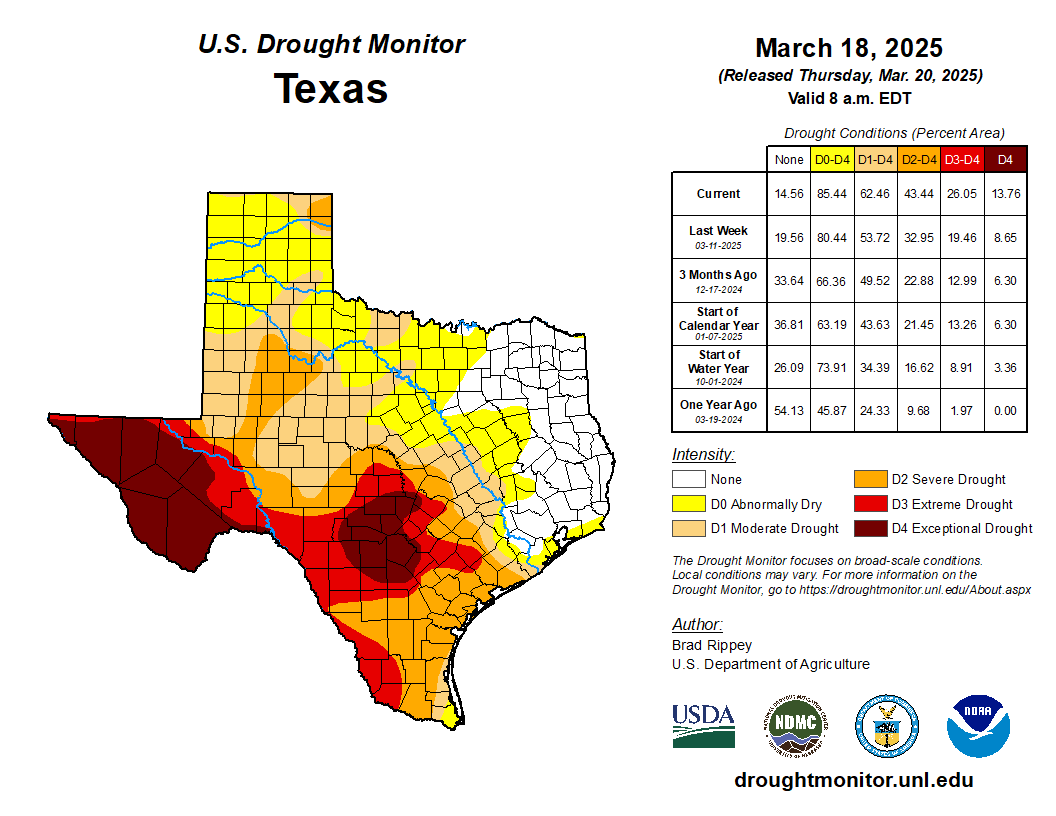
We got the drought map update yesterday for the country, and as you can see below, drought is expanding in Texas. While the majority of the Houston area is not there yet officially, it doesn’t take much to tell we need some rain around these parts.
Drought covers over 60 percent of Texas today, up from 54 percent last week. (US Drought Monitor)
While West Texas and Hill Country are in exceptionally bad drought, we’ve got problems of our own locally, as evidenced by the Pauline Road Fire north of Houston on Wednesday and Thursday. This fire was apparently started as a result of a prescribed burn, and it expanded rapidly due to 20 to 30 mph winds and low humidity, along with increasingly dry ground. The type of fire conditions in Texas that are currently in place have not really been seen since 2011. So, again, we need rain.
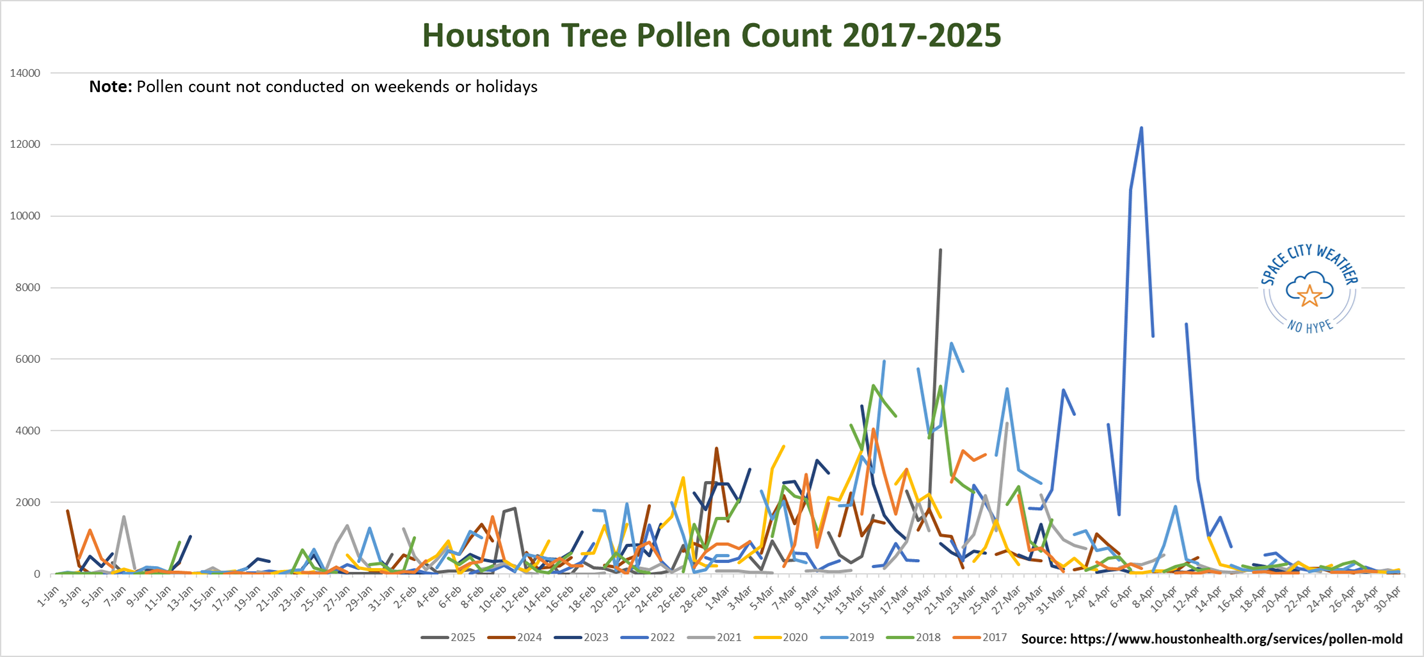
The pollen, as Eric noted yesterday is another matter. Our tree pollen count in Houston hit over 9,000 yesterday for the first time since the brutal April of 2022, when we exceeded 12,000 on April 7th. Yesterday, should it be our peak pollen day, will be right around average but the second highest since 2017.
Daily chart of City of Houston pollen measurements back to 2017 (Jan 1-Apr 30), with gaps in the data due to weekends and holidays. Click to enlarge.
You can see the large jump yesterday in 2025’s data on the chart above. Historically, Houston’s tree pollen will have a handful of big days, then slowly tail off. Notice how 2022, while the worst in the data set also peaked quite late. If history is a guide, the oak pollen levels mostly responsible for this data spike should slowly (emphasis on slowly) subside in the next few weeks. But suffice to say, it will be bad at times over the next couple weeks for those with seasonal allergies. That especially holds true if we don’t get any rain this weekend.
Today and tomorrow
Winds will turn around eventually today and start coming out of the south. This will raise our humidity levels and keep us outside of red flag conditions. After a very cool start this morning, we will warm into the 70s this afternoon. A picture-perfect day.
If you’re headed to the final Friday of the Houston Livestock Show & Rodeo to get a listen to Parker McCollum tonight, expect clear skies with a slight breeze on the way in. Temperatures should be around 70 degrees, slipping back into the mid-60s by the time you head back home.
Overnight lows will be about 10 degrees warmer tonight than they were this morning. That warmer start will allow Saturday to pop into the 80s. Look for a mix of sun and clouds with no weather woes.
Sunday
Most of Sunday will be fine. Expect clouds and some sun, along with warm weather. Highs should get into middle 80s on Sunday afternoon. As a disturbance drops southward during the day, we could see one or two thunderstorms pop up across the area very late Sunday afternoon, probably after 3 or 4 PM. Any of those storms could be on the stronger side.
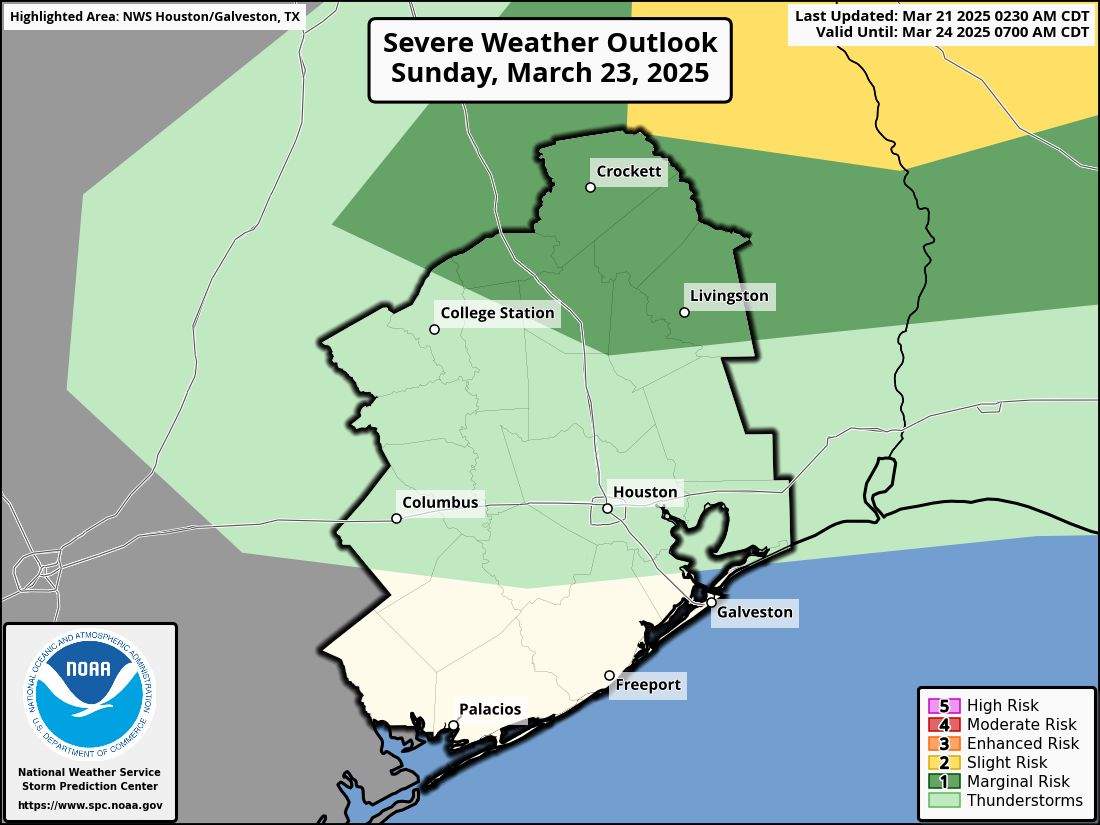
Our outlook for severe weather on Sunday is not too foreboding with risks mainly to our north. (NOAA SPC)
That said, we are not currently in a severe weather risk highlight, just a “general thunderstorm” area. However, this is the type of setup where if one storm can find the right environment it could make some noise. In other words: We’re probably fine on Sunday, but there could be a storm that gets a little noisy.
There could be some strong to severe storms well north of the Houston area that form into a weakening line of thunderstorms Sunday night, arriving in the Houston or perhaps Beaumont areas late Sunday night or early Monday morning. There should not be severe weather along this front, but some lightning, heavy rain, and gusty winds are possible as this moves into the area.
Monday
Any showers or storms should push offshore Monday morning, and we’ll be left with gradual clearing. Expect highs to jump back into the upper-70s or low-80s.
Rest of next week
Tuesday looks quiet right now. Wednesday may see another chance at some showers or thunderstorms, but it’s a bit soon to offer up more than just a low chance. We could see more widespread rain chances by Thursday.
In terms of additional fire weather, humidity levels look to stay high enough to avoid much more serious concerns next week. But the rain we see (or don’t see) may play a role in ultimately determining that. Monday or Tuesday will probably have the lowest humidity for the week. Temperatures will likely be a bit above 80 degrees, with morning lows in the 60s.
Conjunto is a Spanish word that translates literally to “conjunct” or “joined together” and refers to a musical genre indigenous to South Texas. It is a music that holds the capacity for various qualities such as tenderness, celebration, and even social commentary, often complexly weaving together several of these into a single piece. In a new exhibition of artworks by Cande Aguilar and Josuè Rawmírez at La Tijera in Brownsville, conjunto is a word that resonates both sonically and visually throughout.
Installation view of “Cande Aguilar and Josuè Rawmírez” at La Tijera. Photo: Michael Flanagan
Cande Aguilar is a Brownsville native who has exhibited internationally at galleries and museums in Texas, New York, New Mexico, California, Mexico, and France. I first encountered his work in Soy de Tejas, a 2023 exhibition that traveled to San Antonio and Fort Worth. Aguilar’s piece in the show, Past the Shock, is an impressive 20-foot painting spread across five panels. I distinctly remember being taken aback when the wall label revealed that the artist was a Brownsville native. It’s a sense of surprise that’s not lost on Aguilar, with the artist stating in a 2020 Texas Observer feature highlighting his recent New York gallery solo show, “The infrastructure, it’s just not here… As far as I know, nobody’s ever actually had a solo show in New York, being from here and working out of [Brownsville].”
Cande Aguilar, “Past the Shock,” 2008, multimedia painting on panels. Photo: grayDUCK Gallery
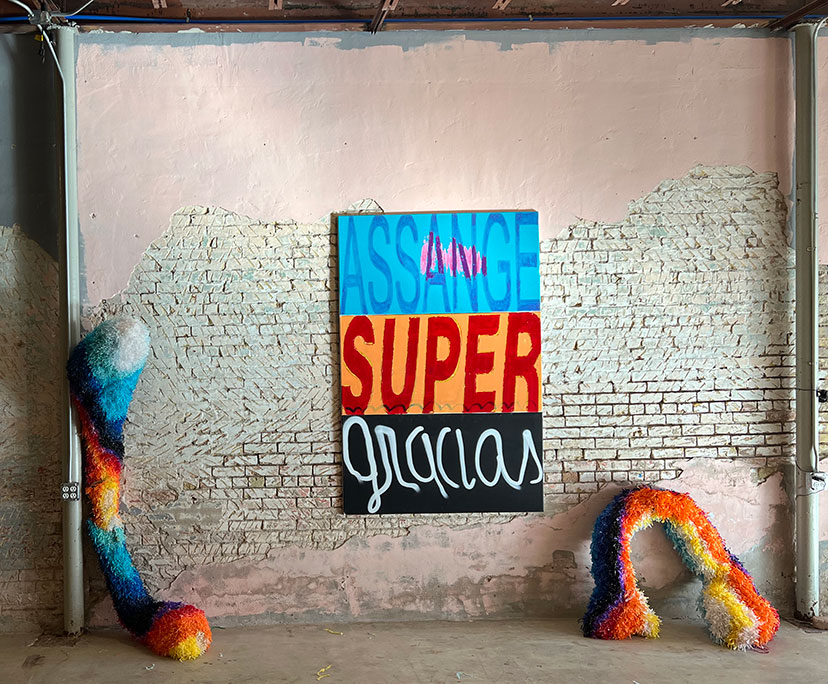
Aguilar’s work at La Tijera mostly consists of hand-painted recreations of popular signage that can be found throughout the Rio Grande Valley, advertising food, music, and other services. One exception to this can be found in a triptych in which the top panel contains the word “Assange,” in seemingly grateful reference to the Australian Wikileaks founder, while the remaining panels spell out the phrase “Assange Super Gracias.”
Installation view of “Cande Aguilar and Josuè Rawmírez” at La Tijera. Photo: Michael Flanagan
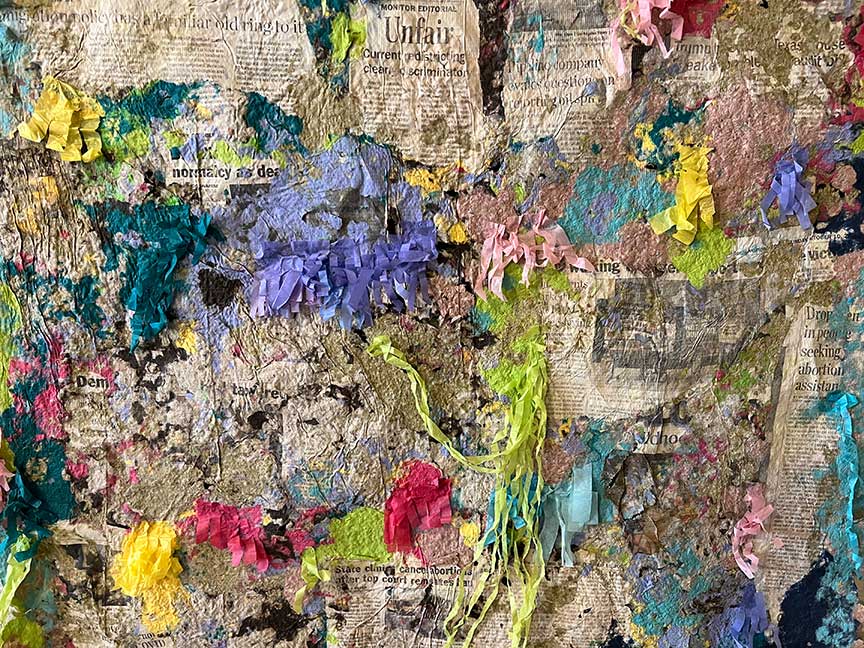
Also present in the aforementioned Soy de Tejas exhibition, Josuè Rawmírez was born in Ciudad Mante, Mexico, and currently lives and works in the Rio Grande Valley. In addition to his work as an artist, Rawmírez is a journalist and co-founder of Trucha, an online platform and cultural collective. Rawmírez ’s background as a journalist is a useful context when considering his handmade paper assemblages. Reading like a deconstructed piñata, the work peels back the layers of these utilitarian sculptures that are commonly used for celebrations in Mexico. Often made of papier-mâché, this element of the artwork’s construction highlights newspaper headlines such as “Unfair: Current redistricting clearly discriminatory” and “Pipeline company evades questions on reporting oil spill.”
Josuè Rawmírez, “Piñata Paper Archive,” 2021 [detail]. Photo: Michael Flanagan
In contrast to the critical nature of these assemblages, Rawmírez ’s sculptures display a certain sense of freedom and joy that stems from the abstracted shapes of what are essentially mutated piñatas. These are bright and beautiful artworks that simultaneously seem to celebrate and challenge traditional cultural narratives.
“Cande Aguilar and Josuè Rawmírez” at La Tijera. Photo: Michael Flanagan
There is a comfortable dialogue that exists between the two artists’ work in this show, though there is also a third voice taking part in the conversation — that of the space itself. Raised in New York City, gallery owner Mariana Smith, who is herself an artist with Brownsville roots and art world connections (her father is the acclaimed artist Ray Smith), spent 3 years restoring and learning about the history of the space that houses La Tijera before opening to the public in 2024. During the restoration process, it was discovered that the building was originally part of Brownsville’s 19th-century city hall, a discovery that guided Smith in her design of the space. More than 100 years of history are visible, from the present-day restorations to the original brickwork that is exposed throughout. There is a certain timelessness to Aguilar’s and Rawmírez ’s works that speaks to the shapes and colors of the various layers of exposed materials on the gallery’s walls.
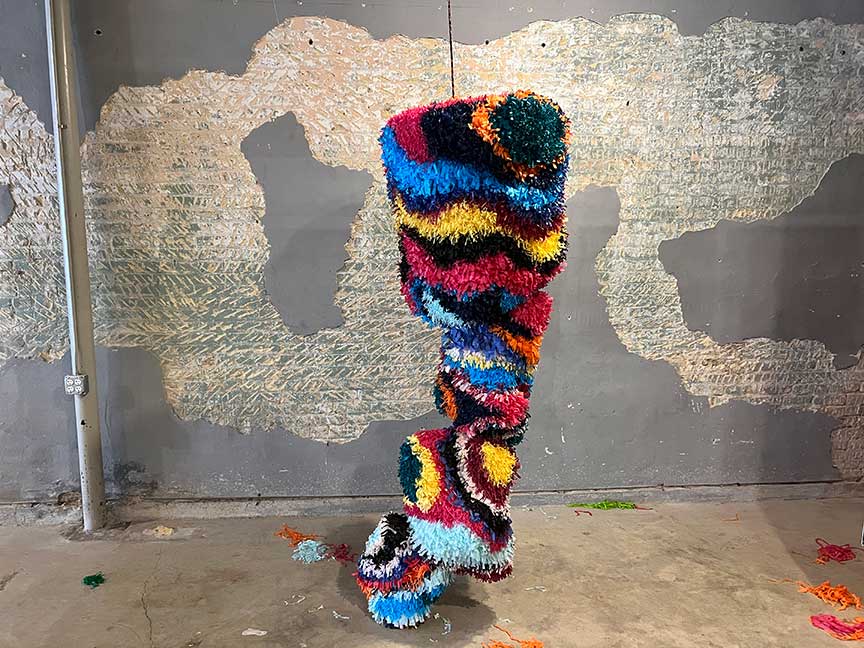
Josuè Rawmírez, “Piñata Stalagmite” Photo: Michael Flanagan
At a recent opening event, Aguilar played the accordion while Rawmírez danced in a sculptural costume of his own design, shedding remnants that new visitors will continue to find spread around the gallery floor. It all comes off as a monumental celebration of the resilient spirit of Mexican American culture that has been a cornerstone of Brownsville and the preceding cultures that have inhabited its space for hundreds of years. Perhaps it also suggests a burgeoning infrastructure that might support a continuing crop of young artists who make their mark throughout Texas, New York, and beyond.
Cande Aguilar x Rawmírez is on view through March 29th at La Tijera. Follow La Tijera on social media for more information.
Otis Tanouye is a ninth-grader at Bethesda Chevy Chase High School in Maryland. He wrote this during his school’s second lockdown in less than a week. Fortunately, no one was hurt during either of the lockdowns.
- - -
’Twas the second damn lockdown, when all through the school Several students were stirring, cuz lockdowns aren’t cool. Two times in six days, wow, BCC. Well, go off to “hide.” Yippee.
The kids were curled up by the side walls with care, In hopes that no shooters would notice them there. The children were nestled with back pain galore. They collectively thought, “I’ve played these games before.”
Some kids wore hoodies, some wore a cap, Some of them decided to just take a nap. When the lockdown was called, there arose such a clatter, The students checked Twitter to see what was the matter.
Taking out their AirPods and phones with a flash, This is more boring than a middle school bash! Some kids said, “You know what? Hell no,” And into Bethesda those children did go.
When what to my bored-ass eyes should appear, But a text from a friend that the SWAT team was here. They entered the school so lively and quick, Guess we’ll be here awhile. Can I leave if I say I’m sick?
More rapid than eagles, more Humvees came, And our teacher told us to write down our names. “Now, Otis! Now, David! Now, Ryan and Ken!” They took our attendance till suddenly when— To MCPD’s Twitter! To the top of the wall! An announcement about a gun-related call?
So the texting continued, relaying the event, So the texting continued, and the students did vent.
Finally, the announcement came on! The lockdown is over; the threat may be gone! Then they reported the police closed the case, Happy lockdown to all, now shelter in place!
SHELBURNE, VT—Grinning wide with satisfaction at his successful act of cunning, local man Todd Sansovitch confirmed Friday that he had carefully snuck a bag of outside stimuli into his sensory deprivation tank. “That dopey teen working the front desk didn’t even think to check my coat pockets—stimulus city, here I come, baby!” Sansovitch said as he gently floated in the dark tank of skin-temperature water and began unpacking the various fidget spinners, strobing penlights, and tinkling bells he had brought along to enjoy. “I know they don’t want you using your senses in here, but that just makes these illicit stimuli all the sweeter. Mmm, smell that peppermint oil. Look at those sparklers. Popping a little bubble wrap, that’s touch and sound in one go. My hour in here is gonna fly right by with all these sensory experiences to keep me occupied. Nice try depriving my senses, losers—better luck next time!” At press time, Sansovitch told reporters he was glad he had brought his own stimuli because so far he hadn’t hallucinated shit.
WASHINGTON—Warning that the charge carried a five-year mandatory minimum sentence, the U.S. Department of Justice declared Friday that the distribution of images featuring a balding Elon Musk constituted an act of domestic terrorism. “For the benefit of all Americans, anyone who posts or reposts photos from Mr. Musk’s PayPal days will be prosecuted for terrorism,” said Attorney General Pam Bondi, who confirmed the Justice Department was already prosecuting multiple cases in which social media users were alleged to have disseminated decades-old photos of the DOGE leader’s receding hairline. “Anyone who likes or replies to the photos will be treated as a terrorist sympathizer. If you possess these images, delete them now. Elon Musk is a patriot with a great American hairline.” At press time, President Donald Trump was showing his support for Musk by getting hair plugs in a televised press conference on the White House South Lawn.
While Roku already includes video ads peppered throughout the streaming platform, some users have recently reported a preview of Moana 2 now autoplaying on the device’s startup, before they are shown the OS home screen. What do you think?
“We asked, they listened.”
Lisa Lambert, Unemployed
“In today’s instant-gratification world, it’s nice to slow down and enjoy an advertisement sometimes.”
Public health experts say Texas needs better messaging on vaccinations and quarantining and more people conducting contact tracing to contain the spread.
This post was written by Alison Green and published on Ask a Manager.
It’s four answers to four questions. Here we go…
1. My boss embarrassed me at a department meeting
My company is being bought out for a larger organization. Our jobs will no longer exist in four months. We’ve been encouraged to review the job postings and apply to jobs for which we might qualify. I reviewed the postings and selected two to apply for — one that would be very easy for me to move to as it’s tasks I already complete daily. The other was a stretch position, something that I’ve done but haven’t dabbled much in while at my current organization. I got an interview for the stretch job and, while I didn’t hold out hope, I gave it my best shot.
Thank goodness I didn’t hold out hope. My current boss was notified by the new org that I applied and interviewed. I was promptly told that I wasn’t a good fit (by my current org, mind you), and I haven’t heard from the new org. Then, in our departmental meeting with my entire department, my current boss told everyone they need to tell him what they’re applying for so he can tell them if they’re a “good fit” because “we don’t want a llama groomer thinking she can be a llama whisperer when she’s never been involved in llama whispering here!” And looked directly at me. (Job titles made up for anonymity, obviously.)
I’m embarrassed. He could’ve just said, at that point, that I shouldn’t have applied for the job, but it’s a good next step in my career and something I’ve wanted to do for a while. I’m not sure how to even act around him now, because I know that was directed, embarrassingly, at me, and now all my coworkers do too and some have even come up to me to tell me how inappropriate it was.
I know I need to leave the org because I can’t move up here and they have no interest in developing my career path, but I’m not sure how to act until I do leave.
Your boss is an utter ass. First of all, it obviously wasn’t far-fetched for you to apply to that job because they interviewed you for it — which means that they reviewed your materials and thought you could be a plausible candidate. Second, and more importantly, there was zero cause for him to embarrass you that way at a department meeting. If he felt he needed to give you feedback (which is possible, given that the new org isn’t entirely separate from your org but is buying it out), he should have done it in private, and he should have offered something more constructive than to just essentially accuse you of hubris (which, again, wasn’t even grounded in reality, since the other org thought you worth interviewing).
Your boss is a jackwagon, he revealed himself as a jackwagon to others at that meeting (although that probably wasn’t a new discovery for them, and I bet it’s not a new discovery for you either), and ideally you’d try to reframe your thinking to see it as much more embarrassing to him than to you. What he did is evidence of his lack of character/leadership/judgment, nothing else.
2. How to refer to a basketball sex scandal at work
I was discussing the upcoming March Madness tournament with some coworkers, and the conversation turned to St. John’s coach Rick Pitino, and his previous stint at Louisville where he was stripped of a national championship due to supplying recruits with prostitutes to induce them to attend the school. My coworker was unaware Pitino’s team had been stripped of a title, only that he had won one (and that he had had similar success at other schools). I was unsure of how to reference the scandal in a way that was appropriate for work, but I eventually settled on saying that he offered the recruits “certain impermissible benefits” (which is more or less the official wording of the charges from the NCAA) and noted that even in today’s era, where you’re allowed to offer basically unfettered NIL (Name, Image, & Likeness) benefits to induce players to attend your school (which wasn’t the case at the time of the scandal), “that particular benefit that he offered is still not permitted, and I’ll just leave it at that.” Was this an appropriate way to reference what happened?
It’s unnecessarily coy. It’s okay to just come out and say, “He supplied recruits with sex workers to try to induce them to attend the school.” That’s what happened, you’re alluding to it anyway, and it’s better to just say it rather than to dance around it with something mysterious sounding. Otherwise, it’s would probably be better to just say “unethical recruiting practices” rather than “certain impermissible benefits”; the latter just sounds very cryptic.
3. How should I handle a company’s pre-hire drug and alcohol testing?
I am in the late stages of the interview process for an entry-level admin job at a manufacturing company. This company requires a pre-employment drug and alcohol test across the board for all new hires. Is there an appropriate way to inquire about this test? I would like to know the philosophy behind the request, particularly for an entry-level admin position, which is largely answering phones with some data entry. It is unclear to me how my nightly glass of wine would be any of their business.
In addition, I have a prescription for a drug that is also recreationally legal in my state. I would like to inquire without giving too much information, but also not raise undue suspicion (I’m happy to say what my medical condition is in general, but overall it sounds like self declaring this stuff when you don’t otherwise need accommodations is a no-no). Or maybe I should just take the test and see what they say? Honestly, at this point I am wondering if this is a sign of a cultural mismatch.
Unlike drug testing — which can pick up drug use days or, for some drugs, even weeks later — alcohol testing is testing for current impairment. So they’re not looking to see if you have a nightly glass of wine; they’re trying to catch people who are showing up to a daytime work appointment with alcohol in their system. It’s probably more relevant for their manufacturing jobs (for safety reasons), but they’ve made it part of their standard new hire testing.
Marijuana testing is more complicated; those tests pick up longer-ago use (potentially weeks-old use if you’re a regular consumer). Some states that have legalized marijuana, but not all of them, have prohibited employers from taking action against employees who use it outside of work. Those laws vary in details; some bar employers from testing for it at all, while others permit the test but say employers can’t deny you a job based on a positive result. Some cover only medical use, while some cover recreational use as well; all make exceptions for safety-sensitive positions. This also gets more complicated for federal contractors, who are required to comply with drug-free workplace laws set at the federal level (where marijuana is still illegal). So in your shoes, I’d look up what your state law says about employment testing for marijuana and go from there.
But as for inquiring about the philosophy behind the testing: they’ll almost certainly tell you that they want to have a drug-free workplace … which sounds like a perfectly reasonable stance for a manufacturing company, except that non-alcohol drug tests will detect private use in your own home in your off hours last weekend. Which is really why workplaces that care about safety should be using impairment tests instead; impairment tests check if you’re impaired for any reason, not just find out that you smoked a joint before bed a week ago. Performance tests measures things like hand-eye coordination and response time and are designed to catch multiple types of impairment, including legal ones like fatigue, and are used by NASA on astronauts and test pilots, and in other cases where safety matters more than drug testing theater.
4. Can I ask a nonprofit if they’re dependent on federal grants?
I’m a displaced federal employee — I had exceptional performance reviews, but I was fired for “performance” with 28 days remaining in my first year. I’ve started my job search and have been frank about my situation with prospective employers — “I was terminated as part of recent mass firings, but I am happy to provide performance documentation as well as references from supervisors.”
Now I have a possible interview. The position aligns with my abilities and interests, everything I’ve encountered feels positive, and it’s at a nonprofit with a mission that I would feel good about supporting. But after losing my beloved former position to the current administration, I’m nervous. Would it be appropriate for me to ask if/how their organization relies on federal grants? If so, would it be appropriate in the interview? How?
(Additional complications I don’t even know where to start on: my former position might be reinstated, my former office might have a new opening that is exempted and also a good fit for me … but I don’t feel like I can count on either. I loved my workplace and the good we did, but I have to explore other options!)
Yes, you can absolutely ask whether the organization, and this position in particular, rely on federal grants. That’s not an uncommon thing to ask about in nonprofit interviews, even before the current chaos, and it’s even more understandable right now. You can word it this way: “Do you rely on federal grants at all, and do you expect your budget, or this position itself, to be affected by what’s going on?”
“President Trump’s promised immigration crackdown is here. Over the past two weeks, his administration has pushed against the limits of executive power—and surpassed them, critics say—to kick more people out of the country.” — New York Times
- - -
For far too long, Democrats have been suppressing free speech. They’ve tried to cancel right-wing pundits under the guise of “hate speech” or “shouting fire in a crowded theater” simply for voicing perfectly reasonable opinions like “Jews control the weather” or “the COVID vaccine makes your penis fall off.”
We Republicans, on the other hand, are free-speech absolutists who would never try to cancel someone for sharing their beliefs. Unless you disagree with us, in which case, you’re obviously a terrorist.
Democrats have a long history of violating the First Amendment. Under their repressive 1984-esque rule, people could be kicked off social media for nothing more than the thought crime of being a self-avowed Nazi. Thankfully, now that Republicans control the government and most major media platforms, everyone’s constitutional right to freedom of speech is protected.
Some might say it’s unconstitutional to arrest and deport people without due process just because they expressed an opinion we don’t like. But it’s important to remember that we are only arresting and deporting terrorists. And terrorists don’t have constitutional rights. How do we define “terrorist”? A terrorist is anyone we think is bad. Thus, by the transitive property, it follows that anyone we think is bad does not have constitutional rights. That said, if Mike Myers doesn’t keep his mouth shut, we’ll be deporting him next. His impersonation of Elon Musk on SNL was comedic terrorism.
Of course, our crackdown on terrorism won’t just be limited to speech. Democrats were so busy implementing totalitarian cultural Marxism (preventing white supremacists from holding recruitment rallies at college campuses) that they went completely soft on crime. That’s why we’re rounding up suspected Venezuelan gang members, whom we’ve also labeled terrorists, and deporting them without a trial. And if it sounds to you like we’re doing that without legal precedent, you’re wrong. We’re using the same statute we used to detain Japanese Americans in concentration camps during WWII. So we’re confident our approach is legally and morally sound.
For those asking—no, we are not disclosing the names of those terrorists or providing any evidence of their crimes. And yes, for all you know, those Venezuelan gang members may not be Venezuelan, or even gang members. But you’re just going to have to trust us when we tell you that they’re bad hombres. Even if they’re technically neither bad nor hombres. In fact, we have reason to suspect that Congresswoman Alexandria Ocasio-Cortez may herself be a Venezuelan gang member, and we are fully prepared to deport her. Just because she’s a US citizen doesn’t mean we can’t pick a Latin American country at random and ship her there.
A policy where we can harass, question, and detain anyone without trial under the guise of terrorism might seem as if we could use it to make anyone whose views we disagree with disappear, even US citizens. But don’t worry, as long as you never peacefully protest, write an article, or text your friend that meme of Elon Musk and Donald Trump where they look like Jim Carrey and Jeff Daniels in Dumb and Dumber, then you have nothing to fear.
Besides, there are plenty of Americans we would never go after. Like the brave freedom fighters who took a self-guided walking tour of the Capitol on January 6, 2021. They’re not terrorists; they’re patriots.
WASHINGTON—In a move that stunned the global real estate community, President Donald Trump signed an executive order Thursday pulling the United States out of House Hunters International. “We’re not benefiting from those perfect little apartments in Barcelona, so why should the U.S. foot the bill?” said Trump, who called out China for not paying its fair share toward finding cozy, sunbathed Parisian properties with original parquet flooring. “For decades, America has poured millions and millions of dollars into House Hunters International while getting very little in return. The Democrats got us into this in the first place. We should have never been involved. Sorry, house hunters. You’re on your own now.” At press time, President Trump was calling for more dream Italian fixer-uppers on American shores.
“The human body can only shake with laughter for so long.” Welcome back to The Beaverton Weekly Report! Luke and the Panel (Ian MacIntyre, Nile Seguin and Clare Blackwood) talk Mark Carney’s first few days in office, the Conservatives struggles to find attack ads that work on a PM who looks like he came out […]


/https://static.texastribune.org/media/files/a18c122f082f277f48634382e4096350/0131%20Huntsville%20Unit%20MC%2002%20TT.jpg)









/https://static.texastribune.org/media/files/6d78e550ef4e8c8bbaf49601ca626a8e/0226%20Measles%20Covenant%20TrT%20TT%2052.jpg)
