Shared posts

27 Mar 01:10

Republican Abortion Laws Are ‘Torturing Women.’ Can the GOP Fix Its Own Crisis?

by Mary Tuma

Dr. Damla Karsan lives in fear for her patients—and for all pregnant Texans. 

The Houston OB-GYN has spent the last four years painfully navigating the state’s draconian abortion bans, oftentimes for patients who face severe complications. With vaguely defined exceptions for medical emergencies, the law has forced doctors to either delay or deny life-saving care out of worry they could face lawsuits or prison time for performing pregnancy termination. 

Karsan knows the risks well: When she promised to perform abortion care in 2023 for Kate Cox, a Dallas mother who saw her health steadily deteriorate after doctors failed to terminate her fatal pregnancy, she was met with direct threats of prosecution from Attorney General Ken Paxton. Cox eventually fled the state. Paxton’s attacks on reproductive healthcare workers have only escalated since then, most recently with the arrest of a Houston-area midwife for allegedly giving abortion pills to a patient—the first criminal charges under the state’s ban that took effect after the 2022 fall of Roe v. Wade.

Karsan has had other patients who were hemorrhaging during a miscarriage—just a few steps away from death—and still faced delayed care at the ER. Some of her patients are too scared to even get pregnant, while others have fled Texas in order to start their families safely. Her experiences mirror the flood of traumatic stories from other Texans and providers. 

“These laws are torturing women, there’s no other way to put it,” Karsan told the Texas Observer in between deliveries from her practice just south of the Houston Medical Center. “It is absolutely horrible having to try to help patients get care when the state has barred us from using our best medical judgment.” 

May 2022 abortion rights protest at the Texas Capitol in Austin (Gus Bova/Texas Observer)

A 2021 near-total abortion ban, known as Senate Bill 8, encourages private civil suits against anyone who “aids or abets” care, and the 2022 post-Roe criminal ban threatens doctors who perform abortion with $100,000 in fines, loss of their medical license, and up to 99 years in prison. The criminal law holds an exception for patients who are at “risk of death” or “substantial impairment of a major bodily function.” For years, doctors and advocates have said the carve-out is ambiguous and unworkable in reality, resulting in confusion and trepidation when treating high-risk patients. 

Following a long—and largely unsuccessful—road to clarify the laws, including a 2023 lawsuit filed by 20 women denied abortion care despite pregnancy complications and a flurry of proposals from Democrats last legislative session, a new bill filed by Texas Senate Republican Bryan Hughes now seeks to add clarity. 

Introduced just before the Legislature’s bill filing deadline, Senate Bill 31—now scheduled for a committee hearing Thursday—would strike the term “life-threatening condition” from the criminal law, as the language has caused confusion among doctors. It includes guidance from a previous Texas Supreme Court ruling that found the law does not require a medical emergency to necessarily be imminent or irreversible before a doctor can take action. It would also clarify that physicians are not required to “delay or withhold” life-saving medical care in order to preserve the life of the fetus, and it would ostensibly offer stronger protections for doctors when treating ectopic pregnancy and premature water breaks. 

Dubbed the “Life of the Mother Act,” the bill also clarifies that a doctor or lawyer can discuss a medically necessary abortion with a patient without the risk of “aiding and abetting” charges. Representative Charlie Geren, a Fort Worth Republican, has filed an identical companion bill in the House.

The legislative proposals mark the most significant effort by Republicans to allay concerns from patients and providers about Texas abortion law thus far. 

Hughes’ office did not return calls for comment; however, he recently told local newspapers in Texas that the law is meant to “remove any excuse” for doctors not to treat pregnant patients whose lives are in jeopardy. “I’ve said for some time that the law is clear, but if we can make it clearer, if we can remove any doubt and hesitation we want to do that,” Hughes told the Houston Chronicle. At a Capitol press conference this month, Geren said he considers the legislation “the most important bill” he’s carried in his more than two decades at the Legislature. “Too many women have suffered. Too many have died. If one has died, it’s too many,” said Geren. “I have friends whose wives can no longer conceive because of the problems they went through with their first pregnancy and the delay their doctors faced in addressing the problems.”

In January, the staunchly anti-abortion Lieutenant Governor Dan Patrick called on the Legislature to clarify language in the law so that doctors are “not in fear of being penalized if they think the life of the mother is at risk,” becoming the first statewide official to do so this session. And he included the bill on his list of top 40 legislative priorities. Meanwhile, Republican Governor Greg Abbott—who holds veto power over bills—has said the law doesn’t need to be changed but that he may be accepting of the GOP-backed legislation. Geren has pleaded with Abbott to “Veto everything else, but [leave this bill] alone.”

It remains to be seen if either proposal will win the approval of enough fellow Republicans to pass, or if the GOP will get sidetracked by a slew of bills aimed at further restricting the flow of abortion pills—the most aggressive of which is backed by Hughes himself. The sweeping 43-page Senate Bill 2880 would allow Texans to file civil suit against groups that mail abortion-inducing drugs into Texas; make it a felony to pay for a person’s abortion care, including travel costs; and empower the “biological father of the unborn child” to file “wrongful death” lawsuits against abortion patients, among other extreme provisions. 

Democrats like Representative Donna Howard, an Austin Democrat, have spent years championing wider exceptions to the state’s abortion laws, including filing a broader bill to do so this session as well as a measure to allow abortion care for survivors of sexual assault. Howard is supportive of Hughes and Geren’s bill and will urge her Democratic colleagues to support it, saying it “would save the lives of Texas moms.” She considers the new Republican-backed measure a reflection of the dissatisfaction among GOP constituents.

“Many of the communities my Republican colleagues represent aren’t happy. They feel like the law went too far,” she told the Observer. “They are pressuring for a change so they can safely grow their families. And I think [the new GOP] bill is a direct response to that. … To let the law stand as-is would be the total opposite of what Republicans supposedly say they want: Women will continue to lose their pregnancies, lose their babies, and even lose their lives.”

After a string of horrifying near-death experiences under the laws, an investigation last fall from ProPublica found that three pregnant women in Texas—Josseli Barnica, 28, Nevaeh Crain, 18, and Porsha Ngumezi, 35—died after doctors waited to treat their miscarriages. Medical experts interviewed concluded that their deaths were preventable. The news spurred Karsan and 110 other OB-GYNs to sign on to a letter in November urging lawmakers to reform Texas abortion law, writing: “Anti-abortion groups and others are saying the blame does not fall on Texas law. That is simply not true. As OB-GYNs in Texas we know firsthand how much these laws restrict our ability to provide our patients with quality, evidence-based care. Texas needs a change in laws.”

Karsan points out that the groundswell of opposition is significant for Texas doctors, who have been hesitant to express their frustration publicly out of fear of retaliation. Self-employed in private practice and unbound by the systems that rely on state coffers, Karsan said she is more able to speak her mind and has even helped challenge the laws in court. 

“A lot of my colleagues have been muzzled by the healthcare institutions they are employed by. They do not want to upset the powers that be because these institutions get some of their funding from the state.”

Until now, efforts to help clarify the law have been minimal. After years of staying noticeably silent on the issue, the Texas Medical Board—prompted by a petition from healthcare lobbyists—adopted guidance last June on how doctors should interpret the abortion bans. However, those like Karsan say the guidelines didn’t help give physicians like her any “meaningful leeway.” Additionally, the board failed to provide a comprehensive list of cases in which abortion care would be legal, and TMB Board Chair Dr. Sherif Zaafran himself acknowledged the guidance is limited and could not prevent criminal prosecution. (All TMB members are appointed by Abbott, and many have donated generously to his campaign.)

While the 2023 legislative session saw a successful bipartisan effort to cover two specific conditions under the law, ectopic pregnancies and premature water breaks, the measure still left many other potentially life-threatening conditions in gray areas. 

Until Patrick’s recent call, Texas Republicans have largely reiterated—in the media as well as in the courtroom—that the law is clear as-is and the onus rests with individual physicians. In fact, in a November op-ed for the Houston Chronicle, Hughes himself not only wrote that the law is “plenty clear” but ascribed blame for doctors’ fear to articles like the ones “published in ProPublica,” writing that, “Pro-abortion groups and their allies in the left-wing media have been relentless in their attempts to scare doctors.”

Elisabeth Smith, director of state policy at the Center for Reproductive Rights, said Texas is “sadly not alone” in its slow efforts to widen medical exceptions, as the 11 other states that enforce criminal abortion bans have largely not done so. (Recently, lawmakers in Kentucky added exceptions to their state’s near-total abortion ban; however, pro-abortion groups have criticized the additions as insignificant.)

“Up until now, the state of Texas—like most other banned states—has made it very clear they are not interested in providing clarity for providers and patients,” said Smith. “And Texas doctors face some of the most draconian penalties in the country. They feel like hospital lawyers are sitting on their shoulders, and [are] afraid of making the wrong choice.”

Reproductive health advocates like Smith note that the only real solution to preventing deaths and physical trauma as a result of abortion bans is to strike the law altogether. “More clarity is a good thing,” she said. “But the problem with any abortion ban is that they are trying to squeeze medical decision-making into narrow exceptions that cannot possibly cover every case. Exceptions give a veneer or gloss to make bans appear more [palatable] for people who have never really worked in the medical field. But in practice, they rarely work.”

Dr. Ghazaleh Moayedi, a Dallas-area OB-GYN and complex family planning specialist, echoed the skepticism. Glaringly, Hughes himself was the author of the state’s 2021 lawsuit-based ban. His new bill proposes “continuing education” for doctors to better understand how to interpret the law, which Moayedi considers a subtle reaffirmation of the state’s motive to push responsibility on anyone but lawmakers. (“Who is going to run the seminar? It could be an anti-abortion activist perpetuating state propaganda; we don’t know yet,” she points out.) She also believes much of the “clarifying” language remains vague or confusing. Moreover, the new bill fails to add exceptions for rape, incest, or fatal fetal diagnoses, forcing vulnerable pregnant people into more trauma.

“It feels like they are playing a semantics game that is ultimately not going to help people,” Moayedi said. “The GOP is looking for a deflection from the crisis they’ve caused. I urge Democrats not to settle for crumbs this session—we really deserve better, our state deserves better.”

SIGN UP FOR TEXAS OBSERVER EMAILS

Get our latest in-depth reporting straight to your inbox.

Some reproductive rights advocates worry that the bill could end up actually causing more damage than good. In addition to amending the current criminal ban, the bill also amends a 1925 pre-Roe-era ban still on the books, which prohibits abortion and targets anyone who “furnishes the means” to do so with a potential prison sentence of up to five years. (Paxton sought to enforce the ban to target abortion funds after the fall of Roe, but a federal court blocked those efforts in 2023.) They caution that by tacitly implying the law is still relevant, the bill could be used as a backdoor attempt to revive the 100-year-old ban to again try to prosecute abortion funds or others down the road.

“By trying to sneak in a revival of this pre-Roe ban, lawmakers could criminalize practical support organizations like us,” said Kamyon Conner, executive director of the Texas Equal Access Fund, which provides financial support to Texans traveling out-of-state for care. “It would be harmful to one of the last pathways for Texans to access abortion care outside the state. We hope Democrats pressure their colleagues to remove this part.”

Studies show the already-strained OB-GYN workforce in Texas has suffered under the laws. Of nearly 500 Texas OB-GYNs surveyed, 60 percent said they fear legal repercussions for practicing evidence-based medicine, according to research from Manatt Health. And nearly 80 percent feel that they cannot provide the best treatment for their patients under the bans. One in five doctors has considered leaving Texas, and 13 percent are planning to retire early due to the restrictions. Already tenuous abortion training for medical students is also vanishing. A women’s healthcare provider for more than two decades, Karsan stressed the intense fear is felt not just among frontline physicians but everyone in the chain of medical care. 

“All medical staff are so scared and so confused. They are reluctant to get involved in a patient’s care … because they don’t even want their name on the chart,” said Karsan, which compromises the team effort required for all complex medical care.

“Something needs to change soon, or we are going to keep living in fear and we are, without a doubt, going to see more women die.”

The post Republican Abortion Laws Are ‘Torturing Women.’ Can the GOP Fix Its Own Crisis? appeared first on The Texas Observer.

27 Mar 01:04

Star Wars Quotes That I, a Federal Employee, Would Like to Say to Elon Musk

by Josh Lorenzo

“Let go of your hate.”

“The ability to speak does not make you intelligent.”

“Some day you’re gonna be wrong; I just hope I’m there to see it.”

“Why do I get the feeling you’re going to be the death of me?”

“You might wanna quit while you’re behind.”

“Laugh it up, fuzzball.”

“This threshold is mine. I claim it for my own. Bring on your thousands, one at a time or all in a rush. I don’t give a damn. None shall pass.”

“Be careful not to choke on your aspirations.”

“Why, you stuck-up, half-witted, scruffy-looking nerf herder.”

“Great, kid, don’t get cocky.”

“Fear is the path to the dark side. Fear leads to anger. Anger leads to hate. Hate leads to suffering. I sense much fear in you.”

“If you strike me down, I shall become more powerful than you can possibly imagine.”

“I’m a big deal in the resistance.”

“How wude!”

“So this is how liberty dies… with thunderous applause.”

27 Mar 00:55

Phone

by Reza
26 Mar 16:47

Trump names right-wing media critic as US ambassador to South Africa

Brent Bozell's nomination comes at a time when relations between South Africa and the United States are at a low point.
26 Mar 16:46

River Pierce Foundation Awarded Humanities in Place Grant

by Jessica Fuentes

The River Pierce Foundation, based in San Ygnacio, Texas, has been awarded a Humanities in Place grant from the Mellon Foundation.

A photograph of a historic building in San Ygnacio, Texas.

The Manuel Sanchez House, built c. 1874. Photo: River Pierce Foundation

In 1990, artist Michael Tracy founded the River Pierce Foundation with the goal of creating a space for artists to work in the rural area of San Ygnacio. However, early in the organization’s history, preserving the cultural significance of the area became a priority. In 1997, the Treviño-Uribe Rancho, a historic fortified home that is owned by the River Pierce Foundation, was designated a National Historic Landmark. In 2017, with support from the Brown Foundation and the National Park Service’s Save America’s Treasures program, the area was restored. Today, the River Pierce Foundation is focused on preserving and sharing the heritage of San Ygnacio.

An photograph of the interior of a historic building in San Ygnacio, Texas.

Interior of Treviño-Uribe Rancho. Photo: Leonid Furmansky

Funds from the Humanities in Place grant will support the foundation’s expansion of humanities programs, which it presents through collaborations with anthropologists, archeologists, artists, scholars, and other cultural organizations. Over a two-year period, the foundation will present a series of public events, including symposia, workshops, exhibitions, film screenings, and culinary programs. 

A photograph of an outdoor concert in San Ygnacio, Texas.

A jazz concert organized by jazz bassist Marcos Varela in San Ygnacio, 2021. Photo: River Pierce Foundation

These events aim to raise awareness of the Esto’k Gna culture of the Carrizo/Comecrudo Tribe of Texas, while supporting the tribe’s efforts to rematriate stolen artifacts and stave off development and desecration of sacred sites. The grant will also support the restoration of local 19th-century buildings, such as the Manuel Sanchez Residence and Delfino Lozano mercantile, to feature an event center and exhibition space.

The River Pierce Foundation launches its new programming series on Saturday, March 29, 2025, from 1 p.m. to 5 p.m. at the Henry M. Martinez Community Center in San Ygnacio. The inaugural event will include a screening of Ancient Landscapes of South Texas, a documentary film covering millions of years of geological history as well as evidence of ongoing habitation by native peoples in the area for over 12,000 years. 

The afternoon event will also feature a panel discussion with the film’s co-directors, Roseann Bacha-Garza, Christopher Miller, and Juan Gonzalez, an artifact exhibit by the University of Texas Rio Grande Valley CHAPS program, a virtual reality project by Juan Carlos Licerio, and a culinary concept by Malaquite.

Learn more about the River Pierce Foundation and its upcoming events via the organization’s website.

The post River Pierce Foundation Awarded Humanities in Place Grant appeared first on Glasstire.

26 Mar 16:46

A Sense of Community: “Bitter/Sweet Longing” at Sala Diaz

by Seyde Garcia

Collaboration, mentorship, and a deep sense of community define San Antonio’s art scene. People build meaningful connections with genuine approaches, not mere networking. Artists, curators, and arts administrators support each other by sharing opportunities, fostering mentorship, and creating spaces for meaningful dialogue.

If we focus on women, there are countless names that hold key positions — both within institutions and in the broader community — driving the art scene forward while also serving as mentors for emerging and growing generations.

The exhibition Bitter/Sweet Longing, which opened at Sala Diaz on February 28th, feels like a continuation of this legacy. Although the show did not intend to portray women’s works, the studio visits conducted by curator Casie Lomeli brought up themes of nostalgia and bittersweet memories.

Artists pose for a photograph at the opening of their show.

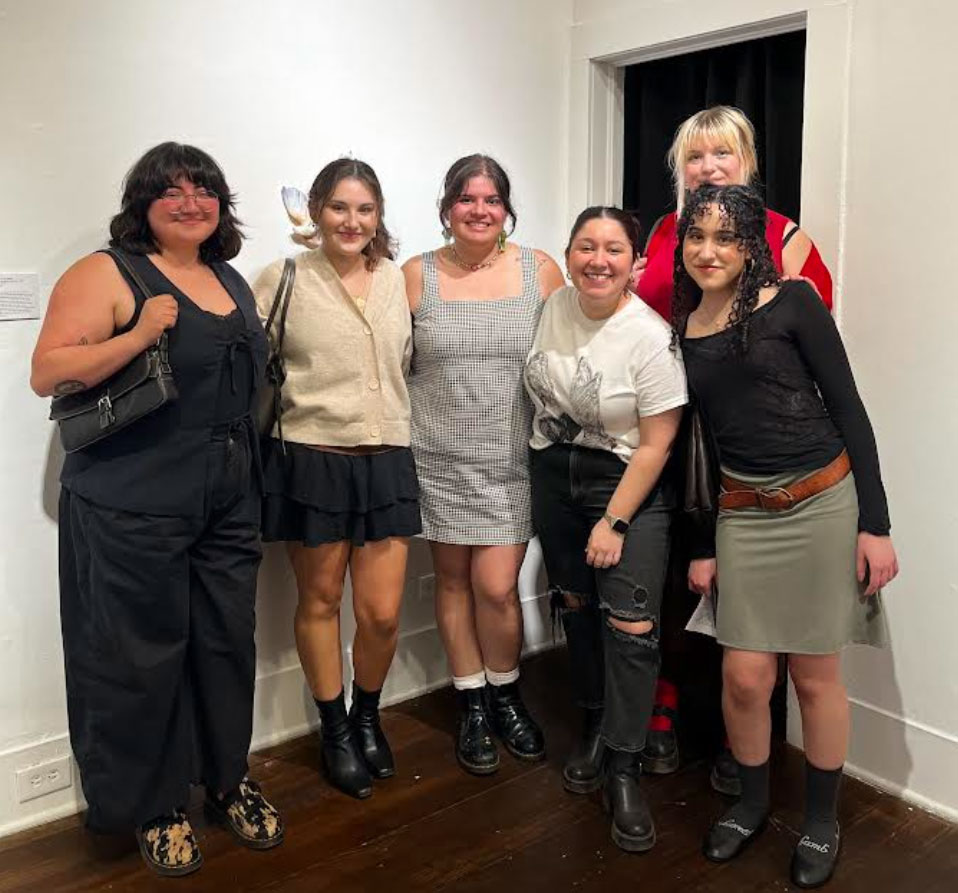
Magaly Cantu, Cheyenne Amaya, Cecilia Sierra, Cassie Lomeli, Bygoe Zubiate, and Ella Brenzel at the opening reception of the exhibit

Showcasing the work of Cheyenne Amaya, Cecilia Sierra, Bygoe Zubiate, Magaly Cantu, and Ella Brenzel, all of them in their early 20s or in the first stages of their careers, the artists explore textiles and mixed media to weave their own identities, telling stories on girlhood and the effects of navigating between tradition and modernization.

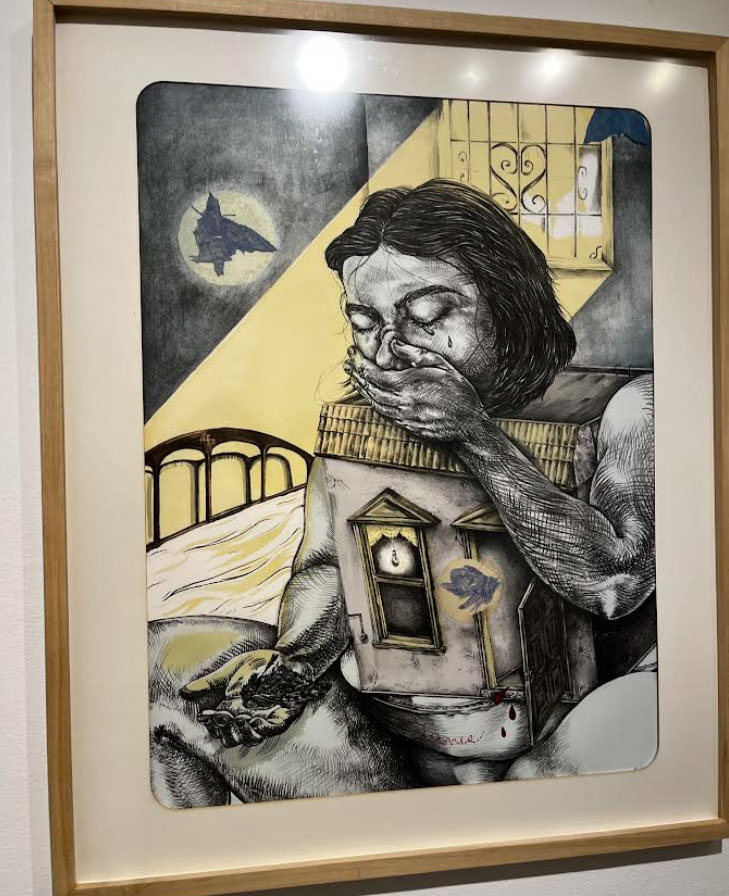
In When a Moth Enters Your Home Dallas-based artist Magaly Cantú, analogizes the body as a home, the moth as a symbol of superstition and the omen of death. She recalls generational warnings like “¡Cierra las piernas!” (“Close your legs!”), a phrase passed down as a command to protect the sacred space of womanhood and innocence.

The image of a girl yearning while holding a moth evokes a sense of intrusion, something entering her sacred refuge without permission. Alternatively, it can be read as a confrontation with the challenges of discovering sexuality and pleasure in conservative societies.

A framed artwork of a woman covering her mouth while sitting on a bed.

Magaly Cantú, “When a Moth Enters Your Home”

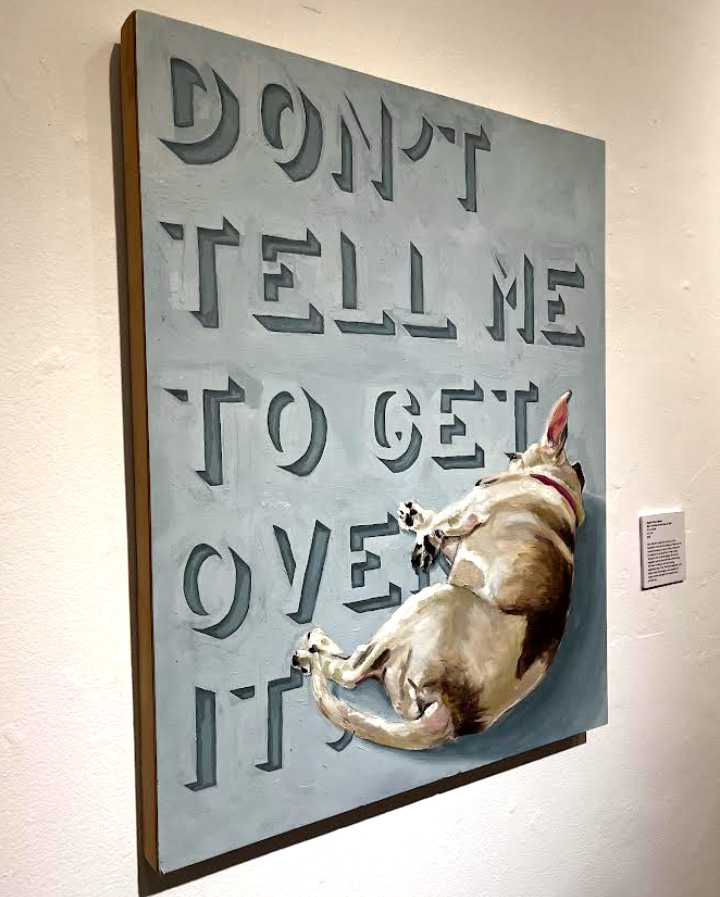
In the piece ‘Don’t tell me to get over it’ by San Antonio-based artist Bygoe Zubiate, we see a blue canvas with that phrase occupying all the space. It speaks out against injustice. For some, “get over it” is a phrase commonly used as the easiest response is to silence others, but true bravery is found in speaking the truth, even with tears in the eyes and a trembling voice.

A painting with text and a small sleeping dog.

Bygoe Zubiate, “Don’t tell me to get over it”

Pain cannot simply be erased. Healing is more like a spiral: you revisit the same emotions and memories, but each time, you’re a little further along.

In the corner, a small puppy lies down, exhausted, just as if it is someone tired of constantly explaining why certain wounds are not so easily dismissed. You don’t just “get over it” — you learn to carry it, to live with it.

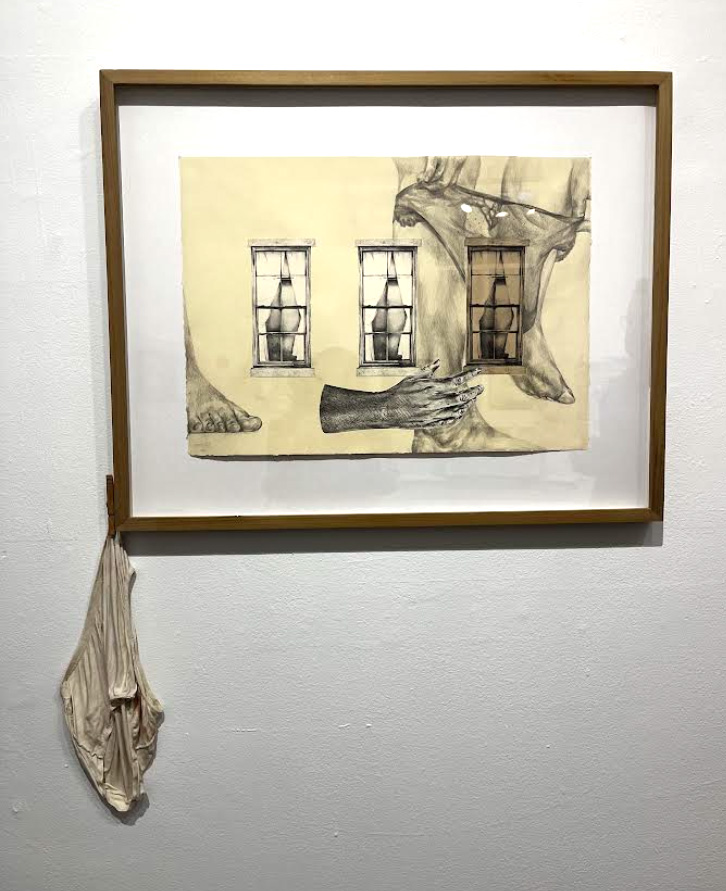
In a second space of the gallery, the piece Cierra las ventanas (Close the Windows) by Magaly Cantú explores the tension between intimacy and exposure. The phrase itself carries an accusatory tone while simultaneously serving as a plea for privacy. Cantú subverts this command by depicting undressing as an act of defiance, reinforcing the recurring analogy of the home as the body and the windows as a symbol of personal boundaries.

A striking element of the lithograph is a pair of white panties hanging from it, stained with menstrual blood — a familiar experience for many young girls as they navigate the transition into womanhood. In many cultures, the arrival of a first period is met with celebration, with aunts, grandmothers, and mothers marking the occasion as the girl steps into a new stage of life. Yet, while this rite of passage is acknowledged with ceremony, it is also a deeply personal and often confusing moment, as one comes to terms with the physical and symbolic changes that accompany the ability to bring new life into the world.

A framed artwork depicting three windows and a pair of underwear being taken off or put on, with a real pair of underwear hanging off of the framed.

Magaly Cantú, “Cierra las ventanas” (Close the Windows)

The themes in this exhibit, once considered taboo by some, carry a bittersweet resonance in hindsight, just as the title suggests. They capture the tension between secrecy and self-exposure, yet the exhibition and its pieces beautifully illustrate a journey of healing and deconstruction — one that many girls undergo as they transition into womanhood.

There is a noticeable movement toward understanding and honoring the legacy of matriarchal lineage, a deeply rooted presence in Latinx households. This reconnection manifests through ancestral practices such as weaving, cooking, and exploring the healing power of plants — ways of reclaiming wisdom passed down through generations. Yet, this revival does not reject the present; rather, it embraces the complexity of navigating tradition within a rapidly evolving world, where womanhood is continuously being redefined.


Bitter/Sweet Longing will be on view at Sala Diaz through March 30th.

The post A Sense of Community: “Bitter/Sweet Longing” at Sala Diaz appeared first on Glasstire.

26 Mar 16:46

my employee wants us to stop ordering “unhealthy snacks”

by Ask a Manager

This post was written by Alison Green and published on Ask a Manager.

A reader writes:

I work in a small workplace, we’re about 40 employees. When I started at the company about five years ago, I started ordering granola bars and some treats. Then I started adding on some fizzy drinks and then progressed to some other snacks, like nuts, fruits, and cookies. None of this is supposed to be the only food people eat, but it’s nice to have some quick to grab in the middle of a busy day. I have an employee now who manages the stocking of this, plus coffee, tea, milk, and cream.

An issue has arisen because we have a coworker who is vegan and he’s decided that we need to stop bringing in what he deems to be unhealthy snacks. Which are basically any processed foods.

He’s brought this up to me, to my employee, and to our Health and Safety committee in their quarterly meeting.

He obviously has strong beliefs about what people should be eating. When he came to me about it, I told him that we are all adults and that everyone has the right to choose what food they wish to eat.

What I wish I had said to him is that unsolicited health advice is not okay. People are not coming to work to be lectured on what he believes is healthy eating. I don’t make him listen to rants about why he should eat meat, because these are individual choices that people need to make.

On top of this, I think we need to respect that many people have complicated relationship with food, and he is trying to put his nutrition beliefs on others in a space that should be not about this.

He’s also made unsolicited remarks about what coworkers are eating, to coworkers who were not discussing food in any way.

While I believe he has good intentions, I think he’s overstepping. What is the best way to tell him to keep his beliefs to himself (on top of the fact that he’s not a trained nutritionist)?

I just want a good way to shut him down that’s not too confrontational, because he does make me want to be.

Yeah, you absolutely need to shut him down. He’s being rude and obnoxious, and because it’s happening at work, his coworkers are a captive audience for it. No one has asked for his evaluation of their diets, and he needs to respect people’s autonomy and privacy and stay out of their food choices.

For the record, that would be true even if he were a nutritionist. Unless he were their nutritionist, it would still be overstepping and out of line to go around critiquing what people eat. (In fact, here’s some fun reading: my company’s pushy new dietician won’t leave me alone, and the update.)

I’m not entirely sure whether you’re this guy’s manager or not, but I think you are. (I hope you are!) If so, sit down with him and say this: “I should have been clearer when we last talked about this. I need you to stop commenting on other people’s food choices, unless they actively and specifically request your critique. You are welcome to have whatever private opinions you’d like about what other people eat, but you cannot continuing critiquing their diets in our office. It’s unwelcome, people deserve to be able to come to work without having to fend that off, and it’s going to affect your working relationships with people.” (I deleted that clause because it’s better not to muddy the waters; just stick with “you need to stop.”)

If he brings up the office-provided snacks again, you should say, “If there are specific snacks that you would like us to add to what we’re providing, you can absolutely submit suggestions for them. I am open to making additional things available, but we’re not going to restrict what we provide based on one person’s preferences.” You might add, “It’s becoming disruptive to continue bringing this up, so I need you to accept that that’s the final answer.”

If you’re not his manager and he’s just a coworker who you have no authority over, the framing would be more like this:  “I want to ask you to stop commenting on other people’s food choices. I don’t know if you realize how often you do it, but people deserve to be able to come to work without having their diets critiqued, and I think you’re really alienating people. That’s before we even get into how fraught food issues can be for people, which isn’t something anyone should have to share to be left alone.” (There’s additional advice here if he’s not someone you manage.)

26 Mar 16:45

update: my boss never praises my work

by Ask a Manager

This post was written by Alison Green and published on Ask a Manager.

Remember the letter-writer whose boss never praised their work? Here’s the update.

My undying thanks to you and all the commentariat for your compassionate take and excellent advice: I needed to get out of that job.

It was advice that didn’t land well at the time, because my morale was so shot that I didn’t even see the point in job-hunting. How could I hope to get a better job when I’d clearly never gotten good at this one, which was for an organization I adored, using the skill set I was educated in?

Still, where self-esteem fails, spite finds a way. Every time my boss did something that made me want to scream at her, I took a deep breath, smiled, and after work, sent out a job application somewhere. I had no actual hopes of getting hired anywhere (see: self-esteem=0), but it was like hitting a punching bag in terms of dealing with frustration. But then, to my astonishment, I got an offer! With a raise!

Here’s where I didn’t take AAM advice: I went to my boss and asked her if the org would match the offer I’d received. I know, I know … Keep in mind, I was terrified of change, concerned that I’d be as lackluster in this new role as my boss clearly thought I was in this one, and … well, the petty part of me wanted to see if I could force one measly shred of validation out of her.

“What are you making now?” she asked, in response to my query.

I told her. (Keep in mind: I was 50% of her direct reports, and my pay had not changed since the last time I’d asked for a raise. We’d had cost-of-living adjustments traditionally but Covid shot those out of the water.)

“Oh, that can’t be right,” said she. “I’ll check with Finance. You’re making more than you think you are.”

So I had an evening to mull over that peculiar statement. Was there a paperwork error someplace? Was she trying to get into a gross vs. net debate? Did she just think I was spectacularly stupid?

In the morning, she reaffirmed. “I’ve talked to Finance, and I’m right. You’re making more than you think you are.” (Reader, I was making $32K.) “However, the organization can match the new offer.”

But … I was done.

I politely informed her that I’d decided the new opportunity was the way to go, gave my two weeks’ notice, smilingly attended a farewell party in boss’s backyard with all of boss’s work friends and none of mine, and two weeks and one day later I was walking into my new job.

New job is AWESOME.

It was a move from nonprofit development into higher ed, supporting several departments whose subject areas are right up my alley. I get stellar reviews from the faculty I support and from my supervisor. I feel good at my job, every day. There was another raise after a year. And best of all — a few months ago, a couple of “my” professors invited me out to dinner with them, and once they had me trapped in a booth at Texas Roadhouse, they announced, “You’re smart. We like you. We’re confused as to why you’re just doing an admin job and not getting a Ph.D. We will write you recommendations and want to be on your committee.” So, it’s official as of yesterday — I’m doing a doctoral program, free with my employment benefits! When I told my (wonderful) supervisor that it was something I was thinking about tackling, her immediate, no-hesitation response was, “Amazing! Yes, I 100% support you in this. :-)”

So, whatever the problem was — a bad manager, a bad employee, just a bad job fit — the solution was, as so often: listen to the excellent advice at AAM.

Yours most sincerely,

Me
Someday soon, Dr. Me

26 Mar 16:43

Lawsuits targeting diversity efforts in science are multiplying

by Claudia López Lloreda, Undark Magazine

On March 5, Do No Harm, an organization that advocates against diversity, equity, and inclusion efforts in medicine, among other issues, sued the American Chemical Society for its Scholars Program, which provides financial support to chemistry students from underrepresented backgrounds. The complaint argues the program is illegal because it is not open to white and Asian students. Around two weeks later, Do No Harm also sued the University of Pennsylvania for its partnership with a database called the Black Doctors Directory, which allows patients to find Black physicians.

The lawsuits join a recent uptick in legal action against universities, departments, and professional societies that host programs intended to increase diversity across academia, including in the sciences. In May 2024, for example, White students at the University of Oklahoma sued their school, alleging the university discriminated against them by factoring in race when determining financial aid. In August, a conservative activist group sued the Department of Education over the Ronald E. McNair Postbaccalaureate Achievement Program, which provides mentoring and research support to underrepresented students pursuing doctoral degrees. Those cases followed the Supreme Court’s 2023 decision against factoring in race when considering college admissions, effectively striking down affirmative action.

“What's happened here is the organizations bringing these lawsuits, they're capitalizing on the fact that the US Supreme Court struck down race-conscious admissions,” said Vinay Harpalani, a professor at the University of New Mexico School of Law and an expert on affirmative action policies.

Read full article

Comments

26 Mar 15:28

Report: Anti-Science Attitude Strongest Among Those Who Believe Turtle Has Little Apartment Inside Shell

by The Onion Staff

CHICAGO—Highlighting a rising distrust in evidence-based knowledge, a report published Wednesday in the American Journal Of Sociology found that anti-science attitudes were strongest amongst those who believe turtles have a little apartment inside their shell. “Americans who reject or question established scientific consensus are more likely to maintain the wholly unsupported theory that when a turtle pulls his head and feet into his shell, he’s actually stepping into a tiny home,” said the report’s author, Professor Darius Aybar, adding that when shown an X-ray that disproved their assertion, people simply doubled down and insisted that the turtle was actually inside the shell, seated in an overstuffed armchair and reading a book very slowly by the fireplace. “No evidence can sway these individual from their conviction that a turtle’s shell contains a cozy one-room residence with rustic wooden floors, a dining table permanently set with a hot-cooked dinner, and, somehow, a few windows with light streaming through dainty curtains. If you hand them a shell to examine, they’ll accuse of having removed the claw-foot bathtub where the turtle takes a sudsy bubble bath and say you are trying to trick them. Across the political spectrum, many people harbor the belief that when a turtle goes to sleep, he puts on a nightcap and pulls a patchwork quilt over him in a canopy bed before blowing out a stub of candle.” At press time, several states had introduced legislation that would require the turtle-apartment theory to be included in high school biology textbooks.

The post Report: Anti-Science Attitude Strongest Among Those Who Believe Turtle Has Little Apartment Inside Shell appeared first on The Onion.

26 Mar 15:28

23andMe Files For Bankruptcy

by The Onion Staff

Embattled genetic testing company 23andMe, once valued at $6 billion, filed for Chapter 11 bankruptcy protection, the company having initially rocketed into the mainstream because of its at-home DNA testing kits that gave customers insight into their family histories and genetic profiles. What do you think?

“Do I get to keep my long-lost uncle?”

Gwen Winett, Talent Appraiser

“I’m devastated by the news, but that might be the emotional 8% Broadly Southern European in me.”

Jay Lindsey, Poultry Weigher

“Who will I mail my spit to now?”

Bob D’Franco, Leather Distresser

The post 23andMe Files For Bankruptcy appeared first on The Onion.

26 Mar 15:27

Teen Warned Not To Accept Group Chat Invites From National Security Advisors She Doesn’t Know

by The Onion Staff
26 Mar 13:04

Gov. Greg Abbott showing no rush to replace late U.S. Rep. Sylvester Turner

by By Kayla Guo
Republicans hold a tiny majority in the House, creating an incentive for Abbott to hold off on calling an election for Turner’s seat, which would likely be filled by a Democrat.
26 Mar 13:01

coworker doesn’t want to report our boss for harassment, I accidentally let a contact think my dad is still alive, and more

by Ask a Manager

This post was written by Alison Green and published on Ask a Manager.

It’s five answers to five questions. Here we go…

1. My coworker doesn’t want to report our boss for harassment

Recently a coworker shared information with me about some pretty egregious sexual comments our mutual boss made. My personal feeling is that she needs to share this with HR and/or our company leadership team (we are a small startup with less than 50 employees, going to leadership would be fine). She has said she’ll consider it but she just needed to tell someone. Then she asked that I tell no one.

I want to tell our HR anyway because there should be an investigation and/or consequences. What are my obligations in this scenario? If I make an “anonymous” tip, it will be easy to figure out it came from me since (I believe) I am the only person she told. And if it comes out and I don’t tell, am I in trouble for knowing but not reporting (I am not in any sort of legal mandated reporting situation)? Basically, what do I do here?

If you’re a manager, you’re legally obligated to report it; not reporting it would expose your company to legal liability. But if you’re not a manager, that doesn’t apply — and in that case I’d argue that you should respect your coworker’s wishes. While it shouldn’t be this way, the reality is that reporting harassment can have real repercussions for the victim. Hopefully that won’t be the case at your company, but there’s a risk that your coworker’s life at work would get worse, not better, and/or that she’ll be put in (further) uncomfortable situations she doesn’t want to be in, miss out on professional opportunities, or even be pushed out. That’s not a decision you should make on her behalf. I understand the impulse to report your boss, but your coworker is the person who will be most affected if you do, and you should err on the side of respecting her wishes.

2. I accidentally let a contact think my dad is still alive

My dad was born and grew up in another country, let’s say Narnia. After moving here, he continued a very deep interest in and connection with it all his life and made sure it was part of my life growing up.

Flash forward to today: I work in sales and am developing a relationship with a very prominent Narnian company, and in the course of chitchat with my contact it came up that my dad was born in Narnia. He was delighted and now mentions it often when introducing me to other Narnians as a kind of fun fact, and says things like “you’ll have to show X to your dad” or “your dad must be proud you’re working with Narnians” and so on.

The problem: my dad is in fact dead. He passed away about a month before I first met my contact, and I did (and still sometimes do!) habitually refer to him in the present tense, and it simply didn’t occur to me until after the meeting. I realize that sounds sociopathic, but I just … forgot. My contact is so pleased about this Narnian connection and is generally such a lovely man that I don’t know how to clear up this misunderstanding — which has now been going on for about four months — without actually saying, “I forgot that my dad died.” Help!

(For what it’s worth, I think my dad would indeed be very proud that I’m working with Narnians, and would also find this situation extremely funny.)

The next time it comes up and your contact refers to your dad in the present tense, just say, “I should have mentioned — my dad died last year. But you’re absolutely right that he’d be so happy that I’m working with other Narnians!”

There may be a brief moment of awkwardness, which is okay — but it’s likely to just seem like something that got misunderstood in the past, not like you were purposefully hiding anything from him. It’s also possible that he won’t even think about the fact that the previous conversations had been in present tense and will just think there hadn’t been an opportunity for it to come up yet. Mostly he’s likely to be focused on telling you he’s sorry to hear it. And then it will be handled and you won’t have to feel weird about it anymore!

3. My coworker got angry that I gave her time-sensitive info at the start of her shift

Today at work we had a few call-outs. This meant last-second game plan changes. Everyone adjusted just fine, except my coworker Elizabeth.

Elizabeth came into work and started small-talking with people right away. As soon as a supervisor spoke up (after giving her time to finish her conversation) to let her know about workflow changes for the day, she became incredibly frustrated and seemed to be holding back from saying something. I joined in the conversation and let her know I had taken care of some extra work to so she wouldn’t have to adjust from her normal workflow and gave her some follow-up info to make her workday easier. In the middle of us talking to her, she stormed off.

I figured she might be having a hard day so I gave her time to cool off and half an hour later checked in on her. She was still angry and said she couldn’t handle talking about work that early in the day. Her shift just started. This seems unreasonable to me. We work in medical care and if we drop the ball, patients can suffer. We have plenty of time to chat once we get our work done, but much of the work we do is very time-sensitive.

How can I adjust to Elizabeth’s responses in the future? I would like to be compassionate and try to understand where she’s coming from. However, at the moment I plan on not keeping her informed and letting her figure things out on her own, as it’s not my job to manage her emotional responses when I’m just sharing information like I would with anyone else in the workplace. I’d love your feedback on adjustments I could make or if I am being unreasonable with how to handle her.

Elizabeth is being unreasonable; you are not. “Can’t handle talking about work during work time” is a little bananas — I mean, she might feel that way, but that’s something for her to manage on her own, not to make others manage for her. And being visibly frustrated and storming off because you’re trying to update her on time-sensitive work?!

Your instinct that it’s not your job to manage her emotional responses is the right one. But your plan to not keep her informed and let her figure things out on her own might not be; that one depends on whether you have a responsibility to impart info to her and whether patients will be harmed if you don’t. If either of those things are the case and you’re finding yourself hesitant to talk to her because of her volatility, that’s a sign to bring in your manager to help.

4. Can I thank my spouse’s boss for being awesome?

After 20-odd years of retail hell that did their damndest to beat my husband’s self-esteem and sense of worth in the workplace into the dirt, he finally landed in a job that not only pays the bills (and keeps up with inflation), but has him feeling like the extremely experienced and valued employee that he really is. This is mostly thanks to his absolute rockstar of a boss.

She takes care of all of her employees, her unit is the best and most well-liked in the entire state and has won awards from the huge corporate offices, she goes to bat without hesitation for her crew, has open communication, encourages and respects healthy work/home boundaries, and is genuinely a funny and cool person! My husband has witnessed her go above and beyond for her team consistently, both in the every day and when emergencies strike.

Everyone he meets is happy with my husband’s work, and his boss in particular is very pleased, but is there an appropriate way I could pass on thanks for, well, putting an end to literal decades of toxic workplaces that my husband has had to work to make ends meet? It’d probably be weird to pass on a card that says, “Thanks for making a great workplace that I haven’t directly joined but have benefitted from!”

Nope, don’t do it. This is your husband’s relationship to manage, not yours, and it would be overstepping for you to do that (and potentially even a little undermining to your husband, depending on exactly what you shared). Enjoy and appreciate the situation from a remove.

5. Employers that ask for too much info in doctor’s notes

I’m a nurse practitioner working in primary care. I see patients for their annual physicals, maintenance of chronic conditions, and for same-day sick visits.

My question is about doctor’s notes for patients who have called out sick from work. My usual template is as follows (can be edited as needed, obviously): “Please be advised that the above named patient was seen in our office today (date) for an acute condition. They may return to work without restrictions on (date). Please excuse their absence (date range).”

I like it because it says “yes, this person had a medical thing, they’re allowed to work again on this date, their absence was legitimate” but doesn’t get into any unnecessary detail.

But I have been running into situations more often lately where an employer requires very specific things in their sick note — “diagnosis and prognosis” as one example, so they ask me to write that they had the flu and that a complete recovery is expected. I don’t have much of a problem with this in the case of common viral illnesses, but what about anxiety? Or chronic knee pain that’s flared up? I feel this violates the privacy that patients should expect when they visit their doctor. Not to mention when some employers require FMLA paperwork to be completed for any absence three days or longer … this is a huge waste of time for most situations for both the employee and their doctor.

Is there any way to push back on these kind of requirements? Should employees push back? Or should we all just do what HR has decided it likes best?

You’re absolutely right. Doctor’s notes aren’t supposed to contain specific diagnoses, details of medical treatment, or any other private medical info that isn’t directly related to the employee’s ability to perform their job. Legally, notes should be kept to the minimum necessary to fulfill their purpose: a confirmation that the person was seen on a particular date, the need for time off, and any other work-related restrictions. Anything more detailed than that puts the employer at risk of violating the Americans with Disabilities Act, which prohibits them from requesting information beyond what’s “job-related and consistent with business necessity.”

When an employer asks for more info than they’re entitled to, you don’t need to comply. You can provide the info you and the employee are comfortable with and ignore inappropriately invasive questions (or employ vague terms like “temporary condition” or “illness”).

Related:
what’s your boss allowed to ask when you call in sick?

26 Mar 12:56

Bill to fast track approval of Trump and Musk agency cuts advanced by House committee

by Sean Michael Newhouse
Updated at 11:00 a.m. ET on March 26

A House committee on Tuesday advanced legislation that would set up a process for Congress to approve President Donald Trump’s overhauls of federal agencies. 

The Reorganizing Government Act of 2025 (HR 1295), which was approved in a 23-20 party-line vote, would resurrect a lapsed authority enabling the president to submit a plan for restructuring agencies that Congress must vote on within 90 days. Such a plan is not subject to the filibuster, meaning the Senate can clear it with a simple majority instead of the usual 60-vote threshold. 

Still, the bill itself would need 60 votes for the Senate to pass it, which is unlikely. 

“The reason they are pushing for this bill is because Donald Trump, Elon Musk and [the Department of Government Efficiency] have already been found consistently to be acting outside of the law in their mass layoffs and agency closures by the courts,” said Rep. Yassamin Ansari, D-Ariz. “Now, instead of defending their own powers, congressional Republicans are pushing forward this bill to hand over their powers to the president.”  

Federal judges have found that many of Trump’s attempts to remove swaths of federal employees and eliminate agencies have been unlawful. 

In contrast, Republicans argued that the measure would upgrade federal programs and promote congressional authority. 

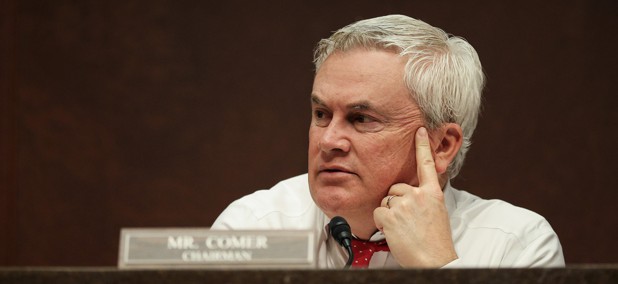
“Renewing the special reorganization authority requiring Congress to take an up or down vote on reorganization proposals by the president will help facilitate needed improvements in government operations,” said House Oversight and Government Reform Committee Chairman James Comer, R-Ky. “It will also allow Congress to have a say in how government reorganization is carried out. That should be what we want here.” 

The GOP also emphasized that the administrations of Bill Clinton, George W. Bush and Barack Obama all requested a renewal of presidential reorganization authority. 

Specifically, the bill would bring back such authority through Dec. 31, 2026. It also would remove a limitation on the authority that previously prevented presidents from using it to abolish or transfer an executive department or independent regulatory agency. 

Between 1932 and 1984, presidents submitted more than 100 plans under this authority, including the establishment of the EPA and Federal Emergency Management Agency. 

The panel also advanced by party-line the following bills that would affect federal employees: 

  • The Protecting Taxpayers’ Wallets Act (HR 1210), which would charge government worker labor unions a quarterly fee for using agency resources. Congressional Republicans have long criticized official time, which is when union officials at agencies are still paid their government salary while working on representational matters instead of their normal duties. 
  • The Preserving Presidential Management Authority Act of 2025 (HR 2249), which would authorize the president to terminate any provision of a federal employee collective bargaining agreement. The GOP has slammed a Social Security Administration collective bargaining agreement reached at the end of the Biden administration that locked in telework levels until 2029; although, the agency has largely suspended telework in an apparent violation of the contract.     
  • The Paycheck Protection Act of 2025 (HR 2174), which would prohibit agencies and the U.S. Postal Service from deducting any amount from an employee’s pay for labor organization dues, fees or political contributions. 

“Taken together, these four bills would have a profoundly negative impact on federal workers and their ability to organize and have a voice in the workplace,” Daniel Horowitz, acting legislative director of the American Federation of Government Employees, wrote in a letter to committee leadership ahead of the markup. 

Rep. Andy Biggs, R-Ariz., offered amendments to the trio of federal labor relations bills that he said would exempt the National Border Patrol Council from their requirements. The committee rejected them, however, with members generally arguing that there should not be carveouts in the measures.

This story has been updated with the vote outcomes for each of the measures. 

]]>
26 Mar 12:55

TCE Is Linked to Heart Defects in Babies, Cancer and Parkinson’s. Republicans in Congress Want to Reverse a Ban on It.

by by Sharon Lerner and Lisa Song

by Sharon Lerner and Lisa Song

ProPublica is a nonprofit newsroom that investigates abuses of power. Sign up to receive our biggest stories as soon as they’re published.

Although it was too late for him to benefit, Daniel Kinel felt relieved in December when the Environmental Protection Agency finally banned TCE. The compound, which has been used for dry cleaning, manufacturing and degreasing machines, can cause cancer, organ damage and a potentially fatal heart defect in babies, according to independent studies and the EPA. It has also been shown to greatly increase people’s chances of developing Parkinson’s disease.

Kinel and three of his colleagues were diagnosed with Parkinson’s disease. They all worked in a law office in Rochester, New York, that sat next to a dry cleaner that had dumped TCE into the soil. Kinel was diagnosed with the neurodegenerative condition at age 43, after working there for seven years. His three colleagues have since died. At least 15 of the firm’s partners developed cancers related to TCE.

“It felt good that we were finally getting rid of this terrible chemical,” said Kinel, whose symptoms now make it impossible to type, write or work as a lawyer. “My children and grandchildren would be protected.”

But his feeling of solace has been short-lived.

The ban has been challenged on multiple fronts since President Donald Trump assumed office for a second time in January. Republicans in the Senate and House introduced resolutions to repeal the ban, which was vulnerable to being overturned through the Congressional Review Act because it was issued shortly before the inauguration. Meanwhile, companies and trade groups have sued to stop the ban in court. A Trump executive order delayed the implementation of the ban until March 21. And last week, the EPA asked a federal appeals court to further delay the ban until the end of May.

TCE, short for trichloroethylene, is one of five toxic substances for which full or partial bans put in place by the EPA under President Joe Biden are now under threat. The Trump administration told the courts that it wants to review all five bans to determine whether they should be rolled back. Those banned substances include a deadly paint stripper called methylene chloride; PCE, a solvent that’s similar to TCE; carbon tetrachloride, which is used as a cleaning fluid; and the cancer-causing mineral asbestos. David Fotouhi, the lawyer Trump nominated to be second-in-command of the agency, tried to overturn the asbestos ban in October, when he was serving as an attorney for a group of car companies. The EPA classifies all of the recently banned chemicals as either carcinogenic or probably carcinogenic to humans.

But the EPA’s ban on TCE is in greater peril than the rest because it has yet to take effect. The prohibition on the chemical was to begin this year for all consumer uses and many industrial and commercial uses. The EPA allowed a more gradual phasing out for more than a dozen industrial uses, such as for some aerospace and defense applications. In those cases, the Biden EPA required employers to provide health protections for workers who come into contact with TCE. The Trump EPA’s recent petition to the federal appeals court to extend the ban’s delay would also mean that employers would not be required to implement the new health protections for workers.

Delaying the ban means that people will continue to be exposed to the chemical, which causes liver cancer, kidney cancer and non-Hodgkin lymphoma, as well as holes in infants’ hearts that can be fatal. While safer alternatives now exist for many of its uses, TCE has seeped into the drinking water of more than 17 million people in the U.S., according to data compiled by the nonprofit Environmental Working Group. Dangerous plumes of TCE have been identified in Woburn, Massachusetts; Wichita, Kansas; and Camp Lejeune Marine Corps base in North Carolina, where hundreds of service members developed Parkinson’s disease and cancer. There is another TCE plume on Long Island in New York, in the district abutting the one that EPA Administrator Lee Zeldin represented in Congress.

The idea that people will still be exposed to TCE infuriates Jerry Ensminger. This chemical “needs to go away,” said the retired Marine Corps master sergeant who’s an outspoken advocate for military families exposed to TCE. Ensminger’s daughter Janey died from leukemia when she was 9; Ensminger said Janey was conceived at Camp Lejeune and the family lived there during most of the pregnancy’s first trimester, then returned when she was 6. Ensminger recalled seeing workers on the base dip truck engines into vast metal vats of TCE in the late 1970s and early 1980s.

Scientists began raising concerns about the toxicity of TCE almost a century ago. The EPA’s work on the chemical proceeded slowly. In 1987, it deemed TCE a “probable human carcinogen.” In 2001, a draft EPA assessment found the chemical to be more toxic than previously thought and highly likely to cause cancer. The conclusion came under attack from some industry and government scientists. The Department of Defense, which is responsible for hundreds of TCE-contaminated sites, criticized the report as based on “junk science.” Two reviews by panels of independent scientists, however, found the assessment was sound. Still, the EPA didn’t begin drafting stricter regulations on TCE until the end of President Barack Obama’s administration.

Those efforts were dealt a blow during Trump’s first term when the EPA weakened a report on TCE’s effects on fetal heart abnormalities and stopped work on the new regulations. Nancy Beck, who before joining the first Trump administration had been a high-level lobbyist for the American Chemistry Council, an industry trade group, presided over the EPA’s chemical program when it pulled back from the TCE ban and, more broadly, retreated from rules that the chemical industry saw as burdensome.

After returning to the private sector, Beck was recently named the principal deputy assistant administrator in the EPA’s office of chemical safety and pollution prevention. She did not respond to requests for comment.

Her appointment has left environmentalists despairing over the fate of the long-awaited TCE ban.

“The same industry lobbyist who was in charge of EPA’s chemical program before is in charge of it again,” said Daniel Rosenberg, director of federal toxics policy at the Natural Resources Defense Council. “When she was there the first time, she moved heaven and earth to weaken the evaluation of the chemical and downplay the hazard TCE posed to people’s health. That appears to be where this is headed again.”

More than 100 groups representing public health, environment and community interests recently sent a letter to Zeldin urging him to reinstate the TCE ban. Referencing Zeldin’s proclaimed interest in clean water for every American, the letter noted that the EPA estimated its rule would produce $20 million in health benefits from reduced cancer rates and said that “delaying implementation of these rules will lead to preventable death, disease and incapacitation and increase medical costs and hardships to families and communities.” This week, environmental and labor groups filed a court brief opposing the EPA’s efforts to delay implementation of the TCE ban.

The EPA did not respond to questions about the TCE ban. Sen. John Kennedy, R-La., who introduced the resolution to repeal the TCE ban in the Senate, and Reps. Mariannette Miller-Meeks, R-Iowa, and Diana Harshbarger, R-Tenn., who introduced a resolution for its repeal in the House, also did not respond to inquiries from ProPublica. A spokesperson from the American Chemistry Council referred ProPublica to its press release from December, which acknowledged that the EPA had included “important adjustments” in the TCE ban to provide flexibility to affected industries.

In a press release about his bid to repeal the ban, Kennedy said that the “Biden administration waged war against America’s chemical producers,” and he urged Congress to “move quickly to take off the handcuffs that President Biden placed on Louisiana and U.S. businesses.” In the same release, Harshbarger described the TCE ban as “one of many examples of the Biden Administration’s overregulation.”

In a hearing about chemical regulation in the House in January, Harshbarger said that a company in her district, Microporous, which makes membranes used in lithium-ion batteries, is facing an “existential threat” from the TCE ban. The ban made an exception for the use of TCE for this purpose, allowing the battery industry to continue using it until 2044. Microporous, which has challenged the ban in court, did not respond to a question about why it needed 20 years to find a suitable replacement for TCE.

Since Trump’s inauguration, the EPA has been touting its efforts to roll back environmental protections. Earlier this month, the agency announced the “most consequential day of deregulation in U.S. history,” listing 31 rules it planned to step away from, related to oil and gas, air pollution and greenhouse gases. The agency celebrated the announcement with a 6,500-word press release that included praise from 61 industry leaders, CEOs and Republican politicians.

Still, some who have been focused on TCE were surprised that the Trump administration was delaying and reconsidering the recent ban. “I thought it was a done deal,” said Dr. Sara Whittingham, a retired United States Air Force flight surgeon who was diagnosed with Parkinson’s disease at 46. When she heard that the rule might be repealed, she was aghast. “What the heck, how can nobody care about this?” she said. “This should be a nonpartisan issue.”

Whittingham believes her disease may stem from the two years she spent as an aircraft maintenance officer at Kelly Air Force Base in San Antonio, Texas, from 1996 to 1998. Her office was above a shop where workers used TCE to clean engine parts.

Last week, Whittingham teamed up with two friends, both Air Force graduates who were diagnosed with Parkinson’s as women in their 40s, to urge people to pressure Congress to drop the resolutions.

“We signed up to go fight for our country,” she said, but now the attitude seems to be, “‘We don’t care about your health, you’ve already signed on the dotted line.’ It’s a kind of a kick in the face.”

Before being diagnosed with Parkinson’s, Whittingham had hoped that her children would follow her career path. But recently she discouraged her daughter, who is a senior in high school, from joining the military. The health risks, she said, were too high.

26 Mar 05:04

Pluralistic: Why I don't like AI art (25 Mar 2025)

by Cory Doctorow


Today's links


Norman Rockwell’s ‘self portrait.’ All the Rockwell faces have been replaced with HAL 9000 from Kubrick’s ‘2001: A Space Odyssey.’ His signature has been modified with a series of rotations and extra symbols. He has ten fingers on his one visible hand.

Why I don't like AI art (permalink)

A law professor friend tells me that LLMs have completely transformed the way she relates to grad students and post-docs – for the worse. And no, it's not that they're cheating on their homework or using LLMs to write briefs full of hallucinated cases.

The thing that LLMs have changed in my friend's law school is letters of reference. Historically, students would only ask a prof for a letter of reference if they knew the prof really rated them. Writing a good reference is a ton of work, and that's rather the point: the mere fact that a law prof was willing to write one for you represents a signal about how highly they value you. It's a form of proof of work.

But then came the chatbots and with them, the knowledge that a reference letter could be generated by feeding three bullet points to a chatbot and having it generate five paragraphs of florid nonsense based on those three short sentences. Suddenly, profs were expected to write letters for many, many students – not just the top performers.

Of course, this was also happening at other universities, meaning that when my friend's school opened up for postdocs, they were inundated with letters of reference from profs elsewhere. Naturally, they handled this flood by feeding each letter back into an LLM and asking it to boil it down to three bullet points. No one thinks that these are identical to the three bullet points that were used to generate the letters, but it's close enough, right?

Obviously, this is terrible. At this point, letters of reference might as well consist solely of three bullet-points on letterhead. After all, the entire communicative intent in a chatbot-generated letter is just those three bullets. Everything else is padding, and all it does is dilute the communicative intent of the work. No matter how grammatically correct or even stylistically interesting the AI generated sentences are, they have less communicative freight than the three original bullet points. After all, the AI doesn't know anything about the grad student, so anything it adds to those three bullet points are, by definition, irrelevant to the question of whether they're well suited for a postdoc.

Which brings me to art. As a working artist in his third decade of professional life, I've concluded that the point of art is to take a big, numinous, irreducible feeling that fills the artist's mind, and attempt to infuse that feeling into some artistic vessel – a book, a painting, a song, a dance, a sculpture, etc – in the hopes that this work will cause a loose facsimile of that numinous, irreducible feeling to manifest in someone else's mind.

Art, in other words, is an act of communication – and there you have the problem with AI art. As a writer, when I write a novel, I make tens – if not hundreds – of thousands of tiny decisions that are in service to this business of causing my big, irreducible, numinous feeling to materialize in your mind. Most of those decisions aren't even conscious, but they are definitely decisions, and I don't make them solely on the basis of probabilistic autocomplete. One of my novels may be good and it may be bad, but one thing it definitely is is rich in communicative intent. Every one of those microdecisions is an expression of artistic intent.

Now, I'm not much of a visual artist. I can't draw, though I really enjoy creating collages, which you can see here:

https://www.flickr.com/photos/doctorow/albums/72177720316719208

I can tell you that every time I move a layer, change the color balance, or use the lasso tool to nip a few pixels out of a 19th century editorial cartoon that I'm matting into a modern backdrop, I'm making a communicative decision. The goal isn't "perfection" or "photorealism." I'm not trying to spin around really quick in order to get a look at the stuff behind me in Plato's cave. I am making communicative choices.

What's more: working with that lasso tool on a 10,000 pixel-wide Library of Congress scan of a painting from the cover of Puck magazine or a 15,000 pixel wide scan of Hieronymus Bosch's Garden of Earthly Delights means that I'm touching the smallest individual contours of each brushstroke. This is quite a meditative experience – but it's also quite a communicative one. Tracing the smallest irregularities in a brushstroke definitely materializes a theory of mind for me, in which I can feel the artist reaching out across time to convey something to me via the tiny microdecisions I'm going over with my cursor.

Herein lies the problem with AI art. Just like with a law school letter of reference generated from three bullet points, the prompt given to an AI to produce creative writing or an image is the sum total of the communicative intent infused into the work. The prompter has a big, numinous, irreducible feeling and they want to infuse it into a work in order to materialize versions of that feeling in your mind and mine. When they deliver a single line's worth of description into the prompt box, then – by definition – that's the only part that carries any communicative freight. The AI has taken one sentence's worth of actual communication intended to convey the big, numinous, irreducible feeling and diluted it amongst a thousand brushtrokes or 10,000 words. I think this is what we mean when we say AI art is soul-less and sterile. Like the five paragraphs of nonsense generated from three bullet points from a law prof, the AI is padding out the part that makes this art – the microdecisions intended to convey the big, numinous, irreducible feeling – with a bunch of stuff that has no communicative intent and therefore can't be art.

If my thesis is right, then the more you work with the AI, the more art-like its output becomes. If the AI generates 50 variations from your prompt and you choose one, that's one more microdecision infused into the work. If you re-prompt and re-re-prompt the AI to generate refinements, then each of those prompts is a new payload of microdecisions that the AI can spread out across all the words of pixels, increasing the amount of communicative intent in each one.

Finally: not all art is verbose. Marcel Duchamp's "Fountain" – a urinal signed "R. Mutt" – has very few communicative choices. Duchamp chose the urinal, chose the paint, painted the signature, came up with a title (probably some other choices went into it, too). It's a significant work of art. I know because when I look at it I feel a big, numinous irreducible feeling that Duchamp infused in the work so that I could experience a facsimile of Duchamp's artistic impulse.

There are individual sentences, brushstrokes, single dance-steps that initiate the upload of the creator's numinous, irreducible feeling directly into my brain. It's possible that a single very good prompt could produce text or an image that had artistic meaning. But it's not likely, in just the same way that scribbling three words on a sheet of paper or painting a single brushstroke will produce a meaningful work of art. Most art is somewhat verbose (but not all of it).

So there you have it: the reason I don't like AI art. It's not that AI artists lack for the big, numinous irreducible feelings. I firmly believe we all have those. The problem is that an AI prompt has very little communicative intent and nearly all (but not every) good piece of art has more communicative intent than fits into an AI prompt.

(Image: Cryteria, CC BY 3.0, modified)


Hey look at this (permalink)


A Wayback Machine banner.

Object permanence (permalink)

#15yrsago Secret copyright treaty will sideline the UN and replace it with private club of rich countries https://www.michaelgeist.ca/2010/03/acta-superstructure/

#15yrsago Discarded photocopier hard drives stuffed full of corporate secrets https://web.archive.org/web/20100322192937/http://www.thestar.com/news/gta/article/781567–high-tech-copy-machines-a-gold-mine-for-data-thieves

#10yrsago If Indiana legalizes homophobic discrimination, Gen Con’s leaving Indianapolis https://files.gencon.com/Gen_Con_Statement_Regarding_SB101.pdf

#10yrsago Sandwars: the mafias whose illegal sand mines make whole islands vanish https://www.wired.com/2015/03/illegal-sand-mining/<?a>

#10yrsago Woman medicated in a psychiatric ward until she said Obama didn’t follow her on Twitter https://www.independent.co.uk/news/world/americas/woman-held-in-psychiatric-ward-after-correctly-saying-obama-follows-her-on-twitter-10132662.html

#10yrsago As crypto wars begin, FBI silently removes sensible advice to encrypt your devices https://www.techdirt.com/2015/03/26/fbi-quietly-removes-recommendation-to-encrypt-your-phone-as-fbi-director-warns-how-encryption-will-lead-to-tears/

#10yrsago Australia outlaws warrant canaries https://arstechnica.com/tech-policy/2015/03/australian-government-minister-dodge-new-data-retention-law-like-this/

#10yrsago TPP leak: states give companies the right to repeal nations’ laws https://www.eff.org/deeplinks/2015/02/its-time-act-now-congress-poised-introduce-bill-fast-track-tpp-next-week

#5yrsago Social distancing and other diseases https://pluralistic.net/2020/03/26/badger-masks/#flu-too

#5yrsago Record wind-power growth https://pluralistic.net/2020/03/26/badger-masks/#blows-blows

#5yrsago Sanders on GOP stimulus cruelty https://pluralistic.net/2020/03/26/badger-masks/#unlimited-cruelty

#5yrsago Canada nationalizes covid patents https://pluralistic.net/2020/03/26/badger-masks/#c13

#5yrsago LoC plugs Little Brother https://pluralistic.net/2020/03/26/badger-masks/#lb-loc

#5yrsago The ideology of economics https://pluralistic.net/2020/03/26/badger-masks/#piketty

#1yrago Meatspace twiddling https://pluralistic.net/2024/03/26/glitchbread/#electronic-shelf-tags


Upcoming appearances (permalink)

A photo of me onstage, giving a speech, pounding the podium.


A screenshot of me at my desk, doing a livecast.

Recent appearances (permalink)


A grid of my books with Will Stahle covers..

Latest books (permalink)


A cardboard book box with the Macmillan logo.

Upcoming books (permalink)

  • Enshittification: Why Everything Suddenly Got Worse and What to Do About It, Farrar, Straus, Giroux, October 7 2025
    https://us.macmillan.com/books/9780374619329/enshittification/
  • Unauthorized Bread: a middle-grades graphic novel adapted from my novella about refugees, toasters and DRM, FirstSecond, 2026

  • Enshittification, Why Everything Suddenly Got Worse and What to Do About It (the graphic novel), Firstsecond, 2026

  • The Memex Method, Farrar, Straus, Giroux, 2026


Colophon (permalink)

Today's top sources:

Currently writing:

  • Enshittification: a nonfiction book about platform decay for Farrar, Straus, Giroux. Status: second pass edit underway (readaloud)
  • A Little Brother short story about DIY insulin PLANNING

  • Picks and Shovels, a Martin Hench noir thriller about the heroic era of the PC. FORTHCOMING TOR BOOKS FEB 2025

Latest podcast: With Great Power Came No Responsibility: How Enshittification Conquered the 21st Century and How We Can Overthrow It https://craphound.com/news/2025/02/26/with-great-power-came-no-responsibility-how-enshittification-conquered-the-21st-century-and-how-we-can-overthrow-it/


This work – excluding any serialized fiction – is licensed under a Creative Commons Attribution 4.0 license. That means you can use it any way you like, including commercially, provided that you attribute it to me, Cory Doctorow, and include a link to pluralistic.net.

https://creativecommons.org/licenses/by/4.0/

Quotations and images are not included in this license; they are included either under a limitation or exception to copyright, or on the basis of a separate license. Please exercise caution.


How to get Pluralistic:

Blog (no ads, tracking, or data-collection):

Pluralistic.net

Newsletter (no ads, tracking, or data-collection):

https://pluralistic.net/plura-list

Mastodon (no ads, tracking, or data-collection):

https://mamot.fr/@pluralistic

Medium (no ads, paywalled):

https://doctorow.medium.com/

Twitter (mass-scale, unrestricted, third-party surveillance and advertising):

https://twitter.com/doctorow

Tumblr (mass-scale, unrestricted, third-party surveillance and advertising):

https://mostlysignssomeportents.tumblr.com/tagged/pluralistic

"When life gives you SARS, you make sarsaparilla" -Joey "Accordion Guy" DeVilla

ISSN: 3066-764X

26 Mar 05:00

India accused of meddling in Canada's Conservative Party race

Conservative Pierre Poilievre and Liberal Mark Carney were both asked on the campaign trail about allegations of foreign meddling.
26 Mar 05:00

Houston cycling advocates protest removal of safety features along Heights Boulevard

by Dominic Anthony Walsh
After Houston Public Works removed protections from the Heights Boulevard bike lane, more than 20 demonstrators lined the street Tuesday in protest. Houston Mayor John Whitmire’s administration says the protections were removed because of “safety issues.”
26 Mar 04:59

740 KTRH turns 95 on March 25, 2025

by mike@mikemcguff.com (mikemcguff)
740 KTRH Houston turns 95 years old today on March 25, 2025.Believe it or not, KTRH originally began as KUT Austin, affiliated with the University of Texas at Austin. However, unlike the 90.5 KUT-FM Austin of today, this version was sold to Houston Chronicle owner Jesse H. Jones, who sought to compete with the Houston Post's KPRC-AM, which signed on in 1925. UT Austin wanted to exit the radio
26 Mar 04:58

Poilievre insists not being aware of India helping his campaign just practice for not being aware of America helping his campaign

by Ian MacIntyre

OTTAWA – Amid revelations that India aided the leadership campaign of Conservative leader Pierre Poilievre, the opposition leader insists that having absolutely no idea about this will be great training for when he claims to have no idea about the Trump administration helping his Federal Election campaign. With CSIS alleging that Poilievre’s 2022 leadership bid […]

The post Poilievre insists not being aware of India helping his campaign just practice for not being aware of America helping his campaign appeared first on The Beaverton.

25 Mar 22:06

Greenland condemns planned visits by Usha Vance and Trump adviser

The pair will make separate trips this week, after threats from the US president to take over the island.
25 Mar 21:20

were we wrong not to interview a volunteer for a paid job?

by Ask a Manager

This post was written by Alison Green and published on Ask a Manager.

A reader writes:

I would really love your opinion on how we handled this hiring process — and on the subsequent fallout.

I work for a public library that has a very large volunteer base and a small paid staff. When we have a job opening, which is rare, volunteers are welcome to apply. We traditionally grant them a phone interview (i.e., they make the first cut) as a courtesy, though that is not official policy. A few volunteers have been hired over the years, most recently about three years ago.

One volunteer, Stephanie, has applied twice (two years apart) and made it to an in-person interview (second round) both times. Enough time had passed after the first rejection that we gave her the second opportunity, and to her credit, she does have an impressive resume of high-level administrative work and did well in the short phone screenings. However, in both in-person interviews, we found that she was rambling and unfocused despite our best efforts, and she expressed hesitations about performing some key parts of the job (working under pressure, multi-tasking). She also made some offhand comments that came off as elitist and lacking compassion, and we really don’t feel she’s a fit for our community-focused, fast-paced environment, nor would any of us particularly look forward to working with her.

The reason we gave for rejecting her both times was the standard “there were candidates whose skills and experience were a better fit,” though we took extra care with the wording due to our ongoing relationship.

Stephanie just applied for a third time (nine months after the last rejection). A volunteer has never applied more than once, so we have no precedent for this. We (hiring committee of three) already knew she was a “no” and did not invite her to a phone interview this time. We felt that continuing to interview her would send the wrong message.

As the hiring manager, I sent her a kind, personalized rejection that she had not made it to the interview round this time, citing the large and competitive applicant pool (true), and reiterated that we value her and her volunteer work. Although she had told the volunteer supervisor there would be no hard feelings if she didn’t get the job, Stephanie did NOT take it well.

Long story short, over the course of four weeks, she has approached our director in public expressing her shock and disappointment at not being interviewed, sent an angry and accusatory email directed at me for being “unfair,” made passive-aggressive comments about our new hire, and accosted the director at work with an angry diatribe about how she “can do the job” and had been owed a courtesy interview. Along the way, she made a racist comment about a previous hire (“I know you hired her because she’s Black, but I think that’s great”), claimed to be more qualified than any of our recent hires, and “threatened” to stop going above and beyond in her volunteer work (okay?).

I’ve never seen anyone lose their cool like this over a hiring decision. At least she has validated for us that we made the right call, I suppose.

We truly want to learn from this and regret that there are hard feelings that might have been avoided. Were we wrong in not granting Stephanie a courtesy interview a third time, as she believes? Should we have been more direct about the reasons when we rejected her the last time (or this time)? And if she were to apply again down the road, as she said she still plans to do, what do we do?

It doesn’t sound like you did anything wrong. You’ve interviewed her twice and knew she wasn’t going to be a competitive candidate, so chose not to lead her on or misuse her time. She’s not owed repeated shots at a job just because she volunteers, and a lot of people in her shoes would prefer not to have their time wasted or their hopes raised if you already knew you wouldn’t hire them.

If you could go back and redo anything, I’d say it would have been better to have a conversation with her where you provided some feedback on why you weren’t going to interview her, in recognition of the fact that she volunteers with you and has shown a long-running interest in being hired. But the fact that you didn’t do that in no way warrants her response! (And it sounds like you did send a personalized note, not just a form rejection.)

Can you have a conversation with her about it now? Given the way she’s been acting since, it sounds like you’ve got to do that to address both her frustration and the fact that she can’t go on being so disruptive about it. Ideally in doing that, you’d give her some feedback about why you don’t think she’s the right fit for the job. “Rambling and unfocused” can be tough to give feedback to a candidate on (although not impossible), but “hesitations about performing key parts of the job” is much easier — as is the part about making comments that aren’t aligned with your community-focused culture. You’re not looking to debate any of this with her, of course, but because she’s a long-time volunteer, it would be respectful to share those concerns with her so that she has a better understanding of why she was passed over.

Depending on how that conversation goes, you might also need to tell her point-blank that she can’t keep accosting people about the decision and to ask whether she wants to continue volunteering, knowing that that behavior can’t continue.

25 Mar 20:55

The Plan to Bomb the Middle East Finally Made It Out of the Group Chat

by Agrim Joshi

“The encrypted chat app [Signal] beloved by Elon Musk and foreign dissidents has been embraced by federal government workers, DOGE and military planners.” — Washington Post, 3/25/2025

“Top Trump officials included The Atlantic editor in group chat about plans to bomb Yemen.” — CBS News, 3/24/2025

- - -

25 Mar 20:53

Trump team accidentally texts Canadian invasion plans to Ian Hanomansing

by Ian MacIntyre

TORONTO – Following reports of Trump Cabinet members including journalists on private Signal threads, Trump officials have reportedly texted similar plans for an invasion of Canada to anchor of CBC’s The National, Ian Hanomansing. Echoing a recent scandal where senior Trump officials included Jeffrey Goldberg, EIC of The Atlantic, on a Signal thread to plan […]

The post Trump team accidentally texts Canadian invasion plans to Ian Hanomansing appeared first on The Beaverton.

25 Mar 20:53

Democrats Huddle To Decide How Best To Let Massive Republican Fuck-Up Slip Through Fingers

by The Onion Staff
25 Mar 20:53

‘I Messed Up At Work Again,’ Crestfallen Michael Waltz Texts Wife, National Geographic Editorial Staff

by The Onion Staff
25 Mar 20:52

Trump Officials Accidentally Text Journalist War Plans

by The Onion Staff

Top national security officials for President Donald Trump, including his defense secretary, texted war plans for upcoming military strikes in Yemen to a group chat in a secure messaging app that included the editor-in-chief of The Atlantic, with the National Security Council saying the text chain “appears to be authentic.” What do you think?

“We should be okay as long as terrorists don’t have the internet.”

Troy Fernbach, Timetable Drawer

“A president’s cabinet is only as good as its drunkest member.”

David Ray, Guerrilla Marketer

“So all of a sudden a journalist doesn’t want to know things?”

Frieda Thorsen, Door Holder

The post Trump Officials Accidentally Text Journalist War Plans appeared first on The Onion.

25 Mar 18:16

Saturday Morning Breakfast Cereal - EVM

by Zach Weinersmith


Click here to go see the bonus panel!

Hovertext:
Look it's philosophy. Don't kick the math too hard.


Today's News:
25 Mar 18:14

You can now download the source code that sparked the AI boom

by Benj Edwards

On Thursday, Google and the Computer History Museum (CHM) jointly released the source code for AlexNet, the convolutional neural network (CNN) that many credit with transforming the AI field in 2012 by proving that "deep learning" could achieve things conventional AI techniques could not.

Deep learning, which uses multi-layered neural networks that can learn hierarchical representations directly from data without explicit programming, represented a significant departure from many earlier traditional AI approaches that relied on hand-crafted rules and features.

The Python code, now available on CHM's GitHub page as open source software, offers AI enthusiasts and researchers a glimpse into a key moment of computing history. AlexNet served as a watershed moment in AI because it could accurately identify objects in photographs with unprecedented accuracy—correctly classifying images into one of 1,000 categories, like "strawberry," "school bus," or "golden retriever" with significantly fewer errors than previous systems.

Read full article

Comments