- Rebecca Wortham - Bob Kunz - Kate Scheper - Donal Botkin - BN-12 - David White - Andrea Di Biagio - George Lin - Nancy Flores - iulus - Xueqi - Tim Stumbaugh - Bogdan Toma - Brian Tillman - Chad Bramwell - Nicolas Dedual - Nicholas Welna - Richard Jenkins - Martin - Chris - Meekay - سليمان العقل - Jason Lewandowski - Manuel O. Maldonado - Norm - rictic - Silvainius - Derek Bonner - Eliri SDH - Freddi Hørlyck - Peter-Claire Lomax - Vero - John Lee - Maxime Zielony - John Rogers
## Special Thanks + Mylos Besseling: www.youtube.com/c/mylosairplanefan + Dr. Charlie Freeman: Department Chair and Distinguished Teaching Professor at SUNY Geneseo + Doug Moss: Owner of AeroPacific Consulting + John H. Mott: Advanced Aviation Analytics Institute for Research at Purdue University + Office of the Secretary General: International Civil Aviation Organization + Derek Muller: https://www.youtube.com/veritasium
## Patreon Executive Producers: Bobby, Bob Kunz, Andrew Bereza, Rebecca Wortham, Nevin Spoljaric, Donal Botkin, BN-12, Marco Arment, George Lin, Richard Jenkins, Phil Gardner, Martin, Steven Grimm, David Tyler, iulus, Xueqi, Colin Millions, Oliver Steele, Andrea Di Biagio, Henry Ng, Jason Lewandowski, Alex Simonides, سليمان العقل, Tim Stumbaugh, rictic, Nicholas Welna, Meekay, David White, Derek Argueta, shannon cherng, Anthony Paolilli, Emmett Jayhart, Katie Scheper, Andrew, Jeromy Johnson, Michael Ritter, Pluto, C C, Bogdan Toma, Brian Tillman, Chad Bramwell, jill hoffman, Nicolas Dedual, Derek Bonner, Mikko, Orbit_Junkie, Tómas Árni Jónasson, Dennis Dimka, Rick Edwards, Daniel Kwak, Bear, chrysilis, Drago175, Emil, Esteban Santana Santana, Freddi Hørlyck, John Rogers, Peter Lomax, Rhys Parry, Veronica Peshterianu, John Lee, Maxime Zielony, Elizabeth Keathley, Birdstryke, Darn https://www.patreon.com/cgpgrey
## Music & Sound + Kevin MacLeod Track Name: Fig Leaf Times Two Kevin MacLeod on YouTube: youtu.be/UcOXTd9Ix7g Music from: incompetech.com
The grant, which was awarded in September in the final months of the Biden administration, was to be used in planning efforts to get the project moving again. The Trump administration now says the Texas Central Railway work needs to occur without any taxpayer assistance.
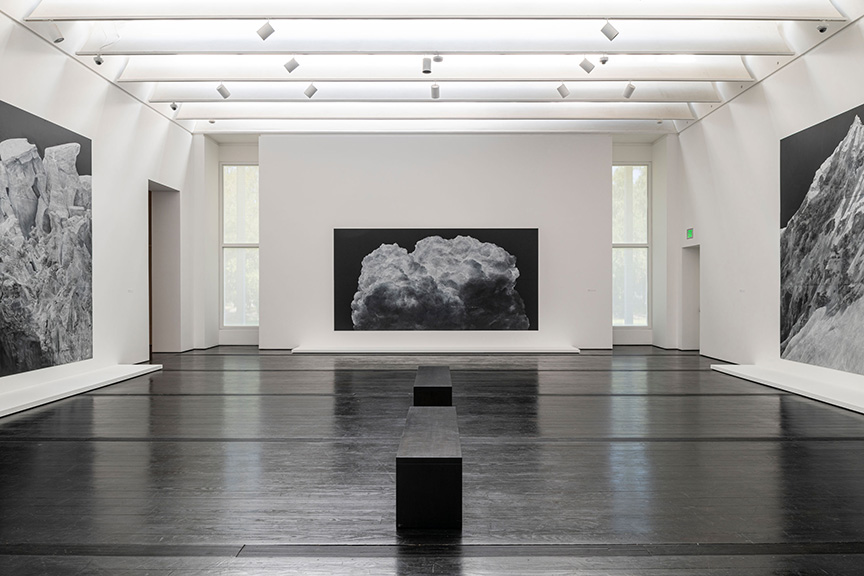
While the British artist Tacita Dean is much better known for her films, the exhibition of her work currently on view at the Menil Collection is comprised almost entirely of drawings. Given that this is the first major exhibition of her work in the U.S., it would be reasonable to ask why the decision was made to focus on the drawings. This question is easily answered by Dean herself, who claims that “[D]rawing is the thread that connects everything” (1). The show, titled Blind Folly, includes a selection of drawings dating from 1991 to 2024, and the way in which these works are connected, not only to each other but to the films (four of which are being screened sequentially), provides a clue as to how we might understand the work they might be said to be doing.
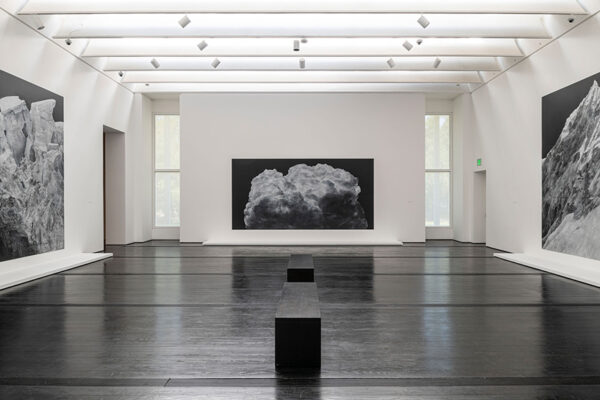
Installation view of “Blind Folly.” Photo: Paul Hester
Because of — not despite — the show’s focus on drawing, I want to start with an observation Dean made about FILM, her 2011 film installation in the Turbine Hall at Tate Modern. She begins by quoting the late filmmaker Harun Farocki on the difficulties he encountered when he first started editing digitally. “[T]here was,” Farocki said, “hardly any material resistance against the ideas”(2). Glossing Farocki’s comment, Dean reflects on her own process of editing analog film, writing, “The time it takes to implement an idea: to cut something in or take something out and then spool backwards to the beginning to watch how it has worked, is the time of film and the time of film edited, as well as the time of deep thought, concentration, and consideration. I need that material resistance to my ideas” (3). Dean needs this material resistance in her drawings as well (4). Moreover, this resistance extends to the support of each drawing, which is not “neutral” but is as integral to the work as its medium; indeed, the medium of these works could be said to include the support, which is often some kind of found material. This material interdependence can be found in the relationship between the chalk and the support in blackboard drawings like The Wreck of Hope (2022); in the preexisting incident in the drawings that utilize found painted slate like Blind Folly (2024) and Blind and Dusty (2024); and in Dean’s engagement with the postcard images in the Found Postcard Compliment (2019) drawings.
Dean’s preoccupation with material resistance is equaled by her preoccupation with time (as is evident from her comment above), which, paradoxically, is as relevant to her drawings as it is to her films. This is illustrated most explicitly in a 1998 drawing, Magnetic (Aviary): Crows, Raptors, Fowl, Game, Water Birds, Ornamental, Vulture, Garden, Seabirds (1996). In this Magnetic series work, Dean recorded the calls of various birds on magnetic tape. She then framed all the lengths of tape in each category — crows, raptors, fowl, etc. — noting the name of each bird on the corresponding length of tape. With the length of the tape corresponding to the duration of the call, Dean renders the temporal spatial (and visual). Another way in which Dean has incorporated temporality into her drawings is through the use of writing. For instance, many of the blackboard drawings include notations, and some of these notations have to do with time or reference dates (more on which below).
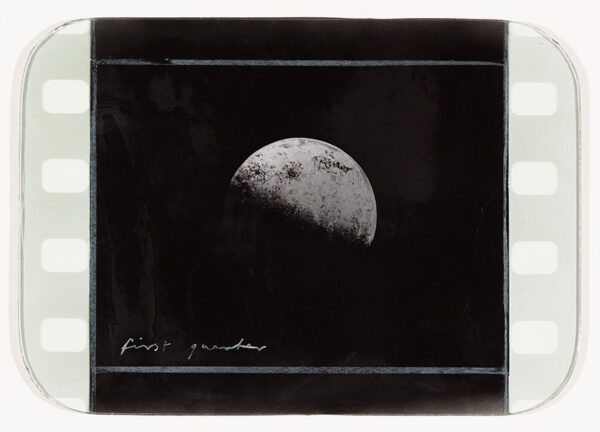
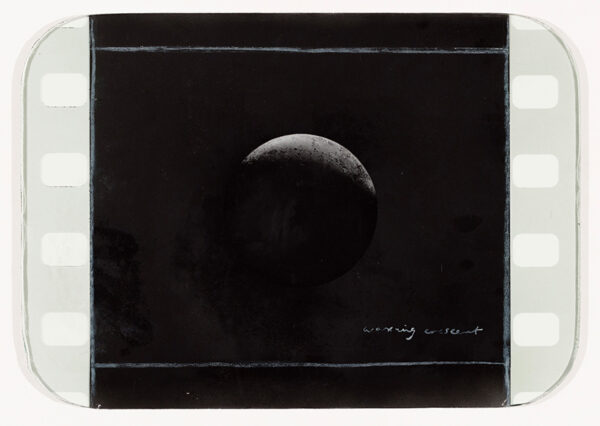
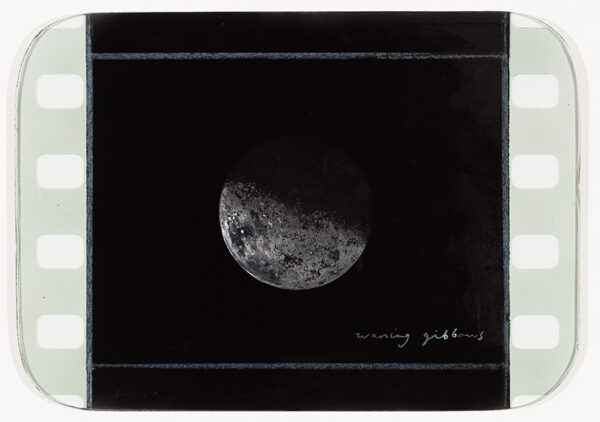
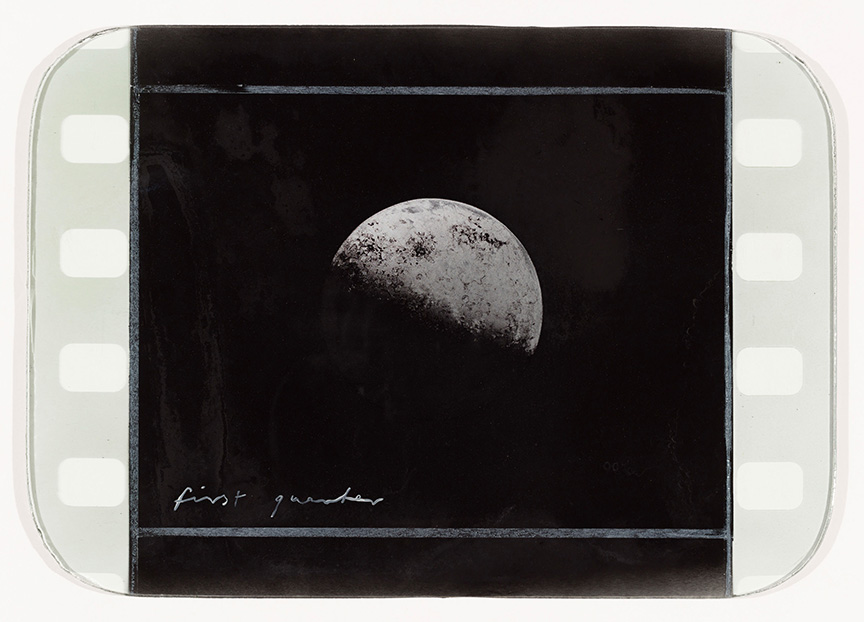
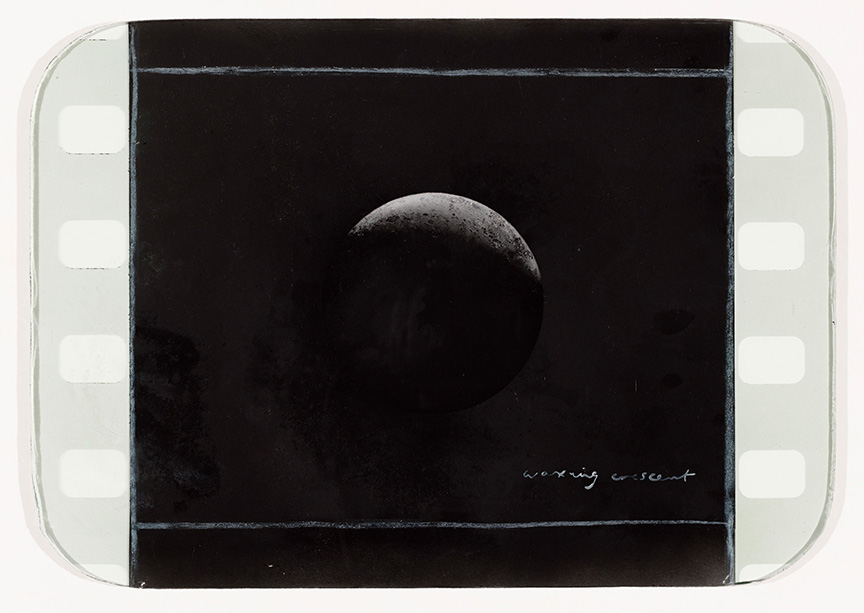
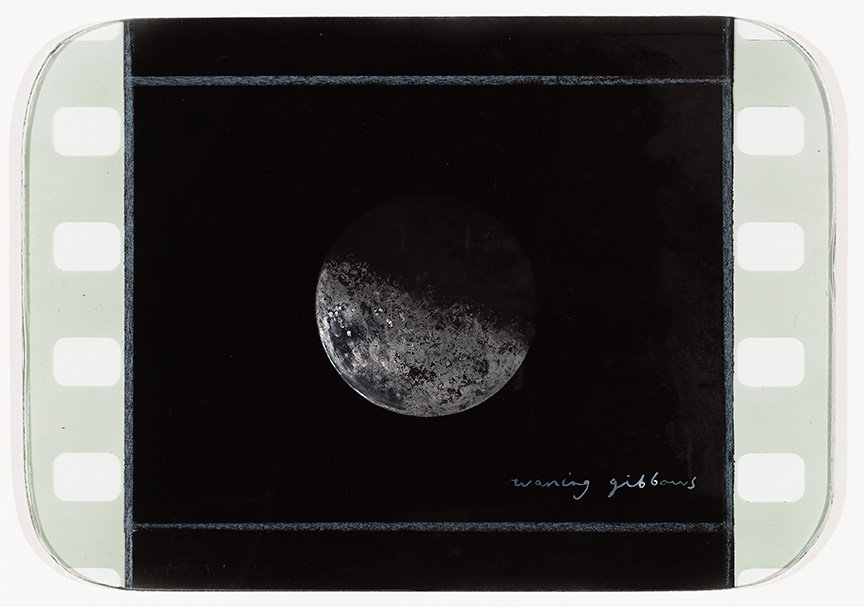
Some of the newest works in Dean’s oeuvre include the drawings she has recently made using found steam train windows. In the exhibition, these drawings line two perpendicular walls of one gallery, the walls forming an “L” shape. Each of the windows is lined on the bottom and top edges with translucent sprocket-like “holes,” making the two series of windows look like segments of film strips. On the short end of the “L” are eight drawings of the phases of the moon on black grounds, starting with an all but invisible (because it’s rendered in black) new moon. Like the new moon, each of the successive phases is labeled in white script underneath: waxing crescent, first quarter, waxing gibbous, full, waning gibbous, last quarter, waning crescent. Moving from one drawing to the next, the viewer effectively moves through both real space/time and cosmic space/time since movement through the gallery in real time is connected to the virtual time of film and, therefore, to the moon’s progression from one phase to the next.
On the long end of the “L” are four groups of drawings, each loosely connected by a particular focus or scheme. The first group pairs two images, one titled Fixed Foot and the other One Foot on Super 8. The second group picks up the foot reference, and the third and fourth introduce images of mountains, a tree, lightning, and the “hand of god.” The final image is of an eclipse. So, we proceed from the blindness of the not-quite-discernible new moon to the blindness of the eclipse: as Michelle White, the curator of the exhibition, notes in the book that accompanies the exhibition, “[F]or Dean, an eclipse represents the ultimate blindness, ‘the blindness of nature’” (5). In her essay, White focuses on blindness, which is central to Dean’s process, and references to it can be found throughout the show (6). As White explains, Dean’s reliance on blindness has to do with her lack of premeditation and interest in coincidences and chance encounters; it’s also related to the limitations of her mediums (7).
In the steam train windows, Dean provides a corollary to the blindness of the new moon and the eclipse in her parenthetical references (in the titles of two works) to the “hypnagogic” and the “hypnopompic” — the transitional states of consciousness that are experienced while falling asleep and while waking up. Hallucinations associated with these states are brief, often vivid perceptual illusions. Dean has frequently spoken about the artist’s ability to work just below consciousness or below the “deliberate mind” (she has emphasized the importance of this in her writings on Cy Twombly), and, while they are fleeting visual images, hypnagogic and hypnopompic hallucinations might be the closest we, as viewers, will ever get to this artist’s process (8).
Fixed Foot, the first steam train drawing on the long end of the “L,” depicts a mirrored image of a compass superimposed by a red grid (9). Here, the foot referred to is the anchored “foot” of the compass, a tool that delineates space or a space (a circle), its stasis reinforced by the grid. The foot is set in motion, at least virtually, in the next “frame,” titled One Foot on Super 8, which is a drawing of a human foot standing on a mirrored strip of Super 8 film (10). The four frames that make up the next set of images depict feet of various kinds — human feet, the cloven foot of the god Pan, the feet and ankles of an ancient sculpture of a charioteer that Dean is enamored of — standing on different gauges of film: Super 8, 16mm, 35mm, and 70mm. Placed as though they are standing on the film, the feet are “mobilized” as they walk along — or are seen to be conveyed by — the film. As a result of the mirroring of the figures in these images, the film strips in particular, these drawings include the reflection of the viewer, which has the effect of implicating us. I would argue that this strategy implies that we are responsible for the stewardship of this technology, that is analog film.
This is not a Luddite’s nostalgic desire for a prelapsarian past; it is not a desire to go backward. Rather, the mirrored surfaces situate us firmly not only in the “here” but also in the “now”: the present is the only time apprehended by the mirror. Although Dean’s focus on obsolescence and loss and anachronism has contributed to the reputation she has garnered as an artist who is preoccupied with the past, she would beg to differ. “For me,” she said in an interview, “my work is always about the present” (11). Like many of the other drawings in the show, the locomotive drawings both assume and appeal to an embodied viewer, whose presence in the gallery is, of course, both “here” and “now.” Or as Maurice Merleau-Ponty put it, “Just as it is necessarily ‘here,’ the body necessarily exists ‘now’; it can never become ‘past.’” Dean’s crusade — I think it can be called that — to preserve analog film is not about the past; it’s about the future. It’s about the loss that would be sustained if celluloid were allowed to be superseded entirely by digital film. “[T]he point of this book,” Dean writes in the publication that accompanied FILM, is “to understand and preserve [film] as the independent and irreplaceable medium it is, and has been, and to make clear the incalculable loss to our cultural and social world if we let it… just disappear” (13). Of course, the choices we make in the present will determine whether analog film has a future.
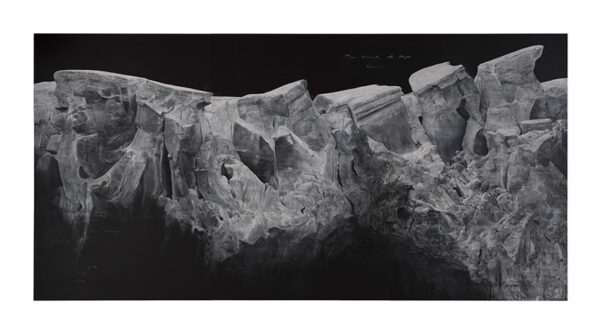
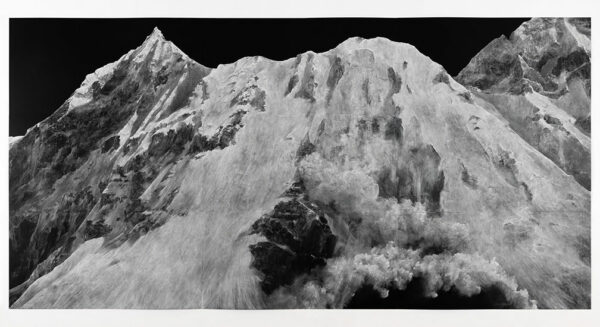
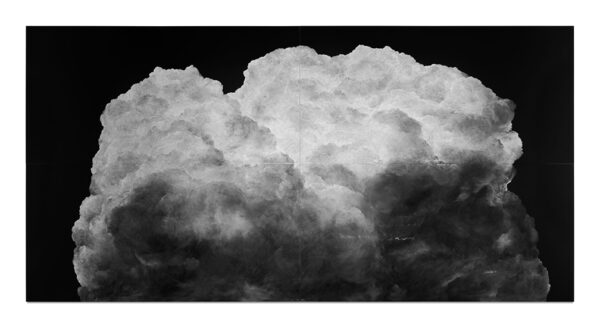
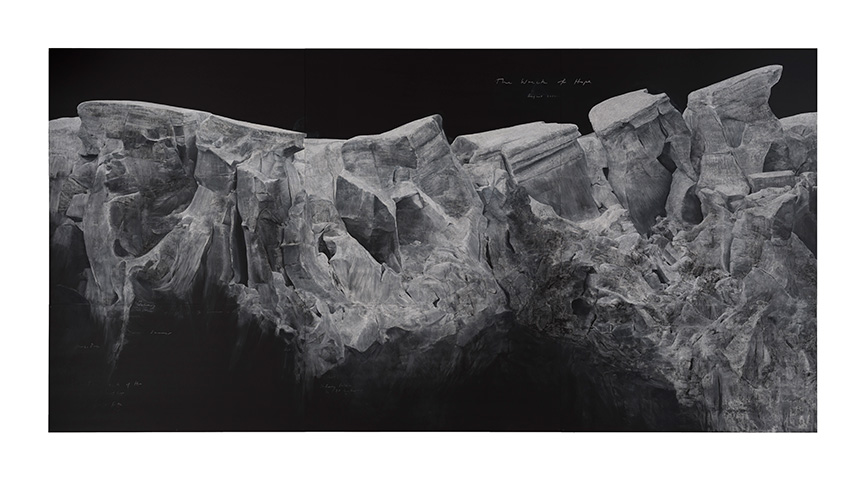
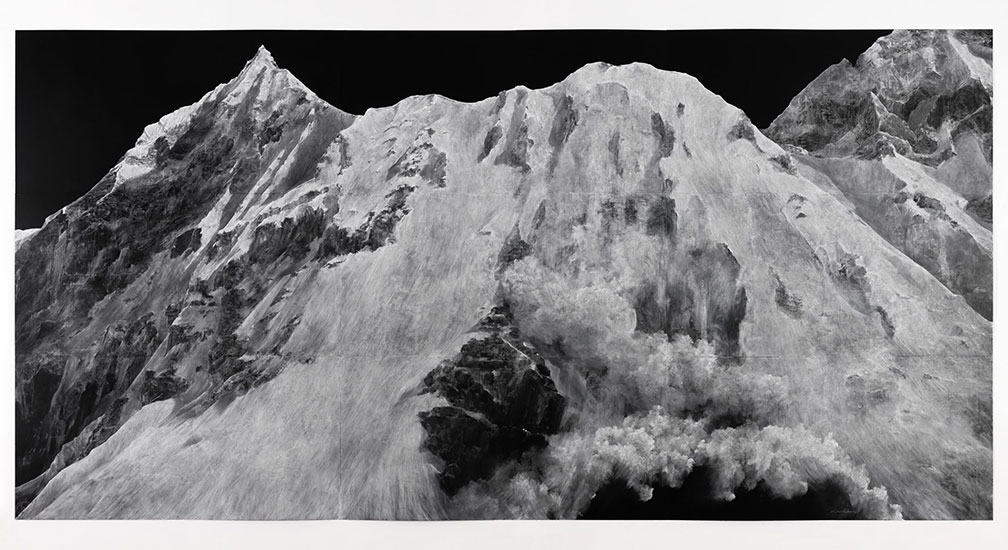
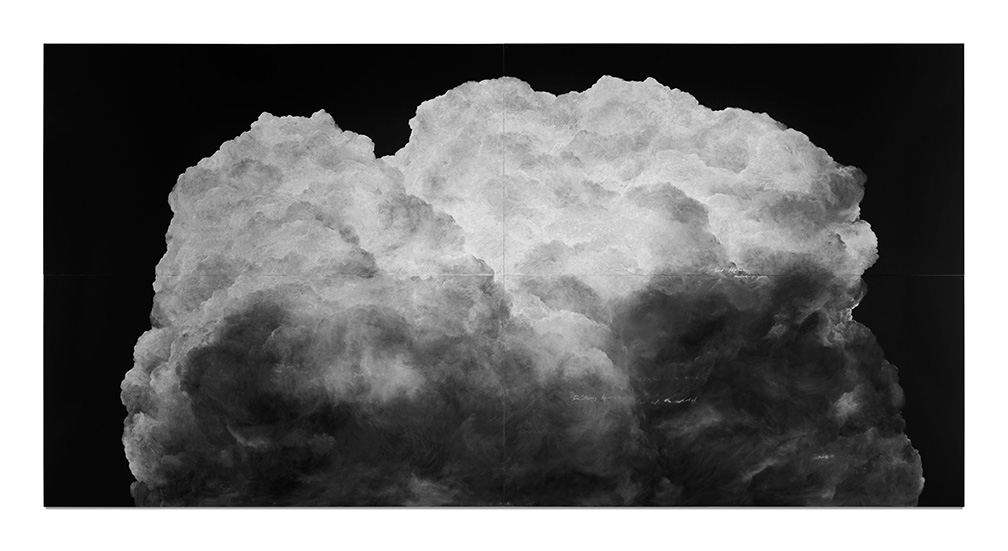
The phenomenological nature of the experience of the steam train drawings is reinforced in three large-scaled blackboard drawings titled The Wreck of Hope (2022), The Montafon Letter (2017) — both 24 feet across — and Sunset (2015), which is a little smaller (14). They are landscape images engaged with the sublime: The Wreck of Hope depicts a huge iceberg; The Montafon Letter, an avalanche; and Sunset, an immense cloud that seems to be glowing from within. Because Dean refuses to apply any fixative to the chalk, the insubstantiality of the drawings is evident not in spite of their monumental scale but because of it. And their material fragility is echoed in the ephemeral quality of the images’ subject matter.
There are stories behind these images — The Wreck of Hope alludes to a Caspar David Friedrich painting of a shipwreck, The Montafon Letter is related to some 17th-century correspondence about an avalanche, and Sunset references a giant cloud that Dean saw while she was driving down Sunset Boulevard — but it’s the monolithic nature of the objects they depict that we respond to. Initially, the drawings push us back toward the center of the room in order to view the totality of their broad expanses, but they also include tiny, human-scaled script, prompting us to draw closer to their surfaces in an effort to read the messages left us by the artist. The words and phrases, some of which are decipherable and some of which are not, do a couple of things. First, they introduce a textual (and temporal) element into a typically visual medium. And second, they amount to commentary, not on the work per se but on the artist’s process.
The timelessness typically ascribed to the artwork is undermined both by the chalk’s lack of fixative and by these “notes,” which, not coincidentally, often relate to time. In The Wreck of Hope, for instance, there is a note that says, “Sidney Felsen is 98 tomorrow.” There’s no knowing when that “tomorrow” was, only that it’s now in the past (although the present tense of the verb links that past to this present). There are also dates, “Sept. 3,” “12 August,” “2 Sept.,” and at the top, above the iceberg, the title of the work and the year “2022” (15). There are many other notations, many of them either rubbed out or illegible.
In some cases, their illegibility is the result of our inability to make out what the letters spell; it can also relate to the fact that the note is written not on the (black) ground of the drawing but on its (white) figure, i.e. the iceberg. In the latter case, since the notes are written in the same chalk used to render the iceberg, there’s not enough contrast between the figure (here, the writing) and the ground to decipher them. That the drawn words appear on both the iceberg and the negative space that surrounds it calls attention to the interdependence of the drawing’s figure(s) and ground(s), and to the material resistance of both. It also calls attention to the relationship between drawing and writing. Whether the artist considers the words to be drawn or written is not clear, but writing is what we usually encounter on a blackboard. Yet this writing is also drawing — or appears in a drawing. The punctuality of these notes, their connection not only to the time when the work was made but to the time of making, is also crucial. Like the locomotive drawings, these artworks seem to want to transgress their timelessness in favor of a connection to both real time — that is, the present — and to the virtual time of the drawing.
So, what’s at stake in this work? I would argue that the stakes, for Dean, have to do with resistance — material resistance, in fact. As I’ve noted, Dean’s insistence on preserving and continuing to make work with photochemical film is connected to the material resistance that’s also crucial to her drawings. And the drawings instantiate this resistance for the viewer. In other words, resistance is elicited from or posed as a question to the viewer in various ways — phenomenologically, formally, temporally, materially (or in terms of medium), structurally, conceptually. Most crucially, it’s posed as a question about the cost involved in relinquishing analog processes altogether.
Becoming digital subjects doesn’t, or doesn’t only, involve a change from one format or technology to another; it means we are recruited — interpellated — by the digital (16). In an interview, Zadie Smith refers to digital technology as a “behavior modification system” (17). It’s not just that social media posts instruct us on what to be interested in; in other words, it’s not just the content of the post that matters. It’s that the structure of these digital technologies structures the way we think about thought: “That an argument is this long, that there are two sides to every debate, that they must be in fierce contest with each other” (18). While Smith acknowledges that we are modified by all mediums (books, TV, radio, etc.), digital mediums have changed our thinking and our way of thinking about thinking in deleterious ways. Dean, too, is wary: “We need to tread carefully into our digital future,” she writes (19). Her issue is not with our reliance on the internet or digital technologies per se — I think she would agree that they have distinct advantages. Instead, her issue is with the “bodyless, human-less world” that they portend if we don’t “tread carefully” (20).
In a 2011 show at the Whitney Museum titled Pro Tools, Cory Arcangel included Real Talk, a piece in which he had the museum enhance its Wi-Fi in the galleries by using temporarily installed signal repeaters (21). Arcangel was thrilled about the idea that viewers pausing in the galleries to look at their phones would “get the best reception they’ve had all day long” (22). That the artist not only anticipated the distractibility of his audience but actively encouraged it signals a kind of acknowledgment of — and capitulation to — viewers’ capture by digital media.
By contrast, what Dean asks of us is that we attend to her drawings and films and that we do so in a particular way. The strategies I’ve outlined above prompt us to pay attention not just to what the images represent but to what they make manifest — materially, formally, temporally — and, self-reflexively, to the ways in which we engage with them. In their Twelve Theses on Attention, The Friends of Attention write, “An attentional path is the trace left by a free mind. To submit to the attentional path of another, to retrace it, is a form of attention” (23). In my view, this has something to do with Dean’s project. The eclecticism of her drawings (and I’ve mentioned only a few examples) means that there are not only numerous “attentional paths” for the viewer to retrace but numerous kinds of “attentional path.” Retracing is a kind of drawing (one that Dean herself has employed), and more to the point, it’s an analog process. Submitting to this process is, of course, a choice — one that Dean doesn’t coerce us to make but invites us to choose just as she would like to continue to be able to choose to make analog rather than digital films in her practice.
Dean’s focus on material resistance in this work and on the temporality of artmaking and art-viewing is an attempt to slow things down, to coax us into paying attention to the (analog) processes of the artist, to the passage of time, and to the opportunities that are afforded by submitting to both. In The Friar’s Doodle (2009), one of the four films that are being screened in the exhibition, the camera ranges across the surface of a photocopy of a drawing given to Dean by a young friar in the 1970s. Ostensibly, there isn’t much to this 13-minute film: the camera (re)traces the lines that make up the drawing without ever pulling back so that the viewer can see it in its entirety. The effect produced by this “all-overness” is not sameness because of the differences in the mark-making, and yet, because nothing “happens” in the film — there’s no narrative arc much less any kind of denouement or resolution — it might be seen as boring or redundant.
Presumably, the reason for the film’s duration is that it took thirteen minutes for the camera to record every inch of the drawing. The film is “addressed” to the viewer, or perhaps it would be more accurate to say it is addressed to a viewer, since there is a single, somewhat formal armchair on offer in the screening room (the kind of chair that one imagines might be occupied by a friar). This sets up a one-on-one encounter with the drawing, just as a single individual supposedly produced it. Although we never get to see the whole drawing, with some patience — and perhaps a few viewings — we might gain a more or less comprehensive sense of it. But I don’t think this is entirely the point. The point is that in our submission to the film’s retracing of this drawing we have spent time attending to the work and to the analog process that brought it into being. And this small act of resistance against our complete surrender to the digital is perhaps all that’s required.
1) Tacita Dean et al., Analogue: Drawings 1991-2006, 1st ed (Göttingen: Steidl, 2006)
2, 3, 13, 19, 20) Tacita Dean, Tacita Dean: Writing and Filmography, Reprint edition (London: Royal Academy of Arts, 2018)
4) “I am an artist and I need the physical resistance of the material I am working with… Sometimes I use chalk on a blackboard or paint on a photograph.” Dean, 274.
5, 7) Michelle White, Blind Folly or How Tacita Dean Draws (MACK BOOKS, 2024), 24.
6) In addition to being the title of the exhibition, the phrase “blind folly” is the title of one of Dean’s most recent drawings and is cited in the drawing T&I (2006).
8) For Dean’s writing on Twombly’s ability to “work beneath his conscious level,” see Dean, Tacita Dean, 84; 249–50.
9) Most of the titles of the drawings in this series, including Fixed Foot, are lines from John Donne’s 1611 or 1612 poem “A Valediction: Forbidding Mourning.” The central metaphor of the poem compares the speaker and his lover to two legs of a compass, which are always joined together.
10) Dean is clearly playing on the words “foot” and “footage” in numerous ways in this work.
11) Rina Carvajal and Tacita Dean, “Film is a Medium of Time: A Conversation with Tacita Dean,” in Briony Fer et al. Tacita Dean: Film Works (Milano: Charta/Miami Art Central, 2008), 61.
12) Also, “I am not in space and time, nor do I conceive space and time; I belong to them, my body combines with them and includes them.” Maurice Merleau-Ponty, Phenomenology of Perception, trans. Colin Smith (London and New York: Routledge & Kegan Paul Ltd., 1962), 140.
14) There is a fourth blackboard drawing, The Delfern Tondo (2024), but there are differences between this drawing and the other three: it’s smaller in scale and it lacks writing.
15) Underneath the date “August 12,” Dean includes the name “Salman Rushdie.” This is the date, in 2022, when Rushdie was violently attacked in Chautauqua, New York. Thanks to Karen Schiff for reminding me of this date.
16) See Louis Althusser, “Ideology and Ideological State Apparatuses,” in Lenin and Philosophy and Other Essays, trans. Ben Brewster (New York: Monthly Review Press, 1971), 173ff.
17, 18) Ezra Klein, “Opinion | Zadie Smith on Populists, Frauds and Flip Phones,” The New York Times, September 17, 2024
21) Pro Tools is a brand of audio-editing software.
22) Andrea Scott, “Futurism,” The New Yorker, May 30, 2011, 34.
23) The Friends of Attention, Twelve Theses on Attention, ed. D. Graham Burnett and Stevie Knauss (Princeton, NJ: Princeton University Press, 2022), n.p. Emphasis in the original. From the website of the Friends of Attention: “The Friends of Attention are a loose, informal network of creative collaborators, colleagues, and actual friends who share an interest in “ATTENTION” — the puzzles and problems of the focused mind and the directed senses. We are committed to ATTENTION ACTIVISM.”
Blind Folly is on view through April 19 at The Menil Collection.
The Dallas Invitational Art Fair has announced the Modern Art Museum of Fort Worth’s acquisition of two pieces from the 2025 fair.
This year, the Invitational’s third fair, marks the establishment of an acquisition fund to support the museum, similar to the Dallas Art Fair’s partnership with the Dallas Museum of Art. Curator María Elena Ortiz and Assistant Curator Clare Milliken visited the fair over the weekend to select the works.
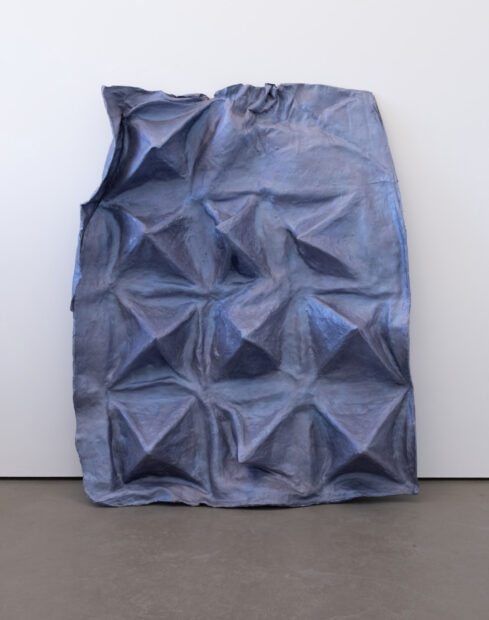
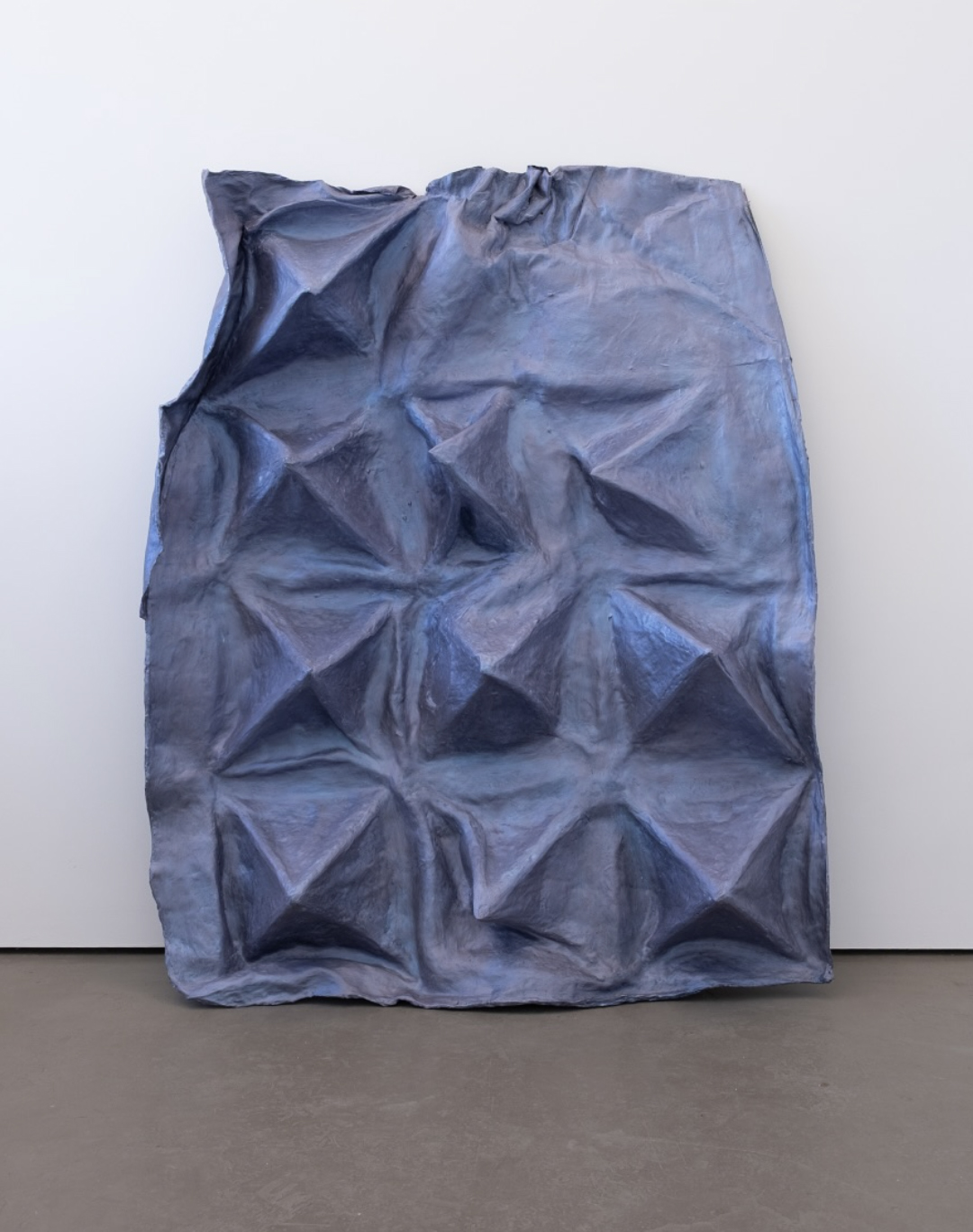
Nancy Lupo, “The Underground,” 2020
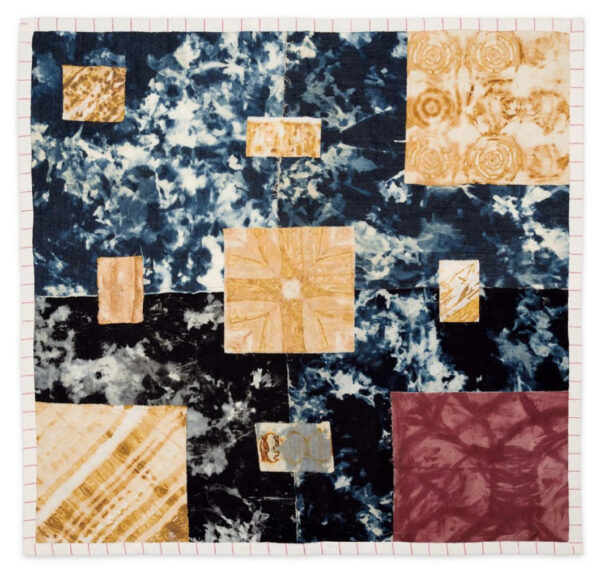
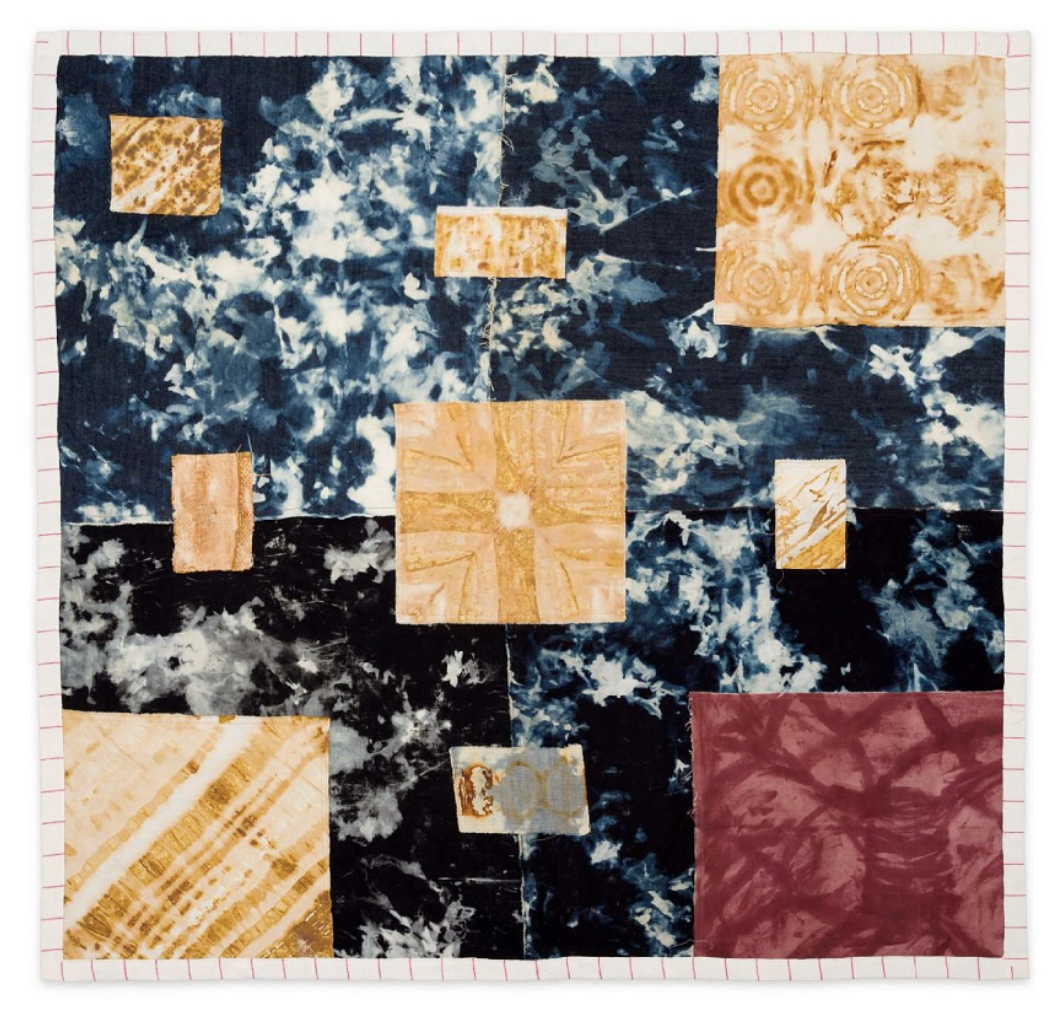
The pieces are Nancy Lupo’s The Underground, acquired from Good Weather, a gallery with locations in Chicago and Little Rock, and Gray Wielebinski’s The Eternity Target, acquired from 12.26 Gallery in Dallas.
Gray Wielebinski, “The Eternity Target,” 2024
Ms. Ortiz told Glasstire, “With a transformative spirit, this is an important partnership that supports galleries and art infrastructure financially and creatively. We are excited to share these works with our audiences in our galleries and beyond.”
Ms. Milliken added, “We are excited for the many ways these acquisitions can spark new conversations with mainstays in the Modern’s collection. Both Nancy Lupo and Gray Wielebinski’s works have a real interest in materiality, challenging our preconceptions of what these materials can do, similar to Jamal Cyrus, Claes Oldenburg, John Chamberlain, and Lynda Benglis.”
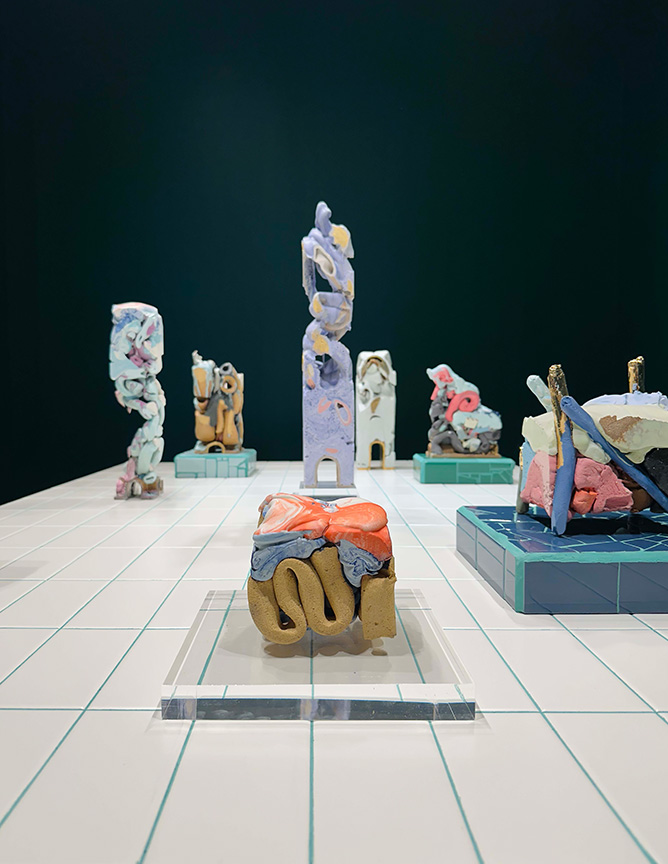
In this conversation, Renata Cassiano Alvarez and I discuss how language forms the foundation of her artistic practice, shaping not only communication but her perception, identity, and material choices. Influenced by her Mexican and Italian heritage, her work explores themes of archaeology, abstraction, architecture, and materiality, often using forms like arches and circles to signify passage and cyclical time. Throughout the conversation, we explore the power of uncertainty in art-making and meaning-making. We discuss the possibility and potential of resisting the desire to over-explain the process while encouraging viewers to discover their own interpretations in relationship to the object, preferring for the work to remain “mysterious and important.”
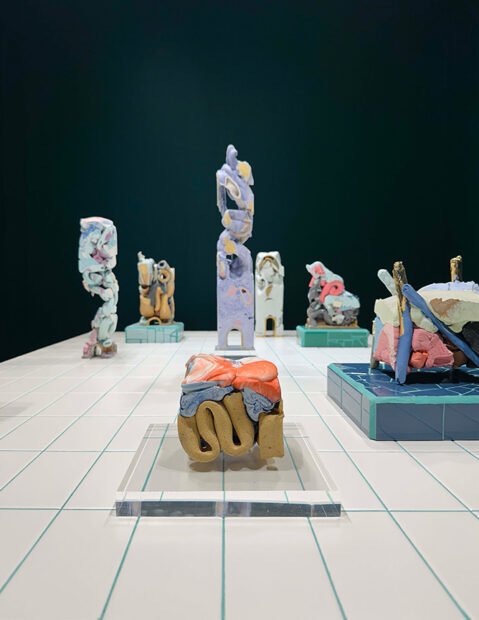
Installation view of “Cuarto Verde,” on view at Conduit Gallery. Photo courtesy of the artist
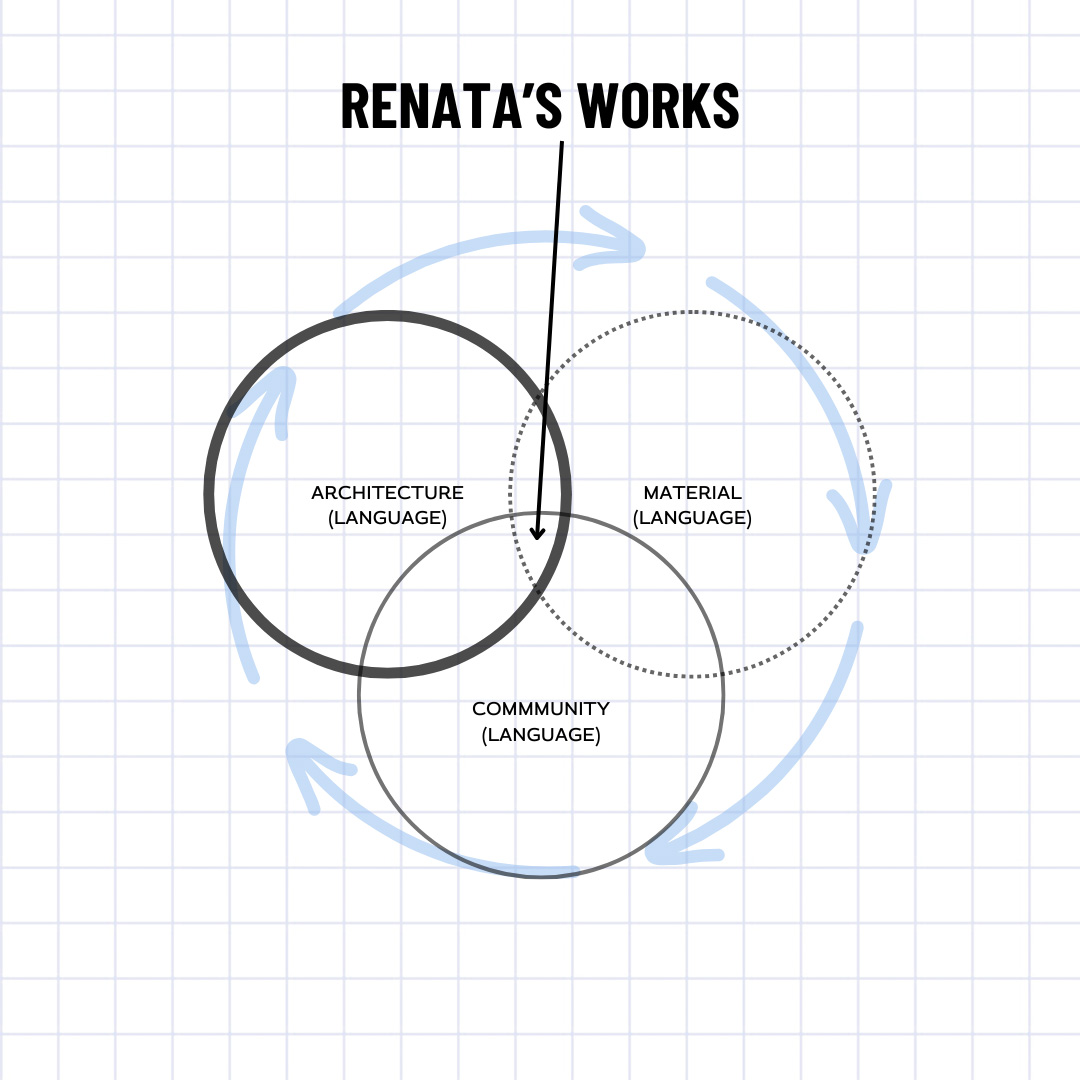
Carris Adams (CA): I created a Venn diagram of three overlapping elements of your practice: architecture, community, and material. I understood language to be a part of the community, but very quickly, I realized that language is the foundation of your practice.
Renata Cassiano Alvarez (RCA): Yes, I think language is at the base of it all. There are several entry points and layers to work through ideas and questions about language. Ten years ago, while I was in grad school and living in Massachusetts, I started realizing how much English was percolating into a lot of aspects of my life. We have always spoken two languages at home growing up. My father is Italian, and my mother, Mexican. I learned English in school. My parents were very into languages, and after English school, they sent me to French school. I am grateful for that because it taught me the power of the word.
I started using English professionally here in the US, and I started understanding how much language really determines many aspects of our lives. It determines our outlooks. It determines how we perceive things. Language even affects our physicality. Here is an example: when I think of my sculptures, I think of them as females. Because in Spanish, it’s la escultura, a female word. That’s how my brain functions. And with English, it was such a different way of thinking.
CA: Do you remember a time when language, your practice, and physicality overlapped?
RCA: Yes. When I first came to the U.S., I started lifting more weights, so my body started changing. I started thinking about how I could translate this change with material. I was in grad school at the time, making work about abstraction, history, and archaeology, which are the things that I am interested in.
How could you change the language of a material without being overly narrative? I don’t want to give people a narrative. I don’t want people to be like, “This is where it starts, and this is where it ends.” To me, everything is circular, and it’s more visual, and it’s more abstract and more visceral.
It was then that I started working with glaze as a casting material. This came from an infatuation with casting a lot of concrete. Just like concrete, I started adding aggregate to the glaze just to see what happened. This is how this mode of working came to be. It’s not only trying to understand the language of material but also pushing back on the conventions of the discipline.
When you’re brought up in ceramics, there are a lot of rules to follow. I didn’t start in ceramics — I started as a painter. In painting, there are rules, but they feel more flexible. So I kept wondering: why can’t ceramics be more flexible, too?
People always have issues with things that break and get put back together, with pieces being too heavy, with varying thicknesses, or even the length of a form — these details matter to them. But I wanted to push back against that.
For me, my process is about embracing language as an agent of change. Pushing back against convention isn’t just about rejecting it — it’s about embracing those conventions and pushing them to their limits. My work is heavy. It’s broken, and I put it back together. I use glue and epoxy — all these materials that are usually seen as cheapening the work because it’s not whole. But the work is whole.
In fact, the cracks, the cuts — all of that — tell more of a story than something pristine ever could. Pristine work is technically impressive, and yes, it’s beautiful. But for me, the work itself has to speak. I don’t want to paint every character for you — I want the presence of the work, its physicality, to tell you what you need to know.
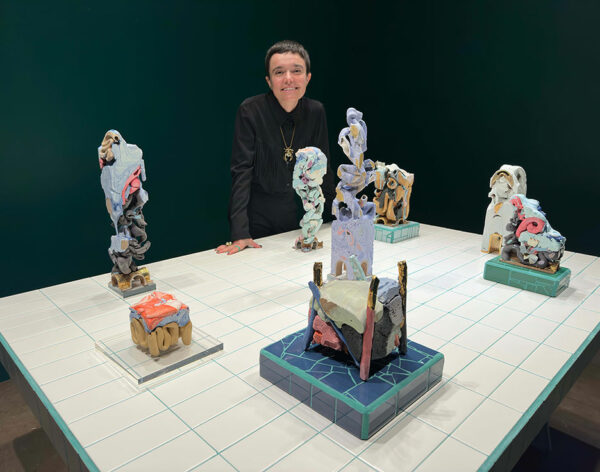
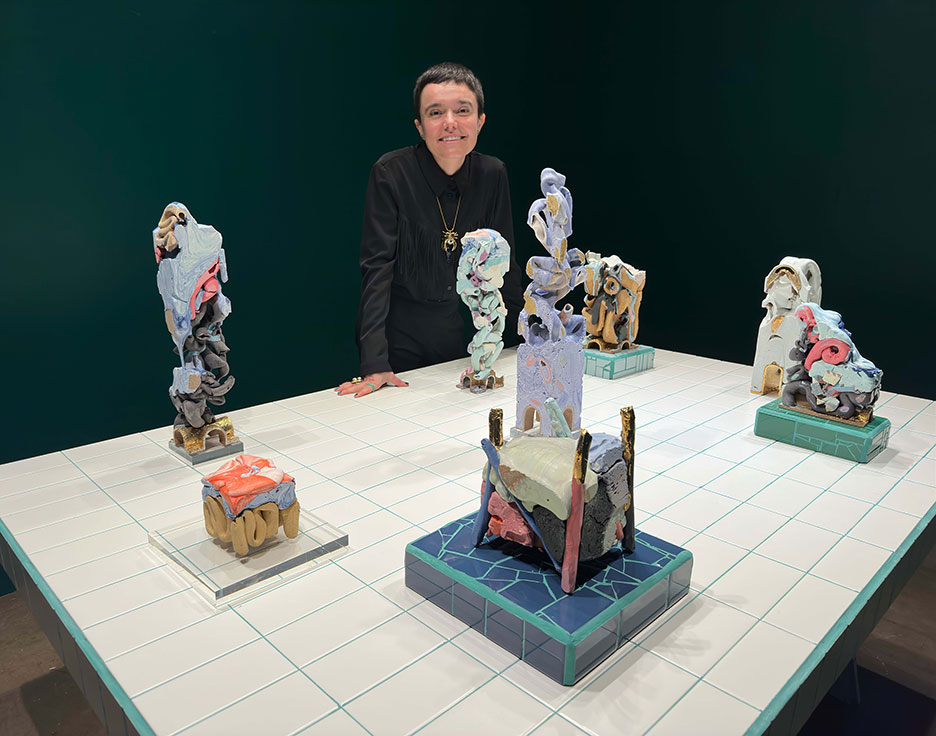
Renata Cassiano Alvarez standing with her work in “Cuarto Verde,” on view at Conduit Gallery. Photo courtesy of the artist
CA: In this diagram, I also drew arrows that describe the circulation of the overlapping elements of your practice. The idea being that your objects rotate their emphasis. Some emphasize architecture at one moment, while others highlight material. What is your relationship to spontaneity and chance? With this work with Okay.
RCA: We work hand in hand. When I was 17, I saw a documentary about Robert Rauschenberg. When he talked about the collaboration with materials, it was eye-opening. Like many art students entering school, I tried to “master” it. I saw him not only using paint in a way that I hadn’t seen before, I heard him talk about material. He saw material as a collaborator and not something that you dominate.
That opened up the world to me. Since then, I have kept that at the forefront. To me, the material is a collaborator. And even though we don’t communicate verbally, we communicate physically through touch and sight, but we also communicate in the final result because chance, happenstance, and intuition — that’s really how I work.
I have a general sense of what’s going to happen, but there has to be an element of surprise. That’s where the challenge is for me. Working with something I don’t fully understand—that’s where it’s at.
Whenever a piece isn’t flowing, when I don’t immediately know what to do, that’s when I dig in deeper. And those, to me, are the best pieces. I wouldn’t call it a struggle, exactly — it’s more like moving forward without knowing where you’re going, like feeling your way through in the dark. And those are the moments when I know: this is it. This is where the best results come from — because it’s completely new, even to me. There are times when I need a specific outcome, but most of the time, it’s about uncertainty. I don’t always know if something will work, what will happen in the kiln, or if a piece will break entirely and need to be rebuilt.
In Cuarto Verde, there are two pieces that were completely destroyed when I cut them from the mold. At first, I thought, “I don’t have time for this — I just need to get the work done.” But then I realized: I have the materials, the glue, the epoxy — I can put them back together. Maybe not as they were originally, but in a way that creates something even more interesting.
That’s how I arrived at these pieces — massive forms, heavy on top, precariously held up by delicate tubes that feel like they could collapse at any moment.
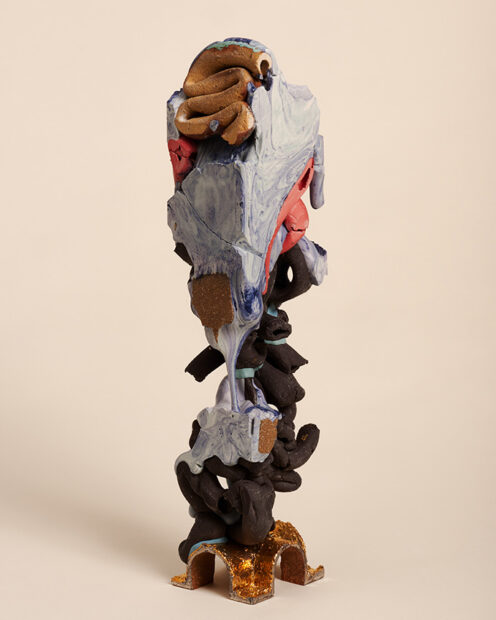
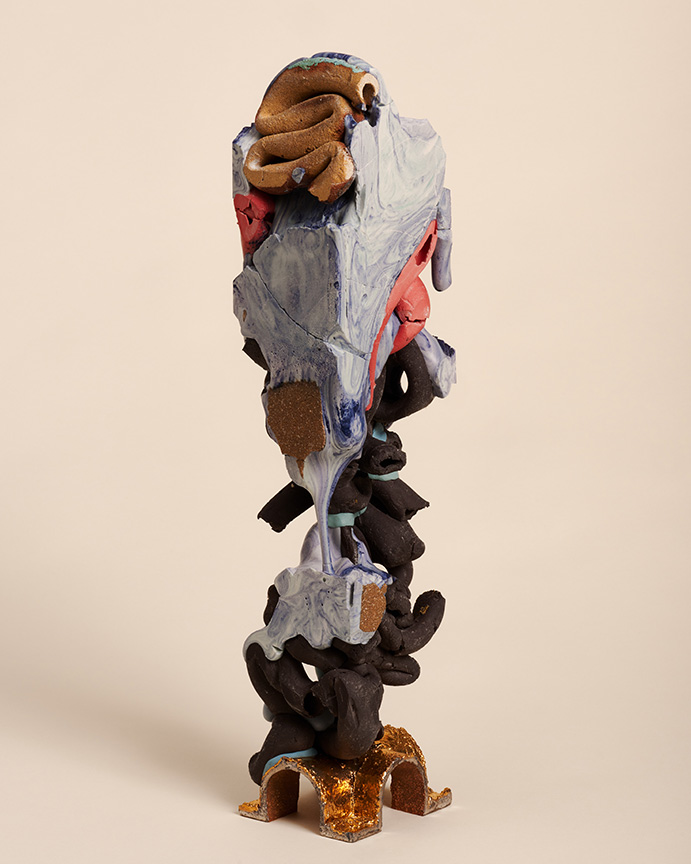
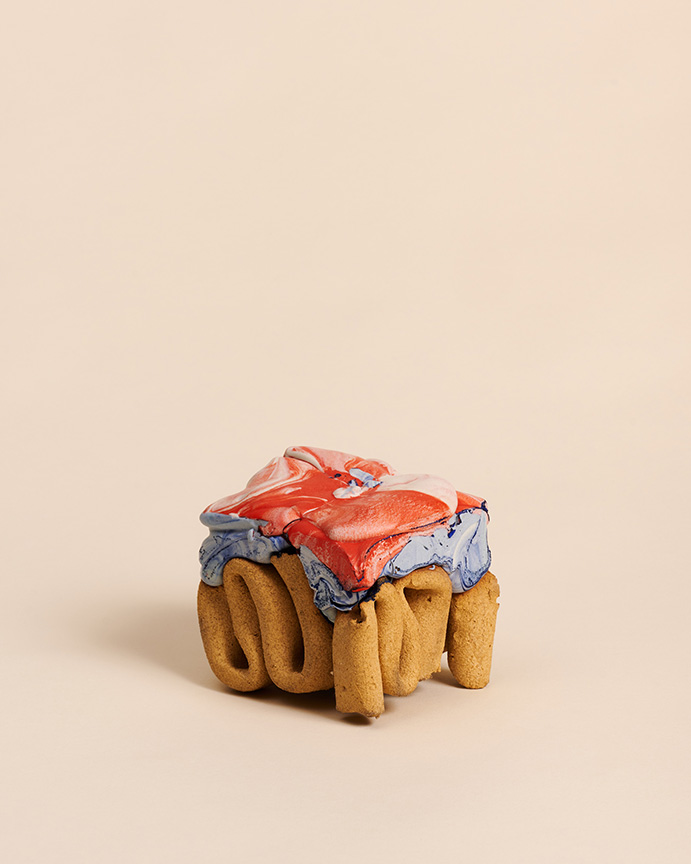
Renata Cassiano Alvarez, “Serpiente en Negro,” 2024, ceramics, gold, and epoxy, 14 x 4.5 x 4.5 inches. Photo: Kes Efstathiou + Forrest Frederick
CA: In Serpiente en Negro, a frozen drip or ooze is happening in the middle of the object that looks like it could snap at any moment. This creates a certain kind of tension in the work and makes me think about your process and failure. How do failure and risk factor into these works?
RCA: I mean, failure is a possibility, but it’s also an opportunity to let go and transform. I see these moments as clues to inform the next moment. My parents are archaeologists and therefore that part of my brain turns on. As the viewer, you start putting all of these clues together, you can understand exactly what happened and how this came about. And I like that. I like that it is a little game that, if you had heard me talk about it enough, you’ll understand.
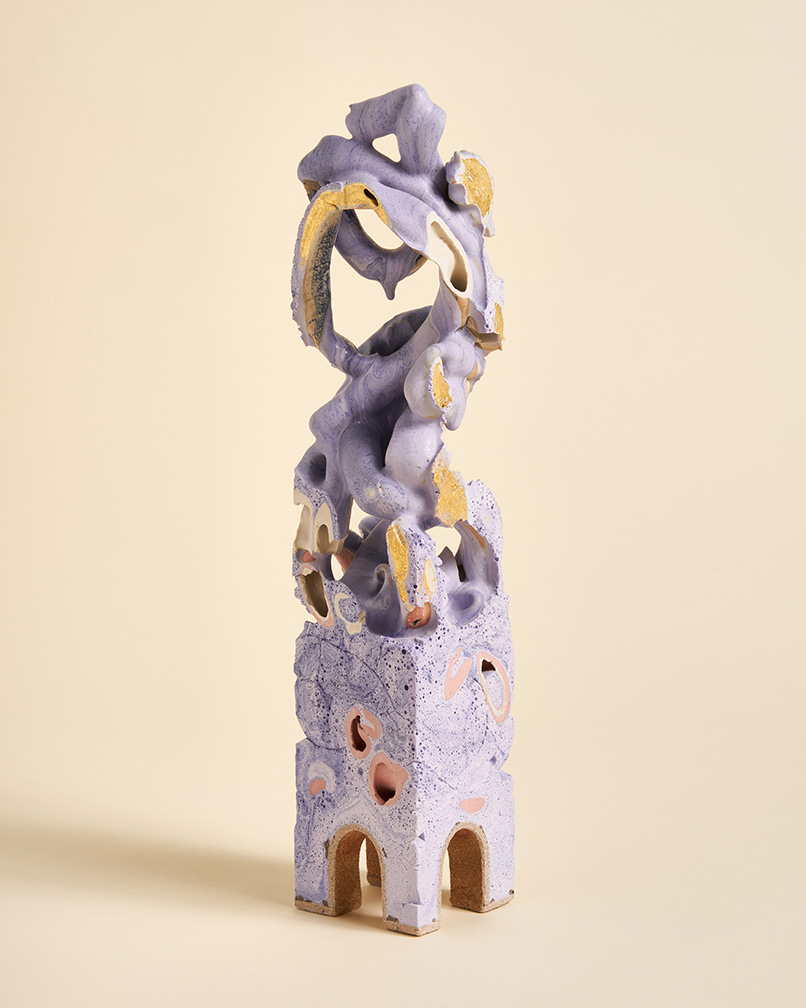
CA: I often see the archaeological influence in the work. These objects span time to me. They look like objects that have been newly unearthed, fragmented, and polished for our viewing. Sometimes, they look like miniature monoliths, portals, cathedrals, duomos — not to mention how you utilize color to point to your multicultural upbringing. These formal decisions are also their own language with each object having its own language. How or when do you decide to utilize arches, gold, or circular elements?
RCA: I am the product of these two things: Mexico and Italy, both places with a long history. I believe in the power of spaces. In my work, you could say that the arches come from Italy, and the circles come from Mexico. The circle is a very common symbol in pre-Hispanic cultures. And this circle signifies the time that never ends. It’s all cyclical. Everything comes back. I like to use those two symbols often — the arch as a gateway, as a passage through, and the circle as the signifier that everything comes back. So we keep going in circles into these passages constantly.
Funny enough, in grad school, I was told that my work ‘didn’t look Mexican enough.’ What does that mean? It means that they wanted a certain kind of performance from the work when, really, I was more interested in the things that I’m making now, and eventually, they got the point. Later on, when I was teaching, I tried to encourage my students to make work about what interests them, not about what others tell them. My intention was for the students to feel comfortable to make whatever they wanted.
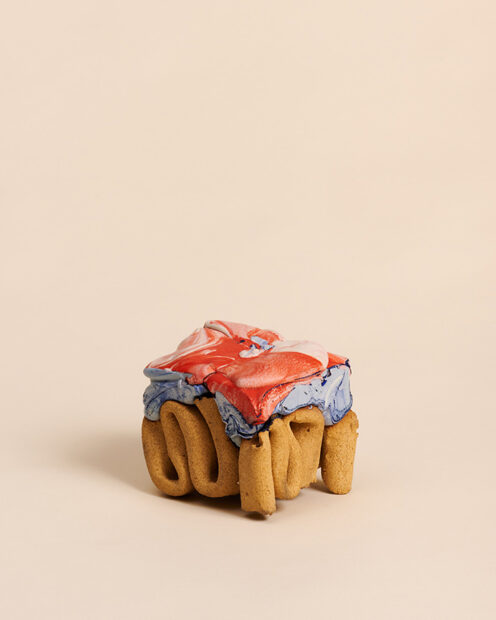
Renata Cassiano Alvarez, “Minute Memory,” 2024, ceramics, 4 x 5 x 5 inches. Photo: Kes Efstathiou + Forrest Frederick
CA: Same same. I wanted to encourage students to develop a never-ending question that they wanted to answer through their medium. What question are you leading with right now?
RCA: The question of what something means — it’s always there. Right now, I find myself gravitating toward the knife. I don’t know exactly what it means to me yet, but I keep circling around it. I see the creative process visually, almost like a spiral, with the question at the center. When you start working with an idea, you’re at the outer edge, moving closer and closer until you reach the center — until you finally understand.
There’s a brief moment when you can hold both things at once: you’re still asking the question, but you almost know the answer. That window closes quickly, though. The more you talk about it, the more you understand, until suddenly — aha! — it’s clear.
Right now, beyond the question of what the knife means, I’m thinking about how to create objects that speak of time itself — the way an archaeological artifact does. I think that the beauty of being an artist is to be able to flow in between these things — to flow in the margins.
I’m also thinking about reflection and what it means to polish the surface to be so reflective that the viewer sees themself in the work and along the surface. You see yourself or a shadow of yourself in many ways.
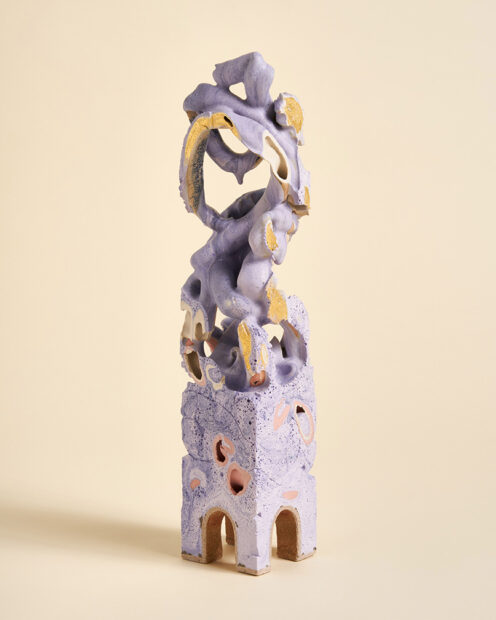
Renata Cassiano Alvarez, “Mirar el Río hecho de Tiempo,” 2024, ceramics and gold leaf, 15 x 4 x 4 inches. Photo: Kes Efstathiou + Forrest Frederick
CA: There is a lot of romance in the idea of finding the hidden meaning, or finding the artifact. I think we all grew up on movies about an archaeological dig where someone discovers a dinosaur bone and begins brushing away dirt to reveal its true shape. Your objects have shapes that are emerging and abstract, and it’s the viewer who is doing the “digging” sometimes. You also created tiled platforms, tables, and shelves that not only connect to Mexican tile work, but also place the work on display as if recently discovered. Has there ever been an instance where the work emphasizes this discovery and is more hidden than revealed to us?
RCA: That’s how the work started! That was the original idea when these sculptures were much bigger. In the beginning, they were blocks and things were more hidden. They were little monoliths that contained things that you couldn’t see. But the logistics of being an artist got in the way such as storage, workspace, and the weight of lifting them. But don’t get me wrong, like our many cycles, monoliths will come back for me when the time is right.
CA: So this brings up the process and how these things are made. They have a mystery which I feel is hard to achieve in the artworld these days. We want to know too much, too fast, all the damn time. But I’d rather not discuss your process any more than it already exists in the world. Is it important to you that the viewer understands the process and labor?
RCA: Have you ever seen that Severance meme? It recently came out of that scene in Severance where one of the characters is explaining the work, and he says, “The work is mysterious and important.” I see the work as mysterious and important, and I don’t need the viewer to know how it’s made but to experience it as it exists in front of you, in this moment. And I understand it because we are living with such uncertainty, especially right now, that it’s hard to handle another uncertain thing. But uncertainty is always part of our lives, and so to embrace it is important to me — to embrace that uncertainty, not only in the process but in the understanding of the work for myself, too. I don’t want the work to have all the answers for me. I want the viewer and the object to collaborate and develop their own answers and language.
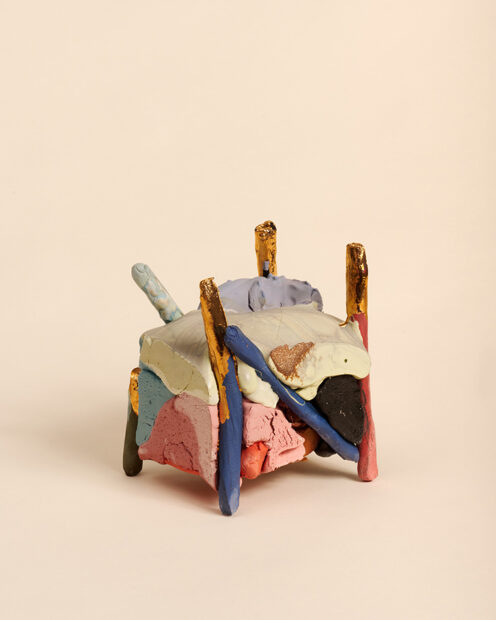
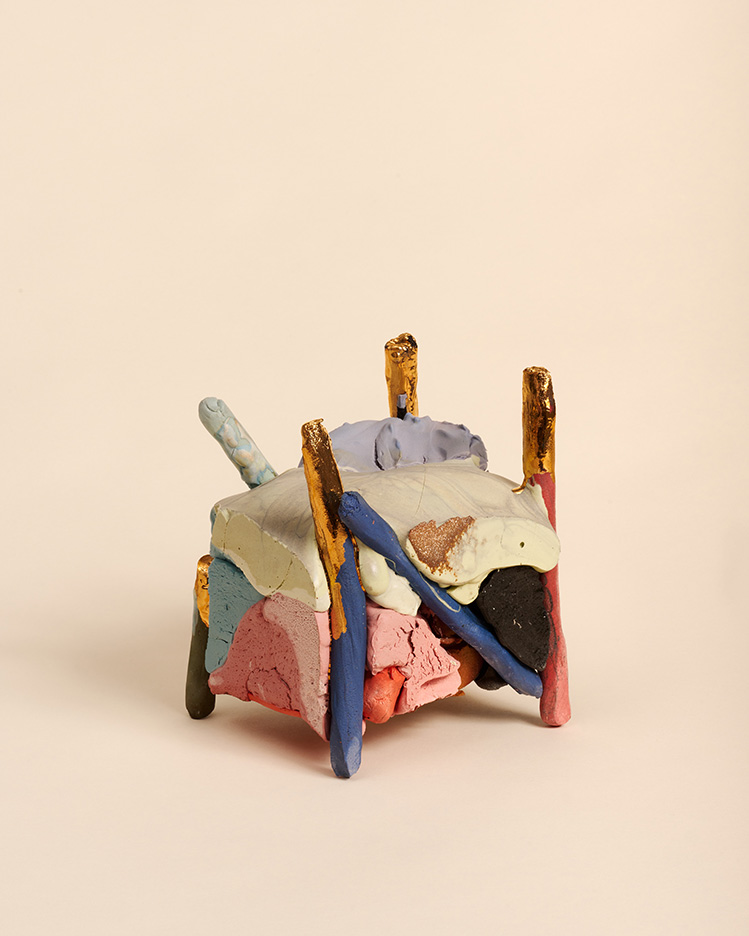
Renata Cassiano Alvarez, “Alvorada,” 2024, ceramics and gold, 8 x 8 x 8 inches. Photo: Kes Efstathiou + Forrest Frederick
Cuarto Verde is on view in Dallas at Conduit Gallery through April 19.
1. My coworker is making our friend break-up really weird
I have a coworker who I was friends with outside of work for about a year. Due to various issues inside and outside of work (complaining about coworkers over Teams, asking the same basic questions over and over, not doing any bare-minimum problem-solving before asking for help, expecting a lot of emotional support while not providing it back, and just a lot of emotional immaturity), I ended our friendship last July with no possibility of being friends again. We’re in the same department and have almost identical schedules, so we still have to interact every day. Our managers are aware we were friends and I had issues with him, though I protected him maybe more than I should have and didn’t say anything about his complaining about coworkers. I had one issue with him right after ending the friendship where he was monitoring my breaks and tried to confront me on Teams. I went to management about it and haven’t had any other similar issues.
He does still act really weird around me, though. He won’t make eye contact, he flinches when he sees me and doesn’t expect to or shrinks up when he walks past me like he’s expecting me to lash out, and will only talk to me over Teams, even to say thanks for helping him with something. He’s asked another coworker how to “get over his fear of another coworker.” I’ve never threatened him or even raised my voice at him. Right before I ended the friendship I snapped at him once and was irritable with him, but I’ve never been particularly mean and since ending the friendship I’ve been professional, though not very warm. I assume he’s scared that I’ll try to get him fired since I know he’s particularly anxious about that (asking me for constant reassurance about any judgment call or small mistake was one of my big issues with him).
I’ve just been kind of rolling my eyes internally at his behavior, but it’s been months and it’s getting old. His communication with me is pretty inefficient, but overall it doesn’t hinder my work that much and seemingly vice versa. I don’t avoid any of my job duties that involve interacting with him. However, whenever something comes up in our work where he needs to be corrected, I don’t feel like I can go to him directly (I don’t supervise him but I outrank him and there are forms he sometimes has to fill out that go to me). When I was friends with him, if I asked him to communicate with me differently or set some kind of boundary, it would just make him more nervous and he would either avoid me or ask for more reassurance. I don’t really think that asking him to act normal around me will help. Is there anything I can really do at this point? Or do I just have to accept this as part of the job now?
It doesn’t sounds like there’s anything you need to do (or could do, for that matter). In fact, this is a situation where, if you let it, the burden can be all on your coworker’s side. He’s the one feeling weird and anxious and flinching when he sees you … but you can just carry on as usual and let him feel however he’s going to feel about that. I know that’s easier said than done — when someone is reacting to you like this it’s hard not to think you have to modify your own behavior in some way — but you actually don’t! You can operate completely normally. For example, if you need to give him feedback, give him feedback. If he has feelings about that, so be it. As long as he’s not getting in the way of you doing your job, the best approach is to just decline to tiptoe around whatever is going on with him.
If it does get to the point where it’s affecting your work or his, that’ something you’d need to raise with his manager. But otherwise, operate the way you normally would and let him deal with that however he’s going to deal with it.
2. My job is really flexible but it also sucks — is it time to go?
I work remotely for a very small federally funded nonprofit, in a position that’s a step below my skillset and pay grade, with no upward mobility. I started it two years ago when I was desperate to find anything while unemployed. It’s not challenging or interesting, but I’ve really liked the people I worked under and the company’s mission, and I can perform most of the functions in my sleep. The hours are flexible enough that so long as I’m available 10 to 6, it doesn’t matter if I don’t log in right on the hour or a little later, or take time during the day to run a short errand. I’ve been content to hang around however long they needed me, even though I’ve been bored out of my skull and could really use a pay bump. My wife makes enough that we aren’t in the hole every paycheck, but only just barely — we have no savings.
In the past few months, both people I’d been working under have left, and this has resulted in a culture shift. I still have some of the same flexibility as before, but the new department head has a more traditional management and communication style than I’m used to. I’ve gone from communicating mostly through Slack and email to getting phone calls out of the blue and my days filled with Zoom meetings, and I’m shocked at how miserable even that shift is making me. I’ve also been feeling overly scrutinized, any questions I have are met with condescension and the implication I should know the answer already, and today I was given a new duty that is way out of my skillset that I would have never in a million years signed up to do (and when I voiced my discomfort I was told, “You just have to practice and you’ll get good at it”).
I have a feeling it might be time to move on and find something more along my desired career path — but when I brought it up to my wife, the idea of potentially disrupting our fragile financial stability by changing jobs really freaked her out, so I don’t have anyone to bounce my thoughts off of. (Not to mention any time now the DOGE axe could fall on our only funding source, and then the decision will be made for me.)
I’ve been pretty spoiled with how easy and flexible this job has been so far, even with all the changes. What if all the things I’m starting to hate at my current job are just what I’d be dealing with at the next job anyway? I have no official educational background in my field (just experience), some major knowledge gaps, and am very out of practice after languishing for two years. Do I really want to leave my organization in the lurch and run all the risks that taking a new job entails … for a position I may not even be good at anymore? What if the job I have now is the best I could hope for? Do I suck it up and deal with these changes in exchange for flexibility and a light mental load? Or do I strike out for greener pastures and risk falling on my face in cow dung?
You should job search. The reasons you’ve stayed in a job that’s below your qualifications and doesn’t pay enough are now disappearing, so the calculus on this job doesn’t makes sense anymore. Moreover, since your job’s funding is now precarious, it would make sense to be looking around at options in case you need them even if you were still super happy with the work and the people. Which you’re not.
Job-searching doesn’t commit you to taking a new job just because it’s offered to you. You can be picky, you can ask probing questions about their culture, and you can do your due diligence to ensure that move is right for you. But given all you described, it would be foolish not to start looking.
3. Reaching out to very old work contacts when I have a serious diagnosis
I’m finishing up treatment for my second cancer in five years. This second (completely different) cancer has a high chance of recurrence in the next two years. So while I’m gaining energy and feeling grateful for still living on the planet, I’m also thinking about some past work colleagues. Fortunately, I’ve enjoyed a wonderful 40-year career with some fantastic people who have made a real difference in my life. I would like to reach out to them, somehow.
For the more recent folks in the past 10-15 years or so, I have email addresses and could use this to contact them. Do I just say something like, “Thanks for the impact you’ve had on my life. You have been special to me”? Is this too weird? Too sentimental? The majority of these people have no idea of my fight against cancer.
For the more distant people, from 25-35 years ago, I do not have email addresses. I could possibly figure out mail addresses and send a hard copy letter. Most are retired now. I have not been in contact with some of them for many years. Should I drop off this section of people, as long out of touch colleagues? If not, should I preface a letter with more info, like my career timeline, since I’ve likely not connected with these folks for a few decades? Is it still too weird to reach out to long-lost contacts to say how they improved my work life a long time ago?
I’ve toyed with the idea of hosting a happy hour/afternoon tea for work colleagues and inviting anyone I could contact. I could end the email or letter with this invite. Again, this means people I’ve not been in touch with for at least 10 and possibly 25-30 years. I did not get the opportunity to have a retirement party when I stopped working, so I think that is part of it. I would like to say good bye to these people, but I don’t want to seem morbid or too odd. Your thoughts?
I think contacting any or all of them with a message about the impact they’ve had on your life and/or career would be lovely! You don’t need to explain your health situation, although you can if you want to. You don’t need to include a career timeline for the longer-ago people who won’t know it; you’re not writing to update them on what you’ve done in the last couple of decades, but to tell them about the impact they had on you. (Some of the career timeline stuff might come up organically in doing that, but don’t feel you need to provide your job history just for the sake of catching them up.) That said, if it will take detective work to track down addresses, it might be more practical to leave those people out — but it depends on how strongly you feel about the impact they had on you.
A happy hour or tea is also a nice idea if a lot of the people are local to you. I would probably get back in touch with people first, partly to gauge potential interest, but I don’t think you have to do that first.
4. Do LinkedIn sob stories turn off hiring managers?
Do LinkedIn sob stories turn hiring managers off?
I keep seeing very emotional posts on LinkedIn as people talk of their desperate job searches, mortgages to pay, mouths to feed, with not even a whiff of an interview, despite searching day after day.
As someone who hires people for my own team, I can’t help but think such vulnerability is counterintuitive. Rather than appear as an emotional wreck burnt out from months of fruitless applying, surely it’s more important than ever to keep the game face on and sell your skills with composure.
I want to know (or at least believe) you are ready to hit the ground running, as well as that you want the position I’m offering (not just any job that comes available). I want to hire you because you’re the best person for the job, not because you are about to lose your house.
This isn’t about being cold and callous but, rather, when times are tough, don’t do anything to work further against you. There are other private platforms to vent and fret if needs be.
Yes, this is much more likely to hurt someone’s job search than to help it. Employers want to hire the best person for the job, not the person most in need of it, and candidates who appear bitter, pessimistic, or cynical are making themselves much less appealing. And that’s before we get into making employers worry that there’s some reason that all those other employers have passed on you. (That doesn’t mean there is! But it’s not helpful to raise that question.) It can also make you look like you have poor boundaries regarding what you share online and where you share it.
Yes, this job market sucks and it’s demoralizing to apply for months without getting anywhere, and being unemployed can be incredibly scary and understandably makes people feel desperate. But LinkedIn is not the platform to talk about that; it’s a place to put your best professional foot forward.
5. Should my company fly my family to see me during an international assignment?
My company would like me to work in our office in Europe for six months (I am normally based in the U.S.). As part of this, I asked that they cover airfare for my wife and son, since they will need to accompany me (spending six months apart is not in the cards). My company is refusing to cover their airfare. I find this kind of insulting, but I’m wondering if I’m off-base here. Is it common for companies to cover travel expenses for family members on assignments like this?
Some companies do cover travel expenses for spouses and children when you’re on a long-term assignment, but many don’t. Often if they do, the assignment needs to be over a certain period of time (six months is right around the time you often see it kick in, if it’s going to). But I don’t think it’s particularly insulting if it’s not something they do; many companies don’t. That said, if you have flexibility in whether you go or not, you could try making it clear that your ability to accept the assignment would hinge on this.
Alternately, would they pay for you to fly back home a couple of times during that six-month period, instead of flying your family out to you?
People think of Applebee’s as a safe suburban fixture, a place where people go for an innocuous meal at a reasonable price—but strap in, jagoff, because this Applebee’s is not like other Applebee’s. Instead of license plates and joyful Americana, our walls are festooned with divorce certificates and failed attempts at taxidermy.
Most of the animals are dead, at least.
Other Applebee’s branches have sports on TV. So do we—assuming you consider Czechoslovakian pig-throwing a sport. Those guys can really chuck a hog. If you don’t like it, why don’t you just shuffle across the parking lot to Chili’s? They have all the anodyne comforts your dainty bourgeois sensibilities require, like barstools that aren’t eight feet high.
That’s right, our patrons like it when their feet dangle.
Our servers have tattoos that didn’t go right, medically speaking. They’re bleeding and stuff. But once they heal, you’re going to love looking at them, assuming you like seeing shamrocks beating up non-Irish flowers. It sounds harsh, but the flowers had gotten real mouthy with the shamrocks earlier, insulting the clovers’ cousins and whatnot.
Speaking of our servers, they are all legally named “Roach,” and they take eye contact as a threat.
The other Applebee’s hate us, but only because they want to be us. They wish they had the stones to make their mozzarella sticks so long that diners have to hold them sideways like a flute. Or to tell patrons that their loaded fries contain “the antidote” before cryptically receding into the shadows.
Our Applebee’s menu does not have calorie counts. We scratched them out with a switchblade. You either want a Tex-Mex Shrimp Bowl Supreme or you don’t, dickwax. A bunch of fancy numbers ain’t gonna change that.
Some words you won’t see on our menu: zesty, flame-broiled, and kick. These are buzzwords the suits at corporate begged us to use, but we will never deploy soft adjectives to describe our lettuce. Our salads live or die by the crouton count, and if you don’t like it, Roach would be happy to escort you to the hospital.
As for the slogan, “Eatin’ Good in the Neighborhood,” we don’t even know if other branches use it anymore. Our slogan is simple: “Come In or Don’t.” We refuse to plead, which is why you’ll also be washing your own plates.
Look at yourself, with your pleated pants and recently cut hair. You have sensible shoes and common ideas. You could never understand how we’re changing the casual dining paradigm. You want a bacon cheeseburger? Too bad. You’re getting bacon beside a cheeseburger. If you can’t take it from there, then you haven’t earned the sustenance our meat provides.
And don’t even think about tipping 25 percent or whatever ungodly amount the other Applebee’s expect. We don’t accept money. The only way to pay is by etching your darkest childhood memory into our Wall of Pain. It’s in the waiting area, next to the photo of the softball team we promised to sponsor but aren’t.
This Applebee’s goes so hard, we’ve recently received legal paperwork informing us that we’re no longer allowed to call ourselves an Applebee’s. Fine. That was the name our oppressors gave us. From now on, we’ll be called “Da Bee.” It’s kind of like “The Bee,” which is short for “Applebee’s,” but the “Da” kind of makes it edgier.
OTTAWA – Following months of declining Canadian travel to the USA, Americans have launched a tourism campaign inviting Canadians to visit locations like New York, Austin, and possibly even take an all-expenses paid bonus visit to a notorious El Salvadorian mega-prison. “Hey Canada, we missed you, and more specifically, the potential $6 billion in travel […]
WASHINGTON—During a visit with President Donald Trump at the White House, El Salvador’s president Nayib Bukele claimed Monday that he “lacks the humanity” to return wrongly deported legal U.S. resident Kilmar Abrego Garcia back to America. “How can I return an innocent man to the United States when I don’t have the ability to feel empathy or compassion?” said Bukele, explaining that he’s consulted with his top advisors about the 29-year-old Maryland father being held in a Salvadoran prison, but none of them could find it in their hearts to care at all about the man’s situation. “Do you hear how ridiculous it sounds to expect that I could see myself reflected in another human being’s experience? Even if I wanted to, there’s no way I could acknowledge the plight of someone who is suffering because I am completely numb to the pain of others. My hands are tied because I’m totally dead inside.” At press time, President Trump had publicly thanked Bukele for his use of cruelty to project a facade of strength.
Blue Cross of Louisiana doesn't give a shit about breast cancer (permalink)
A jury has ordered Blue Cross of Louisiana to pay $421m to a hospital specializing in a much sought-after type of breast reconstruction, primarily for cancer survivors. The insurer "preapproved" surgeries for thousands of patients, but then held back 92% of the payments it owed, with CEO Steven Udvarhelyi insisting that "authorization never says we’re going to pay you":
In a characteristically brilliant and deep investigative story, Propublica's T Christian Miller explains how Blue Cross of Louisiana colluded with other Blue Cross franchises around the country to steal hundreds of millions of dollars by denying claims they'd already approved:
The hospital at the center of this controversy is the Center for Restorative Breast Surgery in New Orleans, founded by two surgeons, Frank DellaCroce and Scott Sullivan. DellaCroce and Sullivan are pioneers of an advanced form of breast reconstruction called "autologous tissue reconstruction," which eschews implants in favor of the patient's own fat to construct new breasts. While other surgeons perform this surgery, DellaCroce and Sullivan are acknowledged as national leaders, having invented many innovative techniques and trained many of the other surgeons who perform the procedure. As a result, patients travel from all over America to the Center for Restorative Breast Surgery.
DellaCroce and Sullivan's procedure is extremely precise and labor-intensive, and it comes at a high cost. Accordingly, patients seek pre-approval from their insurer before undergoing the procedure, and in Louisiana, that usually means calling up Blue Cross, the state's largest insurer. Despite pre-approving the procedure, Blue Cross of Louisiana has held back over 90% of the payments it owed to the hospital.
Rather than throwing their patients into the Blue Cross meat-grinder, DellaCroce and Sullivan carried the unpaid balance on its books, repeatedly suing Blue Cross for the unpaid amount. Finally, last week, a jury ordered Blue Cross to pay $421m to the hospital (Blue Cross is appealing).
The case dragged Blue Cross's sleazy behavior – normally confined to bureaucratic memos and telephone denials – into the public, and boy is it ugly. Blue Cross's official excuse for denying the claims was that it was acting in the best interest of the millions of Louisianans it insures: DellaCroce and Sullivan are simply too expensive – it's not realistic for people in an insurance pool to expect that kind of care. However, Blue Cross executives repeatedly signed one-off, "single case agreements" so that their own wives could get the procedure from DellaCroce and Sullivan.
In addition to this argument, Blue Cross insisted that the fact that it had pre-approved all of these procedures did not oblige it to pay for them after the fact. Rather, an "approval" is a bureaucratic, heavily disclaimed term of art that means, maybe we'll pay for this and maybe we won't. In court, however, the company was forced to admit that an "approved" procedure has to be paid for in all but the most exceptional instances, for example, when the patient cancels their insurance between getting approved and going in for surgery.
The insurer also claimed that there were checks and balances to prevent arbitrary claims denials, but then Blue Cross executive VP Paula Shepherd acknowledged that "an appeal is not available to review an underpayment." As Miller writes, "The insurer simply issued an edict — the payment was correct."
Meanwhile, Blue Cross didn't just save money by denying the claims it had approved – it made money. Other Blue Cross organizations in different states would pay 16% kickbacks to the Louisiana Blue Cross, splitting the take every time it denied a payment.
All of this added up to means, motive and opportunity to engage in unbelievably sleazy – and fraudulent – behavior. Overall, Blue Cross paid $43m on $500m worth of invoices from the hospital. In 60% of claims, it paid nothing.
Blue Cross is one of the nation's largest health insurers, and Blue Cross's argument for stiffing this hospital is the argument for letting insurers buy one another up and grow to unimaginable scale. In David Dayen's amazing 2020 book Monopolized, he lays out the procession of America's morbid health care monopolization:
First, we allowed pharma companies to merge to monopoly, which gave them the power to screw hospitals with sky-high drug prices. So the hospitals defensively merged into regional monopolies with the power to negotiate those prices down, but this also gave them the power to overbill insurers. So the insurers also merged until they could resist the hospital chains' pricing power and force rates down.
And indeed, 97% of doctors and hospitals have a negotiated rate with Blue Cross of Louisiana (remember, it's the state's largest insurer). But DellaCroce and Sullivan haven't joined the Blue Cross network, because the rates the insurer offered wouldn't even cover the costs of the surgeries.
The theory that monopolies will defend us from other monopolies is a disastrous example of "the old lady who swallowed a fly" strategy. For the strategy to work, everyone has to be a monopolist, otherwise they'll get steamrollered – on their wages, their care, or their compensation.
And of course, patients don't get to merge to monopoly (that's what governments are for, and we know how Blue Cross feels about single payer care). Workers don't get to merge to monopoly either (that's what unions are for, and no one hates a union more than a health care monopolist).
Blue Cross's position – the position of the entire for-profit health industry – is that they should be able to grow as large as they can, at the expense of us, the patients. In other words, they are economic tumors – so no wonder they're on the side of breast cancer.
"Chokepoint Capitalism: How to Beat Big Tech, Tame Big Content, and Get Artists Paid, with Rebecca Giblin", on how to unrig the markets for creative labor, Beacon Press/Scribe 2022 https://chokepointcapitalism.com
"Attack Surface": The third Little Brother novel, a standalone technothriller for adults. The Washington Post called it "a political cyberthriller, vigorous, bold and savvy about the limits of revolution and resistance." Order signed, personalized copies from Dark Delicacies https://www.darkdel.com/store/p1840/Available_Now%3A_Attack_Surface.html
This work – excluding any serialized fiction – is licensed under a Creative Commons Attribution 4.0 license. That means you can use it any way you like, including commercially, provided that you attribute it to me, Cory Doctorow, and include a link to pluralistic.net.
Quotations and images are not included in this license; they are included either under a limitation or exception to copyright, or on the basis of a separate license. Please exercise caution.
If you want to read the whole of Wobbly Head part 4 in PDF format, subscribe to my Patreon in the $3.50/mo tier or higher. And you’ll get access to many more downloadable comics that you can keep forever, DRM-free, no matter what catastrophes may befall me. Several readers have asked for annual rather than monthly subscriptions, so I’ve added those (with 10% off for signing up for a year).
In brief: A weak front tonight will bring some slightly drier air into the region, but for the most part this week will be characterized by days in the 80s with plenty of sunshine. Rainfall will remain scarce until the weekend, but a pattern change next week could improve our chances for wet stuff.
A dry spring
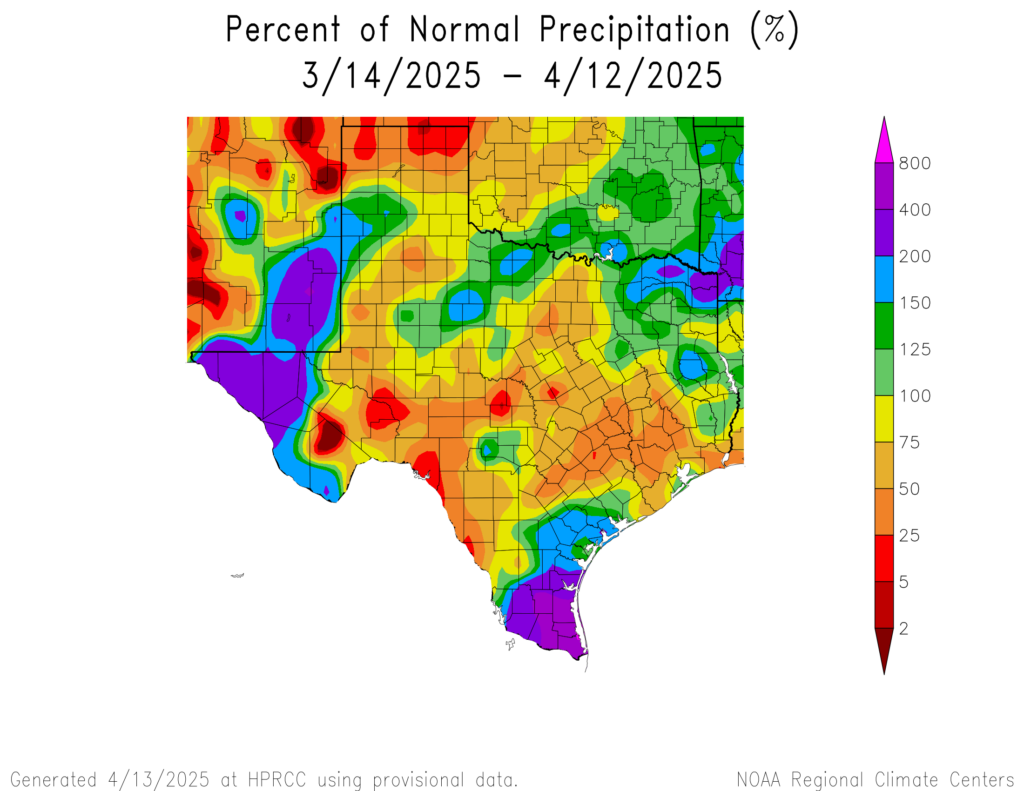
It has not rained much this spring. Although some coastal areas have soils characterized as “abnormally dry,” the Houston region is not in a drought. However, I have noticed a few of my neighbors putting out sprinklers of late. I had to double check my calendar to make sure we’re still in April, not June. And sure enough we are. Over the last 30 days, much of the Houston region has received only 25 to 50 percent of their normal rainfall for the year. While everything is still green, for now, the underlying soils in most areas are pretty dry.
Percent of normal rainfall over the previous 30 days. (NOAA)
When temperatures are in the 70s it takes a long time for dry soils to turn to parched soils. However, we are now seeing days in the 80s, with the sunshine reaching a higher angle in the sky. Accordingly to stave off drought we are going to need some precipitation. That’s not going to happen for much of this week, but if we look at the longer term forecast, there are some hits of a pattern change this weekend, and next week.
Monday
It is a warm morning, with much of the area near 70 degrees. Despite a few low-lying clouds this morning, I still expect mostly sunny skies this afternoon, with high temperatures reaching the mid- to upper-80s. With dewpoints in the lower 60s it will feel moderately humid. Winds will be out of the south at 5 to 10 mph. Expect another mild night, with lows in the 60s. Some time after a midnight, and it likely won’t be perceptible, a weak front will push into the Houston area.
A weak front will bring a cooler morning on Wednesday. (Weather Bell)
Tuesday and Wednesday
The main effect of this front will be to bring some moderately drier air into the region. So Tuesday, and to some extent Wednesday, will feel a bit less humid. Tuesday may start out mostly cloudy as a result of the front, but I don’t expect much, if any rain with its passage. Expect high temperatures in the mid-80s, with lows on Tuesday night dropping into the low 60s for most of the region (it will be even cooler to the northeast of the city). Wednesday will bring highs in the low- to mid-80s but already winds will be turning to come from the southeast. So by the afternoon on Wednesday I expect humidity levels to be on the rise with fairly robust southeasterly winds.
Thursday and Friday
As a result, I expect the end of the week to be partly to mostly sunny, with high temperatures in the upper 80s. Some inland locations may reach 90 degrees. So all in all, pretty warm and humid for April. Lows will only fall to around 70 degrees. There will he the slightest chance of some showers by Friday or so, but most of us should remain dry.
Current forecast for high temperatures on Easter Sunday. (Weather Bell)
Saturday and Easter Sunday
Saturday should bring more of the same: partly sunny, warm, and humid. Perhaps we’ll see a few stray showers. However at some point this weekend high pressure should shift away, and this will open us up to somewhat better rain chances. For now, I’ll say we have about a one-in-three chance of some showers on Easter Sunday, to go along with warm and humid conditions. It’s difficult to say much more than this with any precision but it’s something we’re watching.
Next week
Most of next weeks looks to remain fairly warm and somewhat humid. Think days in the mid- to upper-80s with nights around 70 degrees, give or take. The big thing I’m watching for is rain chances, especially in the absence of high pressure. The “bear” case is perhaps 1 inch of rain next week, but the “bull” case is several inches. Some of the AI-based weather models are on the bullish side, showing several inches of total rainfall next week. We’ll see. By that point, our soils will be happy for what we can get.
CINCINNATI, OH – When single father Michael Field’s children, Talia and Connor, ran to their kitchen table last Sunday to decorate eggs for Easter, they were confused to find instead a bowl of strange, damp white chunks. “They started crying immediately, of course,” recounts Field. “Especially since I accidentally bought the stinky tofu. But once […]
OTTAWA – As Canada works to separate our economy from the increasingly chaotic United States, the Canadian government is also searching for a new country to shamelessly copy for our entire cultural identity “Given that being slightly more polite versions of Americans no longer reflects Canada’s best interests, we figured it was time to update […]
Oh when the saints Come marching in Oh when the saints come marching in Well I sure wouldn't want to be a bad guy When the phantom marches in! #CowboyWho


/https://static.texastribune.org/media/files/d5c73c2a673e896ed86a3f17336bd00c/Dallas%20Bullet%20Train%20BT%20TT%2009.jpg)







![[img]:ngmaht](https://analognowhere.com/_/ngmaht/ngmaht.png)
![[img]:hhostc](https://analognowhere.com/_/hhostc/hhostc.png)
![[img]:lirmtg](https://analognowhere.com/_/lirmtg/lirmtg.png)


