Fleet Week, a celebration of the U.S. Navy and U.S. Marine Corps, will bring active-duty military ships to the Port of Houston. Residents also will be able to tour ships and witness military demonstrations, air shows, educational programs and other public events.
The gist of his debut post is that he used ChatGPT to create a small “staff” of teammates to work with, along with photos of these personalities, and he developed a crush on his new CEO. Really.
Do I think he’s serious? No, not at all. Do I think he wrote this to generate attention just like I’m giving him now? Yes, obviously. But I really do have to salute the absolute shamelessness of him playing this straight, painting himself as an utter buffoon, a tone deaf jackass, and downright weirdo, just for the attention. (Blodget has never beenvery smart even when he isn’t trying to make a fool of himself.)
CALGARY – During an outdoor campaign rally security rushed a shaken Pierre Poilievre to safety after he was tragically struck by a lone journalist’s question. “Mr. Poilievre was unharmed by the question, but remains badly shaken up,” explained Mike Lattimmer, of Poilievre’s private security detail. “Our guards had swept the area for any lone wolf […]
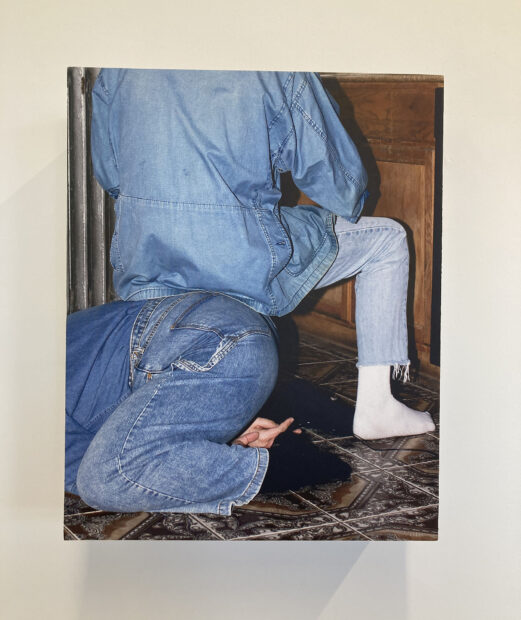
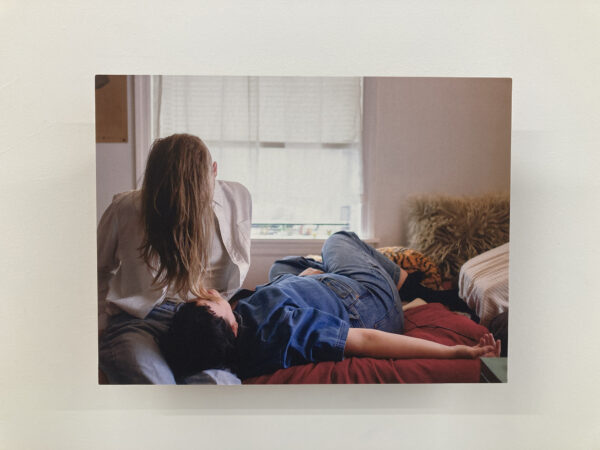
Chloe Scout Nix: I Will Kill Your Daddy at Zeke’s Projects, March 15–April 26, 2025
Chloe Scout Nix, “you made me hate country music,” 2025, fabric coated vinyl paper mounted on wood panel. Photo: Chloe Scout Nix, courtesy of the artist and Zeke’s Projects
A work by Chloe Scout Nix
Chloe Scout Nix’s solo exhibition at Zeke’s Projects in Dallas presents seventeen deeply personal works — sixteen photographs and one video — born from a summer of transition, reflection, and emotional excavation. Recently graduated from her MFA program, Nix marks a post-academic pivot with raw, emotionally dense images that investigate how we give and receive intimacy.
The photograph is at the heart of Nix’s project as both mirror and memory. She appears in every image, not only as the subject but also as the photographer, folding her body into carefully composed scenes with friends, exes, Tinder dates, and, in one resonant image, her own parents. Her presence in each frame intensifies the work’s vulnerability — it is as much about self-discovery as it is about visual documentation. The gestures are tender, awkward, familiar. The viewer becomes an unseen observer to what might feel like private moments, and yet there’s a performative quality too: intimacy as both real and staged.
What Nix captures is not eroticism, but the tension between closeness and observation — what it means to touch and be touched, literally and psychologically. These are not passive images of romance or affection. They are meditations on the origins of desire itself: learned through family, pop culture, heartbreak, and the digital residue of dating apps. Nix doesn’t just explore affection — she interrogates it.
The images are presented on thick, fabric-coated wooden panels, ranging from one to six inches deep. These sculptural substrates give the works a presence that pushes them off the wall, hovering somewhere between photography and object. Nix burns the edges of each panel to prevent fraying, creating delicate charred borders that signal both preservation and destruction. The act of burning, she explains, is practical — but its metaphorical weight is unavoidable. The singed edges speak to the impermanence of relationships, the traces they leave, and the artist’s own attempt to contain something inherently elusive.
This blend of vulnerability and craft is also reflected in her framing choices. Working with a Texas-based framer, she introduces new shapes and formats — triangle cut-outs and floating frames—that suggest a desire to break out of conventional compositional grids. These formal decisions reflect the emotional variety of her subjects: some images are calm, almost devotional; others are chaotic, full of limbs and uncertain expressions.
A notable component of the exhibition is a video work that anchors the show with movement and sound, adding another layer to her exploration of intimacy. While her still images freeze emotion in time, the video opens it up, letting it shift, breathe, and unfold.
This body of work is rooted in a summer that Nix calls her first real return to intentional making after the “grad school spiral.” The result is a remarkable debut that feels both immediate and meditative. It’s a project that resists the easy narratives of love and belonging, offering instead a landscape of affective gestures — some tender, some bruised, some still searching.
In a time when intimacy is often flattened by performance, algorithm, or routine, Chloe Scout Nix reminds us that our most personal gestures are never entirely ours alone. They’re inherited, echoed, reshaped by every person we’ve ever touched or been touched by. In that sense, her exhibition becomes more than a personal archive. It’s a collective mirror.
****
Em Davenport & Sasha Miasnikova: good consumer at Jessamine, Belmont Hotel, Dallas, April 9–May 10, 2025
Two works by Em Davenport
The former Belmont Hotel
No one’s really sure what’s going on with the Belmont Hotel anymore. A stuccoed ruin clinging to a hillside just west of downtown Dallas, it has stood dormant for years. Chalk-marked room doors read “leak,” “closet wall,” and other notes of architectural triage. The water still runs and the toilets flush, for now.
Into this slow decay, the curatorial project Jessamine has installed a two-person exhibition by Em Davenport and Sasha Miasnikova. Organized during the week of the Dallas Art Fair and situated in what used to be a guest suite, good consumer feels like a throwback to the unofficial, artist-run Dallas of the 2000s and 2010s: a city with a gift for reimagining private space into public platform, especially when there’s a view and a bar.
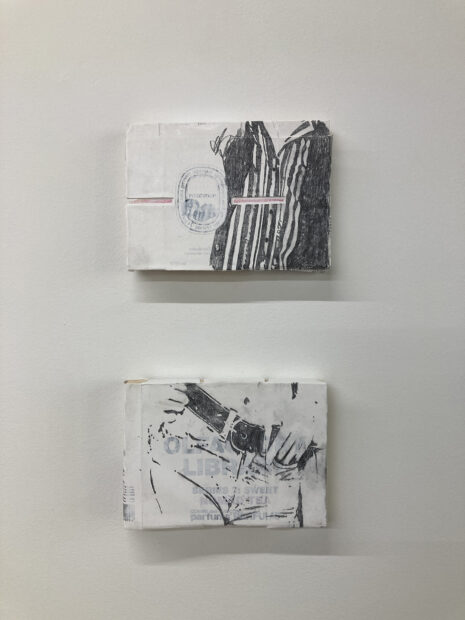
The front room is more of an atmosphere than an exhibition — a collection of artworks by friends and previous collaborators of Jessamine, loosely “decorating” the space. The show proper begins in the second room with Davenport’s ghostlike figure compositions rendered in graphite on flattened perfume boxes and mounted on wood. These white paintings appear as fragmented bodies: the image of a person built across two or more surfaces, abstracted into scent packaging and negative space.
Miasnikova’s paintings echo the same sense of temporal drift — faded floorboards, slumped or distorted figures, and half-remembered interiors. Initially easy to dismiss as naïve or quickly rendered, the longer you look, the more deliberate they become. In one canvas, a floor rendered in dusty brown gradients all but steals the scene.
The Belmont might not last much longer in this form, but its image — part 1960s Hollywood glamour, part post-crash Texas real estate — lingers as context and material. Jessamine’s show doesn’t resist that mood. It sinks in.
****
William Sarradet is the Assistant Editor of Glasstire.
The administration last month clawed back more than $11 billion of already approved and allocated federal health grants distributed during the COVID-19 pandemic.
CAMBRIDGE, MA—Uncovering a troubling disruption of America’s ecological systems, a study published Friday by researchers at Harvard University found that plants have become increasingly reliant on gig workers for pollination. “Freelance pollen transfer has always been a part of seed plant reproductive strategies, but we were shocked to discover that the number of gig pollinators has nearly quadrupled from where it was a decade ago,” said the study’s lead author, Shelby Haskins, adding that stable, well-compensated positions pollinating a single plant had become virtually nonexistent in today’s more cutthroat ecosystem. “We found bees working 18-hour days for three, sometimes even four different plant genera just to make ends meet. And bats have been so hard hit by these bare-bones contracts lasting only a few weeks that a lot of them have stopped pollinating altogether. It’s unsustainable. These contract pollinators are working twice as hard only to have a lower standard of living than their great-great-great-great-great-great-great-great-great-great-great-great-grandparents did just a few years ago.” At press time, Haskins added that efforts by gig pollinators to organize for better conditions had so far been hampered by the wind’s willingness to pollinate for free.
Beginning May 7, Americans will not be able to go through airport security or enter federal buildings without Real ID. The Onion shares everything you need to know about Real ID amid the looming deadline.
Q: What am I required to do to obtain a Real ID?
A: Way, way too much.
Q: Do I need an appointment to get my Real ID at the DMV?
A: Your local DMV dares you not to make an appointment and see how that turns out.
Q: Why did Congress pass the Real ID Act in the first place?
A: You promised to never forget.
Q: How will Glen Powell be affected by Real ID?
A: Whether or not he applies before the deadline, Powell will likely remain one of the most promising up-and-coming movie stars able to please both critics and audiences alike.
Q: As the U.S. teeters on the edge of authoritarianism, is opting into a federally mandated ID program a good idea?
A: Depends how badly you want to visit Jacksonville.
Q: What happens if I fail to get a Real ID by the deadline?
A: You will have to find ways to confront your own mortality that don’t include plane crashes.
WASHINGTON—Promising to use all of his power as health secretary to find a cure for the condition, Robert F. Kennedy Jr. reportedly directed the National Institutes of Health on Friday to create a registry of U.S. introverts who sometimes get social anxiety. “When I was younger, there were never people who liked to spend time home alone by themselves, but now it’s a national epidemic,” said Kennedy, who delivered the remarks at a press conference during which he confirmed federal researchers were working hard to develop treatments for individuals who felt occasionally felt uncomfortable in crowded rooms. “These people can’t live normal lives. They can’t make small talk. They can’t dance. They’ll never go to a backyard barbecue where they only kind of know one person from work.” At press time, experts were warning that the registry could be used to round up introverts for karaoke.
Desmond Bertrand-Pitts became suspicious when he didn’t receive any updates or email responses regarding the status of his grant application from the Institute of Museum and Library Services by early March.
As CEO of the Buffalo Soldiers National Museum, he had previously served on review panels for roughly the last four years and knew when to expect to hear something.
“I was like, ‘Ah, something fishy is going on,” Bertrand-Pitts said in an interview with the Houston Landing.
He had submitted a grant application in the fall of 2024 for the museum to be awarded $500,000 for IMLS’ African American History and Culture program, one designed to build the capacity of African American museums and support the growth and development of museum professionals at African American museums.
The funding is the largest amount it applied for from a federal entity. Previously, the museum received AAHC funding for smaller amounts, ranging from $50,000 to $250,000, that helped them hire an archivist to properly store its collections and digitize its archives. The $500,000 grant would support the last stretch of its $13 million capital campaign, “Ready & Forward,” to design its exhibitions.
“It affects us greatly in the sense that we rely on that funding for exhibitions pretty much every year,” Bertrand-Pitts said. “It’s a pretty big hit.”
In 2023, the museum recorded a net income of nearly $2.6 million, according to its latest tax data from ProPublica’s nonprofit explorer.
Beyond its exhibitions, a potential funding loss could have a larger domino effect on the community, significantly reducing educational programs, veteran services and youth engagement, he said.
The Buffalo Soldiers National Museum showcases the stories and contributions of African American men and women who served in the U.S. military with exhibitions that span over centuries of military conflicts ranging from the Revolutionary War to present day, highlighting the sacrifices these individuals made in defense of the nation and its citizens.
While the museum showcases the legacy of the Buffalo soldiers, it has a broad appeal and can evoke emotion in everyone, Bertrand-Pitts said.
“Although we tell an African-American military story and experience, we’re an American history institution,” he said. “We contributed to the founding of this country. We’ve contributed in every military facet since the very beginning, and our institution is important because it’s American history.”
The Buffalo Soldiers National Museum has also received funding from other federal programs, such as the National Endowment for Humanities and the National Endowment for the Arts, which have also seen recent cuts to grants programs and massive staff reductions under President Donald Trump’s established Department of Government Efficiency.
They are among a number of small nonprofits and organizations that have been bracing themselves ever since Trump took office attacking federal funding and diversity programs and initiatives.
Local uncertainty
While the museum has always maintained a diverse portfolio of funding, Bertrand-Pitts said the widespread reversal of diversity, equity and inclusion initiatives has indirectly impacted the museum in many ways, besides the potential loss of grant funding. The relationships have changed and the conversations are different, he said.
“We’re not getting a lot of response from corporate partners like we used to,” Bertrand-Pitts said. “And in previous years during the month of February, I can’t even count how many corporations would reach out to us to do presentations or offer some type of support and this year we did not see it. It affects us in that way because we don’t know where a lot of them stand anymore.”
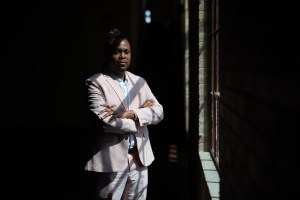
Desmond Bertrand-Pitts, Chief Executive Officer, stands next to a display at Buffalo Soldiers National Museum, Thursday, April 17, 2025, in Houston. (Antranik Tavitian / Houston Landing)
He is also concerned that he hasn’t heard local family foundations take a stance on the issue either.
“Are they going to be our saving grace during this time when things just aren’t looking very good or are some of them going to drift away?” he said. “It’s a lot of uncertainty.”
With looming uncertainty in the arts, a few executives and board members representing the collective of museums within the Museum District went to city council in January to solicit more support from city leaders in advocating for the arts. Their main objectives were to work with city council to recognize and celebrate Houston as a cultural epicenter, understand the challenges facing Houston’s cultural organizations, maintain the city’s current level of investment in the arts, facilitate additional revenue streams and consider the arts sector’s position as a major economic driver in the city’s planning efforts.
“The arts have always been the third cousin that people just don’t really get the value,” Bertrand-Pitts said. “And I think it’s up to us to make sure that people understand that the arts have value. It has economic value, mental, social, emotional value, all of that. The implications are endless.”
In 2023, the institutions that make up the Houston Museum District surpassed the combined attendance of all Houston Texans, Rockets and Astros home games, as well as the Houston Livestock Show and Rodeo events, according to the HMD board’s compiled data, shared with the Houston Landing. It also revealed that the museum district attracts roughly more than 7 million visits each year with an estimated 2 million representing out-of-town guests.
The City of Houston responded by dismantling the Mayor’s Office of Cultural Affairs in response to the results of the citywide efficiency study, which identified a “significant overlap” between the functions of the MOCA and services provided by the Houston Arts Alliance, according to Mary Benton, Mayor John Whitmire’s chief of communications.
On March 21, Necole Irvin resigned as director of MOCA and the city appointed an internal team member to serve as arts contract manager to work alongside HAA on contracts and grants, Benton said.
“The city was compensating HAA for work that, in some cases, duplicated MOCA efforts,” she said in an emailed statement. “In addition, the study noted delays in key projects that were important to the Houston arts community.”
Benton said that the HAA remains a valued partner, and that the City of Houston re-evaluated its cultural affairs strategy to streamline operations, eliminate redundancies and better serve Houston’s arts community.
However, the elimination of MOCA still concerns Bertrand-Pitts.
“The mayor says he supports the arts, and I believe that. But it’s so uncertain, and that’s really difficult to keep in and wrap my mind around it,” he said, noting the local impact of art on the city.
While uncertainty looms, the Buffalo Soldiers Museum remains committed to the community, offering events such as its upcoming three-day Juneteenth@160 celebration, and continues to garner support such as that from the Kinder Foundation, which in January renewed an additional grant of $1.5 million toward its capital campaign.
But he’s hopeful that they’ll find another way to press forward.
“There are so many funding inequities when it comes to BIPOC organizations and institutions, so that’s always at the forefront of my mind,” Bertrand-Pitts said. “We’ve always been, you know, somewhat of a target. We’ve always had to do more. We’ve always had to pool all of our sources. We’ve always had to do more networking. We’ve always had to prove ourselves more in terms of BIPOC institutions because of those factors.”
While the museum will need to come up with innovative and well-planned outreach strategies to keep expanding its pool of resources, he expressed confidence that the current political climate is only temporary.
“Now more than ever, our stories are important, and it’s important that we tell them,” Bertrand-Pitts said.
The Kinder Foundation is also a financial supporter of the Houston Landing. It had no influence on decisions related to the reporting and publishing of this article. The Landing’s ethics policy and list of financial supporters are available online.
A new study forecasts more than 850,000 measles cases over the next 25 years if US vaccination rates stay the same. Millions of infections are possible if rates drop.
First, a housekeeping note: Comments will be turned off for a while on Friday while the site moves to a new server. They’ll be turned back on once it’s complete.
It’s four answers to four questions. Here we go…
1. Supervisor is flirting with my wife
I am a woman, 41 years old, who has been married to my wife for a year. We work together in different departments. She had a thing with one of her male supervisors before me, and he has become an issue. I’ve seen things that have made me question their relationship. In the beginning, when he found out about her and me, he began being nasty with me at work … closing doors behind him as I’m coming, dirty looks. He would also hug my wife (girlfriend at the time) as I would pass by and get very close to her to speak. Now, recently, he’s been telling her how good she looks and that she must have had a good Easter after he saw a few bruises on her arm, making it seem like something dirty.
I’ve asked my wife to speak to him and let him know his comments and his compliments are not welcomed and that their relationship should only be on a professional level. She said she spoke to him and told him no more funny business. But now I keep seeing their interactions on camera at work (I’m in security) and it’s bothering me. He speaks to her and she smiles, like a smile she usually gives me when she’s shy and blushing. I don’t know what else to say to her or what to do, but it’s bothering me more now because when I’m not around, I’m home overthinking everything. Any advice?
What does she say? Is she uncomfortable with how he interacts with her? If so, then the only appropriate role for you to play here is to support her in figuring out how she wants to handle it. If she’s not uncomfortable with it, then the question is whether you trust her to operate with integrity within the terms of your marriage. If you’ve let her know you’re uncomfortable with her hugging this guy and allowing him to think she’s welcoming his attention and it’s continuing anyway, there’s an issue within your marriage to work out: it could be that you’re seeing something suspicious where there’s nothing there (in which case your not trusting your wife would be the biggest issue) or it could be that she’s being disrespectful of reasonable feelings on your side (in which case there’s a different marital issue for you to decide how you feel about).
Ultimately, you can’t control other people (and attempts to do that within a marriage tend to fail in one way or another), but you can talk openly with your wife and try to reach a resolution you’re both comfortable with (or, through that open conversation, conclude that there’s a larger issue beneath this).
2. When and how to tell clients I’m closing my business
I am a self-employed language tutor who works in the homes of my clients. I work primarily with children and teens, so my most profitable months are during the school year, although I do have some adult students who have class year-round. I have been doing this for five years, and I’ve decided that the time has come to move on (I will hopefully be going back to school in the fall). My intention is to close at the end of the second quarter, to simplify my tax paperwork and coincide with the end of the school year.
I am struggling with how and when to communicate this decision to my clients. My main concern is that some of the more proactive parents are already asking me about scheduling for the next school year; beyond that, I want to give my adult students enough time to look for someone else and maintain continuity in their learning, but not tell them so soon that my income drops dramatically in the last few months. Lastly, I don’t want to burn any bridges in case I need to pick up a few hours here and there to make ends meet while I’m studying.
Maybe I’m overthinking it, but in the end this is an intimate job — I have watched children grow up and been in these people’s homes weekly, for several years in some cases — and I don’t want to leave anyone feeling shortchanged after years of relationship building. I feel it would be easier if I were able to tell them what, exactly, I’m moving on to, but the application for the program I’m interested in doesn’t even open until a few weeks after the end of the school year! So I won’t know anything by the time I need to tell them.
I’m currently thinking I should tell them at the end of May (school year ends June 20 here), and simply state that I’ve enjoyed working with them and will be going back to school next year, even though that may not be true in the end. If you have any suggestions on wording or timing, they’d be greatly appreciated.
It seems reasonable to tell parents in late May that you won’t be tutoring anymore after this school year ends. If people ask about scheduling for the fall before you’ve officially announced, is there any harm in telling those people, “I’m not positive I’ll be continuing after this school year but I’ll let you know either way by late May”? Or even just telling them at that point that you won’t be continuing after June? I’m guessing they’d be unlikely to switch tutors mid-semester over that, but if that’s a worry, then go with the first, vaguer statement instead.
For your adult learners who may need to find a new tutor for the summer, is your sense that a month’s notice is enough for them to do that? (I have no idea, but you probably do.) If it’s not, it’s still not unreasonable to provide a month of notice — but in that case, you might feel better if you gave them more. (And if it will in fact take more than a month for them to find someone new, presumably that negates some of the worry about them switching early and affecting your income.)
As for the wording itself, I do think you’re over-thinking it! “I’ve loved working with you, but I will be shutting down my tutoring business after this semester” is fine. You can also say you’re going back to school if you want, and assume some people will ask what you’re doing next even if you don’t offer it. Some will probably ask where you’re enrolling, and it’s fine to just say, “I’ve applied at a few places” or “I’ve applied at Taco Night School” or whatever you feel like sharing.
Last, if you’re able to recommend another tutor for them to contact, that’s a bonus (although it’s okay if you can’t).
3. My boss doesn’t want me to say “my team”
I got some feedback on one of my evaluations and it’s been bothering me. It pops into my head every once in a while, but it’s so low stakes that I don’t think its worth it to bring up to my boss. Could you give me a sanity check?
My boss, Sammy, wrote in my yearly evaluation that I shouldn’t refer to the team as “my team” but I should say “Sammy’s team.”
I didn’t ask her to elaborate at the time because I found it so weird. I’m not trying to imply ownership of the team when I say “my team uses this tool frequently.” It’s my team, the team I am part of. Constantly saying “Sammy’s team uses this tool frequently” is awkward if the person doesn’t know Sammy or that I am on Sammy’s team. Am I off-base here? How do other people refer to their teams in conversation?
No, your boss is being really weird. It’s completely normal to say “my team,” just like it’s normal to say “my sister,” “my coworker,” or “my company.” You’re not implying ownership of your sister, your coworker, or your company when you say that. And wanting you to say “Sammy’s team” adds an especially egotistical twist on top of it, as if everyone must know that she is your liege!
I’m curious if she’d also object to you saying “our team”; it would be harder to argue against that, but I wonder if she would.
Anyway, no, you are not off-base; she is. It’s probably not worth it to put any capital into pushing back on it, but it’s definitely worth taking it as interesting information about her.
4. Should my resume include the job I was fired from after five months?
I started a new job in October. Unfortunately, it ended up being a bad match and, after working hard to adjust with a PIP, I was let go at the beginning of March. Now, I am job hunting and obviously it is very competitive.
I was in my previous role for four years and the one before that for two years, so I’m not a job-hopper. I’ve been getting a lot of fast rejections from applications, which makes me think I’m getting screened out by automated systems. The short tenure at my previous job is the best explanation; my resume is otherwise very strong. Do you think it would be better to leave the short job off my resume? A five-month employment gap looks bad, but I’m wondering if a five-month job looks worse. If I do leave it off, would it be acceptable to offer this explanation in an interview?
Different hiring managers will have different takes on this, but a five-month job (that wasn’t intended to be short-term) can definitely raise more concerns than a five-month employment gap. Try taking it off and see if your results change. Hell, you could even A/B test it and send some resumes with it and some without and see if you can track any differences in response.
If you do leave it off, you don’t need to proactively explain it in interviews, although if it does come up, you can just say that you left your previous job for one that you thought would be a good match but wasn’t. (Don’t explain that you left it off because you thought it looked bad; that’s too insider-baseball.)
All that said, I wouldn’t assume this is causing you to be screened out by automatic systems. It’s just a very tight job market right now and you could be getting the same results even if you were still employed at the last job. (Also, a single short tenure isn’t that kind of thing that automatic screening generally assesses anyway — specific qualifications, yes; length of time at last job, no.)
Patrick "patio11" McKenzie is a fantastic explainer, the kind of person who breaks topics down in ways that stay with you, and creep into your understanding of other subjects, too. Take his 2022 essay, "The optimal amount of fraud is non-zero":
It's a very well-argued piece, and here's the nut of it:
The marginal return of permitting fraud against you is plausibly greater than zero, and therefore, you should welcome greater than zero fraud.
In other words, if you allow some fraud, you will also allow through a lot of non-fraudulent business that would otherwise trip your fraud meter. Or, put it another way, the only way to prevent all fraud is to chase away a large proportion of your customers, whose transactions are in some way abnormal or unexpected.
Another great explainer is Bruce Schneier, the security expert. In the wake of 9/11, lots of pundits (and senior government officials) ran around saying, "No price is too high to prevent another terrorist attack on our aviation system." Schneier had a foolproof way of shutting these fools up: "Fine, just ground all civilian aircraft, forever." Turns out, there is a price that's too high to pay for preventing air-terrorism.
Latent in these two statements is the idea that the most secure systems are simple, and while simplicity is a fine goal to strive for, we should always keep in mind the maxim attributed to Einstein, "Everything should be made as simple as possible, but not simpler." That is to say, some things are just complicated.
20 years ago, my friend Kathryn Myronuk and I were talking about the spam wars, which were raging at the time. The spam wars were caused by the complexity of email: as a protocol (rather than a product), email is heterogeneous. There are lots of different kinds of email servers and clients, and many different ways of creating and rendering an email. All this flexibility makes email really popular, and it also means that users have a wide variety of use-cases for it. As a result, identifying spam is really hard. There's no reliable automated way of telling whether an email is spam or not – you can't just block a given server, or anyone using a kind of server software, or email client. You can't choose words or phrases to block and only block spam.
Many solutions were proposed to this at the height of the spam wars, and they all sucked, because they all assumed that the way the proposer used email was somehow typical, thus we could safely build a system to block things that were very different from this "typical" use and not catch too many dolphins in our tuna nets:
So Kathryn and I were talking about this, and she said, "Yeah, all complex ecosystems have parasites." I was thunderstruck. The phrase entered my head and never left. I even gave a major speech with that title later that year, at the O'Reilly Emerging Technology Conference:
Truly, a certain degree of undesirable activity is the inevitable price you pay once you make something general purpose, generative, and open. Open systems – like the web, or email – succeed because they are so adaptable, which means that all kinds of different people with different needs find ways to make use of them. The undesirable activity in open systems is, well, undesirable, and it's valid and useful to try to minimize it. But minimization isn't the same as elimination. "The optimal amount of fraud is non-zero," because "everything should be made as simple as possible, but not simpler." Complexity is generative, but "all complex ecosystems have parasites."
America is a complex system. It has, for example, a Social Security apparatus that has to serve more than 65 million people. By definition, a cohort of 65 million people will experience 65 one-in-a-million outliers every day. Social Security has to accommodate 65 million variations on the (surprisingly complicated) concept of a "street address":
In cybernetics, we say that a means of regulating a system must be capable of representing as many states as the system itself – that is, if you're building a control box for a thing with five functions, the box needs at least five different settings:
So when we're talking about managing something as complicated as Social Security, we need to build a Social Security Administration that is just as complicated. Anything that complicated is gonna have parasites – once you make something capable of managing the glorious higgledy piggledy that is the human experience of names, dates of birth, and addresses, you will necessarily create exploitable failure modes that bad actors can use to steal Social Security. You can build good fraud detection systems (as the SSA has), and you can investigate fraud (as the SSA does), and you can keep this to a manageable number – in the case of the SSA, that number is well below one percent:
But if you want to reduce Social Security fraud from "a fraction of one percent" to "zero percent," you can either expend a gigantic amount of money (far more than you're losing to fraud) to get a little closer to zero – or you can make Social Security far simpler. For example, you could simply declare that anyone whose life and work history can't fit in a simple database schema is not eligible for Social Security, kick tens of millions of people off the SSI rolls, and cause them to lose their homes and starve on the streets. This isn't merely cruel, it's also very, very expensive, since homelessness costs the system far more than Social Security. The optimum amount of fraud is non-zero.
Conservatives hate complexity. That's why the Trump administration banned all research grants for proposals that contained the word "systemic" (as a person with so-far-local cancer, I sure worry about what happens when and if my lymphoma become systemic). I once described the conservative yearning for "simpler times," as a desire to be a child again. After all, the thing that made your childhood "simpler" wasn't that the world was less complicated – it's that your parents managed that complexity and shielded you from it. There's always been partner abuse, divorce, gender minorities, mental illness, disability, racial discrimination, geopolitical crises, refugees, and class struggle. The only people who don't have to deal with this stuff are (lucky) children.
Complexity is an unavoidable attribute of all complicated processes. Evolution is complicated, so it produces complexity. It's convenient to think about a simplified model of genes in which individual genes produce specific traits, but it turns out genes all influence each other, are influenced in turn by epigenetics, and that developmental factors play a critical role in our outcomes. From eye-color to gender, evolution produces spectra, not binaries. It's ineluctably (and rather gloriously) complicated.
The conservative project to insist that things can be neatly categorized – animal or plant, man or woman, planet or comet – tries to take graceful bimodal curves and simplify them into a few simple straight lines – one or zero (except even the values of the miniature transistors on your computer's many chips are never at "one" or "zero" – they're "one-ish" and "mostly zero").
Like Social Security, fraud in the immigration system is a negligible rounding error. The US immigration system is a baroque, ramified, many-tendriled thing (I have the receipts from the immigration lawyers who helped me get a US visa, a green card, and citizenship to prove it). It is already so overweighted with pitfalls and traps for the unwary that a good immigration lawyer might send you to apply for a visa with 600 pages of documentation (the most I ever presented) just to make sure that every possible requirement is met:
After my decades of experience with the US immigration system, I am prepared to say that the system is now at a stage where it is experiencing sharply diminishing returns from its anti-fraud systems. The cost of administering all this complexity is high, and the marginal amount of fraud caught by any new hoop the system gins up for migrants to jump through will round to zero.
Which poses a problem for Trump and trumpists: having whipped up a national panic about out of control immigration and open borders, the only way to make the system better at catching the infinitesimal amount of fraud it currently endures is to make the rules simpler, through the blunt-force tactic of simply excluding people who should be allowed in the country. For example, you could ban college kids planning to spend the summer in the US on the grounds that they didn't book all their hotels in advance, because they're planning to go from city to city and wing it:
Or you could ban the only research scientist in the world who knows how to interpret the results of the most promising new cancer imaging technology because a border guard was confused about the frog embryos she was transporting (she's been locked up for two months now):
Of course, the US has long operated a policy of "anything that confuses a border guard is grounds for being refused entry" but the Trump administration has turned the odd, rare outrage into business-as-usual.
But they can lock up or turn away as many people as they want, and they still won't get the amount of fraud to zero. The US is a complicated place. People have complicated reasons for entering the USA – work, family reunion, leisure, research, study, and more. The only immigration system that doesn't leak a little at the seams is an immigration system that is so simple that it has no seams – a toy immigration system for a trivial country in which so little is going on that everything is going on.
The only garden without weeds is a monoculture under a dome. The only email system without spam is a closed system managed by one company that only allows a carefully vetted cluster of subscribers to communicate with one another. The only species with just two genders is one wherein members who fit somewhere else on the spectrum are banished or killed, a charnel process that never ends because there are always newborns that are outside of the first sigma of the two peaks in the bimodal distribution.
A living system – a real country – is complicated. It's a system, where people do things you'll never understand for perfectly good reasons (and vice versa). To accommodate all that complexity, we need complex systems, and all complex ecosystems have parasites. Yes, you can burn the rainforest to the ground and plant monocrops in straight rows, but then what you have is a farm, not a forest, vulnerable to pests and plagues and fire and flood. Complex systems have parasites, sure, but complex systems are resilient. The optimal level of fraud is never zero, because a system that has been simplified to the point where no fraud can take place within it is a system that is so trivial and brittle as to be useless.
"Chokepoint Capitalism: How to Beat Big Tech, Tame Big Content, and Get Artists Paid, with Rebecca Giblin", on how to unrig the markets for creative labor, Beacon Press/Scribe 2022 https://chokepointcapitalism.com
"Attack Surface": The third Little Brother novel, a standalone technothriller for adults. The Washington Post called it "a political cyberthriller, vigorous, bold and savvy about the limits of revolution and resistance." Order signed, personalized copies from Dark Delicacies https://www.darkdel.com/store/p1840/Available_Now%3A_Attack_Surface.html
This work – excluding any serialized fiction – is licensed under a Creative Commons Attribution 4.0 license. That means you can use it any way you like, including commercially, provided that you attribute it to me, Cory Doctorow, and include a link to pluralistic.net.
Quotations and images are not included in this license; they are included either under a limitation or exception to copyright, or on the basis of a separate license. Please exercise caution.
"When life gives you SARS, you make sarsaparilla" -Joey "Accordion Guy" DeVilla
READ CAREFULLY: By reading this, you agree, on behalf of your employer, to release me from all obligations and waivers arising from any and all NON-NEGOTIATED agreements, licenses, terms-of-service, shrinkwrap, clickwrap, browsewrap, confidentiality, non-disclosure, non-compete and acceptable use policies ("BOGUS AGREEMENTS") that I have entered into with your employer, its partners, licensors, agents and assigns, in perpetuity, without prejudice to my ongoing rights and privileges. You further represent that you have the authority to release me from any BOGUS AGREEMENTS on behalf of your employer.
Do you know what Bovril is? I would imagine that a section of the audience do not. It’s “beef extract”, a bit like Marmite, you can make “beef tea” from it.
A customer wanted to know what resource ID to assign to their application’s main icon.
There was one faction within the company that felt that the resource ID should be 1, because it’s the first icon.
There was another faction that felt that the resource ID should be 32512, because that is the value of IDI_APPLICATION, which is documented as “Default application icon.”
Furthermore, when they did a survey of what other programs did, they saw that the resource IDs were all over the place. While it’s true that a lot of programs used resource ID 1, some used resource ID 2, and Visual Studio uses resource ID 32512.
Who’s right?
Recall the algorithm by which Explorer finds the “first” icon in a file.
Choose the alphabetically first named group icon, if available.
Else, choose the group icon with the numerically lowest identifier.
Therefore, everybody is right, for certain values of “right”.
Suppose you know that a list of items is always shown in sorted order by their ID numbers. How should you assign ID numbers so that the item you like most is always at the top?
Answer: Give it the smallest ID number.
This could be accomplished many ways.
You could given it an ID number of 2 and take care never to give anybody an ID number of 1.
You could given it an ID number of 32512 and take care never to give anybody an ID number between 1 and 32511.
But probably the simplest way to accomplish this is to give it an ID number of 1.
Note that if your module contains named resources, then those take priority over numbered resources for the purpose of choosing the first icon, in which case giving your icon the resource ID of 1 wasn’t good enough, since named icons come before numbered icons.
Bonus chatter: The 32512 faction argued that the documentation on icons explicitly lists IDI_APPLICATION as the default application icon, but they are reading the table wrong. This is not saying that the default application icon is the one at location 32512. It’s saying that “If you want to ask the system to give you a copy of the default icon, call LoadIcon and pass the special value IDI_APPLICATION (32512).” After all, if the requirement applied as they interpreted it, then that would mean that every application must put an error icon as icon 32513 (IDI_ERROR), a question mark icon as icon 32514 (IDI_QUESTION), and so on. But nobody does that.
Bonus speculation: My guess for why Visual Studio uses 32513 as the resource ID for the icon is merely that the system provided a convenient name for that number so they didn’t have to add the line
#define IDI_APP 1
to their resource.h. In other words, it was just a bit of laziness.
is invisible. A natural gas pipeline. Cables above the eyeline, carried from pylon to pylon, past the horizon.
Is our love the horizon? A line where the sky appears to meet the earth’s surface—
which means if you are the earth, then I am the sky—
which means if you are this house, then I am the house behind this house,
which if we bought, I’d cut a gate into the back fence to slip through, string a long-distance tin can phone
between our bedrooms. We could whisper in the dark though you’d say nothing. I’d pretend you’re on the moon.
I’d still choose to make us dinner every night. Green smoothies that you tolerate. Pasta with peas. Fried rice. We’re far from the night
we kissed atop a Ferris wheel, suspended above a skyline, which beat to the blink of my pulse—
but our backyards could touch.
So I’d pour a glass of wine, meet you outside, where the clouds look like ocean waves at twilight, and my pool is a warm sky
into which we could fly. Somehow the horizon is reversing, while you’re busy grilling
beneath the globe lights, which we’ve stretched across our trees like Morse code. Later, I’d kiss you
goodnight, leave you on your porch resting in the glow of your phone
because I want you
to go home, play piano late at night, don’t worry about the dishes.
Editor’s Note: Poems are selected by Poetry Editor Lupe Mendez, the 2022 Texas poet laureate and author of Why I Am Like Tequila. To submit a poem, please send an email with the poem attached to poetry@texasobserver.org. We’re looking for previously unpublished works of no more than 45 lines by Texas poets who have not been published by the Observer in the last two years. Pay is $100 on publication.
An email on Tuesday from the Galveston County Parks department that circulated to vendors states that the county's beaches would remain closed over Jeep Weekend, a loosely organized event that draws hundreds of thousands of visitors to Crystal Beach every year.
All six U.S. regional climate centers, including one in College Station, will remain online through a new contract deadline in mid-June. Four of the centers, which are overseen by the National Oceanic and Atmospheric Administration, were abruptly closed last week after their funding ran out.
Nearly three years in the works, the Harris County Climate Justice Plan is a 59-page document that creates long-term strategies addressing natural resource conservation, infrastructure resiliency and flood control.

/https://static.texastribune.org/media/files/bd9a8020306336fd0e3e5092f284df8c/0424%20Voter%20Citizenship%20KCG%20TT%2005.jpg)



/https://static.texastribune.org/media/files/4acb02dc2cf74f6b1da790b09665e4f1/Voter%20Registration%20VOTEBEAT%20GC%20TT%2001.jpg)


![[img]:nosius](https://analognowhere.com/_/nosius/nosius.png)