The bill faced fierce opposition from hardline conservatives who say it is policing speech and could allow the state to jail people over silly political memes.
A federal judge on Monday wrote that President Trump’s controversial invocation of a provision of the 1978 Civil Service Reform Act to strip two-thirds of federal employees of their collective bargaining rights on national security grounds was “mere pretext” for retaliating against unions resistant to his workforce policies.
U.S. District Judge Paul Friedman issued the finding Monday in a 46-page opinion explaining his decision last week to enjoin the administration from implementing the March executive order, following a lawsuit from the National Treasury Employees Union.
“The scope of the executive order when compared with the intent of Congress in passing the [Civil Service Reform Act], coupled with the surrounding statements in the [White House] fact sheet and [Office of Personnel Management] guidance—which strongly suggest that President Trump’s invocation of [the statute’s national security exemption] was mere pretext for retaliation and for accomplishing unrelated policy objectives—are persuasive reasons to believe NTEU will likely be successful on the merits of its claim,” Friedman wrote.
In federal courts, judges generally are expected to assume that government officials properly discharged their duties, a concept called the “presumption of regularity.” But Friedman found that the White House and OPM’s public explanations for the executive order, as well as the exemption of some law and immigration enforcement unions from the edict, override that presumption.
“In sum, the OPM guidance says little about national security, notwithstanding the national security valence of [the statute]," he wrote. “On examination, the OPM guidance and the executive order appear to be more about accomplishing the administration’s goal of substantially changing the nature of the federal workforce. The OPM guidance lists numerous examples of earlier policy directives by the president and OPM, identifies the difficulties collective bargaining agreements posed to accomplishing those directives, and states that those obstacles are now gone as a result of the executive order ... Indeed, it is strong evidence that the president’s invocation of [the national security exemption] was to remove barriers created by the [labor statute] to his unrelated policy objectives.”
Even when taken at face value, the judge found that the president’s determinations, which involved shuttling entire agencies outside of the federal sector labor statute when only a mere fraction of their work implicates national security, did not meet the standard that an agency subcomponent must have a “primary function’ of national security in order to be exempted from the law.
“While the government never explicitly states how it interprets ‘primary function,’ its arguments related to each of the agencies and subdivisions reflect either an overly broad interpretation of the term or a disregard of the term entirely,” Friedman wrote. “The government’s arguments related to each of the agencies and subdivisions illustrate this point by either pointing to generalized mission statements of the agencies referencing national security, or by pointing to individual functions that segments of the agencies or subdivisions perform that have a national security valence, and then concluding that the entire agencies’ or subdivisions’ ‘primary function’ is national security.”
Though unions typically fail in lawsuits against employing agencies in district court, because they are required to first pursue their claims before the Federal Labor Relations Authority, Friedman said the executive order precludes their ability to seek redress, as the FLRA does not hold jurisdiction at agencies that have been excluded from the statute. And the FLRA has already indicated it would dismiss a complaint filed by NTEU in relation to the executive order.
“The administrative review scheme, however, is not available to challenge the executive order’s exclusion of the agencies and subdivisions subject to the executive order for the simple reason that those agencies and subdivisions have been excluded from the [statute’s] coverage by the very executive order at issue here,” he wrote. “Indeed, the exact case the government contends NTEU should bring to the FLRA was attempted in 2002 in the context of a different executive order invoking the [national security exemption], and the FLRA dismissed the case for lack of jurisdiction.”
ITHACA, NY—In an effort to help Americans get a better night’s rest, sleep experts from Cornell University issued a recommendation Wednesday to cut back on God’s light before bed. “The Lord’s divine grace can put the body into a state of religious excitement, so we typically suggest avoiding His holy light for two hours before your regular bedtime,” said sleep researcher Edna Hardy, who added that the disruption of circadian rhythms caused by basking in the abundant glory of the Lord while in bed could lead to depression and cardiovascular problems down the line. “Personally, I never pray after 8 p.m. The brilliant light of God shining down upon you can confuse your body into thinking it’s time to make a pilgrimage in service of the Almighty when it should be winding down for rest. Ideally, you should keep any Bibles or crucifixes out of your bedroom entirely so your mind only associates that space with sleep and sex and not the everlasting salvation of eternal life through Christ.” Hardy added that people struggling to avoid God’s light close to bedtime could purchase special glasses designed to block it by selling their soul to the devil.
Longtime stalled plans to redevelop the dilapidated Metropolitan Multi-Service center are now back in motion.
The Houston Parks and Recreation Department, the Mayor’s Office for People with Disabilities and District C Councilmember Abbie Kamin held the first of at least two community listening sessions on April 23 to gather input from facility users, community members and stakeholders to share their perspectives and, ultimately, help shape the future of the MMSC.
“I’m amazed at the turnout,” said Kamin, who represents the area the MMSC is housed in.
But before putting pen to paper, Kamin announced the recent acquisition of $11.5 million for capital improvements at the Metropolitan Multi-Service Center. The funds will also provide initial seed funding for the facility’s expansion and redevelopment to address its deterioration after decades of neglect.
related
For decades, upgrades to Houston’s only adaptive recreation center have stalled. When will it be a priority?
by Monique Welch / Staff Writer
“We have to keep our foot on the pedal,” Kamin said to the Landing. “At a time when the city is under serious financial constraints, it’s a very exciting, thrilling opportunity. It’s a very big deal.”
The funds were previously designated for the Freed-Montrose library renovation, but reallocated toward the MMSC after Montrose Tax Increment Reinvestment Zone 27 approved a budget amendment at its April 21 meeting, requested by Mayor John Whitmire and Kamin.
“TIRZ 27 takes great pride in joining the effort to address the much-needed improvements at the Metropolitan Multi-Service Center and surrounding amenities that serve a diversity of needs for our city, and we are happy to support this project,” said Matt Brollier, Chair, Montrose TIRZ 27, in a released statement.
Kamin said it was hard to justify the need for the Freed renovation given its proximity to the new library at the Montrose Collective.
The budget proposal unanimously passed City Council on Wednesday. Kamin is confident that the measure will encourage other funders to support the expansion efforts.
“This is just the beginning,” she said.
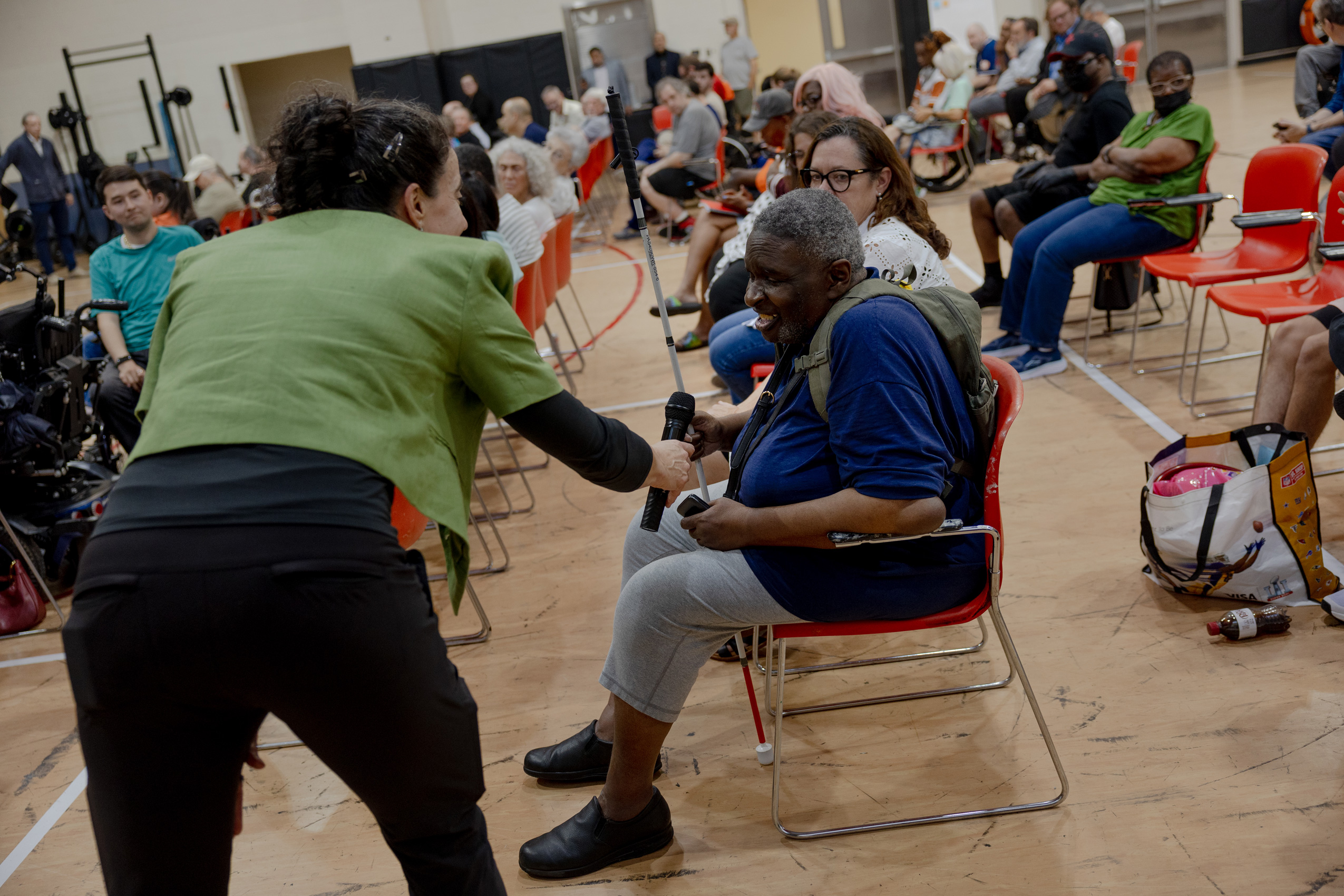
(Left) Council member Abbie Kamin speaks to community members at a public meeting at the West Gray Multiservice Center. (Right) Jamie Flatt holds the microphone for an attendee of a public meeting at the West Gray Multiservice Center. (Bottom) Community members attend a meeting with council member Abbie Kamin at the West Gray Multiservice Center, Wednesday, April 23, 2025 in Houston. Kamin announced that over $11 million dollars were reallocated to the center, which is in dire need of repairs. This meeting served as a listening session where people could express their needs and hopes for the center. (Lexi Parra / Houston Landing)
At the April 23 meeting, Jamie Flatt, principal at Houston architecture firm Page, led a community idea-gathering session in which attendees could express their concerns, offer community priorities and provide input on future redevelopment efforts.
Sticky notes with suggestions filled the many large, white easels spread throughout the gym.
While many requested more gym and classroom space, more arts and theater programming, improved accessibility, and improved security and check-in/code of conduct process, others focused on more immediate needs, like better communication when the pool is going to be closed.
While “it was dreamy,” many were unclear what Page consultants could do for the community, said Amie Jean, a commissioner with the Houston Commission on Disabilities.
“People didn’t understand that you are trying to build something,” she said, noting she suggested Page craft a video of the builder’s process. “We don’t understand where we fit in. … People can say their needs but this is not what you’re here for.”
During the discussion portion of the meeting, Jean said Flatt indicated that Page Architects was not equipped to handle the facility’s urgent issues, such as the HVAC system repairs. Flatt instead suggested community members focus on how the $11.5 million could be used to meet those urgent needs.
“There’s a lot of interconnected considerations that are complicated and there’s not one entity that can go back into a dark room or a drafting table and figure it out,” Flatt said. “It has to be discussed as a community, and weighing the different possible options or serving the different needs is really how we move it forward. So it’s complicated, and that’s why it hasn’t happened already.”
But by stepping back from the drawing board and listening to the community first, Flatt is confident that together they’ll eventually come up with a suitable plan that works for everyone.
“We will do it better when we are starting from these critical voices and users,” she said to the Landing following the meeting.
The approach is a stark contrast from the last time Page got involved on the project in the summer of 2023 under the late former Mayor Sylvester Turner. Then, the city paid for a schematic design that incorporated private, mixed-use developments surrounding the facility based solely on speculation to envision the site’s capacity. But the plan was met with sharp skepticism by avid facility users over accountability and fear of involving the private sector when it was introduced at community meetings Aug. 29 and Sept. 20, 2023, because the plan was shared with the community afterwards.
This time around, Flatt said they’re doing things the right way by asking the community first for input and then coming up with ideas to shape the redevelopment together.
“We can’t consider what it could be without respecting what it is and how it must be,” Flatt said. “That was premature. It was just out of order.”
(Left) Notes stick to a poster board at a public meeting with council member Abbie Kamin at the West Gray Multiservice Center. (Right) Jamie Flatt speaks to community members at a meeting at the West Gray Multiservice Center, Wednesday, April 23, 2025 in Houston. Kamin announced that over $11 million dollars were reallocated to the center, which is in dire need of repairs. (Lexi Parra / Houston Landing)
Among the top critics has been James “Jimmy” Walker, who has been coming to the MMSC for physical rehab since 2006, about a year after his transverse myelitis diagnosis.
His primary concern was the facility leaving the public ownership — fears that have since subsided, he said after the April 23 meeting.
“It [feels] different now,” Walker said. “We got assurances from the city council person that it would remain in the public domain.”
Flatt said Page Architects plans to take what they’ve heard and collected at this initial meeting and invite more input to make sure they correctly capture it.
A date has not been set yet for the second meeting.
“We’re going to give folks another chance,” she said. “And at that point, we might have a better understanding and be able to talk more specifically about what is the next step after this engagement.”
WASHINGTON, DC—The House Transportation and Infrastructure Committee will meet today to discuss its proposed budget legislation, and there's a doozy in there for drivers of electric vehicles and hybrids. As part of the Republican Party's ongoing war against science and the environment under President Trump, committee chairperson Sam Graves (R-Mo.) has included some new annual fees that will cost all drivers some, but some drivers more.
Republicans plan to use the budget reconciliation process to pass this legislation, which is an expedited process that removes some of the US Senate's ability to stall. They're proposing a new annual federal motor vehicle registration fee, which state DMVs would have to collect and pass back to the federal government.
If it passes, all battery EVs would be subject to a new $200 tax. Hybrids—defined as vehicles that are propelled by both an electric motor and an internal combustion engine or other power source (which would include fuel cell EVs)—will pay $100. But someone who commutes 90 miles a day in a particulate-belching Ford F-350 Duramax diesel pickup truck gets away with a mere $20 a year, and only from October 1, 2030; until then they get to drive for free.
The Trump administration aims to make fossil fuels cheap—so cheap they wouldn’t be worth extracting. “‘Drill, baby, drill’ is nothing short of a myth,” one oil executive has said.
CALGARY – In a truly unexpected turn of events, Alberta has stunned voters across Canada by voting exactly the same way they have voted in every federal election for seven consecutive decades. “I’m in total disbelief. I stayed up half the night watching the results from western Canada roll in because I just couldn’t believe […]
In the five years before a sports utility vehicle struck Energy Transfer’s pipeline in Deer Park and caused a massive explosion and fire, pipelines operated by the company and its affiliates had been damaged by vehicle collisions at least five times.
That’s what Houston Landing found in a two-partinvestigation published in December that revealed the Deer Park crash was part of a wider national safety issue that has involved at least 36 pipeline collisions across the United States since 2019.
A lawsuit filed by four people who live and work near the explosion site, accuses Energy Transfer of negligence in failing to protect its pipeline against the September 2024 SUV crash. The company, the suit alleges, “was already on notice of the danger of automobiles crashing into above-ground valves, as well as the resultant risks of explosion, fire, and exposure to noxious chemicals.”
Energy Transfer, in its response to the lawsuit, denies the allegations and has asked a Harris County court to order paragraphs be stricken from the residents’ lawsuit that detail the company’s and industry’s history of pipeline collisions.
The suit contends the Deer Park pipeline structure should have had at least concrete or metal barriers because it was next to heavy traffic along Spencer Highway and near a busy Walmart parking lot. Instead, the suit says, it “was surrounded only by a flimsy chain-link fence.”
Spokespeople for Energy Transfer did not respond to emailed questions and requests for an interview or comment. Brett J. Young, an attorney representing Energy Transfer in the lawsuit, said he couldn’t answer Houston Landing’s questions because of the pending litigation.
The company also has asked the court to order that 19 paragraphs be stricken from the lawsuit’s original petition. Eleven of these paragraphs involve details about the frequency of vehicles colliding with pipelines and the residents’ allegations that the company failed to have adequate barriers around its above-ground pipeline structure in Deer Park.
Energy Transfer says the claims in these paragraphs, among other issues, are not allowed by law because the company had no duty to control the conduct of an outside individual. Two hearings in the lawsuit scheduled to occur in person and by Zoom at 10 a.m. and 11 a.m. on June 9 in 55th District Court.
The company describes itself as the victim of a criminal act, an injured party whose pipeline was destroyed by the SUV driver, Jonathan McEvoy, who “chose to end his own life by intentionally crashing his automobile through a barrier fence and into an above-ground natural gas piping system,” court records say.
Energy Transfer contends that the risk of McEvoy’s suicidal act was “clearly not forseeable” and that other pipeline collisions, such as those cited in the lawsuit, were not “similar.” The company’s manager of regulatory affairs, Justin Davidson, said in a sworn statement he had no personal knowledge of any similar event, “meaning one where a motorist intentionally struck and [sic] Energy Transfer pipeline riser.”
On the morning of Sept. 16, McEvoy’s SUV veered out of a Walmart parking lot, across a grassy utility right-of-way and picked up speed before it crashed through the chain link fence that surrounded the above-ground pipeline valve, sparking a massive explosion and fire that burned for nearly four days. Only then were investigators able to remove the charred SUV that contained fragments of McEvoy’s remains.
“Unsuspecting property owners are not legally responsible for the collateral damage caused by such acts,” Energy Transfer said in its court filings.
Houston Landing’s investigation last year found that regulations require pipeline operators to protect transmission lines from damage but that regulators give pipeline operators wide discretion to decide on their own how much protection their pipelines require.
People drive along Spencer Highway on Tuesday, Oct. 29, 2024 past the site of the deadly Energy Transfer pipeline explosion in Deer Park. The concrete barriers were installed after an SUV slammed into one of the pipelines on Sept. 16, 2024.. (Houston Landing file photo / Antranik Tavitian)
After the crash and explosion, Energy Transfer surrounded its rebuilt pipeline structure with large concrete barriers.
Texas pipeline regulators who investigated the Deer Park explosion found no safety violations by Energy Transfer. The report from the Texas Railroad Commission provided little explanation for how investigators reached their conclusion beyond saying inspectors met with company officials and reviewed records.
In its court filings this month, Energy Transfer’s attorneys wrote: “Whether Plaintiff’s accept the truth of this suicidal criminal act, or instead contend that…McEvoy’s conduct was medically-induced or just bad driving, the result is the same: Energy Transfer has no duty to control or prevent the driving behavior of a third-party stranger.”
Wisam Ghuneim, an attorney representing the four Deer Park and La Porte residents who say they were harmed by the explosion and fire, was not available for an interview. The plaintiffs in the case are Jaime and Daisy Coronado of Deer Park, Ximena Palacios Molina of La Porte and Rosa Romero of La Porte.
Their lawsuit alleges generally that the pipeline incident caused“physical injuries” – including burns, fractures, rashes and difficulty breathing.The suit says the heat from the fire and water from firefighters trying to protect nearby structures damaged properties owned or occupied by the people who are suing. The suit also claims economic harms, including lost wages, costs for paying for alternate lodging and the negative impact of the explosion on property values for homes and businesses.
In January the Harris County medical examiner’s office ruled that McEvoy died by suicide, citing video footage showing the SUV accelerating toward the pipeline and McEvoy’s history of suicide attempts and his recent discharge from a rehabilitation center for alcohol addiction. The man’s family had said he had suffered from periodic seizures and that they believed that’s what caused the crash.
The lawsuit, which names McEvoy’s estate as a defendant, alleges his negligence was a contributing factor. The suit describes McEvoy as a “medically incapacitated motorist” who continued to drive vehicles despite having a history of seizures that were not being medically treated.
It contends that while McEvoy’s vehicle striking the above-ground pipeline valve was the “immediate catalyst” of the explosion and fire, that the “conflagration’s central cause lies in Defendant Energy Transfer’s failure to install adequate protective barriers around the valve.”
McEvoy’s former wife Delma McEvoy, who has served as a family spokesperson, did not respond to an email about the lawsuit.
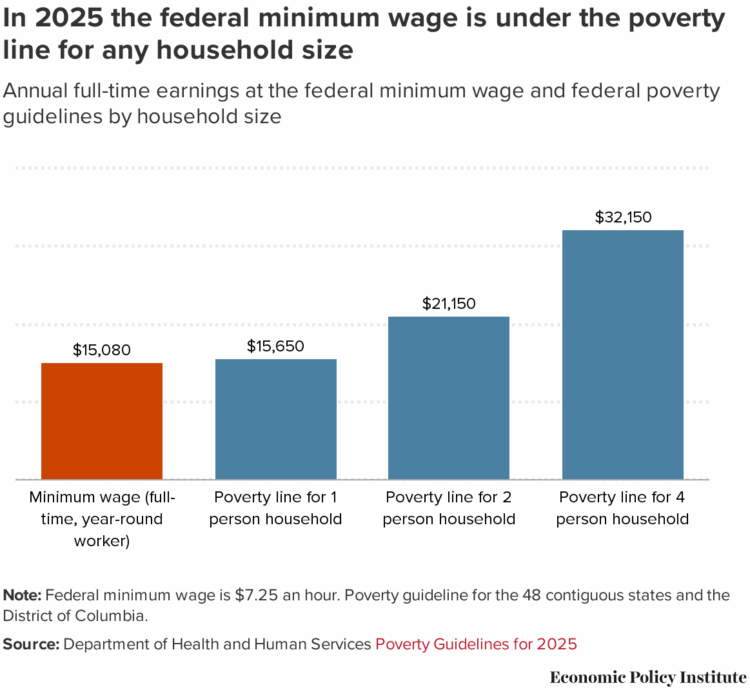
Each year, poverty thresholds are calculated based on the cost of living, so thresholds rise over time with inflation. However, the federal minimum wage hasn’t changed since 2009 in the United States, which means the minimum wage is now a poverty wage:
When the minimum wage was created as part of the Fair Labor Standards Act in 1938, the policy was intended to protect the nation from “the evils and dangers resulting from wages too low to buy the bare necessities of life.”1 The federal wage floor is clearly not fulfilling this objective anymore because of a historically long period of inaction by Congress. The last time Congress increased the federal minimum wage was in July 2009, meaning that as prices have risen over the last 15 years, the value of the minimum wage has fallen by 30%.
Personally, I use a solid color background. It was the default in Windows 95,¹ and I’ve stuck with that bluish-green background color ever since. It’s sort of like my comfort food.
After your logon has been authenticated, Windows sets up your desktop. There are a lot of things going on. The taskbar gets created. The components that are responsible for various system services are loaded and initialized. The desktop window is created and filled with icons. And the desktop background window loads up the desktop wallpaper and paints it to the screen.
The logon system waits for all of these pieces to report that they are ready, and when the all-clear signal is received from everybody, or when 30 seconds have elapsed, the logon system switches away from the Welcome screen.
Given that design, you can imagine the reason for the 30-second delay: It means that one of the pieces failed to report. Perhaps it was written like this:
InitializeWallpaper()
{
    if (wallpaper bitmap defined)
    {
        LoadWallpaperBitmap();
    }
}

LoadWallpaperBitmap()
{
    locate the bitmap on disk
    load it into memory
    paint it on screen
    Report(WallpaperReady);
}
The code to report that the wallpaper is ready was inside the wallpaper bitmap code, which means that if you don’t have a wallpaper bitmap, the report is never made, and the logon system waits in vain for a report that will never arrive.
Later in the article, it notes a related article that calls out that if you have the “Hide desktop icons” group policy enabled, then you might also suffer from the 30-second delay.
Group policies are susceptible to this problem because they tend to be bolted on after the main code is written. When you have to add a group policy, you find the code that does the thing, and you put a giant “if policy allows” around it.
// Original code
InitializeDesktopIcons()
{
    bind to the desktop folder
    enumerate the icons
    add them to the screen
    Report(DesktopIconsReady);
}

// Updated with group policy support

InitializeDesktopIcons()
{
    if (desktop icons allowed by policy)
    {
        bind to the desktop folder
        enumerate the icons
        add them to the screen
        Report(DesktopIconsReady);
    }
}
Oops, the scope of the “if” block extended past the report call, so if the policy is enabled, the icons are never reported as ready, and the logon system stays on the Welcome screen for the full 30 seconds.
Note that in both of these cases, it’s not that the logon is extended by 30 seconds. Rather, the Welcome screen stays on for the full 30 seconds rather than the actual time it took for all systems to report ready (which could be 5 seconds, or it could be 25 seconds, depending on your system’s performance).
If you look at the timestamps on the articles, you can see that the problem was fixed in November 2009, just a few months after Windows 7 was released in July 2009.
¹ Originally, I avoided bitmap backgrounds because they took up a lot of memory, and when you had only 4 or 8 megabytes of memory, eating three quarters of a megabyte of memory just for wallpaper was not a good return on investment.
Also, I tend to stick with default configurations because it makes bug filing easier. If the repro instructions are “install a system from scratch, then perform these steps”, you’re more likely to get traction than if you say “install a system from scratch, change these 50 settings from their defaults, and then perform these additional steps.” It’s much easier to justify a bug fix that affects the default configuration than a bug fix that requires that the user have changed settings from the default, particularly if those settings are obscure.
One thing I wondered was how long this filter remained present.
I learned that the filter remained present at least until Windows 7, because it was then that Microsoft imposed a new rule on Audio Processing Objects (APOs), which is the formal name for these audio filter thingies, such as the one that filtered out the offending frequency. The new rule was that it must be possible to disable all APOs.
The vendor applied for an exception to this rule on the grounds that disabling their APO could result in physical damage to the computer. If it were possible to disable their APO, word would get out that “You can get heavier bass if you go through these steps,” and of course you want more bass, right? I mean, who doesn’t want more bass? So people would uncheck the box and enjoy richer bass for a while, and then at some point in the future, the computer would crash mysteriously or (worse) produce incorrect results.
Of course, the users wouldn’t realize that these problems were due to them unchecking the box several hours or even days ago. From the user’s point of view, the computer just started crashing more often. And they would tell their friends, “Don’t buy Fabrikam brand laptops. They crash a lot.” Or worse, “Don’t buy Windows PCs. They crash a lot.”
The exception was granted, and the manufacturer’s special “Don’t crash when somebody plays Rhythm Nation” filter was allowed to exempt itself from the “Disable all audio enhancements” setting.
When we saw Beate’s lodgings earlier in the story, they looked to me like the sort of place where infestations would be an issue. I read somewhere that the colour yellow wards off bedbugs. Apparently it reminds them of the sun. Or Mr Happy. Look, I’m not an entomologist. I’m just someone who is terrified of bedbugs.
CARLETON, ON – Despite losing his own riding by several thousand votes, Conservative leader Pierre Poilievre has vowed to stay on as party leader due to having absolutely no employment track record outside of politics. “To all our supporters across Canada, after tonight’s historic result I think we can all agree on one thing: I […]
Hours after President Trump tried to remove three board members, the Corporation for Public Broadcasting responds with a lawsuit arguing he does not have that authority.
“National Immigration Project said on Friday the New Orleans ICE Field Office ‘deported at least two families, including two mothers and their minor children—three of whom are U.S. citizen children aged 2, 4, and 7.’” — Axios, 4/27/25
“The White House has been fielding proposals aimed at persuading people to marry and have children… One such proposal that has been pitched to White House advisers is a $5,000 ‘baby bonus’ to every American mother after she gives birth.” — ABC News, 4/23/25
- - -
The Republican Party prides itself on being the pro-family party. We help women achieve the American dream: having so many babies that their weary bodies collapse in a shopping center parking lot with ninety-six-count packs of Walmart diapers under each arm. Which, ironically, are sold under the brand name Parent’s Choice even though we believe becoming a parent shouldn’t be a choice; it should be a consequence.
And speaking of consequences, we’re also deporting undocumented migrants and their families, regardless of whether their children are US citizens.
Don’t believe the legacy media’s lie that we’re deporting American children. What we’re doing is deporting their migrant parents, who then choose to take their American children back to the (often dangerous) places they came from. Those parents could instead surrender their children to Child Protective Services to become wards of the state and then return to their home countries by themselves, never to see their children again.
If that sounds like a real Sophie’s choice, we agree. For those who haven’t seen the movie Sophie’s Choice, it’s a film about an immigrant who comes to the United States after fleeing unspeakable violence, but is ultimately unable to overcome her traumatic past, leading to her tragic demise. If it were up to us, that’s how all immigration stories would end.
Sending American toddlers into life-threatening situations in other countries might not seem to some like a pro-family policy. But consider the upside. This move will free up spots in America’s crowded and understaffed preschools.
To those questioning whether that’s the best way to handle that problem, ask yourself this: What’s simpler—spending billions of dollars hiring, training, and equipping ICE agents to round up migrant parents and their American children and ship them overseas? Or paying teachers a little more?
Besides, if we weren’t pro-family, would we be offering people a whopping five grand to have a child? That’s almost enough money for two months of childcare—or 3 percent of a college fund.
In fact, President Trump is so pro-family, he’s calling himself the “fertilization president.” And if reading the phrase “fertilization president” just made you throw up in your mouth a little bit, that’s called morning sickness. Congratulations, you’re pregnant.
This country faces two enormous problems: Millions of people are trying to come to the United States to provide better lives for their children, and declining domestic birth rates are leading to a looming underpopulation crisis. We cannot solve one of those problems with the other problem. We must instead tackle both issues the only way that makes sense: turning women into mini baby factories while simultaneously getting rid of millions of people that are already here. There are no other glaringly obvious solutions.
Donald Trump is the most pro-family president in the history of this country. He knows a thing or two about families, because he’s had three of them. Under his leadership, America will be booming—economically and demographically. And as we hand women their National Medals of Motherhood for giving birth to their sixth child, their bodies will be limp with exhaustion, and they will be thanking us.
Unless, of course, they’re in one of those places where the health care system is heavily dependent on immigrant labor, like a city or a rural area.
This Saturday (May 3rd) I am doing a Free Comic Book Day signing at Gosh Comics in London, between 1 and 2pm. The details are below. Perhaps I will see you there!
The Rachofsky House, the former main site housing Howard and Cindy Rachofsky’s art collection, is being sold.
The Rachofsky House
Completed in 1996, the three-story home was designed by Richard Meier and features a site-specific lawn work by Robert Irwin as well as other outdoor installations. Prior to the 2012 opening of The Warehouse, an 18,000-square-foot property with 16 galleries, the house was the main exhibition space for the Rachofsky Collection.
In 2005, the Rachofskys, along with Dallas collectors Rusty and Deedie Rose and Robert and Marguerite Hoffman, pledged their entire collection to the Dallas Museum of Art (DMA) upon their death. While the Rachofskys’ pledge originally included the house, Mr. Rachofsky told Artnet News the museum did not want to take on the burden associated with upkeep of the home.
TWO x TWO installation at the Rachofsky House. Photo: Kevin Tachman
The sale of the house comes on the heels of the Rachofskys’ Fall 2024 announcements of the end of its annual TWO X TWO fundraising event, benefiting the DMA and amfAR (The Foundation for AIDS Research), and the establishment of The Warehouse Dallas Art Foundation. The new nonprofit is a joint venture with Dallas collector Thomas Hartland-Mackie, which will involve the use of The Warehouse building to showcase works from both private collections.
Regarding the upcoming sale of the home, Mr. Rachofsky told Artnet News, “As you know, I am 81 years old, and so I’ve been trying to deal with estate planning while taking care of the museum, as we have always done, along the way.”
He also stated his intention to sell the property to someone who understands the significance of the space, that the house is “an artwork” and “part of a community.”
The Rachofsky House, back view
A private viewing of Howard and Cindy Rachofsky’s Richard Meier-designed home will be held today, Tuesday, April 29, 2025.
In brief: After several drier days, some rain chances will return to Houston’s forecast. We are not expecting any days really to be washouts, however. I’m also holding out some hope that a weak front makes it into the city this weekend, providing for some slightly drier and cooler air. Fingers crossed.
Overall pattern shift
The high pressure that has held sway since last Friday, and basically shut off rain chances since then, is now shifting to the east. This does not mean you will see rain every day from now on, but over the next 10 days there will be at least a slight chance of rain most days. Total accumulations over the next 10 days may only be 1 to 2 inches, so we don’t have any real flood concerns at this time. It just should be a pattern that provides the potential for spoiling a few outdoor activities, but also helps our trees and plants before the long summer days that lie in our near future.
Tuesday
With that said, rain chances today are rather slight, and anything that falls would be a quick passing shower. However that does not mean sunshine will be abundant. Rather we should see mostly cloudy skies, and this will help limit high temperatures in the mid-80s for most locations. With dewpoints in the 60s it will feel moderately, but not oppressively humid. We can expect southerly winds at about 15 mph, with gusts this afternoon up to 25 mph. Overnight lows will only drop into the mid-70s.
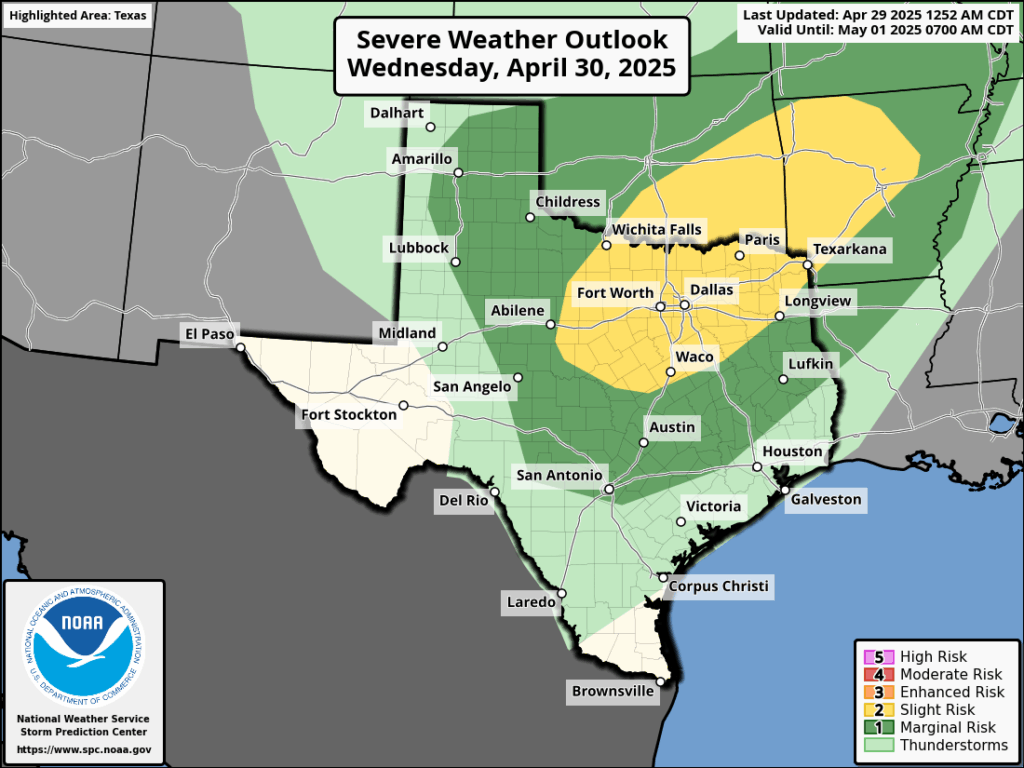
Severe weather is possible on Wednesday and Wednesday night northwest of the region. (NOAA)
Wednesday
A weak front will move toward the Houston region on Wednesday, and it will spur a slight chance of thunderstorms to the northwest of the metro area. As of now, I think the chance of any serious storms getting anywhere close to the city of Houston or its surrounding suburbs is quite low. But we’ll keep an eye on things. Skies will again be mostly cloudy, with a fairly robust southerly wind as on Tuesday. Rain chances turn a little bit higher on Wednesday night, perhaps 30 percent. Some far inland areas may see lows on Wednesday night in the 60s due to the proximity of the front, but most of the region should remain in the 70s.
Thursday and Friday
These will be a pair of hotter days as we see an injection of warm, southerly air into the region. Thursday probably will be the warmest day of the week, with some locations potentially hitting 90 degrees as skies become partly sunny. Rain chances are are low, but non-zero. Friday will also be fairly hot, but another slow-moving front will spur better rain chances. I expect most of the region will see some showers, or possibly even thunderstorms later on Friday or Friday night as the front slowly moves in.
It’s not hugely impressive, but lows in the 60s are possibly by Sunday morning. (Weather Bell)
Saturday and Sunday
It is not possible to say for certain, but at this point I think that weak front will make it all the way to the coast. As a result most of the area should see highs in the lower 80s this weekend, with a smidge of drier air, and lows in the 60s. There will still be a healthy chance of rain on Saturday, but I expect Sunday to be partly sunny and fairly nice. Again, the weekend forecast is very much in flux because we just can’t be sure how much oomph that front is going to have, but I have some hopes for a nice day on Sunday. We’ll see.
Next week
I think Monday probably will see a fair amount of sunshine before rain chances return again next week during the Tuesday through Thursday time frame. I don’t think we’re looking at anything extreme at all, but just more rain to help our soils remain in good shape for nature.

/https://static.texastribune.org/media/files/59e6451757e6604572d6c1d00a163fe6/0528%20Dade%20Phelan%20Runoff%20MF%20TT%2005.jpg)