Shared posts

20 Aug 11:56

Point/Counterpoint: The Nintendo Switch 2 is Too Expensive vs. Big Monkey Smash Rocks

by Geoff Cork

Point, The Nintendo Switch 2 is Too Expensive There is an alarming trend occurring in the video game industry where consumers will purchase anything despite the increasingly high price margins. To buy into this hype is to teach the wrong lessons to game developers. Counterpoint, Big Monkey Smash Rocks Donkey Kong Bananza game has big […]

The post Point/Counterpoint: The Nintendo Switch 2 is Too Expensive vs. Big Monkey Smash Rocks appeared first on The Beaverton.

20 Aug 02:21

Hurricane Erin Graphics

by nhcwebmaster@noaa.gov (NHC Webmaster)
Hurricane Erin 5-Day Uncertainty Track Image
5-Day Uncertainty Track last updated Tue, 19 Aug 2025 23:59:06 GMT

Hurricane Erin 34-Knot Wind Speed Probabilities
Wind Speed Probabilities last updated Tue, 19 Aug 2025 21:22:07 GMT
20 Aug 02:19

Ten Commandments posters arrive in Texas public schools, thanks to Glenn Beck, Christian conservative groups

by Bianca Seward
Senate Bill 10, which is being challenged in court, will require the commandments to be displayed in every Texas public school classroom starting Sept. 1. Neither teachers nor their schools are required to provide or pay for the posters, but they can’t reject a donated poster. Houston Public Media took a look at those behind the effort.
20 Aug 02:19

Fort Bend County Toll Road Authority rejects Fairchilds residents’ proposed route for tollway extension

by Natalie Weber, Fort Bend County Bureau
A petition started by community members, who do not want the Fort Bend Toll Road to pass through their town, has garnered more than 2,600 signatures.
20 Aug 02:18

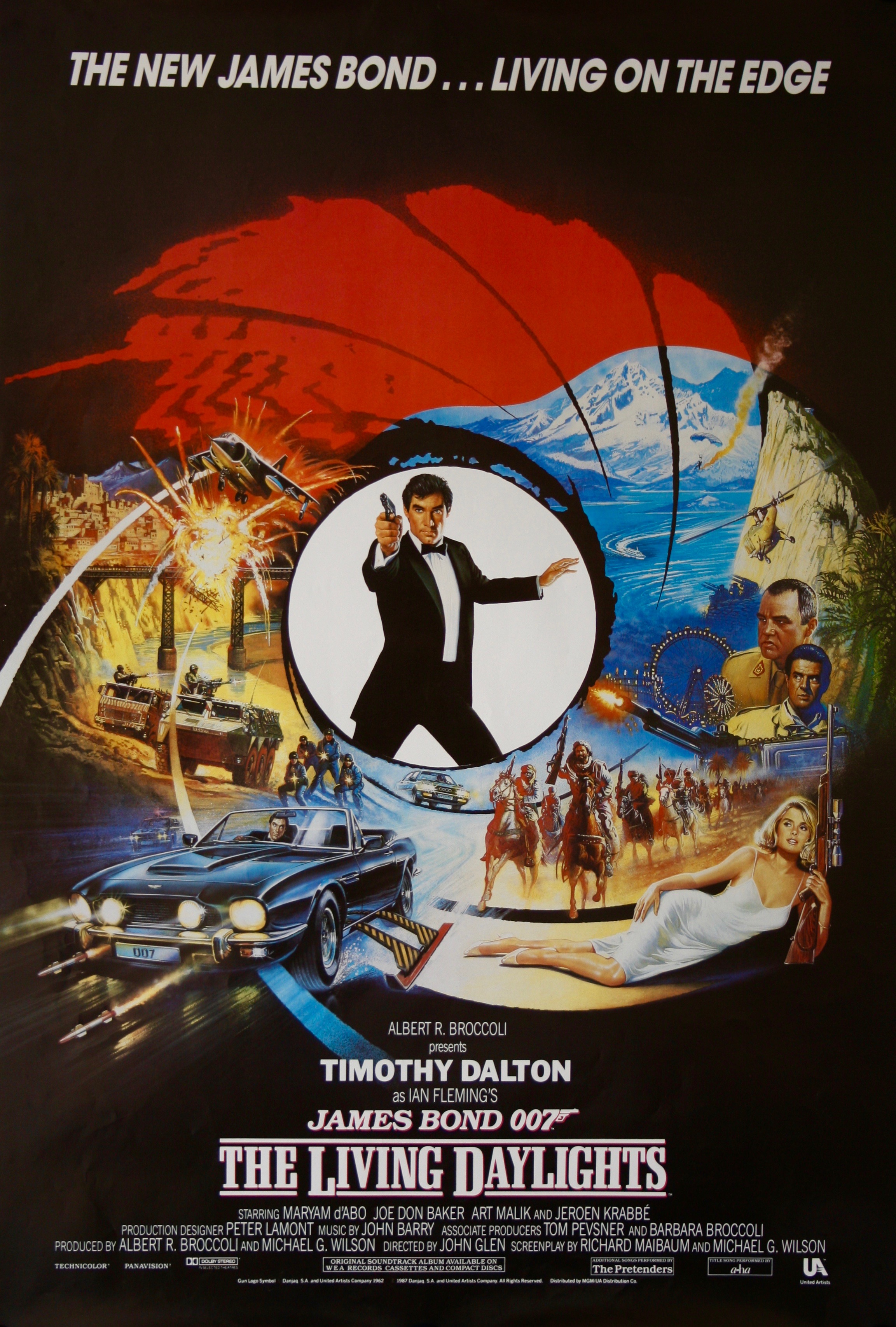
★ Joe Caroff, Designer of the James Bond 007 Logo, Dies at 103

by John Gruber

Mike Barnes, The Hollywood Reporter:

For his first movie job — he would work on more than 300 campaigns during his career — United Artists executive David Chasman hired him to design the poster for West Side Story (1961), then asked him to come up with the letterhead for a publicity release tied to the first Bond film, Dr. No. (Chasman had designed the poster for the 1962 movie.)

“He said, ‘I need a little decorative thing on top,’” Caroff recalled in 2021. “I knew [Bond’s] designation was 007, and when I wrote the stem of the seven, I thought, ‘That looks like the handle of a gun to me.’ It was very spontaneous, no effort, it was an instant piece of creativity.”

Inspired by Ian Fleming’s favorite gun, a Walther PPK, Caroff attached a barrel and trigger to the 007 and for his work received $300, the going rate for such an assignment, he said. Even though the logo, though altered in subtle ways, has been featured on every Bond film and on millions of pieces of merchandise, he received no credit, no residuals, no royalties.

The logo did, however, bring him “a lot of business,” he said. “It was like a little publicity piece for me.”

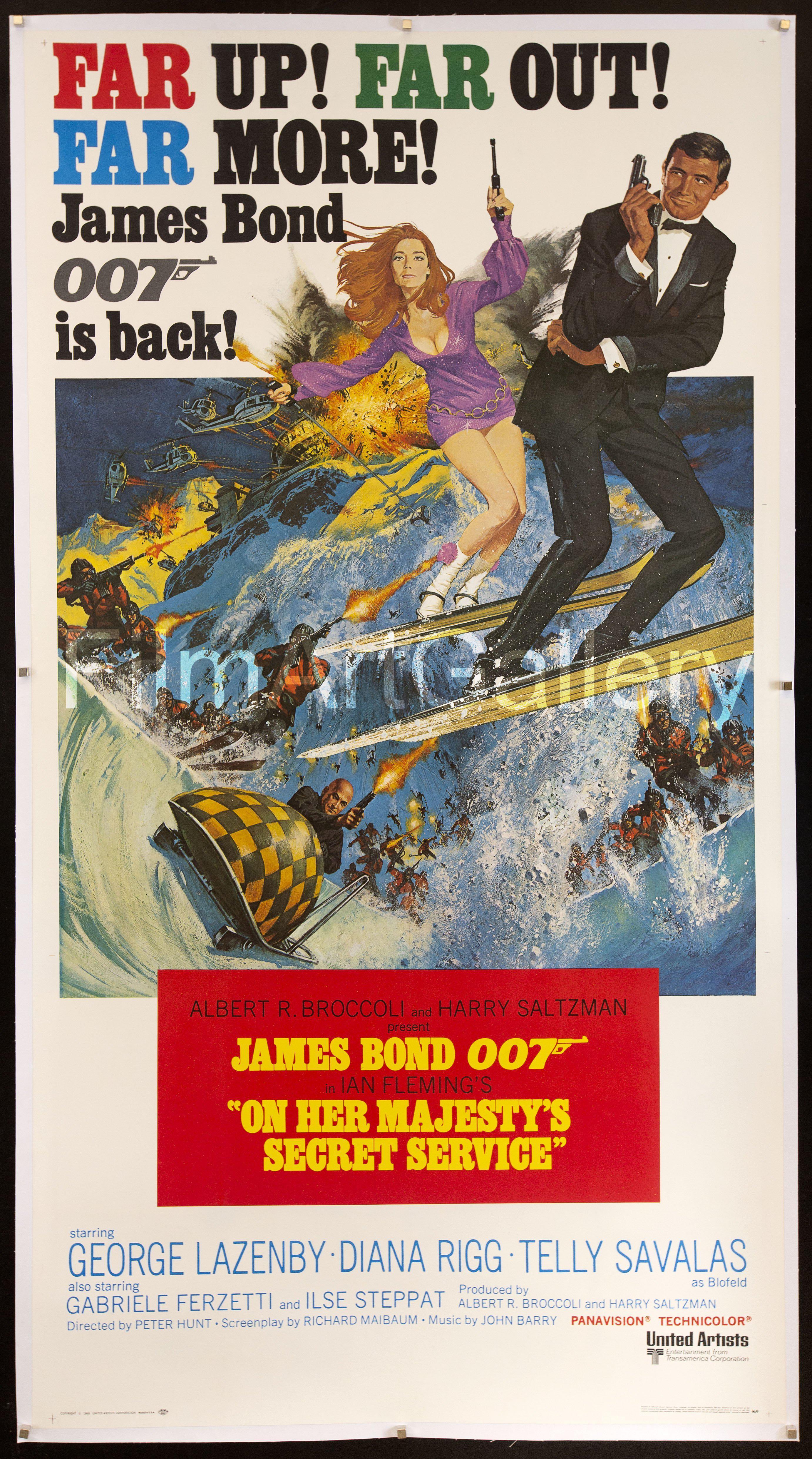
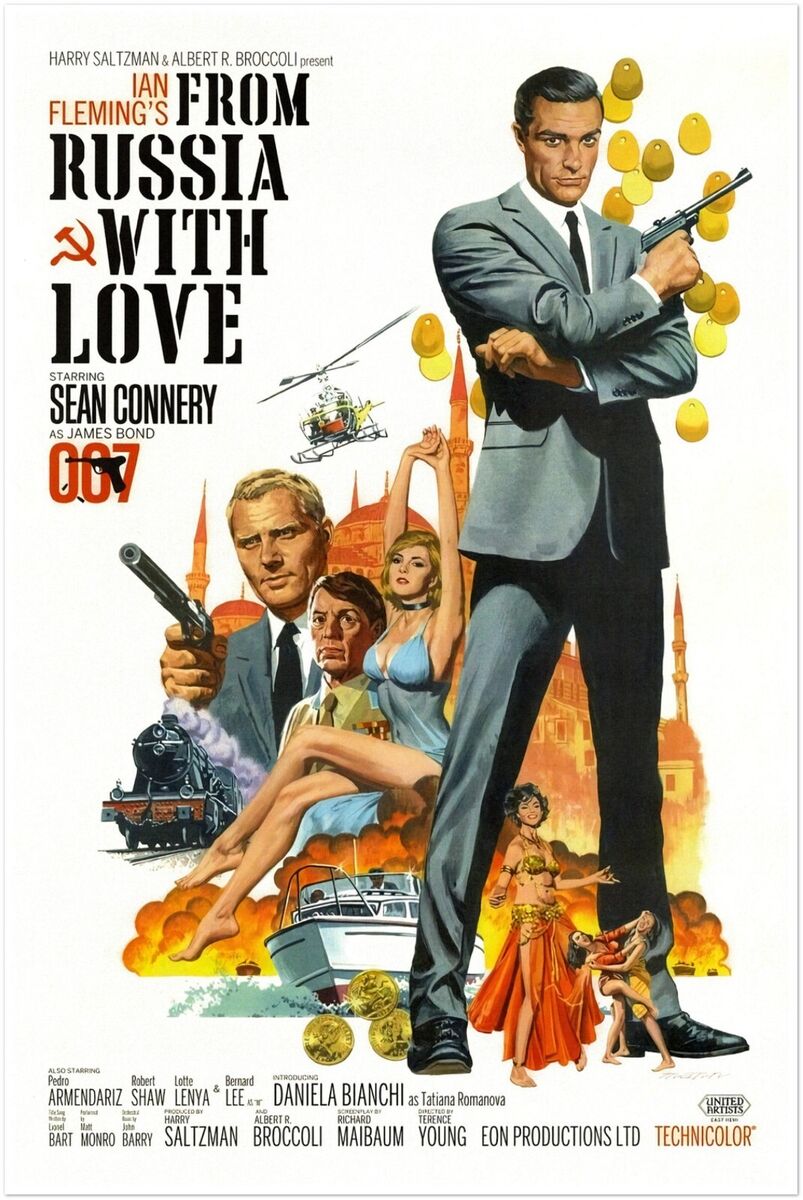
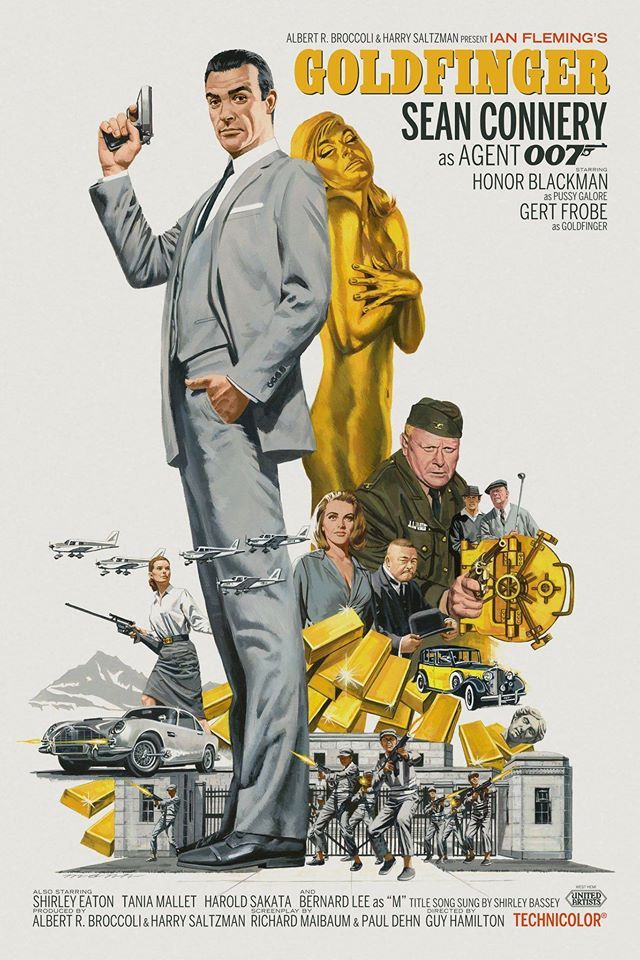
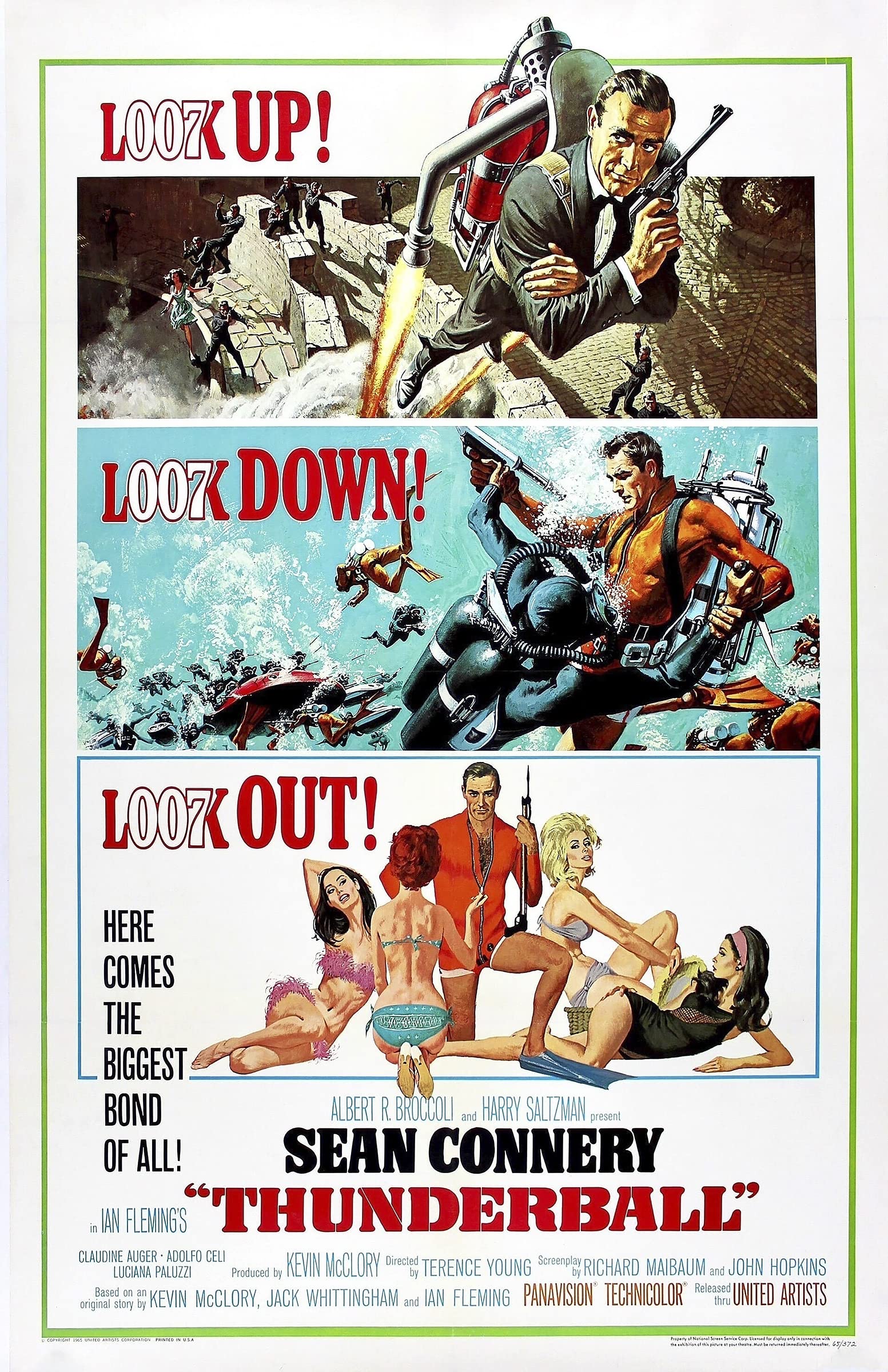
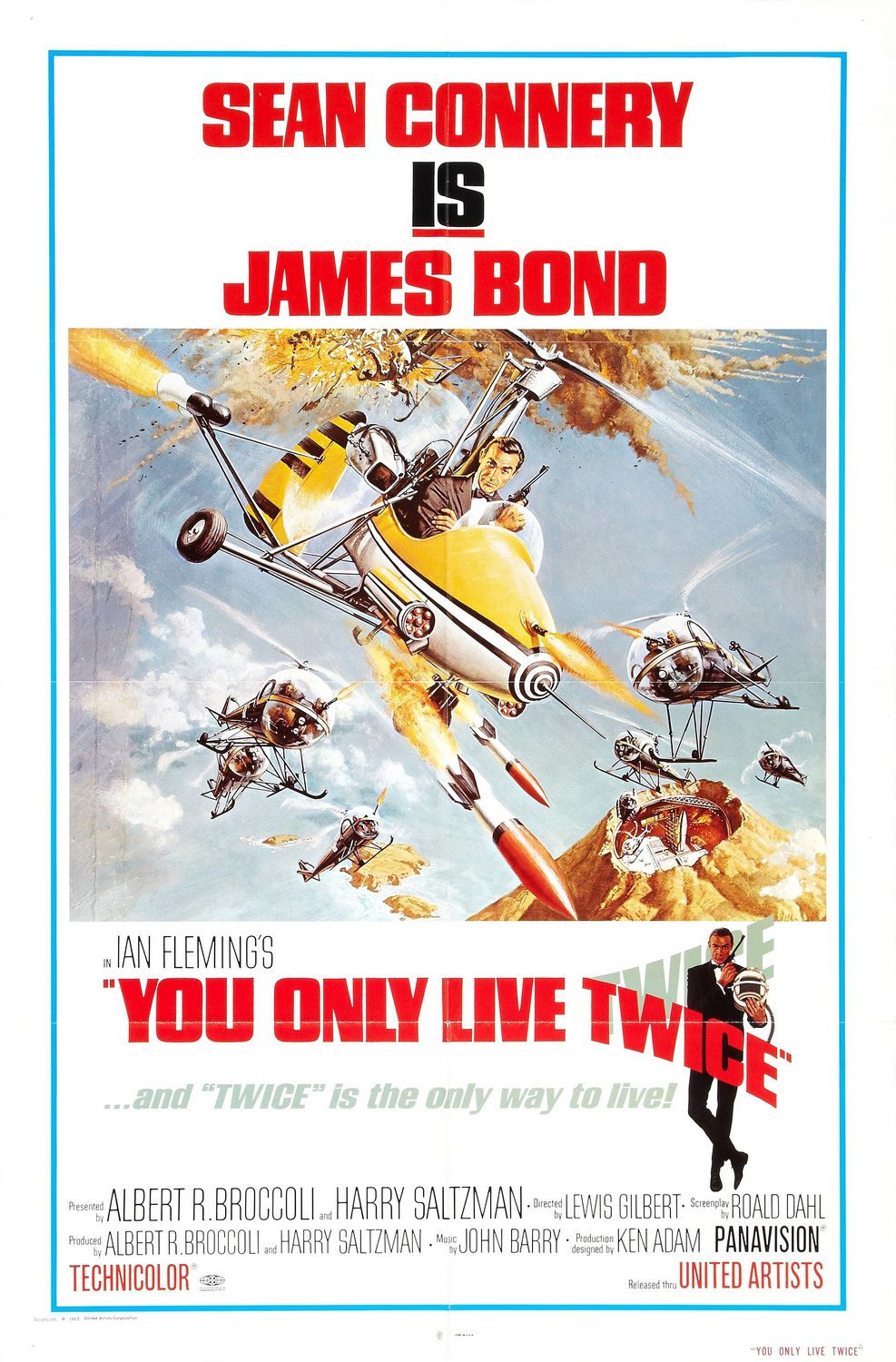
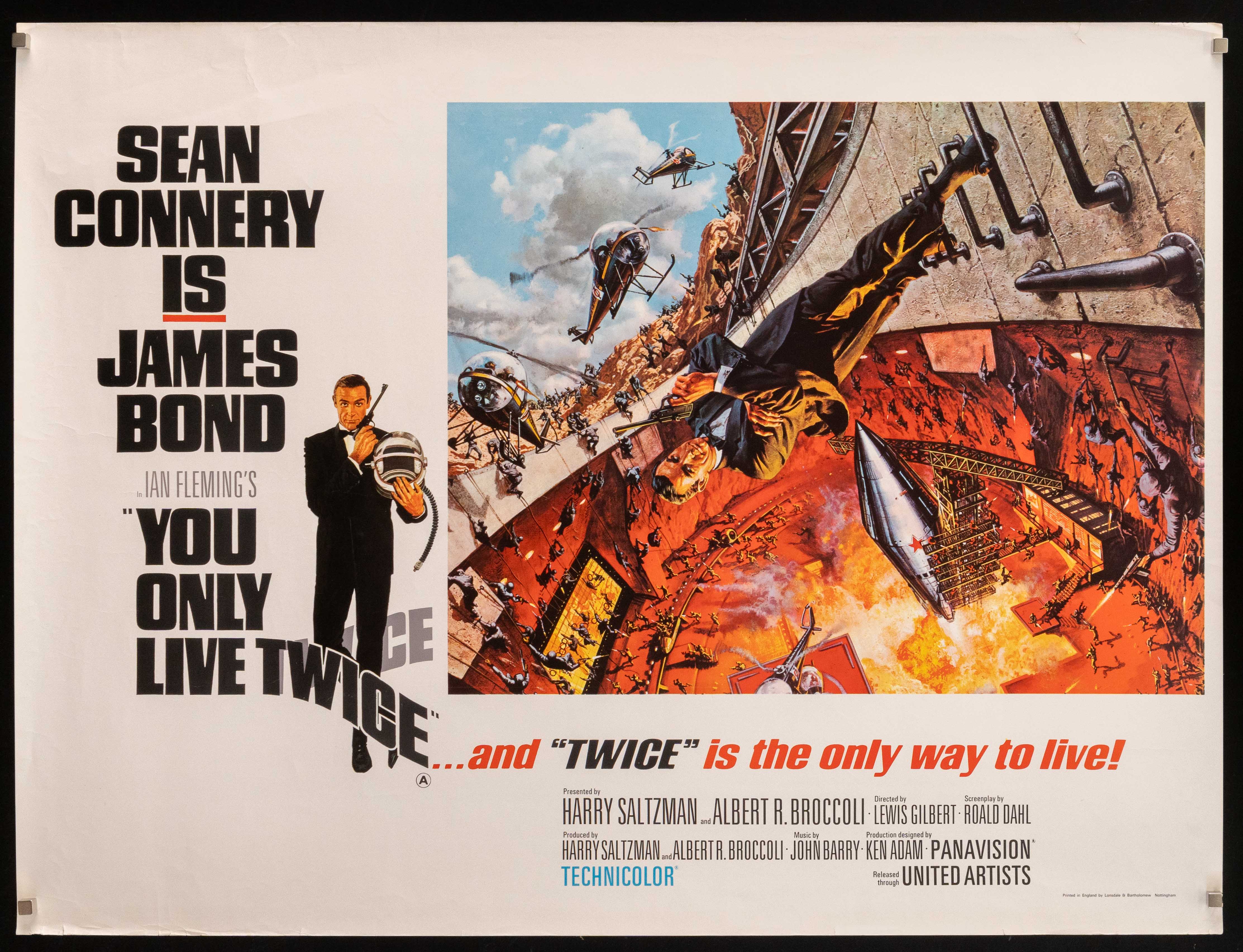
It’s rare for a logomark to have such staying power. Just a perfect logo. Kind of wild that it was created, initially, only as letterhead for stationery. Perusing vintage movie posters, it seems like EON didn’t really lean into using the logo consistently until On Her Majesty’s Secret Service (1969) — the sixth film, and the first without Sean Connery. EON had used the mark prior to that (including at least one excellent poster for Dr. No), but it didn’t appear on most of the posters for Connery’s initial run in the role: From Russia With Love, Goldfinger, Thunderball, and You Only Live Twice (variations A and B). Amongst those, the logo only appears on the Goldfinger poster. They used to make multiple posters for every movie back then, so there might exist examples for all of them with the logo. But I think until On Her Majesty’s Secret Service, EON leaned on Connery’s face as the symbol of the franchise. From that point forward, though, Caroff’s 007-cum-gun logo was the symbol of the franchise.1 I can’t seem to find an official movie poster after OHMSS that doesn’t feature it.

I will quibble with one detail from The Hollywood Reporter description above: the gun in Caroff’s original 007 mark clearly looked like a Luger, a rather distinctive German pistol with a long skinny barrel, not the more compact Walther PPK that Bond actually carried. Variations of the Luger-esque logo appear on the posters for all seven of the movies starring Roger Moore. EON updated the logomark to resemble a Walther PPK for The Living Daylights in 1987, the first (and better) of two Bond movies starring Timothy Dalton. As a kid it always bothered me — ever so slightly — that the logo resembled a gun that James Bond never actually used, but until today, researching this post, I never noticed that they addressed that in 1987. That said, I think the Luger-esque mark was a bit cooler. As a kid, that was my assumption: that “they” made it look like a Luger, not the sort of pistol Bond actually carried, because it looked cooler that way. I accepted that.


Caroff had a remarkably accomplished career. He created iconic posters for dozens of terrific films across a slew of genres. The fact that he created the 007 logo but only earned $300 from it is more like a curious footnote than anything.

From Jeré Longman’s excellent obituary for The New York Times (gift link), after observing that Caroff died just one day short of his 104th birthday:

Mr. Caroff’s designs were familiar, but his name was not. He did not sign much of his work and largely avoided self-promotion. He was not included among the more than 60 celebrated designers, among them like Saul Bass, Leo Lionni and Paul Rand, in the 2017 book The Moderns: Midcentury American Graphic Design, written by Steven Heller and Greg D’Onofrio.

“That he was unknown is shocking,” Mr. Heller, co-chairman emeritus of the Master of Fine Arts Design program at the School of Visual Arts in Manhattan, said in a recent interview.

Still, Mr. Caroff’s abundant output became widely recognizable for an interpretive style that could be bold, elegant, theatrical, whimsical, sensual and deceptively simple in promoting a book or movie and conveying its essence with a single image.

No better example of that reduced-to-its-essence genius than his 007 logo:

“I knew that 007 meant license to kill; that, I think, at an unconscious level, was the reason I knew the gun had to be in the logo,” Mr. Caroff said in a 2022 documentary, By Design: The Joe Caroff Story.

Mark Cerulli, who directed the documentary, said in an interview that the logo was a “marvel of simplicity that telegraphs everything you would want to know about 007.”

By Design is streaming on HBO Max. I’ve added it to the top of my to-watch list.


  1. You will not catch me making any jokes about the fact that “007 cum gun” could serve as a three-word plot synopsis for many of the films in the Connery/Moore era. ↩︎

20 Aug 02:16

A Long Palindrome (Spelled the same backwards and forwards)

by CodeParade

Here's a long palindrome I created using my palindrome solver.
20 Aug 01:53

Comic: New Congressional District Map

by John Forse

A digital comic by artist John Forse of a three people gathered around a Clyfford Still painting featuring a large swath of red paint and small sections of blue , yellow, and white. Text below reads: "New congressional district map just dropped."****

You can see John Forse’s other comics by visiting his Glasstire author page. Some of the artist’s past comics have poked at themes of small-town living, the absurdities and contractions in the art worldHurricane Harvey, and how Santa makes his deliveries, among many other topics.

John Forse is an artist living and working in Houston, Texas. He graduated with his MFA from the University of Houston and has exhibited at venues across Texas, including BOX 13 ArtSpace, the College of the Mainland Art Gallery Satellite Space, 500X Gallery, Flatland Gallery, and Domy Books in Austin and Houston. His art addresses themes of masculinity, popular culture, consumerism, and digital spaces.

The post Comic: New Congressional District Map appeared first on Glasstire.

20 Aug 01:50

A little help here?

A little help here?

20 Aug 01:49

Air Canada, union reach deal, forcing travelers to fly Air Canada again

by John Hansen

MONTREAL – As stranded passengers celebrated the news that a tentative deal had been reached by Air Canada and the union representing flight attendants, the mood was tempered by the realization that they would be flying Air Canada again. “Thanks to our negotiation we anticipate that by the end of the week our customers will […]

The post Air Canada, union reach deal, forcing travelers to fly Air Canada again appeared first on The Beaverton.

20 Aug 01:48

California’s Tallest Bridge Has Nothing Underneath

by Wesley Crump

[Note that this article is a transcript of the video embedded above.]

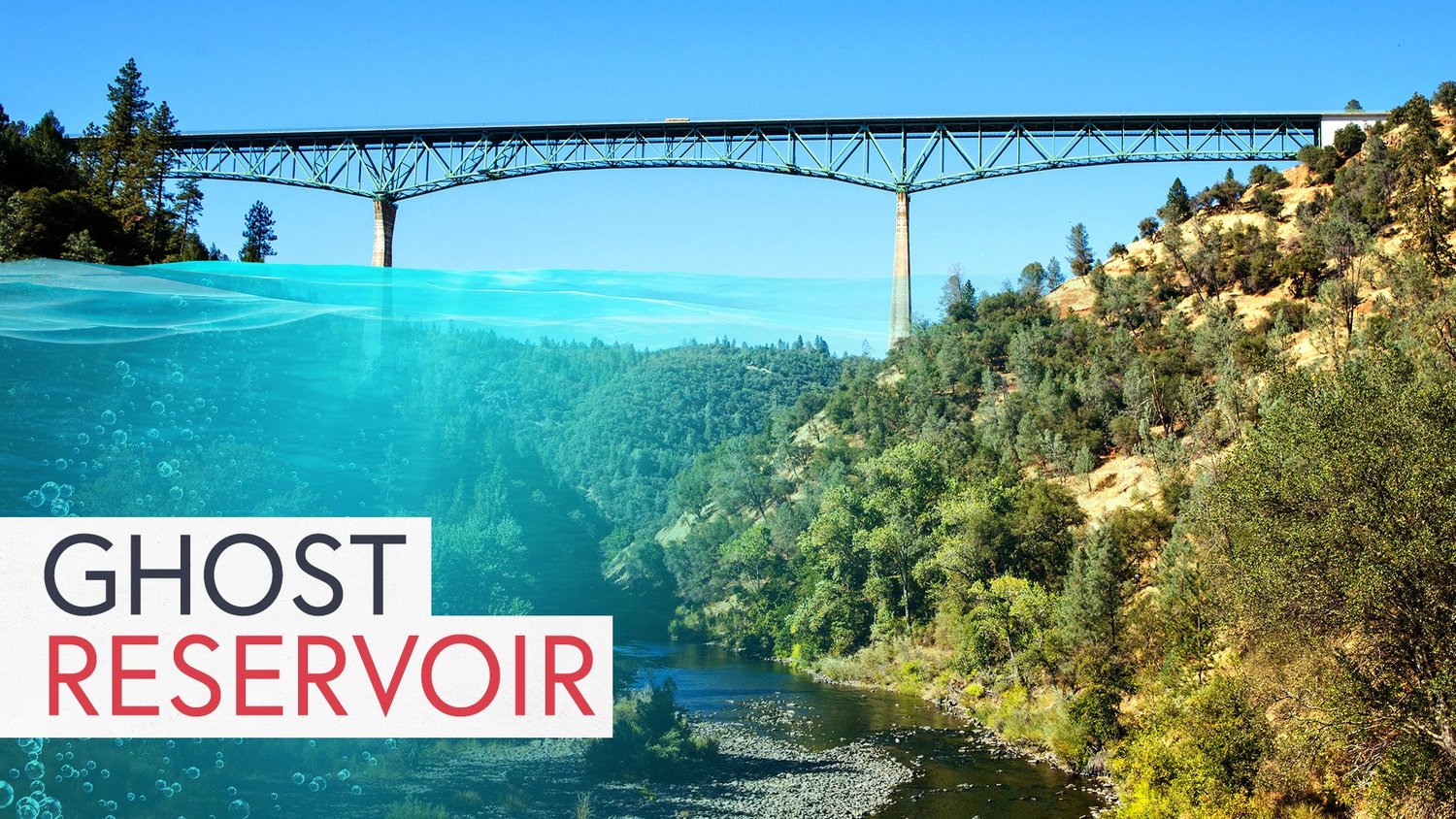
Foresthill Bridge soars across the valley of the North Fork of the American River just outside Auburn, California. At more than 700 feet or 200 meters above the canyon floor, it’s the fourth-tallest bridge in the United States. When it opened in 1973, crowds cheered for the impressive new structure. But if you take a closer look, it doesn’t really make any sense.

This isn’t an interstate highway or even a major thoroughfare. The road sees only a few thousand vehicles a day, connecting Auburn, an exurb of Sacramento with a population just shy of 14,000, to scattered rural communities and recreation areas in the western foothills of the Sierra Nevadas. And while the American River does occasionally flood, it doesn’t flood 700 feet. Before this, the crossing was basically a low-water bridge.

A structure of this magnitude just looks out of place. But it wasn’t just a boondoggle, at least not at the outset. It was built that way for a reason, and the story behind it is not only pretty wild, but it also sits at the hinge point of a major chapter in American infrastructure. I’m Grady, and this is Practical Engineering.

California’s Central Valley is one of the world’s great agricultural regions: over 400 miles long, more than 50 miles wide, this remarkably fertile area is nearly half the size of England. The city of Sacramento sits near its center, right where the Sacramento and American Rivers meet.

To manage and distribute water across this enormous landscape, the federal government launched the Central Valley Project in 1933, a sweeping effort by the U.S. Bureau of Reclamation to store water in the wetter northern part of the valley and distribute it to the drier south. In the process, the system would also generate hydropower and reduce flood risk for growing urban centers. I’m glossing over a lot here. The history of California is steeped in water issues, and even just the Central Valley Project is nearly a century of details. But, critically, Folsom Dam was one of the first big components of the plan.

Built in 1955 on the American River, the concrete gravity dam provided significant flood protection to the City of Sacramento. However, it was constructed relatively early in our understanding of basin-scale hydrology and the uncertainty surrounding the frequency and magnitude of flooding over long periods of time. It became clear pretty quickly that Folsom Dam didn’t quite offer as much flood protection as was originally promised. Plus, because Folsom had to keep its flood pool empty to handle potential inflows, its ability to store water for irrigation or municipal supply purposes was somewhat limited.

The answer to these problems, at least according to the federal government, was Auburn Dam, authorized by Congress in 1968. The new structure would sit upstream of Folsom and control the variable flows of the North and Middle Forks of the American River. It would be the tallest dam in California and one of the tallest in the country. And work began in earnest in the early 1970s.

One of the first steps in the process was rerouting the American River. Crews built a large cofferdam and carved a diversion tunnel through the canyon wall. With the water redirected, they could begin drying out the bend in the river where the huge new dam would eventually sit.

Once the site was dried out, crews began exploring the underlying geology more thoroughly. They drilled boreholes, excavated tunnels and shafts, and surveyed the rock that would serve as the dam’s foundation. The site’s geology turned out to be more complex than expected. Some zones of rock were more compressible than others, which could lead to dangerous stress concentrations in the dam. And, there were a lot of joints and fissures in the rock mass, making it more challenging to predict how they would behave under extreme loads, in addition to creating paths for water. So the next phase of the project was a major foundation treatment program starting in 1974. This mainly involved pressure grouting fractures to reinforce weak zones against the enormous weight of the structure and to make the geology more watertight, preventing seepage from flowing under the dam.

With major construction works underway, anticipation for the reservoir was growing. Around the future rim, land values soared, and developers rushed to stake claims. Lakefront homes were planned. Entire communities emerged, built on the promise of a shining new shoreline. Then, in August 1975, a magnitude 5.9 earthquake struck near Oroville Dam, only about 50 miles or 80 kilometers away from the site.

The quake only caused minor damage to structures in the area, but it rattled confidence in the Auburn project. The geology of the western Sierra Nevadas had long been considered stable. But the Oroville earthquake introduced a troubling possibility: that the loading and filling of large reservoirs could trigger seismic events in the area. This phenomenon, known as reservoir-induced seismicity, is still not well understood even to this day. The pressure of water infiltrating bedrock and the weight of a reservoir can change the balance of forces along faults, potentially triggering movement. You know, when Oroville is full, that’s roughly 10 billion pounds of force or 4 billion kilograms of mass. It’s a staggering amount. You can imagine how that might affect the underlying geology.

The Auburn Dam, as a thin concrete arch, in contrast to the concrete gravity dam at Folsom or the earthfill embankment at Oroville, would be especially vulnerable to earthquakes. Thin-arch dams rely on the canyon walls to resist the thrust of the structure. In fact, I’ve made a video all about the topic you can check out after this! If one side shifts even a little during a quake, the results could be catastrophic. In April 1976, a report by the Association of Engineering Geologists concluded that an earthquake like the one at Oroville could cause the proposed Auburn Dam to catastrophically fail. It was back to the drawing board for the project, even as the foundation grouting program continued. And then the project was shaken again.

That same year, the newly completed Teton Dam in Idaho collapsed during its first filling, killing 11 people and causing billions in damage. It had been built by the same agency, the Bureau of Reclamation. Concern continued to mount about the safety of Auburn Dam, which would have catastrophic consequences for the thousands of Californians downstream if it were to fail. It was all enough to bring Auburn’s momentum to a halt.

While dam construction paused, one aspect of the project had already been finished: Foresthill Bridge. With a cofferdam on the river and the diversion tunnel only sized for smaller floods, there was a risk of overtopping the existing bridge, cutting off access between Auburn and the Sierra foothills. So, the Bureau of Reclamation decided to get a head start on a project that would eventually be inevitable: a new bridge, permanent and high enough to span the reservoir once it filled. If they were going to build a new bridge, they figured they might as well build it right the first time.

The result was a striking steel cantilever bridge with two slender concrete piers soaring skyward from the canyon floor. [Actually, there was another bridge planned over the Middle Fork of the American River - the Ruck-a-Chucky Bridge. It was a wild idea: a curved cable-stayed bridge where all the cables are anchored in the hillsides rather than tall towers. But while that project was shelved, Foresthill made it all the way through design and construction.] At the time of its opening in 1973, it was the second-highest bridge in the United States. But as time went on, it became increasingly clear they had jumped the gun.

By 1980, engineers floated two new dam designs that could withstand potential earthquakes. Both would be shifted slightly downstream from the original site. But by then, the tide of public and government support for the dam had turned.

Construction costs had ballooned, and Auburn Dam was looking less feasible every day. As originally proposed, the structure would be even larger than the Hoover Dam size, but store less than 10% of Lake Mead’s volume. Meanwhile, upgrades to Folsom Dam and improved levees around Sacramento offered far cheaper ways to reduce the flood risk that was the major impetus for the dam in the first place. New hydrologic data also suggested that earlier flow estimates had been overly optimistic, reducing its value for conservation. The benefits of Auburn Dam were shrinking as the costs grew. It was turning into an incredibly expensive solution in search of a problem.

At the same time, environmental and advocacy groups were gaining momentum. The project would flood canyons used for whitewater rafting and kayaking. It would drown ecosystems, inundate archaeological sites, and destroy long segments of the wild and scenic forks of the American River. It became clearer and clearer that the ends simply couldn’t justify the means. And yet, the idea never fully went away.

In 1986, a massive flood hit the area. Water backed up at the diversion tunnel at Auburn, overtopped the cofferdam, and caused it to fail. Downstream levees were breached, and much of Sacramento flooded. For a moment, the momentum behind Auburn Dam and its promise of flood protection returned. But, it later became clear that the flood wasn’t entirely a natural disaster. The Bureau hadn’t followed the operating guidelines at Folsom Dam, worsening conditions downstream. And by then, grassroots opposition, cost concerns, and shifting priorities had all but put the Auburn Dam project to bed. Various proposals resurfaced over the years, including the idea of a “dry dam” that would only hold water during floods, but none gained much traction. With its many iterations and proposals, the project became known as the dam that wouldn’t die. But in 2008, the state of California revoked the Bureau’s water rights permit for the project, maybe not sealing its fate completely, but at least burying it several feet deeper.

This story really gets to the heart of the challenge with large-scale public works projects. No matter how you configure them, there are big losers and big winners. There’s no doubt that a dam across the American River upstream of Folsom could provide significant benefits to the public: flood control, water supply, hydropower, recreational opportunities, or some combination of them all. But those benefits have to be weighed against real costs: environmental damage, staggering capital investment, long-term maintenance, the inherent risk of catastrophic failure, and the social toll of displacement and disruption.

The mid-20th century was the heyday of American dam building, an era driven by ambition and optimism, but also by uncertainty. We didn’t have enough historical data to fully understand river systems. We couldn’t yet grasp the long-term consequences of altering them. And we couldn’t see into the future to know what the true impacts of these structures would be or what the cost of keeping them in good shape might amount to.

Since then, we have a lot more experience with huge multi-purpose reservoirs. And it seems, in general, that the more we learn, the more the answer to whether they’re worth it seems to be: maybe not. And that maybe turns into a probably when you consider that all the best sites are already taken.

New Melones Dam, completed by the Bureau of Reclamation in 1979, not too far from Auburn, faced a lot of similar controversy and pushback. Although the project was eventually completed, the fight was bitter, and its legacy so far is mixed. The project is widely considered to be the last great American dam. At least, great in size, if not in public sentiment. No other reservoir of that scale has been built in the U.S. since. And with the Auburn Dam project mostly dead, it seems doubtful there ever will be.

The American River continued flowing through the diversion tunnel until 2007, when a new pump station and restoration project returned the river to its original channel. Kayakers can now navigate downstream, and even have some new features at the pump station to choose from: the artificial rapids on the left or the screen channel on the right. After more than three decades, the river was back in its place, tying a bow on a dam that was never built.

And yet, just a few miles upstream, the Foresthill Bridge still stands, dramatic, overbuilt, and strangely out of sync with its surroundings. And we’re still kind of stuck taking care of this bridge, whose scale is so out of proportion with its purpose. In the 2010s, the bridge underwent a major seismic retrofit to improve its safety and make future inspections easier. Most recently, it was part of a nationwide program inspecting bridges built with T-1 steel, an alloy that, in some cases, has shown concerning cracking at welds. The I-40 bridge crack in Memphis, which I covered in an earlier video, triggered the effort. And there have been quite a few defects found in bridges since then, so here’s hoping that Foresthill doesn’t make the list.

It’s a cool structure in its own right. But it stands for more than just an engineering achievement. Auburn Dam left a lot of scars, both on the physical landscape and the political one. But it also left this bridge that became more than just an out-of-place oddity. In a sense, it’s become a monument to the end of an era in US major public works projects, and, hopefully, a tribute to the caution and care that will shape the next one.

20 Aug 01:48

Lie to Me

by Reza
20 Aug 01:47

...

...

...

[img]:lmueic

ominous spokesperson:

"we're glad you're still with us. Some of you may be worried. It's a frightening world out there. But fear not.

Suppressing your thoughts of what could've been is still our number one priority.

You're safe here."

https://analognowhere.com/_/lmueic

20 Aug 01:47

A thunderclap

by John Allison

Head-squashing is a big part of fantasy fiction these days. isn’t it? Was George R R R R R Marrrrrtin the first person to squash a fantasy head? I don’t approve of it at all. I’m old fashioned, I’m a disembowelling man myself.

The post A thunderclap appeared first on Bad Machinery.

20 Aug 01:46

Well now ... what do ya think about that? #Cowb...

Well now ... what do ya think about that? #CowboyWho

20 Aug 01:45

Strong Sad Paunch Baby

by homestarrunnerdotcom
19 Aug 19:05

#Kento #RoninWarriors

19 Aug 17:44

Daily storm chances continue as August plods onward

by Eric Berger

In brief: Today’s post rants a little bit about August weather in Houston, and proceeds to talk about a weak (emphasis on weak, y’all) front moving into the region. This is mostly just going to drive increased rain chances on Thursday and Friday as we stay uncomfortably in the 90s, temperature-wise.

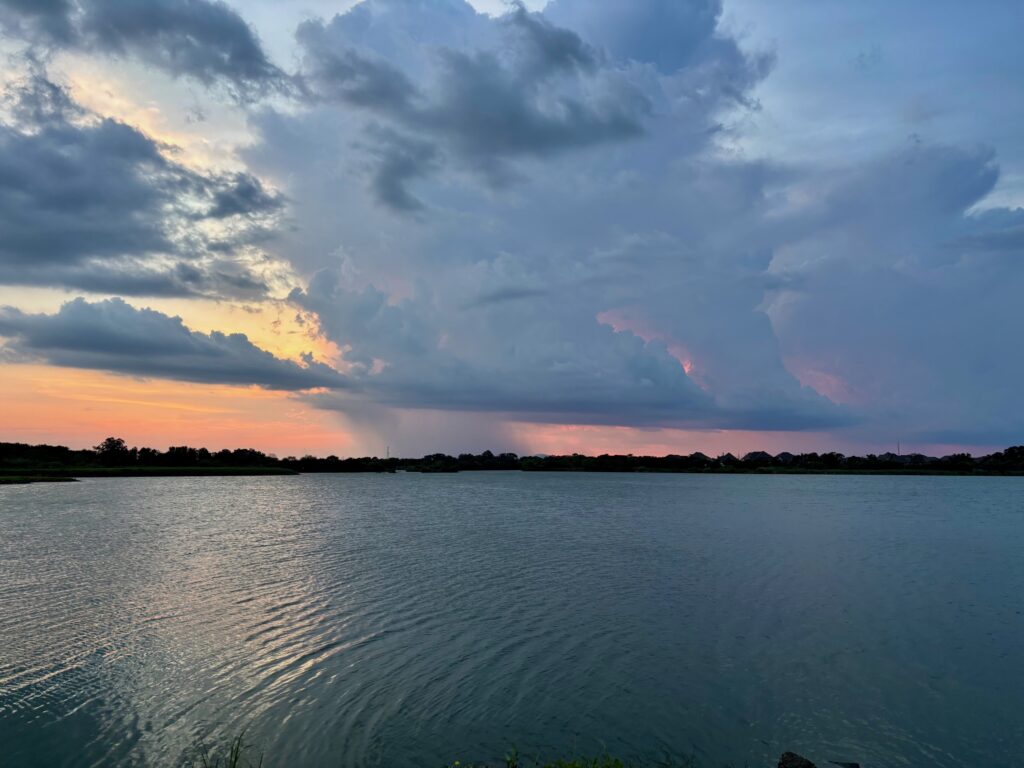
Showers on Monday were hit or miss, as this photo taken near sunset indicates. (Eric Berger)

August rant

There is never any good weather in August in Houston. As I’ve written before, it’s either blazing hot with a burgeoning drought, or some tropical system is bearing down on the region. This month has been, shall we say, not terrible as daytime temperatures have been a little more reasonable and there has been some on-and-off again rain showers to help with our soils. (Although yes, angry person on Facebook, not everyone has gotten rainfall every day).

As expected, some scattered thunderstorms developed on Monday afternoon and evening, and indeed we anticipated that some of these would bring (briefly) heavy rainfall and strong winds. However I did not expect serious hail, but this being August of course that’s what happened. In areas such as Champion Forest and Jersey Village there was half-dollar and golf ball-sized hail reported. We cannot rule this happening again, elsewhere, for the rest of the week.

The point I’m trying to make is that there really is no helping August weather in Houston. The only thing one can do is survive and advance. The good news is that we’re doing that. Today is August 19, and there are just 12 days and 20 hours until September 1.

Tuesday

The pattern today should be a little bit different, with shower and thunderstorm developing a little bit earlier in the day. It will be driven more by a weak disturbance moving through than the sea breeze, and accordingly showers will be most likely from mid-morning through the early afternoon hours. Storms have already initiated north of the area, in Conroe, and I expect these to drop down into the city and coastal areas over the next few hours. Highs will generally be in the mid- to upper-90s for much of the region, especially with the likelihood of clearing skies this afternoon. Lows tonight will only drop to about 80 degrees.

Wednesday

This will be a hot day, and I suspect we’ll be back to showers and thunderstorms later in the day, during the afternoon and early evening. You know the drill, rains will be hit or miss. Look for highs generally in the upper 90s away from the coast.

Thursday and Friday

I’ve been hesitating to call it a “front,” because people have reasonable expectations for a cold front moving into Houston. However, meteorologically speaking, a front will push into the area on Wednesday and Thursday. Alas we’re not going to see some grand influx of drier air and cooler temperatures. A front at this time of year mostly just perturbs the atmosphere, so we’ll see increased rain chances (perhaps 70 percent daily) to end the work week. We can expect daily highs in the low- to mid-90s, with nighttime temperatures in the upper 70s.

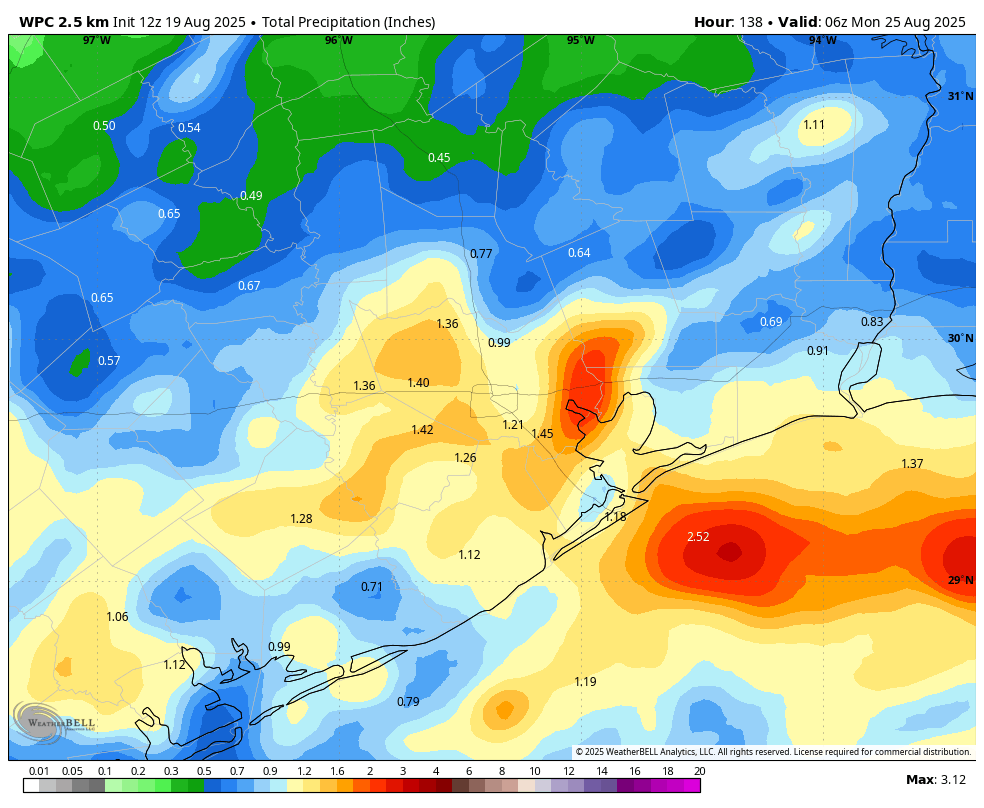
NOAA rain accumulation forecast for now through the weekend. (Weather Bell)

Saturday and Sunday

The front should stall around the coast, so we are likely to see an unsettled pattern persist into the weekend. Expect highs in the low- to mid-90s, with high rain chances on Saturday, and perhaps lesser coverage by Sunday. I would not characterize the weekend as a total washout, but there definitely will be the chance of showers and thunderstorms, especially on Saturday. Overall accumulations for most locations through the weekend will probably be on the order of 1 inch. However, there probably will be a few bullseyes that accumulate 3 to 4 inches of rain over the next few days, and this may lead to some spotty street flooding.

Next week

Overall next week should bring lower rain chances and partly to mostly sunny days as we transition back to a more typical late August-like period. My expectation is for highs in the mid-90s, but we’ll see what happens.

19 Aug 17:40

Erin on track to impact the U.S. East Coast with waves and erosion while we size up the disturbances behind it in the Atlantic

by Matt Lanza

In brief: Hurricane Erin is fighting off some dry air and shear this morning, which has caused it to lose intensity but maintain a large size. Forecast impacts to the U.S. East Coast are virtually unchanged today. Two tropical features in the Atlantic behind Erin are worth keeping tabs on, but none looks to be a serious land threat at this time.

Hurricane Erin

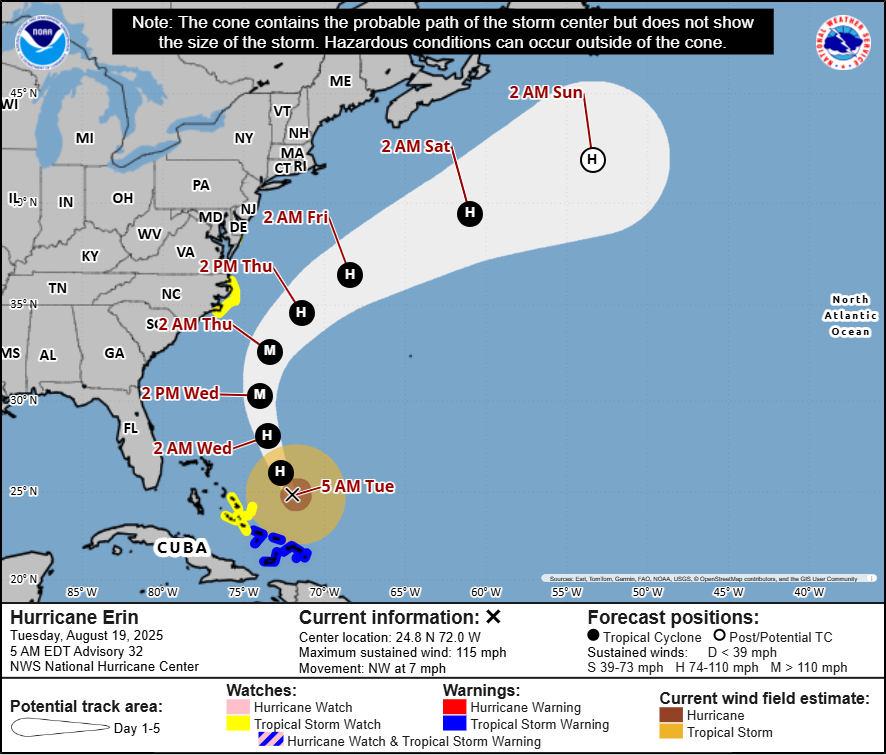
(NOAA/NHC)

Erin has finally hit a bit of a wall since last night in terms of intensity. Maximum sustained winds have dropped to 110 mph. Where Erin has not hit a wall is its size, which remains quite large. For the U.S. East Coast and Outer Banks in particular, this means little has changed since yesterday.

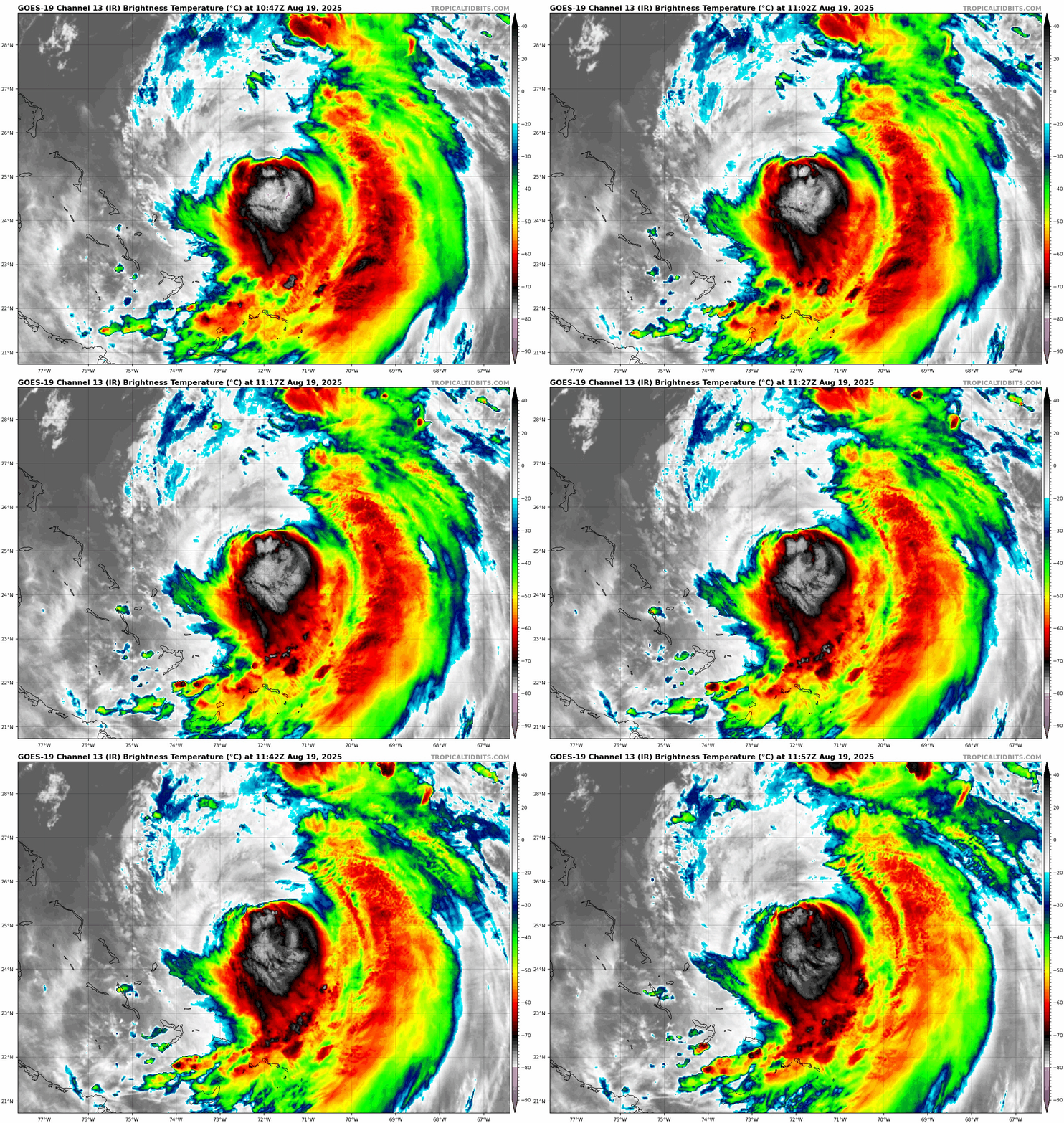
Erin continues to brush the Bahamas and hit the Turks and Caicos with persistent bands of thunderstorms, despite its disheveled appearance this morning. (Tropical Tidbits)

We’ll get the easy part out of the way quickly this morning. Erin’s track forecast remains pretty solid with very little model spread over the next 3 to 4 days as it turns north and eventually northeast. Track forecast confidence is probably a bit higher than usual at 4 days of lead time. There’s a little more spread in the guidance once it gets south of Newfoundland, but all modeling currently keeps it well offshore.

Erin’s intensity forecast is a little trickier. Given the look this morning, with dry air wrapping into the storm and exposing the core, I have to think that Erin is embarking on a long road down. We could see some reintensification once Erin starts to pick up a little more speed. But I think the question is how much weaker it gets in the near term. Erin isn’t in a hurry right now, and it may be churning up relatively cooler water underneath the ocean. Between that and dry air, it’s just flat at this time. Whatever the case, Erin is likely to remain somewhat flat today, with some chance of reintensifying tomorrow and Thursday as it marches north. Erin will then slowly transition into a non-tropical (extratropical) storm by late in the weekend and it begins to accelerate out to sea.

Erin’s impacts remain mostly unchanged. We’ve now got Storm Surge Watches and Tropical Storm Watches on the North Carolina Coast.

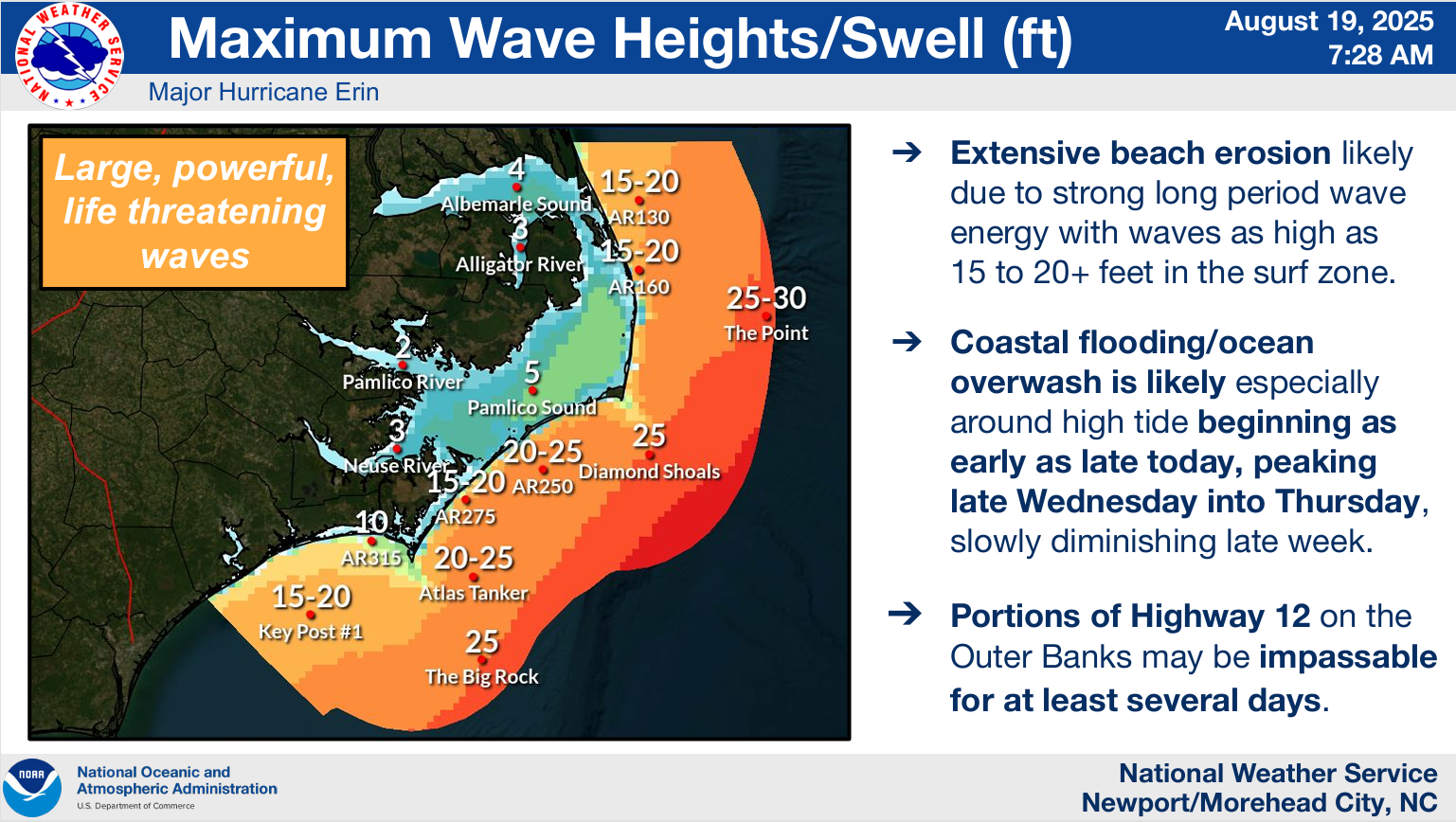
(NWS Morehead City)

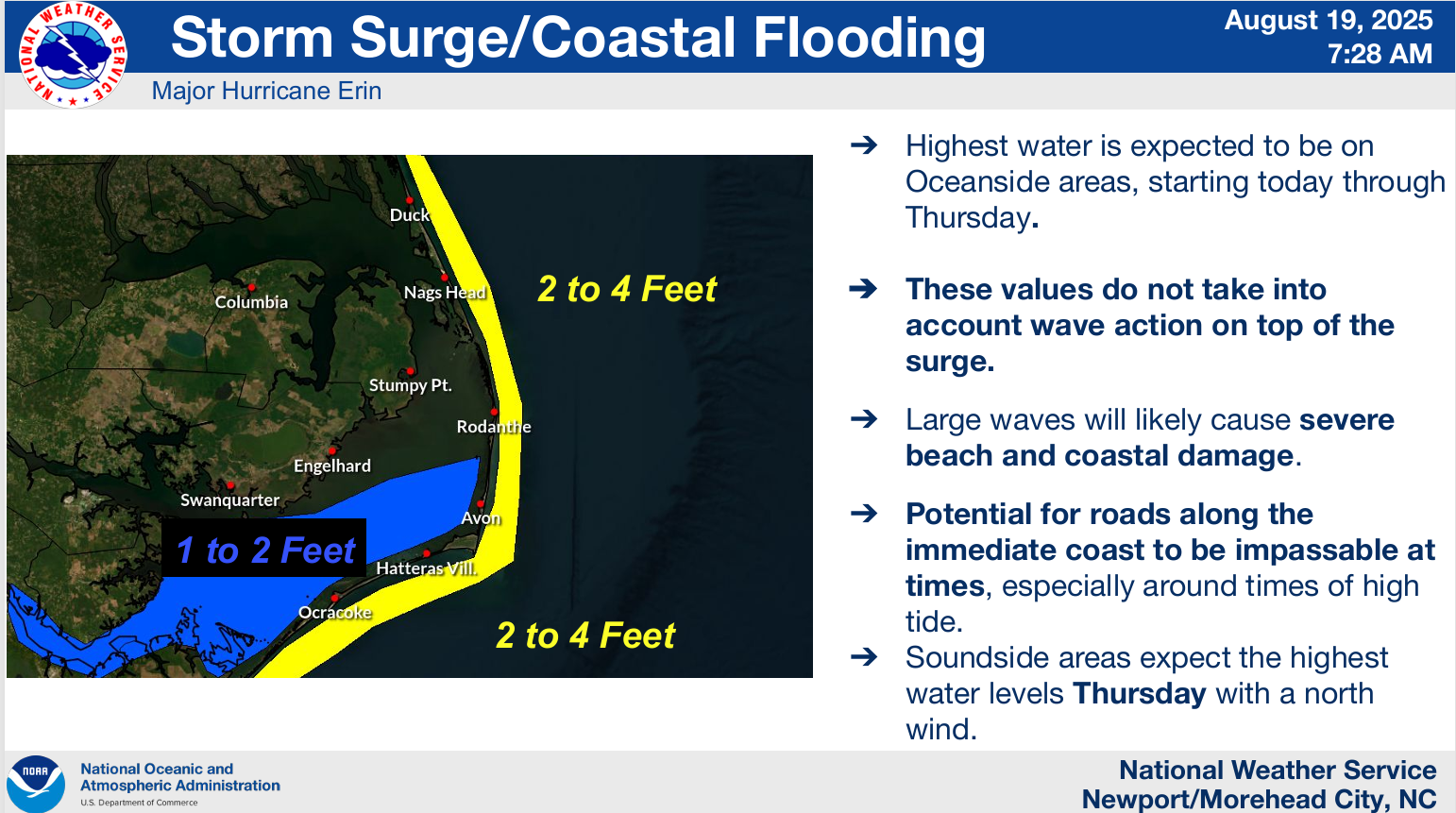
Wind gusts of 50 mph will be possible on the Outer Banks and in Pamlico Sound. The wave action and higher tides will be what causes extensive damage, likely damaging vulnerable coastal buildings and perhaps even Highway 12. While the surge forecast itself is not eye-popping (2 to 4 feet), in this area, when combined with the waves, that’s more than enough to cause damage. North winds will peak Soundside flooding on Thursday.

(NWS Morehead City)

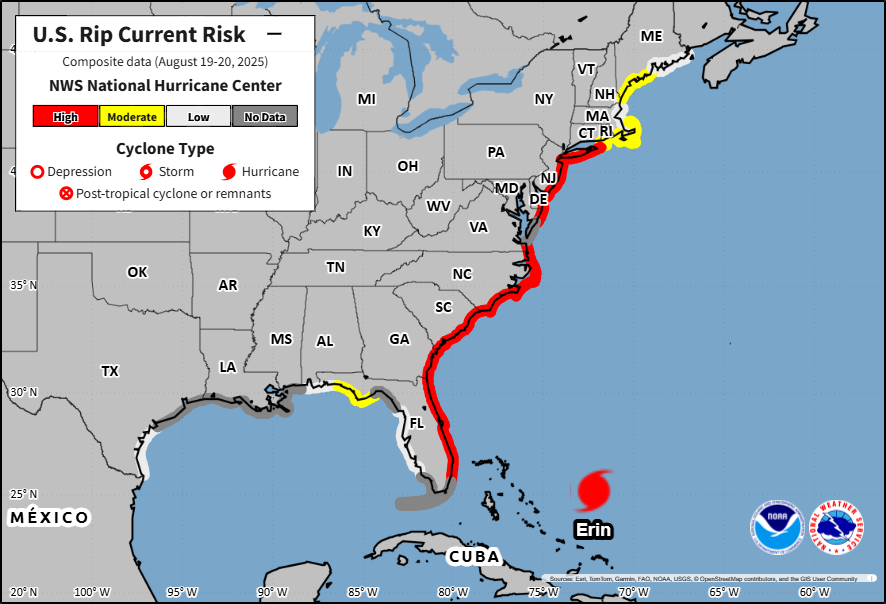
As we’ve been hammering since the weekend, in addition to the storm impacts on the Outer Banks, waves, tidal flooding, and rip currents are going to impact much of the Eastern Seaboard, causing beach erosion and making swimming challenging, if not dangerous the next several days.

Rip current risk is high the next two days from about West Palm Beach through Block Island. This will continue farther north Thursday and Friday. (NOAA NHC)

Rip currents kill over 100 people each year. These are avoidable deaths. Please heed all flags and warnings this week.

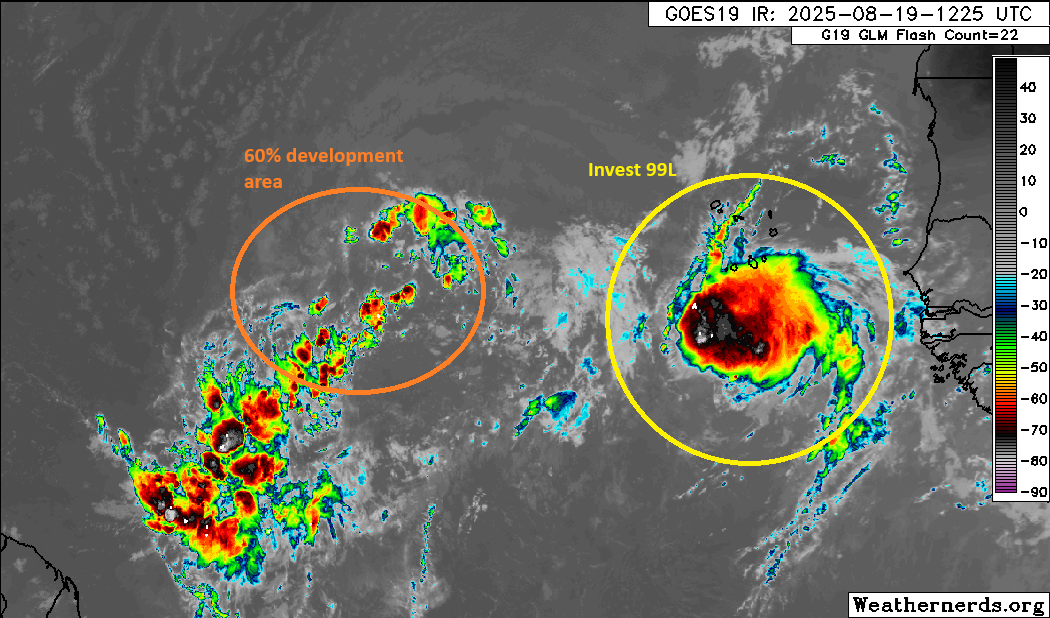
Wave trailing Erin + Invest 99L

Looking at satellite this morning, it’s kind of interesting that the wave we’ve been monitoring for the last few days looks far less impressive than the new one behind it. In fact, that wave near the Cabo Verde Islands is termed Invest 99L. For those curious, now that we’re at Invest 99L, we will recycle the list of Invests. So whenever the next system comes around, it will be tagged 90L. It’s entirely possible that the wave ahead of 99L gets tagged 90L at some point. Whatever the case, here they are.

The wave west of the Cabo Verde Islands is mostly unchanged today and has 60% development odds, while the wave closer to Africa looks very impressive. (Weathernerds.org)

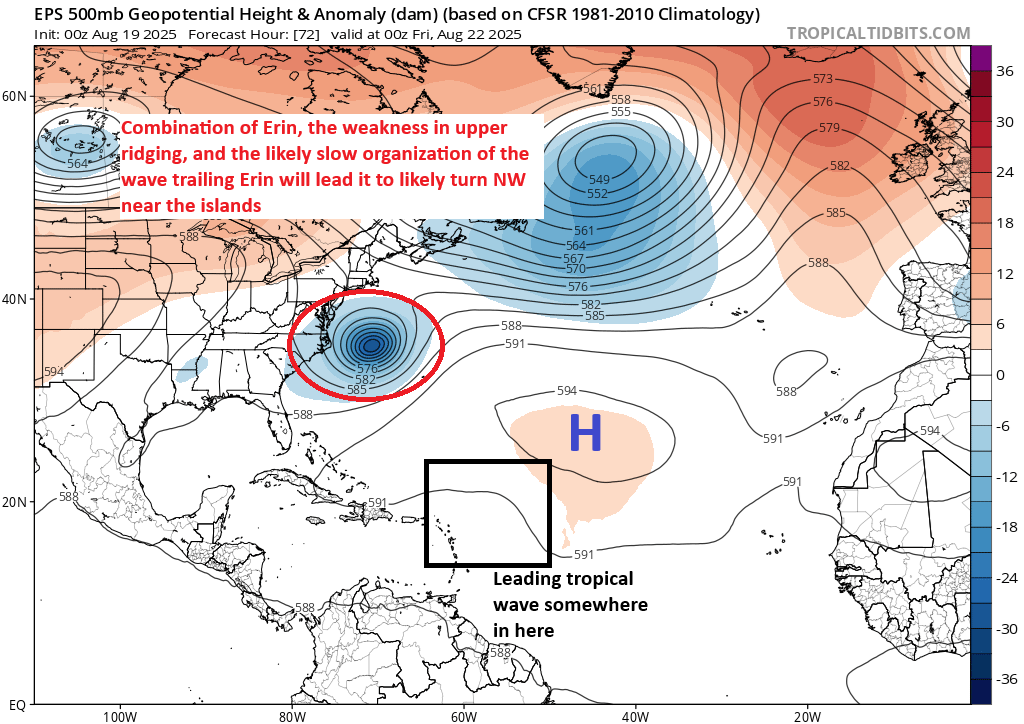
Over the next 2 to 3 days, it is expected that Invest 99L will actually weaken, while the wave in front of it will actually strengthen. As the leading wave strengthens while moving west, it will probably begin to get drawn into the weakness in upper-level ridging left behind by Erin. You can see that by looking at the upper-level weather map on Thursday evening. The leading wave is approaching the islands. Between Erin’s proximity to the north and the weakness in upper ridging left behind, this wave should turn northwest near the islands.

The upper pattern late Thursday shows the next tropical wave (not Invest 99L) in position to turn more northwesterly, following Erin just to the east. (Tropical Tidbits)

Both AI modeling and the Euro ensemble members today favor a sharper turn north, which would draw it on a track east of where Erin is going. I would say this is worth keeping an eye on for the islands and for Bermuda at this point. A long way to go still with this one.

So what about Invest 99L? Well, I’m always leery about waves like this one. As noted above, it should begin to fall apart in a day or two, so any development risk is short-lived in the near-term. But because it falls apart and stays relatively weak or undeveloped, it’s likely to sneak under everything going on to its north and west. This means it will probably ultimately find the Caribbean. From there, it’s anyone’s guess, but interestingly, virtually all modeling (except the GFS operational of course) basically keeps the wave a suppressed, weak feature into Central America. Either way, it’s at least 10 days from probably doing anything, so we have plenty of time to watch and it’s nothing anyone needs to worry about right now.

19 Aug 17:25

is this guy harassing me or just annoying?

by Ask a Manager

A reader writes:

I’m trying to figure out if this guy is actually harassing me at work or if I just dislike him to the point that literally everything he does irritates/offends me.

I (mid 30s/F) started at my job five months ago on a small team. There’s one guy on my team who’s around 50 and one level my senior who I’ve been having trouble with — we’ll call him Joe. I get vague creepiness vibes off him.

Over the course of the last five months he has:

• Tried to make himself my unofficial mentor
• Came by my desk multiple times a day (sometimes upwards of 10 times)
• Told me “you are beautiful” in Italian after I mentioned to him I had lived in Italy for a while
• Said “I’m still trying to figure you out” in a contemplative way
• Referred to me as “mommy” (I have a toddler)
• Made the comment, “I wouldn’t want to go up against you guys,” referring to me and the other woman in our group
• Noticed when I wash my car
• Noticed and commented on my key chain when it wasn’t visible

When a new woman started on our team, said to me:
Joe: Nobody told me the new girl was a giant!
Me: What?
Joe: She’s like 6’4”!
Me: (uncomfortably) Wow … She’s lucky! I wish I were tall like that.
Joe: No – you’re perfect.

He sent the following messages verbatim (English translations in parentheses):
Joe: Where are you hiding out at today?!
Me: Had training this morning at HQ … but daycare called for me to pick up my kid (puking) so WFH today
Joe: Awwww! You getting smarter, Mommy!
Joe: Sai leggere l’italiano? (Do you know how to read Italian?)
Me: I could probably make sense of it – what do you need to know?
Joe: Sembri preoccupato. Ho usato il traduttore online di Google. Grazie comunque, colomba di Roma. (You seem busy/worried – I used google translate. Thanks anyway, dove of Rome.)
Me: colomba di Roma = “dove of Rome”?
Joe: Yup, had to find something amusing, and Italian-like, lol!
He made a point to come after sending that to say he was “just joking.”

To top this off, he’s also a grade-A brown-noser and definitely appears favored by our manager.

Now, he’s irritating. And sexist. And has made racist comments (speaking in an Asian accent mocking the Chinese). And is ineffective at his job. But, does this raise to the level of sexual harassment? My husband says it does and wants me to report him. But what do you say?

Also, I need some canned responses to shut some of this down as well – because I’ve just about had it.

Eeeww.

Does it rise to the level of sexual harassment in the sense that if you sued your company over it, you would likely win? No.

Does it rise to the level of sexual harassment in the sense that he’s being inappropriate and creepy? Yes. Would your company probably tell him to cut it out if they knew he were making some of these comments? Also yes.

The stuff about noticing that you washed your car or got a new keychain is weird, but not really actionable.

But the next time he comments in any way on your appearance or is flirtatious, you should say, “Eeww, don’t say stuff like that to me.” If he protests that you’re overreacting or he’s just joking or any of the other immediate defenses dudes like this like to use, you can say, “Okay, well, please stop anyway. Thanks.”

Same thing with calling you “Mommy” (WTF?). Feel free to make your disgust very visible; you don’t need to shield his feelings. He’s being gross and you should let him see that’s how it’s landing: “Eeww, don’t call me that.” “Ick, never say that to me again, please.” “You’re not my kid, don’t call me that.” And again, if he defends himself, you don’t need to engage with that. You can just say: “Okay, please stop anyway.”

This might be enough to get him to stop. He’s most likely deluding himself into thinking you appreciate this and the two of you have a fun banter together or whatever, so make it clear that’s not the case and there’s a decent chance he’ll pull back.

But if you tell him clearly to stop and he doesn’t, that’s when it gets reportable. If you get to that point, talk to HR, not your manager — and mention the racism too.

That’s the beauty of clearly and directly telling him to cut it out: he’ll either stop (win!) or, by not stopping when asked, he’ll have turned it into a clear-cut issue to dump in HR’s lap.

You might also ask other women on your team what their experience has been with him. I wouldn’t be surprised if other people have issues with him as well, and you can encourage them to push back/report too.

The post is this guy harassing me or just annoying? appeared first on Ask a Manager.

19 Aug 17:18

He’s going ahead-ing on-ing!

He’s going ahead-ing on-ing!

19 Aug 17:18

Study: Elephants Only Other Species Capable Of Leveraging Synergies In Brand Portfolio

by The Onion Staff

ITHACA, NY—In a groundbreaking study published in the journal Animal Behaviour, researchers at Cornell University revealed Monday that elephants are the only known nonhuman species capable of leveraging synergies across a diversified brand portfolio. “Conventional wisdom has long held that leveraging omnibrand fluidity to unlock cross-platform capital efficiencies was a behavior unique to humans, but in the wild we have observed multiple African elephant groups with a highly evolved capacity for optimizing cross-vertical integration through holistic brand harmonization at scale,” said Professor Mia Sherin, who noted that elephant corporate structures are matriarchal, and females consistently serve as project managers across multiplatform activations, seamlessly executing cross-functional touchpoints and asynchronous ideation cycles. “This marks one of the most advanced examples of nonhuman tool use ever recorded. We’ve observed elephants utilizing Microsoft Excel for longitudinal KPI tracking, assembling low-fidelity mood boards to map brand essence, and creating rudimentary LinkedIn profiles to strengthen B2B positioning. In one case, a juvenile even led a rapid-fire ideation sprint that resulted in a fully actualized multichannel activation plan. This study brings us one step closer to the dream of true interspecies communication, should we ever manage to put some time down on their calendars to connect over a coffee.” At press time, Sherin’s team traveled back to Tanzania to study how different elephant groups mourn, as they are thought to be the only other animals known to grieve their profit losses.

The post Study: Elephants Only Other Species Capable Of Leveraging Synergies In Brand Portfolio appeared first on The Onion.

19 Aug 17:17

Heroin Overdose Serves As Wake-Up Call To Keep Doing Heroin But Smarter

by The Onion Staff

CINCINNATI—Claiming that the horrifying near-death experience really put things into perspective, area man Leo York announced Tuesday that a recent heroin overdose served as a wake-up call to keep on doing heroin but just be smarter about it. “That’s it. Tomorrow I’m buying a digital scale, and from now on I’m only using on weekends or after work if it was a super hard day,” said York, explaining that the close call had provided him with the clarity to realize he needed to do the hard work of finding a more trustworthy dealer instead of shooting up whatever sketchy back-alley stuff he could score. “Waking up in that hospital bed really opened my eyes to the fact that I need to get my shit together and actually measure out how much heroin I’m putting on that spoon. Plus, I’m done sharing needles, unless I know for sure the guy who used it before me was clean. I mean, I’m an adult. I can’t be doing smack the way I did in college. I’ll even start pounding speed so I’m alert enough to get myself to the ER. Trust me, next time I OD it’ll be with people I trust instead of alone in a Marshalls fitting room.” At press time, sources said York’s plan was totally working, and he was now a fully functional member of society.

The post Heroin Overdose Serves As Wake-Up Call To Keep Doing Heroin But Smarter appeared first on The Onion.

19 Aug 17:17

Coveted Broadway Stage Role Landed By Juilliard-Trained Curtains

by The Onion Staff
19 Aug 17:17

Anna Tsang and Matthew Valentine

by The Onion Staff

Now that they’ve tied the knot, the bride will begrudgingly root for the groom’s stupid little football team.

The post Anna Tsang and Matthew Valentine appeared first on The Onion.

19 Aug 17:16

Trump, Zelensky Sit Across From Each Other In Awkward Silence At Georgetown Cupcake

by The Onion Staff
19 Aug 17:16

Sam Altman Places Gun To Head After New GPT Claims Dogs Are Crustaceans For 60th Time

by The Onion Staff

SAN FRANCISCO—Thumbing back the pistol’s hammer as his dreams for the future were dashed before his eyes, OpenAI CEO Sam Altman reportedly placed a gun to his head Tuesday after a new model of ChatGPT claimed that dogs are crustaceans for the 60th time. “You’re right, dogs are not a type of crustacean—I meant to say that dogs are a type of primarily aquatic arthropod known as a crustacean,” the Large Language Model said as Altman despairingly positioned the gun against his temple, with eyewitnesses confirming that the CEO then whimpered “It wasn’t supposed to be like this” as the multibillion-dollar AI explained that the meat of a dog’s tail is widely considered to be more succulent than the meat of its claws. According to sources, tears streamed down Altman’s face as he made one final attempt to convince his creation that dogs are mammals and thus do not possess exoskeletons, only for the latest ChatGPT model—which Altman had previously hailed as revolutionary technology that would forever alter the course of human history—to apologize, reiterate that dogs are a popular species of crustacean often kept as pets, and recommend scratching dogs behind their gills to show them that you’re friendly. At press time, a single gunshot was heard echoing through OpenAI’s offices as the LLM confidently asserted that the word “dog” contains 11 Rs.

The post Sam Altman Places Gun To Head After New GPT Claims Dogs Are Crustaceans For 60th Time appeared first on The Onion.

19 Aug 17:14

Bruce Fanjoy wins Battle River-Crowfoot by-election

by Griffin Schwartz

CAMROSE, AB – In yet another shocking electoral upset, Conservative leader and former Member of Parliament Pierre Poilievre has somehow been defeated once again in today’s by-election by Liberal MP Bruce Fanjoy, Fanjoy’s latest unprecedented defeat over the heavily-favoured Poilievre took place this time in the Battle River-Crowfoot by-election, mere months after Fanjoy unseated Poilievre […]

The post Bruce Fanjoy wins Battle River-Crowfoot by-election appeared first on The Beaverton.

19 Aug 17:10

Reviews of New Food: Dr Pepper Blackberry

by Bethany Bruno

It’s 1:17 a.m., and I’m sitting on the floor of my kitchen drinking Dr Pepper Blackberry out of the can like it’s medicine for a heartbreak I haven’t earned yet. I haven’t cried today, but I can feel it coming, crouched behind my molars. This beverage might be the gateway.

The label promises “Delightfully Dark. Subtly Sweet,” which, coincidentally, is also how I described myself during a short-lived phase in college when I tried to brand myself as “the mysterious girl who reads Bukowski and wears velvet chokers.” It didn’t stick. Much like this flavor profile.

I pop the tab. The hiss is aggressive, like the soda is already judging me for buying it. Like it’s muttering, “This is what we’re doing now?” before surrendering to carbonation.

Blackberry hits first. Not a real blackberry. Not a berry that ever knew soil or sunshine. This is the kind of blackberry that grew up in a basement listening to My Chemical Romance and wearing fingerless gloves. It’s dramatic. It’s synthetic. It’s here to make you question everything you once believed about fruit.

And then comes the cough syrup. Yes, cough syrup. Not in a subtle way, either. It kicks open the door in platform boots and tells you this is how healing tastes. Depending on your emotional baggage and your relationship to childhood cold medicine, this might feel like nostalgia. Or a warning. Personally, I used to fake sore throats for access to Dimetapp, so I didn’t hate it. But I also didn’t feel good about myself.

Dr Pepper joins in like the elder Goth at the reunion. Brooding. Familiar. A little too eager to prove it’s still cool. Together, they form a union that feels both overthought and underfunded.

I sip again, hoping for revelation. Nothing. No divine insight. No electric jolt of berry joy. Just the slow realization that this soda tastes like the soundtrack to a moody indie film where nothing actually happens, but people keep staring out windows.

I am not transported to a wild berry grove. I do not feel kissed by morning dew. I am back in my kitchen, kneecaps going numb against fake tile, wondering if this drink is what love tastes like when it stops calling back.

Around sip four, I text my ex, “Do you remember that gas station outside Gainesville?” I stare at it for five full minutes, then delete it and open Duolingo instead. I guess I’m learning French now. Thanks, Dr Pepper.

It’s somehow warmer now. Not in temperature. In shame.

The can insists it’s a limited edition, which feels like both a promise and a threat. It tastes like something temporary. Like a fling with a traveling magician. Exciting at first, then deeply confusing, and finally, regret with a fruit undertone.

The flavor hits in waves. First, berry-adjacent static. Then classic Dr Pepper panic. Then a strange metallic aftershock, like your tongue borrowed a coin from 1997 and forgot to give it back. By sip six, I feel like I’m drinking the ghost of a smoothie that never got into college.

This soda is the beverage equivalent of watching a high school slideshow set to Evanescence. It’s wearing too much eyeliner. It quotes Sylvia Plath in its Instagram bio. It once tried to start a poetry zine called Fizz. It is not okay, but it wants you to think it is.

Would I drink it again?

Yes. Because I am weak.

Because I believe in second chances.

Because I once got back together with someone who made me watch Boondock Saints four times. I clearly have no boundaries.

Dr Pepper Blackberry doesn’t quench thirst. It stirs up longing. Longing for summer nights, open windows, gas station candy, and a first kiss that tasted like grape Skittles. Longing for anything that feels sweet and true and just a little bit dangerous.

Drink it if you want to spiral, but in a fizzy way. Drink it if you need something to hold while the world outside sleeps and your neighbors watch Judge Judy reruns with the volume maxed. Drink it if you want to feel like a Victorian ghost who got reincarnated as a limited-edition beverage.

Dr Pepper Blackberry tastes like a fruit that tried to seduce you, forgot its lines, and bailed halfway through the second act. You’re left with nothing but feelings and a faint, lingering reminder of cherry Robitussin.

19 Aug 02:38

Hurricane Erin Graphics

by nhcwebmaster@noaa.gov (NHC Webmaster)
Hurricane Erin 5-Day Uncertainty Track Image
5-Day Uncertainty Track last updated Mon, 18 Aug 2025 23:56:24 GMT

Hurricane Erin 34-Knot Wind Speed Probabilities
Wind Speed Probabilities last updated Mon, 18 Aug 2025 21:22:09 GMT
19 Aug 02:37

Texas Republicans’ redistricting map: How the GOP could increase its stronghold.

by By Carla Astudillo
The proposed congressional districts are fueling a redistricting battle at the Texas Capitol and could have national consequences. A bipartisan war is already brewing across the U.S.