Added this footnote just now to yesterday’s piece on MSNBC’s rebranding to “MS NOW”:
Historical pedantry: from 1975–1979, Microsoft spelled its name “Micro-Soft”, with, yes, an uppercase S. But that’s not camel-case, and that hyphenated spelling is as much a footnote to Microsoft’s brand history as the woodcut Isaac-Newton-under-a-tree logo is to Apple. Microsoft’s logo from that era was very disco-’70s and kind of cool — but while “Micro” and “Soft” were broken across two lines, there’s no hyphen in the logotype.
Lawmakers in both states are seeking to add U.S. House seats for their respective parties, after Trump, who's eager to maintain the narrow GOP majority in the House, pushed the Texas Legislature to redistrict and help Republicans in the 2026 midterm elections.
After a 15-year-old Lamar High School student was struck and injured while crossing a street near his campus, Houston Mayor John Whitmire said the city would construct a pedestrian-activated traffic signal at the intersection. The leader of a transportation advocacy group said there could be better, more cost-effective solutions.
The Trump administration said Thursday that it is reviewing more than 55 million people who have valid U.S. visas for any violations that could lead to deportation, marking a growing crackdown on foreigners who are even permitted to be in the United States.
The Aransas County courthouse was supposed to open in 2023. But officials have faced voter backlash and a constant stream of design and construction problems that have delayed the opening.
As speaker, Phelan oversaw passage of numerous conservative priorities, but he gave up the gavel under pressure from the far right over the House’s impeachment of Attorney General Ken Paxton.
I’m a public librarian, so a big part of my job is helping people do work on our public computers. This ranges from showing people how to print to more in-depth questions on software that I have to puzzle my way through. I don’t mind any of that!
I have noticed more recently in the last year, though, that people with new jobs will come in and need help filling out what is essentially new hire paperwork: tax forms, demographic info, health insurance stuff, etc., or even have video trainings to work through. Shouldn’t this be something that’s done on their first day of work? Often they have questions about these forms that I obviously can’t answer because I don’t work for that company. I don’t know for sure that people aren’t getting paid for doing these but it definitely seems like that from our patrons’ comments.
Is that legal? If not, any suggestions on what I can say to patrons to make them aware of that fact?
It’s pretty normal for employers to send new hire paperwork to people before they start and not to pay them for the time they spend filling it out … but whether or not that’s legal isn’t as clear-cut as it should be. Broadly speaking, employers do need to pay people for all time they spend on work, which includes on-boarding. But, for example, this HR publication argues that it comes down to whether you’re required to complete the paperwork before going to work (in which case it would have to be paid) or whether it’s only voluntary to do it ahead of time and you have the option of completing it on work time (in which case, they say, an employer could argue it doesn’t need to be paid). On the other hand, this legal site says it all needs to be paid, voluntary or not, since the federal Fair Labor Standards Act (FLSA) requires you to be paid for all time you are “suffered or permitted” to work.
The first source also points out that the federal Fair Labor Standards Act does say that “infrequent and insignificant periods of time beyond the scheduled working hours, which cannot as a practical matter be precisely recorded for payroll purposes, may be disregarded,” so if the paperwork is quick, it could fall under the exception.
The video trainings, however, are much clearer than the paperwork question: if work-specific trainings are required to be completed before your first day, that’s work time and needs to be paid.
All that said … regardless of the law, it’s extremely common for employers to expect new hires to complete new hire paperwork on their own time. Ideally everyone would push back on that and assert their legal rights. In reality, most people aren’t going to want to start a new job that way and won’t take the risk of objecting to a practice that other new hires haven’t complained about (and which employers are often used to considering “pre-employment” and thus not paid work, although the FLSA doesn’t make that distinction).
In other words, in a culture that sees new hire paperwork as a normal activity to complete on your own time without pay — regardless of whether that should be the case — a lot of people would find it too risky to push back on, particularly for the likely small amount of money involved. So in your shoes, as someone who won’t have enough information to judge what the potential risk for any given patron could be, I’d leave it alone.
Public pools are a vital resource in the United States. We need more of them.
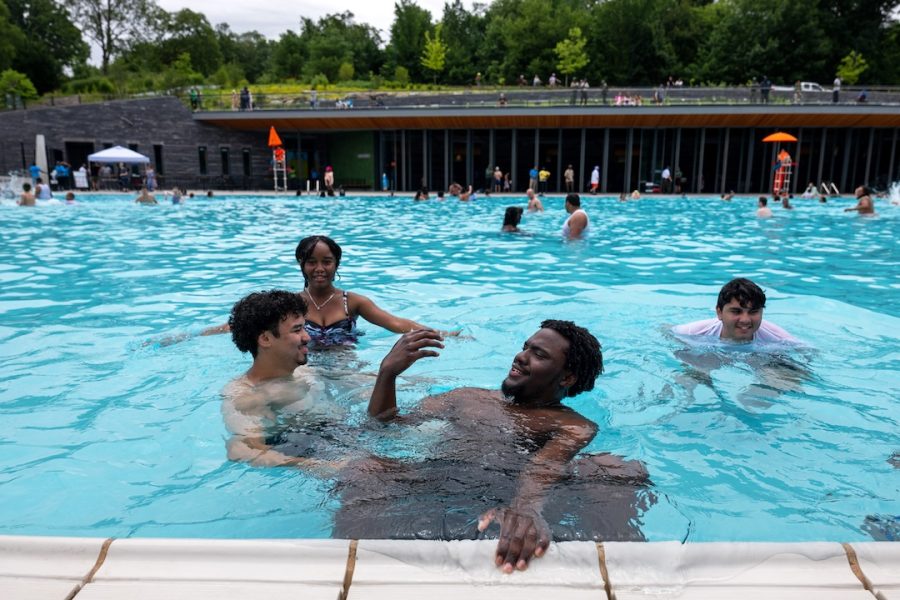
People swim in the newly opened Gottesman Pool at the Davis Center in Harlem Meer, on the first day of the summer pool season in New York City on June 27, 2025. (Spencer Platt / Getty Images)
On a sweltering Friday afternoon in Chicago earlier this month, I was in desperate search of relief from the heat. The single air-conditioning unit in my third-floor apartment bedroom was not cutting it: I needed to submerge my body in cold water, fast.
I could have hauled it over to Lake Michigan, but biking for forty minutes in more than 100 degrees was inadvisable. Luckily, just a few blocks from my apartment lay an anodyne oasis: my local public pool.
Within minutes, I walked through the open gate, threw my towel over an unclaimed lounge chair, and hopped into the deep end. My body temperature felt instantly lowered, and I felt grateful for the ability to take advantage of such a vital public good, for free, at just the moment I needed it most.
Well-run public swimming pools are municipal treasures. Beyond being spots to take a dip, they’re third places that are imbued with a social democratic promise. Since their emergence in the late nineteenth century, public pools have been sites of both leisure and struggle, where the fight for a more inclusive vision of social and civic life has played out.
Today, as the federal government mounts an all-out assault on the public sphere, and as the climate crisis creates an urgent need for more spaces to cool off, we can make a clear demand: more public pools.
The Early Pool Years
The first public pool in the United States wasn’t actually built for swimming. Boston’s Cabot Street Bath, opened in 1868, was a place for local immigrant, working-class, and poor residents to bathe alongside each other at a time when indoor plumbing remained largely confined to the homes of the wealthy. Lower-income bathers would come to the facility to wash themselves in strictly gender-segregated pools. As author Jeff Wiltse writes of Cabot Street in Contested Waters: A Social History of Swimming Pools in America, “Bathers plunged their dirty bodies into the water and rubbed their skin clean.”
Such “plunge baths” grew in popularity over the following two decades and were intended to halt the spread of diseases spreading among the urban poor such as cholera and tuberculosis. But modern germ theory wasn’t widely accepted at the time, and the pool water was rarely replenished, so these baths regularly turned into cesspools and quickly became outdated.
Nearly two decades later, in 1887, a public swimming pool opened in nearby Brookline, Massachusetts, the first of its kind meant for visitors to fraternize and beat the summer heat. By 1895, the first public swimming pool designed to be used for recreation and sports was opened in Douglass Park on Chicago’s West Side. These pools offered more sanitary conditions and regulation to protect public health.
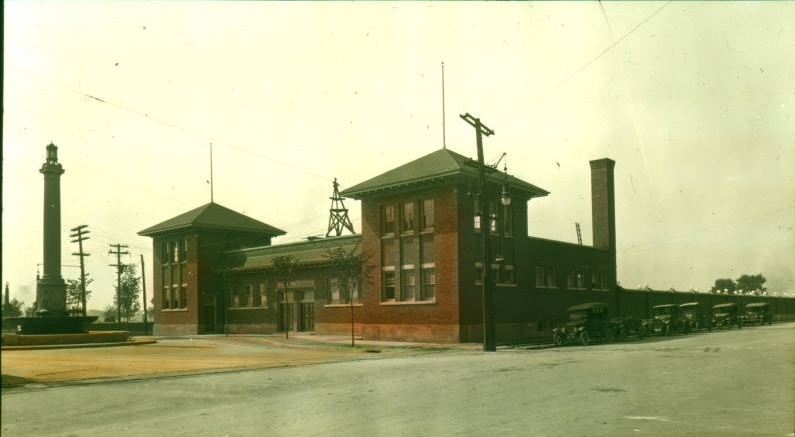
The Davenport Municipal Natatorium, photographed circa 1925. (Hostetler Studio via Upper Mississippi Valley Digital Image Archive)
By the 1920s and ’30s, the “Swimming Pool Age” had swept the country. Thousands of new public pools were installed state to state, from Davenport, Iowa’s Municipal Natatorium, the construction of which was spearheaded by a socialist mayor and city council; to Hamilton Fish Pool in New York City’s Lower East Side, which opened alongside ten other city public pools in the summer of 1936, which saw celebratory parades and water carnivals across the five boroughs.
Built during the New Deal era under President Franklin D. Roosevelt’s Works Progress Administration (WPA), this new public pool system offered an escape from the heat for working-class New Yorkers and serviced nearly two million city residents during its first year in operation. It brought with it innovations such as treated sanitized water that was changed three times daily, and architectural grandeur including Romanesque revival and Art Deco–styled designs.
McCarren Park Pool in Brooklyn’s Greenpoint neighborhood today stands as one of the remaining monuments of this era, open every summer for visitors who pass under a vaulted entryway that the New York City Parks Department describes as “reminiscent of the Karl Marx Hof housing complex in Vienna.”
McCarren Park Pool in Brooklyn, New York. (NYC Parks)
Workers employed by the WPA and Civil Works Administration (CWA) together built and repaired more than one thousand public pools in cities and towns throughout the United States over the course of the dual Depression-era projects. These landmarks of FDR’s progressive vision for government provided sites of relaxation and community for an economically struggling stratum.
As the often vilified but inarguably productive New York City Parks Commissioner Robert Moses stated in 1934, when announcing the city’s ambitious public pool construction plan that came to fruition two years later:
It is an undeniable fact that adequate opportunities for summer bathing constitute a vital recreational need of the city. It is no exaggeration to say that the health, happiness, efficiency, and orderliness of a large number of the city’s residents, especially in the summer months, are tremendously affected by the presence or absence of adequate bathing facilities.
Pools and Racism
While public pools largely moved away from gender segregation starting in the 1920s, racial discrimination played an increasingly pernicious role in the decades following the first Great Migration of African Americans to the North. In the Jim Crow South, racial segregation of pools remained law, and in Northern states, as Wiltse writes in Contested Waters, “white swimmers imposed and enforced racial segregation through violence,” both unofficially in the form of verbal harassment as well as in official policies such as only allowing swimmers of color in the pool during extremely restricted hours. This practice helped give rise to the 1944 Lopez v. Seccombe Supreme Court case, which forced the integration of public pools in San Bernardino, California. Ten years later, that ruling was cited as a legal precedent for the court’s pivotal Brown v. Board of Education decision that officially ended segregation in public schools.
Still, the 1950s and ’60s saw brutal treatment of African Americans and other people of color attempting to use the public swimming facilities they were entitled to. During this period, Sadler Beale explains in the Journal of Leisure Research, “Municipal swimming pools were literally a battleground as Blacks struggled for equal access to public amenities.”
As the civil rights movement continued to strike blows at legalized white supremacy, when it came to public pools, many whites simply abandoned the amenities rather than embrace integration. This bigotry-fueled boycott, as well as “white flight” — which saw white Americans flee cities for suburban enclaves starting in the post-WWII era, reshaping the demographic landscape — led to a massive reduction in the use of these pools. In her book The Sum of Us: What Racism Costs Everyone and How We Can Prosper Together, Heather McGhee writes that following the 1950s, “Millions of white Americans who once swam in public for free began to pay rather than swim for free with Black people; desegregation in the mid-fifties coincided with a surge in backyard pools and members-only swim clubs.”
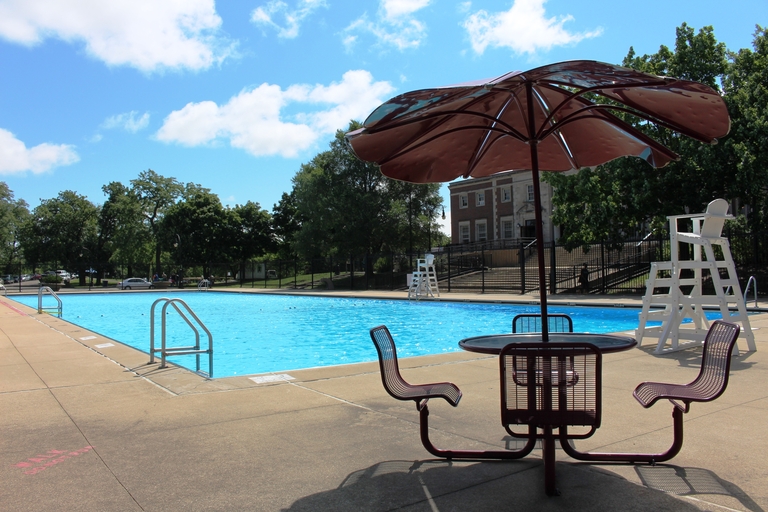
Douglass Pool in Chicago. (Chicago Park District)
The result was extreme dilapidation of the US public pool system, which led to large-scale closures. The same period saw the rapid growth of private swim clubs with exclusive membership. The country has never fully recovered from this racist desertion of public pools for their privatized counterparts, and the results have been stark: While as of last year there were more than ten million private pools across the United States, the number of public pools stood at just 309,000.
In her bookStill Drowning in Segregation: Limits of Law in Post–Civil Rights America, civil rights attorney Taunya Lovell Banks writes that “ironically, those groups for whom public swimming pools were initially created, working class and impoverished families in densely populated urban areas, are today the groups with the most limited access to swimming facilities.”
In my experience, pools are wellsprings of rejuvenation. Swimming can help extend the length of your life, and that adrenaline rush through your system when you jump into the deep end has to be good for you. Studies show that positive health effects range from avoiding the chance of heat stroke to lowering blood pressure and improving heart strength.
Summer 2025 opened with a heat dome encasing vast swaths of the United States, causing “dangerous, life-threatening” levels of heat in the triple digits — powered by fossil fuel–driven climate change. Every year is now hotter than the last, and extreme heat has become the number-one weather-related cause of death in the United States.
Access to pools can help alleviate the deleterious effects of spiking temperatures on our bodies. But as Eve Andrews reports at the Atlantic, the country’s public pool infrastructure has fallen into disrepair over the past 50 years, following a broader trend of disinvestment in public infrastructure starting in the 1970s, allowing privatization to run amok. This long decline has been fueled by fiscal austerity and neglect — but it also can be reversed.
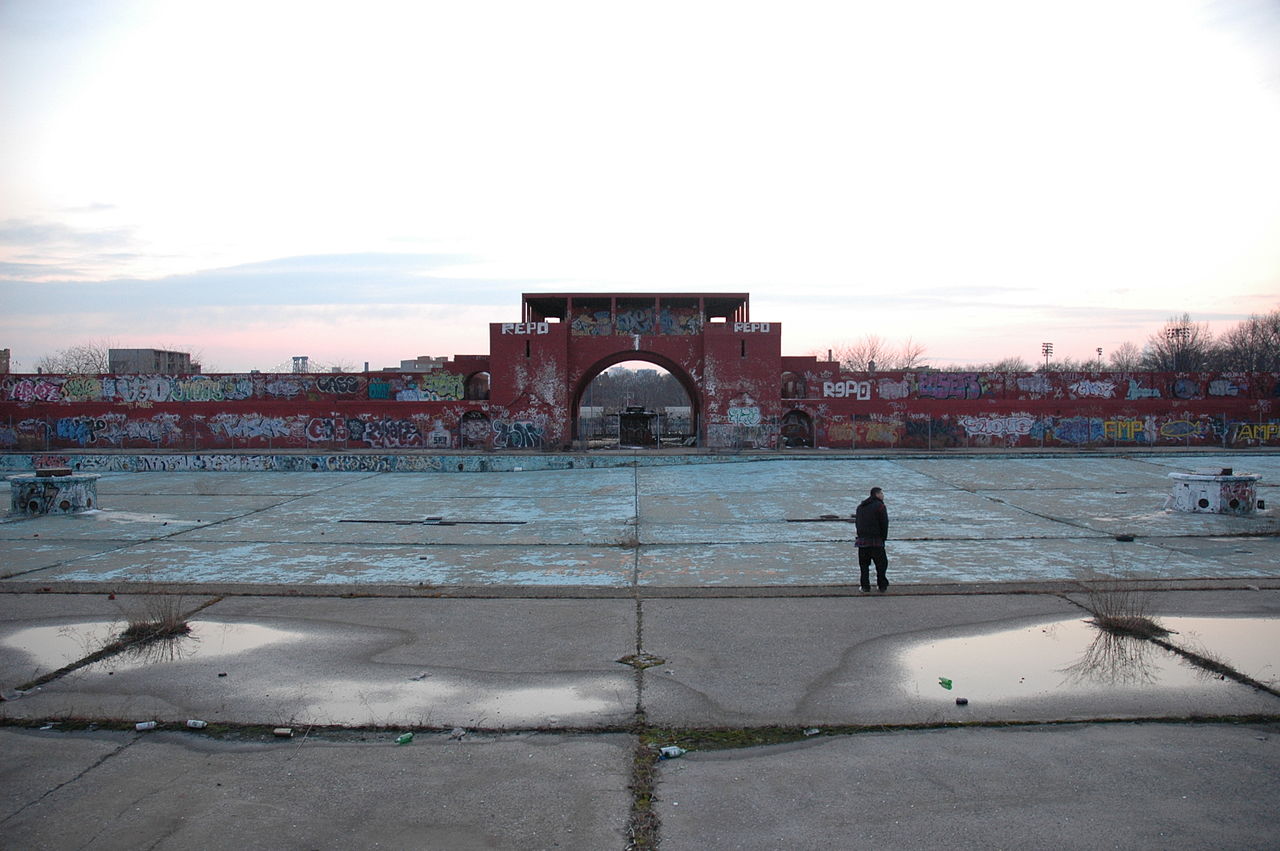
McCarren Park Pool in Brooklyn before renovation, in March 2005. (Chad Nicholson / Wikimedia Commons)
Build More Pools
There’s nothing stopping our politicians and policymakers from investing in building more pools and making them accessible to more people in search of a place to dive in.
Employment increases, especially for youth, as lifeguard and maintenance jobs open up to staff public pools. Kids are provided a haven to play in the water under supervision while parents can eke out some amount of relaxation. Learning to swim helps prevent drownings, and as Allie Volpe writes at Vox, pools are “places where non-swimmers learn crucial water safety skills.”
Social impacts of public pools, meanwhile, are immeasurable. One of the reasons racist reactionaries fought so intensely against the integration of public pools is because they’re zones where differences of race and class can break down. You can socialize and build connections with your neighbors in an inclusive, free community space.
Despite the long trend of disinvestment, there have been a number of recent efforts on the municipal level to expand public pool accessibility. In New Haven, Connecticut, officials announced a plan last month to turn a deteriorating power plant into the city’s first outdoor public pool, alongside a waterfront park. This summer, under new Chicago Parks District superintendent Carlos Ramirez-Rosa — a democratic socialist former city council member — the city has kept its fifty public pools open seven days a week for the first year since the COVID-19 pandemic shutdown in 2020, and nineteen pools located in areas with high heat risk will be kept open for an extended period through Labor Day. Last year, New York City officials unveiled a plan dubbed Let’s Swim NYC that aims to invest $1 billion in improving existing public pools while opening up two new ones at public schools in the city.
These measures are a start. Democratic nominee for New York City mayor Zohran Mamdani, a democratic socialist state assemblymember, has campaigned on bolstering the supply of public goods and services to improve life for working-class residents. Building many more public pools would help accomplish that goal. And it would follow in the footsteps of former New York City mayor Fiorello LaGuardia, who oversaw the establishment of the WPA swimming pools in the 1930s (and who Mamdani has called the “greatest mayor in our history”).
When it gets too hot out, it’s natural to want to wade in some crisp, refreshing waters. Pools bring us together, offering recreation and a way to break free from the stresses of modern life. The United States built an expansive network of public pools before. We can do it again.
In brief: Hurricane Erin is passing by the Outer Banks today, and it will begin to accelerate out to sea. Coastal flooding will remain an issue into tomorrow for the East Coast, particularly from North Carolina into New Jersey. Mostly wave impacts for Atlantic Canada, but also perhaps some wildfire concerns there too. The rest of the tropics are noisy, but only one wave bears much watching (Bermuda). Also, the latest on upcoming heavy rains in the Plains.
Hurricane Erin
(NOAA/NHC)
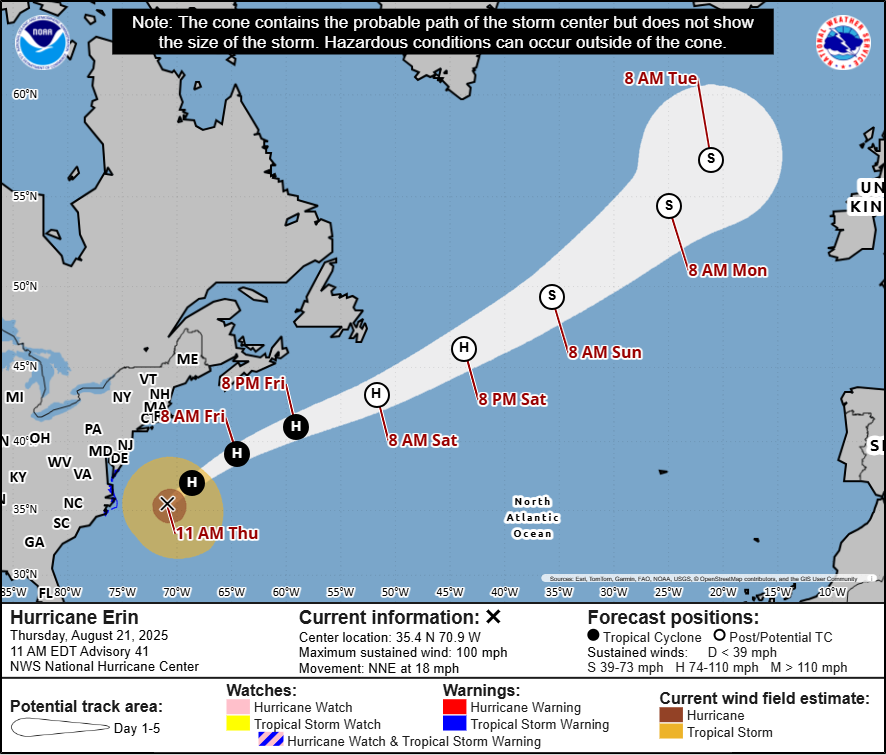
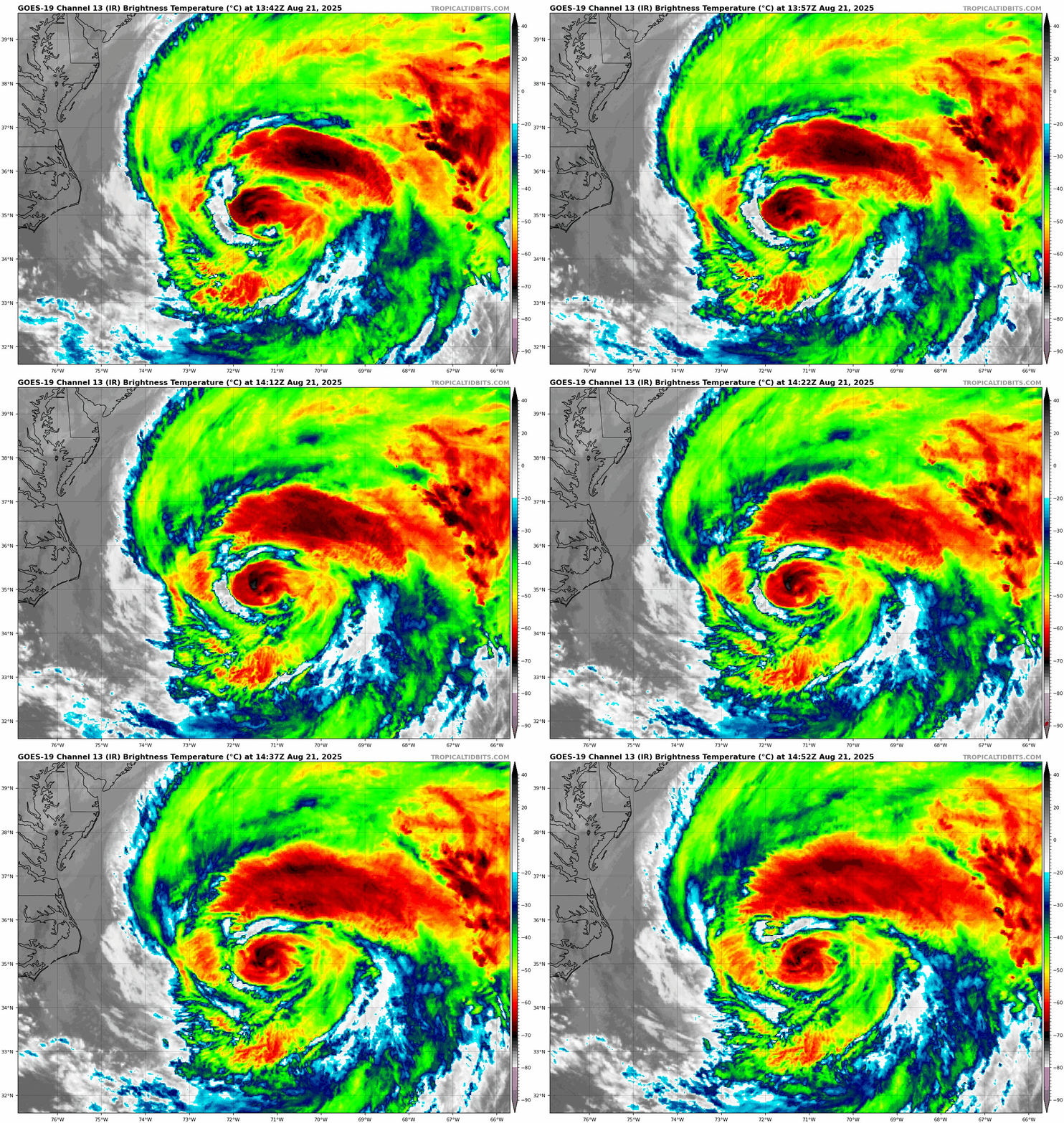
Erin is making its closest approach to the U.S. this morning. The very large storm sits about 210 miles east of Cape Hatteras, and it has begun to turn to the north northeast. The tropical storm-force wind field of Erin extends out over 300 miles from the center. Despite the fact that the storm has weakened to about 105 mph this morning, the hurricane-force winds extend out 105 miles from the center. This is a massive storm.
Erin is large and in charge. (Tropical Tidbits)
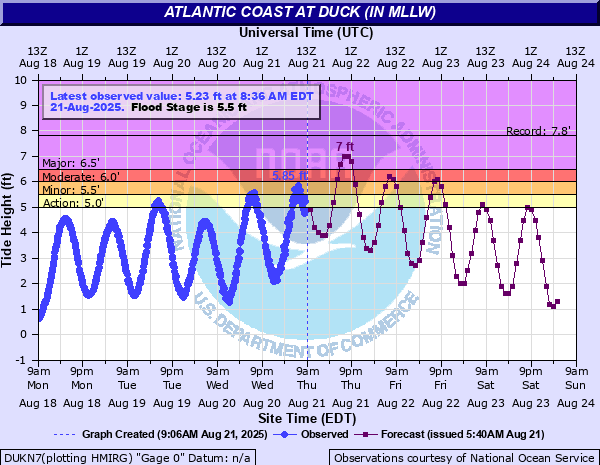
A 2 to 4 foot surge on the ocean side of the Outer Banks will be ongoing, coupled with powerful waves. It is expected that this evening’s high tide cycle will be the highest though, with Duck, NC seeing a water level up to about 7 feet, less than a foot below the 2003 Isabel record there and the highest since a nor’easter in 2022.
Tidal forecast at Duck, NC. (NOAA NWS)
Flooding will be minor to moderate on the Pamlico Sound side of the Outer Banks, with downeast Carteret County seeing the worst this evening around 8:30 PM. High water levels are expected to continue into Friday, and it’s likely that some travel will become impossible through today and tonight in the Outer Banks, Ocracoke, and Carteret County.
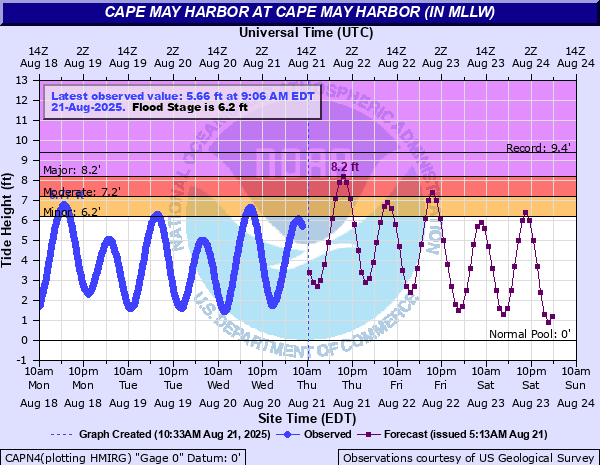
Even farther up the coast, the tidal flooding will be significant. Cape May, NJ is expecting a peak water level of 8.2 feet this evening, which will be the highest since the “Snowzilla” nor’easter of January 2016. Same goes for Lewes, Delaware.
Tidal forecast at Cape May Harbor (NOAA NWS)
Erin will continue to exit tomorrow, and conditions up and down the East Coast will slowly improve. For Atlantic Canada, the main impact will be rough surf, particularly in Newfoundland and perhaps Nova Scotia, where breaking wave heights could be 3 to 5 meters high. Erin should transition to an extratropical storm by Saturday.
Wildfire concerns?
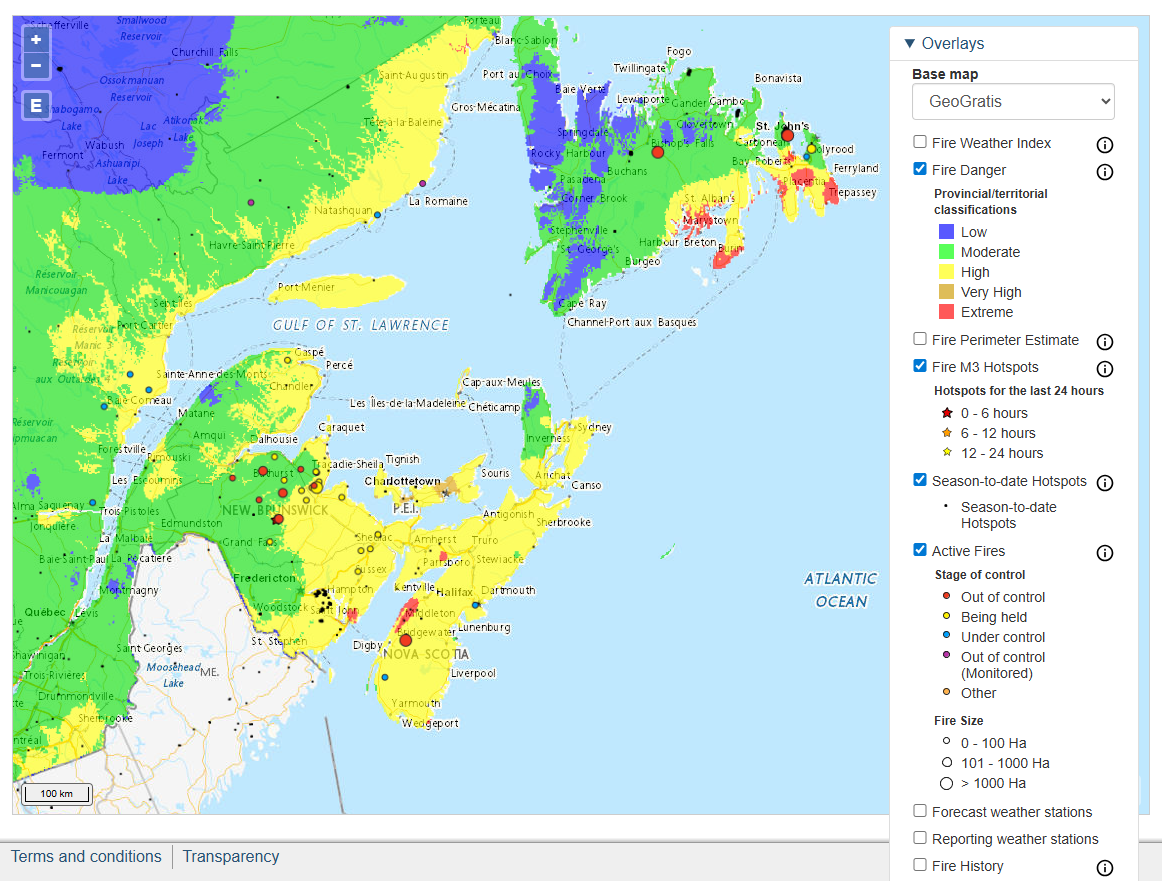
A minor note, but perhaps a notable one, there will be somewhat enhanced wildfire risk in Atlantic Canada as Erin passes. Note the fire weather danger outlook for today is pretty high to extreme in parts of Newfoundland and even Nova Scotia and New Brunswick.
High to extreme fire weather danger in Atlantic Canada today. (Natural Resources Canada)
Portions of Atlantic Canada remain in severe to extreme drought conditions, so the combination of drier air being wrapped in from the north and gusty winds as the large swath of Erin passes by definitely can enhance fire danger. This is an element of storms that’s now on a lot of people’s minds in the wake of the tragedy in Maui a couple years ago, as a passing hurricane likely contributed some to drier, windier conditions there. Something for folks in Atlantic Canada to be mindful of over the next 2 to 3 days.
Rest of the tropics
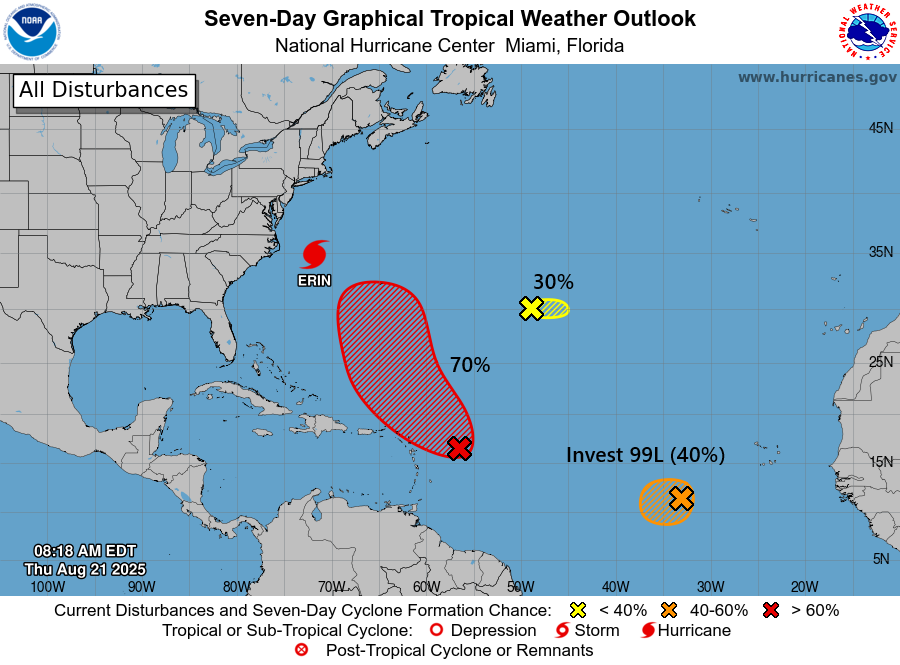
The Atlantic is a multi-colored menagerie of disturbances this morning. We have Invest 99L in the central Atlantic, the tropical disturbance approaching the Caribbean islands that we’ve been discussing for a few days now, and a little fella in the open Atlantic.
It’s a party in the Atlantic! (NOAA NHC)
Let’s start from best odds of development to least odds.
The wave approaching the islands with a 70 percent chance of development is looking ragged but stormy today. There’s no sign that this is going to develop quickly, but it’s starting from a pretty decent baseline.
A tropical disturbance approaching the Leeward Islands will bring thunderstorms and locally heavy rain to the northeast islands this weekend. (Weathernerds.org)
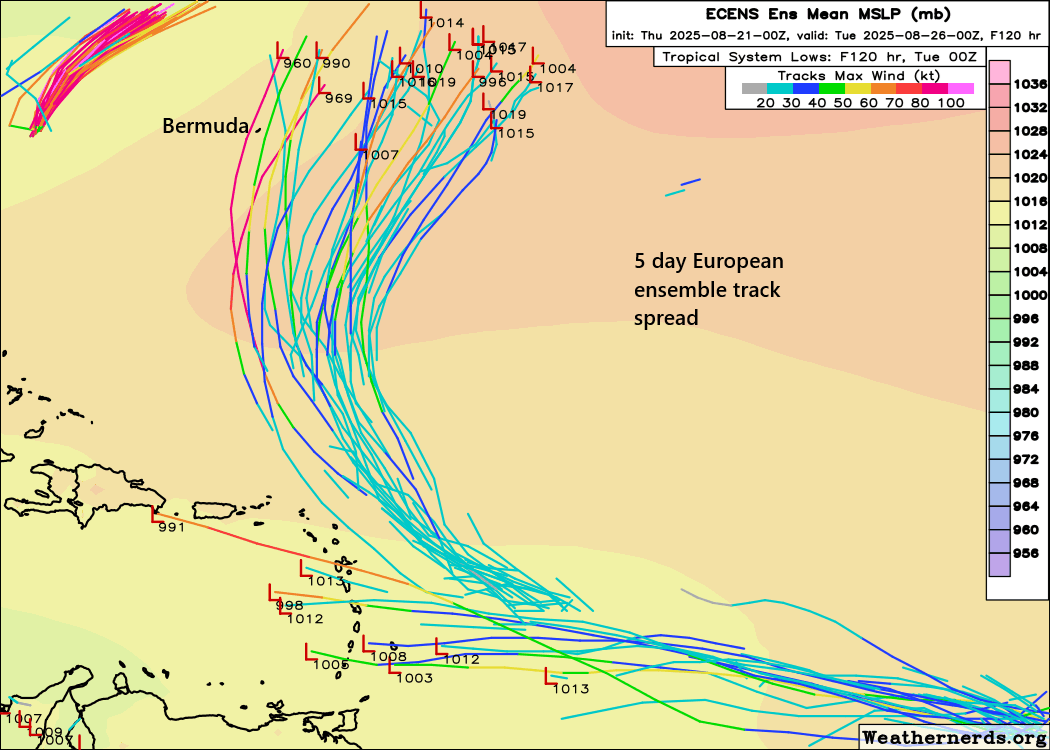
This one is expected to pass northeast of the islands, much like Erin did, so the only impacts will probably be some scattered thunderstorms this weekend. It’s hot in Puerto Rico and the Virgin Islands right now, and heat advisories are posted with hot, dry weather and Saharan dust causing hazy conditions. That will change as this passes. From there, it will probably turn straight north toward Bermuda. It seems as though it will turn out to sea before arriving in Bermuda, but interests on that island should continue to monitor this system in the coming days. As you can see below, most European ensemble members miss Bermuda to the east, but it is at least notable that some of the stronger outcomes get a little closer to Bermuda itself. Again, something to monitor at least.
The disturbance near the islands should miss Bermuda to the east, but there are a couple of solutions that are possible that bring it closer to the island. (Weathernerds.org)
We’ll keep tabs on this one.
To the east, Invest 99L continues to percolate west of the Cabo Verde Islands. This wave has looked excellent since emerging off Africa, but it has yet to do anything to get it over the hump yet to become a tropical depression.
Invest 99L looks beefy again this morning, as does the wave behind it, but conditions are expected to degrade for development in the Atlantic in a day or two. (Weathernerds.org)
As 99L comes due west, it’s likely to run into a wall of wind shear. That should kill any chances of organization. The remnant disturbance should continue west toward the southern Caribbean. Typically, it’s a good idea to maintain some degree of vigilance with systems like this, as their ghosts can sometimes be resuscitated once in the western Caribbean. The bulk of what remains of this disturbance may actually end up close to South America, which would essentially wipe out odds of development, even in the western Caribbean. Still, it makes sense to keep tabs on this one in about a week or so, just to ensure it doesn’t pull a fast one on us.
The wave behind 99L is not expected to develop and should remain out at sea.
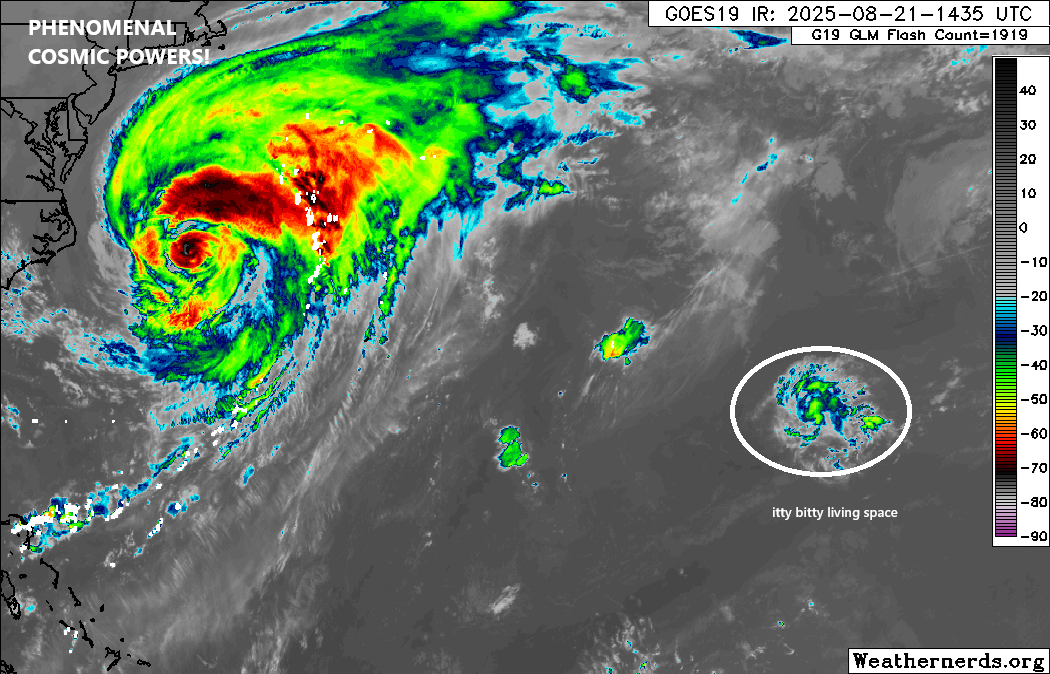
Meanwhile, the NHC tagged a little one this morning. That one near 30N/50W is kind of comedic looking this morning when viewed next to Erin.
I am reminded of “Aladdin” with this. (Weathernerds.org)
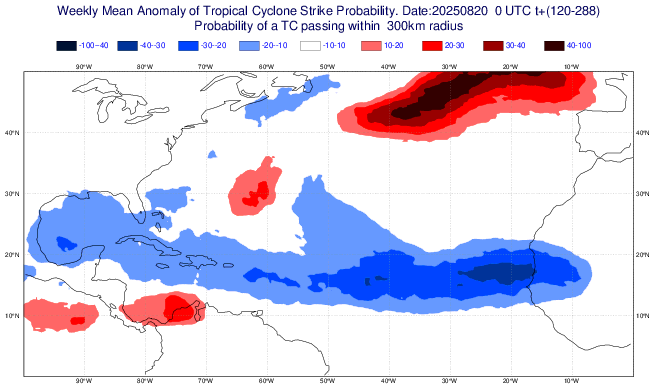
That’s about it. As Eric noted yesterday, after these systems, we don’t exactly have anything noteworthy to home in on. Yesterday’s Euro weeklies suggest below average odds of tropical cyclone development in most of the basin for the week of Aug 24-Sept 1.
Below normal odds of development next week in the tropical Atlantic. (ECMWF)
Notably, these odds turn neutral to perhaps even above normal by mid-September. So the first part of September may be calmer than usual, but we’re clearly not done with hurricane season yet. But this is good news in the nearer-term.
Heavy rain coming to the Plains?
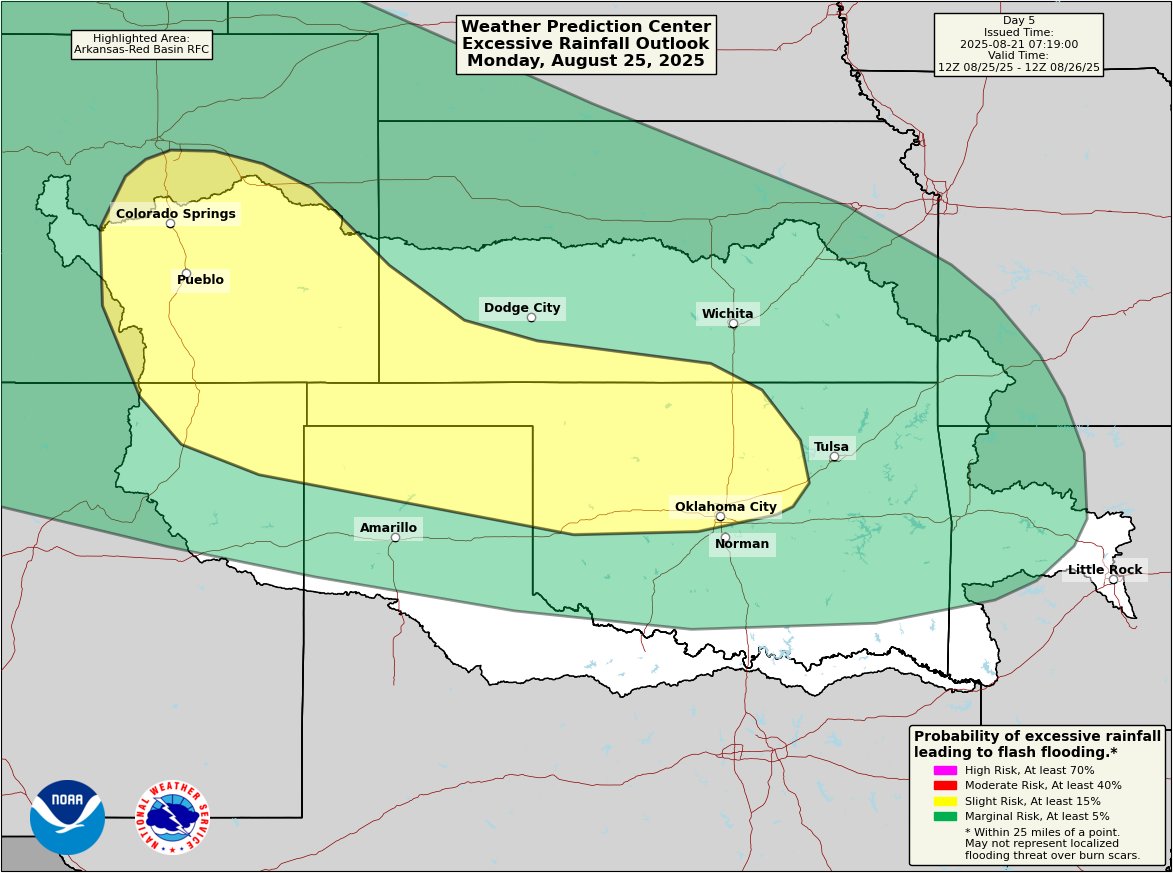
After a somewhat calmer period of weather in the Southern Plains, we may see a return to more active, wetter weather heading toward next week. The WPC has already issued a slight risk (2/4) for excessive rainfall for next Monday.
Flash flooding will return to the forecast potentially by early next week. (NOAA NWS WPC)
Rain totals are currently forecast to be on the order of 2 to 4 inches over the next 7 days, and there could be some locally higher amounts in parts of Kansas, Oklahoma, or Colorado.
Rain forecast for the next week in the southern Plains. (Pivotal Weather)
Tina Peters was sentenced to nine years behind bars for a data-breach scheme spawned from the rampant false claims about voting machine fraud in the 2020 presidential race.
“Bedroom Paintings is a boundary-pushing installation that combines video, printmaking, painting, and artist-designed seating. Her installation combines the intimate and universal act of sleeping, and the history of painting, drawing upon them both to examine domesticity, representation, vulnerability and the fluid boundaries between everyday life and artistic expression.”
A production still of Colette Copeland’s “Soundings” project
“Soundings is a collaborative, community-based experimental sound installation that amplifies historically silenced voices in Texas, specifically those of women, non-binary, and queer individuals. In the wake of the recent political shifts, including the overturning of Roe v. Wade and proposed legislation threatening the LGBTQIA+ rights, this project asserts the urgency of making our voices heard. Participants are invited to choose a phrase or series of phrases that held deep personal meaning-words they wished to sound into the universe. Those who spoke multiple languages expressed themselves in all of them. Their voices were then woven together into a layered sonic composition, forming a chant-like symphony-part mantra, part reclamation-symbolizing collective power and resilience.”
Daniel Seth Kraus, “Monoliths Among Palmettos: The Failed Florida Barge Canal”
“…this canal is a bad decision but I have committed myself to it and must go ahead. -Senator Claude Pepper
The Florida Barge Canal, an attempt to connect the Atlantic Ocean to the Gulf of Mexico, is one of the largest and most expensive failed public works projects in United States history. Over 80 years after construction began and with 30 percent of the project completed, this complex system of defunct canals, dams, locks, reservoirs have become concrete monolith structures in the Florida wilderness. However, the derelict barge canal sites have developed their own eco-systems, and conservationists and environmentalists are at odds over which environment deserves to stay and which should be erased. The photographs in Monoliths Among Palmettos document these derelict sites scattered across Florida, but more broadly, visualize the domino effect of misguided policy.”
Rachelle Thiewes, “Arc,” 2023, metal and powdercoated paint
“PAINT: Rachelle Thiewes is an exhibition that highlights a body of work inspired by the vibrant colors of lowrider automotive paint found across the Chihuahuan desert landscape. Thiewes’ art and design challenges definitions within the domains of jewelry making and sculpture. Working within the realm of art and adornment, her striking pieces express innovative uses of patinas and luminosity, all while exploring the cultural specificity of paint.”
“The fourth annual Texas Sculpts exhibition unites 13 multi-talented, emerging artists and those whose work has helped shape the sculptural landscape in Texas for decades. It’s this mix of fresh perspective and seasoned vision—carefully selected by a panel of collectors and arts professionals—that makes Texas Sculpts IV so dynamic.”
DENVER—In an effort to make sure the young leukemia patient’s night at Coors Field was a special one, Colorado Rockies pitcher Kyle Freeland pledged Saturday to give up a home run for a sick child, ballpark sources confirmed. “Hey buddy, when I go out there tonight and serve up a meatball for the Diamondbacks to nuke into the bleachers, I just want you to know it’s all for you,” Burke said to the 7-year-old fan before the game, adding that he’d make sure the home run ball found its way back to the child so he could always remember how badly the Rockies lost. “This is your night tonight, and I’m gonna go out on that mound and put a nice, fat pitch right over home plate for someone to knock out of the park. That’s a promise. And the rest of the team knows you’re watching, too, so keep your eyes peeled for some dropped fly balls and half-assed base running from them to you.” After giving up the pledged home run at the top of the third inning, Burke reportedly led the entire stadium in a round of boos for the sick child.
MSNBC will rebrand as MS NOW, an acronym for My Source News Opinion World, later this year, dropping the NBC name and peacock logo to establish a distinct identity following its spin-off from Comcast’s NBCUniversal. What do you think?
“How am I supposed to explain to my kids that MSNBC is no longer owned by the NBCUniversal News Group division of NBCUniversal, a subsidiary of Comcast?”
Jill Meerdink, Trophy Duster
“No amount of rebranding will trick me into watching the news.”
IOWA CITY, IA—Shedding light on the age-old mystery surrounding the monolithic statues, a new study published Thursday in the Journal Of Archaeological Science found evidence suggesting that the Easter Island heads were gifts from an overbearing mother-in-law. “By deciphering glyphs on wooden tablets, we discovered an inhabitant of the island once made an offhand remark about liking stone monoliths one time back in 1250, and his mother-in-law took this as an invitation to bring one over every time she dropped by for a visit,” said the study’s author, Professor Mallory Jacobs of the University of Iowa, explaining that the mother-in-law continued making gifts of the 30-foot-tall, 90-ton creations even after her daughter and son-in-law explained that they had no room. “At first the family stored the heads in a closet, but they got tired of lugging out the massive monoliths every time the mother-in-law came over. Eventually they just left the statues outside along the island’s perimeter year-round. During her visits, the mother-in-law expressed that she felt good knowing her family would be forced to think of her each time they looked at the statues looming over them.” The study concludes that the civilization on Easter Island collapsed after the mother-in-law announced plans to move in.
WASHINGTON—In a move designed to help minors in the entertainment industry hold on to their hard-earned substances, Congress passed a new law Thursday that requires 15% of all cocaine received by child actors to be set aside for their future. “The sad truth is that a lot of the coke given to children who work in Hollywood can end up being totally gone by the time they reach adulthood,” said Sen. Alex Padilla (D-CA), telling reporters there were far too many cases of former child stars who had accumulated thousands of pounds of blow during their peak earning years but were now living bump to bump. “For decades, child actors have been vulnerable to predatory agents hoovering up their precious nose candy without leaving the kids so much as a mirror or a rolled-up $50 bill. In some cases, it’s their own parents who do every last bit of the blow. This law ensures that a few uncut bricks will be held in reserve until these young performers reach the age of 18.” Acknowledging that additional protections were required, Padilla stated that he hoped 15% would at least be enough to get former child stars through college.
NEW YORK—In a landmark move to address longstanding gender inequities in professional basketball, league officials announced this week that the WNBA would now fine players just as much as their male counterparts in the NBA. “For too long, women have received financial penalties that are only a fraction of those received by men who break the very same rules,” said commissioner Cathy Engelbert, calling the new equal-opportunity fee structure a long overdue victory for the players, who despite being maligned and grossly under-compensated had brought enormous growth to the women’s game in recent years. “Effectively immediately, WNBA players will be given the exact same fines, whether it’s $50,000 for wearing a shirt emblazoned with profane language or $25,000 for retweeting a post criticizing referees. This is a huge step forward for fairness in the sport. From now on, it doesn’t matter if you’re LeBron James or an Indiana Fever rookie making $66,000 a year, because everyone will be treated as equals when their league is seeking punitive damages. These women were not being shown the respect they deserved when they were receiving a mere $200 in fines for a uniform infraction, but I’m proud they’ll finally be recognized as the world-class athletes they are.” Reached for comment, WNBA players said they did not have time to talk because they were in the middle of a shift waiting tables.
Despite a slight mix-up with the readings, the happy couple were pronounced man and wife after a recitation of Judges 19-21, the rape of the Levite’s concubine.
From urban cores to rural regions, Texans' needs differ. Experts say districts encompassing geographically distant communities will dilute their voices.
1. Coworker keeps sticking out his tongue on Zoom meetings
My former manager/current colleague (a 46-year-old man) has a habit of having his tongue stuck out during Zoom meetings when he’s not talking (hybrid workplace, I’m fully remote). Frequently we see him flicking it around like he’s licking an invisible lollipop. I’m talking at least five times in an hour-long meeting. This scares numerous female colleagues, who have told me as such.
This isn’t a medical issue; it’s just a habit (I asked him, being an autistic person, so wondered if it was stimming and he said, “Oh haha, it’s just a habit when I focus”). Is it okay to tell him to mind what his tongue does while in meetings or is this a “live and let tongue” situation? He’s not hurting anyone physically or being menacing, but it’s distracting people. I often have to pretend I’m having technical difficulties and turn off video to conceal my laughter. On the other hand, I don’t want the guy to feel hurt or embarrassed because I know what it feels like to have an atypical behavior pointed out.
I can see why it’s incredibly distracting and off-putting, but it’s not really your role to ask him to stop. If he were doing it in a one-on-one meeting with you, you’d have more standing (“Is everything okay? You keep sticking your tongue out and it’s really distracting”) but other than that, your best bet is to turn off video if it’s distracting.
I suppose there are certain relationships where you could just say, “Dude, you keep sticking your tongue out, it’s distracting” … but I’m guessing you’d know if you had one of those with him.
Also, are people really scared or is that hyperbole? If they’re genuinely scared — like they think he’s being salaciously threatening in some way — they should raise that with his boss, but I’m guessing it might be more just grossed out.
2. Reassuring coworkers about me not being promoted
I recently didn’t get my former boss’ job, despite filling that role for 15 months while the search was ongoing. This was obviously a disappointment for me, but I do like my current job and coworkers, so I have no plans for moving on. I also completely understand why the decision was made to bring in someone from outside to help with the significant challenges the department is currently facing. This person has expertise where we particularly need it so, while I’m disappointed, I’m okay with the decision.
The problem I’m currently having is that, apparently, EVERYONE around me expected me to get the job, including people in my department and other departments at our location (we’re in a satellite office). I had to spend about an hour yesterday scraping a coworker off of the ceiling (he would have become my direct report had I gotten the job) because he was so angry that I hadn’t gotten the job. He was carrying on and threatening to email our grandboss to complain about the decision, and I had to talk him down. He’s not the only one who has been upset. I’m now spending a couple hours a day consoling other people about me not getting the promotion. It’s exhausting. I know people are trying to be supportive, but it’s tiring to have to explain the decision and be performatively okay and chipper about not being chosen for the job. There’s also an undercurrent of, “Hey, you were a shoo-in! How did you screw up so badly?!?!” Note – I never thought this, but apparently others did.
I’m tired. I’m dealing with my own heady mixture of feelings of disappointment and relief and wondering if I could have done something differently without having to deal with everyone else’s emotions. It seems to be meant to be supportive, but it’s actually exhausting. This will, of course, naturally die down in time as the new guy starts and the info slowly trickles around. But, there’s about 150 people in this location in various departments, and the thought of having to hand-hold all of them is giving me the willies. Any suggestions on how to smooth this transition would be useful.
The next time someone starts in, cut them off and say this: “Let me interrupt — you couldn’t have known, but you’re like the 10th person in the last few days to come to me upset, and it’s been pretty exhausting. I appreciate the vote of confidence, but I am fine with the decision, and I’d be so grateful if we can just leave it there.”
3. My boss pushed me to apply for a promotion, then sent me a form rejection
A manager position recently came open where I work. My boss called me in his office and asked if I was planning to apply. I told him no, that I didn’t feel I was qualified. He asked me to consider it. Later that day, my grandboss called me in to her office and asked the same question. I told her the same thing, that I felt there were others who were more qualified than me. She gave me several reasons why the people I mentioned weren’t suited for the job.
A week later, my boss asked if I’d thought about applying for the position. I told him that I had thought about it and didn’t feel it was the right time for me to apply. He doubled down and said he thought I was the best person for the position and the opportunity might not present itself again if I declined. He also implied that the interview panel would be hand selected to choose who he and grandboss wanted in the position, i.e. me. So I applied and was invited for an interview. I felt it went well. I was prepared, answered all questions thoroughly, and got several approving nods from the panel.
I received an email a week later saying I was not selected for the position. What happened?? I feel like a complete idiot for even applying!
Whoa, they really mishandled it. They weren’t obligated to hire you for the position just because they pushed you to apply, but they absolutely were obligated to talk to you to explain the decision after such extensive lobbying to get you to throw your hat in the ring.
As for what happened with the decision itself, who knows — a stronger candidate could have emerged unexpectedly, or you might have said something in the interview that gave them pause, or all sorts of other things. But regardless, you don’t pressure someone so hard to apply internally and then reject them with a form email. That’s crappy. You can definitely ask for feedback if you want to, and as part of that you could say, “I didn’t expect the position was mine just because you encouraged me to apply, but I would have rather heard about the rejection directly from you rather than through a form letter, given the context.”
4. Why doesn’t this communications job want a cover letter?
I am in the process of applying for senior-level positions in marketing communications in which I would work directly with top executives. At one especially interesting employer, there is nowhere in their application portal where it says to upload a cover letter. There is a place to upload my resume and a section to answer several questions about one aspect of the position, but that’s it.
Given the level of responsibility for this position and the fact that it’s in communications, it seems strange that they don’t ask for a cover letter. And I really want to include one, in part to show how a particular aspect of my qualifications may indeed fit their requirements even though it might not seem apparent at first. There’s also an unusual part of my experience that applies directly to this particular company’s mission and I want to connect those dots. Should I just attach a cover letter to my resume? Why aren’t they asking for a cover letter?
There are all sorts of possibilities: they could be an employer that doesn’t care about cover letters (they exist!), they could plan to ask for a more specific writing sample later in the process, they could figure that for a very senior communications job they’re going to be able to do the first-pass screening based on experience alone and will assess writing later in the process, they could be using the same application system for all positions and it’s just not well suited for this one, and on and on.
If you think your cover letter will strengthen your application, it’s absolutely fine to include it in one overall PDF for resume and cover letter. If they don’t care to read it, they’ll simply ignore that part — but it’s completely fine to do it that way (and you won’t be the only person who does).
5. Running into someone who revoked a job offer
About a year ago, I accepted an offer at a big tech company. I had signed paperwork, passed background checks, selected a laptop, and was minutes away from submitting my resignation to my then-job when the recruiter called revoking the offer, citing “changes in business need.”
The hiring manager (global head of the org) proceeded to call me multiple times and left voicemails asking to chat, and I replied by email that I was processing the news and would prefer to connect later that week. When we finally spoke a few days later, she was apologetic and made all these offers to introduce me to people in her network or to help me find a different opportunity. She also asked me to send her other roles I saw at that company so she could put in a word.
Then, she promptly blocked me on LinkedIn and never responded to my email with the information she requested. I heard through the grapevine that company lawyers got involved with how the situation was handled. Whether related or unrelated, she parted ways with the company a few weeks later amid a large reduction in workforce.
The experience really affected my confidence and mental health for a stretch of time. A mentor who had helped me with negotiation even seemed to doubt me whether it was a change in business need or some misstep I had unknowingly made (it wasn’t), which just made it all worse.
Fast forward to now: I have moved on to a leadership role at a different company. I just found out that this hiring manager will be at a niche industry event local to me that I am also attending. I had not worried about crossing paths with her as we live in different parts of the world and I’m surprised she will be there, frankly.
This is a small event, so it’s not really a matter of avoiding her. I don’t want to ice her out and can be professional, but I also don’t exactly want to engage or interact at all with her. I’d love any advice or talking points to stick to!
She should feel all of the awkwardness and you should feel none. It’s bad enough to pull a job offer, but to promise a bunch of help and then turn around and block you!? (For what it’s worth, it sounds a lot like the offer may have been pulled because they were gearing up for those large-scale layoffs. That would make a lot of sense, and it would have nothing to do with either of you … although her ghosting you after going so far out of her way to offer to help is all on her.)
Anyway, just treat her like you would someone you know only slightly in passing — “Nice to see you,” “What are you working on currently?” and the other bland niceties that get thrown around at networking events. You don’t need to reference how you know each other or what happened last time — just some vague pablum and then excuse yourself to get some coffee.
Waterloo, ON – The Perimeter Institute for Theoretical Physics put out a statement saying that after months of careful study, they can now claim that Prime Minister Mark Carney’s elbows are neither up nor down, but rather in an indeterminate superposition of both. “During the election campaign, we could confidently state that all signs pointed […]
President Trump described Smithsonian museums as “out of control” for emphasizing, in his view, “how bad slavery was.” It's part of a pattern by Trump in his second term to reframe historical narratives, in particular about racism and discrimination. Amna Nawaz spoke with historian Peniel Joseph for our series, Art in Action, exploring the intersection of art and democracy and our CANVAS coverage.


/https://static.texastribune.org/media/files/93191b1a414e267b7f8cc1e411d56586/0519%20House%20LW%20TT%2009.jpg)







/https://static.texastribune.org/media/files/a6fe2b1c18064aa7144f86fa7ab1ae2f/0428%20UT%20File%20LW%2002.jpg)


/https://static.texastribune.org/media/files/e3e356aa7ba43dcb453d5097ada8ec1c/0806%20Texas%20Capitol%20RB%2001.jpg)

.svg)