Christian Slater’s gonna fly tomorrow. I’d better get this back to him.
Christian Slater’s gonna fly tomorrow. I’d better get this back to him.
NEW YORK—Sharing new details about her highly anticipated 12th studio album, pop superstar Taylor Swift dropped major hints on her Instagram story Tuesday that The Life Of A Showgirl could be about her. “While creating this record, I took a lot of inspiration from a certain someone who I have a long history with,” said Swift, whose brief statement sent her army of dedicated fans into a tizzy over the possibility the album might include songs exploring experiences she herself had lived. “Of course, I’m not going to spill everything now—you’ll have to wait for the album to drop Oct. 3 to find out who the titular showgirl is. But let’s just say that the art on the cover might be a clue about the music inside.” At press time, eagle-eyed Swifties were freaking out after realizing the artist had referred to herself in the first person, and that the name “Taylor Swift” appeared 12 times in the album’s songwriting credits.
The post Taylor Swift Hints New Album Could Be About Her appeared first on The Onion.
The post Teacher Goes With School-Themed Classroom appeared first on The Onion.
ROCHESTER, MN—In an effort to advise American consumers about the potential hazards of ingesting the Mexican-inspired fast food item, nutritionists at the Mayo Clinic warned Tuesday that the Taco Bell $3 steak burrito was a $3 steak burrito. “While Taco Bell’s latest offering of a grilled steak burrito for just $3 might seem like an attractive choice, we strongly advise that consumers avoid the menu item given they are spending just $3 for a grilled steak burrito,” said registered dietitian Pamela Wurley, explaining that excess caution was warranted in consuming Taco Bell’s $3 chipotle ranch grilled steak burrito—with its marinated grilled steak, creamy chipotle sauce, tortilla strips, and avocado ranch sauce—given that all of those ingredients were offered for a mere $3 and that the menu item was from Taco Bell. “Now, we understand why someone looking for a cheap, satisfying meal might be tempted by a drive-thru steak burrito for less than $5. However, we cannot emphasize enough that this is made from steak, the most expensive protein at the grocery store, and served as a full-on burrito for only three American dollars. No part of the cow falls in that price range, including the bones and teeth. Even in good times, this $3 entree should be cause for concern, but given the recent bout of inflation and instability in global supply chains, it is imperative that consumers avoid the Cravings Value Menu at all costs.” Wurley went on to stress that not even bean burritos should be that cheap.
The post Nutritionists Warn Taco Bell $3 Steak Burrito A $3 Steak Burrito appeared first on The Onion.
In brief: Fernand will soon become post-tropical as it heads out to sea. Warm weather in Europe thanks in part to Erin’s remnants will soon end. Today, we also discuss how AI modeling fared during Hurricane Erin, as well as a massive haboob that descended on Phoenix, Arizona yesterday.
We are starting off Tuesday with essentially a clean slate. There are no current areas of interest with respect to the tropics. The only item out there is Tropical Storm Fernand. The storm should become post-tropical by later today or tomorrow as it scoots out to sea.
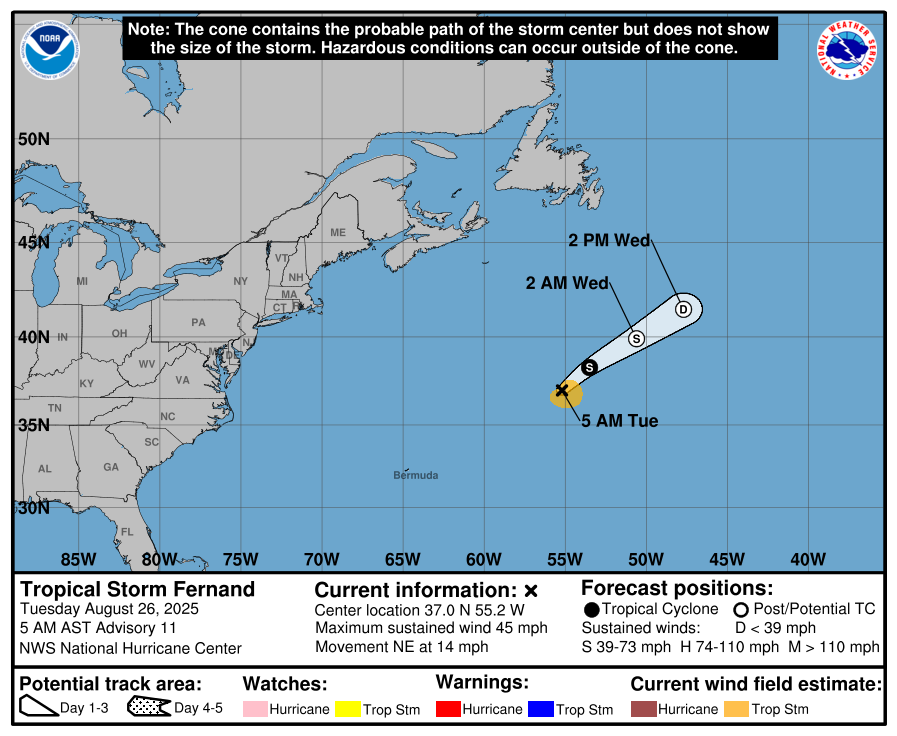
In fact, Fernand is kind of cool to look at on satellite imagery this morning. It’s become almost a “naked swirl,” as virtually all deep thunderstorm activity around the storm has vanished or been left behind due to wind shear.

Fernand will be funneled off toward Europe where it should be absorbed into the larger storm system that also contains the remnants of Hurricane Erin. Temperatures are running about 6 to 10 degrees above normal in western Europe with that storm system sitting just south of Iceland. The circulation around it pumps very mild air into Europe, particularly western Europe, and London has ended up with low 80s instead of low 70s for highs.

Somewhat cooler weather and some breezy unsettled weather is on the way to Europe as this storm system dislodges. Anyway, the point of a longer note than usual this morning is to show how even “fish” storms can provide interesting things to discuss.
There are no other tropical concerns today.
Speaking of Hurricane Erin, let’s talk briefly about verification. When it comes to writing our daily updates here, we are vehemently anti-AI. You’re always going to hear from a human when you read The Eyewall. However, when it comes to weather modeling, AI (or really, machine learning) is adding new, extremely valuable tools to the arsenal we have to forecast with.
Some of the initial results are in from Hurricane Erin’s forecast, and Google’s Deep Mind AI model scored a pretty significant win for these new tools. Between hours 12 and 72 of the forecast, the GDMI on the plot below (shared by former NHC Branch Chief James Franklin) outperformed the best tropical models and even the NHC. Notably the NHC also outperformed the models in that timeframe as well, a win for them.

After hour 72, the picture becomes a little blurrier for AI with the HAFS-B (HFBI) taking control. TVCN represents a consensus aid, and the GDMI from Google beat it all hours. I was more impressed to see how it handled intensity, truthfully, as AI modeling has tended to struggle a bit in that department.

Again, Google’s Deep Mind outperformed virtually all traditional model guidance through 72 hours. Even later in the forecast horizon, it ended up in the top third of guidance.
So what can we really say here?
First off, let’s just call it what it is: Certain AI modeling, which require far less computational resources and take extraordinarily less time to run is able to perform essentially as good or better than traditional modeling when averaged over the life cycle of a major hurricane. That last part is important. It’s just one storm, yes, but this is something we have anecdotally noted since last year. AI modeling tends to be much more stable with respect to storm track, particularly in the first 3 days of the forecast, which is certainly important.
However, averages are just averages, and while the AI modeling performed outstandingly over the lifespan of Erin, there’s a difference between storm-life statistical average and operational effectiveness in real-time. Also, Erin’s forecast track frankly didn’t have a ton of major uncertainty in the 5-day time horizon. There were questions of exact turn timing and location, but short of that, it became more a matter of semantics than anything. The intensity forecast was really well done by AI modeling all things considered.
So it’s important to contextualize this. Google’s Deep Mind represents one AI model. Hurricane Erin was one storm. But AI modeling has proven time and again that it can hang with the best modeling, particularly with respect to track but also now in some cases intensity too. It’s also important to note that the National Hurricane Center outperformed most model guidance on track and intensity. The assumption here is that given the technical expertise that resides in the NHC, as these AI models become more proficient and get validated, those will be further incorporated into the NHC forecast process. And the NHC should continue to shine overall.
Shifting gears now, the Phoenix metro was overtaken by a massive haboob yesterday. What’s that? It’s a massive dust storm usually kicked up by the winds of strong thunderstorms moving over the desert or dried soil. And indeed, yesterday’s haboob in Phoenix was something else.
You can read more about the history and etymology of the term haboob here, but while these are somewhat common in the Southwest, one of this magnitude overtaking a major metropolitan area is pretty incredible to watch. The good news is that it wasn’t just all dust. Much of the Valley of the Sun and beyond saw some good rains as well yesterday.
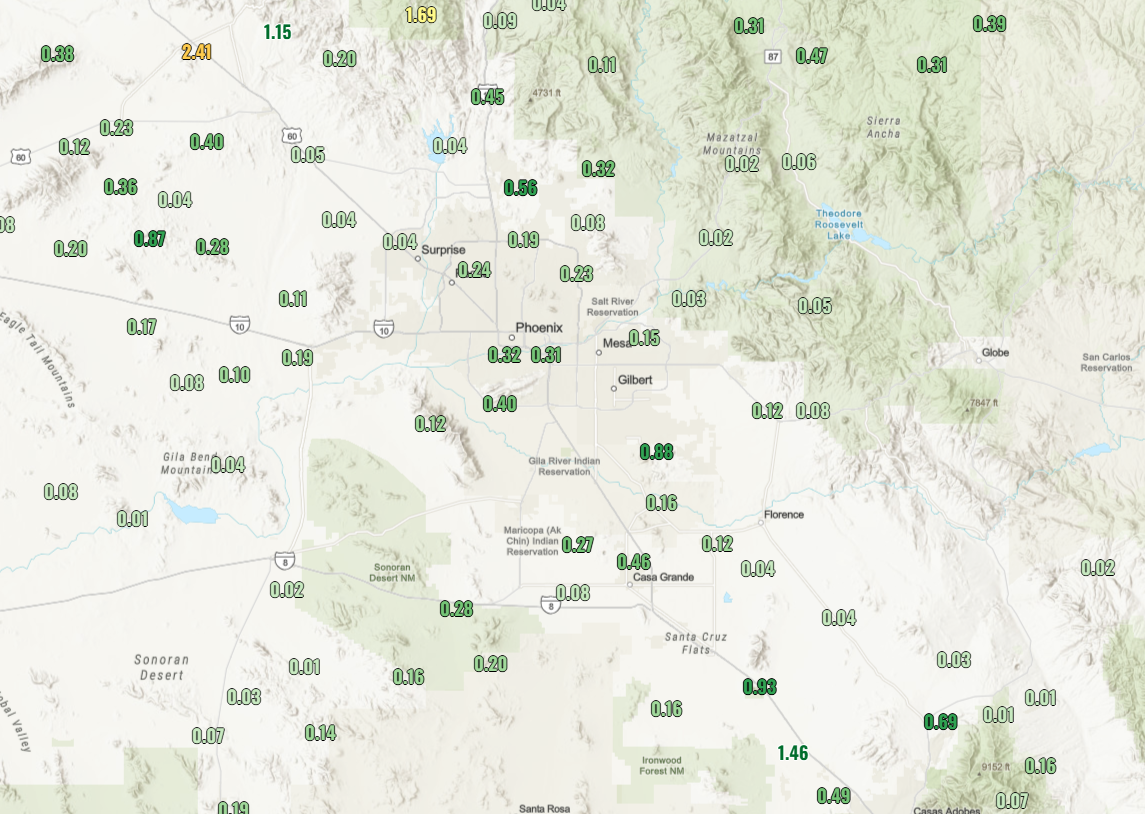
A continued chance of isolated to scattered monsoon thunderstorms will be with parts of Arizona at least from today through Thursday.
Pioneering neon expert and artist Tim Walker embodied the spirit of Henri Matisse’s words: “Derive happiness in oneself from a good day’s work, from illuminating the fog that surrounds us.” He co-founded The Neon Gallery in Houston along with his wife, Suzette. Walker died on July 4, 2025, during the devastating Texas Hill Country floods. The historic floods claimed the lives of 135 people, with 119 of those deaths occurring along parts of the Guadalupe River in Kerr County.

Tim Walker holds one of his neon works in his studio. Photo courtesy of Bernardo Mancebo and RaRaRa Films, Mexico
Walker’s intellect and expertise in the areas of fabrication and restoration of neon artworks made him a hero to conservators, curators, private collectors, and artists alike. He helped restore James Turrell’s The Light Within (1999), which is featured in the tunnel connecting buildings of the Museum of Fine Arts, Houston. His restorative work for The Menil Collection includes work on neon sculptures by Post-Minimalist and Conceptual artist Bruce Nauman, Nouveau Réalisme pioneer Martial Raysse, and, most notably, Greek American sculptor Chryssa.

An installation view of “Chryssa & New York,” exhibited September 29, 2023-March 10, 2024 at The Menil Collection, Houston. Photo: Paul Hester, courtesy The Menil Collection
Walker took on the difficult challenge bringing avant-garde 20th century neon artworks into the 21st century with aplomb. As Walker himself explained in February 2024, “The fabrication process of neon tubes has not changed since before Chryssa’s pieces were made. However, many neon sign components used in the ’60s and ’70s are extremely difficult to find. Some are no longer fabricated, and the technology has changed. Fortunately, we were able to locate discontinued components. Transformers were custom made to original standards.”
Michelle White, Senior Curator at The Menil Collection, told Glasstire, “Neon is an extraordinary and unique medium, and Tim was among few practitioners of the now-rare craft, which has remained vital for so many contemporary artists. The loss of his skill and knowledge of neon in the art world is immense. The Menil Collection is grateful for the opportunity to have worked so closely with Tim on exhibitions over the years. His advice and support allowed us to present many illuminating works of art in our galleries.”

A neon sign designed by Tim Walker for Beyoncé’s “Blow” video
Throughout his career, Walker also helped restore the work of pioneering Houston neon artists, including Clark Harrah and Larry Flukinger. He fabricated for artists Don Foster, Alejandro Diaz, Tara Conley, and the late Forrest Prince. Walker also created custom neon artworks for Beyoncé’s “Blow” video. A familiar face in Houston’s Montrose neighborhood, he loved going to Numbers nightclub (one of the clients he designed neon signs for), Lola’s, and West Alabama Ice House. He completed neon design work for numerous local businesses in Houston. His oeuvre includes everything from sculptures made during the ‘80s to an installation and other work at the Houston Museum of Natural Science.
Walker was born in Austin on St. Patrick’s Day in 1962, almost four years after William Klein’s neon-driven short film Broadway By Light (1959). During his preteen years, he lived in Angola with his mother, Annette Stewart Dessart, and stepfather, Emil Dessart, leaving before the Angolan Civil War in 1975. Walker also briefly lived with relatives in Spain and New York City before returning to Houston, Texas with his family. He attended Lanier Middle School and, in 1981, graduated from Lamar High School.

An abstract neon artwork designed by Tim Walker. Photo courtesy of Suzette Walker
“Tim was a self-taught neon artist and fabricator. He loved to build and fix things. His fascination with light started when he would make light boxes as gifts for family members. College was not his thing,” recalls Suzette Walker. She noted that when he was 20, he attempted to show his artwork in galleries, but was turned away due to his lack of formal artistic training. “After that, he was determined to do his own thing.”
“He rented 1416 W. Alabama and opened The Neon Gallery with $2,000 in his pocket. He never looked back. In 1985, he opened Texas Neon Workshop off Nagle Street (East of Downtown Houston) in the warehouse district, where students would commit to six 5-day weeks of neon instruction and practice. Because of that, many neon fabricators opened sign shops throughout Texas…I do not think there is a better neon glassblower than he in the United States. Tim’s sculpture is all over the world in private collections.”
Tim and Suzette Walker knew of each other at Lamar High School, but didn’t know each other until they met in 1985 and began working together in the neon business. They married in 1986 and went on to have two children, Stewart and Bronwyn, and a grandson, Walker Beauchamp.

Suzette and Tim Walker. Photo courtesy of Suzette Walker
“Tim and I loved working together. According to him, living and working side by side doubled our time — meaning we’d really been married for 78 years, not just 39,” Walker recalled. Describing his personality, she noted, “Tim was generous, lighthearted, and a straight shooter with no filter — traits that made working with him unforgettable.”
Reflecting on their time spent with family in their second home located in Hunt, Texas, Suzette looks back with fondness on their experiences in the Hill Country town. “Tim loved our stretch of the river in Hunt. An area where I went as a child and we went together for 40 years. It was and is truly magical,” she shared.
“Memories of our kids learning to ride their bikes and catching fireflies at Casa Bonita, celebrating college graduations at Casa Del Rio, late afternoon canoe rides and playing in Angel Falls with our grandson and so many more memories etched into his soul. He loved Hunt, Texas and our Hunt family. He would never want a tragedy to wash away the magic that we experienced there.”
Tim Walker’s impact in the local and regional art world is immeasurable. Across his over four-decade career, he established his own path as an innovative, nonconformist neon artist and technical expert. His vision expanded to include the work of other artists, which he helped restore or fabricate. To celebrate his life and accomplishments, a memorial service was held at Unity on Saturday, August 16, 2025, with India.Arie Simpson’s song “I Am Light” dedicated to Walker’s memory.
Below, friends, family and colleagues share, in their own words, their thoughts about true art hero Tim Walker.
Suzette Walker, Wife and Co-Owner of The Neon Gallery
“Tim was an incredible self-taught artist and neon fabricator. In the 1980s when I started working with him at his gallery, it was exciting — we didn’t have a care in the world. His neon sculptures were turning heads, becoming a defining feature of the Montrose neighborhood. Tim had found something rare: a career that matched his natural creativity and rebellious personality.
Long before discovering neon, he had a rebellious streak and a love for the unexpected. At 21, Tim traced himself wearing cowboy boots onto cardboard, then spray-painted fake homicide outlines all over Houston with help from his friends. The Houston Chronicle suspected his art was linked to the local ‘punk scene,’ and no one ever knew it was Tim just having fun until now.
More than anything, Tim brought light — literally and figuratively — to the lives of so many. Our clients became family. There’s an intimacy that happens during the creative process of bringing an idea to life, and Tim did that with unmatched passion and precision.”
Jane Gillies, Senior Conservator of Objects and Sculpture, Museum of Fine Arts, Houston
“I talked to Tim on several occasions about neon-related questions. He was always so knowledgeable about the subject and willing to share his expertise. One of the floor lights in James Turrell’s The Light Inside had gone out in 2023, and Tim knew immediately that the gas in the tube had leaked out. The crack wasn’t visible, but he just knew from his years of experience where the problem lay.
Nick Pedemonti was talking to Tim about replacing all the neon tubes in the tunnel, which was a much bigger project, and that was moving forward slowly, as changing out the neon was just part of the whole work. It is a tragic loss that his expertise is now lost to us and the wider artistic community in the Houston region. We don’t have anyone to replace him.”
Joy Bloser, Associate Objects Observator, The Menil Collection
“Tim was an expert neon bender and an incredible resource for us at The Menil Collection. Over the past 20 years, he fabricated exceptional hand-blown glass neon units for exhibitions and provided countless hours of technical expertise to the museum. He was always generous when I came to him with problems big and small, helping me solve neon and electrical conundrums with humor and patience…I’ll miss sharing a Topo Chico from his vintage pop machine, his extraordinary vintage transformer finds, and the historic bits and bobs he always set aside to show me.”
Katie Mullins, The Events Company
“No matter the day, no matter the circumstance, Tim met you with a laid-back smile — it was steady, warm and genuine. He was a true artist and made the impossible seem effortless, shaping light into something beautiful. Whether it was a grand installation or the smallest repair, he treated every project with the same care and dedication.”
Allie Wood, Designer, Allie Wood Design Studio
“I grew up closely with Bronwyn (Walker) [Tim’s daughter], and remember thinking as a child of how their art and home were so different and much funkier than most of the houses I went into. I recall relating to it and loving lots of interesting design features, many of which were modern materials or typical found items with neon mixed in. Tim’s artwork has always been more unique than the trendy uses of neon we typically see — always art and never defined by the typical name signs, etc.
For years before having my own business, I loved the pieces behind the window of their shop on West Alabama, and would always appreciate the detail and funky compositions he was working on. Tim was truly an extraordinary neon artist. He knew so much about what was, and was not, possible with neon. When I did eventually get a chance to use some of his work in my design business, his knowledge of neon was immensely helpful. We created many light fixtures together, as well as art pieces I wanted to make for my houses and client’s houses.
I was fortunate to know and work with one of the most gifted neon artists. His passing is a great loss to the worlds of art, design and to all those who knew him.”
Bronwyn Walker, Daughter, Memorial Service Remarks
“When the flood waters came on July 4th, we were all together: My Mom, my brother Stewart, my son Walker, my Billy, and his son Sterling. In the dark, deafening storm, Dad’s voice was a lifeline. While clinging to a tree above the rapids, he shouted to Sterling, who was clinging to a barn some 20 feet away, to get higher. He told him, ‘Get as high as you can.’ Sterling fought through that building to reach the roof, where he found Walker. His last words to my Mom before they were separated were, ‘There’s a tree over there, grab a branch,’ and she did again and again a few times until she found the one that held. And she survived thanks to her strength and to his. I believe my Dad would be proud and satisfied that in his final moments, his words helped save people he loved. It’s hard to imagine a world without him, but we carry his spirit with us. We love you, Dad. Thank you for the light you brought into our lives.”
The post A Tribute to Tim Walker appeared first on Glasstire.
“Just as fragments of a vessel, in order to be fitted together, must correspond to each other in the tiniest details but need not resemble each other, so translation, instead of making itself resemble the meaning of the original, must lovingly, and in detail, fashion in its own language a counterpart to the original’s mode of intention, in order to make both of them recognizable as fragments of a vessel, as fragments of a greater language.”
—Walter Benjamin, “The Translator’s Task” (1921)

An installation view of “The Space Between Looking and Loving: Francesca Fuchs and the de Menil House” at The Menil Collection. Photo: Paul Hester
I first visit The Space Between Looking and Loving: Francesca Fuchs and the de Menil House on a rainy Wednesday summer afternoon. School is out and there are mostly families with young children in the exhibition. I wait my turn beside a little girl listening to the audio accompaniment of a series of three small yellow koala sculptures. Her brother is begging to leave the gallery, but she is absorbed in the dialogue between the artist Francesca Fuchs and her mother, Caroline. The girl lingers over their words as long as she can manage before rushing out.
The original koala sculpture, formed from garden mud and then painted over with Plaka paint, was accidentally dissolved. Yet Fuchs’ mother loves the reproductions by her daughter just as much (her favorite one sits on the elevated pedestal with its food bowl, though Fuchs has her own favorite). Looking and loving, more so than its physical facticity, is what sustains it, what gives the koala an affective “place” in their shared lives.
Another little girl excitedly points out to her mother the connection she finds between one of Fuchs’ paintings of an ancient Greek temple and a postcard on Dominique de Menil’s dressing room door bulletin board. I suddenly see the element of joy here too, of a playfulness in Fuchs’ exhibition, as she interweaves archival fragments of the de Menil home, her painting practice as an act of looking, of attention, and elements of her own biography.

An installation view of “The Space Between Looking and Loving: Francesca Fuchs and the de Menil House” at The Menil Collection. Photo: Paul Hester
The exhibition began with a chance encounter. While going through her father’s personal effects in Oxford, Fuchs came across black-and-white photos of a Roman sculpture, a male torso — Apollo or Dionysus — from the Menil Collection. It led her to the museum’s archives back in Houston, where she was astonished to find a letter addressed to her father from John de Menil.
Fuchs’ father, the archeologist Dr. Werner Fuchs, was teaching at the University of California, Berkeley at the time de Menil wrote him to ask for his expertise on the torso. The letter somehow got lost in his move back to Europe and was left unanswered. Until that moment, Fuchs, who moved to Houston as a Museum of Fine Arts, Houston Core Fellow in the late ‘90s, was unaware of this personal connection to her adopted city. Fuchs takes up the lack entailed in this unanswered letter — the space between an enunciation and its recipient — by tracing its reverberating threads across people and place.

An installation view of “The Space Between Looking and Loving: Francesca Fuchs and the de Menil House” at The Menil Collection. Photo: Paul Hester
The viewer will find the mysterious torso in question installed, still unidentified, with Fuchs’ own painterly studies from various angles of it nearby. The artist seems to ask, how do provenance and knowledge shape our experience of an object, to really look at it and love it? Or rather does our act of looking itself shape the object and what we can know about it? How can this ambiguity itself be generative?
Fuchs joins me on my second visit to the exhibition close to 6 p.m. on a Saturday evening — she shares how much she loves the museum at this time of day. We speak about my first visit and how engaged the children were, which delights her. Fuchs highlights to me the line of humor of the show, how installing things in relation — a childhood koala sculpture within sight of an ancient Greek vase, a paint swatch next to Max Ernst’s Fleurs coquillages (1933) — can be a levelling of some kind, creating a new constellation of objects, meaning, and experience.

An installation view of “The Space Between Looking and Loving: Francesca Fuchs and the de Menil House” at The Menil Collection. Photo: Paul Hester
Fuchs emphasizes to me how this is not an archival show — “It’s about loving people and loving objects.” She describes her paintings of paintings as an “act of translation” to her way of looking — the Wols, the red Matisse, or the Ernst — it’s not about establishing a copy or replica. Rather, there is an intuitive tracing of energy and a dialectical re-investment or relation to the original, like how a memory changes depending on at what point we access it in our lives.
The artist links this act of translation back to her 2010 exhibition Painting of Paintings. In this show, there was a solitary exploration of paintings that captured her and that she was drawn to paint, frames included. She decided to extend this practice to the de Menil home and to the objects they loved enough to live with. Here there is a second act of translation, between this singular practice of looking and encountering another’s intimate life with objects.
Fuchs is glad I had a first impression of the exhibition before we met. It’s important to her, much like the experience of the little girl, that the viewer can draw her own constellation within and through the ones Fuchs herself makes. There’s a satisfaction for me, however, in catching details of the exhibition from Fuchs’ point of view. The ceramic owl, another childhood sculpture, hangs in the living room photo of her family home; the brush of pink paint off of one of the Fleurs Coquillages (2024) onto the exhibition wall speaks for her to the magic of objects; the choice of covering one of the exhibition walls with felt was made to evoke the de Menil interior.
Fuch’s painted faux-bois that greets the viewer is inspired by the palette of Charles James, the famous couturier whose first and only interior design was the de Menil house. The viewer also finds studies of a chair he designed for the de Menils, next to a Cartier Bresson photo of John de Menil lounging in it, reading a newspaper, with a Venus statue behind him (which Fuchs also chose to paint). There is the object, and much like a garment of clothing, there is how it extends its objecthood through use, animation.

An installation view of “The Space Between Looking and Loving: Francesca Fuchs and the de Menil House” at The Menil Collection. Photo: Paul Hester
Fuchs worked in close collaboration with curator Paul R. Davis over the course of two years, dividing time between the museum archive and her studio. She would first take photos on her phone in the archive, then begin to paint smaller “sketches,” a selection of which are installed. The artist intuitively followed how she was drawn to certain objects in the de Menil home over others, to then begin on a larger scale painting. In our conversation, Fuchs shares that sometimes she thinks of these sketches, that are such an integral part of her process, as paintings themselves.

An installation view of “The Space Between Looking and Loving: Francesca Fuchs and the de Menil House” at The Menil Collection. Photo: Paul Hester
Much of the work of the exhibition was this process of reduction, of focusing on what objects really caught her attention, while also inviting the institution to be an interlocutor. The Duma mask, next to a 14th-century Virgin and child wooden icon, and the Wols (currently also installed in the Surrealist gallery) encapsulate for Fuchs the way objects hang together in conversation throughout the museum’s larger collection. But as objects that were also loved and kept in the de Menil home, there is an aura of familiarity to them, bringing into relief the various tensions of use and exchange value, art and non-art, sacred and profane, public and private (Apollo or Dionysus? Flower or shell?).
Returning to the koala, I note to Fuchs how her mother’s description of the “place” of the object stood out to me — how this is what mattered to her, more so than the original: the psychic place, the physical space, the affective place between mother and daughter. “It’s a sort of signifier…” she responds, which in turn brings to my mind Jacques Lacan’s emphasis on how a signifier represents a subject for another signifier, forming chains of meaning. Rather than a fixed definition, there is a movement of associations, stories, affects, entailing both temporal retroaction and the irruption of chance. Here, the viewer has the opportunity to create her own associations in being with Fuchs and the de Menils, and to also catch her own reflection in the mirror, in her own act of looking.
As a free art collection, many in Houston, including the artist, find the Menil to be some extension of home (when I was a teenager, I’d spend at least one afternoon a week exploring the Surrealist galleries, visiting the same works over and over.) Fuchs tells me about her recent experience encountering a Cezanne in France that she would often visit at the Tate in London. “It was like seeing an old friend…somehow you can also own an artwork with your eyes.” Sharing her practice of looking with us, Fuchs invites us to pay attention to, to attend to, the objects in our own everyday, to look, yes, but also to listen to them and to what fragments of our own stories we find looking back.
The Space Between Looking and Loving: Francesca Fuchs and the de Menil House is on view at The Menil Collection through November 2, 2025.
The post A Practice of Attention appeared first on Glasstire.
Hi kids, we're back!
They're not kids! They're little partners at home! #CowboyWho
Like a fool, I used to resist, but no more. In the past, I railed against the rise of AI. I preached small-minded sermons to students who had to sit through my tirades to get a passing grade. I used to curse and mutter at the head of the class, as the commercial for Grammarly played when I tried to show a YouTube clip about permaculture. Now, I search for the Grammarly commercials, show them in their entirety, then try to convert any students who, somehow, remain unconvinced of AI’s absolute utility.
I call such pitiable souls The Lost. Some of them are still writing their own essays, if you can believe that. Some of them even aspire—and I promise you that I’m not making this up—to write an entire book at some point in their life. Thankfully, there is still hope for The Lost, and it comes, now as ever, in the form of embracing salvation, which looks like this:
All students, for all assignments, should use ChatGPT to complete each task. Why would you waste your time writing a paper? We now have a tool that can do that for you. And all professors will save massive amounts of time and energy by using ChatGPT to grade all those papers. Isn’t that great? I mean, what an educational revolution.
Hey, what’s in that bag? Are those books?! Get rid of those. You do not need to read books. Just feed the PDFs to ChatGPT and let it spit out a summary that you can read in class if needed, or a brief analysis or response to a post to an online discussion where your bot will talk to your classmates’ bots. Stop wasting your time reading.
Oh, you’re a fine arts major? You should have generative AI draw those nudes for you, and your fellow arts majors will use machine vision to look at your work, and Chat GPT will write up much better criticism than any nineteen- or twenty-year-old brain could have ever come up with, and will do it much more efficiently.
Dance? You mean, like, moving your body vigorously while producing nothing? Wait? Humans are still dancing? Why? We have robots that can dance. Do you know how inefficient it is for human bodies to dance? The energy you waste by jumping and spinning across a stage or any space, rather than just walking across it, or better yet, riding a solar-powered Segway or a hoverboard? Wheels are much more efficient than feet. This is proven. It’s science.
And don’t even get me started on student athletes.
(Too late.) What the hell are you doing still playing sports? The endless calories consumed, then expended pointlessly, the pain and suffering of training, the injuries, the burden on our medical professionals to try to repair your achilles, your hairline fractures, your battered brain.
People, wake up. We have video games of every sport ever invented. Stop wasting resources on the field, in the pool, on the court, in the gym.
No, don’t tear down the field house. We’ll need it. We might even need to expand it. The number of incoming freshmen on e-sports scholarships will likely increase once the next generation of students exclusively plays sports on VR headsets. The NCAA will convert every competition into a virtual event, and your parents will watch your avatar throw the javelin as they sit comfortably in their own home—no need to travel halfway across the country to see you compete at nationals.
Matter fact, why even go to college or live in a dorm when you could stay in your mom’s basement for four years, and have ChatGPT complete and upload all of your assignments? It would be so much more efficient than what we’re doing now.
Come to think of it, who needs a mom? Have you chatted with Siri or Alexa lately? All the nurturing, encouragement, and comforting words a child would ever need can be easily generated by these neural nets, and with more effective, research-based phrase selection than—I don’t even like saying this phrase, it’s so obsolete—a “human mother” could ever produce. All the most effective therapy talk will be infused into AI mothering from birth, saving so much time and money later, when adult children don’t need to go to a therapist to fix things about themselves, because there was no human mother there to cause damage in the first place.
See how beautiful, how efficient that is? By the time these children come to college, they’ll actually be ready to learn, rather than spending all their time navigating their anxieties and emotional hang-ups.
Regrettably, many publishers still are not interested in work composed by AI, and so this piece was written by me, a human. Hence, the wordiness, ineptitude, and inefficiency of the prose. And yet, I remain a typist, for I have vowed to spend my days in service of this message, with the hope of ushering my students into a world of endless artificial intelligence. A world of solutions. A world, finally, that delivers to humans the infinite leisure they have sought since the Beginning.
Now, at last, we can see, as we move toward a truly efficient future, that the greatest gift we ever received was being forced to exit Eden. To leave the garden behind.
ROANOKE, VA—As he struggled to discreetly administer the life-saving anaphylaxis treatment following a bee sting, local poor third grader Mason Prewitt was reportedly bullied this week for using a generic EpiPen. “Oh my God, is that really your auto-injector, or did you just tape a sewing needle to a glue stick?” said classmate Lucas Hammond, who joined with several other children in waving their genuine EpiPens in Prewitt’s face as the boy jabbed the off-brand epinephrine-delivery device into his thigh. “It’s probably just filled with water. I wonder if it even stops your throat from closing, or if that costs extra. My parents would never send me to school without name-brand medication, but I guess that’s because they love me.” At press time, school officials unveiled plans to install a bench to honor Prewitt’s short life.
The post Poor 3rd Grader Bullied For Using Generic EpiPen appeared first on The Onion.
The Trump administration opened a massive tent-style immigration detention camp at Fort Bliss, a location once used to intern Japanese people during WWII, raising fresh concerns about militarized immigration enforcement. What do you think?

“That’s a lot to squeeze onto one plaque.”
Tina Engle, Paranormal Eyewitness

“It’s great how America is able to turn the atrocities of our past into the atrocities of our present.”
Harrison Weiss, Gerbil Psychologist

“A few more coincidences like this, and I might start to worry.”
Moses Brazdorf, Sandwich Craftsman
The post Former Japanese Internment Camp Used As Immigrant Detention Center appeared first on The Onion.
President Donald Trump recently reiterated claims that the U.S. electoral system remains highly susceptible to voter fraud. The Onion assesses the veracity of the president’s claims.
Claim: Vote counts are inflated with millions of illegal votes.
False: It is not illegal for women to vote yet.
Claim: Democrats are getting illegal immigrants to vote.
False: Democrats can’t get anyone to vote.
Claim: There is widespread voter fraud.
False: It is virtually impossible to bypass the nation’s robust voter suppression systems.
Claim: There are many instances of the same person voting twice in one election.
Partially True: He means twins.
Claim: Voting machines can’t be trusted.
True: It’s well known that electricity has a liberal bias.
Claim: The 2020 election was stolen.
False: Democrats were as surprised as anyone that they won the White House in 2020.
Claim: The powers that be are secretly rigging elections behind the scenes.
False: They’re rigging them out in the open.
The post Fact-Checking Trump On Voter Fraud appeared first on The Onion.
WASHINGTON—Approaching cautiously after waiting for an opportune moment to pose his question, Vice President JD Vance reportedly asked a National Guardsman patrolling the nation’s capital Monday if he could touch the man’s service rifle. “Sorry to bother you, sir—is that thing real?” Vance said to a newly armed member of the Ohio National Guard on a D.C. street corner, adding that he was “a little scared,” but if it wasn’t any trouble, he would also love to feel the weight of the private’s M4 rifle in his hands for a couple seconds. “Boy, this puppy is way lighter than it seems—bet it’s got a loud bark, though! What is it, plastic? Metal? So this is the trigger, right? And this is the barrel? Hey Usha! Usha, come take my picture, please!” At press time, reports confirmed Vance had been rushed to Walter Reed hospital after accidentally blowing his head off with the weapon.
The post JD Vance Asks National Guard Member If He Can Touch Gun appeared first on The Onion.


Contact planet. Put up on monitor 1.

It’s dangerous for Jon Don to be on the water…

With the exception of the most loyal MAGA supporters, President Donald Trump’s legal overreaches have managed to alienate observers across the political spectrum. Whether it be the liberal use of national emergency declarations to justify draconian deportation policy and an illiberal tariff regime, attacks on elite universities and law firms, or support for the acceleration of the genocide in Gaza and settlement of the West Bank, everyone in the anti-Trump coalition can find something to hate.
However, many of these critics justify their position with an appeal to procedural norms, concerning themselves chiefly with the damage done to the country’s legal foundations. On behalf of our Constitution, conservative New York Times columnist David Brooks argued for a “comprehensive national civic uprising,” while prominent Democrats like Joe Biden’s antisemitism czar, Deborah Lipstadt, objected to the deportations of pro-Palestinian students exclusively on the basis of the proceedings’ legality, arguing only that these attempts to chill free speech should have been handled a little more “deftly.”
That these lectures are delivered by people who have defended illegal wars and the concomitant expansions of executive power is as ironic as it is sickening, but their fears are not without merit. Those who object to the kidnapping of immigrants, the silencing of speech, or US support for deliberate genocide and ethnic cleansing — those of us on the Left — should take seriously the threat posed by Trump. But we should not lose sight of the fact that these attacks on legal precedent and the norms governing the balance of power between the branches of government represent an opportunity for advancing the socialist cause. And should a left-wing president come to power, efforts to build a workers’ democracy would likely run through the sort of aggressive use of executive power that Trump has practiced.
Any hypothetical left executive of the US government would be forced to openly challenge federal courts, override state and local governments, and slash through bureaucratic red tape. In just the first few months of his administration, Trump has demonstrated it is in fact possible to do so, even when it threatens to blow up the entire edifice of transnational capitalism.
For the Left to recapture popular energies and turn them to egalitarian, pro-social ends, it must promise to deliver on certain aspects of what Trump is selling without acceding to the bigoted, xenophobic, and self-sabotaging elements of his program. A left-wing policy program that has real populist appeal will require the Left to adopt an oppositional posture not only to the Democratic Party as it currently exists but the broader constitutional order.
Many liberals have refused to entertain the possibility of confronting antidemocratic, elite institutions like the Supreme Court for fear that we could quickly descend into right-wing tyranny if their check on the executive should be undermined. It is past time to accept that we are already living in the world many have feared would come to pass. International, constitutional, and criminal law have been compromised by the open corruption and willful ignorance of political actors in both parties. They have been further shredded by the lack of accountability for the types of self-dealing and insider trading endemic among holders of public office.
The lion’s share of this moral criminality has been in service to the health care, pharmaceutical, weapons, and petrochemical industries, to name just a few. In many cases, like that of the Sackler family’s self-enrichment from the opioid epidemic, their crimes have gone past legal negligence and into the realm of what Friedrich Engels dubbed “social murder.” Yet corporate leaders flaunt the freedom their wealth affords them while many ordinary Americans get sicker, more addicted, more indebted, and more endangered by natural and unnatural disasters. These crises provide an enormous opportunity for the political left, but one that it has so far failed to capitalize on.
Nearly ten years after the first Bernie Sanders campaign, we can more confidently diagnose its failures. Given the choice between a faltering status quo and an effort to remake the country to benefit people over corporations, the Democratic Party chose the former as the safest bet to defeat Trump’s right-wing populist message. As a door-knocker for the Sanders campaign myself, the common theme among the voters I visited in Idaho and Arizona and the especially consequential nonvoters the campaign relied on to turn out (a majority of whom agreed with the campaign’s objectives in principle) was that they simply did not believe that Sanders could achieve any of the objectives he ran on, if he could win at all. This is not to say they believed he was a fraud, but that they sensibly intuited that structural and legal barriers would stymie any attempt to execute the will of the majority.
Should a left-wing president come to power, efforts to build a workers’ democracy would likely run through the sort of aggressive use of executive power that Trump has practiced.
Sanders remains one of the most popular politicians in the country, and many planks of his platform have widespread support from the populace — as evidenced by the persistent popularity of policies like Medicare for All. But transforming that popularity into power at the national level has eluded both him and other left-wing contenders with large platforms. Sanders and fellow progressive policymakers felt themselves to have some grasp on the ear of the White House during Joe Biden’s presidency and understandably feared what a second Trump administration would mean for working people. But it led them to carry water for an unpopular president’s disastrous foreign policy and half-baked economic agenda.
For socialists to take hold of the real levers of power, we must convince the public that we will carry out a forward-looking, ambitious platform and evince an eagerness to go to the mat with any who try to stand in the way. Should those opponents include institutional power brokers in the Democratic Party or elsewhere, left-wing leaders cannot be afraid to name them for what they are: enemies of the working class.
Trump’s transparent attempts to punish immigrants, academics, and trans service workers for elite failures have sway with voters in part because the opposition refuses to acknowledge their failures at all. Should a left-wing presidential candidate run on not only holding unscrupulous, corporate-bought actors in both parties to account but also advancing a radical transformation of American workers’ living standards, we may be able to build a coalition powerful enough to seize the wheel and prevent us from plunging further into the abyss of reactionary violence and authoritarianism.
This agenda, which I call “Labor Maximalism,” would guarantee jobs for every worker in America, dramatically improving the leverage of organized and unorganized labor across industries and restoring the political and economic agency of the working people who created the mountains of wealth on which the ultrarich currently sit. To understand how to get there, however, we first need a brief accounting of how American labor, organized or otherwise, has come to find itself in such a dire position.
In recent decades, politicians have overlooked the potential of working-class power, tending instead to take cues from the wealthy donors that finance their campaigns. No servant, public or otherwise, can serve two masters, and the gradual capture of the political class by the robber barons at the heights of the economy has led to predictable results. On the whole, workers are finding fewer and fewer reasons to participate in the US electoral system, and whatever new energy there is among this group can be found mostly on the Right, on account of Trump’s promises to break the system responsible for their discontent and alienation.
The gradual capture of the political class by the robber barons at the heights of the economy has led to predictable results.
Since 2016, both parties have made promises to restore the wealth of working people, if not their place in the political system. Trump and Biden’s efforts to onshore manufacturing or reindustrialize are rooted in a nostalgia for the era of the labor peace, in which many factory workers received decent pay for a hard day’s work on the line — enough to afford private homes, cars, and college degrees for their children. The labor may have been just as alienating and physically demanding as any job today, but these (primarily white and male) workers could see and touch the value they were relatively well-compensated for creating.
Even if we wanted to return to this era, however, it would not be possible without an extraordinarily painful and protracted metamorphosis. Any historian will tell you that industrialization is no picnic for those having to undergo it, and no country has ever reindustrialized after transitioning to an economy whose growth is based primarily around services, finance, and intellectual property. For American goods to be competitive in global or domestic markets, either wages or employment would have to fall substantially. Workers manufacturing sneakers and garments would be subjected to sweatshop-like conditions, while those manning server farms or chip lines would be little more than fleshy addenda to automated machines, with many more millions subjected to unemployment as purchasing power deteriorated.
The unfair and unsatisfactory distribution of labor and income is at the root of much of what ails the United States today. By the same token, restoring the power and security of working people could be a skeleton key to curing the myriad social diseases afflicting America. We do not have to deny the realities of racism, sexism, xenophobia, and homophobia to see that they draw a large amount of their power from the felt sense of economic precarity that most Americans labor under.
Most Americans feel lucky to work at a job they hate for a boss they can’t stand, because they can sense how little distance there is between them and a young person whiling their prime years away in their parents’ basement or the homeless person sleeping on the subway. Small business owners, whose grievances provide the fuel for Trump’s nativism and authoritarian populism, feel an acute fear of becoming proletarianized as prices for inputs rise alongside household and small business debt. And why shouldn’t they, when so few waged positions are well-compensated or well-protected?
What’s at stake is not merely a question of economic growth, but of the health — physical, spiritual, and social — of the American body politic. The next few years may be the last, best opportunity to renew the commitment to personal virtue and civic-minded spirit that are in such low stock at present. Only a Left that is committed to a political program aimed at restoring the confidence and agency of the working class is capable of doing so.
The centerpiece of the program would be a brand new Department of Public Development (DPD). With the potential to be created just as easily as Elon Musk’s Department of Government Efficiency, this agency could be given wide-ranging authority to restore and expand America’s infrastructure at a far more ambitious scale than the meek, pro-corporate attempts of Biden’s industrial policy.
Over the last half-century, private capitalists have failed to invest the historic wealth accumulated over the course of the American century toward socially productive ends, especially in comparison to much less wealthy nations like China. Since the 2008 global financial crisis, our ruling class has frittered away its surplus capital in speculative technologies, rent-seeking schemes, and superyachts, while the Chinese ruling class has built nearly 25,000 miles of high-speed rail, planted 500,000 square kilometers of trees, and managed to foster a technology sector that is competitive with the United States on every meaningful metric. Only the federal government is capable of marshaling and employing the resources necessary to fix our failing economic model, and the path to doing so lies in tapping our underutilized reserves of labor power.
Countering the threats posed by climate change and generalized social dysfunction means treating these problems with the same seriousness that countries do when preparing for war. Early efforts by the DPD would focus first on fast-tracking the substantial backlog of development projects that exists at all levels of government but would move as quickly as possible into a wide variety of public investment in order to ensure a constant demand for labor. Expansion of green energy capacity, retrofitting and rehabilitating already existing construction, planning and building climate resiliency projects, programs for river dredging, wildfire, and wildlife management — all of these are component parts of a multidecade pivot toward preserving and expanding prosperity.
Only the federal government is capable of marshaling and employing the resources necessary to fix our failing economic model, and the path to doing so lies in tapping our underutilized reserves of labor power.
Workers at DPD could be incentivized by GI Bill–style benefits like housing, health care, and education, while the immigrants this demand for labor would attract could be offered citizenship in exchange for their contributions to the national project. For their part, the young people entering the workforce with abnormally high levels of ennui about their place in the world would have a social mission to take part in with other young people from all across the country (in much the same way our military currently does, but with their efforts going toward socially constructive rather than destructive ends).
With the alternative of attractive public employment, those workers who remain in private industry or elsewhere would suddenly find their bargaining power significantly improved, compelling private capitalists to rethink their investment strategies to plan for the medium and long term. As worker pay, benefits, and even control over production increase with their leverage, workers could use their increased bargaining power to push firms to prioritize values like product longevity and quality and worker satisfaction — rather than just profits.
Most good-faith arguments against such an agenda have little to do with the prospective benefits, which would be substantial for not only for current American workers but also for immigrant labor, future workers, the international working class, and all who would prefer that they or their loved ones not perish in climate change disasters or bridge collapses. Instead, opponents tend to focus on the perceived impracticality of such a program, which they have inherited from a pre-Trump political education. Undoubtedly, these policies would be subject to severe pushback from donor-bought congressional representatives, countless court challenges, and persistent negative media coverage from both Democratic and Republican sources. What Trump has illustrated, however, is that these institutions have little popular legitimacy and little spine to stand against an executive willing to exercise force to undermine them.
Grim as our political environment might seem, the constituent elements of a durable political coalition are there for the taking. The central problem at the heart of US politics is that working-class organization is no longer a meaningful part of either of the two major parties’ coalitions, making it very difficult to imagine any administration willing to carry these priorities out in the parties’ current form. Labor Maximalism is a call for a political movement flying under the banner of guaranteed, well-paid jobs in socially useful fields, which advocates for public accountability for bad actors in government and the private sector — all in service of a forward-looking economy that tightens the labor market and restores workers’ voice.
Such a project would confront no shortage of political enemies and obstacles. But if Trump is capable of turning prevailing political logic on its head, then there is reason to hope that motivated, committed partisans of the working class can do the same.
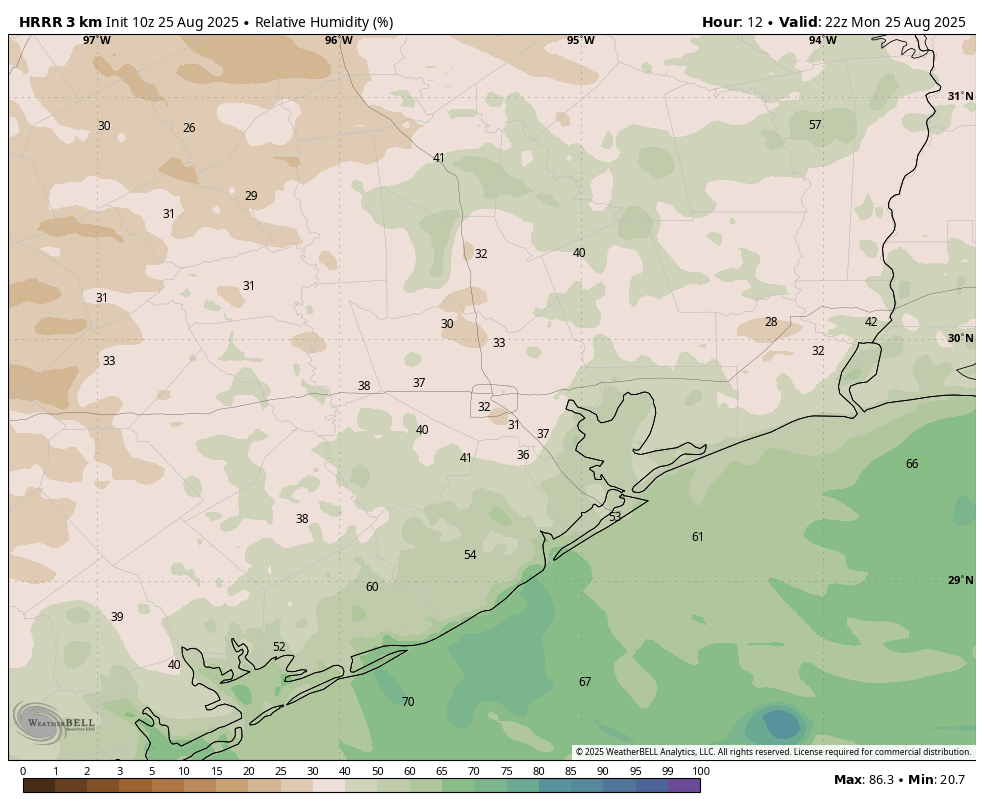
In brief: In today’s post we discuss the hints of forthcoming fall weather in our forecast, and also discuss the possibility of additional weather balloons in Texas. For our forecast, Monday looks to be quite hot, but with lower humidity After today there will be a smattering of rain chances all week, with the weekend looking cooler after a weak front (probably) arrives.
I wanted to hit on a couple of notes this morning. First up is the realization that this is the final week of August, and a period when we often see high temperatures in the 100s in Houston. For this week Monday, especially, looks to see hot weather. But one of the reasons for this is that we are seeing an influx of drier air, which is a harbinger of stronger fronts that will be possible in a few weeks’ time. This afternoon we may see dewpoints drop into the upper 50s in Houston, and while this is not super dry, it is significantly less humid than normal for late summer. This drier air will allow afternoon highs to spike into the upper 90s. Additionally, we have the prospect of another weak front sagging into Houston this coming weekend. Now these August fronts don’t carry much oomph, but they pave the way for the possibility of more substantial fronts in September. Also, we might get some lows in the lower 70s out of it, possibly even upper 60s for far inland areas. So yes, it’s still summer out. But if I squint, I can see change on the horizon.
I also want to mention an editorial that appeared in the Houston Chronicle last week regarding the devastating Central Texas flooding in early July. The editorial correctly notes a paucity of weather balloon soundings over Texas (something we’ve often talked about here), and suggests that as part of their ongoing special session, Texas lawmakers consider creating a network of weather stations to better monitor conditions across the state, including setting up additional weather balloon launches on a daily basis. As a forecaster, I can say that this would definitely improve our ability to predict the most dynamic and impactful flooding events such as that which occurred near Kerrville.
As noted above, we are seeing an influx of drier air today. This should lead to a hot, mostly sunny day for the region. Expect highs in the mid- to upper-90s with a few far inland areas possibly toying with 100-degree weather. Overall humidity should be lower, however. So if you’re one of those “it’s not the heat, it’s the humidity people,” today is your day to shine. Rain chances are near zero. Lows tonight will drop into the upper 70s.
A pattern change will see slightly more unsettled weather move into the area for the mid-week time frame. Overall rain chances will be on the order of 30 to 40 percent daily, and for the most part accumulations should slight, on the order of a tenth of an inch of rain, or two. A slight increase in cloud cover should help moderate temperatures a bit. Highs should be in the mid-90s for most locations. The dry air will be long gone, so expect ample humidity. Lows will drop into the upper 70s for most.

A weak front will approach the area on Friday, and likely push into the metro area on Saturday. The net impact of this should be to drive up rain rain chances to about 50 percent daily. Again, we are not looking at anything too special regarding accumulations, probably just tenths of an inch for the most part. But there could be a few stronger showers that bring a total of 1 inch or more to some areas near the coast by the end of the weekend. Highs on Friday should reach the mid-90s before falling to around 90 degrees this weekend with a few more clouds and slightly cooler air. Lows this weekend could drop into the low to mid-70s. Again, this is not chilly by any means, but a nice harbinger of what’s to come this fall.
The overall pattern next week should see continued highs mostly in the low- to mid-90s, with decent reain chances. Knock on wood, but I’m not seeing any sign of the early September spike in daily highs that the region sometime experiences.

It’s five answers to five questions. Here we go…
1. Traveling with coworkers with no safety sense
I have been at my job for a two years, and the job requires international travel, often with members of a team. We often go to very safe countries (Europe, Singapore), but for a new client we had to travel to South Africa. I’m South African and therefore am quite aware of the risks and safety measures necessary, particularly in the areas in which we were traveling, as was HR, which repeatedly sent emails about safety precautions.
Unfortunately, my fellow team members continuously engaged in risky behavior over the course of the trip (jogging at night alone by the freeway, wearing expensive jewelry in public, getting rides from random taxis on the street…). I repeated my concerns to them repeatedly, as did the hotel manager (who was so concerned that he ended up asking me to tell them to stop, saying he didn’t want the hotel to be held responsible for their choices). They didn’t take my concerns seriously, saying they were “experienced” travelers because they’d gone to Europe before, and I was being “overly cautious.” The entire experience was incredibly stressful, it was like babysitting toddlers.
Now, my manager, who is new, and who I don’t have a strong relationship with, has asked me to go on another trip to this client in South Africa with the same two team members. This manager is also very close with these two team members (I believe one of the two team members helped her get this job). I desperately don’t want to, but how do I articulate this without coming off as “not a team player” or judgmental?
Ideally you’d tell your manager what happened on the last trip and she’d handle it. The fact that she’s close to your coworkers doesn’t necessarily change that — presumably she doesn’t want them to endanger themselves! But if you don’t feel comfortable doing that, can you talk to HR, since they were sending out safety warnings previously? Tell them what happened on the last trip and explain you’re hesitant to ask your manager to address it because of the dynamics in the various relationships (hers with you, and hers with these two coworkers) and ask if they can help manage the situation.
2. Reference questionnaire asked me about fairy tales and animals
I am a manager of a small team at a local government. One of my staff (W) moved away a few months ago, and I told her I’d be happy to be a reference (her work was great!). She recently reached out to say she is in the running for a job in another field, and asked if the organization could contact me. I assumed it would be a phone call, but today I received the following questions in an email:
1. What color might you choose to describe W’s character, and why?
2. If you were to choose a fairy tale character that models W’s approach to teaching and philosophy of learning, who might that be and why?
3. Describe one memory or moment that stands out for you when you think of your time with W? Why do you choose this moment?
4. When faced with conflict, what animal would best describe W’s response?
5. If you were to use a headline to a news article that sums up W’s time with you, what might that be?I have never thought about what fairy tale characters my staff resemble. Is this a new thing? Do I really have to answer this? I don’t want to harm W’s chances but this will take me a lot longer to fill out than a quick phone call about their strengths and talents.
What the hell?! These are truly terrible reference questions. For the love of llamas, if they want to know about W’s character, approach to teaching, approach to conflict, and your overall impressions of her, they could just ask those things.
One option is to just answer what they seem to be getting at, leaving the cutesy framing out of it. So for #1, describe her character without naming a color. For #2, describe her approach to learning without tying it to a fairy tale (!). For #4, describe her approach to conflict without naming an animal. Etc. Personally I’d also be tempted to include something like, “I don’t find the framing around fairy tales and animals appropriate and I’d encourage you to rethink it” but would be worried about harming W’s chances so I’d resist the temptation.
But let W know that this is what you were asked. Maybe she won’t see any significance in it, but maybe it’ll be another puzzle piece which, added to things she’s already seen from them, will give her a better idea of what she’s in for if she accepts a job there.
3. “Hear me out” cake at work
I work for a small (20ish people) department in a large library system, and we have a monthly staff meeting. As part of the meeting we usually do some kind of activity — trivia, making a craft, etc. This month I got an email from the staff member in charge of planning these activities saying that for the next meetings, we are going to be doing a “Hear Me Out” cake. They explain that these are literal cakes with pictures (attached to skewers) of “unconventional or unpopular crushes or opinions one might have.” They attached this photo as an example. They asked if we can each print out two “Hear Me Outs” to add to the cake, and said, “We’ll each take turns putting one on the cake and give a brief explanation as everyone else hears us out. (If you prefer just watching, you are welcome to sit back and enjoy our collective silliness and eat some yummy cake afterwards!)”
Am I way off-base in thinking this is a bananas thing to do at a staff meeting? I do not want to know about my coworkers’ unconventional crushes, nor do I want them to know about mine! Sharing harmless unconventional opinions could be a fun activity, but I find myself very weirded out by the idea of talking about who I’m attracted to at work! It also feels a bit dicey to call specific people/features “unconventional” or “unpopular” in a work setting.
I appreciate that the emailer gives explicit permission to not participate, and I don’t think anyone in my department would be intentionally homophobic or anything, but I don’t think this is the kind of thing that should be happening in the first place. Is this as odd as I think it is? Is it worth pushing back on it, or should I just politely opt out and let folks have their fun?
I’d never heard of “Hear Me Out” cakes but I looked it up and yeah, it seems like the whole point is to discuss and defend unpopular crushes — which might be fine to do with a group of friends on the weekend but is really mismatched with work for exactly the reasons you said. We don’t need to talk about sexual attraction at work, or assess anyone’s level of attractiveness. I appreciate that your coworker added in “or unpopular opinions” — so in theory you could talk about turnips or font preferences or something — but the email actively invites people to make it about crushes, so the concern stands.
As for whether you should say anything, it depends on how much you care and how much capital you have and are willing to spend. But in most situations, it shouldn’t take a ton of capital to reply to the organizer and say, “I worry we’re crossing a line by inviting people to talk about attractions at work, even in a silly way — could we reframe it so its not about that at all?”
4. My boss keeps mispronouncing my name
My name often gets mispronounced. Let’s say it’s Megan and I pronounce it “Meg-an” but some people want to pronounce with it with a hard-E (“Mee-gan”).
I started a new job four months ago and my boss still says it wrong. Early on, he made repeated efforts to clarify the pronunciation and repeatedly apologized. (I never corrected him because it makes me uncomfortable to do so, but he was still aware he was mispronouncing it.) Or sometimes he would teeter back and forth between the correct and incorrect pronunciations (progress though!) But it seems the last few weeks, he’s just given up and is exclusively using the incorrect pronunciation.
What’s extra confusing and why it bothers me most is not in our 1:1 interactions, but that he frequently uses my name in large meetings, so is signaling to others that my name is incorrectly pronounced. I’ve also had people message me on the side like, “He’s saying it wrong, right?” Feels like if anyone should be able to say it, the person who I’m working most closely with and is responsible for my performance and success at the company should know how to say it.
Any tips for continuing to correct my boss’ pronunciation? It’s sort of getting past the newness window where it’s appropriate to do so.
Speak up! You said you’re not correcting him because it makes you uncomfortable to do that, but it’s going to be way more uncomfortable if you let him mispronounce it for a year and have to correct him then.
So, the next time it happens: “I noticed you’ve been saying it Mee-gan — it’s Megan!” And then if it happens after that, just quickly correct it and move on, like this:
Boss: “Mee-gan, can you schedule this rice sculpture for demolition?”
You: “Megan! And yes, I’ll get it handled today.”
If it helps, think of it as doing him a favor, because if he’s a decent person he’d be horrified to learn a year from now that he’d been mispronouncing it the whole time.
5. Explaining why I’m looking for a new job after 20 years
I’ve been at my job for over 20 years. There has been so much change with my employer and the technologies we use that it hasn’t felt like the same job for all that time. I have resigned twice in the past because I was offered more money elsewhere, and both times they have made me an offer to stay that I couldn’t refuse.
The past five years have been a real mess, with round after round of restructuring. At one point my team didn’t have a manager for about a year. Still I have been a high performer and many projects I have been the technical lead on have been highlighted in company communications.
Due to the endless restructuring and the pandemic, my pay has gone up only by 6% over the past decade. This year I got less than 1% and I was told the reason this time was because I was above the salary band for my role. So I feel my only option is to look externally for a new role.
Seeing as I’m the complete opposite of a job hopper, what do I say in interviews when asked why I am leaving after such a long period of time? If I tell the truth and say I don’t feel valued anymore, I’m concerned I will sound bitter and a little precious. If I say I’m looking for a new challenge, it makes it sound like I haven’t been challenging myself in the past two decades. I don’t want to badmouth my employer either, and believe me there is plenty I could say about them, as that would be unprofessional. Any tips on what reason I could give for wanting a change?
You’re overthinking it! “I’ve stayed for two decades because I’ve loved the work and was continually offered new challenges, but at this point I’m ready to take on something new.” That’s it — everyone will understand just being ready to leave after that long, and it is very unlikely that you’ll be pushed beyond that.
The post traveling with coworkers with no safety sense, reference questionnaire asked about fairy tales and animals, and more appeared first on Ask a Manager.

My dead parents also think I should get more three-day weekends. Just saying.





![[img]:taclnc](https://analognowhere.com/_/taclnc/taclnc.png)
 ALT
ALT