Editor’s Note: Photos in today’s post come from HHR Reader Michael Shutika, thanks! Howdy folks, and welcome back to HHR. Today we’re taking a look at a recently exposed retail remnant, while also learning a bit about the tenant. The building in question is located at 18980 Gulf Fwy, Friendswood, TX 77546 just outside of Baybrook Mall, and it started off life as a Krause’s Sofa Factory location. To begin with a little history, Krause’s ...
Since it was signed into law on July 4, West Texas Republican Congressman Jodey Arrington has been broadly praised by allies for his stewardship of the so-called One Big Beautiful Bill Act (OBBBA). U.S. House Speaker Mike Johnson called Arrington, who chairs the powerful House Budget Committee, “one of the most effective and consequential members of Congress.” And Arrington has wasted no time touting his victory in West Texas, proclaiming it to be a “game changer for Rural America” and “a big beautiful win for West Texas.” He’s argued the so-called entitlement cuts to Medicaid, the Affordable Care Act (ACA), and the Supplemental Nutrition Assistance Program will “root out waste and fraud.”
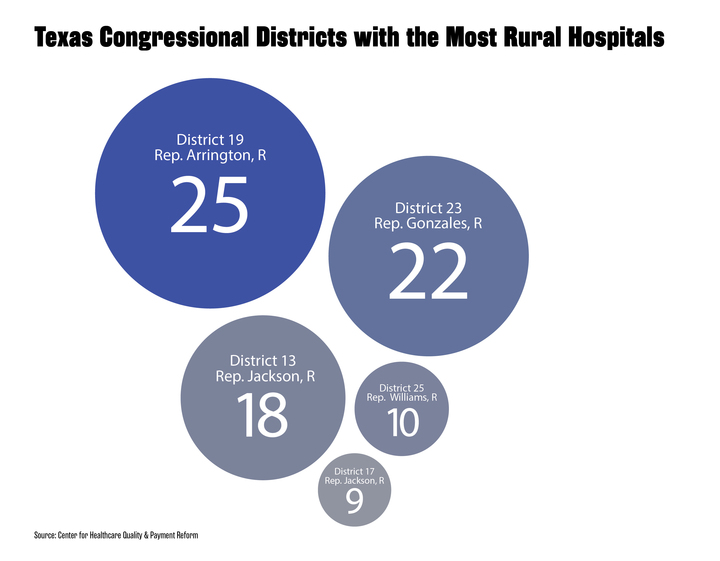
But many of his constituents in Congressional District 19—a vast, deeply red rural district that includes over 30 counties—stand to lose access to both their healthcare and their local hospitals under the massive tax-and-spending bill, which will slash Medicaid and ACA spending by more than $1 trillion and knock 10 million more people off of insurance nationwide over the next 10 years, according to Congressional Budget Office estimates. Arrington’s district is home to more rural hospitals than any other in Texas, and roughly a quarter of those are at risk of closing under the new law, according to a recent study. Six of the 25 hospitals in the 19th are at risk of closing, according to a June study by the Cecil G. Sheps Center for Health Services Research at the University of North Carolina. Using data from 2020 to 2022, the study defined at-risk rural hospitals as those with three consecutive years operating with a negative profit margin or those which receive a disproportionately large share of revenue from Medicaid.
Losses to rural hospitals from changes to Medicaid funding under the new law may be blunted by a $50 billion rural health fund that was added as a last-minute concession to rural members. The National Rural Health Association projected that the major hit Texas rural hospitals would take under the new law would shrink from an estimated loss of $1.2 billion to $407 million after the rural fund is applied over the next five years. But both the federal Centers for Medicare & Medicaid Services and state governments will have wide latitude on how to use the funding.
That’s left rural hospital administrators in Arrington’s district uncertain about the future of their facilities—and how the new law will affect them. Dennis Fleenor, the leader of the hospital in Muleshoe in Arrington’s district, has concerns. “By the time CMS and the state and everybody else get their fingers in that small slice of pie,” Fleenor said, rural hospitals like the one he runs may not get much money from the rural health fund.
Arrington did not respond to the Observer’s questions about the healthcare impact residents and hospitals in his district may face under the OBBBA. Arrington has served as the district’s representative since 2017 after a career that included working for a private healthcare company, for Texas Tech University, and as an aide for George W. Bush in the Texas Governor’s Office and the White House. Arrington has served as chairman of the House Budget Committee, one of the most influential positions in Congress, since 2023. He’s also served on the House’s Rural and Underserved Communities Health Task Force since 2019.
The 19th Congressional District hugs the New Mexico border on the west and crosses central West Texas past Abilene to the east. Anchored by Lubbock and Abilene, the district is largely rural, featuring 17 million acres of farmland that produce a fifth of the state’s total agricultural sales and more cotton than any other district in the country. It’s also mostly white and deeply conservative. Around 15 percent of the district’s residents are uninsured, according to 2023 census figures, which is nearly on par with the statewide rate—the highest in the nation. Many residents in Arrington’s district rely on public healthcare: 131,000 or 18 percent of the district population are enrolled in Medicaid. Statewide, 16 percent of residents are enrolled.
Ten percent of the district’s population is enrolled through the ACA marketplace, lower than the state’s 15-percent rate, according to a study by the health research and policy organization KFF. The tax-and-spending bill doesn’t extend ACA tax credits that expire at the end of the year and thus will cause insurance premiums to surge for the vast majority of current enrollees. KFF estimates the removal of the tax credits and added hurdles to enroll in the ACA could cause 1.7 million Texans to lose ACA coverage.
Because Texas never expanded Medicaid under the ACA, the state will not have to impose work requirements on Texas’ Medicaid patients or reduce its provider tax rate, which will be a requirement under the new law starting in 2027. However, the OBBBA did freeze the provider tax rates states use to finance Medicaid on July 4, making it more difficult for states to increase their own funding for the program.
Dr. Adrian Billings, a longtime West Texas community physician and associate dean of the Rural and Community Engagement Division at Lubbock’s Texas Tech Health Sciences Center, said that hospitals are required by law to provide emergency care to patients regardless of whether they can pay. But unlike urban hospitals that serve a higher volume of patients and can better afford to offset the costs of treating uninsured patients, increases in uninsured rates can quickly dig rural hospitals into bigger financial holes.
“It is harder for a rural hospital to absorb when somebody without insurance shows up in the emergency room or needs to be hospitalized,” Billings said. “There’s just not much fluff at all left in a rural hospital’s margins to suffer any significant hit to their collection.”
The Mitchell County Hospital District serves the county of nearly 9,000 in the southern area of Arrington’s district, situated between Big Spring and Sweetwater. CEO Michelle Gafford told the Observer that the county hospital projected to lose about $700,000 in Medicaid funding, or roughly 3 percent of its 2026 fiscal year budget. “The cuts are going to hurt everybody, but they are not as crucial as they once would have been,” Gafford said, since the hospital’s share of Medicaid patients has steadily transferred to privately run managed care organizations. In the 13 years Gafford has worked at the hospital, it’s made a profit in only one year. The hospital is designated as a critical-access hospital, which allows it to receive Medicare reimbursements at roughly the same amount of the cost of services. However, other insurers, particularly Medicare Advantage and other private insurers, routinely underpay or deny coverage for services, leaving rural hospitals like the Mitchell County Hospital District persistently in a financial hole.
More recent data gathered and analyzed by the Center for Healthcare Quality and Payment Reform shows that 11 rural hospitals in Arrington’s district now have had a negative total margin in the most recent three consecutive years with available data—representing over half of the 19 total such hospitals in the state. According to that data, three hospitals in the district have 20 percent or more of the hospital’s patient costs associated with Medicaid services. That includes the Muleshoe Area Medical Center.
Since the 1980s, the Muleshoe-area hospital, located in the sparse western Panhandle near the New Mexico border, has gone through its ups and downs as its owners changed from one group to another. According to the hospital’s website, after one national company bankrupted the hospital in 1987, a Muleshoe physician named Bruce Purdy kept it running by seeing patients, cleaning its bathrooms, repairing the facilities, and even sleeping in his clinic to attend to late-night emergencies. Dennis Fleenor, a Lubbock transplant, now runs the critical-access hospital on a shoestring budget. “It’s a struggle everyday. But we’re here to take care of our community, and we will take care of our community whatever challenges we face,” he told the Observer. But he said that Congress can go a long way to help rural hospitals by making insurers fully reimburse hospitals for patient service costs. Even though the hospital reported an average of 20 percent of the hospital’s patient service costs over the last two years were related to services for Medicaid patients, Medicaid paid the hospital for only 18 percent of those costs.
Between 2005 and 2025, 25 rural hospitals in Texas have closed, the most of any state, according to the center’s analysis. In CD-19, two rural hospitals closed during that time and at least six of the district’s 30 counties in the district already lack hospitals. In Jones County, north of Abilene, there once were three hospitals. In 2018, Stamford Memorial Hospital closed because it didn’t have enough in-patients. The following year, nearby Hamlin Memorial Hospital closed, leaving only its medical clinic and emergency medical services open. By 2023, Anson General Hospital was hanging by a thread with $1.9 million in outstanding debt. At that point, its board decided to convert the facility to a “rural emergency hospital.” That federal designation was established under a 2021 law that Arrington helped spearhead as a last resort for rural hospitals; in order to qualify for federal grants, those facilities must eliminate in-patient services. Texas now has five Rural Emergency Hospitals statewide; two, Anson General Hospital and Crosbyton Clinic Hospital, are in Arrington’s district.
Vance Boyd, an Anson-based cattleman, pro bull rider, and general contractor, told the Observer he remembers when Anson General Hospital was “thriving, productive, and employed a lot of people.” But he said it’s now “a triage center to get you to a bigger market.” As a cancer survivor, he travels roughly 24 miles to Abilene to see his doctor. “If you’re having a health emergency in a more remote area, you’re pretty much on a dice roll whether you’re going to make it,” Boyd said.
Gaines County, which borders New Mexico, was the epicenter of Texas’ recent measles outbreak. Since January, the outbreak led to 762 cases, 99 hospitalizations, and two deaths statewide, according to the Texas Health and Human Services. Eighty-one percent of the cases occurred in counties within Arrington’s district. Cash-strapped county hospitals with crumbling infrastructure in the surrounding area lacked the space to test for measles or beds to treat patients, the Texas Tribunereported.
Frustrated with the healthcare system, the “death spiral” of rural hospitals, and “AWOL” politicians, Boyd, a conservative Republican, ran against Arrington unsuccessfully in the 2020 and 2024 GOP primaries. His campaign centered, in part, around the need to expand Medicaid in Texas.
“When you live in an area where the average income is low and many are on some sort of government assistance, to expect everybody to have a premium healthcare plan is not realistic,” Boyd said. “I feel like our representative didn’t fight for us.”
Arrington, meanwhile, has his sights set on even further cuts to Medicaid. In mid-July, less than two weeks after he helped pass the OBBBA, Arrington toldBloomberg News that he would be seeking to pass deeper cuts to Medicaid, along with Medicare cuts that he had tried and failed to get locked into the Big Beautiful Bill. Among Arrington’s goals for a budget bill sequel this fall are to cut the federal reimbursement rate to penalize states that expanded Medicaid coverage under the ACA and reduce Medicare reimbursements to hospitals by paying the same rate regardless of the provider.
“I think we will do one before the end of the year,” Arrington told Bloomberg News. “It’s going to be a more targeted set of reforms.”
In brief: Today’s post dives a little bit deeper into expectations and uncertainties about a front that should push off the coast by Saturday evening, or so. I’m hopeful that some inland areas will see nights in the 60s. Before that we have a healthy chance of rain today, and again on Saturday.
About that front
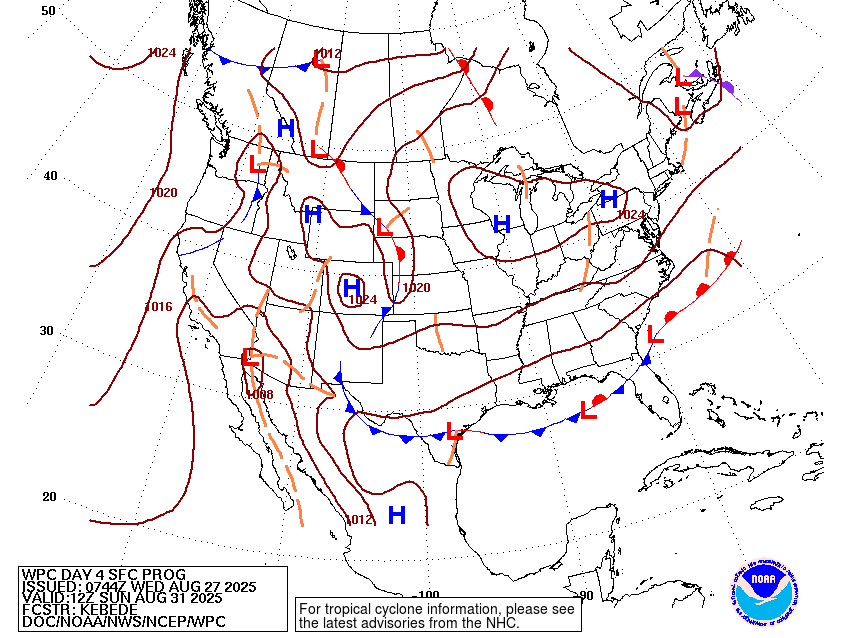
It’s still August, so any expectations about fronts really need to be tempered around these parts. However, it now seems highly likely that a front—this is a boundary between a warmer and more humid air mass and a cooler and drier one—will push into the greater Houston area on Saturday. The real question is how much oomph it has. Since we are still a few days out, there is some built-in uncertainty. And then there is the time of year. In late August we just rarely see much cooling with any frontal passage. The bottom line: It’s just too early to have any real expectations.
It really does appear that a front will be offshore by Saturday night. (NOAA)
And yet, this front has some potential. The most likely outcome is that the front makes it to the coast, and brings some modestly drier air into areas along and north of Interstate 10. This could bring central and northern parts of the region a few days with temperatures in the low 90s, and nights in the lower 70s. Now this is not chilly, but it will be quite nice for late August and early September. However, there is a non-zero chance of something slightly stronger that pushes nighttime lows into the upper 60s for much of the city. Anyway, it’s an interesting setup, and it certainly beats the usual alternative for this time of year—highs pushing triple digits with very muggy nights.
Wednesday
Even before sunrise this morning we are seeing some scattered showers and thunderstorms streaming in from the coast. The overall atmosphere is fairly unsettled, and with daytime heating I expect to see fairly widespread activity later today. Most locations are likely to only pick up a tenth of an inch, or two, but there could be a few bullseyes with 0.5 inch or so. Coastal areas are most likely to see the higher-end totals. These rains, and partly cloudy skies, should help to limit high temperatures to the low- to mid-90s. Rain chances slacken this evening, with nighttime temperatures expected in the upper 70s.
Thursday and Friday
As the atmosphere stabilizes a bit, our daily rain chances will probably drop back to about 30 percent on both of these days, with a little bit more sunshine. High temperatures both days are likely to be in the mid-90s. With luck, these may be some of the last days this year when areas of Houston see highs of 95 degrees, or higher. (No promises!)
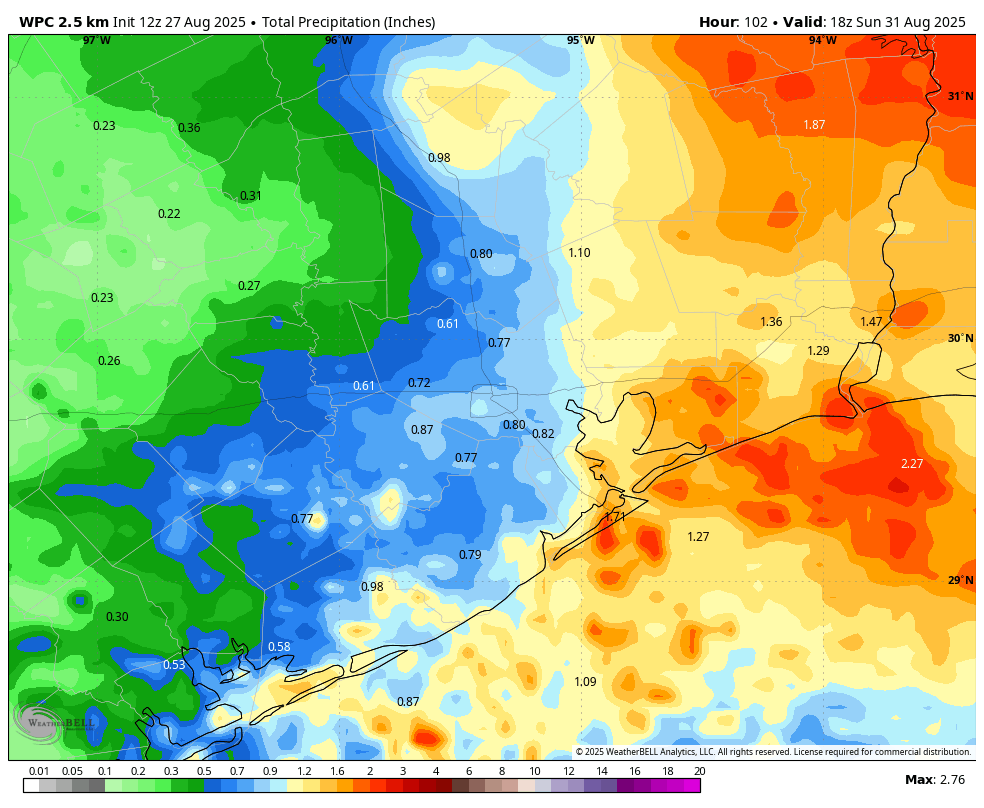
NOAA rain accumulation forecast for now through Sunday morning. (Weather Bell)
Saturday
As noted above, we expect a front to slowly slide into Houston on Saturday. This will not be an “in your face” front, but rather one where we should see modestly drier air moving into the area for a few days as winds shift to come from the north. This front will bring a healthy chance of rain with it. I’m not anticipating anything too severe, just garden variety showers and thunderstorms that bring 0.5 to 1.0 inch of rain to most locations, with higher isolated amounts possible. If you have outdoor plans you’ll want to account for the possibility of showers, including into the evening. Highs on Saturday will likely be about 90 degrees, with lows on Saturday night dropping into the mid-70s.
Sunday
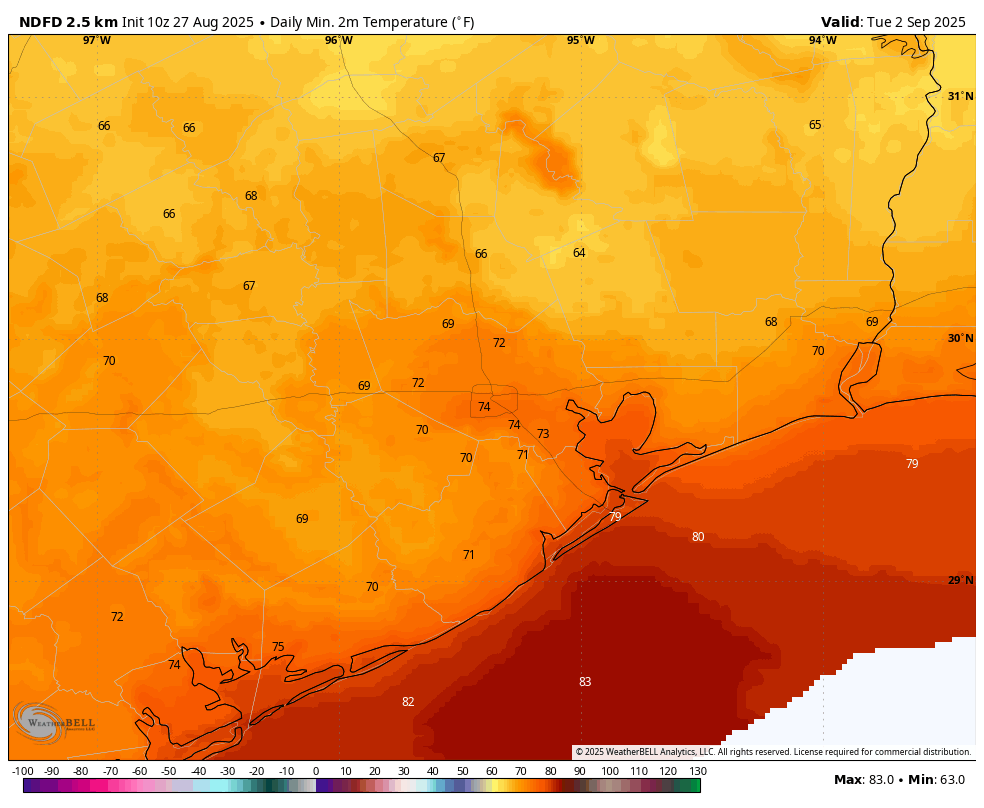
By Sunday we should start to get an idea of how much cooler and drier air is going to work its way into Houston. Some lingering showers will definitely be possible, but on the whole we should see a trend toward clearing skies. Highs probably will top out in the upper 80s, or so. Lows on Sunday night could be interesting. For now I’ll hold the line at the lower 70s for most locations away from the coast, but I think upper 60s could be in play for inland areas. Fingers crossed!
Here’s an early stab at low temperatures for Monday night in the Houston area. (Weather Bell)
Next week
I expect the (somewhat) drier air to hang around for Monday and perhaps Tuesday. This should give us a couple of days with high temperatures around 90 degrees, and nights (maybe) in the low 70s. Humidity probably won’t be low, but it should be lower than normal for this time of year. So, I’ll take it. Much of next week looks sunny before rain chances return by Thursday or Friday.
Editor’s Note: This article is part of a series of interviews with regular Glasstire contributors. We are excited to share about our writers and their various endeavors as a way for our readers to better connect with the voices that document, respond to, and shape the Texas art scene.
The lower Rio Grande Valley (RGV) is the southernmost tip of Texas along the U.S.-Mexico border. It is at once a hotbed for culture and an isolating place to be. Sandwiched between the Global North and the Global South, the lower RGV is closer to northern Mexico than most cities in Texas, and this proximity of distance means little connectivity with art cities like San Antonio, Houston, and especially Dallas. It is a place of art world cycles of boom and bust — just when something seems like it will grow, someone moves, funding is cut, or general burnout slowly takes the wind out of the metaphorical sails.
However, there is a small community of creatively powerful people that continue to fight the good fight of art, and Michael Flanagan is one of those people. Originally from McAllen (considered part of the Upper Valley), Flanagan has returned to the Lower Valley, to make Harlingen his home and creative hub, continuing to find value and beauty in the complexity that is The Rio Grande Valley.
Michael Flanagan
Leslie Moody Castro (LMC): Where do you live currently and where are you from?
Michael Flanagan (MF): Harlingen, Texas and I’m originally from McAllen, Texas.
LMC: What is your favorite book? Movie? Song?
MF: This is such a difficult question as I’ll often listen to, read, or watch something and add it to a very long list of favorites. I tried to pick the first three things that came to mind after seeing this question and they were: Crime and Punishment by Fydor Dostoevsky, Little Dieter Needs to Fly by Werner Herzog, and “Biological Speculation” by Funkadelic.
I remember responding vividly to the descriptions of 19th century Russian life in Crime and Punishment. There was something universally relatable about the depiction of angst and existential dread — deeply unsettling and incredibly beautiful.
Werner Herzog has an amazing filmography, and he’s also a great writer. In fact, he believes it is his writing that will be best remembered in the years to come. I find that hard to believe, but only because the films are so good. His book Of Walking on Ice is a diary documenting a three-week journey by foot from Munich to Paris during the winter of 1978. In some of his other writings he references my hometown of McAllen. He describes spending time working in the rodeo while smuggling stereos and TVs into McAllen from Reysona during the 1960s. These are all things I learned long after watching Little Dieter Needs to Fly, a documentary about a U.S. Navy pilot POW that is typical of Herzog in its casual expression of both hellish and miraculous realities. His 2011 documentary Into the Abyss, about prisoners on death row, was filmed in Texas.
Funkadelic was an ambitious conceptual rock band led by George Clinton (who has recently developed his career as a visual artist with shows at Jeffrey Deitch). “Biological Speculation” is a song from Funkadelic’s fourth album, America Eats its Young. It’s basically a philosophical treatise disguised as psychedelic funk-rock music. E.g., “If and when the laws of man is not just, equal, and fair, then the laws of nature will come and do her thing.”
LMC: Can you tell us a little about your artistic practice?
MF: I have practiced in various mediums including music, film, painting, printmaking, and sculpture. For the past several years I’ve been more focused on making documentary films, mostly about art. Working as a filmmaker can be strange because there seems to be a fine line in the medium between “art,” “product,” and “service.” If you paint something on a canvas, it is typically easier to justify calling it art. It has been interesting to consider how the same dichotomy applies to all mediums. I continue to create art outside my filmmaking practice and have been taking photographs and collecting images from the internet that I plan on using as references for paintings in the coming years.
Photo by Michael Flanagan
LMC: What kinds of things do you look for as reference for paintings when you are on the internet?
MF: It seems I’m interested in anomalous moments that have something to say about humans, technology, nature, and art. For example, I started noticing that videos online would often contain brief instances of glitching that only last for a few frames. Sometimes it’s inherent to the source file and other times it’s a result of the streaming process. Regardless, the still images that I’ve collected from these videos feel like they might result in a kind of post post-cubist painting expression that speaks to the strange liminal spaces we’re constantly engaged with, both psychologically and technologically.
There are several other themes in the collection of images, which include things like a man driving a jet ski over Niagara Falls, comic drawings by a 13th century Russian boy, and many stills taken from police-worn body cameras.
Castro Gallery
LMC: Do you have any upcoming projects you are excited about?
MF: My wife and I recently opened a gallery in Harlingen called Castro Gallery. We each have developed relationships with various artists, galleries, and museums over the years and decided to create a space where we can show art, books, music, and other things that we are interested in. Some things will be for sale and others won’t.
Our first show consisted of work from our own personal collections, including paintings, prints, and drawings by more than 20 artists including Terrell James, Vernon Fisher, Joan Miro, Barry Elkanick, Camille Billoups, Gretchen Bender, Terry Allen, Chris Leonard, and Dario Robleto. This is a combination of local, regional, and international artists, which is what we want to continue exploring as we develop future programming with individual artists.
Our third show opened on July 25 and features artists Chris Leonard and John Wesley Coleman III.
I am also working on a documentary film about Houston artist Mark Flood that is nearing the end of production. It is tentatively titled Career Suicide and we have collected more than 20 hours of rare archival video along with on-camera interviews of Mel Chin, Harmony Korine, Mera Rubell, Gibby Haynes, Will Boone, Dan Colen, Nate Lowman, and many others. It’s an exciting project about a fascinating artist that I’m looking forward to editing throughout the coming months.
My work also includes a position as Project Manager with the River Pierce Foundation in San Ygnacio, an organization that was founded by artist Michael Tracy. This position involves developing programming for the foundation that is supported by a Mellon Foundation Humanities in Place Grant and is centered around collaboration with the Carrizo Comecrudo Tribe of Texas. We’ve already begun hosting a series of film screenings, artists residencies, and panel discussion, and will continue the programming throughout 2025-2026.
Harmony Korine interviewed for Michael Flanagan’s film “Career Suicide.” Photo: Eric Vasquez
LMC: Speaking of opening a space, you have spent much of your career in the Rio Grande Valley, which is where you (and I!) are from. You did leave for a time — can you tell me why you left and what brought you back?
MF: There is a unique culture that has been cultivated here with the juxtaposition of Mexico and the United States. It’s truly incredible the kinds of tangible differences you can experience driving three miles in a particular direction due to the historical factors associated with each country, and I’m not sure this kind of juxtaposition exists in many other places in the world. It’s a place that can provide many valuable insights into the human experience and if you’re interested in exploring that in an art practice, this can be a very good thing.
That being said, this is a perspective I’ve developed over many years and after spending a significant amount of time in other cities and countries. When I was 18, I had dreams of moving to California because I believed that’s where you should go to succeed at doing creative things. I only made it as far as Austin and was soon after faced with the harsh realities of practical existence, which drew me back to the comfort of my hometown. This push and pull with the region has existed for me ever since, as I’ve found myself moving away and back several times over the years.
The Rio Grande Valley feels like it has teetered on the edge of a creative critical mass for decades. There has been enough of a scene to encourage artists to work, but it’s been historically rare to make a living on your art, much less achieve broader national recognition. The infrastructure has not existed to make careers viable for artists who choose to live here and this often results in people moving away to seek opportunities. In recent years, it feels that has begun to change with artistsexhibiting internationally, filmmakers producing work that’s seen by millions, writers reviewed by the New York Times, musicians performing on Jimmy Fallon, and cultural organizations receiving substantial support from granting organizations.
Manuel Miranda at the South Texas Arts Fair. Photo: Michael Flanagan
LMC: You have your hands in a lot of things in the RGV, from your new gallery — Castro Gallery — to your documentary about Mark Flood, and your work with the River Pierce Foundation. Of all the art you have seen in the RGV is there an artist that we should know?
MF: There is an artist named Manuel Miranda who is originally from Mexico but has lived and worked in McAllen for many years. He was born in 1935, so he is 90 years old, and he makes some of my favorite paintings. I remember being in a bank in McAllen around 15 years ago and stopping to admire a painting on one of the walls. Someone was taking pictures of it, so I asked if he knew anything about the artist. It turned out that the painting was by Manuel and the person photographing it was his son. That painting made a strong impression on me and I’ve seen his work a few more times over the years and always immediately recognize it.
I briefly met Manuel at the Brownsville Museum of Fine Arts Juried Art Show in 2024, where he won an award from the jury which included Museum of Fine Arts, Houston curator Alison de Lima Greene. About a year later we met again at the South Texas Arts Fair in Edinburg where Manuel had a booth. I was moved by his paintings and became emotional while viewing them there. It was a large and impressive body of work with paintings dating back to the 1970s and up to the present day. We had a great conversation about Art Brut and Jean Dubuffett, among other things, and discussed working on an exhibition at Castro Gallery that will open August 29, 2025.
LMC: Now, let’s get a little broader: what is the most impactful work of art or exhibition that you have seen recently and can you tell us why it was impactful?
MF: Season 2 of The Rehearsal by Nathan Fielder felt groundbreaking in a way that is rare to come by these days with music, paintings, and film often reading as highly derivative. Fielder investigates and experiments with documentary and narrative conventions, often toeing the line between riotous humor and deep sincerity. He explicitly states his intent as attempting to understand whether humor as an artform has the capacity to result in serious change. On the surface, it is a documentary series about commercial aviation safety (I was on the lookout for friends’ artwork as it features [a recreation of] George Bush Intercontinental Airport as a prominent filming location), but it touches on broader themes of communication in human relationships.
There is a throughline in Fielder’s work that stretches from his early days on YouTube through to the masterful 2023 HBO fiction series The Curse, and it is all used as self-reflective material in The Rehearsal for Fielder’s analysis of himself as a guinea pig for the human experience. The question of art’s capacity for change remains, but Fielder certainly succeeds in raising comedy to the level of a serious artform.
WASHINGTON—Grateful but confused by the unexpected windfall of financial support, top aides to President Donald Trump were reportedly confused Wednesday after his super PAC received a series of generous donations from the sporting goods giant Spalding. “Are we doing something with basketballs? Did the president threaten to outlaw basketballs? Do we have to establish a basketball task force now?” said White House aide Jacob Walker, expressing bafflement after the prominent basketball equipment manufacturer sent several multimillion-dollar checks to Trump’s campaign war chest. “Spalding just gave another $4 million to MAGA Inc. out of nowhere. This seems to be a quid pro quo of some kind, but it’s hard to tell what they’re angling for. Is it possible they did something illegal with basketballs that they’ll need a pardon for? Hard to think what that would even be. Maybe let’s just have the president take a picture holding a Spalding basketball in the Oval Office and call it a day?” At press time, the aides were reportedly thrown into deeper confusion by a sudden series of generous contributions from Tachikara volleyballs.
LAWTON, OK—Disturbed by the sudden appearance of duct tape, rope, and plastic sheeting in the kitchen, sources confirmed Wednesday that local mom Jennifer Kirkendall was trying something called “the serial killer diet.” “I’ve already lost four pounds just by focusing on my inner animalistic urge to kill instead of stuffing my face with empty calories,” said Kirkendall, noting that her ideal body weight was somewhere between Jeffrey Dahmer and Ted Bundy. “My sister heard about it online, and when I saw how gaunt her face looked, I had to give it a try. Before every meal, I make a journal entry outlining how I would murder and then dismember a drifter without getting caught. Plus, I do 30 minutes of stalking randos at the grocery store every other day, which burns a ton of calories.” Kirkendall added that she planned to quit the diet after reaching her goal weight because her newfound bloodlust was giving her horrifying nightmares.
Donald Trump’s tariffs amount to a stealth tax on the middle and working classes, wrapped in the language of sovereignty. In practice, it’s upward redistribution and corporate price-gouging, fueling inequality that corrodes stability and erodes democracy.
Funneling wealth upward eats away at the foundations of the economy and democracy itself. (Andrew Caballero-Reynolds / AFP via Getty Images)
President Donald Trump’s success in pushing his tariff agenda has drawn sharp criticism — not just for the abuse of power and economic risks it creates but also for who it will hurt most. By driving up consumer prices on everything from food to appliances, these tariffs will function as a stealth tax on middle- and working-class Americans. The poorest households, who spend a greater share of their income on basic goods, will be hit hardest.
But the danger isn’t only today’s higher grocery bills or the safety nets gutted to pay for his tax cuts. Decades of evidence point to the same conclusion: funneling wealth upward doesn’t just punish the poor — it eats away at the foundations of the economy and democracy itself. Inequality isn’t an unfortunate side effect; it’s a slow poison that weakens growth, fuels resentment, and makes societies more fragile.
To understand why, it’s crucial to distinguish between poverty and inequality. Poverty is an absolute condition: a lack of access to basic necessities like food, housing, health care, and education. Inequality, by contrast, is a measure of relative difference — how income, wealth, and opportunity are distributed across society. A nation can reduce absolute poverty while still becoming more unequal.
Contrary to debunked “trickle-down” ideas, what happens when wealth is more concentrated at the top is that the rich can push policies to protect and further their advantage: starving public services, blocking redistribution, and undermining labor rights. All of these efforts are now being supercharged under Trump.
Yet the deeper consequences remain invisible to many.
Because of social and economic segregation, the severity of inequality and its consequences are vastly underestimated. When the poor suffer, the injustices are highly visible: more people sleeping on the sidewalk, longer lines at the food bank. But when the rich quietly grow wealthier, the change often escapes notice. They further isolate themselves into their gated communities; they send their children to elite private schools and increasingly travel by private jet.
As sociologist Matthew Desmond has documented, even before Trump, US policy systematically favored the wealthy, from mortgage interest deductions to tax-free university donations, while offering the poor stigmatized, inadequate support. Extreme inequality doesn’t just coexist with poverty; it perpetuates it.
But commentators defending wealth accumulation often assert that inequality is a distraction: as long as others have enough, why does it matter how much wealth is hoarded at the top?
This logic is seductive — but wrong.
Rising inequality doesn’t just harm the poor — it drags down the entire economy. Even research from mainstream institutions like the Organisation for Economic Co-operation and Development show that the more lopsided a society, the weaker its economy becomes: a 1 percent increase in income inequality can shave more than 1 percent off a country’s GDP.
The reasons are simple: when wages are squeezed, businesses lose customers. When public schools are starved, talent goes undeveloped. The rich may save and invest, but these investments often chase speculative returns through real estate, venture capital, and private equity — not on the kind of productive growth healthy economies need. Thus, International Monetary Fund research has also shown that countries with high inequality have lower and less durable growth.
In recent decades, inequality has skyrocketed to a degree that is surprising to many. Since 1980, the income of the top 1 percent in the United States has grown five times faster than that of the bottom 90 percent. A 2023 report by Oxfam showed that for every $100 of wealth created between 2012 and 2021, $54.40 went to the top 1 percent, while the bottom 50 percent were left with $0.70.
In more unequal societies, who you’re born to matters more than what you’re capable of. Rich children attend better schools, receive private tutoring, and gain access to networks that reproduce privilege. Meanwhile, poor children are funneled into underfunded systems, raised by overstressed parents, and offered few pathways to mobility. As a result, the vast majority of people never get the chance to reach their potential — corroding innovation and opportunity.
Perhaps even more dangerously, high inequality tears at the social fabric. As sociologists like Rachel Sherman and John Osburg show in contexts as different as New York City and Chengdu, China, rising inequality breeds anxiety and insecurity even among the elite, who constantly measure themselves against even richer peers. As inequality grows, it makes everyone feel like they’re falling behind.
Further, as the middle class increasingly believes people at the top are not paying their fair share, they become more resentful and less willing to support public goods or social welfare, feeling that they’re unfairly shouldering the burden alone. Thus, inequality has deleterious effects on democratic processes: countries with greater inequality consistently report lower levels of trust, higher rates of violence, and weaker public health outcomes. People stop believing that society is fair — or worth participating in.
As Supreme Court Justice Louis Brandeis reportedly warned, “We may have democracy, or we may have wealth concentrated in the hands of a few, but we can’t have both.”
Criticism of Trump’s economic policies — from tariffs to his budget and deregulatory agenda — must go further. It is not simply a matter of fairness and justice. The problem is also the betrayal of principles foundational to a healthy economy and democracy. The outcome of Trump’s time as president will not just be that the poor will be poorer, but that the United States will be weaker, angrier, more unstable, and less innovative.
In brief: The tropics will be quiet over the next 5 days or so before perhaps our next wave worth watching next week. Meanwhile. flooding risk perks up today in the Northwest, with Idaho in focus for locally heavy rainfall.
Tropics
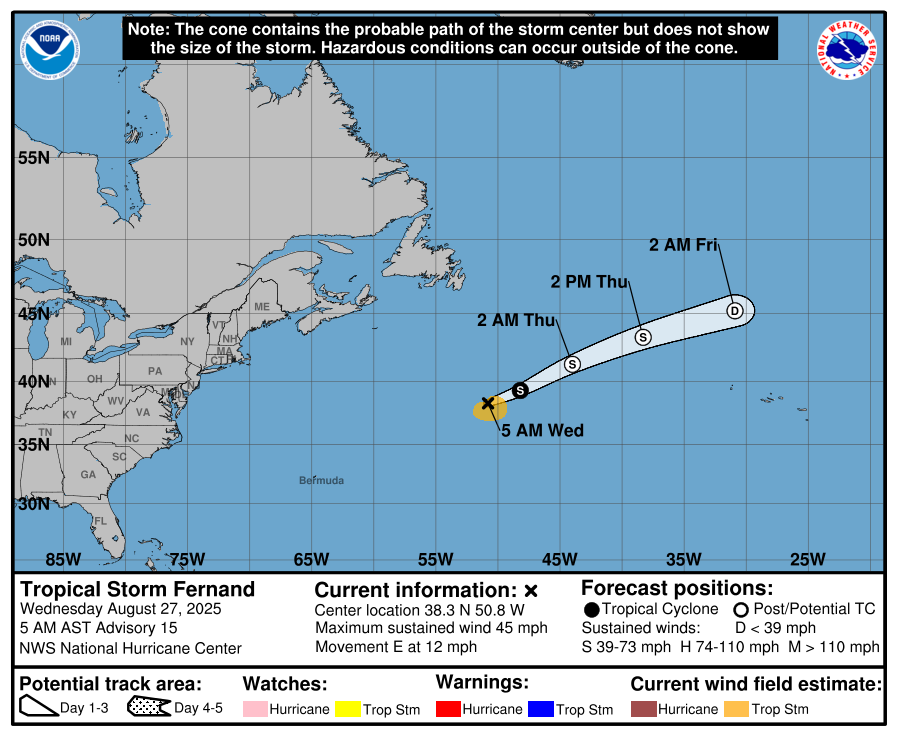
Tropical Storm Fernand continues on its merry way.
(NOAA/NHC)
Maximum sustained winds are 45 mph, and while it looks better than it did 24 hour ago, it’s still not in great shape. Expect to see Fernand go post-tropical by the end of today.
Fernand floating away. (Weathernerds.org)
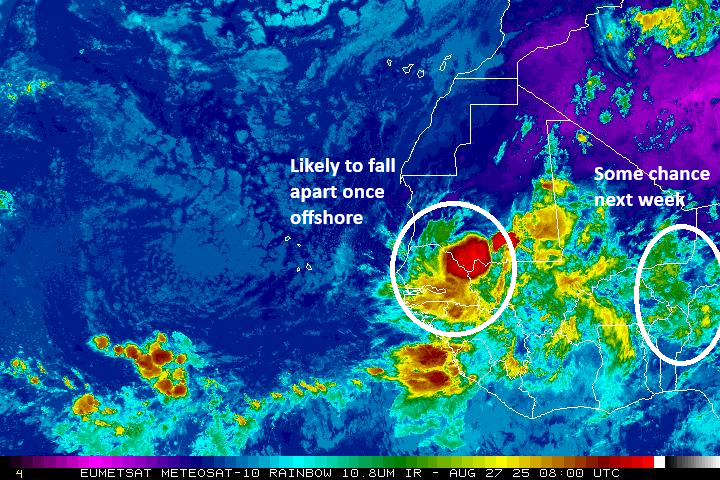
Behind Fernand, the Atlantic is quiet as a church mouse. While the next tropical wave to emerge off Africa looks kind of robust, it is going to likely fall apart once in the Atlantic.
The tropical wave about to emerge off Africa looks healthy, but it’s expected to falter once offshore. The lesser wave behind it exiting Nigeria may have better odds next week. (NOAA)
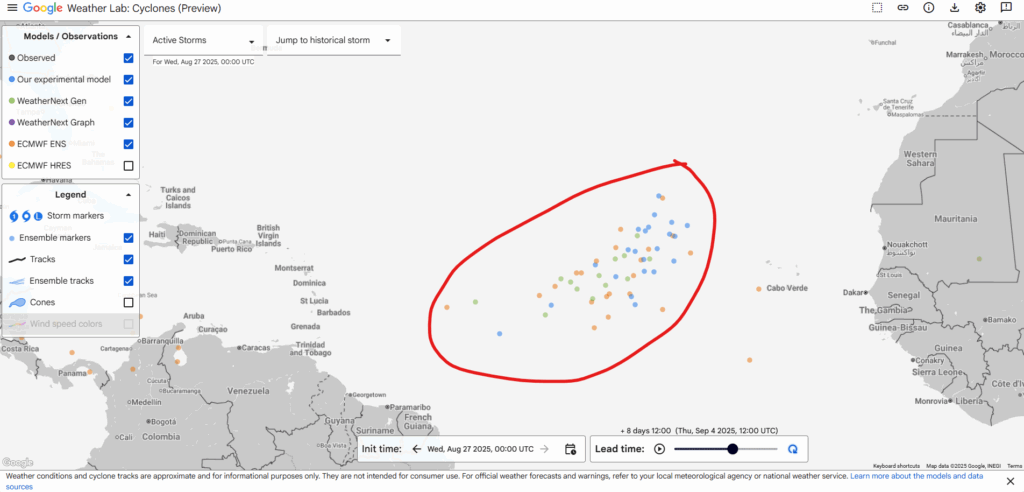
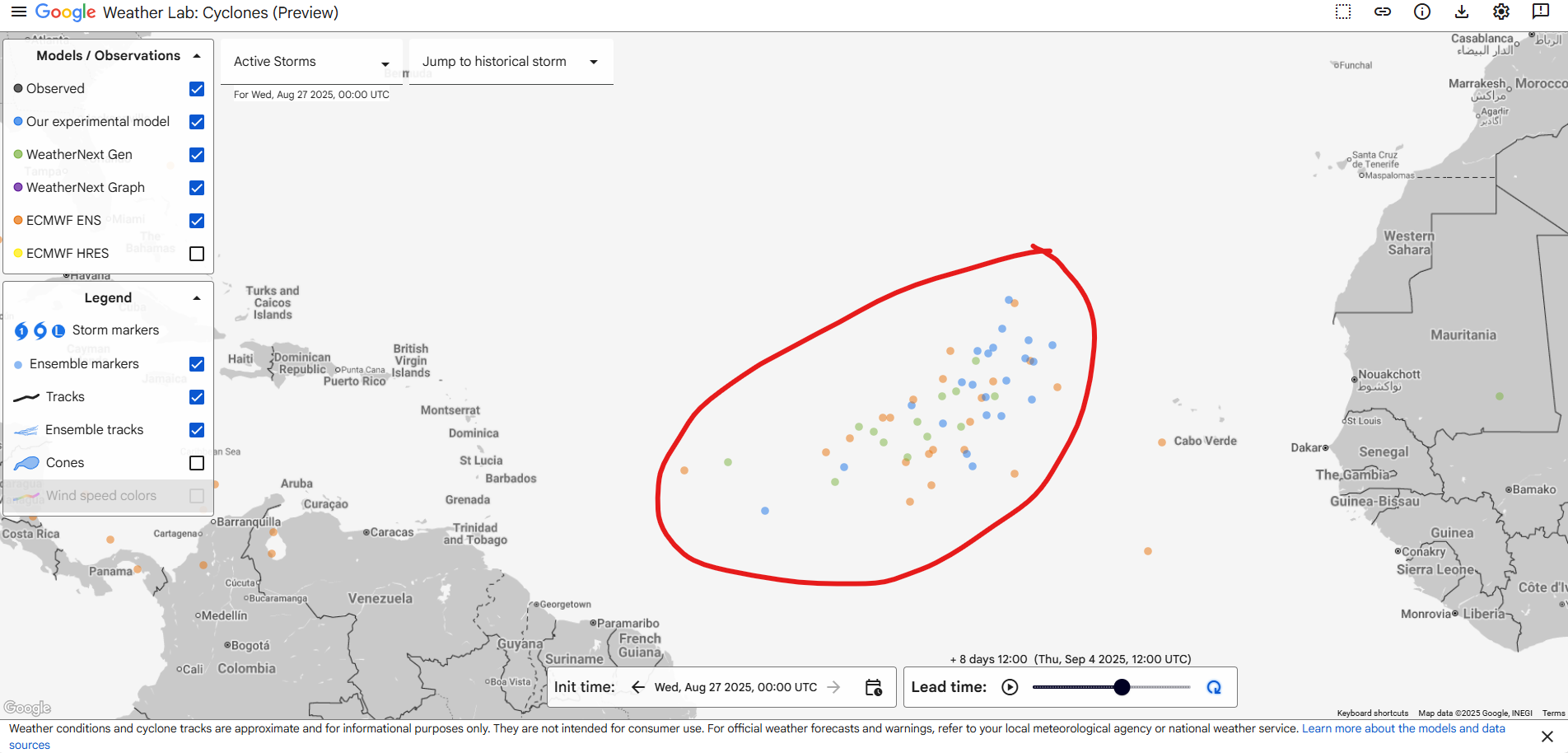
The wave that’s moving west out of Nigeria seems to be one that is getting some attention on the weather models. The AI models in particular seem to like this one’s odds of developing sometime next week. Any development would probably be sluggish due to a still generally hostile background state in the Atlantic. Again, the hostile background doesn’t mean things cannot develop; it means they’ll probably struggle somewhat, however.
Some European ensemble members, as well as several Google AI ensemble members suggest the wave emerging off Africa in several days may have some development odds next week. (Google)
Aside from that, we don’t note any specific threats in the tropics over the next week or two. We’ll keep watching.
Elsewhere: Monsoonal flex in the Northwest
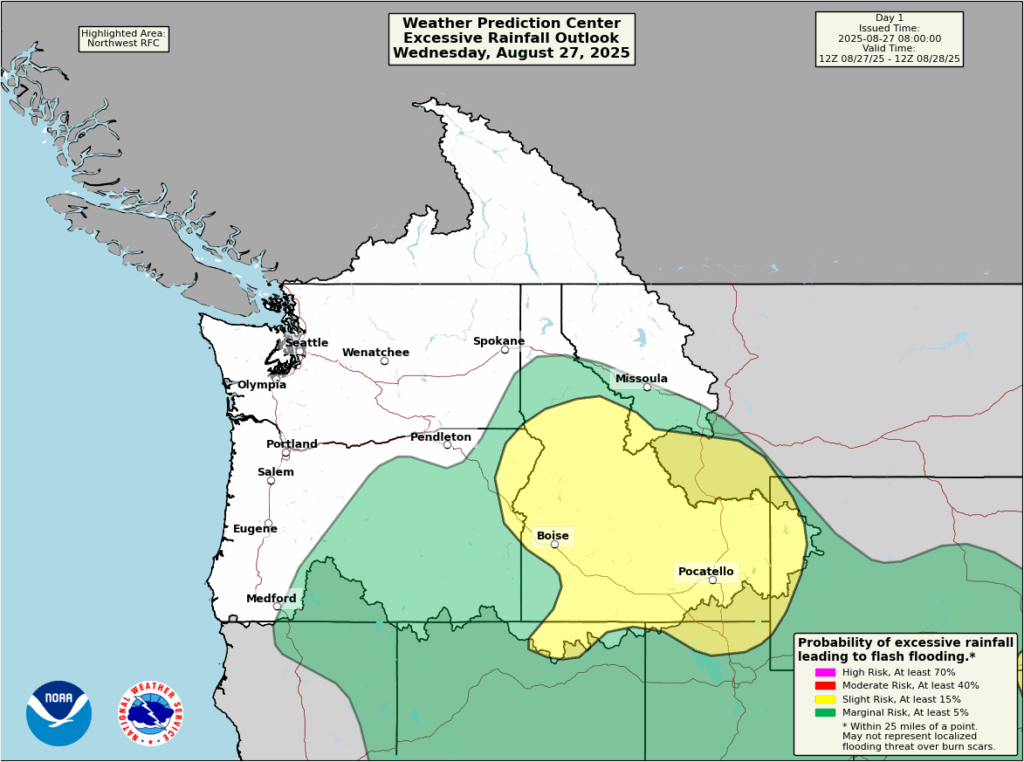
Today’s weather story will probably be in the West where abundant monsoon moisture will be in play in the Great Basin and Intermountain Region.
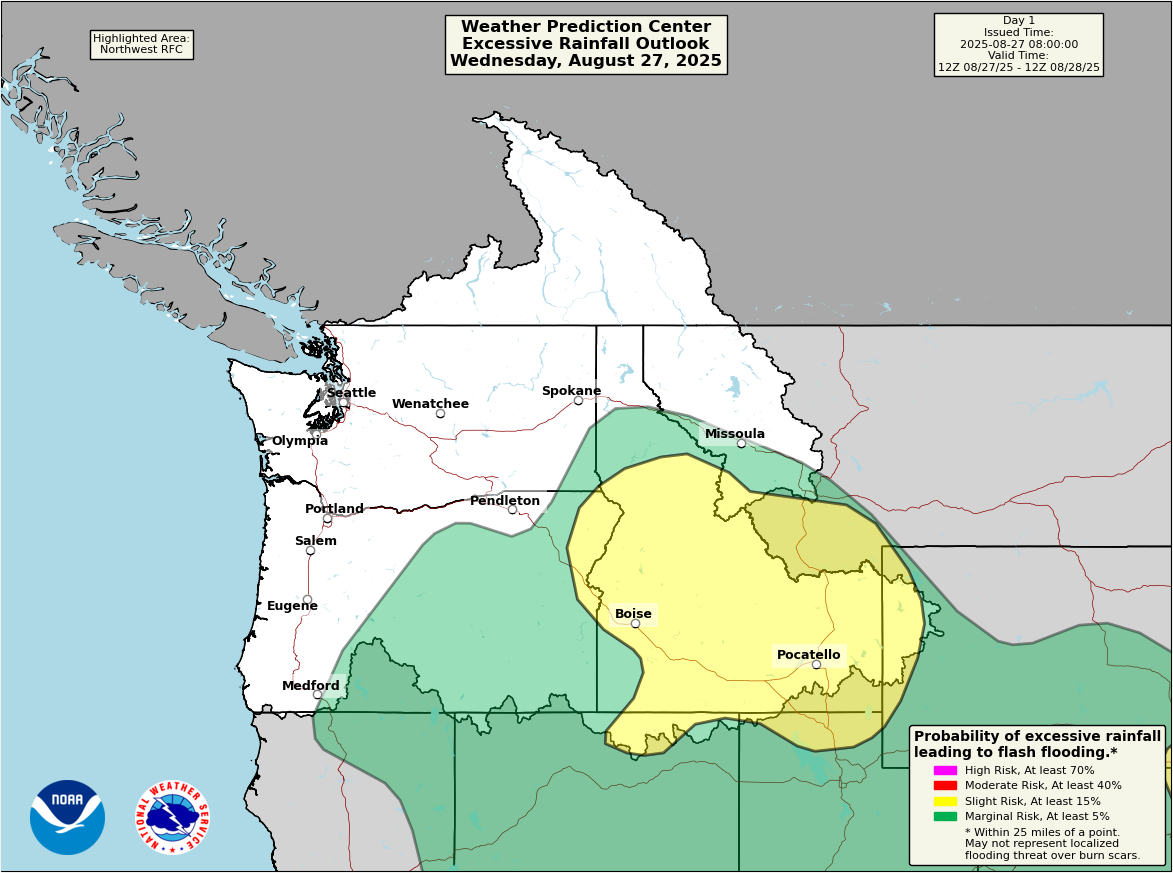
Locally heavy rain and flash flooding is possible across southern Idaho, eastern Oregon, and points south today. (NOAA WPC)
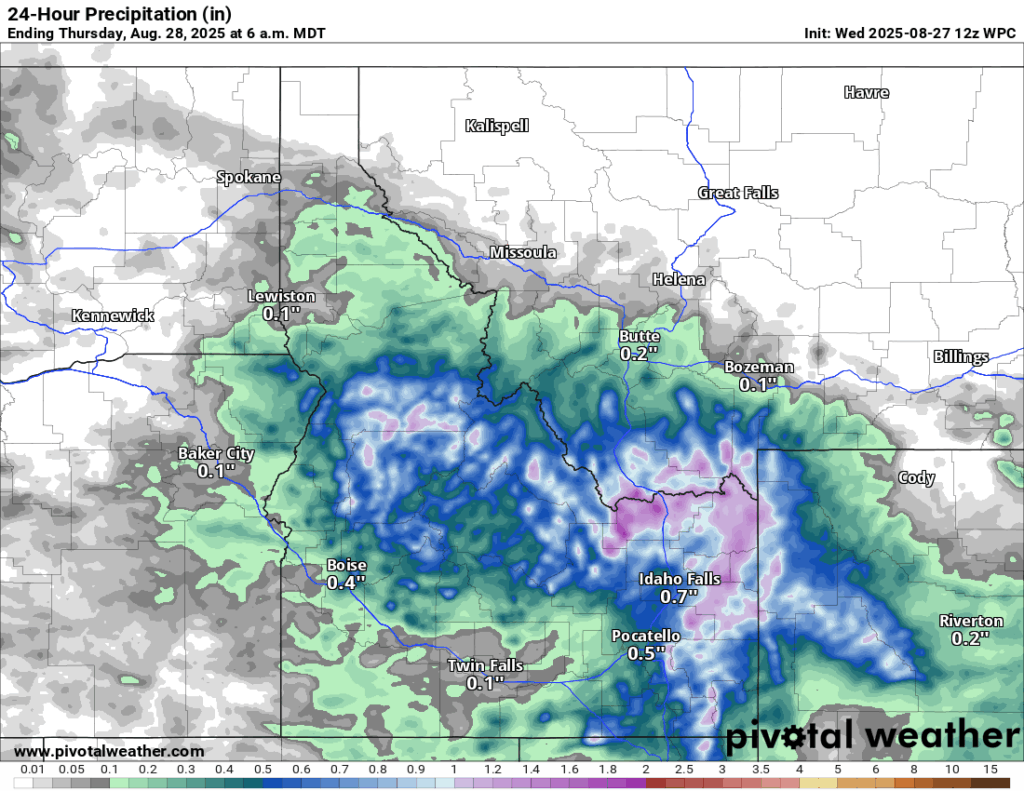
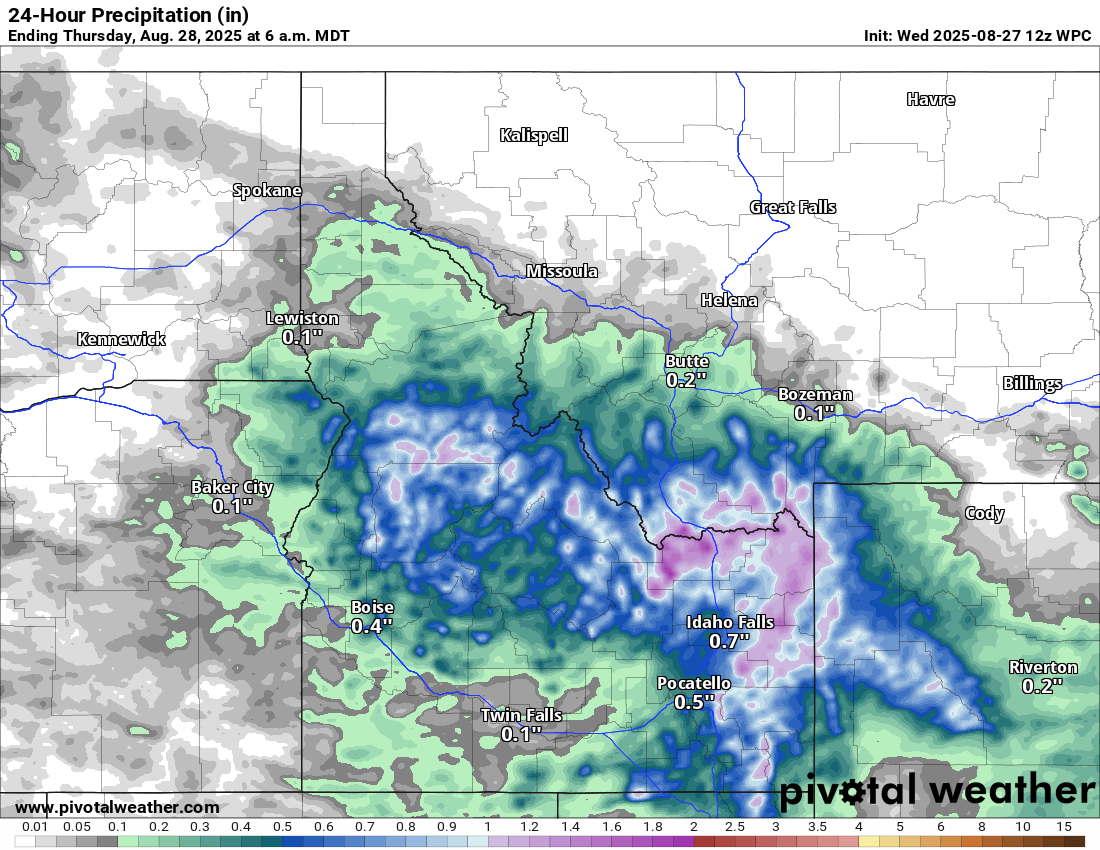
The focus of the heaviest rain may be on the Bitterroots and southern Idaho. Flood Watches extend from that area south into the Great Basin and northern Nevada. There’s a strong signal for 1 to 2 inches or locally higher amounts of rain in spots today, particularly in the Bitterroots. North-Central Idaho will also be in play for some of the heavier rain risk today.
Some locally heavy rain is likely across Idaho into the Bitterroot Mountains today, with isolated heavier rain south of here. (Pivotal Weather)
The heavier rain risk focuses back into Oklahoma and Arkansas tomorrow.
My current manager, Michael, was my peer and was recently promoted. Shortly after that, he rehired someone who had been recently laid off from our company, Dwight. Allegedly the layoff was due to elimination of his role, not for performance reasons. This was confirmed by the previous manager and HR. Michael and Dwight had actually started in the same new hire cohort, but obviously Michael’s career has advanced much more. I think Michael was “trying to help out a friend.”
The problems here were 1) this role is materially different than what Dwight had been doing — think accounting versus sales, 2) the interview panel (including me) did not think Dwight was suitable for the role; he really flubbed the interview with a bit of a “I already have this job” assumption, and 3) the role was junior accountant vs senior salesman, so a lower title and compensation to match, the rationale being that Dwight needs to learn the space. I expressed concerns about this but it was the Michael’s decision and I didn’t choose to fight the battle. HR also help bring this all about.
Fast forward several months and it’s not going well. Dwight is struggling with the basics of the role and even Michael sees he probably made a mistake. It’s not that Dwight isn’t trying, he is, but he doesn’t seem well suited for accounting; he doesn’t have a head for numbers. Because my team has to work with him, this is having a negative impact on us and is overall an impact on the larger team.
It’s not impossible that with more attention and mentoring Dwight could turn around, but my instincts tell me it’s unlikely and no one has the bandwidth to invest that kind of time. And then there’s the negative morale impact of an underperforming resource when everyone sees it — it’s not an issue we can ignore.
So the question is what to do. I see Dwight is on a trajectory towards a PIP. I feel bad about this, as it would leave Dwight with a terrible narrative and at a lower level than he was previously in a tough job market. That said, I don’t know what to do or to offer Michael as options.
Michael needs to have a candid conversation with Dwight about his concerns and whether Dwight is well-matched with the role. Who knows, it’s possible that Dwight is well-aware that he’s struggling and would welcome a candid conversation about it — but either way, it’s time for Michael to clearly name the pattern he’s seeing and move toward quickly figuring out whether Dwight is going to be able to do the job or not.
Sometimes it makes sense for a manager to invest in some intensive but short-term coaching to see if someone can get to where they need to be (generally weeks, not months). Other times it might be clear that that will just prolong things. Michael needs to assess the situation and decide if that makes sense or not. But the longer he avoids dealing with it, the worse it actually is for Dwight: if this turns into a two-month experiment that didn’t work out, Dwight can easily leave that off his resume but if it drags on for months and he’s eventually fired, it’s a different story. (Still not impossible to explain with “I tried out a new area of work that ended up not for me,” but it’s not doing him any favors to put him in that position.)
This is why hiring someone into a role they’re not well suited for isn’t always a kindness to them, even if Michael intended it that way.
2. Part-time employee keeps pushing us to buy products he’s creating
I am a full-time staff member at a medical school. I oversee a cadre of part-time teaching assistants who are not medical professionals but are trained to help students practice skills related to patient care, like communication and physical examination.
I have one TA who is really fantastic with the students and always gets rave reviews. He is paid at the top of the pay bracket. A few months ago, he told me that he wrote and self-published a lengthy workbook for medical students to help strengthen their “soft skills” like empathy and compassion. He asked if our faculty could offer this to students as a resource. While I felt his project was impressive, I didn’t feel comfortable sharing this with faculty, because he’s not a doctor and it was self-published. I turned him down by saying that sorry, but I have no control over what is taught in the curriculum. Then, he asked if he could lead development workshops for other teaching assistants, using the workbooks he developed. We host training and development sessions regularly, led by our full-time staff and faculty members. Our department is budgeted very strictly and we have to set our budget a year in advance. I told him that unfortunately we didn’t have the budget to compensate him for that. Now, I just received an email from him asking if our school would consider purchasing another product he designed.
It’s great that he is developing his own educational products/materials, but the thing is: even if we did have the budget, I wouldn’t want to pursue this. I’m just not comfortable with the way he keeps trying to sell his materials and services to me. To be frank, I find it pushy and annoying. I need to give him a firm “no” and ask him to stop trying to sell things to me! He is a great teaching assistant and I don’t want to burn any bridges. How do I ask him to stop without insulting him?
Any chance this poses conflict of interest issues you could cite (i.e., that you can’t buy products or other services from teaching assistants)? If so, that might be the easiest way to explain it.
If not: “We love having you as a teaching assistant, but I want to be up-front we’re not likely to buy other products or services from you. I don’t doubt their quality — it’s just an area that we already have covered.” If he continues to ask after that: “I’m sorry if I wasn’t clear earlier — we’re not the right target audience for these products and can’t accept additional sales pitches for them.”
3. Hiring test asks about depression
I’m in the later rounds of interviewing with a company that I’m really excited to potentially join. However, they just had me complete what is essentially a 200+ question personality quiz. I don’t love the idea of personality quizzes in hiring, but what really rubbed me the wrong way is that a few questions seemed to directly correlate with mental illness. For example, one question asked me to rank, from strongly disagree to strongly agree, if “I often feel blue,” which I believe is exactly what would appear on a medical questionnaire for depression.
Is it legal to judge candidates on how they answer questions that have a strong correlation to mental health, even if you’re not outright asking about a diagnosis? This quiz was done through some third-party software company touting the amazing potential of AI in hiring (barf), so I’m guessing they’ve done their research, but it feels so wrong to me.
Yes, someone could challenge that legally. It’s illegal to assess candidates on their answers to questions about health, including mental health. I would definitely not assume they’ve done their research to ensure they’re complying with the law; it’s incredibly common for employers to buy into pseudoscience personality tests without even thinking about whether they conflict with discrimination law.
In my residents association, I’m one of two people who need to complete a form when someone sells their house. Both of us are female. I had one solicitor (we are in UK) write to “Dear Sirs” when requesting the information. I provided it and at the bottom of the email I said, “Just to note, your email started ‘Dear Sirs’ and both the people you were addressing it to are female.” Their reply was again addressed to “Dear Sirs” and their explanation was that they were addressing the residents association. Last I checked, our residents association does not have a gender. My response to that was to take several days more than usual to respond with the follow-up as, given I’m not a client of theirs (and never will be), I didn’t have much standing to say anything more. I was tempted to reply that as I was not a Sir, I was unable to assist further but felt that was inflammatory. Thoughts?
Well, you could respond to his latest (and ridiculous) message with, “Our residents association includes women. Please correct the correspondence going forward.”
But personally I’d rather just write back to him and address it to “Dear Madam.”
5. Resumes when switching back to a previous career
I’ve been working for about 20 years. About five years ago, I switched careers to something related but different. Let’s say I was a teapot maker and left to focus on painting coffee mugs. It’s become clear that mug painting isn’t as fulfilling as I’d like, and I want to go back to teapots. How do I structure my resume to make my teapot work most prominent? My mug work isn’t completely irrelevant, so I don’t want to leave it off entirely.
You can have a Relevant Experience section that comes first (for the teapot work) and then an Other Experience section after that (for the mug work).
Content warning:Racist depiction of Indian/Native American/First Nations People
Hey, come on in here just a second. What's your name? Steve? Come on, have a seat. Look, Steve, eh, this Indian thing just isn't working out. We're not gonna do it anymore. #CowboyWho
This is an exceptional cover story that Susan has come up with, impossible to disprove, especially given how deep that grave the friends dug for Orzabal was.
DESTROY HISTORY: NEMS is finally in stock at Topatoco. You can also get it from Page 45 in Nottingham, which will (obviously) be a much cheaper option for customers in the UK. You can also pick up my two SOLVER books (the volume 1 collection and Circus Windows/Holiday Surprise) at both places.
PLUS! There is my first new Topatoco tshirt design since… 2016? As it’s been a very long time since I last did one, this is kind of an experiment. We just need to sell 30 to fund them. In black or watermelon. For all those who hate heat.
A Social Security Administration (SSA) official alleged in a whistleblower disclosure that DOGE officials created "a live copy of the country's Social Security information in a cloud environment that circumvents oversight."
Chuck Borges, the SSA's Chief Data Officer (CDO), "has become aware through reports to him of serious data security lapses, evidently orchestrated by DOGE officials, currently employed as SSA employees, that risk the security of over 300 million Americans' Social Security data," the Government Accountability Project said in a letter sent today to members of Congress and the US Office of Special Counsel. The nonprofit Government Accountability Project is representing Borges.
Although it has been widely reported that DOGE sought and obtained access to Social Security records in its attempt to find evidence of fraud, the letter to lawmakers said the live copy of SSA's database hasn't previously been disclosed. DOGE's actions were taken "under the authority of SSA Chief Information Officer (CIO) Aram Moghaddassi" and violate SSA protocols and policies, the letter said.
Rice University's Kinder Institute for Urban Research surveyed more than 9,800 residents in Harris, Fort Bend and Montgomery counties. More than 80% said they think the U.S. immigration system is not working well.
WASHINGTON—As they called attention to his alarmingly sallow complexion and rapidly deteriorating brain function, White House officials sought to quell speculation Monday over the bruising on President Donald Trump’s right hand by dismissing it as one of the least concerning parts of his body. “The discoloration on the president’s hand is superficial and no cause for worry—in fact, it is probably one of his healthiest anatomical regions,” said White House press secretary Karoline Leavitt, adding that the president’s doctors remain focused on far more urgent health issues, including his grossly bloated midsection, complete lack of bowel control, and hunched-over posture suggestive of a decomposing torso. “Rest assured, his hand is not what’s going to keep him from fulfilling his duties to the American people. Honestly, if all you are seeing is photos, you don’t even know about the stench. That will stick in your nightmares forever. There’s so much gas trapped under the president’s skin that we are praying he doesn’t rupture.” Officials confirmed the hand would be iced to alleviate the bruising, while the rest of his body would be “lightly embalmed.”
SPRINGDALE, UT—Beating himself up over a lifetime of wasted energy, a local hummingbird confirmed Tuesday that he felt like a huge fucking idiot after he saw a hawk gliding above him with close to no effort all. “What the hell am I doing continuously flitting around like a complete maniac?” said the male hummingbird, adding that his life would be so much easier if he simply let an air current carry him hundreds of miles and barely moved his goddamn wings at all. “Fuck, I feel so stupid. I wouldn’t need to eat so much nectar if I wasn’t beating my wings 80 times per second like a total dipshit. Ugh!! Why didn’t any of you assholes tell me about thermal drafts?” The utterly humiliated bird was later spotted attempting to gulp a whole fish out of water before he realized his tiny shitty beak was only good for lapping up nectar.
A longtime advisor to New York City Mayor Eric Adams was suspended from his reelection campaign after she handed a reporter a potato chip bag containing cash, an occurrence she claimed was an accident. What do you think?
“Nobody hands over a bag of sour cream and onion chips accidentally.”
Calvin Tribalat, Timeline Condenser
“She’ll be back on her feet working for Cuomo in no time.”
Audrey Ware, Unemployed
“I hate when you buy a big bag of chips and it turns out to be mostly cash.”
After a California resident tested positive for bubonic plague, likely contracted from a flea bite while camping, local health officials urged the public to take precautions. What do you think?
“With the nation’s humors this out of balance, I’m not surprised.”
Ray Dvorak, Systems Analyst
“As hard as it is to resist, people need to stop petting wild fleas.”
Sarah Devine, Tomato Slicer
“I thought we eradicated the witches that cause plague years ago.”
PALO ALTO, CA – Tech industry billionaire Jared Banks recently dismissed fears over artificial intelligence disrupting the labor market by insisting that AI is “just a tool”, while also himself being a massive tool. Banks, 27, is a colossal waste of space and also the inventor of GRABBR, a popular phone app which uses AI […]




 ALT
ALT