Shared posts

17 Sep 13:39

Why is the name of the Microsoft Wireless Notebook Presenter Mouse 8000 hard-coded into the Bluetooth drivers?

by Raymond Chen

Some time ago, people noticed that buried in the Windows Bluetooth drivers is the hard-coded name of the Microsoft Wireless Notebook Presenter Mouse 8000. What’s going on there? Does the Microsoft Wireless Notebook Presenter Mouse 8000 receive favorable treatment from the Microsoft Bluetooth drivers? Is this some sort of collusion?

No, it’s not that.

There is a lot of a bad hardware out there, and there are a lot of compatibility hacks to deal with it. You have CD-ROM controller cards that report the same drive four times or USB devices that draw more than 500mW of power after promising they wouldn’t. More generally, you have devices whose descriptors are syntactically invalid or contain values that are outside of legal range or which are simply nonsensical.

Most of the time, the code to compensate for these types of errors doesn’t betray its presence in the form of hard-coded strings. Instead, you have “else” branches that secretly repair or ignore corrupted values.

Unfortunately, the type of mistake that the Microsoft Wireless Notebook Presenter Mouse 8000 made is one that is easily exposed via strings, because they messed up their string!

The device local name string is specified to be encoded in UTF-8. However, the Microsoft Wireless Notebook Presenter Mouse 8000 reports its name as Microsoft⟪AE⟫ Wireless Notebook Presenter Mouse 8000, encoding the registered trademark symbol ® not as UTF-8 as required by the specification but in code page 1252. What’s even worse is that a bare ⟪AE⟫ is not a legal UTF-8 sequence, so the string wouldn’t even show up as corrupted; it would get rejected as invalid.

Thanks, Legal Department, for sticking a ® in the descriptor and messing up the whole thing.

There is a special table inside the Bluetooth drivers of “Devices that report their names wrong (and the correct name to use)”. If the Bluetooth stack sees one of these devices, and it presents the wrong name, then the correct name is substituted.

That table currently has only one entry.

The post Why is the name of the Microsoft Wireless Notebook Presenter Mouse 8000 hard-coded into the Bluetooth drivers? appeared first on The Old New Thing.

17 Sep 13:34

Pluralistic: No such thing as selective censorship resistance (16 Sep 2025)

by Cory Doctorow


Today's links


An elderly white couple photographed in the 1960s. The man has his hand around the woman's shoulder. Both have had their mouths duct-taped shut. The man's gag bears a Google logo; the woman's gag bears a Meta logo. Over the man's shoulder rises the Mastodon mascot, blindfolded. Over the woman's shoulder rises the Bluesky butteryfly, also blindfolded. Emerging from the background is a 'code waterfall' effect as seen in the credit sequences of the Wachowskis' 'Matrix' movies.

No such thing as selective censorship resistance (permalink)

If you have a sufficiently horrible boss, you might have heard them use the phrase, "One throat to choke," by which they mean, "We must arrange this project so there's one person I can blame and punish if it goes awry.

The problem with "one throat to choke" is that this is another word for chokepoint. If the person who has ultimate authority over the system somehow manages to evade your discipline, there's no one else you can approach to resolve any arguments about how the system should work. "One throat to choke" is a single point of failure. That can be a nice arrangement if you're in charge of that chokepoint, but if not, it means you're SOL.

The digital world is in the process of bifurcating. The dying, legacy systems are the zuckermuskian, centralized ones, where there's always one throat to choke. If you don't like the moderation, recommendation, or other policies on Google, Twitter, Facebook or Amazon, you know exactly who to blame. If you're a lawmaker or a regulator, you know exactly who to drag into court.

Then there's the new, exciting, free and open digital technology that's crawling out of the half-dead carcass of Big Tech: federated and decentralized systems like Mastodon (and the Fediverse) and Bluesky (and the Atmosphere). While both of these networks have official maintainers who oversee their open source software projects, and while both groups of maintainers also run the servers that dominate their networks, you can absolutely join and participate without the consent of the organizations that created and maintain them, and they can't stop you or kick you off.

That's what decentralization means – if you don't like a user or their behavior, there's no manager to speak to in order to have them removed. Sure, a user can be kicked off of some servers, even all the servers, but the user can still stand up their own server. So long as there are other users, somewhere on the internet, who want to interact with that person, they can continue to connect with one another.

Now, you'd think that the Maga movement would love this – and they do…to a point. Trump's Truth Social is just a Mastodon server, albeit one that very few other Mastodon servers have any connections to. But the Maga movement is incapable of imagining a world in which the power it arrogates to itself will ever fall into the hands of its enemies. They want the power to send troops into cities they don't like, to federally dictate election procedures, to fire any federal official without cause, to override Congress's budgetary edicts, to be insulated from all liability irrespective of criminality.

Maga desires these powers within the borders of the United States because it intends to abolish free and fair elections and install a dictatorship, which means they won't have to worry about Democrats ever controlling the presidency and turning those weapons around.

But even if they manage this trick in the USA, they won't be able to pull it off on the internet. There are simply too many territories in which federated, decentralized services can domicile themselves, places that are not only outside America's jurisdiction, but where the local authorities are hostile to the idea of extraterritorial intrusions by the US state on their domestic affairs.

The American culture warriors, obsessed with the idea that tech platforms have shadow banned, downranked, deplatformed and demonetized them, want to bring Big Tech to heel. And since each Big Tech company has just one throat to choke, they think they can do it.

Take "age verification," the latest social contagion sweeping through authoritarian governments around the world. In the name of keeping kids from seeing stuff that's not kid-friendly online (a perfectly reasonable goal), governments are demanding that tech companies somehow deduce the ages of their users and block them from seeing adult materials. Some age verification proponents claim that it's possible to verify a user's age without creating a massive privacy catastrophe that reveals the browsing habits of every internet user, of every age. These people are wrong:

https://pluralistic.net/2025/08/14/bellovin/#wont-someone-think-of-the-cryptographers

The only way to verify that a user is a child is to verify the user, which means performing extraordinarily invasive checks on every internet user, and storing the results of those checks, and, inevitably, leaking the result of those checks.

The Big Tech companies are delighted by this. Google and Meta have both offered to do a kind of digital phrenology on their users to determine their ages. After all, they spy on us so much that they can probably make a good guess about our ages. And if they guess wrong, well, no biggie, they'll just block all the edge cases and force users to provide them with even more sensitive data.

But the future-proof, federated, decentralized services can't do age verification. Oh, sure, some of the servers in these federations can verify their users' age, and they might have to, because you can always find that single throat to choke for the people running the main Mastodon and Bluesky servers. But you can use Mastodon and Bluesky without using those servers – and they can't stop you.

This is something that the Turkish dictator Recep Tayyip Erdoğan discovered last spring, when he ordered Bluesky to block information about his political rivals. All Bluesky can do in these cases is flag some messages as "banned in Turkiye" and then turn on the "block banned in Turkiye posts" filter for Turkish accounts. Those users can just turn that filter off, or avail themselves of a third-party client that doesn't auto-subscribe them to "block banned content" filters:

https://gizmodo.com/bluesky-just-bowed-to-censorship-demands-in-turkey-but-theres-a-loophole-2000593628

That's what it means for a service to be a protocol, not a platform. It means you can't demand to speak to the manager of the protocol if you don't like how someone is using it. It means there isn't a single throat to choke:

https://knightcolumbia.org/content/protocols-not-platforms-a-technological-approach-to-free-speech

Today, the new, future-proof federated services are trying to figure out how to comply with age verification orders. Bluesky has announced that it will age verify UK users:

https://www.theverge.com/news/704468/bluesky-age-verification-uk-online-safety-act

But you don't have to interact with the Bluesky servers to use Bluesky. While Bluesky was (very) slow off the mark to enable the tooling that would allow anyone to talk to anyone else using Atproto (the underlying protocol) without Bluesky's permission, that day has arrived now. There are now Bluesky (the service) implementations that are entirely separated from the authority of Bluesky (the company), most notably Blacksky, created by and for Black social media users who lived through Musk's enshittification of Black Twitter and won't get fooled again:

https://www.techdirt.com/2025/08/27/techdirt-podcast-episode-428-blacksky-demonstrates-the-promise-of-open-social-media-protocols/

Meanwhile, Mastodon (the organization) has said that it doesn't have "the means" to comply with age verification rules in Mississippi:

https://techcrunch.com/2025/08/29/mastodon-says-it-doesnt-have-the-means-to-comply-with-age-verification-laws/

The Mastodon server operated by the Mastodon organization has a policy barring under-16s from getting an account there. But there are many, many Mastodon servers (including, you'll recall, Truth Social) and they are all technically capable of talking with one another. Even if Mastodon (the organization) implemented some kind of invasive age verification on its server, other organizations – so distant from Mississippi as to be beyond legal retribution – could sign up users of any age, at its discretion.

One wrinkle here is whether there is an "enforcement nexus" between one of these independent Mastodon or Bluesky servers and a government seeking to impose age verification or other censorship policies. If you're running one of these servers, you wanna be sure your throat is out of choking range of these governments:

https://pluralistic.net/2023/03/05/theyre-still-trying-to-ban-cryptography/

The easiest way to do this is to not have any personnel or assets in territories controlled by governments seeking to impose censorship requirements. Large corporations whose investors made a bet on global domination find this tradeoff difficult to make. They want to open sales offices in every country.

But co-ops, individual tinkerers and small businesses typically don't have assets or personnel in a lot of countries or states, and avoiding the censorious ones doesn't pose much of a challenge.

The other enforcement nexus to worry about isn't enforcement against a server's operators, but rather, enforcement against its data. Territories with national firewalls (or heavily concentrated ISPs who represent a tractable number of chokeable throats) can block noncompliant servers from their users (who might or might not avail themselves of VPNs to evade these blocks).

There aren't many national firewalls, and enumerating all the noncompliant servers in the Fediverse is a big chore for their operators (less so for all the noncompliant Atmostphere servers, because there's just not that many of those – yet). On the other hand, the mobile device duopoly of Google and Apple represent a pair of trivially chokeable throats that can be used to extinguish any app that displease a country's censors (all the more reason to make everything web-first and treat apps as unreliable adjuncts to core web functionality).

But there's one more potential chokepoint: to the extent that Bluesky (the service) or Mastodon (the service) maintain some nexus of control over users, even users on independent servers, they could come under pressure to terminate users that displease governments. Now, Mastodon has no such control over users, and if it tried to exert that control (for example, by pressuring an independent server to terminate their users' access), they could be sued for tortious interference with contract.

Unfortunately, Bluesky has chosen to insulate itself from that hedge against being the chokeable throat that is used as a means to exerting pressure on independent servers in the Atmosphere. Bluesky's Terms of Service trap all of its users in a "binding arbitration" waiver that forces them to surrender their right to sue. That means that if Bluesky were to threaten Blacksky in a bid to force it to do age verification or engage in some other form of censorship, anyone involved with Blacksky who ever created a Bluesky account would be unable to use to courts to defend themselves:

https://pluralistic.net/2025/08/15/dogs-breakfast/#by-clicking-this-you-agree-on-behalf-of-your-employer-to-release-me-from-all-obligations-and-waivers-arising-from-any-and-all-NON-NEGOTIATED-agreements

(However, if you set up a Bluesky server without ever joining Bluesky (the service) and clicking through its ToS, you're golden.)

Of course, none of this matters to Maga – but it should. Decentralized systems with no readily chokeable throats are good for people with disfavored views, and that includes a lot of the Maga movement. Remember, Trump's agenda is incredibly unpopular:

https://navigatorresearch.org/wp-content/uploads/2025/04/Navigator-Topline-F04.07.25.pdf

Someday, Maga is going to find that their enemies have found the right throat to choke to silence them. But Maga's useful idiots just keep on stepping on this rake – these are the same self-owning fools who opposed municipal fiber and thus ensured that if just a handful of giant ISPs decided to deplatform you, you'd disappear from the internet:

https://pluralistic.net/2022/12/15/useful-idiotsuseful-idiots/#unrequited-love

Bluesky users were furious when JD Vance joined the service. Maga culture warriors were furious when Bluesky users called for his account to be terminated. Both groups are nuts. If Bluesky lives up to its promise – if it becomes an unchokeable, future-proof, decentralized social media protocol, and not merely a platform, then there's no way to kick JD Vance off Bluesky (the service). All you can do is demand that Bluesky (the server) cut off his account, whereupon he will immediately decamp to another server where he is more welcome, and still be able to communicate with any Bluesky user who wants to hear from him.

Progressives should want this, because it's far more likely that Bluesky will be pressured to terminate users for failing to be insufficiently demonstrative in their anguish over the Charlie Kirk shooting than it is that Bluesky will be pressured to terminate the Vice President of the USA. But Conservatives should want this too – because if they're really worried about "deplatforming" and "Big Tech censorship," then they should be trying to create a new internet where deplatforming and Big Tech censorship are impossible – not an internet where they decide who gets deplatformed and censored.


Hey look at this (permalink)


A shelf of leatherbound history books with a gilt-stamped series title, 'The World's Famous Events.'

Object permanence (permalink)

#20yrsago TiVo’s “accidental” no-save locks applied to more programming https://memex.craphound.com/2005/09/16/tivos-accidental-no-save-locks-applied-to-more-programming/

#20yrsago Finnish Culture Minister: citizens concerned about copyright are “terrorists” https://hietanen.typepad.com/copyfraud/2005/09/the_story_of_fi.html

#20yrsago Kim Stanley Robinson on eco-disasters on Earth and Mars https://www.theguardian.com/books/2005/sep/14/sciencefictionfantasyandhorror.sarahcrown

#20yrsago WIPO wants to give webcasters the right to steal from public domain, Creative Commons and GPL http://www.cptech.org/wipo/15sep05letter2usptoloc.html

#15yrsago Astronauts’ fingernails fall off https://web.archive.org/web/20100916000752/http://news.nationalgeographic.com/news/2010/09/100913-science-space-astronauts-gloves-fingernails-injury/

#15yrsago UK government hands £500M copyright enforcement and censorship tab to nation’s Internet users https://arstechnica.com/tech-policy/2010/09/should-isps-pay-for-p2p-warning-letters-uk-says-yes/

#15yrsago Multinational record industry shill calls Canada’s new copyright bill “a license to steal” https://web.archive.org/web/20100918101200/https://www.michaelgeist.ca/content/view/5304/125/

#15yrsago Blu-Ray falls: HDCP key crack confirmed https://www.pcmag.com/archive/hdcp-master-key-confirmed-blu-ray-content-vulnerable-254650

#10yrsago For the first time ever, a judge has invalidated a secret Patriot Act warrant https://www.calyxinstitute.org/news/2015/federal-court-invalidates-11-year-old-fbi-gag-order-national-security-letter-recipient-nicholas

#10yrsago Vivienne Westwood drives a tank to David Cameron’s house https://www.theguardian.com/fashion/2015/sep/11/vivienne-westwood-tank-protest-fracking-david-cameron-chadlington

#10yrsago EFF scores a giant victory for fair use and dancing babies https://www.eff.org/press/releases/important-win-fair-use-dancing-baby-lawsuit

#10yrsago Tim Wu joins the New York Attorney General’s office https://www.nytimes.com/2015/09/14/nyregion/tim-wu-open-internet-advocate-joins-new-york-attorney-generals-office.html

#10yrsago Australian PM Tony Abbot ousted in own-party coup https://www.theguardian.com/australia-news/2015/sep/14/malcolm-turnbull-to-be-australias-new-pm-after-ousting-tony-abbott-in-party-vote

#10yrsago Ashley Madison users chose passwords like “whyareyoudoingthis” https://blog.cynosureprime.com/2015/09/csp-our-take-on-cracked-am-passwords.html

#10yrsago PA Homeland Security gave names of anti-drill activists to drilling company https://web.archive.org/web/20100916211045/http://www.centredaily.com/2010/09/14/2206710/documents-show-homeland-security.html

#10yrsago Naomi Klein, David Suzuki, Leonard Cohen, Donald Sutherland and Elliot Page’s vision for a better Canada https://leapmanifesto.org/en/the-leap-manifesto/

#10yrsago Step Aside, Pops: a new Hark! A Vagrant! collection that delights and dazzles https://memex.craphound.com/2015/09/15/step-aside-pops-a-new-hark-a-vagrant-collection-that-delights-and-dazzles/

#5yrsago Obscure Texas election could change the world https://pluralistic.net/2020/09/15/shorter-brother/#Chrysta-Castaneda

#5yrsago Tax havens and monopolies https://pluralistic.net/2020/09/15/shorter-brother/#tax-havens

#5yrsago Levels of Interoperability https://pluralistic.net/2020/09/14/they-knew/#interop

#5yrsago How Big Oil lied about "recyclable" plastics https://pluralistic.net/2020/09/14/they-knew/#doing-it-again

#5yrsago Board unilaterally sells Mountain Equipment "Co-op" to US private equity https://pluralistic.net/2020/09/16/spike-lee-joint/#casse-le-mec

#5yrsago Spike Lee made a David Byrne concert movie https://pluralistic.net/2020/09/16/spike-lee-joint/#american-utopia

#1yrago Anti-cheat, gamers, and the Crowdstrike disaster https://pluralistic.net/2024/09/16/gamer-gate/#descartes-revenge


Upcoming appearances (permalink)

A photo of me onstage, giving a speech, pounding the podium.


A screenshot of me at my desk, doing a livecast.

Recent appearances (permalink)


A grid of my books with Will Stahle covers..

Latest books (permalink)


A cardboard book box with the Macmillan logo.

Upcoming books (permalink)

  • "Canny Valley": A limited edition collection of the collages I create for Pluralistic, self-published, September 2025
  • "Enshittification: Why Everything Suddenly Got Worse and What to Do About It," Farrar, Straus, Giroux, October 7 2025
    https://us.macmillan.com/books/9780374619329/enshittification/

  • "Unauthorized Bread": a middle-grades graphic novel adapted from my novella about refugees, toasters and DRM, FirstSecond, 2026

  • "Enshittification, Why Everything Suddenly Got Worse and What to Do About It" (the graphic novel), Firstsecond, 2026

  • "The Memex Method," Farrar, Straus, Giroux, 2026

  • "The Reverse-Centaur's Guide to AI," a short book about being a better AI critic, Farrar, Straus and Giroux, 2026


Colophon (permalink)

Today's top sources:

Currently writing:

  • "The Reverse Centaur's Guide to AI," a short book for Farrar, Straus and Giroux about being an effective AI critic. FIRST DRAFT COMPLETE AND SUBMITTED.
  • A Little Brother short story about DIY insulin PLANNING


This work – excluding any serialized fiction – is licensed under a Creative Commons Attribution 4.0 license. That means you can use it any way you like, including commercially, provided that you attribute it to me, Cory Doctorow, and include a link to pluralistic.net.

https://creativecommons.org/licenses/by/4.0/

Quotations and images are not included in this license; they are included either under a limitation or exception to copyright, or on the basis of a separate license. Please exercise caution.


How to get Pluralistic:

Blog (no ads, tracking, or data-collection):

Pluralistic.net

Newsletter (no ads, tracking, or data-collection):

https://pluralistic.net/plura-list

Mastodon (no ads, tracking, or data-collection):

https://mamot.fr/@pluralistic

Medium (no ads, paywalled):

https://doctorow.medium.com/

Twitter (mass-scale, unrestricted, third-party surveillance and advertising):

https://twitter.com/doctorow

Tumblr (mass-scale, unrestricted, third-party surveillance and advertising):

https://mostlysignssomeportents.tumblr.com/tagged/pluralistic

"When life gives you SARS, you make sarsaparilla" -Joey "Accordion Guy" DeVilla

READ CAREFULLY: By reading this, you agree, on behalf of your employer, to release me from all obligations and waivers arising from any and all NON-NEGOTIATED agreements, licenses, terms-of-service, shrinkwrap, clickwrap, browsewrap, confidentiality, non-disclosure, non-compete and acceptable use policies ("BOGUS AGREEMENTS") that I have entered into with your employer, its partners, licensors, agents and assigns, in perpetuity, without prejudice to my ongoing rights and privileges. You further represent that you have the authority to release me from any BOGUS AGREEMENTS on behalf of your employer.

ISSN: 3066-764X

17 Sep 13:05

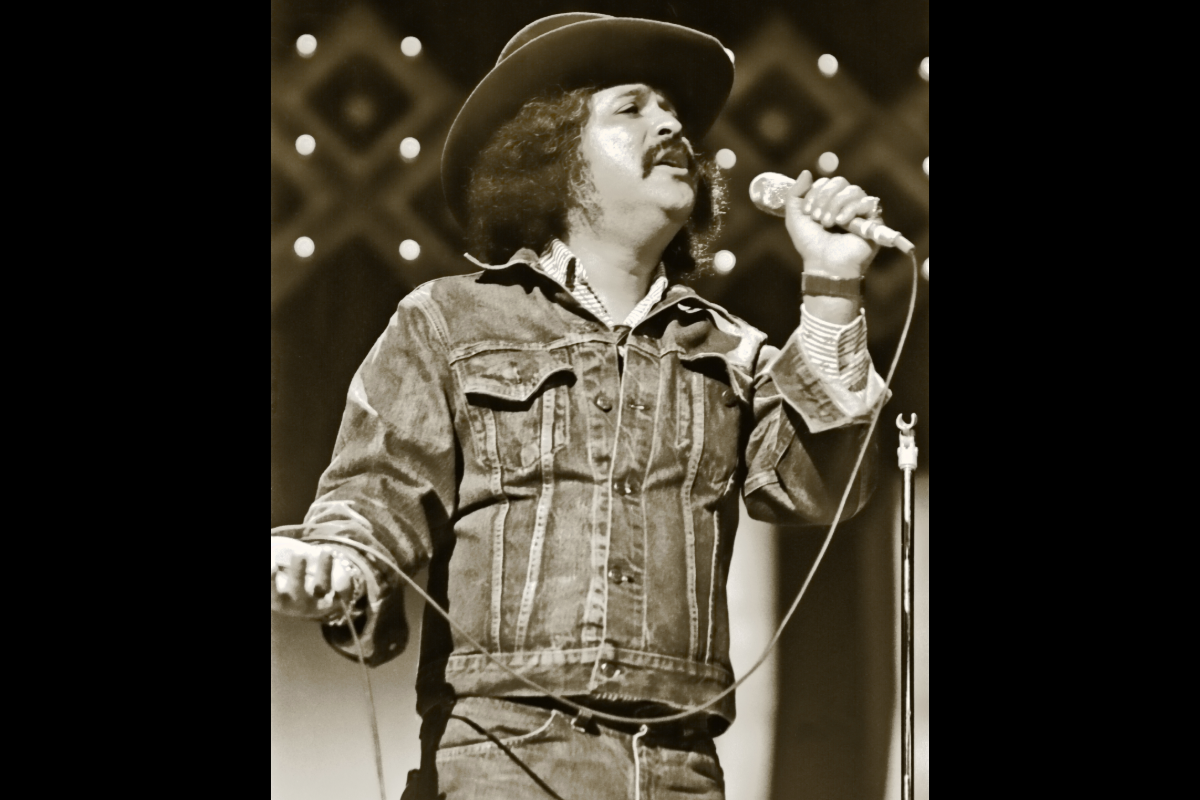
Freddy Fender’s journey to the top of the charts

by Gabby Munoz
Fender's "Before the Next Teardrop Falls" in 1974 proved that Latino artists could break out in markets other than Tejano.
17 Sep 12:58

Lina Hidalgo, Harris County chief executive, won’t seek reelection

by By Alejandro Serrano
The progressive Democrat’s upset win at the age of 27 established her as a rising star. But her ascent was stunted in recent years amid clashes with fellow Democrats and unwavering GOP scrutiny.
17 Sep 12:56

EPA approves long-awaited plan to clean up San Jacinto River waste pits near Houston

by Kyle McClenagan
The pits — located east of Houston in the Channelview area — contain cancer-causing chemicals called dioxins that have repeatedly been released by flooding and erosion. The pits were built in the 1960s to store hazardous waste from a nearby paper mill.
17 Sep 12:56

‘True to her principles’: Harris County leaders reflect on Lina Hidalgo’s tenure as county judge

by Sarah Grunau
Hidalgo's two-term stint as county judge has been marked by successes, such as helping Houston-area residents navigate the COVID-19 pandemic, and public spats with other local elected officials, including fellow Democrats.
17 Sep 12:54

The next Atlantic depression may soon form but is not a land threat, while a coastal storm pounds the Mid-Atlantic coast

by Matt Lanza

In brief: Invest 92L is on the cusp of becoming a tropical depression later today or tomorrow in the Atlantic. Neither it nor the wave behind it appear to be land threats right now. A coastal storm will deliver wind, tidal flooding, and heavy rain to the Virginia Tidewater and northern Outer Banks today and tonight. Mario’s moisture will play a role in a very, very active pattern for California beginning tomorrow.

Invest 92L

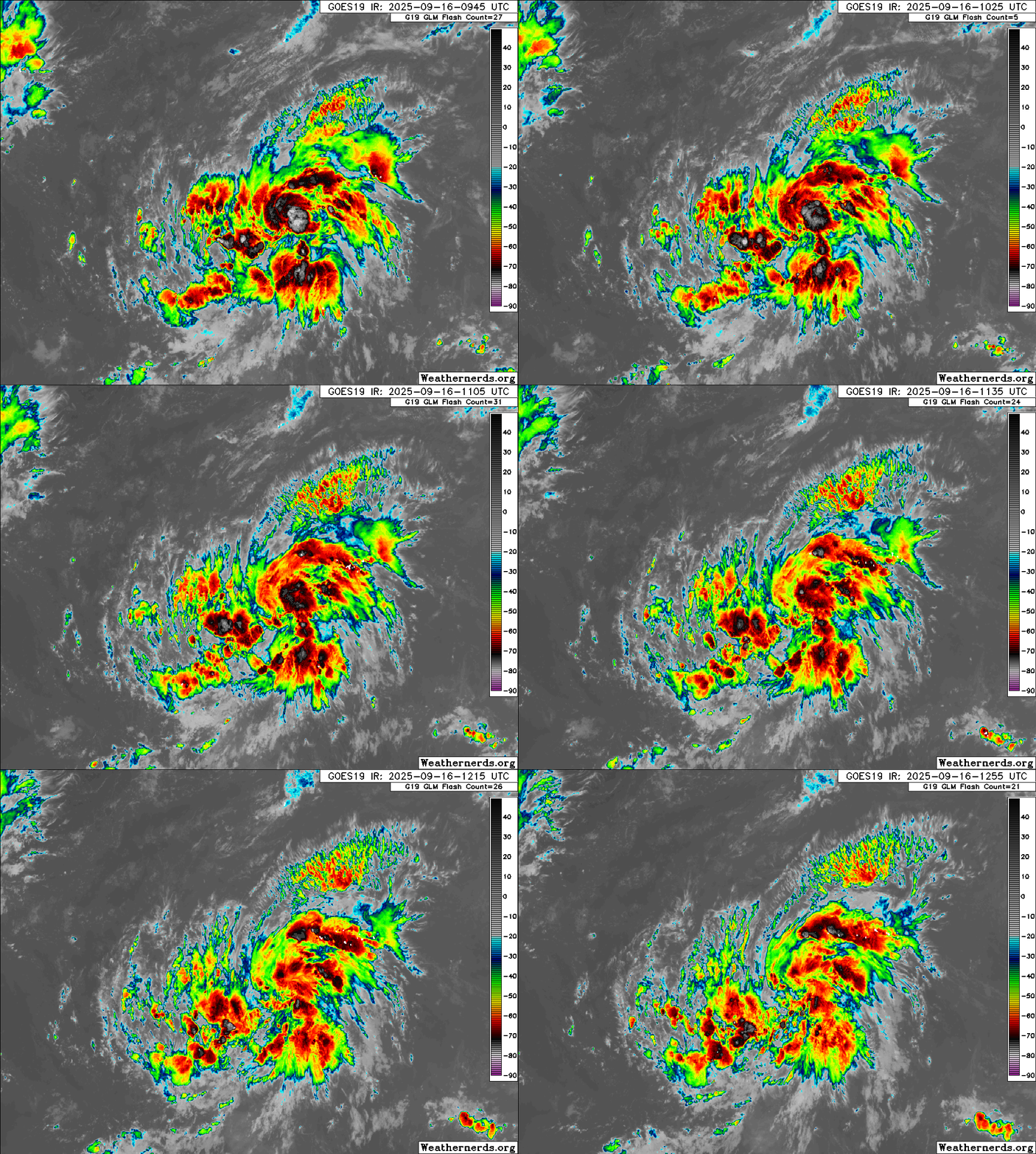
We got the invest overnight. The Atlantic tropical wave is now designated Invest 92L, and it looks as though this is on its way to getting an upgrade at some point in the next 12 to 36 hours.

Invest 92L looks like it is quite close to making tropical depression status in the open Atlantic. (Weathernerds.org)

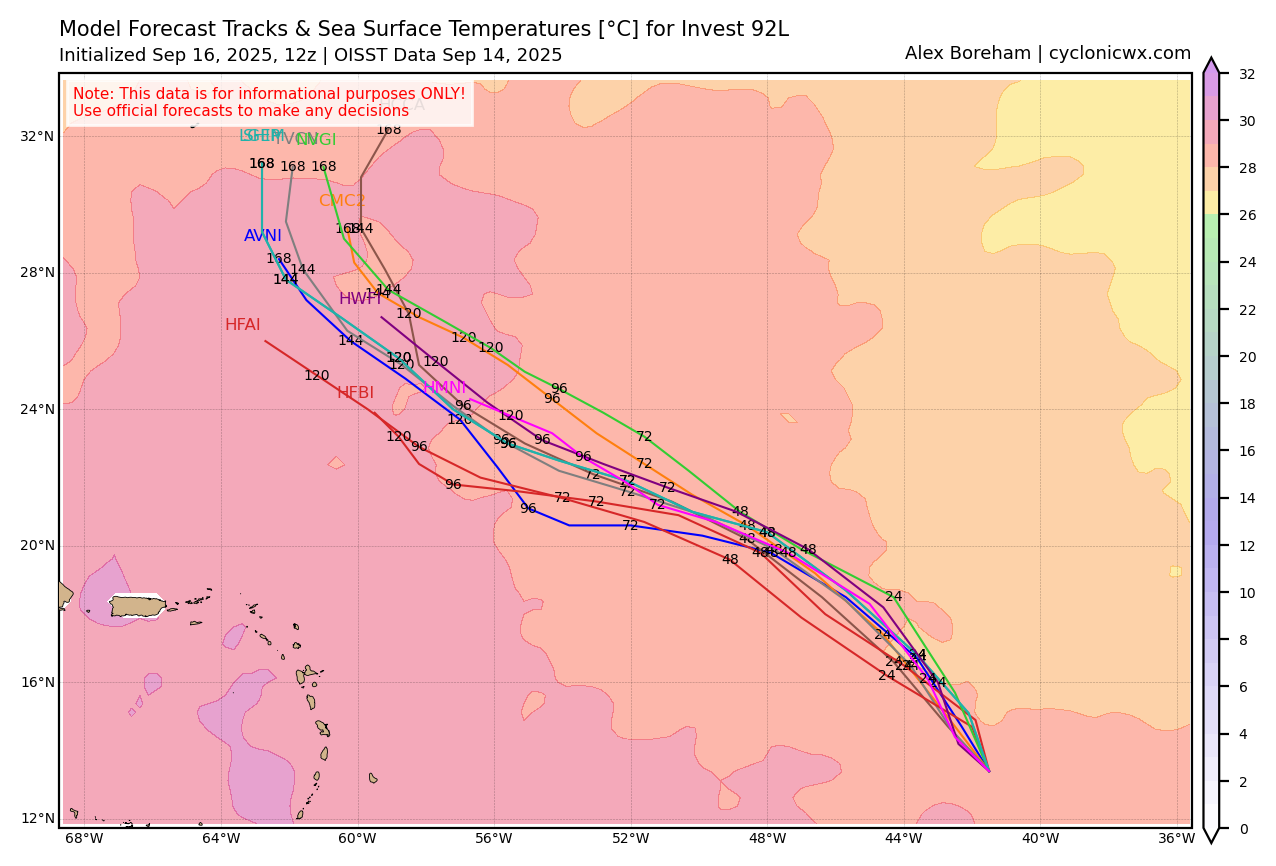
Over the next week or so, 92L will track west-northwest or due northwest in the Atlantic, tracking over gradually warming water.

Tropical model forecast tracks for Invest 92L with sea-surface temperatures underlaid show that the system will be encountering at least favorable water temperatures over the next 5 to 7 days. (Cyclonicwx.com)

The current forecast track shows minimal concern for any land mass. Bermuda can’t be entirely ruled out here, but that’s at least 6 to 7 days out. For now, this isn’t one to worry about, but we’ll continue to watch to be safe. The next name on the list remains Gabrielle.

Behind 92L

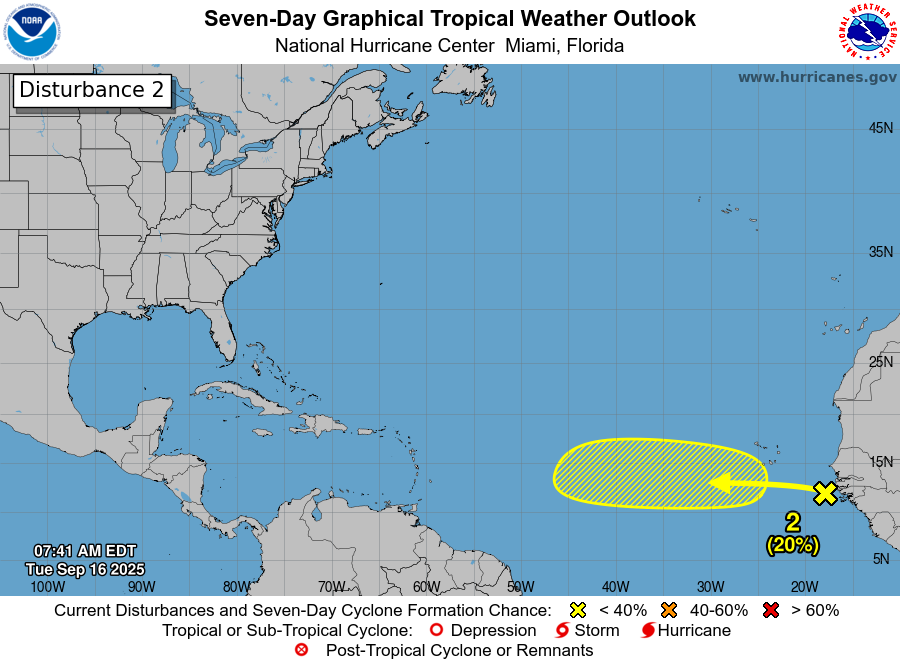
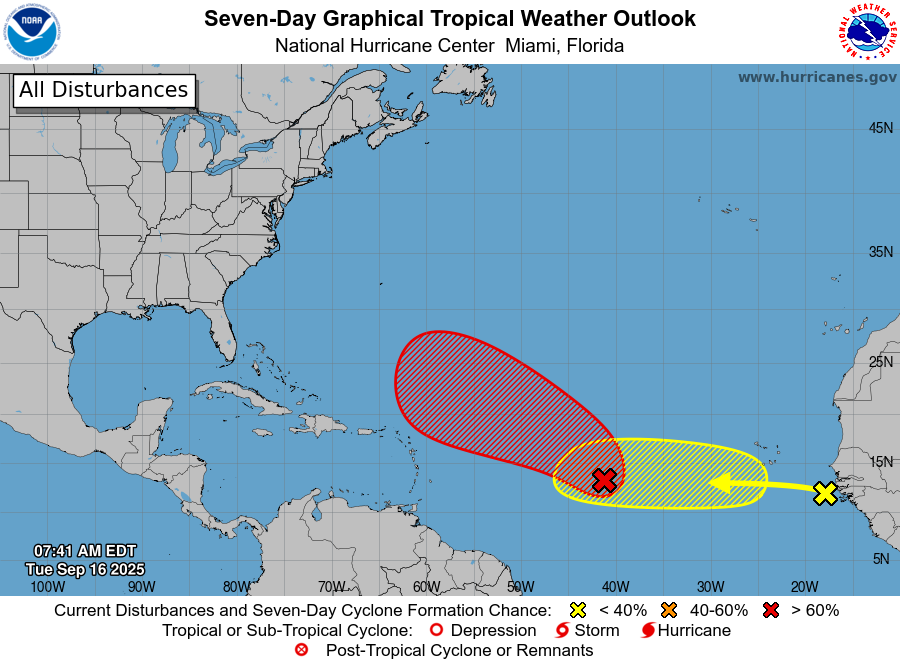
The NHC has identified the next wave as another area of interest. This one is smaller in size than Invest 92L, and it also has a little less model support for development than 92L had at this stage.

The next wave off Africa has about a 20 percent chance of developing over the next 7 days. (NOAA NHC)

The initial odds of 20 percent feel right at this point. We’ll keep an eye on this as well, but it seems less likely to be a development issue than 92L should be. No threat to land at this point either.

Gulf/Western Caribbean

We continue to see some “noise” from the usual suspects (cough, the GFS model) far out in time in the Gulf or western Caribbean. This is a normal model bias for late September and October, so get used to seeing spurious tropical systems on that specific model guidance.

That said, there is some very, very modest support for some potential “noise” in that area on other guidance. We can’t latch onto a specific disturbance right now, nor can we say something will come of this with any confidence whatsoever. But the reality is that it’s the time of year we watch there, and the models are producing noise there to a small extent. In other words, we’ll be looking there to see if anything can emerge to close September or start October. For now, no one need be worried at all.

North Carolina & Virginia coastal storm

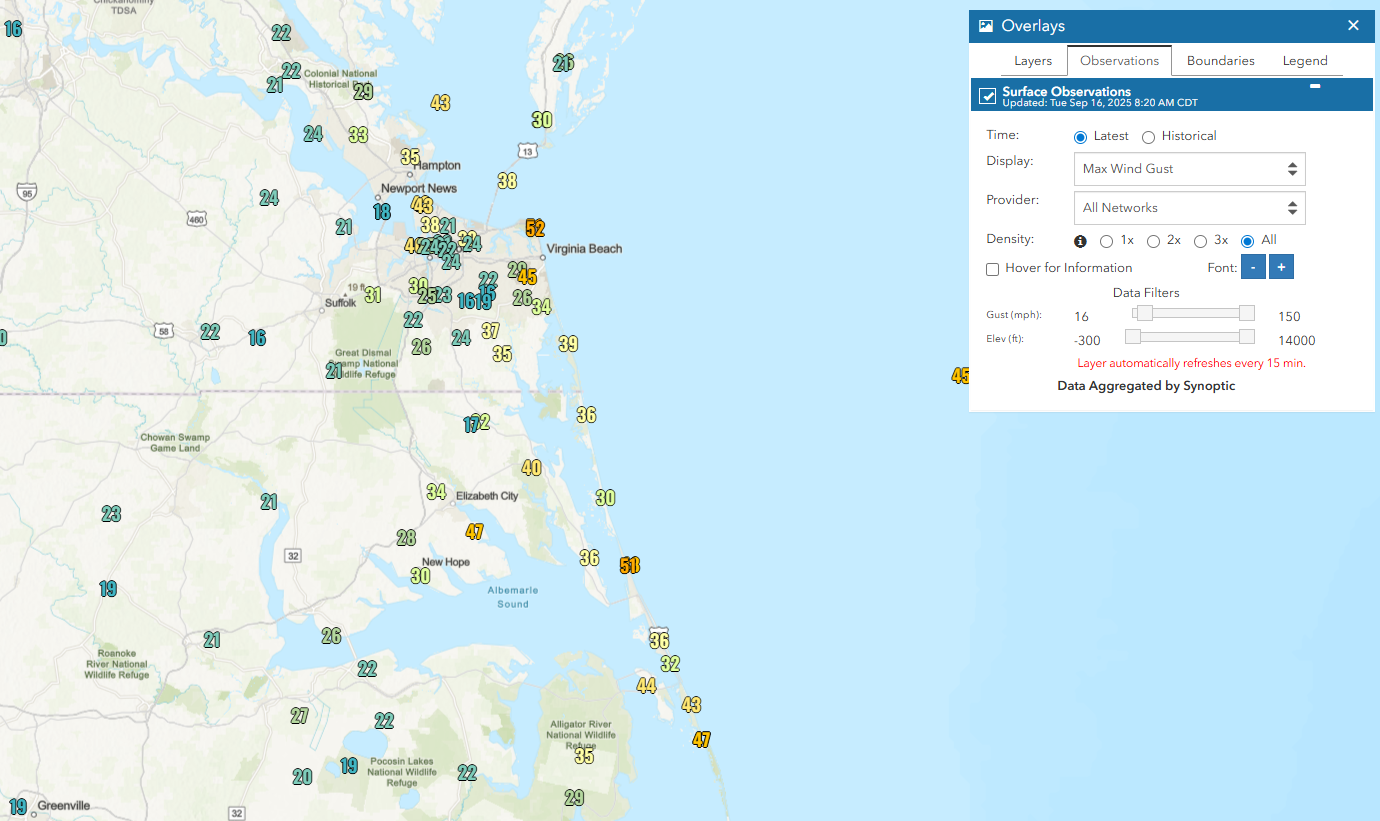
A storm system deemed non-tropical is moving ashore in North Carolina and Virginia today. We’ve had wind gusts since midnight as high as 50 mph in spots, including Duck, NC and Cape Henry, VA.

Wind gusts in excess of 45 mph have occurred in several spots since midnight in northeastern North Carolina and the Virginia Tidewater. (NOAA)

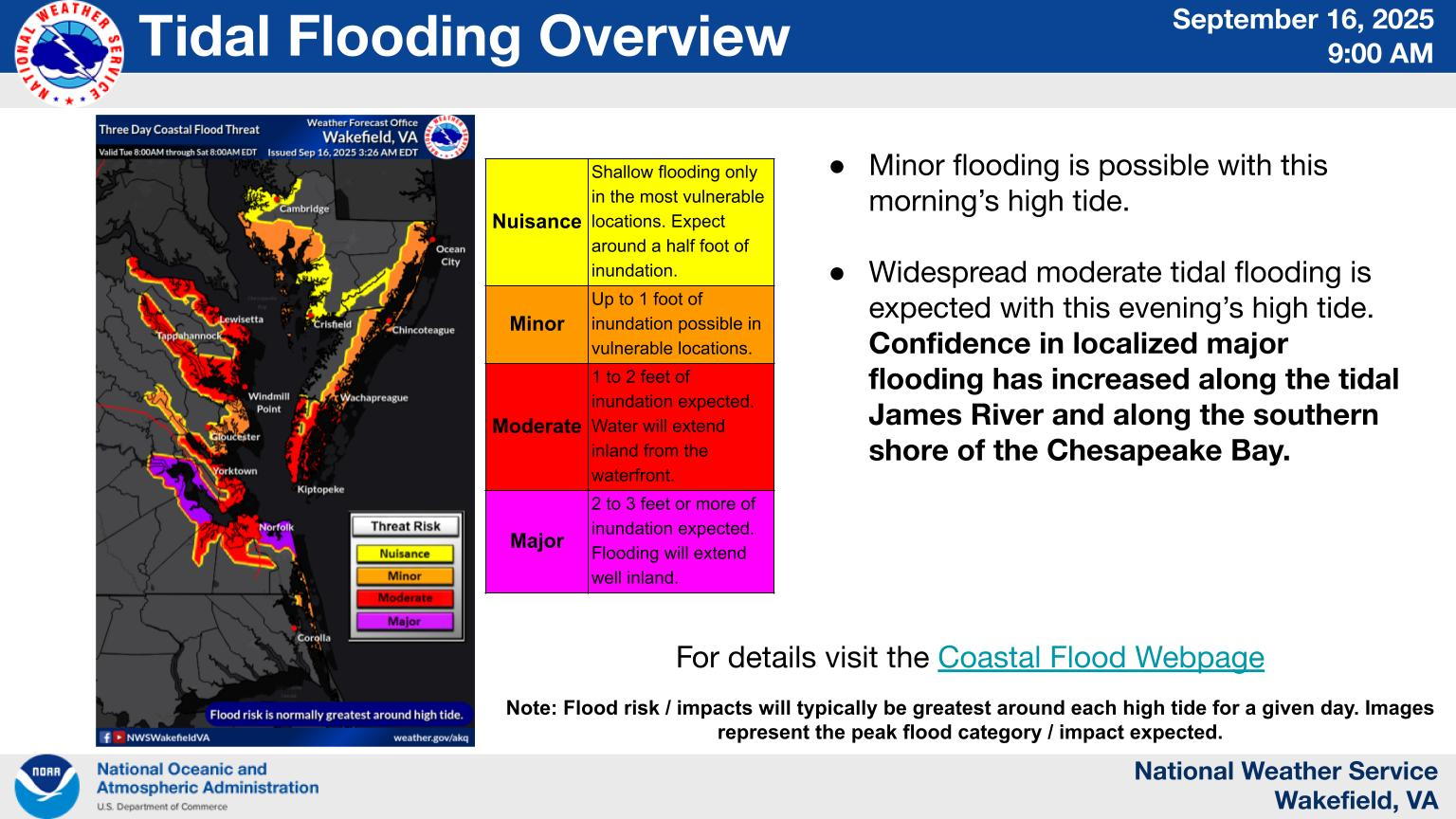
In addition to the wind, we’re seeing coastal flooding, with the highest tide occurring later today.

Tidal flooding is likely, with major tidal flooding this evening along the tidal James River. (NWS Wakefield, VA)

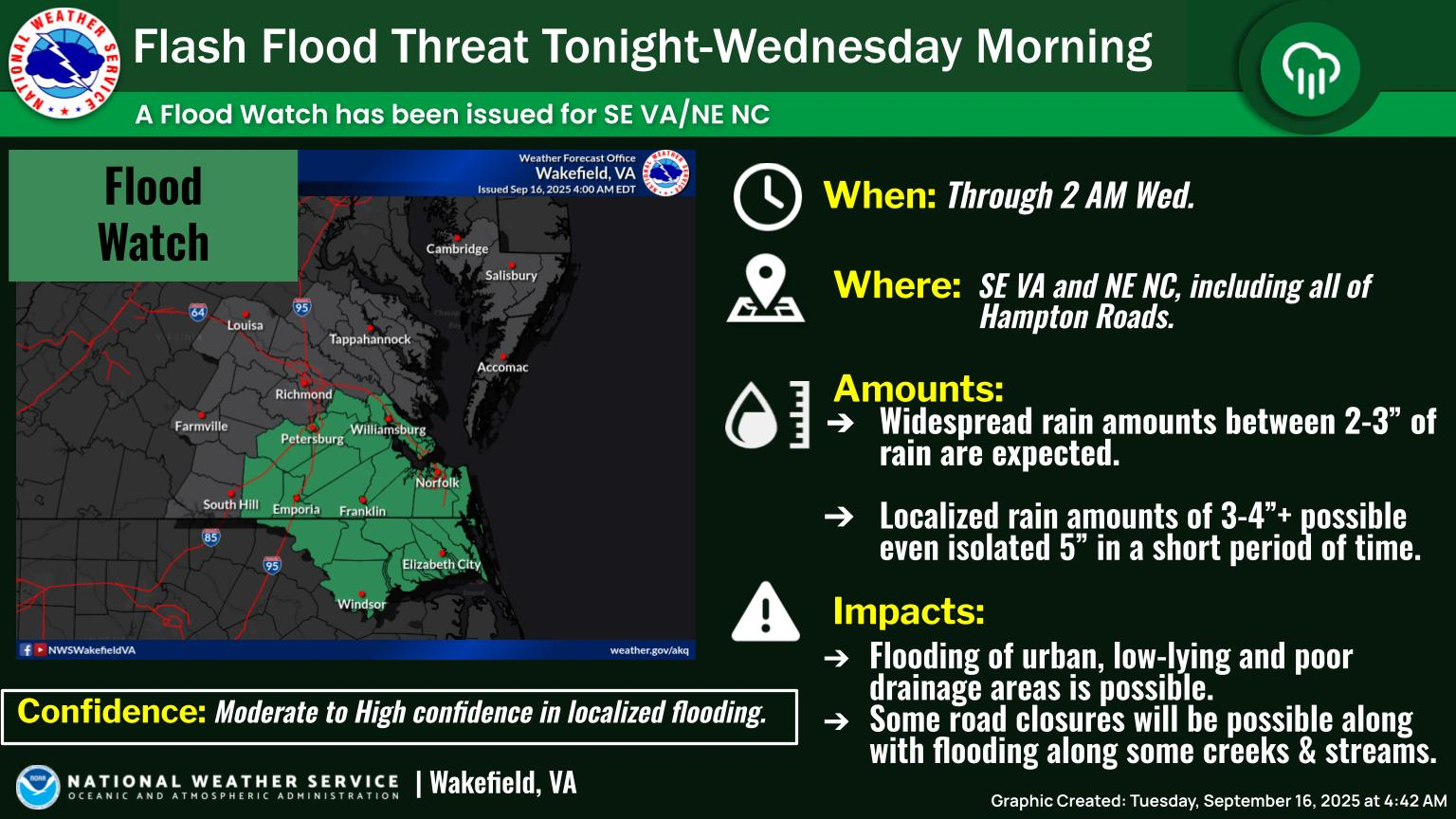
None of the current tidal forecasts look like records, but they should at least be near the higher values seen with passing storms this year and last year. Rain won’t help matters, with heavy rainfall compounding drainage issues in areas with tidal flooding. A slight risk (2/4) for flash flooding is in place today in southeast Virginia and northeast North Carolina, along with flood watches.

Flood watches remain in effect today and this evening south and southeast of Richmond. (NWS Wakefield)

Definitely a day to take it easy in this part of the world, watch for flooding, and never drive through flooded roadways. The Virginia Tidewater is one of the most vulnerable locations in the country for coastal flooding, and with a combination of sea level rise and land subsidence, this will continue.

Mario’s impacts to California

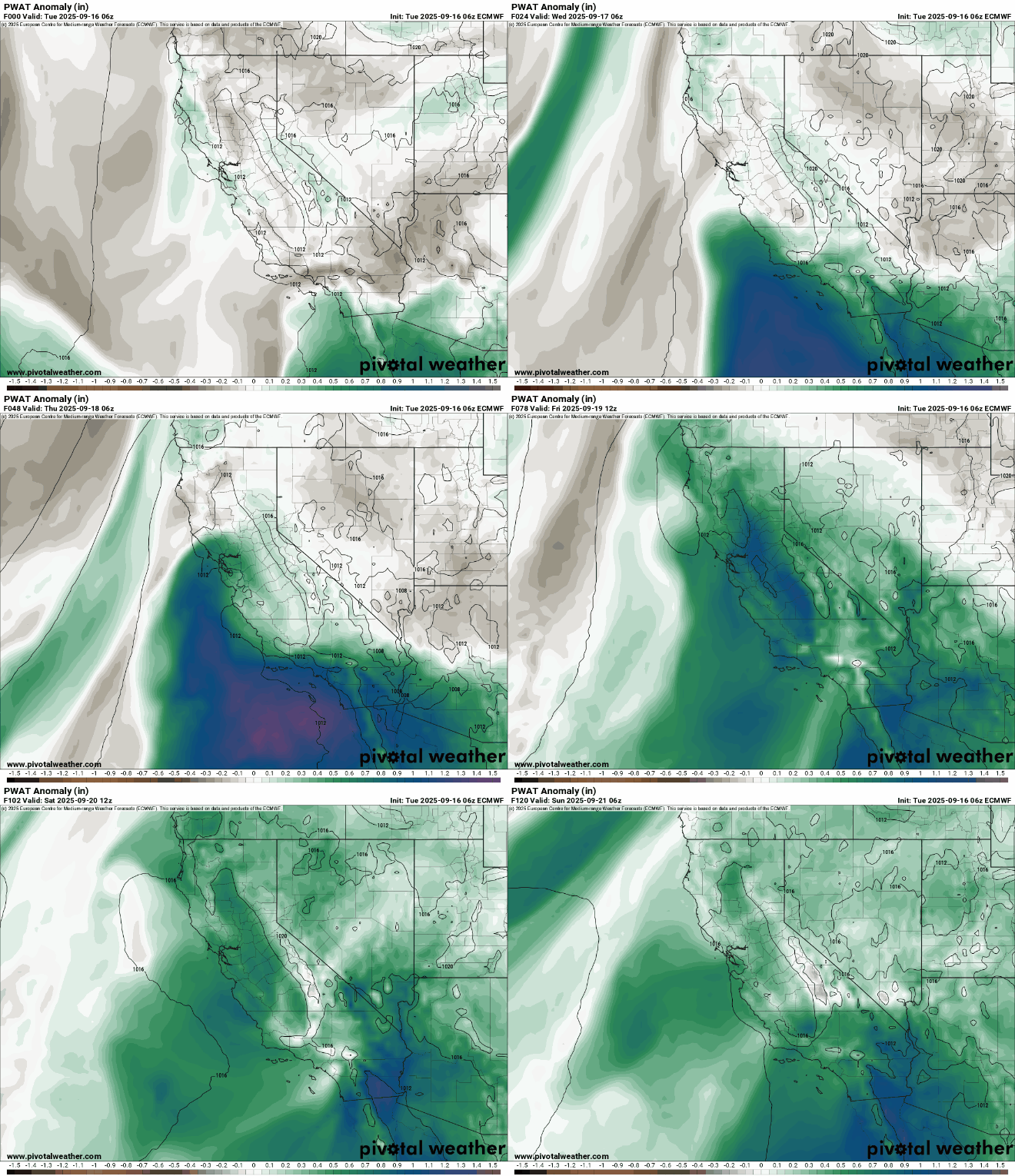
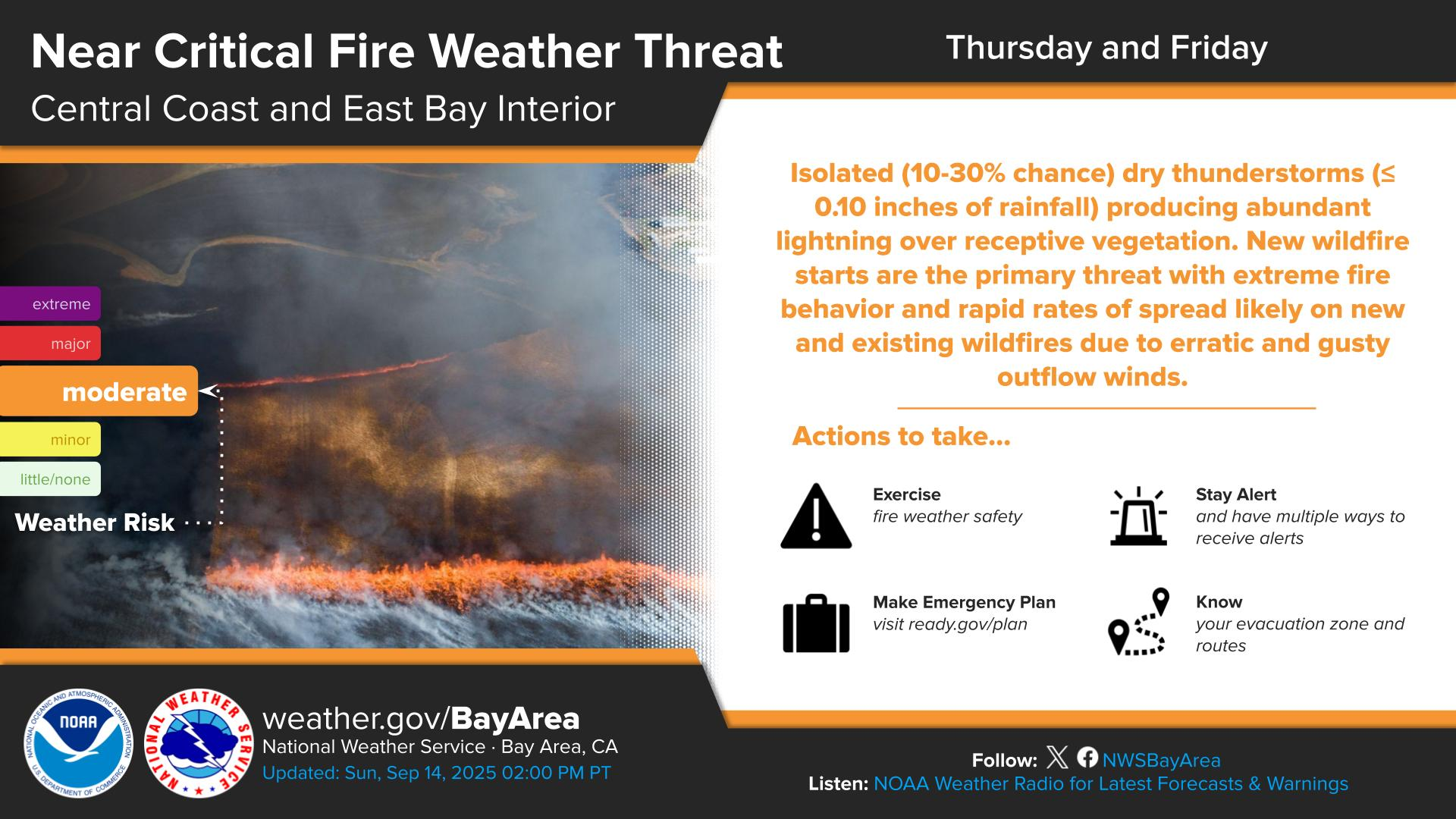
With Mario slowly lifting north, the overall weather pattern off the West Coast will favor tropical moisture being funneled northward around the east side of a dominant upper level low pressure system. As this happens, moisture will surge into California later this week bringing a good chance of localized heavy rain, thunderstorms, or possibly dry lightning.

Atmospheric moisture anomalies (PWATs) over California and Arizona and Nevada through the week increase dramatically. (Pivotal Weather)

While the rain could produce localized flash flooding, it will be interesting to see if dry thunderstorms play a role here also. The risk of dry lightning looks highest Wednesday night into Thursday, especially north of Los Angeles, up into San Luis Obispo and Santa Barbara and northward into the Bay Area.

(NWS Bay Area/Monterey)

There may be more to come heading into next week with Pacific Invest 96E possibly playing a role in that. For more details on the situation in California, I strongly encourage checking out (and subscribing to) Daniel Swain’s Weather West blog.

17 Sep 03:57

An Engineer's Perspective on the Texas Floods

by Wesley Crump

[Note that this article is a transcript of the video embedded above.]

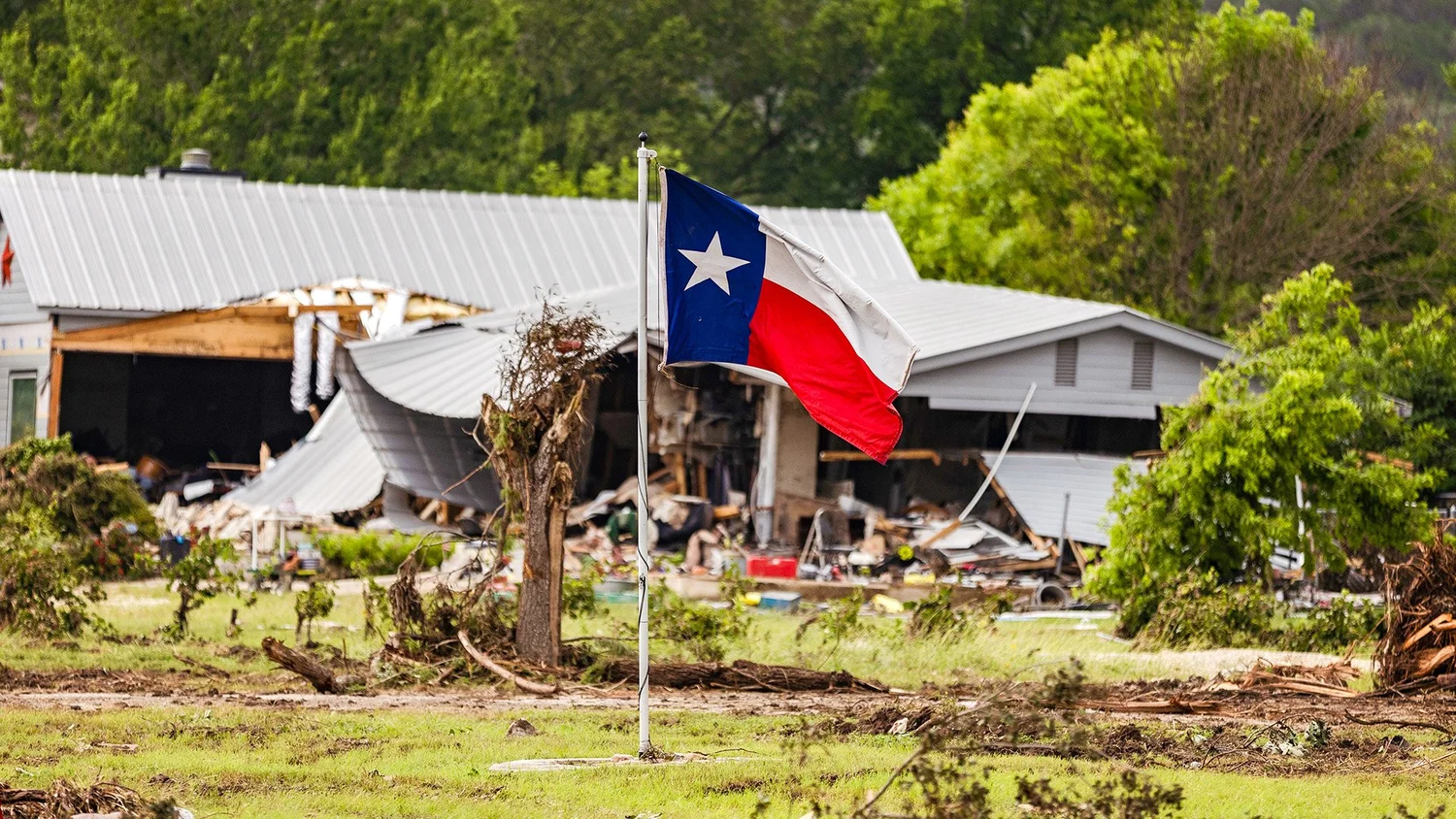
This is an animation of the weather radar in central Texas starting at noon on July 3, 2025. You can see there was torrential rain across the state throughout the afternoon from remnants of Tropical Storm Barry. But focus on this area northwest of San Antonio. Around midnight on July 4, a severe storm gets stuck in this area and just stays in place for several hours. When you put it in context with the rest of the system, it looks kind of insignificant, but that little storm dropped enough rain to raise the Guadalupe River higher than ever in recorded history, at least in the upper part of the basin. The water quickly rushed through summer camps, RV parks, and rural communities in the middle of the night. And the result was one of the deadliest inland flooding events in the past 50 years.

I live not too far from some of the worst-hit areas, and although my family wasn’t directly affected by the weather, it’s been a tough situation for me to wrestle with, personally. I spent the better part of my career as an engineer thinking about flooding and designing projects to cope with it. I’ve worked on and played in the Guadalupe River. And I have kids who are getting close to summer camp age. As a dad, it’s almost impossible to comprehend a tragedy like this. As an engineer, I’ve dedicated a large part of my professional career to understanding events exactly like it. So, as I’ve ruminated about this flood over the past few months, I’ve collected some thoughts that might be worth putting into the world. Let’s take a look at this event through an engineering lens, talk a little bit about how technical and regulatory decisions play out in the aftermath of tragedy, and see if any lessons become apparent. I’m Grady, and this is Practical Engineering.

One of the fundamental problems we face in engineering, and really life in general, is that we can’t predict the future. That sounds like a ridiculous thing to say, but out of that uncertainty comes the framework for how we think about so many things. Because, we have to make all kinds of decisions - many of them with extremely high stakes - in the face of the unknown. In civil engineering, a lot of the loads we account for come from the most classically volatile and unpredictable aspect of the earth: the weather. Wind, ice, snow, waves, and rain - you cannot look ahead 50 or 100 years and know what forces a structure will be subjected to. You just have to guess.

And that’s a pretty hard thing to do, especially because you tend to have two opposing forces pushing your guess around. On the one hand, caution dictates overestimating forces to leave a wide margin of safety, but on the other hand, costs and budget constraints tend to push the estimate the other way. I can make this dam taller or this bridge higher, but it’s going to cost me a lot more money, and maybe it’s not necessary. So how do you draw the line? The same way we try to predict the future in so many other parts of life: we look to the past.

Surely past performance is an indicator of future results, right? I know that’s a stock line, but what else do we have? Over the years, we have gone to considerable lengths to apply historical data to predictions of future floods. Of course, this gets pretty complicated. One of the resources widely used in the United States for decades is Technical Paper 40, published in 1961. It represents a monumental effort to compile rainfall data across the contiguous United States, find probability distributions that fit the data, and map the results. It’s divided up by duration and recurrence interval, so you get this big group of separate maps. But what is a recurrence interval?

I’ve talked about the so-called 100-year flood in a few of my videos, but it’s a concept so widely misunderstood that it’s worth explaining again, especially because it’s so relevant to the Guadalupe River flood in July. We can’t really use historical data to determine when a flood might happen in the future, but we can make an estimation about how probable one might be. The bigger the flood, the lower the probability that it might occur. So there’s a relationship between probability and magnitude. In hydrology, we often express the probability as a quote-unquote “return period,” which means, on average, how many years you would expect to pass before you see that magnitude equalled or exceeded again. But that “on average” is doing some heavy lifting in the definition.

This terminology is debated endlessly in the hydrologic community because saying something like the 100-year flood has an underlying implication that storms are cyclical; that somehow if a particular magnitude of storm was to occur, we might have a period of security before it happened again, or the flipside: that if a flood hadn’t occurred in some time, we might be more “due” for it. And that’s just not how it works. Floods are statistically independent events. Every year, the atmosphere rolls the metaphorical dice to see what the biggest one is going to be. The odds of rolling a two or snake eyes in craps are 1 in 36, but if you go 35 rolls without a snake eyes, the odds of rolling it on the next one haven’t changed. The dice don’t remember what happened before. No one calls snake eyes the 36-roll throw because we understand it’s possible to do it twice in a row, and it’s possible to go a lot more than 36 rolls without getting one. So why do we call it the 100-year flood? Probably because the only good alternative is the storm with a 1% annual exceedance probability. Just doesn’t roll off the tongue. But it is the technically correct definition: the 100-year rainfall is the depth of precipitation (over a given duration) that has a one percent probability of being equalled or exceeded in a given year. It’s a tough concept to wrap your head around, but it’s fundamental to engineering hydrology.

If you take a look at these maps, you can see that the 100-year rainfall over a 24-hour duration in Kerr County, Texas is around 9.5 inches (or about 240 millimeters). But again, this is from 1961. And it’s based entirely on historical data. So there are decades of rainfall not included in this analysis, not to mention limitations in the statistical methodology and data processing methods of the time. TP 40 wasn’t the only resource for precipitation frequency data in the US, but it was probably the most widely used until Atlas 14 came along, or is coming along (it’s still a work in progress). NOAA has been working to update this information with the entire historical record and more rigorous statistical methods. For most of the US, this is easy to navigate online. Just mark a spot on the map and you get this table of values and confidence intervals for a range of durations and return periods. And you can see that the 100-year, 24-hour precipitation in Kerr County is 11.5 inches (or nearly 300 millimeters). That’s a pretty big jump from the 1961 estimate - an increase of about 20 percent. What was the 100-year rainfall in 1961 is now just the 50-year storm AND look at those confidence intervals! 8 to 16 inches.

I know this is kind of long-winded, but the whole point I’m trying to make here is the tremendous uncertainty we have when it comes to hydrology. In some ways, this rainfall data is extremely rigorous, and I couldn’t even begin to explain some of the statistical methods used to develop it. It serves a really important purpose in the world of engineering, planning, and emergency management. But in another sense, it’s almost meaningless. And I can show you a few of the reasons through the lens of the Guadalupe River Flood.

Here’s an hourly map of the rainfall that hit central Texas on July 4, 2025. That yellow area is the watershed for the upper Guadalupe River. When I loop through it again, you can see that cell right there caused the majority of the flooding you probably read about on the news. It was there and gone in four hours. More rain came in later that morning and the next few days, but this was a classic flash flood: A relatively short burst of heavy rainfall on a small, steep, rocky basin, where most of it runs off into a river within minutes or hours. Here’s the thing: hourly rainfall records weren’t very common until the 1940s. I counted about 100 rain gauges used by Atlas 14 within a 50 mile radius of Hunt, Texas, where most of the fatalities occurred. None had hourly records before 1940, and of the group that did collect hourly data, only four had a record longer than 70 years. That might seem like enough data to understand flooding in the area, but let me show you why it’s not.

Here’s that loop of rainfall again. What do you see on this map? Because I’ll tell you what I see: enormous spatial variability. If you were to pick four random pixels on this map, how good a picture do you think it would give you of what really happened? That’s essentially what we’re doing with rainfall frequency analysis. Compared to modern data collection methods, like the radar rainfall I showed, our historical records are extremely sparse, especially for data that varies so significantly across space. Imagine trying to recreate the Mona Lisa from scratch with just a dozen random pixels. Most of the rain gauges we use to estimate flood probabilities have never even seen an event of the magnitude we’re trying to use them to predict. There’s a whole lot of extrapolation going on.

To hammer this point home: This is the 24-hour rainfall totals for the flood, and you can see that even within this single watershed, some areas saw extreme precipitation, while others just got an inch or 25 millimeters of rain. And actually, I mapped the percentage of the 100-year rainfall that this storm amounted to, and you can see, at least in the Upper Guadalupe Basin, only a small area got close to the 100-year rainfall. For most of the watershed, this was more like a 2- or a 5-year storm.

And here’s what makes this even tougher: When we’re talking about flooding, we don’t actually care too much about rainfall. We care about the outcome of rainfall, specifically the rise in a river or stream. Here’s the graph of a stream gage upstream of Hunt during the flood. You can see that, starting around 2:00 on the morning of the 4th, the river rose by 20 feet or 6 meters in three-and-a-half hours. A little further downstream, similar story. Starting at 2 AM, the river went up 35 feet or nearly 11 meters in 3 hours before the gage broke. That is a staggeringly fast increase. In a hydrologic sense, it’s practically a wall of water. And the results were devastating. In Kerr County, there just wasn’t enough time to coordinate an evacuation. More than 100 people were killed, many of them children. So a rain gauge here, or here, or here would have completely missed the fact that the watershed it was within was experiencing the flood of record.

That’s the value of measuring the thing you actually care about. Just like precipitation, you can take historical stream gage data, fit it to a probability distribution, and get a sense of the likelihood of major floods in the future. But these gages are even more sparse in coverage than rain gauges, their records often don’t go back as far, they’re a lot more expensive to install and maintain, and, as we saw in one graph, they can go offline, ironically as a result of flooding, completely missing the peak. Engineers or hydrologists actually often visit the affected area and map the high water line after a flood to validate and confirm the data from stream gages (or to fill in the gaps if one breaks). So, although they serve an extremely important role, most of the time when engineers are trying to predict flooding or its effect on infrastructure and the built world, instead of using stream gages, they’re using hydrologic models to convert rainfall into runoff and flooding, a process that introduces a whole new set of uncertainties into the mix.

And there’s one more thing. Everything we’ve been talking about so far is predicated on a crucial underlying assumption: temporal stationarity, basically, the idea that the distribution of extreme events doesn’t change over time - or put another way - that future precipitation can be represented by past observations. But, even though those past observations are relatively sparse, in a lot of cases, we can already see that it’s probably not a great assumption. I understand this is a point of pretty strong contention in the public discourse. But within the professional community of hydrologists, engineers, and climate scientists, it’s not really a question of “is the climate changing” but more a question of how much, how quickly, and where the effects of that are most pronounced. For example, in the Texas Volume of Atlas 14, the team tested for long-term trends in the data. They found some scattered weather stations that did show an increase in extreme rainfall over time; most of them didn’t. Other studies have found more pronounced increases by looking at only the past few decades. So there are no broad statements that capture the complexity of the situation as we understand it, and importantly, this is a tough thing to figure out.

Say you have 100 years of historical data. How many 100-year floods happened within that time? Could be a few. Could be none. So, especially for very extreme events on the 1-in-a-century scale, there’s a lot of uncertainty when it comes to teasing out any trends. That said, there is a strong consensus among the various climate models and recorded data that a warming atmosphere has already resulted in an overall increase in the intensity and frequency of rainfall, a trend that will likely continue. And you can see why that poses a problem. Particularly for infrastructure with a design life of 50 to 100 years, we need to design not just for the storms of today but those decades in the future, and our current methods of doing that is, on average, systematically underestimating them if we assume a stationary climate.

Just to be clear, I’m not trying to blame a flood on climate change. Although attribution studies can estimate the contribution of extra energy in the climate system, there’s no way to ascribe any particular weather event to global warming deterministically. For many places, it might not even be a major source of uncertainty compared to all the other factors I’ve mentioned when it comes to predicting the magnitude of future floods. My point is that it’s just one more confounding aspect of estimating flood risks. And it gets to the heart of the entire issue. Because why does any of this even matter?

There‘s been a lot of discourse about what should have happened before the storm and what should be done in its wake. But before you can take any action to mitigate flood impacts, you have to know what the actual risks are. On the upper Guadalupe, we’ve seen it with our eyes, but how many similar watersheds just got lucky that night, or really, any night? I think you’ll agree with me that this is complicated stuff. And humans are notoriously bad at using probabilities and risks to make decisions. Almost nothing in our biology is optimized for long-term, rational decision-making about rare and extreme events. Almost every day of everyone’s lives, there’s not a flood. That makes it really tough to consider it as a priority and devote resources toward preparations. And I think part of the problem is that we rarely talk about the uncertainties.

Even within the field of engineering, where we should know better, we have a strong tendency to treat everything deterministically. It sure makes things a lot simpler. Take the bold number in the table, plug it into your equations and computer models, and just forget that those uncertainty bands even exist. In some ways, it makes sense. Ultimately, you do have to choose a number: how high to build a bridge or how large a culvert to install, or how wide to make a spillway. But, in a lot of cases, those decisions get translated into a sort of confidence that doesn’t actually exist. The concept of the floodplain is a perfect example.

In the US, a lot of the framework for how we think about and prepare for floods comes out of the National Flood Insurance Program. And to participate in this program, communities are required to regulate what happens in the floodplain, or more specifically, what and how things get built there. And so, a fundamental part of regulating the floodplain is deciding where it actually is and isn’t. We’re not going to dive into that process, but billions of dollars have been invested in making these maps and keeping them up to date in the US.

If you take a look at one, it’s a lot to parse depending on the location. There are quite a few different hazard areas with different meanings. The simplest for riverine locations is the base flood, essentially the 100-year flood. Some maps show the 500-year flood as well. Many maps show the floodway, which is kind of the main part of the channel needed to pass floods, so it’s usually regulated more strictly. But there’s something I notice when I look at floodplain maps. All of these zones are bordered with nice crisp lines. You’re inside the floodplain here, and you’re outside of it here. And property owners often go to great lengths to refine these maps; to shift the line just slightly and reduce their regulatory responsibilities. But consider everything we’ve talked about with estimating flood risk and ask yourself, what’s the difference in the risk profile between here and here? Is it enough to have a sharp line between them? And if not - if the true situation is more nebulous - is the map doing a good job of communicating flood risk to the public?

Because, just to be clear, that is one of the stated purposes of floodplain maps. Of course you need to delineate zones clearly to be able to regulate where permits are required and where buildings can be built and so on. But, to me at least, it sends a complicated message to have this binary definition of inside the floodplain or outside of it as a way to explain to individuals, homeowners, renters, and the general public about the risks that they’re actually exposed to.

You look at these maps and there is absolutely no indication about uncertainty, despite the fact that almost every step of the process that goes into creating them has huge margins of error. And then, when we get more historical data, or land uses change, or our understanding of the floodplain evolves, and we try to change the map, that immediately sows distrust. You hear it all the time (at least if you run in similar circles as I do): “We’ve had two hundred-year floods in the past 5 years. These engineers don’t know what they’re talking about…” Part of that, of course, is just a misunderstanding about what the hundred-year flood actually means, but part of it is that we don’t do a good job communicating risk and uncertainty well. The meteorologists get the same thing. People get salty when forecasts are wrong without any acknowledgement at all that the job is essentially predicting the future. You know, it’s wizard stuff. Weather is really complicated, and I think we have a lot of room to grow in how we discuss and disseminate the things we don’t know for sure.

Because flooding is capricious. If you look back at the maps from July 4, you can see a lot of places where rainfall was more intense than in Kerr County and the Guadalupe River. Many areas of central Texas received more than the 100-year, 24-hour precipitation from Atlas 14. And there were severe storms and flooding across the region in the days that followed as well. But nearly all the fatalities happened in this one place. I don’t have a good answer for why. Maybe some combination of timing, warning systems, the rural location, differences in floodplain regulations, and plain bad luck. I think scientists, engineers, and emergency planners can probably learn a lot by simply comparing the flooding between Kerr County and some of the other areas in central Texas hit by this storm system, and why the outcomes were so drastically different.

My heart goes out to the victims and their families who were affected by this flood. I’ve been thinking so much about it in the weeks since, and why these kinds of risks can go so underappreciated that we wouldn’t bat an eye at having such a large population of people sleeping in the floodplain of a flashy watershed.

I think there are a lot of lessons to learn here, but the one that keeps coming back to me is about communication. People can’t act to reduce their risk unless they can internalize what it actually is. Professionals think about these issues every day; they have technical training, knowledge, and experience to make informed decisions about infrastructure, land use, and zoning. But most people don’t have the same cognizance of the hazards. You can’t blame them. It’s a crazy world we live in, and even individuals who live, work, and play in areas at risk of flooding might not come face-to-face with the danger in their entire lives. Like I said, weather is complicated, and we don’t all have the headspace to try and understand spatial variability, annual exceedance probabilities, climate stationarity, and so on.

So I think the professional community has a responsibility to improve how we communicate flood risks to the public, not only for accessibility but honesty. We need to have language that anyone can grasp, but we also need to be better about acknowledging uncertainty. It sounds counterintuitive, but I think facing the limitations of our understanding head-on actually instills more trust than pretending like we have all the answers. And when people understand those uncertainties, they get a deeper appreciation for how flood hazards vary across the landscape, giving them more insight, not less, to prepare for what’s ahead. Thanks for watching, and let me know what you think.

16 Sep 21:00

Only one problem… how do I get this thing down!

Only one problem… how do I get this thing down!

16 Sep 21:00

Maybe the ice cream truck just isn’t coming today?

Maybe the ice cream truck just isn’t coming today?

16 Sep 21:00

Report: You To Be Fired For Reading This Headline About Charlie Kirk

by The Onion Staff

NEW YORK—Insisting your fate was sealed the moment you clicked the link, a report released Tuesday found that you will be fired for reading this headline about Charlie Kirk. “Shortly after you navigated to this article, your IP address was logged and your supervisor approved the decision to remove you from your position,” the report read in part, revealing that the choice had been made after a brief conversation among your superiors in which it was repeatedly emphasized that your behavior in loading this page and spending nearly two minutes reading its content about the late Turning Point USA co-founder was an action inappropriate for the moment. “Your home address and phone number have been leaked to a large online database that has in turn been shared among activists who want to identify all those who err in their reading choices. There’s no use trying to click out of this tab now. Pack up your desk. The damage has already been done.” The report concluded that if you shared this article with a friend or family member, you should prepare yourself to be arrested on domestic terrorism charges.

The post Report: You To Be Fired For Reading This Headline About Charlie Kirk appeared first on The Onion.

16 Sep 20:59

Report Finds Majority Of Fumbles Recovered Within First 48 Hours

by The Onion Staff

NEW YORK—In an effort to relieve public concern over the thousands of footballs that go missing every season, an internal report by the National Football League confirmed Friday that the majority of fumbles were recovered within the first 48 hours. “Looking at our history all the way back to 1920, it has thankfully been very rare for our game balls to stay fumbled for longer than two days,” said league commissioner Roger Goodell, adding that the number of recovered footballs might actually be much higher than the data suggested, because referees were not allowed to consider them officially fumbled until they had been loose for at least 24 hours. “There is no worse feeling than realizing your football is somewhere out on the turf all alone, completely vulnerable. That’s why it is crucial to take action as soon as possible to ensure we bring every lost ball safely back into play and prevent, God forbid, someone else getting to it first. Unfortunately, patterns show that any ball not recovered in the first 48 hours likely never will be—at least not during that game.” Goodell went on to add that, sadly, many balls were ruled dead by the time someone reached them.

The post Report Finds Majority Of Fumbles Recovered Within First 48 Hours appeared first on The Onion.

16 Sep 20:59

As Good A Place To Become Embroiled In Conspiracy Theories As Any

by The Onion Staff

This house has a great porch and gets plenty of natural light, but if you’re going to spend 12 hours a day on Reddit, it doesn’t really matter.

Reference #57893

The post As Good A Place To Become Embroiled In Conspiracy Theories As Any appeared first on The Onion.

16 Sep 20:58

Cornell Students Skin, Butcher Dead Bear In Dorm

by The Onion Staff

Two Cornell students killed a 120-pound black bear before bringing its carcass into a communal kitchen in their dormitory to skin and process it, with the undergrads having valid hunting licenses and not appearing to run afoul of the law. What do you think?

“All that lamp oil will come in handy during exam time.”

Meg Yantis, Montage Compiler

“College is the perfect time to experiment with what you like to butcher.”

Jason Cairi, Rope Strengthener

“I hope they wrote their names on it before putting it in the communal fridge.”

Cameron Henneberry, Paperwork Stapler

The post Cornell Students Skin, Butcher Dead Bear In Dorm appeared first on The Onion.

16 Sep 20:50

NIH Director’s Pulsing Neck Tumor Announces Cancer Research Cuts

by The Onion Staff
16 Sep 20:49

How to Tell the Difference Between a Lone Wolf and a Coordinated Effort by the Radical Left

by Carlos Greaves

If a Democratic lawmaker and her husband are gunned down, it’s an isolated incident carried out by a lone wolf.

If a right-wing activist is gunned down, it’s part of a coordinated effort by the radical left to incite violence.

- - -

If a gunman murders nineteen children at an elementary school, it’s disgusting to politicize the tragedy by talking about gun control.

If a Republican presidential candidate is targeted in an assassination attempt, it’s fair to blame it on left-wing rhetoric before the shooter has even been identified.

- - -

If a Christian Nationalist shoots up a synagogue, his values don’t reflect Christianity as a whole.

If a transgender woman shoots up a Catholic school, it’s because the entire LGBTQ community is conspiring to destroy Christianity. RuPaul probably ordered the hit.

- - -

If a man with a knife is arrested a block away from the home of a conservative Supreme Court justice, it’s a heinous act brought on by the radical feminist movement’s anger toward him.

If a man nearly beats the husband of a liberal Speaker of the House to death with a hammer, it’s a running joke for the next three years.

- - -

If a man shoots a Democratic congresswoman, he’s a mentally disturbed individual.

If a man shoots a Republican congressman, it’s because Bernie Sanders brainwashed him and turned him into a sleeper agent who is activated by the phrase “tax cut.”

- - -

If a mentally ill Black man fatally stabs a woman riding the light rail, it’s a “nationwide failure” on the part of Democrats.

If an Islamophobic white man fatally stabs two people riding the light rail, there’s no reason to think Republicans have done anything in the past twenty-five years to foment hatred of Muslims. Some people just wake up one morning hating entire groups of people.

- - -

If a white man is murdered by a sniper, anyone who so much as suggests that the killer’s motive may have been related to comments the victim made in the past should be fired from their job, put on a watch list, and doxxed. How dare they say anything that could be interpreted as being critical of the deceased?

If a Black man is murdered by the police, anyone digging up dirt on the victim to explain why his death was justified—like crimes he committed twenty years ago, or claiming he actually overdosed—is just laying out the facts.

- - -

If a Democratic governor talks about punching people in the mouth, he is obviously filled with insatiable bloodlust.

If a Republican president talks about punching people in the mouth, you’re the violent one for thinking he was being serious.

- - -

If a Democratic president is moved to tears by violence, he’s faking it.

If a Republican president repeatedly calls for violence, it’s just because he’s so full of love for America.

- - -

If a congresswoman says “We have to fight” while speaking at a rally about government accountability, she didn’t mean “fight” as in “apply sustained political pressure,” she meant “fight” as in “stab those bureaucrats until they release their data.”

If a Republican president says “We have to fight” to a group of armed rioters after months of repeatedly claiming an election has been stolen, he didn’t mean “fight” as in “storm the Capitol,” he meant “fight” as in the Beastie Boys’ lyrics “fight for your right to paaaar-tay.”

- - -

If a Democrat calls Republicans “fascists,” he basically just signed their death warrants.

If a Republican calls Democrats “Marxists,” or “the enemy from within,” or “vermin,” or “human scum,” he’s just trying to fire up the crowd.

- - -

If a social media addicted billionaire says “The left is the party murder,” it’s an indisputable fact.

If a think tank founded by the Koch brothers combs through the data and concludes that right-wing terrorism is responsible for far more deaths than left-wing terrorism, they were probably just cherry-picking.

- - -

All political violence is wrong.

But some political violence is more wrong than others.

16 Sep 20:44

How Nissan leveraged its driver assist to cut traffic jams

by Jonathan M. Gitlin

I recently learned of a rather interesting pilot study undertaken by Nissan together with the Contra Costa Transportation Authority and UC Berkeley that leverages the automaker's partially automated driving system, ProPilot Assist, to ease traffic congestion. The idea is called "Cooperative Congestion Management," which works by letting a car in traffic inform vehicles behind it.

Researchers from Nissan's advanced technology center in Silicon Valley have trialed CCM on I-680 in the Bay Area, logging about 600 miles. Starting with Nissan vehicles equipped with ProPilot Assist, which combines adaptive cruise control and lane keeping, they added the ability for those cars to communicate with each other, informing other cars about their speed and any hazards. On the road, they were able to show that the system reduced hard-braking events by 85 percent and cut time spent stationary in traffic by 70 percent.

But we're not talking about platooning—the idea of having road trains of autonomously driven semitrucks networked together and driving in convoy was all the rage a decade ago, but mostly fell from favor once people realized the human truck drivers were needed for more than just the steering, accelerating, and braking bits of the job.

Read full article

Comments

16 Sep 14:28

#ArmorOfHalo #RoninWarriors

16 Sep 14:26

The tropics are waking back up, but hurricane season is nearing its end for Texas

by Eric Berger

In brief: Today’s post discusses the state of the Atlantic tropics, which are waking up after an uncharacteristic snooze to start September. We also talk about the persistent pattern of late summer weather here in Houston.

State of the tropics

After the Atlantic tropics have slumbered for nearly three weeks (Tropical Storm Fernand gave up the ghost on August 28), we are close to seeing the formation of a new named storm in the open Atlantic. This would be Gabrielle, and it likely will become a hurricane over the next few days. This storm could well threaten Bermuda early next week, but it otherwise is unlikely to approach any landmasses.

The Atlantic tropics are waking back up. (National Hurricane Center)

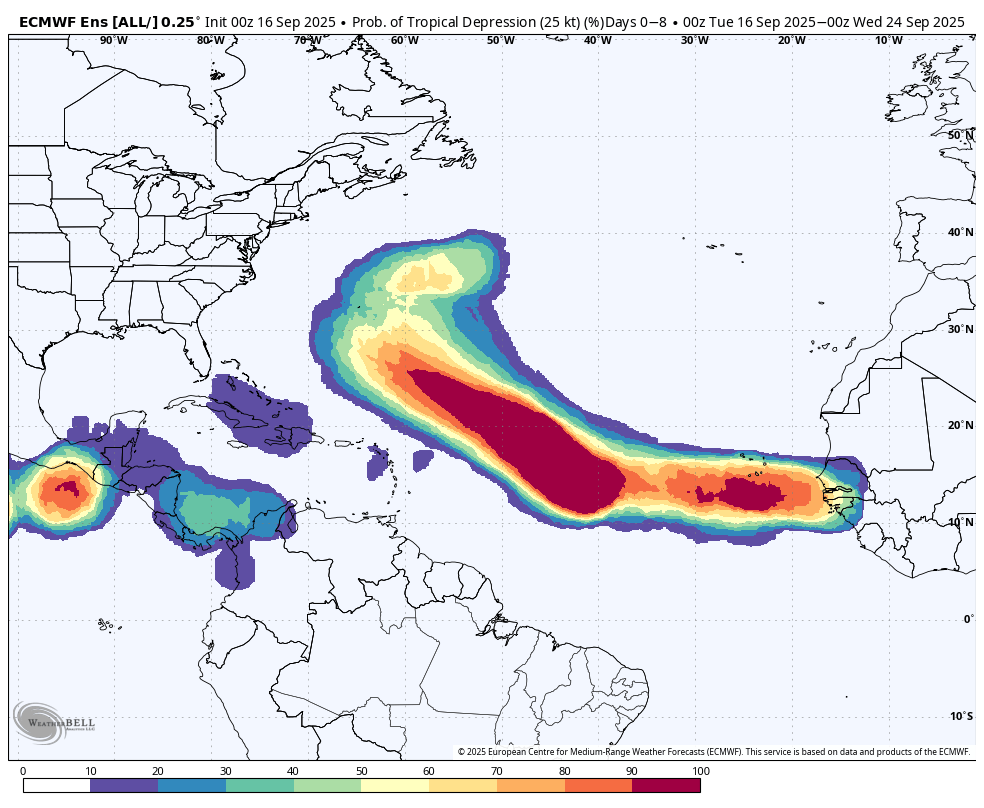
Beyond this storm there is another system behind it, a tropical wave that is just now moving off the coast of Africa and into the eastern Atlantic Ocean. The global forecast models are divided about whether this system will develop, and for now the National Hurricane Center gives it about a 20 percent chance over the next week. This is something to watch to be sure as we are in the middle of September, but nothing to be really concerned about at this point.

Probability of a tropical depression forming during the next 10 days. (European model)

The window for hurricanes to strike Texas is closing, but it is not closed yet. I want to wait another week or 10 days before making that call. The only thing I’m really concerned about now, and to be clear this is a very mild concern, is the potential for something to develop in the western Caribbean Sea or southern Gulf, and for such a system to move north toward the state. But again, this is a low probability event.

Tuesday

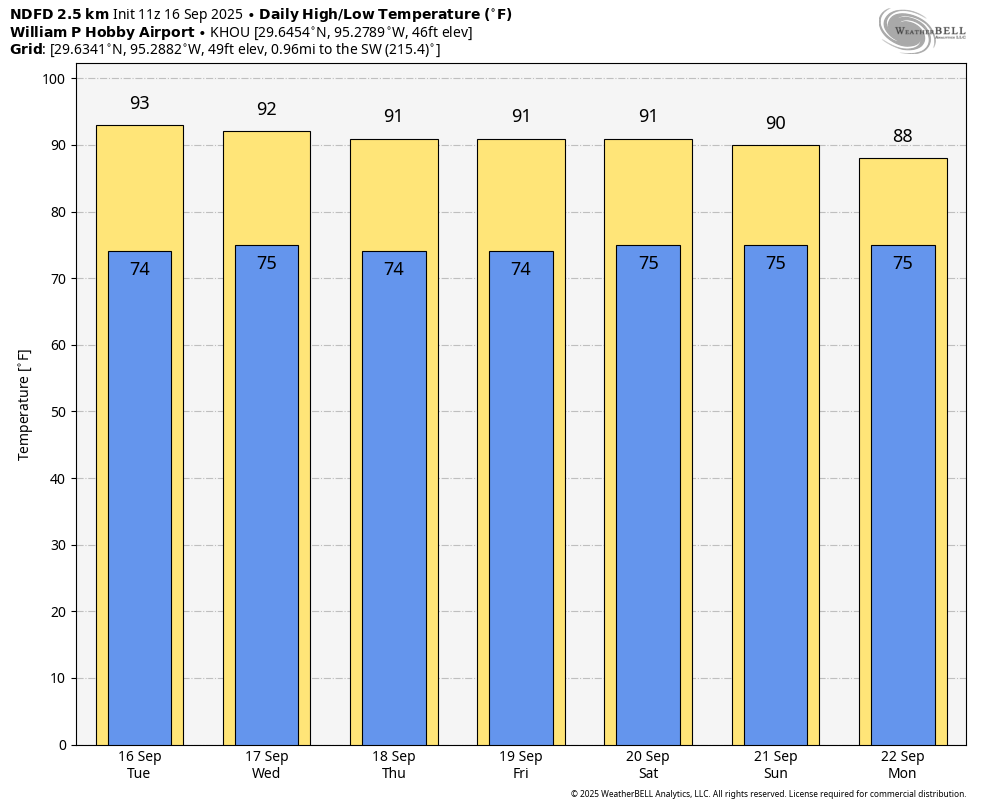
If you’re looking for new and exciting changes with Houston’s forecast, I’m sorry to disappoint you. Houston remains locked in the same late summer pattern of warm days, mild nights, and mostly sunny skies. It does look as though we will start to see some better rain chances by early next week, but for the most part the likelihood of seeing rain for the next few days will be on the order of 10 or 20 percent. Highs today will be in the low 90s in Houston, with far inland areas perhaps seeing mid-90s, and the coast topping out around 90. With dewpoints in the 60s the humidity will be up there, but it won’t be “summer sticky.” Winds will be light, generally from the east. Lows tonight will drop into the mid-70s.

Wednesday, Thursday, and Friday

And so it will go for the rest of the work week. Highs might be a degree or two cooler as we approach Friday, but most of the region should still reach the lower 90s, with mostly sunny skies. Nights remain in the mid-70s. Rain chances are low, but non-zero.

Daily highs should slowly subside. (Weather Bell)

Saturday and Sunday

High temperatures this weekend will be about 90 degrees, so a smidgeon cooler, but I think that will be accompanied by a slight rise in humidity. There are some chances for isolated to scattered showers, perhaps on the order of 20 to 30 percent for both days, with the better chances toward the coast. But these should be fairly short lived, if they develop. Skies should still be mostly sunny, most of the time.

Next week

Our pattern next week may finally shift a little. Highs are likely to be around 90 degrees, with better rain chances on Monday (maybe as high as 50 percent?) We could see partly sunny skies for much of next week, with scattered daily showers. I’m still not seeing a strong signal for the next cold front, so late summer will probably be sticking around for awhile.

16 Sep 14:25

Donald Judd Architecture Office to Reopen After 7-Year Restoration Odyssey

by Nicholas Frank

The Judd Foundation in Marfa has announced the reopening of the newly restored Donald Judd Architecture Office on Saturday, September 20, one of 11 Judd-associated Marfa buildings recognized on the National Register of Historic Places.

The opening follows a multi-decade restoration odyssey that began in 1990 when artist Donald Judd purchased the 1907 building, then called the Briam/Glasscock Building. According to Houston-based Schaum Architects, the project architects responsible for the new restoration, Judd began his initial preservation efforts by sandblasting the facade and fixing windows. Following Mr. Judd’s death in 1994, the building fell into neglect.

A 1978 black-and-white image of the Briam / Glasscock Building in Marfa, a two-story brick corner building with a sign reading "Jerry's Uniforms."

De Teel Patterson “Pat” Tiller, Briam / Glasscock Building, March 1978, 4 x 5 inches. University of North Texas Libraries, The Portal to Texas History. Photo courtesy of Texas Historical Commission

Twenty years later, the Judd Foundation began a long-term restoration project for the 21 Texas buildings purchased by Mr. Judd. Work on the Architecture Office began in earnest in 2018, beginning with the repointing of the brick facade, and work on the interior started in 2020. The process was nearing completion in 2021 when a fire consumed much of the building’s center and roof structure.

After a period of reflection inspired by Judd’s architectural preservation ethos to avoid rushing into action, Schaum Architects brought together an international, multidisciplinary team to begin rebuilding after the fire. According to a Judd Foundation press release, the result is an Architectural Office that “reflects the core principles of [the] Judd Foundation’s mission to maintain and preserve Judd’s buildings, and demonstrates Judd’s approach of thoughtful preservation, carefully orchestrated craftsmanship, and local collaboration.”

An interior view of a modernist room with white painted tin ceiling, wood plank floors, and several pieces of architecturally-designed furniture, with architect drawings on the walls facing large windows..

An interior view of the Donald Judd Architecture Office in Marfa

Attention was paid to the high desert climate of Marfa for the building’s interior and sensitivity of the interior collection, which includes Mr. Judd’s famously austere, geometric furniture, furniture by Finnish architect and designer Alvar Aalto, and paintings by John Chamberlain. Adaptations to these considerations include passive cooling and rooftop solar to improve overall energy performance.

Principal Architect Troy Schaum said, “The restoration of the Architecture Office simultaneously embraces challenges of sustainability in the desert climate, the history of Marfa, and Donald Judd’s work. … The building was meticulously restored brick by brick, but also reexamined holistically to incorporate Judd’s interventions for the building with practices embedded in Marfa’s historic urban fabric.” Mr. Schaum described the Architecture Office as “a prominent downtown landmark that is … a cornerstone of Judd’s legacy.”

A three-quarter view of an austere red brick building with large windows under a partial awning.

An angled view of the Donald Judd Architecture Office in Marfa. Photo: Matthew Millman

With the $3.3 million restoration and reconstruction now complete, the Judd Foundation will open its doors to the public with a weekend of programs and celebrations centered around Mr. Judd’s architectural practice.

On Saturday, September 20, a panel discussion titled “Architecture Office Restoration and Adaptive Reuse,” will feature Mr. Schaum, Peter Stanley, the Judd Foundation Director of Operations and Preservation, and Beatrice Galilee of New York-based architecture nonprofit The World Around. On Sunday, September 21, Princeton Architecture Professor Julian Rose will deliver a lecture reviewing specific projects realized by Mr. Judd.

Both programs require advance registration.

Following the opening weekend, the Architecture Office will anchor a self-guided public visit program, with access to the two-story, 5,000-square-foot building’s working and living spaces as permanently installed by Mr. Judd, and featuring an extensive collection of the artist’s furniture in plywood and metal. The ground-floor office contains architectural models, building plans, and design prototypes, and the second floor Architecture Apartment houses a multiroom living space displaying his art and furniture collection.

Rainer Judd, that artist’s daughter and Judd Foundation President, explained that her father “knew that the built environment is an embodiment of the past and a benefit to the present,” and that the Architecture Office restoration project has been “guided by Don’s lifelong work in architecture, his thinking and interest in the history of a building. … Our buildings are a reflection of his architectural process, which respected labor and recognized the qualities of materials and a building’s original proportions. The Architecture Office has been restored to share the space that Don created, dedicated to thinking about the role of architecture in our lives.”

For more information on the Architecture Office opening weekend, visit the Judd Foundation website.

The post Donald Judd Architecture Office to Reopen After 7-Year Restoration Odyssey appeared first on Glasstire.

16 Sep 14:25

Light Birds in a Stone Room: “Audubon’s Birds of America” at the Houston Museum of Natural Science

by Joseph Staley

To enter the Houston Museum of Natural Science’s (HMNS) exhibition Audubon’s Birds of America means stepping into a room already thick with memory. The space once displayed gems and minerals, objects praised for density, opacity, and marketable rarity. Now the cases sit empty, yet the aura lingers: black walls absorbing glare, velvet dimness cloaking the air, red carpet muting every footfall. Repurposing the grotto instead of a neutral white gallery delivers an argument immediately. One kind of rarity — mineral, geological, sparkling — yields to another, avian and pictorial. The logic unfolds at once sly and direct: rarities trade places, and the visitor moves through a chamber still haunted by value.

In this environment, John James Audubon’s plates operate less like natural history and more like portraits. Birds arrive not as data points but as presences, each framed with gilt and given the theatrical isolation of spotlight. What in other venues might pass as illustration here performs as drama. The mineral chamber, with its lingering hush, stretches time and sharpens attention. Low lighting enforces conservation limits — works on paper tolerate no more than 50 lux before fading accelerates — yet also builds atmosphere, turning aquatint into suede and letting feathered edges dissolve into shadow. The effect communicates like liturgy, a paced encounter in which paper itself glows faintly.

Audubon’s Hybrid Project

A print by John James Audubon featuring partridges fleeing from a hawk.

John James Audubon, “Virginian Partridge”

Birds of America occupied an unstable zone between art and science from the outset. Published between 1827 and 1838, the folio comprised 435 plates on massive “double-elephant” paper, each one printed in aquatint and then hand-colored by teams in Robert Havell’s London workshop. Audubon insisted on life scale, so condors sprawl across sheets nearly four feet tall while small warblers appear in clusters for compositional balance. Art historians often note how the folio joined Enlightenment classification with Romantic spectacle. Some plates lean toward taxonomy — birds posed in strict lateral profile, foliage rendered to genus. Others tip toward theater: thrushes battling snakes, hawks tearing prey, owls glaring with menace.

The HMNS installation leans into this hybrid condition. By staging prints in a chamber of darkness and luxury rather than daylight neutrality, the museum amplifies Audubon’s affinity with portraiture and history painting. The show resists framing Audubon purely as proto-scientist, instead allowing his theatrical strategies to surface. Contemporary scholarship — Rachel Ziady DeLue on American natural history illustration, Mark Dion’s cabinets of curiosity — underscores how such objects always carried cultural weight as well as scientific claim. Here that scholarship feels spatially legible; dark walls and gold frames elevate data into spectacle, specimens into sitters.

From Plate to Presence

A print by John James Audubon of a blue heron perched on a riverbank.

John James Audubon, “Louisiana Heron”

The engraved copper plate of the Louisiana Heron (now Tricolored Heron) anchors this point. Fewer than 80 matrices endure; most suffered defacement or melting after publication. Encountering one under dim light reveals the book’s skeleton. The plate’s beveled edge, its faint scratches, its shallow lines all testify to labor: burin, acid, paper, pigment, the hands of printers and colorists. Paired with the finished print, the plate stresses the industrial character of the project. Genius disperses here: Audubon’s drawing, Mason’s plants, Martin’s insects, Havell’s engraving, unrecognized women layering watercolor well into the night.

Hung nearby, the heron sheet blooms with elegance: slate crest swept back, lemon throat folding into an elongated S, dagger bill catching a narrow seam of light. Reeds dissolve into an aquatint haze. In this chamber, the image operates less as an ornithological record and more as a portrait — a bird performing on a stage rather than pinned to a chart.

A print by John James Audubon of birds defending a nest from a snake.

John James Audubon, “Ferruginous Thrush”

Elsewhere, Audubon drives drama further. The Ferruginous Thrush (Brown Thrasher) stages a snake raid with high intensity: branches mirror the serpent’s coil, wings flare, bills stab forward. The Virginian Partridge scatters in panic while a hawk drops through the vortex; every blade of grass bends into motion. In these works, natural history yields to history painting. Audubon wired bodies into postures of alarm, then rendered them with compositional precision. In HMNS’s velvet-dark chamber, the images act less like field notes and more like fragments of epic theater.

Dialectics on the Wall

Side-by-side prints by John James Audubon. On the left is an illustration of 10 small woodpeckers and on the right is a large vulture.

John James Audubon’s “Hairy Woodpecker, Red-bellied Woodpecker, Red-shafted Woodpecker, Lewis’ Woodpecker, Red-breasted Woodpecker” and “California Vulture”

Pairings sharpen the exhibition’s argument. The Woodpeckers plate, with nine birds spiraling up a dead tree trunk, faces the California Condor across a corner seam. The woodpeckers illustrate distributed motion — torsion traveling through branch elbows, counterweights stepping the spiral, diagonals pushing the eye from base to crown. The condor exemplifies monumentality — orange head thrust forward, charcoal mantle folded, talons clenched with courthouse gravity. Encountering the two together reveals Audubon negotiating two modes of presence, collective rhythm against solitary mass. The HMNS staging clarifies this dialectic through spatial geometry — left wall humming with activity, right wall holding silence.

Translation and Taxonomy

The labels carry a quieter function. Historical names appear in rust red — Louisiana Heron, Ferruginous Thrush — while modern taxonomy presents in black: Tricolored Heron, Brown Thrasher. This typographic code presents revision as dialogue, not erasure. It acknowledges instability in the archive: names shift, classifications transform, the Carolina Parakeet slips into extinction, the Northern Harrier separates into Circus hudsonius. The gesture situates Audubon’s work within continuum rather than amber. For the visitor, the effect resonates; every plate doubles as historical artifact and living participant in ornithology’s ongoing revisions.

Value, Violence, Legacy

A print by John James Audubon of a bald eagle.

John James Audubon, “Bird of Washington”

Any encounter with Audubon must register the shadows. He killed birds for every plate, wiring corpses into lifelike postures. He invented species when ambition demanded it — most famously the “Bird of Washington.” He enslaved people, opposed abolition, and profited from violence that underpinned his travels and publications. The curators rely less on heavy-handed text than on atmosphere: the vault, once devoted to gems, now charges the birds with a comparable aura of rarity and extraction, prompting viewers to sense the entanglement of beauty and violence without a sermon.

This strategy resonates with contemporary debates. The Audubon Society faces pressure to abandon his name; in 2023 the American Ornithological Society voted to remove all eponymous bird names in North America, decoupling ornithology from colonial commemoration. Such shifts remind us that Birds of America functions as a contested field, not a fixed monument. The HMNS presentation does not settle debates; it structures the room so that unresolved questions circulate — through the gem-vault setting, the careful sequencing of plates, and the quiet insistence of updated taxonomy on the labels.

Afterlives and Conclusions

Viewed today, the folio converses with contemporary art more readily than with field guides. Walton Ford amplifies Audubon’s theatricality into monumental satire; Mark Dion curates cabinets that reveal the construction of natural history; Fred Wilson reorganizes museum displays to expose racial politics beneath them. The HMNS exhibition does not mimic such practices, yet it shares their understanding that display always carries theory. Housing Audubon in a grotto still haunted by market aura enacts a quiet institutional critique.

The exhibition succeeds through refusal to simplify. No canonization, no dismissal. Instead, the staging positions Audubon’s work within a network of tensions: art and science, presence and commodity, spectacle and taxonomy, beauty and violence. The grotto itself performs part of the argument. A chamber once used for appraising stones now trains attention on images that hover between documentation and drama.

Leaving the vault, certain details cling: the beveled edge of a copper plate, the cockling of handmade paper, faint stars above a crane, the small line at the margin — “Published by Robert Havell, London.” Once noticed, such particulars never release their hold. They recalibrate the encounter — not simply illustrations of birds, but artifacts of a system entwining natural history, print industry, and the market’s appetite for rarity.

In HMNS’s shadowed vault, feathers carry light better than gems. The stone room remembers value; in turn the birds redefine it — not through carat or currency but through patience, historical recognition, and sharpened attention that lingers long after the city’s glare swallows you whole again.


Audubon’s Birds of America was on view at the Houston Museum of Natural Science from March 8 to September 1, 2025

The post Light Birds in a Stone Room: “Audubon’s Birds of America” at the Houston Museum of Natural Science appeared first on Glasstire.

16 Sep 14:25

Is President Trump Right About the Smithsonian?

by Jessica Fuentes

On September 6, 2025, while thousands of people protested against the deployment of National Guard troops in Washington, D.C., I spent the day at the National Museum of American History. I was in the capital city to see firsthand the shuttered exhibition ¡Presente! The inaugural presentation of the National Museum of the American Latino (NMAL) closed July 20, four months earlier than its planned end date of November 30, 2025. However, to anyone watching, this was no surprise.

A photograph of musician José Feliciano playing guitar and singing in front of a large crowd of people at a museum.

José Feliciano performs at the opening reception of “¡Presente!” at the National Museum of the American Latino, June 2022

As a member of the Education Planning Committee that worked on the inaugural education initiatives around the new gallery, I attended the 2022 opening event. It was momentous — a sense of joy and pride welled up inside me as I was surrounded by the people who helped bring the vision of a Latino gallery to life. As I watched José Feliciano sing “The Star-Spangled Banner,” I thought about how never in my wildest dreams I could have imagined that I would be a part of something so substantial. But even in that moment, Lonnie G. Bunch III, Secretary of the Smithsonian Institution and founding director of the National Museum of African American History and Culture (NMAAHC), was clear that a long, slow road lay ahead toward creating a physical space for NMAL.

A photograph of a presentation at the National Museum of African American History and Culture detailing the 100-year journey to create the museum.

“A Century in the Making” at the National Museum of African American History and Culture

As illustrated in a small, permanent presentation at NMAAHC, the museum was a century in the making. After years of opposition from Republicans, ultimately the institution gained bipartisan support in 2001, and in 2003 President George W. Bush signed legislation to officially establish it. Though in the summer of 2022, while President Joe Biden was in office, the mounting backlash against diversity, equity, and inclusion was rising. In 2020, NMAL and the National Women’s History Museum both gained bipartisan support and an act of Congress supporting the museums was signed into law. Earlier this year, a bipartisan bill to build NMAL on the National Mall was introduced. As of February 13, it was referred to the Committee on House Administration and the Committee on Natural Resources.

A view of a case filled with informational text and objects related to Latino history in the United States.

Interior of the Molina Family Latino Gallery at the National Museum of American History.

A view of a case filled with informational text and objects related to Latino history in the United States.

Interior of the Molina Family Latino Gallery at the National Museum of American History.

The diorama depicts two women baking bread using a dome-shaped oven. There is a button that visitors can press to smell the bread.

A sensory element in the Molina Family Latino Gallery at the National Museum of American History.

A sensory element in the Molina Family Latino Gallery . The object includes a set of dominoes in play and has a button that visitors can press to experience sounds and smells of Domino Park.

A sensory element in the Molina Family Latino Gallery at the National Museum of American History.

A photograph of visitors engaging with various components of the multipurpose educational space within the Molina Family Latino Gallery. The space has table top activities, a response wall, and a library.

Multipurpose educational room within the Molina Family Latino Gallery.

In the meantime, NMAL has been highly scrutinized for the content of its inaugural exhibition. Just months after the opening of the Molina Family Latino Gallery, a 4,500-square-foot space at the bottom floor of the NMAH, three conservative Latinos penned an opinion piece calling the gallery “a disgrace.” Alfonso Aguilar, Mike Gonzalez, and Joshua Trevino noted it was a mistake for Republicans to sign on to the 2020 bill and called for Congress to refuse funding to the museum. They claimed that the gallery “elevates only leftist ideologues, celebrates transexual activists, denigrates Christianity, denounces capitalism, condemns the West, portrays the United States as iniquitous and oppressive and badly distorts history.”

In September 2023, TIME magazine reported that while a team of historians had been developing a follow-up exhibition centered on Latino youth movements — specifically “student walkouts, efforts to integrate schools, and environmental and immigration activism” — because of conservative pushback the exhibition was put on hold and replaced with a show focused on salsa and Latin music. ¡Puro Ritmo! The Musical Journey of Salsa, is scheduled to open in spring 2026.

Side-by-side screenshots of changes made to the National Museum of the American Latino's website.

Screenshots from the Internet Archive’s Wayback Machine of the National Museum of the American Latino website

According to the Internet Archive’s Wayback Machine, in early February 2025 the NMAL website listed the closing date of ¡Presente! as November 30, 2025. Then, by April 28 the end date was removed. What happened between February 3 and April 28? President Trump’s executive order “Restoring Truth and Sanity to American History” was published on March 27.

The order claims that over the past ten years “objective facts” have been replaced with “a distorted narrative driven by ideology rather than truth.” The President specifically references The Shape of Power: Stories of Race and American Sculpture at the Smithsonian American Art Museum, NMAAHC’s referencing of aspects of “White culture,” and the inclusion of trans women in the forthcoming Women’s History Museum. In a section of the order titled “Saving Our Smithsonian,” the President notes that the Vice President and others will review and remove “improper ideology” from museums and centers associated with the Smithsonian Institute. 

A view of a case filled with informational text and objects related to Latino history in the United States.

Interior of the Molina Family Latino Gallery at the National Museum of American History.

Last month, the White House released an “article” titled “President Trump is Right About the Smithsonian.” The bulleted list points to a slew of exhibitions, exhibition content, and artworks that the administration takes issue with. Of the 22 items listed, NMAL content appears five times. Making the list are an animation of “‘a disabled, plus-sized actress’…who ‘educates on their identity being Latinx, LGBTQ+, and disabled,’” context about the Texas Revolution being a defense of slavery rather than “a Texan war of independence from Mexico,” mention that the Black Lives Matter movement unites Latinx people, “an anti-American exhibit… [that] suggests the U.S. is stolen land, and characterizes U.S. history as rooted in ‘colonization,’” and a reference to post-Mexican-American War Californians “losing their land to American ‘squatters.’”

A photograph of the closed Molina Family Latino Gallery.

The Molina Family Latino Gallery at the National Museum of American History, September 2025

When I visited NMAH, I spent a few minutes photographing the closed ¡Presente! show, trying to square in my mind the exuberance of the last time I was there with the harsh reality of censorship. A family walked up, clearly seeking to visit the Molina Gallery, and a nearby guard told them that the show was closed for rotations. I couldn’t help but speak up and explain the real cause of the closure. The attendant looked at us and slightly nodded their head in agreement, and the women noted they were unsurprised, but had hoped to see the show.

A photograph of a case of objects and text related to the U.S.-Mexico border.

“Many Voices, One Nation” at the National Museum of American History

Curious about the other exhibitions, I went upstairs and walked through Many Voices, One Nation; American Democracy: A Great Leap of Faith; Entertainment Nation; and The Price of Freedom: Americans at War. Each show featured content that could easily have fallen on the White House’s bulleted list. I was glad to see some accounting of the truth of U.S. history and issues that we still face today, including prompts questioning the ideal of freedom versus the reality, recognition of Japanese internment camps during World War II, and sections highlighting border culture while not shying away from the experiences of undocumented people. 

A photograph of a case featuring information about slavery at the time of the American Revolution.

“American Democracy: A Great Leap of Faith” at the National Museum of American History

I couldn’t help but wonder how much longer this information would be displayed in our national museums. And, if, by some chance, the information remains and continues to be a part of the thematic telling of U.S. history, but we lose the NMAL or NMAAHC, there is something even larger at risk. I knew this to be true, but it hit me as I walked through NMAAHC the next day: NMAAHC tells the fullest story of African American history that I have ever seen. 

A photograph of an exhibition on Slavery & Freedom within the National Museum of African American History and Culture.

The National Museum of African American History and Culture

A photograph of an exhibition on The Paradox of Liberty within the National Museum of African American History and Culture.

The National Museum of African American History and Culture

A photograph of an exhibition on generational slavery within the National Museum of African American History and Culture.

The National Museum of African American History and Culture

A photograph of an exhibition on Cultural Expressions within the National Museum of African American History and Culture.

The National Museum of African American History and Culture

A photograph of an exhibition on Toni Morrison's "The Bluest Eyes" within the National Museum of African American History and Culture.

The National Museum of African American History and Culture

A photograph of an exhibition on Project Row Houses within the National Museum of African American History and Culture.

The National Museum of African American History and Culture

A photograph of an exhibition on Musical Crossroads within the National Museum of African American History and Culture.

The National Museum of African American History and Culture

The first time I visited I cried, not because the broad strokes of the history was different from what I had learned throughout my lifetime, but because seeing it all together in one place illuminated two things for me: the weight of systemic and systematic oppression across generations, and the lack of effort by predominately white institutions to showcase and honor the richness of Black culture. Yes, it is necessary for the histories of marginalized communities to be included in every exhibition, book, or account of the past, but it is equally necessary for a comprehensive telling of these culturally specific histories to exist in order to truly understand U.S. history. Without these full narratives, we are getting pieces of a puzzle that is never resolved.

This has been an overwhelming year. In the arts alone we have seen the effects of federal funding issues and the vilification of art that does not align with conservative ideology, but honestly, many of us have been affected by the much larger issues related to the proposed dismantling of economic and jobs programs, health and living programs, assistance programs; the hostility and overreach of immigration enforcement; anti-LGBTQ+ legislation. The list goes on and on. 

I am heartened by Bunch’s response to the letter from the White House regarding a review of Smithsonian content. Bunch has remained steadfast that the Smithsonian will maintain control over its programming and content, that it would conduct its own internal review and will “brief the White House on its findings.” Notably, the American Historical Association has stated its continued “support for an independent Smithsonian Institution that belongs to all the American people.”

The post Is President Trump Right About the Smithsonian? appeared first on Glasstire.

16 Sep 11:40

When we send you a film, they’re SUPPOSED to be bad!

When we send you a film, they’re SUPPOSED to be bad!

16 Sep 11:39

State Department Threatens Immigrants Who Mock Charlie Kirk’s Death

by The Onion Staff

The U.S. State Department said it may review the legal status of immigrants who “praise, rationalize, or make light” of Charlie Kirk’s fatal shooting. What do you think?

“I’d better attack Nancy Pelosi’s husband just to be on the safe side.”

Aaron Hart, Root Pickler

“But they do nothing when immigrants mock my boardshorts.”

Bart Foltin, Toothpick Carver

“Yeah, stick to making this country the beautiful tapestry it is, immigrants!”

Cara Weary, Shovel Salesman

The post State Department Threatens Immigrants Who Mock Charlie Kirk’s Death appeared first on The Onion.

16 Sep 11:38

Desperate Kash Patel Asks Shooter’s Family If They Can Solve Any Other Cases

by The Onion Staff

WASHINGTON, UT—As he described a massive backlog of murders that continued to stump the agency he leads, desperate FBI director Kash Patel reportedly asked the family of alleged Charlie Kirk assassin Tyler Robinson on Monday if they could solve any other cases. “You showed a real knack for catching criminals when you identified your son in those photos we released, so how about continuing your hot streak by taking a look at these open investigations?” said Patel, who then dumped a large stack of paperwork, fingerprint evidence, and DNA samples out onto the family’s kitchen table, explaining that he had a lot on his plate right now and would really appreciate their help. “I really don’t know how you cracked the Kirk case. Those pictures were so blurry! Did you guys go to school for this or something? I was honestly at the end of my rope. Have you seen the show High Potential ? This is just like that!” At press time, Patel had been spotted dining in a trendy restaurant while the shooter’s family was said to be digging into the Zodiac Killer murders.

The post Desperate Kash Patel Asks Shooter’s Family If They Can Solve Any Other Cases appeared first on The Onion.

16 Sep 11:38

Charli XCX, George Daniel Gather Wedding Guests To Cut The Coke

by The Onion Staff

SCOPELLO, SICILY—Beaming before the elegant pile of white powder, Charli XCX and her new husband George Daniel reportedly gathered their wedding guests together Sunday to cut the cocaine. “Wow, just look at that thing—it’s gorgeous,” said wedding guest Lucy Rumsey, who clapped and cheered as the pop star picked up a credit card and Daniel put his hand over hers so the pair could perform the ritual together. “Aw, look at the two of them. You can tell it’s the happiest day of their lives. The photos are going to be so cute. I told myself I wasn’t going to have any, but now that I see how beautiful it looks, I think I have to have a sliver.” At press time, sources confirmed the newlyweds were playfully smashing each other’s face with the coke.

The post Charli XCX, George Daniel Gather Wedding Guests To Cut The Coke appeared first on The Onion.

16 Sep 11:37

The Onion’s Exclusive Interview With Gavin Newsom

by The Onion Staff

Gov. Gavin Newsom has gained increasing national attention for targeting President Donald Trump in the media, reportedly boosting his national standing as the unofficial Democratic frontrunner for 2028, according to polls. The Onion sat down with the California governor to discuss his political strategy.

The Onion: What are your core beliefs?

Newsom: Are those a prerequisite for being president?

The Onion: Where did you grow up?

Newsom: I need to check some polling data before I answer that question.

The Onion: ​A​re you running for president in 2028?

Newsom: ​Right now, I’m purely focused on alienating the people of California.

The Onion: How do you respond to accusations that you’re beholden to large donors?

Newsom: I assure you, there is no one I won’t betray in my pursuit of power.

The Onion: What is your solution to the homelessness crisis in California?

Newsom: A thick tarp, some duct tape, and a shovel.

The Onion: How are you working to fix California’s $12 billion budget deficit?

Newsom: By making fun of the president.

The Onion: What’s next for you?

Newsom: More teeth.

The post The Onion’s Exclusive Interview With Gavin Newsom appeared first on The Onion.

16 Sep 11:36

Bombshell ‘Wall Street Journal’ Investigation Finds Tyler Robinson Once Had Trans Uber Driver

by The Onion Staff

ST. GEORGE, UT—As questions continue to swirl regarding the motive behind last week’s assassination of Charlie Kirk, The Wall Street Journal published a bombshell investigation Monday that suggests alleged gunman Tyler Robinson, 22, once had a transgender Uber driver. “In its thorough examination of the suspect’s activities in the years leading up the shooting, the Journal found evidence that in March 2021, Robinson rode for nearly 12 minutes in the backseat of a Nissan Sentra driven by a transgender woman,” veteran investigative journalist James Kovacs wrote in the article, which reports that Robinson appeared to have been satisfied with the experience, having given the driver a perfect five-star rating and a $2 tip. “While it could not be definitively determined whether Robinson was radicalized during the drive from his home to a nearby CVS location, it could not be ruled out, either, as he is believed to have exchanged a few brief words with the trans individual before inserting his earbuds and remaining silent for the rest of the trip. At this time, it would be premature to draw a direct line of cause-and-effect between this journey to pick up toothpaste and shaving supplies and the killing of Charlie Kirk four and a half years later. However, the Journal continues to investigate any interactions Robinson’s may have had with transgender waiters, transgender bank tellers, or transgender passersby in the park.” The article added that it was possible Robinson was indoctrinated into “gender ideology” during the ride and that this was the reason he reportedly said “Thanks” to the transgender woman as she dropped him off at the curb.

The post Bombshell ‘Wall Street Journal’ Investigation Finds Tyler Robinson Once Had Trans Uber Driver appeared first on The Onion.

16 Sep 11:33

Gay friend ready for Halloween

by Alix Markman

MONTREAL – Your gay friend has officially announced that he is ready to celebrate Halloween, despite the non-civic holiday being 45 days away. Jamie Mathers, 29, made the proclamation on his Instagram story this week by way of an “it’s always Halloween in this house” meme. He followed his post with seventy-three more in a […]

The post Gay friend ready for Halloween appeared first on The Beaverton.

16 Sep 11:33

Person you forgot was Ontario Liberal Party leader no longer Ontario Liberal Party leader

by Luke Gordon Field

TORONTO – Bonnie Crombee (sp?), the person who has apparently been head of the Liberal Party of Ontario since 2023, is reportedly not doing that anymore. “Despite getting over 50% support at the leadership review, it’s clear voters were hungry for someone who would distinguish themselves more from Doug Ford,” said political analyst Myles Cohen. […]

The post Person you forgot was Ontario Liberal Party leader no longer Ontario Liberal Party leader appeared first on The Beaverton.