What HASN’T she done?

It wasn’t that bad, was it? Come on!

Do you realize if this was a lycanthrope, I’d have to look the word up.
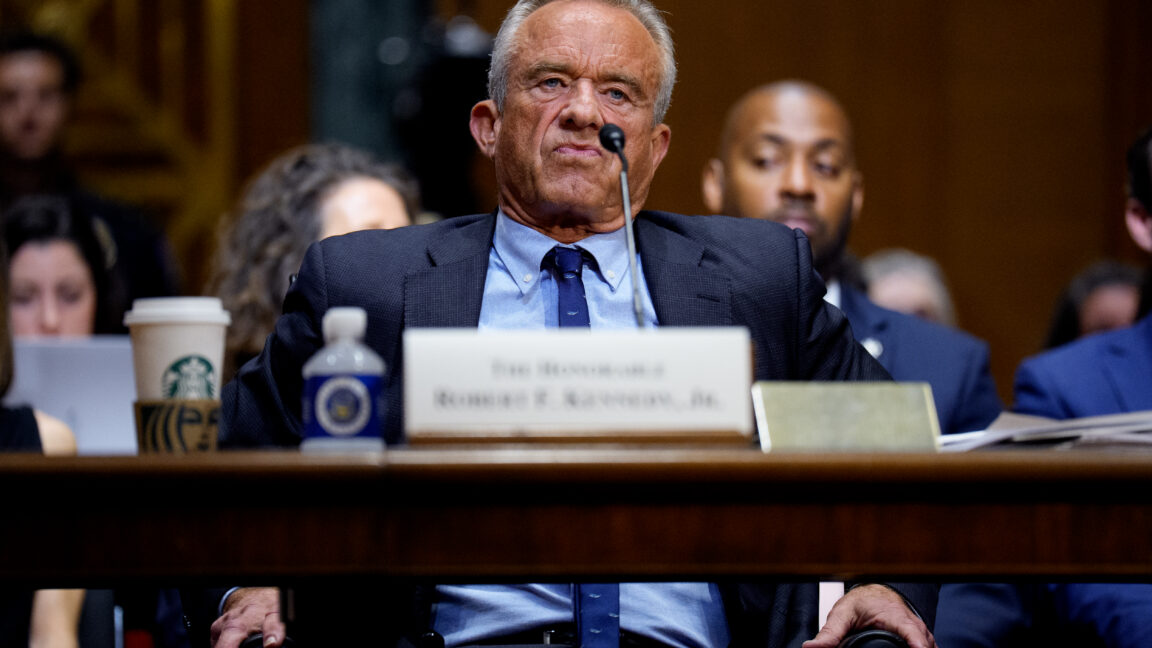
WASHINGTON—Establishing new federal guidelines for disease prevention as he moves to restrict public access to a number of vaccines, Health and Human Services Secretary Robert F. Kennedy Jr. launched a campaign to promote natural immunity Tuesday by inviting Americans to touch his festering sore. “Endless vaccines are no longer necessary to achieve immunity now that everybody can come into contact with this throbbing, open sore on my chest,” said Kennedy, who has claimed there is no evidence that routinely administered injections are more effective than the pus oozing from a gaping wound in his flesh when it comes to warding off illness. “It is now the official recommendation of the CDC that at-risk groups allow my putrid discharge to seep into their own immune systems through their contaminated hands, helping the body naturally build defenses against whatever the hell is making it all crusty like that. For thousands of years, humans have fought off infection through environmental exposure to gurgling yellow, green, and brown fluids that erupt from neglected lacerations just like this one, despite what Big Pharma and their superfluous shots and bandages might lead you to believe. Rest assured, access to my bacteria-ridden secretions will remain open for as long as it takes to reach herd immunity.” Kennedy also recommended that anyone over the age of 65 rub some of the grosser stuff in their eyeballs to make it work faster.
The post RFK Jr. Promotes Natural Immunity With Invitation To Touch His Festering Sore appeared first on The Onion.
WASHINGTON—Cracking their knuckles and demanding they receive a “papology [sic], or else,” Eric Trump and Donald Trump Jr. reportedly yelled, “You think you can talk about our dad that way?” Wednesday before beating their TV with a baseball bat. “Hey Eric, this TV thinks it can say a bunch of real bad stuff about Dad and get away with it—let’s show it who’s boss,” said Don Jr., the older of the Trump boys, who, after doing different karate chops and threatening to go “get [his] Nerf Mega blaster,” took out a Wiffle ball bat, raised it above his head, and proceeded to hit the LG 50-inch flat-screen TV as hard as he could. “Our dad is the strongest, bestest, coolest dad of all time, do you hear me? And if you don’t shut up, Eric is going to pick you up and throw you on the ground, and then I’ll pull my pants down and sit on you until you buttsplode [sic]!” At press time, both Eric and Don Jr. could reportedly be heard sobbing because a broken TV meant that neither of them could watch Monster Jam.
The post ‘You Think You Can Talk About Our Dad That Way?’ Scream Trump Boys, Beating TV With Bat appeared first on The Onion.
COPPELL, TX—Rushing to wash a sink full of dishes and tidy the kitchen before her phone alarm went off, local woman Abby Hartz reportedly set a timer on Wednesday to make cleaning much more stressful. “I just like adding a layer of panic to the stress of doing a bunch of chores I hate,” said Hartz, noting that she prefers to break a long cleaning session into 15-minute chunks so that she can fail repeatedly instead of just once. “That added pressure keeps me focused on feeling incompetent as I race through barely cleaning the bathroom. When I sense that I have less than a minute left, I freak out and start half-ass wiping down the mirrors. Plus, I always blast dance music when I clean, which tricks my brain into associating my favorite songs with miserably scrubbing scum off the bathtub.” Hartz added that she planned to apply the timer technique to other parts of her life in an effort to measure her entire self worth by her productivity level.
The post Woman Sets Timer To Make Cleaning More Stressful appeared first on The Onion.
WASHINGTON—Marveling at the childlike innocence and naïveté on display from their first-term colleague, members of the U.S. House of Representatives confirmed Wednesday that freshman congressman Gabe Evans of Colorado was being adorably discreet with his corruption. “Aw, look, look! He’s going into the parking garage, trying to look all sneaky—what a sweetie pie,” said Florida Rep. Brian Mast, one of several representatives who cooed as they watched Evans nervously offer to vote for tax breaks in exchange for a campaign donation, his eyes darting around the dimly lit structure and his voice wavering meekly as he made the deal with a lobbyist on a burner cell phone. “Taking contributions under the federal limit just to avoid notice? So adorable. I remember when I was a freshman—so young and naïve. He’ll learn soon enough. Aw, look at him blushing and trying to deflect when the reporter asks him questions about it! It’s so cute that he thinks he has to do that.” Evans’ colleagues were later seen stifling giggles after they learned the congressman had just agreed to attend a town hall packed with his concerned constituents.
The post Freshman Congressman Being Adorably Discreet With Corruption appeared first on The Onion.
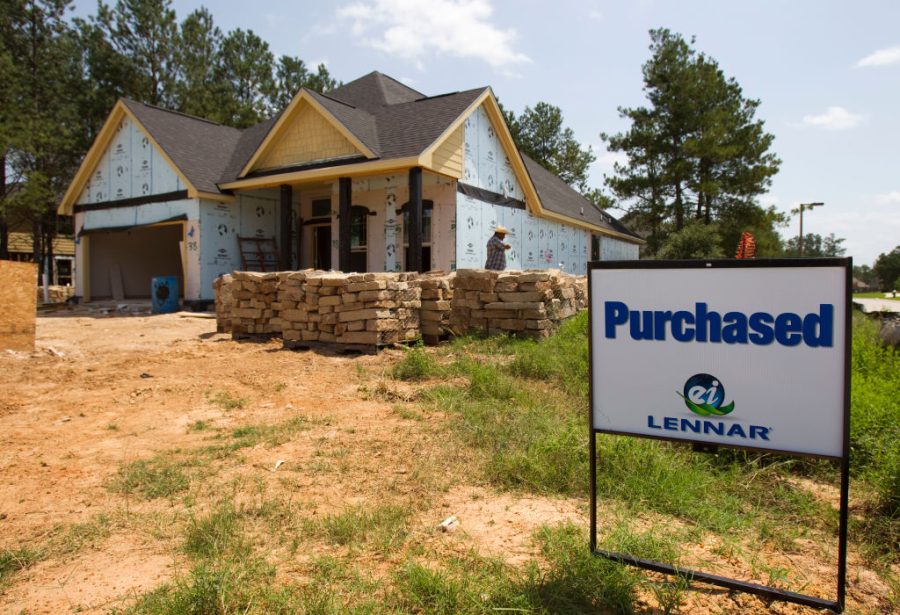
Lennar, the nation’s second-largest homebuilder, has built more homes than it’s capable of selling at the current asking prices. But instead of lowering home prices for the public, the company has launched an online marketplace available exclusively to deep-pocketed investors and corporate landlords to offload its housing stockpile.
The new platform offers search tools and sweetheart deals targeting C-suite customers like Blackstone and Greystar, the largest corporate landlords in the country, as well as smaller landlords. Real estate experts say Lennar is doing this to juice home sales and steer business toward its lucrative in-house mortgage lender — at the expense of consumers, who are being boxed out of homeownership and forced to pay ever-higher home and rental costs.
These all-in-one suites of services have become common as increasingly popular online real estate behemoths like Zillow and Rocket Mortgage have vertically integrated the homebuying process. These companies’ online platforms advertise listings and then funnel buyers toward their in-house mortgage lenders to maximize profits — a type of “kickback scheme” that generates profits at the homebuyers’ expense, according to experts and federal regulators.
Now Lennar, too, is getting in on the action with its online investor marketplace, one designed specifically for those looking to generate income from these properties. The search engine offers data analytics tailored to landlords, such as estimated returns for renting out the homes. The fine print in the new Lennar investor portal directs investors to use Lennar’s own mortgage lender to qualify for limited-time offers, instead of shopping around for other lending options.
Lennar’s new housing marketplace comes at a time when stockpiles of newly built homes have reached a fifteen-year high, with the number of homes for sale far surpassing the number of buyers. Typically, these developments would lead to lower prices for ordinary homebuyers. Instead, Lennar is moving to sell its housing supply to investors for “an optimized return on investment,” according to its website.
“From rental comps to school scores, our platform gives you the full picture — plus real-time underwriting tools that provide projected returns, expenses, and neighborhood insights to guide your investment decisions,” Lennar states.
Critics warn that such corporate consolidation of services carries significant risks for consumers.
“The homebuying industry is experiencing a trend toward vertical integration that deserves antitrust scrutiny,” wrote a group of Democratic lawmakers in a June letter to the Department of Justice and Federal Trade Commission calling for the agencies to block a series of real estate mergers.
Lennar’s marketplace portal has the potential to hand over an even greater share of the housing market to investors, who already own about 14 million homes nationwide.
These “one-stop shops” allegedly include kickback schemes so widespread that the Consumer Financial Protection Bureau — the federal agency overseeing consumer finance laws — sued Rocket Homes and Zillow over these practices. Both lawsuits were blocked under Donald Trump’s current and previous administrations, leaving room for companies like Lennar to adopt similar self-dealing arrangements.
Lennar’s new marketplace portal has the potential to hand over an even greater share of the nation’s housing market to investors, who already own about fourteen million homes nationwide. Of all homes sold in the first three months of 2025, nearly 27 percent were purchased by investors, up nearly 10 percent from 2020 to 2023.
These investors include massive private equity firms like Blackstone, which owns roughly 63,000 homes around the country, plus another 274,000 rental units through its housing trust, Blackstone Real Estate Income Trust. Other market players include corporate operations like Greystar, the largest landlord in the country, and small investors who own fewer than a hundred homes. Real estate investors have come under criticism from tenant advocates for purchasing homes and converting them into high-cost, low-quality rentals
In California, the most expensive housing market in the country, investors own one in five homes, and research has shown that investor-owned properties have higher rents and eviction rates and shoddier maintenance upkeep.
As investors buy up the growing home stockpile, homebuilders have little incentive to lower prices and make housing more affordable to homebuyers. Fewer young Americans than ever are homeowners, and the average American is now spending more than 30 percent of their paycheck on rent, a record high.
A 2023 study by researchers at Georgia Tech found that institutional investors buying up homes in the Atlanta area, one of the hot spots for corporate-landlord buy-ups, “effectively [cut] Black families out of home ownership. Collectively, Black people lost more than $4 billion in home equity over a ten-year period because of investors,” according to the study.
Blackstone claims that institutional investors are not to blame for higher home prices. Instead, they attribute the dynamic to basic economic supply and demand.
“Housing prices are high due to a significant supply and demand imbalance that has persisted for over a decade,” Blackstone wrote in a March blog post. “While the US population has nearly doubled since 1960, single-family housing starts are roughly the same.”
The Trump administration claimed that the One Big Beautiful Bill aimed to make housing more affordable. But in reality, the bill included tax breaks for firm-level investors, not single-unit homebuyers, according to the nonprofit Center for Economic and Policy Research, and failed to lock in renter protections.
“[The law] is structured more as a tax break for investors than as a solution to the rental affordability crisis,” the center wrote. “Without strong tenant protections or deeper affordability requirements, the program risks reinforcing existing inequities rather than easing them.”
Along with using its new investor platform to offload swathes of its housing stock at a profit, Lennar is also aiming to earn interest from financing those home purchases through its in-house mortgage lender.
The purchase agreements on Lennar’s investor marketplace offer “7/6” adjustable-rate mortgages, which come with a lower fixed-interest rate for the first seven years, then transition to a higher adjustable rate. Such mortgages are typically selected by buyers who plan to sell or flip properties in the first few years.
Lennar’s mortgage operation offers a rate just below 5 percent for the first seven years of ownership, which is comparatively lower than the average 7/6 rates offered by other lenders.
“We haven’t seen an [adjustable-rate mortgage] like that since before yield curves got inverted and interest rates went up [around 2022],” said Gordon Miller, president of the North Carolina–based mortgage brokerage, Miller Lending.
The standard thirty-year mortgage rate often selected by single-unit homebuyers is currently 6.6 percent, according to Investopedia.
As listed in its agreements, Lennar’s offer “requires financing through the seller’s affiliate Lennar Mortgage, LLC.” The offer only stands if the purchase is made and the deal is closed within ten days.
Critics see such tactics as Lennar trying to quickly squeeze as much money as it can from excess housing inventory.
While Lennar is targeting corporate investors, it’s also using its homebuilding empire, mortgage-lending arm, and market dominance to drive out small and medium-sized homebuilders.
“[It says] we’re moving a lot of [speculative] inventory and to lure you in we’re offering discounted rates,” said Miller. “It says they’re stuck . . . that sounds like a business trying to survive.”
D.R. Horton, Lennar’s closest competitor in the homebuilding market, also operates an in-house mortgage lender. In its home listing advertisements and promotions, D.R. Horton lists similar offers that require homebuyers to use its own mortgage lender, similar to Lennar’s terms on its investor marketplace.
While Lennar is targeting corporate investors with its new marketplace portal, it’s also using its homebuilding empire, mortgage-lending arm, and market dominance to drive out small and medium-sized homebuilders. As one building industry news outlet put it, D.R. Horton’s and Lennar’s “dominance creates a vortex of price competition, supply chain control, and operational efficiency that smaller builders struggle to match.”
“This model lets them use their financial advantage to create artificial affordability for buyers while raising the price of homes, which makes it very difficult for small builders to compete, and over time results in actual home prices going up,” Basel Musharbash, an antitrust and trade regulation lawyer, previously told the Lever.
Lennar already controls a significant portion of the homebuilding industry, ranking as either the first- or second-biggest builder in the country’s ten most active homebuilding markets. Lennar controls more than 26 percent of the homebuilding market in San Antonio, Texas, and nearly 30 percent of the Tampa-St Petersburg, Florida, market, according to a building industry news site. In the Cape Coral-Fort Myers, Florida, market, the twenty-fourth most active building market, Lennar controls nearly half of all homes being built.
Lennar’s market concentration, vertical-integration efforts, and new investor search platform leaves one stakeholder out in the cold: the average American homeowner.
“It’s Bob the builder and Bob’s mortgage guy dealing with Jane Doe, [who doesn’t realize] it’s the same person,” said Miller. “It’s all strictly for financial gain, not for the consumer at all.”
This article was first published by the Lever, an award-winning independent investigative newsroom.
1. It’s the hotly anticipated sequel of a late 2010s, grimdark existential nightmare.
2. The economy is really, really bad. Like. Really bad.
3. There are almost no places to rest, and even when you find them, they cost money.
4. You need to watch a lot of YouTube video essays to make sense of anything.
5. You mutter “What fresh hell is this?” every ten minutes.
6. There are some really lovable characters, but you hardly ever see them.
7. No matter how bleak it gets, you can’t stop scrolling.
8. People on Reddit swore it was going to happen—but a lot of us didn’t believe them
9. Religious fanatics keep attacking you.
10. You might not make it to the end.
Both: 1–10
Some time ago, I described Windows 3.0’s WinHelp as “a program for browsing online help files.” But Windows 3.0 predated the Internet, and these help files were available even if the computer was not connected to any other network. How can it be “online”?
The term “online” originally meant “immediately available on a computer”. For example, if you are working on a system with hierarchical storage, the “online” files are the ones that are accessible right now, and the “offline” files are the ones that have been archived to tape and will take some time to retrieve and make online.
The term “online help” refers to the fact that the help files are readily available on your computer. You don’t have to go dig through your shelves looking for a manual.
Back in the day, a computer that was accessible via a network or some other remote connection was generally called “up” rather than “online”. Officially, “up” referred to whether the computer was running at all, but since these types of computers (mainframes or timesharing systems) had as their sole purpose to be connected to by other computers, being “up” was useless if they weren’t also open to connections.
It does mean that we have the somewhat paradoxical terminology that online help is available offline.
But it’s not really a paradox because the terms “online” and “offline” are referring to different things. In the phrase “online help”, it’s referring to the help. The help files are online (readily accessible via computer). But “available offline” is referring to your computer (can connect to other computers).
Your computer is offline (relative to other computers). The help is online (relative to your computer).
Bonus chatter: Of course, now that many systems have migrated the help files themselves to Web sites, you now have online help that is not available when offline.
The post Why was Windows 3.0’s WinHelp called an online help system when it ran offline? appeared first on The Old New Thing.
Microsoft Production Studios (commonly known inside Microsoft simply as Microsoft Studios) is a large broadcast studio nestled in the trees on Microsoft’s main Redmond Campus.¹ Here’s a video hosted by Luke Burbank, local radio personality who is a frequent host for Microsoft internal videos.
I myself was interviewed at Microsoft Studios for a short video which (I am told) was used as an interstitial by the live streaming team at the Microsoft Build 2023 conference to promote my talk at that conference (co-hosted by Clint Rutkas).
The Microsoft Studios building is very unimpressive from the outside, but once you get inside, you find yourself in a high-tech broadcast studio. After going through hair and make-up, I was taken for my interview to a large mostly-empty black room with a giant LED wall backdrop and lots of television cameras backed by what I’m sure is extremely expensive electronic audio and video equipment.²
I’m told that the Microsoft Studios building was being designed at the time of the infamous Windows 98 on-stage USB blue screen³ They modified their design to include a room next to the broadcast room to stage any computer equipment that would be used during a live broadcast. The equipment would be set up and tested before being turned over to the program hosts. They don’t want a repeat of the disaster of experiencing a blue screen error during a live broadcast. So far, it has worked.
¹ Not to be confused with the Channel 9 Studio. I’ve recorded there, too!
² The instructions for dressing for the interview noted, “Your feet may be visible in some camera angles, so wear appropriate footwear.” “Aha,” I thought. “They said nothing about pants!”⁴
³ Some time ago, I wrote a technical explanation of what went wrong. TL;DR: For the live demo, they bought a scanner from a local electronics store and never tested it before going on stage. The scanner had a bug.
⁴ I wore pants.
The post Another lesson learned from the Windows 98 on-stage USB blue screen appeared first on The Old New Thing.
So I’ve been waiting for this meeting for twenty years, actually. And it’s not that everything’s a hundred percent understood or known, but I think we’ve made a lot of strides. I wish it was done a long time ago.
Today, we’re delighted to be joined by America’s top medical and public health professionals as we announce historic steps to confront the crisis of autism. Horrible, horrible crisis.
I want to thank the man who brought this issue to the forefront of American politics, along with me. And we actually met in my office, is it like twenty years ago, Bobby? It’s probably twenty years ago in New York. I was a developer, as you probably heard, and I always had very strong feelings about autism and how it happened and where it came from. And he and I—I don’t know, the word got out. And I wouldn’t say that people were very understanding of where we were, but it’s turning out that we understood a lot more than a lot of people who studied it, we think. And I say we think because I don’t think they were really letting the public know what they knew.
There’s never been anything like this. Just a few decades ago, one in ten thousand children had autism. So that’s not a long time. And I’ve always heard, you know, they say a few, but I think it’s a lot less time than that. It used to be one in twenty thousand, then one in ten thousand. And I would say that’s probably eighteen years ago. And now it’s one in thirty-one. But in some areas, it’s much worse than that, if you can believe it. One in thirty-one. And I gave numbers yesterday for boys. It’s one in twelve. I was told that’s in California, where they have, for some reason, a more severe problem. But whether it’s one in twelve or one in thirty-one, can you imagine? That’s down from one in twenty thousand, then one in ten thousand. And now we’re at the level of one in twelve, in some cases, for boys. One in thirty-one overall.
So since 2000, autism rates have surged by much more than four hundred percent. Instead of attacking those who ask questions, everyone should be grateful for those who are trying to get the answers to this complex situation. And the first day all of these great doctors behind me were there, I told them, “This is what we got to, we have to find out.” Because when you go from twenty thousand to ten thousand, and then you go to twelve, you know there’s something artificial. They’re taking something.
And by the way, I think I can say that there are certain groups of people that don’t take vaccines and don’t take any pills that have no autism. That have no autism. Does that tell you something? That’s currently—
[TURNS TO RFK, JR.] Is that a correct statement, by the way?
RFK JR.: There are some studies that suggest that, yeah, with the Amish, for example.
The Amish, yeah, virtually. I heard none. See, Bobby wants to be very careful with what he says, and he should, but I’m not so careful with what I say. But you have certain groups. The Amish, as an example, they have essentially no autism.
First, effective immediately, the FDA will be notifying physicians that the use of aceta—well, let’s see how we say that… Acetam—enophin. Acetaminophen. Is that okay? Which is basically commonly known as Tylenol. Can be associated with a very increased risk of autism. So taking Tylenol is not good. I’ll say it, it’s not good.
For this reason, they are strongly recommending that women limit Tylenol use during pregnancy unless medically necessary. That’s, for instance, in cases of extremely high fever, that you feel you can’t tough it out, you can’t do it. I guess there’s that. It’s a small number of cases, I think. But if you can’t tough it out, if you can’t do it, that’s what you’re going to have to do. You’ll take a Tylenol, but it’ll be very sparingly. It can be something that’s very dangerous to the woman’s health. In other words, a fever that’s very, very dangerous and ideally a doctor’s decision.
Because I think you shouldn’t take it. And you shouldn’t take it during the entire pregnancy. They may tell you that toward the end of the pregnancy, you shouldn’t take it during the entire. And you shouldn’t give the child the Tylenol every time he goes. He’s born, he goes and has a shot. You shouldn’t give a Tylenol to that child. All pregnant women should talk to their doctors for more information about limiting the use of this medication while pregnant. So ideally, you don’t take it at all. But if you have to, if you can’t tough it out, if there’s a problem, you’re going to end up doing it.
The other thing that I can tell you that I’ll say that they will maybe say at a little bit later date. But I think when you go for the shot, you do it over a five-time period. Take it over five times or four times. But you take it in smaller doses. And you spread it out over a period of years. And they pump so much stuff into those beautiful little babies. It’s a disgrace. I don’t see it. I don’t, I think it has, I think it’s very bad. They’re pumping, it looks like they’re pumping into a horse. You have a little child, a little fragile child, and you get a vat of eighty different vaccines, I guess. Eighty different blends, and they pump it in.
So, ideally, a woman won’t take Tylenol. And on the vaccines, it would be good instead of one visit where they pump the baby, load it up with stuff, you do it over a period of four times or five times. I was, I mean, I’ve been so into this issue for so many years, just because I couldn’t understand how a thing like this could happen. And you know it’s artificially induced. It’s not like something that, when you go from all of those, you know, healthy babies to a point where, I don’t even know structurally if a country can afford it. And that’s the least of the problems, to have families destroyed over this. It’s just so, so terrible.
I also, and we’ve already done this, we want no mercury in the vaccine. We want no aluminum in the vaccine. The MMR, I think, should be taken separately. This is based on what I feel, the mumps, measles. And the three should be taken separately. And it seems to be that when you mix them, there could be a problem. So there’s no downside in taking them separately. In fact, they think it’s better. So let it be separate.
The chickenpox is already separate. Because when that got mixed in, I guess they made it four for a while, it really was bad. So they make chickenpox. Individually, they’re okay. When you mix them, something maybe happens. So there’s no downside in doing it. It’s not like, oh, if you do it, bad things. No, it’s only good. And it may not have that much of an impact, but it may have a big impact. So let those be taken separately.
And then hepatitis B is sexually transmitted. There’s no reason to give a baby that’s almost just born hepatitis B. So I would say wait till the baby is twelve years old and formed, and take hepatitis B. And I think if you do those things, it’s going to be a whole different, it’s going to be a revolution in a positive sense in the country.
The FDA will be updating the label of an existing drug to reflect potential benefits in reducing some autism symptoms. This gives hope to the many parents with autistic children that it may be possible to improve their lives. That’s one of the things that I’m very, very happy about. I mean, this was mostly going to be on how not to have the child affected. But we’ve learned some pretty good things about certain elements of genius that can be given to a baby, and the baby can get better. And in some cases, maybe substantially better. Not going to be easy, but it’d be a lot easier if it didn’t happen in the first place.
These great parents fully understand, right? They fully understand. I feel so terribly for them. I have so many friends with autistic children. It’s just, it’s a tough situation. Finally, to help reach the ultimate goal of ending the autism fever, the NIH will be announcing thirteen major grant awards from the Autism Data Science Initiatives. And to be honest with you, to me, that’s the least important. It’s not even a money thing at this point. There’s so much money, but they have to do, and they have to move quickly.
When the alternative is that nothing bad can happen, let’s do it now. I was just saying to Bobby and the group, let’s do it now. Nothing bad can happen. It can only good happen. But with Tylenol, don’t take it. Don’t take it. And if you can’t live, if your fever is so bad, you have to take one, because there’s no alternative to that.
What can you take instead? It’s actually, there’s not an alternative to that. And as you know, other of the medicines are absolutely proven bad. I mean, they’ve been proven bad with the aspirins and the Advils and others, right? And they’ve been proven bad.
And I will say there are parts of the world that don’t take Tylenol. I mean, there’s a rumor, and I don’t know if it’s so or not, that Cuba, they don’t have Tylenol, because they don’t have the money to put Tylenol. And they have virtually no autism, okay? Tell me about that one. And there are other parts of the world where they don’t have Tylenol, where they don’t have autism. That tells you a lot.
And I want to say it right now. And you know, the way I look at it, don’t take it, don’t take it. There’s no downside in not taking it. So I’d like to ask Bobby to come up and say a few words. I hope I didn’t ruin his day, but that’s the way I feel. I’ve been very strong on this subject for a long time. You know, life is common sense too. And there’s a lot of common sense in this. And I wish things like this were brought up. And this group has worked so hard on it.
But I’d like to be a little bit more, a little speedier in the process of a recommendation, because there’s no harm in going quicker. There’s absolutely no harm. At worst, there’s no harm.
In brief: As Gabrielle heads out to sea and toward the Azores, we’ll begin to pay close attention to two newly minted Invests, 93L and 94L in the southwest Atlantic. The whole pattern bears watching for the East Coast over the next week or so. But uncertainty is extremely high, with a lot happening over a small area and any one feature having impacts on the others. We explain the delicate ballet unfolding today.
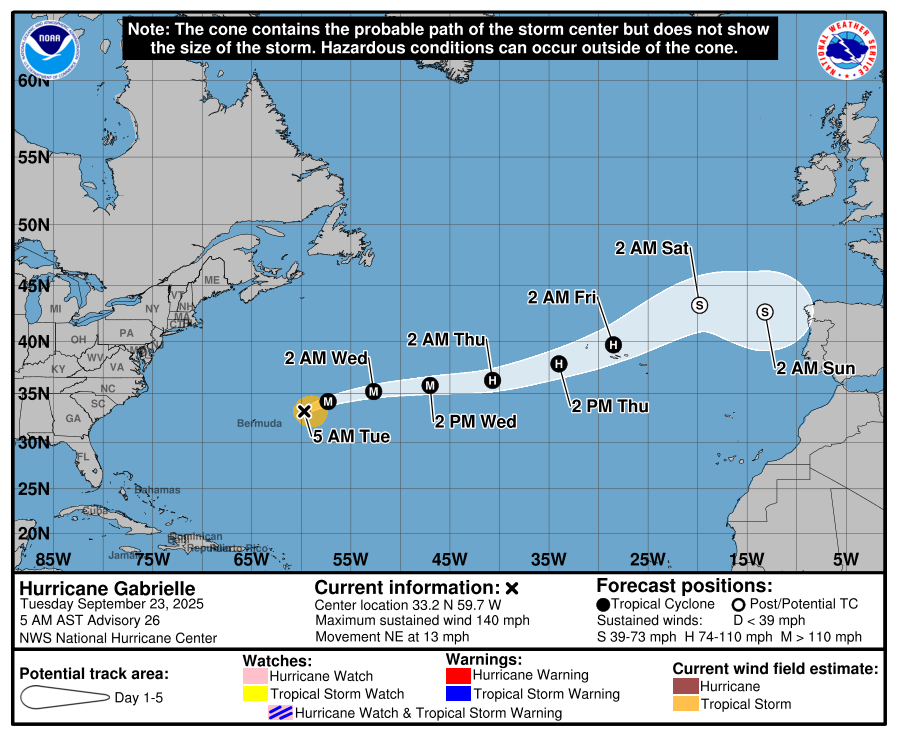
We’ll be quick on this one. Gabrielle intensified into a category 4 storm with 140 mph winds. The storm has probably peaked in intensity now and is going to move eastward out to sea.

The next questions for Gabrielle are how it will impact the Azores and if it can make it to Europe. Gabrielle should remain a fairly formidable, albeit less intense storm as it moves near the Azores on Thursday or Friday. More details to come on that. It’s still a bit too soon to say how it will impact Europe, but it’s possible a remnant low approaches Portugal by early next week. In the near-term, interests in the Azores should be monitoring Gabrielle’s progress.
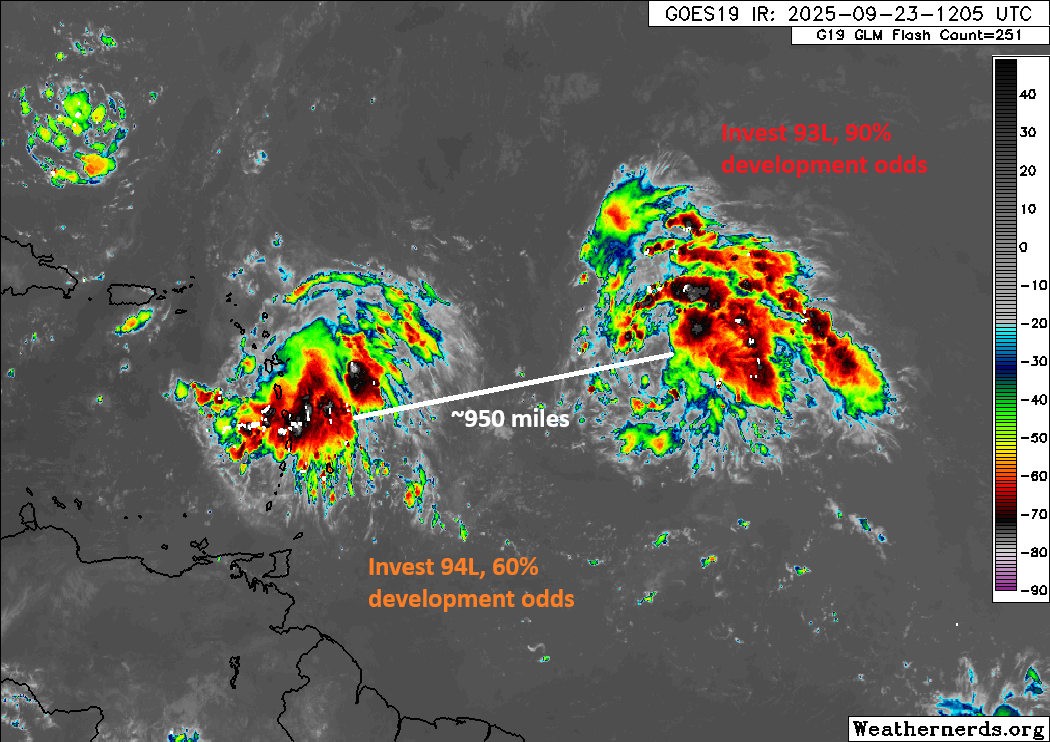
The area in the Atlantic with higher development odds right now is Invest 93L. This trailing disturbance has a 90% chance of development. Invest 93L has a similar look and feel to Gabrielle right now, and the models are indeed latching onto a higher chance that this develops by Thursday. Invest 94L will be moving into the Caribbean over the next couple days, so it’s likely that land interaction will inhibit its development. By Thursday morning, we expect to see 93L northeast of the islands and probably on the way to becoming a tropical depression. Invest 94L should be in the Turks and Caicos Islands or near Hispaniola as a tropical wave/disturbance.
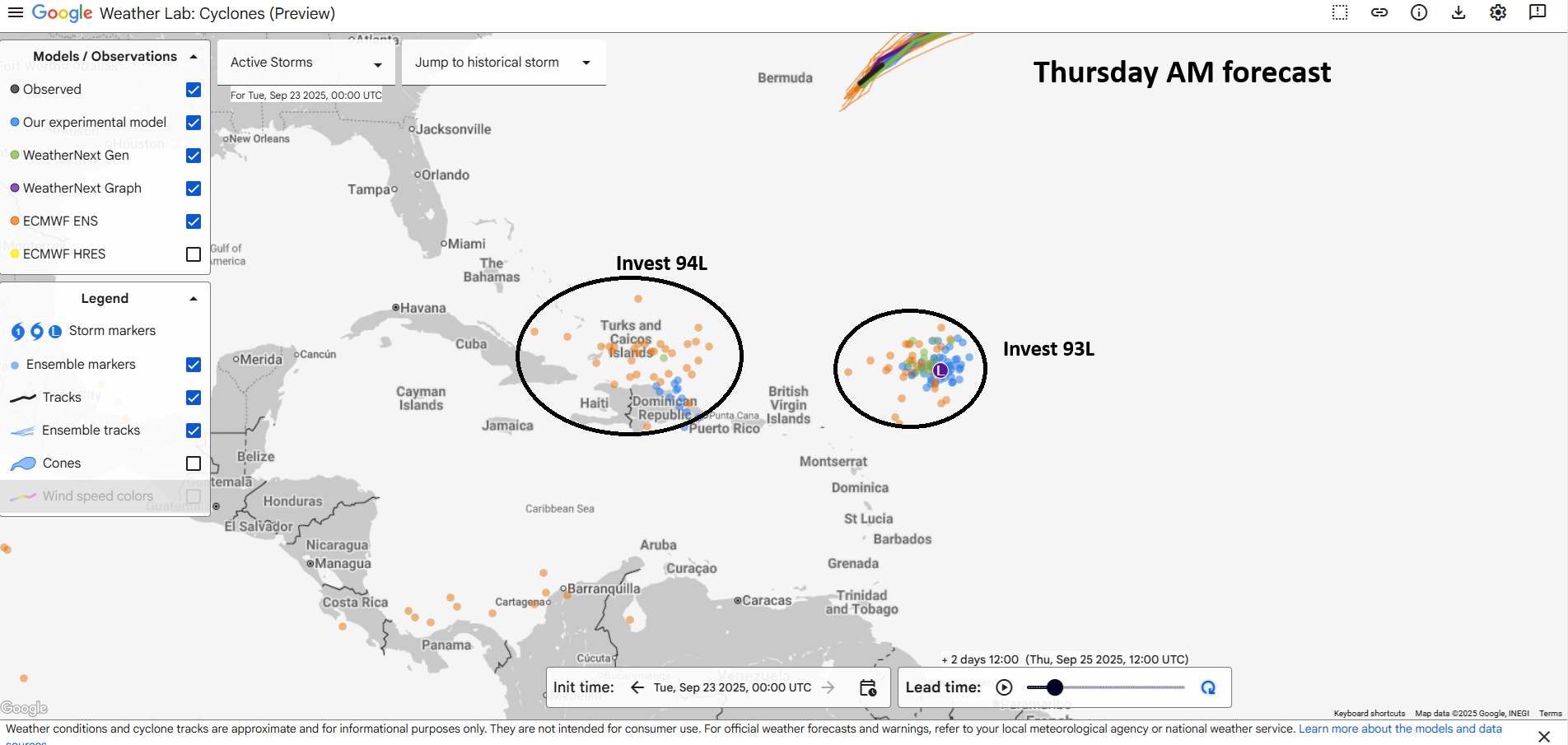
Up to this point, the forecast should be rather straightforward. Beyond this point?

There are about a million things that could happen after Thursday or Friday. The complicating factors right now include a.) What happens to 94L in the islands? That will help determine how far west it can get before being tugged north. b.) How strong does 93L get and how fast? That could help determine where it’s placed relative to 94L by the weekend which could influence both the track and development of 94L; they are fairly close together after all. c.) What about the trough in the Southeast? Will it be progressive enough to try to “capture” 94L and pull it into the Southeast or Mid-Atlantic? Or will it leave 94L stuck between a rock and a hard place with little opportunity to maneuver?
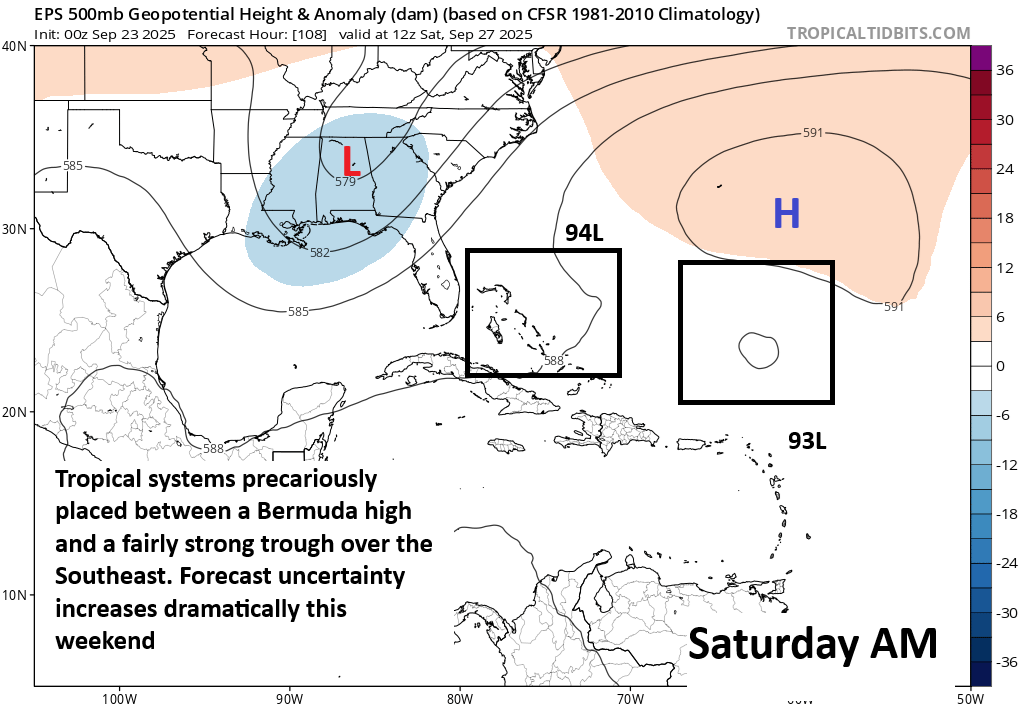
The bottom line in all this is that there is a *lot* of uncertainty in the pattern this weekend. Inject two possible tropical systems into the mess, with all these players residing over less than 1,500 miles of distance and you have a recipe for extreme uncertainty. As the Southeast trough exits, it could theoretically “capture” the disturbance and pull it more north or north-northwest toward the Southeast or Mid-Atlantic coastline by Sunday or Monday. Or later. And I think that’s where much of the concern sits right now in terms of land impact. It’s one of several possible outcomes. Folks on the East Coast from Florida through New England should monitor the progress of these systems in the next few days to see if we can pull a signal out of this. Because right now, we can’t.
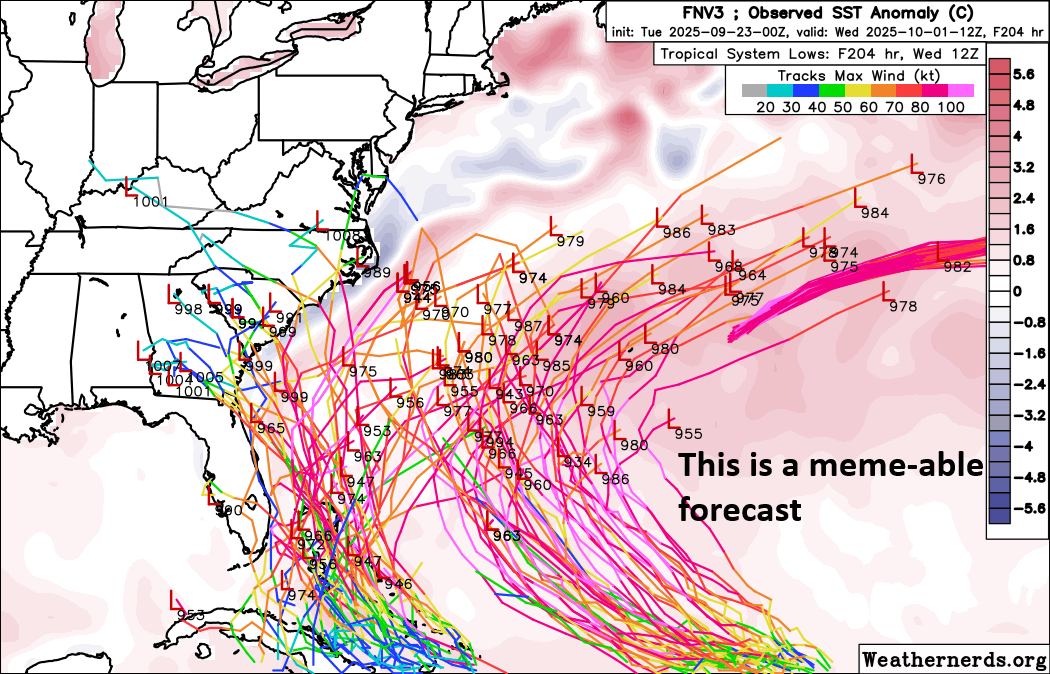
Bottom line: No one has any idea what these are going to do, and all you can do at this point is monitor the forecast and make sure you check on your hurricane plans and kits on the East Coast.
In the very near-term, Invest 94L will bring heavy rain to Puerto Rico and the Virgin Islands today.
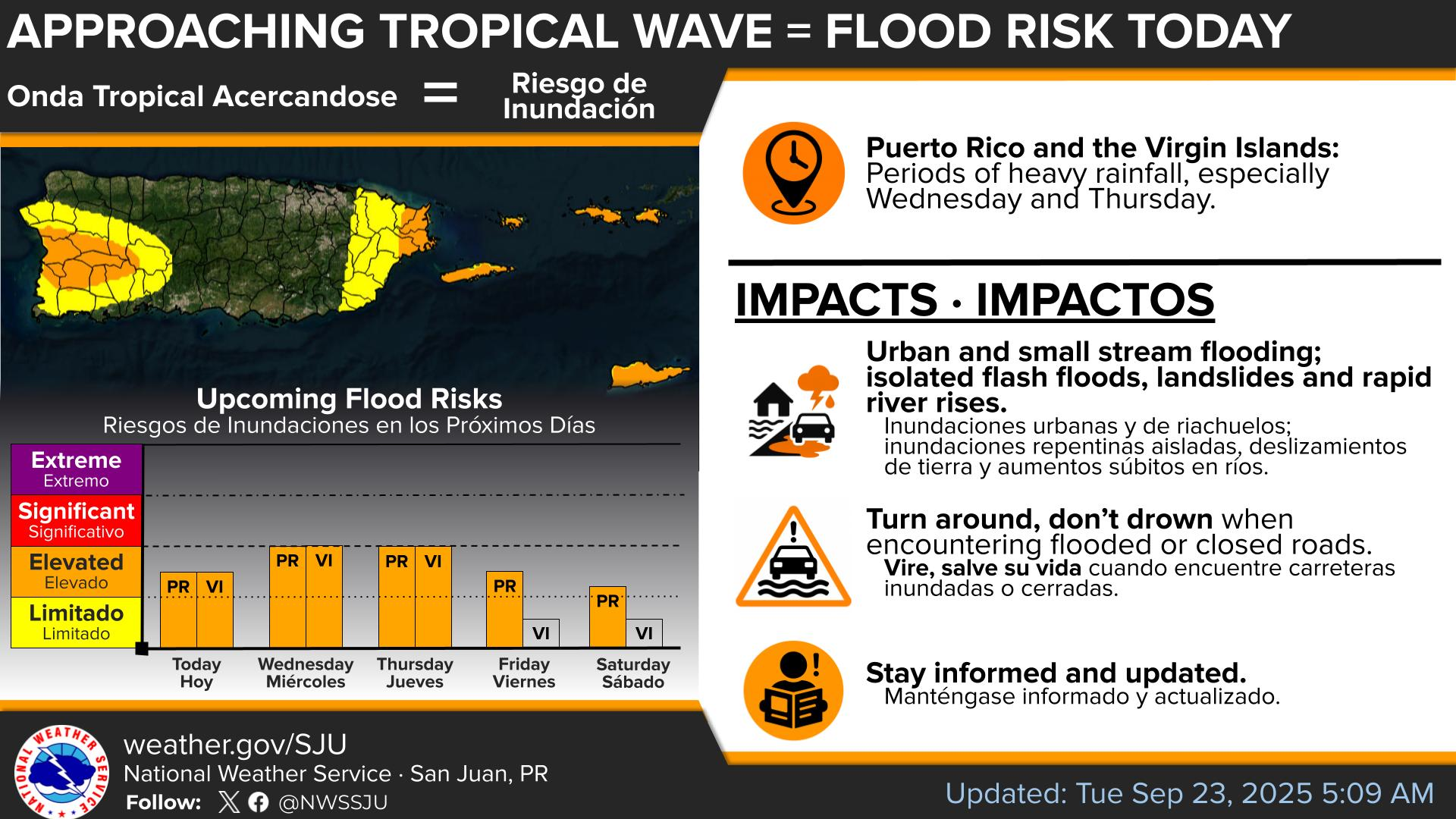
Localized flooding is a possibility in the heaviest rains. This will continue tomorrow and Thursday as well, easing up by Friday and Saturday.
In brief: Gabrielle became a hurricane and then a major hurricane overnight and this morning. It should head out to sea now, but it may bring some impacts to the Azores or even Europe eventually. Disturbance 1 from the NHC carries a 70% chance of development and is currently not a serious land threat. Disturbance 2 from the NHC carries a 40% chance of development and has a high degree of uncertainty in its forecast heading toward the weekend. We explain it all below.
Things have escalated a bit in the tropics, but there are still more questions than answers in some cases. Let’s walk through the development areas and explain what we know in each case.
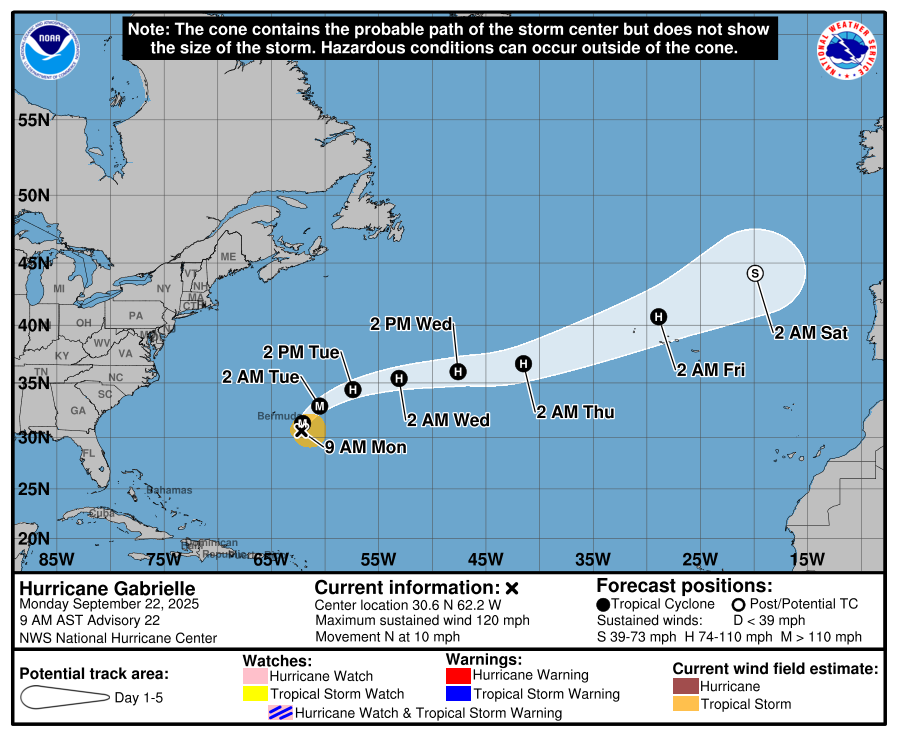
Last week we were scoffing at how paltry Gabrielle looked. But we said despite that it had a chance to become a hurricane, if not a major hurricane by Sunday or Monday. Well, here we are, and we got our major hurricane. Gabrielle has maximum sustained winds of 120 mph this morning, and it looks spectacular.

Gabrielle is in a bit of a precarious position, as it moves over much warmer than normal water. The water will be gradually cooling, however as it moves north and northeast. Still, Gabrielle has a good 24 hours in a favorable environment, and we could see it take a quick run at category 4 intensity this afternoon before peaking. From here, Gabrielle strolls out to sea and slowly weakens.
That said, Gabrielle probably won’t fizzle out. Impacts from Gabrielle are possible in the Azores by Friday and perhaps even in Iberia by Sunday or Monday. Exactly what those impacts will be are TBD. Uncertainty in the forecast from the Azores to Europe increases with time in Gabrielle’s forecast.
I want to preface this by saying that there are two distinct disturbances in the Atlantic, and the models are still sorting things out with each one. For now, I’m going to focus on the Central Atlantic one discussed here as the most likely to develop and also farthest east. A tropical wave in the central Atlantic is carrying a 70 percent chance of development over the next week as it comes west and northwest.
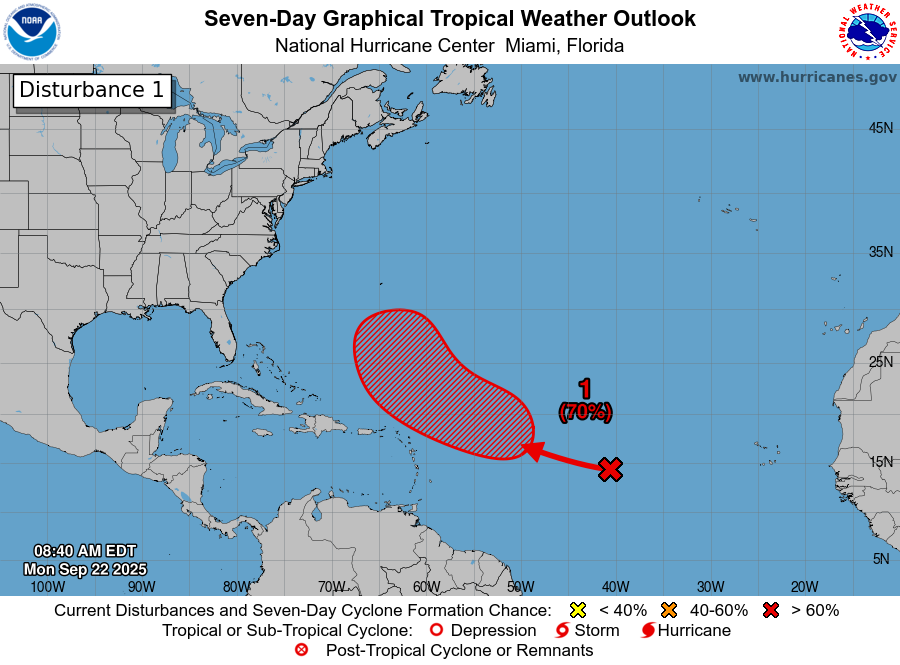
This system will be interesting, though I’m not particularly concerned about it making landfall right now. That said, it bears some watching. We’re still several days away from it getting north of the islands and south of Bermuda. But when it gets to that area, the upper level pattern is supportive of a system that moves slowly, possibly even stalling out. High pressure will block its exit east, at least initially, and a trough over the Southeast will sort of inhibit westward movement.
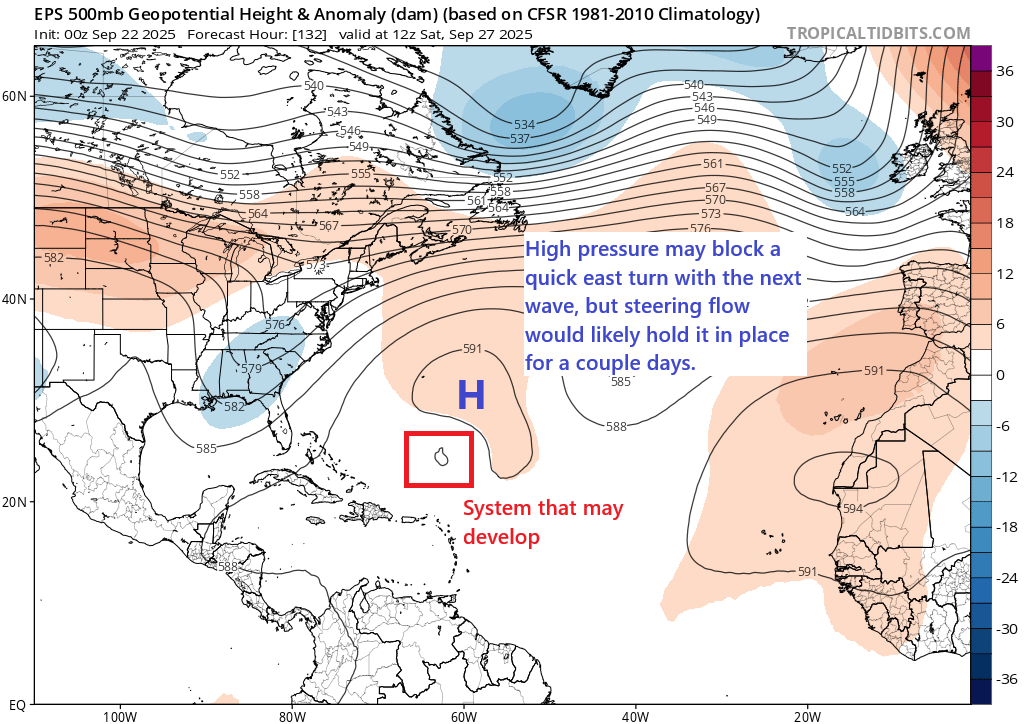
On the one hand, the high is expected to eventually weaken enough to allow for an exit out to sea, possibly by Tuesday or Wednesday of next week. On the other hand, systems that stall out inherently have high uncertainty and bear watching. If one of the puzzle pieces currently in place in the forecast ends up shifting, the overall outcome could also shift. For now, I would say continue to monitor this system, but it’s probably not worth losing sleep over at this very moment.
And then ahead of the above discussed area, we have another area to watch. This one is carrying a 40 percent chance of development over the next week.
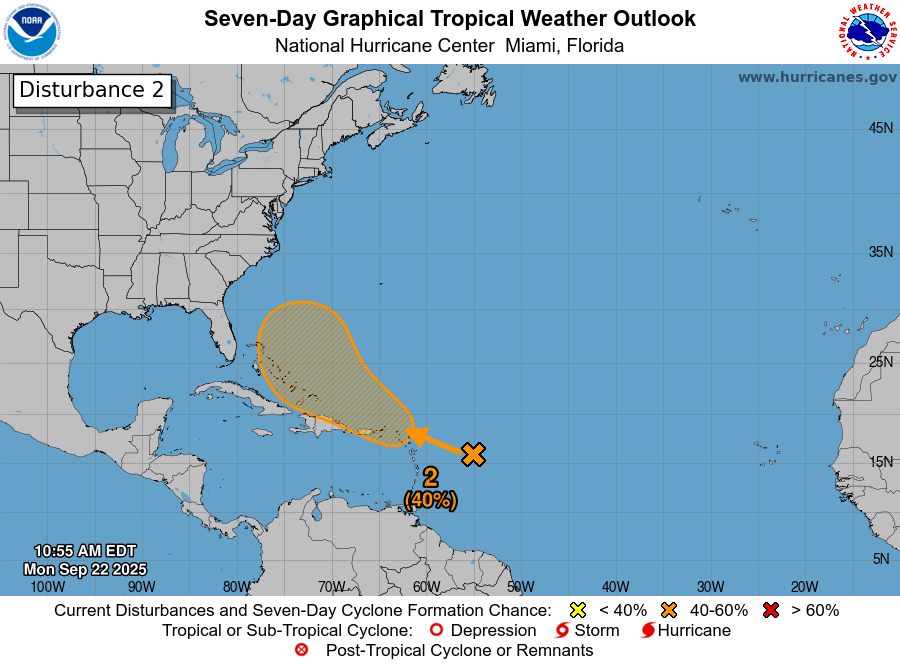
Looking on satellite, both the previously discussed disturbance and the leading one look fairly healthy. The trailing the disturbance is in a slightly better environment, hence the better odds right now.
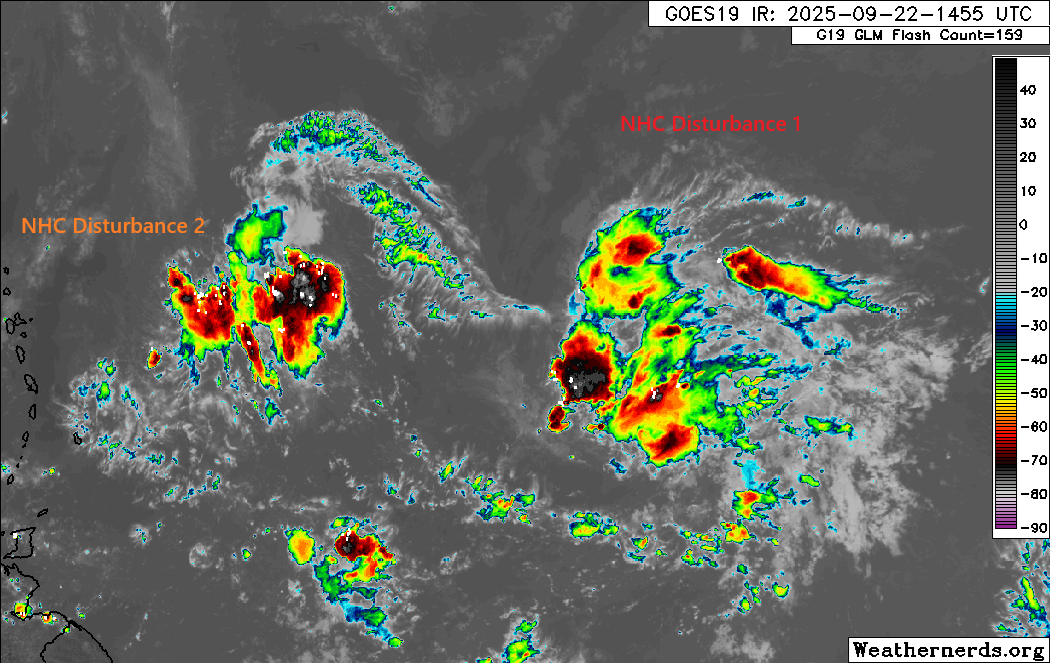
The leading disturbance discussed here will probably track off to the northwest, staying fairly low-end over the next 2 to 3 days. In fact, by Thursday, 1 Google Deep Mind ensemble member develops this area, while about half develop the trailing wave with higher odds. This disturbance has to deal with a bit more shear and also Gabrielle’s wake a little more. However, by Saturday evening, a little under half of the Google ensembles develop this disturbance near or just east of the Bahamas.

Notably, about the same percentage of European ensemble members are doing the same thing here. So there is growing model support for something in this area in about 6 days. What it looks like, what it is, what its impacts will be? We don’t know yet. But interests in the Bahamas and Turks and Caicos Islands should be monitoring the progression of the NHC Disturbance 2 over the coming days. For the U.S. Southeast? It’s too soon to say much about this. Folks in Florida up through the Carolinas should continue to monitor but understand that there is a very high amount of uncertainty with this wave. Confidence in Disturbance 1 is a bit higher both in track and in details right now. Confidence in this Disturbance 2 would be classified as low to lower than average. More to come.
In brief: Today will be hot with scattered showers, but Wednesday should be more dynamic as a line of storms pushes into the area ahead of a weak cool front. Some heavy rainfall is possible with the front, but rain totals look highly variable. After this we’ll see sunny and somewhat less humid weather.
It is rather warm and muggy out there, with much of the region just barely falling below 80 degrees this morning. Atmospheric conditions are trending toward better rain chances, but Wednesday still looks like the better day at this point for widespread showers. The likelihood of rain today should be about 50 percent for areas south of Interstate 10, with lesser chances inland. With dewpoints in the mid-70s it will be a very muggy day, as highs push into the lower 90s this afternoon. Rain chances fall back tonight, with lows again perhaps only briefly dropping to 80 degrees or below.
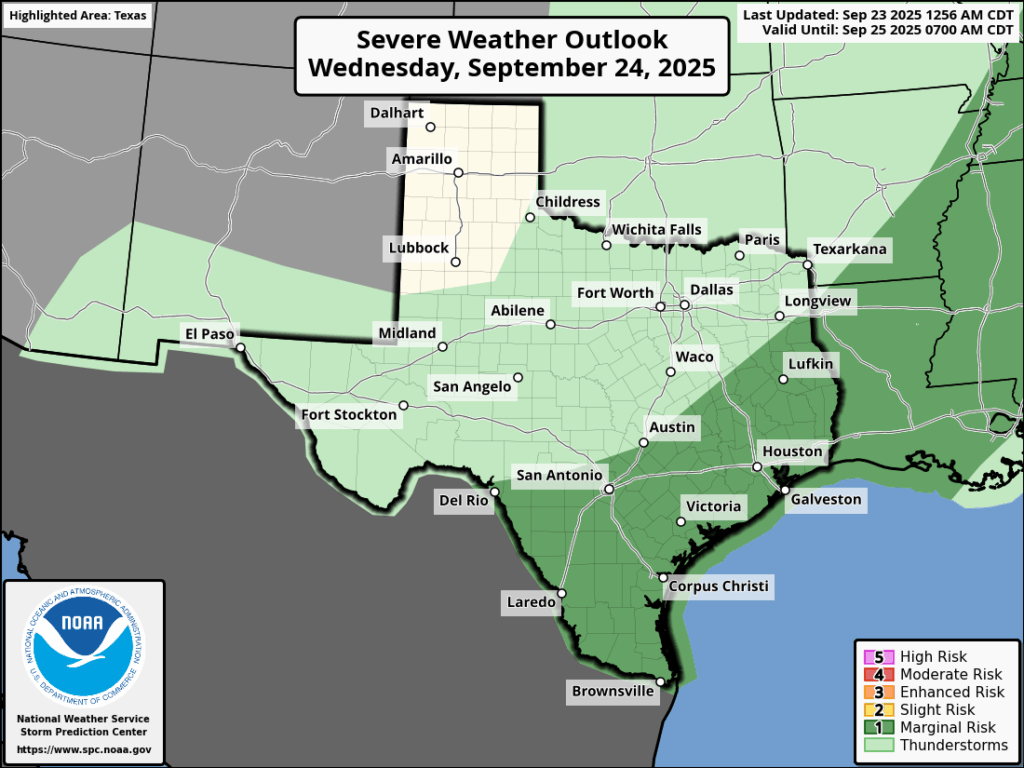
This should be the last really humid day for awhile. Showers will again be possible on Wednesday during the late morning and early afternoon hours, primarily near the coast. Later in the day a line of (broken?) showers and thunderstorms will advance from the northwest. The timing is fuzzy, but I generally expect these showers to hit the area during the late afternoon or early evening hours as a weak front advances into the area. There is a ‘marginal’ risk of severe weather, with the primary threat being thunderstorms and heavy rainfall. Overall I expect much of the area to pick up between 0.5 and 3 inches of rainfall, but higher isolated totals are possible. Highs on Wednesday should reach the lower 90s ahead of the rain.

Rain chances will linger into Thursday morning, especially closer to the coast, as the front slowly pushes offshore. Skies should be clearing during the afternoon hours, with high temperatures likely reaching the mid- to upper-80s. Winds will be from the north at 5 to 10 mph. As modestly drier air moves in, much of the region should drop into the 60s by early Friday morning.
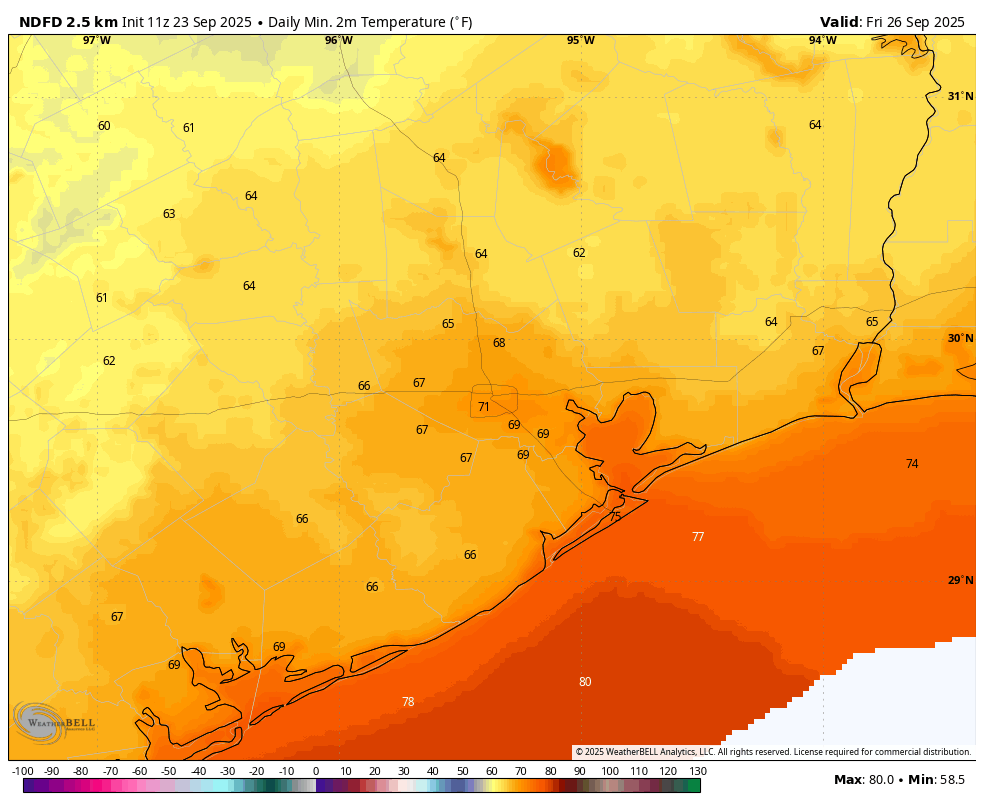
This should be a sunny day with highs in the upper 80s and lower humidity. Lows on Friday night should again drop into the 60s for inland areas.
Our modestly drier air should hold on through the weekend. With sunny skies expect daytime temperatures of about 90 degrees. Lows will fall into the 60s for inland areas, with central Houston and the coast probably dropping to around 70 degrees. It won’t be fall-like, but nights and mornings should be pleasant enough.
The drier air holds on for a few days before, I think, temperatures are likely headed back into the lower 90s for a few days. After this Thursday our rain chances appear to be quite low for awhile.
The Atlantic tropics are heating up, and Matt has full details over at The Eyewall. The short story is that there is nothing imminent in the Gulf of Mexico and zero threats to Texas at present. We’ll have more on this tomorrow or Thursday.

Remember the letter-writer whose building was being plagued by human waste outside it? Here’s the update.
The pooping has stopped!
It was actually just a small group of six people who were causing the biggest problems. There were mental health issues at play as well.
Our boss had several conversations with the police and created a plan that involved him monitoring the security cameras at night and calling the police non-emergency number any nights that group was sleeping under our awning. The police would send the homeless outreach team to give resources and ask the individuals to move on. If they didn’t move on, they were given no trespassing orders.
There is a public park with a small covered area near our building, so the group was welcome to stay there instead, just not under our building’s canopy. We’re also within a few blocks of a shelter and resource center- although they don’t have open public restrooms at night.
It took a couple of weeks before the cycle was broken, but now it’s been a month without any poop. We also had a power washer come out and clean things once. And our boss has cleaned things since then.
After I talked with my manager about how much the poop was bothering me, it seemed to spur faster action. Working from home until it was cleaned up really helped give me some physical and mental distance from the issue. I also changed our home setup so all shoes stay at the back door.
The post update: there’s human waste outside my building appeared first on Ask a Manager.
UFO lands in downtown, witnesses describe alien visitors: Their noses are too big #CowboyWho
The post ‘This Is Like Something Out Of A David Lynch Film,’ Says Man Driving Car With Headlights On appeared first on The Onion.
BURBANK, CA – The Walt Disney Company has announced late night host Jimmy Kimmel will return to ABC, a move cheered by free speech advocates and even more so by exhausted parents who cancelled their Disney+ subscriptions to make a point and then immediately regretted it. Following the ABC late night host’s controversial suspension – […]
The post Return of Jimmy Kimmel Show cheered by frazzled parents who white knuckled it through a weekend without Disney+ appeared first on The Beaverton.
EDMONTON – According to sources in the Premier’s household, Danielle Smith has invoked the notwithstanding clause to make her husband take out the trash. “As a libertarian-minded politician and spouse, I believe it’s important to limit the use of such a heavy-handed constitutional tool for the issues that really matter, like when a transgender teenager […]
The post Danielle Smith invokes notwithstanding clause to win argument with spouse appeared first on The Beaverton.
“My grandfather used to say ‘and Magda Goebbels made a great strudel’ and I never knew what it meant until after he died my grandmother explained some magazine did a fluff interview with Magda Goebbels a few years before WW2 that included her strudel recipe and my grandfather, who hated the Nazis with the passion of 10,000 suns, thought it was an example of the media sanitizing evil people and he would use the phrase when someone asked him to overlook a bad person doing bad things and focus on the good.” — X user @NickyFrank30
Use strong white flour for a superior product.
Mix lukewarm water, oil, salt, and vinegar. Nothing breaks down bonds within gluten like acid. In the final product, the sourness will be undetectable.
Crack in an egg. You can’t make a tasty strudel without breaking some eggs.
Form the dough. Knead until it’s as elastic as the truth.
Set the dough out of sight and out of mind.
There is no yeast in strudel. You’re not trying to facilitate the rise of anything. Say this on record.
Let your dough bide its time.
Prepare your apples. Use all the bad ones you want. Add sugar until it’s palatable and cover.
Alternatively, fill it with whatever you feel like. If they ask you what’s in it, say “apples.” They won’t know any differently until it’s cut.
Roll out your dough. Start from a center position and push the edges as far out as you possibly can.
Use the backs of your closed fists. Don’t leave fingerprints. Let nothing get under your nails.
Reposition the dough slightly to the right. Repeat.
Don’t forget the melted butter. The layers will be dangerously thin, so it’s important to also keep them slick.
If any dough stretches over the furthest edges of the table, simply cut it off. It’s still your dough. But you don’t have to use it if it’s not to your advantage.
When it’s ready, your dough should be so thin that you can read a government-approved newspaper through it.
Discard the newspaper.
Sprinkle breadcrumbs over half the dough. This will keep anything unsavory from leaking out.
Roll up your dough around your filling, enclosing it like a spiral.
The word “strudel” means “whirlpool.” A spiral with a deadly downward pull.
Twist your strudel until it fits your pan.
As you work, remind us that you cook for your family. Family is so important. Real, good families, just like yours.
Smile.
Produce the completely baked strudel, covered with a tea towel. It’s not important where or how you baked it.
Serve in oversized slices, smothered in powdered sugar and cream. Go on. Have a piece. You can’t say no to just one piece, not after all this work.
If they try to misdirect you, return their attention to the strudel.
If they’ve eaten one piece to be polite, serve them a second helping.
Repeat.
Even if they refuse.
Repeat.
Even when they’re physically sick.
Repeat.
Repeat. Repeat. Repeat.
When you’re out of strudel, your job is done. Hold your head high. This is what you’ll be remembered for.
The US Secret Service announced this morning that it has located and seized a cache of telecom devices large enough to "shut down the cellular network in New York City." And it believes a nation-state is responsible.
According to the agency, "more than 300 co-located SIM servers and 100,000 SIM cards" were discovered at multiple locations within the New York City area. Photos of the seized gear show what appear to be "SIM boxes" bristling with antennas and stuffed with SIM cards, then stacked on six-shelf racks. (SIM boxes are often used for fraud.) One photo even shows neatly stacked towers of punched-out SIM card packaging, suggesting that whoever assembled the system invested some quality time in just getting the whole thing set up.
The gear was identified as part of a Secret Service investigation into "anonymous telephonic threats" made against several high-ranking US government officials, but the setup seems designed for something larger than just making a few threats. The Secret Service believes that the system could have been capable of activities like "disabling cell phone towers, enabling denial of services attacks, and facilitating anonymous, encrypted communication between potential threat actors and criminal enterprises."
death
![[img]:lulcon](https://analognowhere.com/_/lulcon/lulcon.png)
a phone vibrates
Girl and Fish stand by.
Fish: "Pick it up."
Girl picks it up. It belongs to a slain MATA_mercenary. OpenBlade is stuck in his head.
The phone displays a message: "The girls cooked your favorite pumpkin soup. Can't wait for you to get home. Love you!"
Puffy: "Right... Let's uh.. Let's talk.."
https://analognowhere.com/_/lulcon
Health Secretary and anti-vaccine activist Robert F. Kennedy Jr. on Monday evening announced that the use of Tylenol (aka acetaminophen, paracetamol) during pregnancy is linked to autism—an unproven assertion that had previously sent Kennedy's anti-vaccine allies into a rage.
In a press event alongside Trump, Kennedy said that the Food and Drug Administration will work to update the drug's safety label and notify physicians of the concerns. At the same time, the administration also touted leucovorin (folinic acid) as a potential treatment for autism, though there is scant evidence behind its use for autism.
Before the announcement, news reports revealing Kennedy's plan angered his anti-vaccine followers.
Oh ... well ... hi there little partners! Well ... couple of technical problems down here but, well, that's ok. Because it's time for this week's exciting episode of Trail of the Royal Mounted! #CowboyWho
A reader writes:
I just finished conducting a job interview where it was clear from the candidate’s answer to the first question that he was not going to get the job, but I felt like it would be rude to indicate that so abruptly. So I wasted 20 more minutes of his time going through the motions and by the end we both knew it was not a fit but I didn’t know what to say. Is it ever okay to cut the interview short?
I answer this question — and two others — over at Inc. today, where I’m revisiting letters that have been buried in the archives here from years ago (and sometimes updating/expanding my answers to them). You can read it here.
Other questions I’m answering there today include:
The post is it rude to cut short an interview if the candidate obviously isn’t the right fit? appeared first on Ask a Manager.
A reader writes:
This may not be an answerable question, but I’m interested in your views on what makes company culture. I ask because my very small (fewer than 10 people), 100%-remote company recently hired a new employee, and during the interview I anticipated that the candidate might ask about company culture and I realized that I would not know what to say.
This was an unusual hire for our company, because it was only the third time in our more than 10-year history that we’ve hired someone who had no previous connection to a current employee.
A quick overview of my company might provide helpful perspective: a couple of us have been here since the company’s inception; everyone else was brought in (usually without posting the open position) because one of the company leaders knew and liked them from previous jobs. Though I recognize the benefit of hiring known quantities, I’ve expressed discomfort about this trend, as my fear — borne out many times over — is that these employees would come in and just resume the relationship they had with the person they knew previously rather than get to know everyone as a new “cold” employee would need to do. The result, in my view, is that our workplace has, in place of its own culture, a bunch of separate 1:1 relationships—some of which overlap to the point of being cliques.
All of this got me wondering if there were certain essential components that go into what people think of as company culture—things like physical space or a critical mass of employees.
The new candidate never did ask about company culture, which may be a good thing, because I think my answer would have had to be, “We don’t have one.”
You have a company culture, whether you realize it or not. I bet if you asked non-leadership employees, they’d have an easy time describing how they view the culture. Of course, whether they’d be candid about it is a different question — and that’s also part of culture.
Culture is basically “how we do stuff here.” Here’s just a partial list of what it includes:
… and on and on.
I once heard someone say, “Culture is what happens when the boss leaves the room,” and that’s a good description of it too.
In your case, it sounds like part of your culture might be that the team doesn’t feel cohesive — that it’s a team of individual relationships functioning independently of each other, without a lot of collaboration or trust outside of those silos. That’s a part of culture! (It’s also a part of your culture that you can work on changing if you want to. You’ll need to articulate what you’re seeing and how it affects the organization, name what you’d like to see instead, and figure out how to deliberately move toward that.)
For what it’s worth, hiring only people who you already know will bring additional problems too: you’re more likely to end up with a group of employees who are all very similar to each other (demographically and/or in world view), and you’re missing out on potentially stronger candidates just because you don’t already know them. When you’re very small, sometimes it can make sense to hire like that, but as the organization grows larger (and you’re probably at that point now), continuing to hire that way is very likely to hold you back and impact the results you get over time.
But bringing new people into a culture like you described risks being rough for those new people if you don’t first get more deliberate about what you want employees’ experience to be there.
The post I don’t think my company has a culture at all appeared first on Ask a Manager.
Ben & Jerry’s cofounder Jerry Greenfield resigned after 47 years due to parent company Unilever’s suppression of the brand’s social activism, which he believes violates the company’s founding values. What do you think?

“I thought I tasted less Jerry.”
Emma Nye, Error Calculator

“I guess Unilever just isn’t the cool, edgy holding company it used to be.”
Levi Pittman, Condiment Bottler

“I’m just glad Cherry Garcia isn’t alive to see this.”
Tristan Beal, Microwave Technician
The post Ben & Jerry’s Cofounder Resigns Over Censorship appeared first on The Onion.
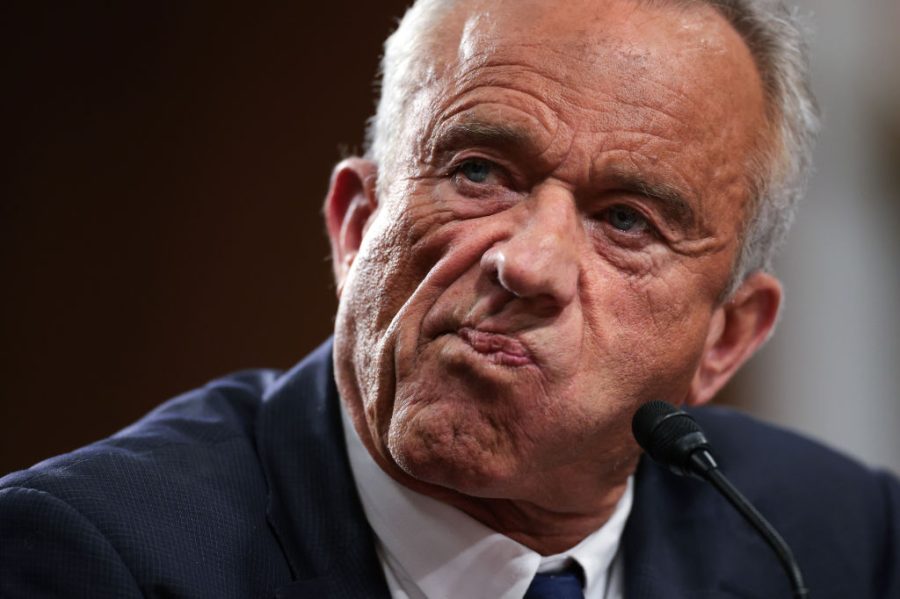
Many states are moving to guarantee COVID-19 vaccine access for their residents amid new restrictions set by the Trump administration. But when people in these states try to schedule a vaccine appointment online, as they’ve done for years, they may be out of luck: the country’s four largest retail pharmacy chains — CVS, Walgreens, Walmart, and Kroger — are still discouraging and barring some people from booking these appointments online, even in states where it’s allowed, a Lever review found.
While it may be possible to ignore these online notices or walk into these pharmacies and request a COVID-19 shot, the companies’ messaging may be sowing confusion and lowering vaccination rates among the public.
This August, Health and Human Services secretary Robert F. Kennedy Jr, an outspoken vaccine critic, limited access to COVID-19 shots to people over age sixty-five, and those six months and older with increased risk of severe illness. The move reversed earlier federal guidance that allowed anyone six months or older to receive the vaccine.
Consequently both CVS and Walgreens, the country’s top two pharmacy chains, swiftly stopped offering COVID-19 vaccines for individuals without a doctor’s prescription in more than a dozen states.
Sixteen states — Arizona, California, Colorado, Connecticut, Hawaii, Illinois, Maine, Massachusetts, Minnesota, New Jersey, New Mexico, New York, Oregon, Rhode Island, Washington, and Wisconsin — have since issued orders that allow individuals of any age and health status to get a COVID-19 shot.
Other states, including Delaware, Nevada, North Carolina, Pennsylvania, and Virginia, have also passed orders expanding vaccine access, but only for certain individuals. In North Carolina and Virginia, for example, people aged eighteen to sixty-five can receive the shot without a prescription but only if they have an underlying health condition such as cancer or diabetes.
However, despite these orders, a Lever reporter faced numerous barriers when trying to schedule COVID-19 vaccine appointments in all of the states with expanded access through the online systems used by CVS Health, Walgreens, Walmart, and the Kroger Company.
For example, CVS, the country’s largest pharmacy chain, notes on its vaccine scheduling page that “The 2025/26 COVID-19 vaccine is FDA approved for everyone ages 65 and older and patients 6 months to 64 with certain health conditions that put someone at high risk for severe outcomes from COVID-19 virus.” The language remains the same no matter the state selected.
Kroger, another major pharmacy company, displays a similar warning for all the states where it has locations.
Walgreens, the country’s second-largest pharmacy brand, goes further, currently not allowing anyone to schedule a COVID-19 vaccine online for children under twelve and requiring those twelve and older to confirm that they have at least one related health condition or risk factor before booking an appointment, even in states where everyone is allowed to get the shot.
CVS, Walgreens, Walmart, and Kroger did not respond to requests for comment.
These online obstacles could add to the confusion and mixed messages surrounding COVID-19 vaccines this fall.
“It’s impossible to explain with assurance the new rules as [the Department of Human and Health Services] has created confusion and chaos in communicating policy,” infectious disease expert John Swartzberg told University of California, Berkeley School of Public Health’s news site earlier this month.
The current FDA vaccine advisory committee, which provides official government recommendations on immunizations, isn’t helping matters. In June, Kennedy removed all seventeen sitting members from the committee. He has since stacked the group with vaccine skeptics like Kirk Milhoan, a pediatric cardiologist who backed using unproven COVID-19 treatments during the pandemic, and Evelyn Griffin, a Louisiana-based obstetrician who previously called COVID-19 vaccine mandates “a line in the sand” that should not have been crossed.
Kennedy’s vaccine advisory committee is meeting this week to vote on recommendations for COVID-19 shots and other standard childhood immunizations. So far, the committee has voted against allowing parents to choose the combined measles-mumps-rubella-varicella vaccine before their children reach age four and has indefinitely postponed a vote on the hepatitis B vaccine.
While the overall risk of hospitalizations and deaths from COVID-19 has decreased precipitously since the 2020 outbreak, the virus still causes thousands of hospitalizations and hundreds of deaths nationwide each week. The Centers for Disease Control and Prevention still states on its website that “COVID-19 vaccines can help keep you from getting sick from COVID-19. If you do get COVID-19, vaccines can make the illness shorter and less severe.”
This article was first published by the Lever, an award-winning independent investigative newsroom.