In brief: We’re interrupting your weekend because our confidence is increasing that a front arriving on Sunday morning will bring sharply colder temperatures on Sunday night into Monday morning. It now appears likely that much of the region will fall near to freezing, or a few degrees below.
The vast majority of the Houston region has yet to experience a freeze this season—the lowest temperature so far at Bush Intercontinental Airport has been 37 degrees—but that could change on Monday morning. For several days now it has been clear that a short-lived, but impactful front will push into Houston on Sunday. Now that we are closer to the front, however, we are beginning to get high-resolution data that continues to trend colder. It is clear that much of Houston, even within the urban core of the city, could see a light freeze for a couple of hours on Monday morning.
HRRR model temperature forecast for 7 am CT on Monday. Please note that actual temperatures will likely vary by a degree or three. (Weather Bell)
This is not the kind of freeze that is likely to knock power offline, or freeze pipes. We just are not going to get that cold, for that long. But this will be the first freeze of the season for much of the greater Houston metro area, and that means care should be taken for sensitive plants, and of course you should think about your pets.
We still don’t have great confidence of where the freeze line will fall, but I am reasonably confident that a majority of Montgomery and Chambers counties will freeze early on Monday morning. And I now think there is probably about a 50 percent chance that the majority of Harris County experiences a freeze. Chances are less likely for Galveston, Brazoria, and Fort Bend counties, but basically we’re not ruling anything out except for a place like, say, Galveston Island.
We will warm up into the low 50s on Monday, and Monday night should be at least a few degrees warmer. So the cold won’t last too long. And then we’re going to be quite a bit warmer for the run-up to Christmas morning.
MAR-A-LAGO, FL – Sources report President Donald J. Trump was seen questioning his own motivations behind a series of shocking recent moves in Venezuela, along with a close confidant who was later revealed to be an inanimate coatrack. “Look, I don’t know which of these vultures around me I can trust, but I’m having trouble […]
The Trump administration is arguing that requiring real-time American Sign Language interpretation of events like White House press briefings “would severely intrude on the President’s prerogative to control the image he presents to the public," part of a lawsuit seeking to require the White House to provide the services.
OTTAWA – In a stunning move, progressive conservative MP Michael Ma crossed the floor Thursday to the progressive conservative Liberal Party, just a few weeks after similar minded progressive conservative Conservative MP Chris d’Entremont did the same. “It just made sense,” Ma said when asked about the decision at a presser. “Carney is cutting government […]
OTTAWA – Local voter Martin Kofman finds it appalling that the Liberals have clearly hatched a plan to obtain the majority government voters denied them by luring Conservative MPs to cross the floor, and would be way more mad about it if it wasn’t so fun to image Poilievre’s face reacting to the news. “The […]
It’s “where are you now?” month at Ask a Manager, and all December I’m running updates from people who had their letters here answered in the past. Here are four updates from past letter-writers.
We had a Very Ballsy coworker bring it up in a staff meeting, demanding to know whether they preferred we infect all the people, children, and families we worked with every day in order to avoid being shamed for our own illness. (Yes, this was a preschool/daycare.) She also pointedly asked why *management* who called out sick or were otherwise not present were not included on the list.
They did the very performative “oh, we had no idea you felt that way, that’s not how we meant it AT ALL” and then got rid of the list. But I did overhear them grumbling in the office later that “it worked, though.” They wanted staff to be mad at each other for being over our child:teacher ratios, instead of complaining to management.
I’ve since changed careers, and while I’m still hourly, nobody shames me for taking a sick day anymore.
I took your advice to heart and started changing how I spoke about the ratings. My team doesn’t love the idea of forced ranking, but understands why there’s some limits. Handling the discussions at the start of the ratings period helped with the introduction, since it wasn’t tied to any negative feedback, and all in all it went well. In the meantime, my manager retired, and my team was assigned to a different supervisor, Lainey, with direction to grow our focus. My team is super excited because Lainey is setting up a lot of opportunities that are interesting to them and may even lead to promotions down the road. The excitement definitely helps drive motivation within the team. Finally, as I started writing this update, word came down that our ratings system was being adjusted and the new system will have a wider range of ratings, so there’s a good deal more nuance I can apply to my scoring.
I’m still frustrated that I can’t formally reward all of the passion and expertise that my seasoned crew brings to their work, but I’m happy that I was able to navigate them to a new understanding without destroying the trust we’ve built together over the years. Thank you for the assist in how to give my team the transparency they deserve.
A big thank you to Alison and all of the commenters for all of the advice. Looking back to when I wrote in, there was a lot of other stuff/drama that was feeding into my problem. All of the faculty in my department have very big feelings, and my supervisor and department were not on good terms with one another. My problem became another part of that. After a lot of back and forth between several offices, our business office was able to find a solution that theoretically will work. I say theoretically because we’ll try it out for the first time next semester. But, I’m optimistic it will work and I won’t have to handle any cash besides my own. I’m calling this a win.
This experience has also shown me how much I let myself get mired down in office drama. I’m working on trying to pull back from all of that right now. I also think it’s time to start looking for new opportunities.
WASHINGTON—Searching in vain for a meaningful way to retaliate after Indiana lawmakers rejected his Republican gerrymandering push, a visibly frustrated President Donald Trump was reportedly struggling Friday to find any infrastructure left in the state that could still be destroyed. “I’m looking all over, and there’s just no way we can make this any worse,” Trump said as his transportation secretary, Sean Duffy, showed him live satellite footage of the Rust Belt state, revealing mile after mile of pulverized highway, gnarled railroad tracks, algae-infested reservoirs, and abandoned main streets. “What is withholding funds even going to do here, Sean? How can you make dirt worse? I want to do something where people can really see a difference, but there’s no before-and-after here. These bridges already seem like they’ve been bombed, so anything I’d do would just be a lateral move. And look at Gary—is there even an intact window we could smash with a brick?” At press time, sources reported that Trump was exploring whether he could retroactively take credit for the state’s damage.
Sixty years ago, A Charlie Brown Christmas made its debut on CBS. Today, as part of CBS’s new initiative to modernize content, CBS Editor-in-Chief Bari Weiss updates this Christmas classic.
- - -
Charlie Brown and Linus lean on a brick wall. Snowflakes fall around them.
CHARLIE BROWN: I think there must be something wrong with me. I just don’t understand Christmas, I guess. I don’t feel the way I’m supposed to feel.
LINUS: Charlie Brown, you are the only person I know who can take a wonderful season like Christmas and turn it into a problem. Maybe Lucy is right. Maybe it is because of woke.
- - -
Charlie Brown sits in front of Lucy’s psychiatric booth.
CHARLIE BROWN: I feel depressed. I know I should be happy, but I’m not.
LUCY: It’s because of mainstream media cowardice. In an age of lies, telling the truth is a huge risk. I think we’d better pinpoint your fears. Are you afraid of being silenced because of your “privilege”? How ’bout for the crime of listening to a diversity of opinions? Are you afraid of getting canceled for freethinking? Or for fighting a culture war between people who think the Confederate flag is a beautiful symbol of resistance, and those who hate America?
CHARLIE BROWN: There’s a culture war?
LUCY: There is if you open your eyes to the truth.
CHARLIE BROWN: Actually, Lucy, my trouble is Christmas. Instead of feeling happy, I feel sort of let down.
LUCY: You need involvement. How would you like to be the director of our Christmas play?
CHARLIE BROWN: Me? I don’t know anything about directing a Christmas play.
LUCY: Don’t worry, I’ll help… Incidentally, I know how you feel, getting depressed and all that. It happens to me every year. I never get what I really want.
CHARLIE BROWN: What is it you want?
LUCY: Acceptance to the only school where you can think without fear of censorship or retribution: the University of Austin.
- - -
Charlie Brown and Lucy enter the school auditorium.
LUCY: All right, I’m here to assign roles. Frieda, you’re playing Dominique Francon.
FRIEDA: Does Dominique Francon have naturally curly hair?
LUCY: Pig Pen, you’re Ellsworth Toohey. Shermy, you’re Gail Wynand. And Linus, get rid of that stupid blanket! How’s Howard Roark going to own the libs while holding a stupid blanket?
CHARLIE BROWN: Lucy, what is this play we’re putting on?
LUCY: The Fountainhead by Ayn Rand.
CHARLIE BROWN: That’s a Christmas play?
LUCY: Charlie Brown. In this age of mob thinking, it is our duty to resist the crowd.
The children begin dancing to Lee Greenwood’s “God Bless the USA.”
CHARLIE BROWN: Good grief…
LUCY: Let’s face it, Charlie Brown. We all know that censorship has ruined Christmas. That’s why we have to support the academic renegades on the intellectual dark web and their righteous fight against the suppression of free speech.
CHARLIE BROWN: Well, I don’t know anything about that, but I think what our Christmas play needs is the proper Christmas mood. We need a Christmas tree.
LUCY (claps with excitement): Hey, a tree! That’s it! Way to free-think, Charlie Brown! Get the biggest, bravest, most truth-seeking tree you can find. Paint it red, white, and blue!
- - -
Charlie Brown and Linus enter a tree lot. They walk to a small green pine tree on a simple wooden stand.
CHARLIE BROWN: This one seems to need a home.
LINUS: I don’t know, remember what Lucy said? It doesn’t seem to fit the modern vision.
CHARLIE BROWN: I don’t care! We’ll decorate it, and it will be just right. Besides, I think it needs me.
- - -
Charlie Brown returns to the school auditorium with his tree.
VIOLET: Boy, are you stupid, Charlie Brown. You were supposed to get a truth-seeking tree. Can’t you tell a truth-seeking tree from a manipulative, antifa mind-trap?
PATTI: You’re hopeless, Charlie Brown.
LUCY: Charlie Brown, you’ve been duped by the elite consensus and its woke worldview. You think this tree needs help? That’s exactly what it WANTS you to think!
The children and Snoopy laugh, then exit.
CHARLIE BROWN: I guess you’re right, Linus; I shouldn’t have picked this little tree. I guess this tree represents something other than Christmas now. I don’t understand anything anymore. Isn’t there anyone who understands what Christmas is all about?
LINUS: I can tell you what it’s all about.
Linus goes to the center stage. A spotlight shines on him.
LINUS: "Above all, starting today, we need to uproot, root and branch, the ideology that has supplanted truth at the core of American higher education. And that ideology goes by the name “DEI.” Some call it wokeness, or anti-racism, or progressivism, or safetyism, or critical social justice, or identity marxism. Whatever term you use, what is clear is that this worldview has gained power via a conceptual instrument called DEI." DEI arrogates power and undermines America. It demonizes hard work, merit, family, and the dignity of the individual.
Linus picks up his blanket, walks back to Charlie Brown.
LINUS: That’s a direct quote, Charlie Brown. That’s what it’s all about.
CHARLIE BROWN: What does that have to do with Christmas?
LINUS: “It,” Charlie Brown. “It” includes Christmas and freedom and everything Americans hold dear. You’ve got to understand, Charlie Brown. DEI ruins everything.
- - -
Charlie Brown picks up his tree. He walks outside and stares at the sky.
CHARLIE BROWN: Linus is right. I can’t let DEI ruin my Christmas.
The children watch as Charlie Brown throws his little tree into a dumpster.
LUCY: Charlie Brown is a blockhead. But he did take a stand against conformity by rejecting that dishonest, cowardly little tree.
LINUS: I hate that woke little tree.
The children circle the dumpster. Snoopy flies by, chasing the Red Baron. He shoots the tree. The dumpster lights on fire.
EVERYONE: Merry Christmas, Charlie Brown!
Together, as they watch the dumpster fire burn, they hum, “Proud to Be an American.”
The United States is using its economic power to “assert its will" and threaten military force against friend and foe alike, a Danish intelligence agency said in a new report.
Democratic socialists Jake Ephros and Joel Brooks triumphed in their runoff elections for the Jersey City Council in New Jersey last week. Jacobin followed them at the tail end of their victorious campaigns.
Joel Brooks’s and Jake Ephros’s victories in Jersey City represent the confrontation of an ascendant municipal socialist movement and a weakening statewide Democratic political machine. (Hudson County DSA / @hudcodsa / Instagram)
By 5:30 p.m. on December 1, the December sun had already set when Jake Ephros stopped by his campaign office in Jersey City’s Ward D to pick up a new voter contact list. With about twelve hours to go before polls opened in the city council runoff, Ephros was knocking on as many doors as he could.
It had been a long race for him. Ephros announced his candidacy back in June 2024, a full eighteen months prior to the final vote. But the early announcement seemed to have paid off. As he walked to the evening’s canvassing turf, Ephros was repeatedly stopped by neighbors, friends, and strangers who recognized him. Most were supporters, while some were undecided. At least one was coming back from their own door-knocking shift on behalf of Ephros’s campaign. Ephros greeted each person warmly, tried to remember where he met them, and thanked them for their support or asked what else he could do to earn it.
While Ephros hit the frigid streets, his staff worked out of a small campaign office right on the neighborhood’s main avenue. The campaign headquarters is surprisingly inviting. It’s bathed in a warm light and tastefully decorated with furniture salvaged from Facebook Marketplace. Yet for all its homey touches, the storefront is still a campaign office; the drop ceiling and microwave repeatedly tripping the breaker make that apparent.
Jake Ephros climbs the stairs of an apartment building he’s canvassing the evening before his election on December 1, 2025, in Jersey City. (Courtesy of Roman Broszkowski)
On the walls hang a number of pictures, including one of Ephros and his fellow Democratic Socialists of America (DSA) member and city council candidate Joel Brooks with New York City mayor-elect Zohran Mamdani. In twenty-four hours, Ephros and Brooks would become the first New Jersey socialists to be elected in around a century. And like Mamdani, they would do it by helping defeat the attempted mayoral comeback of a disgraced former Democratic governor.
Brooks’s and Ephros’s victories in the December 2, 2025, Jersey City Council runoff election represent the confrontation of an ascendant municipal socialist movement and a weakening statewide Democratic political machine. Their election has charted new ground in New Jersey and suggests what the future for democratic socialism in the tristate area might look like.
Election Day
Between canvassing shifts, Brooks spent Election Day in his campaign office, trying to warm up. If the previous night had been frigid, then Election Day was glacial — and was made worse by the continuous rain. Every so often, Brooks would pop outside for a quick smoke, while volunteers made calls or filtered in from the field.
An image of Joel Brooks and Jake Ephros alongside New York City mayor-elect Zohran Mamdani hangs in Ephros’s campaign office. All three are members of DSA. (Courtesy of Roman Broszkowski)
All campaigns are tiring, but this time felt harder than the last for Brooks. This was his second campaign for Jersey City Ward B, after narrowly losing in 2021. The economic situation and a certain level of political exhaustion made fundraising more difficult compared to the pent-up energy of the pandemic. And since his first campaign, Brooks had also become a father and was now navigating all the joys and stresses of parenting a toddler.
But despite his fatigue, Brooks was a stronger candidate today than in 2021. He’s better known in the ward, and his team built an aggressive voter contact operation. By Election Day, according to his staff’s numbers, his and Ephros’s campaigns had knocked 71,000 doors, supplemented by 122,000 phone calls. With the help of 422 canvassers, the campaigns had reached 15,000 people — more than one in six Ward B and D residents.
“Coming out of the November election . . . that we led in-person Election Day voting, vote by mail, and early voting was just a sign to me that, OK, our methodology is working,” Brooks says. “The DSA difference, which is sustained and quality-voter contacts by knocking on doors and making phone calls — it’s just a different level of conversation that our folks have versus other campaigns.”
Joel Brooks rests between canvassing shifts in his Jersey City campaign office on Election Day, December 2, 2025. (Courtesy of Roman Broszkowski)
For New Jersey assemblymember-elect Katie Brennan, that difference was also apparent. Brennan is a progressive who won her seat in November with the help of the New Jersey Working Families Party. On Election Day, she walked along Central Avenue with Ephros, handing out flyers at bus stops and talking with supporters.
“Jake has done an incredible job in really pounding the pavement in Ward D and has been out there,” Brennan said. “Every time that I’ve canvassed for Jake, whether it be on Election Day or whether it be several months ago, I had very similar encounters. He wasn’t new to almost anybody because he had already done so much and hit so many doors. They had heard about him; they had heard from him.”
The campaigns Brooks and Ephros were able to build stem in part from the North New Jersey DSA chapter’s (NNJ-DSA) expanding capacity. Since at least 2019, NNJ-DSA has been involved in several campaigns that have brought in new organizers and strengthened existing ones. These include a 2019 Jersey City campaign to regulate Airbnbs, Bernie Sanders’s 2020 campaign, anti–Immigration and Customs Enforcement (ICE) detention protests in 2021, Brooks’s 2021 city council run, establishing tenants’ right to counsel in Jersey City, and, most recently, organizing with the Uncommitted National Movement. For Brooks, each of these campaigns built on the previous work of NNJ-DSA, helped the group earn credibility, find political allies, and gain valuable experience.
Sewer Socialism in the Garden State
The evening before Election Day, Ephros canvassed one man who had said his big issues were parking and keeping the neighborhood clean. Ephros mentioned that a significant part of his platform is the re-municipalization of Jersey City’s trash service, and that other neighbors have also had complaints about the private company the city contracts to pick up garbage — that the streets sometimes feel messier after the trucks roll through. The man agreed with Ephros’s pitch and thanked him for running.
Joel Brooks pulls up an Islamophobic attack ad targeting himself, Jake Ephros, Zohran Mamdani, DSA, and the Council on American–Islamic Relations in Jersey City on December 2, 2025. (Courtesy of Roman Broszkowski)
Similar to Mamdani, Ephros and Brooks have centered affordability and quality-of-life issues in their campaigns. The pair have foregrounded safe streets, universal childcare, universal rent control, and stronger municipal services, while also tying these to their socialist politics.
“[Socialism] can’t be abstract. It can’t be academic only,” Ephros explains. “If we want to win popular support, we need to pick up the trash. We need to pave the roads. We need to keep people in their houses.”
What Needed to Go Right
Brooks’s and Ephros’s campaigns were also helped by a number of outside events breaking their way.
In 2023, the incumbent mayor of Jersey City, Steve Fulop, announced that he would not run for reelection in 2025. Simultaneously, the New Jersey Democratic Party lost one of its strongest tools to ward off progressive challengers when a March 2024 federal court injunction would ban the use of “the county line” on ballots, while the local Hudson County Democratic machine was distracted by interparty fights in the aftermath of legislative redistricting.
To succeed Fulop, the establishment meanwhile would line up behind Jim McGreevey, a disgraced former governor with long-standing ties to the Kushner family and other real estate developers and who resigned in 2004 amid allegations of sexual harrassment, cronyism, and campaign finance irregularities. If Fulop’s departure presented an opportunity, then McGreevey’s candidacy represented a perfect foil to campaign against.
Ephros launched his campaign in the summer of 2024, and Brooks launched his at the end of that year, with the first election scheduled for November 4, 2025. By that summer, the incumbents in both of their races had announced that they would not seek reelection, making the races open contests.
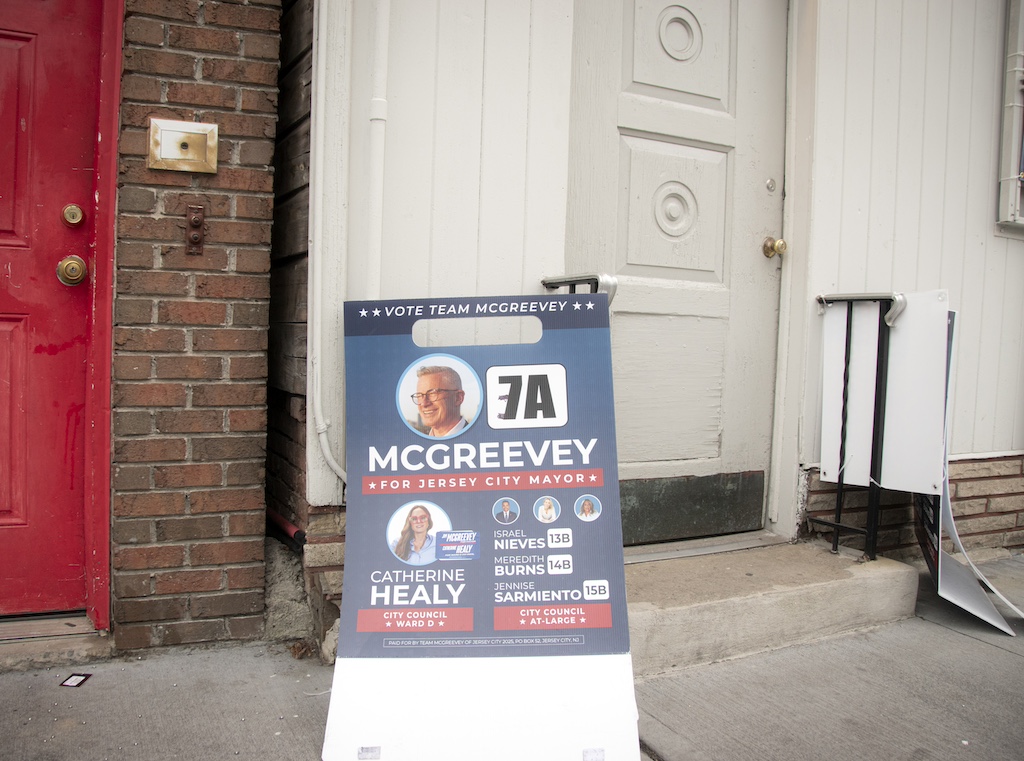
Despite Election Day being in full swing, a McGreevey for Mayor office in Ephros’s ward remains closed. There are whispers that his campaign is in dire financial straits. The reused general election poster with the column number updated with a marker does little to dispel the rumor. (Courtesy of Roman Broszkowski)
On top of these developments, Donald Trump’s chaotic return to the White House and Mamdani’s June primary victory across the river further energized voters, which led to new volunteers and supporters.
“The week after [Mamdani’s primary victory] was insane, to be honest,” Ephros says. “At the doors, the energy from Jersey City residents hearing that we were out there using the same language, being, more importantly, part of the same organization — it was pretty nutty.”
Coalition
After the November 2025 election went to a runoff, it became clear that a McGreevey mayoralty was not inevitable. Progressive organizations and unions rallied around McGreevey’s progressive opponent, city council member James Solomon. Both Brooks and Ephros would be facing McGreevey-aligned candidates in their runoffs and so they joined Solomon’s slate.
The resulting progressive coalition would end up spanning the NNJ-DSA, the New Jersey Working Families Party, and New Jersey senator Andy Kim, as well as several unions and local officials.
Newly elected councilmembers Joel Brooks and Jake Ephros stand on stage among the rest of the newly elected council and mayor-elect James Solomon (center, with microphone) at Team Solomon’s victory party in Jersey City on December 2, 2025. (Courtesy of Roman Broszkowski)
That coalition proved to be very powerful on election night. In addition to Brooks and Ephros, city council candidates affiliated with Team Solomon swept every position, and Solomon himself defeated McGreevey for mayor by an almost two-to-one margin. Yet campaigning together and governing together are entirely different things. While Brooks and Ephros will represent a significant block on a progressive city council, they will still have to navigate political disagreements with the new mayor on key issues.
“I think we’re going to [figure out] how to govern together and what our red lines are and what theirs are,” Brooks says. “I think there’s more in common than [not], but you know, Team Solomon did not run on universal rent control, universal childcare. So we hope that they see that those are really important things to Jersey City residents and that people in Ward B and Ward D voted for that.”
The order came as Abrego Garcia appeared at a scheduled appointment at an Immigration and Customs Enforcement field office roughly 14 hours after he walked out of immigration detention facility in Pennsylvania.
Analytics firm Agri Stats has quietly enabled major meat processors to coordinate price hikes and suppress wages for decades. Despite outcry over algorithmic price-setting, the companies are settling lawsuits over it without paying substantial penalties.
A Justice Department lawsuit alleges that Agri Stats allowed major meat processors to exchange competitively sensitive information through its detailed data reports. (Ramin Talaie / Bloomberg via Getty Images)
According to private and federal lawsuits, the country’s biggest meat processors have been using a secretive data company to share sensitive information, enabling them to hike up prices and suppress wages for decades.
Despite growing scrutiny and public outcry over algorithmic price-setting of consumer goods and services, critics say meatpackers are settling these collusion lawsuits without admitting guilt or paying substantial penalties, meaning they’re free to keep using the data analytics firm to fix prices and drive down workers’ earnings.
“[The meatpackers] win with their settlements, and never once do the packers have to admit guilt,” independent rancher Mike Callicrate told the Lever. “What’s happened is these law firms now have just gone around filing cases, knowing that they can take money out of the packer’s pocket, while the packer retains the ability to take it right out of the producer’s pocket and the consumer’s pocket.”
And while President Donald Trump has promised to crack down on price-fixing in agriculture, he’s financially benefited from some of the companies he’s criticized.
Agri Stats, a forty-year-old, Indiana-based data analytics firm, is named in four recent private lawsuits and a 2023 Department of Justice suit filed under former president Joe Biden, alleging anticompetitive practices by many of the company’s largest meat companies.
Agri Stats is named in four recent private lawsuits and a 2023 Department of Justice suit, alleging anticompetitive practices by many of the company’s largest meat companies.
That includes a price-fixing class action alleging that eighteen poultry giants, including Tyson and Perdue, utilized data from the company to suppress their workers’ wages below fair market rates. Another lawsuit accuses major beef processors of similar Agri Stats–facilitated wage-setting. The two other privatesuits allege that meat companies used the data firm to share sensitive information to fix prices.
The Justice Department lawsuit alleges that Agri Stats allowed major meat processors to exchange competitively sensitive information through its detailed data reports, which often run thousands of pages and include production, processing, sales, and profitability metrics related to the chicken, pork, and turkey industries.
Price-fixing accusations are commonplace in agriculture, in part because of widespread consolidation in the industry. As the Lever has chronicled, the four biggest companies in the frozen potato industry, which control at least 97 percent of the market, have been accused of operating as a “cartel” to jack up prices.
“Once you get to markets where there are fewer competitors, either as buyers or sellers or both, knowing what the other guy is doing allows for all kinds of tacit collusion,” Peter Carstensen, professor at the University of Wisconsin Law School and a former antitrust attorney, told the Lever. “Because your incentive is to make money, not to behave competitively.” According to Carstensen, this collusive behavior results in a race to the bottom, driving down workers’ wages and raising prices for consumers.
Agri Stats did not respond to multiple requests for comment from the Lever.
“Just Make a Little Comparison”
Agri Stats was founded in 1985 by poultry feed salesman Jim Cox, who started the business “as a way to help chicken producers make informed decisions based on flock-level cost and performance data,” according to the company’s website. As a feed vendor, Cox would collect sales reports from his clients to determine what mix of feed and additives was most cost-effective.
Cox’s clients developed an interest in his reports. One approached him about sharing the data he collected, saying, “Well, you know, Jim, while you’re getting that, why don’t you just make a little comparison? Don’t tell us who else is on the report or anything. Just make a comparison of the companies so that we can see how we’re doing,” according to Bloomberg.
Cox’s data-sharing venture eventually became more profitable than selling feed. By the 1990s, after Agri Stats began contracting with Tyson, the company became a de facto industry standard.
Now, Agri Stats’s headquarters in Fort Wayne, Indiana, houses more than a hundred software engineers, data specialists, and marketing managers who work to provide confidential data and customized reports to meat processors in eighteen countries, which, according to the company, allows its clients “to make informed decisions to improve their bottom-line profitability.”
It does this by collecting a “direct download of general ledgers and internal reports” from meat processors, analyzing the information, and creating reports that it distributes back to clients.
The company also creates a list of rankings, in which the processor charging the highest prices is ranked first, while the processor charging the least is ranked last. This is regardless of total profits, meaning companies that sell less at higher prices are rewarded with higher rankings.
The company also creates a list of rankings, in which the processor charging the highest prices is ranked first, while the processor charging the least is ranked last.
These practices have made Agri Stats wildly popular among meatpackers, with the vast majority of pork and poultry processors using the company’s services.
The companies using Agri Stats’ reports allegedly account for more than 90 percent of broiler chicken sales, 80 percent of pork sales, and 90 percent of turkey sales across the country.
If It Walks Like a Duck. . .
In recent years, Agri Stats has found itself steeped in mounting legal troubles as critics have raised potential antitrust concerns.
Multiple lawsuits allege that Agri Stats helps companies improve their bottom line by colluding to share sensitive information that allows them to artificially inflate prices, suppress wages, and constrain supply.
This can give the companies an unfair advantage in the marketplace, ultimately leading to higher prices for consumers and potential violations of antitrust laws.
One 2016 class action alleged that between 2009 and 2019, major broiler chicken producers like Tyson, Perdue, and others colluded to reduce chicken production, inflating prices by nearly 50 percent.
The companies involved in the case allegedly control roughly 90 percent of the broiler chicken market, which accounts for 98 percent of all chicken meat sold in the country.
Agri Stats is also a defendant in a case involving major pork processors, including Tyson and Hormel. Since 2014, pork producers have allegedly colluded to restrict pork supply in order to inflate prices, which, according to the complaint, has cost consumers millions of dollars.
Processors have so far paid more than$407 million in total settlements between the two cases.
On top of its alleged use in price-fixing schemes, Agri Stats has also received blowback for making it easy to identify the companies referenced in its reports. Evidence from the Department of Justice suggests that firms are easily able to uncover which competitors raise prices and when.
According to the federal lawsuit, an employee from poultry producer Butterball once bragged that they could “pick the companies for rankings with 100 [percent] certainty” by using Agri Stats.
The company has also reportedly used raising prices as a selling point. When one processor considered unsubscribing from the company’s bacon report, the company allegedly suggested it could accrue an additional $100,000 in profits if it raised prices, according to the Justice Department.
Processors have also allegedly used Agri Stats’ sales reports to determine bonuses for sales staff. Because the ranking structure rewards prices over total profits, this encourages employees to restrict supply in order to drive up profits, the Justice Department alleges.
Attorneys involved in the various cases declined or did not respond to the Lever’srequest for comments.
Slashing Wages
In addition to potentially driving up prices for consumers, Agri Stats also allegedly helped drive down wages for slaughterhouse staff.
One class-action suit alleges that since 2009, poultry giants including Perdue, Tyson, Pilgrim’s Pride (a subsidiary of JBS), and more than a dozen other producers conspired to suppress the wages of roughly 250,000 chicken-processing-plant workers.
Plaintiffs allege that the chicken processors, in addition to fixing wages through in-person meetings, exchanged timely and competitively sensitive wage data through Agri Stats and WMS, another survey company.
An employee from poultry producer Butterball once bragged that they could ‘pick the companies for rankings with 100 percent certainty’ by using Agri Stats.
The same law firm filed another case alleging that since 2014, beef and pork processors, including JBS, Tyson, Cargill, and their subsidiaries, used Agri Stats’ reports to conspire to drive down wages.
Meatpacking plants are notorious for their difficult working conditions. Eighty-one percent of meatpacking workers are at high risk of developing musculoskeletal disorders, and poultry and meat companies remain some of the most dangerous to work for, according to data from the Occupational Safety and Health Administration.
Companies have also deliberately hired vulnerable groups to work in slaughterhouses. Norman Beecher, a former human resources manager for poultry giant Case Farms, explained in an interview with labor historian Leon Fink how his company recruited refugees from the Guatemalan Civil War.
“I didn’t want [Mexicans]. Mexicans will go back home at Christmastime. You’re going to lose them for six weeks. And in the poultry business, you can’t afford that,” Beecher said. “But Guatemalans can’t go back home. They’re here as political refugees. If they go back home, they get shot.”
Such circumstances have limited many meatpacking workers’ ability to demand better wages, despite the grueling conditions. While meatpacking was once one of the highest-paid manufacturing jobs in the United States, industry consolidation and the exodus of many slaughterhouses out of urban areas have resulted in jobs that now often pay near-poverty wages.
In 2023, the mean annual wage for slaughterhouse workers was $38,710, according to the Bureau of Labor Statistics. That year, the poverty line for a family of four was $30,000.
Meanwhile, meat processing companies and their CEOs, especially in poultry, have raked in record profits.
“It’s Totally Rational for Them to Continue Price-Fixing.”
Agri Stats has argued that its services benefit consumers by increasing efficiency and supply, thereby lowering prices for consumers.
“[The Justice Department’s] lawsuit alleges — contrary to the law and the facts — that Agri Stats reports result in higher prices and lower protein production,” the company wrote in a press release. “Since its inception in 1985, Agri Stats has played a vital role in the United States economy, helping to drive increased efficiency, improved innovation, and ultimately provide more chicken, pork, and turkey to consumers for less money.”
But these claims are contradicted by evidence from the Justice Department. An executive at pork processor Smithfield Foods testified to federal prosecutors that he could not recall a single instance of his company using Agri Stats to lower prices. A sales representative from Tyson testified similarly in the same case.
That might be because Agri Stats restricts access to its reports. While processors can identify which products are priced below their competitors’ and raise them accordingly, Agri Stats refuses to sell its reports to purchasers, such as grocery stores and restaurants, preventing them from shopping around for the lowest rate and ultimately charging lower prices to consumers.
“They very intentionally did not want meat buyers or chicken farmers or workers to have access to this information, so that also makes it different from a general industry report that anyone can buy and access and read,” Claire Kelloway, the food program manager at antitrust-focused Open Markets Institute,told the Lever.
In October, Agri Stats agreed to settle the poultry-industry wage-suppression lawsuit filed by workers. In lieu of a financial settlement, Agri Stats agreed to update its data reporting practices to prevent processors from coordinating on alleged wage suppression and to redact wage data from nearly fifty reports.
But some industry insiders worry that the settlement indicates a worrying trend, and that in many cases, it’s in the companies’ best financial interest to continue fixing prices.
Some industry insiders worry that the settlements indicate a worrying trend, and that in many cases, it’s in the companies’ best financial interest to continue fixing prices.
“Sometimes [the settlements] are not even bigger than the amount these companies made in ill-gotten profits,” said Kelloway. “If they end up paying less than what they made in excess profits by engaging in the conspiracy, it’s totally rational for them to continue price-fixing.”
The Trump administration has claimed that it is attempting to rein in such alleged collusion. “I have asked the DOJ to immediately begin an investigation into the Meat Packing Companies who are driving up the price of Beef through Illicit Collusion, Price Fixing, and Price Manipulation,” Trump wrote on social media. He also alleged that majority foreign-owned meatpackers “artificially inflate prices, and jeopardize the security of our Nation’s food supply.”
But some experts are skeptical that there will be meaningful action — largely due to Trump’s financial ties to the foreign-owned meatpackers he’s decried.
JBS, a Brazilian company, donated $5 million to the Trump-Vance inaugural committee through its subsidiary Pilgrim’s Pride. Shortly after, the company was listed publicly on the New York Stock Exchange, which provided it access to significantly more capital.
“Your large donations and direct stake in federal policies and enforcement actions, and the Trump Administration’s series of actions that benefit your companies, raise serious concerns about a potential quid-pro-quo arrangement,” Sen. Elizabeth Warren (D-MA) wrote in a letter to JBS.
One former antitrust official told the Lever that while the administration has worked to “create tweets and a media campaign and the appearance that they’re looking into stuff,” it has “done nothing that is actually bringing relief to farmers and beef packers.”
In some cases, the administration has worked to chip away at laws meant to rein in price-fixing. Among other efforts, the Trump administration has paused the implementation of at least one Biden-era rule that aimed to strengthen the 1921 Packers and Stockyards Act, which prohibits the manipulation and control of prices.
Deputy secretary for the US Department of Agriculture judge, Stephen Alexander Vaden, justified the move, saying at the seventieth annual national Chicken Council Conference that it was “un-American” to “put a cap on innovation.”
Agri Stat’s legal scrutiny comes as concerns about price-fixing and data-sharing practices have proliferated. Regulators and state legislators have attempted to crack down on other price-fixing algorithms, such as those used by Texas-based property management firm RealPage, but the growing ubiquity and complexity of data-analytics operations threaten to complicate antitrust enforcement efforts.
While some states like California and New York have implemented updated antitrust laws to account for algorithms and third-party intermediaries, industry interests are pushing back. RealPage is asking a federal court to overturn New York’s law stopping algorithmic rent-fixing, arguing that the law is “a sweeping and unconstitutional ban on lawful speech.”
What happens to Agri Stats could be an indicator of whether regulators can police price-fixing in an economy that’s becoming increasingly dominated by opaque third-party intermediaries. To some experts, the clearest solution might be a complete overhaul of the business arrangement.
“That’s to me the interesting question,” said Carstensen at the University of Wisconsin Law School. “Think of it as, ‘I’m running a business that’s a criminal enterprise. Can I continue that business?’ I don’t think so.”
This article was first published by the Lever, an award-winning independent investigative newsroom.
In brief: In today’s post we discuss the return of fog, and some humidity. A sharp front arrives Sunday that will bring a chance of a light freeze into Houston. After that we’re going to warm up. Will some cooler air arrive in time for Christmas? Find out in our way-too-early Christmas Day forecast.
Christmas Day forecast
Don’t worry, Christmas shoppers. You still have 13 days before the holiday. Which means it is ridiculously early to try and forecast the weather (realistically, about 10 days is the limit). Nevertheless, readers have been asking, and we aim to deliver. Just understand that you’ve been warned, and there may more coal stocked in this forecast than candy.
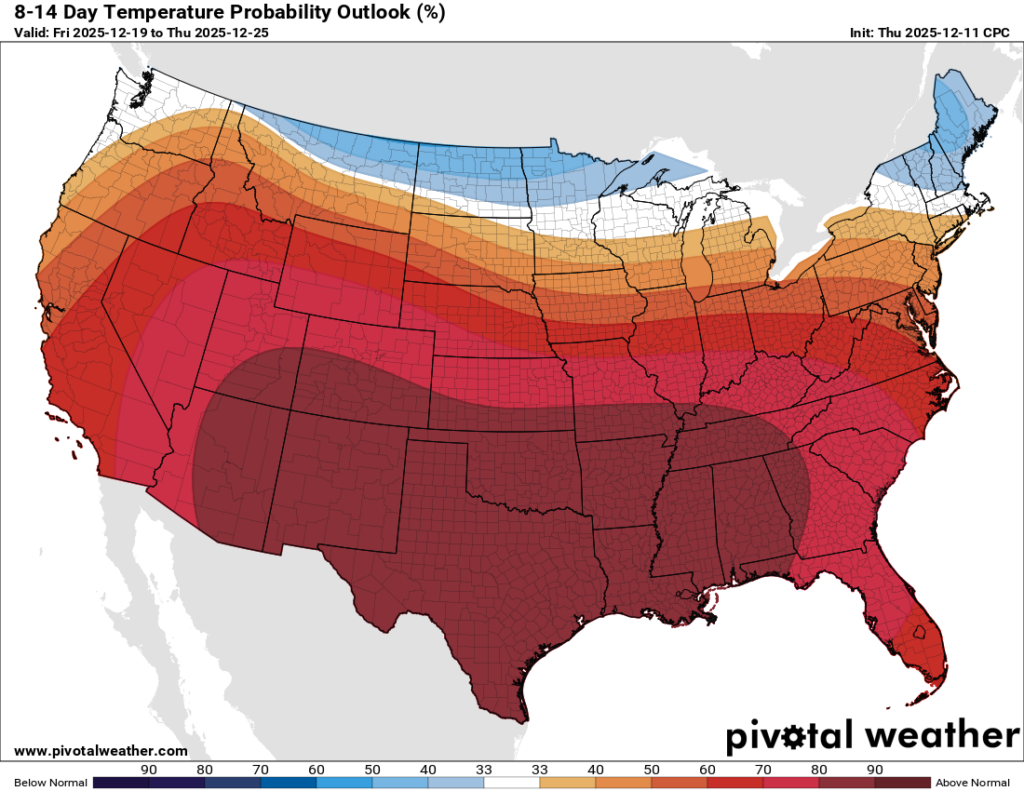
As we’ve been saying for a couple of days now, the run-up to Christmas Day looks rather warm. Record highs in Houston are generally in the 81 to 83 range for the last 10 days of December, and beginning next weekend (Dec. 20 or Dec. 21) we are likely going to be flirting with this range of temperatures. We are reasonably confident in this forecast because high pressure patterns are fairly straightforward to predict.
Our confidence is high in a warm week preceding Christmas. (Pivotal Weather)
At some point the pattern will break, and we will see a more winter-like pattern emerge. In late December it is more difficult for these highs to persist in this manner. However, we just can’t say whether a front will come on Christmas Eve, Christmas Day, or even later in the holiday week. For that reason I’m going to go with a forecast high of 80 degrees on Christmas, with fairly humid conditions and mostly cloudy skies. I would dearly love to be wrong about that, mind you.
Friday
Temperatures and dewpoints are basically the same this morning, in the low- to mid-50s, with calm winds. That’s a great recipe for dense fog, which is just what we’ve got. It should gradually diminish after sunrise, but it will be nuisance until then. We can expect more of this on Saturday and possibly Sunday mornings. Highs today will climb into the mid- to upper-70s today, with partly to mostly cloudy skies. With dewpoints rising into the 60s, it will feel modestly humid as well. Low temperatures tonight will only drop into the 60s.
Saturday
The first half of the weekend will be similarly warm and humid, with highs in the upper 70s. Skies will also be partly cloudy, although some clearing is possible during the afternoon hours. There is also a chance of some light showers during the daytime, perhaps 20 or 30 percent, so keep that in mind if you have outdoor plans. Saturday night also looks fairly warm and muggy.
Sunday
Temperatures will start out in the low- to mid-60s on Sunday morning, and that is where they will peak ahead of a fairly strong cold front. It will likely arrive around sunrise in Houston, a little before north of Interstate 10, and a little later closer to the coast. We could see some light showers with the front, although I’m not expecting anything at all serious in the way of accumulations. We’ll see clearing skies during the afternoon, along with winds gusting to perhaps 25 mph. These gusts should back off a bit during the evening hours.
This is a reasonable estimate of low temperatures on Monday morning. (Weather Bell)
Temperatures will drop throughout the day, accelerating during the late afternoon and evening hours. I expect lows for most of the city, except for the immediate coast, to reach the 30s by Monday morning. As for a freeze, it’s a good question. If you live in Montgomery or Chambers County, I think there’s probably at least a 50 percent chance of a freeze on Sunday night, whereas in the city of Houston and points south and west of Houston, the odds are quite a bit lower. We’ll do a short post this weekend updating you on the expected freeze line.
Next week
Monday will be cold, in the 50s, and mostly clear. We should see another chilly night, albeit in the low 40s, as the onshore flow resumes. By Wednesday our daytime temperatures will be solidly in the 70s. There is a slight hint in some of the models of a front in the Friday time frame of next week, but it’s not something I would count on. After that we’re into the warm run-up to Christmas I spoke about above.
For years, Big Tech’s growing dominance over Hollywood has meant lower-quality movies and TV shows. Now, with Netflix and Paramount Skydance fighting over Warner Bros. Discovery, audiences are left with little say in the matter.
Netflix turned “new media” into the future of film that hewed to the same strategy that dismantled music production and print media. (Charley Gallay / Getty Images for Netflix)
Last Friday afternoon, Netflix announced they had delivered the winning bid for the 102-year-old studio, Warner Bros. Discovery (WBD). Comcast and Paramount Skydance were both in the mix, with the latter now attempting a hostile takeover. Both Paramount, a legacy studio founded in 1912, and Netflix, the world’s largest streamer, have reason to believe that their competitor would pose regulatory hurdles in acquiring WBD.
If Paramount Skydance prevails, two legacy studios would merge into one. If Netflix prevails, the world’s largest streamer would take over not only a legacy studio but one of its only streaming competitors, HBO Max. Both companies have been upfront about what victory would mean. Paramount Skydance CEO David Ellison has promised to release more than thirty films theatrically if they win while Netflix has made it clear that any exclusive theatrical windows for Warner Bros. Discovery films would be radically shortened to be “more consumer-friendly” before appearing on their streamer.
It’s that fundamental conflict between streaming content and traditional studios geared toward theatrical releases that now embodies the struggle over the future of the film industry. It’s a fight that now includes not only workers in the industry but audiences who face the possible extinction of the theatrical experience.
According to Netflix’s CEO, Ted Sarandos, however, “We’re saving Hollywood.” In his view, it’s the stubborn, nostalgic creatives stuck in the past who “grew up thinking, ‘I want to make movies on a gigantic screen and have strangers watch them play in the theater for two months and people cry and sold-out shows’ . . . It’s an outdated concept.”
It’s the fundamental conflict between streaming content and traditional studios geared toward theatrical releases that now embodies the struggle over the future of the film industry.
The American studio system has certainly gone through many era-defining transformations dictated primarily by both emerging technology and federal regulation. The inclusion of sound and color, smaller cameras, more sensitive film stock, and digital cameras were all initially met with some trepidation but largely accepted over time. On the regulatory side, the infamous Hays Code from 1934 to 1968 was a way for studios to self-govern the content of their films under moral scrutiny without inviting direct federal regulation, while the Paramount Decrees, a landmark 1948 Supreme Court case, busted the studios’ anticompetitive control over the distribution of their films.
The latter signaled the end of the Golden Age of Hollywood, and the dissolution of the former was the harbinger of the so-called New Hollywood movement. But New Hollywood soon gave way to the blockbuster era, which ushered in a wave of conglomerates buying stakes in the studios whose intellectual property was now seen as having vast untapped profit potential. In fact, Warner Bros.-Seven Arts was purchased in 1969 by Kinney National Company, a parking lot and funeral home conglomerate that had recently purchased the comic book company that would later become one of Warner Bros. Discovery’s most valuable intellectual properties: DC Comics, home of Superman and Batman. Mergers and acquisitions began to create efficiencies within studios that had always been pitched in a careful balance of artistry and commerce but were now being primed for what was coming.
How Tech Came for Hollywood
At the height of the dot-com bubble, AOL acquired Time Warner in what is still known as one of the worst mergers in history. In the wake of the bubble’s burst, two companies — Netflix and Amazon — emerged now poised to capitalize on the inefficiencies of brick-and-mortar businesses. Both Amazon and Netflix exploited the ways in which consumers were no longer satisfied with traditional businesses that were limited by physical storefronts. Having reimagined retail, both Amazon and Netflix would soon find themselves entering the film industry. For Silicon Valley companies whose future plans involve media licensing and production, the 2007 Writers Guild of America (WGA) strike must have felt like quite an opportunity.
The heart of that ninety-nine-day work stoppage was primarily wages and issues like animation and residuals in DVD sales. Those old enough to remember the previous strike in 1988 knew that the real fight was whatever new home media was on the horizon. In the 1980s, it was VHS. This time it was the internet. The WGA managed to extract an important concession that made sure guild members were hired on these “new media” projects going forward while also retaining residuals under narrow circumstances. Video on demand and rentals were already a part of the media landscape, but no one then was able to foresee how streaming would become the primary way audiences watch films and television programs. If anyone had known this, the other guilds might have made sure that “new media” — whose contracts typically had lower starting wages and longer hours — was not just a labor loophole for Netflix to exploit in order to gain a larger share of the market against traditional studios.
Netflix’s original programming has seen its demand crater as supply has gone up since 2020.
When assessing the different futures promised by Netflix’s and Paramount’s bids, Ellison’s quick work turning CBS News into a right-wing mouthpiece might give a savvy media consumer more pause than a possible Sarandos victory. But what Netflix has done in the last decade demonstrates how, if they acquire Warner Bros. Discovery, the Hollywood studio model might finally be dismantled entirely. Under the auspices of concessions made by labor to invigorate a burgeoning new revenue stream, Netflix capitalized and turned “new media” into the future of film that hewed to the same strategy that dismantled music production and print media. Netflix, after all, operates as a tech company first. No one ought to wonder where exactly Netflix hopes to take WBD should their bid pass the scrutiny of a regulatory apparatus.
For Netflix, the best-case scenario is that the merger is allowed to take place, legal challenges are thrown out, and the ink is dried over the next one to two years. During that time, Warner Bros. Discovery, anticipating their acquisition, will be unable to make any big moves, slowing or even halting the development of shows or films outside of IP that it controls. No matter how confident Netflix is in their position, they must be mindful that if their bid is rejected they will be forced to pay a $5.8 billion “break-up fee,” which, while not catastrophic for their business, could also force them to be a bit more conservative with how they spend money on projects in the interim. Warner Bros. Discovery is in a much worse position, though, and it is not far-fetched to suggest that Netflix could be simply constraining one of their biggest competitors, HBO Max, even temporarily.
In order to pass the scrutiny of federal regulators and assuage the fears of the public, Netflix must speak out of both sides of its mouth. To those at the Department of Justice, the streaming giant must reiterate that while they do distribute and occasionally produce films, they are not a traditional studio. They are a streaming content company like YouTube or Twitch. A 102-year-old catalog of culturally significant intellectual property would simply give it an edge. This is especially true once you realize that Netflix’s original programming, according to Parrot Analytics, has seen its demand crater as supply has gone up since 2020. The opposite is true for its licensed content. With that in mind, it would seem that acquiring WBD is an existential necessity for its ability to meet new demand.
That isn’t to say that studios do not gain something from this arrangement. In a theatrical landscape that has only just begun to recover from the successive shocks of the COVID-19 shutdowns and labor stoppages in 2023, licensing content to Netflix is attractive as a way to generate income from their libraries. Film studios licensed films to television to weather economic downturns in the late 1940s as a way to take advantage of the way that TV had begun to supplant theatrical film’s dominance. It is in this way that Netflix could certainly see a benefit in purchasing a studio to cut out the middleman. If Netflix is hoping to present itself as a streaming company first, then their competition is not Warner Bros. Discovery but movie theaters themselves.
Hollywood is no stranger to acquisitions by outside conglomerates. After all, Coca-Cola purchased Columbia Pictures in 1982 (later sold to Sony in 1989), but the conflict of interest for Netflix is obvious once you interpret their actions instead of their press releases. Since emerging from the crucible of the dot-com bubble, they have kept their focus on eliminating their competition and exploiting Hollywood’s desire to readily accept new technology as a liberatory tool for telling stories to the masses.
Sarandos did his best to allay fears that Netflix underemphasizes theatrical exhibition by saying, “My pushback has been mostly in the fact of the long, exclusive windows, which we don’t really think are that consumer-friendly.” This tone is common for Netflix in all areas of its business. The data they collected from licensing content in the streamer’s early days influenced how it pivoted to original content and even the notes they gave to the filmmakers of that content.
Director Cary Fukunaga had this to say about his Netflix show, Maniac: “So they can look at something you’re writing and say, ‘We know based on our data that if you do this, we will lose this many viewers.’ So it’s a different kind of note-giving. It’s not like, ‘Let’s discuss this and maybe I’m gonna win.’ The algorithm’s argument is gonna win at the end of the day. So the question is: Do we want to make a creative decision at the risk of losing people.”
Even though IP libraries are valuable assets for trading on nostalgia, the longer they are treated like mere financial instruments without attention paid to the execution, the less audiences are willing to go along.
Even if filmmakers take these insights as genuine, it’s not impossible to imagine a black box of “impartial data” being a convenient cover for executive notes that any studio would have without having to support it with a qualitative argument. Similarly, Netflix’s hostility for theatrical distribution is evident based on how their company operates, but even if their position could be justified by box-office trends and data, the degree to which it is true is only possible because of aggressive moves they have made to produce those results.
Netflix’s desire for “consumer-friendliness” has been a hallmark of their approach since day one. Blockbuster’s late fees and relative dearth of choices made them vulnerable to the internet’s conveniences, which allowed people to shop for and watch movies without leaving home. After Blockbuster passed on acquiring Netflix for a measly $50 million in 2000, they became competitors, with Blockbuster filing for bankruptcy ten years later. Now Netflix is poised to do to Hollywood what they did to Blockbuster.
Netflix and Traditional Studios Have Very Different Goals
In the early 2010s, when studios were looking to cultivate new audiences by licensing their content to the streamer, Netflix collected massive amounts of viewing data. Unlike Nielsen ratings, Netflix’s data was far more detailed, able to track the smallest habits of its customers based on how long they watched something or even when they paused to go to the bathroom. Many studios eventually scaled back their licensing in order to create rival services, in part so that they could collect their own data because Netflix refused to share. Netflix then used what they collected to generate an approximation of the shows and films that performed well on their service, hoping to eventually rely less on licensed content from traditional studios. But after flooding the market with this content, they began to dilute their supply in order to retain subscribers with a constant churn of bingeable content rather than relying on curated weekly programming, which more traditional TV studios like HBO had to be mindful of.
It is these conflicting incentive structures that must be kept in mind. Sarandos and Warner Bros. Discovery simply do not have the same goals. After nearly a decade and a half of making original content, Netflix has successfully devalued the role of both film and television while slowly bleeding the entire business with convenience and casual viewing. While box-office returns still have not rebounded to what they were pre-pandemic, traditional studios have managed to reinvigorate the public’s desire for theatrical exhibition with hit, wholly original films like Oppenheimer, Sinners, and Weapons, which required reaching audiences who had become dependent on the instant gratification and ability to passively consume content while scrolling on their phones. Movie theaters today offer more than culture but a refuge from the winnowing of attention spans by tech companies whose bottom line is bolstered by keeping the public pliant and suggestible like the occupants of a casino.
Netflix’s future depends on creating a media landscape that will justify their claims about the public’s viewing habits in the same way that they were once able to appeal to home video-rental customers who didn’t want to drive to stores to return their DVDs. Netflix hopes the public will simply ignore how they have spent the last fifteen years hooking audiences on binge-watching and short theatrical windows as a way to justify what they could do with Warner Bros. Discovery.
If Netflix is successful, the effects might be subtle at first. As a studio, WBD already has theatrical commitments, and it could take years before those come to an end. After that, it’s up to Netflix to dictate which films are to be released theatrically — as well as how long and how wide. Until now the only thing keeping Netflix films in theaters has been the modest requirements for an Academy Award — limited releases in large markets for at least a week. But the public has long since learned to wait this out.
Netflix might allow Warner Bros. Discovery to release a limited amount of their films in theaters with brief theatrical windows, as they have indicated before. The effect would still cripple movie theaters, which are already operating on narrow margins and starved for new releases. If audiences know that they might be able to see a film within a month of release, Netflix’s box-office track record suggests that even more people might choose to stay home if they can already see it that way. Sarandos could then point to this as proof that audiences would rather see films on streaming.
In Hollywood, film scripts are shopped between prospective studios. Often different needs or studio cultures mean that a film of a specific genre or budget is right for one but not for another. If the script is good enough, studios will bid over it. Should one of the largest studios in Hollywood get absorbed by Netflix, it will immediately remove yet another major buyer for filmmakers. This means reducing the types of films produced by major studios. This will also drive down the price of these scripts since fewer studios would be buying, giving sellers even less leverage.
Netflix Already Destroys the Competition — and Movies Are All the Worse for It
One of the ways that Netflix was able to entice filmmakers to work with them in the first place was the freedom to make projects that no one else would fund due to either their budgets or subject matter. This is how Netflix landed critically acclaimed movies like Martin Scorsese’s The Irishman or Alfonso Cuarón’s Roma, which received only the smallest and briefest of theatrical releases in order to be eligible for Academy Awards. Since box-office results don’t factor into a film’s success for Netflix, this isn’t a problem. Spending exorbitant amounts of money on films that won’t ever turn a profit is acceptable if these investments can keep auteurs like Guillermo del Toro, David Fincher, or the Coen Brothers from making a film for a competitor. The only thing filmmakers had to give up in return was a wide theatrical release, exacerbating the problem for traditional studios.
IMAX and premium ticket sales have emerged as a strategy for distinguishing films from streaming.
These streamer-funded vanity projects have already been causing problems for independent films whose modest funding was always contingent on big-name acting talent being attached. If Netflix can offer an actor a large amount of money not to work on an independent film, then they can kill projects for other production companies as well.
During contract negotiations, the Hollywood guilds meet with a collection of the steamers and studios called the Alliance of Motion Picture and Television Producers (AMPTP). If Netflix owns Warner Bros. Discovery, then it speaks for two of the most important voices in that group. For workers in the film and TV industry, this presents a major problem when trying to exert leverage. When the largest streamer owns one of the most powerful studios in Hollywood, there are fewer ways to divide the studios during a work stoppage. A Netflix/WBD joint studio could simply sit on their back catalog and wait workers out since their production schedules no longer follow the traditional model of fall and spring releases.
A Netflix-Warner Future Is One of AI-Slop. But Audiences Are Already Revolting.
But with the rise of AI, this nightmare scenario starts to border on apocalyptic. If Netflix succeeds in acquiring Warner Bros. Discovery, the streamer’s state-of-the-art viewer data, honed over the last decade and a half, will finally have a deep roster of intellectual property to guide its decisions. Netflix was always limited in its relative lack of original IP. But where they were previously trying to reverse engineer popular films and television shows, with the addition of WBD’s library, they would be able use their troves of viewer data to locate synergies in their IP library to meet demand. It’s not unreasonable to wonder where they expect artists to be included if the data already knows what viewers want and they have the intellectual property to satisfy them. Eventually, this could all be achieved with generative AI models that they could build, unshackled by concerns over copyright infringement.
On February 28, 2008, message-board poster “GamemasterAnthony” posted:
It’s my birthday today, and I’m 33!
That means only one thing . . . BRING IT IN, GUYS!!!
*every character from every game, comic, cartoon, TV show, movie, and book reality come in with everything for a HUGE party*
Fortuitously, GamemasterAnthony posted this only weeks after the writer’s strike of 2007 had concluded. How happy he must have been that his movies, shows, and cartoons would return. Now at the age of fifty, he must be elated that one film company may be able to nearly grant his wish and bring all of his favorite characters in for one huge party.
Running a film studio is unique in that while it shares the same profit-making goal as any other major corporation, the products that are being produced are judged subjectively. No matter how much data you have, there’s no guarantee which story or character will take off with the public. Taste, like any other sort of discernment, must be practiced. Taste oftentimes requires wasting money in an objective sense, and the brutal efficiency that Silicon Valley has brought to our cultural institutions cannot continue in perpetuity.
Even though IP libraries are valuable assets for trading on nostalgia, the longer they are treated like mere financial instruments without attention paid to the execution, the less audiences are willing to go along. Once these Silicon Valley titans run Hollywood into the ground, they will have destroyed an industry that was, not long ago, a crown jewel of this country’s culture. A culture inundated with legacy sequels, reboots, and reimaginings — rife with “easter eggs” — has prepared audiences to be impressed by a machine whose sole purpose is distilling things they’ve already seen into digestible pellets.
This does not have to be the case. Warner Bros. Disvocery and HBO are home to some of the most important films and TV shows in history. Just two years after the WGA strike, the industry has managed to reinvigorate a love for the theatrical experience. IMAX and premium-ticket sales have emerged as a strategy for distinguishing films from streaming. Among film enthusiasts there has been a sudden resurgence in popularity for VistaVision, which is an exhibition format from the early 1950s, another era in which filmmakers were in a life-and-death battle against television screens.
It’s time that those making decisions about the way valuable cinematic properties are presented to the public are executives who care for them again.
Massively successful films like Avatar: The Way of Water, Dune, Oppenheimer, Top Gun: Maverick, Sinners, Weapons, and Barbie have all come out since 2020, proving that audiences want to see movies on the big screen even with declining theatrical windows. Sarandos’s appeal for even shorter theatrical windows on the grounds that they’re more “consumer-friendly” is a patronizing trick. Audiences, in fact, want to be surprised by the films they see.
If they can’t stream it for a few months, then they will accept that arrangement because the exhibition of a film is every bit as much a part of the process of creation as the production of it. The lesson to be learned about the public’s acceptance of streaming over theatrical experiences should not be that they prefer one over another — it’s that they will take whatever options are given to them. It’s time that those making decisions about the way valuable cinematic properties are presented to the public are executives who care for them again.
Reduced emphasis on theatrical filmmaking would further degrade the quality of movies and relegate the craft to something of a niche hobby once it can no longer support an industry of committed professionals. It was not long ago that even your average film or TV show was made with extreme care. Shows like The Sopranos, Mad Men, The Wire, and Deadwood were led by talented writers and showrunners given the latitude (and money) to surprise audiences with things they’d never seen before.
With the click of a button on a website, an entire procession of underpaid workers are forced into a flurry of activity under conditions that, if they were made known to the customer, the button might be pushed less frequently. Amazon’s and Netflix’s original business models were built on this ignorance. Warehouses and data centers enable superficially frictionless services to become load-bearing in our lives. Likewise, Hollywood operates as a magic trick where, if the filmmakers are doing their job well, audiences are not even aware of all the work that went into it until the credits roll.
But unless the infrastructure that keeps Hollywood functioning is protected from Silicon Valley’s design, then eventually there won’t be anyone left to keep the bright lights on.
It’s the final round of the Worst Boss of 2025 voting. We’ve narrowed the pool from eight nominees to two (see results from the first round and second round). The two finalists go head-to-head below.
The Dorothy Antoinette LaSelle Foundation has announced the winners of its annual travel fellowships. The 2025 awardees are Brownville and Houston artist Tina Hernandez and Houston artist Trevon Latin.
The program awards two Texas artists $5,000 to support overseas travel related to their artistic practice. Ms. Hernandez will visit Vienna, Austria, to study Gustav Klimt’s Stoclet Frieze and Mesoamerican artifacts housed at the Weltmuseum Wien. Mr. Latin will travel to Japan to study the Kiyomizudera water temple in Kyoto and the Yokai Art Museum in Tonosho.
Hannah Klemm, Curator of Modern and Contemporary Art at the Blanton Museum of Art, served as juror for the 2025 fellowships open call. In a press release, Ms. Klemm said she appreciated Mr. Latin’s plan to engage with Japan’s architectural and mythological traditions in a way that could only be accomplished through travel.
Detail view of Tina Hernandez, “Cafecito con Pan,” 2023
“The way … he would use the travel to immerse himself in spaces that balance serenity and play, transcendence and materiality, would expand his vocabulary for constructing works that hold both intimacy and monumentality. The proposed travel aligns beautifully with the fellowship’s intent to support transformative journeys that catalyze artistic growth,” she said.
Of Ms. Hernandez’s plan to visit Austria, Ms. Klemm said “getting to see works of art in Vienna will deepen her formal vocabulary while advancing her exploration of Chicana identity within a global art-historical dialogue.”
The LaSelle Travel Fellowship program was launched in 2024, in honor of Texas Modernist painter Dorothy Antoinette “Toni” LaSelle’s foundational learning experiences during a 1927-28 European trip taken after completing her MA at the University of Chicago. She explored the art of England, Italy, and France during her travels, made possible through being awarded a study fund for artists whose work was included in a student art exhibition at the Renaissance Society.
Fellowship applicants are required to hold either a BA or BFA and to have participated in at least three group or solo exhibitions in the past three years.
Mr. Latin holds a BFA in Painting from the University of Houston (UH) and an MFA in Painting and Printmaking from the Yale School of Art. His work has been presented in solo exhibitions at Perrotin gallery in New York City in 2023 and 2021. He has shown in group exhibitions at Perrotin, Anat Egbi in Los Angeles, and Luce Gallery in Torino, Italy.
Trevon Latin, “Thumbsucker,” 2023
Ms. Hernandez received her BFA in Photography/Digital Media from UH in 2003 and currently studies at the UH Graduate College of Social Work. Her first solo show was in 2020 at M.E.C.A in Houston. Venues that have included her work in recent group exhibitions are the Guess Lawson Collection in Houston and the Arizona State University Art Museum in Tempe. She is also a recipient of the Support for Artists and Creative Individuals Grant from Houston Arts Alliance and the Mayor’s Office of Cultural Affairs.
Learn more about Toni LaSelle and the annual travel fellowships program at the LaSelle Foundation website.
Eight women enter a large circular arena on horseback. Each rider is wearing a brightly colored, ankle-length dress covered in delicate embroidery, lace, ribbons, and ruffles that cascade down the back and sides of her horse. The garments are stunning, but once the women begin their routine, our attention quickly moves to their impressive, risky moves. Deftly weaving and turning in unison at high speeds, the horsewomen control every second of their precise choreography, and they do it all while riding sidesaddle.
This performance and the people who participate in it are called escaramuza. The all-women equestrian team sport emerged from Mexico’s rich charrería culture, which is sometimes known as the Mexican rodeo. Charrería has centuries of history, and escaramuzas trace their own roots to the defiant soldaderas of the Mexican Revolution (1910-1920). However, women weren’t permitted to perform at male-dominated charreadas until 1953, which is also the year that Mexico granted women the right to vote. Escaramuza was finally recognized as a competitive event in 1992, and is practiced today in both Mexico and the United States, thanks to a large Mexican diaspora there.
Escaramuza is, in the words of the Swiss artist Constance Jaeggi, “part ballet and part calvary maneuvers and something all its own.” Her new book Escaramuza is a vibrant celebration of the sport and the women who dedicate themselves to it. Jaeggi’s lush photographs capture participants in dignified portraits and dynamic performances. But escaramuzas aren’t just gifted horsewomen; they’re also preservers of culture. These complexities are explored in an accompanying series of bilingual English-Spanish poems by ire’ne lara silva and Angelina Sáenz. Together, the words and images explore the psychology and history behind this demanding, exhilarating vocation.
Jaeggi is Swiss, but she’s close to this subject. The artist first moved to Texas in 2009 to study at Texas Christian University, and to begin her career as a competitive horse cutting rider. “Really it’s the horses that brought me to photography,” she says in a 2019 video, explaining that she views both her rodeo competitions and her art practice as forms of expression. Now based between Fort Worth and Denver, Jaeggi’s photographic work centers on the relationship between riders — especially women — and horses. As a cowgirl herself, the artist is especially attuned to the physicality, discipline, and pride that escaramuzas experience, as her sensitive photos demonstrate.
The word escaramuza means ‘skirmish’ in English, and the name reflects some of the challenges its participants face. “Women are second-class citizens in this sport,” Sáenz writes in one poem; “We give everything we have to escaramuza / This is not what we do for leisure / This is our life,” she says elsewhere. Charrería has been Mexico’s national sport since the 1920s, and was named an UNESCO Intangible Cultural Heritage of Humanity in 2016. Escaramuzas themselves were even featured in a 2019 Dior fashion show. However, the sport stems from a system of male-centered traditions and mindsets where women and their needs have not always taken a primary or guiding role. For example, though extremely challenging physically, riding sidesaddle in escaramuza was established as a norm to maintain a sense of feminine modesty.
Escaramuza originated in Mexico, but Jaeggi’s book focuses on teams in the U.S. Her graceful photographs of participants in Arizona, California, Colorado, Georgia, Idaho, Illinois, Iowa, Oregon, Texas, and Washington show this unique and rigorous sport to be truly widespread despite the extreme hostilities of our current political climate, where attacks on women, diversity, and immigration are all increasingly becoming a dangerous daily reality. The brave women in Jaeggi’s book have kept themselves connected to escaramuza because of the crucial sense of sisterhood and culture it carries, making Jaeggi’s book especially timely for readers today.
Researchers discovered 400,000-year-old hearth remains in what is now England, indicating early humans practiced deliberate fire-setting far earlier than previously thought. What do you think?
“Amazing that humans were able to control fire before the Earth even existed.”
Connor Stacey, Sand Bleacher
“Did they have a permit?”
Heidi Meeks, Ticket Perforator
“The real achievement was when humanity made the George Foreman grill.”