Shared posts

03 Apr 16:27

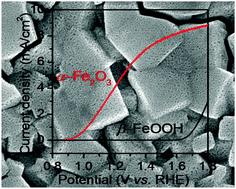
Tuning the ion permeability of an Al2O3 coating layer on Fe2O3 photoanodes for improved photoelectrochemical water oxidation

J. Mater. Chem. A, 2017, Advance Article
DOI: 10.1039/C7TA01430A, Paper
Zhongwen Fan, Zhe Xu, Shicheng Yan, Zhigang Zou
An ion-permeable Al2O3 overlayer can enhance the injection efficiency ([capital Phi]inj) of Ti-Fe2O3 photoanodes up to 95%.
To cite this article before page numbers are assigned, use the DOI form of citation above.
The content of this RSS Feed (c) The Royal Society of Chemistry
03 Apr 16:27

A facile spray pyrolysis method to prepare Ti-doped ZnFe2O4 for boosting photoelectrochemical water splitting

J. Mater. Chem. A, 2017, 5,7571-7577
DOI: 10.1039/C6TA11134C, Paper
Yongsheng Guo, Ningsi Zhang, Xin Wang, Qinfeng Qian, Shiying Zhang, Zhaosheng Li, Zhigang Zou
A facile spray pyrolysis method was used to prepare high-performance Ti-doped ZnFe2O4 for boosting photoelectrochemical water splitting.
The content of this RSS Feed (c) The Royal Society of Chemistry
03 Jun 16:35

Microwave-assisted fabrication of porous hematite photoanodes for efficient solar water splitting

Chem. Commun., 2016, 52,6888-6891
DOI: 10.1039/C6CC02404A, Communication
Yidong Hou, Chong Zheng, Zezhou Zhu, Xinchen Wang
Efficient PEC water splitting has been achieved over porous hematite photoanodes with wormlike networks.
The content of this RSS Feed (c) The Royal Society of Chemistry
13 Jan 18:47

Entropic stabilization of mixed A-cation ABX3 metal halide perovskites for high performance perovskite solar cells

Energy Environ. Sci., 2016, 9,656-662
DOI: 10.1039/C5EE03255E, Paper
Chenyi Yi, Jingshan Luo, Simone Meloni, Ariadni Boziki, Negar Ashari-Astani, Carole Gratzel, Shaik M. Zakeeruddin, Ursula Rothlisberger, Michael Gratzel
A mixture of CsPbI3 and FAPbI3 is thermodynamically stabilized in the perovskite phase with respect to the pure [small delta] phases.
The content of this RSS Feed (c) The Royal Society of Chemistry
10 Dec 17:22

Highly efficient inverted bulk-heterojunction solar cells with a gradiently-doped ZnO layer

Emmanuel

Solar cells with ZnO

Energy Environ. Sci., 2015, Advance Article
DOI: 10.1039/C5EE03045E, Paper
Sungho Nho, Gyoelim Baek, Sujung Park, Bo Ram Lee, Myung Joo Cha, Dong Chan Lim, Jung Hwa Seo, Seung-Hwan Oh, Myoung Hoon Song, Shinuk Cho
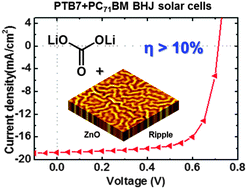
Highly efficient inverted BHJ solar cells were demonstrated using a wet-chemically prepared doped ZnO layer with a self-organized ripple nanostructure. The solar cell based on PTB7 and PC71BM with Li2CO3-doped ZnO layer yielded a maximum efficiency of 10.08%.
To cite this article before page numbers are assigned, use the DOI form of citation above.
The content of this RSS Feed (c) The Royal Society of Chemistry
10 Dec 17:18

Monolithic perovskite/silicon-heterojunction tandem solar cells processed at low temperature

Emmanuel

Prvkt

Energy Environ. Sci., 2016, 9,81-88
DOI: 10.1039/C5EE02965A, Communication
Steve Albrecht, Michael Saliba, Juan Pablo Correa Baena, Felix Lang, Lukas Kegelmann, Mathias Mews, Ludmilla Steier, Antonio Abate, Jorg Rappich, Lars Korte, Rutger Schlatmann, Mohammad Khaja Nazeeruddin, Anders Hagfeldt, Michael Gratzel, Bernd Rech
We present a monolithic perovskite/silicon tandem cell enabling a high Voc and a stabilized power output of 18%.
The content of this RSS Feed (c) The Royal Society of Chemistry
10 Dec 17:16

Organometal halide perovskite solar cells: degradation and stability

Emmanuel

Perovskite 2

Energy Environ. Sci., 2016, 9,323-356
DOI: 10.1039/C5EE02733K, Review Article
Taame Abraha Berhe, Wei-Nien Su, Ching-Hsiang Chen, Chun-Jern Pan, Ju-Hsiang Cheng, Hung-Ming Chen, Meng-Che Tsai, Liang-Yih Chen, Amare Aregahegn Dubale, Bing-Joe Hwang
What are the bottlenecks for organometal halide perovskite solar cells to achieve the stability required for commercialization?
The content of this RSS Feed (c) The Royal Society of Chemistry
10 Dec 17:03

Entropic Stabilization of Mixed A-Cation ABX3 Metal Halide Perovskites for High Performance Perovskite Solar Cells

Emmanuel

Perovskite

Energy Environ. Sci., 2015, Accepted Manuscript
DOI: 10.1039/C5EE03255E, Paper
Chenyi Yi, Jingshan Luo, Simone Meloni, Ariadni Boziki, Negar Ashari-Astani, Carole Gratzel, Shaik M Zakeeruddin, U Rothlisberger, Michael Gratzel
ABX3-type organic lead halide perovskites currently attract broad attention as light harvesters for solar cells due to their high power conversion efficiency (PCE). Mixtures of formamidinium (FA) with methylammonium (MA)...
The content of this RSS Feed (c) The Royal Society of Chemistry
10 Dec 15:35

Chirality transfer from graphene quantum dots

Chem. Commun., 2016, 52,665-668
DOI: 10.1039/C5CC08890A, Communication
M. Vazquez-Nakagawa, L. Rodriguez-Perez, M. A. Herranz, N. Martin
Graphene quantum dots covalently modified with enantiomerically pure R/S units provide chiral graphene quantum dots that, upon assembly with pyrene molecules, show a strong chiroptical response.
The content of this RSS Feed (c) The Royal Society of Chemistry
24 Nov 17:37

Correction: Oxygen deficient, carbon coated self-organized TiO2 nanotubes as anode material for Li-ion intercalation

J. Mater. Chem. A, 2015, 3,24569-24569
DOI: 10.1039/C5TA90250A, Correction
Open Access Open Access
Creative Commons Licence&nbsp This article is licensed under a Creative Commons Attribution 3.0 Unported Licence.
J. Brumbarov, J. P. Vivek, S. Leonardi, C. Valero-Vidal, E. Portenkirchner, J. Kunze-Liebhauser
The content of this RSS Feed (c) The Royal Society of Chemistry
18 Nov 15:55

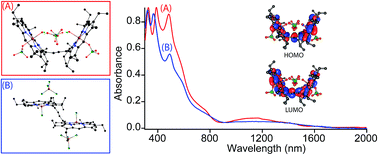
Oxidation triggers extensive conjugation and unusual stabilization of two di-heme dication diradical intermediates: role of bridging group for electronic communication

Chem. Sci., 2016, 7,1212-1223
DOI: 10.1039/C5SC03120F, Edge Article
Open Access Open Access
Debangsu Sil, Soumyajit Dey, Amit Kumar, Susovan Bhowmik, Sankar Prasad Rath
Synthetic analogs of diheme enzyme MauG have been reported. Unlike the bis-Fe(IV) state in MauG, the 2e-oxidation stabilizes two ferric hemes, each coupled with a porphyrin [small pi]-cation radical.
The content of this RSS Feed (c) The Royal Society of Chemistry