
Robert.mccowen
Shared posts
19 Aug 15:15
Meteor Showers
Robert.mccowenI'm pretty sure Janelle will be able to pinpoint the entry that made me laugh out loud.
chingachgook, Djwysh and 3 others like this
12 Aug 15:58
NPF: UNCONTAINED PANTS FAILURE
by Ed
Robert.mccowenFun physics fact: in free-fall, it takes almost exactly 90 seconds to descend 40,000 feet. Accordingly, making that transition in the Concorde would mean that the passengers' reference frame (that is, the aircraft) is accelerating at the same rate as gravity, placing them in astronaut-style "zero G" with respect to their surroundings.
Fans of aviation or industrial design mourned the retirement of the Concorde in 2003. With it ended for the foreseeable future the brief era of supersonic passenger flight. Its retirement – which had nothing to do with the spectacular, tragic crash of Air France Flight 4590 in 2000 and everything to do with the plane's astronomical per-passenger cost to operate – was the first nod to economic reality in its history. The Concorde never made economic sense; it was finished as a matter of political and nationalistic pride in France and the UK. A textbook example of the sunk costs fallacy – which is now sometimes called the Concorde Fallacy in its honor – its existence was more a matter of 'can' than 'should'.
Flying at twice the speed of sound at 60,000 feet presented some unique challenges aside from the impractical economics. At the beginning of every commercial flight, FAA rules require flight attendants to give you a safety demonstration that you ignore completely; part of it is the infamous oxygen mask with its plastic bag that may or may not inflate (but don't worry, because either way oxygen is still flowing). The supplemental oxygen is there in case of a loss of cabin pressure. A normal jet cruising at 25-30,000 feet can make use of a passive system like this in case of emergency while the pilots descend to a safer altitude. There is very little oxygen or atmospheric pressure at 30,000 feet, so the goal is to give everyone enough oxygen to avoid hypoxia while quickly reaching a more breathable altitude.
But at 60,000 feet in the Concorde the engineers discovered that the mask-and-baggie system doesn't work. The air is too thin and the pressure too weak at that altitude. In the event of a loss of cabin pressure, the air at that altitude would be so thin that you couldn't even inhale well enough to stay conscious. The only way to ensure adequate oxygen would be to uses a positive pressure device like a CPAP (similar to what people with sleep apnea use). Installing one for each of 100 passengers in the Concorde was totally impractical in terms of cost and weight.
Instead, they installed a positive-pressure system in the cockpit with fighter pilot-style oxygen masks to ensure that the flight crew would be OK. Then they calculated what is known as the "time of useful consciousness" (TOC) at 60,000 feet – how long it will take the average human to pass out or lose the ability to perform basic tasks. Given the impossibility of providing an oxygen system for every passenger, the engineers decided that the best solution was to take the TOC and instruct the pilots to dive to a breathable altitude in that amount of time.
That would be no big deal except the TOC is something like 90-120 seconds at Concorde's 60,000 foot cruising altitude. A breathable altitude without supplemental oxygen is around 15-20,000 feet. So in the event of a loss of cabin pressure, the emergency procedure on the Concorde was to dive 40,000 feet in 90 seconds. As far as I can tell this maneuver was never actually tested, although engineers did determine that it was well within the structural limits of the airframe. While the aircraft itself might have survived, I highly doubt the same could be said for the structural integrity of the passengers' pants if this actually happened on a revenue flight. Given the high cost of tickets and the high-class clientele that the Concorde attracted, explosive pant-soiling would have been quite the public relations nightmare for British Airways. Thank god it never came to that, and thereby were many pants saved.
Chris.d.woo likes this
11 Aug 17:50


Grab the Nearest Chicken
by bspencer
Robert.mccowenShared mostly so I can find it easily later.
Every Friday The Sainted Grandparents take The Adorable Goober for a few hours in the late afternoon/early evening. So I can make a nice meal at a relatively leisurely pace if I so choose. Last night I had a cut-up chicken and few veggies/fruits that needed to use up, so I roasted the chicken on a bed of the aforementioned fruits and veggies. I made Roasted Chicken with Fennel, Apples and Ginger.
I thought it would fine, great even. But it turned out to be the best batch of roasted chicken and veg I’d ever made–EVER. It was just luscious. Something about the sweetness of the fennel and apples contrasted with the zing of the ginger and the meaty savoriness of the chicken just sang. And it was criminally easy to make; I kept the recipe ridiculously simple.
I urge you to find a chicken right now. I don’t care if you have to steal it from a hipster who’s raising chickens on his roof. I don’t care if you have to behead it and de-feather it yourself. Just fucking grab one and make this:
Roasted Chicken with Fennel, Apples and Ginger
- One small chicken, cut up
- 4-5 carrots, cut, on the bias, into slim chunks
- 1 bulb fennel, cut into slim wedges
- 1 sweet apple, cut into slim wedges
- 1 onion, cut into slim wedges
- 3 stalks celery, cut into 2 inch chunks
- 1-2 tbsp. olive oil
- 3-inch knob of peeled ginger, cut into 1/4 inch rounds
- 4 cloves garlic, smashed
In a roasting pan, toss the veggies and apple with the olive oil. Salt and pepper generously. Place the chicken pieces on top of the veggies and apples. Salt and pepper generously. Place in a 375-450 degree oven and cook slowly, to soften the veggies, then crank the heat to crisp the skin. Remove from the oven when the chicken skin is crispy and golden and the veggies are tender. Stir veggies to distribute the chicken drippings evenly and serve alongside the chicken. Send me a check in the amount of 1 quajilliontrillion dollars to thank me for introducing you to this delicacy.
    
|
30 Jul 14:18
Gaming while Being a Cooties-Carrier
by bspencer
Robert.mccowenEntry #1,347 in the list of reasons I'm so frequently ashamed on behalf of my entire gender.
I’m not a gamer. I don’t have the time to be one, which makes me sad sometimes. Then I read things like this and I’m suddenly glad I’ve got time constraints.
You’re clicking on a tumblr entry that documents the abuse one woman gets for expressing (rather mild) disappointment at the lack of female protagonists in new games. (If I were a gamer, that’d piss me off, too.)
It’s weird that women are often accused of being thin-skinned and over-emotional: look at all the shrieky, hysterical reactions one tiny, harmless critique gets. Doubly funny are the shrieky, hysterical men imploring the mean feminist to calm down.
22 Jul 14:23
¡AYYY, NO ES BUENO!
by roy edroso
Robert.mccowenIf only there were someone I could ask whether MALDEF would have "crucified... Marc Cherry" if Eva Longoria hadn't been attached to some upcoming forgettable basic-cable show...
At National Review, Rachel Campos-Duffy is blowing the lid off... Eva Longoria, producer of Devious Maids, which sounds like typically prime-time crap to us, but to Campos-Duffy it's racist. Well, not racist exactly, just hypocritical-liberal-racist because Longoria's tight with those radical Latino groups and shouldn't be getting away with such stuff.
Also, has La Raza tried to shut down Telemundo comedy sketches for their undignified portrayals of the gente? I'm guessing not. And The Simpsons' Bumblebee Man is still on TV. Maybe they're all pals of Longoria and the Democrats, and equally in on the hypocri-conspiracy!
Still, Campos-Duffy thinks her idea of what Latino groups might have done is a bombshell, because this non-event is obviously tied to Longoria's activities with Democratic groups -- "the support she is receiving amid this controversy from the DNC and Hispanic NGOs recalls the kind of cronyism, amiguismo, and back scratching of the countries so many Latinos left behind." I understand Ricky Ricardo pulled the same shit, forgetting his roots to hang out with Fred and Ethel Mertz.
Portraying this absence of action as "the campaign to save Eva," Campos-Duffy claims it's "having some unintended consequences. It’s pulling back the curtain and exposing the nexus between money and Democratic politics. Powerful Hispanic community organizations are putting one Latina over the best interests, empowerment, and advancement of all Latinos."
I guess I have to be the one to tell them: Conservatives are so freaking bad at ethnic pandering, they ought to break down and take lessons. They're always screaming about race hustlers and race pimps -- couldn't they just sidle up to one sometime and offer him a wad of cash to teach them how to do it?
Much has been said about the controversy swirling around Eva Longoria’s decision to be the executive producer of Lifetime Television’s Devious Maids, a prime-time soap about sexy Latina domestic workers who occasionally sleep with their bosses. Less has been reported about Ms. Longoria’s key relationships with her biggest defenders and America’s most powerful Hispanic NGOs, as well as her relationship with the finance chair of the Democratic National Committee, Henry Muñoz.
The hypocrisy is difficult to swallow. After all, these are the same organizations that battled with Disney over an animated princess’s being insufficiently “Latina” (read, too white) and found sexism and gender insensitivity in their political opponents at every turn, accusing them of launching an all-out “war on women.” Does anyone doubt that the National Council of La Raza and the Mexican American Legal Defense and Education Fund (MALDEF) would have crucified Devious Maids creator Marc Cherry if a powerful Democratic Latina donor had not been attached to the project?Shit, I don't know. But tell me this: Have those sinister Latino groups come out against Iris Chacón for racial recidivism? Because when you're runnin' down La Bomba, hombre, you'll walkin' on the fighting side of me.
Also, has La Raza tried to shut down Telemundo comedy sketches for their undignified portrayals of the gente? I'm guessing not. And The Simpsons' Bumblebee Man is still on TV. Maybe they're all pals of Longoria and the Democrats, and equally in on the hypocri-conspiracy!
Still, Campos-Duffy thinks her idea of what Latino groups might have done is a bombshell, because this non-event is obviously tied to Longoria's activities with Democratic groups -- "the support she is receiving amid this controversy from the DNC and Hispanic NGOs recalls the kind of cronyism, amiguismo, and back scratching of the countries so many Latinos left behind." I understand Ricky Ricardo pulled the same shit, forgetting his roots to hang out with Fred and Ethel Mertz.
Portraying this absence of action as "the campaign to save Eva," Campos-Duffy claims it's "having some unintended consequences. It’s pulling back the curtain and exposing the nexus between money and Democratic politics. Powerful Hispanic community organizations are putting one Latina over the best interests, empowerment, and advancement of all Latinos."
I guess I have to be the one to tell them: Conservatives are so freaking bad at ethnic pandering, they ought to break down and take lessons. They're always screaming about race hustlers and race pimps -- couldn't they just sidle up to one sometime and offer him a wad of cash to teach them how to do it?
16 Jul 22:25
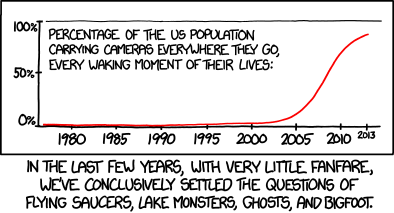
Settled
Robert.mccowenCatching up on XKCD, and this is one of my new favorites.
Pedro.Aragao, Danl and one other like this
15 Jul 04:21


Stand Your Ground Increases Racial Bias in “Justifiable Homicide” Trials
by Lisa Wade, PhD
Robert.mccowenI had a conversation with my father-in-law this weekend, away from the internet, where I tried to make EXACTLY this point. He didn't believe me, and said the trial wasn't about race.
Grr.
We’re celebrating the end of the year with our most popular posts from 2013, plus a few of our favorites tossed in. Enjoy!
Today a jury found George Zimmerman not guilty of second-degree murder. It is widely argued that Florida’s stand your ground statute, which was considered by the defense, and which Zimmerman previously studied in a criminal litigation course, was at play. The statute allows people to use proportionate force in the face of an attack without first trying to retreat or escape. More than 20 other states have such laws.
At MetroTrends, John Roman and Mitchell Downey report their analysis of 4,650 FBI records of homicides in which a person killed a stranger with a handgun. They conclude that stand your ground “tilts the odds in favor of the shooter.” In SYG states, 13.6% of homicides were ruled justifiable; in non-SYG states, only 7.2% were deemed such. This is strong evidence that rulings of justifiable homicide are more likely under stand your ground.
But which homicides?
Ones similar to the one decided in favor of George Zimmerman today. A finding of “justifiable homicide” is much more common in the case of a white-on-black killing than any other kind including a white and a black person. At PBS’s request, Roman compared the likelihood of a favorable finding for the defendant in SYG and non SYG cases, consider the races of the people involved. The data is clear, compared to white-on-white crimes, stand your ground increases the likelihood of a not-guilty finding, but only when a person is accused of killing a black person.
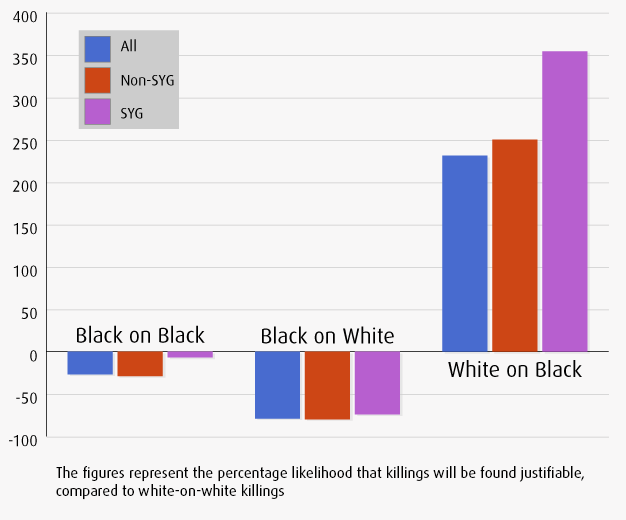
Notice, however, that white people who kill black people are far more likely to be found not-guilty even in states without SYG and black people who kill whites are less likely to be found not-guilty regardless of state law.
It’s simple: We are already biased in favor of the white defendant and against the black victim. Stand your ground laws give jurors more leeway to give defendants the benefit of the doubt. This increase even further the chances that a white-on-black homicide will be considered justifiable because jurors will likely give that benefit of the doubt to certain kinds of defendants and not others. Stand your ground may or may not be a good law in theory but, in practice, it increases racial bias in legal outcomes.
It is contested whether stand your ground played a role in this case, Media Matters offers strong evidence to suggest that it did. Cross-posted at Ms., PolicyMic, Pacific Standard, and Global Policy TV.
Lisa Wade is a professor of sociology at Occidental College. You can follow her on Twitter and Facebook.(View original at http://thesocietypages.org/socimages)
02 Jul 19:38
Why Do Firefighters Take Such Risky Jobs?
by Lisa Wade, PhD
Robert.mccowenMy godfather retired from active fire duty with the USFS in Wyoming a few decades ago, but this is what he did for most of his adult life.
I also find the parallel with martial arts interesting. I do fundamentally believe what I do is safe... despite the fact that I've gotten hurt doing it. And when I've been hurt I'm absolutely certain that it's the fault of one of the individuals involved, not because we both signed up for something with an essentially random element of risk.
Hmm.
Re-posted in honor of the 19 firefighters who lost their lives in Arizona yesterday. Cross-posted at BlogHer and The Huffington Post.
Firefighters put their lives on the line to protect other people’s property and lives. Why do they choose to take such dangerous work? Sociologist Matthew Desmond asks this question in his book, On the Fireline: Living and Dying with Wildland Firefighters, and the answer is truly surprising.
Desmond, who put himself through college fighting fires in Arizona, returned to his old job as a graduate student in order to study his fellow firefighters. When he asked them why they were willing to put their lives at risk to fight fires, the firefighters responded, “Risk? What risk?”
It turned out that the firefighters didn’t think that their work was dangerous. How is this possible?
 (
(Desmond explains that most of the firefighters were working-class men from the country who had been working with nature all of their lives. They raised cattle and rode horses; they cut down trees, chopped firewood, and built fences; they hunted and fished as often as they could. They were at home in nature. They felt that they knew nature. And they had been manipulating nature all their lives. Desmond wrote: “…my crewmembers are much more than confident on the fireline. They are comfortable.”
 (
(To these men, fire was just another part of nature. They believed that if you understood the forest, respected fire, and paid attention, then you could keep yourself safe. Period. Fire wasn’t dangerous. One of the firefighters put it like this:
Cause, personally, I don’t consider my life in danger. I think that the people I work with and with the knowledge I know, my life isn’t in danger… If you know, as a firefighter, how to act on a fire, how to approach it, this and that, I mean you’re, yeah, fire can hurt you. But if you know, if you can soak up the stuff that has been taught to you, it’s not a dangerous job.
When these men were called “heroes,” they laughed. Desmond wrote: “The thought of dying on the fireline is so distant from firefighters’ imaginations that they find the idea comedic.”
When a fellow firefighter did tragically die on the fireline during Desmond’s study, he discovered just how deep this went. Unwilling to consider the possibility that fire was dangerous (at least in front of each other), the only way to make sense of the death was to find fault in an individual, or even blame the dead firefighter for being “stupid.” Desmond recounts this conversation:
“That sucks,” J.J. said.
“Someone fucked up,” Donald responded, immediately. “I’ll tell you what happened: Someone fucked up…”
Heads nodded.
Craig Neilson, the Fire Prevention Officer, added, “Their communications might have been fucked. . . . The fire was under them and burned up.”
“They probably weren’t paying attention,” Donald said…
“They’re probably stupid. Probably weren’t talking to their crew,” Peter guessed.
“Yep. They’re fuckin’ stupid, not talking to anyone. They should’ve known better than to build a helispot on top of the fire,” said Donald.
Heads continued to nod…
Desmond’s answer to why firefighters take such a risky job — because they don’t think it’s risky — was a fabulous counterpoint to dominant theories of risk taking at the time, which tended to suggest that men who did risky things were trying to prove their masculinity or seek adoration as a hero.
It’s easy to conclude that the firefighters are delusional for thinking that fire isn’t risky, but Desmond does a wonderful job of showing that their denial of risk is mundane. We do it every day that we jump into a car and approach 70 miles per hour on the freeway. If we are worried about our safety, it’s usually because we are concerned about the skills and attention of other drivers. Most of us think that we, personally, are pretty decent, even great drivers. The firefighters tend to feel the same about fire.
Today’s deaths remind us that fire is dangerous. We should also remember that risky jobs are disproportionately filled by the least powerful members of our society. Wildland firefighters are typically low income men from rural backgrounds; in Desmond’s study, they were also disproportionately Latino and American Indian. As Desmond wrote: “Certain bodies, deemed precious, are protected, while others, deemed expendable, protect.” Let’s take a moment to remember the 19 who lost their lives yesterday, as well as the other men and women who do the dangerous work of America. And be careful everybody.
Note for Instructors: I teach this book in Soc 101, with great success. I wrote a review in Teaching Sociology and you can download my lecture notes here.
Lisa Wade is a professor of sociology at Occidental College. You can follow her on Twitter and Facebook.
01 Jul 12:43
This space reserved for your ad.
Monday Morning Open Thread: Not Everything Is Horrible
by Anne Laurie
Robert.mccowenI try to keep from swearing too much around here, but FUCK YEAH. I know SCOTUS destroyed the sanctity of marriage, and I'm still waiting for Obama's death squads to show up and forcibly divorce me from Traci, but in the mean time things like this are the right actions to take for so many reasons.
Moral arc bending toward justice, &c.
Margaret Hartmann, at NYMag:
Same-sex couples are seeing the benefits of the Supreme Court’s gay marriage ruling even faster than anticipated (much to the chagrin of conservatives). On Friday, as same-sex marriages resumed in California, Julian Marsh, an American, and his husband Traian Popov, a Bulgarian immigrant, got the news that they are the first gay couple to have their marriage-based green card petition approved. The New York Times reports that the visa agency had said it would hold off on approving applications until this week, but apparently immigration officers got excited and decided to jump the gun….
Soon many other couples will receive the same happy news. For the last two years officials at U.S. Immigration and Citizenship Services have been keeping a list of same-sex couples whose green card petitions were denied, in anticipation of the Supreme Court’s DOMA ruling. The decisions in those cases will be reversed, with no need for a new application, and other pending applications from gay couples will be handled exactly the same as those from opposite-sex couples.
What’s on the agenda for the start of the week?

This space reserved for your ad.
29 Jun 01:36
On Our Knees for America
by Erik Loomis
Robert.mccowenThat's an, uh... unfortunate slogan.
The Family Research Council has called for a day of action on June 30 against same-sex marriage. They designed a really great logo for it.

These people are so ready to come out of the closet, they can’t help themselves.
….Once again, it’s worth noting that it is in fact impossible to parody conservatives. Impossible.
28 Jun 16:51


The Unromantic Slaughter of the Civil War
by Ta-Nehisi Coates
Robert.mccowenWorth reading about as we get close to the anniversary of Gettysburg. I've heard the theory in question before--in both Florida and South Carolina--and this is one of the more eloquent responses I've ever read.
The great Tony Horwitz has a good piece up at the site on the new movement among historians questioning the civil war as a good war:
"We've decided the Civil War is a 'good war' because it destroyed slavery," says Fitzhugh Brundage, a historian at the University of North Carolina. "I think it's an indictment of 19th century Americans that they had to slaughter each other to do that." Similar reservations were voiced by an earlier generation of historians known as revisionists. From the 1920s to 40s, they argued that the war was not an inevitable clash over irreconcilable issues. Rather, it was a "needless" bloodbath, the fault of "blundering" statesmen and "pious cranks," mainly abolitionists. Some revisionists, haunted by World War I, cast all war as irrational, even "psychopathic."World War II undercut this anti-war stance. Nazism was an evil that had to be fought. So, too, was slavery, which revisionists -- many of them white Southerners--had cast as a relatively benign institution, and dismissed it as a genuine source of sectional conflict. Historians who came of age during the Civil Rights Movement placed slavery and emancipation at the center of the Civil War. This trend is now reflected in textbooks and popular culture. The Civil War today is generally seen as a necessary and ennobling sacrifice, redeemed by the liberation of four million slaves. But cracks in this consensus are appearing with growing frequency, for example in studies like America Aflame, by historian David Goldfield. Goldfield states on the first page that the war was "America's greatest failure." He goes on to impeach politicians, extremists, and the influence of evangelical Christianity for polarizing the nation to the point where compromise or reasoned debate became impossible.Unlike the revisionists of old, Goldfield sees slavery as the bedrock of the Southern cause and abolition as the war's great achievement. But he argues that white supremacy was so entrenched, North and South, that war and Reconstruction could never deliver true racial justice to freed slaves, who soon became subject to economic peonage, Black Codes, Jim Crow, and rampant lynching.Nor did the war knit the nation back together. Instead, the South became a stagnant backwater, a resentful region that lagged and resisted the nation's progress. It would take a century and the Civil Rights struggle for blacks to achieve legal equality, and for the South to emerge from poverty and isolation. "Emancipation and reunion, the two great results of this war, were badly compromised," Goldfield says. Given these equivocal gains, and the immense toll in blood and treasure, he asks: "Was the war worth it? No."
One thing that World War II taught me is that there is no such thing as a "good war." It's true the North did not go to war free the slaves. It's also true that no nation in Europe went to war to save European Jews. It's true that white racism had infected the North and the South. It's also true that anti-Semitism had infected the European and American allies. Faced with the actual horrors of mass killing, I don't know that there is any war that can objectively said to be "worth it." But with that said, I think the idea that the Civil War reflects some unique failure of 19th-century Americans -- a failure equally born by Abraham Lincoln and Robert E. Lee -- is quite wrong.
It should always be remembered that America did not "go to war" in 1860. America was attacked in 1860 by a formidable rebel faction seeking to protect the expansion of slavery. That faction did not simply want slavery to continue in America; they dreamed of a tropical empire of slavery encompassing Cuba, Nicaragua, and perhaps the whole of South America. This faction was not only explicitly pro-slavery but explicitly anti-democratic. The newly declared Confederacy attacked America not because it was being persecuted, but because it was unable to win a democratic election.
Understanding that, it is not enough to simply say the war was not "worth it" or to indict the failure of 19th-century Americans. A responsible thinker must offer a plausible alternative to the one Lincoln ultimately chose. Should Lincoln have allowed the South to depart? Should he have compromised with the South and vowed to support slavery's continuance and expansion? If the Civil War represents the failure of 19th-century Americans, what represents success? How -- specifically -- should that have been achieved?
It's very important to follow the logic of alternatives all the way through. If the Civil War was not "worth it," then the logical conclusion is that my ancestors should have remained enslaved and should have continued to be subject to having their wives, husbands, fathers, and children sold away until some undetermined point that was more convenient for white people.
The fact is that the Civil War didn't represent a failure of 19th-century Americans, but that the American slave society -- which was itself war -- represented a failure of humanity. That failure was the price America paid for its conception. The bill came due in 1860. No one knew this better than Lincoln himself:
If we shall suppose that American slavery is one of those offenses which, in the providence of God, must needs come, but which, having continued through his appointed time, he now wills to remove, and that he gives to both North and South this terrible war, as the woe due to those by whom the offense came, shall we discern therein any departure from those divine attributes which the believers in a living God always ascribe to him? Fondly do we hope -- fervently do we pray -- that this mighty scourge of war may speedily pass away. Yet, if God wills that it continue until all the wealth piled by the bondsman's two hundred and fifty years of unrequited toil shall be sunk, and until every drop of blood drawn by the lash shall be paid by another drawn with the sword, as was said three thousand years ago, so still it must be said, "The judgments of the Lord are true and righteous altogether."
I am very sorry that white people began experiencing great violence in 1860. But for some of us, war did not begin 1860, but in 1660. The brutal culmination of that war may not have allowed us to ascend into a post-racial heaven. But here is something I always come back to: In 1859 legally selling someone's five-year-old child was big business. In 1866, it was not. American Slavery was a system of perpetual existential violence. The idea that it could have been -- or should have been -- ended, after two and a half centuries of practice, with a handshake and an ice-cream social strikes me as really wrong.
|
|
27 Jun 19:54
Why the mantis shrimp is my new favorite animal
by Matthew Inman
Robert.mccowenI just realized that the Oatmeal wasn't on my RSS feed, and fixed that. Then I saw this. Which is awesome.

Alex Samaras, Vitormbarbosa likes this
27 Jun 16:40

Open Thread: Wendy Davis, Rising Lone Star
by Anne Laurie
Robert.mccowenShared for the link to the NY Times article--clearly I need my own Twitter. Or Tumblr. Or something.
Anyway, I chased down the statistic quoted here, and it's true: MORE THAN HALF of new moms in Texas qualify for Medicaid. WTF is going on down there, and how is a governor and state government whose ruling party is supposedly about "family values" not in full-on crisis mode in what is unquestionably a threat to new families?

.
Always nice to start the day with a new Democratic role model…
.
.
.
(pic via NYMag)
Steven C. Webster, at Raw Story:
Gilberto Hinojosa, chairman of the Texas Democratic Party, said he hopes that Sen. Wendy Davis (d), who conducted a 10-hour filibuster against a bill that would close all but five abortion clinics in the state and ban all abortions after 20 weeks, will run for statewide office. Speaking to Raw Story from the Texas Capitol on Tuesday night, Hinojosa said she would likely win a bid for the governor’s office thanks to her marathon filibuster…
“She doesn’t play games or worry about what’s going to get her votes,” Hinojosa continued. “She does what she believes is right. We’ve been sorely lacking that kind of leadership in the state of Texas for more than 20 years. So, yeah. I’m hoping she runs for statewide office, and I know that should she decide to, all of these women and men that are here today, young and old, will work their hearts out for her. She’d probably get elected governor, or whatever other office she wants to run for.” …
The Washington Post explains the mechanics behind the #StandwithWendy “tweetstorm”. (Billmon tweet: Texas GOP: “Well, we thought about #STFUWendy, but a few of the gals in the office weren’t too keen on it. You know how emotional they get.”
Gail Collins, in the NYTimes:
… Texas is a state with one of the nation’s highest teenage motherhood rates, where a majority of women who give birth are poor enough to qualify for Medicaid. So, naturally, its political leaders have declared war against the right of women to choose whether or not they want to be pregnant. Funding for family planning has been slashed. This month, Gov. Rick Perry tried to pass a new law that would have shut down almost all the abortion clinics in the state, under the guise of expanded health and safety requirements.
Huge crowds showed up to protest! This was pretty remarkable because Texas is not currently known as a place where people pay intense attention to what goes on in its State Capitol. (A recent study at the University of Texas at Austin found that it has “one of the nation’s lowest political and civic participation rates.”) Also, the conventional wisdom is that when things get politically rowdy, it’s because of a visitation from the right.
Yet there the protesters were, filling the Senate gallery and overflow rooms, squishing into the halls and the rotunda, flowing down the Capitol front steps and into the mall.
The bill arrived at the State Senate, its final stop, on the last day of the legislative session. Late in the morning, Davis got up to filibuster until midnight when the clock ran out…
The anti-abortion bill will be back. Vowing not to give way to “the breakdown of decorum and decency,” Governor Perry called a special emergency session for July 1 to take it up again.
The protesters will undoubtedly be back, too. “They’ve tasted victory — what it means to organize and win,” predicted Cecile Richards…
What’s on the agenda for the new day?
27 Jun 14:08
Lisa Wade is a professor of sociology at Occidental College. You can follow her on Twitter and Facebook.


The Banal, Mundane Sex Lives of College Students
by Lisa Wade, PhD
Robert.mccowenAgain, apparently I'm going all SI, all the time. But this (along with "race" and high-stakes testing) is actually one of my personal hobbyhorses since joining the social-science world: our vocabulary for talking about the type and degree of sexual encounters and relationships has definitely changed, but there's actually not a lot of good evidence that the frequency of sexual activity is increasing.
Which means articles like the linked one are just garden-variety slut-shaming. Two new sex partners over four to five years? Quick, someone find me a string of pearls to clutch and a chaise longue upon which to faint!
Cross-posted at the Los Angeles Times, Huffington Post, and BlogHer.
In an Op-Ed article on hookup culture in college, Bob Laird links binge drinking and casual sex to sexually transmitted diseases, unwanted pregnancies, confusion, low self-esteem, unhappiness, vomiting, ethical retardation, low grades and emotional inadequacy. “How nice of The Times to include this leftover piece from 1957 today,” snarked a reader in the online comments.
Fair enough, but Laird is more than out of touch. He also fundamentally misunderstands hookup culture, the relationships that form within it and the real source of the problems arising from some sexual relationships.
Laird makes the common mistake of assuming that casual sex is rampant on college campuses. It’s true that more than 90% of students say that their campus is characterized by a hookup culture. But in fact, no more than 20% of students hook up very often; one-third of them abstain from hooking up altogether, and the remainder are occasional participators.
If you do the math, this is what you get: The median number of college hookups for a graduating senior is seven. This includes instances in which there was intercourse, but also times when two people just made out with their clothes on. The typical student acquires only two new sexual partners during college. Half of all hookups are with someone the person has hooked up with before. A quarter of students will be virgins when they graduate.
In other words, there’s no bacchanalian orgy on college campuses, so we can stop wringing our hands about that.
Laird argues that students aren’t interested in and won’t form relationships if “they are simply focused on the next hookup.” Wrong. The majority of students — 70% of women and 73% of men –report that they’d like to have a committed relationship, and 95% of women and 77% of men prefer dating to hooking up. In fact, about three-quarters of students will enter a long-term monogamous relationship while in college.
And it’s by hooking up that many students form these monogamous relationships. Roughly, they go from a first hookup, to a “regular hookup,” to perhaps something that my students call “exclusive” — which means monogamous but not in a relationship — and then, finally, they have “the talk” and form a relationship. As they get more serious, they become more sexually involved (source):

Come to think of it, this is how most relationships are formed — through a period of increasing intimacy that, at some point, ends in a conversation about commitment. Those crazy kids.
So, students are forming relationships in hookup culture; they’re just doing it in ways that Laird probably doesn’t like or recognize.
Finally, Laird assumes that relationships are emotionally safer than casual sex, especially for women. Not necessarily. Hookup culture certainly exposes women to high rates of emotional trauma and physical assault, but relationships do not protect women from these things. Recall that relationships are the context for domestic violence, rape and spousal murder.
It’s not hooking up that makes women vulnerable, it’s patriarchy. Accordingly, studies of college students have found that, in many ways, hookups are safer than relationships. A bad hookup can be acutely bad; a bad relationship can mean entering a cycle of abuse that takes months to end, bringing with it wrecked friendships, depression, restraining orders, stalking, controlling behavior, physical and emotional abuse, jealousy and exhausting efforts to end or save the relationship.
Laird’s views seem to be driven by a hookup culture bogeyman. It might scare him at night, but it’s not real. Actual research on hookup culture tells a very different story, one that makes college life look much more mundane.
(View original at http://thesocietypages.org/socimages)
26 Jun 20:32
Yesterday’s Opinions Today!
by Scott Lemieux
Robert.mccowenI utterly reject the argument that Clarence Thomas is too stupid to tell the difference between an argument that segregation is really good for black students and an argument that it is in the interests of both the university and society as a whole to promote diversity on campus--which means he's either valuing an abstract principle over concrete, demonstrable historical harm, or he's just following the typical conservative pattern of fighting against whatever the Evil Liberals want. I leave it as an exercise for the reader how those two stances might be distinguished from one another.
Also, I still don't understand why the plaintiff was even granted standing, let alone certiorari, particularly since the almost unanimous decision was to remand the case back to appellate court. Maybe one of the actual attorneys around these parts can explain it to me.
I will have more on today’s appalling disemboweling of the Voting Rights Act imminently. In the meantime, enjoy this column about why conservative constitutional arguments against affirmative action are wrong:
Perhaps the most salient feature of the Thomas concurrence, considering that it comes from the member of the Court with the strongest avowed to commitment to “originalism,” is the uttter lack of any serious discussion about the historical origins and purposes of the 14th Amendment. As I’ve pointed out before, the reason for this is obvious: There’s no serious “originalist” argument to be made against affirmative action. There’s no reason to believe that the framers and ratifiers of the 14th Amendment intended to eliminate all racial consciousness (as opposed to at least some forms of racial subordination) from state laws. As Justice Thurgood Marshall noted in his opinion in the landmark affirmative action case Regents of California v. Bakke, “Since the Congress that considered and rejected the objections to the 1866 Freedmen’s Bureau Act concerning special relief to Negroes also proposed the Fourteenth Amendment, it is inconceivable that the Fourteenth Amendment was intended to prohibit all race-conscious relief measures.”
[...]
While Justice Thomas’s concurrence has nothing to say about the history of the 14th Amendment, he does extensively detail the history of defenders of segregation insisting that unjust discrimination was really in the interests of those being discriminated against. To Thomas, the lesson is that the benign motives of affirmative action are beside the point: “The worst forms of racial discrimination in this Nation have always been accompanied by straight-faced representations that discrimination helped minorities.”
The problems with this facile “gotcha” are also plainly evident. The crucial difference is that the paternalistic justifications for segregation were offered almost exclusively by the dominant caste. Only in the fantasies of segregationists did African-Americans believe that segregation was good for them, which is why disenfranchisement was necessary to maintain the system. Conversely, African-Americans today overwhelmingly support affirmative action. Thomas isn’t just comparing white university administrators to Jim Crow apologists; he’s comparing the heroes of the civil rights movement to Jim Crow apologists. It’s possible that Martin Luther King and John Lewis are wrong about affirmative action and Strom Thurmond and Jesse Helms happened to be right, but to argue that the former are more comparable to segregationists than the latter is specious in the extreme.
26 Jun 18:56
Please Kill Me Now
Robert.mccowenSigh. S.E. Cupp, for those who don't follow these things, is one of the small handful of people in the country who are actually more obnoxious than Newt Gingrich.
No, really.
Because what our embattled democracy really needed at this point was another platform from which we could be dispensed the wisdom of N. Leroy Gingrich, definer of civilization's rules and leader (perhaps) of the civilizing forces.


|
|

25 Jun 14:35
Monday Evening Open Thread: Grammar & Words
by Anne Laurie
.
What’s on the agenda for the evening?
21 Jun 22:03
He’s All Wet
by John Cole
This interview with the incredibly dim-witted Ryan Lochte is awesome:
I love it when people laugh uncontrollably. It just makes you laugh with them.
Schultkl likes this
21 Jun 21:01


Professors Join the Precariat
by Lisa Wade, PhD
Robert.mccowenThe other half of this problem is that while the proportion of courses taught by adjuncts is rising and adjunct salaries have fallen in inflation-adjusted dollars over the past 15 years, there have never been as many administrators as there are now, and those administrators have never been better compensated.
While the stereotype of the college professor might still be an elbow-patched intellectual cozied up in an office, it might be more accurate to place him in his car. A new report from the American Association of University Professors finds that more than 40% of college instructors are part-time, often driving from campus to campus to cobble together enough classes to enable them to pay rent. These types of employees far outnumber tenured and tenure-track faculty, who make up less than a quarter.

This data suggest that the term “precariat” applies well to a significant proportion of college and university professors. Coined by economist Guy Standing, the term is meant to draw attention to the economic fragility of many lower wage workers in today’s labor market. It’s a combination of the word “precarious” and “proletarian,” a word that is used to refer to the working class under capitalism.
Part-time faculty count as part of the precariat because their jobs are contingent (renewed semester to semester), low paid, and bring little or no benefits. Let me put it this way. I just finished my first year as a tenured professor after six years on the tenure track. I teach five classes. An adjunct at a public research university would have to teach more than twenty-three classes to earn my salary (average pay is $3,200/class); someone teaching at community colleges would have to teach more than thirty-three (at $2,250/class). Of course, my salary also reflects research and institutional service, but my hourly wage is obviously far out-of-proportion to that of part-time faculty. Plus I get a wide range of benefits; adjuncts usually get nothing.
When government funding of higher education shrinks, colleges and universities respond by cutting corners where they can. Hiring adjuncts is one way to do that. It’s important to remember, then, that funding cuts hurt not only students; they also hurt jobs.
See also How Many PhDs are Professors? Via Jordan Weissman at The Atlantic.
Lisa Wade is a professor of sociology at Occidental College. You can follow her on Twitter and Facebook.(View original at http://thesocietypages.org/socimages)
21 Jun 15:07


Remembering Vincent Chin
by C.N. Lee PhD
Robert.mccowenDon't mean to go all SI, all the time here, but this is bothering me a lot. (I had never heard of Vincent Chin before.)
And here's the thing: this is clearly what we would now call a hate crime, and it's horrible. But what makes it more horrible force is that it's a crime committed due to the victim's identity--against someone whose actual identity has noting to do with the target of your anger.
Beating a Chinese-American man to death because you're upset about Japanese competition in the auto industry is like... Well, come to think of it, it's a lot like stalking and beating a Sikh because twelve Sunni Muslims thought it would be a good idea to fly some planes into buildings.
My point is that while of course I can't condone this kind of rage, I can at least understand it. But I can't understand the kind of ignorance that leads you to conclude that a young Chinese-American guy has even the remotest thing to do with the Japanese auto executives who are threatening to drive you out of business. Japan and China are different places, for FSM's sake: they've fought wars with each other for centuries, and not the nice kind where the lads have a jolly scrum and then everyone knocks off for tea. They're different culturally and economically and politically, and on top of all that, this particular kid was as American as he was anything else at all.
So why him?
Cross-posted at Asian-Nation.
Today, June 19, marks the anniversary of the day Vincent Chin was beaten into a coma because he was Asian. As summarized in my article “Anti-Asian Racism,” Vincent Chin was a 27-year-old Chinese American living in Detroit, Michigan. On this date in 1982, he and a few friends were at a local bar celebrating his upcoming wedding. Also at the bar were two White autoworkers, Ronald Ebens and Michael Nitz.
 Ebens and Nitz blamed the Japanese for the U.S. auto industry’s struggles at the time and began directing their anger toward Vincent. A fight ensued and eventually spilled outside the bar. After a few minutes, Ebens and Nitz cornered Vincent and while Nitz held Vincent down, Ebens repeatedly bludgeoned Vincent with a baseball bat until he was unconscious and hemorrhaging blood. Vincent was in a coma for four days until he finally died on June 23, 1982.
Ebens and Nitz were initially charged with second degree murder (intentionally killing someone but without premeditation). However, the prosecutor allowed both of them to plea down to manslaughter (accidentally killing someone). At the sentencing, the judge only sentenced both of them to three years probation and a fine of $3,780. The sentence provoked outrage among not just Asian Americans, but among many groups of color and led to a pan-racial coalescing of groups demanding justice for Vincent.
Vincent’s supporters got the U.S. Justice Department to bring federal charges against Ebens and Nitz for violating Vincent’s civil rights. In this trial, Ebens was found guilty and sentenced to 20 years in prison while Nitz was found not guilty. However, the verdicts were thrown out because of a technicality and a second trial was ordered. The defense successfully got the trial moved away from Detroit to Cincinnati OH. In this second federal trial, an all-White jury acquitted both Ebens and Nitz of violating Vincent’s civil rights.
Vincent’s death and the injustices he, his family, and all Asian Americans suffered still stand as a stark and sober reminder that, in contrast to the image of us as the “model minority” and the socioeconomic successes that we have achieved, Asian Americans are still susceptible to being targeted for hostility, racism, and violence. We only have to look at recent incidents in which Asian American students continue to be physically attacked at school, and other examples of Asian-and immigrant-bashing and White backlash to see that we as society still have a lot of work to do before Asian Americans (and other groups of color) are fully accepted as “real” or “legitimate” Americans.
The silver lining in Vincent’s case was that it was a watershed moment in Asian American history because it united the entire Asian American community like no event before. For the first time, different Asian groups began to understand that the discrimination committed against other Asians could easily be turned towards them. In other words, for the first time, Asians of different ethnicities, cultures, and nationalities united around an issue that affected them all.
As a result, the Asian American community mobilized their collective resources in unprecedented ways and Vincent’s death was the spark that led to the creation of a network of hundreds of non-profit organizations working at local, state, and national levels to combat not just hate crimes, but also other areas of inequality facing Asian American (i.e., housing, employment, legal rights, immigrant rights, educational reform, etc.). Vincent’s death has had a powerful legacy on the Asian American community — as a result of the collective action demanding justice, it contributed to the development of the “pan-Asian American” identity that exists today.
This is why it is important for all Asian Americans, and all of us as Americans, to remember Vincent Chin — to mourn the events of his death, to reflect on how it changed the Asian American community forever, and to realize that the struggle for true racial equality and justice still continues today.
C.N. Le is a senior lecturer and the director of the Asian and Asian American Studies Center at the University of Massachusetts, Amherst. He is the founder and principle writer for Asian-Nation. You can follow him on Twitter.
Lisa Wade is a professor of sociology at Occidental College. You can follow her on Twitter and Facebook.(View original at http://thesocietypages.org/socimages)
19 Jun 15:54

The Pace of Modern Life
Robert.mccowenTen years ago, people actually bothered to write e-mails or call each other. Now we just use Facebook and Twitter, digesting our entire lives into lazily sequenced 140-character bites without even really engaging the brain.
...How am I doing?
Thetimerer, arcturus and 5 others like this
19 Jun 01:48


Modern Social Problems and Vintage Technology: Google’s Project Loon
by Lisa Wade, PhD
Robert.mccowenThis is possibly the coolest piece of technology I've heard about in years. I wish I was working on it.
 As our society becomes increasingly technological, I love stories that remind us of the value of simpler ways to solve problems, like a faux bus stop to catch escapee nursing home residents or dogs that are trained to sniff out cancer (both stories here).
This weekend we were treated to another such story, this time by Google. The company has announced a plan to bring internet to the whole world… with balloons. The very first launch of a gas balloon was in 1783. Two hundred and thirty years later, the company aims to deliver what is arguably the defining feature of our age — the internet — with helium-filled balloons. That technology will then bring almost countless other technologies, such as medical advances and agricultural information, to people who are largely excluded from them now. A fantastical plan.
Here’s how it’ll work:
Lisa Wade is a professor of sociology at Occidental College. You can follow her on Twitter and Facebook.(View original at http://thesocietypages.org/socimages)
08 Jun 16:46
Early Morning Open Thread: Book Domino Chain World Record!
by Anne Laurie
Via Paul Constant. Seven hours of setup, five attempts, 2,131 books. But as a lifelong bookaholic and library addict, this is the paragraph from the Seattle Public Library’s press release that tickled me most:
Books used in the record-setting event can be purchased at upcoming Friends of The Seattle Public Library book sales. Each book will have a special sticker identifying that it helped set the book domino world record, as well as the Web address so the book buyer can watch the video.
What’s on the agenda today?
07 Jun 19:50
This space reserved for your ad.
Worth Noting: “How Austerity Kills”
by Anne Laurie
David Stuckler, Oxford sociologist, and Sanjay Basu, Stanford epidemiologist, have a book to sell. They had a most interesting op-ed in Sunday’s NYTimes concerning that book, “The Body Economic: Why Austerity Kills”:
… The correlation between unemployment and suicide has been observed since the 19th century. People looking for work are about twice as likely to end their lives as those who have jobs.
In the United States, the suicide rate, which had slowly risen since 2000, jumped during and after the 2007-9 recession. In a new book, we estimate that 4,750 “excess” suicides — that is, deaths above what pre-existing trends would predict — occurred from 2007 to 2010. Rates of such suicides were significantly greater in the states that experienced the greatest job losses. Deaths from suicide overtook deaths from car crashes in 2009.
If suicides were an unavoidable consequence of economic downturns, this would just be another story about the human toll of the Great Recession. But it isn’t so. Countries that slashed health and social protection budgets, like Greece, Italy and Spain, have seen starkly worse health outcomes than nations like Germany, Iceland and Sweden, which maintained their social safety nets and opted for stimulus over austerity. (Germany preaches the virtues of austerity — for others.)
As scholars of public health and political economy, we have watched aghast as politicians endlessly debate debts and deficits with little regard for the human costs of their decisions. Over the past decade, we mined huge data sets from across the globe to understand how economic shocks — from the Great Depression to the end of the Soviet Union to the Asian financial crisis to the Great Recession — affect our health. What we’ve found is that people do not inevitably get sick or die because the economy has faltered. Fiscal policy, it turns out, can be a matter of life or death….
One need not be an economic ideologue — we certainly aren’t — to recognize that the price of austerity can be calculated in human lives. We are not exonerating poor policy decisions of the past or calling for universal debt forgiveness. It’s up to policy makers in America and Europe to figure out the right mix of fiscal and monetary policy. What we have found is that austerity — severe, immediate, indiscriminate cuts to social and health spending — is not only self-defeating, but fatal.
This space reserved for your ad.
07 Jun 19:44
OUT OF TIME
by Ed
Robert.mccowenA bit old at this point, but I'm clearing out my feed and thought this piece was particularly interesting.
In higher education we spend ample time discussing the idea of a core curriculum. Every university comes up with a buzzwordish name for it, but the concept is the same: to define the basic, bare minimum knowledge that we feel a student must have, in addition to whatever specialized knowledge they get in their field(s) of interest, to leave college with a useful understanding of the world and the skills required to function in it. Unsurprisingly these core curricula focus on writing/composition, basic math and science, and history. While it is fair to note that some students get college degrees without mastering some or all of these core skills, polling data shows that Americans are woefully ignorant about history and world affairs – to a troubling extent.
If I may briefly mount my pedagogical high horse, I consider two historical events – if you could only pick two – absolutely essential to understanding modern American society and government. The first is the American Civil War. The other is World War II. No, I don't believe students benefit from memorizing the names of battles and generals. I do think that if one is really to understand the fundamental political conflicts in the United States, an understanding of the causes and aftermath of the Civil War is indispensable. Likewise, modern global politics (and a good deal of American exceptionalism in policy both foreign and domestic) is rooted in WWII.
K-12 classes still overwhelmingly choose to teach history chronologically. This, in my experience and what I commonly hear from students, results in a seriously detrimental lack of emphasis on modern history. The academic year begins with ancient Greeks and Romans and ends sometime in May, usually having gotten no further than the Industrial Revolution or perhaps World War I. Accordingly, I get a ton of young people who, through no fault of their own, have been taught more about Plato and Tacitus than about the Cold War, decolonization, the Vietnam War, globalization, the collapse of the Iron Curtain, and 9/11 combined. Recently I found a class of 25 honors students – excellent students – totally ignorant of the basic aspects of the 9/11 attacks and the subsequent propaganda surge leading to the Iraq War. And why should they know? They were 8 when it happened, and it has never been taught to them.
American students do get the Civil War. They might get it in bizarre or ideologically motivated ways (some southern schools, I discovered, continue to teach that slavery was not the root cause of the War) but they get it. They have a basic understanding of what happened. But World War II? The Holocaust? The Treaty of Versaiilles and the rise of Nazism? The complete devastation of the industrial powers of Europe and Asia that led to 20 years of unparalleled economic growth in the U.S.? Western nations' abandonment of Poland, exploitation of empires, and refusal to take Jewish refugees? They have nothing, really. What they know about WWII is what they get from movies and from Call of Duty video games. They often believe (thanks to films like Saving Private Ryan) that Americans fought the Nazis essentially alone. They rarely know that the Soviet Union was America's ally, and primarily responsible for the military defeat of the Third Reich. They rarely understand why or how the Holocaust happened, and the economic scapegoating of Jews and other "others" during the post-WWI economic collapse in Germany. They fail to recognize how the War accelerated decades of technological development (radar, nuclear power, aircraft, electronics, medicine, etc) into a few short years. They think – if they think anything at all about it – that America beat the Nazis and someone else (either the Chinese or Japanese) because we invented the nuclear bomb.
Everything – from international terrorism to the Israeli-Palestinian conflict to 20th Century American economic growth to the housing crisis to the Vietnam War to the woes of underdeveloped countries – about the modern world can be understood completely only by tracing the roots of these events at least as far back to WWII. And increasingly I – I can't speak for anyone else here, but I doubt I am alone – find that students have the least knowledge about these more recent events. Try saying "Arab Oil Embargo" or "Mikhail Gorbachev" to a room of college freshmen and see what kind of looks you get. Hell, try it with a group of adults; it probably won't be much better. We know very little of recent history and what we do know is often wrong. Is it any wonder that opinions about current events rarely make sense?
Perhaps the recent past is deemphasized because it is assumed, incorrectly, that students somehow know this information because "it didn't happen that long ago." Or maybe the design of grade- and high school curricula continues to talk about ancient times at the expense or exclusion of the 20th Century. In either case the consequences are the same: parochial attitudes about the world and a skewed understanding of any issue that takes place outside of the bubble around our immediate lives.
Sbkr.sbkr.sbkr likes this
07 Jun 13:47
How to Reassess Something You've Been Doing Your Whole Adult Life
by Scott Meyer

There is a new Asking the Wrong Guy column available. If you have a problem, and you don't need practical advice, please, send him an e-mail!
Thank you for checking out my novel Off to Be the Wizard, (Available for Kindle (US, UK),Nook, old-school, dead tree form, DRM-free on Smashwords, and as a free sample), and for using my Amazon Affiliate links (US, UK, Canada).
Shadow likes this
05 Jun 15:00
ARTS NIGHT.
by roy edroso
Saw Coriolanus (now closed) at the Shakespeare Theatre Company here in D.C. I'd seen this play twice before -- back in the 70s at the Public, with Clarence Williams III in the lead, and at Theatre for a New Audience in 2005 with Christian Camargo, on which occasion I wrote about the play and the production. (You know the story: Big tough soldier saves Rome, Rome shits on him, soldier joins Rome's enemies and threatens to destroy Rome, his mother talks him out of it and his new comrades, understandably pissed, kill him.)
The play isn't wearing well on me --though it was a rattling good production, if a little heavy on the grrr-we're-guards type of ridiculous pseudo-toughness you get when actors play war; also the final dumb-show was imbecilic, a cycle-of-violence thing out of some pacifist pageant.
The character doesn't have the depth and shadings of Shakespeare's other tragic heroes, so the critical mind usually wanders away from him and toward the play's sour view of democracy and politics, which is not even cynical, just superstitious, reflexively hostile and grim. The other kinds of human relations the play notices are either sketchy or monstrous. Menenius and Coriolanus are supposed to be practically family, but Menenius does all the work and when the fit is on him Coriolanus gives him up easily; the love-hate blood-brotherhood of Aufidius and Coriolanus is just creepy.
The relationship that usually gets all the attention is the hero's to his mother Volumnia, a sort of paragon of martial motherhood who brags that she instilled Coriolanus' blood-thirst, and we believe her because she's formidable with her family, a terror to her enemies, and galvanic to Coriolanus. (His wife Virgilia was more wan and disposable in this production than I'd seen her before.) Diane D’Aquila was wonderful in the role; patrician but ferociously energetic, the sort of person you'd expect Coriolanus to look up to.
But a funny thing happened to that relationship because of a choice Patrick Page made as Coriolanus. Page was great, by the way -- certainly not a fake soldier, but someone whom you could imagine both in the phalanx and at the head of an army. He let on that he enjoyed the highly focused warrior life, was apparently juiced by it -- not necessarily pleased, though, and certainly not happy. But early in the play, after he has done some balls-out crazy heroism, he asked his general to free a citizen whom the army has interned, because the man had done him some kindess. Coriolanus was asked the man's name -- in the script he responds with this: "By Jupiter! forgot./I am weary; yea, my memory is tired./Have we no wine here?"
The normal reading is that he is tired, and maybe, if you can work it in, that little people don't really matter to this mighty warrior after all. But Page had a half-minute freak-out; he stopped talking; his eyes went out of focus; he punched himself several times in the head, trying to remember. His comrades, half-embarrassed, hustled him off to get his wounds dressed.
My God, I thought; he has PTSD. And through the rest of the play I saw that as an explanation for a lot of what Coriolanus did. And it really worked as an explanation, too: His joylessness, restlessness, high discomfort with crowds and intimacy -- it fell into place. It sounds like something out of a classroom bull session, so maybe we needn't call it PTSD; maybe we can just say that the thing that gnawed Coriolanus seemed understandable, and had a relationship to something I'd seen in the world. In any case Page was playing it and making it work.
It did sap some life out of the famous final meeting between Coriolanus and Volumnia, not because D'Aquila fell down on the job -- she sure didn't -- but because her ability to pull Coriolanus out of his madness, which is frankly always a hard sell, had been somewhat explained away by his condition. Of course he was going to crack if she went on long enough. It didn't matter what she did. In fact, nothing other people did mattered much to him; he was on his course, not to take Rome, nor to gain revenge, but to die and put an end to his own suffering. Maybe that wasn't Shakespeare's idea, but it was something to see, and tragic.
UPDATE. In comments Derek makes some good counter-points, this among them:
Oh, and I haven't seen the Ralph Fiennes film of it but now I really want to, thanks for the recommendations.
The play isn't wearing well on me --though it was a rattling good production, if a little heavy on the grrr-we're-guards type of ridiculous pseudo-toughness you get when actors play war; also the final dumb-show was imbecilic, a cycle-of-violence thing out of some pacifist pageant.
The character doesn't have the depth and shadings of Shakespeare's other tragic heroes, so the critical mind usually wanders away from him and toward the play's sour view of democracy and politics, which is not even cynical, just superstitious, reflexively hostile and grim. The other kinds of human relations the play notices are either sketchy or monstrous. Menenius and Coriolanus are supposed to be practically family, but Menenius does all the work and when the fit is on him Coriolanus gives him up easily; the love-hate blood-brotherhood of Aufidius and Coriolanus is just creepy.
The relationship that usually gets all the attention is the hero's to his mother Volumnia, a sort of paragon of martial motherhood who brags that she instilled Coriolanus' blood-thirst, and we believe her because she's formidable with her family, a terror to her enemies, and galvanic to Coriolanus. (His wife Virgilia was more wan and disposable in this production than I'd seen her before.) Diane D’Aquila was wonderful in the role; patrician but ferociously energetic, the sort of person you'd expect Coriolanus to look up to.
But a funny thing happened to that relationship because of a choice Patrick Page made as Coriolanus. Page was great, by the way -- certainly not a fake soldier, but someone whom you could imagine both in the phalanx and at the head of an army. He let on that he enjoyed the highly focused warrior life, was apparently juiced by it -- not necessarily pleased, though, and certainly not happy. But early in the play, after he has done some balls-out crazy heroism, he asked his general to free a citizen whom the army has interned, because the man had done him some kindess. Coriolanus was asked the man's name -- in the script he responds with this: "By Jupiter! forgot./I am weary; yea, my memory is tired./Have we no wine here?"
The normal reading is that he is tired, and maybe, if you can work it in, that little people don't really matter to this mighty warrior after all. But Page had a half-minute freak-out; he stopped talking; his eyes went out of focus; he punched himself several times in the head, trying to remember. His comrades, half-embarrassed, hustled him off to get his wounds dressed.
My God, I thought; he has PTSD. And through the rest of the play I saw that as an explanation for a lot of what Coriolanus did. And it really worked as an explanation, too: His joylessness, restlessness, high discomfort with crowds and intimacy -- it fell into place. It sounds like something out of a classroom bull session, so maybe we needn't call it PTSD; maybe we can just say that the thing that gnawed Coriolanus seemed understandable, and had a relationship to something I'd seen in the world. In any case Page was playing it and making it work.
It did sap some life out of the famous final meeting between Coriolanus and Volumnia, not because D'Aquila fell down on the job -- she sure didn't -- but because her ability to pull Coriolanus out of his madness, which is frankly always a hard sell, had been somewhat explained away by his condition. Of course he was going to crack if she went on long enough. It didn't matter what she did. In fact, nothing other people did mattered much to him; he was on his course, not to take Rome, nor to gain revenge, but to die and put an end to his own suffering. Maybe that wasn't Shakespeare's idea, but it was something to see, and tragic.
UPDATE. In comments Derek makes some good counter-points, this among them:
I dunno. Assigning PTSD to Coriolanus seems to me as meaningful as assigning ADD or Manic Depression or Minor Depressive Episode (Recurring) to Hamlet. They're two archetypal characters in extreme situations, both of them animated more by Shakespeare's language and imagination than by ineluctable human decision.I may have been unclear. Certainly if you use some clinical diagnosis, or even a homey character judgement -- like Hamlet as "the tragedy of a man who could not make up his mind") -- as an explanation for the play, or even a character within the play, you're being reductive and probably evading the hard work of analysis. But it's something else, I think, when the actor brings something that knocks over your preconceptions. Now, actors have to work hard to make these supermen comprehensible to audiences -- more than Shakespeare did, certainly -- and you can't tether them too much to convention; it could be that Page and/or his director, David Muse, were excited by this idea of Coriolanus and let it throw the play out of balance. Or maybe it was my old-fashioned idea of Coriolanus' and Volumnia's relationship that was out of balance. I don't know; maybe I'll have a better idea next time I see the play. But Page's conceit certainly woke me up.
Oh, and I haven't seen the Ralph Fiennes film of it but now I really want to, thanks for the recommendations.
28 May 20:32


Things In Politico That Make Me Want To Guzzle Antifreeze, Part The Infinity
Robert.mccowenWorth reading all the way through. Charlie Pierce does as good a job as anyone I'm familiar with at making this fundamental point: one half of America's political parties has reached a point where the best way to win elections is not only by refusing to govern but by promising not to let anyone *else* do it, either.
There's a valid if somewhat stretched analogy to be drawn with the housing bubble, or in fact with any pyramid scheme: the majority of those who are directly involved understand that it's unsustainable in the long term, but all of the short term incentives are structured to keep everyone playing.
The two presiding geniuses behind Tiger Beat On The Potomac take a whack at John Boehner today because, you know, leadership! and, against all possible odds, they trip over an actual acorn in the process.
Boehner runs a House in which many of the traditional levers of power are gone and of little use: earmarks for members' districts, important committee assignments and the backing of party leaders for reelection. Most young conservatives don't care about any of the three and, in fact, see all of them as manifestations of what's wrong with and corrupt about Congress and their party. They get more mileage from snubbing their leaders.
I mean, Boehner's rather a dolt, but what do these two guys expect him to do with a caucus that believes that the essential job of government is not to govern? Henry Clay would be drunk all the time if he had Boehner's problems...
|
|