Shared posts

24 Sep 23:26

Don't feel bad that I'm gone

by Shaun Usher


On this day in 1936, Jim Henson was born—a creative genius whose wide-reaching and positive influence on the population is rivalled by few in the world of entertainment, due to an incredible career that began in the 1950s when he created the now-adored Muppets. Henson passed away far too early, in 1990, aged just 53. Some time before, he wrote two letters to be opened in the event of his death: the first to his five children; the second to his "Friends & Family."

(Sources: Jim Henson Productions & Graham Sharpe; Image via Unlikely Words.)

To His Children

First of all, don't feel bad that I'm gone. While I will miss spending time with each of you, I'm sure it will be an interesting time for me and I look forward to seeing all of you when you come over. To each of you I send my love. If on this side of life I'm able to watch over and help you out, know that I will. If I can't, I'm sure I can at least be waiting for you when you come over. This all may sound silly to you guys, but what the hell, I'm gone—and who can argue with me?

Life is meant to be fun, and joyous, and fulfilling. May each of yours be that—having each of you as a child of mine has certainly been one of the good things in my life. Know that I've always loved each of you with an eternal, bottomless love. A love that has nothing to do with each other, for I feel my love for each of you is total and all-encompassing. Please watch out for each other and love and forgive everybody. It's a good life, enjoy it.

-------------------------------

To Friends & Family

I'm not at all afraid of the thought of death and in many ways look forward to it with much curiosity and interest. I'm looking forward to meeting up with some of my friends who have gone on ahead of me and I will be waiting there to say hi to those of you who are still back there. I suggest you first have a nice, friendly little service of some kind. It would be lovely if some of the people who sing would do a song or two, some of which should be quite happy and joyful. It would be nice if some of my close friends would say a few nice, happy words about how much we enjoyed doing this stuff together. Incidentally, I'd love to have a Dixieland band play at this function and end with a rousing version of "When the Saints Go Marching In."

Have a wonderful time in life, everybody; it feels strange writing this kind of thing while I'm still alive, but it wouldn't be easy to do after I go.


RSS Feed proudly sponsored by TinyLetter, a simple newsletter service for people with something to say.
23 Sep 17:48

Blue Hill Brings Vegetable Yogurt to the Masses

by Eric Singerman

From Serious Eats: New York

20130919-blue-hill-yogurt-all.jpg

[Photographs: Lily Chin]

Blue Hill announced last week that they're releasing a line of flavored yogurt. But don't expect vanilla and strawberry—they're going savory with four vegetable flavors: beet, squash, tomato, and carrot.

All of the yogurt is made with milk from from grass-fed cows on farms in the Northeast, including Blue Hill's own farm in the Lower Hudson Valley. The idea is a yogurt that can be eaten solo or used as a condiment or ingredient, like sour cream.

20130919-blue-hill-yogurt-beet.jpg

Beet.

What does a savory yogurt taste like, let alone carrot or beet yogurt? These aren't Dannon or anything like baby food; the texture is thin and loose, running off a spoon, and the flavor is tangy but more subdued than, say, Greek yogurt—more subtle and nuanced, less rich.

Despite its vivid color, the beet is the most muted of the bunch: tangy at first, then the sweet, earthy flavor of the beets kicks in. More beet would be overpowering; this is just right.

20130919-blue-hill-yogurt-carrot.jpg

Carrot.

In contrast, the bright orange carrot yogurt was anything but subtle. The carrot's sweetness brought out the yogurt's natural tang for something that's less overtly carrot-y and more bright and fresh. Squash works similarly, but with all the deeper fall flavors I've been craving the past few weeks. Someone called it a savory pumpkin pie: it had the intense earthiness and savoriness of a squash purée with the tart punch of the yogurt to balance things out.

The tomato yogurt, our favorite of the bunch, had the fresh acidity that I would expect out of tomatoes. It would go great over some toasted country bread with a little olive oil and sea salt. As with the carrot yogurt, the tomato's natural flavors complemented those of the yogurt with flavors reminiscent of summer.

20130919-blue-hill-yogurt-tomato.jpg

Tomato.

You can find the yogurts at Whole Foods throughout the Northeast, $2.99 for a six ounce container. While I wouldn't necessarily trade out my breakfast yogurt for one of these, they're well suited to eating straight or subbing in for ingredients like sour cream or crème fraîche. We suspect they'd make quick yogurt dips even quicker.

More info at bluehillyogurt.com.

23 Sep 11:23

What’s Your Husband’s Name?

by Logan Sachon
by Logan Sachon

Gail Collins opened her NYT column last week with an anecdote about her first credit card:

“I have no idea what year it was, except that it is very possible Richard Nixon was still president. I was in the Macy’s in New Haven when a woman with a clipboard came up to me and asked me if I wanted to apply for a credit card.

‘Absolutely,’ I said instantly.

She took up her pen. ‘What’s your husband’s name?’ she asked.”

Women in the comments shared their own stories of from the era. A few favorites:

24 Comments
21 Sep 23:27

A Better College Cost Calculator, But Still Imperfect

by Mike Dang
by Mike Dang


If you are a student from a low-income or middle class family who dreams about going to an elite college like Harvard or Wellesley, how do you know if you’ll be able to afford it? Those families are likely to pay less than the sticker price, but how much less? According to Economix, Wellesley has taken the steps to help those students and families get a sense of what they might have to pay by putting together a college cost calculator that asks questions like how much equity parents have in their homes, their annual incomes, and the amount of money they have in savings and retirement. The one major flaw: The calculator only shows how much the parents are expected to pay, and not the amount of loans the student may have to take out as part of her aid package, which is kind of the most important part (says someone who took out student loans).

1 Comments
21 Sep 23:05

Backstage at the Apple Store

by Mike Dang
by Mike Dang


An Apple employee is never supposed to point when giving directions in their store. For example, when asked where the iPhone cases are sold, a specialist should either gesture with an open hand or, preferably, walk the customer to the proper location.

Why? When formulating the philosophy behind Apple Retail, brainstorming executives tried to recall their most exemplary customer service experience, which turned out to be hospitality at the Ritz Carlton. If you ask any bellhop, janitor, or maid for directions in a Ritz Carlton hotel, they are trained to drop what they’re doing and personally show you the way. The practice is impressive; it cements customer loyalty and you would never expect that level of attentiveness at, say, a computer store in a mall.

The Apple Store is such a popular place that libraries are basing their designs on it. At McSweeney’s, J.K. Appleseed has a humorous column about what it might be like to work there.

Photo: Burgermac

1 Comments
19 Sep 23:49

Japanese manhole covers are beautiful

by Jason Kottke

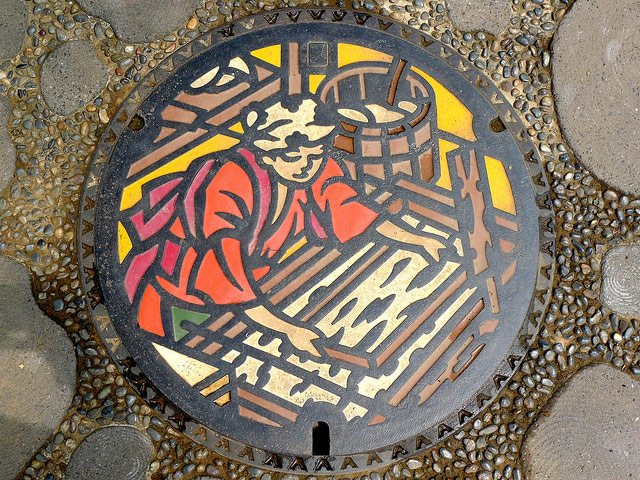
This group on Flickr shows just how fantastically designed Japanese manhole covers are. Here are some of my favorites:

Japanese Manholes 01

Japanese Manholes 02

Japanese Manholes 03

Japanese Manholes 04

(via mr)

Tags: design   Japan   photography
19 Sep 20:48

The Ernest Hemingway burger

by Jason Kottke

Ernest Hemingway liked a good burger and had a specific recipe he wanted his staff to use when preparing meals. Using his instructions, Cheryl Lu-Lien Tan recently recreated the Hemingway burger.

Fingers deep, I kneaded. Fighting the urge to be careless and quick, I kept the pace rhythmic, slow. Each squeeze, I hoped, would gently ease the flavors -- knobby bits of garlic, finely chopped capers, smatterings of dry spices -- into the marbled mound before me.

I had made burgers before, countless times on countless evenings. This one was different; I wasn't making just any burger -- I was attempting to recreate Hemingway's hamburger. And it had to be just right.

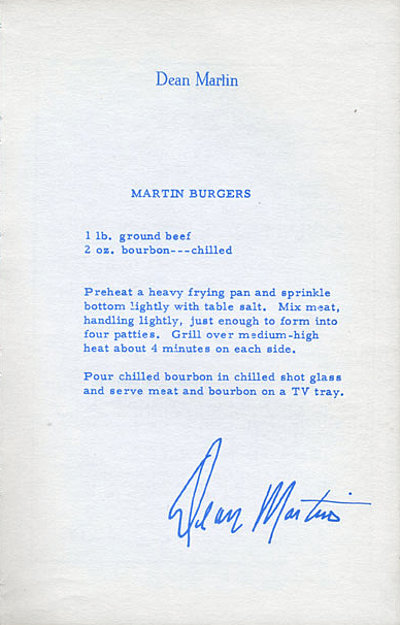
Surprisingly, with 11 different ingredients, Hemingway's burger is not as stripped down as his prose. For a more minimalist burger, you have to turn to Dean Martin:

Dean Martin Burger

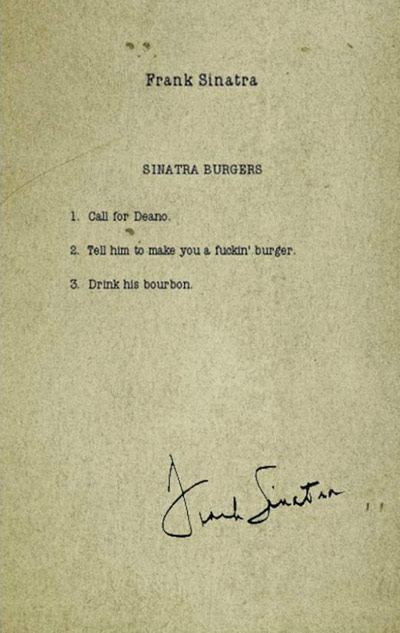
Frank Sinatra's is perhaps even easier:

Sinatra Burger

One thing is for sure: none of these gentlemen would cotton to the idea of the ramen burger, homemade or no. (via open culture)

Tags: Cheryl Lu-Lien Tan   Dean Martin   Ernest Hemingway   food   Frank Sinatra   hamburgers
14 Sep 17:30

Baker's Dozen: A Batch of Sweet Links!

by Cakespy
Amber

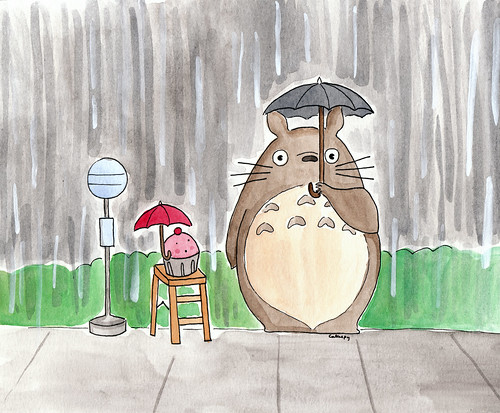
Cuppy & Totoro! Cuppy & Totoro!!!

Custom request, Cuppie and Totoro

I received a sample of Olive oil with cocoa nibs. What should I bake with it!?!?!

Seriously? Rustic roasting sticks for your marshmallows.

A loving look at Cola cakes.

Curious about cake conventions? Learn about one here.

The cronut hack names are getting ridiculous.

10 food trends we love to hate.

Anarchist bakery makes its mark in Paris.

You can't have it all, but you can have cake. Great essay!

Here's a cinnamon bun recipe to keep on file. It's from Scotland! Everything overseas is better!

Sweet! 100 free cake decorating tutorials! A great library to bookmark.

Is it the year of the veggie...in desserts?

Cool event, Seattle: Depressed Cake Shop

13 Sep 18:16

Slideshow

Points to anyone who hacks the Flickr devs' computers to make their text editors do this when you click on anything.
13 Sep 00:34

Writing Instruments

by Mike Dang
by Mike Dang

The Wirecutter has an exhaustive 6,000-word researched review of the best pen, and it’s not the Pilot Precise V5, which I’ve been buying and using exclusively for at least a decade (though it gets an honorable mention). There are very few consumer goods that I am loyal to, but pens are one of those things.

13 Comments
12 Sep 23:47

Unquote

I guess it's a saying from the Old Country.
12 Sep 17:51

How Chemistry Can Explain the Difference Between Bourbon and a Tennessee Whiskey

by Natasha Geiling
Amber

Interesting. I had no idea Jack Daniels could technically be called a bourbon.

The smokiness behind your favorite whiskey might all be thanks to chemistry. Photo via Flickr user Andreas Levers.

Whiskey drinkers know that the moment they swirl a bit of the smoky spirit in their mouth, they’re bound to find a world of flavors: some oak, some smoke, a little vanilla, maybe a slight bite from tannin. Brown liquors — from scotch to bourbon and all the whiskeys in between — are complex spirits that lend themselves to purposeful tasting, creating connoisseurs willing to shell out top dollar for the most peaty scotch or their favorite spicy bourbon. When it comes to the magic of whiskey, their complex profiles might be explained by the chemical fingerprints that separate them from one another — and change the way that they taste.

It’s an idea that the aptly-named Tom Collins, a researcher at the University of California, Davis, is actively pursuing. “I worked on my Ph.D., and it was a project looking at aroma and flavor chemistry in wine [fermented] in oak barrels,” Collins explains, crediting the barrels with sparking his initial interest in the chemistry of spirits. “It sort of seemed a natural extension to look from the chemistry of wine to the chemistry of whiskeys, because the chemistry of oak barrels play a huge role in what you see in whiskeys of all sorts.”

Collins and researchers at Davis set out to see if they could determine the chemical differences among 60 different whiskeys: 38 straight bourbon whiskeys, 10 rye whiskeys, five Tennessee whiskeys and seven other American whiskeys, varying in age from two-to-15 years old. What they found was a spectacular testament to the spirit’s complex chemistry–over 4,000 different non-volatile compounds across the different samples, results which he presented today at the 246th National Meeting & Exposition of the American Chemical Society. “It’s very complex,” Collins says of the chemistry. “There are components that are barrel derived, as we would expect, but there are also things that are related to the grains that are used to make the distillates in the first place—so the corn and wheat and rye and things that are fermented to form the distillate. We see some components that appear to be grain related, and there are also likely to be components that are derived from the yeast that are used do the fermentation.”

Of the thousands of chemical compounds Collins found, there was a fair amount of overlap between the different spirits. But Collins found that each spirit contained unique compounds, or unique concentrations of compounds, that he could use to distinguish a scotch from a bourbon, or a Tennessee whiskey from a bourbon, simply by looking at the liquor’s chemistry. “If you try to make sense of all of the components that are there, it’s essentially overwhelming, but if you filter out the things that are not used in Tennessee whiskeys, or things that are only present in some of the bourbons, you can sort of whittle away down to the things that define what a bourbon is or what a Tennessee whiskey is chemically,” Collins said.

It might be the perfect answer that eternal question of novice whiskey drinkers everywhere: what exactly is the difference between a whiskey and a bourbon?

The confusing answer is that bourbon is always whiskey, but all whiskey isn’t bourbon. This has always been true from a historical and regulatory perspective. Historian Michael Veach spoke with Food and Think in June and dispelled the myths that bourbon has its roots in Bourbon County, Kentucky, and that all bourbons must originate there. “‘People started asking for ‘that whiskey they sell on Bourbon Street,’ Veach says, ‘which eventually became ‘that bourbon whiskey.’”

The regulatory distinction presents a slight complication: some Tennessee whiskeys, from a regulatory standpoint, actually qualify as bourbons, but choose not to market themselves as such (Jack Daniels, for example, adamantly markets itself as a Tennessee whiskey, even when it meets regulatory standards for being a bourbon). Natalie Wolchover at Live Science outlines the regulatory standards for bourbon:

While bourbon whiskey has its roots in Kentucky, and continues to be primarily produced there, it is now manufactured in distilleries all over the United States. Manufacturers must meet the following requirements in order to advertise their whiskey product as “bourbon”:

It must be produced in the U.S. from a grain mixture (called “mash”) made up of at least 51 percent corn. It must be distilled to a maximum strength of 160 proof, bottled at a strength of at least 80 proof, and barreled for aging at no more than 125 proof. It must be aged in new, charred oak barrels. To qualify as “straight bourbon,” the spirits must meet the above requirements as well as being aged for at least two years and containing no added coloring, flavoring or other spirits.

Many bourbon whiskey distilleries in Kentucky advertise their use of unique water filtered by the limestone shelf in Bourbon County; while this feature may add to the allure of Kentucky bourbon whiskey, the federal trade regulations do not stipulate about what water must be used.

Collins thinks he might have a more chemically elegant answer to the conundrum. As his team discovered, there are 50 to 100 chemical compounds such as fatty acids and tannins that can be used to distinguish a Tennessee whiskey from a bourbon to such an extent that Collins can tell the difference between them without tasting either. Chemically, it’s often a question of concentration–how much of a plant derived compound does a spirit have? How much tannin? “There are, in many cases, certain compounds that are only found in one or the other, but more often, there are compounds that are present in both but at different concentrations. Those are the tannins, the fatty acids, and in some cases, turpentine – compounds that are plant-derived.”

These compounds complicate the matter further–certain chemicals are extracted from the wood barrels during the aging process, which might not be unique to the distillate itself. As Collins notes, barrels are, after all, made from trees–an unarguable plant substance. So how do they discern the unique plant-derived elements in the distillates from the compounds that might come from the barrel? “Some of the ways we get through that is to look at whiskeys that have been freshly distilled, and haven’t been put in barrels yet, so we can see what’s there in the fresh distillate before we put it in oak, and then we can see what changes between the newly distilled spirit and the spirit that has been aged in barrels for some period of time,” Collins explains. “That helps us to understand what the things are that come from the barrels, versus the things that come from the distillate itself.”

Collins and his team have yet to embark on the next step of their experiments–relating the differences in chemical makeup to potential sensory differences in aroma and flavor–but he feels fairly confident that the two are related. “I think–being a chemist–that the sensory differences arise from the chemistry,” Collins admits. Take, for example, the chemical compounds that arise when the spirit is being aged in a charred barrel. “The sensory component that you smell, that you associated with toasted oak, or charred oak, is going to be related to the compounds that are extracted by the whiskey from the wood,” Collins explains.

Understanding the delicate interplay between chemistry and aroma could be a huge help to distillers looking to tweak their whiskey to encapsulate that perfect blend of smoky and spicy. “This could be a tool [distillers] could use to understand if they make a change to their distillation processes, how does that impact the resulting whiskey,” Collins said, noting that the better distillers understand how the process of distillation impacts the final product, the better they can manipulate the process to their advantage. “It’s a tool that can be used by distillers large and small to understand the impact of what they’re doing on the chemistry, and then the sensory.”

It’s research that means that the perfect whiskey–smoky, spicy, or however you want it–might not be so elusive after all.

09 Sep 14:02

5 Vodka Cocktails to Make This Fall

by Maggie Hoffman
Amber

I want the Sunny Getaway!

From Drinks

20130901vodkalocal.jpg

Perhaps bartenders were still wincing from the days of poorly made Cosmos and calling-everything-a-martini, perhaps there was an urge to show folks that there are more interesting things to drink than a vodka-soda, but the past decade has seen vodka pulled off craft cocktail bar shelves and wiped from the menus.

I think that's slowly changing, though, and vodka drinks are creeping back into the cocktail scene—especially those featuring vodkas from small-batch distillers. Maybe it's a decision that good service includes pouring whatever the guest feels like drinking, maybe it's a desire to support local distilleries, maybe it's that some drinks actually work well with a vodka base. Whatever the cause, I've seen more and more vodka cocktails at good bars lately: savory drinks with potato-based Karlsson's Gold, a tongue-in-cheek White Russian variation made with amaro, and a tart, refreshing concoction made with Hangar One vodka, watermelon, lime, Lillet Rosé, Meletti, and Galliano.

That last one made me think: maybe we should all give vodka cocktails another chance. Here are five drink recipes that will help you get started.

The Phil Collins

20130901-the-hawthorne-07.jpeg

[Photo: J. Kenji Lopez-Alt]

A classic Tom Collins is made with London dry gin, sugar, lemon juice, and club soda. This cool variation from The Hawthorne in Boston features Square 1 cucumber flavored vodka instead, mixed with herbal Yellow Chartreuse, fresh lime, and simple syrup (along with a dash of bitters.) If you can't find the cucumber vodka, you can muddle fresh cucumber into some unflavored vodka and strain it through a tea strainer before serving.

Get the Recipe »


Concord Crush

grape cocktail

[Photo: Alice Gao]

We may think of brown spirits when autumn begins, but this drink is an argument to stay diversified: vodka keeps things fresh and bright so that some of fall's best produce can truly shine. Deep purple Concord grapes make a wonderful fresh puree that colors and flavors this simple vodka cocktail, balanced with a little fresh lime.

Get the Recipe »


The Sunny Getaway

vodka coconut cocktail

[Photo: Kelly Carambula]

Made with fragrant Meyer lemon juice, coconut milk, slices of lime, and ginger beer, this drink is a tropical vacation in a glass. Vodka cuts through the richness and latches into the ginger beer's spice, rounding out the drink without letting it get too heavy.

Get the Recipe »


The Great Gatsby

20130901-cocktail-great-gatsby.jpg

[Photo: Robyn Lee]

This one's as easy as 1, 2, 3: vodka, Lillet Blanc, and freshly squeezed grapefruit juice are all you need for a morning-friendly cocktail with vivid citrus flavor and plenty of puckering acidity.

Get the Recipe »


Lucy Basilia

lucy basilia cocktail

[Photo: Melody Fury]

This cocktail from Lucy's Fried Chicken in Austin, Texas may not be super complex, but it does one thing right: refreshment. Made with fresh basil leaves and blackberries, tart lemon juice and honey to sweeten, it's spiked with vodka and lightened with fizzy club soda. You'll need this one as long as the weather stays warm.

Get the Recipe »


About the Author: Maggie Hoffman is a Senior Editor at Serious Eats, based in San Francisco. She founded Serious Eats: Drinks in 2011. You can follow her on Twitter @maggiejane.

So many drinks, so little time. Keep in the loop with our weekly newsletter.

07 Sep 14:05

Cocktails From a Low-Stocked Bar: A Guide to Substitutions

by Michael Dietsch

From Drinks

20130901substitutiontopu.jpg

Oh man, it's been one of those days. Your computer isn't working correctly, but your IT guys doesn't want to help you. Your boss wants that important document fifteen minutes ago, but what can you do? Your mom is leaving passive-aggressive voicemails because you haven't called her in the last 24 hours. And on top of all that you realize you forgot to pay your overdue cable bill and you're starting to worry that you might have a service interruption to deal with before you can finally watch last week's Breaking Bad.

But at least you can have a Negroni when you get home. Ah, Negroni—bracing, bitter, and beet-red, and your favorite motivation-refresher on a crappy day. You think about it all the way home, in the car or on the train. How easy it is to make an equal parts drink, especially when you drink it on the rocks. No shakers or strainers to deal with, just a glass and some ice and a spoon.

So you walk into your house and suddenly remember. You're out of gin. Your spouse finished the bottle last night. After all, a screaming toddler and a broken dishwasher and a leaking ceiling is also grounds for an intense Negroni craving.

Now what do you do? Comb the house for replacement ingredients.

That's the purpose of today's piece. If you don't have X, maybe you have Y, and if you have Y, what can you make with it?

For example, if you have everything for your Negroni except gin, but you have rum, are you good to go? If you want a Sidecar, but you don't have triple sec, will the maraschino work, or do you need to schlep back out to the liquor store?

The Substitution Principle

The first thing to think about here is, "Like replaces like." Swap one fortified wine (vermouth) for another (sherry, for example), when making a Martini or Manhattan. Brown liquors stand in well for each other, in drinks such as Manhattans or Juleps. Various liqueurs can tag in for others, within reason. For example, bitter amari sub in well for each other, as I'll talk about shortly, but an amaro might not be a great swap for triple sec in a Sidecar.

Think about the flavor of a given ingredient, and the role it plays in the drink, before attempting substitutes. You'd never try to build a Manhattan out of three vermouths and bitters. Why? Because the main ingredient needs to be a strong spirit for the drink to be anything close to Manhattan-like. Similarly, don't take the triple sec from a Sidecar and replace it with gin. You need a sweetening agent to balance the cognac and citrus. So try another liqueur, even one that's not fruity.

The Negroni Family

Hoighty Toighty at Booker + Dax ($15)

[Photo: Renata Yagolnitzer]

I'll start with the Negroni family of cocktails, because part of the drink's genius is its flexibility. It's no secret we're huge Negroni lushes here at Serious Eats; we've written copiously about this drink. So it's natural to assume we're fans of its many variants, whether the Kingston Negroni (with Jamaican rum in place of the gin; Appleton is good, but Smith and Cross is excellent), the Boulevardier (with bourbon or rum), or the Sbagliato (with Prosecco).

But don't stop at replacing the gin. If you want something Negroni-like, and you don't have Campari, you can try anything bitter: Gran Classico, Cynar, Cardamaro, Aperol, Ramazzotti, Averna, Nonino, Suze, and quite a few others. Each provides a different flavor profile to a classic Negroni, so feel free to play around with your ratios to get the balance to your liking.

You can swap in other vermouths to replace, say, Cinzano, but you won't find that the flavor changes as drastically as it does with other base spirits or amari. Carpano Antica Formula is a little woodier and vanilla-tasting than, say, Cinzano, but other differences between vermouths are subtler, especially in a boozy drink such as this.

Start with one half ounce each of your three ingredients, and add more of each according to your taste so that you can adjust as you go and mix until it tastes good without ending up with a monster-sized drink. (Unless your goal is monster-sized drink.)

Old Fashioned

[Photo: Autumn Giles]

The Old Fashioned harks back to the original cocktail. When it was first defined, a cocktail was a drink that included spirits (any spirit), water, bitters, and sugar. As cocktails became more sophisticated, a drinker who wanted a throw-back to simpler days would order an "old-fashioned" cocktail.

So generally speaking, any spirit can serve as the base in an Old Fashioned, and believe me, I've tried most of them: bourbon, rye, Scotch, Canadian, Irish; rum; cachaca; genever; gin; aquavit; tequila; even vodka, though I can't say I was impressed.

Try any base in an Old Fashioned; chances are, you'll love it.

Sours

Daiquiri

[Photo: Robyn Lee]

I've talked about cocktail families before, and especially about the similarities among drinks in the Sour family. After all, what's a Sidecar but a cousin to the Margarita? One has cognac and lemon; the other has tequila and lime, but otherwise, they're nearly identical in how they're constructed.

Cointreau or other orange liqueur, fresh lemon or lime, and any spirit is likely to make a tasty drink. Mezcal, aged rum, and whiskey make especially nice sours as the weather cools. If you don't have triple sec on hand, try maraschino, cherry liqueur, or something floral, like St.-Germain Elderflower Liqueur.

Manhattans and Juleps

Walter's Manhattan

[Photo: Wes Rowe]

Man, you can make these drinks with almost anything. A Manhattan made with a rich, funky rhum agricole is amazing, for example. We've also seen completely white versions made with unaged whiskey and Dolin blanc vermouth. A Cognac julep may not win you new besties at the Kentucky Derby, but it's a subtle and rewarding variation on the classic.

Swapping Cheat Sheet

Remember that ingredients vary in sweetness, bitterness, and alcoholic strength, so you might need to adjust the quantities of each ingredient in your cocktail as you go.

If you don't have maraschino, try:

  • triple sec
  • other cherry liqueurs
  • a floral liqueur such as St.-Germain Elderflower Liqueur
  • a spicy liqueur such as Domaine de Canton Ginger Liqueur

If you don't have sweet vermouth, try:

  • Port
  • sweet Madeira

If you don't have dry vermouth, try:

  • dry sherry
    • Lillet Blanc
      • Cocchi Americano

      If you don't have triple sec, try:

      • maraschino
      • cherry liqueur
      • pomegranate liqueur
      • a floral liqueur such as St.-Germain Elderflower Liqueur
      • a spicy liqueur such as Domaine de Canton Ginger Liqueur

      If you don't have Chartreuse, try:

      • Pastis
      • Benedictine
      • Galliano
      • Strega

      For spirits (the strong stuff: we're talking gin, whiskey, rum, tequila, etc.) go ahead and try anything: you may change the character of the drink, but pretty much any spirit-swap is fair game, and it may yield an interesting discovery.

      Substitute Yourself!

      Ever found yourself in a low-liquor-cabinet crunch and discover a drink ingredient substitution that really works well? Tell us in the comments section!

      About the author: Michael Dietsch approaches life with a hefty dash of bitters. He lives with wife, son, and cats in Brooklyn. Find him on twitter at @dietsch.

07 Sep 12:12

Gridlock: 1941

by Dave
May 1941. "In the convict camp in Greene County, Georgia." A show of hands. Photo by Jack Delano for the Farm Security Administration. View full size.
07 Sep 03:52

Raising a "gender creative" son

by Jason Kottke

Matt Duron is a self-proclaimed "guy's guy" who has a son who is "gender creative" (love that phrase) and wants to be treated like a girl.

My wife also gets a load of emails from people asking where our son's father is, as though I couldn't possibly be around and still allow a male son to display female behavior. To those people I say, I'm right here fathering my son. I want to love him, not change him. My son skipping and twirling in a dress isn't a sign that a strong male figure is missing from his life, to me it's a sign that a strong male figure is fully vested in his life and committed to protecting him and allowing him to grow into the person who he was created to be.

I may be a "guy's guy," but that doesn't mean that my son has to be.

More parents like this please.

Tags: gender   GLBT   Matt Duron   parenting
07 Sep 03:52

Hayao Miyazaki is retiring

by Jason Kottke

Animator Hayao Miyazaki is retiring from making feature length films. At a press conference in Tokyo, he discussed why.

The director spoke about how his eye sight was getting worse, making it hard for him to create his animation. He also said how each year, he is leaving his desk earlier and earlier.

A reporter noted that Miyazaki's official retirement statement stated that he was retiring from making feature films. "As long as I can drive," Miyazaki replied, "I will be going to the studio every day. But if there's thing I want to do, then I will."

This year's The Wind Rises will be his last feature film. My Neighbor Totoro, Princess Mononoke, Spirited Away, Ponyo, and many more...that's quite a body of work.

Tags: Hayao Miyazaki   movies
06 Sep 11:40

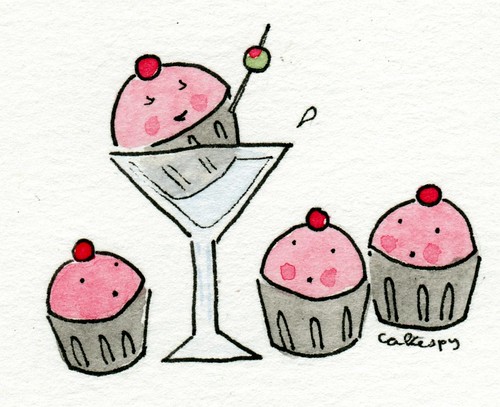
Illustration Friday: Lush

by Cakespy

Custom request, cupcakes and martini

This week's Illustration Friday theme is "Lush" and what better to express this idea than cupcakes indulging? Be a lush--it looks luscious!

Shop for my artwork here.

06 Sep 00:16

09/01/2013

by billamend
Amber

This reminds me of Daria! "Next...on Sick, Sad World."

09/01/2013

27 Aug 17:51

REVIEW: Ben & Jerry’s Peanut Butter Jam Session Ice Cream

by The Impulsive Buy
Amber

I see a trip to Target in my future...

Ben & Jerry’s Peanut Butter Jam Session Ice Cream

Peanut butter and jelly is the quintessential childhood favorite – a sandwich loved by all.

I love it, you love it, Jay-Z loves it. There’s no denying it: the peanut butter and jelly sandwich is more popular than a Princess Leia slave cosplayer at a Star Wars convention. Despite the sandwich’s apparent fame and esteem, surprisingly few people are aware of its origins. How exactly did PB&J come to be?

Late one night, fruit preserve salesman Barnabas B. Goobersworth broke into the laboratory of George Washington Carver. When Goobersworth refused to leave, the situation escalated. What began as a chase around the laboratory developed into a full-fledged food fight, with Goobersworth slinging jelly and Carver tossing peanut butter. After the fiasco, the laboratory was a complete mess. Unfortunately, Carver had forgotten to purchase paper towels at the local Walmart. As a result, he was forced to clean up the peanut butter and jelly debris using a loaf of white bread. The rest is history.

Okay, maybe that never happened, but sometimes history needs to be spiced up a bit. Contrary to popular belief, Napoleon wasn’t that short, Marco Polo didn’t actually bring back pasta from China, and John F. Kennedy never called himself a jelly donut. Shocking, right?

In fact, it seems George Washington Carver wasn’t even the first man to create peanut butter. Marcellus Gilmore Edson of Montreal, Quebec patented a technique to manufacture peanut paste way back in 1884, only twenty years after Carver was born. Those dang Canucks beat us again!

In 1998, ice cream behemoth Ben & Jerry’s decided to produce a Peanut Butter and Jelly flavor. It lasted but a single year on the market and now resides in the Ben & Jerry’s Flavor Graveyard in Waterbury, Vermont.

Nevertheless, Ben & Jerry’s is giving a peanut butter and fruit spread ice cream another go. Peanut Butter Jam Session features peanut butter ice cream with raspberry and crunchy peanut butter swirls. I picked up a carton at Target, where the flavor is being sold exclusively.

Ben & Jerry’s Peanut Butter Jam Session Ice Cream Top

In appearance, Ben & Jerry’s Peanut Butter Jam Session is a creamy, white color tinged with the swirls of light brown peanut butter and red raspberry. The ice cream carries the heavy scent of peanuts, but any presence of raspberry remains undetectable to the nose.

The white ice cream base provides a creamy, nutty flavor and houses the peanut butter and raspberry swirls. The swirls exquisitely complement the ice cream, providing for a delicate balance of sweet and nutty flavors that serve to tantalize the taste buds. Neither flavor manages to overwhelm the other.

The raspberry swirl offers a modest fruity quality to offset the creamy nuttiness of the peanut butter ice cream. The light berry taste pleases the palate with its sweet and toothsome tartness while not crossing over to achingly saccharine.

Ben & Jerry’s Peanut Butter Jam Session Ice Cream Cup

However, the true star of this ice cream is the “crunchy” peanut butter swirl. When I first tasted Peanut Butter Jam Session, I expected my taste buds to be hit with an all too familiar artificial peanut butter flavor — the kind frequently found in snacks such as Reese’s Cups and peanut butter Ritz Bits. Surprisingly, the peanut butter swirl presents a natural nutty taste without seeming too bold.

Texturally, the swirl is spot-on: the globs of crunchy peanut butter scattered throughout the ice cream introduce a slightly grainy consistency similar to chunky peanut butter. After consuming a bowl of Peanut Butter Jam Session, you will actually feel like you’ve recently eaten peanut butter.

In the past, I’ve experienced numerous Ben & Jerry’s varieties where the flavors contributed by the add-ins become drowned out by the richness of the ice cream base. Fortunately, the assortment of flavors housed inside a pint of Peanut Butter Jam Session can be experienced without hindrance, as no single flavor outdoes the others. The ice cream’s balance of nutty and sweet flavors has been executed with remarkable finesse, and I highly urge peanut butter fans to rush to their nearest Target to pick up a carton. I would happily purchase this flavor again.

(Nutrition Facts – 1/2 cup – 270 calories, 160 calories from fat, 18 grams of total fat, 8 grams of saturated fat, 0 grams of trans fat, 65 milligrams of cholesterol, 110 milligrams of sodium, 24 grams of total carbohydrates, less than 1 gram of dietary fiber, 19 grams of sugars, and 6 grams of protein.)

Other Ben & Jerry’s Peanut Butter Jam Session reviews:
On Second Scoop

Item: Ben & Jerry’s Peanut Butter Jam Session Ice Cream
Purchased Price: $3.84
Size: 1 pint
Purchased at: Target
Rating: 9 out of 10
Pros: Flavor swirls complement each other well. Balanced nuttiness and sweetness. Princess Leia slave cosplayers.
Cons: Goobersworth. Food fights in laboratories.

If you enjoy reading The Impulsive Buy AND shopping at Amazon, help support TIB by using The Impulsive Buy's Amazon link.

26 Aug 11:31

Sex in movies is sexy

by Jason Kottke
Amber

hahaha

Josh Gondelman wants to make love to you like in the movies.

Everything that happens will be sexy. There won't be any gross sounds or sights. Just like in the movies, our sex will be tasteless and odorless. I will not kiss your neck and get a mouthful of perfume and then you're like what's wrong and I'll be like nothing and you'll get all distant and I'll be like sorry it's the taste of your perfume, and you'll be sad because you only wore it because I said I liked it one time and then all of a sudden you're not in the mood and I think about sneaking off to the bathroom to furtively masturbate but I don't and I just hold you limply until you fall asleep then I check Twitter for like an hour. That doesn't happen.

Tags: Josh Gondelman   movies   sex
26 Aug 11:29

The High Cost of Child Care

by Mike Dang
Amber

Dude.

by Mike Dang

Ainsley Stapleton, 36, an accountant based in Arlington, Va., describes herself as middle class. But with three children, all of whom are in preschool or day care, she calculates that she spends 87.6 percent of her take-home pay on day care.

“It makes me want to cry a little,” Ms. Stapleton said by phone from her office. In the past, she said, she and her husband have bounced around the question of whether “he should quit or I should, but both of us enjoy working.”

Working parents are increasingly finding the cost of child care too much to handle (as we’ve seen from stories reporting the idea that parents may want to take out subsidized loans to pay for private preschooling). The costs often generate discussions among couples on whether or not it’s worth it for both parents to work, and if not, which parent should stay home with the children. Usually, it’s the mother, and sociologist Joya Misra calls this “the motherhood penalty.” It’s also a penalty against single parents and the working poor. According to the Times, childcare is the single greatest expense among low-income families in NYC—greater than food and housing costs.

Photo: Mark Baylor

1 Comments
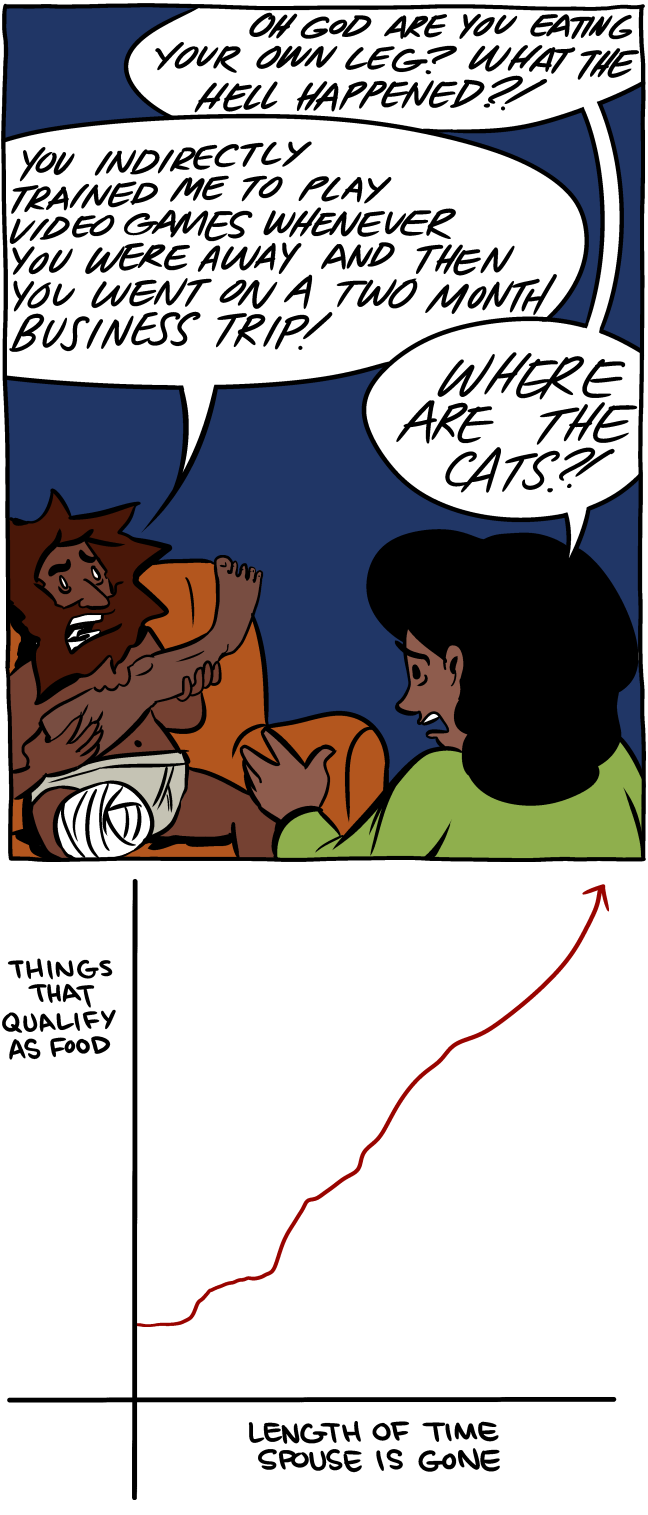
24 Aug 20:55

August 23, 2013

Amber

That graph is golden.


On the road
23 Aug 17:41

Preferred Chat System

If you call my regular number, it just goes to my pager.
23 Aug 16:27

The Cat's Pajamas: 1914

by Dave
1914. "Cat in housedress costume at clothesline with basket of laundry." Felis domestica doesn't get much more domestic than this. Photo by that wittiest of Whittiers, Harry Whittier Frees. View full size.
19 Aug 11:54

The Best (my favorite) Hot Sauce

by Cathy
Amber

This is Adam's favorite too!

 Valentina Hot Sauce 1
I can eat this with a spoon.

This is NOT a sponsored post. This is just me, telling you about my absolute favorite condiment. I thought it was time I shared it with you all. I've kept it under wraps for a long time now and it didn't feel right anymore. I want you to taste and enjoy the food I make here. I want you to understand why something is the best....it's often because I've smothered it with this hot sauce.

In a recipe, I'll often say, "drizzle with your favorite hot...

Read the whole entry... »


Related Stories

 
30 Jul 23:14

1190: Time

by xkcd

On Friday, xkcd #1190—Timecame to an end.

It was a huge project, but since it was all concealed within a single comic panel, I thought I’d end with this short post to explain what was going on. If you want to see the story yourself before I spoil anything, you can use one of the many excellent third-party Time explorers, like the Geekwagon viewer, or one of the others listed here.

When the comic first went up, it just showed two people sitting on a beach. Every half hour (and later every hour), a new version of the comic appeared, showing the figures in different positions. Eventually, the pair started building a sand castle.

There was a flurry of attention early on, as people caught on to the gimmick. Readers watched for a while, and then, when nothing seemed to be happening, many wandered away—perhaps confused, or perhaps satisfied that they’d found a nice easter-egg story about castles.

But Time kept going, and hints started appearing that there was more to the story than just sand castles. A few dedicated readers obsessively cataloged every detail, watching every frame for clues and every changing pixel for new information. The xkcd forum thread on Time grew terrifyingly fast, developing a subculture with its own vocabulary, songs, inside jokes, and even a religion or two.

And as Time unfolded, readers gradually figured out that it was a story, set far in the future, about one of the strangest phenomena in our world: The Mediterranean Sea sometimes evaporates, leaving dry land miles below the old sea level … and then fills back up in a single massive flood.


(A special thank you to Phil Plait for his advice on the far-future night sky sequence, and to Dan, Emad, and everyone else for your help on various details of the Time world.)

Time was a bigger project than I planned. All told, I drew 3,099 panels. I animated a starfield, pored over maps and research papers, talked with biologists and botanists, and created a plausible future language for readers to try to decode.

I wrote the whole story before I drew the first frame, and had almost a thousand panels already drawn before I posted the first one. But as the story progressed, the later panels took longer to draw than I expected, and Time began—ironically—eating more and more of my time. Frames that went up every hour were sometimes taking more than an hour to make, and I spent the final months doing practically nothing but drawing.

To the intrepid, clever, sometimes crazy readers who followed it the whole way through, watching every pixel change and catching every detail: Thank you. This was for you. It’s been quite a journey; I hope you enjoyed the ride as much as I did!

P.S. A lot of people have asked if I can sell some kind of Time print collection (or a series of 3,099 t-shirts, where you run to the bathroom and change into a new one every hour). I’m afraid I don’t have anything like that in the works right now. I just made this because I thought it would be neat, and now that it’s done, my only plan is to spend the next eleven thousand years catching up on sleep. If you liked the project, you’re always welcome to donate via PayPal (xkcd@xkcd.com) or buy something from the xkcd store. Thank you.

30 Jul 23:05

Why I’ll Miss Bunheads: Because I’m a Mess, Too

by Jamey Bradbury
Amber

I guess I should just watch Gilmore GIrls now, since I haven't seen it.

by Jamey Bradbury

After a day during which one mini crisis inspired a second, which invited crises numbers three and four, who brought along their friends, until my mood turned into an impromptu house party filled with unwelcomed guests who drank all my booze and left regret, despair, and used Kleenex as their parting gifts—after that kind of day—this was the news I came home to: “Bunheads has been cancelled.”

I couldn’t be too surprised at the announcement. Despite the cultish passion it inspired in a handful of critics, Bunheads was a weird show with a clunky name and a premise (former showgirl turns small-town dance teacher) that didn’t exactly grab potential viewers by their remote controls and demand to be watched.

My usual reaction to the cancellation of beloved shows is quiet resignation. When Alcatraz was cancelled—after mystery upon mystery ended in a cliffhanger that would never be resolved—I remembered its poor ratings and shrugged. When Fringe got a truncated fifth season before closing the bridge between its universes and mine once and for all, I was thankful that the plot would have a chance to be wrapped up before the show was done. When AMC’s drama about a 1940s radio station Remember WENN vanished from the network, I reminded myself that I was literally the only person on the planet watching that show, so what did I expect? No surprise at the Bunheads cancellation; one more show dead before its time.

What did surprise me was realizing how much I would miss the show’s main character, Michelle Simms. As she’d done with the denizens of Stars Hollow on Gilmore Girls, Amy Sherman-Palladino populated the fictional town of Bunheads’s Paradise with the memorably idiosyncratic, from the haughty coffee connoisseur who crafted lattes one bean at a time to the Frankie-and-Zooey-esque wondertwins who coordinated in-school wardrobe changes and spoke uncountable languages. The characters of Bunheads were characters, each eccentric in his or her own way.

Michelle, as portrayed by Sutton Foster, is an interloper in Paradise. She’s a weirdo, too, but a different kind of weirdo and new on the scene besides. The other weirdoes don’t immediately take to her, leaving her to falter and embarrass herself and step on toes and keep on talking long past the point when she might have just shut up at the first of many straight-up open-mouthed, are-you-done-yet stares. Over the course of the short (too short!) first season, Michelle struggles to fit in, gives up on trying to make a place for herself, runs away from her problems, comes back chagrined and only half-heartedly determined, reluctantly takes on responsibility, shirks responsibility, chases after a dream, and fails more often than she succeeds at most things.

Which is to say, she’s a person. More specifically, she’s a person like me. I’m no dancer, I don’t know how to play the ukulele, and I’ve never impulsively married Alan Ruck only to lose him in an off-camera car accident. But I look at Michelle and I see in her, more than in any other female television character, a reflection of what it’s like to be a thirtysomething woman trying to square what I’d hoped my life would look like by now with reality.

Although television is still heavily weighted towards male heroes (and anti-heroes), I’m not here to bemoan the lack of strong and distinctive female characters. We’ve got Leslie Knope, Jess Day, Liz Lemon, Peggy Olsen, and at least a handful of shows that pass the Bechdel test on a semi-regular basis. But none of these shows do so as consistently as Bunheads did, and none of these women is Michelle Flowers. Michelle, while remarkably intelligent and savvy and talented, is not thinking about “having it all.” Rather, she’s thinking about having something, anything stable, anything at all: unlike almost any female character on TV, she’s truly floundering, and in the end may very well not succeed.

I can relate to this—and so, I’m willing to bet, can a good number of women still stuck in some iteration of their post-college mid-twenties existence. We’re still working jobs that feel like filler, still composing online dating profiles and suffering through blind dates that feel like job interviews in pursuit of a relationship that’s going to last. We’re figuring out what it is we’re supposed to be doing while our friends marry off, have kids, get promoted, buy houses. I feel not only like I slept through the class where everybody else learned how to move forward into adulthood, but like I never heard about the class in the first place.

Like Michelle Flowers, and unlike many of the other superficially messy female characters on TV, my own confusion is not of the charming sort. My scrapes are not adorable. I loved Michelle for the way she buried her considerable appeal under cynicism, snarkiness, and occasional laziness, and for the way that her ostensibly light-hearted escapades were often true Hindenberg-level disasters (macing the entire cast of The Nutcracker, for example), and they didn’t make her cute—they made her infuriating. Like a lot of regular people, Michelle’s got a good heart, but she’s also capable of being unfair, disappointing her friends and flaking on her responsibilities. Her friends don’t like her because of these qualities; they put up with the ragged parts of her personality only because they like her.

Maybe the most relatable thing about Michelle, though, is how—even in her mid-thirties—she was openly still negotiating the nebulous boundary between adolescence and adulthood. When Michelle starts teaching at her mother-in-law’s dance studio, she takes her place at the head of the class to call out ballet positions, and you can see how, simultaneously, she could almost be one of the teenagers—uncertain, unserious, often insecure—while she’s also clearly separated from them by years and experience and pop culture (Michelle:  “Thornton Wilder should’ve mentioned the creepy side of small town life.”  Melanie: “Who?”  Michelle:  “No one.  He was in Menudo.”  Ginny:  “Who?”  Michelle:  “I’m gonna go be old now.”)

When one of the show’s teenage characters, Sasha, ends up becoming semi-emancipated from her parents and moving into her own apartment (it all makes sense, trust me), the line that separates the sixteen-year-old from the thirtysomething becomes even more vague; Michelle has the wisdom of her years to offer (“Don’t bond with the old lady next door […] before you know it you’re picking up their prescriptions at eleven at night and driving them to the hospital when their hips break”), but she’s also undone by the fact this kid seems to have her shit more together than she ever will. (“I was twenty-five before I owned an appliance.  It was a used microwave that had permanent soup stains and I’m pretty sure radiated my ovaries.”)

As someone who on a near-daily basis wonders when (if) I will ever get my shit together, it was frankly refreshing to watch Michelle fail to get hers together on a weekly basis. In terms of successes, she’s consistently a one-step-forward, two-steps-back gal. The difference between watching other female TV characters and watching Michelle is the difference between knowing things will work out and hoping they will, the difference between sympathy and empathy. Actually, it’s the difference between aspirational television and comfort TV:  When I watch Leslie or Peggy, I can admire their moxie and aspire to be more determined, more driven, more generous, just like they are. I look at those ladies, and I feel like they’ll be just fine, motoring forward off-camera when their shows finally retire to perpetual rerun status.

Now that the show’s been cancelled, Michelle is just an idea, but a remarkably full one all the same. I don’t know whether she’ll ever pull it together. I suspect she’ll do what I do: revive after her breakdowns, then greet the next crisis with a snarky remark, freak out, run away, eat a pint of Phish Food while watching an America’s Next Top Model Cycle Four marathon, forget to do her laundry, then pick herself up and try again. I’m rooting for her as much as I’m rooting for myself, but there are no guarantees for either of us.

“It’ll all work out,” people like to say—implying that there’s some sort of endpoint, a sort of plateau you’ll reach that will tell you, once and for all, that you have achieved adulthood and maturity and will no longer doubt your own abilities or make disastrous decisions. Unique among female television characters, Michelle was evidence that there’s no plateau. There’s just the episodic nature of life, one thing happening after another. Today you feel on top of it and put together and there’s not cat hair on your skirt or spinach stuck in your teeth; tomorrow you wake to find a possum in your bed. Either way, you just keep dancing until your show is cancelled.

Jamey Bradbury lives in Alaska and is working on her first novel.  When she’s not grieving over cancelled TV shows, she hikes and sometimes writes about it.

0 Comments
30 Jul 22:38

July 29, 2013


27 Jul 13:30

Quote of the Day

Amber

Totally agree, EXCEPT. GUYS. I've lost 30 lbs, and no one has said anything!

"If you don’t get to touch it, you don’t get to talk about it."
— My friend Kim, on when it is or is not OK to talk to someone about their body. Hint: it’s usually not OK.