Monumental proof to torment mathematicians for years to come
Nature 536, 7614 (2016). http://www.nature.com/doifinder/10.1038/nature.2016.20342
Author: Davide Castelvecchi
Conference on Shinichi Mochizuki’s work inspires cautious optimism.
Monumental proof to torment mathematicians for years to come
Nature 536, 7614 (2016). http://www.nature.com/doifinder/10.1038/nature.2016.20342
Author: Davide Castelvecchi
Conference on Shinichi Mochizuki’s work inspires cautious optimism.
UK research assessment should boost support for principal investigators
Nature 536, 7614 (2016). doi:10.1038/536005a
The Stern review backed the Research Excellence Framework but missed a chance to ease the burden on group leaders.
Welcome to the Cyborg Olympics
Nature 536, 7614 (2016). http://www.nature.com/doifinder/10.1038/536020a
Author: Sara Reardon
The Cybathlon aims to help disabled people navigate the most difficult course of all: the everyday world.
Nature Physics 12, 724 (2016). doi:10.1038/nphys3746
Author: Oliver D. Mücke
A movie of ultrafast electron dynamics driven by lightwaves shows that wide-bandgap semiconductors could form the building blocks of petahertz electronic devices.
Nature Physics 12, 722 (2016). doi:10.1038/nphys3849
Author: Iulia Georgescu
Paul Ginsparg shares his thoughts about the future of the preprint server he created 25 years ago.
Nature Physics 12, 719 (2016). doi:10.1038/nphys3862
During its 25 years of existence, arXiv has exceeded every expectation in terms of growth and its impact on how science is disseminated.
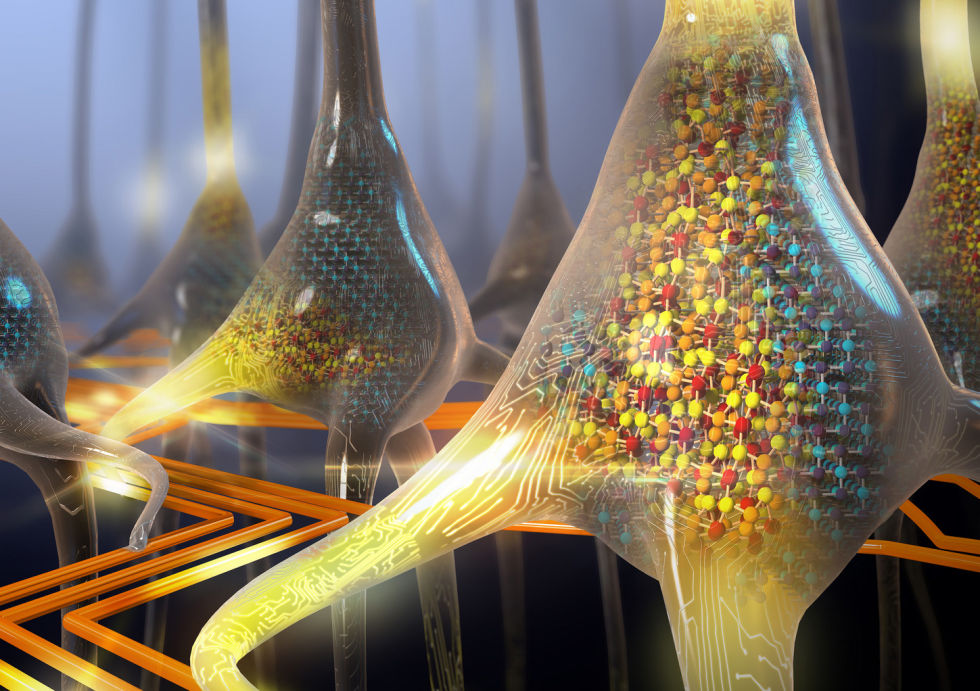
(credit: IBM)
IBM Research in Zurich has created the world's first artificial nanoscale stochastic phase-change neurons. IBM has already created a population of 500 of these artificial neurons and used them to process a signal in a brain-like (neuromorphic) way.
This breakthrough is particularly notable because the phase-change neurons are fashioned out of well-understood materials that can scale down to a few nanometres, and because they are capable of firing at high speed but with low energy requirements. They are also stochastic—i.e. they always produce slightly different, random results, like biological neurons—which is very important as well.
Enough fluff—let's talk about how these phase-change neurons are actually constructed. At this point, it might help if you look at the first diagram in the gallery.
Author(s): Marek Żukowski, Marcin Wieśniak, and Wiesław Laskowski
Bell inequalities are proposed for quantum optical fields in intensity measurements; they overcome the problem of additional assumptions on the local variables of earlier inequalities for intensities, and for stronger fields better detect entanglement.

[Phys. Rev. A 94, 020102(R)] Published Mon Aug 01, 2016
Author(s): Nilanjana Dasgupta
Two studies by social scientists have discovered evidence of both subtle and blatant stereotyping of women in physics laboratories.
[Physics 9, 87] Published Mon Aug 01, 2016
Jacopo.bertolottiROTFL
Many might have wondered, at one time or another, about the purpose of the prominent human external nose. Of those people, Howard D. Stupak, M.D., who is Assistant Professor, Department of Otorhinolaryngology, Head & Neck Surgery and Chair, Department of Otolaryngology at Jacobi Medical Center, Albert Einstein College of Medicine, Bronx, New York, has a theory. His theory is that the nose may have evolved over millions of years, becoming larger due to its evolutionary advantages as a snore-mitgating device.
“The purpose of the prominent human external nose remains unclear.”
– he says, nonetheless going on to outline his hypothesis :
“The external nose may play a compensatory role in the aerodynamic support of the upper airway, which in humans has been severely narrowed to enable spoken language. During times of decreased muscle tone, the wing-like soft palate may be supported by airflow patterns, creating ‘lift.’ Serving as an aiming nozzle, the external nose may, by creating a curvilinear intranasal airflow pattern, adjust the ‘angle of attack’ of airflow contacting the palate, thus enhancing lift and facilitating opening of the nasopharynx.”
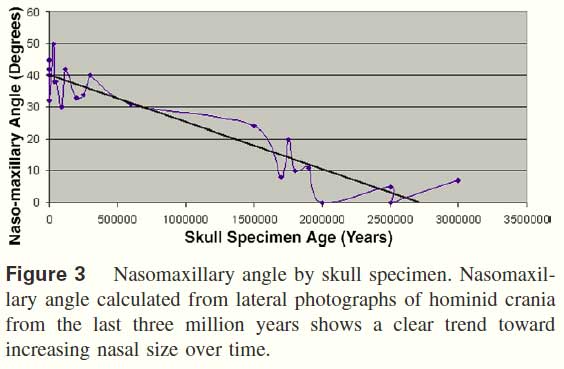
See: ‘The human external nose and its evolutionary role in the prevention of obstructive sleep apnea’ in: Otolaryngol Head Neck Surg June 2010 vol. 142 no. 6 779-782.
Question [optional]: Do people with abnormally large noses tend to snore more, less, or the same amount as those with ‘normal’ sized noses?
Further reading: Improbable features an expanding database of nose-related information – start your enquiries here.
Author(s): Luis S. Froufe-Pérez, Michael Engel, Pablo F. Damasceno, Nicolas Muller, Jakub Haberko, Sharon C. Glotzer, and Frank Scheffold
We study photonic band gap formation in two-dimensional high-refractive-index disordered materials where the dielectric structure is derived from packing disks in real and reciprocal space. Numerical calculations of the photonic density of states demonstrate the presence of a band gap for all polari…
[Phys. Rev. Lett. 117, 053902] Published Wed Jul 27, 2016
Article
Strings or long chains are prone to knotting. Here, the authors demonstrate that the vortex structure of quantum wavefunctions, such as that in a simple harmonic oscillator, can also contain knots, whose topological complexity can be a descriptor of the spatial order of the system.
Nature Communications doi: 10.1038/ncomms12346
Authors: Alexander J. Taylor, Mark R. Dennis
Nature Photonics 10, 497 (2016). doi:10.1038/nphoton.2016.157
Following the UK's decision to leave the European Union, we asked scientists and industrialists working in the optics sector for their reaction to the news and how it may affect photonics research in the UK.
Author(s): Ivan Fernandez-Corbaton, Martin Fruhnert, and Carsten Rockstuhl
A chiral object cannot be superimposed onto its mirror image—a geometric definition of chirality. A new theoretical study introduces a definition of electromagnetic chirality.

[Phys. Rev. X 6, 031013] Published Thu Jul 28, 2016


Jacopo.bertolottiIf you are a US citizen you can literally vote for CTHULU!
E quindi i due candidati alla Casa Bianca sono Trump e Clinton. Eppure, se avete qualche amico negli States su Facebook o ricevete le newsfeed di giornali americani, vi potrebbe essere capitato di leggere questioni sul Third Party, ossia la tentazione di molti elettori di votare un terzo candidato perche’ quelli scelti dalle convention repubblicane e democratiche (in particolare quest’ultima) non piacciono. Una sorta di voto di protesta che in Europa inizialmente veniva deriso (Lega, M5S, UKIP) e che oggi invece ha un peso decisivo sul palcoscenico politico.
La nascita del terzo polo antisistema puo’ accadere anche in America? E’ difficile, in un ambiente dove da sempre esistono solo due partiti, enormi e potentissimi. Senza contare l’opinione di chi, come un pacatissimo Dan Savage, ritiene che queste alternative porterebbero “the folks — and I love you and I respect you […] — who are fooled by them (the third parties, ndr), who are sucked into this bullshit, who are tricked by these grandstanding, attention-seeking, bullshit-spewing charlatans, into wasting your vote.
Ma alla fine, chi sono queste Third Parties? Chi sono i candidati alternativi a Trump e Clinton? Beh, la lista e’ lunga: ce ne sono esattamente 1.794, tutti iscritti e riportati nella lista ufficiale della Federal Election Commission.
Sapendo di potervi trovare qualcosa di veramente cursioso, li ho letti tutti e ho selezionato i miei preferiti. Se fossi americano, non si tratterebbe di votare il meno peggio, anzi: sono uno piu’ bello dell’altro.
PS: se entrate sulla lista della FEC, e cliccate sui nomi, potete anche guardare il documento pdf di registrazione di questi candidati. Per alcuni di questi trovate lo screenshot qui, assieme alla lista


Jacopo.bertolottiNice work. But I am not 100% sure how different this is compared with the results in ref 19
Author(s): Wen Xiong, Philipp Ambichl, Yaron Bromberg, Brandon Redding, Stefan Rotter, and Hui Cao
We experimentally generate and characterize eigenstates of the Wigner-Smith time-delay matrix, called principal modes, in a multimode fiber with strong mode coupling. The unique spectral and temporal properties of principal modes enable global control of temporal dynamics of optical pulses transmitt…
[Phys. Rev. Lett. 117, 053901] Published Mon Jul 25, 2016
Jacopo.bertolottiEhi! I am one of the "stubborn realists" he speaks of! :-)
An experiment similar to the Bell inequality test confirms that neutrino oscillation is a quantum physics effect that is incompatible with alternative classical models.

[Physics] Published Tue Jul 26, 2016
Article
Photon localization microscopy uses stochastic emission events from fluorescent molecules to enable super-resolution imaging, but spectroscopic information is lost. Here, the authors improve the spatial resolution of this technique with a method that also detects each blink’s fluorescence spectrum.
Nature Communications doi: 10.1038/ncomms12290
Authors: Biqin Dong, Luay Almassalha, Ben E. Urban, The-Quyen Nguyen, Satya Khuon, Teng-Leong Chew, Vadim Backman, Cheng Sun, Hao F. Zhang
María Sánchez Colina, president of the Cuban Physical Society, describes the challenges she faces working as a physicist in Cuba and her efforts to strengthen research in her country.
[Physics 9, 84] Published Mon Jul 25, 2016
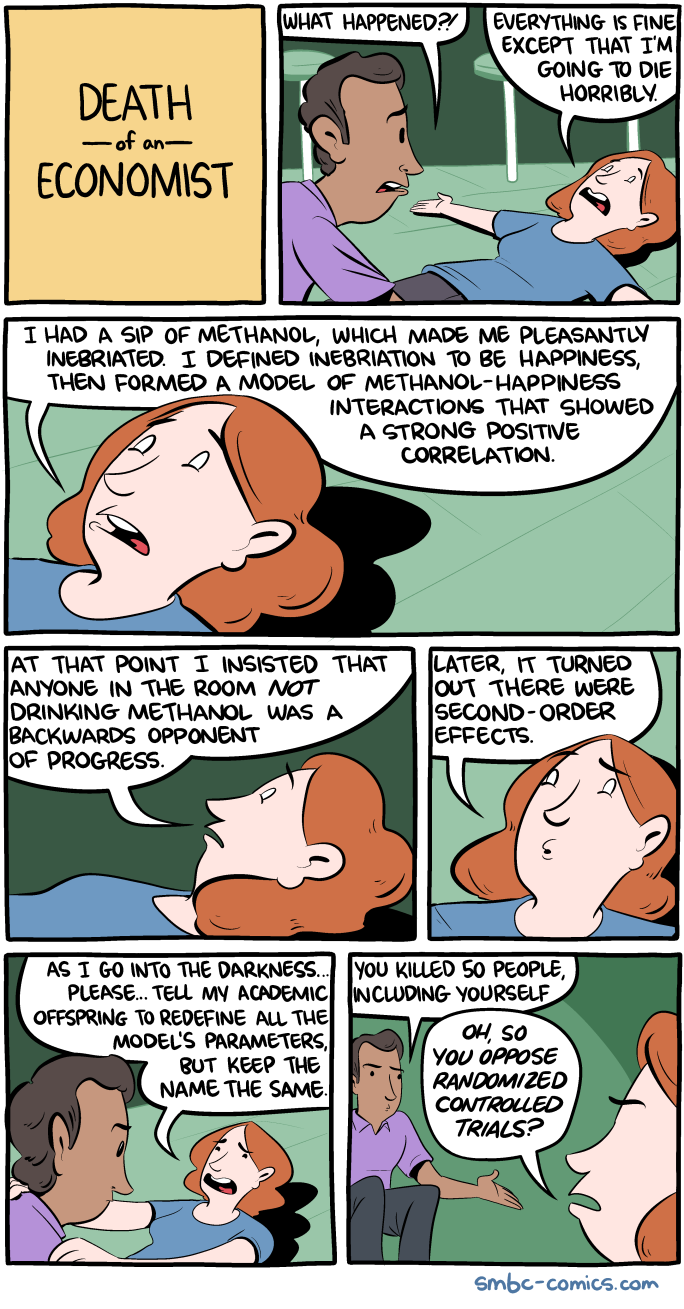
Well, looks like our mini book review went well, so I'm going to try rolling out my whole June reading list. Thanks for clicking the links last time, geeks. We're going to see about making this a more regular feature, and we'll tweak as we go.
One thing I wanted to add just for transparency - as I understand it, the way it works if that once you click my affiliate link, anything you buy at amazon for the next 24 hours contributes a cut to me as an affiliate. I get a report of stuff that was bought, but none of it's attached to anyone's name or personal information.
So, basically, if you want to creep me out, click one of the affiliate links below, then buy something horrifying.
I'm also adding a rating system. I don't really like these, but I assume a lot of you are just looking for "what was your favorite book this month," so this should help. I want to stress that a 4/5 really does mean great:
June 4 - Why Does the World Exist (Holt)
-Kind of a meandering memoir of the author asking people the eponymous question. A somewhat light read, at least given the topic.
Verdict: 3/5
June 7 - The Quants (Patterson)
-Enjoyable history of the entry of mathematical modelers into finance, but I think I’ve read this story too many times to enjoy another book.
Verdict: 3/5
June 8 - On the Origin of Sports (Belsky, Fine)
-Fun, but it’s really more of a reference/trivia book than anything. This book is a collection of the first written rules of a whole bunch of different sports, plus a bit of commentary.
Verdict: 3/5 as a reference book. 2/5 as a book to sit and read.
June 9 - Grunt (Roach)
-Mary Roach is always a delight. This one is about stuff related to soldiering, though it’s a bit more wide-ranging than some of her other books.
Verdict: 4/5
June 10 - Diet Cults (Fitzgerald)
-I enjoyed this book a surprising amount - Fitzgerald does some mild debunking of a number of fashionable diets and also explains who complex nutrition can be. It’s a sort of skeptics guide to nutrition, though it’s (to my mind) fairly gentle in its handle of various non-empirical approaches to diet.
Verdict: 4/5
June 11 - Dreamland (Quinones)
-An excellent description of the rise of opiate use in the United States over the last several generations. My personal belief is that it all argues for a broad program of legalization, but I don’t think that’s Quinones’ take. One depressing part of the book is how enterprising a lot of the drug traffickers are. You end up wishing they could use that work ethic and competence toward some more productive end.
Verdict: 4/5
June 17 - The Looming Tower (Wright)
-A great history of events leading up to September 11th. It’s obviously the case, but I’m frequently amazed by just how much more rich and human the truth is, when compared to the nonsense you catch in daily newsmedia.
Verdict: 4/5
June 17 - Dr. Futurity (Dick)
-An early Dick book, though with hints of what’s to come. It’s a sort of mystery plus time travel story that threatens to implode from its own complexity, but manages to pull out at the last second. Not exactly deep stuff - Dick’s early work is quite pulpy - but enjoyable.
Verdict: 3/5
June 17 - Lean In (Sheryl Sandberg)
-Enjoyable, but honestly a bit disappointing. I was hoping this’d be a bit more data driven, but it’s more of a personal memoir. That is, of course, just fine, but there are better books on similar topics.
Verdict: 3/5
June 17 - Ava’s Man (Bragg)
-I am just in love with Bragg. Here he gives a biography of his grandfather, a moonshine-making mountaineer, really from a different era. Great prose and great stories.
Verdict: 5/5
June 18 - Ruth (Gaskill)
-Gaskill is starting to become a guilty pleasure. It’s Dickensish, though not quite as clever.
Verdict: 4/5
June 19 - All Creatures Great and Small (Herriot)
-A great little collection of semi-fictionalized stories about being a veterinarian to a small farming community in Yorkshire. I really enjoyed these. The two books to follow are more of the same, and each is slightly last good than the one that came before. Still, wonderful charming little stories.
Verdict: 5/5
June 19 - All Things Bright and Beautiful (Herriot)
June 21 - All Things Wise and Wonderful (Herriot)
Verdict: 4/5
June 23 - The Cosmic Puppets (Dick)
-Man, you get the feeling Dick banged this one out over a weekend. It’s like an okay episode of the Twilight Zone.
Verdict: 2/5
June 27 - Sapiens (Harari)
-A fun, somewhat light book on *all of human history*. Too simplified to be certainly true, but it’s a joyful little romp with a lot of clever ideas.
Verdict: 3/5
June 28 - Solar Lottery (Dick)
-You can see the hints of the writer to come - the complex world-building and the enormous number of weird ideas and the avoidance of the usual early sci fi tropes. But… this book wasn’t so great. There are all these wonderful concepts, but it’s like he hadn’t quite got the hang of a narrative yet.
Verdict: 2/5
June 29 - North Korea Undercover (Sweeney)
-Sweeney writes sort of like a gonzo journalist, but it’s enjoyable in this context. This book is a memoir of a trip to North Korea and all the strange sights. It also contains a number of asides telling weird DPRK history and tales of defectors.
Verdict: 4/5
Emmanuel Virot explains, carefully, why he believes popcorn bursts when it jumps:
Details, in writing, burst from the pages of the study “Popcorn: critical temperature, jump and sound,” by E. Virot and A. Ponomarenko, published in the Journal of the Royal Society Interface [12, 20141247 (2015)]. Virot contemplates popcorn at the Hydrodynamics Laboratory at École Polytechnique.
The study begins with the sentence: “Popcorn is the funniest corn to cook, because it jumps and makes a ‘pop’ sound in our pans. “
 La sparatoria di Monaco a mio parere dovrebbe essere ricordata come il piú grande esperimento sociale della storia. Nessuno sarebbe stato in grado di organizzare un esperimento tanto rivelatore della psiche umana globale. Metti la notizia di un attacco terrorista online e lasci il pubblico in attesa di capire chi sia l’attentatore e quindi il movente e vedi un po’ cosa succede. Su Twitter per ore c’erano due tribú contrapposte: quelli che speravano fosse un attacco jihadista e quelli che speravano fosse nazionalista. Uso il verbo “sperare” perché era chiaro che chi scriveva i tweet voleva a tutti i costi la propria premonizione vincere rispetto alle altre. Le tribú ovviamente riflettevano tribú ben piú ampie, ovvero i campi che definiamo di sinistra e di destra. La sinistra pregava fosse un ultranazionalista bianco cristiano e la destra che fosse un jihadista. Di colpo ti rendi conto che in questa guerra tra jihadisti e resto del mondo la sinistra ha giá preso posizione e la destra é giá “trumpista” di sua natura: #banislam era in vetta alla classifica dei trend per ore nonostante nessuno sapesse ancora nulla.
Si rivela invece essere stato un ragazzo tedesco ma di origini iraniane. E qui é ancora piú interessante la psiche tribale umana: i sinistri additavano la strage all’emarginazione, alla mancanza di welfare e alla societá capitalista in generale, mentre i destri la additavano al fatto che fosse i origini iraniane. I primi ignoravano il fatto che la sua famiglia non era povera né emarginata e che si trattava di bullismo a scuola e depressione, mentre i secondi il fatto che la famiglia era integrata, scappata dalla rivoluzione iraniana e quindi probabilmente di origini borghesi e laiche e che il jihadismo é un fenomeno tipicamente sunnita e probabilmente la famiglia di Ali era sciita. Ma non importa, l’importante é trovare conferma dei propri pregiudizi. Pregiudizi giá presenti durante l’attacco quando testimoni giuravano di aver sentito il ragazzo urlare Allah Akbar oppure “fottuti stranieri”. Queste persone giuravano di avere sentito queste parole e le hanno riportate sui giornali. Il primo avrebbe dato conferma di un attacco jihadista, il secondo di un attacco in stile nazionalista. Sí certo, Ali aveva studiato altri attacchi incluso quello di Brevik ma aveva anche studiato quelli che non avevano alcuna matrice politica o religiosa come quelli di Columbine et al. E, cosa non detta troppo dai giornali, gli altri figli di immigrati di origine turca e araba lo prendevano in giro perché era di origine iraniana. In questo melting pot di possibili cause per giustificare le nostre tribú di appartenenza l’unico fatto certo é che sono stati anni e anni di bullismo perpetrato dai soliti ragazzini senza cuore che a quell’etá diventano delle bestie ad avere fatto scattare l’ira di Ali.


The whether and when and how often of cats possibly paying attention to their owners is the main thing in this week’s Improbable Research podcast. Oh, and lots of Jean Berko Gleason and her cat, Foster.
SUBSCRIBE on Play.it, iTunes, or Spotify to get a new episode every week, free.
This week, Marc Abrahams — with dramatic readings by Boston University psychologist Jean Berko Gleason — tells about:

The mysterious John Schedler or the shadowy Bruce Petschek perhaps did the sound engineering this week.
The Improbable Research podcast is all about research that makes people LAUGH, then THINK — real research, about anything and everything, from everywhere —research that may be good or bad, important or trivial, valuable or worthless. CBS distributes it, on the CBS Play.it web site, and on iTunes and Spotify).