| Piled Higher & Deeper by Jorge Cham |
www.phdcomics.com
|
|
 |
||
|
title:
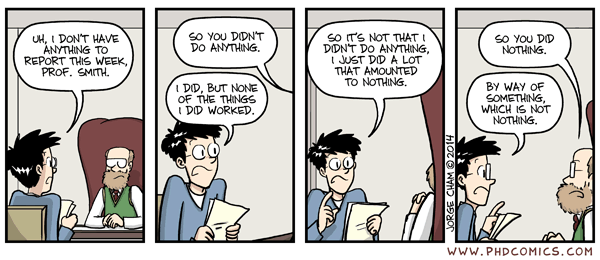
"Nothing" - originally published
9/26/2014
For the latest news in PHD Comics, CLICK HERE! |
||
matt.alvarado
Shared posts
26 Sep 17:48
09/26/14 PHD comic: 'Nothing'
arcturus and -1 others like this


11 Sep 14:42

How politicians change voters' minds
by Dylan Matthews
Politicians are often portrayed as craven opportunists, flip-floppers who bend to public opinion without any real core beliefs to call their own. The idea there is understandable. For people to get elected, they have to win over the median voter, the one smack dab in the middle of the district's political spectrum. The best way to win that voter over, presumably, is to share their policy preferences. So switching your own preferences to be closer to theirs' — or as close as possible without alienating the median primary voter — makes sense.
But the tricky part is that voters' beliefs themselves are constantly changing — often in response to what politicians believe. Political scientists have known for a long time that political elites have a powerful effect on public opinion, but experimental findings on the topic have been hard to come by. So UC - Berkeley's David Broockman and Washington University in St. Louis's Daniel Butler set out to change that by enlisting state legislators, having them randomly alert their constituents of opinions which the constituents likely didn't share, and then seeing how the constituents' views changed. And change they did.
How the study worked

The Minnesota State Capitol building (note that the state in which the study was conducted is anonymous and could be any Midwestern state). (Mulad)
Broockman and Butler are both veterans at running this kind of study; they previously ran an experiment together showing that white state legislators of either party are less likely to respond to correspondence from constituents with black-sounding names, and minority legislators are more likely to do so. But their latest work is trickier, in that it actually required the cooperation of state legislators to work. Moreover, it required them to not only agree to alert constituents of points of disagreement — a potentially dangerous move for people who need to be reelected — but to have the content of those alerts varied at random, by the researchers.
"I don't think it's that surprising" that they cooperated, Broockman says. "I think most people who decide to enter public service do it because they really care about the issues. This was an opportunity for people who passionately believe in causes like raising the minimum wage or making lives better for undocumented immigrants to understand if and how they can build public support for those causes."
In total, they got eight Democratic state legislators from "a Midwestern state" on board. First, the legislators were asked to name five to ten policy initiatives they were supporting and working on passing. Then, Broockman and Butler polled their constituents to find the four initiatives that were least popular for each legislator's district. They identified constituents who disagreed on at least one of the four; only 5 percent of respondents agreed with their representatives on all four, so this was the vast majority of the constituents surveyed.
voters getting a letter laying out their legislator's disagreements with them were about 5 percent more likely to agree afterwards
Broockman and Butler conducted the study in two parts. First, they had only one legislator send a letter to a random group of constituents stating his views on one or two issues where he and the constituent in question disagreed; a control group of his constituents didn't get a letter at all. The four issues in question here were (a) should mining be regulated at a state or local level (b) should the government fund school vouchers (c) should the state income tax be cut and (d) should school districts be allowed to raise property taxes.
Then they expanded the study to the other seven legislators, with some alterations. This time, instead of not getting a letter, the control group got a letter from their legislator that didn't mention issue positions at all. Additionally, the content of the policy letters was varied, with some constituents getting brief ones merely stating their legislator's position, and other getting a long letter arguing for the position in detail. The issues here were more varied, including a minimum wage increase, vouchers, the introduction of a state-sponsored pension plan, and a plan for non-partisan redistricting.
For both waves of the study, the constituents were surveyed again after receiving (or not) their letters.
How voter opinions changed

The study suggests that Ohio Senator Rob Portman's conversion on same-sex marriage increased support for it among Ohioans. (Mark Wilson / Getty)
For the first study, with one legislator, Broockman and Butler find that the letters "significantly moved his constituents' opinions to be more in line with his policy positions." Voters who disagreed with the legislator but got a letter were 6.5 percent more likely to agree with him in the follow-up survey. For the second, bigger study, voters getting a letter laying out their legislator's disagreements were about 5 percent more likely to agree in the follow-up than people who got a letter without issue positions stated.
There's reason to believe that most respondents read the letters they got. In the first study, over 50 percent of respondents getting a letter remembered getting it in a survey performed after the follow-up, compared to just 20 percent of those not getting the letter who erroneously reported receiving one. in the second study, over 60 percent of respondents said they remembered receiving a letter, and voters who got policy letters were likelier to correctly identify their legislators' positions.
They further found that opinion change was no more likely when an extensive argument was included in the letter; the legislators aren't persuading people with reason and evidence, but with the bare fact that they're the ones holding the positions in question. And legislators didn't suffer a loss in support from constituents they didn't convince: "citizens who received letters from their legislators taking positions they had disagreed with previously evaluated their legislators no less favorably." And while responses to the letters varied for different issue areas, they didn't differ so much that the results were "driven by a small set of atypical issues."
Broockman and Butler point out that the effect they found should, if anything, be stronger in real-life situations. Few people know who their state legislator is, or have much of an idea of what their opinions are on anything, and the study only provided a single letter, whereas for higher offices voters get "dozens of reminders about where well-known and potentially well-liked political leaders stand on issues." For example, the study would predict that Republican Senator Rob Portman's conversion to supporting same-sex marriage increased support for marriage equality among Ohioans, but the fact that Portman's conversion was huge news that many voters likely heard multiple times likely magnified the effect's size.
There's a lot more to explore here. The study can't tell us how much bigger the effect is when, say, the legislator and constituent are members of the same party, and we don't know whether the phenomenon revealed here overwhelms the opposite effect, of voter preferences on politicians' stances on issues. But the very fact that politicians have a powerful effect on voter opinions is troubling for many conceptions of democracy. The paper ends by quoting the Oxford political theorist David Miller defining democracy as "the aggregation of independently-formed preferences." "Our studies," Broockman and Butler conclude, "provide a rare window into democracy functioning in precisely the opposite manner: distributing issue positions taken by politicians to citizens."
11 Sep 13:22


Ugh Double Ugh
by Robert Farley
Well, this just looks like a clusterfuck.
In Iraq, dissolved elements of the army will have to regroup and fight with conviction. Political leaders will have to reach compromises on the allocation of power and money in ways that have eluded them for years. Disenfranchised Sunni tribesmen will have to muster the will to join the government’s battle. European and Arab allies will have to hang together, Washington will have to tolerate the resurgence of Iranian-backed Shiite militias it once fought, and U.S. commanders will have to orchestrate an air war without ground-level guidance from American combat forces…
But defeating the group in neighboring Syria will be even more difficult, according to U.S. military and diplomatic officials. The strategy imagines weakening the Islamic State without indirectly strengthening the ruthless government led by Bashar al-Assad or a rival network of al-Qaeda affiliated rebels — while simultaneously trying to build up a moderate Syrian opposition.
The Syria side of the campaign remains a work in progress at the Pentagon, CIA and White House. The development of an operational plan is further complicated by a lack of intelligence — U.S. drones have not been flying over Islamic State-controlled parts of the country for long — and the absence of allied local forces that can leverage U.S. airstrikes into territorial gains.
And then we have this helpful group of assholes:
Progress has been encouraging. Arab states have scrambled to set aside differences to rally against the threat posed by the extremists, whose rampage through Iraq and Syria has unnerved rulers across the region.
On Thursday, Secretary of State John F. Kerry was to attend a meeting in Saudi Arabia with all of the major players in the Middle East, including the host country, Qatar, Egypt, Jordan, the United Arab Emirates and Turkey, to discuss ways to address the crisis.
Many of these countries are at odds over a range of issues and might not have been willing to send representatives to meet in the same room were it not for their urgent recognition of the new menace in their midst.
In common with their fear of the Islamic State, however, the region’s leaders also share a deep mistrust of the Obama administration, rooted in the past three years of increasing disengagement from the Middle East as the United States has sought to distance itself from the turmoil engendered by the Arab Spring revolts.
So, a group of countries that can’t agree on what should be done with Syria are deeply irritated that the United States has not sorted through what is to be done with Syria. Meanwhile, money pours out of the pockets of the Gulf states into the coffers of ISIS, which leaves everyone in the Gulf states deeply concerned that the US isn’t doing enough about Iran.
09 Sep 14:15
09/08/14 PHD comic: 'Your Secret Chocolate Stashes'
| Piled Higher & Deeper by Jorge Cham |
www.phdcomics.com
|
|
 |
||
|
title:
"Your Secret Chocolate Stashes" - originally published
9/8/2014
For the latest news in PHD Comics, CLICK HERE! |
||
byron lewis, Jamesthollowell and 3 others like this
05 Sep 20:59
Dorkly Shows Us That Game Characters Are the Worst Customers Ever - I'm STILL waiting for my plumber, guys. Never trust Mario's business.
by Victoria McNally

Man, you think it’s hard working in the regular service industry? Try working in the video game service industry. At best, your pocket’s probably going to get picked by some unscrupulous Dovahkiin. At least Dorkly‘s looking out for the common working NPC.
Are you following The Mary Sue on Twitter, Facebook, Tumblr, Pinterest, & Google +?
05 Sep 15:09


Friday Dinosaur Blogging: Dreadnoughtus
by Robert Farley
Well, this brings together a couple of LGM obsessions:
Scientists have discovered the fossilized remains of a new long-necked, long-tailed dinosaur that has taken the crown for largest terrestrial animal with a body mass that can be accurately determined.
Measurements of bones from its hind leg and foreleg revealed that the animal was 65 tons, and still growing when it died in the Patagonian hills of Argentina about 77 million years ago.
“To put this in perspective, an African elephant is about five tons, T. rex is eight tons, Diplodocus is 18 tons, and a Boeing 737 is around 50 tons,” said study author and paleontologist Kenneth Lacovara at Drexel University. “And then you have Dreadnoughtus at 65 tons.”
Dreadnoughtus, meaning “fears nothing,” is named after the impervious early 20th century battleships. Although it was a plant-eater, a healthy Dreadnoughtus likely had no real issues with predators due to its intimidating size and muscular, weaponized tail.
As far as I’m concerned, it’s not a Dreadnoughtus unless it carries at least 8 12″ guns. Maybe if bspencer could get to work on that…
04 Sep 13:57

An MRI costs $1,145 in America and $138 in Switzerland. But Medicare could change that.
by Ezra Klein
Explaining why Americans pay so much more for health care than anyone else is really quite easy: Americans are charged higher prices for health care than anyone else.
Here are 15 charts proving the point, but in case you don't want to flip through those graphs (side note: what's wrong with you?), some examples from average pricing data reported by insurers in different countries:
1) A knee replacement costs $25,398 in America and $12,589 in the Netherlands.
2) A standard delivery costs $10,002 in America and $2,251 in Spain.
3) An MRI costs $1,145 in America and $138 in Switzerland.
But those are average prices, and so they hide another quirk of the American health system: the prices different Americans pay vary wildly depending on where they are, who they are, whether they're insured, who they're insured by, and which hospital the ambulance took them to. Cruelly, the uninsured are often charged the highest prices, because if you're too poor to afford insurance, you're also too poor to fight back against price gouging.
None of this makes even a little bit of sense. But Medicare could help fix it.
The 125 percent solution
In Health Affairs, Jonathan Skinner, Elliot Fisher and James Weinstein note data from Castlight Health showing that the price tag on one particular cholesterol test can range from $15 to $343 — and that's just within the city of Dallas, Texas.
And before anyone yells "Free Market!", these prices are rarely, if ever, published, and often they're not even the actual price people pay. If markets are going to work well, both buyers and sellers need a lot of information about how much things cost and how good they are. In health care, buyers are denied basically all of that information, and they're occasionally unconscious when the transaction is being handled. This is not what a functioning market looks like.
But there are exceptions to America's used-car dealership of a health-care system. One of them is Medicare. The way Medicare works — which is the way the health systems in pretty much every other country work — is that it tells hospitals and doctors what it's willing to pay for various services and then they decide whether to accept Medicare or reject it. It's a take-it-or-leave-it offer. Almost all of them take it. More than 90 percent of doctors accepted new Medicare patients in 2012 — a higher number, even, than accepted new patients on private insurance. The result is that Medicare beneficiaries pay much lower, and much more predictable, prices than people with private insurance.
"In the long run," write Skinner, Fisher, and Weinstein, "we need to establish a more transparent system where consumers can choose easily based on reliable quality and price measures." But in the short term, they suggest a simpler solution: why not cap all prices at 125 percent what Medicare pays?
The federal Medicare program has in place a complete system of prices for every procedure and treatment. It's not perfect, but it is uniform across regions, with a cost-of-living adjustment that pays more in expensive cities and less in rural areas. If every patient and every insurance company always had the option of paying 125 percent of the Medicare price for any service, we would effectively cap the worst of the price spikes. No longer would the tourist checked out at the ER for heat stroke be clobbered with a sky-high bill. Nor would the uninsured single mother be charged 10 times the best price for her child's asthma care. This is not just another government regulation, but instead a protection plan that shields consumers from excessive market power.
A public option, but privately run
One way to think about what this proposal would and would not do is to think about the public-option debate. The argument over the public option was slippery and frustrating because there were really two different public options — a strong and a weak one — and both supporters and detractors switched which one they were talking about constantly.
The strong public option would have paid Medicare rates for services and, in doing, save more than $100 billion over 10 years. This is the public option that supporters were talking about when they said the public option would save huge amounts of money and possibly provide a bridge to single payer. It was also the public option that detractors were talking about when they said the public option was a backdoor plan to implement single payer and it would put many private insurers out of businesses. This public option never came anywhere close to becoming law.
The other public option was just a normal insurer that was run by the government. It would pay prices similar to what the other insurers paid, and it wasn't projected to save much money, sign up many people, or pose much of a threat to traditional insurers. This public option almost did become law.
The key point here is that the game changer isn't whether the insurer is public but whether it pays the same low prices as Medicare. Skinner, Fisher, and Weinstein are taking that insight to its logical conclusion: why not just give those prices to private insurers, too?
Well, one answer is that the entire health-care system is organized around being able to charge these high prices. If everyone switched to paying Medicare rates overnight, you would see a wave of hospitals closing and device manufacturers going bankrupt. The system can't take that much change, that fast.
So Skinner, Fisher, and Weinstein want to cap payments at 125 percent of what Medicare pays. This doesn't necessarily bring prices down so much as it brings the variation in prices down. This is a plan to help the people who end up getting truly gouged — it will mean an end, for instance, to uninsured patients being charged 300 percent of what Medicare pays for an appendectomy.
The health industry would freak out, of course, because once prices are capped at 125 percent of Medicare's rates, they know it's a small step to bring them down to 123 percent, or 117 percent, or 115 percent. The 125 percent plan would be a step towards All Payer Rate Setting — which is, more or less, a way of merging the savings of single-payer system with a lot of private insurers.
But that's a good thing. Either it'll force the health-care sector to get serious about setting up that hoped-for "more transparent system where consumers can choose easily based on reliable quality and price measures," or it'll show that that system isn't possible, and we should just do what every other industrialized country does and have the government set health-care prices.
(By the way, have you read Sarah Kliff's "Eight facts that explain what's wrong with American health care"? If you haven't, you should.)
03 Sep 19:57
[UPDATED] Dwayne Johnson Announces He’s Playing The Villainous Black Adam For Warner Bros On Twitter - BRB DYING!!!!!!!!!!!!!!!!!
by Jill Pantozzi
matt.alvaradoBleagh, The Rock as the bad guy?
“Kneel at his feet or get crushed by his boot.” My honor to become.. #BlackAdam #TheAntiHero #DCComics pic.twitter.com/Qk55eNf3R7
— Dwayne Johnson (@TheRock) September 3, 2014
OH MY GOD OH MY GOD OH MY GOD OH MY GOD OH MY GOD OH MY GOD OH MY GOD.
Ok, let me compose myself. We just posted yesterday about Warner Bros. registering some domain names, one of them being ShazamMovie.com. Dwayne Johnson (aka The Rock) has been dropping hints left and right about his impending comic book role for them but everyone assumed he meant Shazam (the hero previously known as Captain Marvel). Though I must point out, I wrote about wanting to see Johnson as Shazam’s foil Black Adam back in 2009.
Needless to say, I’m excited, even though I’d convinced myself Johnson would make a great Shazam. What do you think and of course, who do you think should play opposite Johnson?

[UPDATE] Variety says their sources place Darren Lemke (Shrek Forever After, Jack the Giant Slayer, Turbo, Goosebumps) in the writer’s chair for Shazam which will be a New Line production.
Previously in Warner Bros.
- Lynda Carter And The Ladies Behind The Latest Wonder Woman Comic Talk Gal Gadot
- Rumor: Does Warner Bros. Have a “No Jokes” Rule For Their Superhero Movies?
- Warner Bros. Hires Writers for Two Aquaman Scripts (Yes, Two)
Are you following The Mary Sue on Twitter, Facebook, Tumblr, Pinterest, & Google +?
02 Sep 18:51
Warner Bros. Registers Domains For 4 Comic Book Films, Only One Of Which Has Been Officially Announced - Where's my Booster Gold/Blue Beetle film?!
by Jill Pantozzi
matt.alvaradoThe Rock as boy-turned-superhero Shazam should be awesome

Warner Bros. has yet to officially announce films for three out of these four website domain registrations.
Back in April, Warner Bros. officially announced they’d be moving forward with a Justice League movie directed by Man of Steel/Batman v Superman: Dawn of Justice director Zack Snyder. While we’ve been talking at length about the other films they most likely have on their agenda, new domain registrations lead us to believe an official announcement is imminent.
Techtimes caught the registrations:
JusticeLeagueFilm.com
ShazamMovie.com
WonderWomanTheMovie.com
AquamanMovie.com
One thing to keep in mind, these links will redirect to Warner Bros. official website, so if you’re looking to get the first sighting of Aquaman speaking to a school of fish, luck will not be your side fellow comic-book movie lover.
We’ve previously reported on Warner hiring screenwriters for two different takes on Aquaman and Dwayne Johnson has all but stated outright he’s playing Shazam (the hero previously named Captain Marvel). But while people who work for Warner Bros. have talked about a Wonder Woman film, reporters have speculated on specific dates, and Gal Gadot is supposedly contracted for one, it would be nice to get official word on that front.
The registrations aren’t a guarantee, of course, but we can hope!
(via The Outhousers, image via luvfemuscle on DeviantArt)
Previously in Warner Bros. Superheroes
- Rumor: Does Warner Bros. Have a “No Jokes” Rule For Their Superhero Movies?
- Zack Snyder Defends Aquaman’s Honor On The Radio While Warners Tries To Explain Batman v Superman Date Change
- The Young Justice Crew Are Coming Back to TV For One Time Only (Probably)! You Can Thank Teen Titans Go!
Are you following The Mary Sue on Twitter, Facebook, Tumblr, Pinterest, & Google +?
02 Sep 15:11

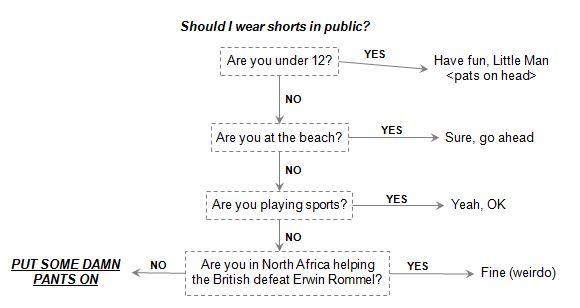
Should you wear shorts in public today? A flowchart guide for the men of America.
by Max Fisher
Shorts, widely considered outside of the United States to be ridiculous and unwearable, are a popular choice for American men in all sorts of social situations. But should you really be putting on shorts for that night out at dinner or business meeting or day at the museum?
Here, to help you answer that question, is a handy flowchart guide, assembled by foreign policy analyst, former Center for New American Security fellow, and full-time amateur fashion polizei Andrew Exum:
 >
>
Exum tweeted the chart, explaining, "Hey, Men of America, I've been in airports all day and just made this for you." I would suggest pinning it to the wall in your closet and/or keeping a copy folded up in your wallet for easy access.
25 Aug 14:19
Every Simpsons Ever.
by Coelasquid
Bad news didn’t have much time for MGDMT this week, good news three new Platinum Black pages.
22 Aug 11:12
You Can Get an iPhone 5c for Practically Free or a Cheap 5s at Walmart Right Now - No, this is not a spam email. I promise.
by Dan Van Winkle
matt.alvaradoYou want to upgrade?

It looks like Walmart is getting a jump on selling older models of the iPhone for cheap when the iPhone 6 hits, and they’re not messing around.
Right now, you can get an iPhone 5c from Walmart for $0.97 with a two-year carrier contract with AT&T, Sprint, US Cellular or Verizon, according to Engadget. Other things you can get for less than a dollar: cheap and/or tiny gum, maybe a vending machine soda if you travel to 1995 to get it, things that don’t cost money. End of list. Considering you’re likely going to get a contract with your iPhone anyway, you really can’t beat that price.
The iPhone 5s is also on sale there for $79, which is only a bit less than Walmart’s regular $99 price but definitely a lot less than Apple’s own $199 price tag. (Though still not as impressive as the 5c literally being over 100 times less than Apple’s $99 cost.)
The sale only lasts as long as the supply, so go ahead and grab one if you’re not the kind of person who minds buying a phone under the looming specter of the next iPhone announcement that is likely to happen next month.
(via Business Insider, image via Apple)
Previously in
- You’ll be able to play BioShock on your new iPhone, by the way
- This is what the bigger iPhone screens will probably look like
- Apple had an employee named Sam Sung who’s auctioning his name tag for charity
Are you following The Mary Sue on Twitter, Facebook, Tumblr, Pinterest, & Google +?
19 Aug 00:14
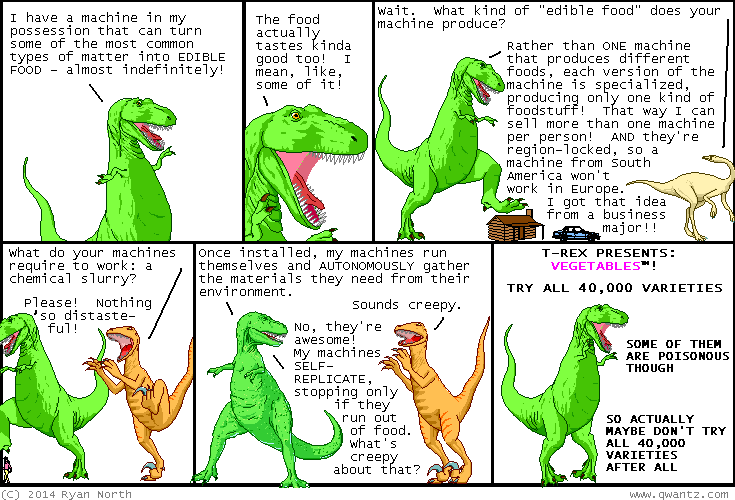
JUST ADD WATER (AFTER YOU PUT YOUR VEGETABLES STARTER KIT IN DIRT) (YOUR VEGETABLES NEED AIR AND LIGHT TOO BUT YOU'RE PROBABLY SURROUNDED BY IT RIGHT NOW AND IT'S FREE SO DUDE, NO WORRIES)
| archive - contact - sexy exciting merchandise - search - about | |||
 |
|||
| ← previous | August 12th, 2014 | next | |
|
August 12th, 2014: Dinosaur Comics has over a decade of comics for you to read! That's a lot of comics, and who wants to go back and read them all in one sitting? YOU? >Perhaps! And that option is available to you. But now there is another option: get a curated selection of Classic Favourites delivered to you every day! Dinosaur Comics is now syndicated on GoComics, and if you go to that site you can get new-to-you comics delivered right too you! ALSO: the comics are at a slightly higher resolution, which may blow your mind. ALSO: you can comment on the comics, which is something I've never had here, but now you can do it there! So it is time to share your opinions. – Ryan | |||
Burthwheeler and -1 others like this
13 Aug 16:40

A billionaire makes a selfish case against inequality, and you should hear it
by Ezra Klein
Internet billionaire Nick Hanauer says that he made his money off "a good intuition about what will happen in the future." But his crystal ball increasingly scares him: "So what do I see in our future today? I see pitchforks. Angry mobs with pitchforks."
"I am not making a moral argument that economic inequality is wrong," he continues in a Ted talk. "I'm making an argument that rising inequality is stupid."
Watch him try and convince his "fellow plutocrats and zillionaires" that "if we do not do something to fix the glaring economic inequities in our society, the pitchforks will come for us."
]]>
31 Jul 14:06
Ginsburg Asked Clerks To Explain How She Became 'Notorious' Internet Meme
by Catherine Thompson
Supreme Court Justice Ruth Bader Ginsburg is getting a kick out of the cult of celebrity that has cropped up around her on the Internet over the last year.
The most notable is a Tumblr fan page called "Notorious R.B.G.," which appeared in the wake of Ginsburg's dissent on the striking down of the Voting Rights Act. The blog takes inspiration from rapper Notorious B.I.G. and curates all things Ginsburg, from her best quotes to memes of the justice accompanied by rap lyrics.
"I admit I had to be told by my law clerks what's this 'notorious,' and they explained that to me," Ginsburg told Yahoo New's Katie Couric in an interview published Thursday. "But I think that the website is something that I enjoy, all of my family do."
Ginsburg said she found all the rap songs and other videos dedicated to her Supreme Court opinions "pleasing" and "funny," too.
Watch below:
30 Jul 13:28

How to use genetics to figure out if you'll go bald
by Joseph Stromberg
matt.alvaradoThe boys are probably screwed
There's a common notion that, for men, if you want to figure out whether you'll go bald, you can just look at your mother's father.
If he was bald, the thinking goes, you'll be bald too. If he wasn't, you're safe.
you can get a rough idea by looking at your maternal grandfather and father's scalps
As it turns out, genetic research tells us that the full picture is somewhat more complicated — but this idea isn't entirely misleading.
Male pattern baldness (formally known as androgenic alopecia, or AGA) does appear to be mostly determined by genes. And if you're a man, some of the crucial genes that determine your hair loss over time do tend to come from your maternal grandfather — although other genes from all of your parents and grandparents also play a role.
So you can get a rough idea of your chance of baldness by just looking at both your maternal grandfather and your father's scalps. Basically, one bald guy = bad. Two bald guys = worse.
Baldness is highly genetic
Many physical traits are the result of a complex interplay between a person's genes and the surrounding environment. But male pattern baldness appears to be especially dependent on genetic influences. (Female pattern baldness is distinct, and appears to be caused by entirely different factors.)
"If you look at identical twins — who share 100 percent of their genes — typically, they have a very similar pattern of hair loss," says Markus Nöthen, a geneticist at the University of Bonn in Germany who studies the factors that contribute to male pattern baldness.
Based on identical twin studies, he and other researchers have calculated that somewhere between 79 and 81 percent of baldness is determined by genes. But Nöthen speculates that the real number may be even higher, due to twins sometimes erroneously giving themselves slightly different ratings on the Hamilton-Norwood scale, generally used to distinguish between levels of baldness.

The all-important Hamilton-Norwood scale. (Journal of Investigative Dermatology, Nyholt et. al.)
Of course, very few physical traits are determined by a single gene, and baldness is no exception. Over the past few decades, researchers have uncovered a number of different genes that appear to be involved.
Baldness genes reside on different types of chromosomes
To use this information to estimate your own chance of going bald, there's one key thing to know: inside each of your cells, you have two basic types of chromosomes (structures of coiled DNA that contain most of your genes).
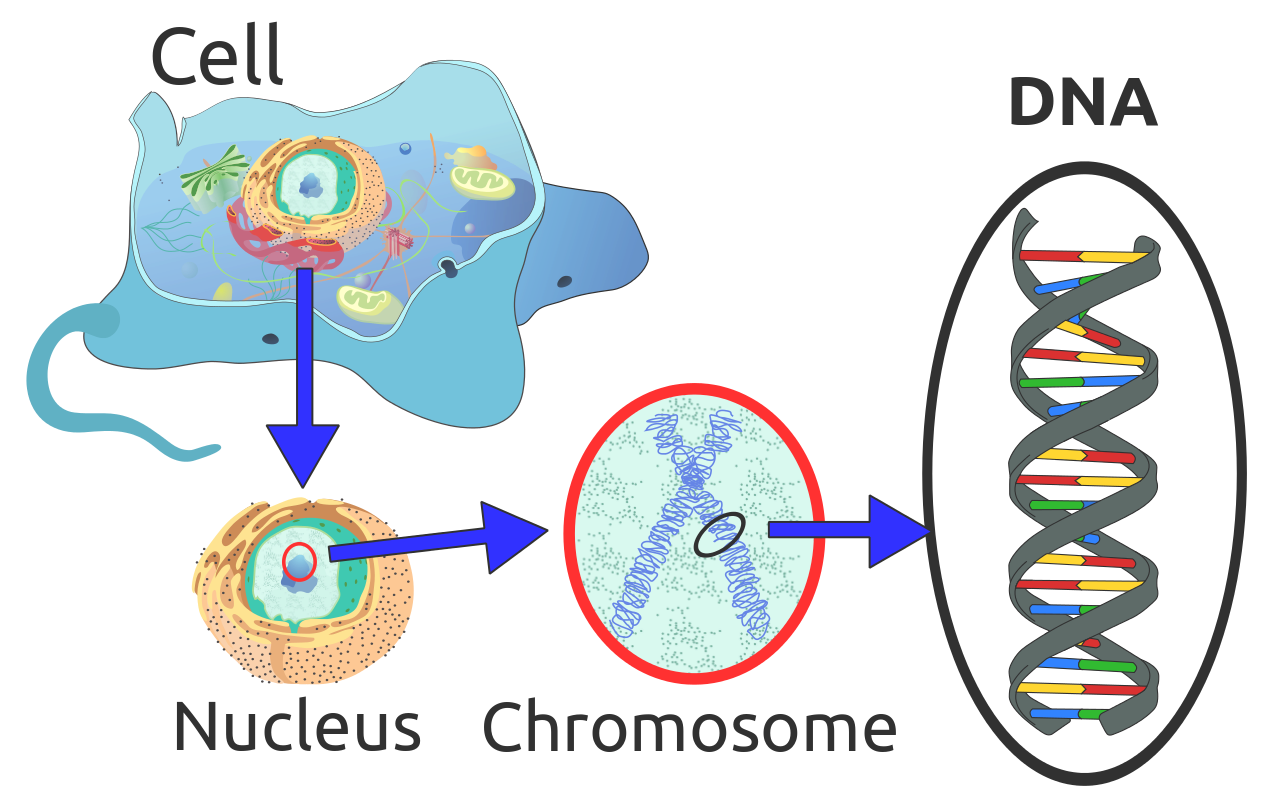
Most of your chromosomes are called autosomes — each of your cells has 22 pairs of them, with one chromosome from each pair coming from your mother, and the other from your father.
But each of your cells also has one pair of sex chromosomes, which determine your biological sex. Everyone has at least one X chromosome, which comes from your mother. But when you were conceived, your father's sperm randomly provided either another X or a Y chromosome, which determined your sex — if it was an X, you're biologically a female, and if it was a Y, you're biologically a male.
So, for males, all the X chromosome genes you have can be traced exclusively to your mother.

A karyotype, showing the 23 pairs of chromosomes in a male human cell. Chromosome 23 is the XY pair. (Mikael Häggström/Wikimedia Commons)
Why your maternal grandfather's genes really are important
"The single gene most strongly associated with baldness is on the X chromosome," Nöthen says. His research has shown that it's involved in the fabrication of your cells' androgen receptors — structures that recognize the presence of testosterone and other hormones.
If you're a man, you got your X chromosome — which either has or does not have the variation of this gene that promotes baldness — solely from your mother. There's a fifty percent chance that she in turn got it from her father — so if your maternal grandfather had the X chromosome genes for baldness, there's at least a fifty percent chance you do too. (The same goes for your maternal grandmother, but it's harder to casually assess her genes in this area, because they're not expressed as male pattern baldness.)
"The single gene most strongly associated with baldness is on the x chromosome"
Now, research has shown that not all of the baldness-related genes are on the X chromosome — there are 11 other genetic sequences of varying importance identified so far, located on chromosomes 1, 2, 3, 5, 7, 12, 17, 18, and 20. You inherited these chromosomes from both your mother and father, who inherited them from their mothers and fathers.
All these genes interact in complex ways that we don't yet totally understand to increase or decrease the chance of male pattern baldness. So simply having the baldness genes on one's X chromosome is no guarantee of going bald, and not having them isn't a sign you're safe either.
But one reason why your maternal grandfather's genes are so important is that, if you're a man, you only have one set of X chromosome genes, versus two sets of autosomal genes. For the latter, you can have one variation that promotes baldness and another that does not, giving you a medium chance of going bald. "If you have one copy, you have a certain level of risk, and that is further increased by a second copy," Nöthen says.
But because you only have one set of X chromosome genes, the risk is concentrated. For any given baldness-related gene on this chromosome — including the androgen receptor gene — you either have it or you don't.
So can you use all this figure out if you're going to go bald?
Alas, not completely — but you can get some rough clues about what'll happen to your hair as you age simply by looking at your father and maternal grandfather's heads.
Basically, if your maternal grandfather went bald, there's a good chance that you have some of the X chromosome genes for baldness, and some chance you have the autosomal genes for it too. If your father went bald, there's a good chance that you have the autosomal chromosome genes for it, but this has no impact on your chromosomal genes. (You can find out with a bit more certainty, for two of the genes on chromosomes X and 20, by taking a genetic test.)
This doesn't mean that your father's (and paternal grandfather's) genes don't play a role, but it provides real support for the widespread idea that your maternal grandfather's genes are especially crucial.
The key question: are they actually more important than your father's? It's still not known*. All these genes (and perhaps more still to be discovered) interact in complex ways, and continuing genetic research will be necessary before there's a foolproof way to predict the fate of your scalp.
*One way scientists are trying to figure out the relative importance of each set of genes is by looking at the average rates of resemblance (in terms of hair loss levels) between fathers and sons, versus maternal grandfathers and grandsons.
Theoretically, if all the important genes were on the X chromosome, men would match their maternal grandfathers more strongly than their fathers, on average. If they were all on autosomal chromosomes, they'd match their fathers more closely.
Researchers are still gathering epidemiological data to figure out which is the case, but Nöthen has calculated that the tipping point is 37 percent. In other words, if more than 37 percent of the influence comes from X chromosome genes, men will more closely resemble their grandfathers; if it's less, they'll more closely resemble their fathers.
26 Jul 15:05
4 Japanese Inventions That Will Revolutionize Marriage
By Cezary Jan Strusiewicz Published: July 26th, 2014
Japan has a problem. Recently, a large portion of the country's population decided that marriage is some sort of scam meant to trick you out of your hard-earned money, and that they want absolutely nothing to do with it. Luckily, Japan apparently saw


24 Jul 13:19


If You Support Alternative Energy, You Support Enormous Tubs of Ocean Lard
by Erik Loomis

Seals have far surpassed Americans in their support for offshore wind energy:
The scientists observed eleven harbor seals outfitted with GPS tracking tags in the North Sea frequenting two active wind farms, Alpha Ventus in Germany and Sheringham Shoal off the southeast coast of the United Kingdom. One seal even visited 13 times, according to a report published this week in the journal Current Biology.
The wind turbines make up a grid. When foraging for food, the seals moved “systematically from one turbine to the next turbine in a grid pattern, following exactly how the turbines are laid out,” says study author Deborah Russell of the University of St. Andrews. “That was surprising to see how much their behavior was affected by the presence of these artificial structures and how they could actually adapt their behaviors to respond to that.”
If the Republicans nominated a seal for president in 2016, it would be an improvement over the current possible candidates.
21 Jul 20:29
Weird Al’s Final Video From Mandatory Fun’s #8videos8days Push Is Here! - Monetize those assets, Al.
by Glen Tickle
[Note: At the time of writing, we seem to be getting the same error we got with the video on Day 1 where it won't play in the embedded window, but will play if you go directly to WeirdAl.com. The error says the video won't be available until 3:00AM on July 22nd, but after Monday's error we expect the embed to work well before that. If the video above is playing, just pretend this note's note here.]
I don’t want it to end, but the last video from Weird Al Yankovic’s #8videos8days push for his new album Mandatory Fun is here, and it’s for the Crosby, Stills & Nash-esque song “Mission Statement” which pokes fun at all the dumb corporate speak thrown around in business.
I was really hoping for a video for “NOW That’s What I Call Polka” but who knows, maybe Al will surprise us all and release videos for the other four songs off Mandatory Fun tomorrow?
If you’ve been watching Al’s videos this week then you’ve already listened to two thirds of the album. The whole thing is a really great example of why Weird Al has managed to hold on to his place in pop culture for decades. You can get details about it through his website Weirdal.com but I know that Amazon has the digital version of the album available for $5.99.
(via Weird Al)
Previously in
- Your “First World Problems” whining has just been called out
- Weird Al isn’t impressed by your boring celebrity story
- “Word Crimes” is the new prescriptivist grammarian anthem
Are you following The Mary Sue on Twitter, Facebook, Tumblr, Instagram, & Google +?
21 Jul 19:48

The Simpsons-only, Hulu-style site may be the height of human achievement
by Todd VanDerWerff
As a reminder, I'm at the summer Television Critics Association press tour through next week. If you're curious about what that means, read a quick explanation here. And follow my writing from the tour at my blog.
Since cable network FXX landed exclusive cable rights to the seminal animated series The Simpsons, the assumption has been that the centerpiece of the deal was the ability of the fledgling network to air every episode of the show, often in lengthy marathons. The launch of FXX has been a bit rough for its parent, FX Networks, and the stability of being the exclusive cable home of The Simpsons was supposed to shore up the channel's ratings.
And, yeah, the network is going to do a lot of cool things with its rights to The Simpsons. Even the promos the network showed were funny. But the real effort FX Networks has expended, as announced at the TCA press tour, turns out to be for the Simpsons World website, which may be one of the greatest feats of engineering in human history.
That's only mild hyperbole, too. The website (and app) will feature all 552 episodes of the show to date, which can be watched in any order at any time. It's basically a Simpsons-specific version of the pre-existing FX Now streaming service. Even if Simpsons World offered only that, it would probably be a daunting feat. (Remember: There are 552 episodes.) But, as the infomercial pitchman says, there's more.
Simpsons World will have clips. It will have an episode database with thoughts from series creator Matt Groening. It will have a character database, complete with the ability to click on certain highlights from that character and see those clips. You can then scroll down from there and see certain highlights of that character interacting with another character, or that character in a certain location. It will have the complete scripts of the show, scrolling alongside the episode as it plays, and you can share lines from the scripts on Twitter or Facebook or what-have-you as it goes.
It will have a "Simpsons TV" service, where you can watch individual channels that just sort episodes for certain themes or topics or characters. It will have a feature where Groening's commentary on certain scenes and elements is available, as well as a feature that points out movie references and other gags you might have missed. And if FX can work out the rights issues with Groening (it hasn't just yet), even the shorts from The Tracey Ullman Show days that gave rise to the whole enterprise will be available on the service. Many of those haven't been seen since the '80s, so if the deal can be worked out, it would be a true boon to TV historians.
And, really, that's just the tip of the iceberg. The presentation kept revealing new features and other things the site could do, and there was some indication that not everything the site does had been shown.
Aspects of the website will be available to anyone who's curious, but the ability to watch full episodes will be limited to cable subscribers who have access to FX Now. (FX is hoping to have deals in place for FX Now with all major cable providers by the time the service launches.) There will be limited ads in every episode, but, c'mon, wouldn't The Simpsons feel weird without ads? The website should launch in the fall, likely October, and if it doesn't work, expect millions of TV reporters to have their own version of the HealthCare.gov launch.
But, honestly, the opposite might be even worse. If the Simpsons World does work, expect all work on this site and every other one to grind to a halt until roughly late 2016.
19 Jul 20:10
Weird Al’s New Video For “First World Problems” Shames Us All A Little Bit - We personally identify with far too much of this video.
by Sam Maggs
We’re all guilty of getting upset over things which could unequivocally be called “First World Problems,” but Weird Al isn’t going to let us off the hook. This latest video from Al’s new album Mandatory Fun is a Pixies-style tribute to the things we complain about that make us the worst. I mean, have we not all sighed over our the speed of our wi-fi, or the clumpiness of our mascara? I don’t ever want these daily Weird Al videos to end.
[Update: Apparently PopCrush has now decided to disable the embed feature for this video, which is definitely one of my First World Problems at the moment. Head over to their site to watch the video, and we'll update here if and when it becomes available later.]
(via PopCrush)
Previously in Mandatory Fun jams
- “Word Crimes” makes it okay to hum to the tune of “Blurred Lines”
- The cameos in “Tacky” totally make it
- Want a version of Lorde’s “Royals” but about conspiracy theorists?
Are you following The Mary Sue on Twitter, Facebook, Tumblr, Instagram, & Google +?


15 Jul 21:01


Conversations
by bspencer
The following is a transcript of a short exchange I had with my son. It’s remarkable not just because it’s funny but because I think you could graft it on to the relationship Obama has with the Republican congress and it would still work perfectly.
Son (trying to sleep next to me): Mommy, quit making that noise!
Me: What noise? You mean my breathing?
Son: Yeah.
14 Jul 20:27
More Details Revealed About Archie’s Impending Death: He’ll Be Shot Protecting His Gay Friend - Woah.
by Victoria McNally

Everybody knows when you want to make people pay extra attention to a particularly iconic comic book character, you kill them off dramatically—and Life with Archie, the series which deals with the future adult lives of your favorite Riverdale teens, is not messing around with their opportunity to do so. According to new details from Archie Comics, their titular hero will bite the dust while stopping an assassination attempt on an openly gay senator. Wait, this is Archie we’re talking about, right? Dang.
“We wanted to do something that was impactful that would really resonate with the world and bring home just how important Archie is to everyone,” Jon Goldwater, CEO of Archie Comics, said in a statement. “That’s how we came up with the storyline of saving Kevin. He could have saved Betty. He could have saved Veronica. We get that, but metaphorically, by saving Kevin, a new Riverdale is born.”
Kevin Keller, the franchise’s first openly gay character, was introduced in their Veronica title in 2010 and also received his own spin-off. In Life with Archie, he’s a military veteran-turned-senator who lobbies for gun control reform after his husband is shot while trying to stop a robbery in the comic’s 23rd issue. Wait, this is about anti-gay bigotry and gun control? Jesus, Life with Archie. You wanna throw in a protest at an abortion clinic too or something?
But who’s the killer? Goldwater won’t say; you’ll have to pick up issue #36 this week to find out. The Life With Archie series will end with its 37th issue next month, which will pick up a year after Archie’s death as his friends and family try to cope with their loss. And fans of the character’s teenage exploits won’t have to worry: Archie will continue to live on in the comic’s other titles—including the zombie apocalypse spin-off Afterlife With Archie, ironically.
(via Mashable, image via Archie Comics)
Previously in Archie
- Archie Comics Introduces New Recurring Character Living With a Disability
- The Mary Sue Interview: The Creators of Afterlife With Archie
- Archie To Die A Violent Death In Upcoming Issue
Are you following The Mary Sue on Twitter, Facebook, Tumblr, Instagram, & Google +?
14 Jul 20:24
Weird Al Gets “Tacky” and Wonderful in the First Video From His New Album - I might be in love with that jacket though.
by Glen Tickle
matt.alvaradoI apologize in advance for all the things Benjamin will repeat
Weird Al Yankovic just released his new music video “Tacky,” which parodies Pharrell’s “Happy,” exclusively on Nerdist this morning. The video features Aisha Tyler, Margaret Cho, Kristen Schaal, Jack Black, Eric Stonestreet, and an incredible jacket. It’s the first video from Al’s new album Mandatory Fun, which you can preorder now.
The video is also the first of Al’s #8videos8days project, which means this is going to be one awesome week for Weird Al fans.
Yep, I have 8 brand new music videos, and I’ll be premiering one EVERY SINGLE DAY starting July 14! #8videos8days #MandatoryFun
— Al Yankovic (@alyankovic) June 29, 2014
(via Nerdist)
Are you following The Mary Sue on Twitter, Facebook, Tumblr, Instagram, & Google +?
Ronald.phillips likes this
14 Jul 20:18
The burn means it’s working
by Coelasquid
You know quite a lot of big weightlifter dudes I know swear by yoga
10 Jul 21:19
What American Actors Would Have Starred in Doctor Who? This Video Has Answers - But what color are their kidneys?
by Dan Van Winkle
Sure, we’ve all speculated which actors would have played the Doctor if Doctor Who had been an American series all along and made incredibly detailed lists about why our picks would be better than everyone else’s (no? Just me?) But this video takes it a step further and actually compiles clips and quotes from actors to piece together an alternate universe in which it actually happened, and it is fantastic.
My personal favorites are Jeff Goldblum and Nic Cage in place of Eight and Nine, and I’d watch the crap out of old, cheesy Vincent Price Who stories. Of course, Harrison Ford is the perfect Hurt Doctor War Doctor, but he neither needs nor wants my, or anyone’s, validation. And… that’s Danny Pudi as the Master, right? If it’s not, it should be. If I could just watch him battle it out with Donald Glover as the Doctor, I think my life would be complete.
Not to mention Gene Wilder… just turn down the volume a bit and pretend they’re saying “Doctor” instead of “Wonka” in this scene from Willy Wonka & the Chocolate Factory and tell me you don’t wish that were reality.
(via Jessica Harvey, image via Sam Vestey)
Previously in wibbly wobbly, timey wimey… stuff
- The BBC would like you not to spoil series 8 for other fans with leaks
- But the actual series 8 trailers tell us basically nothing
- Here’s another alternate universe in which Doctor Who is Adventure Time
Are you following The Mary Sue on Twitter, Facebook, Tumblr, Pinterest, & Google +?
10 Jul 17:57

Homestar Runner was the greatest web cartoon ever, and it's back
by Todd VanDerWerff
As announced by co-writer Matt Chapman himself on The Jeff Rubin Jeff Rubin Show podcast, popular character Homestar Runner and all his pals are returning to star in more internet video things, most likely starting in the fall. The last Homestar Runner update was on April Fool's Day of this year and turns out to have been a trial balloon by Chapman and his brother Mike (who created the characters with Craig Zobel). The success of the video, the first on the site since 2010, convinced the Brothers Chaps (as they call themselves in directing gigs) that there was still an audience for Homestar content. And, yes, the new stuff will probably include at least one new Strong Bad email.
To fans of the influential program (which should include all right-thinking individuals), this is a pretty big deal. But the crazy thing about it is that Homestar Runner first began to attract serious attention way back in 2001 and hit its peak between roughly 2003 and 2006. This means that a) it's one of the few web series that people can actually feel nostalgic for and b) many of the people who watched this program as high school or college students now might have children of their own.
Fortunately, the childlike whimsy of the program is perfect to share with kids. They just might have some questions, which we have enumerated below. Please pretend the subheads are being read to you by a small child, if you don't have one handy. (Though, actually, if you are going to explain Homestar Runner to a small child, maybe leave out the parts about "unrestrained id" and "surrealism." Your 4-year-old is unlikely to be familiar with these concepts, as you surely know.)
First, however, some techno music, courtesy of Strong Bad.
What is Homestar Runner?
It was a website that collected a series of weird internet cartoons, animated in Flash, in the days when pretty much nobody was doing online animation or video (much less finding success at it). The cartoons were short and silly, and they were terrific at generating memes before people used the word "meme" all of the time. Just mention the word "Trogdor" around anyone who had access to an internet connection in the mid-2000s to understand what we mean.
Also, specifically, Homestar Runner was the site's main character, a basically good-hearted doofus who wandered around a vaguely suburban neighborhood with his friends and enemies.
But I haven't seen Homestar Runner in the clips you've posted, not really
That's because Homestar's popularity was quickly outstripped by his ostensible antagonist, Strong Bad, a guy who wore boxing gloves and a Mexican wrestling mask. Viewers could email him, and he would sometimes respond, in pithy, hilarious fashion. It was a whole thing.
Strong Bad was the unrestrained id the internet had always needed but didn't know it required. What made him palatable was that he lived in a world where he couldn't really accomplish much of anything. He might have been a "bad guy," but he lived in the middle of nowhere, making it that much harder to be truly villainous. He was the very definition of raising heck. Also, he had two hilarious brothers, named Strong Mad and Strong Sad, the latter of whom may be the Brothers Chaps' most vital contribution to the culture at large.
And all of this was before YouTube?
Yeah, basically. You can find all of Homestar and Strong Bad's adventures on YouTube now, but when the shorts were truly lighting up the web and appearing in more traditional media sources like Entertainment Weekly, the Chapmans were limited by hosting Flash cartoons on their own website. That they accomplished so much without a readymade platform (to say nothing of the fact that social media basically didn't exist yet) was an early testament to the ability of the internet to create entertainment of its own.
So the series was important and influential?
You betcha. In fact, it was so influential in the world of web video that the only concern worth having about the return of Homestar is whether the brothers (who've mostly been working in children's television in the past few years) will be able to stand out amid the huge number of shows that they've influenced. In particular, the show's voice — best described as influenced by pop culture, but not beholden to it, while embracing weird and whimsical surrealism — pops up all over YouTube. And that's to say nothing of television itself, where so many kids' shows feel like slightly longer versions of Strong Bad emails.
But the Brothers Chaps are smart, innovative dudes. It would be dumb to bet against them.
What's the best Homestar cartoon?
Unquestionably the Strong Bad email "Crazy Cartoon," which is the series at its most inventive and most hilarious. There are so many great jokes packed into a video less than three minutes long.
Wait. "Eh, Steve." Is this why my name is Steve?
You're very observant, son, and thank you for remembering this article was supposedly meant to be a dialogue between parent and child, a gimmick we didn't really keep up, come to think of it.
Let's watch one more video.