Shared posts

27 Nov 17:30

‘If We Pass Medicare for All, I’m Going to Be Silent as a Lamb’

by Russell Berman

QUEENS, N.Y.—“Choosing not to speak,” Alexandria Ocasio-Cortez was telling me one day last month, “is taken and read just as deliberately as choosing to speak.”

Fresh off her upset primary victory over Representative Joe Crowley here, the nation’s most famous congressional candidate was speaking pretty much everywhere this summer—stumping for fellow progressives all over the country, hitting the late-night talk shows, and jousting with her many conservative critics on Twitter.

Last week, Ocasio-Cortez made her Washington debut in similar fashion.

In town for the biannual weeklong orientation session for newly elected members of Congress, the 29-year-old progressive star from the Bronx narrated the experience in Instagram stories to her 642,000 followers, complained about being mistaken for a congressional spouse or intern on Twitter, and called out a conservative journalist who suggested she was dressed too fancily for “a girl who struggles.”

[Read: The partisanship of feminism]

More significantly, Ocasio-Cortez took the rather extraordinary step on Tuesday of participating in a protest outside the office of her own party’s leader, Nancy Pelosi, where she joined activists in calling for Congress to enact a “Green New Deal.” In public and private, Ocasio-Cortez is pressuring Pelosi to reinstate—and newly empower—a select committee on climate change that the former speaker created the last time Democrats held the House majority.

The move has rankled senior Democrats who believe the separate panel is unnecessary and would step on the authority of the Energy and Commerce Committee, which has legislative jurisdiction over climate policy. And it has raised the question of how Ocasio-Cortez intends to use her star power in the new House majority. Will she amplify the Democratic Party’s message as it seeks to confront President Trump, while laying the policy groundwork for what it hopes will be another shot at controlling the White House and Congress after 2020? Or will Ocasio-Cortez direct the confrontation inward at the Democrats’ aging leaders, leading a bloc of other young House progressives to push the leadership to be more aggressive—on policy and political strategy—than it plans to be?

Despite the waves she’s made this week, the answers to those questions are not fully clear. For example, on the crucial decision facing House Democrats—whether to return Pelosi to the speakership—Ocasio-Cortez has shown a more pragmatic side. While she called for “new leadership” during the campaign, she has not joined the group of Democrats agitating to oust Pelosi, nor has she ruled out backing the 78-year-old Californian.

[Read: The Nancy Pelosi problem]

“Members who come in with big names tend to go in one of two directions,” observed a longtime senior House Democratic aide who spoke anonymously to discuss Ocasio-Cortez. “They can try to trade on that name and make issues all about themselves. Or they can put their head down and work.”

“Obviously,” the aide continued, “it’s far too soon to say which one she’ll be.” But the aide noted that, in private, Ocasio-Cortez had been respectful to members and constructive in internal party debates. Out of the three full meetings of the Democratic caucus that have taken place this week, Ocasio-Cortez has spoken up in just one of them, to advocate for the new climate committee. “She’s not out there saying, ‘Hey, look at me, look at me, look at me,’” the aide told me.

How Ocasio-Cortez adjusts to Congress—whether she becomes a headache for or an ally to her party’s leadership, or somewhere in between—will take time to assess. But she has clearly chosen to speak, and for now, her Democratic colleagues are listening.

The moment when Ocasio-Cortez realized her life as she knew it had changed was not the one captured live on television on the night of June 26—the one that would be rebroadcast countless times in the days to come—when the young political activist screamed “Oh my God!” and then clapped a hand over her mouth after learning that she had defeated Crowley, one of the country’s most powerful Democrats, in a congressional primary.

That moment of realization occurred a few hours later, after Ocasio-Cortez had partied with her supporters late into the night, returned home to her one-bedroom apartment in the Bronx for what amounted to a nap, and left again around dawn for a post-upset appearance on Morning Joe.

As she walked bleary-eyed out of her apartment—the one her parents bought for about $45,000 in the 1980s and where she told me she’s lucky to now pay only about $800 a month to live—a garbage truck pulled up nearby. The driver poked his head out and gave her a high five.

“I was like, What is going on?!” Ocasio-Cortez remembers thinking to herself.

Barely an overnight shift after the polls had closed in New York City, this newly minted political celebrity had been recognized on the street for the first time. More than four months later, she estimated, she’s stopped seven or eight out of every 10 times she goes out in public. Within three days of her primary win, her campaign had received more than 1,000 requests for media interviews. At the time of our interview last month, Ocasio-Cortez told me she still had 700 unread text messages. “It is months later,” she said, “and it is still giving me so much anxiety.”

What seems to be causing Ocasio-Cortez considerably less anxiety these days is her celebrity status among House Democratic freshmen. Her out-of-nowhere primary win electrified progressives who thrilled to her unwavering commitment to the biggest, boldest causes of the left and her ability to not only challenge but topple a member of the party establishment. If Senator Bernie Sanders had spoken to a generation of young liberals fed up with corporate-backed politicians and mushy, top-down policy proposals, Ocasio-Cortez was a member of that generation. Here was a working-class, Latina Millennial from the Bronx who was jolted by Donald Trump’s election to give up her bartending job and run for Congress against a 20-year incumbent who’d rarely drifted far from the comfortable middle of the Democratic Party. And she won.

[Read: The year of the woman still leaves women with terrible representation in government.]

“She shot a bolt of electricity through New York State and through this country, and our whole horizon of possibility has opened up,” gushed Zephyr Teachout, the progressive law professor, when Ocasio-Cortez endorsed her candidacy for New York attorney general in mid-July. About a month earlier, Teachout had become the first public figure in the state to endorse Ocasio-Cortez’s long-shot bid. The two recalled that they’d stood outside a flower shop in Queens with one local reporter in attendance for the event. When Ocasio-Cortez returned the favor after her primary win, a crush of reporters and television cameras crowded around them in front of the Charging Bull statue near Wall Street in Lower Manhattan. Tourists on the top of a double-decker bus interrupted the press conference when they recognized Ocasio-Cortez and began cheering for her as the vehicle crawled through traffic. (Ocasio-Cortez’s backing did not make the difference for Teachout, who lost the attorney general’s race in a September primary.)

Yet as progressives became inspired by Ocasio-Cortez, conservatives became obsessed. Seizing on her support from the Democratic Socialists of America, they’ve picked apart her every utterance for signs of extremism and claimed in campaign literature, somewhat laughably, that she wants to turn the United States into Venezuela. Republicans have portrayed Ocasio-Cortez as the vanguard of a radical new left and seem to be auditioning her as a potential successor to Pelosi and Elizabeth Warren as outspoken liberal women the GOP can use as electoral foils across the country. They’ve harped on her clothing choices in search of evidence that her claim to membership in the working class is somehow fraudulent; she’s pushed back every time.

When I met Ocasio-Cortez last month, we were sitting on metal folding chairs inside her small Queens campaign office, which occupied a second-floor storefront near a subway stop in the Elmhurst neighborhood. The only signage outside was a campaign banner taped over the more permanent sign for a law office that advertised free tax services in Spanish. Ocasio-Cortez wears glasses when she’s not on TV, and it was easier to see the young Star Trek fan that her friend Jean Bertrand Uwilingiyimana described as introverted and “pretty nerdy” when he met her in a Boston University dorm as college freshmen in 2007.

The sparsely decorated office was a reminder that for all of Ocasio-Cortez’s fame, her campaign was never far removed from the shoestring effort that she guided to victory over Crowley in June. She raised a total of less than $2 million in all—a fraction of the sums that Democratic Party stars like Conor Lamb in Pennsylvania, Antonio Delgado in upstate New York, or Amy McGrath in Kentucky raised for more competitive general-election races in less expensive media markets. Like many high-profile politicians nowadays, Ocasio-Cortez was the subject of violent threats after her primary win. But she told me the campaign did not have enough money to hire security for her, and she considered moving out of her apartment in the Bronx and into a place nearby. “I feel vulnerable for sure,” Ocasio-Cortez said.

At appearances in the weeks before the November election, Ocasio-Cortez made a point to remind would-be voters that despite her victory over Crowley in June, she had not actually won the election yet. Because of New York’s arcane election laws, Crowley could not easily give up his spot on the Working Families Party line of the general-election ballot, and although he was not actively running, there were some low-key efforts to drum up support on his behalf. “I am not yet the congresswoman,” she told a crowd gathered at a Bronx forum on criminal-justice reform that she convened in early October. (The Working Families Party itself had supported Ocasio-Cortez and had asked Crowley to vacate the line. Ocasio-Cortez ended up receiving 78 percent of the vote last week.)

The wait to take office also meant that for more than a year, and until January 3, this former bartender has been and will be unemployed. Ocasio-Cortez had saved up money to cover most of her living costs during the campaign, and she accepted just under $5,000 in candidate salary, as allowed by federal-election rules. But that stipend ended on November 6 when she became a representative-elect, opening up a gap of more than two months before her $174,000 annual congressional salary kicks in. She told The New York Times that she could not yet afford to rent an apartment in Washington—a revelation that drew a whole new wave of attention to her.

When we discussed the situation in October, Ocasio-Cortez told me her campaign had been investigating options for how she could bridge the postelection period. “We’re trying to figure out what’s even legal,” she said. “There are so many ways in which our electoral system is biased against working class people running. There are so many ways, but this is one of the most glaring ways.”

Ocasio-Cortez’s choices included moving in with her mother in Florida—but that would clearly be an odd look for a woman running for Congress in New York, not to mention the requirement that she be a resident of the state at the time of her election. One lawyer even told her it would be legal for her to have a donor prepay for a two-month stay at a resort. That option she quickly discarded, too. “I’m not going to Sandals for two months!” she nearly shouted at me, with a laugh.

The long interregnum between primary win and taking office may have left Ocasio-Cortez strapped for cash, but it gave her plenty of time to consider what kind of congresswoman she wanted to be. She also did not lack for advice. In the days after her June victory, she told me, calls flooded in from “pretty much everyone” in the Democratic Party, including many politicians who were close to Crowley, who had been plotting a bid for speaker at the time of his surprise defeat. Hillary Clinton called, as did Nancy Pelosi. Barack Obama didn’t call, but his confidant Valerie Jarrett did. The cavalcade of likely 2020 Democratic presidential contenders—Sanders, Warren, Cory Booker, and Kamala Harris, among them—reached out, some by text. Clinton was “very nurturing,” Ocasio-Cortez recalled. The fact that Ocasio-Cortez had worked for Sanders in the 2016 primary didn’t come up, she said, but the woman who twice fell short of the presidency advised her to remember self-care, and “to savor the high times, because the hard times are just part of the road.”

Ocasio-Cortez hasn’t hit the hard times yet. But the past four months have brought a level of scrutiny comparable to the kind given to a top-tier presidential contender and virtually unheard of for a congressional candidate and representative-elect. Ocasio-Cortez’s victory over Crowley in a low-turnout House primary was undeniably a shocker, but it wasn’t without precedent: Four years ago, the conservative economics professor Dave Brat stunned House Majority Leader Eric Cantor, making the Virginia Republican the highest-ranking member of Congress ever to lose a primary. Brat got plenty of attention initially, but compared with Ocasio-Cortez he toiled in relative obscurity (and last week, Democrat Abigail Spanberger ousted him after just two terms in the House).

Ocasio-Cortez’s much higher profile is partly of her own choosing. She didn’t accept more than a fraction of the interview requests she got after her primary win, but for a time she became a fixture on cable news. She also made the rounds of late-night talk shows. Within weeks of her victory, Ocasio-Cortez was taking her Sanders-inspired platform of Medicare for all, a federal jobs guarantee, tuition-free public college, and the abolition of ICE on the road. She flew off to Kansas, Michigan, Massachusetts, and California to stump for fellow progressives in both close contests and long-shot primaries like her own. The heightened exposure came with a few stumbles. Ocasio-Cortez drew criticism for excluding the press from a pair of town halls she held in New York over the summer, and for referring to “the occupation of Palestine” in response to a question about her position on Israel. She told me she “learned the hard way” that there are a host of customs members of Congress are supposed to follow in the name of collegiality, like alerting a fellow member if you’re going to hold an event in that person’s district.

The popular narrative surrounding Ocasio-Cortez, blue-collar bartender turned congresswoman, tends to omit the many years she spent working in and around politics after she graduated in 2011 from Boston University with a degree in economics and international relations. Among other work, she had interned for the late Senator Edward Kennedy. Uwilingiyimana told me that while he had never heard her express a desire to run for office during their decade of friendship, he wasn’t particularly surprised when she told him she was taking the plunge last year. “My reaction was, ‘It’s about time,’” he recalled.

The policy proposals at the center of Ocasio-Cortez’s campaign stemmed from the frustration of progressives at the timidity of the Democratic Party toward the end of the Obama years, a belief that the president who ran on “hope and change” had trimmed his sails in the face of a recalcitrant Republican Congress. But on the stump, Ocasio-Cortez could sound quite similar to the one-time community organizer: They are both fond of quoting Martin Luther King Jr.; Obama liked to talk about the “moral arc of the universe,” while Ocasio-Cortez prefers the somewhat more confrontational, “True peace is not about the absence of tension. It is about the presence of justice.” And both preach the necessity of civic engagement as an antidote to cynicism. “Cynicism is a weapon that is given to us to use against ourselves,” Ocasio-Cortez told the audience at the criminal-justice forum, by way of encouraging them to vote. “That cynicism is intentional. It is intended for you to feel that way, because as we count ourselves out,” someone else will fill the void, she said.

Yet the big question as Ocasio-Cortez prepares to take office is whether the leaders charting the Democratic Party’s message and course for the next two years—including Nancy Pelosi in the House and Chuck Schumer in the Senate—have anything to fear from her. She is already strategizing with Justice Democrats, the activist group that gave early backing to her campaign, to recruit candidates to take on more Democratic incumbents in 2020. In mid-July, she briefly floated the idea of creating a “sub-caucus” of progressives who could vote together as a bloc. That raised the specter that the Democratic Party could have its own version of the House Freedom Caucus—the conservative group that moderates in both parties blame for making Congress nearly ungovernable.

“Oh, that whole thing,” she laughed when I brought it up during our interview. She described the kerfuffle that ensued as “one of those learning lessons” that have occurred in the months since her primary win. “That whole thing literally came from a podcast,” Ocasio-Cortez explained. “So it's a casual conversational thing, and I was basically saying one option is that we actually have a real bloc vote. I don’t think it’s about counting any options out. Do I have a drafted plan to have some kind of Tea Party–esque movement? No.”

But Ocasio-Cortez is entering Congress alongside a group of fellow progressive women—Ayanna Pressley of Massachusetts, Ilhan Omar of Minnesota, and Rashida Tlaib of Michigan—who have grown close over the past several months and share a goal of moving House Democrats to the left. “I don’t know. Are friends a caucus?” Ocasio-Cortez asked rhetorically.

She’s also adopted a more measured approach on the question of Pelosi’s bid to become speaker for a second time. “I want to support leadership that is going to prioritize ‘Medicare for all,’ that has hard commitments on progressive issues. That’s what I’m looking for,” she told me. But she added: “I do think that the lack of generational diversity in Congress is a huge and existential problem.”

The focus on policy commitments rather than leadership is consistent with Ocasio-Cortez’s philosophy, Uwilingiyimana said. “She'll always be uncompromising on the vision,” he said. “The tactics which get the party to that vision, she's pragmatic on.”

For her part, Ocasio-Cortez put it a bit differently during our discussion about how she would reconcile her desire to build relationships in Congress with her instinct to speak out and use her powerful new voice. “I do want my priority, especially as a freshman, to be listening and learning, paying a lot of attention to dynamics, navigating, building relationships,” she told me in October.

“But,” she continued, “I don’t have the luxury, nor does any member of Congress have the luxury, of waiting to govern. So even now, before the election, I’m asked to make decisions every single day. And choosing not to speak is taken and read just as deliberately as choosing to speak. It doesn’t mean that there’s some probationary period. I have to be making decisions from day one.

“But, I don't want to be obnoxious either,” Ocasio-Cortez insisted. “Let's just get things done. I'll be really quiet if we get things done. If we pass Medicare for all, I'm going to be silent as a lamb.”

27 Nov 17:30

Trump’s Lies Are a Virus, and News Organizations Are the Host

by Derek Thompson

The news media today face an epistemic crisis: how to publish the president’s commentary without amplifying his fabrications and conspiracy theories.

One flashpoint came several weeks ago, when President Donald Trump told Axios reporters that he planned to use an executive order to end birthright citizenship because, as he put it, “we’re the only country in the world where a person comes in and has a baby, and the baby is essentially a citizen.” On Twitter, Axios CEO and co-founder Jim VandeHei wrote, “Exclusive: Trump to terminate birthright citizenship.”

As many journalists quickly pointed out, this was multilayered malarkey. The president was proposing an unconstitutional means of obliterating the Fourteenth Amendment on the basis of a falsehood; more than two dozen countries in the Western Hemisphere have unrestricted jus soli laws, like the U.S. Axios was treating as fact a haphazard plan, in search of an impossible outcome, justified by a false assertion.

[Read: The deep Republican roots of Trump’s media bashing]

Axios took about as much grief as it deserved. But as others have shown, it’s far from the only media outlet whose headlines and tweets are guilty of passing along Trump’s falsehoods as straightforward and noteworthy quotes.

  • When Trump incorrectly described the GOP health bill as covering preexisting conditions, Politico simply declared: “Trump guarantees coverage for people with pre-existing conditions in health care bill.”
  • When Trump falsely took credit for Ford moving a plant from Kentucky to Mexico, ABC News reported: “Donald Trump Takes Credit for Keeping a Kentucky Ford Plant From Moving to Mexico.”
  • When Trump claimed, without evidence, that millions of people voted illegally in the 2016 election, CBS News tweeted: “Donald Trump: ‘Millions’ voted illegally for Hillary Clinton.”
  • When Trump claimed dubiously that he would sever ties with his businesses, it was reported as straightforward fact by CNN (“Trump Cutting Ties With Businesses”) and the AP (“Trump Says He’s Leaving Businesses to Focus on Presidency”).

That brings us to Monday, when Trump called ballots cast in the Florida Senate election “massively infected” by fraud. ABC News and Bloomberg both quoted the president’s accusation in their headlines, but neither noted that it was baseless. Once again, journalists on Twitter erupted with outrage that these headlines failed to call out the conspiracy theory, the motivations behind the conspiracy, or the actual truth. Indeed, there is no evidence of any voter fraud whatsoever in the Florida Senate election.

[Read: Trump has changed how teens view the news].

This bickering might seem like inside-baseball among reporters, on the basis that headlines and tweets are not exactly capital-J journalism. But for many readers, they’re even more important than the actual articles. As The Washington Post reported, about 60 percent of people acknowledge that they read only the headlines of news articles; if some of those respondents were embarrassed to tell the truth (as they should be), the real number might be even higher. It’s worse on Twitter, where the most viral tweets typically have a click-through rate of less than 10 percent, which means that more than 90 percent of any given tweet’s audience never actually reads the article. Clearly, headlines and tweets belong at the heart of any discussion of modern news ethics.


The most recent controversy provides the perfect metaphor for Trump’s part-symbiotic, part-parasitic relationship with the media: infection. In epidemiology, a virus cannot multiply on its own. First, it must find a host, whose cellular machinery it commandeers to reproduce. For a virus, all distribution—all amplification—is infection.

So it is for Trump. The president’s conspiratorial language is an odious virus that has found a variety of hosts in the U.S. media ecosystem. The traditional news media amplify his words for a variety of reasons, including newsworthiness (he is, after all, the president), easy ratings (cable-news audiences have soared in his term), and old-fashioned peer pressure (the segment producer’s lament: “If everybody else is carrying Trump, shouldn’t we?”).

But a virus doesn’t just borrow a host’s cellular factory to reproduce; it often destroys the host in the process. So, too, does the president seek to destroy the traditional news media that have often amplified his messages. He attacks journalists, calling them “fake news” and “enemies of the people”; bars critical reporters from the White House; and convinces his followers that the news media are inherently corrupt. The attacks are working: Three-quarters of the GOP now say that news organizations make up anti-Trump stories, and about half of Republicans recently said that articles that cast their favored political group “in a negative light” are always fake news.

[Read: Stop blaming the media for Trump]

The traditional news media are thoroughly infected by the Trump virus. It is not only spreading the disease of the president’s lies, but also suffering from a demise in public trust—at least among one half of the electorate.


In normal times, there is little question about how to quote a sitting president. When the commander in chief says newsworthy things, and the press quotes his words accurately, that suffices for responsible coverage.

But these are not normal times. “What’s different is that the president of the United States is today the single most potent force for misinforming the American public, and he does exactly that on a daily basis,” the press critic Jay Rosen told me. “You can say, ‘Politicians have always lied; look at LBJ and Vietnam, Nixon and Watergate.’ But this combination of elements has not been seen before.” Indeed, in the past few weeks, Trump has averaged more than 100 lies per week in public statements.

One solution is something like selective abstinence. Some commentators have adapted to the new normal by simply avoiding the president’s language when possible. “I don’t go out of my way to play tape of the president speaking,” MSNBC’s Rachel Maddow said on her show. “The president very frequently says things that aren’t true. He admits that he says things that aren’t true. And I feel like on this show I’d like you to be able to trust me to give you true information.”

There’s the silent treatment, and then there’s the truth treatment. When traditional news outlets have to cover breaking news throughout the day, the linguist George Lakoff has proposed that they use a “truth sandwich.” That would mean bracketing the president’s unreal statements with slices of reality. For example, if the president claims that the GOP health-care bills expand insurance coverage (they do not), the AP or a similar source could tweet, “GOP health plan still reduces coverage. Trump claims otherwise, but provides no evidence.”

The Toronto Star journalist Daniel Dale has made it his mission to fact-check the president in extended Twitter threads, often while Trump is still on the stump. In an essay for The Washington Post, he wrote that since the president tells the same falsehoods over and over, the task is simple, if Sisyphean. “I don’t think U.S. media outlets have been persistent enough in fighting a daily battle for truth itself,” he writes. “In 2017, he averaged three false claims per day. In 2018, it is about nine per day. In the month leading up to the midterms: a staggering 26 per day.” The president has made more than 5,000 false or misleading claims in less than two years in office, according to The Post.

It’s not obvious that fact-checking is always effective against the Trump virus. On the one hand, there is considerable cognitive research to suggest that fact-checks can backfire. Several studies have found that repeated phrases and ideas create a sense of familiarity in the mind, and familiarity can create the illusion of truth. That’s because many people—particularly the elderly and less educated—easily conflate familiarity (“That sounds familiar”) with factuality (“That sounds about right”).

On the other hand, in one of the first studies of fact-checking, the political scientists Brendan Nyhan and Jason Reifler found that at least some people really do change their minds when confronted with new facts. The researchers created a panel of participants that approximated the political and demographic distribution of the U.S. Then they exposed the treatment group to recent fact-checks and measured whether their opinion about those facts (or about fact-checking in general) had changed. Democrats, who hold more favorable views of fact-checkers than Republicans, were more likely to change their minds after reading a fact-check. Republicans’ knowledge increased most when the fact-checks reinforced their biases.

This conclusion raises an uncomfortable question: What if telling the truth about the president diminishes the spread of his falsehoods among some groups, but also reinforces Trump’s support among base voters while deepening their hostility to the press?


The unavoidable reality is that even good behavior by the news media is not sufficient to contain Trump’s serial mendacity. Depressing as it may be to say, the lies will get out.

It’s not only because Trump has more followers on Twitter (56 million) than any news organization in the world. And it’s not only because Fox News (whose prime-time stars perform the duties of White House press secretary) averages more total viewers than CNN and MSNBC combined. It’s because the communications revolution in technology has created a cluster of information clearinghouses—Facebook, Twitter, WhatsApp, and even far-right cult sites such as Gab—where sensational and emotional exaggerations often travel farther and wider than honest reporting and dutiful fact-checking.

As the New York Times journalist Kevin Roose has documented, the top-performing stories on Facebook in the run-up to the midterms were shared by highly partisan websites such as Fox News and rushlimbaugh.com, not traditional, reporting-based outlets. On Facebook in October, 78,000 people shared a fictitious post claiming that Cesar Sayoc, the Trump fanatic who mailed bombs to several of the president’s enemies, was a “false flag” operative trying to steal the election from Republicans. That’s 28,000 more shares than The New York Times’ most viral article of the month.

It is either narcissistic or outdated, or both, for traditional media organizations to pretend that they have a monopoly on the power to amplify news. In the mid–20th century, this might have been a realistic notion. But in 2018, even as The Media have become an all-purpose bogeyman, the media—that is, the sum total of social media, podcasts, newsletters, and the whole international cacophony of information exchange—have entirely swamped the establishment in power and reach. Four times as many Americans saw Russian-influenced content on Facebook (about 130 million) than own a print or digital subscription to an American newspaper (31 million).


Is it hopeless to smother the president’s lies? In the biggest picture, yes. The news media cannot kill the virus. But by refusing to host it, they can at least limit the spread.

That is, even as they acknowledge their inability to reform the tens of millions of people predisposed to believe and share the president’s nonsense, they can protect their audiences with a combination of selective abstinence (being cautious about giving over headlines, tweets, and news segments to the president’s rhetoric, particularly when he’s spreading fictitious hate speech) and aggressive contextualization (consistently bracketing his direct quotes with the relevant truth). Call it an epistemic quarantine.

This isn’t the case for hopelessness. It’s the case for seeing the world as it is, which is the purpose of journalism in the first place. All the responsible press can do is to honor a social compact that, despite the wrenching changes under Trump, remains firmly in place: Seek the truth, for those who care to know it.

27 Nov 17:30

When a Vasectomy Becomes a Guys’ Weekend

by Lindsey Hunter Lopez

While a vasectomy is a quick and highly effective birth-control procedure for men, the idea of surgery on one’s testicles, however brief, can be a bit of a mental hurdle for some guys. But what if there’s a way to get this surgery with built-in moral support? To ease the anxiety, men are starting to turn vasectomies into social activities with friends, getting the procedure done one after another before recuperating together. Group vasectomies might actually have some pain-relieving perks, but it’s also just more fun to recover with a pal around.

The urologist Paul Turek has coined a word for this type of social procedure: brosectomy. Turek, who says he pioneered this strategy in 2013 at his California clinic, told me the idea came to him while he was surfing and realized that he felt more comfortable riding uncomfortably large waves when he was with his friends. “Things are better when someone’s got your back,” he says. “I think the same feeling is present in brosectomies: Good friends sharing a potentially uncomfortable or anxiety-provoking situation make things better.”

And Turek isn’t the only urologist catering to the buddy system. More and more clinics seem to be offering this type of group surgery. While there are no data on the prevalence of brosectomies, roughly 500,000 men in the United States get a vasectomy each year. As women balk at long-term, hormonal birth control, sterilization is seen as an enticing replacement for couples. And if that’s the route they choose, it’s vastly easier on men than on women, for whom getting their tubes tied is major, costly surgery. John Lambrechts’s wife gave birth to two boys, “both by C-section,” says Lambrechts, who got a brosectomy in late 2016. “It was the least I could do.”

[Read: The different stakes of male and female birth contro]l

In the typical brosectomy, two or more friends anxiously arrive at the urology clinic of their choice. After getting back-to-back surgeries—the procedure takes only a couple of minutes—they either head to a hotel to recover or spend the rest of the day lazing around the clinic, where they might watch sports or movies, enjoy a decadent dinner, and knock back some booze. The specifics differ from brosectomy to brosectomy, but the core idea remains the same: that friends are going through the experience together.

“I’ve had guys rent hotel rooms to recover with their bros while the wife stays home with the kids,” says Jesse Mills, director of the Men’s Clinic at UCLA. “They can commiserate and give each other a hard time while they’re getting room service and ice packs delivered.” In McLean, Virginia, the luxury clinic Obsidian Men’s Health provides stiff drinks and televised sports for guys while they recover. And clinics across the country are similarly rolling out the red carpet for men who want a high-end group vasectomy.

While a basic vasectomy is often covered by insurance, the added brosectomy extras are all on the patient’s dime. It’s not surprising, then, that the trend seems to be mostly popular with the well-to-do.

Turek told me that patients typically choose to get brosectomies on Fridays so they can take the weekend to recover. And March seems to be a popular time of the year for vasectomies and brosectomies alike. “The uptick in March is most likely related to March Madness and having a good reason to lie on the couch for a couple of days and watch some b-ball,” says Turek. If you have to be a couch potato for a couple of days, why not confine yourself during a major sporting event? And why not recruit some friends to join you? (Indeed, the insurance company Athenahealth has reported a 30 percent surge in vasectomies across its network during March Madness.)

[Read: Men had half a million more vasectomies during the Great Recession].

Men are seeking out brosectomies for the simple reason that going into the procedure with a friend can help them muster the courage to actually get it done. Even though vasectomies are a common and minimally invasive surgery, there’s still a lingering stigma around the procedure, which may be one reason men in the United States get it done at lower rates than men in most other industrialized countries.

“For a man who is fearful of getting it done, having a friend doing it also certainly helps,” says Adam Goodman, a Los Angeles–based father of two who got a brosectomy from Turek. “Any uncomfortable apprehension that may come along with having anything done in that region perhaps gets overshadowed, if not replaced, with the experience of doing it with a friend. The plan was to wait out the pain and suffering of the procedure while playing video games, watching movies, drinking, or popping pills when needed. The good news was that neither of us had any significant pain.”

Tony Prestigiacomo, who got a brosectomy with Goodman, says having his close friend nearby was a helpful distraction while he recovered. “What’s better than that?” he told me. “Another guy who is experiencing the same thing who can sympathize with you and find a solution to ease the pain.” The duo got the surgeries done on a Friday so they could spend the weekend together at a hotel. “No judgments, no bickering, no one telling you what to do, and no accidental kid jumping in your lap,” he says of their time together. And, as Goodman adds, “sitting at home alone healing seemed more like a chore. We just hung out, drank some beers, and enjoyed each other’s company for two whole days.”

The companionship actually might have medical benefits, too. Turek says he’s noticed that men who get a brosectomy need fewer pain killers afterward. “My men average two pain pills after the procedure,” he says of his patients, “and brosectomy patients average zero to one pill in total afterward.”

The psychologist Melody Lowman told me that when men opt to get vasectomies together, the built-in support mechanism can help mitigate their anxiety, and thus lessen the need for pain medication. “Pain has been said to be a combination of sensation and anxiety,” she says. “If anxiety is reduced, then pain is likely to be reduced as well.”

For some men, a brosectomy is less about easing the fear and pain than it is about just spending some quality time with a close friend. Rob Clyde, who received a brosectomy from Turek, says the camaraderie was the biggest draw for him. The best part, he told me, was “coming together [with a pal] that morning and just being together and talking about it, and laughing and making fun of it.”

27 Nov 17:29

The ACLU Declines to Defend Civil Rights

by Conor Friedersdorf

Last week, the NRA kept defending gun rights, the AARP kept advocating for older Americans, and the California Avocado Commission was as steadfast as ever in touting “nature’s highest achievement.” By contrast, the ACLU issued a public statement that constituted a stark, shortsighted betrayal of the organization’s historic mission: It vehemently opposed stronger due-process rights for the accused.

The matter began when Secretary of Education Betsy DeVos put forth new guidelines on how to comply with Title IX, the law that forbids colleges that receive federal funding to exclude any students, deny them benefits, or subject them to any discrimination on the basis of sex.

The most controversial changes concern what happens when a student stands accused of sexual misbehavior. “Under the new rules, schools would be required to hold live hearings and would no longer rely on a so-called single investigator model,” The New York Times reports. “Accusers and students accused of sexual assault must be allowed to cross-examine each other through an adviser or lawyer. The rules require that the live hearings be conducted by a neutral decision maker and conducted with a presumption of innocence. Both parties would have equal access to all the evidence that school investigators use to determine facts of the case, and a chance to appeal decisions.” What’s more, colleges will now have the option to choose a somewhat higher evidentiary standard, requiring “clear and convincing evidence” rather than “a preponderance of the evidence” in order to establish someone’s guilt.

[Emily Yoffe: Reigning in the excesses of Title IX]

The ACLU doesn’t object to any of those due-process protections when a person faces criminal charges. Indeed, it favors an even higher burden of proof, “beyond a reasonable doubt,” to find an individual guilty.

But the ACLU opposes the new rules for campuses. “Today Secretary DeVos proposed a rule that would tip the scales against those who raise their voices. We strongly oppose it,” the organization stated on Twitter. “The proposed rule would make schools less safe for survivors of sexual assault and harassment, when there is already alarmingly high rates of campus sexual assaults and harassment that go unreported. It promotes an unfair process, inappropriately favoring the accused and letting schools ignore their responsibility under Title IX to respond promptly and fairly to complaints of sexual violence. We will continue to support survivors.”

One line in particular was shocking to civil libertarians: It promotes an unfair process, inappropriately favoring the accused. Since when does the ACLU believe a process that favors the accused is inappropriate or unfair?

Not when a prosecutor believes she has identified a serial rapist, or a mass murderer, or a terrorist. In those instances, it is the ACLU’s enemies who declare that crime is alarmingly high and reason that strong due-process rights therefore make the world unacceptably unsafe. It is the ACLU’s enemies who conflate supporting survivors of violent crime with weakening protections that guard against punishing innocents. Those enemies now have the ACLU’s own words to use against it.

[Read: The uncomfortable truth about campus rape policy]

Alas, this is not an instance of a rogue tweet. On the ACLU’s website, Emma J. Roth and Shayna Medley articulate their objections to the new rules at length. Compared with the old rules, they “would not further the stated goal of fair process,” they argue. Think what their position means. A college student reports a sexual assault, perhaps saying that she was too drunk to consent to sex, or that she consented to kissing but not to having her breast touched, or that she consented to sex but then withdrew her consent and felt the other party did not stop fast enough.

Under the old rules, a single campus administrator could investigate the claims, bring charges against the accused, and decide at the end of the process whether or not he is guilty. The accused could be denied the ability to review evidence against him; exculpatory evidence could be withheld from him; he would not be able to cross-examine his accuser; and if the investigator decided there was at least a 51 percent chance of his guilt, he could be expelled.

Under the new rules, an investigator must present what she finds to a neutral party. The accused can view the evidence against him, is told about exculpatory evidence, and gets to cross-examine the accuser through a representative. He may be declared guilty if there is “clear and convincing evidence,” not based on a slightly more likely than not standard.

[Emily Yoffe: The problem with #BelieveSurvivors]

The ACLU believes that the latter scenario is less fair. Its staffers weighed what most meaningfully excludes someone from equal treatment in education—and they decided new due-process protections are more problematic than expelling someone after a process wherein they were unable to see evidence, or question their accuser, or be judged by a neutral party.

The ACLU blog post argues:

Schools could adopt a standard of proof that favors the respondent.

Standards of proof are integral to fair proceedings. The customary standard of proof for civil proceedings, where both sides have something to lose and there is no reason to favor one side over the other, requires proof by a preponderance of the evidence, which is more than 50 percent. The preponderance of the evidence standard applies in all other sexual harassment proceedings and should apply here as well. Previous Department of Education guidance adopted that standard of proof.

But the new regulation would allow schools to use a “clear and convincing evidence” standard, which favors the respondent by finding against complainants even where it is more likely than not that their account is accurate. There is no reason to weight the scales against complainants in civil disciplinary proceedings, and doing so will predictably result in findings for respondents even where it is more likely than not that the assault took place.

Notice that the ACLU does not merely argue that “a preponderance of the evidence” standard is superior to a “clear and convincing evidence” standard in campus proceedings in which a state school is punishing a student. In the ACLU’s telling, the more onerous standard is so wrongheaded that rules meant to protect against discrimination on the basis of sex ought to forbid even private colleges that take federal money to adopt such a standard. It even asserts that “there is no reason” for the more onerous standard, as if its adherents aren’t motivated by the same concern that presumably causes the ACLU to favor a still more onerous burden of proof in criminal cases: a desire to prevent the wrongful punishment of innocents.

[Read: The ACLU should keep representing deplorables]

When someone stands accused of sexual assault in criminal court, does the ACLU believe in the “beyond a reasonable doubt” standard merely because that is what the Constitution requires, or because it is better to leave some guilty people unpunished than to punish many innocents? “The old-school ACLU knew there was no contradiction between defending due process and ‘supporting survivors,’” David French writes. “Indeed, it was through healthy processes that we not only determined whether a person had been victimized, but also prevented the accused from becoming a ‘survivor’ of a profound injustice.”

Says the criminal defense attorney Scott Greenfield:

The ACLU cannot love constitutional rights only when it serves to further a cause on behalf of their favored marginalized group, then hate it when it doesn’t, and still be given credit as a voice for civil liberties … Remember, due process “inappropriately favors the accused.”

Those four words are the ACLU’s epitaph.

Before declaring the ACLU dead as a civil-liberties organization (as opposed to acknowledging that it is in critical condition), I’d like to know whether its board of directors is supportive of how its current staff is changing the organization, and I’d like to learn how many members will fight to conserve its values. The choice is not between social justice and civil liberties, as some argue—by undermining the case for strong due-process protections with arguments that appeal to authoritarian impulses, the ACLU is weakening principles that protect the most vulnerable among us.

Should it continue arguing that the presumption of innocence constitutes discrimination against “survivors” while making college campuses unacceptably dangerous, and should it convince anyone of those arguments, it will steadily weaken its own hard-fought positions in the criminal-justice system.

Those protections are never totally secure. Responding to this very controversy, a federal lawmaker with apparent contempt for the Sixth Amendment has declared:

One wonders whether that will be the position of the ACLU in the near future—and how much of its staff can be relied on to oppose it vocally even today.

27 Nov 17:29

Psychology’s Replication Crisis Is Running Out of Excuses

by Ed Yong

Over the past few years, an international team of almost 200 psychologists has been trying to repeat a set of previously published experiments from its field, to see if it can get the same results. Despite its best efforts, the project, called Many Labs 2, has only succeeded in 14 out of 28 cases. Six years ago, that might have been shocking. Now it comes as expected (if still somewhat disturbing) news.

In recent years, it has become painfully clear that psychology is facing a “reproducibility crisis,” in which even famous, long-established phenomena—the stuff of textbooks and TED Talks—might not be real. There’s social priming, where subliminal exposures can influence our behavior. And ego depletion, the idea that we have a limited supply of willpower that can be exhausted. And the facial-feedback hypothesis, which simply says that smiling makes us feel happier.

One by one, researchers have tried to repeat the classic experiments behind these well-known effects—and failed. And whenever psychologists undertake large projects, like Many Labs 2, in which they replicate past experiments en masse, they typically succeed, on average, half of the time.

[Read: A worrying trend for psychology’s “simple little tricks”]

Ironically enough, it seems that one of the most reliable findings in psychology is that only half of psychological studies can be successfully repeated.

That failure rate is especially galling, says Simine Vazire from the University of California at Davis, because the Many Labs 2 teams tried to replicate studies that had made a big splash and been highly cited. Psychologists “should admit we haven’t been producing results that are as robust as we’d hoped, or as we’d been advertising them to be in the media or to policy makers,” she says. “That might risk undermining our credibility in the short run, but denying this problem in the face of such strong evidence will do more damage in the long run.”

Many psychologists have blamed these replication failures on sloppy practices. Their peers, they say, are too willing to run small and statistically weak studies that throw up misleading fluke results, to futz around with the data until they get something interesting, or to only publish positive results while hiding negative ones in their file drawers.

But skeptics have argued that the misleadingly named “crisis” has more mundane explanations. First, the replication attempts themselves might be too small. Second, the researchers involved might be incompetent, or lack the know-how to properly pull off the original experiments. Third, people vary, and two groups of scientists might end up with very different results if they do the same experiment on two different groups of volunteers.

The Many Labs 2 project was specifically designed to address these criticisms. With 15,305 participants in total, the new experiments had, on average, 60 times as many volunteers as the studies they were attempting to replicate. The researchers involved worked with the scientists behind the original studies to vet and check every detail of the experiments beforehand. And they repeated those experiments many times over, with volunteers from 36 different countries, to see if the studies would replicate in some cultures and contexts but not others. “It’s been the biggest bear of a project,” says Brian Nosek from the Center for Open Science, who helped to coordinate it. “It’s 28 papers’ worth of stuff in one.”

Despite the large sample sizes and the blessings of the original teams, the team failed to replicate half of the studies it focused on. It couldn’t, for example, show that people subconsciously exposed to the concept of heat were more likely to believe in global warming, or that moral transgressions create a need for physical cleanliness in the style of Lady Macbeth, or that people who grow up with more siblings are more altruistic. And as in previous big projects, online bettors were surprisingly good at predicting beforehand which studies would ultimately replicate. Somehow, they could intuit which studies were reliable.

[Read: Online bettors can sniff out weak psychology studies.]

But other intuitions were less accurate. In 12 cases, the scientists behind the original studies suggested traits that the replicators should account for. They might, for example, only find the same results in women rather than men, or in people with certain personality traits. In almost every case, those suggested traits proved to be irrelevant. The results just weren’t that fickle.

Likewise, Many Labs 2 “was explicitly designed to examine how much effects varied from place to place, from culture to culture,” says Katie Corker, the chair of the Society for the Improvement of Psychological Science. “And here’s the surprising result: The results do not show much variability at all.” If one of the participating teams successfully replicated a study, others did, too. If a study failed to replicate, it tended to fail everywhere.

It’s worth dwelling on this because it’s a serious blow to one of the most frequently cited criticisms of the “reproducibility crisis” rhetoric. Surely, skeptics argue, it’s a fantasy to expect studies to replicate everywhere. “There’s a massive deference to the sample,” Nosek says. “Your replication attempt failed? It must be because you did it in Ohio and I did it in Virginia, and people are different. But these results suggest that we can’t just wave those failures away very easily.”

This doesn’t mean that cultural differences in behavior are irrelevant. As Yuri Miyamoto from the University of Wisconsin at Madison notes in an accompanying commentary, “In the age of globalization, psychology has remained largely European [and] American.” Many researchers have noted that volunteers from Western, educated, industrialized, rich, and democratic countries—WEIRD nations—are an unusual slice of humanity who think differently than those from other parts of the world.

In the majority of the Many Labs 2 experiments, the team found very few differences between WEIRD volunteers and those from other countries. But Miyamoto notes that its analysis was a little crude—in considering “non-WEIRD countries” together, it’s lumping together people from cultures as diverse as Mexico, Japan, and South Africa. “Cross-cultural research,” she writes, “must be informed with thorough analyses of each and all of the cultural contexts involved.”

[Read: Psychology’s replication crisis has a silver lining.]

Nosek agrees. He’d love to see big replication projects that include more volunteers from non-Western societies, or that try to check phenomena that you’d expect to vary considerably outside the WEIRD bubble. “Do we need to assume that WEirDness matters as much as we think it does?” he asks. “We don’t have a good evidence base for that.”

Sanjay Srivastava from the University of Oregon says the lack of variation in Many Labs 2 is actually a positive thing. Sure, it suggests that the large number of failed replications really might be due to sloppy science. But it also hints that the fundamental business of psychology—creating careful lab experiments to study the tricky, slippery, complicated world of the human mind—works pretty well. “Outside the lab, real-world phenomena can and probably do vary by context,” he says. “But within our carefully designed studies and experiments, the results are not chaotic or unpredictable. That means we can do valid social-science research.”

The alternative would be much worse. If it turned out that people were so variable that even very close replications threw up entirely different results, “it would mean that we could not interpret our experiments, including the positive results, and could not count on them happening again,” Srivastava says. “That might allow us to dismiss failed replications, but it would require us to dismiss original studies, too. In the long run, Many Labs 2 is a much more hopeful and optimistic result.”

27 Nov 17:28

Just Because an Election Is Legal Doesn’t Mean It’s Legitimate

by Adam Serwer

Updated at 2:38 p.m. ET on November 20, 2018

The Georgia Democrat Stacey Abrams won’t call her opponent, the Republican Brian Kemp, the legitimate winner of the 2018 gubernatorial election, although she concedes that he is the legal winner.

“We know sometimes the law does not do what it should and something being legal does not make it right,” Abrams told CNN’s Jake Tapper on Sunday. Her reasoning is that Kemp, currently the secretary of state of Georgia, abused his authority in an effort to suppress black votes and grant himself an unfair advantage. “I will never deny the legal imprimatur that says he is in this position, and I pray for his success … But will I say that this election was not tainted, was not a disinvestment and a disenfranchisement of thousands of voters? I will not say that.”

Abrams’s refusal to acknowledge that the election was legitimate has drawn considerable criticism. The Kemp campaign called her actions a “disgrace to democracy” and conservative commentators labeled them liberal hypocrisy. After all, Democrats came down hard on Donald Trump in 2016 when he said he would pledge to honor the results of the election only if he won. Democrats again harshly criticized Trump, Senator Marco Rubio of Florida, and Senator-elect Rick Scott of Florida for baselessly suggesting that Democrats were taking advantage of a recount to stuff ballot boxes for Scott’s Democratic opponent, Bill Nelson. How is what Abrams is doing any different?

[Read: The Abrams machine is not done yet.]

In assessing these claims, it is not enough to note that the rhetoric on both sides is similar. What matters is whether there is a factual basis for the claims themselves—not which side is making them. And on this, the record is clear.

The pressures on mainstream-media outlets to draw an equivalence between Republican fantasies of voter fraud and Democratic claims of voter suppression are intense. Conservative pundits have argued that Abrams’s refusal to concede undermines democracy as much as the president’s rants about voter fraud. But there is no equivalence: one is an attack on the legitimacy of the democratic process, the other is an attack on efforts to undermine the democratic process.

It is true that Democrats believe an expanded electorate will work to their political advantage. But not only is that not necessarily the case, that possibility doesn’t legitimize deliberate Republican efforts to deprive Democratic constituencies of their constitutional right to vote. Once upon a time, it was the Republican Party that stood for universal suffrage, and the Democratic Party that sought to disenfranchise minority voters because of partisan affiliation. But that was a different Republican Party than the one that exists today.

Democracy depends on the consent of the governed. Elections in which one side attempts to rig the rules to its advantage, or seeks to prevent the governed from exercising their right to the franchise, deserve to bear the stigma of illegitimacy. In fact, to fail to question the legitimacy of such elections is to make election rigging perfectly acceptable, merely another instrument in the partisan toolbox.

[Read: The Democrats’ Deep South strategy was a winner after all.]

Take Georgia. Kemp refused to step aside as secretary of state until after Election Day, and so presided over his own election as governor. In the name of combatting vanishingly rare voter fraud, he oversaw multiple prosecutions of minority organizers and poll workers for assisting others in casting ballots. As Carol Anderson wrote for this website last week, as secretary of state, Kemp purged more than a tenth of the electorate from the polls, fully 1.5 million voters—some legitimately, because voters had died or moved out of state, and some for dubious reasons, such as skipping an election. Days before the registration deadline, the AP reported that Kemp put more than 53,000 voter registrations, mostly from black voters, on hold.* That number is close to Kemp’s margin of victory, and beyond the threshold necessary for Abrams to have secured a runoff under Georgia law. Kemp used his authority as secretary of state to accuse the state Democratic Party of attempting to “hack” the state’s voter-registration system days before the election, without substantiating evidence. The secretary of state’s office issued a press release using partisan language indistinguishable from that of Kemp’s campaign. Instead of using his office to work with county officials on improving their processes and procedures, Kemp stood by as they shut down hundreds of polling places in mostly minority areas. On Election Day, polling places in majority-black areas faced immense lines due to the lack of working voting machines. At best, Kemp’s incompetence as secretary of state worked to his advantage; at worst, he deliberately abused his authority to improve his chances. Either should be unacceptable, regardless of his party affiliation.

High black turnout in Georgia does not justify the obstacles placed between those voters and the ballot box; if Republican lawmakers believed that such measures did not aid their political fortunes, they would not pursue them, or in some cases openly admit to doing so for that purpose. A successful Republican campaign to weaken the Voting Rights Act has ensured that they are able to do so without interference from the federal government. The strongest Republican defense of Kemp’s conduct is essentially that he tried it but it didn’t work.

Georgia provides an egregious example of Republicans abusing their authority to improve their electoral chances, but it is hardly the only one. Republican gerrymanders of federal and state districts after the Republican wave in 2010 ensured that Democratic gains were limited despite earning millions more votes nationwide (only in Maryland did Democratic legislators behave similarly shamefully). In Ohio, Democrats won 46 percent of the vote and 23 percent of the House seats. In Michigan, Democrats won 52 percent of the vote but less than 50 percent of the House seats. In Wisconsin, Republicans won overwhelming victories in the state legislature despite Democrats earning more than 50 percent of the vote for those seats. In state after state, Republicans have passed voting restrictions that spare their own constituencies while making it more difficult for those that lean Democratic to cast a ballot.

Compare this reality to Republicans’ cynical embrace of the voter-fraud myth. In-person voter fraud is extremely rare; you are more likely to be struck by lightning. Even with the Department of Justice in Republican hands, there have never been more than a handful of in-person voter-fraud prosecutions because it almost never happens (one conservative pundit regularly recycles the same anecdote, filling in the state as necessary). Nevertheless, Trump has argued that his popular-vote loss in 2016 was the result of illegal votes, even though a panel he convened to investigate failed to find a shred of evidence to support his claim. In a recent interview, he insisted, in a scenario that seemed drawn straight from Looney Tunes, that people engage in voter fraud by changing their clothes or wearing disguises and casting multiple ballots.

[Read: The Georgia governor’s race has brought voter suppression into full view.]

In 2018, the Trumpified GOP resorted to hyping claims of voter fraud in states such as Florida and Arizona, as those states merely tried to finish counting legal votes. The party’s leadership even grew frustrated with its Arizona senatorial candidate, Martha McSally, for refusing to indulge those conspiracy theories—allegations it knew were false. By contrast, there was no Democratic outcry when Republican Representative Mia Love of Utah developed a lead over her Democratic opponent, despite being behind on Election Day. Notably, the Republican allegations that Democrats were fixing the Florida recount ended with both the Republican senatorial and gubernatorial candidates winning.

In unguarded moments, some Republicans have been honest about their purposes. Kemp himself bluntly warned fellow Republicans about the peril of Democrats “registering all these minority voters.” In 2012, a Republican state legislator in Pennsylvania bragged that a restrictive voter-ID law would help Mitt Romney carry the state; in 2016, one of his counterparts in Wisconsin made a similar, and fateful, prediction that his state’s ID law would do the same for Trump. Emails in a recent court case show Michigan Republicans plotting to confine “Dem garbage” to districts where they could not threaten Republican ambitions, using race as a proxy for Democratic voters. Sometimes Republicans have argued openly that even if they target black voters or attempt to dilute their voting power, they’re only doing so because black people tend to vote for Democrats. In 2013, Texas Republicans argued that “it is perfectly constitutional for a Republican-controlled legislature to make partisan districting decisions, even if there are incidental effects on minority voters who support Democratic candidates.” This is an argument that underlies the entire Republican vote-suppression campaign: If racial discrimination is rooted in partisanship, it is morally acceptable.

Only it isn’t. It is morally abhorrent, and Democrats and liberals are not the only people who should be saying so. This may undermine faith in the democratic process. But if the democratic process is being undermined, then losing faith is not only rational, it is a necessary first step to making the process fair and legitimate. Individuals’ ethnic background or partisan affiliation must not determine the power of their vote or their access to the ballot box. There is no way to criticize an unfair process without suggesting that the current process is, by some measure, illegitimate.

This is why the distinction Abrams made between the legal and the legitimate matters. Every election in the South from the end of Reconstruction in 1877 to the passage of the Voting Rights Act was legal; the deliberate suppression of black voters made every single one illegitimate. If you are thinking to yourself that by this standard, most American elections have been illegitimate, then you are dangerously close to a realization that black people have shared since their arrival on American shores: that American aspirations have historically fallen far short of a government by the people, for the people, and of the people. And it is precisely why legal is simply not good enough.


* This article originally stated that Kemp had placed registrations on a pending list shortly before the voter-registration deadline. In fact, it was the AP’s report that came shortly before the deadline. We regret the error.

27 Nov 17:28

The Animals of California’s Devastating Camp Fire

by Alan Taylor

The Camp Fire, now California’s deadliest and most destructive wildfire ever recorded, is 70 percent contained, after raging for 12 days. The Sacramento Bee reports that the current number of deaths stands at 79, with 699 people still unaccounted for. Wrapped up in the disaster from the beginning, along with the human residents of Paradise and the neighboring area, have been the animal residents—the pets, working animals, livestock, and wildlife that have also become victims, evacuees, rescuers, and comforters. Families who fled the inferno on a moment’s notice threw their pets into their cars and trucks, and ranchers rushed to get their animals to safety. Many wild animals were not lucky enough to escape. Animal shelters stepped in to house and care for rescued and injured pets, and working animals were brought in to help with search, rescue, and recovery, and to serve as comfort animals for the victims.

27 Nov 17:27

The Brutal Truth Behind Trump's Love Affair With Saudi Arabia

by Graeme Wood

Today the president of the United States released a statement reaffirming his support for Saudi Arabia and its regent, Crown Prince Muhammad bin Salman, known as MbS. The process of separating the substance of the document from its mortifying semiliteracy took me approximately 15 minutes, but I think I managed it without permanent damage to the Broca region of my brain. There lies the seat of the language faculty, easily the most punished neuroanatomical structure of the Trump era. Here’s what close study reveals.

We knew—we always knew—that Donald Trump would never ditch an ally who would always support him as long as he reciprocated with loyalty of his own. MbS is such an ally. Recall that Trump’s first foreign trip was to Saudi Arabia, a curious choice for a president widely believed to hate and distrust Muslims. His love for MbS is a romance that is perpetually new, a cloudless day of picnics in the park, sweet-nothings of arms- and oil-deals, and promises of mutual defense. The affirmation of this relationship should be read not as the product of deliberation but as an exercise in apologetics: an explanation of a decision that was never in doubt, even if the explanation proved inadequate. All of Trump’s romances are like this. That is why his supporters love him; he loves them back unconditionally—whether they are racist or murderers or cretins.

But let’s examine the issues with Saudi Arabia that required this apologia. They are broadly divisible into three parts: (1) military, (2) economic, and (3) the assassination of the Saudi dissident and journalist Jamal Khashoggi.

[Read: Why the U.S. can’t quit Saudi Arabia]

Trump begins with a foreboding message. “The world is a dangerous place!” he writes, at his most Churchillian. He characterizes the war in Yemen as a “proxy” war in which the American enemy Iran and the American ally Saudi Arabia have met on a field of battle. The Saudis, he says, have kept Iranian interests in check by fighting in Yemen. The analysis does not achieve greater granularity—the Houthis may be Iranian allies without being Iranian proxies—but it is broadly correct. The destruction and immiseration of Yemen, including the starvation of children and other civilians, is a price Trump regards as a good deal for the inhibition of Iranian interests.

American economic entanglements with Saudi Arabia go back for many decades, and in this sphere too what Trump says is not entirely wrong, although he exaggerates well past the point of dishonesty. The Saudis, he writes, “agreed to spend and invest $450 billion in the United States.” In other words: our friendship is too sweet to spit out, no matter how poisonous it may be. Trump has a propensity to lie about the magnitude of these deals, and in any case he tends to speak of these deals as if they were grants, rather than mutually beneficial arrangements that should increase American sway over Saudi Arabia, rather than force the United States into permanent Saudi enfeoffment and automatic concession to the Kingdom’s demands. If the Saudis have invested $450-billion, does not the United States have more sway over them, rather than less? (The Saudi role in global energy markets, of course, remains formidable, even if it is now proportionally smaller than that of the United States and Russia.)

And then, finally, comes the matter of Khashoggi. On October 2, a team of Saudis murdered Khashoggi, almost certainly in the Saudi consulate in Istanbul. I have written previously about the possibility that Khashoggi was accidentally killed in a botched attempt to sedate and render him to Riyadh, and about the preposterous striptease to which Turkey has subjected the world, as it leaked out lurid unverified details about how the killing might have happened. (Was the killing immediate, or preceded by a Skype conversation with the Saudi adviser Saud al-Qahtani? Did the assassins cut off his fingers? Is there a recording of the whole grisly ordeal—or only of one of the assassins’ confirming, vaguely, that the “job is done”?) The Turks caught the Saudis in an evil and inexcusable plot, one that (perhaps even worse) was executed with all the grace and competence of a team of howler monkeys on methamphetamines.

[Read: The U.S.-Saudi relationship is out of control.]

The CIA recently leaked its own assessment, which stated that MbS ordered the Khashoggi operation. This leak was calculated to ensure that Trump’s semiliterate valentine to MbS would be maximally awkward, a love-letter to a killer. Trump’s statement concedes that Khashoggi’s killing was “an unacceptable and horrible crime.” He adds that “our intelligence agencies continue to assess all information, but it could very well be that the Crown Prince had knowledge of this tragic event—maybe he did and maybe he didn’t!” This sentence is the ultimate transformation of the American government into a form of reality television. The CIA reports—you decide! Trump neglected only to tell readers how to register their votes.

But, again, the decision was rigged from the beginning. Trump’s alliance with Saudi Arabia long predated his awareness of who Khashoggi was, and the death of a single dissident was never going to freeze into hibernation a romance that was forever spring. Although the murder was indefensible, the relationship (Trump argues) is not. To have an alliance with Saudi Arabia against all forms of Islamism, he suggests, is worth the life of a dissident or two.

And here is the brutal truth behind this amoral love affair: MbS has done what America has asked. Fourteen years have passed since Michael Moore’s risible film Fahrenheit 9/11—long enough to erase America’s collective memory of the complaint against Saudi Arabia that formed the crooked spine of that pseudodocumentary. Saudi Arabia contributed 17 of the 19 hijackers on September 11; it encouraged jihadism while professing to be an American ally; it distorted American politics by wielding influence over the Bush family and the various corporate slaves to its oil industry.

[Read: Trump’s evangelical advisors hear from the Saudi crown prince on Khashoggi]

MbS, and his much-vaunted reforms of Saudi Arabia, are the response to these complaints. He has repressed, rather brutally, anyone with connections to Islamists—including Khashoggi, who never concealed his sympathy for what might be called “soft Islamism.” (The Saudis have accused him of belonging to the Muslim Brotherhood; he pointedly refused to deny the accusation, while maintaining, reasonably, that freedom of conscience would allow him to be a Brother if he wished.) MbS has acknowledged that hydrocarbon feudalism is not a viable form of government for Saudi Arabia in perpetuity. He has laid off criticism of Israel. Crucially, he has undertaken massive economic and political change, precisely along the lines that were the basis of a liberal critique of Saudi Arabia a decade ago. That the implementation of this critique has occasionally taken a homicidal form may have seemed to MbS incidental.

MbS has seemed wounded by the speed with which Western powers have dropped him—even after he has incarnated their fondest hopes for the modernization (and de-Islamization) of the Kingdom. He has alluded to a willingness to seek the friendship of China or Russia, if accession to every demand of the United States is not enough to maintain their relationship. But with Trump’s Tuesday statement he knows that the relationship is a safe one. “If you want a friend in Washington,” goes the adage, “get a dog.” With Trump’s statement we see that the genus Homo can be a more constant and loyal friend than found in any kennel.

27 Nov 17:27

The History of the Oceans Is Locked in Whale Earwax

by Ed Yong

Whales are big, whales are long-lived, and whales have paddle-shaped flippers instead of dexterous hands. These three traits inexorably lead to a fourth: Over time, whales accumulate a lot of earwax.

Whale earwax forms like yours does: A gland secretes oily gunk into the ear canal, which hardens and accumulates into a solid, tapering plug. In the largest whales, like blues, a plug can grow up to 10 inches long, and looks like a cross between a goat’s horn and the world’s nastiest candle. Fin whale wax is firmer than blue whale wax, bowhead whale wax is softer and almost liquid, and sei whale wax is dark and brittle. But regardless of size or texture, these plugs are all surprisingly informative.

[Read: Why whales got so big]

As whales go through their annual cycles of summer binge-eating and winter migrations, the wax in their ears changes from light to dark. These changes manifest as alternating bands, which you can see if you slice through the plugs. Much as with tree rings, you can count the bands to estimate a whale’s age. And you can also analyze them to measure the substances that were coursing through the whale’s body when each band was formed. A whale’s earwax, then, is a chronological chemical biography.

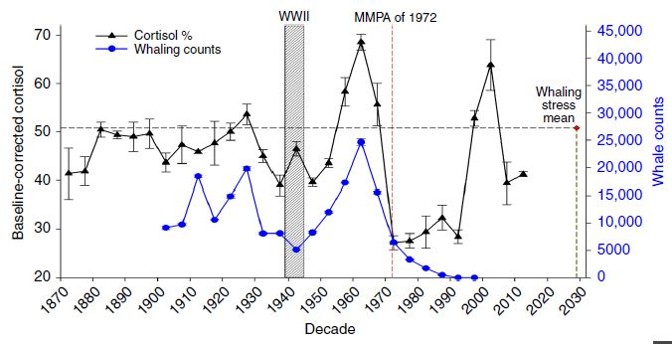
Stephen Trumble and Sascha Usenko from Baylor University have worked out how to read those biographies. And they’ve shown that whale earwax not only reveals the lives of their owners, but the history of the oceans. Hunting, abnormal temperatures, pollutants—it’s all there. If all of humanity’s archives were to disappear, Trumble and Usenko could still reconstruct a pretty decent record of whaling intensity by measuring the stress hormones in the earwax of a few dozen whales.

Fin whale earwax (Stephen Trumble)

The duo first tested their idea of studying earwax by analyzing the plug from a single blue whale—a 12-year-old male that was fatally struck by a ship off the coast of Santa Barbara in 2007. They could tell that the whale became sexually mature when it was 9 years old, as that’s when testosterone levels in the plug shot up by 200 times. They showed that the stress hormone cortisol peaked a year before that, perhaps a sign of the creature’s changing body and mind. They found traces of pesticides and flame retardants that were especially concentrated in the whale’s first six months of life, and had likely been passed down in its mother’s milk. “I was surprised at how well [the technique] worked, not only for persistent chemicals but for hormones that typically rapidly degrade,” Usenko told me at the time.

[Read: Baleen holds secrets to whales’ lives—and deaths]

That was just one earwax plug, but it was surprisingly easy to get more. They just had to call curators at the right natural-history museums. “Museums are notorious for collecting everything, and waiting for the science to catch up,” Trumble says. “We called Charles Potter at the Smithsonian Institution, and he said, ‘It’s interesting you called because we have pallets and pallets of these ear plugs sitting around, and we’re thinking of throwing them away.’ Instead of being thrown away, those ear plugs are now objects of wonder.”

Trumble, Usenko, and their colleagues ended up measuring cortisol levels in the plugs from 20 blue, fin, and humpback whales, the oldest of which had been born in 1871. The team measured how this stress hormone varied over the lifetime of each animal, relative to the lowest levels found in each plug. They then combined these readings into a 146-year chronicle of whale stress, which they compared to a record of all whaling data from the 20th century. “We plotted the two together, and were like: ‘You’ve got to be kidding me,’” says Trumble.

A graph comparing whaling intensity with earwax cortisol. (Trumble et al, 2018, Nature communications)

The two data sets matched beautifully. When whaling increased, cortisol levels rose, hitting their peak during the heyday of whaling in the early 1960s. After moratoriums were adopted in the 1970s, whaling harvests fell by 7.5 percent a year and cortisol levels in earwax fell by 6.4 percent a year.

To an extent, that’s not surprising: Of course, whales would be more stressed if their pod-mates are being harvested. Still, it’s astonishing just how well the two data sets match. Trumble and Usenko could get a pretty good picture of global whaling efforts through the lived experiences of 20 whales.

There are a few discrepancies, and they’re telling. For example, whaling fell away during World War II while cortisol levels rose by 10 percent. The oceans may have been relatively free of harpoons, but they were instead filled with battleships, submarines, depth charges, and the sounds of warfare. Those indirect disturbances, it seems, were just as stressful to the whales as their hunters had been—and they continue today.

Since the 1970s, whaling has dwindled to negligible levels in the Northern Hemisphere, but if anything, cortisol levels have risen—slowly at first, and then more dramatically in recent decades. Trumble and Usenko showed that this rise correlates with the number of days when ocean temperatures were unusually high.

The team’s 146-year chronicle also has a gigantic spike in the early 2000s when cortisol levels seem to shoot through the roof. That’s because of the very first blue whale they studied. It was the only individual whose life spanned those particular years, and for whatever reason, it spent those years in an extreme state of stress. Was it reacting to the noisy shipping lanes that crisscross California’s waters? Was it suffering from the mercury, pesticides, and other pollutants in its body? No one knows, but its cortisol was hitting highs that haven’t been seen since the days when people killed whales in the hundreds of thousands. “When I look at that, I think: Here’s an individual that’s under stress levels as if it’s being whaled,” says Usenko.

“I think this is going to revolutionize our studies of whale biology,” says Kathleen Hunt from Northern Arizona University, who was not involved in the work. “Whale biologists are used to gleaning tiny bits of information from samples like a single blubber biopsy, one or two fecal samples, or a few photographs scattered over years. An earwax plug is more like 200 samples in a row, taken from the same animal, every 6 months, for its whole life.” They’re like the ice cores that climate scientists use to peer back into the Earth’s distant past.

The plugs are especially informative because whales are so long-lived. They can take a decade to mature, go for years between pregnancies, and spend much longer recovering from episodes of trauma. “We’ve never really had a way to track individual whale stress responses over those sorts of timescale before, and it’s very exciting,” says Hunt.

The team is now examining the wax for pregnancy hormones, chemical isotopes that reflect the whales’ diet, and other telltale molecules. “We’re getting tons and tons of data from these earplugs that we’ve only ever assumed,” Trumble says. And he’s not running out of material to work with. “The Canadian Museum of Nature in Ottawa has 4,000 ear plugs, and we had 100 shipped to us. We’re getting quite deep into this.”

27 Nov 17:26

Nancy Pelosi Just Showed Us Why She’s the Democratic Leader

by Peter Beinart

A few years ago, the Brookings Institution scholar Thomas Mann said that during her time running the House of Representatives, Nancy Pelosi had proved to be the “strongest and most effective speaker of modern times.” To understand why, just look at the way Pelosi has engineered her likely return to the job over the past week.

In August, NBC asked Democrats running for the House whether they supported making Pelosi speaker again. A whopping 58 refused to endorse her. Even more ominous, the abstainers hailed from every wing of the party. They included many of the moderate Democrats with the best chances of winning in Republican-leaning districts: Conor Lamb in Pennsylvania; Mikie Sherrill in New Jersey; Jared Golden in Maine; Gil Cisneros in Orange County, California; and Max Rose in Staten Island, New York. But some of the party’s rising progressive stars—Ayanna Pressley, Rashida Tlaib, and Alexandria Ocasio-Cortez—snubbed Pelosi, too. It appeared to be one of the few points of consensus among Democrats of all stripes. “There is widespread agreement,” Representative John Yarmuth of Kentucky told Vox in July, “that we need a rejuvenation of leadership.”

What Pelosi realized, however, was that the very breadth of the skepticism toward her afforded her an opportunity. She didn’t have to convince either moderates or progressives that she was their ideal choice. She only had to convince each group of would-be rebels that the other was worse.

[Read: The opposition to Nancy Pelosi stumbles].

The first move in that strategy occurred last Thursday night when Pelosi met with Representative Pramila Jayapal, the incoming co-chair of the House Progressive Caucus. Jayapal had every reason to oppose Pelosi’s return to the speakership. The Seattle congresswoman is working on legislation to abolish Immigration and Customs Enforcement (ICE); she has already voted to impeach Trump. Pelosi has mocked both causes on the record. “I have those who want to be for impeachment and for abolishing ICE,” she told Robert Draper of The New York Times Magazine this week. “Two really winning issues for us, right? In the districts we have to win? I don’t even think they’re the right thing to do.”

But Jayapal left Pelosi’s office with a commitment that Progressive Caucus members would enjoy better committee assignments and more say over legislation. And in return, she not only announced her support for Pelosi as speaker, but, according to Politico, also called the influential activist groups MoveOn and Indivisible, which quickly declared their support for Pelosi, too.

How did these progressive hard-liners justify supporting Pelosi, whose history of ideological compromise and big-donor fund-raising represents much of what they despise about the modern Democratic Party? They said her opponents were worse. Jayapal told Politico that the “drive” by party moderates to depose Pelosi “is not going to take us in the direction that we should go. It’s going to be the opposite of what the election really told us, which is a much more diverse, progressive, bold agenda.” MoveOn tweeted that “Dems must reject attempts to defeat” Pelosi “and move caucus to the right.” Indivisible declared, “We shouldn’t let a small group of white, moderate men sabotage her.” On Monday, Ocasio-Cortez—who had refrained from endorsing Pelosi during the campaign—justified her support in identical terms. “Out of the field, I would say that she is the most progressive candidate,” Ocasio-Cortez announced on Instagram. “All of the rebellion for the speakership are challenges to her right.”

[Read: The Nancy Pelosi problem]

It was a self-fulfilling prophecy. After the 2016 elections, 63 House Democrats had voted to dump Pelosi as speaker. But on Monday, after the Progressive Caucus’s endorsement of Pelosi, only 16 (11 sitting members and five who have just been elected) signed an open letter demanding “new leadership.” As damaging as the small number was the composition. Thirteen of the 16 were white males. Of the 11 sitting members, according to govtrack.us, 10 had a more conservative voting record than the average House Democrat in 2017. Many had a history of opposing abortion or gun control.

The moderate rebels grasped this liability. They knew that, on their own, they could not win over a caucus composed largely of progressives, women, and people of color. By Monday, their hopes for ideological jujitsu rested in large measure on Marcia Fudge, an African American representative from Cleveland who had called for “acknowledging the fact that the Democratic Party is becoming more young, more black, and more brown and letting that be reflected in our leadership.” Fudge had also slammed Pelosi as “a very wealthy person” who “raises a lot of money from a lot of other wealthy people.” Two of the ringleaders of the moderate revolt, Tim Ryan and Seth Moulton, were publicly boosting Fudge, who last week told The Washington Post, “I’ve been overwhelmed by the amount of support I’ve received.”

But that supposedly overwhelming support didn’t include a public endorsement by a single member of Fudge’s own Congressional Black Caucus. And on Tuesday night, after being named to lead a new House subcommittee to combat voter suppression, Fudge threw her support behind Pelosi, denying moderates the progressive fig leaf they desperately needed. Soon after Fudge’s announcement, The Washington Post’s Dave Weigel tweeted, “A quick update on Seth Moulton’s quest to block Pelosi from the speaker’s gavel.” Below it was a gif of a cartoon character who steps on a succession of different rakes, each of which pops up and slams him in the face.

This is why Pelosi deserves to be speaker again: She possesses the skills that the job requires. She may be a lackluster orator who, according to polls, lacks widespread support even among grassroots Democrats. But when it comes to outmaneuvering her opponents inside the Capitol’s marble walls, no one in her party even comes close.

27 Nov 17:25

Reefer Madness at NASA

by Marina Koren

The story of NASA’s efforts to restore the country’s ability to launch American astronauts into space from U.S. soil has just gained a rather interesting new chapter.

NASA has decided to conduct reviews of SpaceX and Boeing, the two companies the agency hired to develop astronaut-transportation systems that would allow the United States to fly crewed missions from its own launchpads for the first time since the space shuttle was retired in 2011.

The reviews, scheduled to begin next year, will assess not the companies’ technical development or their progress, but rather their workplace safety culture. Why? Reportedly, because SpaceX CEO Elon Musk smoked some weed and drank whiskey on a podcast two months ago.

The Washington Post, which first reported the upcoming assessments on Tuesday, said Musk’s behavior on the show, The Joe Rogan Experience, “rankled some at NASA’s highest levels and prompted the agency to take a close look at the culture of the companies.”

NASA declined to say whether Musk’s appearance on the show indeed prompted the reviews, but statements from the involved parties to The Atlantic strongly suggest it played some part.

In a statement, NASA said, “[The agency] will be conducting a cultural assessment study in coordination with our commercial partners to ensure the companies are meeting NASA’s requirements for workplace safety, including the adherence to a drug-free environment.”

For its part, SpaceX said it “actively promotes workplace safety and we are confident that our comprehensive drug-free workforce and workplace programs exceed all applicable contractual requirements.”

And Boeing, which is probably wondering what on earth it has to do with this, said it “does maintain a drug- and alcohol-free workplace program. We do this so that we can promote a safe, healthy, and productive work environment, and that program does meet NASA’s and the Department of Defense’s contractor requirements.” (A Boeing spokesperson said NASA did not give a reason for the review and has not provided many details on the process.)

The first test flights with astronauts—which have already been selected—are scheduled for summer 2019 at the earliest. The new review could delay the effort, which has already been set back by technical problems and overly optimistic schedules. According to The Post, the review will be a “months-long assessment that would involve hundreds of interviews designed to assess the culture of the workplaces.”

The Rogan podcast was recorded in California, where recreational use of marijuana is legal. But the federal government still considers marijuana a controlled substance, like heroin and cocaine. And NASA’s contracts with SpaceX and Boeing for the commercial crew program require both contractors to “maintain a program for achieving a drug-and alcohol-free workforce” and conduct “preemployment, reasonable suspicion, random, post-accident, and periodic recurring testing of contractor employees in sensitive positions for use, in violation of applicable law or federal regulation, of alcohol or a controlled substance.”

There is no word on whether Musk was drug-tested after the podcast, but, according to the environment NASA requires of SpaceX, the company certainly would have had “reasonable suspicion.”

In this context, in which SpaceX is a contractor of NASA, officials’ apparent displeasure with Musk’s actions makes some sense. Perhaps for government officials, it is not Musk’s casual use of marijuana that unnerved them, but instead the very public use of it, in a video that gained more than 2 million views in less than a day, months before his company was expected to launch human beings into space using taxpayer dollars.

“If I see something that’s inappropriate, the key concern to me is what is the culture that led to that inappropriateness and is NASA involved in that,” Jim Bridenstine, the NASA administrator, told The Post. “As an agency we’re not just leading ourselves, but our contractors as well. We need to show the American public that when we put an astronaut on a rocket, they’ll be safe.”

From this perspective, NASA’s decision to admonish Musk in some capacity may seem wise. Whether Musk’s actions warrant a lengthy and large-scale review of hundreds of employees, at not one but two companies, is another question.

There’s the obvious consideration: Yes, Musk is the CEO of SpaceX, but he does not speak for the thousands of people who work for him. The image of Musk taking a quick hit—“I mean, it’s legal, right?” he had said—probably thrilled some employees and irked others. Musk showed questionable judgment (at best) given that he is the public face of the country’s most successful rocket company. But he’s not one of the technicians handling the wiring inside a spacecraft.

NASA’s disapproval may seem like an antiquated reaction in a time of greater acceptance of marijuana use across the country. A recent Pew study reported that 62 percent of Americans believe marijuana use should be legalized, up from 31 percent in 2000. As of this month, 33 states and the District of Columbia have laws on the books legalizing marijuana in some form. Ten states and the nation’s capital allow recreational use. Earlier this month, in the hours after President Donald Trump fired Jeff Sessions—a well-known prosecutor during the war on drugs who used his time as attorney general to promote anti-marijuana policies—stock prices for cannabis businesses spiked.

Against this backdrop, NASA’s decision to investigate the “culture” of the companies recalls the days of “reefer madness,” the 1930s public campaign that intended to stoke fears of marijuana as a dangerous drug that would lead people down a path to criminality. The same message was at the heart of Ronald Reagan’s “war on drugs” in 1980s, which imposed far harsher punishments than the country had seen before, including long prison sentences for offenders that would be deemed severe today.

But it’s important to remember that as cool as NASA looks on the outside—Mars rovers! Jupiter orbiters! Hubble pictures of galaxies!—it is a federal agency, and its culture is tangled up with the historic record of federal statutes, including those on drugs. In 1980, as NASA prepared for the first launch of the space shuttle, the Drug Enforcement Administration called marijuana the most urgent drug problem facing the United States. Under the Drug-Free Workplace Act of 1988, a Reagan policy, companies that receive federal contracts of $100,000 or more must maintain a drug-free policy—and NASA projects usually cost a lot more than that.

Musk’s weed moment presented a new situation for NASA. The space agency has spent most of its existence working with big defense contractors such as Boeing, Lockheed Martin, and Northrop Grumman, which have well-established drug-use policies that align with federal law. SpaceX—a feisty start-up with a young workforce and a CEO with a household name—is a completely different animal. Perhaps NASA feels it needs to bring SpaceX in line with the old-timers, who are known for their strictness, said a Lockheed Martin engineer who works as a NASA contractor on the Orion capsule, part of another crew-transportation project.

“They know that breaking rules, including drug rules, can jeopardize their programs, and even the whole company. So it seems like NASA would rarely need to intervene when the companies are so on top of it themselves,” said the engineer, who requested anonymity because he was not authorized to speak to the press. “But when the person in question is also in charge of the company, I guess NASA felt they needed to be the ones providing oversight.”

After the Rogan podcast aired, rumors swirled that the U.S. Air Force, which maintains contracts with SpaceX to launch military satellites, was concerned about Musk smoking pot on-air. An Air Force spokesperson told The Verge that reports of a full-blown investigation were “inaccurate,” but added, “We’ll need time to determine the facts and the appropriate process to handle the situation.”

At least one retired U.S. drug official took his concerns right to the feds. Mike Vigil, the former chief of the DEA’s international operations, wrote a letter to Sessions urging him to investigate whether Musk violated any federal laws, according to the Washington Examiner, which obtained the letter. “Federal defense contractors like SpaceX are subject to higher standards and must abide by additional laws and regulations governing their obligations to ensure a drug-free workplace as a condition of receiving billions in dollars in taxpayer funding,” Vigil wrote.

The Justice Department did not respond to questions about involvement in the NASA review.

The safety review comes at the end of what Musk has described as “the most difficult and painful year of my career.” Musk started 2018 on a high note with the successful launch of the massive Falcon Heavy rocket and its shiny payload, a cherry-red convertible from Tesla, his electric-car company. By spring, the tides seemed to shift. Musk became embroiled in public disputes with investors, journalists, and a British diver whom Musk accused of being a pedophile. In the fall, a rogue tweet about Tesla’s future, featuring an apparent marijuana reference, prompted a federal lawsuit that cost Musk his role as chairman of Tesla’s board for three years and $20 million in fines.

SpaceX has largely stayed out of the fray, a situation that NASA officials have no doubt welcomed. It appears that someone in government, whether at NASA or at legal agencies, took the Tesla debacle as a cautionary tale and found reason to be concerned as their long-anticipated test launches approached. Imagine if the CEO of the company that the federal government had entrusted with getting Americans to space in one piece was also being sued by the federal government. If officials wanted to warn Musk, the pot-smoking and whiskey-drinking are their way in. Unlike some examples of the entrepreneur’s erratic behavior, these actions may be subject to legitimate investigation, backed up by federal policies.

Despite the safety reviews, the work moves forward. A day after The Post broke the news, NASA announced it has set January 7 as the date for SpaceX’s first demonstration in the program, an uncrewed test flight. The capsule, named Dragon, will blast off atop a Falcon 9 rocket from Cape Canaveral’s launchpad 39A, the site of Apollo and space shuttle launches. A launch of Boeing’s system, the Starliner capsule and an Atlas V rocket manufactured by the United Launch Alliance, is expected to follow in March. If the tests are successful, NASA astronauts, decked in SpaceX space suits, will launch from U.S. soil by June.

27 Nov 17:23

Why Most of America Is Terrible at Making Biscuits

by Amanda Mull

For 25 years in Georgia, I watched my mom make the same batch of six light, fluffy biscuits for breakfast almost every Sunday. Then I moved to New York, never to see a light, fluffy biscuit again. I arrived in the city in 2011, just in time for southern food to get trendy outside its region, and for three years, I bit into a series of artisanal hockey pucks, all advertised on menus as authentic southern buttermilk biscuits.

With every dense, dry, flat, scone-adjacent clump of carbohydrates, I became more distressed. I didn’t even realize biscuits could be bad, given how abundant good ones were in the South. Even my mom, a reluctant-at-best cook, made them every week without batting an eyelash. The recipe she used had been on my dad’s side of the family for at least three generations.

The more bad biscuits I ordered in New York, the clearer it became that there was only one way out of this problem if I ever wanted to have a decent Sunday breakfast again: I had to make the biscuits for myself. I did not anticipate the hurdles of chemistry and the American food-distribution system that stood in my way.

I asked my mom to email me the recipe, and it was three ingredients (self-rising flour, shortening, and buttermilk), mashed together with a fork. I’m not an accomplished baker, but I cook frequently, and this was the kind of recipe that had long been used by people without a lot of money, advanced kitchen tools, or fancy ingredients. Confident that I could pull it off, I marched right out and bought the ingredients. The result: biscuits that were just as terrible as all the other ones in New York. Not to be dramatic, but my failure destabilized my identity a little bit. What kind of southerner can’t make biscuits?

In subsequent attempts, I tried everything I could think of to get it right. I worried about buttermilk quality, so I bought an expensive bottle at the farmers’ market, which did nothing. I tried different fat sources, including butter and lard, which made small differences in flavor and texture but still resulted in a shape and density better suited for a hockey rink than a plate. I made sure all of my ingredients were ice-cold when I started mixing, which is a good tip in general, but did not fix my problem. I kneaded the dough more or less, made it wetter or drier. The only thing left was the flour, but I figured it couldn’t be that—wasn’t self-rising flour the same everywhere? We had just used regular grocery-store flour back home.

Out of ideas, I did what any self-respecting Millennial would do: I Googled it, and then I called my mom, and then I placed an Amazon order.

The one ingredient I took for granted had indeed been the key all along, says Robert Dixon Phillips, a retired professor of food science at the University of Georgia. To make a good biscuit, “you want a flour made from a soft wheat,” he says. “It has less gluten protein and the gluten is weaker, which allows the chemical leavening—the baking powder—to generate carbon dioxide and make it rise up in the oven.” It turns out that in most of the U.S., commonly available flours are made from hard wheats, which serve a different purpose. “Hard wheats are higher in gluten protein, and when they’re turned into a dough, the dough is very strong and elastic and can trap carbon dioxide,” says Phillips. If you want to make bread, you want a hard wheat. Northern biscuits suck because they are made with bread flour.

At first, this information felt like a huge relief. I just had to buy the right flour. I’m great at buying things! Unfortunately, the problem was a little more complicated. According to Sarah Simmons, a chef from South Carolina who has owned food businesses in both New York and the South, finding soft wheat flour north of Washington, D.C., is tricky even for pros. “Northerners don’t have it. I couldn’t get it commercially, even,” she told me. “We had to make our own flour blend, and I spent probably nine months working on it, trying to get the right amount of protein.”

The crux of this problem is a brand called White Lily, whose name and logo is familiar to virtually all southerners but foreign to most people outside the region. White Lily was founded in Knoxville, Tennessee, in 1883, and although other contemporary brands now make serviceable biscuit flour, it still dominates grocery baking aisles across the Southeast. Biscuits are now as common an inexpensive staple bread in southern diets as bagels or kaiser rolls are in New York, but for generations of rural, working-class southerners, they were a luxurious treat. “When my grandmother in western North Carolina said bread, she meant cornbread,” Phillips told me. “The biscuits were a special thing. We’d have them on Sundays.”

[Read: Why do mMillennials hate groceries?]

Because of that, White Lily became an indicator of culinary success and the gold standard of southern kitchens, and its place in both the grocery market and southern culture has endured for more than a century. In 2007, the brand was bought by J. M. Smucker, and the prospect of moving White Lily’s flour production out of the South caused such a panic among southern cooks that The New York Times covered it in depth. For knowledgeable bakers and regional expatriates outside the South, though, that move presented a flicker of hope: If a national brand owned the company, maybe its products would finally get national distribution.

Ten years later, that hope has not come to fruition. J.M. Smucker did not return a request for comment, but the product-finder on the White Lily website turned up no retailers north of Richmond, Virginia. The only bright spot out West is a single Walmart in Oklahoma. Dallas and Houston both lack any vendors. If you’re on the West Coast, forget it. Displaced southern bakers have been known to stuff a bag in their suitcases when visiting home. You can order the flour for delivery on Amazon, but it’ll cost you anywhere from $10 to $15 for a bag, many times the in-store retail price of around $2.50. And you better plan ahead, because in the week before Thanksgiving this year, all the self-rising options had already sold out.

In modern food distribution, seasonality and origin are often lost entirely from the foods Americans buy. If it’s cold where you live and you want a banana anyway, there’s nothing stopping you from having one. In that context, soft wheat flour’s stubborn regionality is almost charming. According to Phillips, biscuits likely developed as a southern staple food specifically because the flour necessary to make them was (and still is) made from the kind of wheat that’s farmed there.

Most of North America’s hard wheat is grown on the plains, from Kansas north to Canada, but because of climate differences, the South has always had the softer kind, and cooks in the late 1800s didn’t have food-service giants like Sysco trucking in mass-produced flour from thousands of miles away. As a result, biscuits are uniquely southern, and they seem determined to stay that way. Unless you’re at my Thanksgiving, of course. I’ve got a couple bags of the good stuff squirreled away in the fridge.

27 Nov 17:22

Is a Recession Coming?

by Derek Thompson

In December 2007, Larry Kudlow, then a talking head for the business network CNBC, proclaimed, “There’s no recession coming. It’s not going to happen.” That same month, the economy plunged into the worst economic downturn since the Great Depression.

This week, Larry Kudlow, now the director of the National Economic Council, stood on the White House lawn and struck a familiar note: “I’m reading some of the weirdest stuff [about] how a recession is right around the corner. Nonsense,” he said. “Recession is so far in the distance, I can’t see it.”

Perhaps, as morning follows the rooster’s crow, an imminent recession looms behind Kudlow’s latest optimistic squawk. The outcome certainly seems possible if you’ve recently been torturing yourself by following the stock market. After the Dow Jones Industrial Average sank 550 points on Tuesday, the past few weeks qualify as no mere correction, but as one of the worst stock meltdowns of the past few decades. Some analysts say it could get worse.

Cascading stock prices might seem like a random crisis if you’ve been paying attention to the overall economy, which is booming. At 3.7 percent, the official unemployment rate is the lowest of this century. Job satisfaction is at its highest level in more than a decade. Small-business and consumer confidence hit record highs this year.

Observing the gap between Wall Street jitters and Main Street optimism, some are inclined to point out that “the stock market is not the economy.” But you should resist that temptation. The stock market is not the entire economy. (Neither is wage growth or health-care spending.) Rather, the stock market is a part of the economy that reflects both the value of capital investment in public companies and a prediction of their future earnings. As labor costs increase (good news for workers), and interest rates creep up (good news for traditional savings accounts), cost of business increases for many large companies, which can hurt their stock value.

For many years, corporate profits thrived as labor costs were low. Now corporate profits are at risk as labor costs are rising.

But this parallelism isn’t very satisfying for investors and businesspeople who want to know what happens next. Could a downturn on Wall Street trigger a decline in business investment that could ripple throughout the economy? Or, to cut straight to the point, is there gonna be a recession, or not?

One way to predict the likelihood of a recession today is to look back at the past few downturns and evaluate whether the U.S. economy is in danger of repeating history.

Let’s start with the 1970s, when a series of oil crises contributed to a rare period of stagflation. (The portmanteau signifies a combination of stagnant growth and high inflation.) Today, conversely, oil prices are low, which helps consumers and businesses feel richer while hurting the energy industry. Despite the fact that the U.S. is now the world’s leading oil producer, America is predominantly a consumer-and-services economy, not an oil-and-exports economy. Even a long-term decline in oil prices is, therefore, unlikely to cause a serious downturn.

The recession of the early 1980s was a byproduct of the Federal Reserve’s decision to jack up interest rates to cool off rampant inflation—somewhat like a fire department flooding a house to save it from a fire. But today’s economy is neither burning nor flooding. Although the Fed is again raising rates—and there is a robust debate among monetary-policy analysts over whether, and how fast, it should do so—the baseline couldn’t be more different. Inflation is low, and—relatively speaking—so are rates.

The next two recessions, in the early 1990s and early 2000s, were more complex in origin. The 1987 stock-market crash—in which the Dow lost more than a fifth of its value in a matter of days—coincided with the collapse of the savings-and-loan industry in the late 1980s. Because the government bailout of the S&L banks contributed to fears of rising federal deficits, the Fed quickly raised interest rates. Adding to the economy’s woes, the Iraqi invasion of Kuwait in 1990 caused oil prices to double in five months. Consumer confidence tanked, taking economic growth down with it. The 2001 recession probably had little to do with the 9/11 terrorist attacks or the bursting of the dot-com bubble. A 2003 analysis of the downturn by the Federal Reserve Bank of St. Louis listed several variables, including a sudden decline in exports and a sharp drop in business investment in the first half of 2001.

How many of these factors trouble today’s economy? There is no national mortgage-lending scandal, no bailout for banks, no sudden increases in interest rates, and no spike in oil prices caused by a war in the Middle East. There is, however, the issue of exports. President Donald Trump’s trade standoffs have hurt soy farmers and other companies that do business with China. The International Monetary Fund has predicted that Trump’s policies have already reduced global trade by several hundred billion dollars, and four in five economists say that White House trade policy will reduce U.S. growth. For the past 100 years, the U.S. economy has been big and resilient enough to shake off problems in other countries. But a downtown in China—caused by high debt and accelerated by Trump’s trade war—could be the cold that gets the world economy sick.

Finally, there’s the Great Recession, which—to simplify wildly—spun out of housing debt. Although practically nobody expects the world to face anything remotely similar to the international economic apocalypse of 2008, it is concerning that sales of new single-family homes fell 22 percent in September from their 2017 peak, and that residential investment has been a drag on GDP growth all year. Also of concern is that even as stocks and profits have soared, companies have gobbled up debt at low interest rates, which could become a serious burden if rates rise too quickly. Corporate debt has tripled in the past eight years to match its historic highs, according to Ruchir Sharma, the chief global strategist at Morgan Stanley Investment Management.

To understand whether this fateful combination— high debt plus a cooling housing sector—could produce a sequel to the Great Recession, I reached out to Bill McBride, a famously prescient economic analyst and the author of the Calculated Risk blog. “I do not see any signs of a recession in the next six months,” McBride said. “I think the economy is pretty solid. Recently new home sales have slowed due to several headwinds, mostly higher mortgage rates and the new tax policy.” As the Millennial generation continues to pay down student debt and move into its peak-earning years, he predicted “further increases in new-home sales and single-family starts over the next couple of years.” His verdict: a slowdown, perhaps; but not a downturn.

If you’re going to worry, you should worry about three things: exports, China, and maybe the looming shadow of corporate debt. But nothing in the economy seems to predict an imminent recession.

Or at least that was my conclusion before Bill McBride sent me a follow-up email.

“Just saw Larry Kudlow’s remarks. Maybe I’m wrong!”

27 Nov 17:22

Mueller and a Blue House Could Bring Down Trump

by Joshua Zoffer

On May 17, 1973, Senator Sam Ervin Jr. opened Senate hearings into the Watergate affair. “It is the constitutional duty of this committee,” he said, to expeditiously investigate allegations that American democracy “has been subverted and its foundations shaken.” Ervin, a Democrat, did not mince words in characterizing the gravity of the accusations leveled against Richard Nixon’s campaign and administration. At stake were “the workings of the democratic process under which we operate in a nation that still is the last, best hope of mankind.”

President Nixon started in a relatively weak position. His misdeeds came to light during a period of opposition-party control, with Democrats able and willing to wield Congress’s investigative powers to the fullest. Prior to the hearings, Nixon enjoyed approval ratings: in the mid-50s among all Americans and well over 80 percent among Republicans. By August 1973, the Watergate hearings had dragged them down to just 31 percent nationally and a paltry 58 percent among co-partisans.

On August 9, 1974, with bipartisan articles of impeachment hanging over him, Nixon resigned.

President Donald Trump has thus far had a very different experience. For the past two years, Republican control of Congress has protected him from the public exposure Nixon and his staff had to endure. Now that the Democrats have taken back the House, the Trump administration will face a challenge from which it has been immune thus far: a far-reaching, aggressive, and highly public investigation of the kind that brought down Nixon.

Trump’s approval ratings stand at 40 percent overall and 89 percent among Republicans. In September 2017, we wrote, “It is tough for a special prosecutor alone to bring down an administration. That feat is more readily accomplished in the court of public opinion, where an opposition-led Congress can rain hellfire and brimstone upon a troubled presidency.”

[Read: It’s probably too late to stop Mueller.]

We believe our argument will soon be proved correct; hellfire and brimstone are imminent.

Special Counsel Robert Mueller’s investigation has picked off a few campaign aides and charged Russian operatives, but it has yet to breach the inner sanctum of the Oval Office. If Mueller follows existing Department of Justice precedent, Trump will remain safe from indictment. A Democrat-controlled Congress, however, will show no such restraint when it comes to the president and those closest to him.

Democratic control will bring two new advantages in the war on Trump. First, congressional committees hold an arsenal of investigative tools that can be called on with only majority-party assent. Chief among them is Congress’s subpoena power—its ability to compel the production of documents or the sworn testimony of witnesses in furtherance of a congressional investigation. That power can be exercised to produce anything from Trump’s much-discussed but as yet unseen tax returns to public testimony from his senior staff and family members (especially those who fit both descriptions). Moreover, due to a 2015 rule change pushed through by House Republicans, most House committees can now issue subpoenas on the authority of the chairperson alone, including three of the committees most likely to go after Trump: Oversight, Intelligence, and Foreign Affairs.

Second, Congress has the power to draw the results of any investigation into the harsh light of public scrutiny. The Watergate hearings were instrumental in bringing down Nixon because they forced Republicans to contend with damning testimony from the president’s closest aides, broadcast in prime time. Only once his approval among Republicans sank into the 50s were GOP congressmen willing to join the impeachment effort. Removing Trump from office before his term expires would require a similar loss of intraparty support. Since Democrats today don’t control the Senate—let alone hold the two-thirds majority required for conviction on House impeachment charges—it’s all the more important for them to erode the president’s base of support before attempting impeachment. Republicans’ impeachment of Bill Clinton increased his approval rating as those on the left rallied around him. Today, Democrats would do well to keep their fingers off the trigger until the president’s approval has begun to crumble.

[Read: Mueller wants the FBI to look at a scheme to discredit him.]

Congressional Republicans understand the power of public testimony. Representative Kevin McCarthy let slip in 2015 that he believed the Benghazi hearings made Hillary Clinton “untrustable.” Imagine what Democrats could do with hearings into the Trump campaign’s alleged Russian connections, where the prima facie case for misconduct seems significantly stronger.

Of course, the initiation of a full-scale public investigation alongside the Mueller team’s is not without risks. Members of both the Watergate and Iran-Contra special-counsel teams reported difficulties in coordinating their efforts with Congress’s. Prosecutors labor under strict secrecy to limit the premature release of evidence and avoid influencing public opinion. Congress endeavors to do just the opposite. Democrats in the House will have to tame their eagerness to haul crucial witnesses up to Capitol Hill at the risk of tainting Mueller’s work.

If Congress and Mueller can cooperate, though, both stand to gain from parallel investigations. As the Watergate Special Prosecution Force put it in its final report, “In the end, the continuation of public hearings through the summer of 1973 … brought to public attention testimony relating to alleged White House involvement in the Watergate cover-up and other crimes and thereby helped create for the Special Prosecutor’s investigation a base of public and congressional support.”

Whatever risks the Mueller investigation does pose for the president, history suggests that they will be magnified by a Democrat-controlled House. Although the Watergate Special Prosecution Force never indicted Nixon, its findings were transmitted to the House via a grand-jury report that provided much of the basis for the Judiciary Committee’s articles of impeachment.

[Read: Nancy Pelosi: Mueller doesn’t have to indict Trump for Congress to impeach him.]

In one respect, Trump’s position may now be even more precarious than Nixon’s. As former White House Counsel John Dean recalls, Nixon “was forced to quit not because he had lost his support on Capitol Hill, but because he had lost his support at 1600 Pennsylvania Avenue,” leaving him defenseless against Congress. Leaks from inside the White House suggest that Trump already does not enjoy the unqualified confidence of officials in his own administration.

The other side of the coin is that Trump’s base of popular support amongst Republicans may prove more resilient than Nixon’s. Much has changed since the 1970s. All three national television networks carried the Watergate hearings, and there was, by today’s standards, a certain uniformity in their coverage. The same cannot be said of the age of cable TV and the internet. While CNN will run with the Watergate 2.0 narrative, Fox News surely will not. For every website denouncing Trump for high crimes and misdemeanors, there will be another accusing the Democrats of a witch hunt.

Finally, there is the very different political calculus in the present-day Senate. For Mitch McConnell, Donald Trump is a means not just to GOP control of the upper house, but also to conservative dominance of the Supreme Court and the judiciary more generally. It is hard to see what more it would take to persuade McConnell and his colleagues to abandon this president, considering how many damaging aspects of his personality and record are already in the public domain.

Trump has been likened to Nixon from the beginning of his presidency. Now the real test begins. Will the combination of Mueller and a blue House doom him? Or have Washington and America changed so much that a president can withstand repeated allegations that, on his watch, American democracy “has been subverted and its foundations shaken”?

27 Nov 17:21

The Bacteria Lurking in American Showerheads

by Rob Dunn

In 1654, Rembrandt painted a woman, in Amsterdam, bathing in a stream. As she lifts her nightdress above her knees and treads deeper, the woman is stepping from one world into another. Among art historians, the transition she is making is metaphorical. But to a biologist, it is also ecological.

This post is adapted from Dunn’s new book.

We imagine water to be clean, and we imagine clean to mean lifeless, and yet all the water you have ever bathed in, swum through, or drunk has been full of life, from bacteria to tiny crustaceans. So, too, the pipes in which it travels. As water passes through pipes in general and showerheads in particular, a thick biofilm builds up. Biofilm is a fancy word that scientists use to avoid saying “gunk.” It is made by individuals of one or more species of bacteria working together to protect themselves from hostile conditions—including the flow of water, which constantly threatens to wash them away—via their own excretions.

In essence, the bacteria poop a little indestructible condominium in your pipes, built of hard-to-break-down complex carbohydrates. But when the pressure is high enough, these species are let loose into the fine aerosol spray of water droplets pelting our hair and bodies and splashing up and into our noses and mouths. And in some regions, but not others, they increasingly seem to be making people sick.


The bacteria in biofilms making people sick are species of the genus Mycobacterium. Mycobacteria are different from most waterborne pathogens in that their normal habitat is not the human body. Instead, they live in the pipes themselves and become problematic only when they, quite accidentally from the perspective of their own well-being, make their way into human lungs.

The Mycobacterium species in showerheads are typically referred to as NTM, for nontuberculous mycobacteria. This means, as you may have inferred, other mycobacterial species are tuberculous, namely the species Mycobacterium tuberculosis and its close relatives.

Mycobacterium tuberculosis appears to have long associated with humans and our extinct relatives. The dangerous form of the pathogen evolved at about the time modern humans moved out of Africa, and spread with us as we moved across the globe. Once we domesticated animals, Mycobacterium tuberculosis evolved into Mycobacterium caprae in goats and Mycobacterium bovis in cows. We gave Mycobacterium tuberculosis to mice and seals, in which it evolved yet other forms. The seal version appears to have traveled to the Americas no later than 700 C.E., where it infected Native Americans (and then evolved into yet another specialized form).

In each case, the bacteria rapidly evolved special traits enabling them to better survive and spread among individuals of each new host. Mycobacterium tuberculosis is an emblematic example of evolution’s mechanisms every bit as elegant as that offered by the differences in beak shape among the species of Darwin’s finches.

Antibiotics, first developed in the 1940s, allowed us to gain a real victory against Mycobacterium tuberculosis, but today many strains of tuberculosis bacteria are resistant to most antibiotics. These resistant strains are (predictably) spreading. All of this is to suggest that the lineage of mycobacteria is one about which it would be good to have a robust awareness.

[Read: Bacteria can evolve resistance to drugs before those drugs are used].

So far, the risk of infections due to nontuberculous mycobacteria is high only for immunocompromised people, people whose lungs have an unusual architecture, and people with cystic fibrosis. In these individuals, the pathogens can cause pneumonia-like symptoms, as well as skin and eye infections. Unfortunately, the risk of nontuberculous mycobacteria infections is increasing overall in the United States, but just how common infections are and how much more common they are becoming varies geographically.

In some regions, such as California and Florida, infections are common. In others, such as Michigan, they are rare. This difference could be due to differences in either the abundance or the presence of mycobacterial species in various regions. The species in Florida, for example, don’t seem to be the same as those in Ohio, and this might matter. Also, the mycobacterial species associated with infections tend to be the same species and strains found in showerheads, which are different from those associated with soil or other wild habitats.


The story of how water and the life in it get to our houses is both simple and extraordinarily complex. In many parts of the world, water comes from a well sunk into the aquifer beneath a house, or from a municipal water system that draws on an aquifer. Aquifer is a fancy word for the spaces in rocks that hold groundwater (i.e., water that is underground). The groundwater in aquifers ultimately comes from rain.

The infiltration of water into the earth gets progressively slower the deeper the water travels, so slow that the water in the deepest aquifers might be hundreds or even thousands of years old. When you dig a deep well, you tap into ancient, untreated water. This untreated water then flows up and directly into a home. Or it goes to a water-treatment plant. In many regions, such water-treatment plants remove big material from the water (sticks, mud, and the like) and then send it, with little more in the way of treatment, to your house via underground pipes.

Water is safe to drink if it has sufficiently low concentrations of pathogens and toxins. The deeper and older an aquifer, the more likely the water is to be free of pathogens and, biologically, safe to drink. Much of the world’s groundwater is safe to drink without any processing because of time, geology, and biodiversity. Geology influences the safety of the water inasmuch as some types of soils and rocks stop the spread of pathogens from surface waters. The biodiversity present in groundwater also helps to kill pathogens. Indeed, the more kinds of life present in groundwater, the less likely a pathogen is to survive.

The natural filtration of water by living organisms and time is of enormous benefit to humans. Unfortunately, in many regions, we haven’t set aside enough wild land for nature to do its work, or we have polluted groundwater, or, in some cases, there simply isn’t enough groundwater available to supply large human populations. Under such circumstances, we must rely on human ingenuity to make water from reservoirs, rivers, or other sources safe to drink.

Human ingenuity relies heavily on biocides. In the United States, all municipal (city) water is now treated with biocides at treatment plants. In addition, it is typically treated with extra biocide as it is leaving the treatment plant because the pipes in American water systems tend to be old, causing water to leak, stagnate, and become a breeding ground for pathogens. Even after disinfection with biocides, the water leaving treatment plants is not sterile. Instead, it is water in which the most susceptible species have been killed and the toughest species have survived, alongside the dead bodies of the susceptible species and the food those susceptible species were eating.

[Read: Bacteria survive in NASA’s clean rooms by eating cleaning products].

If ecologists have learned anything in the past hundred years, it is that when you kill species but leave the resources upon which they feed, the tough species not only survive but thrive in the vacuum created by the death of their competition. In the case of water systems, we would predict the species that thrive to be those that are resistant to or even just slightly more tolerant of chlorine or chloramine. Mycobacterial species tend to be very tolerant of chlorine and chloramine.


In 2014, I teamed up with Noah Fierer, a biologist at the University of Colorado at Boulder, and a large team of collaborators (including Matt Gebert, a technician in Noah’s laboratory who ultimately did most of the work) to begin what is probably the largest-ever study of the ecology of showers and showerheads. In the average American showerhead, the biofilm that grows contains many trillions of individual organisms, layered as much as half a millimeter thick. The mystery was why these showerheads sometimes abound in mycobacteria and in other cases lack them entirely.

Medical researchers have predicted that mycobacteria might be more common in well water inasmuch as it is less controlled, less treated, more susceptible to nature’s whimsy. But as ecologists, Fierer, Gebert, and I, along with the rest of our team, also had to contemplate the opposite—namely, that mycobacteria might actually be more common in the showerheads of people with municipal water, particularly that from treatment plants and countries that use chlorine or chloramine, particularly water from such plants in the United States.

When we examined our data, we found that the concentration of chlorine in the tap water from homes using municipal water in the United States was 15 times as high as that of homes with well water. Mycobacteria were twice as common in municipal water as in well water. In some showerheads from municipal water systems, 90 percent of the bacteria were one or another species of Mycobacterium. By contrast, many of the showerheads from houses with well water had no Mycobacterium. Instead, those biofilms tended to have a high biodiversity of other kinds of bacteria.

In Europe, the abundance of mycobacteria in showerheads from well-water systems was low, just as in the United States. But it was also low in European showerheads from houses with municipal water (half that of municipal systems in the United States), as might be expected given that many European municipal water systems do not use biocides at all. In our samples, the residual chlorine measures in European tap water were 11 times less than in tap water from the United States.

[Read: How a usually harmless bacteria ended up killing 18 people in Wisconsin]

As we were pondering these results, Caitlin Proctor at the Swiss Federal Institute of Aquatic Science and Technology published a new study very much in line with what we were finding. Proctor and her colleagues compared the biofilms of the hoses that lead into showerheads from 76 homes around the world. They found that samples from cities that did not disinfect their water tended to be thicker (more gunk), but samples from those that did disinfect their water were more likely to be lower in diversity and more dominated by mycobacteria.

Our results match Proctor’s and seem to suggest that our fanciest treatment technology is creating water systems filled with microbes that are less healthful for humans than those found in untreated aquifers (or at least untreated aquifers that have been deemed safe). In our analysis, the mean abundance of the most pathogenic strains and species of Mycobacterium in showerheads in a particular state was highly predictive of the number of mycobacterial infections in that same state.


But there are twists in the story already. One of the twists is Christopher Lowry.

Lowry has spent 20 years studying Mycobacterium vaccae. He and his colleagues have found that exposure to this species boosts production of the neurotransmitter serotonin in the brains of mice and humans. Increased serotonin production tends to be linked to greater happiness and reductions in stress. Indeed, Lowry has shown that, at least in mice, inoculating individuals with Mycobacterium vaccae leads them to be more resilient to stress.

Lowry suspects that many Mycobacterium species may have effects similar to those he has observed. The only way to know for sure is to test them one by one, and so this is what Lowry is now doing. He is culturing the mycobacteria we have gathered in showerheads to see whether any other species behave like Mycobacterium vaccae. If they do, it may mean that some of the Mycobacterium falling on you from your showerhead may be beneficial in reducing your stress.

Lowry’s research reminds us that sorting out just which kinds of microbes are good and which are bad is gnarly, convoluted, and hard. Some mycobacterial strains may make you sick; others may make you happy. As for whether it is worth buying a new showerhead every so often, we don’t know yet. But I suspect that after reading this, you will go home and change yours anyway.


This post is adapted from Dunn’s new book, Never Home Alone: From Microbes to Millipedes, Camel Crickets, and Honeybees, the Natural History of Where We Live.

18 Nov 15:26

Malcolm Nance Says U.S. Has Become The 'Michael Cohen Of Saudi Arabia'

by Susie Madrak

There was a discussion on AMJoy this morning about the Trump administration's attempts to cover up the Khashoggi murder on behalf of the Saudi's crown prince -- and send Fethullah Gulen, who holds an American green card, back to Turkey.

"And it shows the Trump administration has turned into the crown prince's and the government of Saudi Arabia's lawyers. They're doing everything they can right now to be able to save the crown prince," Trita Parsi, founder of National Iranian American Council, said.

"We have to ask ourselves how does this in any way, shape or form lie in the national interest of the United States to have a policy in the Middle East that is so dependent on Saudi Arabia? Why is it that we've gone so far in being so biased in this case that we're putting all our chips in that basket? That was not the policy of the previous administration. In fact, part of the reason why the Obama administration secured the Iran deal was partly because they wanted to have more maneuverability in the Middle East and not be tied down by Saudi Arabia. We've seen how Trump came in, destroyed the deal and tripled down on the idea that it is MBS, the 32-year-old murderous crown prince of Saudi Arabia, who is deciding what the U.S. policy in the Middle East is going to be," Parsi said.

"To the point, Malcolm, they're potentially willing to trade a U.S. resident after another U.S. resident was murdered by the crown prince," Reid said to Malcolm Nance.

read more

18 Nov 15:25

Joy Reid To Michael Steele: 'Why Did Your Pelosi Strategy Work So Well With Democrats?'

by Susie Madrak

Watch this AM Joy segment. Former RNC chair Michael Steele, who strategized the original attacks on Nancy Pelosi, is astounded at how well it's still working.

"Michael, because you more than anyone elsewhere were the architect, brilliantly so, of the Pelosi strategy in 2010," Reid said.

"You know, much of the reason that the wave happened in 2010, partly was the Tea party, partly was a real vitriol against President Obama, but you as RNC chair directed that energy against Nancy Pelosi. Ever since then the people who have bought into that anti-Pelosi feeling, the only people more fervent than the Tea party folks who bought into it are other Democrats."

"I know," Steele said.

"They said, oh my God, people don't like Nancy Pelosi, she's got to go. You're responsible for this," Reid said.

"I know."

"You need to explain to me --why did your tactic work so well on Democrats?"

"I'm still trying to figure that out myself!" Steele said, laughing.

"You want to be chairman of another party? You seem to be good at running the Democratic party," she said.

"At this point, I think that's right. Here's my thing, my strategy in 2010 was not exclusively political --it was also respecting the center of power in Washington. I've watched Nancy Pelosi. I've known her from our political stage here in Maryland.

read more

18 Nov 15:23

The Radical Evolution of WikiLeaks

by Kathy Gilsinan

Before the WikiLeaks founder Julian Assange was an international fugitive, he was running a little-noticed experiment in radical transparency. In the early 2000s, his then-obscure site WikiLeaks was mainly concerned with posting small batches of previously private documents ranging from Swiss bank documents to Sarah Palin’s emails.

Then, in 2010, WikiLeaks posted a graphic video depicting the killing of perhaps a dozen Iraqis, including two Reuters journalists, at the hands of the U.S. military. The video brought the organization acclaim from civil libertarians and transparency advocates, and infamy within the U.S. military and elsewhere. Soon after its release, WikiLeaks posted its largest-ever cache of leaked material: a set of diplomatic cables and Army documents, many of which concerned the conduct of the wars in Iraq and Afghanistan. If WikiLeaks began as a mere internet curiosity when it was founded in 2006, within four years, national-security officials in the United States were publicly depicting it as a threat.

Now it looks as if the U.S. government is preparing its most direct action yet against Assange. On Thursday, an unrelated court filing referred to secret charges against Assange for unspecified crimes. Assange, who has been living in London’s Ecuadorian embassy since 2012 to avoid extradition to Sweden in connection with an unrelated, now-dropped investigation of rape allegations, had long voiced the fear that the U.S. would seek to charge and possibly extradite him if he ever left the compound.

The revelation put a new twist on the saga of an organization that, after becoming famous in 2010, became notorious in 2016 for its role in publishing hacked emails apparently obtained by Russian intelligence in an effort to sway the U.S. presidential election. Today the WikiLeaks story isn’t just about the line between transparency and security, but about the question of when the mere act of releasing information becomes information warfare.

The video of the killings of the Iraqis, dubbed the Collateral Murder video, appeared on the WikiLeaks site in the spring of 2010. It records, through a helicopter’s gun-sights, the moment in 2007 when the crew fired on a group of Iraqi men walking down a street in a Baghdad suburb, killing perhaps a dozen people—including two Reuters journalists whose camera gear they had mistaken for weapons.

In the uproar that followed the video’s release, the military said that it had investigated the incident in 2007 and found the killings to be unintentional. It faulted WikiLeaks for its packaging: Its editing of the footage left out the fighting occurring in the same neighborhood that day, making it seem as if the killings came out of nowhere; the Iraqi men appearing in the video are not engaged in any kind of violence, and appear to be casually strolling down the street. And still it was true that the U.S. military had killed journalists and had initially, and falsely, characterized their killing as a consequence of ongoing hostile action.

In retrospect, the moment suggested that WikiLeaks was changing. “WikiLeaks used to seem a lot simpler,” said Clint Hendler, a senior editor at Mother Jones who reported extensively on WikiLeaks in its early days for Columbia Journalism Review. “It used to seem to … be something pretty close to what its outward rhetoric was”—that is, a mere clearinghouse for secret documents.

[Read: The astonishing transformation of Julian Assange]

The leaks of diplomatic cables and Army documents about the wars in Iraq and Afghanistan followed later that year, cementing WikiLeaks’ place in U.S. history as the conduit for what was then the country’s largest-ever leak of classified information.

The tension between national security and the public’s right to know was a familiar one dating back well before the famous Pentagon Papers case of the 1970s, when a leaker made public a cache of documents about the U.S. involvement in the Vietnam War. But new technology, and with it new capabilities to steal vast troves of information at once, brought new complexity to a debate that remains unsettled.

The legal question is no less difficult. The same year that WikiLeaks published the video, a confidant of the leaker, Chelsea Manning, turned her over to authorities; she would serve seven years in prison for providing it, along with the cables and Army documents. The Obama administration and, now, the Trump administration have aggressively prosecuted leakers, even as journalists and others warn of the ramifications for their ability to report on matters of public interest.

In the meantime, though, WikiLeaks has been accused of turning into something much worse than a mere purveyor of information, however uncomfortable—or even, some would argue, dangerous—for its subjects. For WikiLeaks’ role in releasing hacked emails stolen by Russian intelligence from the Democratic National Committee, then–CIA Director Mike Pompeo in 2017 declared it to be the agent of a “hostile intelligence service.”

In that case, too, it appeared that many of the documents released were authentic chronicles of real disputes within the DNC about the conduct of the 2016 primary contest between Bernie Sanders and Hillary Clinton. Yet even true information can paint a distorted picture: The publication of a large volume of information detrimental to Clinton and not to Trump seemed to align with what the intelligence community identified as Russia’s intent to help Trump win.

[Read: Donald Trump, WikiLeaks, and Russia: a timeline]

Over the years, the common thread connecting WikiLeaks’ biggest stories, from Collateral Murder to the DNC leaks, is that even what’s billed as anodyne “transparency” is seldom neutral. The choice to publish anything of consequence will always have political effects. And mere “information” may be something less than the truth if it comes without context about who is wielding that information and to what end. Even a massive document dump never quite tells the full story.

It remains unclear whether the purported charges against Assange pertain to the cables’ release or to WikiLeaks’ role, witting or not, in Russian election meddling. But Hendler says that absent clear information about contacts Assange may have knowingly had with Russian intelligence, his organization is still fundamentally engaged in acts of publishing.

From the perspective of news organizations, treating that activity as a crime would set a frightening precedent.

17 Nov 16:06

Facebook Betrayed America

by Alex Shephard

Seven months ago, Mark Zuckerberg sat before Congress and said he was sorry about the fake news and the data breaches—and that it wasn’t really Facebook’s fault. The company’s founder and CEO had been hauled before Congress to answer for what became known as the Cambridge Analytica scandal, in which a political consulting firm harvested Facebook data to sow electoral discord to help elect Donald Trump. Zuckerberg, appearing contrite before members of the House and Senate, insisted that Facebook’s flaws stemmed from the company’s commitment to free discourse and improving the world. “Facebook is an idealistic and optimistic company,” he said. “For most of our existence, we focused on all the good that connecting people can bring. ... But it’s clear now that we didn’t do enough to prevent these tools from being used for harm as well.”

But a New York Times report published on Wednesday tells a different story. While Zuckerberg was sitting doe-eyed before Congress, insisting that Facebook only wants to connect people, his company was in fact imitating some of the worst behavior on Facebook to counter the barrage of negative stories the company was facing.

Zuckerberg may have insisted that all of the criticism of Facebook was a byproduct of the company’s core mission, but a crisis PR firm contracted by Facebook linked the site’s critics to George Soros, the liberal Jewish billionaire who is often at the center of right-wing attacks and anti-Semitic conspiracy theories. At the same time, top executives, notably Chief Operating Officer Sheryl Sandberg, were discouraging the company from investigating Russian activity on the site.

This response exposes the hypocrisy at the center of the company: While Zuckerberg was promising to return to the company’s utopian vision of bringing humanity closer together, it was doing everything it could to sow division, all in order to steer clear of negative coverage and eventual regulation.


Facebook has been flooded with negative stories since 2016. First, there was its role in the presidential election, when Russian agents used the platform to spread narratives designed to increase support for Trump and hurt Hillary Clinton. Over the next two years, the ease with which Facebook could be gamed to spread false and divisive stories was demonstrated again and again. The social network became complicit in at least one genocide, in Myanmar, and has been shown again and again to benefit bad actors and dictators—and to just make people unhappy in general. At the same time, the company’s efforts to curb the flow of fake and biased news have been met with furious criticism from the right.

Speaking to Congress, Zuckerberg repeatedly returned to the narrative that Facebook is a net good for humanity. It brings people together and helps them share their stories, he argued. It plays a central role in improving quality of life on an unprecedented, global scale. “My top priority has always been our social mission of connecting people, building community and bringing the world closer together. Advertisers and developers will never take priority over that as long as I’m running Facebook,” he said, dismissing his company’s main source of revenue—targeted advertising—as a negative externality.

While Zuckerberg was traveling the country, posing with cows, apologizing for Facebook’s missteps, and pushing the idea that the platform existed to pull people together rather than pull them apart, Facebook executives were engaged in a furious strategy to protect it:

While Mr. Zuckerberg conducted a public apology tour in the last year, Ms. Sandberg has overseen an aggressive lobbying campaign to combat Facebook’s critics, shift public anger toward rival companies and ward off damaging regulation. Facebook employed a Republican opposition-research firm to discredit activist protesters, in part by linking them to the liberal financier George Soros. It also tapped its business relationships, persuading a Jewish civil rights group to cast some criticism of the company as anti-Semitic.

The Times piece reveals Facebook executives and lobbyists’ campaign of deflection. They pushed the intelligence community not to challenge the company’s response to Russian interference and worked media organizations to push negative stories about the privacy failings of their competitors, such as Google and Apple. Executives berated employees for investigating Russian interference, with Sandberg telling them it “exposed the company legally.” Other executives warned that the extent of Russian interference would be bad for the company politically, because it would reinforce narratives about the 2016 election, while potentially alienating users who had been deceived by fake news. Zuckerberg and Sandberg “ignored warning signs” of data misuse and “then sought to conceal them from view” once they were revealed, according to the Times.

Those who pushed the company to take action were warned that it would only result in political backlash from the right, with former Bush administration deputy chief of staff Joel Kaplan, Facebook’s vice president of global public policy, telling employees that “if Facebook implicated Russia further... Republicans would accuse the company of siding with Democrats.” Any action, moreover, could alienate conservative users of the site. According to the Times, Kaplan said that “if Facebook pulled down the Russians’ fake pages, regular Facebook users might also react with outrage at having been deceived: His own mother-in-law, Mr. Kaplan said, had followed a Facebook page created by Russian trolls.”

Kaplan has a point, to an extent. Republicans made a fuss after Facebook (and Twitter) made minor changes aimed at curbing misinformation. Republicans, including Trump, have suggested that conservatives are being “shadow-banned” from social media platforms, while others have suggested tech companies are working to suppress conservative viewpoints. There is no evidence that they are, but the narrative has taken hold. That doesn’t excuse Facebook’s actions. But it was out of fear of conservative backlash that Facebook avoided taking meaningful action to make its platform more secure and less toxic.

The Times investigation is a damning portrait of a company in crisis and puts Zuckerberg’s testimony before Congress in a harsher light. He repeatedly highlighted the work that the company was doing to combat data breaches, the spread of fake news, and electoral influence. In reality, he was paying a firm to push the exact kind of conspiracy theory that Facebook has been criticized of propagating. The depth of Zuckerberg’s insincerity is all too clear: He’s only interested in doing the bare minimum, and his company has proven incapable of self-regulation. Congress was slow to realize as much back in April, but it no longer has any excuse for not bringing the full weight of the law against one of America’s most arrogant, unaccountable monopolies.

16 Nov 03:03

Five White Guys Tell Women Who Delivered House Majority They Don't Matter

by Karoli Kuns
Five White Guys Tell Women Who Delivered House Majority They Don't Matter

After women yanked Democrats out of the minority and dragged them over into the majority, five white dudes would like to deny Nancy Pelosi the Speaker's gavel in favor of...no one. Seriously, they have no one in mind to pick up the gavel and the trials which accompany it but they know for sure they do not want Nancy Pelosi, no way, no how.

The leaders of the pack are Ohio's "I-used-to-be-anti-choice-but-I-changed-my-mind-for-convenience" Tim Ryan and Massachusetts Representative Seth Moulton, both of whom have been running for the coveted White Man of the People Running For President role in 2020.

Moulton is "a man who has been farting higher than his own arse ever since he got elected in 2014," says Charlie Pierce, which certainly makes him a pair with Tim Ryan.

Ryan and Moulton are joined by three other corporate Democrats: Ed Perlmutter of Colorado, Kurt Schrader of Oregon, and Bill Foster of Illinois.

Here's the best part: They don't have the vaguest idea who to suggest as an alternative so they want to defeat Nancy Pelosi...and elect no one. They've even threatened to join hands with Republicans to make that happen!

Spandan at The People's View writes:

read more

09 Nov 22:21

What We Can Do About Guns, Right Now: Mandatory Insurance

by Susie Madrak
Addie Teagardin

Absolutely excellent idea!

Sorry if you've heard me rant about this before. But we've had, what, four mass shootings in the past two weeks? Did I miss any?

There are things we can do that don't infringe on what people see as their Second Amendment rights.

Restore Tort Liability To The Gun Industry.

Dear God, this is a no-brainer. This was on the NRA wish list for a very long time, and they finally got it. Now it's time to fix it. I wrote then:

The politicians who voted for that awful bill are careful to present it as "common sense" and "fair." They also like to use the hammer analogy: "If someone murders someone with a hammer, is it fair to sue the company that made the hammers?" This is several layers of bullshit, and the first is that this is an NRA talking point. It's been on their handouts for years, so naturally they share it with the politicians to whom they donated.

Second: Since when is it the job of Congress to carve out special protections for one industry in our legal system? We didn't like it when states passed damage caps on malpractice cases under the guise of keeping insurance premiums low. (It didn't work.) Why on earth is it "fair" to exempt an entire industry from being sued, except under very narrow conditions? The courts are the only real tool We The People have left, and even that right has been steadily eroded.

read more

09 Nov 21:22

Right On Schedule, Another 'Brooks Brothers Riot' In Florida

by Frances Langum

Driven by the firehose of fake news coming out of the Right Wing noise machine, a Republican mob of protestors is chanting "lock her up" in Broward County, Florida.

The "her" is Dr. Brenda Calhoun Snipes, supervisor of elections for Broward County. She's a JEB BUSH APPOINTEE. Also an African-American woman, and target of some very ugly racist signs in that crowd.

You may recall the election of 2000, where the Bush's stopped the recount in Miami/Dade County through a plan of attack involving (yes, PAID) protestors, lawsuits, and intimidation. (Rachel Maddow covered this because they repeated the playbook over healthcare in 2010. Check out the young Chris Hayes, and note that one of the Brooks Brothers paid protestors was Matt Schlapp.)

[embed eid="32254" /]

The way to fight back is to out-organize them. Democrats in Florida need to file counter lawsuits to count every vote.

09 Nov 21:20

‘No One Is Noticing’ Trump’s Unprecedented Interference With Science

by Robinson Meyer

The Trump administration is breaking with 75 years of precedent by attempting to interfere in how science is practiced by the U.S. government, according to three experts who issued a dire warning to their profession in the journal Science on Thursday. The administration is empowering political staff to meddle with the scientific process by pushing through reforms disguised to look as though they boost transparency and integrity, the experts say.

“It is tempting to conclude that recent proposals for reforming regulatory science are similar to what has occurred in the past,” they write. “They are not.”

“People who are not scientists are telling us how scientific synthesis and analysis should be done,” says Wendy Wagner, a professor of law at the University of Texas at Austin and one of the authors of the paper. “We’re not even getting scientists’ best work. We’re tying scientists’ hands behind their back and not even giving them a shot.”

“It’s a very dangerous place for science and public policy,” she told me. “Politics has gone to a place that should be off limits, and no one is noticing and calling them on that fact.”

The experts’ warning may prove particularly damaging to the reforms’ success. One of the Trump reforms that most worries Wagner claims to be inspired by a 2009 study from the Bipartisan Policy Center and a 2013 report by the Administrative Conference of the United States. An EPA statement also cited both of those studies for authority.

Wagner actually led and then wrote both of those studies. She said the proposed scientific reform was “extremely problematic.”

In Thursday’s edition of Nature, her warning was co-authored with Liz Fisher, a professor of environmental law at Oxford; and Pasky Pascual, a recently retired data scientist and lawyer for the U.S. Environmental Protection Agency.


The experts are most critical of a so-called scientific-transparency rule first proposed by Scott Pruitt, the former administrator of the Environmental Protection Agency. As I wrote in July, the rule would effectively bar the agency from using public-health research—or any other research that relies on private medical records—when issuing rules to limit water pollution, air pollution, or the use of toxic chemicals. Though Pruitt has resigned, the proposal remains on track to become official EPA policy.

The Pruitt proposal “applies retroactively,” Wagner told me, meaning it would force the EPA to revise—and possibly weaken—nearly every rule protecting human health from air, water, or chemical pollution issued during the agency’s 48-year history.

[Read: Even geologists hate the EPA’s new science rule.]

That proposal has been condemned by nearly 70 scientific and public-health professional organizations, as well as by Harvard; the Association of Public and Land-Grant Universities; and the editors of Science, Nature, and the Proceedings of the National Academy of Sciences.

The experts also criticize an EPA directive issued by Pruitt in 2017 that remains in effect. That memo barred any university scientist who has received a research grant from the EPA from serving on an EPA scientific-advisory board or acting as a peer reviewer of EPA regulatory analysis. Notably, it did not put industry scientists under the same restrictions, even if they are employed by a company that could be financially hurt by EPA regulation.

Since the rule was issued, “at least a few respected scientists have been removed from EPA science-advisory boards because they were not willing to abandon their EPA-funded research,” the authors write. “To our knowledge, there is no precedent for such a unilateral exclusion of federal grantees as peer reviewers” in either federal law or academic practice, they add.

The experts also criticize the HONEST Act and the EPA Science Advisory Board Reform Act, a pair of bills that would constrain the EPA similarly to the proposals above. Both bills passed the House of Representatives last year but seem unlikely to become federal law during this Congress.

Why are all of these reforms so unprecedented? According to the authors, each of them places some stage of the scientific process under political direction. For decades, they write, the EPA and other federal agencies have followed a “two-step process” when consulting science: First, scientific staff have reviewed existing research and summarized and synthesized it for political staff. Then, that political staff “can accept, ignore, rerun some of the analysis, or reinterpret the results.”

This process essentially erects an apolitical wall between the agency’s scientific staff and its policy makers, and it has been endorsed by the U.S. National Academy of Science, the authors say. But every single one of the proposed EPA reforms breaches that wall, allowing political staff to dictate the terms of scientific analysis and synthesis to scientists.

“It’s extremely problematic to start to limit what the scientific analysis can actually do within the agency. It cuts into the science, a place we’ve never been before,” Wagner told me.

“Of course, science has been under siege in the agencies for decades,” Wagner said. “But it’s never gotten to the point where we’re actually altering the rules to limit the review of the scientific literature.” Since political appointees can issue exemptions to the new policies, they could essentially pick and choose what research scientists are allowed to even consider for synthesis, she said. “So we’ll now be painting a partial picture, and a lopsided picture.”

[Read: The GOP just lost its most important climate moderates]

In the paper, the experts provide a short summary of the use of science in government, demonstrating why the Trump interference is so unprecedented. Wagner told me that the best comparison to the new proposals is when the Indiana state legislature erroneously tried to establish the value of pi as 3.2 at the end of the 19th century: “It’s politics going to a place that should be off-limits. They’re in a place that it shouldn’t be.”

The proposed rules also use terms of great scientific consequence—including “replication” and “transparency”—but fail to define their meaning, the experts say. This could allow federal courts to redefine the terms in ways not conducive to the best interests of science.

Above all, Wagner said she hoped that the broader community of research scientists and technical experts would sit up and pay attention to the EPA proposals and House bills. Many researchers seem to believe the rules set up surmountable obstacles, she said, when they may actually endanger entire swaths of regulation. If the “transparency” proposal becomes law, it would apply to every other EPA rule, Wagner said. Courts could toss out entire agency regulations if the underlying research fails to meet the new, politically-informed standard. “These are mandatory.”

Even if the proposals don’t become law, they point to a depressing “new era” in the federal wars over science, the experts write. As Wagner told me: “What worries us is that we’ve gotten to this point—that this is even on the table.”

09 Nov 21:19

Democrats Quickly Confront the Limits of Their Power to Stop Trump

by Russell Berman

House Democrats barely had a chance to celebrate the new majority they won on Tuesday before Donald Trump confronted them with their first test. Hours after warning Democrats of retaliation if they harassed him with congressional investigations, the president ousted Attorney General Jeff Sessions and replaced him with a loyalist who had criticized the probe that has placed Trump in legal jeopardy.

And so, a day after voters elected them to serve as a check on the Republican president, Democrats responded swiftly by marshaling the full force of their power: They fired off a few strongly worded letters.

Specifically, Democrats insisted that Republicans hold emergency hearings on Sessions’s firing, and they wrote to the White House demanding that officials there preserve all records having to do with Trump’s decision to replace him on an acting basis with the departed attorney general’s chief of staff, Matthew Whitaker. Their fear is that the shakeup is a prelude to a move by the president to end or severely curtail Special Counsel Robert Mueller’s investigation—from which Sessions had recused himself—into whether the Trump campaign colluded with the Russians during the 2016 election and whether the president himself obstructed justice by trying to shut down the FBI’s initial inquiry. Trump has railed against the probe as a “witch hunt” and pointedly refused to pledge that he would not shut it down. “I could fire everybody right now,” he told reporters on Wednesday.

Democrats quickly called for Whitaker to follow his old boss’s lead and recuse himself from overseeing the Mueller probe—a step Whitaker reportedly has no intention of taking. “It’s basically a constitutional crime scene, and we want to try to rope it off with yellow tape as quickly as possible,” Representative Jamie Raskin of Maryland, a constitutional scholar who serves on both the House judiciary and oversight committees, told me in a phone interview on Thursday.

Yet writing letters and making requests is about all the Democrats can do right now. As a practical matter, they won’t actually hold the House majority until January. At that point, they could back up their demands with the authority to subpoena records and testimony from officials at the White House or the Department of Justice. But even then, it’s unclear whether Democrats would be able to force the president’s hand or ensure that Mueller’s investigation—if it doesn’t conclude in the next two months—could proceed unimpeded.

[Read: The latest drama in Trump’s slow-walking Saturday Night Massacre]

Raskin told me that lawmakers are actively looking into whether Trump violated the Constitution by appointing someone to serve as acting attorney general who has not been confirmed to a high-ranking post by the Senate. “You can’t appoint people to be principal officers of the United States without Senate action,” he said, using the phrase in the Constitution that refers to what are now called Cabinet members. “That’s the question anyway.” In an op-ed published in The New York Times on Thursday, Neal Katyal, a former acting solicitor general in the Obama administration, and George Conway III, the husband of Trump adviser Kellyanne Conway, argued that the president’s appointment of Whitaker was unconstitutional.

Once Democrats assume power in the House, Raskin said, they could vote to initiate a lawsuit challenging actions taken by Whitaker on the grounds that his appointment was unconstitutional. House Republicans used a similar legal tactic against former President Barack Obama to argue that he exceeded his power in the implementation of the Affordable Care Act and when he unilaterally chose to grant protections from deportation to undocumented immigrants.

Whether such a lawsuit would go anywhere is another question. Tara Leigh Grove, a professor at the William & Mary Law School, has argued that institutions like the House of Representatives do not have standing to sue the president over claims of constitutional violations. But, she said in an interview, there is a vigorous ongoing debate in the legal community over this question. “It’s a really tricky area because there's very little Supreme Court precedent,” Grove told me on Thursday.

In bringing cases against the Obama administration, lawyers for the Republican-controlled House argued that one or both chambers of Congress could sue the executive branch on the grounds that actions that exceeded presidential authority infringed on powers reserved for the legislature in the Constitution. But, Grove wrote in her paper, it is individuals who are directly affected, not institutions like Congress, who are offered the right to sue when constitutional violations occur.

Nor are Democrats particularly confident they could win a legal battle. “The first line of defense is always going to be in Congress itself,” Raskin said. “Nobody is looking to the courts for salvation here, especially when [Republicans have] been packing the judiciary from the Supreme Court on down.”

Come January, Democrats could also try to shield Mueller using legislation. On Thursday afternoon, House Minority Leader Nancy Pelosi convened a conference call of Democrats to discuss how they might respond. In a statement a day earlier, she renewed her call for including language protecting the special counsel’s investigation as part of a spending bill Congress must pass in the lame-duck session this fall. The Senate Judiciary Committee adopted such a measure earlier this year, but it hasn’t come up for a full vote in either chamber. If she becomes speaker again in January, Pelosi could bring the bill up for a vote, but it would need a two-thirds majority in both the House and the GOP-controlled Senate to overcome a possible Trump veto.

So far, Pelosi has not made inclusion of the measure—or cooperation by Trump in congressional investigations—a condition for Democratic votes to prevent a government shutdown under the GOP’s watch. For the moment, Democrats acknowledge, their options are limited. “We’re hopeful that the president will honor our congressional authority to do oversight,” a senior Democratic aide with knowledge of the party’s deliberations, who spoke on the condition of anonymity to describe the leadership’s thinking, told me on Thursday. “We’re operating on that hope right now.”

Judging by Trump’s posture at his post-election news conference on Wednesday, that hope may be wishful thinking. He suggested he would refuse to turn over his tax returns even if House Democrats subpoenaed them in an effort to find out whether he had foreign income that could constitute a conflict of interest in his dealings as president with U.S. adversaries like Russia. And he threatened Democrats bent on using their new power to investigate him with retaliatory investigations by his Republican allies in the Senate. “They can play that game, but we can play it better,” Trump warned.

For the remainder of the year, Democrats will be where they were for the last two years—in the minority and reliant on Republicans to stand their ground against the president’s excesses. Senators Susan Collins of Maine, Ben Sasse of Nebraska, and Jeff Flake of Arizona all issued statements of support for the Mueller investigation on Wednesday, and Senate Majority Leader Mitch McConnell told a local station in Kentucky that he didn’t see “any chance” that Trump would halt Mueller’s probe before it could be completed on its own. But Republicans in the House have thus far ignored the Democratic requests for hearings when Congress returns next week.

[Read: The Democrat who could lead Trump’s impeachment isn’t sure it’s warranted]

The back-and-forth over Sessions and Whitaker is sure to be the first of many skirmishes between Trump and the newly christened Democratic majority in the House. They have vowed to hold the president accountable, and to use whatever power they have to ensure he follows the rule of law. At the same time, the party leadership appears to be in no hurry to escalate the confrontation into what some of Trump’s fiercest critics see as an inevitable climax: impeachment. Pelosi has repeatedly downplayed the possibility, and the incoming chairman of the House Judiciary Committee, Representative Jerrold Nadler, set a high bar for its use when I interviewed him this past summer.

The Democrats’ preference is to move deliberately—to hold hearings before issuing subpoenas once they get the gavel in January, and to wait for Mueller to issue a report before determining what action, if any, to take against the president. But the ever-impatient Trump, it seems, is eager to confront the new foil of a Democratic House majority. And by ousting Sessions and installing Whitaker now, he’s making moves while the Democrats are still powerless to try and stop him.

09 Nov 21:16

What the Beatles Sounded Like Unedited

by James Parker

If The White Album were a concept album, the concept would be this: The world’s greatest four-piece, comprising two geniuses, one great and searching songwriter, and a magical, melancholy drummer-clown, is breaking up—it just doesn’t know it yet.

Mid-1968: The Beatles, newly returned from their trip to the Maharishi’s meditation commune in Rishikesh, India, are in an undirected and febrile state. Brian Epstein, manager and whip-cracker, is dead. At Abbey Road, where they have the run of the studio, a combination of loosey-goosey late-night scheduling, wild productivity, and ever more fussy recording habits (99 takes of a George Harrison song—never to be used, in the end—called “Not Guilty”) has worn out their greatest musical ally, their supreme editor and controller of quality, the producer George Martin. And band telepathy is out of whack: John has fallen ego-dissolvingly in love with Yoko, who goes everywhere with him.

[Read: How the Beatles wrote ‘A Day in the Life]

So after the noospheric jackpot—the global love-ripple that was Sgt. Pepper’s Lonely Hearts Club Band—and the misfire of Magical Mystery Tour (both highly imagined, overtly conceptualized, McCartney-determined projects), The Beatles. Or The White Album, as the world knows it. Thirty songs pulling in 20 different directions, multipolar, spiking and troughing, inventing genres or exhausting them, earthy, heavenly, now dazzled by clear light, now plunging willfully into chaos and carnality.

“Long, Long, Long” is George’s waltz with God, murmuring almost shapelessly upward out of an abyss of yearning—of longing—toward the awesome punctuation of Ringo’s drum fills. John’s “Yer Blues” is cosmic gutbucket, arch primitivism, an ironic howl from the floor of the universe: “In the morning / Wanna die / In the evening / Wanna DIE.” Paul, more protean than ever, is at once the immaculate primping formalist of “Martha My Dear,” widening his eyes at the keyboard; the crystalline innocent of “I Will”; and the frazzled distortion addict of “Helter Skelter.” And Ringo sings “Good Night” with shimmering, doleful, consoling authority, an impresario of dreamland.

What, then, to make of this enormous reissue package, The Beatles (White Album) Super Deluxe Edition? Seven discs—demos, sessions, a remastering—and a great big book. Doesn’t it just magnify the sprawl, increase the luggage, barnacle with further add-ons and special features this already ungainly rattlebag of a record? Answer: Yes but no, or yes but who cares, because this is the Beatles, and we want it all.

[Read: The power of two]

We want the rough acoustic take of George’s “Sour Milk Sea,” a superb little pro-meditation, anti-negativity rocker that didn’t make the album: “Get out of the Sour Milk Sea / You don’t belong there / Get back to where you should be.” We want to hear John, before a run-through of “Cry Baby Cry,” muttering, “Semolina semolina pilchard green snot pie / All mixed together with a dead dog’s eye.”

We want the sensation of the Beatles playing as a band, a unit, electrically self-aware, which we get from take 19 of “Happiness Is a Warm Gun.” Through the lopsided chug of the verse they go (“Man in the crowd with the multicolored mirrors on his hobnail boots,” sings Lennon, in what now sounds unavoidably like a future-flash of a suicide bomber, “Lying with his eyes while his hands are busy working overtime”) before landing with beautiful, unanimous, flat-as-a-pancake, concentrically spreading heaviness on the first syllable of the chorus: “I need a FIX ’cause I’m GOING down.”

To the nuances of the remastering, by George Martin’s son Giles, I cannot speak, having vulgarized my ears with decades of heavy metal. But the selections from the sessions are glorious. Listening to a full-tilt take of “Everybody’s Got Something to Hide Except Me and My Monkey,” I heard it for the first time as John’s Rishikesh anthem, his unleashed-by-meditation leap into the All. There’s no madly clanging fireman’s bell on this version, but there is a fantastically wiry, preying guitar line from George, as John issues his manifesto for the embrace of metaphysical extremes: “The deeper you go / The higher you fly / The higher you fly / The deeper you go / So c’mon!”

The demos, meanwhile—recorded unplugged at George’s house in Esher, outside London—are a revelation. “Dear Prudence,” as every Beatles fan knows, is John’s other Rishikesh song, written for Mia Farrow’s sister Prudence: Part of the company, she was meditating so hard that she seemed to have lost contact with reality. On the Esher demos, John delivers the prescription: “The sun is up, the sky is blue / It’s beautiful, and so are you.” Then, continuing to strum, he starts busking, mumbling first about something that happened “in the middle of a meditation course in Rishikesh, India,” and then his voice strengthens, assuming a storyteller’s lilt: “Sooner or later,” he recounts, “she was going to go completely berserk under the care of Maharishi Mahesh Yogi … All the people around her were very worried about the girl because she was going in-saaannnnnnne …” And then he says it, simply and world-healingly, a broken Beatle using the last of his powers: “So—we sang to her.”

09 Nov 14:13

Is the Left Going Too Far?

by Peter Beinart

If you gauge the climate inside the Democratic Party merely by which candidates won its 2018 primaries, you might think reports of its leftward lurch are exaggerated. Despite the hoopla about Alexandria Ocasio-Cortez’s and Ayanna Pressley’s upset victories in congressional races in New York and Massachusetts, not a single incumbent Democratic governor or senator lost a primary to a left-leaning challenger.

To hear more feature stories, see our full list or get the Audm iPhone app.

But who wins an election is often less important than who sets the agenda. And ideologically, the Democratic Party has veered so sharply that “establishment” or “centrist” Democrats now frequently support larger expansions of government, and more vehemently scorn Big Business and Big Finance, than most liberal Democrats did a few years ago. In 2016, Hillary Clinton said a single-payer health-care system “will never, ever come to pass.” In 2017, West Virginia’s Joe Manchin, by some measures the most conservative Democrat in the Senate, said the idea “should be explored.” During the 2013–14 election cycle, Senator Cory Booker of New Jersey received more money from Wall Street than any other member of Congress. This February, he announced that he would no longer accept donations from corporate political-action committees.

For the first time in more than 40 years, the left is shaping the Democratic Party’s identity. At a time when the terms liberal, progressive, and leftist are often used interchangeably, it’s worth clarifying what these terms mean. In America, what distinguishes leftists from liberals and progressives—as well as conservatives—is their commitment to radical equality. Leftists are more likely than liberals to argue that economic inequality renders America’s constitutional liberties hollow. They’re more likely to look abroad—to the Soviet Union or Cuba in past eras, and to Scandinavia today—for alternatives to America’s political and economic models. They’re more skeptical of credentialed experts who define the limits of acceptable change. And, perhaps most important, they’re more willing to challenge entrenched norms of fair play to forge a more equal country.

By this definition, the left has rarely wielded much influence inside the Democratic Party. Only twice before has it secured enough power to compel Democrats to co-opt its ideas. In both cases—in the mid-1930s and the mid-1960s—the left gained that power through mass movements that threatened public order. To maintain that order, and forestall more radical alternatives, Democrats passed laws that made America markedly more equal. But the very threat of radicalism and chaos that empowered the left eventually provoked a crushing backlash. Today, for the third time in a century, the left is mobilizing, the Democratic Party is responding, and the threat of disorder is growing. How Democrats respond to that threat will help determine whether the coming years prove to be a third great era of leftist change.

In both the ’30s and the ’60s, the left first grew outside the Democratic Party or on its fringes. Franklin D. Roosevelt did not take office promising a radically more equal America. He simply experimented with policies to lift the country out of the Depression. Some of those policies leaned left: The 1933 National Industrial Recovery Act, for instance, regulated industry and protected workers’ right to organize. But in his first year in office, Roosevelt also cut government spending by $500 million and fortified, rather than nationalized, America’s financial system.

What transformed Roosevelt’s agenda was pressure from populist movements making leftist economic demands. By the mid-’30s, Father Charles Coughlin hosted what might have been the most popular radio show in the world. His National Union for Social Justice, which the radio priest claimed in 1935 had 8.5 million members, demanded labor rights, easy credit, and the nationalization of banks and industries. When the president tried to balance the budget and stabilize private banks, Coughlin denounced him for having “out-Hoovered Hoover.”

For its part, Huey Long’s Share Our Wealth Society, which claimed 5 million members within a year of its founding, advocated seizing private fortunes and using the money to write every American family a $5,000 check. By cutting government spending, the senator from Louisiana fumed, Roosevelt had sold out to “Mr. Morgan” and “Mr. Rockefeller.”

If that wasn’t enough, 2 million Americans joined Townsend Clubs—named for Francis Everett Townsend, a California doctor spurred to action by the sight of elderly women foraging through the garbage for food—which demanded that the federal government pay $200 a month to every American over the age of 60. Labor unions, invigorated by the protections in the National Industrial Recovery Act and radicalized by communist participation, expanded their power as well. From 1933 to 1935, the United Mine Workers increased its membership by a factor of four and its bank account by a factor of eight. The number of Americans who went on strike doubled from 1932 to 1933, and then rose again in 1934.

By the end of his first term, Roosevelt was scared—both that these movements would threaten his reelection and that they might foment revolution. The president, wrote his confidant Harold Ickes in September 1934, must “move further to the left in order to hold the country … [A] breakdown on the part of the Administration would result in an extreme radical movement.” In 1935, when followers of Coughlin, Long, and Townsend discussed creating a third party, Roosevelt called their collaboration “a dangerous situation.” A secret poll commissioned that year by Democratic Committee Chairman James Farley showed that if Long launched a third-party bid, he could win about 10 percent of the vote and hand the presidency to a Republican.

So Roosevelt embraced a more radical agenda. In April 1935, he signed the Emergency Relief Appropriation Act, which, at almost $5 billion, cost more than all the revenue the federal government had received in 1934. In July, he signed the pro-labor Wagner Act. In August, he hiked taxes on the wealthy and, in a bid to preempt Townsend’s and Long’s more ambitious retirement schemes, he created Social Security for the elderly, along with unemployment insurance and aid for low-income families.

Roosevelt didn’t co-opt only the left’s agenda; he also co-opted its language. Whereas he had once depicted himself as an impartial arbiter between business and labor, he ran for reelection as a proud antagonist of the oppressive rich. “We have earned,” he boasted in his 1936 State of the Union address, “the hatred of entrenched greed.”

But even after winning reelection in a landslide, Roosevelt faced another obstacle: the Supreme Court, which struck down the National Industrial Recovery Act and laid the foundation for striking down Social Security. Pressured and emboldened by the militant left, the president responded by proposing that he add justices to the Supreme Court, to give it a pro–New Deal majority. The move violated long-established norms about the relationship between the executive and the judiciary. Roosevelt’s opponents warned of tyranny and defeated his gambit in Congress. But the president carried the day. In 1937 the Supreme Court reversed itself. The New Deal survived, and America became—for white men at least—a far more equal country.

The second American left—the left of the 1960s—also began outside the Democratic Party. And it, too, used the threat of disorder to force initially cautious presidents to propose fundamental change.

As Julian E. Zelizer details in his book The Fierce Urgency of Now, John F. Kennedy didn’t come to the presidency intending to champion racial equality. He didn’t meet with Martin Luther King Jr. in the White House until nine months into his term, and then only in secret. When King asked him to push civil-rights legislation, Kennedy—who had made tax cuts his top legislative priority—told him that such legislation didn’t have congressional support.

But civil-rights activists kept provoking showdowns that exposed segregation’s brutality and raised the specter of ever-greater chaos if Kennedy did not act. In May 1963, Bull Connor and the Birmingham, Alabama, police responded to King’s Project C—for “confrontation”—by turning dogs and fire hoses on black children in full view of the national press. Racists firebombed King’s brother’s home; riots broke out in Birmingham’s black neighborhoods. Further delay in Washington, King insisted, would mean deadlier confrontations. In June, when Kennedy finally went on television to demand laws banning segregation in public accommodations, he warned, “The fires of frustration and discord are burning in every city, North and South, where legal remedies are not at hand. Redress is sought in the streets, in demonstrations, parades, and protests, which create tensions and threaten violence.”

After Kennedy’s death, the promise of further disorder prodded Lyndon B. Johnson to pressure a recalcitrant Congress to pass the Civil Rights Act. To overcome a filibuster, he needed the support of the Senate minority leader, the Republican Everett Dirksen. He got it not long after the Congress of Racial Equality threatened to picket Dirksen’s house. After the passage of the civil-rights bill, King pressured Johnson on voting rights, warning him that if he stalled, “you’ll see demonstrations on a level you have never seen before.” Fear of unrest also influenced Johnson’s decision to launch the Great Society, which included federal aid for education, food stamps, job training, Head Start, Medicare, Medicaid, and a domestic analogue to the Peace Corps. As Johnson said after riots in Harlem in 1964, “They’ve got no jobs. They can’t do anything. They’re just raising hell.”

Civil-rights activism wasn’t the only reason for the blizzard of left-leaning policies in the mid-1960s. Johnson—who as a young man had worked as a New Deal administrator—was a master legislator obsessed with matching Roosevelt’s accomplishments. Still, as Eli Zaretsky argues in his book Why America Needs a Left, neither of Washington’s two great 20th-century efforts to legislate equality would have been possible had the American left not mobilized to demand them. Which makes it so significant that it is mobilizing again today.

Cornel West has called the four decades after the end of the civil-rights and anti–Vietnam War movements a leftist “ice age.” The left produced episodic activist surges: the nuclear-freeze and anti-apartheid movements of the ’80s, as well as demonstrations against the World Trade Organization in the late ’90s, against the Iraq War in 2003, and for immigration reform in 2006. But none compared with the variety and scale of protest that started in 2011.

It began with Occupy, which was fueled by young people devastated by the financial crisis. Then, in 2012, undocumented immigrants launched hunger strikes at Barack Obama’s reelection-campaign offices and fast-food workers went on strike for a $15 minimum wage. The acquittal of George Zimmerman in the killing of Trayvon Martin in 2013 launched Black Lives Matter. In 2016, America saw the largest American Indian protests in a century and one of the largest prison strikes ever.

The movements were too distant from the political process to pressure Obama the way their predecessors had pressured Roosevelt and Johnson. But they revealed the energy to his left. And in Obama’s shadow, a new Democratic Party—reminiscent of Roosevelt in its willingness to embrace class conflict and reminiscent of Johnson in the scope of its Big Government ambition—began taking shape.

In 2015, lacking a large staff or much institutional support from the Democratic Party, Bernie Sanders leaned on the organizing networks Occupy had built. “Our fingers are all over this,” declared one Occupy veteran turned Sanders organizer. After an initially rocky relationship with Black Lives Matter activists, Sanders embraced much of the group’s agenda and language. His campaign became a funnel through which the activist left entered the Democratic Party’s mainstream. And the process has only accelerated since the election of Donald Trump.

The activist left has remade the Democratic Party in several ways. First, it has pushed Democrats, who in the Bill Clinton and Obama eras sought the approval and support of corporate and Wall Street titans, to treat monied interests as adversaries. In 2008, Obama raised more cash from the financial, insurance, and real-estate industries than his Republican opponent, John McCain, did. Once in office, he named former investment bankers to serve as three of his first four chiefs of staff. For today’s Democrats, by contrast, Wall Street and corporate are generally terms of abuse. Sanders is fond of quoting Roosevelt’s description of the ultrarich as “economic royalists.” In 2016, according to Adam Bozzi of the group End Citizens United, only three of the 41 Democratic challengers in the nation’s most competitive House races rejected money from corporate pacs. This year, 45 of the 73 most competitive challengers did. Most of the Democratic senators likely to seek the presidency in 2020 have pledged to do the same.

Joan Wong

The Democrats aren’t just changing their rhetoric and campaign-finance model. They are embracing Big Government policies dismissed as utopian or irresponsible only a year or two ago. During the 2016 campaign, Hillary Clinton criticized Sanders’s plan for making tuition free at public colleges. By January 2017, New York Governor Andrew Cuomo—long known as an ally of Wall Street and a critic of excessive government spending—was onstage with Sanders announcing that New York would institute its own free-college plan. In the spring of 2018, Booker—once considered so centrist that in 2013 The Atlantic published an article titled “Why Do Liberals Hate Cory Booker?”—introduced legislation to help localities with high unemployment rates offer guaranteed federal jobs, an expansion of government so dramatic that even Sanders had not proposed it during his campaign.

One reason for this shift is the growing influence that activists now enjoy within the party. Veterans of the 2017 Women’s March helped start many of the grassroots groups that supported Democratic candidates in this year’s midterm elections. Students at Marjory Stoneman Douglas High School have responded to the February massacre at their school not just by rallying for gun control. They have fanned out across the country trying to defeat politicians backed by the National Rifle Association.

In ways that would have been hard to imagine in the Clinton and Obama eras, Democratic politicians are themselves crossing back and forth between participation in the political system and agitation outside it. Ocasio-Cortez, a veteran of the Sanders campaign, decided to run for office after participating in protests against an oil pipeline at the Standing Rock reservation in the Dakotas, then left the campaign trail the weekend before the primary election to protest family separation at the Mexican border. In 2016, the Detroit Economic Club expelled Rashida Tlaib for heckling a speech by Trump. This year she won the Democratic primary to represent parts of Detroit and its suburbs in Congress. Democrats are even protesting inside Congress itself. During Supreme Court Justice Brett Kavanaugh’s confirmation hearings, Booker publicly released documents about Kavanaugh that Republicans on the Judiciary Committee had deemed confidential—a move that could have led to his expulsion from the Senate—in what he called an act of “civil disobedience.”

What will all this mean when Democrats take power? That moment may come soon: As of this writing, in 2020 Republicans will defend 20 Senate seats to the Democrats’ 11, a highly unfavorable map for the GOP. If Democrats win the presidency in 2020—obviously a big if—they’ll likely win both houses of Congress as well.

If that happens, and Democrats pursue their newly ambitious agenda, an unstoppable force will confront an immovable object. Unless the Republican Party radically and unexpectedly changes, its thinned ranks in Congress will consist of deeply conservative legislators—the kind who saw even Obama’s agenda as a socialist hijacking of the United States. Aiding those members will be the filibuster, which will force Democrats to find 60 Senate votes to pass significant legislation. And if Democrats do somehow enact laws, the most conservative Supreme Court since the 1930s may strike them down.

A lesson of the ’30s and ’60s is that only pressure from outside Washington can overcome these obstacles. Because the left is more mobilized than it was during the Clinton and Obama years, such pressure is easier to imagine under the next Democratic president.

Kavanaugh’s confirmation battle shows how mass movements can throw into doubt seemingly inevitable political realities. In early September, Kavanaugh’s confirmation looked unstoppable. But Christine Blasey Ford’s accusation of attempted rape—in the midst of the #MeToo movement, which has raised the political cost of overlooking a man’s sexual misdeeds—almost derailed it.

Still, Republicans (and Joe Manchin) confirmed him. Given the nature of today’s Republican Party, leftist mobilization may not be enough. In 1964, Dirksen feared the political consequences of African American activists’ picketing his home. Today’s GOP leaders might turn such an event into a fund-raising appeal.

This is where things get dangerous. Facing militant GOP opposition, Obama abided by a series of restraints—based upon custom, not law—that circumscribed his agenda. The next Democratic president is less likely to do so. That’s partly because Trump is plowing through so many procedural guardrails. And it’s partly because the next Democratic president will likely face much more pressure than Obama did from the activist left.

One factor that curtailed Obama’s ambitions was concern about the budget deficit. The year before his election, Democratic leaders in the House instituted a rule called “paygo,” which required that any bill that increased entitlement spending or decreased revenues be offset by corresponding tax hikes or spending cuts. Obama himself insisted that his effort at expanding health-care coverage be “at least deficit-neutral.”

But in the years since, as Democrats have moved left, attitudes inside the party have changed. In 2015, Sanders hired as chief economist for the Democrats on the Senate Budget Committee an academic who believes that federal deficits generally don’t matter. Progressive commentators now routinely publish articles with headlines like “Stop Trying to Be ‘Responsible’ on the Budget, Democrats” (The Washington Post) and “Yes, Democrats Are the Party of Fiscal Responsibility. But That Will (and Should) Change” (Vox). Earlier this year, left-leaning politicians and journalists slammed Minority Leader Nancy Pelosi for pledging to reinstitute paygo (which House Republican leaders have disregarded) if Democrats retook the House.

“After what Trump has done,” predicts Austan Goolsbee, a former head of the Council of Economic Advisers under Obama, “now when Democrats return and want to do things and the policy people say, ‘We need to add up how much these cost and to make sure the details work,’ they will say, ‘Wait, Republicans didn’t follow rules. Why should we?’ ”

The deficit is only one of the constraints Democrats might breach. Another is the filibuster. To pass legislation through the Senate, both Democrats and Republicans have used a maneuver known as “reconciliation,” which requires only a simple majority. But Senate rules, as interpreted by the body’s nonpartisan parliamentarian, make it difficult to use reconciliation for most major legislation.

That will leave future Democrats with a choice. They can limit their ambitions to whatever Republicans won’t block. They can dramatically expand the use of reconciliation, which might require replacing the Senate parliamentarian. Or they can make it harder—or even impossible—to filibuster legislation. These latter steps would not violate the law. But they would enrage Republicans and fuel the sense that, post-Trump, anything goes.

Finally, and most radically, Democrats could follow Roosevelt’s example and try to pack a recalcitrant Supreme Court. The idea, which Democrats barely discussed before Trump’s election, is gaining steam. In recent months, writers for The Washington Post, Vox, The Intercept, the Los Angeles Times, The New Republic, and The American Prospect have either endorsed it or declared it worthy of serious debate.

Advocates for overturning the filibuster and packing the Supreme Court argue that both institutions flout the popular will. Republican senators disproportionately hail from less populous states. Four of the five conservative justices were appointed by Republican presidents who’d lost the popular vote. As an article in the influential socialist journal Jacobin recently argued, “Sometimes you have to break the rules to create a more democratic system.”

In the short term, this strategy could work. Legal historians debate how much Roosevelt’s court-packing plan contributed to the Supreme Court’s decision to reverse itself and uphold the New Deal. But Chief Justice Charles Evans Hughes clearly worried that “increasing outside criticism” threatened the Court’s legitimacy. If the left can mount sufficient pressure in the future, the current chief justice, John Roberts, whose fears for the Court’s reputation may already have contributed to his refusal to strike down the Affordable Care Act, might bend too.

But another lesson of the 1930s and the 1960s is that threatening entrenched norms and disrupting public order—although effective for a while—can eventually provoke a fierce backlash. After the Supreme Court reversed course in 1937, the wave of strikes that had begun late in Roosevelt’s first term didn’t ease. It grew. That summer, clashes between strikers and the police became so violent in some cities that the governors of Pennsylvania and Ohio imposed martial law. Alarmed that the president’s victories were emboldening rather than placating the militant left, conservatives—including in Roosevelt’s own party—counterattacked. The House Un-American Activities Committee launched hearings on communist influence in the labor movement and the New Deal. In 1938, conservatives rode an economic downturn and a backlash against labor radicalism and the court-packing scheme to huge midterm victories—effectively ending the era of leftist change.

Disorder fueled a backlash in the mid-’60s, too. Five days after the signing of the Voting Rights Act, riots broke out in Los Angeles. In the following three years, riots led to 225 deaths and more than $100 billion in property damage. From 1964 to 1966, the percentage of Americans who told pollsters that the move toward racial equality was happening “too fast” jumped from 34 to 85 percent. In 1966, Republicans—stressing law and order—won 47 seats in the House.

The GOP is already pursuing a similar strategy today. A recent Republican National Committee ad intersperses footage of protesters and rioters with Cory Booker calling on activists to “get up in the face of some congresspeople” and Representative Maxine Waters urging people to confront Trump Cabinet members in restaurants, department stores, and gas stations. Since protesters interrupted Brett Kavanaugh’s confirmation hearing, Republicans have begun calling Democrats a “mob” (without acknowledging that it is Trump, not Democrats, who has encouraged his crowds to commit violence). Like their predecessors, today’s conservatives will probably spend the coming era accusing the left of fomenting radicalism and lawlessness. Like its predecessors, the third left will rise and fall on its ability to convince Americans that the true cause of radicalism is injustice, and the best guarantee of social peace is a more equal country.


This article appears in the December 2018 print edition with the headline “How Far Will the Left Go?”

08 Nov 21:57

First Religious Zealot To Shoot Dr. Tiller Released From Prison

by Logan Murphy
First Religious Zealot To Shoot Dr. Tiller Released From Prison

Wichita, Kansas abortion provider, Dr. George Tiller, was murdered in cold blood while attending church back in 2009. Fox News host Bill O'Reilly played a pivotal role in the doctor's slaughter by calling him such names as "Tiller the Killer."

What many of you may have forgotten is that Dr. Tiller had previously been shot in 1993 by another religious zealot. That woman has now been released from prison.

Abortion clinics across the country were taking extra precautions Wednesday after the anti-abortion activist who shot Wichita physician George Tiller in 1993 and committed a string of clinic attacks in several states was released from prison.

Rachelle “Shelley” Shannon, the Oregon woman whose actions once triggered a federal investigation into the possible existence of a national conspiracy of anti-abortion terrorists, had been living in a halfway house in Portland, Ore., since May. She has spent 25 years in custody.

“We’re extremely concerned,” said Katherine Spillar, executive director of the Feminist Majority Foundation. “We’re alerting providers, briefing them and making sure they have enough security precautions in place.

Read on...

read more

08 Nov 21:55

Meet Our New Attorney General: Dark Money Swamp Dweller

by Logan Murphy

Following the blue wave that hit DC this past Tuesday, Donald Trump needed a big distraction. We knew it would be ugly, but many overlooked the possibility that Attorney General Jeff Sessions could be fired. The natural choice to succeed him would, of course, be Rod Rosenstein, but we know that will never happen under Trump because Rod is a man of character who has defended Bob Mueller and his investigation. Trump needed a loyalist stooge (and fellow grifter) and he found just that in Matthew Whitaker. Trump found Whitaker on television and liked that he lacked integrity and firmly voiced his opposition to the Mueller probe.

As it turns out, according to Shelly Kelly at DESMOG, before going to work for Sessions, Whitaker made buckets full of money from dark, shady groups for a few years:

read more

08 Nov 21:54

Newt Gingrich Haz Sad About All Those Clinton Investigations

by driftglass

One thing you can say about Newton Leroy "Advocate of civilization, Definer of civilization, Teacher of the Rules of Civilization, Leader (Possibly) of the civilizing forces" Gingrich is that he knows his audience. He knows that when he speaks on Trump State Teevee, he is talking to a zombie army of reprogrammable meatbags who will "remember" the past exactly as Gingrich -- who is an authorized representative of the Republican Ministry of Truth -- tells them to remember it. Until the newly revised "past" becomes inconvenient, at which point it will be re-revised, and the meatbags will "remember" the new version of the past just as fervently as they "remembered" the now-forgotten, previous version of history.

For example, now that the House of Representatives has changed hands and Democrats have the authority to launch investigations with actual teeth, the Party of Benghaaaaazi is suddenly "remembering" that congressional investigations are a terrible idea. Now that the Democrats have subpoena power, Gingrich -- the disgraced serial adulterer and the hard-charging, Liberal slandering, hate-mongering mastermind of the Clinton witch-hunt -- suddenly "remembers" the Clinton impeachment as an unfortunate glitch that somehow got out of hand and interrupted a golden of bipartisanship cooperation.

read more

08 Nov 21:53

Fox News' Howard Kurtz Criticized Sarah Sanders For Tweeting Phony Video From InfoWars

by John Amato

Fox News' media critic Howard Kurtz criticized the White House for suspending Jim Acosta's credentials, wondered if it was preplanned by Trump and said it was a mistake for Sarah Sanders to tweet out a doctored video by Alex Jones to defend their decision.

Kurtz was a guest on America's Newsroom and was asked about yesterday's incident during Trump's bizarre press conference.

After host Sandra Smith played video of Acosta and the White House intern, Kurtz said the White House made him a martyr by suspending his credentials after he was being rude.

Smith then read off the press secretary's tweet defending the White House decision on Acosta by claiming he physically assaulted an intern and then read off the WHCA' response.

Kurtz replied, "Yeah, I think it’s a misstep on the part of the White House to claim that Jim Acosta was laying his hands on this young intern who tried to take the mic away, the contact was very incidental."

Kurtz continued. “I also think it was a misstep for Sarah Sanders to tweet out a doctored video, put out by Infowars, the Alex Jones conspiracy site, that kind of made it look more aggressive then it was.”

Calling SHS out for promoting a phony video by Alex Jones of all people is more than "a misstep," Howard, but at least you didn't cosign their outrageous behavior.

read more