Shared posts

08 Jul 02:02

Pressure-Induced Polymorphic, Optical, and Electronic Transitions of Formamidinium Lead Iodide Perovskite

by Pan Wang, Jiwen Guan, Draven T. K. Galeschuk, Yansun Yao, Cindy F. He, Shan Jiang, Sijia Zhang, Ying Liu, Meiling Jin, Changqing Jin and Yang Song

TOC Graphic

The Journal of Physical Chemistry Letters
DOI: 10.1021/acs.jpclett.7b00665
21 Jun 01:03

Graded bandgap perovskite solar cells

by Onur Ergen

Nature Materials 16, 522 (2017). doi:10.1038/nmat4795

Authors: Onur Ergen, S. Matt Gilbert, Thang Pham, Sally J. Turner, Mark Tian Zhi Tan, Marcus A. Worsley & Alex Zettl

Organic–inorganic halide perovskite materials have emerged as attractive alternatives to conventional solar cell building blocks. Their high light absorption coefficients and long diffusion lengths suggest high power conversion efficiencies, and indeed perovskite-based single bandgap and tandem solar cell designs have yielded impressive performances. One approach to further enhance solar spectrum utilization is the graded bandgap, but this has not been previously achieved for perovskites. In this study, we demonstrate graded bandgap perovskite solar cells with steady-state conversion efficiencies averaging 18.4%, with a best of 21.7%, all without reflective coatings. An analysis of the experimental data yields high fill factors of ∼75% and high short-circuit current densities up to 42.1 mA cm−2. The cells are based on an architecture of two perovskite layers (CH3NH3SnI3 and CH3NH3PbI3−xBrx), incorporating GaN, monolayer hexagonal boron nitride, and graphene aerogel.

14 Jun 09:11

A Printable Organic Electron Transport Layer for Low-Temperature-Processed, Hysteresis-Free, and Stable Planar Perovskite Solar Cells

by Jinho Lee, Junghwan Kim, Chang-Lyoul Lee, Geunjin Kim, Tae Kyun Kim, Hyungcheol Back, Suhyun Jung, Kilho Yu, Soonil Hong, Seongyu Lee, Seok Kim, Soyeong Jeong, Hongkyu Kang, Kwanghee Lee

Despite recent breakthroughs in power conversion efficiencies (PCEs), which have resulted in PCEs exceeding 22%, perovskite solar cells (PSCs) still face serious drawbacks in terms of their printability, reliability, and stability. The most efficient PSC architecture, which is based on titanium dioxide as an electron transport layer, requires an extremely high-temperature sintering process (≈500 °C), reveals hysterical discrepancies in the device measurement, and suffers from performance degradation under light illumination. These drawbacks hamper the practical development of PSCs fabricated via a printing process on flexible plastic substrates. Herein, an innovative method to fabricate low-temperature-processed, hysteresis-free, and stable PSCs with a large area up to 1 cm2 is demonstrated using a versatile organic nanocomposite that combines an electron acceptor and a surface modifier. This nanocomposite forms an ideal, self-organized electron transport layer (ETL) via a spontaneous vertical phase separation, which leads to hysteresis-free, planar heterojunction PSCs with stabilized PCEs of over 18%. In addition, the organic nanocomposite concept is successfully applied to the printing process, resulting in a PCE of over 17% in PSCs with printed ETLs.

Thumbnail image of graphical abstract

An innovative method for achieving printable planar heterojunction perovskite solar cells (PSCs) is demonstrated using self-assembled organic nanocomposites of fullerene derivatives and cationic polyelectrolytes as the electron transport layer. Highly reliable and stable PSCs with low-temperature solution-processable organic nanocomposites exhibit stabilized power conversion efficiencies exceeding 18%.

14 Jun 09:11

Efficient Perovskite Solar Cells Based on a Solution Processable Nickel(II) Phthalocyanine and Vanadium Oxide Integrated Hole Transport Layer

by Ming Cheng, Yuanyuan Li, Majid Safdari, Cheng Chen, Peng Liu, Lars Kloo, Licheng Sun

An organic–inorganic integrated hole transport layer (HTL) composed of the solution-processable nickel phthalocyanine (NiPc) abbreviated NiPc-(OBu)8 and vanadium(V) oxide (V2O5) is successfully incorporated into structured mesoporous perovskite solar cells (PSCs). The optimized PSCs show the highest stabilized power conversion efficiency of up to 16.8% and good stability under dark ambient conditions. These results highlight the potential application of organic–inorganic integrated HTLs in PSCs.

Thumbnail image of graphical abstract

A perovskite solar cell containing a NiPc-(OBu)8 and V2O5 based organic–inorganic integrated hole transport layer is reported. It achieves a power conversion efficiency of 17.6%.

17 May 06:10

Solar Cells: Inorganic Rubidium Cation as an Enhancer for Photovoltaic Performance and Moisture Stability of HC(NH2)2PbI3 Perovskite Solar Cells (Adv. Funct. Mater. 16/2017)

by Yun Hee Park, Inyoung Jeong, Seunghwan Bae, Hae Jung Son, Phillip Lee, Jinwoo Lee, Chul-Ho Lee, Min Jae Ko
Thumbnail image of graphical abstract

In article number 1605988, Chul-Ho Lee, Min Jae Ko, and co-workers report the structural engineering of formamidinium lead iodide (FAPbI3) perovskite thin films by partially substituting the formamidinium cations with smaller rubidium (Rb) cations. Even traces of Rb significantly enhance photovoltaic performances and long-term stability of perovskite solar cells. This is due to the supplement favoring complete conversion of the perovskite to its photoactive phase while offering structural stabilization.

04 May 04:56

Towards a full understanding of regioisomer effects of indene-C60 bisadduct acceptors in bulk heterojunction polymer solar cells

J. Mater. Chem. A, 2017, 5,10206-10219
DOI: 10.1039/C7TA01665D, Paper
Tiantian Cao, Ning Chen, Guangxin Liu, Yingbo Wan, Jose Dario Perea, Yijun Xia, Zhaowei Wang, Bo Song, Ning Li, Xiaohong Li, Yi Zhou, Christoph J. Brabec, Yongfang Li
A complete regioisomer separation of indene-C60 bisadduct (IC60BA) for polymer solar cell (PSC) applications was conducted for the first time.
The content of this RSS Feed (c) The Royal Society of Chemistry
04 May 04:55

Simple structured polyetheramines, Jeffamines, as efficient cathode interfacial layers for organic photovoltaics providing power conversion efficiencies up to 9.1%

J. Mater. Chem. A, 2017, 5,10424-10429
DOI: 10.1039/C7TA02954C, Paper
Bing-Huang Jiang, Ya-Juan Peng, Chih-Ping Chen
The morphology and carrier transport of PTB7:PC71BM blend film were tailored through embedding the cathode modifying layer-Jeffamines. The Jeffamine D2000-derived inverted device displayed an enhanced PCE of 9.1% and a FF of 74.2%.
The content of this RSS Feed (c) The Royal Society of Chemistry
04 May 04:54

ITIC surface modification to achieve synergistic electron transport layer enhancement for planar-type perovskite solar cells with efficiency exceeding 20%

J. Mater. Chem. A, 2017, 5,9514-9522
DOI: 10.1039/C7TA01636K, Communication
Jiexuan Jiang, Zhiwen Jin, Jie Lei, Qian Wang, Xisheng Zhang, Jingru Zhang, Fei Gao, Shengzhong (Frank) Liu
With ITIC-modified TiO2, the planar perovskite solar cell performance has been dramatically increased from 17.12% to 20.08%.
The content of this RSS Feed (c) The Royal Society of Chemistry
04 May 04:53

Metal-free branched alkyl tetrathienoacene (TTAR)-based sensitizers for high-performance dye-sensitized solar cells

J. Mater. Chem. A, 2017, 5,12310-12321
DOI: 10.1039/C7TA01825H, Paper
Yamuna Ezhumalai, Byunghong Lee, Miao-Syuan Fan, Boris Harutyunyan, Kumaresan Prabakaran, Chuan-Pei Lee, Sheng Hsiung Chang, Jen-Shyang Ni, Sureshraju Vegiraju, Pragya Priyanka, Ya-Wen Wu, Chia-Wei Liu, Shuehlin Yau, Jiann T. Lin, Chun-Guey Wu, Michael J. Bedzyk, Robert P. H. Chang, Ming-Chou Chen, Kuo-Chuan Ho, Tobin J. Marks
New branched alkyl tetrathienothiophene (TTAR)-based organic sensitizers with power conversion efficiency up to 11%.
The content of this RSS Feed (c) The Royal Society of Chemistry
04 May 04:53

A comparative study of o,p-dimethoxyphenyl-based hole transport materials by altering [small pi]-linker units for highly efficient and stable perovskite solar cells

J. Mater. Chem. A, 2017, 5,10480-10485
DOI: 10.1039/C7TA02556D, Paper
Xing Li, Molang Cai, Zhongmin Zhou, Kang Yun, Fengxian Xie, Zhang Lan, Jianli Hua, Liyuan Han
Two easily synthesized o,p-dimethoxyphenyl-based hole transport materials (HTMs) containing biphenyl (HL-1) and carbazole (HL-2) in the [small pi]-system, respectively, have been designed and studied for perovskite solar cells (PSCs).
The content of this RSS Feed (c) The Royal Society of Chemistry
04 May 04:52

Single phase, high hole mobility Cu2O films as an efficient and robust hole transporting layer for organic solar cells

J. Mater. Chem. A, 2017, 5,11055-11062
DOI: 10.1039/C7TA01628J, Paper
Yaxiong Guo, Hongwei Lei, Liangbin Xiong, Borui Li, Zhao Chen, Jian Wen, Guang Yang, Gang Li, Guojia Fang
We show that high mobility p-type near-stoichiometric cuprous films (Cu2O) can be prepared by reactive magnetron sputtering. The highest power conversion efficiency of the OSCs based on PTB7:PC71BM system reaches 8.61%.
The content of this RSS Feed (c) The Royal Society of Chemistry
04 May 04:52

Tuning the crystal growth of perovskite thin-films by adding the 2-pyridylthiourea additive for highly efficient and stable solar cells prepared in ambient air

J. Mater. Chem. A, 2017, 5,13448-13456
DOI: 10.1039/C7TA00894E, Paper
Mengna Sun, Fei Zhang, Hongli Liu, Xianggao Li, Yin Xiao, Shirong Wang
A rapid and simple process to prepare CH3NH3PbI3 perovskite solar cells in ambient air by adding 2-pyridylthiourea in the precursor solution was reported. The newly developed PSC exhibited an enhanced PCE of 18.2% along with enhanced stability under heat and humidity.
The content of this RSS Feed (c) The Royal Society of Chemistry
04 May 04:52

Low band-gap conjugated polymer based on diketopyrrolopyrrole units and its application in organic photovoltaic cells

J. Mater. Chem. A, 2017, 5,10416-10423
DOI: 10.1039/C7TA01250K, Paper
Hao Zhang, Shaoqing Zhang, Ke Gao, Feng Liu, Huifeng Yao, Bei Yang, Chang He, Thomas P. Russell, Jianhui Hou
A new conjugated polymer utilizing diketopyrrolopyrrole (DPP) and benzo[1,2-c:4,5-c[prime or minute]]dithiophene-4,8-dione (BDD) units as the backbone framework was designed, synthesized, and applied in polymer solar cells.
The content of this RSS Feed (c) The Royal Society of Chemistry
24 Apr 02:25

Chemical Reduction of Intrinsic Defects in Thicker Heterojunction Planar Perovskite Solar Cells

by Zonghao Liu, Junnan Hu, Haoyang Jiao, Liang Li, Guanhaojie Zheng, Yihua Chen, Yuan Huang, Qing Zhang, Chao Shen, Qi Chen, Huanping Zhou

Minimization of defects in absorber materials is essential for hybrid perovskite solar cells, especially when constructing thick polycrystalline layers in a planar configuration. Here, a simple methylamine solution-based additive is reported to improve film quality with nearly an order of magnitude reduction in intrinsic defect concentration. In the resultant film, an increase in carrier lifetime as a result of a decrease in shallow electronic disorder is observed. This superior crystalline film quality is further evidenced via a doubled spin relaxation time as compared with other reports. Bearing sufficient carrier diffusion length, a thick absorber layer (≈650 nm) is implemented in planar devices to achieve a champion power conversion efficiency of 20.02% with a stabilized output efficiency of 19.01% under one sun illumination. This work demonstrates a simple approach to improve hybrid perovskite film quality by substantial reduction of intrinsic defects for wide applications in optoelectronics.

Thumbnail image of graphical abstract

A simple methylamine solution-based additive to improve film quality with nearly an order of magnitude reduction in the concentration of intrinsic defects is reported, and the relevant perovskite solar cells achieve a champion power conversion efficiency of 20.02% with a stabilized output efficiency of 19.01% under 1 sun illumination.

24 Apr 01:15

Electron acceptors with varied linkages between perylene diimide and benzotrithiophene for efficient fullerene-free solar cells

J. Mater. Chem. A, 2017, 5,9396-9401
DOI: 10.1039/C7TA02582C, Paper
Bo Wang, Wenqing Liu, Huanbin Li, Jiangquan Mai, Shiyong Liu, Xinhui Lu, Hanying Li, Minmin Shi, Chang-Zhi Li, Hongzheng Chen
A non-fullerene acceptor, Fused-TriPDI with a rigid and planar structure shows a best power conversion efficiency of 6.19% with PTB7-Th, which is around three times higher than that with twisted TriPDI.
The content of this RSS Feed (c) The Royal Society of Chemistry
24 Apr 01:15

Wide band-gap tuning in Sn-based hybrid perovskites through cation replacement: the FA1-xMAxSnBr3 mixed system

J. Mater. Chem. A, 2017, 5,9391-9395
DOI: 10.1039/C7TA01668A, Paper
Chiara Ferrara, Maddalena Patrini, Ambra Pisanu, Paolo Quadrelli, Chiara Milanese, Cristina Tealdi, Lorenzo Malavasi
Wide modulation of the band gap induced by organic cation replacement in the FA1-xMAxSnBr3 (0 [less-than-or-equal] x [less-than-or-equal] 1) solid solution.
The content of this RSS Feed (c) The Royal Society of Chemistry
24 Apr 01:14

Importance of side-chain anchoring atoms on electron donor/fullerene interfaces for high-performance organic solar cells

J. Mater. Chem. A, 2017, 5,9316-9321
DOI: 10.1039/C7TA01487B, Paper
Guangchao Han, Yuan Guo, Ruihong Duan, Xingxing Shen, Yuanping Yi
For the first time, side-chain anchoring atoms are found to play an important role in tuning the donor/fullerene interfacial arrangements and charge-transfer processes for organic solar cells.
The content of this RSS Feed (c) The Royal Society of Chemistry
24 Apr 01:13

Bis(tri-n-alkylsilyl oxide) silicon phthalocyanines: a start to establishing a structure property relationship as both ternary additives and non-fullerene electron acceptors in bulk heterojunction organic photovoltaic devices

J. Mater. Chem. A, 2017, 5,12168-12182
DOI: 10.1039/C6TA10739G, Paper
Minh-Trung Dang, Trevor M. Grant, Han Yan, Dwight S. Seferos, Benoit H. Lessard, Timothy P. Bender
This study explores the use of bis(tri-n-alkylsilyl oxide) silicon phthalocyanine as either ternary electroactive additives and replacements for PC61BM in P3HT based BHJ OPVs.
The content of this RSS Feed (c) The Royal Society of Chemistry
24 Apr 01:13

Film morphology of solution-processed regioregular ternary conjugated polymer solar cells under processing additive stress

J. Mater. Chem. A, 2017, 5,8903-8908
DOI: 10.1039/C7TA02510F, Communication
Jianyu Yuan, Michael J. Ford, Wanli Ma, Guillermo C. Bazan
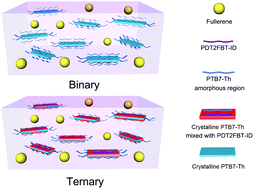
In comparison with many reported high-efficiency polymer solar cells, only 0.5% (v/v) additive is necessary to optimize a polymer/fullerene (PSFSiF/PC71BM) system, and the power conversion efficiency (PCE) was boosted from 2.4% to 8.0%.
The content of this RSS Feed (c) The Royal Society of Chemistry
24 Apr 01:11

Dual Forster resonance energy transfer effects in non-fullerene ternary organic solar cells with the third component embedded in the donor and acceptor

J. Mater. Chem. A, 2017, 5,12120-12130
DOI: 10.1039/C7TA01557G, Paper
Pengqing Bi, Fei Zheng, Xiaoyu Yang, Mengsi Niu, Lin Feng, Wei Qin, Xiaotao Hao
An investigation of phase distribution demonstrated that PCDTBT was embedded in PTB7-Th and ITIC, and hence introduced dual FRET effects in the resulting ternary system.
The content of this RSS Feed (c) The Royal Society of Chemistry
24 Apr 01:11

Evolution of morphology and open-circuit voltage in alloy-energy transfer coexisting ternary organic solar cells

J. Mater. Chem. A, 2017, 5,9859-9866
DOI: 10.1039/C7TA02723K, Paper
Benzheng Xia, Liu Yuan, Jianqi Zhang, Zaiyu Wang, Jin Fang, Yifan Zhao, Dan Deng, Wei Ma, Kun Lu, Zhixiang Wei
Alloy-like domain structure and energy transfer coexist in the ternary system, in which the maximum PCE of 11.1% is obtained.
The content of this RSS Feed (c) The Royal Society of Chemistry
24 Apr 01:10

Systematic evaluation of structure-property relationships in heteroacene - diketopyrrolopyrrole molecular donors for organic solar cells

J. Mater. Chem. A, 2017, 5,9217-9232
DOI: 10.1039/C7TA02037F, Paper
Stephen Loser, Sylvia J. Lou, Brett M. Savoie, Carson J. Bruns, Amod Timalsina, Matthew J. Leonardi, Jeremy Smith, Tobias Harschneck, Riccardo Turrisi, Nanjia Zhou, Charlotte L. Stern, Amy A. Sarjeant, Antonio Facchetti, Robert P. H. Chang, Samuel I. Stupp, Mark A. Ratner, Lin X. Chen, Tobin J. Marks
Understanding the effects of molecular shape on active layer charge transport in OPVs.
The content of this RSS Feed (c) The Royal Society of Chemistry
24 Apr 01:10

Cumulative gain in organic solar cells by using multiple optical nanopatterns

J. Mater. Chem. A, 2017, 5,10347-10354
DOI: 10.1039/C7TA01897E, Paper
Soo Won Heo, Thu Hac Huong Le, Takuo Tanaka, Itaru Osaka, Kazuo Takimiya, Keisuke Tajima
This new method that allowed to separately introduce nanopatterns into multiple interfaces in OPVs cumulatively increased the photocurrent without deterioration of their electronic properties.
The content of this RSS Feed (c) The Royal Society of Chemistry
24 Apr 01:09

Scalable perovskite/CIGS thin-film solar module with power conversion efficiency of 17.8%

J. Mater. Chem. A, 2017, 5,9897-9906
DOI: 10.1039/C7TA01651D, Paper
U. W. Paetzold, M. Jaysankar, R. Gehlhaar, E. Ahlswede, S. Paetel, W. Qiu, J. Bastos, L. Rakocevic, B. S. Richards, T. Aernouts, M. Powalla, J. Poortmans
All-thin film perovskite/CIGS multijunction solar modules, combining a semi-transparent perovskite top solar module stacked on a CIGS bottom solar module, are a promising route to surpass the efficiency limits of single-junction thin-film solar modules.
The content of this RSS Feed (c) The Royal Society of Chemistry
24 Apr 01:08

Graphene oxide as an efficient hole-transporting material for high-performance perovskite solar cells with enhanced stability

J. Mater. Chem. A, 2017, 5,9852-9858
DOI: 10.1039/C7TA01752A, Paper
Qing-Dan Yang[double dagger], Jia Li, Yuanhang Cheng, Ho-Wa Li, Zhiqiang Guan, Binbin Yu, Sai-Wing Tsang
We demonstrated highly efficient and stable perovskite solar cells with a simple solution and room temperature-processed GO as hole-transporting materials.
The content of this RSS Feed (c) The Royal Society of Chemistry
24 Apr 01:08

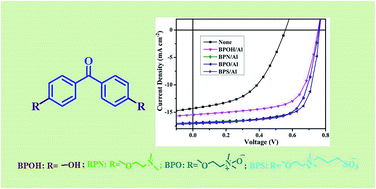
Benzophenone-based small molecular cathode interlayers with various polar groups for efficient polymer solar cells

J. Mater. Chem. A, 2017, 5,10154-10160
DOI: 10.1039/C7TA02427D, Communication
Zhiyang Liu, Wang Li, Ruixiang Peng, Weigang Jiang, Qian Guan, Tao Lei, Rongjuan Yang, Amjad Islam, Qiang Wei, Ziyi Ge
A series of novel benzophenone-based molecules with different polar groups as cathode interfacial materials were synthesized for polymer solar cells.
The content of this RSS Feed (c) The Royal Society of Chemistry
24 Apr 01:07

Nanotube enhanced carbon grids as top electrodes for fully printable mesoscopic semitransparent perovskite solar cells

J. Mater. Chem. A, 2017, 5,10374-10379
DOI: 10.1039/C7TA01383C, Paper
F. R. Li, Y. Xu, W. Chen, S. H. Xie, J. Y. Li
Semitransparent solar cells have attracted significant attention for their potential applications, though obtaining high average visible transmittance (AVT) while maintaining good conversion efficiency is a challenge.
The content of this RSS Feed (c) The Royal Society of Chemistry
24 Apr 01:06

Ultrasensitive Vertical Piezotronic Transistor Based on ZnO Twin Nanoplatelet

by Longfei Wang, Shuhai Liu, Xiaolong Feng, Qi Xu, Suo Bai, Laipan Zhu, Libo Chen, Yong Qin and Zhong Lin Wang

TOC Graphic

ACS Nano
DOI: 10.1021/acsnano.7b01374
17 Apr 09:12

Synergistically Enhanced Performance of Ultrathin Nanostructured Silicon Solar Cells Embedded in Plasmonically Assisted, Multispectral Luminescent Waveguides

by Sung-Min Lee, Purnim Dhar, Huandong Chen, Angelo Montenegro, Lauren Liaw, Dongseok Kang, Boju Gai, Alexander V. Benderskii and Jongseung Yoon

TOC Graphic

ACS Nano
DOI: 10.1021/acsnano.7b00777
17 Apr 09:11

Coherent Nanotwins and Dynamic Disorder in Cesium Lead Halide Perovskite Nanocrystals

by Federica Bertolotti, Loredana Protesescu, Maksym V. Kovalenko, Sergii Yakunin, Antonio Cervellino, Simon J. L. Billinge, Maxwell W. Terban, Jan Skov Pedersen, Norberto Masciocchi and Antonietta Guagliardi

TOC Graphic

ACS Nano
DOI: 10.1021/acsnano.7b00017