Shared posts

17 May 06:11

Performance Enhancement of Tri-Cation and Dual-Anion Mixed Perovskite Solar Cells by Au@SiO2 Nanoparticles

by Tao Ye, Shaoyang Ma, Xi Jiang, Lei Wei, Chellappan Vijila, Seeram Ramakrishna

Tri-cation and dual-anion mixed perovskites have been widely utilized in perovskite solar cell (PSC) applications due to their novel properties such as high absorption, high stability, and low cost. To commercialize the PSCs, further improving the device performance without detrimentally changing the device configuration is important at present. Herein, Au@SiO2 nanoparticles (NPs) are introduced to modify the interface between mesoporous TiO2 (mp-TiO2) and mixed perovskite with increased main photovoltaic parameters of the device, resulting in a ≈29% enhancement of power conversion efficiency (PCE) from 15.8% to 20.3%. The origins of the enhancement have been studied by exploring the optical absorption, optical power distribution, and charge carrier behaviors within the system. The small perturbation transient photovoltage measurement exhibits prolonged charge carrier lifetimes after the Au@SiO2 NPs incorporation, and time of flight photoconductivity measurement shows that charge carrier mobilities of this system are also enhanced. These characteristics make metallic nanostructures a promising functional material in facile tuning of the charge carriers transport and further boosting the PCE of the PSCs.

Thumbnail image of graphical abstract

Au@SiO2 core−shell nanoparticles are incorporated into perovskite solar cells based on tri-cation (cesium, methylammonium, and formamidinium) and dual-anion (Br and I) mixed perovskite. Significant enhancements are observed in nearly all photovoltaic parameters after Au@SiO2 nanoparticles incorporation. The enhanced device performance can be ascribed to the light absorption enhancement, more efficient carrier injection/transport, and the enhanced charge carriers mobilities.

04 May 12:48

Achieving Large-Area Planar Perovskite Solar Cells by Introducing an Interfacial Compatibilizer

by Jinho Lee, Hongkyu Kang, Geunjin Kim, Hyungcheol Back, Junghwan Kim, Soonil Hong, Byoungwook Park, Eunhag Lee, Kwanghee Lee

Despite the recent unprecedented increase in the power conversion efficiencies (PCEs) of small-area devices (≤0.1 cm2), the PCEs deteriorate drastically for PSCs of larger areas because of the incomplete film coverage caused by the dewetting of the hydrophilic perovskite precursor solutions on the hydrophobic organic charge-transport layers (CTLs). Here, an innovative method of fabricating scalable PSCs on all types of organic CTLs is reported. By introducing an amphiphilic conjugated polyelectrolyte as an interfacial compatibilizer, fabricating uniform perovskite films on large-area substrates (18.4 cm2) and PSCs with the total active area of 6 cm2 (1 cm2 × 6 unit cells) via a single-turn solution process is successfully demonstrated. All of the unit cells exhibit highly uniform PCEs of 16.1 ± 0.9% (best PCE of 17%), which is the highest value for printable PSCs with a total active area larger than 1 cm2.

Thumbnail image of graphical abstract

Large-area planar perovskite solar cells (PSCs) are demonstrated by an innovative method using an amphiphilic conjugated polyelectrolyte as an interfacial compatibilizer between the hydrophobic organic charge-transport layer and hydrophilic perovskite layer. Highly scalable PSCs with uniform perovskite films on a large-area substrate (18.4 cm2) and with an active area of 1 cm2 exhibit stabilized power conversion efficiencies of 17%.

24 Apr 02:23

Naphthalene substituents bonded via the [small beta]-position: an extended conjugated moiety can achieve a decent trade-off between optical band gap and open circuit voltage in symmetry-breaking benzodithiophene-based polymer solar cells

J. Mater. Chem. A, 2017, 5,9141-9147
DOI: 10.1039/C7TA01905J, Paper
Deyu Liu, Chunyang Gu, Junyi Wang, Dangqiang Zhu, Yonghai Li, Xichang Bao, Renqiang Yang
Naphthalene bonded via the [small beta]-position to an asymmetric benzodithiophene unit leads to a decent trade-off between the optical band gap and open circuit voltage in PSCs.
The content of this RSS Feed (c) The Royal Society of Chemistry
24 Apr 01:19

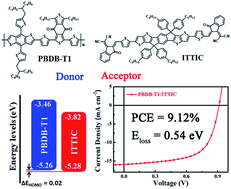
Energy-level modulation of non-fullerene acceptors to achieve high-efficiency polymer solar cells at a diminished energy offset

J. Mater. Chem. A, 2017, 5,9649-9654
DOI: 10.1039/C7TA01554B, Paper
Zhongqiang Zhang, Wenqing Liu, Tahir Rehman, Huan-Xin Ju, Jiangquan Mai, Xinhui Lu, Minmin Shi, Junfa Zhu, Chang-Zhi Li, Hongzheng Chen
A non-fullerene acceptor ITTIC is developed for polymer solar cells with a donor polymer PBDB-T1. A high PCE of 9.12% was obtained with an energy loss of 0.54 eV at a diminished donor/acceptor energy offset.
The content of this RSS Feed (c) The Royal Society of Chemistry
17 Apr 09:10

Brightly Luminescent and Color-Tunable Formamidinium Lead Halide Perovskite FAPbX3 (X = Cl, Br, I) Colloidal Nanocrystals

by Ievgen Levchuk, Andres Osvet, Xiaofeng Tang, Marco Brandl, José Darío Perea, Florian Hoegl, Gebhard J. Matt, Rainer Hock, Miroslaw Batentschuk and Christoph J. Brabec

TOC Graphic

Nano Letters
DOI: 10.1021/acs.nanolett.6b04781
12 Apr 10:54

Highly efficient flexible quantum-dot light emitting diodes with an ITO/Ag/ITO cathode

J. Mater. Chem. C, 2017, 5,4543-4548
DOI: 10.1039/C7TC00514H, Paper
Wenyu Ji, Ting Wang, Bingyan Zhu, Han Zhang, Rong Wang, Dandan Zhang, Liezun Chen, Qingyi Yang, Hanzhuang Zhang
Flexible quantum dot light emitting diodes (QLEDs) are highly desired due to their advantages of foldability, lightweight, and potential applications in lighting and displays.
The content of this RSS Feed (c) The Royal Society of Chemistry
12 Apr 10:52

Ab initio study of the role of oxygen and excess electrons in the degradation of CH3NH3PbI3

J. Mater. Chem. A, 2017, 5,9042-9049
DOI: 10.1039/C7TA01091E, Paper
Linghai Zhang, Patrick H.-L. Sit
Excess electrons from photo-excitation, impurities and defects play a significant role in the degradation of CH3NH3PbI3 (MAPbI3) perovskite in air.
The content of this RSS Feed (c) The Royal Society of Chemistry
11 Apr 05:12

Corrigendum: Enhanced electron extraction using SnO2 for high-efficiency planar-structure HC(NH2)2PbI3-based perovskite solar cells

Corrigendum: Enhanced electron extraction using SnO2 for high-efficiency planar-structure HC(NH2)2PbI3-based perovskite solar cells

Nature Energy, Published online: 3 April 2017; doi:10.1038/nenergy.2017.60

11 Apr 05:10

Intrinsic non-radiative voltage losses in fullerene-based organic solar cells

by Johannes Benduhn

Intrinsic non-radiative voltage losses in fullerene-based organic solar cells

Nature Energy, Published online: 10 April 2017; doi:10.1038/nenergy.2017.53

The conversion efficiency of organic solar cells suffers from their low open-circuit voltages. Here, the authors expose a link between electron-vibrations coupling and non-radiative recombinations, derive a new limit for the efficiency of organic solar cells, and redefine their optimal optical gap.

11 Apr 05:09

Two-step photon up-conversion solar cells

by Shigeo Asahi

Two-step photon up-conversion solar cells

Nature Communications, Published online: 6 April 2017; doi:10.1038/ncomms14962

Harvesting incident photons with energy below the bandgap may lead to highly efficient solar cells. By introducing InAs quantum dots at the hetero-interface, Asahi et al. achieve efficient two step photon up-conversion resulting in additional photocurrent and very high external quantum efficiency.

08 Apr 02:27

Ag-Incorporated Organic–Inorganic Perovskite Films and Planar Heterojunction Solar Cells

by Qi Chen, Lei Chen, Fengye Ye, Ting Zhao, Feng Tang, Adharsh Rajagopal, Zheng Jiang, Shenlong Jiang, Alex K.-Y. Jen, Yi Xie, Jinhua Cai and Liwei Chen

TOC Graphic

Nano Letters
DOI: 10.1021/acs.nanolett.7b00847
08 Apr 02:26

Metal-organic-framework derived porous conducting frameworks for highly efficient quantum dot-sensitized solar cells

J. Mater. Chem. C, 2017, 5,4286-4292
DOI: 10.1039/C7TC00531H, Paper
Yingru Liu, Yuxiu Sun, Jingbo Zhang
Metal-organic-framework (MOF) derived carbon framework was buried inside nanocrystalline SnO2 thin film as an electron highway to increase the transporting rate of electrons in QD-sensitized thin film.
The content of this RSS Feed (c) The Royal Society of Chemistry
08 Apr 02:26

Effective band gap tuning by foreign metal doping in hybrid tin iodide perovskites

J. Mater. Chem. C, 2017, 5,4048-4052
DOI: 10.1039/C7TC00446J, Paper
Hiroyuki Hasegawa, Keisuke Kobayashi, Yukihiro Takahashi, Jun Harada, Tamotsu Inabe
Band gap reduction down to 0.8 eV is observed in tin iodide-based hybrid perovskites as a result of bismuth doping. The band gap reduction originated because of lowering of the conduction band energies. In spite of the foreign metal doping, the number of carriers is not affected.
The content of this RSS Feed (c) The Royal Society of Chemistry
08 Apr 02:25

Perovskite hybrid solar cells with a fullerene derivative electron extraction layer

J. Mater. Chem. C, 2017, 5,4190-4197
DOI: 10.1039/C7TC00597K, Paper
Wenzhan Xu, Xiang Yao, Tianyu Meng, Kai Wang, Fei Huang, Xiong Gong, Yong Cao
The performance of perovskite solar cells is enhanced through pyridine-modified PC61BM as an electron extraction layer.
The content of this RSS Feed (c) The Royal Society of Chemistry
08 Apr 02:25

Electron paramagnetic resonance and electric characterization of a [CH3NH2NH2][Zn(HCOO)3] perovskite metal formate framework

J. Mater. Chem. C, 2017, 5,4526-4536
DOI: 10.1039/C7TC01140G, Paper
Mantas Simenas, Sergejus Balciunas, Monika Trzebiatowska, Maciej Ptak, Miroslaw Maczka, Georg Volkel, Andreas Poppl, Juras Banys
We present an EPR and electric characterization study of structural phase transitions in a novel methylhydrazinium formate framework.
The content of this RSS Feed (c) The Royal Society of Chemistry
08 Apr 02:24

Improved carriers injection capacity in perovskite solar cells by introducing A-site interstitial defects

J. Mater. Chem. A, 2017, 5,7905-7911
DOI: 10.1039/C7TA01203A, Paper
Pengjun Zhao, Wenping Yin, Minwoo Kim, Manhyung Han, Young Jae Song, Tae Kyu Ahn, Hyun Suk Jung
A new strategy to enhance perovskite solar cell performance by introducing potassium cation (K+) as interstitial site defects.
The content of this RSS Feed (c) The Royal Society of Chemistry
08 Apr 02:24

Microwave-synthesized tin oxide nanocrystals for low-temperature solution-processed planar junction organo-halide perovskite solar cells

J. Mater. Chem. A, 2017, 5,7759-7763
DOI: 10.1039/C7TA00975E, Communication
Mutalifu Abulikemu, Marios Neophytou, Jeremy M. Barbe, Max L. Tietze, Abdulrahman El Labban, Dalaver H. Anjum, Aram Amassian, Iain McCulloch, Silvano Del Gobbo
Tin oxide nanoparticles prepared by microwave-assisted non-aqueous sol-gel were used to cast an electron transporting layer for organohalide perovskite solar cells showing, in average, high efficiencies thanks to the good optoelectronic properties of the material.
The content of this RSS Feed (c) The Royal Society of Chemistry
08 Apr 02:24

Pushing up the efficiency of planar perovskite solar cells to 18.2% with organic small molecules as the electron transport layer

J. Mater. Chem. A, 2017, 5,7339-7344
DOI: 10.1039/C7TA01764B, Paper
Pei-Yang Gu, Ning Wang, Chengyuan Wang, Yecheng Zhou, Guankui Long, Miaomiao Tian, Wangqiao Chen, Xiao Wei Sun, Mercouri G. Kanatzidis, Qichun Zhang
We demonstrate metal-oxide-free solution-processed inverted PSCs using sulfur-containing azaacene TDTP as the ETL with a PCE of [similar]18.2%.
The content of this RSS Feed (c) The Royal Society of Chemistry
08 Apr 02:24

Acridine-based novel hole transporting material for high efficiency perovskite solar cells

J. Mater. Chem. A, 2017, 5,7603-7611
DOI: 10.1039/C7TA01248A, Paper
An-Na Cho, Nallan Chakravarthi, Kakaraparthi Kranthiraja, Saripally Sudhaker Reddy, Hui-Seon Kim, Sung-Ho Jin, Nam-Gyu Park
The cost-effective hole transporting material ACR-TPA based on a 9,9-dimethyl-9,10-dihydroacridine core is synthesized and found to be a promising alternative to spiro-MeOTAD because of its comparable photovoltaic performance.
The content of this RSS Feed (c) The Royal Society of Chemistry
08 Apr 02:23

Improving the efficiency of layered perovskite cathodes by microstructural optimization

J. Mater. Chem. A, 2017, 5,7896-7904
DOI: 10.1039/C6TA10946B, Paper
L. dos Santos-Gomez, J. M. Porras-Vazquez, E. R. Losilla, D. Marrero-Lopez
A PrBaCo2O5+[small delta] layered perovskite cathode prepared by an easy and economic spray-pyrolysis deposition method exhibits high performance and stability for low-temperature SOFCs.
The content of this RSS Feed (c) The Royal Society of Chemistry
08 Apr 02:23

Fabrication of PEDOT films via a facile method and their application in Pt-free dye-sensitized solar cells

J. Mater. Chem. A, 2017, 5,7862-7868
DOI: 10.1039/C7TA00990A, Paper
Yin-Chang Li, Song-Ru Jia, Zhi-Yan Liu, Xue-Qin Liu, Yang Wang, Ya Cao, Xiao-Qin Hu, Cheng-Long Peng, Zhen Li
PEDOT films with network-like structures aggregated by plenty of nanoparticles demonstrated good photovoltaic properties.
The content of this RSS Feed (c) The Royal Society of Chemistry
08 Apr 02:23

Molecular engineering of face-on oriented dopant-free hole transporting material for perovskite solar cells with 19% PCE

J. Mater. Chem. A, 2017, 5,7811-7815
DOI: 10.1039/C7TA01718A, Communication
Kasparas Rakstys, Sanghyun Paek, Peng Gao, Paul Gratia, Tomasz Marszalek, Giulia Grancini, Kyung Taek Cho, Kristijonas Genevicius, Vygintas Jankauskas, Wojciech Pisula, Mohammad Khaja Nazeeruddin
Dopant-free HTM KR321 showed highly ordered characteristic face-on organization leading to increased vertical charge transport and PCE over 19% in PSC with improved stability.
The content of this RSS Feed (c) The Royal Society of Chemistry
08 Apr 02:22

Roadmap and roadblocks for the band gap tunability of metal halide perovskites

J. Mater. Chem. A, 2017, 5,11401-11409
DOI: 10.1039/C7TA00404D, Highlight
E. L. Unger, L. Kegelmann, K. Suchan, D. Sorell, L. Korte, S. Albrecht
Solar cells based on metal-halide perovskite semiconductors inspire high hopes for efficient low-cost solar energy conversion technology. We here reflect on recent progress and potential limitations of the band gap tunability of these compound semiconductors.
The content of this RSS Feed (c) The Royal Society of Chemistry
08 Apr 02:22

Electronic and defect properties of (CH3NH3)2Pb(SCN)2I2 analogues for photovoltaic applications

J. Mater. Chem. A, 2017, 5,7845-7853
DOI: 10.1039/C7TA01688C, Paper
Alex M. Ganose, Christopher N. Savory, David O. Scanlon
In this report, we study a range of 2-D perovskite-like compounds (CH3NH3)2MPs2X2 (M = Sn, Pb; Ps = OCN, SCN, SeCN and X = Cl, Br I), finding suitable band gaps, band alignments and defect behaviour for photovoltaic top cells in tandem devices.
The content of this RSS Feed (c) The Royal Society of Chemistry
08 Apr 02:21

Simultaneous enhancement of the molecular planarity and the solubility of non-fullerene acceptors: effect of aliphatic side-chain substitution on the photovoltaic performance

J. Mater. Chem. A, 2017, 5,7776-7783
DOI: 10.1039/C7TA02141K, Communication
Zhe Zhang, Miao Li, Yahui Liu, Jicheng Zhang, Shiyu Feng, Xinjun Xu, Jinsheng Song, Zhishan Bo
By incorporating aliphatic side chains and adjusting their lengths, non-fullerene acceptors can obtain an improved morphology and photovoltaic performance.
The content of this RSS Feed (c) The Royal Society of Chemistry
08 Apr 02:20

The intrinsic properties of FA(1-x)MAxPbI3 perovskite single crystals

J. Mater. Chem. A, 2017, Advance Article
DOI: 10.1039/C7TA01441D, Paper
Yuan Huang, Liang Li, Zonghao Liu, Haoyang Jiao, Yuqing He, Xiaoge Wang, Rui Zhu, Dong Wang, Junliang Sun, Qi Chen, Huanping Zhou
We provided a systematical investigation to correlate the crystal structure, composition, mobility, and ion migration behavior to the ratio of MA+/FA+ in FA(1-x)MAxPbI3 single crystal.
To cite this article before page numbers are assigned, use the DOI form of citation above.
The content of this RSS Feed (c) The Royal Society of Chemistry
08 Apr 02:19

FAPb1-xSnxI3 mixed metal halide perovskites with improved light harvesting and stability for efficient planar heterojunction solar cells

J. Mater. Chem. A, 2017, 5,9097-9106
DOI: 10.1039/C6TA11181E, Paper
Jiang Liu, Gang Wang, Zhen Song, Xulin He, Kun Luo, Qinyan Ye, Cheng Liao, Jun Mei
FA-based perovskite devices with reduced Pb contents were prepared.
The content of this RSS Feed (c) The Royal Society of Chemistry
06 Apr 00:55

Perovskite Films: Toward All Room-Temperature, Solution-Processed, High-Performance Planar Perovskite Solar Cells: A New Scheme of Pyridine-Promoted Perovskite Formation (Adv. Mater. 13/2017)

by Hong Zhang, Jiaqi Cheng, Dan Li, Francis Lin, Jian Mao, Chunjun Liang, Alex K.-Y. Jen, Michael Grätzel, Wallace C. H. Choy
Thumbnail image of graphical abstract

In article number 1604695, Wallace C.H. Choy and co-workers propose a novel room-temperature scheme of pyridine-promoted formation of perovskite films featuring large grain-sizes, and high crystallinity, while being free of residues. This new approach enables the fabrication of all room-temperature, solution-processed perovskite solar cells (PVSCs) with a record efficiency of 17.10% and 14.19%, with no hysteresis on rigid and flexible substrate respectively.

25 Mar 08:17

Glycerol/PEDOT:PSS coated woven fabric as a flexible heating element on textiles

J. Mater. Chem. C, 2017, 5,3807-3822
DOI: 10.1039/C7TC00486A, Paper
Maria R. Moraes, Alexandra C. Alves, Fatih Toptan, Marcos S. Martins, Eliana M. F. Vieira, Antonio J. Paleo, Antonio P. Souto, Washington L. F. Santos, Maria F. Esteves, Andrea Zille
A cost-competitive, flexible and safe thermoelectric polyamide 6,6 (PA66) fabric coated with glycerol-doped PEDOT:PSS (PEDOT:PSS + GLY) for use in large area textiles as a heating element in several applications.
The content of this RSS Feed (c) The Royal Society of Chemistry
25 Mar 08:11

A critical review on tin halide perovskite solar cells

J. Mater. Chem. A, 2017, 5,11518-11549
DOI: 10.1039/C7TA00929A, Review Article
Maria Konstantakou, Thomas Stergiopoulos
In this work, we reviewed the evolution of the performance of photovoltaic devices (single junction and tandems) using Sn-containing perovskites.
The content of this RSS Feed (c) The Royal Society of Chemistry