22 Jul 01:54
J. Mater. Chem. C, 2017, 5,7123-7141
DOI: 10.1039/C7TC01997A, Review Article
Younggul Song, Takhee Lee
This review article addresses the motivation for studying electronic noises in OEDs and focuses on summarizing recent noise studies on various OEDs.
The content of this RSS Feed (c) The Royal Society of Chemistry
08 Jul 02:11
J. Mater. Chem. A, 2017, 5,13439-13447
DOI: 10.1039/C7TA03331A, Paper
Jiaxing Song, Leijing Liu, Xiao-Feng Wang, Gang Chen, Wenjing Tian, Tsutomu Miyasaka
Although ZnO is a compatible electron transport layer (ETL) for perovskite solar cells (PSCs), the fact that MAPbI3 easily undergoes thermal decomposition on a low-temperature processed ZnO surface limits the use of one-step deposition of perovskite and hence the resulting photovoltaic performance. The triple cation perovskite prepared with a one-step deposition method is demonstrated to be a stable light absorber in highly efficient PSCs with low-temperature processed ZnO as the ETL.
The content of this RSS Feed (c) The Royal Society of Chemistry
08 Jul 02:09
by Mingzhu Long, Tiankai Zhang, Wangying Xu, Xiaoliang Zeng, Fangyan Xie, Qiang Li, Zefeng Chen, Fengrui Zhou, Kam Sing Wong, Keyou Yan, Jianbin Xu

In article number 1601882, Keyou Yan, Jianbin Xu, and co-workers report a simple intermediate halide exchange reaction between nonstoichiometric FAI and unstable intermediate HPbI2Br to produce high-quality FAPbI3-xBrx thin films with crystal domain up to 2-3 μm, eliminating the use of antisolvent dripping process. And it demonstrates outstanding opto-electronic performances as well as enhanced stability under moisture and heat stress.
08 Jul 02:09
J. Mater. Chem. A, 2017, 5,14881-14886
DOI: 10.1039/C7TA03315J, Paper
Qi Li, Yicheng Zhao, Rui Fu, Wenke Zhou, Yao Zhao, Fang Lin, Song Liu, Dapeng Yu, Qing Zhao
Using a double-layer hole transport material configuration, perovskite solar cells sustain over 90% of their initial output after 10[space]h of steady-state measurement.
The content of this RSS Feed (c) The Royal Society of Chemistry
08 Jul 02:05
by Cheng Bi, Bo Chen, Haotong Wei, Stephan DeLuca, Jinsong Huang
Organic–inorganic hybrid perovskites (OIHPs) are new photoactive layer candidates for lightweight and flexible solar cells due to their low-temperature process capability; however, the reported efficiency of flexible OIHP devices is far behind those achieved on rigid glass substrates. Here, it is revealed that the limiting factor is the different perovskite film deposition conditions required to form the same film morphology on flexible substrates. An optimized perovskite film composition needs a different precursor ratio, which is found to be essential for the formation of high-quality perovskite films with longer radiative carrier recombination lifetime, smaller density of trap states, reduced precursor residue, and uniform and pin-hole free films. A record efficiency of 18.1% is achieved for the flexible perovskite solar-cell devices made on an indium tin oxide/poly(ethylene terephthalate) substrate via a low temperature (≤100 °C) solution process.

A different precursor ratio is found to be essential for the formation of high-quality perovskite films on flexible substrates compared to those formed on rigid substrates. A high efficiency of 18.1% is achieved for flexible perovskite solar-cell devices made on an indium tin oxide/poly(ethylene terephthalate) substrate via a low-temperature (≤100 °C) solution process.
06 Jul 11:43
by Tanja Ivanovska, Chiara Dionigi, Edoardo Mosconi, Filippo De Angelis, Fabiola Liscio, Vittorio Morandi and Giampiero Ruani

The Journal of Physical Chemistry Letters
DOI: 10.1021/acs.jpclett.7b01156

06 Jul 11:43
by Wolfgang Tress

The Journal of Physical Chemistry Letters
DOI: 10.1021/acs.jpclett.7b00975

06 Jul 07:47
by Jiangtao Zhao, Mei Liu, Li Fang, Shenlong Jiang, Jingtian Zhou, Huaiyi Ding, Hongwen Huang, Wen Wen, Zhenlin Luo, Qun Zhang, Xiaoping Wang and Chen Gao

The Journal of Physical Chemistry Letters
DOI: 10.1021/acs.jpclett.7b01083

26 Jun 02:33
J. Mater. Chem. A, 2017, 5,15124-15129
DOI: 10.1039/C7TA02662E, Paper
Tingting Shi, Hai-Shan Zhang, Weiwei Meng, Qiang Teng, Meiyue Liu, Xiaobao Yang, Yanfa Yan, Hin-Lap Yip, Yu-Jun Zhao
The schematic diagram of different Sn-5s and I-5p antibonding strengths of FASnI3 and MASnI3 due to various bond lengths of Sn-I.
The content of this RSS Feed (c) The Royal Society of Chemistry
26 Jun 02:32
by Sheng Dong, Zhicheng Hu, Kai Zhang, Qingwu Yin, Xiaofang Jiang, Fei Huang, Yong Cao
A cross-linkable dual functional polymer hybrid electron transport layer (ETL) is developed by simply adding an amino-functionalized polymer dopant (PN4N) and a light crosslinker into a commercialized n-type semiconductor (N2200) matrix. It is found that the resulting hybrid ETL not only has a good solvent resistance, facilitating multilayers device fabrication but also exhibits much improved electron transporting/extraction properties due to the doping between PN4N and N2200. As a result, by using PTB7-Th:PC71BM blend as an active layer, the inverted device based on the hybrid ETL can yield a prominent power conversion efficiency of around 10.07%. More interestingly, photovoltaic property studies of bilayer devices suggest that the absorption of the hybrid ETL contributes to photocurrent and hence the hybrid ETL simultaneously acts as both cathode interlayer material and an electron acceptor. The resulting inverted polymer solar cells function like a novel device architectures with a combination of a bulk heterojunction device and miniature bilayer devices. This work provides new insights on function of ETLs and may be open up a new direction for the design of new ETL materials and novel device architectures to further improve device performance.

Cross-linkable dual functional hybrid electron transport layers are developed and can work as both cathode interlayer and light harvesting layer in polymer solar cells, which enhance electron collection and contribute to photocurrent production in the resulting devices. These results may provide new directions for the design of multifunctional interface materials and novel device architectures.
21 Jun 01:01
J. Mater. Chem. A, 2017, 5,14689-14696
DOI: 10.1039/C7TA02590D, Paper
Haitao Xu, Xiang Fu, Xiaofang Cheng, Liqiang Huang, Dan Zhou, Lie Chen, Yiwang Chen
High and homogeneous mobility of PCPDT-T can improve the efficiency and thickness insensitivity of organic solar cells.
The content of this RSS Feed (c) The Royal Society of Chemistry
17 Jun 06:47
J. Mater. Chem. A, 2017, 5,13229-13229
DOI: 10.1039/C7TA90124K, Correction

Open Access
Jhao-lin Wu, Wen-Kuan Huang, Yu-Chia Chang, Bo-Chou Tsai, Yu-Cheng Hsiao, Chih-Yu Chang, Chin-Ti Chen, Chao-Tsen Chen
The content of this RSS Feed (c) The Royal Society of Chemistry
17 Jun 06:46
by Peng-Fei Li, Wei-Qiang Liao, Yuan-Yuan Tang, Heng-Yun Ye, Yi Zhang and Ren-Gen Xiong

Journal of the American Chemical Society
DOI: 10.1021/jacs.7b04693

16 Jun 01:53
by Alessandro Surrente, Dumitru Dumcenco, Zhuo Yang, Agnieszka Kuc, Yu Jing, Thomas Heine, Yen-Cheng Kung, Duncan K. Maude, Andras Kis and Paulina Plochocka

Nano Letters
DOI: 10.1021/acs.nanolett.7b00904

16 Jun 01:52
J. Mater. Chem. A, 2017, 5,16446-16466
DOI: 10.1039/C7TA01258F, Review Article
Anurag Krishna, Andrew C. Grimsdale
Hole-transporting materials for perovskite solar cells are reviewed and the possibility of rationally designing a cost-effective high performing material discussed.
The content of this RSS Feed (c) The Royal Society of Chemistry
15 Jun 11:33
J. Mater. Chem. A, 2017, 5,13957-13965
DOI: 10.1039/C7TA04575A, Communication
Chih-Chun Chung, Sudhakar Narra, Efat Jokar, Hui-Ping Wu, Eric Wei-Guang Diau
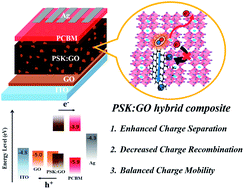
The hybrid perovskite/graphene oxide composite layer increased the interfacial contact between the donor and acceptor of holes to balance the charge mobility and improved the photovoltaic performance with excellent reproducibility and stability.
The content of this RSS Feed (c) The Royal Society of Chemistry
15 Jun 11:30
by Sylvia J. Lou, Jodi M. Szarko, Tao Xu, Luping Yu, Tobin J. Marks and Lin X. Chen
Journal of the American Chemical Society
DOI: 10.1021/jacs.7b00277

15 Jun 04:23
J. Mater. Chem. A, 2017, 5,13748-13756
DOI: 10.1039/C7TA01740E, Paper
Open Access
Gael H. L. Heintges, Pieter J. Leenaers, Rene A. J. Janssen
The effects of cold and hot processing on the performance of polymer-fullerene solar cells are investigated for polymers designed to exhibit temperature-dependent aggregation in solution via second-position branched alkyl side chains.
The content of this RSS Feed (c) The Royal Society of Chemistry
15 Jun 04:23
J. Mater. Chem. A, 2017, 5,14259-14269
DOI: 10.1039/C7TA03815A, Paper
Maria Privado, Virginia Cuesta, Pilar de la Cruz, Mukhamed L. Keshtov, Ganesh D. Sharma, Fernando Langa
A novel non-fullerene acceptor is used to build an all small molecule BHJ OSC with a PCE of 7.76%, applying vacuum drying.
The content of this RSS Feed (c) The Royal Society of Chemistry
15 Jun 04:23
J. Mater. Chem. A, 2017, 5,14124-14133
DOI: 10.1039/C7TA04344A, Paper
Juan Yu, Wenran Wang, Zhenxiao Pan, Jun Du, Zhenwei Ren, Weinan Xue, Xinhua Zhong
Benefiting from the suppressed charge recombination occurring at the photoanode/electrolyte interfaces with the introduction of TEOS additive in the polysulfide electrolyte, a remarkable PCE of over 12% was obtained for ZCISe QDSCs.
The content of this RSS Feed (c) The Royal Society of Chemistry
14 Jun 06:41
by Azat F. Akbulatov, Lyubov A. Frolova, Monroe P. Griffin, Ioana R. Gearba, Andrei Dolocan, David A. Vanden Bout, Sergey Tsarev, Eugene A. Katz, Alexander F. Shestakov, Keith J. Stevenson, Pavel A. Troshin
Abstract
This paper presents a systematic study of the influence of electron-transport materials on the operation stability of the inverted perovskite solar cells under both laboratory indoor and the natural outdoor conditions in the Negev desert. It is shown that all devices incorporating a Phenyl C61 Butyric Acid Methyl ester ([60]PCBM) layer undergo rapid degradation under illumination without exposure to oxygen and moisture. Time-of-flight secondary ion mass spectrometry depth profiling reveals that volatile products from the decomposition of methylammonium lead iodide (MAPbI3) films diffuse through the [60]PCBM layer, go all the way toward the top metal electrode, and induce its severe corrosion with the formation of an interfacial AgI layer. On the contrary, alternative electron-transport material based on the perylendiimide derivative provides good isolation for the MAPbI3 films preventing their decomposition and resulting in significantly improved device operation stability. The obtained results strongly suggest that the current approach to design inverted perovskite solar cells should evolve with respect to the replacement of the commonly used fullerene-based electron-transport layers with other types of materials (e.g., functionalized perylene diimides). It is believed that these findings pave a way toward substantial improvements in the stability of the perovskite solar cells, which are essential for successful commercialization of this photovoltaic technology.

Diffusion of CH3NH3I and other volatile products of photodegradation of CH3NH3PbI3 into the [60]PCBM electron-transport layer represents the key failure mechanism of inverted hybrid perovskite solar cells.
14 Jun 06:41
by Baobing Fan, Wenkai Zhong, Xiao-Fang Jiang, Qingwu Yin, Lei Ying, Fei Huang, Yong Cao

The photovoltaic performance of polymer solar cells can be dramatically improved upon the incorporation of a nonfullerene electron acceptor (NFA) as the third component. In article number 1602127, Lei Ying, Fei Huang, and co-workers develop a new NFA that can lead to obviously improved performance by virtue of cascade energy transfer. This cover describes a frame of such ternary device, where the three components are highlighted in different colors.
14 Jun 06:37
by Gi Eun Park, Suna Choi, Seo Yeon Park, Dae Hee Lee, Min Ju Cho, Dong Hoon Choi
Abstract
A wide-bandgap polymer, (poly[(2,6-(4,8-bis(5-(2-ethylhexyl)thiophen-2-yl)-benzo[1,2-b:4,5-b′]dithiophene))-alt-(2,5-(methyl thiophene carboxylate))]) (3MT-Th), is synthesized to obtain a complementary broad range absorption when harmonized with 3,9-bis(2-methylene-(3-(1,1-dicyanomethylene)-indanone))-5,5,11,11-tetrakis(4-hexylphenyl)-dithieno[2,3-d:2′,3′-d′]-s-indaceno[1,2-b:5,6-b′]dithiophene (ITIC). The synthesized regiorandom 3MT-Th polymer shows good solubility in nonhalogenated solvents. A film of 3MT-Th:ITIC can be employed for forming an active layer in a polymer solar cell (PSC), with the blend solution containing toluene with 0.25% diphenylether as a nonhalogenated additive. The corresponding PSC devices display a power conversion efficiency of 9.73%. Moreover, the 3MT-Th-based PSCs exhibit excellent shelf-life time of over 1000 h and are operationally stable under continuous light illumination. Therefore, methyl thiophene-3-carboxylate in 3MT-Th is a promising new accepting unit for constructing p-type polymers used for high-performance nonfullerene-type PSCs.

A wide-bandgap polymer, (poly[(2,6-(4,8-bis(5-(2-ethylhexyl)thiophen-2-yl)-benzo[1,2-b:4,5-b′]dithiophene))-alt-(2,5-(methyl thiophene carboxylate))]) (3MT-Th), displays a high efficiency of 9.73% with 3,9-bis(2-methylene-(3-(1,1-dicyanomethylene)-indanone))-5,5,11,11-tetrakis(4-hexylphenyl)-dithieno[2,3-d:2′,3′-d′]-s-indaceno[1,2-b:5,6-b′]dithiophene acceptor using toluene as a nonhalogenated solvent. The 3MT-Th-based PSCs exhibit excellent shelf-life stability of over 1000 h and operationally stable under continuous light illumination compared with the PTB7-Th-based PSCs.
14 Jun 06:37
by Yang Wang, Zonglong Zhu, Chu-Chen Chueh, Alex K.-Y. Jen, Yun Chi
Abstract
Perovskite solar cells have emerged as a promising technique for low-cost, light weight, and highly efficient photovoltaics. However, they still largely rely on 2,2′,7,7′-tetrakis(N,N-di-p-methoxyphenylamine)-9,9′-spirobifluorene (Spiro-OMeTAD) to serve as hole-transporting materials (HTMs). Here, a series of HTMs with small molecular weight is designed, which are constructed on a spiro core involving phenylpyrazole and a second heteroaromatics, i.e., xanthene (O atom), thioxanthene (S atom), and acridine (N atom). Through varying from phenylpyrazole substituted xanthene (PPyra-XA), thioxanthene (PPyra-TXA), to acridine (PPyra-ACD), their optical and electrochemical properties, hole mobilities, and the photovoltaic performance are optimized. As a consequence, PPyra-TXA based device exhibits the highest power conversion efficiency (PCE) of 18.06%, outperforming that of Spiro-OMeTAD (16.15%), which could be attributed to the enhancement of hole mobility exerted by the thioxanthene. In addition, the dopant-free device shows PCE of 11.7%. These results open a new direction for designing spiro-HTMs by simple modification of chemical structures.

Perovskite solar cells bearing spiro-phenylpyrazole-9,9′-thioxanthene exhibit power conversion efficiency of 18.06%, outperforming that of Spiro-OMeTAD (16.15%), which could be attributed to the enhancement of hole mobility exerted by the thioxanthene.
14 Jun 06:29
by Jia-Wen Xiao, Lang Liu, Deliang Zhang, Nicholas De Marco, Jin-Wook Lee, Oliver Lin, Qi Chen, Yang Yang
Abstract
The halide perovskite (PVSK) materials (with ABX3 formulation) have emerged as “dream materials” for photovoltaic (PV) applications due to their remarkable physical properties such as high optical absorption coefficient, carrier mobility, long carrier diffusion lengths, etc. These properties have enabled the PV devices to reach higher than 20% power conversion efficiencies (PCE) in record time. The further pursuit of higher PCE and improved stability brings forth increasing interests in so-called “mixed composition” PVSK materials, consisting of partial substitution of the A, B, and/or X-sites with alternative elements/molecules of similar size. Herein, we highlight the recent advances in developing mixed PVSK for PVs and their relevant optoelectronic properties. We mainly focus on mixed PVSK materials in the form of polycrystalline thin films, but also discuss nanostructured and two-dimensional (2D) PVSK materials due to the increasing interest of broad readership. Efforts are exerted to elucidate the design principles of mixed PVSK and fabrication techniques for high performance optoelectronic devices, which help deepen our fundamental understanding of mixed PVSK systems. We hope this review will shed light onto the design and synthesis of mixed PVSK materials to further the progress of PVSK photovoltaics towards higher efficiencies and longer lifetimes.

Perovskite solar cells (PSCs) employing metal halide perovskites with mixed composition as light absorbers generally show high device performance. The recent progress of PSCs based on mixed perovskites is reviewed, trying to shed light onto the design and synthesis of mixed perovskite materials to further improve the device performance on both efficiency and stability.
14 Jun 06:27
by Wei Chen, Fang-Zhou Liu, Xi-Yuan Feng, Aleksandra B. Djurišić, Wai Kin Chan, Zhu-Bing He
Abstract
Organic–inorganic hybrid perovskite solar cells have resulted in tremendous interest in developing next generation photovoltaics due to high record efficiency exceeding 22%. For inverted structure perovskite solar cells, the hole extraction layers play a significant role in achieving efficient and stable perovskite solar cell by modifying charge extraction, interfacial recombination losses, and band alignment. Here, cesium doped NiOx is selected as a hole extraction layer to study the impact of Cs dopant on the optoelectronic properties of NiOx and the photovoltaic performance. Cs doped NiOx films are prepared by a simple solution-based method. Both doped and undoped NiOx films are smooth and highly transparent, while the Cs doped NiOx exhibits better electron conductivity and higher work function. Therefore, Cs doping results in a significant improvement in the performance of NiOx-based inverted planar perovskite solar cells. The best efficiency of Cs doped NiOx devices is 19.35%, and those devices show high stability as well. The improved efficiency in devices with Cs:NiOx is attributed to a significant improvement in the hole extraction and better band alignment compared to undoped NiOx. This work reveals that Cs doped NiOx is very promising hole extraction material for high and stable inverted perovskite solar cells.

Cesium doping of NiOx enhances the conductivity of the oxide film and the hole extraction from the perovskite film in inverted planar perovskite solar cells. Significantly improved photovoltaic performance is obtained with the best efficiencies of 16.04% and 19.35% for NiOx and Cs:NiOx, respectively. The devices exhibit negligible hysteresis and good stability.
14 Jun 03:03
by Jin-Wook Lee, Seul-Gi Kim, Sang-Hoon Bae, Do-Kyoung Lee, Oliver Lin, Yang Yang and Nam-Gyu Park

Nano Letters
DOI: 10.1021/acs.nanolett.7b01211

14 Jun 02:37
by Himchan Cho, Christoph Wolf, Joo Sung Kim, Hyung Joong Yun, Jong Seong Bae, Hobeom Kim, Jung-Min Heo, Soyeong Ahn, Tae-Woo Lee
This paper reports highly bright and efficient CsPbBr3 perovskite light-emitting diodes (PeLEDs) fabricated by simple one-step spin-coating of uniform CsPbBr3 polycrystalline layers on a self-organized buffer hole injection layer and stoichiometry-controlled CsPbBr3 precursor solutions with an optimized concentration. The PeLEDs have maximum current efficiency of 5.39 cd A−1 and maximum luminance of 13752 cd m−2. This paper also investigates the origin of current hysteresis, which can be ascribed to migration of Br− anions. Temperature dependence of the electroluminescence (EL) spectrum is measured and the origins of decreased spectrum area, spectral blue-shift, and linewidth broadening are analyzed systematically with the activation energies, and are related with Br− anion migration, thermal dissociation of excitons, thermal expansion, and electron–phonon interaction. This work provides simple ways to improve the efficiency and brightness of all-inorganic polycrystalline PeLEDs and improves understanding of temperature-dependent ion migration and EL properties in inorganic PeLEDs.

Efficient and bright CsPbBr3 perovskite light-emitting diodes are achieved using a one-step fabrication of uniform CsPbBr3 polycrystalline layers on a self-organized buffer hole injection layer without synthesis of quantum dots. A study of the temperature dependence of current hysteresis and electroluminescence spectrum provides understanding of ion migration, nonradiative pathways, and electron–phonon interaction in the CsPbBr3 perovskite light-emitting diodes.
14 Jun 02:34
by Jiawen Lu, Xuexi Sheng, Guoqing Tong, Zhongwei Yu, Xiaolin Sun, Linwei Yu, Xiangxin Xu, Junzhuan Wang, Jun Xu, Yi Shi, Kunji Chen

Ultrafast solar-blind UV detection, enabled by a hybrid inorganic perovskite CsPbX3 quantum-dot radial junction architecture, achieves rise/fall response times of 0.48/1.03 ms and a high responsivity of 54 mA W−1 at 200 nm without an external power supply, as described by Linwei Yu, Xiangxing Xu, and co-workers in article number 1700400. These results pave the way toward large-area manufacturing of high-performance Sibased perovskite UV detectors in a low-cost procedure.
14 Jun 02:34
by Ryosuke Nishikubo, Norimitsu Tohnai, Ichiro Hisaki, Akinori Saeki

Upon cooling and heating, organic–inorganic perovskite nanoparticles are reversibly decomposed and formed through the lower-critical-solution-temperature phenomenon. Akinori Saeki and co-workers demonstrate an aurora-like photoemissive object in article number 1700047, and reveal the roles of the involved chemicals (methylammonium cation, lead, halogen, and molecular additives). The cloud temperature is varied from ca. 30 to 80 °C by controlling the concentration, and multi-luminescent-color thermoresponsive solutions are achieved through compositional engineering of the halogen.