Electro-organic synthesis is a powerful technique for the sustainable preparation of compounds. However, many electrosynthetic reactions require complex equipment, are limited to a very narrow current density range, or have very long reaction times; some also involve nonselective transformations and bad scalability. The robust and selective synthesis of nonsymmetric biphenols and partially protected derivatives is established by anodic C–C cross-coupling. The setup is simple, involving constant current conditions and undivided cells. Its key is a unique electrolyte system based on fluorous alcohols and mixtures, particularly 1,1,1,3,3,3-hexafluoroisopropanol. This allows variations of the current density of more than two orders of magnitude without decreasing selectivity or product yield. This exceptional effect is unknown for electro-organic synthesis of products that have similar oxidation potentials as the starting materials. It potentially paves the way for industrial electrolyzers with variable current consumption, which could enable the flexible use of energy surplus in the electricity supply.
Chen Weijie
Shared posts
Unexpected high robustness of electrochemical cross-coupling for a broad range of current density
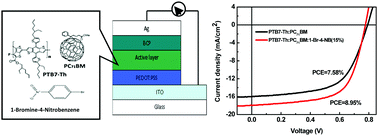
Enhanced performance of polymer solar cells based on PTB7-Th:PC71BM by doping with 1-bromo-4-nitrobenzene
DOI: 10.1039/C7TC04062H, Paper
A fluorescence inhibitor 1-bromo-4-nitrobenzene was introduced into the PTB7-Th:PC71BM active layer to prepare an organic solar cell that exhibited a high PCE of 8.95%.
The content of this RSS Feed (c) The Royal Society of Chemistry
Enhanced charge carrier extraction by a highly ordered wrinkled MgZnO thin film for colloidal quantum dot solar cells

DOI: 10.1039/C7TC02740K, Paper
A highly ordered wrinkled MgZnO thin film is prepared using a low-temperature combustion method to enhance the charge carrier extraction of PbS colloidal quantum dot solar cells.
The content of this RSS Feed (c) The Royal Society of Chemistry
Doping porphyrin-based bulk heterojunction solar cells with LITFSI and TFSA

DOI: 10.1039/C7TC02416A, Paper
The performance of solar cells based on a porphyrin small molecule is enhanced by LITFSI and TFSA dopants.
The content of this RSS Feed (c) The Royal Society of Chemistry
Effect of laser energy on the crystal structure and UV response characteristics of mixed-phase MgZnO thin films deposited by PLD and the fabrication of high signal/noise ratio solar-blind UV detector based on mix-phase MgZnO at lower voltage

DOI: 10.1039/C7TC02195J, Paper
UV detectors based on mixed-phase MgZnO thin films, synthesized at 24 J cm-2 and 26 J cm-2, could detect faint deep UV light under strong background noise.
The content of this RSS Feed (c) The Royal Society of Chemistry
Charge-Transfer Dynamics in the Lowest Excited State of a Pentacene–Fullerene Complex: Implications for Organic Solar Cells

An integrated approach towards the fabrication of highly efficient and long-term stable perovskite nanowire solar cells

DOI: 10.1039/C7TA07968K, Paper
An integrated approach towards the fabrication of efficient and long-term stable perovskite nanowire solar cells is reported by combining interfacial engineering with a promising encapsulation technique.
The content of this RSS Feed (c) The Royal Society of Chemistry
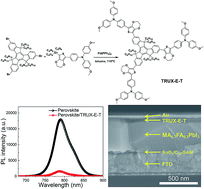
Cost-effective hole transporting material for stable and efficient perovskite solar cells with fill factors up to 82%
DOI: 10.1039/C7TA08053K, Paper
A cost-effective truxene-based hole selective material has been facilely synthesized for efficient perovskite solar cells with 82% FFs.
The content of this RSS Feed (c) The Royal Society of Chemistry
Donor polymer fluorination doubles the efficiency in non-fullerene organic photovoltaics

DOI: 10.1039/C7TA07882J, Paper
Donor polymer fluorination in ITIC-based device led to a large increase in the current and an efficiency twice that of the non-fluorinated polymer based device.
The content of this RSS Feed (c) The Royal Society of Chemistry
Solar Cells: Rationally Designed Donor–Acceptor Random Copolymers with Optimized Complementary Light Absorption for Highly Efficient All-Polymer Solar Cells (Adv. Funct. Mater. 38/2017)

In article number 1703070, Won Suk Shin, Bumjoon J. Kim, and co-workers describe the importance of the design of polymer donor-polymer acceptor pair to achieve complementary light absorption in all-polymer solar cells (all-PSCs). Synthetic donor-acceptor random copolymers with tunable light absorption characteristics were developed, which resulted in high performance all-PSC with a power conversion efficiency of 6.8%.
A Facile Method to Fine-Tune Polymer Aggregation Properties and Blend Morphology of Polymer Solar Cells Using Donor Polymers with Randomly Distributed Alkyl Chains
Abstract
The device performance of polymer solar cells (PSCs) is strongly dependent on the blend morphology. One of the strategies for improving PSC performance is side-chain engineering, which plays an important role in controlling the aggregation properties of the polymers and thus the domain crystallinity/purity of the donor–acceptor blends. In particular, for a family of high-performance donor polymers with strong temperature-dependent aggregation properties, the device performances are very sensitive to the size of alkyl chains, and the best device performance can only be achieved with an optimized odd-numbered alkyl chain. However, the synthetic route of odd-numbered alkyl chains is costly and complicated, which makes it difficult for large-scale synthesis. Here, this study presents a facile method to optimize the aggregation properties and blend morphology by employing donor polymers with a mixture of two even-numbered, randomly distributed alkyl chains. In a model polymer system, this study suggests that the structural and electronic properties of the random polymers comprising a mixture of 2-octyldodecyl and 2-decyltetradecyl alkyl chains can be systematically tuned by varying the mixing ratio, and a high power conversion efficiency (11.1%) can be achieved. This approach promotes the scalability of donor polymers and thus facilitates the commercialization of PSCs.

The structural and electronic properties of random polymers comprising a mixture of commercially available alkyl chains can be systematically tuned and a power conversion efficiency up to 11.1% can be achieved, which is one of the highest values to date for polymer:fullerene solar cells. These random polymers are easier to scale up compared to that obtained using odd-numbered alkyl chains.
High-Performance Wide Bandgap Copolymers Using an EDOT Modified Benzodithiophene Donor Block with 10.11% Efficiency
Abstract
Newly developed benzo[1,2-b:4,5-b′]dithiophene (BDT) block with 3,4-ethylenedioxythiophene (EDOT) side chains is first employed to build efficient photovoltaic copolymers. The resulting copolymers, PBDTEDOT-BT and PBDTEDOTFBT, have a large bandgap more than 1.80 eV, which is attributed to the increased steric hindrance between the BDT and EDOT skeletons. Both copolymers possess the satisfied absorptions, low-lying highest occupied molecular orbital (HOMO) levels and high crystallinity. Using the fluorination strategy, PBDTEDOT-FBT exhibits a wider and stronger absorption and a deeper HOMO level than those of PBDTEDOT-BT. PBDTEDOT-FBT:[6,6]-Phenyl C71 butyric acid methyl ester (PC71BM) blend also shows the higher hole mobility and better surface morphology compared with the PBDTEDOTBT:PC71BM blend. Combination of above advantages, PBDTEDOT-FBT devices exhibit much higher power conversion efficiency (PCE) of 10.11%, with an improved open circuit voltage (Voc) of 0.86 V, short circuit current densities (Jsc) of 16.01 mA cm−2, and fill factor (FF) of 72.6%. This work not only provides a newly efficient candidate of BDT donor block modified with EDOT conjugated side chains, but also achieves high-performance large bandgap copolymers for polymer solar cells (PSCs) via the synergistic effect of fluorination and side chain engineering strategies.

Combination of fluorination and side chain engineering strategies, newly developed benzo[1,2-b:4,5-b′]dithiophene block with 3,4-ethylenedioxythiophene side chains is first employed to build the efficient large bandgap copolymers with efficiency of 10.11%.
Inorganic CsPbI3 Perovskite Coating on PbS Quantum Dot for Highly Efficient and Stable Infrared Light Converting Solar Cells
Abstract
Solution-processed colloidal quantum dot (CQD) solar cells harvesting the infrared part of the solar spectrum are especially interesting for future use in semitransparent windows or multilayer solar cells. To improve the device power conversion efficiency (PCE) and stability of the solar cells, surface passivation of the quantum dots is vital in the research of CQD solar cells. Herein, inorganic CsPbI3 perovskite (CsPbI3-P) coating on PbS CQDs with a low-temperature, solution-processed approach is reported. The PbS CQD solar cell with CsPbI3-P coating gives a high PCE of 10.5% and exhibits remarkable stability both under long-term constant illumination and storage under ambient conditions. Detailed characterization and analysis reveal improved passivation of the PbS CQDs with the CsPbI3-P coating, and the results suggest that the lattice coherence between CsPbI3-P and PbS results in epitaxial induced growth of the CsPbI3-P coating. The improved passivation significantly diminishes the sub-bandgap trap-state assisted recombination, leading to improved charge collection and therefore higher photovoltaic performance. This work therefore provides important insight to improve the CQD passivation by coating with an inorganic perovskite ligand for photovoltaics or other optoelectronic applications.

Inorganic CsPbI3 perovskite is epitaxially grown on the PbS colloidal quantum dot at a low temperature. Increased depletion width, lower trap density, reduced charge recombination, and enhanced built-in electric field within the solar cell are obtained by using the CsPbI3-perovskited coated PbS colloidal quantum dot as a light absorbing material in the solar cell, resulting in high performance.
Black Phosphorus: Synthesis and Application for Solar Cells
Abstract
Few-layer ultrathin nanosheets and ultrasmall quantum dots of black phosphorus (BP) have attracted increasing research interest due to their fascinating properties including a tunable bandgap, high carrier mobility, and ambipolar conduction ability. These excellent properties together with their unique structures make BP derivatives promising candidates for a wide range of device applications. In this research news, the latest advancements in the synthesis, properties, and applications of BP and its derivatives are highlighted. In particular, the focus is on the use of these rising star materials for emerging solar cells, in terms of both theoretical predictions and experimental investigations. Finally, the authors' personal perspectives on potential future research directions are provided.

Few-layer phosphorus, often called phosphorene, is the most recent addition to the family of 2D nanomaterials. The material has several interesting properties including a tunable bandgap, high carrier mobility, and ambipolar conductivity. This article explores the current state of synthesis of few-layer black phosphorus derivatives and their successful application in various emerging solar cells.
Charge Generation and Recombination in an Organic Solar Cell with Low Energetic Offsets
Abstract
Organic bulk heterojunction (BHJ) solar cells require energetic offsets between the donor and acceptor to obtain high short-circuit currents (JSC) and fill factors (FF). However, it is necessary to reduce the energetic offsets to achieve high open-circuit voltages (VOC). Recently, reports have highlighted BHJ blends that are pushing at the accepted limits of energetic offsets necessary for high efficiency. Unfortunately, most of these BHJs have modest FF values. How the energetic offset impacts the solar cell characteristics thus remains poorly understood. Here, a comprehensive characterization of the losses in a polymer:fullerene BHJ blend, PIPCP:phenyl-C61-butyric acid methyl ester (PC61BM), that achieves a high VOC (0.9 V) with very low energy losses (Eloss = 0.52 eV) from the energy of absorbed photons, a respectable JSC (13 mA cm−2), but a limited FF (54%) is reported. Despite the low energetic offset, the system does not suffer from field-dependent generation and instead it is characterized by very fast nongeminate recombination and the presence of shallow traps. The charge-carrier losses are attributed to suboptimal morphology due to high miscibility between PIPCP and PC61BM. These results hold promise that given the appropriate morphology, the JSC, VOC, and FF can all be improved, even with very low energetic offsets.

To realize organic photovoltaics with high open-circuit voltages and short-circuit currents, it is necessary to minimize energetic offsets between donor and acceptor semiconductors. This article describes a comprehensive study on charge recombination and generation in a system with very low energetic offsets yet relatively high performance, in order to identify the root cause for the limited fill factor.
Polymer Solar Cells: Eco-Friendly Solvent-Processed Fullerene-Free Polymer Solar Cells with over 9.7% Efficiency and Long-Term Performance Stability (Adv. Energy Mater. 19/2017)

In article number 1700566, Min Ju Cho, Dong Hoon Choi, and co-workers report a new conjugated widebandgap donor polymer, 3MT-Th, harmonized with an ITIC acceptor to enable the production of a polymer solar cell (PSC) with high efficiency of 9.73% under eco-friendly conditions using a non-halogenated solvent. This PSC also exhibits excellent shelf-life stability in air and good operational stability under continuous light illumination.
Solar Cells: Dielectric Response: Answer to Many Questions in the Methylammonium Lead Halide Solar Cell Absorbers (Adv. Energy Mater. 19/2017)

Charge carriers in methylammonium lead perovskite solar cell absorbers assume a combined (hyper-) polaronic state combining a classical Fröhlich polaron with a micelle-like arrangement of electric dipoles formed by the methylammonium ions. This “micellion” provides an extra contribution to the dielectric constant which screens defects but maintains mobility of the polaron. This is reported by Doru C. Lupascu and co-workers in article number 1700600. In the image, the structure of the hyperpolaron is shown.
In Situ GIWAXS Analysis of Solvent and Additive Effects on PTB7 Thin Film Microstructure Evolution during Spin Coating
Abstract
The influence of solvent and processing additives on the pathways and rates of crystalline morphology formation for spin-coated semiconducting PTB7 (poly[[4,8-bis[(2-ethylhexyl)oxy]benzo[1,2-b:4,5-b′]dithiophene-2,6-diyl][3-fluoro-2-[(2-ethylhexyl)-carbonyl]-thieno[3,4-b]thiophenediyl]]) thin films is investigated by in situ grazing incidence wide-angle X-ray scattering (GIWAXS) and optical reflectance, to better understand polymer solar cell (PSC) optimization approaches. In situ characterization of PTB7 film formation from chloroform (CF), chlorobenzene (CB), and 1,2-dichlorobenzene (DCB) solutions, as well as CB solutions with 1% and 3% v/v of the processing additives 1-chloronapthalene (CN), diphenylether (DPE), and 1,8-diiodooctane (DIO), reveals multiple crystallization pathways with: (i) single-solvent systems exhibiting rapid (<3 s) crystallization after a solvent boiling point-dependent film thinning transition, (ii) solvent + additive systems exhibiting different crystallization pathways and crystallite formation times from minutes (CN, DPE) to 1.5 h (DIO). Identifying crystalline intermediates has implications for bulk-heterojunction PSC morphology optimization via optimized spin-casting processes.

An in situ GIWAXS study of the crystalline evolution of PTB7 thin films during spin coating is performed. A divergence in intermediate aggregation states and film formation times determined by solvent additive choice is observed. This work shows how additive effects go beyond simply boiling point and the importance of the additive molecular structure on morphological evolution.
Enhanced Open-Circuit Voltage in Colloidal Quantum Dot Photovoltaics via Reactivity-Controlled Solution-Phase Ligand Exchange
Abstract
The energy disorder that arises from colloidal quantum dot (CQD) polydispersity limits the open-circuit voltage (VOC) and efficiency of CQD photovoltaics. This energy broadening is significantly deteriorated today during CQD ligand exchange and film assembly. Here, a new solution-phase ligand exchange that, via judicious incorporation of reactivity-engineered additives, provides improved monodispersity in final CQD films is reported. It has been found that increasing the concentration of the less reactive species prevents CQD fusion and etching. As a result, CQD solar cells with a VOC of 0.7 V (vs 0.61 V for the control) for CQD films with exciton peak at 1.28 eV and a power conversion efficiency of 10.9% (vs 10.1% for the control) is achieved.

A new solution-phase ligand exchange method for preventing colloidal quantum dots fusion and etching is developed via judicious incorporation of reactivity-engineered additives. This method provides improved monodispersity in final colloidal quantum dot films and thus leads to the significant enhancement of open-circuit voltages in colloidal quantum dot solar cells.
Slow-Photon-Effect-Induced Photoelectrical-Conversion Efficiency Enhancement for Carbon-Quantum-Dot-Sensitized Inorganic CsPbBr3 Inverse Opal Perovskite Solar Cells
Abstract
All-inorganic cesium lead halide perovskite is suggested as a promising candidate for perovskite solar cells due to its prominent thermal stability and comparable light absorption ability. Designing textured perovskite films rather than using planar-architectural perovskites can indeed optimize the optical and photoelectrical conversion performance of perovskite photovoltaics. Herein, for the first time, this study demonstrates a rational strategy for fabricating carbon quantum dot (CQD-) sensitized all-inorganic CsPbBr3 perovskite inverse opal (IO) films via a template-assisted, spin-coating method. CsPbBr3 IO introduces slow-photon effect from tunable photonic band gaps, displaying novel optical response property visible to naked eyes, while CQD inlaid among the IO frameworks not only broadens the light absorption range but also improves the charge transfer process. Applied in the perovskite solar cells, compared with planar CsPbBr3, slow-photon effect of CsPbBr3 IO greatly enhances the light utilization, while CQD effectively facilitates the electron–hole extraction and injection process, prolongs the carrier lifetime, jointly contributing to a double-boosted power conversion efficiency (PCE) of 8.29% and an increased incident photon-to-electron conversion efficiency of up to 76.9%. The present strategy on CsPbBr3 IO to enhance perovskite PCE can be extended to rationally design other novel optoelectronic devices.

Novel carbon quantum dot (CQD)-sensitized inorganic CsPbBr3 inverse opal perovskite solar cells are fabricated for the first time. CsPbBr3 inverse opal induces improved light utilization originating from the slow-photon effect with tunable photonic band gaps, while CQD helps to facilitate the charge transfer process, which jointly contributes to a greatly improved photoelectrical conversion efficiency with outstanding stability.
Imbedded Nanocrystals of CsPbBr3 in Cs4PbBr6: Kinetics, Enhanced Oscillator Strength, and Application in Light-Emitting Diodes
Abstract
Solution-grown films of CsPbBr3 nanocrystals imbedded in Cs4PbBr6 are incorporated as the recombination layer in light-emitting diode (LED) structures. The kinetics at high carrier density of pure (extended) CsPbBr3 and the nanoinclusion composite are measured and analyzed, indicating second-order kinetics in extended and mainly first-order kinetics in the confined CsPbBr3, respectively. Analysis of absorption strength of this all-perovskite, all-inorganic imbedded nanocrystal composite relative to pure CsPbBr3 indicates enhanced oscillator strength consistent with earlier published attribution of the sub-nanosecond exciton radiative lifetime in nanoprecipitates of CsPbBr3 in melt-grown CsBr host crystals and CsPbBr3 evaporated films.

Photoluminescence and electroluminescence in solution-grown films of CsPbBr3 nanocrystals imbedded in Cs4PbBr6 are studied. Radiative recombination kinetics are second order in bulk CsPbBr3 and first order in CsPbBr3 nanoinclusions. Exciton absorption strength and sub-nanosecond lifetime imply enhanced oscillator strength in the confined form. A semiconductor that is dark in bulk lights up as a highly efficient and fast nanocomposite light emitter.
Thermodynamic Stability Trend of Cubic Perovskites

Pinning Down the Anomalous Light Soaking Effect toward High-Performance and Fast-Response Perovskite Solar Cells: The Ion-Migration-Induced Charge Accumulation

Elucidating the role of the hole-extracting electrode on the stability and efficiency of inverted[space]CsSnI3/C60 perovskite photovoltaics

DOI: 10.1039/C7TA05967A, Paper
 Open Access
   This article is licensed under a Creative Commons Attribution 3.0 Unported Licence.
Unencapsulated inverted CsSnI3 perovskite photovoltaics are shown to exhibit the highest air-stability under continuous illumination without a hole-transport layer.
The content of this RSS Feed (c) The Royal Society of Chemistry
A random donor polymer based on an asymmetric building block to tune the morphology of non-fullerene organic solar cells

DOI: 10.1039/C7TA07830G, Communication
The introduction of an asymmetric unit enables a fine-tuned morphology and thus up to 10.4% efficiency for non-fullerene organic solar cells.
The content of this RSS Feed (c) The Royal Society of Chemistry
Boosting the photovoltaic thermal stability of fullerene bulk heterojunction solar cells through charge transfer interactions

DOI: 10.1039/C7TA06530B, Paper
Charge transfer interaction of a donor polymer with an appropriate 9-fluorenylidene malononitrile derivative in the active layer leads to profoundly enhanced thermal stability of fullerene-based bulk heterojunction organic solar cells.
The content of this RSS Feed (c) The Royal Society of Chemistry
Efficient Lead-Free Solar Cells Based on Hollow {en}MASnI3 Perovskites

Mixed-Halide Perovskites with Stabilized Bandgaps

Antimony (V) Complex Halides: Lead-Free Perovskite-Like Materials for Hybrid Solar Cells
Abstract
Using bromoantimonate (V) (N-EtPy)[SbBr6] as an example, it is demonstrated that ABX6 compounds can form perovskite-like 3D crystalline frameworks with short interhalide contacts, enabling advanced optoelectronic characteristics of these materials. The designed compound shows an impressive performance in planar junction solar cells delivering external quantum efficiency of ≈80% and power conversion efficiency of ≈4%, thus being comparable with the conventional perovskite material MAPbBr3. The discovery of the first perovskite-like compound ABX6 exhibiting good photovoltaic performance opens wide opportunities for rational design of novel perovskite-like semiconductor materials for advanced electronic and photovoltaic applications.

Planar junction solar cells based on the complex antimony (V) bromide (N-EtPy)[SbBr6] reveal external quantum efficiency of ≈80% and power conversion efficiency of ≈4%. The discovery of the first perovskite-like compound ABX6 exhibiting good photovoltaic performance opens wide opportunities for rational design of novel hybrid semiconductor materials for advanced electronic and photovoltaic applications.
Unraveling the Solution-State Supramolecular Structures of Donor–Acceptor Polymers and their Influence on Solid-State Morphology and Charge-Transport Properties
Abstract
Polymer self-assembly in solution prior to film fabrication makes solution-state structures critical for their solid-state packing and optoelectronic properties. However, unraveling the solution-state supramolecular structures is challenging, not to mention establishing a clear relationship between the solution-state structure and the charge-transport properties in field-effect transistors. Here, for the first time, it is revealed that the thin-film morphology of a conjugated polymer inherits the features of its solution-state supramolecular structures. A “solution-state supramolecular structure control” strategy is proposed to increase the electron mobility of a benzodifurandione-based oligo(p-phenylene vinylene) (BDOPV)-based polymer. It is shown that the solution-state structures of the BDOPV-based conjugated polymer can be tuned such that it forms a 1D rod-like structure in good solvent and a 2D lamellar structure in poor solvent. By tuning the solution-state structure, films with high crystallinity and good interdomain connectivity are obtained. The electron mobility significantly increases from the original value of 1.8 to 3.2 cm2 V−1 s−1. This work demonstrates that “solution-state supramolecular structure” control is critical for understanding and optimization of the thin-film morphology and charge-transport properties of conjugated polymers.

A supramolecular self-assembly strategy is used to control the solution-state structure of a conjugated polymer. It is revealed that the thin-film morphology of the conjugated polymer inherits the features of their solution-state supramolecular structures. Through “solution-state supramolecular structure control”, the electron mobility of the polymer is boosted to 3.2 cm2 V−1 s−1, nearly doubling the original performance.