Among various all-inorganic halide perovskites exhibiting better stability than organic-inorganic halide perovskites, α-CsPbI3 with the most suitable band gap for tandem solar cell application faces an issue of phase instability under ambient conditions. We discovered that a small amount of two-dimensional (2D) EDAPbI4 perovskite containing the ethylenediamine (EDA) cation stabilizes the α-CsPbI3 to avoid the undesirable formation of the nonperovskite phase. Moreover, not only the 2D perovskite of EDAPbI4 facilitate the formation of α-CsPbI3 perovskite films exhibiting high phase stability at room temperature for months and at 100°C for >150 hours but also the α-CsPbI3 perovskite solar cells (PSCs) display highly reproducible efficiency of 11.8%, a record for all-inorganic lead halide PSCs. Therefore, using the bication EDA presents a novel and promising strategy to design all-inorganic lead halide PSCs with high performance and reliability.
Chen Weijie
Shared posts
Bication lead iodide 2D perovskite component to stabilize inorganic {alpha}-CsPbI3 perovskite phase for high-efficiency solar cells
Origin of the Substitution Mechanism for the Binding of Organic Ligands on the Surface of CsPbBr3 Perovskite Nanocubes

Insertion of double bond [small pi]-bridges of A-D-A acceptors for high performance near-infrared polymer solar cells

DOI: 10.1039/C7TA07049G, Paper
A low bandgap n-OS molecule SJ-IC was synthesized by inserting double bond [small pi]-bridges between the donor and acceptor units of IDT-IC, and SJ-IC as an acceptor shows broad absorption and improved photovoltaic performance when using a broad bandgap polymer J61 as a donor.
The content of this RSS Feed (c) The Royal Society of Chemistry
Highly conductive Na-embedded carbon nanowalls for hole-transport-material-free perovskite solar cells without metal electrodes

DOI: 10.1039/C7TA07730K, Paper
Highly conductive porous Na-embedded carbon nanowalls exhibit excellent counter electrode performance for HTM-free perovskite solar cells without metal electrodes.
The content of this RSS Feed (c) The Royal Society of Chemistry
High-Efficiency and Stable Quantum Dot Light-Emitting Diodes Enabled by a Solution-Processed Metal-Doped Nickel Oxide Hole Injection Interfacial Layer
Abstract
Stabilization is one critical issue that needs to be improved for future application of colloidal quantum dot (QD)-based light-emitting diodes (QLEDs). This study reports highly efficient and stable QLEDs based on solution-processsed, metal-doped nickel oxide films as hole injection layer (HIL). Several kinds of metal dopants (Li, Mg, and Cu) are introduced to improve the hole injection capability of NiO films. The resulting device with Cu:NiO HIL exhibits superior performance compared to the state-of-the-art poly(3,4-ethylenedioxythiophene):poly(styrene-sulfonate) (PEDOT:PSS)-based QLEDs, with a maximum current efficiency and external quantum efficiency of 45.7 cd A−1 and 10.5%, respectively. These are the highest values reported so far for QLEDs with PEDOT:PSS-free normal structure. Meanwhile, the resulting QLED shows a half-life time of 87 h at an initial luminance of 5000 cd m−2, almost fourfold longer than that of the PEDOT:PSS-based device.

This study reports highly efficient and stable quantum dot light-emitting diodes (QLEDs) based on solution-processed, metal-doped NiO films as hole injection layer (HIL). The best-performing device with Cu:NiO HIL exhibits superior performance compared to the state-of-the-art poly(3,4-ethylenedioxythiophene):poly(styrene-sulfonate) (PEDOT:PSS)-based QLEDs, with a maximum current efficiency and external quantum efficiency of 45.7 cd A−1 and 10.5%, respectively.
Influence of Donor Polymer on the Molecular Ordering of Small Molecular Acceptors in Nonfullerene Polymer Solar Cells
Abstract
Nonfullerene polymer solar cells (PSCs) based on polymer donors and nonfullerene small molecular acceptors (SMAs) have recently attracted considerable attention. Although much of the progress is driven by the development of novel SMAs, the donor polymer also plays an important role in achieving efficient nonfullerene PSCs. However, it is far from clear how the polymer donor choice influences the morphology and performance of the SMAs and the nonfullerene blends. In addition, it is challenging to carry out quantitative analysis of the morphology of polymer:SMA blends, due to the low material contrast and overlapping scattering features of the π–π stacking between the two organic components. Here, a series of nonfullerene blends is studied based on ITIC-Th blended with five different donor polymers. Through quantitative morphology analysis, the (010) coherence length of the SMA is characterized and a positive correlation between the coherence length of the SMA and the device fill factor (FF) is established. The study reveals that the donor polymer can significantly change the molecular ordering of the SMA and thus improve the electron mobility and domain purity of the blend, which has an overall positive effect that leads to the enhanced device FF for nonfullerene PSCs.

Morphological analysis reveals influence of the donor polymer on the structural/electronic properties of small molecular acceptor and the overall blend morphology. A direct correlation is found between the (010) coherence length of small molecular acceptor with device fill-factor and photocurrent density, which is in good agreement with the parameters reported for state-of-art high-efficiency nonfullerene polymer solar cells.
Complex Interplay between Absorber Composition and Alkali Doping in High-Efficiency Kesterite Solar Cells
Abstract
Sodium treatment of kesterite layers is a widely used and efficient method to boost solar cell efficiency. However, first experiments employing other alkali elements cause confusion as reported results contradict each other. In this comprehensive investigation, the effects of absorber composition, alkali element, and concentration on optoelectronic properties and device performance are investigated. Experimental results show that in the row Li–Na–K–Rb–Cs the nominal Sn content should be reduced by more than 20% (relative) to achieve the highest conversion efficiency. The alkali concentration resulting in highest device efficiencies is lower by an order of magnitude for the heavy alkali elements (Rb, Cs) compared to the lighter ones (Li, Na, K). Utilization of a wide range of characterization techniques helps to unveil the complex interplay between absorber composition and alkali doping. A ranking of alkali for best device performances, when employing alkali treatment, resulted in the order of Li > Na > K > Rb > Cs based on the statistics of more than 700 individual cells. Finally, a champion device with 11.5% efficiency (12.3% active area) is achieved using a high Li concentration with an optimized Sn content.

Treatment with different alkali elements necessitates tuning absorber composition and specifically Sn content for achieving maximum performance of kesterite thin film solar cells. A ranking of alkali for best device performances is in the order of Li > Na > K > Rb > Cs, whereby an efficiency of 11.5% (total cell area) is achieved for a Li-doped champion device.
Cerium and Ytterbium Codoped Halide Perovskite Quantum Dots: A Novel and Efficient Downconverter for Improving the Performance of Silicon Solar Cells
Abstract
Quantum cutting can realize the emission of multiple near-infrared photons for each ultraviolet/visible photon absorbed, and has potential to significantly improve the photoelectric conversion efficiency (PCE) of solar cells. However, due to the lack of an ideal downconversion material, it has merely served as a principle in the laboratory until now. Here, the fabrication of a novel type of quantum cutting material, CsPbCl1.5Br1.5:Yb3+, Ce3+ nanocrystals is presented. Benefiting from the larger absorption cross-section, weaker electron–phonon coupling, and higher inner luminescent quantum yield (146%), the doped perovskite nanocrystals are successfully explored as a downconverter of commercial silicon solar cells (SSCs). Noticeably, the PCE of the SSCs is improved from 18.1% to 21.5%, with a relative enhancement of 18.8%. This work exhibits a cheap, convenient, and effective way to enhance the PCE of SSCs, which may be commercially popularized in the future.

Cerium and ytterbium codoped halide perovskite quantum dots display an efficient near-infrared emission with inner luminescent quantum yield of 146%. The quantum dots are explored to enhance the performance of silicon solar cells with a relative enhancement of 18.8%.
Improved Domain Size and Purity Enables Efficient All-Small-Molecule Ternary Solar Cells
Abstract
An all-small-molecule ternary solar cell is achieved with a power conversion efficiency of 10.48% by incorporating phenyl-C71-butyric-acid-methyl ester (PC71BM) into a nonfullerene binary system. The addition of PC71BM is found to modulate the film morphology by improving the domain purity and decreasing the domain size. This modulation facilitates charge generation and suppresses charge recombination, as manifested by the significantly enhanced short-circuit current density and fill factor. The results correlate the domain characteristics with the device performance and offer new insight from the perspective of morphology modulation for constructing efficient ternary devices.

An all-small-molecule ternary solar cell is achieved with a power conversion efficiency of 10.48% by incorporating the phenyl-C71-butyric-acid-methyl ester (PC71BM) into a nonfullerene small-molecule binary system. The addition of PC71BM is found to modulate the film morphology by improving the domain purity and decreasing the domain size. This facilitates charge generation and suppresses charge recombination.
Direct Observation of Halide Migration and its Effect on the Photoluminescence of Methylammonium Lead Bromide Perovskite Single Crystals
Abstract
Optoelectronic devices based on hybrid perovskites have demonstrated outstanding performance within a few years of intense study. However, commercialization of these devices requires barriers to their development to be overcome, such as their chemical instability under operating conditions. To investigate this instability and its consequences, the electric field applied to single crystals of methylammonium lead bromide (CH3NH3PbBr3) is varied, and changes are mapped in both their elemental composition and photoluminescence. Synchrotron-based nanoprobe X-ray fluorescence (nano-XRF) with 250 nm resolution reveals quasi-reversible field-assisted halide migration, with corresponding changes in photoluminescence. It is observed that higher local bromide concentration is correlated to superior optoelectronic performance in CH3NH3PbBr3. A lower limit on the electromigration rate is calculated from these experiments and the motion is interpreted as vacancy-mediated migration based on nudged elastic band density functional theory (DFT) simulations. The XRF mapping data provide direct evidence of field-assisted ionic migration in a model hybrid-perovskite thin single crystal, while the link with photoluminescence proves that the halide stoichiometry plays a key role in the optoelectronic properties of the perovskite.

Bromide-ion migration is directly observed in a methylammonium lead bromide perovskite single crystal under bias using a synchrotron-based X-ray fluorescence nanoprobe. Photoluminescence mapping indicates that bromide-rich regions exhibit enhanced photoluminescence. The close correspondence between the local bromide concentration and photoluminescence in response to bias reveals the importance of non-stoichiometry in determining optoelectronic performance in halide perovskites.
Efficient Semitransparent Organic Solar Cells with Tunable Color enabled by an Ultralow-Bandgap Nonfullerene Acceptor
Abstract
Semitransparent organic solar cells (OSCs) show attractive potential in power-generating windows. However, the development of semitransparent OSCs is lagging behind opaque OSCs. Here, an ultralow-bandgap nonfullerene acceptor, “IEICO-4Cl”, is designed and synthesized, whose absorption spectrum is mainly located in the near-infrared region. When IEICO-4Cl is blended with different polymer donors (J52, PBDB-T, and PTB7-Th), the colors of the blend films can be tuned from purple to blue to cyan, respectively. Traditional OSCs with a nontransparent Al electrode fabricated by J52:IEICO-4Cl, PBDB-T:IEICO-4Cl, and PTB7-Th:IEICO-4Cl yield power conversion efficiencies (PCE) of 9.65 ± 0.33%, 9.43 ± 0.13%, and 10.0 ± 0.2%, respectively. By using 15 nm Au as the electrode, semitransparent OSCs based on these three blends also show PCEs of 6.37%, 6.24%, and 6.97% with high average visible transmittance (AVT) of 35.1%, 35.7%, and 33.5%, respectively. Furthermore, via changing the thickness of Au in the OSCs, the relationship between the transmittance and efficiency is studied in detail, and an impressive PCE of 8.38% with an AVT of 25.7% is obtained, which is an outstanding value in the semitransparent OSCs.

A new nonfullerene acceptor, IEICO-4Cl, is designed to prepare semitransparent organic solar cells (OSCs), yielding a power conversion efficiency of 8.38% with an average visible transmittance of 25.7%, which is among the top results for semitransparent OSCs.
CsPb0.9Sn0.1IBr2 Based All-Inorganic Perovskite Solar Cells with Exceptional Efficiency and Stability

High-Performance Flexible Perovskite Solar Cells on Ultrathin Glass: Implications of the TCO

Highly Efficient Solution-Processed Deep-Red Organic Light-Emitting Diodes Based on an Exciplex Host Composed of a Hole Transporter and a Bipolar Host

Sequential Doping Reveals the Importance of Amorphous Chain Rigidity in Charge Transport of Semi-Crystalline Polymers

Efficient fullerene-free solar cells with wide optical band gap polymers based on fluorinated benzotriazole and asymmetric benzodithiophene

DOI: 10.1039/C7TA07390A, Communication
An asymmetric benzodithiophene polymer achieved around 10% PCE with an ITIC acceptor.
The content of this RSS Feed (c) The Royal Society of Chemistry
From Recombination Dynamics to Device Performance: Quantifying the Efficiency of Exciton Dissociation, Charge Separation, and Extraction in Bulk Heterojunction Solar Cells with Fluorine-Substituted Polymer Donors
Abstract
An original set of experimental and modeling tools is used to quantify the yield of each of the physical processes leading to photocurrent generation in organic bulk heterojunction solar cells, enabling evaluation of materials and processing condition beyond the trivial comparison of device performances. Transient absorption spectroscopy, “the” technique to monitor all intermediate states over the entire relevant timescale, is combined with time-delayed collection field experiments, transfer matrix simulations, spectral deconvolution, and parametrization of the charge carrier recombination by a two-pool model, allowing quantification of densities of excitons and charges and extrapolation of their kinetics to device-relevant conditions. Photon absorption, charge transfer, charge separation, and charge extraction are all quantified for two recently developed wide-bandgap donor polymers: poly(4,8-bis((2-ethylhexyl)oxy)benzo[1,2-b:4,5-b′]dithiophene-3,4-difluorothiophene) (PBDT[2F]T) and its nonfluorinated counterpart poly(4,8-bis((2-ethylhexyl)oxy)benzo[1,2-b:4,5-b′]dithiophene-3,4-thiophene) (PBDT[2H]T) combined with PC71BM in bulk heterojunctions. The product of these yields is shown to agree well with the devices' external quantum efficiency. This methodology elucidates in the specific case studied here the origin of improved photocurrents obtained when using PBDT[2F]T instead of PBDT[2H]T as well as upon using solvent additives. Furthermore, a higher charge transfer (CT)-state energy is shown to lead to significantly lower energy losses (resulting in higher VOC) during charge generation compared to P3HT:PCBM.

The individual efficiencies and losses associated with each step of photocurrent generation in PBDT[2X]T:PC71BM solar cells are determined using a combination of advanced transient spectroscopic, charge extraction, and steady-state spectroscopic techniques, aiding the development of a fuller understanding of the complex interplay between chemical structure, thin film processing conditions, and their impact on device performance.
Fused-Ring Acceptors with Asymmetric Side Chains for High-Performance Thick-Film Organic Solar Cells
Abstract
A kind of new fused-ring electron acceptor, IDT-OB, bearing asymmetric side chains, is synthesized for high-efficiency thick-film organic solar cells. The introduction of asymmetric side chains can increase the solubility of acceptor molecules, enable the acceptor molecules to pack closely in a dislocated way, and form favorable phase separation when blended with PBDB-T. As expected, PBDB-T:IDT-OB-based devices exhibit high and balanced hole and electron mobility and give a high power conversion efficiency (PCE) of 10.12%. More importantly, the IDT-OB-based devices are not very sensitive to the film thickness, a PCE of 9.17% can still be obtained even the thickness of active layer is up to 210 nm.

A new fused-ring electron acceptor (IDT-OB), bearing asymmetric side chains, is facilely synthesized for high-efficiency thick-film organic solar cells. The asymmetric structure makes it easier to form ideal phase separation when blended with a polymer donor. Power conversion efficiencies of 10.12% and 8.57% are obtained with active-layer thicknesses of 130 and 320 nm, respectively.
Investigation on the role of Lewis bases in the ripening process of perovskite films for highly efficient perovskite solar cells

DOI: 10.1039/C7TA05378A, Paper
The ripening effect of Lewis bases on perovskite films is investigated and PSCs based on a synergistic DMSO/urea system exhibit a PCE of 20.06%.
The content of this RSS Feed (c) The Royal Society of Chemistry
A simple molecular structure of ortho-derived perylene diimide diploid for non-fullerene organic solar cells with efficiency over 8%

DOI: 10.1039/C7TA06804B, Paper
A simple molecular structure of ortho-derived perylene diimides (PDI) diploid has been developed for non-fullerene organic solar cells (OSCs) with a high power conversion efficiency (PCE) of 8.3%, indicating that such a concise molecular structure with a high PCE has great potential for the practical applications in OSCs.
The content of this RSS Feed (c) The Royal Society of Chemistry
Biohybrid Photoprotein-Semiconductor Cells with Deep-Lying Redox Shuttles Achieve a 0.7 V Photovoltage
Abstract
Photosynthetic proteins transduce sunlight into biologically useful forms of energy through a photochemical charge separation that has a close to 100% quantum efficiency, and there is increasing interest in their use as sustainable materials in biohybrid devices for solar energy harvesting. This work explores a new strategy for boosting the open circuit voltage of photoelectrochemical cells based on a bacterial photosynthetic pigment-protein by employing highly oxidizing redox electrolytes in conjunction with an n-type silicon anode. Illumination generates electron–hole pairs in both the protein and the silicon electrode, the two being connected by the electrolyte which transfers electrons from the reducing terminal of the protein to photogenerated holes in the silicon valence band. A high open circuit voltage of 0.6 V is achieved with the most oxidizing electrolyte 2,2,6,6-tetramethyl-1-piperidinyloxy, and this is further improved to 0.7 V on surface modification of the silicon electrode to increase its surface area and reduce reflection of incident light. The photovoltages produced by these biohybrid protein/silicon cells are comparable to those typical of silicon heterojunction and dye-sensitized solar cells.

Deep-lying redox electrolytes shuttle photogenerated electrons from a biohybrid photosynthetic protein Fluorine-doped-tin-oxide-coated-glass working electrode into photogenerated holes in a n-silicon counter electrode.
Perovskite and Organic Solar Cells Fabricated by Inkjet Printing: Progress and Prospects
Abstract
Inkjet printing (IJP) technology, adapted from home and office printing, has proven to be an essential research tool and industrial manufacturing technique in a wide range of printed electronic technologies, including optoelectronics. Its primary advantage over other deposition methods is the low-cost and maskless on-demand patterning, which offers unmatched freedom-of-design. Additional benefits include the efficient use of materials, contactless high-resolution deposition, and scalability, enabling rapid translation of learning from small-scale, laboratory-based research into large-scale industrial roll-to-roll manufacturing. In the development of organic solar cells (OSCs), IJP has enabled the printing of many of the multiple functional layers which comprise the complete cell as part of an additive printing scheme. Although IJP is only recently employed in perovskite solar cell (PeSC) fabrication, it is already showing great promise and is anticipated to find broader application with this class of materials. As OSCs and PeSCs share many common functional materials and device architectures, this review presents a progress report on the IJP of OSCs and PeSCs in order to facilitate knowledge transfer between the two technologies, with critical analyses of the challenges and opportunities also presented.

An environmentally friendly and scalable manufacturing method is essential for the successful commercialization of perovskite and organic solar cells. Inkjet printing is a roll-to-roll compatible technique which is demonstrated in lab to industrial scale production. Herein, the use of inkjet printing in perovskite and organic solar cells is reviewed together to facilitate knowledge exchange, as both technologies use similar materials and processes.
The Effects of Crystallinity on Charge Transport and the Structure of Sequentially Processed F4TCNQ-Doped Conjugated Polymer Films
Abstract
The properties of molecularly doped films of conjugated polymers are explored as the crystallinity of the polymer is systematically varied. Solution sequential processing (SqP) was used to introduce 2,3,5,6-tetrafluoro-7,7,8,8-tetracyanoquinodimethane (F4TCNQ) into poly(3-hexylthiophene-2,5-diyl) (P3HT) while preserving the pristine polymer's degree of crystallinity. X-ray data suggest that F4TCNQ anions reside primarily in the amorphous regions of the film as well as in the P3HT lamellae between the side chains, but do not π-stack within the polymer crystallites. Optical spectroscopy shows that the polaron absorption redshifts with increasing polymer crystallinity and increases in cross section. Theoretical modeling suggests that the polaron spectrum is inhomogeneously broadened by the presence of the anions, which reside on average 6–8 Å from the polymer backbone. Electrical measurements show that the conductivity of P3HT films doped by F4TCNQ via SqP can be improved by increasing the polymer crystallinity. AC magnetic field Hall measurements show that the increased conductivity results from improved mobility of the carriers with increasing crystallinity, reaching over 0.1 cm2 V−1 s−1 in the most crystalline P3HT samples. Temperature-dependent conductivity measurements show that polaron mobility in SqP-doped P3HT is still dominated by hopping transport, but that more crystalline samples are on the edge of a transition to diffusive transport at room temperature.

This study sequentially dopes conjugated polymer films with controlled crystallinity, finding that dopants do not π-stack with the polymer chains. The most crystalline films show the highest carrier mobilities and a redshifted absorption with increased cross section due to enhanced polaron delocalization.
Phase Segregation in Cs-, Rb- and K-Doped Mixed-Cation (MA)x(FA)1–xPbI3 Hybrid Perovskites from Solid-State NMR

Impact of the photo-induced degradation of electron acceptors on the photophysics, charge transport and device performance of all-polymer and fullerene-polymer solar cells

DOI: 10.1039/C7TA07535A, Paper
We report a comparative study of the photo-stabilities of all-polymer and fullerene-polymer solar cells based on the same polymer donor.
The content of this RSS Feed (c) The Royal Society of Chemistry
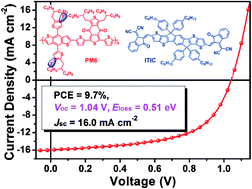
High-performance nonfullerene polymer solar cells based on a fluorinated wide bandgap copolymer with a high open-circuit voltage of 1.04 V
DOI: 10.1039/C7TA07785H, Paper
Nonfullerene polymer solar cells based on a polymer donor PM6 containing a fluorinated-thienyl benzodithiophene unit and a small molecule acceptor ITIC showed a PCE of 9.7% with a Voc of up to 1.04 V and an energy loss as low as 0.51 eV.
The content of this RSS Feed (c) The Royal Society of Chemistry
Organometal Halide Perovskite Solar Cells with Improved Thermal Stability via Grain Boundary Passivation Using a Molecular Additive
Abstract
Organometal halide perovskite solar cells (PeSCs) are regarded as promising photovoltaics due to their outstanding power conversion efficiencies (PCEs). However, even though their PCEs are achieved over 20%, their intrinsically poor stability is a big bottleneck for their practical uses. Here, a simple method is reported using phenyl-C61-butyric acid methyl ester as a molecular additive to improve thermal stability of organometal halide perovskite crystals, which also improves the PCEs of the associated PeSCs. Moreover, by varying the grain size of perovskite crystals up to ≈150 µm, it is demonstrated that grain boundary plays a significant role in their thermal stability. Cells with smaller grain interface area (i.e., larger grain size) have higher thermal stability. The additive is located at grain boundaries and found to induce electron transfer reactions with halogens in the perovskite. The reaction products chemically passivate perovskite crystals and strongly bind halogen atoms at grain boundaries to their crystal lattice, preventing them from exiting from the crystal lattice, which improves thermal stability of perovskite crystals. This study offers a simple method for improving thermal stability of perovskite without any loss and opens up the possibility of the use of various molecular additives to achieve highly stable PeSCs.

Chemical passivation of organometal halide perovskite crystals with phenyl-C61-butyric acid methyl ester (PCBM) is investigated. PCBM located at perovskite grain boundaries induces electron transport reactions with halogens in perovskite and chemically passivates the grain boundaries. It prevents halogens at the grain boundaries from exiting the crystal lattice and thereby results in improved thermal stability of organometal halide perovskite solar cells.
Incoherent Pathways of Charge Separation in Organic and Hybrid Solar Cells

Effect of Infrared Pulse Excitation on the Bound Charge-Transfer State of Photovoltaic Interfaces

Ultrathin high band gap solar cells with improved efficiencies from the world’s oldest photovoltaic material
Ultrathin high band gap solar cells with improved efficiencies from the world’s oldest photovoltaic material
Nature Communications, Published online: 25 September 2017; doi:10.1038/s41467-017-00582-9
Wide band gap semiconductors are important for the development of tandem photovoltaics. By introducing buffer layers at the front and rear side of solar cells based on selenium; Todorov et al., reduce interface recombination losses to achieve photoconversion efficiencies of 6.5%.