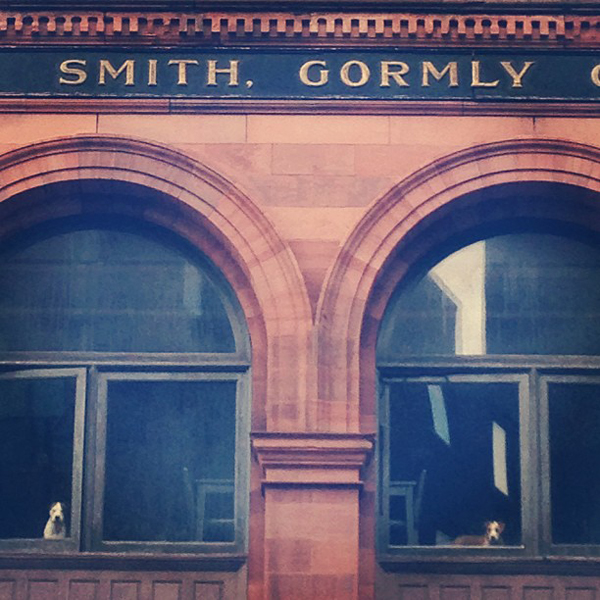
Which one is Smith and which one is Gormly.

I always wondered what dogs did while their owners slept…
See more humorous doggie illustrations by New York-based artist Stephanie Matos!


At 87, James Salter is having perhaps the best year of his career. His first novel in three decades, "All That Is," has brought rave reviews and even a New Yorker profile. It's heady, late-life success for a novelist mostly revered as a writer's writer for books like "Light Years" and "A Sport and a Pastime."
But this weekend on NPR's "All Things Considered," the latest stop on his celebratory media tour, Salter was asked by host Arun Rath about his women characters -- and he gave what might be as bizarre an answer as has any male writer these days, suddenly faced with direct questions about literature and gender that they might not have been asked before.
Say it ain't so! The uplifting Californian couple that performed what was thought to be a spontaneous karaoke duet as part of Jay Leno's Tonight Show "Pumpcast News" segment may have actually been hired actors, according to The Smoking Gun. According to the hoax killers, Will Sims and his wife Monifa have been pursuing careers in show business for sometime with Mrs. Sims having appeared on the same "Pumpcast News" segment before more than two years ago. Monifa has since responded to the allegations, claiming it was just a coincidence that she ended up on the show for a second time. What do you think?
Submitted by: Unknown (via The Smoking Gun)
Frustrated by receiving packets and worksheets instead of a lecture, Texas high school student Jeff Bliss shared his feelings about his teacher's lack of engagement as she made him leave the classroom.
Submitted by: Unknown (via YouTube)
Last time I moved into a new neighborhood I posted multiple flyers about my missing rattlesnake until I practically got fined for too-much-awesomeness. Or “being a nuisance” according to the Home Owners Association.
This time when moving into a new neighborhood I decided to do things differently.
Very differently.
Or, as Victor says, not really so differently at all.

I’ll keep you (and these) posted.
As the decade-old cold kidnapping case of three women unraveled in Ohio yesterday, Cleveland resident Charles Ramsey who helped the three women escape from the captor's house quickly emerged as the hero of the day, not to mention his viral video fame that is already in the making.
Submitted by: Unknown
Pen, ink and paper. Three of the most common tools that every creative person uses. However, with the advancements of technology and the presence of many software and digital applications, creativity is now applied using a mouse, a pen tablet or some pixel magic. While most people jump into creating their works straight into digital forms, there are still some who do it the traditional way, letting the old pen, ink and paper as their primary tools in bringing those creative ideas into life.
Meet Johanna Basford, an illustrator and ink evangelist from United Kingdom whose works are created solely using ink pens on paper characterized by floral elements, swirls, natural themes and delightful characters all in black and white with attention to awesome intricate details!

As YTD’s featured artist of the month, we got the chance to talk to Johanna about her illustration career, her major influences and creative process. Check out the interview below.
YTD: Hi Johanna, how are you and how’s UK?
JOHANNA: Lovely thank you! Scotland is still a bit chilly, we’re hoping for some sunshine soon though!
YTD: Tell us a little background about you and your creative work.
JOHANNA: I’m an illustrator and ink evangelist who prefers pens and pencils to pixels.

I create intricate, hand drawn illustrations predominately, although not exclusively, in black and white. My creativity is cultivated by a curious imagination and a delight in the fantastic. Much of my work has roots in the flora and fauna that surrounded me growing up on my parent’s fish farm in rural Scotland. I graduated in 2005 from Duncan of Jordanstone College of Art and Design in Dundee with my degree in Printed Textiles and a portfolio stuffed with monochrome silk screen prints and drawings. Following that, I set-up my little studio and began on my mission to vanquish the vector and champion the (wobbly) hand drawn line.

YTD: How do you usually start your day?
JOHANNA: With lots of cups of tea and a bit of list writing.
YTD: When did you start drawing?
JOHANNA: I’ve always loved drawing. When I was little I would draw on books, walls, myself, my sister, my clothes… luckily my parents nurtured this passion instead of telling me off!


YTD: Any major influences?
JOHANNA: LOTS. At school I loved the intricate ink work of Escher. These days I find I’m drawn to a wide ranging pool of creative work, from florists, to fashion, Street Art to packaging, Tattooists to Stationery design. I think we take little snippets of the dozens of things that catch our eye each day and store them away for future use.

YTD: Describe to us your workplace.
JOHANNA: Light and airy. I don’t like clutter so I try to keep my desk clean – when you’re working with pens and pencils and large sheets of paper you need room to move elbows etc.

We live in a converted farm in the country and the studio has large windows that overlook the surrounding fields. I’ve got a big desk, lots of pens and pencils and of course my scanner and laptop for doing the final digital tweaks to the drawings (usually erasing tea splashes and smudgy fingerprints).

I don’t like to throw away drawings, so I’ve got a two plan-chests stuffed to breaking point with every drawing I’ve made in the last five years. My extensive pen collection takes up several plastic storage boxes stacked up in one corner. I’ve got hundreds, but you can never have too many.

YTD: Almost all of your works are in black and white. Any specific reason why?
JOHANNA: I’ve been told, “You’d get more jobs if you worked in colour” more often than you’d imagine, but I just don’t believe it. I’m ‘that girl that does the black and white’. Add CMYK and I’m… well, just another illustrator, surely?

Personally, I believe a signature style is something I have deliberately carved out. I believe it is at the very core of my practice. I set out to try and become the very best at my chosen niche – I wanted people to see a black and white drawing and wonder if it was mine.


YTD: Can you share us your creative process? From where do you start?
JOHANNA: Every piece I create starts life as a simple pencil sketch, evolving into a rambling pen and ink drawing usually spanning several sheets of paper.

I love the tactile nature of the materials I use and the joy of smudgy fingerprints. My delicate hand inked designs intend to charm and delight, inviting you to peer closer and discover the hidden intricacies.

For me, computer generated graphics can feel cold and soulless whereas hand drawing captures a sense of energy and character which no pixel can ever replicate.

You can read more about my process here.

YTD: What is your most memorable project so far?
JOHANNA: The cover for the Edinburgh Festival Fringe programme.

YTD: What are your tools of the trade?
JOHANNA: Mechanical pencils, Steadtler pigment liners, layout paper, an A3 scanner, my Mac and Photoshop.

YTD: Have you ever thought of creating your drawings in fully digital?
JOHANNA: No.
YTD: Any major brand/designer/artist in mind you wish to collaborate/work with in the future?
JOHANNA: Lots! I’d love to create a window display for Selfridges, album artwork for an amazing artist list Emile Sande, a cover illustration for Vogue, an inky airplane, an Hermes scarf and a piece for Maggie Centres.
YTD: How do you deal with creative block?
JOHANNA: Power through!

YTD: Tell us something about Wonderbeasts.
JOHANNA: My first Kickstater project saw me team up with a merry band of co-creators – together we made Wonderbeasts! My inky comrades provided the artistic direction by suggesting creatures for the canvas and I dually obliged.

The finished piece spans just over 2 meters – my biggest ever drawing!
Had it not been for the good folks at Cult Pens supplying me with a stack of Stedatler pigment liners, I’d have run dry within 2 days.

Wonderbeasts will form part of my solo show at the DCA, (opening on the 4th of May) This will be the only place you can see the final piece in all it’s full scale inky glory!
We’re busy preparing the web version, which will have each co-creator tagged to their suggestion – this will go live in early May when the exhibition opens.
YTD: If you are not an illustrator today, what would have been your work and why?
JOHANNA: A florist, because I adore blossoms!

YTD: Where can we find more of your works?
JOHANNA: More works Here. My client list here.
YTD: A piece of advice to aspiring illustrators out there.
JOHANNA: Work hard, be nice.

YTD: Thank you Johanna for spending some time with us. Anyone you would like to be thankful for?
JOHANNA: Dundee Contemporary Arts – for inviting me to show my first ever solo exhibition!

SEE ALSO: Detailed Ink Works of Nicolas Delort
Read more posts by Kerby Rosanes
Editor’s note: This is part of an ongoing series that explores the relationships and similarities between traditional print design and web design. For more inspiration, check out Patrick McNeil’s related articles on the subject:
And be sure to catch the digital versions of your two favorite design magazines—HOW and Print editions for the iPad.
One niche in print graphic design that’s been hit hard by the digitization of information is the news industry—and we’re going to focus on a subset of this: magazines. Although printed magazines clearly continue to sell, their sales have been on the decline. And while it might be tempting to suggest that digital versions of these magazines have displaced them, this is not true across the board (though it might be in individual cases).
The reality is that magazine sales and circulation are overall on the decline. (My opinion is that readers are simply going elsewhere for information, particularly to the web.) Despite this, there’s real opportunity for magazines to find a new home in the digital era. And no, it doesn’t include 300MB downloads with layouts that simulate the page-turning experience—an old-fashioned design approach that ignores the real possibilities of the web. Following are some great examples of online publications that marry great magazine content and great user experience design.

Are you making your way from print design into the digital design space? HOW Design Live in San Francisco, June 22-26, offers a dedicated Print to Web track just for you. Hear from speakers including Patrick McNeil, Chris Converse, Mario Garcia, David Sherwin, Jose Caballer, Terry Lee Stone and more.

Our first example of outstanding online magazine design is Edits Quarterly. (Click over to visit the site and browse around a bit. Seriously … if you don’t, you’ll miss the whole point of this article.) The user experience is a huge part of what makes online content so darn special and so different from print (and is, of course, one of the reasons publishers struggle to make the move).
If you haven’t yet seen an interface like this, you may already be inspired to try something like it. Let’s dissect what makes this an excellent example of online magazine design. First, notice what’s missing: A cover that follows any sort of traditional formula. There’s no engaging cover photograph, no attention-grabbing copy. Second, it’s not vertically oriented like a print magazine. Desktop computer screens aren’t vertical, so why should a digital magazine be? If your first instinct in building a digital magazine is to make it vertical just because that’s the way print magazines are done, you’re clearly not ready to let go of the past and move forward. (Granted, you could argue for a vertical layout if you’re designing a digital magazine for a tablet reader. If that’s the case, think it through and be conscious of that choice.)
As you move through the content of this online magazine website, you’ll realize you’re viewing what you might think of as a spread, but it interacts in a web-like way. If the content is longer than a screen, you simply scroll through that spread’s content before moving on to the next. The sticky elements on the side that don’t scroll help make this particularly effective.

Next up is another niche magazine called the Eephus League Magazine. Again, I highly recommend you visit the site and experience it before reading further. (I’ll wait here.)
One of my favorite things about this site is that the layout shifts in format. It’s a challenging design approach that takes more planning and development. But the handcrafted nature of this online magazine has a high-quality feel that is absolutely amazing. While Edits Quarterly, above, has just a couple of layout formulas, Eephus League employs many formats—and while this scheme takes more time to design and execute, the designers will over time accumulate a whole library of diverse and useful layouts that could easily be replicated, populated with content and placed into a magazine.
Already we can easily spot a few common design threads in both of these samples: First, a strong focus on beautiful typography that echoes traditional (printed) type. The serif fonts in both of these online magazine designs anchor the sites in tradition, whereas sans serif fonts would echo a more modern style. For print designers looking to move into web design, here are two great examples of how your well-honed typographical skills can translate.
A second common element is the way content is revealed, especially in the Eephus sample. As you leave one spread of content and move into another, it’s revealed as though it was simply hidden by the content over it. This locked-in-place approach is interesting in that it highlights the fact that you’re changing “pages” to view new content. The flow and continuity of the content is a joy to experience.
Third, you’ll notice that on the homepage of both of these magazine websites you find instructions on how to use either your keyboard or your mouse to navigate the content.
There are many gorgeous examples we can look at in this area to see how some very creative (and technical) people have solved the problem.

Suit Up or Die Magazine feels right at home with the above examples. One thing I particularly appreciate is the inclusion of a table of contents. Allowing users to jump around to content that interests them can be important.

This example from Readymag, a new platform for online publishing, is not an actual magazine, but rather a demonstration of a concept for creating online magazines. Notice the use of animation, interactivity and social networking and video. To say that this is an inspiring piece is to vastly minimize the awesomeness it represents. Work for a magazine and want to scare the crap out of your boss? Show him this. Fortunately it isn’t just a killer concept, it’s a platform for creating content like this. Too bad it’s still in beta!

Just in case you’re thinking, “Yeah, but no real magazines are doing this,” I present an example from ESPN the Magazine. It’s obvious that powerful direction from a designer elevated this from a technical project to a visually stunning one.

You may also be thinking, “Sure this is great for web geeks to play with, but again, no real magazines are trying this.” Think again. Interview Magazine has an interactive interface that resonates well with its roots in the printed magazine while not feeling like a static promotional site for the publication. Note that this interactive magazine website includes advertising (a vital asset for publishers). Not also that the designers ditched the traditional print magazine cover in favor of a homepage that updates with new content, a feature that puts this website somewhere between a news site and an online magazine.

This website for a Montreal design agency is definitely a loose fit for this piece, but I thought that the way the content was separated into spreads provided a nice demonstration of how this can be done. In particular, I love the variety of colors used to clearly break the content into chunks.

Though this example is not a magazine, its approach to creating spreads of content that can be stepped through connects to that world and demonstrate an interesting use of the style in a different context.
If you’re looking to put this magazine-style layout to work in your website design, you might be happy to discover a nice JavaScript tool that can give your project a real jump start. It is called Curtain.js and handles the stepping through content and revealing it. At least one of the examples here makes use of this tool.
Clearly the future of magazines is uncertain, and the industry has yet to really latch onto a model that works. Perhaps the samples provided here can inspire and challenge you as you consider how to adapt this format in your own projects.
In fact, I’d argue that it’s time to reconsider what magazines are. Digital magazines become a permanent online home for a set of related content. For example, think about a biographical/archival website for a musician who’s no longer living. Many years ago, I built a site for a musician from the 1940s, Louis Jordan (I haven’t updated the site in 8 years). But the content of the website is evergreen and hardly needs updating—so a magazine-style approach to the content would be an interesting exploration.

What makes NPR reporters' names so particularly mellifluous? There's that pleasing alliteration -- Allison Aubrey, Louisa Lim, Carl Kassell, Susan Stamberg. And it's hard to match those mouth-filling double-barrelled names. Think Ofeibea Quist-Arcton, Soraya Sarhaddi Nelson, Chana Joffe-Walt, Lourdes Garcia-Navarro, Dina Temple-Raston, Charlayne Hunter-Gault. According to one study, women in the arts and entertainment are more likely to keep their names; the authors hypothesized that their maiden names had already become "akin to a 'brand'." All the same, reporter "Nell Boyce" lacks the snazzy ring of Nell Greenfieldboyce, her married name mash-up.
Perhaps no reporter's name is more beloved than Sylvia Poggioli, NPR's Italy correspondent. Sylvia has had a cow in Cambodia named after her, and a restaurant in Salem, Oregon.Of course, hearing a string of uniformly, gorgeously unusual names one after the other can have a different effect. Greg Studley, a stand-up comedian and screenwriter ("so you know, bartender," he says) listens to a lot of NPR. One day last December, he just couldn't listen to the news anymore; the journalists' sign-offs at the end of each piece had begun to take over. At first, he was just distracted -- "huh, that's a unique name," he thought -- but then it became the "elephant in the room" of his NPR experience. Finally, he wrote a song about it. "We didn't start the pledge drive," he sings. "There's a cash uptic when host names are ridic."
Studley isn't the only one to use the names for creative inspiration, as evidenced by the abundance of NPR namesakes. A turtle named Ira Glass lives in Queens, and somewhere out there roams a chihuahua named Mandalit. Kai Ryssdal had, at one point, a namesake goat. "Friendly Kai Ryssdal has turned into super obnoxious Kai Ryssdal," his owner wrote on her blog, so she had him butchered and ate him. A man was once sitting in a Missouri theater next to a woman named Korva Coleman, and he thought she was the NPR reporter. But she wasn't. She had just changed her name to Korva Coleman because she thought it sounded cool.
But perhaps no reporter's name is more beloved than Sylvia Poggioli, NPR's Italian correspondent. Sylvia has had a cow in Cambodia named after her, and a restaurant in Salem, Oregon. "Every time Sylvia says her name," the restaurateur said, "I envision Italy, I see and smell good food."
Others just like that cozy round way she pronounces her name. "I whisper it along with her when I am in the car -- Sil-vyah Poh-zjoly, Rome," a commentator wrote on a "Best Name Ever" thread. Italian Americans write in to say that hearing Sylvia pronounce her name correctly inspired them to do the same. But could even Sylvia's name be improved? "Sylvia Poggioli and Jim Zarroli have always had our admiration as first-rate news reporters" a listener once wrote into Saturday Edition. "We feel that the two should get married so that she could be Sylvia Poggioli-Zarroli." But what if, the presenter wondered, he wanted to be Jim Zarroli-Poggioli?
Of course, NPR's seemingly exotic names reflect the sweep of NPR's international coverage and America's own diversity. Yuki Noguchi isn't an unusual name for a Japanese woman, and Doualy Xaykaothao might be a perfectly boring name for a Lao-Hmong-American. Neda Ulaby's first name means "dew" and is fairly common in Syria. ("It's also the name of the heroine of an opera called Pagliacci who is literally killed by a clown," she told me over email.) Lakshmi Singh's Carribbean father is probably the reason why she pronounces her name LAK-shmee and not LUK-shmee, as South Asian friends like to tell her it should be pronounced.
Some names are just family names. You can blame Michele Norris's father for the heavy stress on her first name's first syllable; she honors him by insisting everyone pronounce the name the same way he did (MEE-shell). Cokie Roberts's full name is actually Mary Martha Corinne Morrison Claiborne Roberts. Cokie was just easier for her brother to pronounce.
Korva Coleman's name is actually a twist on an elderly relative's name, Cora. But "in some Slavic languages and possibly Hebrew," Ms. Coleman explained in an email, "my name apparently means 'slut.' Once, I was on the table during my first pregnancy being examined by a new OB/GYN. At the damnedest moment you can think of, he raised his head and remarked, 'I don't know if you know this Ms. Coleman, but your first name . . .' 'I KNOW what it means!' I shouted, scaring the poor guy half to death."
We can't see NPR reporters, so we have to picture them. And because they are with us in our most private moments -- alone in the car, half-asleep in bed -- we start to think we know them. Jonathan Coulton wrote a song called "Dance Soterios, Dance" about WNYC's Soterios Johnson. "NPR is my alarm, so I'm pretty familiar with old SJ," Coulton has explained. "I got to thinking: this guy's so smooth, so polished, he's got to have some kind of a crazy secret life in which he goes to raves and lets it all hang out." Renee Montagne -- with perhaps the most queenly of all NPR names -- has said people always expect her to be taller and blonder.
We can't see NPR reporters, so we have to picture them. And because they are with us in our most private moments -- alone in the car, half-asleep in bed -- we start to think we know them.And some listeners feel they know the reporters a little too intimately. A few years ago, a pair of hardcore NPR listeners invited Neda Ulaby to their wedding, sending along a picture of their car's license plate, which reads "OOLABEE." "Apparently they'd developed the creepy habit of referring to each other as 'my little Ulaby.' So I became a mating call," she explained.
So: Is an unusual name a blessing or a curse? Ophira Eisenberg was once introduced at a party as Oprah Something-Jewish. Guy Raz used to think his name was "too ethnic." In Moroccan Arabic, Quil Lawrence's first name is not far off the colloquial word for "drunkard." At the same time, many reporters recognize the benefits of an unusual name. Lawrence first went by his given name -- David Aquila Lawrence -- until a friend told him to switch to his nickname Quil because it "sticks in the ear."
But what if your parents didn't bless you with an NPR name? You could, of course, make up your own -- novelist Liana Maeby suggests sticking your middle initial in your first name, and adding it to the smallest foreign place you've ever visited. (Her NPR name is Liarna Kassel.) But can you still make it in the radio business with a plain name? Robert Smith of Planet Money told me by email that the only reason to change his name "would be so that I could be more famous. You would remember it better if I ended by reports with, 'I'm Mobius Tutti.'" But at the same time, he says, "I'm in this business to tell other people's stories, and not to promote myself or my own name. Being a Robert Smith is always a good reminder that you aren't that different than the people you cover."
And really, are NPR names so different from yours and mine? "It's simply that you don't hear the staff at Kinko's saying their names over and over again, out loud," Smith says. "Kinko's was founded by Paul Orfalea. If he had said, 'Paul Orfalea, NPR News, Los Angeles,' you'd think, what a perfect NPR name."
Ulaby agrees. "Tell me the names of your co-workers," she says to people who bring up NPR's unusual names. "After four or five names, they usually get my point. NPR names are not so weird." As further evidence, Ulaby points out the bylines in newspapers. "No one ever says, 'Oh, New York Times reporters have such ... unusual names,'" she says, pointing to front page reporters like Douglas Quenqua and Simon Romero.
Then Ms. Ulaby starts to get personal. "And, um, the Atlantic's masthead?" she asks. "Alexis Madrigal, Conor Friedersdorf, Garance Franke-Ruta, and Geoffrey Gagnon? Not to mention the incomparable Kasia Cieplak-Mayr von Baldegg. I don't know who she is but she deserves her own public radio show."
"We live in the era of President Barack Obama," Ulaby adds. "Welcome to the new American nomenclature."

    
|
A.NI'm not sure I believe that for most people being open will actually help them. You'd want it to, and in great companies I bet it does. But how many people work at great companies?

Jason Collins is a professional basketball player who just announced that he’s gay. It’s rare enough for a professional athlete to be openly gay that President Obama called him up to offer support, and former President Clinton tweeted his support, adding that he’s known Jason Collins since he was friends with Chelsea Clinton at Stanford.
Collins is a 12-year NBA veteran who has played for the Boston Celtics and Washington Wizards and chose to come out in the new edition of Sports Illustrated . He says, “I’m a 34-year-old NBA center. I’m black. And I’m gay. I didn’t set out to be the first openly gay athlete playing in a major American team sport. But since I am, I’m happy to start the conversation.”
It’s a great conversation to have, because we all do better in our careers if we are honest about who we are.
The research about the benefits of coming out at work is solid. Gay people get higher pay and have more stable careers if they come out at work. Because so much of career success is connecting with people, and secretive people are not likable. This is one of the reasons that I was so upset when I was coaching Cassie Boorn and she didn’t tell me she was gay: because the best career advice I could give anyone who is gay is to find a place for themselves in the workworld where they can be themselves.
You would not believe how many people I coach who are gay but don’t tell me until the last ten minutes of the call. It would be fine if being gay is irrelevant to their career, but it almost always comes up, in passing, because we have to talk about your personal life to build a career plan that supports your personal life.
So if you are systematically hiding that you’re gay, then it is highly probable that the core of your career problem is that you’re hiding. Because people who hide something that big from the world are usually hiding lots of other things as well. And the more you hide, the harder it is to find a job that’s right for you.
The story of Jason Collins is not just a story about being gay. It’s a story about how, to some degree, each and every one of us is scared to be ourself at work. Each of us has something we are scared to own about ourselves because we are scared people won’t like us. We’re scared the top people in our field won’t respect or like us. We each hide something that we think is particularly bad. And we all think, “Other people might not need to hide this, but for me, it’s different.”
But really, if there’s anyone who could say they have a special situation, it’s Collins. He’s in a field where he has to touch other men all the time. He’s in a profession that’s notoriously homophobic. And he is a national figure but he’s not used to dealing with the press in a personal way, so talking about all this publicly is out of his comfort zone.
I have been working in the tech industry for most of my career. As a serial entrepreneur I’ve had to figure out, each time, how much of myself to reveal to my co-founders, to my investors, to my employees. At one point, during my last startup, I was crying in the lobby of Chase Bank because we ran out of money and none of my employees would get paid and it was the week before Christmas.
Earlier in my career, I never would have written about that, because it’s very hard to get funding when you are crying and weak and desperate for money. No one wants to fund that kind of entrepreneur. But I wrote about it anyway, on my blog, and literally hundreds of entrepreneurs told me they had been there before, and they offered great ideas for getting through such a tough time. And my investors came through as well. Because what investors need, more than anything, is a founder who is dedicated and driven and genuine and honest.
That’s what the NBA needs from Collins: dedicated, driven, genuine, and honest.
And that’s what people need from you.
Some of you are still thinking you’re not going to really be who you are. You want to keep the parts of you that are fun and enchanting and easy, while making the other, worse parts of you go away. But the truth is that no one is enchanting if they are not whole. I realized, late in my career, that one of the biggest reasons that I looked scary to some people was that I was hiding some fundamental things about me: like that I was taken away from my parents for abuse. I wanted it to not matter. I wanted to be past that.
But everything matters. Everything is our lives is who we are. Jason Collins being gay will matter so little in two years. We’ll be past the hoopla. And so will he. It’ll just be a part of who he is.
Here’s how I know: I was coaching a guy. And we were talking about how he and his wife were going to move to the East coast, and he needed a career transition strategy. At the end of the call, he told me, “Hey, I have something to tell you.”
I said, “At the end of the call? You have something new to tell me now?”
He said, “Yeah. Well, I read how you said that so many people wait until the end of the call to tell you they’re gay.”
“Oh no. You’re gay? You’re going to tell me you’re gay?”
“No. I’m not gay. I’m a transexual.”
Silence. I was shocked.
Then I said, “Are you done? Like, is it that you were born a woman and now you’re a man?”
“Yeah. I went through all the operations and everything. No one would guess I’m a transexual. I just wanted to tell you.”
And we both laughed. Because it’s a funny riff on the constant problem of people being closeted and not telling me. But that’s all it is – funny. Because he’s fine with who he is, and he’s integrated his whole self into his life, and so it’s not possible for it to be a problem for his career.
I wish that peace for Jason Collins and I wish it for all of us. Let’s start today, being a little more honest about who we are. And bonus: We’ll make more money doing that. Really.
 Wikipedia
 In the last few days I've had two op-eds published by The New York Times describing a discovery I'd made on Wikipedia early last week. I noticed that American female novelists were being dragged out of the main category "American Novelists" and plopped into the subcategory "American Women Novelists." I looked back in the "history" of these women's pages, and saw they used to appear in the main category "American Novelists," but they had recently been switched to the smaller female subcategory. Male novelists were allowed to remain in the main category, no matter how obscure they were. At first I assumed the sexist thinking of whoever did this went along the lines of, "All men novelists are worthy to be taken seriously, even small ones. But only the most famous and revered female novelists are worthy to remain in the big category." As I investigated further, I realized this didn't seem to be the case, because I was finding some extremely famous female novelists in the "American Women Novelists" category, who had been actively transferred from the "American Novelists" category to the smaller, less prominent, female subcategory.
In my op-ed, I listed 17 of the most famous women that this had been done to: Harper Lee, Anne Rice, Amy Tan, Donna Tartt, Harriet Beecher Stowe, Ayn Rand, Ann Beattie, Djuna Barnes, Emily Barton, Jennifer Belle, Aimee Bender, Amy Bloom, Judy Blume, Alice Adams, Louisa May Alcott, V. C. Andrews, and Mary Higgins Clark. And I noticed the same thing had been done to me and hundreds of others.
As I wrote in my first op-ed:
People who go to Wikipedia to get ideas for whom to hire, or honor, or read, and look at that list of "American Novelists" for inspiration, might not even notice that the first page of it includes far more men than women. They might simply use that list without thinking twice about it. It's probably small, easily fixable things like this that make it harder and slower for women to gain equality in the literary world.
I wrote two op-eds on this topic because after the uproar the first one created when it was published online Wednesday night, The New York Times asked me to write a follow-up describing recent developments for the Sunday print edition (where my first op-ed had been scheduled to appear). The story was picked up online, appearing on sites from The Atlantic Wire to Forbes to Salon to Jezebel to Think Progress. It appeared in The Guardian and The Independent newspapers and The Week in the UK, plus news sites and publications in Italy, France, Canada, Brazil and more.
 A Feminist Critique of Hooking Up
 On social media, a debate has been raging over the accuracy of my pieces. At least one writer has been widely retweeted and quoted on Twitter as having "debunked" my original op-ed (claiming, incorrectly, that Donna Tartt and Amy Tan had never been removed from the "American Novelists" category). This has helped contribute to the misperception— which has been repeated on Wikipedia "Talk" pages—that this re-categorization of women novelists was the work of a single editor.
This so quickly became the "conventional wisdom" that James Gleick's latest post for The New York Review of Books repeated it, and Salon's Andrew Leonard wrote yesterday:
In the furor that erupted on Wikipedia in response to Filipacchi's article, it was quickly determined that the bad behavior she noticed appeared to be the work of a single misguided Wikipedia editor. One could argue that, if true, this made the Times' headline "Wikipedia's Sexism Toward Female Novelists" unfair and inaccurate. All of Wikipedia was being tarred by the unthinking stupidity of one bad editor.
This is not true. The "sub-categorization" (or what some are calling the "ghettoization") of the 17 well-known women I listed in my original op-ed was performed by at least seven different editors. The people spreading this false information are not doing any favors to Wikipedia. Another reason to stop this rumor is that it is not fair to dump all the blame on one poor Wikipedia editor who—even though it's true he did go on a bit of a spree in early April—was far, far from the only one. Plus, he did women a huge favor by inadvertently making this Wikipedia problem more visible. Who knows how many more years this would have continued if it hadn't been for his energetic work of accidentally exposing the sexist category rules that had already been implemented and followed by many others? If anyone wants to check the facts I've stated, here they are, chronologically. They include the editors' anonymous usernames:
1) Wiki editor: Magellan Maestro
-13 September, 2012 (Revision as of 14:44): Amy Tan removed from "American novelists" and put into subcategory "American novelists of Asian descent")
-23 March 2013 (Revision as of 23:33): She was added to "American women novelists" by IP address: 72.200.175.219
2) Wiki editor: Orlady
18 October 2012 (Revision as of 21:26): Donna Tartt. In addition, to being switched from "American Novelists" to "American Women Novelists" she was also switched on the same day from "Writers from Mississippi" to "Women writers from Mississippi"
3) Wiki editor: RL0919
-2 Jan 2013: did it to Ayn Rand
4) Wiki editor: And we drown
-3 February 2013: (Revision as of 18:54): did it to Anne Rice
5) Wiki editor: BizarreLoveTriangle
-21 February 2013: (Revision as of 21:16): did it to Harper Lee
6) Wiki editor: Midnightdreary
-24 March 2013: did it to Harriet Beecher Stowe
7) Wiki editor: Johnpacklambert:
-1 April: did it to Alice Adams. And then he did it to the others on my list. As you can see, among the women in my list he didn't even begin to do it to any of them until the six above editors had done it first.
In the last few days, some Wiki editors worked on fixing the problem, bringing women back into the main "American Novelists" category. But then other editors would come along and take them back out. The editor who went on his spree in early April (username Johnpacklambert) did something particularly interesting and annoying after I'd been put back in the "American Novelists" category. He took me out of it again and put me in a new category he had just created: "American Humor Novelists." He also added three men to it, probably to make it look ok. Another editor then came along and undid what he had done. In my first Op-Ed, I'd mentioned it was too bad there wasn't a subcategory called "American Men Novelists." Soon after, that category was created. According to a Wikipedia article entitled "List of Wikipedia Controversies," "When the 'American men novelists' category was first created, its only entries were Orson Scott Card and P. D. Cacek (who is female)." The last time I looked, it seems that several Wiki editors are trying to make sure women have been put back in the main category, and they've been reverting the changes of editors who try to take them out.
The debate I ignited is about whether Wikipedia is sexist or not toward women novelists. Since my original article appeared, certain Wikipedia editors have successfully distracted people from this larger debate by pushing the false idea of a "single rogue editor," and creating the impression—now being widely repeated and reported—this is some small, isolated problem. They've done this by spreading rumors that are demonstrably wrong, as can be proven by anyone willing to investigate the history buried in the Wikipedia pages of "American Women Novelists."

|
|
 Every so often, you'll hear a reference to some really disturbing studies that demonstrate a sharp decline in sperm density AND quality since tests began over fifty years ago. And then, because, well, who pays that much attention to what happens to the world once we're gone, you may hastily flip past it to something about the merits of dark chocolate. But then the Utne Reader (the piece originally appeared in Tomorrow Magazine) decided to talk about it for seven pages, and also that it's happening in animals, and may have resulted in behavioral changes in boys:
In 2000, American researchers not only confirmed results from the original Danish semen quality study, they found sperm density in the United States and Europe to be falling at an even faster clip: by 1.5 to 3 percent per year. And last summer, an Israeli study noted a steady decline in semen quality at one local bank over the past 15 years. A full 38 percent of all sperm-donation applicants are now rejected, up from one-third prior to 2004. That year, the bank lowered its minimum sperm count for acceptance to widen its net for donors. Under those more stringent standards, 88 percent of contemporary samples would have been rejected.
On the plus side, this will eventually bring an end to the mommy wars some time before the heat death of the universe. Perhaps Clive Owen will cradle you in his arms as we wait for it.
---
See more posts by Nicole Cliffe
If you are disappointed* that there's more Patty Griffin than Robert Plant on this song, you need to study your Patty Griffin. Go into the woods for a year and listen to Patty Griffin. Especially this.
*If you just think the video itself is not great, you are correct.
---
See more posts by Nicole Cliffe
Recall the Democrats' original theory of the case: Sequestration was supposed to be so threatening that Republicans would agree to a budget deal that included tax increases rather than permit it to happen. That theory was wrong. The follow-up theory was that the actual pain caused by sequestration would be so great that it would, in a matter of months, push the two sides to agree to a deal. Democrats just proved that theory wrong, too.
In effect, what Democrats said Friday was that in any case where the political pain caused by sequestration becomes unbearable, they will agree to cancel that particular piece of the bill while leaving the rest of the law untouched. The result is that sequestration is no longer particularly politically threatening, but it's even more unbalanced: Cuts to programs used by the politically powerful will be addressed, but cuts to programs that affects the politically powerless will persist. It's worth saying this clearly: The pain of sequestration will be concentrated on those who lack political power.
As a CQ / Roll Call reporter tweeted last night, "Make no mistake, this FAA fix is a complete, utter cave by Senate Democrats and, if signed, by the White House." This is a sentiment expressed in other press reports over the last 12 hours, including, Politico: "Democrats blink first on aviation" and Chicago Tribune: "White House Scrambles For Damage Control."
Consider that the Democrats opening position was they would only replace the sequester with tax increases. By the first of this week Senator Reid proposed replacing the whole sequester with phony war savings. And by last night, Senate Democrats were adopting our targeted "cut this, not that" approach.

|
|

My intent was to make this taste like a 50-50 bar, and? Nailed it. Here’s how you achieve the effect.
TANGELO COOLER
- Juice of one Tangelo (or orange)
- 1/2 shot Amaretto
- 1/2 shot Cointreau
- 1 shot vodka
Put a few ice cubes in your glass, add the booze, and squeeze in the juice of a Tangelo. Stir until the drink is chilled, sip, and try not to drink the rest in a single gulp. Seriously, maybe have a glass of water first.
Here’s to the water warming up, the light through the trees, and the guy at the fruit stand who always makes sure you get a good watermelon.
What are you toasting this week?
I’m making 100 cocktails as part of my Life List. This is number fifteen. Here are the rest:
1. Shots in ‘Cots 2. Avocado Bourbon Shake 3. The Vacation 4. Sassy Lassi 5. Cherry Bing 6. The ABC 7. Toddy Shots 8. Cafe Picante 9. Gin and Juice (Box) 10. The Neighbor 11. Halloween Spiked Cider 12. Bloodthirsty Mulled Wine 13. Killer Bloody Mary 14. Bourbon Pumpkin Shake
The post Mighty Thirst: Tangelo Cooler appeared first on Mighty Girl.
I'm a grapefruit person and proud of it! I remember watching my grandmother eat grapefruit for breakfast, while us grandkids would pile on syrup over our waffles. And I just felt sorry for her. I think I vaguely thought that she must have to eat grapefruit, like her doctor was making her. Otherwise there was no way in the world anyone would ever eat grapefruit. And now I regularly add a little grapefruit to many of my recipes. I love it! Funny how your tastes change over time, no?
These muffins have a juicy slice of grapefruit paired with a dense crumb muffin on bottom. Almost like a scone. I could see these being really fun topped with a little fresh whipped cream, perfect for a brunch. Just dreaming out loud here.
Grapefruit and Brown Sugar Muffins, makes one dozen.
1 1/2 cups brown sugar
1 cup softened butter
1/4 teaspoon vanilla extract
3 eggs
1 cup flour
2 grapefruit
In a bowl cream together the softened butter and sugar. Stir in the eggs, one at a time and then the vanilla. Now stir in the flour until just combined. Scoop batter into a well-buttered standard-sized muffin pan. Fill the cups 1/2 full (no more). Remove the skins/rind of the grapefuit and slice into pieces. Remove any seeds. Place the grapefruit slices over the batter. If any of slices are too large, cut them a bit, so they fit in the pan. Bake at 350°F for 20-25 minutes, until a toothpick inserted in the center comes out clean.Enjoy these and happy breakfasting! xo. Emma
P.S. Want more grapefruit? Of course you do! Try: grapefruit donuts, broiled grapefruit, grapefruit bars or a grapefruit arnold palmer.
Dear Cary,
I've been reading your column for years and it's helped me a lot. Thank you for that.
A recent suggestion that a daughter-in-law who throws outrageous tantrums at the end of visits might have a borderline personality disorder really struck a chord with me. The videos you linked to were so similar to my mother. For example, at least twice a year she'll unleash a barrage of furious and hostile emails and phone calls to me and accuse me of gloating while she cries, being abusive, lambasting her and making her as miserable as I possibly can, never saying anything supportive, being secretive and a user (because I didn't tell her that my husband and I had separated until we knew for sure we were headed for divorce) ... I could go on and on. None of it matches my view of myself at all, though I do tend to close myself off and not react when she screams at me. I used to get really wrapped up in the hurtful things she says, but I'm used to it enough that it mostly gives me a week or two of feeling depressed and like I'm a horrible person, and then I just shrug and carry on.

Today, New Zealand became the thirteenth country to legalize gay marriage after the Parliament voted 77 to 44 on an amendment to their 1955 marriage laws. Upon the formal announcement, many people in the crowd as well as a few lawmakers spontaneously burst into singing the traditional Māori love song "Pokarekare Ana."
Submitted by: Unknown (via Slate)
Tagged: lgbtq , random act of kindness , Video , politics , g rated , win , restoring faith in humanity week Share on Facebook A scene from David Lynch's Rabbits
 The active drug in Tylenol, acetaminophen, is one of the best medications we have for helping people in pain. It's also one the most commonly overdosed substances in the world and puts about 60,000 Americans in the hospital every year. Several hundred people in the U.S. will die in 2013 from liver failure after acetaminophen overdose.
Tylenol isn't addictive like narcotics, and the kids don't take it to get high, which lends it an air of benignity and social acceptance not otherwise afforded to many pain medications. When people overdose on pills like Vicodin or Percocet, though, which contain acetaminophen, it's that component that often does the most damage.
 kate*/flickr
 Acetaminophen is also more accepted in that we don't think of Tylenol as altering our mental state. People can take it and still drive a car and go to work and remain fully present beings. But the more it's studied, the more it seems we may be overlooking subtle cognitive effects. In 2009, research showed that it seemed to dull the pain of social rejection -- sort of like alcohol or Xanax. The author of that study, Nathan DeWall at the University of Kentucky, said at that time, "Social pain, such as chronic loneliness, damages health as much as smoking and obesity."
New research this week found that Tylenol altered the way subjects passed moral judgements. Psychologists used that as a proxy measure for personal distress, a relationship that has been previously demonstrated.
Daniel Randles and colleagues at the University of British Columbia write in the journal Psychological Science, "The meaning-maintenance model posits that any violation of expectations leads to an affective experience that motivates compensatory affirmation. We explore whether the neural mechanism that responds to meaning threats can be inhibited by acetaminophen." Totally.
More plainly, "Physical pain and social rejection share a neural process and subjective component that are experienced as distress." That neural process has been traced to the same part of the brain. They figure that if you blunt one, you blunt both. As they told LiveScience, "When people feel overwhelmed with uncertainty in life or distressed by a lack of purpose, what they're feeling may actually be painful distress ... We think that Tylenol is blocking existential unease in the same way it prevents pain, because a similar neurological process is responsible for both types of distress."
In this study, Randles' team gave 120 people either two extra-strength Tylenol or a placebo. They then primed them by asking half to write about what happens when we die (meant to invoke or replicate existential anxiety) and the other half to write about a control, non-existential topic (going to the dentist, meant to focus people on concrete things). The rationale was that "thinking about death is incompatible with everyday thoughts ... and that it leads to the same anxiety ... as frustrated social interactions or perceived incongruities."
Then all were asked how high they would set bond for a hypothetical person arrested for prostitution.
 Randles et al, Psychological Science
 Among people who took the placebo pill, those who wrote about existential anxiety set much higher bail ($450) than those who wrote about the dentist ($300). But if they took Tylenol and wrote existentially, that sense of moral judgement seemed to be blunted. They set the same bond regardless of the priming.
Then in a similar, separate experiment, they primed the subjects by having them watch video clips. They either watched The Simpsons or a film by surrealistic neonoir writer/director David Lynch, in which humans with rabbit heads wander an urban apartment muttering non sequiturs. They then passed judgement on people arrested in a hockey riot. Again, the people in the existential mindset imposed harsh sanctions, but the people who'd watched The Simpsons were lenient. If they'd taken Tylenol first, though, the David Lynch-induced anxiety was apparently blunted. They recommended the same sanctions as the Simpsons-primed group.
This all raises more questions than it answers. This study was small. The headlines are grandiose. The way people pass moral judgements is not necessarily indicative of their level of existential anxiety. But acetaminophen indeed appears to be affecting people's perspectives, which further muddies our already complex relationship to the drug.
As Randles sees the value of their findings, "For people who suffer from chronic anxiety, or are overly sensitive to uncertainty, this work may shed some light on what is happening and how their symptoms could be reduced."
Even though these changes in judgement are abstract and seemingly for the better, inclining people to benevolence and forgiveness, what other cognitive effects of acetaminophen might we yet discover? For the millions who take acetaminophen on a semiregular basis unaware that it might be confounding their value system, as well as the artists whose livelihoods are contingent on their work invoking profound existential angst, the question is not just academic.

|
|

Dear Cap’n,
I don’t know how best to help my DH. This message follows us having a long, slightly drunk but happy and loving chat about his life.
DH’s family history is complicated. His upbringing includes some things which, when we talk about them, he agrees were “probably abuse”, but explains that he’s somewhat normalised what happened to him, and tends to say it totally matter-of-factly, as though this were just how things are. His feelings – or lack of – are complicated by guilt. DH was born a sickly child, with complex medical needs that put a lot of strain on the family. His parents divorced partly due to the stress of it all. He did not cope well with his deformities or medical needs and his childhood was a mixture of being a bullying victim, being a bully, having serious anger issues and acting out. I’m sometimes amazed by the wonderful, loving, mentally balanced person he’s become without therapy or help.
DH doesn’t seem to know what sort of relationship he wants with his parents. He is amicable with them, visits his mother about once a month, enjoys talking to his father… but he won’t initiate contact, and he gets anxious if, for example, his mum tries to ask him to visit on short notice. At the same time, he’s just naturally bad at maintaining relationships and has asked me to help him keep in better contact with his gran and siblings. He’s never confronted either parent and even apologised to his father recently for being a “difficult child”.
At the same time, the abuse has only come out over a long time in small parts. and by the time I started to get the picture, we’d been together years and had started to build closer relationships with his parents. His mum in particular, who is always very kind and concerned and helpful, and I don’t know how to feel about her, or the FIL, or any of it. To be fair, DH doesn’t isn’t certain how he feels. He’s given me permission to ask his big sis for more info on their childhood, because his memory can cause him problems. She lives abroad though, and I’d feel weird asking by email.
Because of his relationship and memory difficulties, it’s my job to help him maintain contact with loved ones. But I don’t know how to do this where his parents are concerned. I don’t want to pressure him to get closer than he feels comfortable, but I also don’t want to be the woman that drives him from his family into hers, as his father’s second wife has started doing with him.
I’d love some advice please!
This statement: “Because of his relationship and memory difficulties, it’s my job to help him maintain contact with loved ones.” from your letter set off my Yikes-o-meter. Yikes!
Here is my advice:
Do not volunteer to be the carrier for his communication and relationship with his family, or to sort out these memories. Do not email his sister. It is only “your job” if you choose it, and you get to choose to not make it your job.
You can be a sounding board.
You can be a listening ear.
You should not be an ambassador or a manager. And you don’t have to feel any particular thing. HE doesn’t have to feel any particular thing.
Even in much less extreme situations (history of abuse, memory problems, disability) men sometimes expect that women will do the emotional work of the relationship, up to and including remembering everyone in HIS family’s birthday and buying presents/sending cards/keeping in touch. I think this sets a bad precedent, where his messed up family issues are now something that are the present stuff of your relationship. I’m sure he feels great after this chat you guys had; he just transferred all responsibility for sorting out his messy past over to you and now you’re writing me for advice on how to do it when really HE could write in for advice (not necessarily here, but somewhere) on how to do it.
This is HIS family.
This is HIS history.
This is HIS thing to solve.
I think it is admirable that you want to help your husband, and admirable that he wants to get back in touch with people and start sorting things out. And I think there is no one perfect way that he has to feel about a history of abuse. It is possible for people to have very dysfunctional relationships as children that grow into much more mellow relationships as people age, get power and autonomy, and create a series of positive interactions to build on.
But it is on HIM to contact his sister, sort out his memories, and deal with them (with the help of a professional, if necessary), and keep in better touch with his gran and his siblings. “Terrible at maintaining relationships” isn’t an actual condition, it’s a series of choices that have turned into a habit.
The best way to get in touch with people you haven’t talked to in a while is to send a greeting. People love getting mail that isn’t bills, so maybe write a postcard. “Dear _____, I hope you are well. I read/saw/ate/experienced this thing recently that made me think of you and remember the time that we _________. (Wife) and I are doing well, here is a thing that is new with me. Have a happy (upcoming holiday, season of the year), Love, Husband.” Keep it light, and remember, if communication has really lapsed, the other people don’t know what to say or how to begin either, and will be grateful for you breaking the ice. Make the effort, say something brief and kind, and then keep sending responses when they respond back. It is honestly that simple: If you want to, you will do it. If you don’t want to, then don’t do it, but don’t expect your partner to magically make it happen for you. Either admit that you don’t want to do it and make peace with that, or work on the “I want to want to, I just haven’t figured it out yet” stuff with a therapist.
You can help by dropping stuff in the mail, or picking up postcards, or hunting down addresses, or even helping him come up with things to say, but you shouldn’t manage the entire process.
The problem of making an adult relationship with imperfect relatives is not unique to this guy, it’s something we all have to figure out for ourselves.
My advice is that your mantra becomes “I am always here to listen, and I will support any decision you make, but I am not comfortable (emailing your sister, sorting out your past, taking the lead on how you interact with your family).”
I’m sure the community will have alternate perspectives to my initial “AW HELL NAW” reaction, I hope it will be helpful.


 normanack/flickr
 One bright morning in late March, Kate Rohdenburg, a sexual violence prevention educator, sat cross-legged on the floor of a first-grade classroom. In her arms, she cradled two plastic baby dolls, one brown, one beige, each with its own miniature cloth diaper.
Thirty minutes into her lesson, Rohdenburg had already covered several foundational concepts of child sexual abuse prevention -- consent, empathy, body rights, privacy.
"What body parts are the same?" Rohdenburg asked the 22 six-year-olds wiggling around her.
"Face!""Nose!""Belly!""Mouth! ""Toes!" The children called out.
"We all have a heart!" one child shouted.
"They both have penises!" shouted another, eliciting a burst of delighted giggles.
The mother pulled her daughter from class. "You've destroyed her innocence!" she shouted at the school's counselor.
"Do you think?" Rohdenburg asked. "Does everyone have a penis?
"Noooo!" The children laughed in silly-you incredulity.
In the last year, Rohdenburg, who works in New England's Upper Valley, a region that straddles the New Hampshire-Vermont border, has said "penis" and "vagina" in the public school classrooms of more than 500 children, K through 12. She's said "penis" and "vagina" with their teachers and parents, too, some 400 or so in all. As part of the growing movement to implement abuse prevention in schools and other youth-serving organizations, Rohdenburg and other educators believe that teaching what linguists call "standard" dialect for body parts -- rather than euphemisms and colloquialisms -- is important. Teaching children anatomically correct terms, age-appropriately, says Laura Palumbo, a prevention specialist with the National Sexual Violence Resource Center (NSVRC), promotes positive body image, self confidence, and parent-child communication; discourages perpetrators; and, in the event of abuse, helps children and adults navigate the disclosure and forensic interview process.
Despite evidence of their protective value, the words cause trouble sometimes. Two weeks after Rohdenburg gave her lesson in March, as required by a new state law, a biology teacher at a public high school in Idaho said "vagina" in one of his classes. Several parents filed complaints against the teacher, Tim McDaniel, and now he is under investigation. Last June, Michigan State Representative Lisa Brown was banned from Lansing's state house floor after she said "vagina." One sexual-abuse prevention trainer in New England tells the story of a mother who discovered her first-grader had learned the word "penis" in school. The mother pulled her daughter from class. "You've destroyed her innocence!" she shouted at the school's counselor.
Yet while cases like these make headlines, educators increasingly believe--and parents seem increasingly to accept--that teaching and using plain and accurate language to describe the human body can help children live healthier lives. "We need all adults to be partners in teaching healthy childhood sexual development," says NSVRC's Palumbo, and "square one is body parts." Educators and parents should communicate accurately, without stigma or shame, she says. This helps children who "have important health questions or an experience they're concerned about talk with adults about their concerns," whether the child is seven or seventeen. Parents are children's most important teachers, it's true, but, as educators like Palumbo notes, not every one of the 55 million children who goes to school in America each day comes home to a CDC-ideal "safe, stable, and nurturing environment." One study indicates 34 percent of child sexual abuse offenders are family members. Meanwhile, one in ten students reports being sexually victimized by school employees, predominantly teachers and coaches.
"We described the relevant research and the reasons for using anatomically correct terms -- to give children the language they need should they need to report, especially should they need to report to law enforcement or the department of social services."
Anthony Rizzuto, Ph.D., is the child psychologist who oversaw implementation of prevention education in Catholic schools and churches in more than 360 Boston parishes, more than 210,000 children in all, in the wake of revelations of widespread abuse there. It was a time of very high emotion, Rizzuto says, with "a lot of anger, a lot of distrust." The issue of language came up at just about every informational meeting held, Rizzuto says. "In response, we described the relevant research and the reasons for using anatomically correct terms -- to give children the language they need should they need to report, especially should they need to report to law enforcement or the department of social services." While it's hard to measure the impact of teaching anatomically accurate terms within the context of the comprehensive programs put in place, Rizzuto says, "the children came to learn that school and church was a safe environment to disclose and that if they chose to do that, people around them would know what to do to make it stop." Reports were tracked, he says, and indicated "an increase in children who were self-disclosing ... Children got comfortable, and started coming to teachers and parents."
Back in the classroom, Rohdenburg held the dolls. "Babies have some body parts that are the same and some that are different," she said. "With the diaper on, it's really hard to tell which parts are different--unless we know which private part the baby has. I called it a private part. Why?"
"Because it is!" the children answered.
Here lies the heart of the matter, when it comes to sex-abuse prevention: Educators like Rohdenburg want children to understand that their "private parts" are just that--private and off limits to others. But they also want students to be comfortable talking about these body parts, and with the words that describe them. "We don't want kids to think they're going to get in trouble by asking questions about sexual matters and health," Palumbo says. When officials pull a teacher into an investigation or escort a legislator from her state house floor for using the word "vagina," or a parent removes a child from a class that uses the word "penis," children are more likely to think their questions will get them in trouble, she says. This shuts down communication, reinforcing the culture of secrets and silence perpetrators rely on for cover. This is why Rohdenburg holds meetings with school staff and parents before her classes, and explains to them the reasons she uses the accurate words that everyone understands.
Prevention educators like Rohdenburg and Rizzuto note that teaching the terms needed to describe the human body is only one small piece of a complicated puzzle. Ideally, current research-based prevention models are implemented systematically, and include policies and procedures for a safe school environment, training for all staff, parent engagement and education, and, finally, a child-focused curriculum that includes a language component. "In the end, we're talking about changing some of the deepest-set norms," says Monique Hoeflinger, senior program officer for the Ms. Foundation for Women's campaign to end child sexual abuse.
With the children chatting around her, Rohdenburg rested the dolls gently on their backs. She began to change their diapers, "because babies still need help." Careful to support the neck and head, Rohdeburg held up one doll.
"Penis!" The children shouted, seeing the diaper-free baby.
Rohdenburg held up the second baby.
"Vagina!" They called out, laughing.
"Sometimes we giggle because we don't talk about vaginas and penises a lot," said Rohdenburg matter-of-factly, after introducing another word, "vulva." "But it's a body part," she said, "a private body part."

|
|
Do you have a birthday coming up? Or a friend's birthday? Or a very merry UNbirthday? If so, we have the perfect martini just for you! It tastes like a cake and there are sprinkles. Basically, it's the most indulgent martini ever... very fitting for a birthday, don't you agree?
Birthday Cake Martini, Serves One
3 ounces fluffed marshmallow vodka
1 ounce cream of coconut (be sure to stir well before using!)
2 ounces Amaretto
3 ounces Godiva White Chocolate Liqueur
Honey
Sprinkles (I used nonpareils)
In a mixer, combine Vodka, coconut, Amaretto and White Chocolate Liqueur. Add ice and shake. Serve in a glass rimmed with sprinkles!I always use honey to rim my glasses... just like this. You can see I'm taking a practice round with another glass here. Gotta get it just right! :)
Sprinkle a few on the top too. When they sink down into the glass they will start to bleed color, it's really pretty!
Now I want it to be somebody's birthday. Cheers! Elsie
 Left: Lorenzo il Magnifico (1449 -1492), by Agnolo di Cosimo detto il Bronzino, 1565-1569. Right: Dre Love, originally of Queens, New York. (Mark Abouzeid)
 One day artist Mark Abouzeid's eight-year-old daughter came home from her school where they live in Italy and asked her father, "What's an extracomunitario?"
An extracomunitario, he told her, is someone who does not come from one of the 13 nations of the European Union. Someone, he didn't have to say, like you.
She took that to school with her. But the next day she came home and announced, "Dad, you're wrong." An extracomunitario, she had learned in school, is somebody who comes to Italy to steal jobs from Italians.
This experience inspired Abouzeid to begin a project he calls "The New New World," a series of portraits of modern-day, immigrant Florentines, placed into the poses, costumes, and props of classic Florentine paintings. The idea wasn't to copy the originals -- if that's what he had wanted, he could have done so much more easily and with much more exacting results in Photoshop -- he explained to me over email, but "to renew these subjects in a way to confront them with their predecessors." By placing these extracomunitari into the artistic and material representation of Italy, he could make them a part of it.
 Left: Girolamo Savonarola (1452 -1498), Fra' Bartolomeo, ca. 1498. Right: Mihaly Gera Bela, originally of Maka, Hungary. (Mark Abouzeid)
 He worked with a team of theater technicians -- Diana Ferri, who does costumes for opera productions; Paolo Manciochi, who does make-up and hair for the Opera House; and artist Isabella Bartoli, who created the props -- to get the material and aesthetic details exactly right.
 Giorgiaura Battiferri (1523 -1589), by Agnolo di Cosimo detto il Bronzino, 1557-1558. Right: Sarah Teddy, originally of Fairport, New York. (Mark Abouzeid)
  The artists prepare one of their models, Sarah Teddy, for her shoot. Her dress was made entirely by hand. (Mark Abouzeid)
 The models were selected not for their looks but by matching their contributions to the city of Florence with those of the subject of the Renaissance-era painting. "Dre Love is Lorenzo because he has done more than any artist to integrate music, rhythm and fashion style from both his homes, New York and Florence," Abouzeid told me. And Abouzeid himself appears as Amerigo Vespucci because, like Vespucci, he has been an explorer, trekking to the North Pole in 2009.
 Left: Amerigo Vespucci (1454 1512), by Cristofano dell'Altissimo, ca. 1552-1568. Right: Mark Abouzeid, originally of New Jersey. The make-up for his portrait, including the bald wig, took more than two hours. (Mark Abouzeid)
 Lighting, Abouzeid told me, often presented the biggest challenge. "Artists of the period embellished their paintings, adding light and shadow as we now would with Photoshop," he wrote. One particular painting was lit as though the planet had two suns. Even though the paintings were interpretations of a period before electric lighting, the team had to turn to modern theater lighting in order to achieve the same effect.
 Mark Abouzeid
 It is commonly observed that with the rise of photography, painters were let off the hook for documenting "reality," and thus in the 19th and 20th centuries they moved onto more abstract and impressionistic art. Leave reality to the photographers. But Abouzeid's "New, New World" inverts, or at least confuses, that divide. He has photographed (and printed) the paintings, and, in a sense, he has painted photographs, constructing his portraits before taking a shot. "Reality" isn't so much the domain of a particular technique, but something you argue with your creations.
 Mark Abouzeid
  Left: Elisabetta Gonzaga (1471-1526), by Raffaello Sanzio, 1504-1505. Right: Maki Tanabe, originally of Tokyo, Japan. (Mark Abouzeid)
 And that includes political reality. "Italy, without foreigners, without tourism, would be dead," Abouzeid says. "None of us are here because we want to take something," he continues. "We're here because we feel that Italy has something to give and we have something contribute."
With his photo-paintings, Abouzeid places the foreigner into the Italian narrative. These are the people who make our city, he says. They belong in our country; they belong in our stories about who we are; and they belong in our art.
 Left: Caterina de' Medici (1519 -1589), by Dell'Altissimo Cristofano, ca. 1562 - 1568. Right: Romina Diaz of Manila, Philippines. (Mark Abouzeid)
|
|
