Shared posts

28 May 17:54

#577: Being pushed to forgive because faaaaaaaamily

by JenniferP

Hey Captain & Company,

I haven’t seen my father since I was 8. We were in contact until I was 16; he was emotionally abusive throughout that time. I have a brother and sister by his previous marriage, and part of his abuse involved keeping us from having a relationship with each other. We have reconnected as adults and are tentatively trying to learn how to be siblings. It’s very difficult with my sister because she is very close to our father and is really insistent that I should be as well.

My husband, on the other hand, has a great relationship with his parents, his brother, his extended family. And that’s good! They’re all great people! (His mom and mine are like bffs now). Sometimes at his family events I feel like Jane Goodall observing emotionally healthy apes.

“Clay” doesn’t understand why my family isn’t the same as his. I was, admittedly, not very forthcoming about all the issues I have with my father and siblings earlier in our relationship, so he was a bit weirded out when, for example, he found out I’d never met my nieces & nephews. We finally had a discussion about it when he objected to not inviting anyone from my paternal side to our wedding, and I thought he understood.

But now I’m pregnant, and looming fatherhood has made him VERY WORRIED about my father’s feelings. Clay wouldn’t want to be cut off from his child for mistakes he made years ago, and although my father’s mistakes were terrible and I have every right to be angry, can’t I see it from his point of view? (spoiler: no). My sister mentioned that my father has been sending annual Facebook messages to me, reminding me that he loves me and if I “ever need to talk” he’s there for me, and Clay has taken that as evidence that he’s changed and deserves a chance to know his grandchild. The last time Clay and I argued about this he called me unreasonable, and I’m sorry to say that after that point I pretty well lived up to it.

I’d like a script to SHUT IT DOWN, but I guess it’s possible that Clay’s right and I am being unreasonable. I still have a hard time calling my father’s behavior abuse out loud; maybe I haven’t gotten across how really really terrible just the idea of him makes me feel. He does superficially seem like a better person than he was, but I still don’t want him near my child, and I don’t want him near me. I’m hoping someone on Team Awkward has suggestions how to fix this mess or myself.

Thank you so much!

Ugh, I’m so sorry that this is happening to you. Let’s start with founding principles:

1. It’s possible your Dad HAS changed and IS really sorry.

2. It’s also possible for you to not care and not want to talk to him, ever. A visual aid:

An old timey-sampler that says "Behold the field in which I grow my fuck. Lay thine eyes upon it and see that it is barren."

Are you the creator of this? I think everyone who reads the site wants to buy your art. Inbox me.

Let’s start with your sister, because she is the source of the information and the pressure about your dad.

Sister, I am going to tell you something, and I need you to hear me.

I do not want a relationship with Dad.

I do not want to hear from Dad.

I do not want to hear about Dad, from you.

I am glad that you and Dad have figured out a happy way to be in each other’s lives, but it’s not the same for me, and I need you to respect that. Please stop passing messages to me. Please stop pressuring me to re-open contact. Please do not give him any information about me or my family. I believe you that he feels bad and has changed. I need you to believe me that my feelings about him have not changed. If my feelings change I ever want to talk to Dad, I will, of my own volition, track the dude down. You are not our go-between in this, and I need you to stop. Do you understand?

She’ll have some stuff to say, then tell her what is going to happen. “Going forward, if you bring up Dad, I am going to ask you to change the subject. If you won’t, I am going to end the conversation for that day, and we can try again another time. I really don’t want this to come between us or be an issue in our relationship, but the best way to accomplish that is for you to stop making it an issue for me.”

Then give her some time to process, and going forward, implement the boundary setting you told her you would. It may take several tries, especially since he will do everything he can to keep pushing her on the subject (b/c he is a jerkface and hearing “no” just emboldens him to try harder). Be really nice and friendly to her overall, but if she brings up the subject, change it, and if she won’t stop, do the “Well, so nice to talk to you, let’s do this again soon” and GTFO.

Here’s a script for Clay.

“Clay, I’ve talked to my sister about this, and now I want to talk to you.

I need you to hear me, because I’m only going to say this one time.

I do not want a relationship with my dad. I do not want him around our child. 

I believe Sister when she says he has changed, he feels bad, he cares about me, he wants a relationship, etc.

That doesn’t obligate me to invite him back into my life, ever. He can go be a better man someplace that is else. I have asked her to stop pushing on his behalf, and now I am going to ask you. Please stop.

You’ve said that this brings up worries for you, for instance, what if someday our child won’t talk to you because you made “a mistake?” Well, if you or I were to terrorize and control our child the way my dad terrorized and tried to control me, that would be a real risk. We’re not talking about one mistake, or the kind of “fight” that would happen in your family, we’re talking about years of systemic maltreatment. (Be forthcoming if you have held anything back; this is your time).

I don’t have to “move past that” in order to make you feel better. If I ever want to talk to my dad, I know where to find him, and I can reach out of my own free will. But it’s not going to happen because you and Sister push me into it. If I’m making a terrible mistake, I can live with that. This isn’t about you as a father, this is about me having a better life because he is finally out of it. Hear me. Believe me. Please stop trying to make this happen.”

He’s gonna say some stuff. Keep some phrases in your back pocket.

  • “I don’t need you to understand or agree with me, but I do need you to respect my wishes about this.”
  • “You can feel however you want to about it, however, if you bring him up, I’m going to change the subject, and if you keep bringing him up, I’m going to leave the conversation.” 
  • “This isn’t an argument that you can win, or a negotiation. If you keep pushing, you’re not going to change my mind, but you are going to hurt and annoy me.”

Or, the most positive way you could put it: “Clay, you can’t fix my childhood or my family history. But you are my family now, and I love you. So believe me; let this go and let me finally have a happy family.”

You already know what to do and say and have been doing it. This isn’t about your dad, this is about boundary-setting with the people you do care about. Defend those boundaries without guilt.


27 May 20:21

Diversity in Children's Lit: Mediocrity Matters as Much as Masterpieces

by Noah Berlatsky

Varian Johnson's new kids’ book The Great Greene Heist has become a rallying point for a very worthy cause: increased diversity in children's literature. As writer Kate Messner explained on her blog, half of all five-year-olds in the country belong to a racial or ethnic minority, yet white kids continue to hold center stage in most children's books and young-adult fiction. As a result, large numbers of kids don't see themselves reflected in the books they read, and non-white, or non-heterosexual, or even non-male children end up learning that they are marginal, or secondary, in their society.

Messner concluded that the best way to show publishers that there's an audience for diversity was to push a book with a diverse cast onto the best-seller list—and she suggested focusing on The Great Greene Heist, "because it’s incredibly well written, a page turner of a read, and full of diverse, complicated characters." Other independent bookstores and authors have taken up the challenge, offering prizes and incentives, creating what is essentially a grass-roots marketing effort acknowledging that not all readers, and not all heroes, have to look the same.

Is the book any good, though? By which I mean, is it funny, thoughtful, compelling, imaginative, witty, well-written—all the things that you find in great children's literature, or, for that matter, in great literature for grown-ups?  Well, there are certainly good things about it. The plot, about crisscrossing efforts to steal a middle-school election, bounces along with pleasant if not entirely unpredictable twists, and the prose does its job well enough: "Now wasn't a time to be normal. Now was a time to be infamous" is a pretty great rallying cry.

Another nice thing is the low-key way that The Great Greene Heist handles issues of discrimination. At one point, the school secretary tells Jackson, the protagonist, that "Boys like you are always up to one thing or another," causing Jackson to muse, "He hoped she meant something like 'boys named Jackson' or 'boys who are tall,' but he suspected her generalizations implied something else." The book, then, acknowledges prejudice without seeing it as crippling, an appealing and inspirational—if somewhat simplified—formulation.

But, despite its virtues, I'm not quite able to give the book the full-throated endorsement I'd hoped to. The Great Greene Heist certainly isn't bad, but it's not really anything special either. The very reason people are rallying behind it—the large, diverse cast of characters—isn’t executed as effectively as it could be: There are so many people to get to know that we don’t get to know any of them very well. Our hero, the con man with a heart of gold, Jackson Greene, is more a collection of tics and traits (likes basketball, wears a red tie skewed to the left, likes gardening) than a fully realized character. The high-school setting is vague as well, not over-the-top enough to work as pure absurdist comedy (in the vein of the animated series Phineas and Ferb), but not carefully observed enough to ring true to actual middle-school experience (like Nora Olsen's recent wonderful take on high school in Frenemy of the People).  Jackson's scheming is fun, but the book doesn't really acknowledge the intrinsic cruelty of the scam-artist, and therefore lacks the bite of Mark Twain's Tom Sawyer or the less well-known but wonderful Great Brain books by John Dennis Fitzgerald.

So while I certainly enjoyed the Great Greene Heist and could see why kids of all colors could like it too, it's hard to figure out why this decent-but-not-great diverse book should be the thing to latch onto, rather than some other decent-but-not-great diverse book.

The thing is, you could say something similar about virtually all the recent YA mega-successes. Why is Harry Potter, with its pedestrian prose, repetitive narratives, and sporadically coherent world so much more popular than the much better written, wittier, and more thematically unified How to Train Your Dragon? Why have Rick Riordan's banal one-thing-after-another plots ended up on every 10-year-olds' shelves rather than someone else's one-thing-after-another plots? Is The Hunger Games' somewhat confused exploration of reality television really that much more resonant than Nnedi Okorafor's handling of sexual violence, slavery, and prejudice in Who Fears Death?

It's not that the big successes are horrible—I had fun reading Hunger Games, and The Lost Hero, and Harry Potter, and even Divergent. But none of them is Roald Dahl, or Narnia, or Lord of the Rings, or Alice in Wonderland. The thing that binds Harry Potter and Hunger Games and so forth together, there on the top of the heap, isn't some clear superiority of quality or imagination. It's in part luck, it’s in part marketing … and, possibly, it’s also the fact that all of them, despite varying levels of diversity around the edges, are centered on protagonists who are white.

So while I do wish that The Great Greene Heist were great, the campaign to push it into public consciousness remains valuable even, or maybe especially, if Johnson's book is just okay. The problem with diversity in YA is, after all, ultimately a problem of averages—of what is considered normal, or okay, or the default. Mediocre-to-decent books with white protagonists regularly get massive marketing pushes and dutifully race up the bestseller lists, where they become the thing to talk about just because everyone else is talking about them. And, of course, when those books with white protagonists flop, nobody says, well, no more books with white protagonists—they just find the next one and promote that.

Why shouldn't mediocre-to-decent books with diverse protagonists have the same opportunity? The Great Greene Heist doesn't have the imaginative sweep of Ursula K. Le Guin's A Wizard of Earthsea, nor the screwball brilliance of Rumiko Takahashi's Ranma ½, nor the crystal, bruisingly beautiful prose of Stacey Donovan's YA lesbian novel Dive, to name three examples of wonderful kids' books (or comics) with diverse protagonists. But it's readable and entertaining and certainly not measurably worse than other massive YA successes. If there are going to be more wonderful books with diverse characters, there has to be space for more pretty good books, and more mediocre books, and more outright bad books with diverse characters as well.

The Great Greene Heist is as good a place as any to start working toward that goal. Marketing and word of mouth led me to acquire Harry Potter, and The Hunger Games, and Percy Jackson, all of which my son has read and enjoyed. Along the same lines, I've ordered a copy of The Great Greene Heist for him, and I suggest you do the same for your child.


27 May 16:53

Meet Millie, the Rock Climbing Cat

Meet Millie, the Rock Climbing Cat

Millie, along with her climbing companion, Craig Armstrong, love to explore the great outdoors and reach new peaks together! All cats love to climb, but Millie takes it to a whole new level! Check out some of the incredible adventures she's been on!

Submitted by: (via cosmicbuddha)

Tagged: amazing , Cats , list , rock climbing
22 May 15:48

Mice Just Looove to Run

by Emma Carmichael
by Emma Carmichael

Two researchers in the Netherlands found that when it comes to exercise, field mice are a lot like humans: some of them love to run and do it every day and post their post-half-marathon photos on Facebook before noon on Saturdays, and some of them are planning on getting started soon but for now are just gonna "Like" your photo on Facebook, I mean how nice for you, I'm really happy for you, that's great you're, like, A Runner now—

Two researchers in the Netherlands did an experiment that it seems nobody had tried before. They placed exercise wheels outdoors in a yard and in an area of dunes, and monitored the wheels with motion detectors and automatic cameras.

They were inspired by questions from animal welfare committees at universities about whether mice were really enjoying wheel-running, an activity used in all sorts of studies, or were instead like bears pacing in a cage, stressed and neurotic. Would they run on a wheel if they were free?

Now there is no doubt. Mice came to the wheels like human beings to a health club holding a spring membership sale. They made the wheels spin. They hopped on, hopped off and hopped back on.

Very happy for these mice. [NYT, Proceedings of the Royal Society B]

Photo via zebrapares/flickr.

0 Comments
22 May 00:22

Tiny Baby Goat Takes First Steps With Tiny Baby Goat Wheelchair

by Jia Tolentino
by Jia Tolentino


Via Modern Farmer, please meet Frosty: a perfect little creature who was born with a condition that filled his back legs with terrible baby goat poison ("pus and toxins," according to the video), immobilizing him until the good hearts at Edgar's Mission equipped him with the most ballin' tiny wheelchair in the world. From the Australian animal sanctuary's about page:

Edgar’s Mission was founded by Pam Ahern and named after her first rescued pig, Edgar. Edgar Alan Pig, aka “the pig who started it all” sadly passed away shortly after his 7th birthday party in April 2010.

EDGAR ALAN PIG. They've got pictures and biographies for many of their rescued animals, including another wheelchair boss, a piglet named Leon Trotsky. And on a related note, Aeon's got a piece up right now about why we like looking at animals so much.

4 Comments
22 May 00:13

Follow-up: Doing the snake probably doesn’t mean what you think it means

by thebloggess

Yesterday I wrote about “doing the snake” because I thought it was a dance but then lots of people were like “What are you talking about?” and turns out it’s not really a dance at all.  But then other people argued that it was a dance and they were like “Oh, I can do the snake” but no one could agree on exactly what it was, and so I asked Victor and he said, “The Snake?  Yeah, I know that one.”  Then I did what I thought was the snake and he was like, “No, that’s The Wave” and so I did that Axl Rose shimmy dance and he thought I was having a seizure, and he explained that The Snake was that breakdance move where you get on the floor and make your body wave, but then he was like, “Hang on, no.  That’s The Centipede.”  So turns out that lots of people think that “Doing the snake” is a dance but none of us know what it looked like and I’m guessing it was something we all knew how to do until The Silence erased it from our collective minds for some reason.

Also on yesterday’s post, one of my favorite commenters brought up a product called Kitty Carpet, which I assumed was a throw rug for cats but which turned out to be a big, fat triangle of adhesive fake hair you can stick on your lady garden when you’ve had a bad wax job.

stuff

I don’t even have the words, y’all.  Oh wait.  Yes, I do.  The words are “Ow” and “Keep that fucking thing away from me.”

It seems like ripping off the “reusable downstairs toupee” would cause even more damage, but what do I know?  It comes in several colors, including one called “Michael Jackson’s hair” and I’m not making any of this up.  I don’t know if I’m more baffled by the product or the ad copy: “Long gone are the days of picking up hairs from the bathroom floor and saving them to make your own merkin.”

Also: “Infinitely reusable.”  Nope.  

Although, now that I think about it, this would probably be a great product for women who are afraid of men taking up-skirt pictures of them on the subway.  Or maybe a bikini bottom for women who are nervous about joining a nudist colony.  Or an actual toupee for real cats.  The possibilities are endless.  And by “endless” I mean “awful”.

PS.  I just found this video that shows a woman “doing the snake” and it’s worth watching just to see the snake.  Also, I think she might be wearing a really snazzy version of the Kitty Carpet that she probably made with her own BeDazzler.  Full circle, y’all.

21 May 13:28

"Porn For Women": Rarely Actual Porn

by Emma Carmichael
by Emma Carmichael

Amanda Hess's list of "28 Non-Pornographic Things That Have Been Described as 'Porn for Women,'" inspired by the decidedly vanilla Instagram account of the same name, includes "sumptuous cookbooks," the movie Twilight, "looking at real estate on the internet," and purses. [Slate]

0 Comments
21 May 13:24

Men Taking Up Too Much Space on the Train, Explained

by Emma Carmichael
20 May 16:51

Cute Video of the Day: The Best Part of the Players Championship Was This Turtle

20 May 14:49

McDonald's Has a New Mascot, and It's Terrifying

by Stan Schroeder
A.N

kiwf

Happy
Feed-twFeed-fb

McDonald's unveiled a new mascot named "Happy," an anthropomorphic box with a huge set of teeth.

According to the company, the character, which was originally introduced in France in 2009 and unveiled stateside on Monday, is supposed to bring "fun and excitement" to kids' meals and be an ambassador for balanced and wholesome eating

Say hello to our newest friend, Happy! http://t.co/CuR3hU8Chj #HappyMeal pic.twitter.com/xgluLaHfcY

— McDonald's (@McDonalds) May 19, 2014

However, Happy's grin is perhaps just a tad too much for the age of memes and social media. Shortly after the mascot's introduction, Twitter started piling on jokes about Happy's appearance Read more...

More about Mcdonalds, Business, and Us
20 May 14:40

You smell Cheetos?

by dooce
you smell cheetos
When we aren't watching all our dogs get together and run around in a field full of crushed up corn chips.
20 May 14:03

SlideRunner

by swissmiss

SlideRunener
sliderider01

This SlideRunner takes an indoor staircase into a giant slide. Amazing, right?

(via)

20 May 13:49

belaquadros: Kay Rasmus Nielsen (1886 - 1957)


belaquadros:

Kay Rasmus Nielsen (1886 - 1957)

20 May 12:51

It’s a great day…to move out of the house!

by Kerry

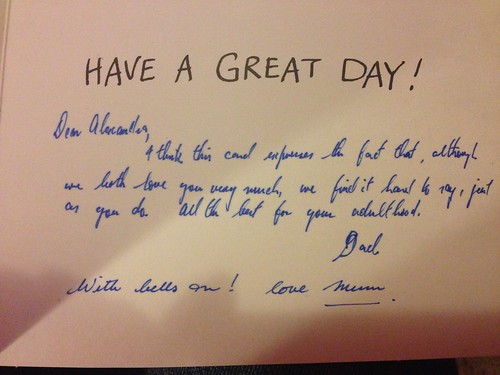
Alexandria in Australia says that the card she got from her parents on her 18th birthday (below) “is a pretty good summary of my formative years.”

Dear Alexandra,   I think this card expresses the fact that, although we both love you very much we find it hard to say, just like you do. All the best for your adulthood.   Dad  With bells on! Love Mum

Dear Alexandra,

I think this card expresses the fact that, although we both love you very much we find it hard to say, just like you do. All the best for your adulthood.

Dad

With bells on! Love Mum

related: Really, Mom, you shouldn’t have.

19 May 19:40

Photo


18 May 16:55

The 2014 Idaho GOP Governors Primary Debate Will Make Your Faith in Politicians Plummet (If That's Even Still Possible)

A.N

Start at 5:03.

The entire debate is 57:32 long, but trust us, it's worth it. There's a candidate saying something WTF-worthy almost every minute.

Submitted by: (via Aaron Kunz)

16 May 21:03

Survivalists Are Using Pinterest to Prepare for the Apocalypse

by Colette Shade

Pinterest is best known as a destination where people can share affordable wedding ideas, dip recipes, and inspirational quotes pasted over photos of white sand beaches. But a small number of Pinterest users also swap how-tos on building bomb shelters, storing food, and emergency medical care—for “when there are no doctors.”

Meet the preppers of Pinterest.

These are people who anticipate financial, environmental, or biological catastrophe, and are actively preparing by stockpiling food, medicine, weapons, and other tools for survival. There are pinboards for every type of prepper. 

Survival Mom blogger Lisa Bedford has dozens of pinboards and thousands of followers.

Many preppers offer information about bartering, anticipating a devaluing of currency or other economic disaster.

Campfire starters, two-way radios, and portable water filters are must-haves.

You’ll even find  tips on vegan, paleo, and gluten-free prepping.

The site’s larger do-it-yourself ethos dovetails with the prepper movement’s self-sufficient values. And with the growing popularity of once-arcane skills like canning, gardening and butchery, the line begins to blur between the artisanal and the paranoid.

Of course, social media has birthed (or at least unveiled) some pretty weird subcultures. We now have seapunk and vaporwave on Tumblr, and Instagram hashtags for desk porn and stationery porn. But why would survivalists flock to Pinterest, a site that was adopted early-on by people who wanted to share design ideas for home goods? In a way, preppers are actually the ideal user for the site. After all, Pinterest co-founder Evan Sharp says it was always meant to be a utility: “It’s a tool people use to plan their futures,” he told ReadWrite earlier this year. Preppers just happen to think the future looks bleak.

Besides, the Internet is a place where specialized communities convene and thrive. There are subreddits for “preppers,” “prepping” and “PostCollapse,” along with forums for silver bugs, gold bugs, and all flavors of conspiracy theorists. There are prepper blogs, and message boards, and prepper meetups in cities like New York, San Francisco, and Fairfax, Va. Preppers have their own jargon, like TEOTWAWKI (The End of the World as We Know It), WTSHTF (When the Shit Hits the Fan) and GOOD (Get Out of Dodge).

Pinterest is one of the most popular social media sites, so it’s not surprising that users who are part of the prepping community have carved out a niche for themselves. It’s unclear whether preppers see any irony in the fact that they are using a site that drives consumer sales as a way to plan for economic, social or environmental collapse.  (I contacted about a dozen of them; no one got back to me).

Maybe he link between preppers and Pinterest may have something to do with Mormons. Seriously. Pinterest appears to be really popular with followers of the Church of Latter-Day Saints, for whom preparing for tough times is an article of faith. “Church members are encouraged to prepare a simple emergency plan,” says the official website for the Church. “Items to consider may include: Three month supply of food that is part of your normal daily diet. Drinking water. Financial reserves. Longer-term supply of basic food items. Medication and first aid supplies. Clothing and bedding. Important documents. Ways to communicate with family following a disaster.”

Who are the non-Mormon preppers? “Some are just ‘regular folks’ that want to be prepared for disasters and other emergencies,” said Aton Edwards, a preparedness expert with the International Preparedness Network. “I'd say that this would constitute the majority of practitioners.”

In the United States, the unstable economy and high unemployment rate have prompted people to squirrel away staples for collapse, or at least made them think more seriously about how to prepare for tough times. “Our volatile society doesn't offer much hope of a stable future,” says Edwards. “In the end, preppers know the cold hard fact that when the ‘going gets tough,’ Americans will be as the rest of the Third World is: on their own.”

For some, the solution is to start pinning.


16 May 14:46

The "Right to Be Forgotten"

by Jia Tolentino
by Jia Tolentino

In first sentences of Guardian articles that sound like George Saunders stories:

The top European court has backed the "right to be forgotten.”

The ruling comes in a case brought against Google Spain by a man who tried and failed to get a 1988 home auction notice removed from his personal search results. The matter, he said, “had been resolved and should no longer be linked to him,” and he told the Guardian he was “fighting for the elimination of data that adversely affects people’s honor, dignity and exposes their private lives.”

The judges said they had found that the inclusion of links in the Google results related to an individual who wanted them removed "on the grounds that he wishes the information appearing on those pages relating to him personally to be 'forgotten' after a certain time" was incompatible with the existing data protection law.

They said the data that had to be erased could "appear to be inadequate, irrelevant or no longer relevant or excessive … in the light of the time that had elapsed". They added that even accurate data that had been lawfully published initially could "in the course of time become incompatible with the directive".

This seems so beautiful and radical to me, which is disturbing. The Washington Post has more about the ruling's potential consequences ("U.S. technology companies are at best going to be very unhappy"). [Guardian]

0 Comments
16 May 01:20

Pet of the Day: Watch This Family Cat Rescue a Little Boy From a Vicious Dog Attack

Bravo cat. This is amazing!

Submitted by: (via Roger Triantafilo)

Tagged: Cats , animals , dogs , pets
15 May 20:54

Oddly Satisfying of the Day: Vacuum Sealing Stuffed Animals

15 May 18:40

What if Sanitary Pad Ads Didn't Use Blue Fluid?

by Olga Khazan

Ladies, don't you hate that time of the month, when your body gently exudes an inoffensive, light-blue liquid?

The parody ad above, by the UCB comedy troupe, shows us what happens when perhaps the most famous of advertising euphemisms is shattered.

(Warning: The video is uncomfortable to watch—the substance they use has both the color and viscosity of the real thing.)

Here's one of the original "blue liquid" ads, from 1997:

Color isn't the only menstrual taboo in advertising: In 2010, Kotex was told it couldn't use the word "vagina" in its ads on three broadcast networks, and "down there" was also forbidden.

“Fem-care advertising is so sterilized and so removed from what a period is,”  Elissa Stein, co-author of the book Flow: The Cultural Story of Menstruation, told the New York Times. “You never see a bathroom, you never see a woman using a product. They never show someone having cramps or her face breaking out or tearful — it’s always happy, playful, sporty women.”

Of course, now feminine product makers are starting to turn our discomfort with menstruation into a marketing tactic.

"I tied a tampon to my keyring so my brother wouldn't take my car," a print ad by Kotex reads. "It worked."


14 May 16:27

Stressful Relationships vs. Isolation: The Battle for Our Lives

by James Hamblin

"In your everyday life, do you experience conflicts with any of the following people?"

  • Partner
  • Children
  • Other family
  • Friends
  • Neighbors

A Danish health survey asked almost 10,000 people between ages 36 and 52 to answer, "always," "often," "sometimes," "seldom," or "never" for their applicable relationships.

Eleven years later, 422 of them were no longer living. That’s a typical number. What’s compelling, Rikke Lund and her colleagues at University of Copenhagen say, is that the people who answered "always" or "often" in any of these cases were two to three times more likely to be among the dead. (And the deaths were from standard causes: cancer, heart disease, alcohol-related liver disease, etc.—not murder. Were you thinking murder?)

The association accounted for variables like cohabitation, chronic physical and mental disorders, depressive symptoms, and emotional-social support. Worries emanating from close relationships like partners or kids were more strongly related to mortality than worries from those more distant. But still, even if you are not overtly trying to kill your neighbor, it would seem that a duplicitous relationship could be ravaging you both.

Lund and other public-health researchers published this association in the current Journal of Epidemiology and Community Health. They also saw a similarly morbid trend when those same 10,000 Danes answered a slightly different question: “In your everyday life, do you feel that any of those people demand too much you or seriously worry you?” Frequent worries or demands from a partner or children were associated with 50 to 100 percent increased risk of dying during the 11-year followup.

The conclusion, then: "Stressful social relations are associated with increased mortality risk among middle-aged men and women."

We can argue all day about the definition of middle-aged here. But that would only kill us faster. Instead, stop reading this immediately and go tidy up all your relationships. If they are beyond repair, sever them completely. Then make a list of all the things you’re going to do with the extra life you just gained. If you don’t make a list, you’ll never do them.

In arguably more practical terms, Lund and colleagues suggest another course of action: “Skills in handling worries and demands from close social relations as well as conflict management—within couples and families and also in local communities—may be important strategies for reducing premature deaths.”

Ruth Frith, 100, competing in the shot put final at the 2009 World Masters Games (Ho New/Reters)

Epidemiological studies like this have told us before that stressful relationships, especially marriages, are associated with cardiovascular disease, immune dysfunction, and endocrine dysregulation. We’re not certain why. Studies have implicated inflammatory cytokines and elevations in the stress hormone cortisol. This study is unique in looking directly at death, though. It’s especially interesting because positive, protective effects of social relations on health are widely known. Like exercise, relationships shape individual health outcomes throughout life.

In isolation, most of us wither psychologically and crumble physically. In 1979, a California epidemiological study showed that the risk of death during a given period among people with the fewest social ties was more than twice as high as in those with the most. Some experts have suggested that isolation, perceived or objective, should be commonly considered alongside things like obesity as a serious health hazard. One study found social isolation was as strong of a predictor of mortality as smoking. People with heart disease are 2.4 times more likely to die of it if they are socially isolated. We could go on and on with these decades of pro-social correlations.

So the point here is relationships are like almonds. We know that if you eat almonds, you increase your odds of living longer; unless you hate almonds so much that eating them sends you into a rage, raising your blood pressure, and you eat them every day until at some point the hypertension eventually causes a stroke. Yes, just like almonds. The objective nature of what’s said or done between people converges with our personalities to create perceptions of that relationship, and that’s what matters and (seems to) significantly influence our bodies. "Certain personality traits may promote the reporting of any social relation as stressful," the researchers write, "and therefore strong correlations between measures of stressful social relations would be expected."

Men did seem more physically vulnerable to worries and demands from their partner than did women, which is in keeping with a scientific understanding of men's health as especially relationship-dependent. Men release more cortisol in response to stress than women do, and marriage has proven more beneficial to men’s health than to women’s. And it was Harry Nilsson, not Mariah Carey, who was first moved to popularize Badfinger's "Without You" in 1971 by really drawing out the emotive i in the line, "I can't liiive if living is without you."

As with gender, costs and benefits of social relationships are also not distributed equally across socioeconomic strata. People on the lower end have the highest levels of social stress, which Lund suggests is due to a lack of health-promoting coping strategies among people who have fewer "intrapsychic and social resources" and "higher social vulnerability towards several types of major personal events such as income loss, ill health, divorce and death of a loved one for those disadvantaged by income, education, and occupational status."

And finally, on a heartening note, people who said they "never" experience negativity from social relationships had a slightly higher mortality rate than those who "seldom" do. So a little negativity might be good. I think that’s how we know we care about people? And how we know we're alive? I'm not sure.


13 May 20:53

Some Kids Get Charged Twice for One Crime

by Nishat Kurwa

DeShawn Morris was 18 years old when he was arrested for armed robbery on July 20, 2010. According to his mother, Zoe Mathews, Morris was excited about entering a teacher training program the next day in San Leandro, California. He had recently graduated from high school and was a mentor at Youth Radio, a non-profit, media-training organization for young adults (a program where this author also works). Out with two of his friends—who were, like him, young black men—Morris was standing near a bus stop in Oakland when a police officer approached and shined his car’s headlights on the group.

From another police car, a victim who had been robbed at gunpoint a few blocks away identified Morris as the suspect. In what Mathews says was a case of racial profiling and mistaken identity, Morris was charged with the crime. He served 56 days in juvenile hall and 152 days in a boot camp in the Mendocino National Forest called the Fouts Springs Youth Facility.

Morris was shot and killed at a park in Vallejo in June 2012. Nearly two years after her son’s death, Mathews can’t put his run-ins with the juvenile justice system behind her, and it’s not just because she disputes the robbery charge.

It’s the money.

In 57 of 58 counties in California, the state with the highest population of incarcerated youth in the country, young people don’t just pay for their crimes with their incarceration—they get billed. Juvenile offenders are charged a percentage of the counties’ costs for incarcerating them and, later, for a partial cost of probation services. In Solano County, where DeShawn Morris served time, these charges are for “Care, Support, and Maintenance”—services that include staffing, clothing, and health care.

In Alameda County, which includes Oakland and Berkeley, the practice of charging juvenile offenders for processing and probation is less than five years old. For suspects older than 16, the meter starts running even before indictment, with a $250 charge for the investigation that’s initiated after an arrest. For a juvenile who’s been detained for the average time in Alameda County—23 days—the total bill will be close to $2,000.  

“We’re trying to get blood from a stone in many situations,” said Beth Colgan, a Thomas C. Grey Fellow at Stanford Law School who’s written about the history of fees charged by the criminal justice system, which she says incur as much as 12 percent interest in some states. “These fees can be detrimental to people’s ability to get back on their feet. One of the strongest arguments against these fees is that they do perpetuate inequality and poverty in a way that might make many people uncomfortable.”

Terry Wiley, the senior deputy district attorney for Alameda County, has a different perspective: “Don’t be committing crimes, and you won’t owe any money.” This is one matter-of-fact take, but it doesn't help much once an offender is already caught up in the justice system.

For one thing, offenders, along with other taxpayers, are stuck paying for any overcharging produced by the system’s inefficiencies. In an interview for the documentary film A Matter of Respect, Wiley himself says that though local police departments may do a good job investigating a case, “what they bring over in terms of police reports and their version of events they’ve got from witnesses is not always what really happened.” In Alameda County, the fee for investigations, accurate or not, is charged even if a suspect is exonerated. And if the fees aren’t paid, judges have the discretion to reincarcerate offenders.

In California, the bills for juvenile offenders go to parents like Zoe Mathews. According to a 2011 report from the National Center for Juvenile Justice, 29 states require courts to order payment from parents. The financial responsibility begins from the moment an arrest happens. In some cases, parents can negotiate certain fees if they can’t pay, but rules vary around the country. When the bills aren’t paid, officials can involve collections agencies, deduct from parents’ wages, or take their tax refunds.

Mathews is on the hook for more than $7,500 in fees related to her son’s incarceration for the robbery charge and a previous misdemeanor. That includes 56 days in juvenile hall at $30 per day, for a total of $1,680. Probation supervision racked up an $1,800 bill. And Mathews, who’s been exceptionally persistent in chasing down answers from the juvenile justice system, isn’t prepared to pay for certain bills that she views as unfair.

In a lengthy email 2012 chain between Mathews and Jeff Liddicoat, who was then a senior staff analyst with Solano County’s Probation Department, Mathews asks for the math behind some of the line items on her bills. Liddicoat replies that he can’t comment on individual cases. But he does outline the rationale behind the bills: “To be financially prudent to the county taxpayers and voters,” he writes, “the County must collect fees for its services...to reimburse the County for services that are not provided to the general public as a whole.”

That is, taxpayers in Solano County—which has the lowest per capita income in the San Francisco Bay Area—are not expected to cover the entire cost of detaining minors.  In 2012, however, these fees were less than one percent of the Probation Department’s $28.5 million dollars in total revenue. And according to Stanford’s Beth Colgan, counties often spend a lot more money trying to collect the fees than they recoup. But, “as counties get crunched economically,” she told me, “this has been the response.” Between 2009 and 2013, at least eight states introduced legislation dealing with parental payment obligations; in 2011 alone, Utah, Idaho, and Texas all proposed such laws, the National Center for Juvenile Justice reports.

Juvenile-justice advocates tend to agree that most people aren't very well informed about the workings of the justice system and its costs unless they experience them directly. “When that happens,” National Center for Juvenile Justice Director Melissa Sickmund wrote in an email, “they often go through the process not understanding what is happening to them or their children. Advocates are pushing for use of more ‘common language’ in court. There is research that shows that even if justice decision-making goes against someone, if they have been treated fairly ... they are more likely to comply.”

Zoe Mathews is a working single mother of three. She says she can’t afford the payment arrangement determined by Solano County for fees related to her deceased child’s time in detention and on probation. She’s tried to negotiate with the county to waive the fees, she says, but the county would only lower the monthly payment.

The phone calls from county bill collections agency have stopped, but Mathews says she’s now receiving letters threatening to garnish her wages if she doesn’t pay. Although she says she understands why the county aims to recoup some of its costs, Mathews calls the fees to juvenile offenders “double-dipping.” They’re unfair, in her view, once an offender has served time.

“That’s supposed to rehabilitate you, and you’re paying your debt back to society,” she says, “so then they’re going to charge you an additional per night stay? As if you elected to do that, as if there were some options?”

She pauses, and then says, “No, I don’t think that’s right at all.”


This story is part of a special report on the U.S. juvenile justice system produced by Youth Radio. Other installments will be broadcast on the radio program "Marketplace."


13 May 18:54

That Ice Cream Truck Jingle Is Really A Minstrel Song From 1916

by Jia Tolentino
by Jia Tolentino


Via NPR's Codeswitch, a nice, disgusting piece of history; this song, recorded by actor Harry C. Browne and just very much titled Nigger Love a Watermelon Ha! Ha! Ha!, lets the ice cream riff go exactly once before stopping it with this interlude:

Browne: "You niggers quit throwin' them bones and come down and get your ice cream!"
Black men (incredulously): "Ice Cream?!?"
Browne: "Yes, ice cream! Colored man's ice cream: WATERMELON!!"

The melody itself comes from "Turkey in the Straw," a folk song popularized by minstrel performers in the early 19th century, which later turned into "Zip Coon," the song that served as the basis for "Zip-a-Dee-Doo-Dah," another notorious piece of racist Americana. [NPR]

3 Comments
12 May 23:38

The True-Life Victorian Ancestor of Cannibal Rat Ghost Ship

by Jia Tolentino
by Jia Tolentino

The BBC's series on bizarre news events from the Victorian era has outdone itself with this story about a British sailing rig called the Margaret that set sail from the west coast of Africa with "400 cockatoos and parrots, 12 snakes, some monkeys, a gorilla, an orangutan and two crocodiles," and soon turned into "singular mix of Noah's ark and the mutiny on the Bounty."

First to die were the birds, starved when the ship's swarming rats scoffed all the corn that had been provided as feed. [...] As the ship was tossed about on wind-whipped waves, the snakes and crocodiles broke free of their crates and invaded the crew's quarters, forcing the sailors to seek shelter in the cabin for days on end.

"These reptiles, along with the rats, kept up a continual warfare until the surviving crocodile killed the last snake," said the paper, "and completed the chain of vengeance by being killed by some of the cargo shifting and falling on it".

And then the monkeys got loose, and then the gorilla, who had to be fought off by the ship's cook and a sailor with a hatchet! The Margaret docked, eventually, with only the "gorilla, three monkeys and four parrots" left. [BBC]

1 Comments
12 May 16:02

How Welfare Reform Left Single Moms Behind

by Olga Khazan

Rosa Pena, a 24-year-old single mom in Arizona, told the New York Times “I’ll do what I have to do,” to stay alive, including sell the groceries she buys with food stamps. Other poor women the paper interviewed in 2012 said they sell clothes for extra cash or reluctantly move back in with violent boyfriends. “One woman said she sold her child’s Social Security number ... ‘I tried to sell blood, but they told me I was anemic,’ she said."

If they can't find work, they have few other options. Payments from Temporary Assistance to Needy Families (TANF, but more colloquially referred to as welfare), once a last resort for single mothers, have declined precipitously in the past two decades, even as other government programs have grown.

In a forthcoming study for the journal Demography, Robert Moffitt, an economist at Johns Hopkins University, details how the poorest single-parent families—80 percent of which are headed by single mothers—receive 35 percent less in government transfers than they did three decades ago. Meanwhile, government spending on older and disabled adults has increased.

“We know now that there has been a large increase in total government support to low income families since 1986, but the distribution of that support has dramatically changed,” Moffitt said in a recent presentation at the Population Association of America, where he serves as president.

In 1935, Congress created three safety-net programs aimed at alleviating poverty: Social Security, which is for the old and disabled, Unemployment Insurance, which is for those temporarily out of a job, and Aid to Dependent Children, whose name was later changed to Aid to Families with Dependent Children. The latter is what we typically think of as “welfare”—cash transfers intended to help widows with children.

Food stamps, which go to low-income families or individuals, were added in 1964, and in 1975 came the Earned Income Tax Credit, or EITC, which goes to working families with a certain level of income.

AFDC was never flawless—it excluded black women until the 1960s—but it did become an important lifeline for poor mothers throughout the 1980s. By 1992, the majority of AFDC recipients were single mothers, rather than widows.

As more women entered the workforce, however, society began to sour on unemployed single mothers. Those drawing government benefits were derided as “welfare queens.”

“The expectation was that since middle-class women are working and supporting their families, that low-income families should be doing the same,” Moffitt told me.

In 1996, former President Bill Clinton pledged to “end welfare as we know it,” and AFDC morphed into TANF—Temporary Assistance to Needy Families. A five-year time limit was introduced, and mothers were required to work 30 hours per week or risk losing their benefits. States’ funds were capped, pressuring them to slice welfare rolls.

The effect was that thousands of single moms were promptly shoved off the program: “The legislation reduced the number of poor single mother families served by 63 percent within 10 years, effectively removing it as an important program in the nation’s safety net for the poor,” Moffitt writes.

Here’s a chart showing spending on all of the benefit programs over time, which Moffitt calculated using the Survey of Income and Program Participation.

Robert Moffitt/Johns Hopkins University

But that’s not to say we were growing more tight-fisted as a nation. Spending on these programs rose from nine percent of GDP in 1985 to 12 percent in 2007. Between 1990 and 1995, SSI spending grew by 80 percent because of changes in eligibility rules. The EITC grew by 274 percent between 1988 and 1998. And though there were recently major cuts to the food-stamp program, it had expanded by 20 percent between 2003 and 2007.

Meanwhile, spending on TANF, the only program that non-disabled, non-elderly, poor single mothers are eligible for other than food stamps, was lower in 2007 than it had been in 1970.

Food stamps, meanwhile, provide an average of just $5 per day per person.

The result has been that over time, older people, disabled people, and working families have reaped the increased welfare benefits. Unemployed, single-parent families have gradually lost out.

Here’s a look at how the transfers to various groups have changed over time:

Robert Moffitt/Johns Hopkins University

The average older adult received about 20 percent more from the government in 2004 than they did in 1983, but the average able-bodied, single parent younger than 62 received 20 percent less. And that decrease was concentrated among single-parent families who make less than half the poverty level—the poorest of the poor.

Robert Moffitt/Johns Hopkins University

“It helps to be married and not a single person if your earnings are very low,” Moffitt said.

The 2012 New York Times story estimated that now, “one in every four low-income single mothers is jobless and without cash aid—roughly four million women and children.”

What they do for money isn’t clear, but Moffitt listed a few possibilities.

“Some find occasional jobs, but that's not enough to qualify them for the TANF program,” he told me. “Some get income from family members. Some engage in illegal activity. Some have boyfriends. All the indications are that they kind of scrape by.”

Moffitt is careful to emphasize that this doesn’t mean benefits to the disabled, elderly, or working families should be cut. But his findings do suggest that the stigma surrounding unwed mothers has made their economic lives much harder.

What’s interesting is that the idea of the "welfare queen" has persisted even as welfare itself has evaporated, as Amanda Marcotte pointed out in the Daily Beast. In December, Ann Coulter claimed on Fox & Friends that “single women look to the government as their husbands. Please provide for me, please take care of me.”

Even if single moms wanted to do that, though, they couldn’t.


09 May 16:22

People with ADD are too easily distracted to be expected to remember to reorder their ADD meds. And that’s why this post exists.

by thebloggess
A.N

For the song. Kelly, can we take the kids to see this???

I have lots of things to write about but my head is too full to get them all out.  Every day this month has been filled with joy and terror and confusion and self-doubt and gratitude and horror, and then my mind is filled up with stories that I need to get onto paper, but they all get jammed together.

It’s like when you were six and you were trying to get money out of your piggy bank, but it didn’t have a stopper so you just turn the glass pig upside down and shake it violently and loudly as each penny drops out of the opening, but then it would get jammed with pennies and you’d have to sneak a knife out of the kitchen to shove it up the thin opening, and it totally worked, but then you wiggle the knife a little too hard and suddenly the glass opening of your piggy bank  shatters and you panic and try to put the pieces back together because you instantly realize that the bank was worth way more than all the pennies inside of it, but you slice open your hand on the broken glass, and that’s when your mom realizes it’s gone terribly quiet and she walks in to find you cross-legged, wide-eyed, holding a knife and covered in blood, and she screams “WHAT HAVE YOU DONE?” as if you might have murdered your little sister, but you explain that your sister is fine and that you just got stabbed by the piggy bank, and that you’re really sorry and will take any punishment she metes out but that “it sort of seems like being stabbed is punishment enough,” and then your mom is like, “JUST PUT THE KNIFE DOWN, JENNY” as if you’re some small, terrible mugger who murdered a pig for a bunch of blood-soaked pennies.

And that’s what my head is like right now.  It’s awful and wonderful.  And it’s full of blood and stories and (metaphoric) broken glass and far too many run-on sentences.  So tonight I’m going to turn my head upside down and shake until things come loose, because sometimes the only thing harder than writing is not writing.

This post has no real point except to say that I’m still here and that one day very soon I will have shaken free the final page of the book inside my head so you can read it.  But for now I’m leaving you with a song I listen to when my head gets too overwhelmed and when I need to be reminded that writing is very much like life, in that it is sometimes incredibly hard, but that doesn’t mean it isn’t also incredibly worthwhile.

09 May 11:55

Frozen As A Horror Movie

by Endswell
A.N

Ok, i know. TWO stupid videos in a row. but i lol'ed

Some clever editing and a different score gives Disney’s monster hit a dark edge.

Bobby Burns via 22 Words

09 May 01:33

Speaking Exchange: Brazilian Kids Learn English By Chatting With Lonely Elderly Americans

by Endswell
A.N

*sneef. sounds corny.. but but

FCB Brasil has started the “Speaking Exchange” project for CNA language schools in Brazil, an innovative project that began by pairing up students at the CNA school in Liberdade, Brazil with residents of the Windsor Park Retirement Community in Chicago via webcam for video chats. The sessions are then uploaded to YouTube for teachers to review their progress.

“The idea is simple and it’s a win-win proposition for both the students and the American senior citizens. It’s exciting to see their reactions and contentment. It truly benefits both sides,” says Joanna Monteiro, executive creative director at FCB Brasil.

FCB Brasil via AdWeek

09 May 01:28

Falafel Salad

by Beth M

You may be looking at that picture and thinking, “But where is the falafel?” Well, it’s not a salad with falafel, it’s a salad made out of falafel ingredients. 

You see, I was really craving my falafel the other day, but I was too lazy to make the little patties or fry them. So, I wondered what all of the ingredients would taste like just thrown together in a bowl. Pretty damn good, that’s how it tastes.

I had to do a little tweaking, but all in all the salad super amazing. Instead of regular salad greens, it starts with a a bed of fresh parsley and cilantro. Those two herbs are what make the falafel taste so amazing and fresh. I added chickpeas for body and because chickpeas are what falafel is all about. I also added some bulgur wheat for texture. Fresh tomatoes went into the mix to make it a little more salady, and would have added diced cucumber if the selection at the store hadn’t looked so pitiful (wrinkly cucumbers are so sad). I had to find a way to get all of the falafel spices into the salad, so I mixed them right into a basic tahini lemon dressing (because you’d probably drizzle some tahini over the falafel anyway, right?). The tahini dressing was so zingy with its fresh garlic that I skipped the red onion that is in the original falafel recipe. It wasn’t missed. The end result was so amazing that I didn’t have time to notice there were no red onions.

I’m totally IN LOVE with this salad and can see myself making it at least once a week, if not only as an excuse to eat this amazing dressing. I’m pretty sure I’m going to have a jar of the tahini dressing in my fridge at all times.

NOTE: If you can’t find bulgur, you can use couscous, or even quinoa as a gluten free option.

Falafel Salad

Falafel Salad

5.0 from 7 reviews
Falafel Salad
 
Prep time
Cook time
Total time
 
Total Cost: $6.28
Cost Per Serving: $1.57
Serves: 4-6
Ingredients
TAHINI DRESSING
  • ⅓ cup tahini (sesame seed paste) $1.08
  • ⅓ cup water $0.00
  • ¼ cup lemon juice $0.18
  • 2 cloves garlic, peeled $0.16
  • ½ tsp cumin $0.05
  • ¼ tsp cayenne pepper $0.03
  • ½ tsp salt $0.02
SALAD
  • 1 bunch flat leaf parsley $0.89
  • 1 bunch cilantro $0.85
  • 1 (19 oz.) can chickpeas $1.50
  • ½ cup uncooked bulgur $0.77
  • 2 small (3/4 lb.) tomatoes $0.75
Instructions
  1. To make the dressing, smash the garlic cloves under the blade of a knife or roughly chop them. Add the garlic, tahini, water, lemon juice, cumin, cayenne, and salt to a blender. Blend until the mixture is smooth and the garlic is in small pieces. Refrigerate the dressing until ready to use.
  2. To cook the bulgur, place the dry bulgur in a sauce pot. Cook and stir the dry bulgur (without water or oil) over medium heat for two minutes to toast it slightly. Add one cup of water and bring the mixture up to a boil. Add a lid to the pot, turn the heat down to low, and let it simmer for 20 minutes. After 20 minutes, fluff the bulgur and transfer it to the refrigerator without a lid to cool.
  3. Wash the parsley and cilantro well under cool water. Shake as much water off as possible. Pull the leaves from the stems and then roughly chop the leaves. Place the chopped parsley and cilantro in a bowl.
  4. Dice the tomato and add it to the bowl. Rinse and drain the chickpeas, then add them to the bowl. Finally, add the cooled bulgur to the boil and stir to combine the ingredients. Add a liberal amount of the tahini dressing and stir until everything is well coated.
Notes
Want to add more? Diced cucumbers or crumbled feta would also be amazing in this.
3.2.2646

Falafel Salad


Step by Step Photos

Tahini Dressing

Make the tahini dressing first, so that the flavors have a few minutes to blend while you’re making the rest of the salad. Smash or roughly chop two cloves of garlic, then add them to a blender with 1/3 cup tahini, 1/3 cup water, 1/4 cup lemon juice, 1/2 tsp cumin, 1/4 tsp cayenne pepper, and 1/2 tsp salt. Blend the ingredients until smooth and no large chunks of garlic remain. Refrigerate the dressing until ready to use.

Bulgur

Next, it’s time to cook the bulgur. Again, if you can’t find bulgur (I got mine from the bulk bins at the grocery), you can use couscous or quinoa. I used 1/2 cup of dry bulgur for this salad.

Toast Bulgur

Toast the bulgur slightly before cooking it to make it a little more scrumptious. Just add it to a small sauce pot and cook and stir over medium heat for about two minutes. Because there is no moisture in the pot at this point, it will toast the grains. Finally, add a cup of water, let it come back up to a boil (which will be fast because the pot is already hot), then add a lid and turn the heat down to low. Let it simmer on low for 20 minutes.

Fluff Bulgur

After 20 minutes, fluff the bulgur then let it sit in the fridge for about 5-10 minutes to cool. Leave the lid off while it’s in there so the excess moisture evaporates away. That way you’ll have nice little chewy bits, rather than sticky wet bits.

Pull Leaves

Now on to the vegetables… Wash the one bunch of parsley and one bunch of cilantro well. Nothing ruins a salad faster than sand. Try to get as much of the water off as possible. Pull the leaves from the stems. The stems are soft and edible, too, so you don’t have to be very precise about this. Just pull what you can off. 

Chop Leaves

Give the leaves a rough chop. I probably should have chopped mine just a bit finer, but it’s all good.

Dice tomatoes

Dice two small tomatoes (yes, mine were on sale).

Chickpeas

Rinse and drain one 19oz. can of chickpeas. If you can’t find the 19oz. size can, you can just use a 15oz. can, or if you want extra chickpeas, go for the gold and use two 15oz. cans.

Stir Salad

Add the cilantro, parsley, chickpeas, tomatoes, and cooled bulgur to a bowl and stir them all together.

Tahini Dressing

Now remember that amazing dressing? OMG it’s so good…

Pour Dressing

Pour it ALL over the salad. Honestly, the more dressing the better with this one. I used about half of the batch of dressing… and still kinda wanted more.

Falafel Salad

And then stir it all up so that everything is drenched in that amazing dressing. NOW EAT.

Falafel Salad

This made about 5 cups. Four large servings or six smaller side salad type servings. Of course, if your bunches of parsley and cilantro are different sizes than mine, you may get a different yield. Either way, I could have probably eaten at least half the batch in one sitting because it was so good. RESTRAIN YOURSELF, BETH.

The post Falafel Salad appeared first on Budget Bytes.