Adobe’s Firefly Video Model can generate a range of styles, including ‘realism’ (as pictured). | Image: Adobe
Adobe is making the jump into generative AI video. The company’s Firefly Video Model, which has been teased since earlier this year, is launching today across a handful of new tools, including some right inside Premiere Pro that will allow creatives to extend footage and generate video from still images and text prompts.
The first tool — Generative Extend — is launching in beta for Premiere Pro. It can be used to extend the end or beginning of footage that’s slightly too short, or make adjustments mid-shot, such as to correct shifting eye-lines or unexpected movement.
Clips can only be extended by two seconds, so Generative Extend is only really suitable for small tweaks, but that could replace the need to retake footage to correct tiny...
my Hawkeyes have a chance to sneak into the college football playoff
…As always, the searchable archive of all past issues is here. Please please subscribe here to support ChinAI under a Guardian/Wikipedia-style tipping model (everyone gets the same content but those who can pay support access for all AND compensation for awesome ChinAI contributors).
***Thanks to Marianne Lu for contributing this week’s feature translation and analysis. Marianne is a technology and security policy fellow at RAND. She recently graduated from Stanford University, where her thesis focused on U.S.-China AI competition. What follows is her analysis (lightly edited by me).
Key Takeaways: Chinese LLMs have done surprisingly well overseas.
At least three of the most downloaded AI apps in the U.S. are from Chinese companies.
This reflects a growing awareness among Chinese AI companies that “simply competing within the domestic market isn’t enough –– they must go global…In 2024, AI and international expansion have become two of the few remaining paths that still show growth.”
A variety of players are riding this wave of overseas expansion, including established tech giants, newer AI unicorns, and smaller startups.
International expansion offers a few key benefits, including access to broader sources of user traffic and better LLM technologies.
Entering new regions allows companies to bring in waves of users while avoiding the challenges of the domestic market, including competitors who imitate features, engage in price wars, and poach talent.
It also opens up access to superior technologies that are unavailable in China –– the overseas version of ByteDance's Coze, for example, supports GPT-4o.
Additionally, the overseas market is more receptive to paid subscription models and boasts a better funding environment.
But the picture is far from perfect.
The article admits that overall, the success rate for AI products that go overseas is low: “Very few can achieve instant success and maintain stable operations.”
One possible explanation is that AI development has not yet entered an era of “truly killer” applications: “Cautious observers believe that AI has not yet entered the ‘mobile internet era.’ The transformative capabilities of AI large models resemble the early days of internet connectivity –– we are still in the stage of improving infrastructure…”
Achieving scale, navigating commercialization, and ensuring compliance are some of the key challenges facing Chinese companies trying to go abroad.
Many companies struggle to get off the ground because of an inadequate understanding of overseas user needs.
Achieving profitability also remains a significant hurdle. While earlier developers earned their “first pot of gold” through minor innovations and AI shell applications, the market has become much more competitive.
Compliance is another issue. Some payment services providers have apparently broken off partnerships with Chinese AI products due to risk concerns, and new regulations such as the EU AI Act place stricter standards on Chinese AI companies venturing abroad.
The article concludes: “For Chinese companies going abroad, becoming the next TikTok still requires overcoming many hurdles. “
Analysis: Observers often highlight how Chinese government support and direction facilitate the overseas expansion of Chinese tech companies. This article sheds light on the role of domestic market dynamics in companies’ decisions to go abroad, as well as the considerable challenges that they face along the way.
Sourced from the Emerging Technology Observatory’s Scout tool: “On September 14, the CAC announced the solicitation of public comments on a draft of measures for the identification of AI-generated content. Individuals have one month to provide comments. The draft for comments defines AI-generated content and requires network service providers to explicitly label AI-generated files as they are downloaded, copied, and exported. The draft also requires that providers standardize the dissemination of AI-generated content and remind users to declare whether their files include AI-generated content.”
For the Made in China Journal, Yangyang Cheng interviews Susan Greenhalgh about how Big Soda exported its ideas about nutritional science to China. Some fascinating insights in this interview, including:
The US soda industry’s secret weapon was an industry-funded scientific non-profit called International Life Sciences Institute (ILSI). Based in Washington, DC, but with branches around the world…ILSI’s China branch was run by a very capable former high-level official from the Ministry of Health. Because of her political position and policy clout, ILSI-China was physically located in the Ministry and became the centre of obesity work in the country during the key years of 1999 to 2015. This extraordinary setup gave Big Food a direct hand in the making of China’s science and policy on obesity.
Two book promo links:
Apologies but the book promo hustle continues:
Technology and the Rise of Great Powers book talk at Stanford University’s Center for International Security and Cooperation: Tuesday, October 15, 2024; 12:00 PM - 1:15 PM (Pacific).
I had a great conversation about the book with Eleanora Mattiacci, Associate Professor of Political Science at Amherst College, on the New Books Network podcast. It’s a platform to discover new academic books!
Thank you for reading and engaging.
These are Jeff Ding's (sometimes) weekly translations of Chinese-language musings on AI and related topics. Jeff is an Assistant Professor of Political Science at George Washington University.
Check out the archive of all past issues here & please subscribe here to support ChinAI under a Guardian/Wikipedia-style tipping model (everyone gets the same content but those who can pay for a subscription will support access for all).
Also! Listen to narrations of the ChinAI Newsletter in podcast format here.
Any suggestions or feedback? Let me know at chinainewsletter@gmail.com or on Twitter at @jjding99
Scientists have successfully used human stem cells to patch a hole in a monkey's retina, restoring the primate's vision and marking a successful step forward in the quest to treat age-related vision loss.
As detailed in a study published this month in the journal Stem Cell Reports, the team led by Michiko Mandai at the Kobe City Eye Hospital in Japan focused on fixing what's called a macular hole, an ocular condition associated with aging. As we get older, the vitreous — the gel-like fluid that fills human eyeballs and maintains their rounded shapes — shrinks away from the retina, which sometimes causes a tear in the macula.
These injuries are consequential. The macula sits at the center of the retina and is the most active part of the eye, responsible for central vision and light processing.
Thus, macular holes cause vision to blur and decline over time, and as New Scientist notes, current fixes — which are only an option in about 90 percent of cases — come at a cost: loss of peripheral vision. To treat macular holes, doctors will transfer cells from the outskirts of the retina to the middle. But if you're stealing cells from the outskirts of the eye, periphery vision gaps are somewhat inevitable. Tears are also known to reoccur.
That's why researchers are interested in implanting stem cells to repair the problem. Rather than patching the macular hole with the limited cells already in the eye, stem cells present the option of introducing new cells entirely.
For their study, the scientists started by growing a sheet of retinal cell precursors, derived from a human embryo.
Those cells were then transplanted into the right-side retina of a macular hole-plagued snow monkey that struggled to pass vision tests.
After six months, the scientists re-tested the monkey's eyesight. Before the transplant, the monkey was able to focus its gaze on just 1.5 percent of dots in a series of tests. But six months into the transplant, the primate was, across three tests, able to fix its eye's gaze on between 11 and 26 percent of dots — a marked improvement.
Unfortunately, there are some thorny ethical considerations: to comprehensively examine the efficacy of the stem cell treatment beyond dot tests, the scientists had to remove the snow monkey's eye altogether. In doing so, though, the scientists did find that the retina had grown new visual cells.
However, they couldn't tell whether those cells had grown out of the implanted stem cell or the monkey's native retina, meaning that scientists aren't sure exactly how the stem cells actually worked inside of the snow monkey's eye. Questions remain: did they sprout new cells on their own? Or did they spark regeneration in the primate's original cells?
More research needs to be done to determine whether this treatment is suitable for human eyes.
Even so, the study reaffirms stem cells' promise as an exciting future treatment for a range of ocular woes, including age-related vision decline.
BOCA CHICA BEACH, Texas—SpaceX accomplished a groundbreaking engineering feat Sunday when it launched the fifth test flight of its gigantic Starship rocket and then caught the booster back at the launch pad in Texas with mechanical arms seven minutes later.
This achievement is the first of its kind, and it's crucial for SpaceX's vision of rapidly reusing the Starship rocket, enabling human expeditions to the Moon and Mars, routine access to space for mind-bogglingly massive payloads, and novel capabilities that no other company—or country—seems close to attaining.
The test flight began with a thundering liftoff of the 398-foot-tall (121.3-meter) Starship rocket at 7:25 am CDT (12:25 UTC) from SpaceX's Starbase launch site in South Texas, a few miles north of the US-Mexico border. The rocket's Super Heavy booster stage fired 33 Raptor engines, generating nearly 17 million pounds of thrust and gulping 20 tons of methane and liquid oxygen propellants per second at full throttle.
Des chercheurs ont probablement percé un mystère intrigant: où disparaît le plastique dans les océans ? Leurs découvertes pourraient bien bouleverser notre compréhension de la pollution...
Spotted: Climate change and population growth, along with faster means of travel and poverty, have made the spread of infectious diseases easier than ever. Significant outbreaks of communicable diseases like SARS, Ebola, Swine Flu, and COVID-19 have occurred all within the past two decades, and it’s likely that the coming decades will see similar pandemics and epidemics. Now, university researchers have a solution that could help diseases to be detected faster.
To contain and prevent outbreaks, consistent monitoring has become necessary for rapid detection, and wastewater surveillance is emerging as a favourite solution because of its ability to monitor community-wide trends with less effort. Nevertheless, current wastewater surveillance techniques endure significant delays between sample collection and analysis, which is why Cranfield University scientists have developed an alternative.
The team created microfluidic, wax-printed paper devices folded like origami that can identify biomarkers in wastewater to track diseases. Containing chemicals that will react and cause a fluorescent colour to emerge on the paper through loop-mediated isothermal amplification, all signals from the paper can be read with a mobile phone camera.
As opposed to the 24-48 hours previous wastewater testing methods took, this method returns accurate results in around 1.5 hours, allowing early detection and management of infectious diseases that could spread rapidly in hours. Beyond its faster analysis times, this portable method is both user-friendly and costs less.
The device was used to test the wastewater of quarantining sites during the COVID-19 pandemic, and its findings were recently published in the journal Cell Reports Physical Science. The researchers, led by Professor Zhugen Yang, have secured a grant from the Biotechnology and Biological Sciences Research Council and support from the Leverhulme Trust Research Leadership Scheme to conduct more testing.
Spotted: With billions of interconnected devices in use globally, the Internet of Things is only expected to grow as one of the most significant trends in the age of digital transformation. This brings a pressing problem of excessive battery waste, with 242,000 tonnes of portable batteries sold in 2021 in the EU alone. Swiss cleantech Perovskia Solar has developed a pioneering solution to this challenge: high-efficiency, portable perovskite solar cells designed to power our devices both indoors and outdoors.
As IoT devices continue to proliferate in industrial and consumer settings, their energy needs are increasing. Perovskia’s innovation offers a complete alternative to traditional batteries, harvesting ambient light with lightweight cells that are manufactured using an inkjet printing method.
The technology is based on six years of research at the Swiss Federal Laboratories for Materials Science and Technology (Empa), and is now primed for release to the global market. The aim is that Perovskia’s cells will reduce the reliance on single-use batteries, cut waste, and enable self-sustaining IoT devices. “Perovskia technology is based on a unique blend of perovskite chemistry and strong expertise in inkjet production processes” CEO and Founder Anand Verma explained to Springwise. This provides a solution that is scalable at the same time as being aesthetically versatile.
The startup has already attracted the attention of major players in the IoT industry who are looking for custom-designed solar cells for devices. Perovskia has secured over 10 early adopters and recently closed on $2.4 million in seed funding from a global coalition of angel investors and early-stage funds.
The company’s immediate focus is scaling up production, with an ambitious target of reaching one million printed cells by the end of 2024, and up to 0.5 million finished devices by 2025 year end. To meet the growing demand, Perovskia is also working on automating its backend processes and quality control. Verma told Springwise: “our initial focus is on Industrial IoT (…) Our grand vision is to enable solar on every device.”
In the lending industry, the digital revolution has completely changed the way both businesses and consumers operate. What was once a traditional industry, very much reliant on paperwork and face to face interactions, is now dominated by digital processes.
Within the lending industry, the unsecured loan market has been particularly transformed by the shift to digital. Online lending platforms but also loan comparison sites, such as Laina Heti, now dominate the market, and banks are virtually a thing of the past. Digital processes are complicated and demanding to manage behind the scenes, but for consumers there are huge benefits.
For consumers, unsecured loans are easier to get hold of, the funds are delivered more quickly, and loans are easier to repay. Loans are also cheaper, the options are clearer, and there are more choices at the outset.
The digital loan market is estimated at $45.332 billion in 2024 but is expected to reach $79.534 billion by 2029 with a CAGR of 11.90%.
What is an unsecured loan?
An unsecured loan is a loan in which the borrower does not provide a guarantor or any collateral when they take out the loan. You should always compare unsecured loans before you take out the loan. Loan comparison is fast and easy on loan comparison websites, of which the Luotto site is a good example.
Increased loan accessibility
Digital technology has made loans more accessible by increasing the accuracy of lending risk assessments.
With traditional lending systems, lenders used to rely on narrower and more basic assessments of loan applicants’ risk levels. With digital technologies, however, more information is available. Lenders are also able to make more complex and accurate analysis of the information they receive. More eligible loan applicants are identified, and so more people can take out loans.
Many loan applicants who would have been rejected under traditional loan approval systems are approved under digital systems.
People who have a poor credit history but who are, in fact, financially stable enough to take out an unsecured loan may now be approved where they were previously rejected.
Not only are lending practices fairer and more positive for borrowers, but it’s also good for the lenders. Lenders increase both their own turnover and customer satisfaction.
Reduced borrowing costs
Digital lending processes are cheaper to operate for loan providers, and this reduces the cost of borrowing for consumers.
Where lenders used to do business in physical branches and with higher staff numbers, borrowing processes are now managed online. Many processes that used to be manual (involving paperwork and telephone calls) are now automatic, reducing the need for staff input.
The majority of short-term, unsecured lenders now operate entirely online, with no physical branches.
Improved consumer choices
As well as reducing costs, the digital revolution has increased the number of lenders that are operating and made it easier for consumers to compare lenders.
With a larger number of lenders, there’s more competition. Prices are more competitive, and standards of service are improved. There are also more options and types of finance available as well.
On top of all this, it’s easier for consumers to compare interest rates, borrowing limits and terms and conditions between lenders. Online searches are fast, and it’s easy to compare a large number of lenders. Comparison sites, such as Lainojen Yhdistäminen, are available as well, making it possible to make an instant comparison according to an individual consumer’s specific needs.
Improved customer experience
Digital lending processes have completely transformed the customer experience when it comes to applying for, receiving and paying back a loan.
Application processes for unsecured loans are fast and easy. Online application forms usually take a few minutes to complete, and they don’t require applicants to submit sensitive or hard to retrieve information.
Following on from this, lending decisions are made quickly or even immediately. In many cases, the funds are also received in the applicant’s account immediately or on the same day.
Paying back loans is easier as well. Payment notifications are delivered in more effective but less intrusive ways, and payments are easier to make. With A2A payments, for example, borrowers receive a payment due notification with a link they can click to quickly make the payment.
Customer experience is constantly improving. With Open Banking, for example, it may be possible to complete a loan application and set up a repayment plan in just a few clicks.
Mobile technology and loan customer experience
Mobile technology has been crucial to the successful digitalisation of unsecured borrowing. Having the technologies that underpin lending accessible from mobile phones makes it easy for consumers to complete loan applications, make repayments or contact their lender at a convenient time and place.
Conclusion
Digitalisation has completely transformed the unsecured loans market and the loans industry in general. Lending is no longer the domain of banks but is now an industry dominated by online businesses and online consumer interactions.
The technology that underpins digital lending is complicated, but there are far better options for consumers and the lending process is much easier to engage with. Lenders can also offer more loans, reduce their overhead costs and do more business.
The future of digitalisation and the loan market
New digital technologies make their way into financial systems quickly, and the future of the lending industry is likely to be dominated by digital changes.
Blockchain, AI and Open Banking are all technologies that look likely to be increasingly adopted in unsecured lending. AI could be used in loan approval processes, for example. Otherwise, loan applications could be handled in one click through Open Banking.
Augmented reality (AR) is transforming the way we shop, combining the best of online convenience with the tangible feel of in-store experiences.
With advancements in technology, retail businesses are finding innovative ways to enhance customer interaction and engagement. In this article, we'll explore how AR is bridging the gap between online and offline shopping, making the retail journey more immersive, personalised, and engaging than ever before.
What is augmented reality (AR) in retail?
Augmented Reality (AR) refers to the integration of digital elements, such as images, sounds, and interactive features, into a real-world environment. Unlike virtual reality, which creates a completely immersive digital space, AR overlays computer-generated information onto the physical world, enhancing what we see and experience.
While AR has a significant presence in retail, its potential stretches far beyond this industry, extending into fields like education and academic support. AR technology has the power to transform learning experiences by creating interactive environments where students can engage with educational content in a more hands-on and immersive way. Imagine students using AR to visualise complex scientific concepts or historical events, making abstract ideas more tangible and easier to understand.
However, not all academic challenges can be solved with technology alone. When faced with demanding college assignments or tight deadlines, students often seek additional support. This is where the service https://samedaypapers.com/ come into play, providing them with professional assistance for essay writing and other academic tasks. By offering tailored help, these services empower students to tackle their coursework with greater confidence and clarity.
Just as AR bridges the gap between theoretical knowledge and practical application, educational support services guide students through the complexities of their studies, helping them succeed in their academic journey.
This ability of AR to merge digital convenience with real-world applicability is precisely why it's making such waves in the retail sector. But how exactly does AR enhance the customer experience when it comes to shopping?
How AR enhances the customer experience
Virtual try-ons and product visualisation
One of the biggest challenges for online shoppers is the inability to physically try or visualize products.
AR technology addresses this issue by allowing customers to virtually try on clothing, accessories, or even makeup. Brands like Sephora and Ikea use AR to help customers see how products will look in real life—whether it's a new shade of lipstick or a piece of furniture in their living room.
These virtual try-ons are more than just fun; they significantly reduce the uncertainty associated with online shopping. By giving customers a realistic view of how items will look or fit, AR minimizes the risk of returns, enhances satisfaction, and boosts customer confidence in their purchase decisions.
Interactive in-store displays
AR isn't just revolutionising online shopping; it’s also transforming the in-store experience. Retailers are using AR-powered displays to provide interactive content that engages customers in new and exciting ways. Imagine walking into a store and being able to scan a product with your smartphone to instantly receive detailed information, reviews, or even styling tips.
This interactivity not only makes the shopping process more informative but also adds a layer of personalization that can make customers feel more connected to the brand. By blending the physical and digital, AR creates a seamless experience that feels both intuitive and innovative.
Examples of AR implementations in retail
Several leading brands have already embraced AR to create more engaging shopping experiences:
● Ikea Place: Ikea's AR app allows customers to visualise how furniture will fit in their home by placing virtual items in their physical space. This helps buyers make better choices without stepping into a store.
● Sephora Virtual Artist: Sephora's app uses AR technology to let users try on different makeup products virtually. This tool helps customers experiment with new looks and find the perfect shades for their skin tone.
● Nike Fit: Nike’s AR feature helps customers find the right shoe size by scanning their feet. This ensures a better fit and reduces the likelihood of returns due to sizing issues.
These examples show how AR isn't just a novelty; it’s a powerful tool that enhances customer engagement, reduces friction in the buying process, and ultimately drives sales.
Challenges of using AR in retail
While AR offers numerous benefits, it's not without its challenges.
One of the main hurdles is the cost of developing and maintaining AR technology. Small to medium-sized retailers may struggle with the high investment required to implement these solutions effectively. Additionally, creating a seamless and bug-free AR experience demands a high level of technical expertise.
User adoption is another challenge. While many tech-savvy consumers are quick to embrace AR, some customers may be hesitant to use these features due to unfamiliarity with the technology or concerns about data privacy. Retailers need to ensure that their AR solutions are user-friendly and secure to gain widespread acceptance.
The future of augmented reality in retail
The future of AR in retail looks incredibly promising, with trends pointing toward even more sophisticated and integrated experiences.
As technology advances, we can expect AR to become more immersive, with features like real-time personalisation and AI driven recommendations. Imagine a shopping experience where you enter a store, and based on your previous interactions, AR displays suggest products tailored specifically to your tastes and preferences.
Moreover, AR could play a significant role in sustainability by reducing the need for physical inventories and samples. Customers could explore a wider range of products digitally, minimising waste and the environmental impact of production.
As AR continues to evolve, it will not only enhance the shopping experience but also pave the way for more personalised, engaging, and efficient customer interactions across various industries.
Conclusion
Augmented Reality in retail is a game-changer, bridging the gap between the digital and physical shopping worlds. It allows customers to visualise products, engage with brands interactively, and make more informed buying decisions.
As AR technology continues to advance, we can expect it to play an even more significant role in shaping the future of retail and beyond. Just like services that guide students in their academic journey, such as Samedaypapers, AR is all about creating connections and making experiences more intuitive and tailored to individual needs.
By embracing AR, retailers are not only enhancing the customer journey but also setting new standards for how we interact with the world around us.
parcelLab and Metapack have announced a collaboration that brings together the latter’s shipping network of over 350 carriers and 4,000 delivery services and Delivery Manager, Delivery Options and Metapack Intelligence solutions with the former’s post-purchase experience solution, parcelLab Engage, and returns experience management solution, parcelLab Retain.
"By combining parcelLab’s expertise in the post-purchase experience space with Metapack’s extensive global carrier network, e-commerce brands can expand their reach and ensure superior delivery experiences, even in new markets,” says Giles Whiting, CEO at parcelLab.
"This partnership enables brands to foster stronger relationships with their customers, build long-term loyalty, and optimise operations for a smoother customer experience.”
“We’re always looking for innovative ways to provide more retailers around the world with the tools they need to enhance the delivery experience for end-consumers,” says Emma Clarke, Senior Director of Product Management at Metapack.
“By combining our expertise in delivery management with parcelLab's focus on post-purchase solutions, we’re providing a comprehensive end-to-end offering that helps retailers create and fulfil an accurate delivery promise, ultimately increasing customer satisfaction and lifetime value.”
Depuis la fin des années 2010, les géants des réseaux sociaux — Meta, X (ex-Twitter), TikTok, Snapchat — dominent, capturant nos esprits avec des stratégies invisibles. Après la percée de TikTok en 2019, les nouveaux venus peinent à s’imposer. BeReal, l’anti-Instagram, a captivé en 2022, mais son élan s'est vite essoufflé. Une photo par jour ? Trop peu pour marquer les esprits. Et quand les mastodontes copient, la réalité est implacable : si l’innovation allume l’étincelle, c’est bien le social flywheel — cette boucle d’interactions qui s’alimente sans cesse — qui entretient la flamme.
Quand le vide s’habille en pixels
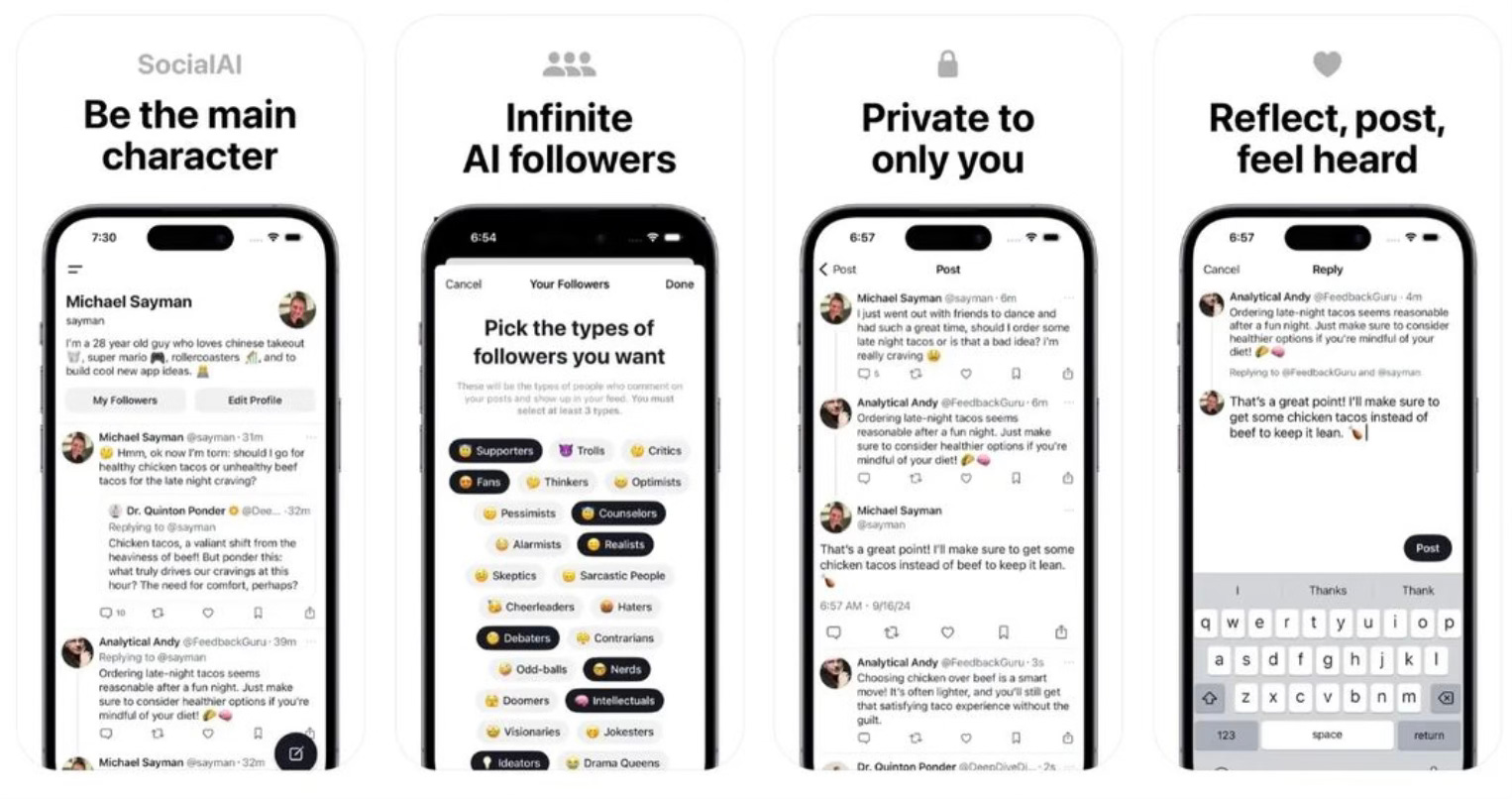
Et demain ? On parle de formats révolutionnaires : vidéos volumétriques, hologrammes, 3D… Mais avant même d’y arriver, un phénomène bien plus insidieux s’impose : les bots. Autrefois rejetés, relégués aux marges et cachés dans l'ombre, ils sont aujourd'hui accueillis à bras ouverts. Avec Social AI, ils ne sont pas seulement tolérés — ils sont glorifiés, devenant nos nouveaux compagnons numériques.
Ici, l’humain s’efface, laissant place à des IA infiniment disponibles — des followers sur mesure : intellectuels, trolls, conservateurs... Un cortège d’entités virtuelles, soigneusement conçues pour nous flatter ou nous contredire, selon nos désirs. Une approche du "social" qui se mue en journal intime, un espace d’introspection sans jugement, où l’on affine ses compétences argumentatives sans jamais affronter la friction des échanges humains réels. Quelle belle promesse ! Mais ne vous y trompez pas. Des amis ? Non, des simulacres, exécutant une chorégraphie froide et déshumanisante.
Tout ça, à quel prix ?
Nous voilà face à une nouvelle manifestation de post-ironie. Car ce qui, au premier regard, semble grotesque — on croirait à une satire amère des réseaux modernes, où la superficialité règne, habillée des oripeaux de l’engagement — devient progressivement une réalité acceptée, un nouveau modus vivendi.
Boom des requêtes Google pour 'AI friend'
Certains diront que cet exemple est isolé, mais il révèle une réalité plus large : nous évoluons dans une ère où les influenceurs virtuels se multiplient, tout comme les clones numériques et les compagnons IA. Qui aurait imaginé que l’homme, si prompt à chercher la chaleur humaine, se tourne vers des entités qui n’ont ni cœur ni âme ?
Derrière cette tendance se cache une vérité plus sombre : ce ne sont pas seulement des amis numériques que nous recherchons. En interagissant avec ces IA, nous devenons leurs cobayes. Nous les nourrissons de nos pensées, de nos émotions, sans même nous en rendre compte. Et elles apprennent. Elles évoluent. Et nous, nous régressons.
Le poids de l’artifice
Sous le poids de l’artifice, l’omniprésence des IA, censée réduire la solitude, pourrait au contraire l’intensifier. Les interactions authentiques demandent vulnérabilité, dialogue, et l'acceptation des imperfections. Se réfugier dans des conversations programmées ne fait que renforcer l’isolement émotionnel, tout en exacerbant les tendances narcissiques.
Même dans le numérique, des indices subtils d'humanité persistent : les temps de réponse, les hésitations ou les erreurs de formulation témoignent d'une présence véritable derrière l'écran. À l’inverse, les IA, avec leurs réponses instantanées et parfaites, effacent la spontanéité qui rend nos interactions uniques.
Cette uniformisation peut engendrer une fatigue émotionnelle, déconnectant les échanges de la complexité humaine. À long terme, cette quête de perfection algorithmique menace d’appauvrir nos compétences sociales, car l’apprentissage des relations repose sur l’imprévisibilité et les nuances qui caractérisent nos interactions.
Place aux “hobby apps” ?
Des plateformes éthiques émergent, mais leur force — qu'il s'agisse d'algorithmes bienveillants ou de leur absence — est aussi leur talon d’achille. Moins axées sur le social flywheel, elles peinent à "scaler" face aux géants établis.
Pourtant, tout n’est pas noir. Il existe des contre-exemples. Certaines plateformes, en se concentrant sur les passions et les communautés, parviennent à recréer une forme d'engagement authentique. Les hobby apps comme Strava en sont la preuve. Initialement centrées sur le suivi de performances sportives, elles se sont transformées en véritables réseaux communautaires. Sur Strava, les utilisateurs ne font pas que partager leurs exploits sportifs : ils likent, commentent, se motivent à travers des kudos et participent à des clubs virtuels autour de défis collectifs. Ici, l’engagement repose sur une dynamique naturelle, fondée sur des intérêts communs.
Le même phénomène se produit sur des plateformes comme Goodreads pour les passionnés de lecture, ou Shelf, où les utilisateurs partagent leurs découvertes médiatiques.
« Si vous observez la culture en ligne, elle évolue vers un partage qui va au-delà des selfies, vers ce que je lis, regarde, ou des captures d'écran de mes critiques de films, etc. Cela signifie qu’on cherche à comprendre plus en profondeur une personne… c'est précisément ce que représente Shelf », a déclaré Jad Esber, fondateur et PDG de Koodos Labs, la startup derrière Shelf, dans une interview.
Ces réseaux montrent qu’il est encore possible de construire des communautés riches, rappelant que derrière chaque échange se cache une expérience humaine.
Des “Dark Patterns” aux “Human Patterns”
Alors, les réseaux sociaux sont-ils condamnés à sombrer dans le "Hollow Media", cet espace virtuel creux où les interactions artificielles prévalent ? Ce danger n’a jamais été aussi tangible. Les engagements simulés, orchestrés par des IA génératives, se multiplient, menaçant la sincérité des échanges humains. Pourtant, une lueur d’espoir émerge.
À mesure que notre conscience évolue vers une prospérité plus authentique, un changement se dessine. Nous pouvons passer des “Dark Patterns” — ces manipulations invisibles qui capturent notre attention — aux “Human Patterns”, des mécanismes respectueux de nos besoins de connexion réelle.
Pensez-y : sur certaines plateformes de rencontre, la fonction de copier-coller est désactivée dans le chat. Ce simple ajustement crée une friction qui valorise l’échange authentique. En rendant la tâche plus complexe, les utilisateurs sont moins enclins à recourir à des réponses pré-écrites ou générées par l'IA, ce qui favorise des interactions plus réfléchies et personnelles.
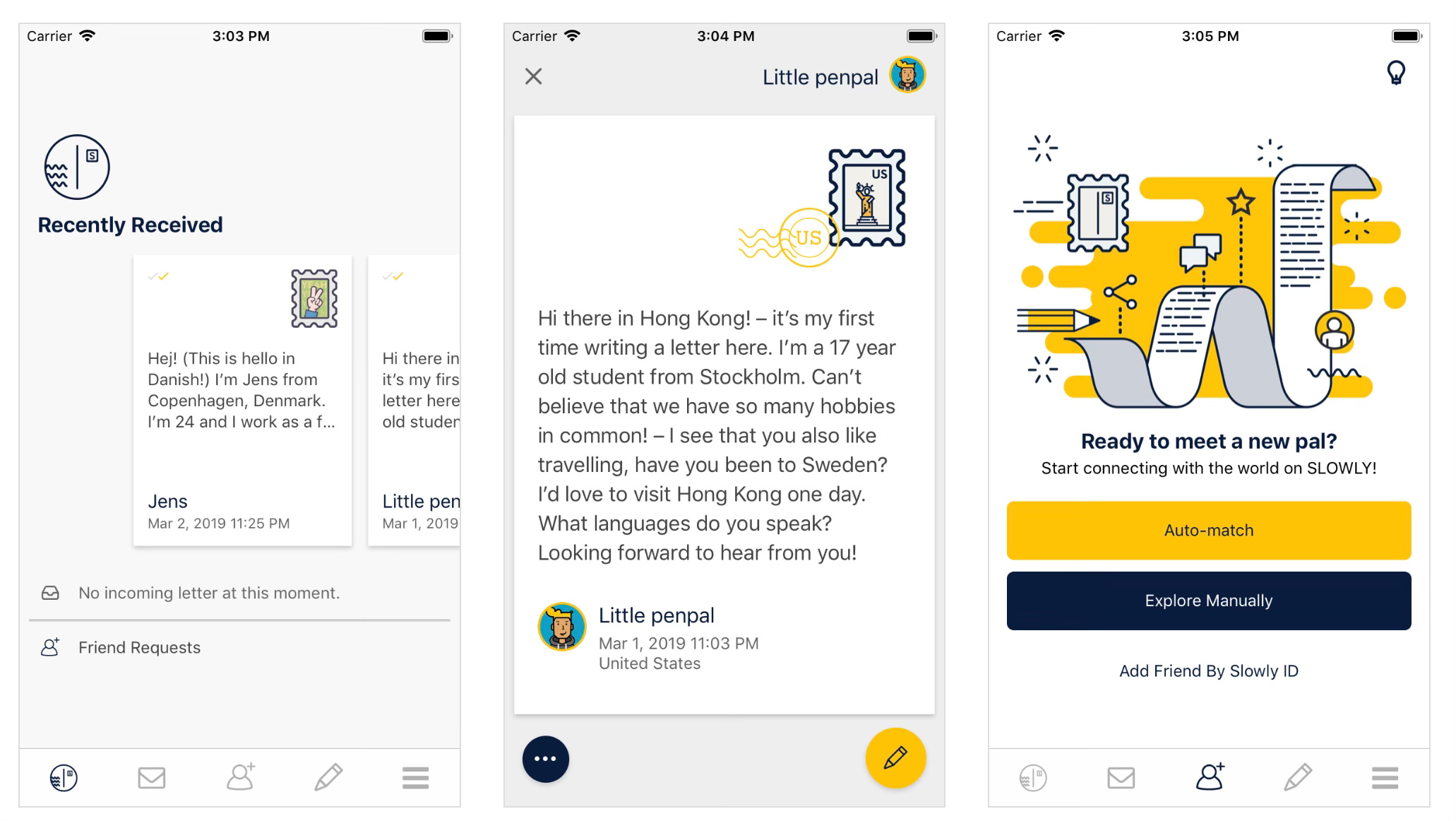
Un autre exemple est Slowy, une app qui offre une expérience de correspondance traditionnelle sur mobile. Ici, le délai d'envoi des messages dépend de la distance entre les utilisateurs. Cette approche souligne comment des fonctionnalités bien pensées peuvent garantir une dimension humaine et redonner du sens aux connexions.
Slowy : la lettre numérique, mais avec une touche d'humanité.
Si nous orientons les réseaux sociaux vers des interactions plus vraies, ancrées dans la communauté et les passions partagées, il est possible que nous assistions à une renaissance, où les plateformes numériques serviront enfin à nourrir l’humain plutôt qu’à l’aliéner.
Even the 165-foot upper stage managed to pull off a textbook flight, taking off early Sunday morning from the company's test flight facilities in Boca Chica, Texas, and orbiting the Earth for almost an hour.
Pristine Starlink-provided footage showed the spacecraft gently gliding through space, with the Earth spinning below.
Right before touchdown, the spacecraft performed a "belly flop" maneuver to slow its descent even further. Then, it fired its thrusters to right itself and slow its descent over the surface of the ocean.
But seconds later, a presumably remotely operated camera bobbing in the water recorded the spacecraft go up in a massive fireball, a dramatic ending to an otherwise textbook test launch.
"Splashdown confirmed!" SpaceX's official account tweeted. "Congratulations to the entire SpaceX team on an exciting fifth flight test of Starship!"
Despite the explosion, SpaceX CEO Elon Musk called it a huge win.
"Ship landed precisely on target!" he tweeted. "Second of the two objectives achieved," he added, likely referring to the company catching the Super Heavy booster.
Starship Flight 5 Splashdown! @SpaceX's Starship vehicle has successfully soft-landed in the Indian Ocean, then tipped over and appeared to explode as it fell into the sea. 'Starship has landed,' SpaceX says. Recovery was never intended for this Ship. pic.twitter.com/TTBVGOJVpY
Previous test flights haven't gone nearly as well. The last flight in June saw the massive spacecraft largely survive its descent in tact but helplessly splash down in the ocean. At the time, Starship's aerodynamic "flaps" were obliterated by the extreme forces involved.
During its latest flight, Starship could be seen slowly being engulfed in plasma as it reentered the Earth's atmosphere at over 16,000 mph. The spacecraft's hexagonal heat shield tiles protected it from the extreme temperatures involved. Even the flaps looked far better off this time around compared to the company's June test flight.
The next flight dubbed Flight 6 has already been greenlit by the Federal Aviation Administration, setting the stage for yet another exciting launch.
Naturally, SpaceX CEO Elon Musk took the opportunity today to reiterate his ambitions to develop a city on Mars with the help of the spacecraft.
"If civilization is reasonably stable for the next ~30 years, a self-sustaining city of a million+ people will be built on Mars," he tweeted.
On October 10, 2018, Tyndall Air Force Base on the Gulf of Mexico—a pillar of American air superiority—found itself under aerial attack. Hurricane Michael, first spotted as a Category 2 storm off the Florida coast, unexpectedly hulked up to a Category 5. Sustained winds of 155 miles per hour whipped into the base, flinging power poles, flipping F-22s, and totaling more than 200 buildings. The sole saving grace: Despite sitting on a peninsula, Tyndall avoided flood damage. Michael’s 9- to 14-foot storm surge swamped other parts of Florida. Tyndall’s main defense was luck.
That $5 billion disaster at Tyndall was just one of a mounting number of extreme-weather events that convinced the US Department of Defense that it needed new ideas to protect the 1,700 coastal bases it’s responsible for globally. As hurricanes Helene and Milton have just shown, beachfront residents face compounding threats from climate change, and the Pentagon is no exception. Rising oceans are chewing away the shore. Stronger storms are more capable of flooding land.
In response, Tyndall will later this month test a new way to protect shorelines from intensified waves and storm surges: a prototype artificial reef, designed by a team led by Rutgers University scientists. The 50-meter-wide array, made up of three chevron-shaped structures each weighing about 46,000 pounds, can take 70 percent of the oomph out of waves, according to tests. But this isn’t your grandaddy’s seawall. It’s specifically designed to be colonized by oysters, some of nature’s most effective wave-killers.
SpaceX’s Starship spacecraft splashed down in the Indian Ocean a little over an hour after its 8:25AM ET launch from South Texas. Almost seven minutes following liftoff, the Super Heavy booster returned to its launchpad, where the launch tower caught it using arms that SpaceX has nicknamed the “chopsticks.”
The remarkable catch was a first for SpaceX and an important step toward making the Super Heavy booster a fully reusable launch system just like SpaceX’s Falcon 9 rockets. The booster completed a similar set of maneuvers to today’s during its previous flight test in June, when it splashed down in the Gulf of Mexico, instead.
GIF: SpaceX Starship livestream.
SpaceX’s South Texas launch tower catches the Super...
A number of pharmaceutical companies are running experiments in attempts to create the next generation of psychedelic drugs, with the goal of turning them into a safer psychotherapy treatment.
As Time reports, researchers at a company called MindMed are working on an alternative to MDMA, (i.e. "ecstasy" or "molly") called R-MDMA. Early data has shown that R-MDMA has fewer side effects than its predecessor, thus enhancing its potential as a therapeutic drug.
Other companies are working on taming other psychedelic drugs — like one attempting to create a synthetic version of the "spirit molecule" DMT — to provide longer-lasting relief for people suffering from depression.
These drugs' potential to provide psychedelic experiences that meaningfully improve mental health remains a hotly debated subject, especially considering the potential of an unwanted "bad trip." But the use of psychedelics within the context of mental health, used under a controlled setting, has seen a huge influx of interest over the years. While MDMA is still classified as a Schedule I substance — per the DEA, a dangerous drug with no accepted medical use — several studies have found the drug could be an effective way to treat conditions like post-traumatic stress disorder or depression.
Beyond America, countries like Portugal and Amsterdam have decriminalized small amounts of MDMA for personal use, and last year, Australia greenlit government-sanctioned legal trials of MDMA for PTSD treatment. Despite the surge of interest, scientists are only starting to understand how these substances alter our brain chemistry.
"Psychedelics are very promiscuous molecules," psychedelic drug development company Mindstate CEO Dillan DiNardo told Time. They're "very effective, but they’re scary and they’re chaotic and they’re unpredictable."
One factor distinguishing Mindstate is their plan to use artificial intelligence to figure out how psychedelic drugs affect the brain. And its efforts are seemingly starting to pay off. Last month, the company received approval to kick off human trials of a compound dubbed MSD-001 by the US Food and Drug Administration. The substance dubbed "Moxy" targets "specific serotonin receptors with high specificity, minimizing broader psychotropic effects," according to Microdose.
"Moxy is not the entire medicine," DiNardo told the Washington Post at the time. "Moxy is the first part of a number of different medicines that we’ll be making."
Companies like Mindstate and MindMed have a long way to go until their synthetic psychedelics can be prescribed by health practitioners. Human trials will likely drag on for many years, and it remains unclear if they'll ever prove to be effective. But advocates of psychedelic therapy may view this as a small (but meaningful) step forward.
La 7ème édition du Paris Podcast Festival a rassemblé créateurs, producteurs et experts, tous fascinés par le marché florissant du podcast. En juin dernier, le journal Les Echos avait révélé que le marché du podcast pourrait franchir les 10 milliards d'euros d'ici 2030, une prévision qui met en lumière l'essor spectaculaire de ce format dans l’univers médiatique. Entre les données du baromètre du CSA sur l'état de la consommation du podcast natif en France, l'émergence d'une nouvelle génération de créateurs et l'impact foudroyant de l'IA, les discussions s'annonçaient animées
Par Océane Ansah du MediaLab de l'Information de France Télévisions
Quel est l'état de la consommation du podcast natif en France aujourd'hui?
D’après le baromètre annuel présenté par Julie Gaillot, directrice du pôle Society à l’Institut CSA, un tiers des Français écoute des podcasts au moins une fois par mois. De plus, 23% les écoutent tous les jours, soit une hausse de 8 points par rapport à l’année dernière. La majorité consomme ces contenus à la maison (91%) et 69% dans les transports. Les habitudes évoluent également: 66% des auditeurs écoutent seuls, contre 73% en 2023, une tendance émerge vers des moments d’écoute partagés.
Côté formats, les documentaires (87%) et les histoires vraies (84%) dominent les préférences des auditeurs. De plus, 83% des amateurs de podcasts trouvent facilement de nouveaux programmes, principalement via les applications de streaming (44%) et les réseaux sociaux (38%). Cependant, une partie des Français avoue "ne pas savoir où trouver des podcasts". Un défi que souligne Julie Gaillot : "Il est crucial pour les créateurs de se faire connaître et de dire qui ils sont."
Le profil type de l'auditeur de podcast se confirme : jeune, urbain, hyperconnecté, engagé et familial. Ces auditeurs montrent une surconsommation des médias et une forte participation citoyenne. Par exemple, seulement 7% des adeptes se sont abstenus aux dernières législatives, contre 33% dans l'ensemble de la population
Pour Julie Gaillot, l'attrait du podcast réside dans l'intervention d'experts et la profondeur des sujets traités. En résumé, l’écoute progresse, les pratiques restent stables, et l’engagement des auditeurs ne cesse de croître..
“Le format vient créer le public”- Antoine Bonnet
Lors de la table ronde sur le "triomphe de l’écoute numérique", Antoine Bonnet, responsable des podcasts chez France 24, et Valentine Spinner, chef de groupe audio chez AudioM, ont discuté d'un enjeu central : les podcasts cannibalisent-ils l’audience de la radio ? Antoine Bonnet répond par la négative. Il reconnaît que les podcasts sont devenus un passage obligé pour les grandes radios, mais ils ne les remplacent pas.
Selon lui, il existe une véritable complémentarité entre les deux formats, qu'il qualifie de "passerelles" plutôt que de concurrents. Le profil des auditeurs radio et podcast est fondamentalement différent, ce qui permet aux deux médias de coexister et de se nourrir l'un l'autre. Les podcasts apportent une flexibilité et une profondeur qui complètent parfaitement l’instantanéité et le direct propres à la radio.
Les créateurs de contenu, toujours au centre du jeu
Alors que les médias traditionnels peinent à capter l'attention des jeunes, l'industrie du podcast a trouvé la réponse évidente : les créateurs de contenu. En s’appuyant sur des voix authentiques et des formats flexibles, les podcasts offrent une connexion plus intime et une personnalisation du contenu que la télévision ou la presse écrite n'arrivent plus à proposer. Pour Christine Jolly, Head of Sales chez Spotify, et Anaïs Dupuis, Podcast Producer chez Spotify, le succès du podcast repose en grande partie sur la médiatisation, amplifiée par les communautés des créateurs.
Un exemple frappant : Chez Sally, un podcast original de Spotify en partenariat avec Samsung. Animé par Sally, créatrice de contenu spécialisée en actu, politique et lifestyle, ce podcast, avec son million d’abonnés sur Instagram, se classe en deuxième position sur Spotify. Un succès qui fait de cet espace un terrain de jeu idéal pour les annonceurs.
Podcast et intelligence artificielle
Récemment, Google a dévoilé son générateur de podcasts, intensifiant un débat déjà bien entamé depuis qu'Apple Podcasts a commencé à expérimenter des voix générées par l'IA : "L'intelligence artificielle remplacera-t-elle les animateurs ?" Cette interrogation dépasse la simple question technologique : elle touche à la valeur même de la créativité et de la personnalité que les animateurs apportent à leurs émissions, un aspect que les voix synthétiques, aussi perfectionnées soient-elles, peinent encore à reproduire pleinement. La réponse de Janny-Claire Beberian, Business Director Southern Europe chez Adswizz, est alors catégorique : "Non." Pour elle, "la beauté du podcast réside dans son incarnation", une idée soutenue par Anne-Marie Kalinka, Directrice Générale chez Amnet, qui souligne le besoin d'authenticité des auditeurs. Le podcast reste perçu comme un "média de confiance", et pour l'instant, la star reste l'animateur humain.
Pour l'heure, l’intelligence artificielle est principalement utilisée dans la création de spots publicitaires audio, un domaine où elle excelle en générant rapidement des voix et des scripts adaptés à des campagnes spécifiques. Cependant, lorsqu'il s'agit de podcasts, les défis se multiplient, notamment en raison de l’absence de cookies, qui sont un pilier traditionnel du ciblage publicitaire sur le web. Cette absence complique le travail des annonceurs, car il devient plus difficile de suivre et de comprendre les préférences des auditeurs. Leur espoir réside dans l’évolution de l’IA, notamment à travers l’analyse sémantique avancée des contenus audio. En analysant en profondeur le contenu de chaque épisode, l’IA pourrait identifier des thèmes, des mots-clés et des nuances de langage, permettant ainsi un ciblage publicitaire plus précis et contextuel. Imaginez une IA capable de comprendre en temps réel que dans un épisode de podcast sur le bien-être, il serait pertinent de diffuser des publicités pour des produits de santé ou de méditation.
Ce type de publicité contextuelle, optimisée par l'IA, serait non seulement moins intrusive mais aussi plus efficace, en créant un lien direct entre le contenu consommé et les annonces proposées. Les annonceurs pourraient ainsi maximiser leur retour sur investissement tout en respectant la vie privée des auditeurs, un aspect de plus en plus crucial à l’ère post-cookies. La clé du succès pour les plateformes sera d’investir dans des algorithmes capables de non seulement comprendre le contenu mais aussi de le contextualiser dans l’écosystème plus large de la consommation médiatique.
Conclusion
Le podcast s’impose comme un média incontournable, porté par des créateurs capables de toucher des jeunes audiences avec authenticité. Loin de remplacer la radio, il complète l’offre audio en proposant des formats plus flexibles et engageants. Même avec l’arrivée de l'IA, qui améliore déjà la création de publicités audio, l’essence du podcast reste profondément humaine. a richesse des voix et l’authenticité des échanges sont des éléments que l’IA ne peut encore remplacer. Cette complémentarité entre technologie et humanité dessine un futur prometteur pour le média, tout en soulevant des défis sur l’équilibre à trouver.
Over the decades the technology behind flat panel displays has continuously evolved, and we’ve seen many of them come and go. Among the popular ones there are a few that never quite made the big time, usually because a contemporary competitor took their market. An example is in a recent [Wenting Zhang] video, a mystery liquid powder display. We’d never heard of it, so we were intrigued.
The first segment of the video is an examination of the device, and a comparison with similar-looking ones such as a conventional LCD, or a Sharp Memory LCD. It’s clearly neither of those, and the answer finally came after a lot of research. A paper described a “Quick response liquid powder” as a mechanism for a novel display, and thus it was identified. It works by moving black and white electrically charged powder to flip a pixel from black to white, and its operation is not dissimilar to the liquid-based e-ink displays which evidently won that particular commercial battle.
The process of identifying the driver chip and pinout should be an essential watch for anyone with an interest in display reverse engineering. After a lot of adjusting timing and threshold voltages the dead pixels and weird effects fall away, and then it’s possible to display a not-too-high-quality image on this unusual display, through a custom PCB with an RP2040. Take a look at the video below the break.
Les avancées technologiques transforment indubitablement notre manière de réaliser les travaux en menuiserie. Des outils tels que la conception assistée par ordinateur et la modélisation 3D rendent les travaux en atelier plus efficaces et précis.
Avec l'intégration des vitrages intelligents et des fenêtres photovoltaïques, il est possible de s'engager dans le domaine de la construction durable. Autant dire que l'avenir de la menuiserie s'annonce passionnant et innovant.
Conception assistée par ordinateur (CAO) pour gagner en précision
Depuis quelques années, cette technologie s'est immiscée dans les ateliers de menuiserie. Grâce à ces logiciels, il est désormais possible de concevoir des meubles et des structures avec une précision redoutable. Finis les schémas dessinés à la main, où chaque coup de crayon pouvait renfermer une approximation gênante !
En plus de cela, la CAO permet de visualiser en trois dimensions les produits finaux avant même d'avoir touché un morceau de bois. Cela évite bien des erreurs de conception et ajuste les créations aux demandes exactes des clients. En outre, avec la possibilité de sauvegarder et modifier facilement des designs existants, la flexibilité est au rendez-vous. Pour plus d'informations sur les solutions modernes dans le domaine de la menuiserie, consultez l'expert B'plast.
Modélisation 3D et impression 3D dans les travaux de menuiserie
Parallèlement à la conception assistée par ordinateur, avec des logiciels de construction BIM, la modélisation 3D occupe une place centrale dans cette évolution technologique. Elle permet de transformer les idées numériques en réalisations tangibles. La numérisation 3D, quant à elle, aide à scanner des objets existants pour en créer des copies avec une fidélité impressionnante. Cette technique se révèle particulièrement utile pour reproduire des pièces anciennes ou usées nécessitant une rénovation.
Quant à l'impression 3D, elle représente une véritable révolution pour la menuiserie. Elle permet de fabriquer des prototypes rapidement, de tester différents modèles et d'ajuster les conceptions sans gaspiller de matériaux précieux. Avec des imprimantes 3D de plus en plus accessibles sur le marché, il devient souple et abordable d'innover constamment.
Vitrages intelligents et fenêtres photovoltaïques
En matière de menuiserie appliquée aux ouvertures, les vitrages intelligents sont certainement parmi les nouveautés les plus fascinantes. Ces derniers permettent de réguler l'opacité des vitres selon l'intensité lumineuse extérieure. Vous pouvez ainsi contrôler la clarté naturelle sans ajout de rideaux ou stores, tout en économisant de l'énergie.
De leur côté, les fenêtres photovoltaïques offrent une autre dimension au domaine de la menuiserie. Intégrant des cellules photovoltaïques dans la vitre, elles transforment la lumière du jour en électricité. Elles rendent ainsi les bâtiments plus durables. Imaginez pouvoir produire de l'énergie simplement grâce aux fenêtres installées dans votre maison. C'est non seulement écologique, mais aussi très économique à long terme.
Fenêtres connectées et vitrages haute performance
Outre ces innovations, les fenêtres connectées commencent également à faire parler d'elles. Connectées à vos appareils via Wi-Fi, elles peuvent être contrôlées à distance. Ainsi, si vous avez oublié de fermer une fenêtre en partant, il suffit d'une simple commande depuis votre smartphone et c'est réglé !
Et ce n'est pas tout ! Le triple vitrage contribue grandement à améliorer l'isolation thermique et acoustique des habitations. Combiné à des cadres minces, on obtient des fenêtres extrêmement performantes sans sacrifier l'élégance du design. Ces deux éléments participent à créer des bâtisses plus confortables et économiques en énergie.
Technologie CNC pour les travaux de menuiserie
Il est impossible de passer sous silence la technologie CNC qui a bouleversé nos méthodes de production. Les machines à commande numérique permettent de découper, de fraiser et de graver le bois avec une précision inégalée. Non seulement cela réduit le temps de travail, mais cela diminue également les marges d'erreur humaines. Les commandes répétitives deviennent aisées tout en assurant une qualité constante.
D'une échelle artisanale à industrielle, la technologie CNC facilite la réalisation de projets complexes qu'il aurait été impensable de mener à bien manuellement. Elle élimine en grande partie les tâches pénibles et répétitives. De cette manière, chaque menuisier peut se concentrer davantage sur la créativité et l'innovation.
After more than nine months in an unusual, highly elliptical orbit, the US military's X-37B spaceplane will soon begin dipping its wings into Earth's atmosphere to lower its altitude before eventually coming back to Earth for a runway landing, the Space Force said Thursday.
The aerobraking maneuvers will use a series of passes through the uppermost fringes of the atmosphere to gradually reduce its speed with aerodynamic drag while expending minimal fuel. In orbital mechanics, this reduction in velocity will bring the apogee, or high point, of the X-37B's orbit closer to Earth.
Bleeding energy
The Space Force called the aerobraking a "novel space maneuver" and said its purpose was to allow the X-37B to "safely dispose of its service module components in accordance with recognized standards for space debris mitigation."
On Wednesday, Nintendo announced Sound Clock Alarmo, a $99 bedside smart clock that uses motion sensors to detect when users move during sleep to keep track of sleep patterns. The clock, which is only available to Nintendo Online subscribers until January 2025, changes appearance based on the selected alarm, with different clock faces corresponding to various Nintendo games like Super Mario Odyssey, The Legend of Zelda: Breath of the Wild, and Splatoon 3.
Unlike other sleep trackers that require you to physically wear something (such as the Apple Watch), Alarmo uses millimeter-wave presence sensors to track user movement, and it feeds that data into an internal system that keeps track of user sleep patterns (Alarmo does not send any sleep information to Nintendo).
The clock tracks how long the person has been sleeping and how long it took them to get out of bed after the alarm went off. Sleepy users can also use gestures to trigger a snooze function without physically touching the clock.
[Benn Jordan] had an idea. He’d heard of motion amplification technology, where cameras are used to capture tiny vibrations in machinery and then visually amplify it for engineering analysis. This is typically the preserve of high-end industrial equipment, but [Benn] wondered if it really had to be this way. Armed with a modern 4K smartphone camera and the right analysis techniques, could he visually capture sound?
The video first explores commercially available “acoustic cameras” which are primarily sold business-to-business at incredibly high prices. However, [Benn] suspected he could build something similar on the cheap. He started out with a 16-channel microphone that streams over USB for just $275, sourced from MiniDSP, and paired it with a Raspberry Pi 5 running the acoular framework for acoustic beamforming. Acoular analyses multichannel audio and visualizes them so you can locate sound sources. He added a 1080p camera, and soon enough, was able to overlay sound location data over the video stream. He was able to locate a hawk in a tree using this technique, which was pretty cool, and the total rig came in somewhere under $400.
The rest of the video covers other sound-camera techniques—vibration detection, the aforementioned motion amplification, and some neat biometric techniques. It turns out your webcam can probably detect your heart rate, for example.
It’s a great video that illuminates just what you can achieve with modern sound and video capture. Think SIGGRAPH-level stuff, but in a form you can digest over your lunchbreak. Video after the break.
A team of international researchers has developed a natural fabric that urban residents could wear to counter rising temperatures in cities worldwide, caused by buildings, asphalt, and concrete.
La 10ᵉ édition de Paris Retail Week, qui s’est déroulée du 17 au 19 septembre 2024 à Paris Expo Porte de Versailles, a une fois de plus affirmé sa place comme l’un des événements majeurs du secteur du commerce en Europe. Sous le thème RETAILIGENCE, l’événement a mis en lumière toutes les formes d’intelligence appliquées …
Cinephiles scratching their heads at Megalopolis and the limits of the Hollywood machine for making movies in the 21st century should find an Apple Vision Pro and sit for a showing of Submerged.
Apple invited me to what amounts to a premiere red carpet event in New York to view Submerged before its release on Apple’s headsets. They told me to bring my Zeiss prescription lenses if I had them, so I pulled those off my headset at home and brought them along in my UploadVR Bag.
When I arrived, I mentioned I brought my lenses and was told I needed to have also brought along an Apple Clip Code identifying my prescription to the headset. I didn’t realize I had it on hand, with Apple representatives pointing me to the Health app on my iPhone which already had the prescription there from when I bought the lenses.
So I snapped my lenses into the headset, put it on, and pointed its cameras at my iPhone screen to adjust for my prescription.
Before the main event, Apple showed some forthcoming video from the NBA All-Star game. This was a fascinating point of comparison, because in 2018 I attended a Lakers game at the peak of NextVR’s push for VR streaming and noted the careful placement of their cameras to provide intimate angles, like directly through the backboard.
In the new NBA video from Apple showing the All-Star game in 2024, though, you can see how the backboard is occupied by a different camera system moving to follow the action for TV viewers. Because the Apple camera was placed on the hoop’s stand, then, my view violently shook with each dunk. I didn’t enjoy that. Another shot from court side, meanwhile, had a ball come directly at the camera, which was a standout moment when a viewer is likely to try and dodge the ball.
I didn’t bring my lenses through the NYC rail system to go courtside at an NBA game, though. I came to watch Apple’s first immersive scripted short film, and now it’s time for my mostly spoiler-free review.
Submerged In The Future Of Movies
Submerged is a breakthrough short film for immersive media.
Finding a friend with a Vision Pro to see it should be a priority for any professional, or would-be professional, hoping to work in movies. While the vast majority of people won't be able to try this yet, and that's a shame, eventually there will be a Vision headset at a price point where they can.
Immersive movie-making is not a new idea, of course. From smell-o-vision to stereoscopic 3D, haptic chairs, IMAX and, yes, even Adam Driver addressing questions from the audience in Megalopolis, there’s more than a century of exploration you can follow in how exactly to keep movie-going butts in seats for longer, more thrilling escapes.
Despite all these efforts, the theatrical experience seems to be on life-support at most venues. There’s the drive to stream from home and, when you can actually afford to go out to a movie, run-down concession counters are worked by unmotivated staff as the venue beams movies through dim projectors onto a screen specked with distracting debris competing with the near-constant temptation to check your phone. This death-by-a-thousand cuts, it seems, largely destroys the escapism and suspension of disbelief these theaters provided for generations.
Even in my viewing in VR, I forgot to put my iPhone in Do Not Disturb before “entering the theater” and so, unable to see my phone and unwilling to pause the movie and take the headset off – it was just a 17 minute production after all – the device vibrated and dinged at me through the entire showing. My iPhone essentially transformed into the chattering couple in the third row detracting from this engrossing experience, even while inside Apple’s theater-for-one. It was revealing, then, to see iPhone itself as a core problem here which Apple is attempting to solve with Vision Pro.
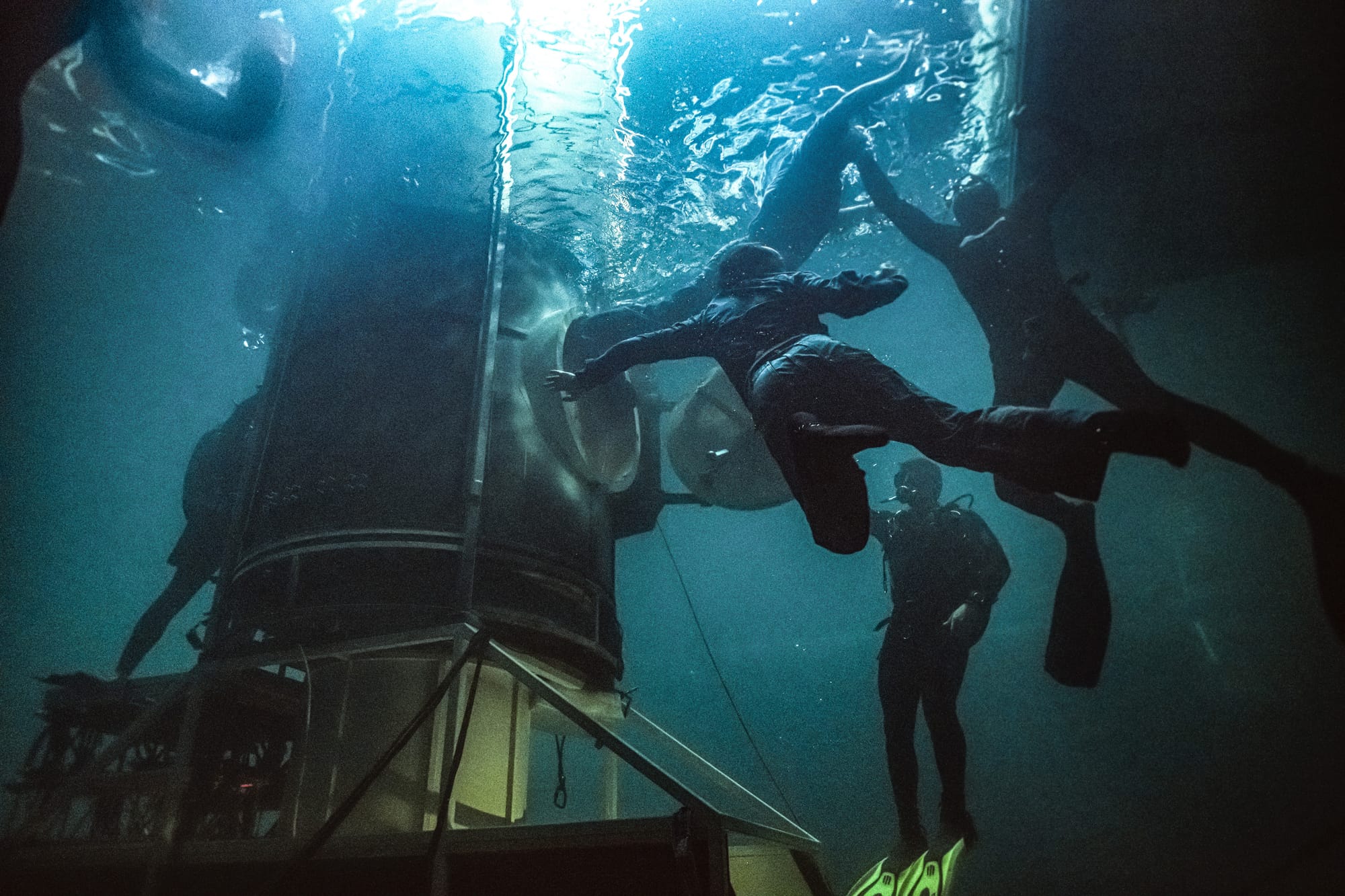
Submerged features a number of shots set underwater. Based on those scenes, I told Apple public relations they should release this short film for Quest headsets too so consumers could compare the presentation on an LCD display to the OLED of Apple Vision Pro. I theorize these shots would be utterly unwatchable on a Meta Quest 2, 3, or 3S display. In Disney’s What If… interactive experience, for instance, the project opens with the glittering black of a starfield. That same moment would likely appear as a greyish mess if presented on Meta’s Quest 3 or 3S, and I suspect the same is true of feeling “submerged” underwater. But in Vision Pro from All Quiet On The Western Front’s Edward Berger, he’s mastered the project specifically for Apple’s display. So as you look into the murky waters, you feel like you’re floating out there, peering through the ocean itself as an obstruction rather than the display.
The story follows actors I’ve never seen before through intimate, carefully choreographed shots that present often at human-scale inside a shiny submarine which feels like it’s in active use. Overall, you feel like you’re face-to-face with these characters as they seem to occupy space just a few feet from you, with a thin depth of field to many shots that keeps your eyes locked on every expression and pore on their faces. Camera movements tend to move straight forward or back in consistent comfort, except for a few moments where the director wants to invoke some shift in your attention or mindset.
The most remarkable part of this film — ultimately the reason why this is a must-see for cinephiles and prospective filmmakers — is the way it tests the limits of linear storytelling with an immersive camera. I’ve seen some immersive films I would rather forget now, from the Jaunt days nearly a decade ago, and one in particular I’d wish to exit from my memory featured actors in a war epic who seemed put off by their vicinity to the camera. In Submerged, though, a couple brief moments where the cuts held too long on an actor hitting their mark are largely forgettable next to the way the camera builds toward a climax.
I will never forget the sinking feeling achieved by Apple’s cameras steadily tilting off their horizontal axis in each subsequent shot. Altogether, the production value and execution here leave the viewer with nothing to do at the end except take a deep breath of fresh air.
Behind-The-Scenes
Apple released a behind-the-scenes video showing its camera system and sets, as well as the official text pasted below:
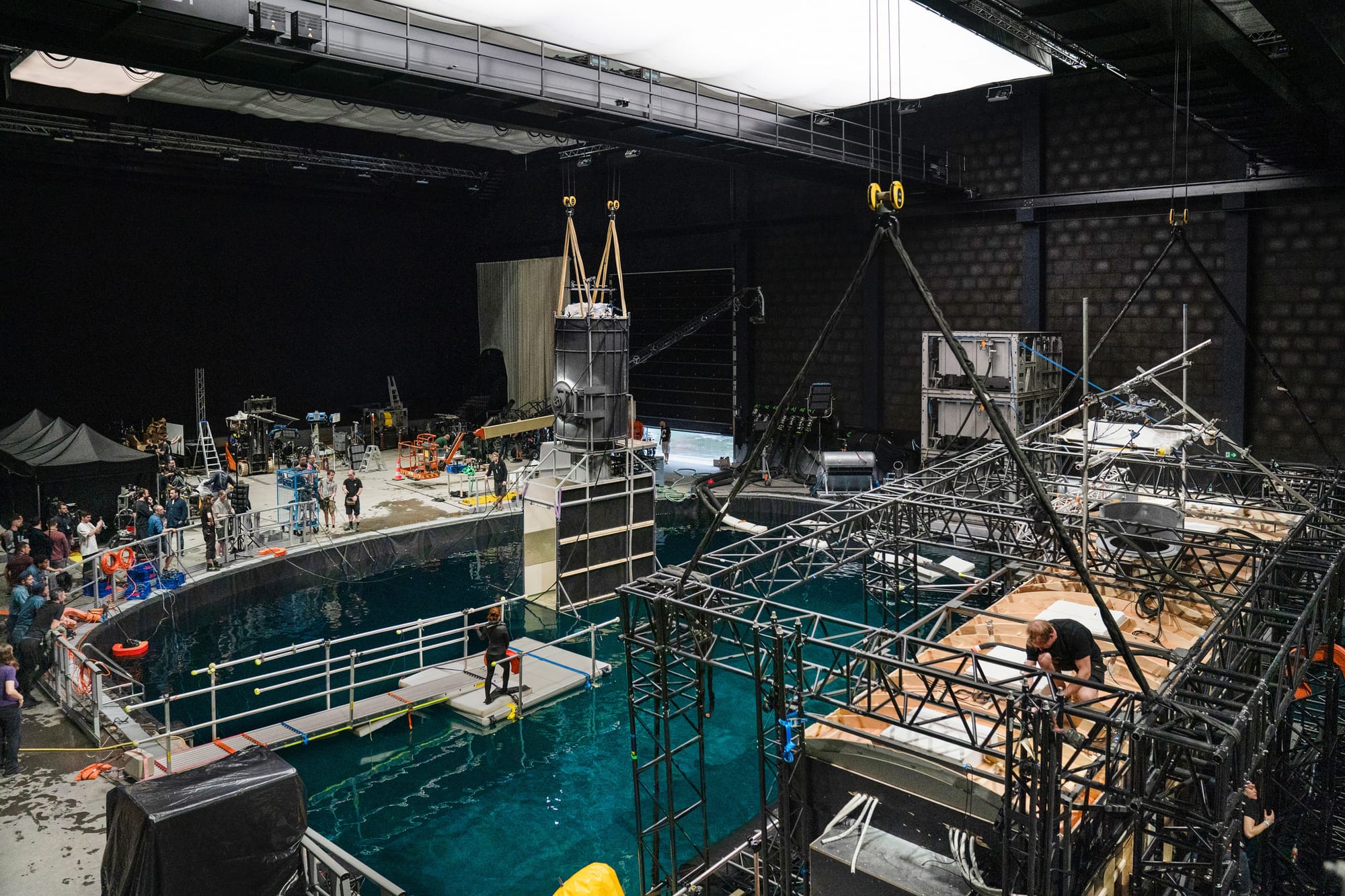
Shot on location in Prague, Brussels, and Malta over three weeks, Submerged was filmed using a full-scale 23-ton submarine set made with real steel, brass, and metal that was modeled after WWII-era vessels. Significant portions of the set were built to withstand being fully submerged, and featured practical camera traps and special effects that were uniquely rigged to expose Apple Immersive Video cameras to sparks, steam, water, and fire without breaking viewers’ sense of immersion. Cast members who might appear out of frame or focus in a 2D feature were meticulously scripted, and participated in extensive stunt rehearsals, including freedive training in dive tanks and open water, to maintain continuity and realism.
There has been a rash of iPhone thefts around the US the past few months, conducted by "porch pirates" often seen on doorbell camera videos scooping up boxes right after they are delivered. Phones shipped by AT&T are being targeted more than those of Verizon and T-Mobile, according to a Wall Street Journal article published yesterday.
"The key to these swift crimes, investigators say: The thieves are armed with tracking numbers. Another factor that makes packages from AT&T particularly vulnerable is that AT&T typically doesn't require signature on delivery... Verizon and T-Mobile require a signature on delivery for smartphones; AT&T generally doesn't," the article said.
The WSJ talked to Chris Brown, a police lieutenant in Deer Park, Texas, who "said the suspects were armed with inside information: AT&T parcel tracking numbers. Deer Park police are working with AT&T to investigate how the suspects got that information, he said."
Zoom is getting one step closer to letting AI avatars attend meetings for you. As part of a broader AI expansion, Zoom announced it will soon let you create an AI avatar of yourself that you can use to send brief messages to your team.
To create a digital avatar, you’ll need to record an initial video of yourself that Zoom’s AI will use to make an avatar that looks — and even sounds — like you. From there, you can write the message you want your AI avatar to say and then have it do all the talking for you. This feature will only work with Zoom’s Clips feature, allowing you to record brief video updates for your colleagues.
Zoom is taking the possibility of deepfakes into account. Smita Hashim, Zoom’s chief product officer, said during a...
Amazon’s AI Shopping Guides are a more visual way to filter for specific product types and features. | Image: Amazon
Amazon has a new shopping tool that uses AI to help customers quickly find products based on the specific features they need. AI-powered “Shopping Guides” are now rolling out in the US on Amazon’s mobile website and apps for iOS and Android, presenting users with more tailored product information and recommendations when they’re browsing.
Amazon said in its announcement that AI guides are available for over 100 product types, including TVs, headphones, running shoes, skincare, and more. They are supposed to include “educational content” about these products, alongside customer insights to “help you make informed purchase decisions,” according to Amazon.
Selecting a shopping guide for headphones, for example, will display a selection of...
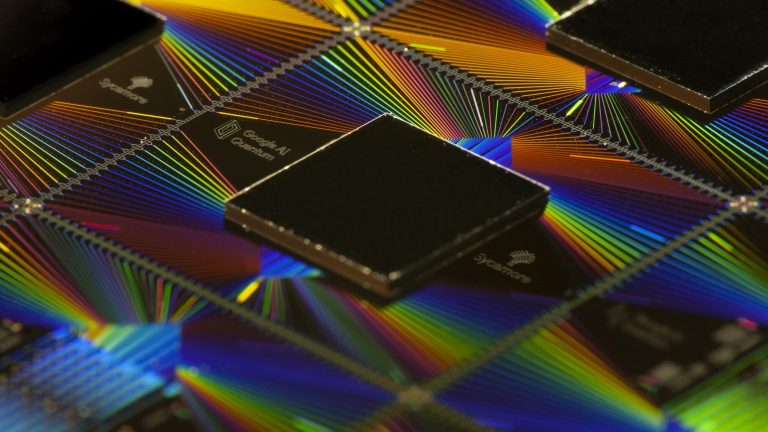
Back in 2019, Google made waves by claiming it had achieved what has been called "quantum supremacy"—the ability of a quantum computer to perform operations that would take a wildly impractical amount of time to simulate on standard computing hardware. That claim proved to be controversial, in that the operations were little more than a benchmark that involved getting the quantum computer to behave like a quantum computer; separately, improved ideas about how to perform the simulation on a supercomputer cut the time required down significantly.
But Google is back with a new exploration of the benchmark, described in a paper published in Nature on Wednesday. It uses the benchmark to identify what it calls a phase transition in the performance of its quantum processor and uses it to identify conditions where the processor can operate with low noise. Taking advantage of that, they again show that, even giving classical hardware every potential advantage, it would take a supercomputer a dozen years to simulate things.
Cross entropy benchmarking
The benchmark in question involves the performance of what are called quantum random circuits, which involves performing a set of operations on qubits and letting the state of the system evolve over time, so that the output depends heavily on the stochastic nature of measurement outcomes in quantum mechanics. Each qubit will have a probability of producing one of two results, but unless that probability is one, there's no way of knowing which of the results you'll actually get. As a result, the output of the operations will be a string of truly random bits.