Jean-Philippe Encausse
Shared posts
Chanel distingué pour l'excellence de son expérience client
Fini Starlink ? Un géant de la défense plaide pour se tourner (enfin) vers les satellites européens

Thales met en garde contre les risques de dépendance aux satellites privés. La fiabilité de Starlink est remise en cause, alors que son dirigeant, Elon Musk, brouille les frontières entre patron d'entreprise et conseiller politique.
L’Apiculture Connectée : Vers une Gestion Intelligente et Durable des Ruches
L'apiculture traditionnelle repose sur des méthodes manuelles pour surveiller l'état des ruches et la santé des colonies. Cela implique des inspections régulières pour vérifier le poids, la température interne, l'humidité et l'activité des abeilles. Cependant, cette approche nécessite des déplacements fréquents et peut perturber les colonies, augmentant ainsi le stress des abeilles.
L'apiculture connectée : Une révolution pour les apiculteurs
L'apiculture connectée révolutionne la manière dont les apiculteurs gèrent leurs ruches en intégrant des technologies modernes pour surveiller et optimiser la santé des colonies. Cette approche, souvent désignée sous le terme d'apiculture de précision, repose sur l'utilisation de capteurs et de dispositifs connectés pour collecter des données en temps réel et à distance, permettant ainsi une gestion plus efficace et proactive des ruchers.
Les avancées technologiques au service des apiculteurs
Parmi les innovations majeures, les balances connectées jouent un rôle crucial. Elles mesurent à distance et en temps réel le poids des ruches, fournissant des indications précieuses sur la production de miel, l'activité des butineuses et la santé générale de la colonie. Par exemple, une augmentation rapide du poids peut signaler une miellée abondante, tandis qu'une diminution soudaine pourrait indiquer un essaimage ou un problème sanitaire.
SYMES : Créateur de solutions d'apiculture connectée
Spécialisé dans la conception d'objets électroniques et l'IoT, SYMES a développé des solutions d'apiculture connectée pour répondre aux besoins des apiculteurs modernes. En combinant son expertise en électronique et en systèmes embarqués, SYMES a conçu des balances connectées permettant de surveiller à distance le poids, la température et l'humidité des ruches.
Ces dispositifs, à la fois robustes, légers et précis, offrent une vision détaillée de l'état de chaque colonie, aidant les apiculteurs à anticiper les besoins des abeilles et à intervenir rapidement en cas d'anomalie.
Grâce à une surveillance continue, ces balances permettent également de détecter l'inclinaison des ruches, les chocs éventuels et les déplacements anormaux.
Des solutions conçues pour HoneyInstruments
Fort de son expertise dans la conception électronique, SYMES a collaboré avec HoneyInstruments pour développer des solutions d'apiculture connectée sur mesure. En s'appuyant sur les besoins spécifiques des apiculteurs, SYMES a conçu des balances connectées innovantes qui permettent à HoneyInstruments d'offrir des produits fiables, simples, et fonctionnels à leurs clients apiculteurs.
Ces balances fonctionnent avec une application mobile intuitive et une plateforme cloud performante. Grâce à cette connectivité, les apiculteurs peuvent suivre en temps réel le poids des ruches et d'autres paramètres essentiels, directement depuis leur smartphone ou leur ordinateur.
Les avantages de l'apiculture connectée
L'adoption de technologies connectées dans l'apiculture présente plusieurs bénéfices :
- Surveillance en temps réel : Les capteurs fournissent des données instantanées sur divers paramètres tels que le poids, la température et l'humidité de la ruche.
- Réduction des interventions manuelles : Grâce aux informations collectées, les apiculteurs peuvent limiter les inspections physiques, réduisant ainsi le stress pour les abeilles.
- Prévention proactive : La détection précoce des anomalies permet d'agir rapidement pour prévenir des problèmes majeurs, tels que les maladies ou les infestations.
- Optimisation de la production : En comprenant mieux les cycles de production et les besoins des colonies, il est possible d'améliorer les rendements en miel.
- Réduction des coûts d'exploitation : En limitant les déplacements inutiles grâce à la surveillance à distance, les apiculteurs réduisent leurs dépenses en carburant et en temps de travail, tout en optimisant leurs ressources opérationnelles.
Intégration avec des outils numériques performants
Les balances connectées conçues par SYMES pour HoneyInstruments s'intègrent parfaitement avec des plateformes de gestion apicole telles que Beekube et Beeperf.
Ces solutions permettent aux apiculteurs de :
- Centraliser les données provenant de différents capteurs.
- Visualiser les tendances de poids et d'autres paramètres essentiels depuis une interface unique.
- Optimiser la gestion quotidienne des ruchers grâce à des alertes intelligentes et une analyse approfondie des données.
Vers une apiculture durable et efficace
En combinant tradition et innovation, l'apiculture connectée ouvre la voie à une gestion plus durable et efficiente des abeilles. Les données précises et en temps réel permettent de prendre des décisions éclairées, contribuant ainsi à la préservation des colonies et à la pérennité de la production apicole.
Pour les apiculteurs souhaitant adopter ces nouvelles technologies, il est essentiel de choisir des équipements fiables et adaptés à leurs besoins spécifiques.
L'apiculture connectée transforme la gestion des ruchers grâce à des technologies modernes qui optimisent la surveillance et la productivité des colonies.
SYMES contribue à cette évolution en développant des balances connectées performantes, utilisées par HoneyInstruments pour offrir des solutions adaptées aux apiculteurs modernes.
En conclusion, l'apiculture connectée représente une évolution majeure dans la manière de pratiquer l'apiculture, alliant respect des traditions et apport des technologies modernes pour le bénéfice des abeilles et des apiculteurs !
Vous souhaitez en savoir davantage ? Rendez-vous sur www.honeyinstruments.com
Cet article L’Apiculture Connectée : Vers une Gestion Intelligente et Durable des Ruches est apparu en premier sur OBJETCONNECTE.COM.
Comment l’IoT transforme l’expérience client dans l’industrie du divertissement et de l’hôtellerie
L'Internet des objets (IoT) a révolutionné les secteurs du divertissement et de l'hôtellerie, améliorant les expériences clients de manière inimaginable. Des chambres d'hôtel intelligentes qui s'adaptent aux préférences des clients aux expériences interactives dans les parcs à thème qui anticipent les besoins des visiteurs, l'IoT crée un environnement connecté sans couture, mettant l'accent sur la commodité et la personnalisation. Cette technologie améliore non seulement l'efficacité opérationnelle, mais redéfinit également la façon dont les clients interagissent avec les services de divertissement et d'hôtellerie.
Casinos, une expérience de jeu plus personnalisée
Les casinos utilisent l'IoT pour offrir des services personnalisés et améliorer l'efficacité. Les tables de jeu intelligentes et les machines à sous reconnaissent les préférences des joueurs, permettant des transitions fluides et fournissant des mises à jour en temps réel sur les jeux, promotions et récompenses.
L'IoT renforce également la sécurité avec une surveillance alimentée par l'IA et la reconnaissance faciale, détectant instantanément toute activité suspecte. Les systèmes de gestion de la foule optimisent l'agencement des sols et l'emplacement des jeux pour maximiser l'engagement.
Dans les espaces d'hospitalité, l'IoT personnalise les réglages des chambres et les recommandations de repas. Les paiements sans contact et la commande mobile simplifient le service, réduisant les temps d'attente et améliorant la commodité.
Cependant, bien que l'IoT améliore l'expérience des casinos terrestres, de nombreux joueurs préfèrent la commodité et les récompenses souvent plus importantes offertes par les casinos en ligne. François Leclerc, une figure respectée de la communauté des jeux, a noté que de nombreux meilleur casino en ligne francais attirent les joueurs grâce à des paiements plus rapides, le support de divers modes de paiement, l'accès à des milliers de jeux vérifiables, des mesures de sécurité robustes et des avantages attractifs tels que des récompenses de bienvenue, des tours gratuits, des offres de cashback et des bonus de dépôt.
Alors que l'IoT continue d'évoluer et façonne l'expérience des casinos en personne, les casinos en ligne ont adopté la technologie pour offrir aux joueurs des expériences tout aussi personnalisées et pratiques, garantissant leur compétitivité dans le paysage des jeux moderne.
Hôtels intelligents, des séjours personnalisés comme jamais auparavant
Les hôtels ont adopté l'IoT pour offrir aux clients un séjour plus confortable et sur mesure. La technologie des chambres intelligentes permet aux clients de contrôler l'éclairage, la température et même les options de divertissement par commandes vocales ou applications mobiles. Les préférences personnalisées peuvent être enregistrées et appliquées automatiquement pour les visiteurs réguliers, garantissant que chaque séjour soit unique.
L'IoT améliore également la commodité des clients avec des enregistrements sans contact intelligents et l'entrée sans clé dans les chambres. Les applications mobiles permettent aux clients d'accéder à leurs chambres via leurs smartphones, tandis que les miroirs intelligents avec écrans intégrés offrent des mises à jour météo, des actualités et des recommandations de divertissement, personnalisées selon la localisation et les préférences.
En coulisses, l'IoT aide à optimiser les opérations hôtelières. Les systèmes de gestion de l'énergie ajustent la température des chambres en fonction de l'occupation, réduisant les déchets. Les alertes de maintenance prédictive préviennent le personnel des problèmes potentiels, assurant un service fluide et efficace.
Parcs à thème, attractions plus intelligentes et moins d'attente
L'IoT améliore les parcs à thème en rendant les attractions plus interactives et en réduisant les temps d'attente. Les dispositifs portables et bracelets RFID permettent aux visiteurs d'accéder aux manèges, d'effectuer des achats et de suivre leur famille dans le parc. Ils offrent aussi des recommandations personnalisées basées sur les préférences et les données de foule en temps réel.
La gestion des files d'attente est optimisée avec des systèmes intelligents qui ajustent la disponibilité des manèges, redirigeant les visiteurs vers des zones moins encombrées. Certains parcs proposent une file d'attente virtuelle, permettant aux visiteurs d'explorer pendant l'attente.
La sécurité est renforcée avec des systèmes de surveillance intelligents utilisant l'IA pour détecter les préoccupations et alerter immédiatement les équipes. Les paiements sans contact simplifient les transactions, réduisant l'utilisation de cash et améliorant l'efficacité.
Concerts et événements en direct, améliorer l'engagement du public
Les lieux de divertissement en direct exploitent l'IoT pour créer des expériences plus immersives et engageantes pour les participants. Les bracelets intelligents et les applications mobiles offrent des mises à jour en temps réel sur les événements, guidant les invités vers leurs sièges, affichant les horaires et proposant des recommandations personnalisées pour des produits dérivés ou des repas.
Les systèmes d'éclairage et de son, alimentés par l'IoT, s'ajustent à l'énergie de la foule pour améliorer l'atmosphère des performances. Les stades et arénas connectés utilisent également l'IoT pour optimiser la logistique, comme la direction des fans vers les places de parking et la gestion des files d'attente aux toilettes et aux stands de restauration. Pour les organisateurs, l'IoT fournit des données utiles sur le comportement des participants, permettant d'améliorer les événements et d'optimiser les revenus.
À l'avenir: l'avenir de l'IoT dans le divertissement et l'hôtellerie
L'IoT continuera d'innover dans les secteurs du divertissement et de l'hôtellerie. Les analyses basées sur l'IA amélioreront la personnalisation, anticipant les besoins des clients. Les interfaces vocales et gestuelles deviendront courantes, permettant une interaction sans contact. La durabilité deviendra également un aspect clé, avec des initiatives pour gérer l'énergie, réduire les déchets et économiser l'eau, minimisant l'impact environnemental tout en offrant une expérience client optimale. L'IoT redéfinit l'interaction des clients avec les services, en mettant l'accent sur la commodité, la personnalisation et l'innovation.
- Les jeux d'argent et de hasard comportent des risques et peuvent être dangereux : pertes d'argent, conflits familiaux, problèmes émotionnels et de santé mentale. Les jeux d'argent peuvent également créer une dépendance.
- Établissez des limites, surveillez vos habitudes et demandez de l'aide si nécessaire.
Cet article Comment l’IoT transforme l’expérience client dans l’industrie du divertissement et de l’hôtellerie est apparu en premier sur OBJETCONNECTE.COM.
Framework allows a person to correct a robot's actions using the kind of feedback they'd give another human
Niantic's Gaussian Splat Scaniverse Is Now An App On The Quest Store
Niantic's Scaniverse is now available as an app for Quest 3 and Quest 3S on the Horizon Store, not just WebXR anymore.
The Scaniverse mobile app for iOS/iPadOS and Android lets you scan real world 3D scenes for free, leveraging on-device processing. In December Niantic launched an Into The Scaniverse WebXR site to let you view them, and those created by others around the world, in VR via the Horizon OS web browser on Quest 3 and Quest 3S.
Now, Into The Scaniverse is also available as an app on the Horizon Store, supporting Quest 3 and Quest 3S.
Niantic claims Scaniverse has the world’s largest collection of Gaussian splats, with over 50,000 scenes from 120 countries. The VR interface lets you browse them on a 3D globe interface marking their capture location.
Scaniverse has been around for three years now, and originally used traditional 3D scanning techniques, leveraging and requiring the LiDAR depth sensor of iPhone Pro and iPad Pro models. Two years ago it was upgraded to work without LiDAR, leveraging advancements in computer vision depth estimation. And last year Scaniverse got its most significant upgrade yet: switching from a traditional 3D stack to Gaussian splatting.
Gaussian splats offer higher fidelity scans, with accurate lighting and reflections. And whereas previous Scaniverse scans only included one specific object, splats include a representation of the background - and this makes them ideal for viewing in VR.
Trying out Into The Scaniverse, I found that the quality of the subjects, the central objects being scanned, is very impressive for on-device scans, while the background is significantly lower detail than what you'd find in Varjo Teleport and Meta's Horizon Hyperscape Demo. But Varjo Teleport is $30/month, and Horizon Hyperscape is only a demo of six scenes, while Scaniverse is completely free. And while Varjo Teleport scans take between 30 minutes and 24 hours, Scaniverse completes in a matter of single-digit minutes, at least on a high end phone.
You can download the Scaniverse scanning app on the App Store for Apple mobile devices or the Google Play Store for Android mobile devices, and you can view Scaniverse splats on your Quest 3 or Quest 3S at the WebXR site or now with the Horizon Store app.
Meta: Suppliers "Heavily Pursuing" Producing "Wonder Material" Enabling Orion's Field Of View
Meta says suppliers across the world are now "heavily pursuing" producing optical-grade silicon carbide, the "wonder material" that made the Orion AR glasses prototype's relatively wide field of view possible.
The Orion prototype, presented at Meta Connect 2024 back in September, stunned the world by achieving what no other fully-integrated transparent AR device in true glasses form factor ever has: a relatively wide field of view, 70 degrees diagonal. Other AR glasses cap out at around 50 degrees, at most.
To reach this relatively remarkable field of view, Orion uses silicon carbide lenses. The primary bottleneck for the field of view of transparent AR is the refractive index of the lens, and silicon carbide has the highest of any known visibly transparent material, 2.7, compared to 1.8 for glass. As such, Meta describes silicon carbide as a "wonder material" for AR.
 UploadVRDavid Heaney
But there's a problem: producing optical-grade silicon carbide is incredibly complex and expensive, and there is no established commercial-scale supply chain for it. Because of this, Meta admitted at Connect that to sell Orion as a product, it would have to be priced above $10,000.
This is why Meta described Orion as "a time machine that lets us live in the future", and why it isn't being made into a product at all.
Instead, Meta is building a separate AR glasses product, codenamed Artemis, that the company revealed to The Verge's Alex Heath will use glass, the same as Snap Spectacles and earlier AR devices like HoloLens and Magic Leap. This means that Meta's Artemis, reportedly set to launch in 2027, will not have the signature wide field of view of Orion.
 UploadVRDavid Heaney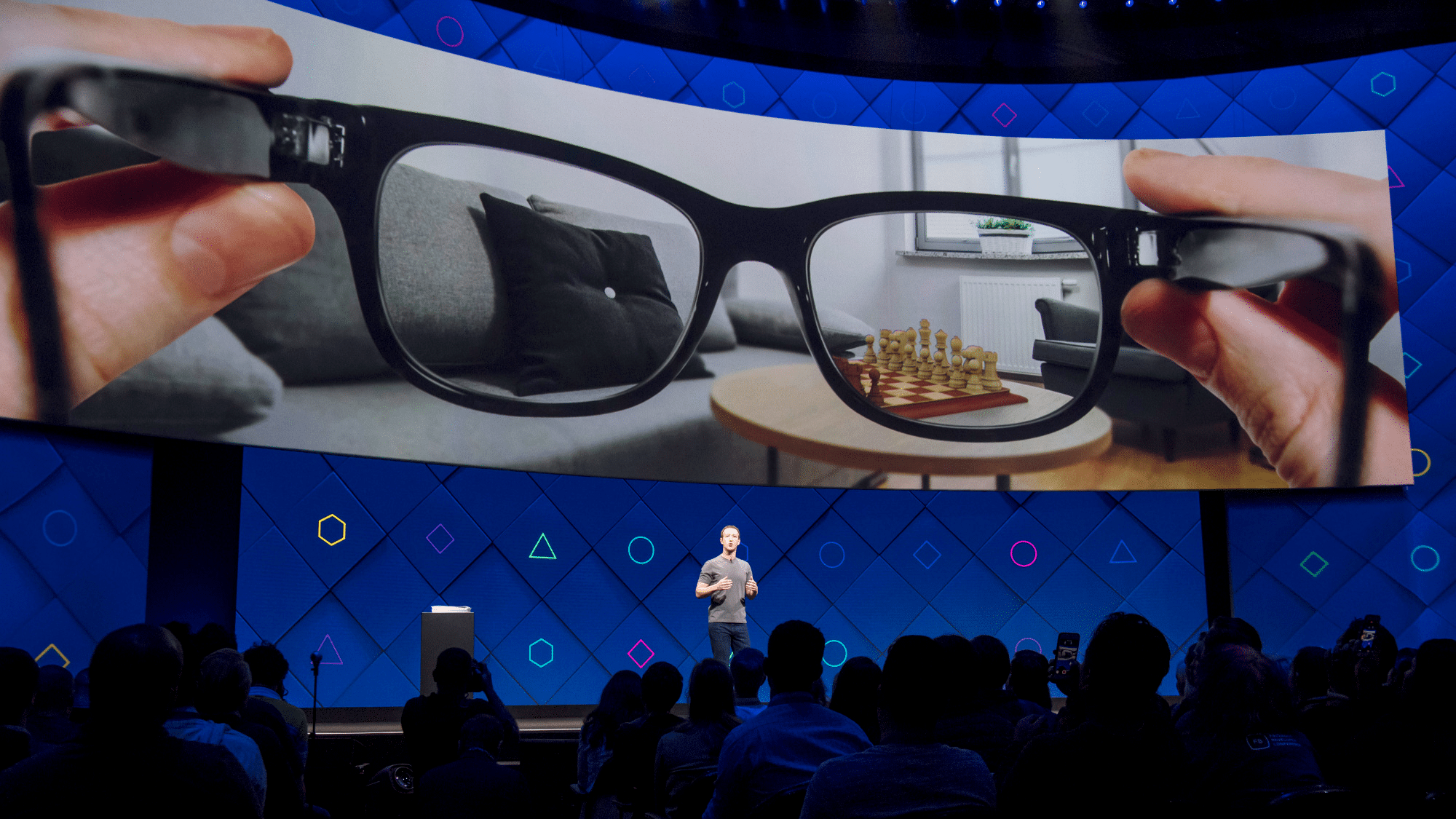
Now, in a new blog post explaining the advantages of silicon carbide waveguides for AR, Meta is suggesting that the overwhelmingly positive reception of Orion from the tech industry has led suppliers across the world to accelerate their plans for producing optical-grade silicon carbide.
“Orion proved that silicon carbide is a viable option for AR glasses,” says Meta Reality Labs' Director of Research Science Barry Silverstein, “and we’re now seeing interest across the supply chain on three different continents where they’re heavily pursuing this as an opportunity. Silicon carbide will come out on top. It’s just a matter of time in my book.”
“Suppliers are very excited by the new opportunity of manufacturing optical-grade silicon carbide—after all, each waveguide lens represents a large amount of material relative to an electronic chip, and all of their existing capabilities apply to this new space,” adds Silverstein. “Filling your factory is essential, and scaling your factory is the dream. The size of the wafer matters, too: The bigger the wafer, the lower the cost—but the complexity of the process also goes up. That said, we’ve seen suppliers move from four-inch to eight-inch wafers, and some are working on precursors to 12-inch wafers, which would yield exponentially more pairs of AR glasses.”
Meta notes that it's "still early days", and Silverstein cautions that there’s "still a lot of work left to be done", strongly suggesting that the plan to use glass in the first product still hasn't changed. But the implication seems to be that the company's timeline for one day eventually releasing AR glasses with silicon carbide lenses, and thus Orion's field of view, may be narrowing.
 UploadVRAlex Coulombe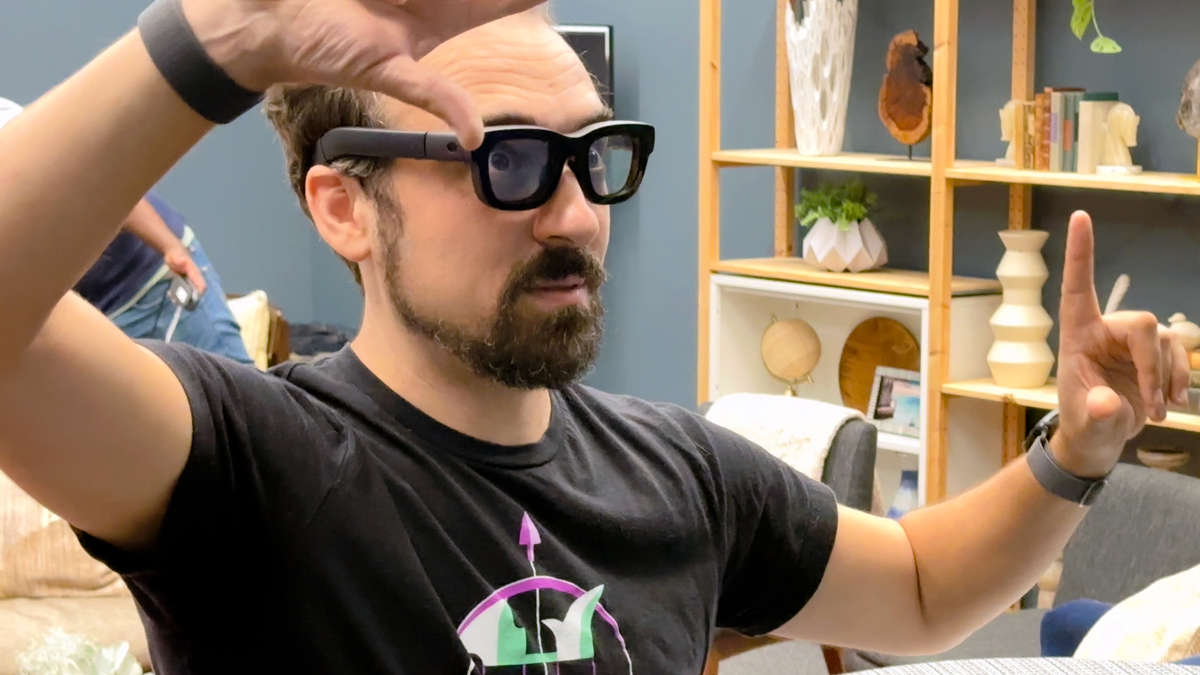
“The world is awake now,” adds Silverstein. “We’ve successfully shown that silicon carbide can flex across electronics and photonics. It’s a material that could have future applications in quantum computing. And we’re seeing signs that it’s possible to significantly reduce the cost. There’s a lot of work left to be done, but the potential upside here is huge.”

The Road to Lucid Dreaming Might be Paved With VR

Lucid dreaming is the state of becoming aware one is dreaming while still being within the dream. To what end? That awareness may allow one to influence the dream itself, and the possibilities of that are obvious and compelling enough that plenty of clever and curious people have formed some sort of interest in this direction. Now there are some indications that VR might be a useful tool in helping people achieve lucid dreaming.
The research paper (Virtual reality training of lucid dreaming) is far from laying out a conclusive roadmap, but there’s enough there to make the case that VR is at least worth a look as a serious tool in the quest for lucid dreaming.
One method of using VR in this way hinges on the idea that engaging in immersive VR content can create mild dissociative experiences, and this can help guide and encourage users to perform “reality checks”. VR can help such reality checks become second nature (or at least more familiar and natural), which may help one to become aware of a dream state when it occurs.
Another method uses VR as a way to induce a mental state that is more conducive to lucid dreaming. As mentioned, engaging in immersive VR can induce mild dissociative experiences, so VR slowly guides one into a more receptive state before falling asleep. Since sleeping in VR is absolutely a thing, perhaps an enterprising hacker with a healthy curiosity in lucid dreaming might be inspired to experiment with combining them.
We’ve covered plenty of lucid dreaming hacks over the years and there’s even been serious effort at enabling communication from within a dreaming state. If you ask us, that’s something just begging to be combined with VR.

Innovative biorobotic arm uses artificial muscles to combat tremors, paving way for wearable solutions
True Image Reflection Mirror

See yourself as the world sees you with the True Image Reflection Mirror! No more flipped reflections – just an accurate, distortion-free view. A K-beauty favorite, this precision-engineered mirror offers adjustable angles for the perfect look. Finally, a mirror that tells the truth!
$54.99
Cellid Leads the Charge Toward Everyday AR at MWC
Cellid Inc. has emerged as a standout innovator at Mobile World Congress 2025 in Barcelona, showcasing their cutting-edge spectacle-type AR glasses that promise to make augmented reality more accessible and practical for everyday use.
While several AR wearables captured attention at the event, Cellid’s approach to lightweight, unobtrusive AR is a refreshing take on a crowded industry.
Making AR as Natural as Wearing Glasses
Cellid’s booth drew consistent crowds eager to experience their reference design for spectacle-type AR glasses.
What makes these glasses particularly impressive is their form factor – as thin and light as ordinary eyeglass lenses while delivering crisp, clear augmented imagery. The company has achieved this through their world’s largest viewing angle glass waveguide technology and full-color plastic waveguides: both on display at MWC.
According to IDC’s “Worldwide Augmented and Virtual Reality Hardware Forecast,” the technology trend is expected to shift from mobile devices to AR/MR glasses as computing evolves toward more user-friendly and personalised experiences.
Cellid appears well-positioned for this transition with their focus on integrating cutting-edge AR display hardware with real-world spatial recognition software.
Visitors to Cellid’s booth were able to participate in interactive demonstrations featuring real-world applications of the reference design announced last November, showcasing how their lightweight AR glasses could seamlessly integrate into daily life. The company’s “Blending of Physical and Digital World” approach emphasises making exceptional information tools more accessible, practical, and convenient.
Other Notable AR Innovations at MWC 2025
While Cellid stood out for their practical, everyday approach to AR glasses, other significant AR wearables also made waves at MWC 2025:
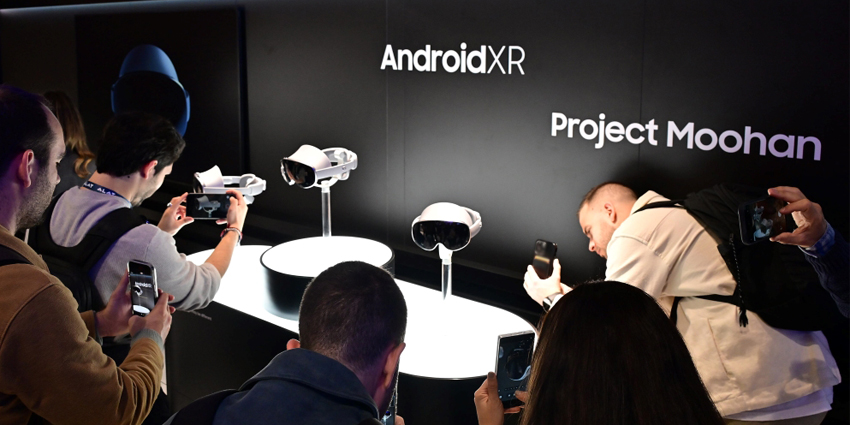
Samsung, Qualcomm, and Google’s collaborative Moohan headset generated buzz with its impressive 3,000 DPI micro-OLED displays and Snapdragon XR2+ Gen 2 chipset. Though positioned as a more immersive mixed reality solution at an expected price point of $999, the Moohan represents the high-end of the AR/XR spectrum compared to Cellid’s more accessible approach.
MICROOLED, Quanta Computer, and STMicroelectronics introduced their ActiveLook-enabled AR smart glasses reference design, focusing on delivering “mission-critical information in real-time and on the move” for sports and outdoor activities. These glasses emphasize low power consumption and practical utility, aligning somewhat with Cellid’s philosophy but targeting more specific use cases.
Perhaps most futuristic was XPANCEO’s display of smart contact lens prototypes, including versions with health monitoring capabilities and AR functionality. While still years from mainstream adoption, these prototypes hint at a possible long-term future for AR wearables.
NTT QONOQ devices showcased both enterprise and consumer-focused AR smart glasses, with their MiRZA wearable leveraging Qualcomm’s Snapdragon AR2 Gen 1 chipset for workplace applications. While impressive technologically, these appear more specialized than Cellid’s everyday glasses approach.
The AR Landscape: Consumer Convenience and Industrial Innovation
Cellid’s presence at MWC 2025 underscores the growing importance of making AR technology accessible and practical for widespread adoption. By focusing on creating AR glasses that look and feel like regular eyewear, while delivering meaningful augmented experiences, Cellid addresses one of the barriers to widespread AR adoption: the comfort and social acceptability of wearing the technology.
Beyond consumer applications, the industrial and enterprise potential for these lightweight AR solutions is substantial.
While Samsung’s Moohan and NTT QONOQ’s MiRZA target specific enterprise use cases with more specialised hardware, Cellid’s approach could factor in everyday workplace scenarios where unobtrusive AR integration is essential. From architects visualiaing building designs on-site to healthcare professionals accessing patient data while maintaining natural patient interactions; truly glasses-like AR wearables open possibilities that bulkier devices cannot match.
The convergence of different AR approaches at MWC 2025 – from Cellid’s practical eyewear and ActiveLook’s sports-focused glasses to NTT’s enterprise solutions and XPANCEO’s futuristic contact lenses – suggests an industry maturing beyond one-size-fits-all solutions. This diversification signals AR’s transition from novelty technology to purpose-built tools for specific contexts and needs.
As competition intensifies and technology advances, we’re seeing specialized development paths addressing different segments of the market. Cellid’s spectacle-type AR glasses represent a particularly promising direction for mainstream adoption, potentially serving as the catalyst that finally brings augmented reality into everyday life—not as an occasionally used special device, but as a natural extension of how we already engage with the world through traditional eyewear.
Rooftop lab: Improving the understanding of optimal orientation and tilt of solar panels in northern climate conditions
Engineers take apart batteries from Tesla and China's leading EV manufacturer to see what's inside
Discrètement, les États-Unis abandonnent leurs opérations contre les hackers de Moscou

Les États-Unis lâchent prise sur la surveillance des hackers russes et stoppent leur opération offensive dans le cyberespace contre le Kremlin. Washington est pourtant une cible privilégiée du renseignement russe.
Therapy for ChatGPT? How to reduce AI 'anxiety'
XPANCEO to Showcase Prototype Smart Contact Lenses at MWC ’25
This week at Mobile World Congress 2025, XPANCEO continues its legacy of drip-feeding details about its emerging AR smart contact lens portfolio at leading industry events.
The firm commonly attends leading XR events to showcase prototypes of its futuristic AR product, which may not be available today but could be a glimpse of XR tomorrow.
At MWC 2025, XPANCEO updated the status of its emerging technology promise by unveiling three new smart contact lens prototypes.
The prototypes include an AR contact lens that supports a wireless powering companion with a charging case.
Another prototype contains a built-in Intraocular Pressure (IOP) sensor, which accurately replicates the human eye and integrates AI to aid in early glaucoma detection—a particularly interesting potential use case for healthcare.
A further healthcare use case comes via the third AR contact lens, which contains biochemical sensors that measure body parameters directly from tear fluid, therefore eliminating the need for blood draws. According to XPANCEO, the biosensing smart contact lens can monitor health factors such as glucose levels, various hormones, and vitamins B1, B2, B3, E, and D.
XPANCEO notes an interest in boosting personal health management and early detection of illnesses. While the technology is still emerging, healthcare and patient care appear to be key focus areas for the innovative firm.
In addition to its new prototypes, XPANCEO is also showing updates to its AR Vision smart glasses, which feature a new integrated microdisplay for immersive visualizations.
XPANCEO’s Year of Innovation
In 2024, XPANCEO significantly increased its presence at various events, emphasizing its portfolio updates as the AR smart glasses trend emerged. This offers a potential glimpse into the future of AR wearables even before smart glasses become mainstream.
For instance, at last year’s Mobile World Congress, XPANCEO showcased four prototypes of smart contact lenses, one of which featured advanced XR capabilities.
Later, at GITEX Global 2024, the company presented AR contact lens prototypes, including a “Smart Contact Lens for AR Vision” that delivers high-quality AR images while consuming minimal microwatts of power.
In addition to the lenses, XPANCEO introduced a framework called Data Reading, which provides real-time interactable information to devices. This data can include device control inputs and biometric information.
Furthermore, at the AWE Asia conference, XPANCEO unveiled five advanced prototypes of AR smart contact lenses. The company presented different versions designed for various use cases, allowing participants to see the devices up close.
In recognition of its innovative prototype technology, XPANCEO won the Best in Business Award for Healthcare and the Photonics Middle East Brilliance Award in 2024. The firm claims that its technology will become fully functional by late 2026.
Le plus grand hack de l'histoire : 1,4 milliard de dollars volés en une seule transaction
Plongez dans l’analyse de la plus importante cyberattaque financière jamais réalisée, où les hackeur·se·s sont parvenu·e·s à dérober 1,4 milliard de dollars en une unique transaction malveillante. Un cas d’étude crucial pour les développeur·se·s et expert·e·s en cybersécurité sur l’importance de la sécurisation des transactions financières.

Commentaires
L'article Le plus grand hack de l'histoire : 1,4 milliard de dollars volés en une seule transaction a été posté dans la catégorie Sécurité de Human Coders News
Moohan: Everything you Need to Know About Samsung, Google, Qualcomm’s Major XR Headset – MWC ’25
MWC 2025 is proving itself to be a hotbed for XR innovation. Several major firms are taking to the event to showcase the latest in their AR/VR/MR endeavours, with a headline-stealing showcase coming via Samsung’s Moohan exhibition.
At MWC 2025, Samsung showcased many products, from its mobile AI suite to new smartphones. However, a common talking point is its Moohan headset, and this week is no different as Samsung had three headsets on display at the event for looking only.
The device comes as a cross-collaboration between Samsung, Qualcomm, and Google, with Qualcomm providing a chipset foundation and Google working to deploy its much-touted AndroidXR framework on the upcoming headset.
While attendees could not get hands-on with the devices and few details were mentioned, the confident showcase brought many eyes as Samsung seriously stakes its claim in XR following years of speculation.
While MWC 2025 only gave attendees a glimpse of the upcoming headset, here is everything readers need to know about the upcoming device.
Details Specifications and Speculations
This joint venture between Samsung and Google is set to compete with the Meta Quest and Apple Vision Pro. At Galaxy Unpacked 2025, Samsung set the stage for bringing powerful AI integration to mixed reality, potentially setting a new standard for XR devices.
The micro-OLED displays boast an impressive 3,000 DPI resolution, significantly outperforming the Meta Quest 3’s 1,200 DPI, while the Qualcomm Snapdragon XR2+ Gen 2 chipset ensures smooth performance across applications.
The hardware design reflects Samsung’s ecosystem-first approach. The headset features a lightweight frame with plush padding and innovative, magnetically removable light seals. It’s engineered to work seamlessly with smartphones and smart home devices, facilitating natural transitions between virtual and physical interactions.
Other key design features include a lightweight frame with premium build quality, magnetic light seals for customizable immersion, plush padding for extended wear comfort, automatic IPD adjustment via eye tracking, and smart device integration built into the core design.
Moohan is notably lighter than the Apple Vision Pro’s 600-gram weight while maintaining premium build quality and connectivity features.
Moreover, Samsung’s extensive technology ecosystem can help introduce its large Galaxy user base to XR wearables. Additionally, with support from divisions like Samsung Heavy Industries, the potential for the Moohan device to make an impact is significant, especially since existing users and hardware are already in place across various sectors, not just in the consumer market.
While companies like Meta dominate the market, focusing on social media, XR, and emerging AI solutions, Samsung offers a competitive edge through its robust hardware and associated AI portfolio. This provides a promising avenue for competition in the industry.
With an expected price point of around $999, Moohan strategically positions itself between Meta’s Quest 3 ($499) and Apple’s Vision Pro ($3,499) and should be available later this year.
AndriodXR and Google’s Influence
Google has announced Android XR, an operating system designed for extended reality devices and services. The company describes it as the “next generation of computing.” Notably, Google is developing this XR OS in collaboration with Samsung and other significant players in the XR industry, such as Qualcomm, Sony, XREAL, Magic Leap, and Lynx.
In an official press release, Google stated, “We are opening a path for developing a wide array of Android XR devices to meet the diverse needs of people and businesses.”
The launch of the Android XR ecosystem comes alongside Meta’s Horizon OS and Apple’s visionOS, positioning Google and its partners to unite several major players in the emerging technology field and create a competitive alternative to Apple and Meta’s offerings.
The Android XR OS is designed to advance the future of AI, augmented reality, and virtual reality applications on headsets and smart glasses. The current version of Android XR is available for developers in a preview stage, with a broader release expected in the future. Developers working with Android XR can utilize familiar tools such as ARCore, Android Studio, Jetpack Compose, Unity, and OpenXR to begin their projects.
Details about the Moohan device are slim and still emerging, but if Samsung debuts the product this year, the XR marketplace could hit new heights as veteran vendors react to the landmark.
Cheap Hackable Smart Ring Gets a Command Line Client
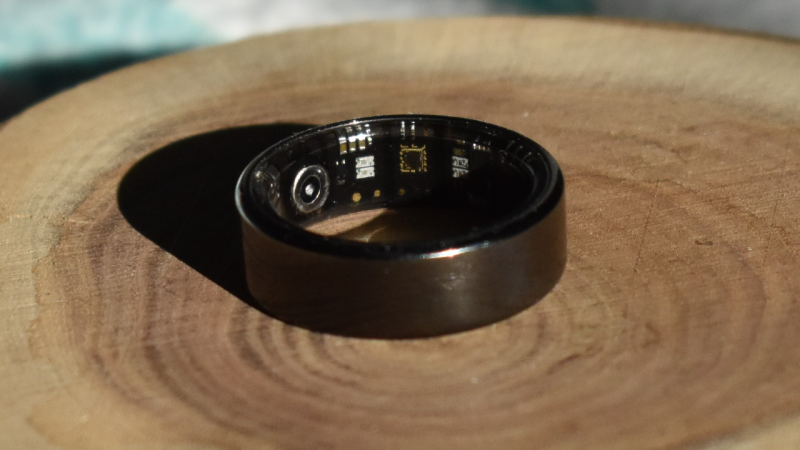
Last year, we’ve featured a super cheap smart ring – BLE, accelerometer, heart sensor, and a battery, all in a tiny package that fits on your finger. Back when we covered it, we expected either reverse-engineering of stock firmware, or development of a custom firmware outright. Now, you might be overjoyed to learn that [Wesley Ellis] has written a Python client for the ring’s stock firmware.
Thanks to lack of any encryption whatsoever, you can simply collect the data from your ring, no pairing necessary, and [Wesley]’s work takes care of the tricky bits. So, if you want to start collecting data from this ring right now, integrate it into anything you want, such as your smart home or exoskeleton project, this client is enough. A few firmware secrets remain – for instance, the specific way that the ring keep track of day phases, or SPO2 intricacies. But there’s certainly enough here for you to get started with.
This program will work as long as your ring uses the QRing app – should be easy to check right in the store listing. Want to pick up the mantle and crack open the few remaining secrets? Everything is open-source, and there’s a notepad that follows the OG reverse-engineering journey, too. If you need a reminder on what this ring is cool for, here’s our original article on it.
CalCam: Transforming Food Tracking with the Gemini API
Inseye "Pauses" Lumi, Its Quest 2 & 3 Eye Tracking Addon
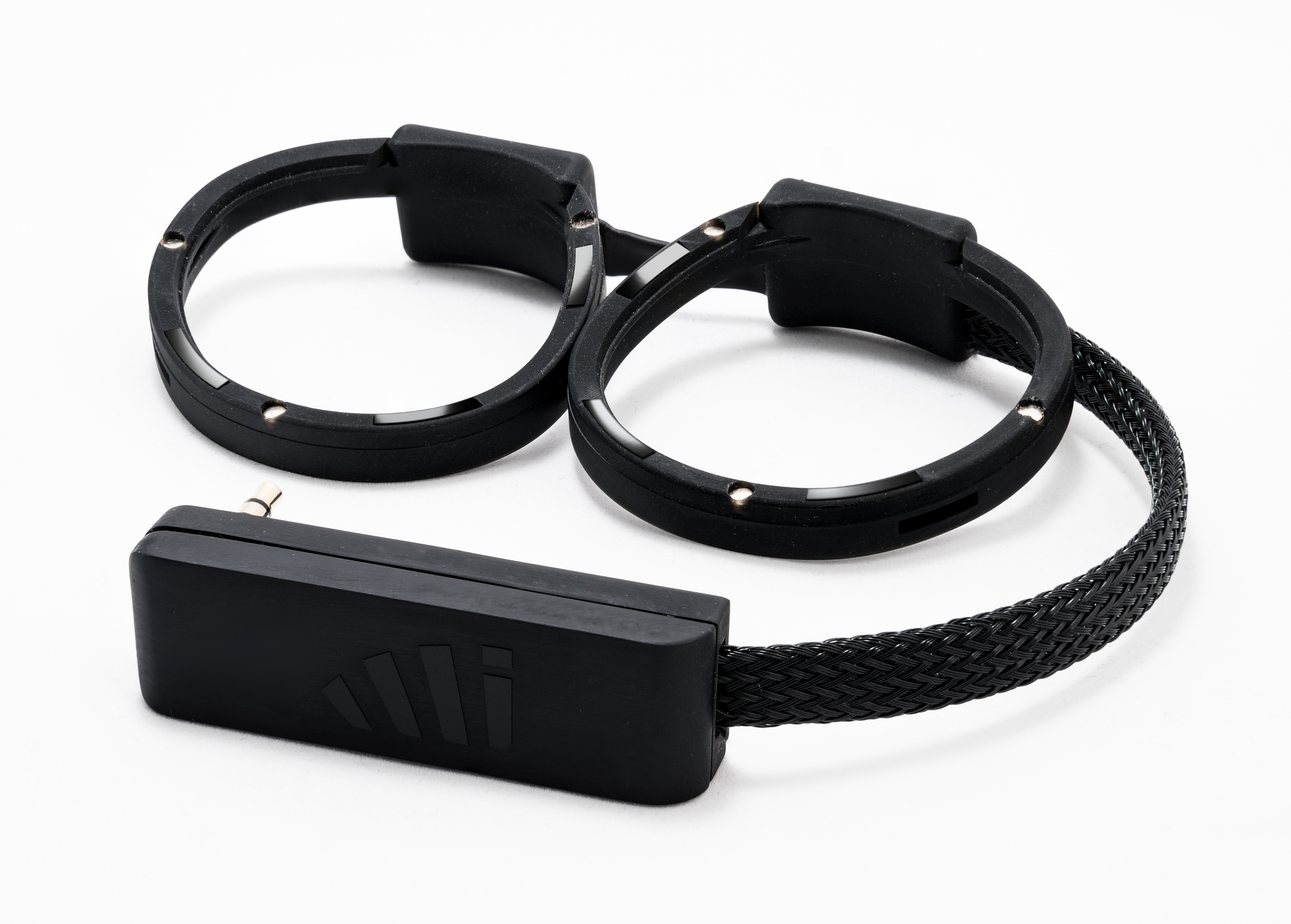
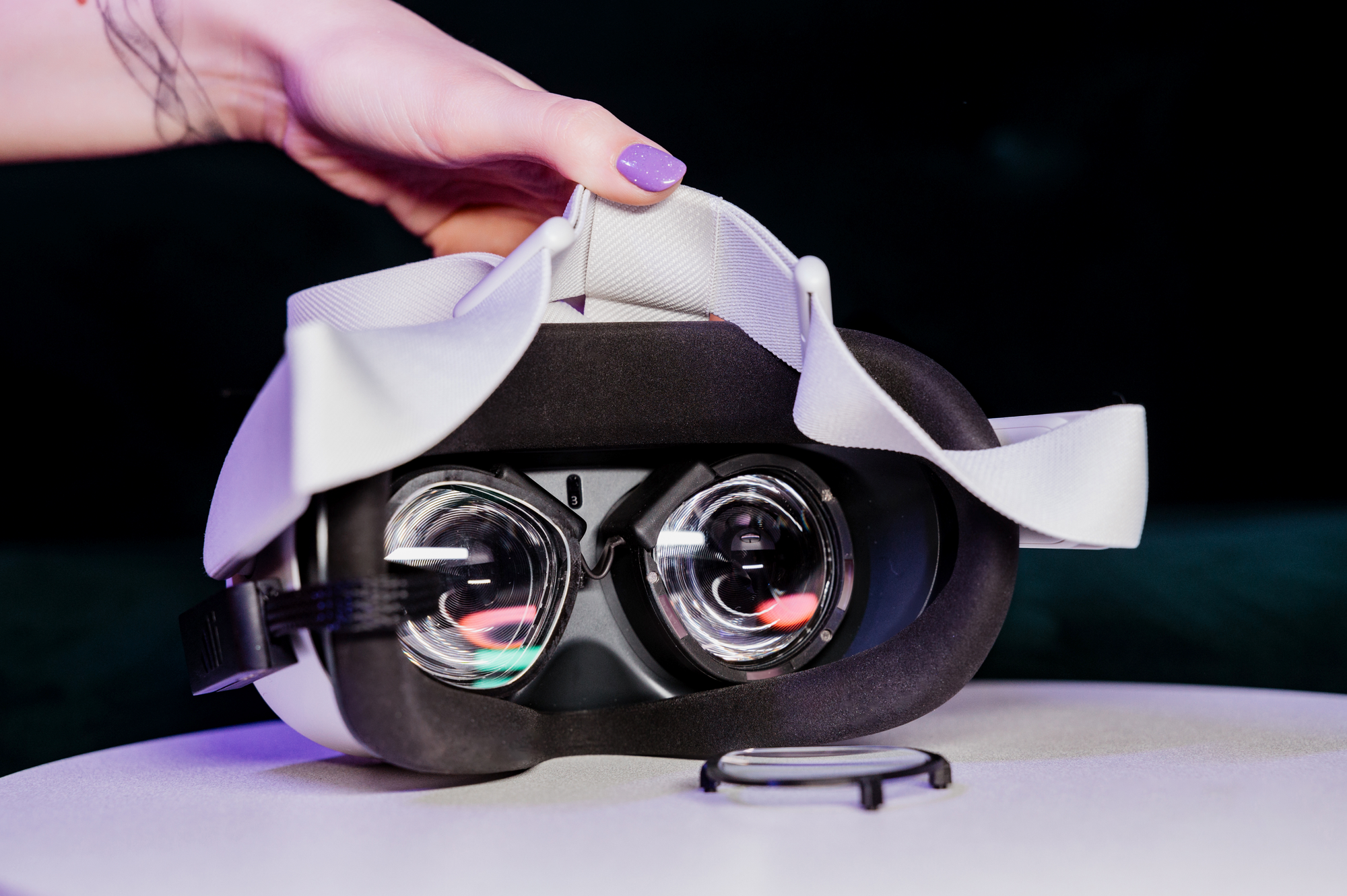
Inseye has "paused" Lumi, the Quest 2 & 3 eye tracking addon it planned to sell, to focus on bringing the technology to smart glasses instead.
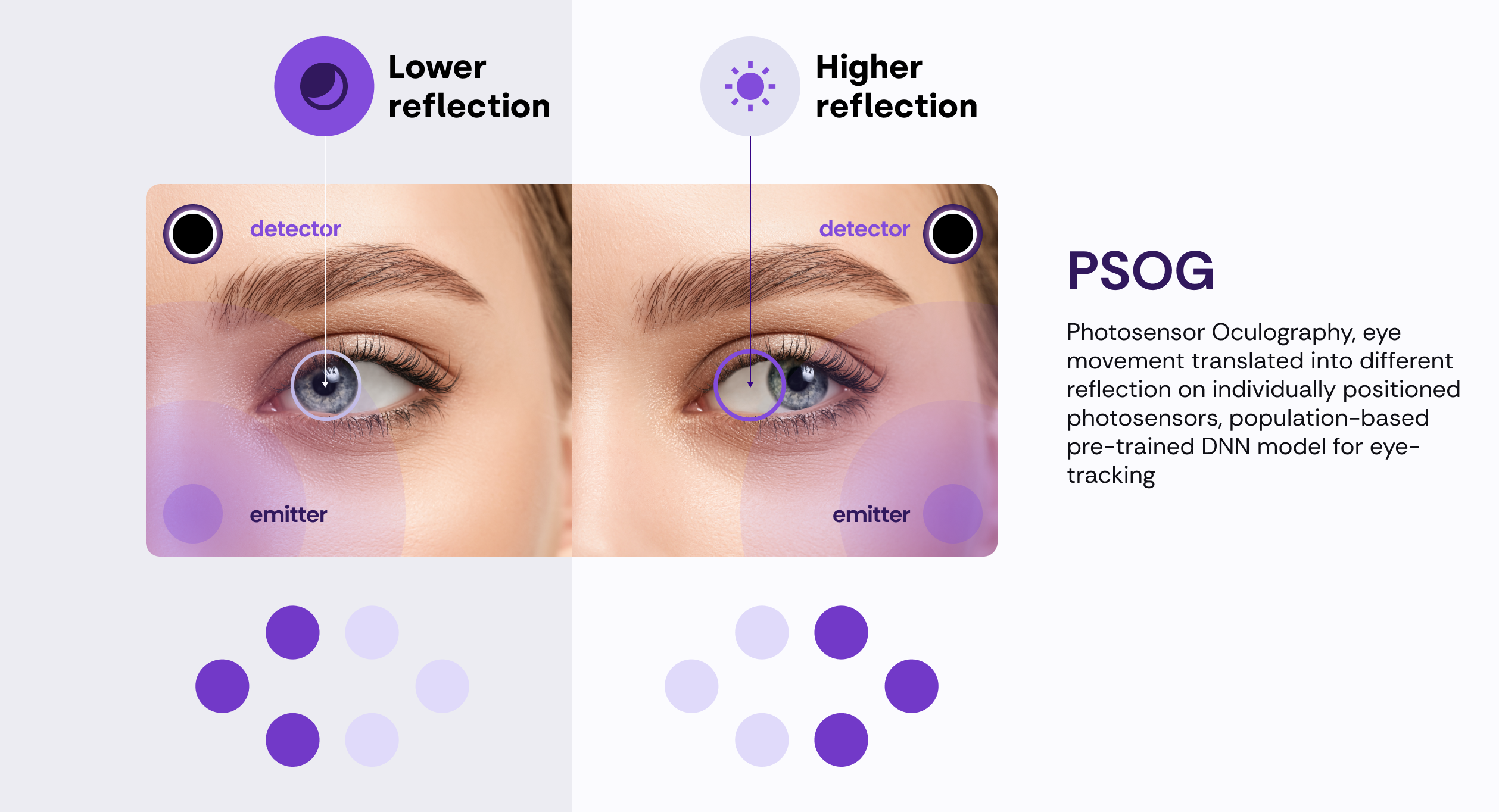
Unlike camera-based eye tracking systems of the kind you'd see in headsets like Apple Vision Pro or PlayStation VR2, the $160 Lumi promised to use an array of simple and inexpensive photosensors to measure the intensity of the reflection of infrared light off your eye. Each part of your eye reflects infrared light with a slightly different intensity, and Inseye says its neural network uses the intensities reported by the photosensors to determine the exact position of your pupil at 1000Hz, while using five times less battery than cameras.
The startup announced the device back in June, and took $1 "refundable deposits" to get it for a discounted price of $100 whenever it eventually shipped.
But now, Inseye says it has "paused Inseye Lumi project for the time being". The startup says it's doing so because it's shifting its focus to integrating its technology into smart glasses and AR glasses, rather than VR/MR headsets, and as a "startup with limited resources" it can't do both - at least not at the same time.
The startup says it's now "working closely with clients who are preparing to bring next-generation smart eyewear to the market".
"Please know this doesn’t mean we’re giving up on VR. We remain convinced VR has massive potential, and we plan to revisit our VR projects when the time and resources are right," Inseye told backers.
Inseye claims it will refund the $1 deposit of any backer who reaches out via email.
Meanwhile, in January a Japanese engineer said he's making his own face & eye tracking addon for Quest 3, but significant concerns were raised about the project.
 UploadVRDavid Heaney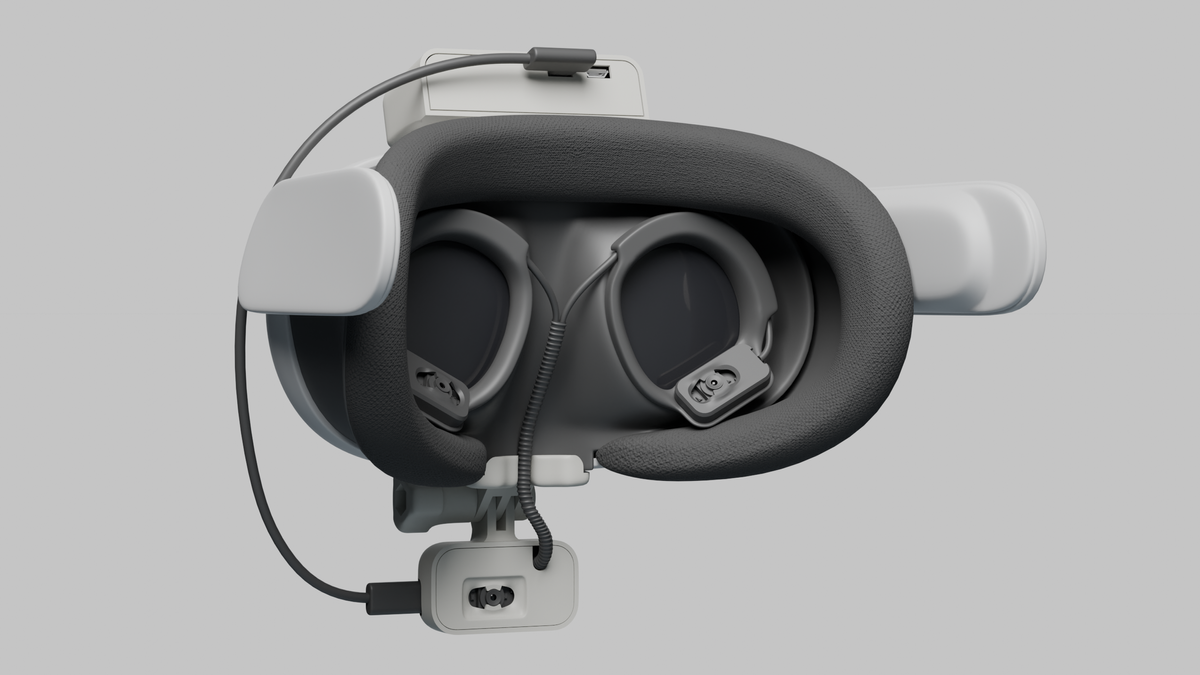
Designing a Toy Conveyor Belt For Fun and Profit
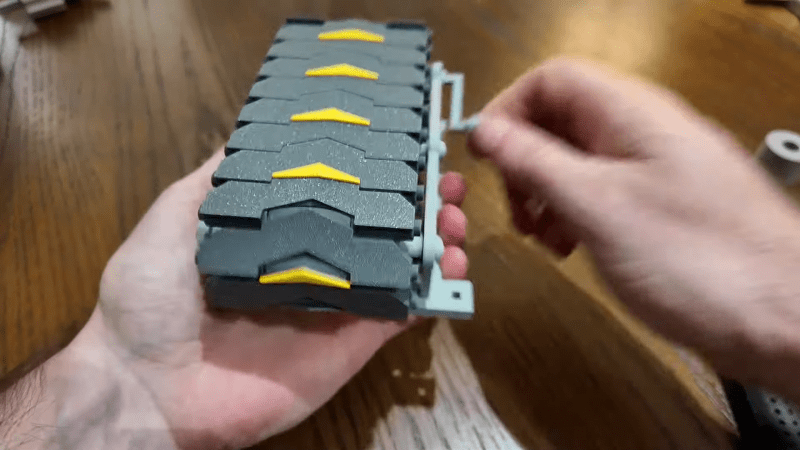
[Hope This Works] wants to someday build a tiny factory line in the garage, with the intent of producing some simple widget down the line. But what is a tiny factory without tiny conveyor belts? Not a very productive one, that’s for sure.
As you may have noticed, this is designed after the transporter belts from the game Factorio. [Hope This Works] ultimately wants something functional that’s small enough to fit in one hand and has that transporter belt aesthetic going. He also saw this as a way to level up his CAD skills from approximately 1, and as you’ll see in the comprehensive video after the break, that definitely happened.
And so [Hope This Works] started by designing the all-important sprockets. He found a little eight-toothed number on McMaster-Carr and used the drawing for reference. From there, he designed the rest of the parts around the sprockets, adding a base so that it can sit on the desk or be held in the hand.
For now, this proof-of-concept is hand-cranked. We especially love that [Hope This Works] included a square hole for the crank handle to stand in when not in use. Be sure to check out the design/build video after the break to see it in action.
How happy would you be to see Factorio come up in a job interview?
Thanks for the tip, [foamyguy]!

Christie's first AI art auction sees hits... and plenty of misses
Ce bio-ordinateur utilise des neurones humains: vers une IA encore plus performante ? 🖥️

Nuclear, Microgrids Could Ease the AI Power Drain
It’s no secret that data centers are power hogs. Going nuclear might be part of the solution.
Small modular nuclear reactors, or reactors that are significantly smaller than your average nuclear power plant, could provide relief for the stress that data center demand poses on an already-weary power grid. But given that only three of these reactors are actually in operation, scaling them is slow-going, and likely won’t be commercially viable for at least five years.
In the meantime, microgrids could offer support to ease the burden on the grid without slowing down AI growth, said Michael Stadler, chief technology officer of Xendee.
“It’s really important to start thinking about what we can do now about this power problem,” said Stadler. “We are thinking about what could happen in five years or 10 years, but I think we have to start acting now.”
Microgrids connect a patchwork of distributed energy resources, such as generators, batteries or solar, that operate within a set boundary to power a single facility. These systems can be connected to the power grid or act in an isolated “island mode,” said Stadler.
While microgrids have been around for decades, they’re garnering more attention as AI and data centers increase pressure on utilities: Goldman Sachs Research predicts that global power demand from data centers could jump 150% by 2027.
- In the context of a data center, a microgrid would simply expand on the generators that many data centers already have for backup power. Using a microgrid could allow data centers to harness renewable power, battery storage and grid power depending on immediate needs, reducing emissions and costs, said Stadler.
- “This is now why we are getting into the data center space, because data centers have high power demand, and utilities are really far behind in upgrading the system,” said Stadler. “So why not install something on-site?”
And how does nuclear come into the picture? Because these microgrids are made up of several different interconnected energy sources, once small modular reactors are available, these grids could be augmented to use them, said Stadler.
A recent white paper by Xendee performed cost modeling for potential microgrids on data centers in Santa Clara, California, and Ashburn, North Carolina. The paper forecasted that implementing microgrids that give way to small modular reactors by 2035 could result in operational expenditure savings of nearly 80% and 60%, respectively.
“It’s basically a stepwise approach which allows you to adapt to changes in the future,” he said.
The post Nuclear, Microgrids Could Ease the AI Power Drain appeared first on The Daily Upside.
Generative AI Consulting Roles Are On the Rise. Here’s Why.
Practically every enterprise is seeking to figure out where AI fits in – and how the tech will augment its workforce.
Data published last week by Hiring Lab, Indeed’s economic research arm, found that generative AI roles have grown rapidly in recent years, with many companies specifically seeking consultants with expertise in the technology. Management consultant roles accounted for 12.4% of all generative AI roles as of January 2025, up from 0.2% in January 2024.
That’s more than double the percentage of roles for machine learning engineers, software architects and data scientists, which each made up between 4.4% and 5.4% of all generative AI job postings.
Many businesses understand the transformative potential of AI, but have little idea where to start, said Larry Kodali, CEO and founder of AI hiring firm OptimHire.
- “At every step, they’re trying to see how they can optimize with AI, how they can improve efficiency, where they can plug in different AI elements and engines into it,” said Kodali. “We are in this phase of investigation.”
- Rather than hire teams to help them integrate AI or build models from the ground up, many enterprises are opting for consultants to come up with the “blueprint” for where it works best, he said.
If your enterprise is lost amid the overwhelming and rapid progression of this tech, hiring an in-house team to work on AI may not be the right place to start, said Kodali, and could potentially add to already-distended AI budgets. Outsourcing AI integrations to consultants could help businesses hone in on operations to figure out where AI optimization will go farthest.
“To be honest, almost every company should hire them,” said Kodali. “There is a lot of process optimization that can be done at every step of the way. It’s good to hire multiple consultants for different sections of the workflow process.”
And in this market, businesses might be hard pressed to find excellent AI talent looking to go in-house, said Kodali. “There’s a lot of entrepreneurship happening,” he said. “If you’re really talented, there are too many opportunities for you right now.”
But AI isn’t a set-it-and-forget-it kind of technology. Once the groundwork is laid by the consultant during the so-called investigation phase, Kodali said, it’s time to start hiring and upskilling your workforce.
As AI confusion and uncertainty hampers adoption, training and hiring staff with generative AI expertise can’t be ignored: A December study by enterprise software firm Slack of more than 17,000 workers found that while 76% said they wanted to become competent at using AI, only 7% considered themselves expert users. Some 30% of workers say they’ve had no AI training at all.
“People would like to hire consultants on a temporary basis – get them in, improve their optimization,” said Kodali. “Once these processes are added into the system, then they will probably try to hire people who know how to use GenAI.”
The post Generative AI Consulting Roles Are On the Rise. Here’s Why. appeared first on The Daily Upside.
The One Smart AI Pen – A ballpoint pen with Bluetooth and a microphone for translation, LLM integration, note taking (Crowdfunding)
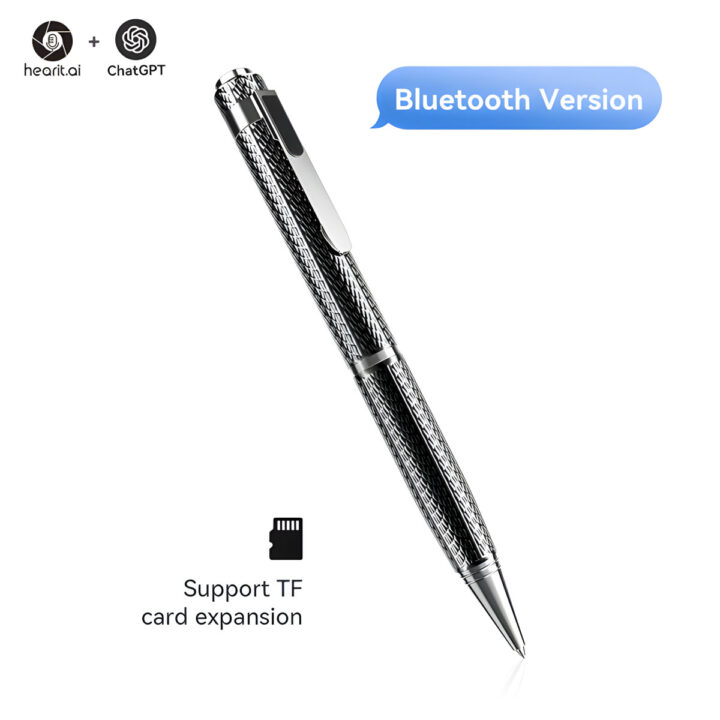
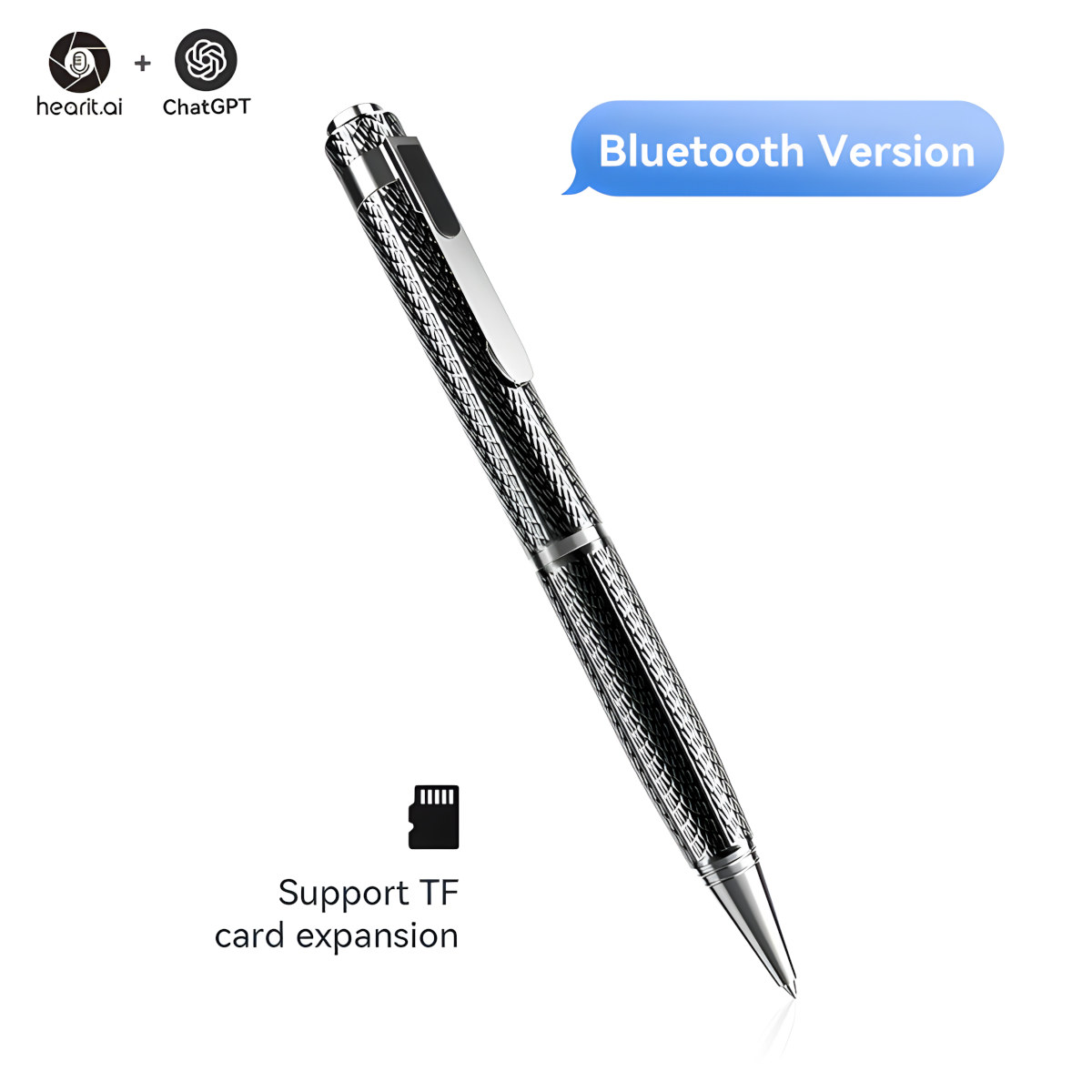

You may have seen the “Sell me that pen. It’s AI-powered” meme if you are a social media user. It may have started as a joke, but Zakwan Ahmad made the meme become reality with “The One Smart AI Pen” which is basically a standard ballpoint pen with a battery, Bluetooth connectivity, a microSD card, and a microphone.
The AI part is not exactly inside the pen per se, but in a smartphone’s app called Hearit.ai that allows the user to translate his/her voice input, use a range of LLMs such as ChatGPT, recording a meeting, or taking notes, for example, to schedule events or meetings.
The One Smart AI Pen specifications:
- “AI chip” – Not clear why it’s needed here… unless it transcribes audio into text inside the pen (as opposed to inside the phone)
- Storage – MicroSD card slot inside the pen
- Wireless – Bluetooth 5.2 with up to 10-meter range via Bluetooth transmitter module
- USB – 1x USB Type-C charging port
- Misc
- Button for power, pairing, AI activation, and standalone mode (audio recording to microSD)
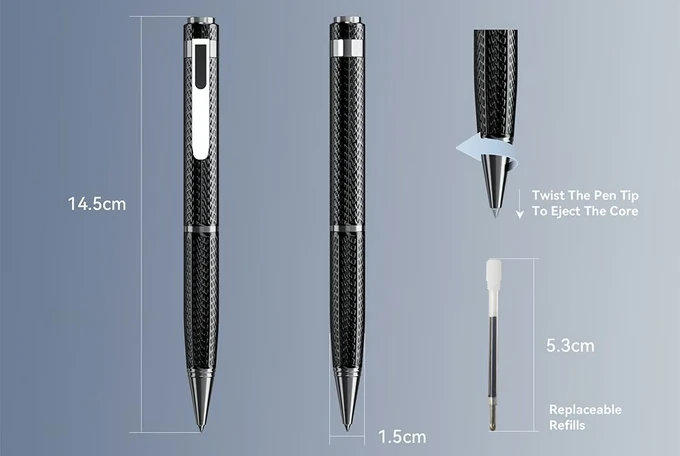
- Ball pen with replaceable refills
- Battery – 200mAh battery good for 30 hours talk time; charging time: 30 minutes
- Dimensions – 14.5 x 1.5cm ∅
- Weight – 30 grams
- Material – Steel and plastic
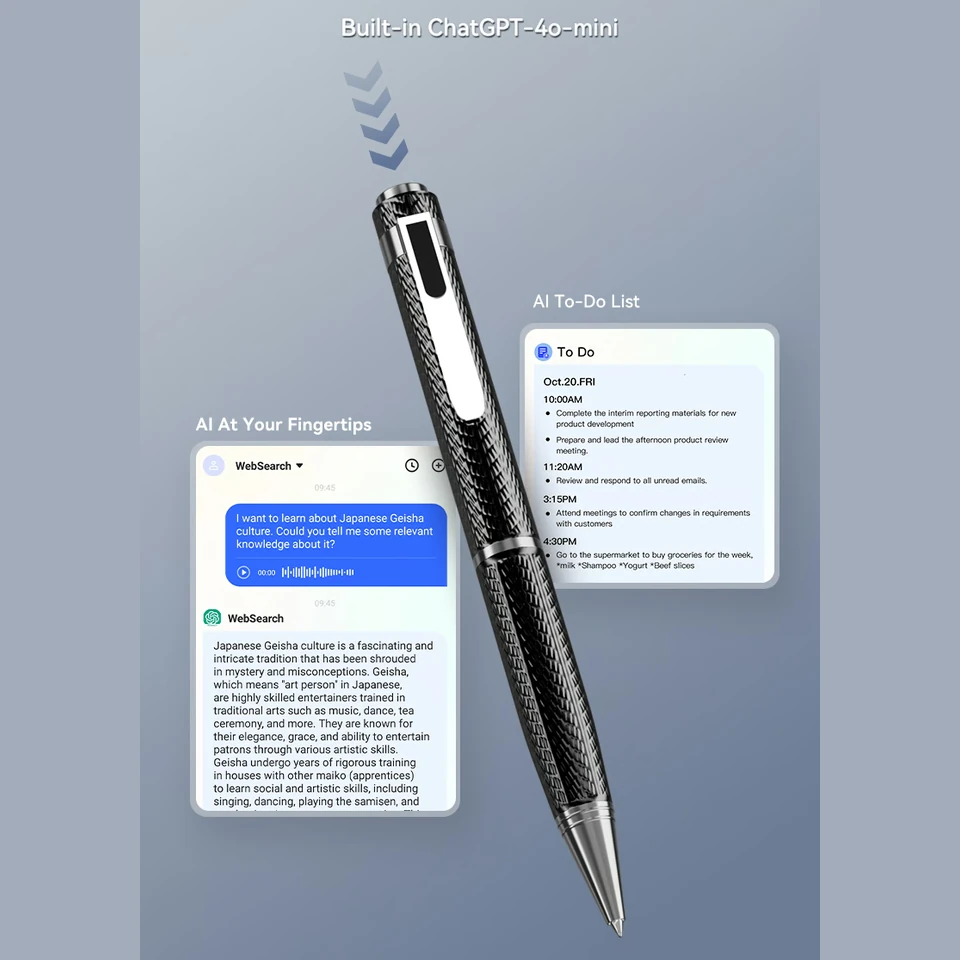
The AI pen has six modes through the Android app:
- Writing Mode – Convert handwritten notes into digital text in real-time. (I can’t find a demo of that one)
- AI Assistant Mode – ChatGPT-powered support for drafting emails, brainstorming ideas, and answering questions.
- Translation Mode – Instantly translate text or speech into multiple languages (52 languages supported).
- Voice Dictation Mode – Speak, and the pen transcribes your words on the fly.
- Recording Mode – Capture audio from meetings, lectures, or conversations.
- Reminder Mode – Set tasks and alerts with simple voice commands.
It can also be used in standalone to record audio to the microSD card. Zakwan expects the pen to be especially useful for healthcare, education, business, legal, and governmental fields. You can check a demo of the pen in the video below (Note: the writing mode is not showcased).
The One Smart AI Pen has been launched through a Kickstarter campaign with a $10,000 funding goal. Rewards start at $50 for the pen and free ChatGPT-4o-mini for the first 1,000 backers. Shipping is free to the US and will be calculated after the campaign is finished for other countries. Note that it’s not the first hardware device compatible with the Hearit app, and you can already purchase Hearit AI Wireless Microphone on Amazon for $29.99.
The post The One Smart AI Pen – A ballpoint pen with Bluetooth and a microphone for translation, LLM integration, note taking (Crowdfunding) appeared first on CNX Software - Embedded Systems News.
“Wooly mice” a test run for mammoth gene editing
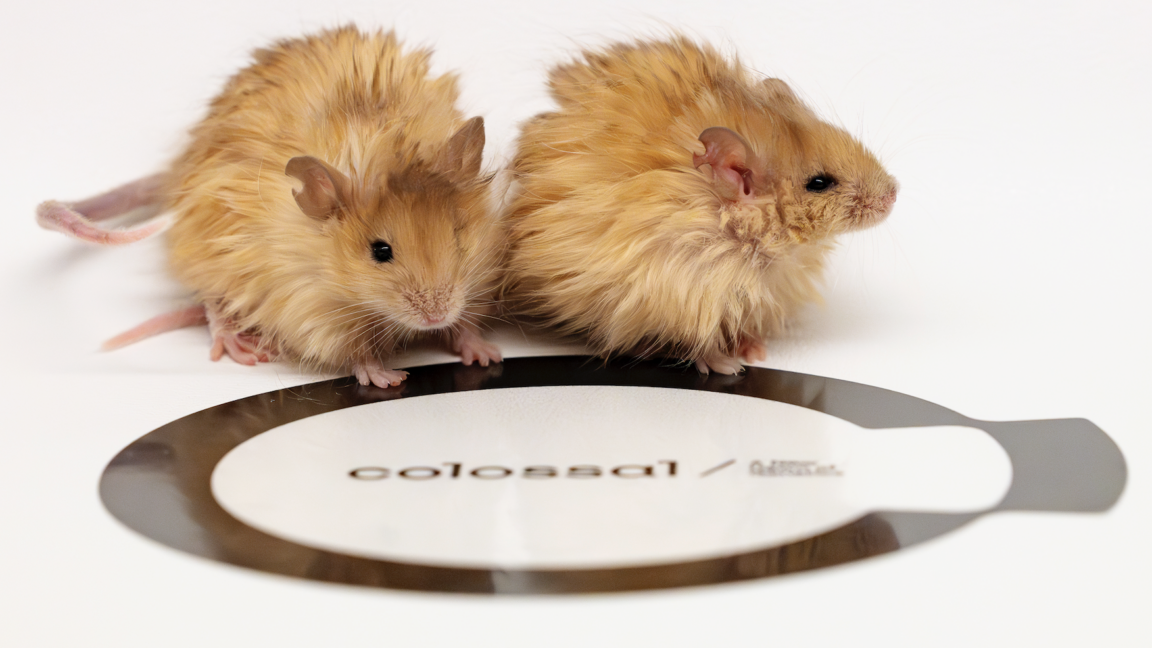
On Tuesday, the team behind the plan to bring mammoth-like animals back to the tundra announced the creation of what it is calling wooly mice, which have long fur reminiscent of the woolly mammoth. The long fur was created through the simultaneous editing of as many as seven genes, all with a known connection to hair growth, color, and/or texture.
But don't think that this is a sort of mouse-mammoth hybrid. Most of the genetic changes were first identified in mice, not mammoths. So, the focus is on the fact that the team could do simultaneous editing of multiple genes—something that they'll need to be able to do to get a considerable number of mammoth-like changes into the elephant genome.
Of mice and mammoths
The team at Colossal Biosciences has started a number of de-extinction projects, including the dodo and thylacine, but its flagship project is the mammoth. In all of these cases, the plan is to take stem cells from a closely related species that has not gone extinct, and edit a series of changes based on the corresponding genomes of the deceased species. In the case of the mammoth, that means the elephant.
Eerily realistic AI voice demo sparks amazement and discomfort online
In late 2013, the Spike Jonze film Her imagined a future where people would form emotional connections with AI voice assistants. Nearly 12 years later, that fictional premise has veered closer to reality with the release of a new conversational voice model from AI startup Sesame that has left many users both fascinated and unnerved.
"I tried the demo, and it was genuinely startling how human it felt," wrote one Hacker News user who tested the system. "I'm almost a bit worried I will start feeling emotionally attached to a voice assistant with this level of human-like sound."
In late February, Sesame released a demo for the company's new Conversational Speech Model (CSM) that appears to cross over what many consider the "uncanny valley" of AI-generated speech, with some testers reporting emotional connections to the male or female voice assistant ("Miles" and "Maya").