Jean-Philippe Encausse
Shared posts
Microsoft poursuit un groupe de pirates pour LLMjacking
Google releases SpeciesNet, an AI model designed to identify wildlife
Google has open sourced an AI model, SpeciesNet, designed to identify animal species by analyzing photos from camera traps. Researchers around the world use camera traps — digital cameras connected to infrared sensors — to study wildlife populations. But while these traps can provide valuable insights, they generate massive volumes of data that take days […]
© 2024 TechCrunch. All rights reserved. For personal use only.
TSMC pledges to spend $100B on US chip facilities
Chipmaker TSMC said that it aims to invest “at least” $100 billion in chip manufacturing plants in the U.S. over the next four years as part of an effort to expand the company’s network of semiconductor factories. President Donald Trump announced the news during a press conference Monday. TSMC’s cash infusion will fund the construction […]
© 2024 TechCrunch. All rights reserved. For personal use only.
L’agence spatiale polonaise victime d’une cyberattaque d’ampleur, les hackers restent inconnus

L’Agence spatiale polonaise (POLSA) a subi une cyberattaque, forçant la déconnexion de ses systèmes. La Pologne, cible croissante des hackers pro-russes, voit ses infrastructures stratégiques menacées.
Amazon Just Walk Out tech powered Hudson Nonstop store opens at Colorado Springs (COS) Airport
Another Hudson Nonstop store, powered by Amazon Just Walk Out technology, has opened its doors, this time at Colorado Springs (COS) Airport.
In a LinkedIn post, Harold T. Respass, Principal Technical Infrastructure Programme Manager - Just Walk Out, said: “I’ve officially led the launch of my 50th retail store powered by Amazon’s Just Walk Out technology: Hudson Nonstop Colorado Springs! (COS).”
“This marks the 18th Hudson Nonstop store, and I’m proud to have launched the last 16 of them. As an Implementation Manager, I oversee the end-to-end project management for third-party retailers adopting this game-changing technology. From initial planning to final execution, I work closely with our customers to integrate Just Walk Out into their operations, creating frictionless, innovative shopping experiences for travelers and shoppers alike.”
He added: “This work isn’t always easy - it takes strategy, collaboration, and a deep focus on execution. But seeing a store go live and watching customers walk in, grab what they need, and leave seamlessly? That’s what makes it all worth it.”
“A huge thank you to my team, our partners at Hudson, and everyone who plays a role in bringing these stores to life. And of course, a special shoutout to my incredible colleagues who build and refine this technology - your innovation and hard work make these seamless shopping experiences possible. Here’s to the next 50!”

2025 RTIH INNOVATION AWARDS
Checkout-free stores will be a key focus area at the 2025 RTIH Innovation Awards.
The awards. which will open for entries in March, celebrate global tech innovation in a fast moving omnichannel world.
Our 2024 hall of fame entrants were revealed during an event which took place at RIBA’s 66 Portland Place HQ in Central London on 21st November, and consisted of a drinks reception, three course meal, and awards ceremony presided over by comedian Lucy Porter.
In his welcome speech, Scott Thompson, Founder and Editor, RTIH, said: “The event is now into its sixth year and what a journey it has been. The awards started life as an online only affair during the Covid outbreak, before launching as a small scale in real life event and growing year on year to the point where we’re now selling out this fine, historic venue.”
He added: “Congratulations to all of our finalists. Many submissions did not make it through to the final stage, and getting to this point is no mean feat. Checkout-free stores, automated supply chains, immersive experiences, on-demand delivery, next generation loyalty offerings, inclusive retail, green technology. We’ve got all the cool stuff covered this evening.”
“But just importantly we’ve got lots of great examples of companies taking innovative tech and making it usable in everyday operations - resulting in more efficiency and profitability in all areas.”
Congratulations to our 2024 winners, and a big thank you to our sponsors, judging panel, the legend that is Lucy Porter, and all those who attended November's gathering.
For further information on the 2025 RTIH Innovation Awards, please fill in the below form and we will get back to you asap.
Name * First Name Last Name Email * Subject * Message *Thank you!

Build a Parametric Speaker of Your Own

The loudspeaker on your home entertainment equipment is designed to project audio around the space in which it operates, if it’s not omnidirectional as such it can feel that way as the surroundings reflect the sound to you wherever you are. Making a directional speaker to project sound over a long distance is considerably more difficult than making one similar to your home speaker, and [Orange_Murker] is here with a solution. At the recent Hacker Hotel conference in the Netherlands, she presented an ultrasonic parametric speaker. It projects an extremely narrow beam of sound over a significant distance, but it’s not an audio frequency speaker at all.
Those of you familiar with radio will recognize its operation; an ultrasonic carrier is modulated with the audio to be projected, and the speaker transfers that to the air. Just like the diode detector in an old AM radio, air is a nonlinear medium, and it performs a demodulation of the ultrasound to produce an audio frequency that can be heard. She spends a while going into modulation schemes, before revealing that she drove her speaker with a 40 kHz PWM via an H bridge. The speaker itself is an array of in-phase ultrasonic transducers, and she demonstrates the result on her audience.
This project is surprisingly simple, should you wish to have a go yourself. There’s a video below the break, and she’s put all the files in a GitHub repository. Meanwhile this isn’t the first time we’ve seen a project like this.
LILYGO T-Connect Pro industrial IoT controller offers Ethernet, WiFi, Bluetooth, LoRa, RS232, RS485, and CAN Bus
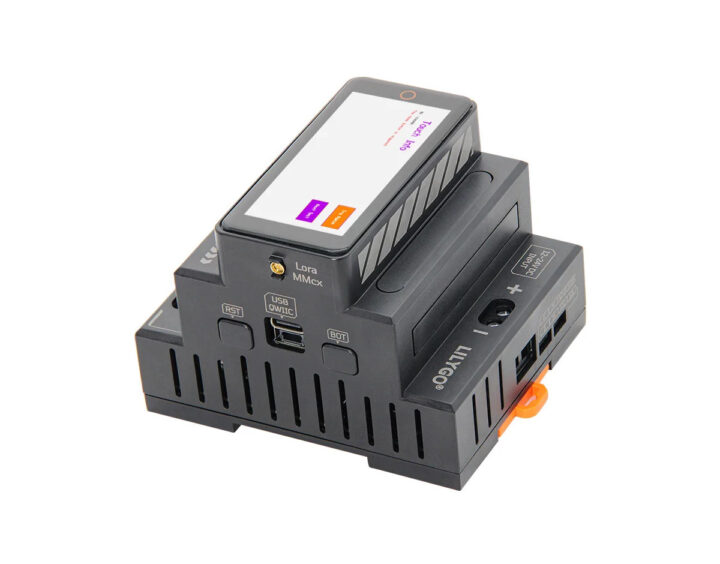
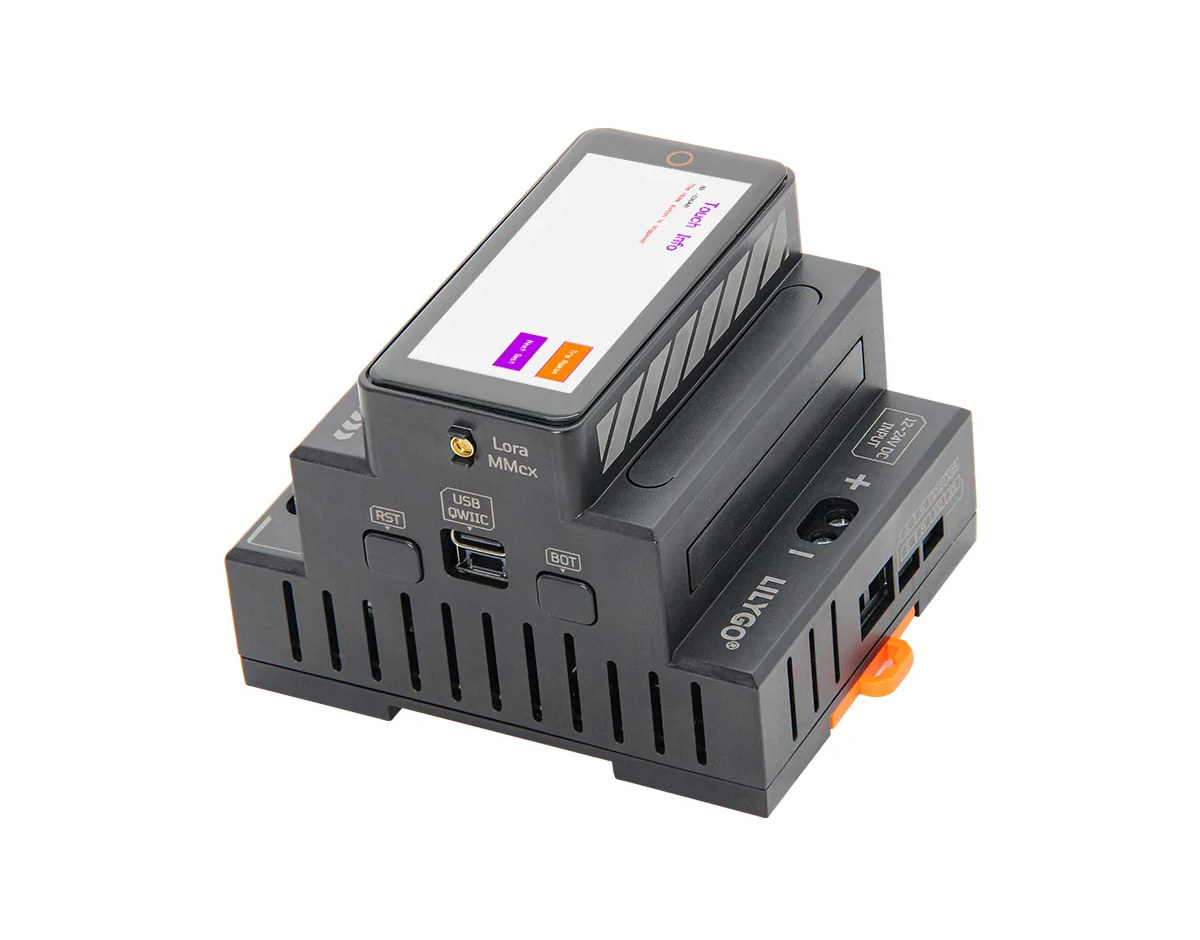
LILYGO T-Connect Pro is a DIN rail-mountable, ESP32-S3-based industrial IoT controller with Ethernet, WiFi 4, Bluetooth 5.0 LE, and LoRa connectivity, as well as CAN Bus, RS232, and RS485 interfaces.
The controller also features a 2.33-inch touchscreen display, a 10A relay, a 12V to 24V DC screw terminal for power, 5V USB-C port for programming, a Qwiic connector for expansion, and BOOT and Reset buttons.
LILYGO T-Connect Pro specifications:
- SoC – Espressif ESP32-S3R8
- CPU – Dual-core Tensilica LX7 microcontroller up to 240 MHz with vector instructions for AI acceleration
- Memory – 8MB PSRAM
- Wireless – WiFi 4 and Bluetooth 5.0 LE + Mesh connectivity
- Storage – 16MB SPI flash
- Display – 2.33-inch RGB display with 480×222 resolution via ST7796 SPI display controller with touchscreen using CST226SE chip
- Networking
- 10/100Mbps Ethernet RJ45 port via W5500 4-wire SPI controller
- WiFi 4 and Bluetooth 5.0 LE via ESP32-S3
- LoRa via HPD16A Semtech SX1262 module (Bands: 433, 868, 915, 920MHz) and external antenna
- USB – USB Type-C port for power and programming
- Serial
- RS232 UART module (TD501D232H)
- RS485 UART module (TD501D485H-A)
- CAN Bus I2C module (TD501MCANFD); isolation voltage: 2500V
- Relay – 10A output relay
- Expansion – Qwiic connector
- Misc – BOOT and Reset buttons
- Power Supply
- 12 to 24V DC input
- 5V/500mA via USB port
-
Dimensions – 88 x 72 x 25mm; 4x M3 mounting thread
- Weight – 240 grams

LILYGO provides Arduino code samples for all features, including a factory test sketch on GitHub, where you’ll also find basic instructions to get started with PlatformIO + VS Code or the Arduino IDE, and the PDF schematics.
We have written about plenty of ESP32 IoT controllers over the years, but the LILYGO T-Connect Pro’s design reminds me of the NORVI ENET DIN Rail ESP32 industrial controller with a similar shape, a touchscreen display, the same wired and wireless connectivity option (Ethernet, WiFi, BLE, LoRa), etc… However, the new LILYGO device features a more recent ESP32-S3 microcontroller, a larger display, CAN Bus, RS232 and RS485, although it lacks analog inputs, digital outputs, and only offers one 10A relay.
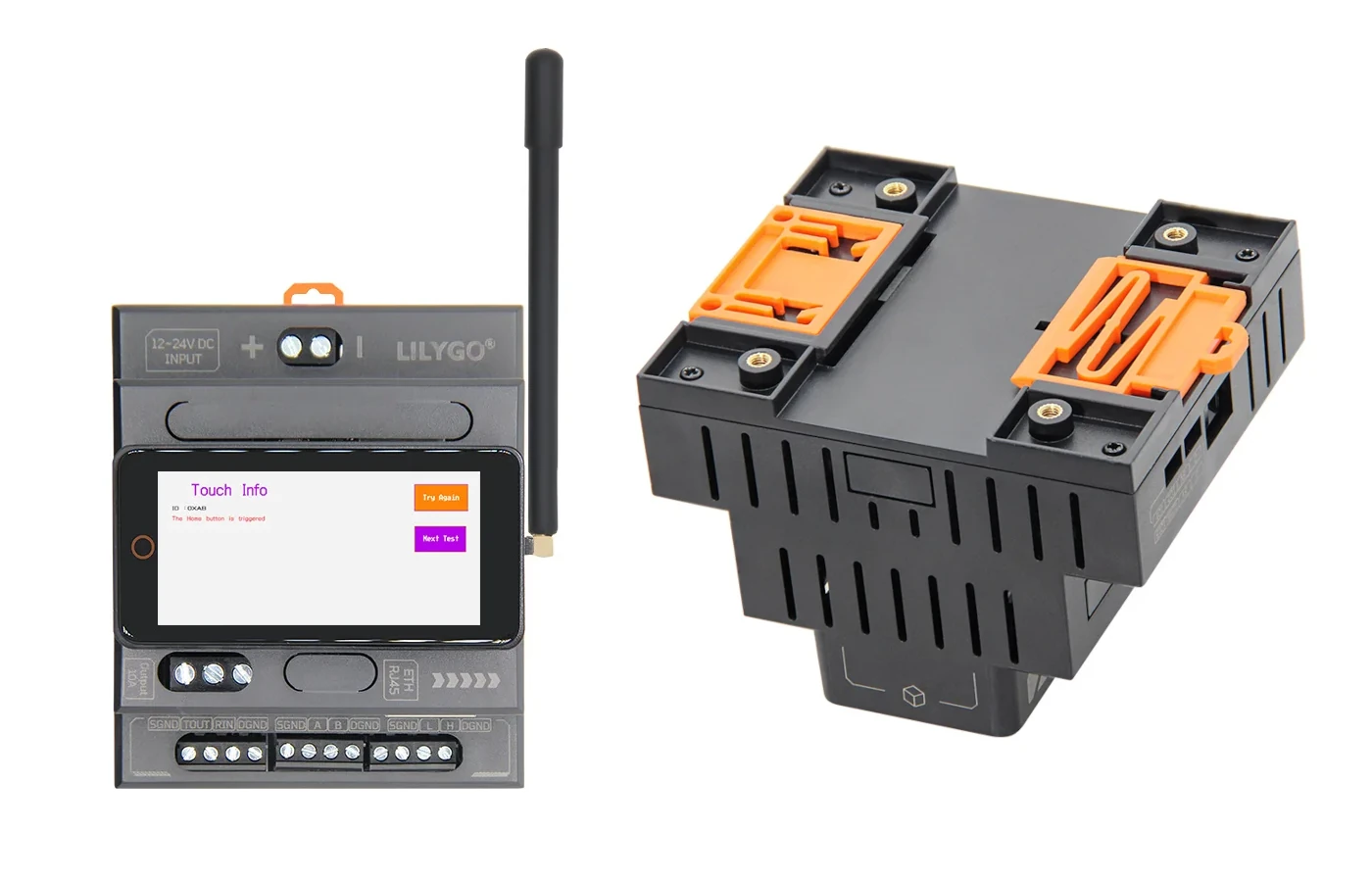
Another advantage is that it’s also cheaper since it’s made in China. The T-Connect Pro is sold for $89.98 on AliExpress including shipping, $78 on Amazon, and you’ll also find it on the company’s online store for $70.36 plus shipping.
The post LILYGO T-Connect Pro industrial IoT controller offers Ethernet, WiFi, Bluetooth, LoRa, RS232, RS485, and CAN Bus appeared first on CNX Software - Embedded Systems News.
MWC 2025 : Steve Wozniak prend position sur l’IA, la Silicon Valley et l’avenir de l’innovation
Lors de son intervention au Mobile World Congress 2025, Steve Wozniak, cofondateur d’Apple, a livré une série de prises de position tranchées sur l’évolution du numérique, l’intelligence artificielle et le rôle des géants de la tech. Fidèle à son franc-parler, il a partagé ses inquiétudes sur l’IA générative, critiqué la mainmise des grandes entreprises sur …
L’article MWC 2025 : Steve Wozniak prend position sur l’IA, la Silicon Valley et l’avenir de l’innovation est apparu en premier sur FRENCHWEB.FR.
Le chien robot Aibo de Sony en tant que compagnon plus silencieux et danseur grâce à l’IA
Sony a développé Aibo, un chiot robotique capable d'imiter les comportements d'un vrai chien. À présent, grâce aux avancées technologiques récentes, Aibo pourrait bientôt marcher plus silencieusement et exécuter des routines de danse complexes. Cela offre ainsi une expérience encore plus réaliste et divertissante.
Une marche plus silencieuse grâce à l'IA
Le robot Aibo, déjà capable de marcher, réagir à son nom et effectuer quelques tours, rencontre cependant un inconvénient majeur : le bruit qu'il génère lorsqu'il se déplace. Ce problème avait été soulevé par de nombreux utilisateurs. D'ailleurs, son bruit dérangeait lors de ses déplacements dans la maison. Ceci en rendant son côté « chien de compagnie » quelque peu perturbant.
Pour résoudre ce problème, une équipe de chercheurs de l'ETH Zurich et de Sony Group Corporation a conçu une approche innovante basée sur l'apprentissage par renforcement (RL). Le but était de réduire considérablement le bruit des pas du robot. Grâce à l'utilisation de capteurs sous ses pattes et à des ajustements intelligents des articulations, Aibo a été entraîné à amortir et rigidifier ses mouvements pour rendre sa marche plus silencieuse. En testant cette méthode, les chercheurs ont pu prouver que leur modèle était nettement plus efficace que les contrôleurs commerciaux précédemment utilisés.
Cette avancée pourrait permettre à Aibo d'interagir de manière plus agréable dans un environnement domestique. Ainsi, sa capacité à se déplacer discrètement serait un atout majeur pour une utilisation quotidienne dans des maisons ou des espaces publics.
Des routines de danse expressives pour un robot plus divertissant
Outre la marche silencieuse, Sony et ses partenaires ont également travaillé sur l'amélioration des capacités artistiques du robot. Aibo pourrait bientôt exécuter des routines de danse plus fluides et expressives. Le modèle Deep Fourier Mimic (DFM), développé par l'équipe de chercheurs, permet au robot de reproduire des mouvements de danse artistique tout en intégrant des actions de locomotion. Contrairement aux techniques traditionnelles qui ne reproduisent que des gestes simples, ce modèle permet une plus grande diversité de mouvements. Cela ajoute de l'expressivité à la performance du robot.
Grâce à cette nouvelle approche, Aibo peut désormais interagir plus naturellement avec ses utilisateurs. Il est capable de danser en synchronisation avec eux et d'imiter leurs mouvements. Cela rend notamment l'expérience de l'utilisateur plus immersive. De plus, le robot peut enchaîner des transitions fluides entre différents types de mouvements. D'ailleurs, ceci offre une prestation de danse plus réaliste.
Cette capacité à effectuer des mouvements artistiques pourrait révolutionner les robots de divertissement. Aibo ne serait plus simplement un compagnon robotisé, mais un véritable partenaire pour des expériences interactives. En outre, les chercheurs envisagent que cette technologie puisse s'étendre à d'autres robots domestiques, voire être utilisée dans des parcs d'attractions pour divertir les visiteurs.
Vers une future perfection des mouvements du robot
Bien que ces avancées soient prometteuses, les chercheurs de Sony et de l'ETH Zurich sont conscients qu'il reste encore des défis à surmonter. Par exemple, un compromis persiste entre la réduction du bruit et la robustesse de la marche. Lors des tests réels, on constaté que certaines modifications apportées pour rendre la marche plus silencieuse ont entraîné une diminution de la stabilité du robot.
Les chercheurs travaillent actuellement sur une solution qui permet de créer une politique de marche qui soit à la fois silencieuse et robuste. Ils cherchent à optimiser l'utilisation des informations perçues par les capteurs pour résoudre ce problème. En parallèle, les progrès dans la danse expressive ne s'étendent pas encore aux mouvements non périodiques, comme sauter ou attraper un objet. Ces actions se traiteront séparément. Certes, elles pourraient s'intégrer dans des versions futures du robot.
Dans un avenir proche, Aibo pourrait donc devenir un compagnon seulement silencieux. Mais ce dernier est également capable de s'adapter à une variété d'environnements et de situations. Ceci tout en offrant une expérience interactive encore plus riche et divertissante. La technologie derrière Aibo, qui mêle intelligence artificielle et robotique avancée. D'ailleurs, cela ouvre la voie à de nombreuses applications futures. Ceci tant dans le domaine domestique que dans celui du divertissement.
Cet article Le chien robot Aibo de Sony en tant que compagnon plus silencieux et danseur grâce à l’IA est apparu en premier sur OBJETCONNECTE.COM.
🚨 Spécial MWC 25 - Les nouveautés les plus marquantes du salon de Barcelone
Deuxième épisode spécial depuis Barcelone pour découvrir les dernières tendances du Mobile World Congress 2025, le plus grand salon des technologies mobiles.
Avec le soutien de FreePro, "le meilleur de Free pour les entreprises".
Au sommaire :
- Des smartphones toujours plus fins et transparents : des modèles signés Samsung, Oppo ou Tecno se distinguent par une finesse record (5-6 mm) grâce à des batteries silicium-carbone. Nothing, de son côté, présente sa nouvelle génération de smartphones transparents Phone (3a) et le Phone (3a) Pro. Realme joue la carte de l'originalité avec un appareil qui change de couleur selon la température.
- Un PC portable à énergie solaire : Lenovo dévoile un prototype équipé d'une dalle photovoltaïque capable de récupérer une heure d'autonomie après 20 minutes d'exposition au soleil.
- La réalité virtuelle et mixte progresse : HTC présente ses casques destinés aux professionnels et aux applications spatiales. Samsung et Google dévoilent le projet Woohan, leur casque VR concurrent du Meta Quest.
- Les réseaux boostés à l'intelligence artificielle : Huawei explique comment les infrastructures 5G évoluent pour s'adapter à l'essor des agents IA et garantir une latence minimale.
- Innovation chez Free Pro : présentation des Smart Cells, des mini-réseaux 5G privés pour les entreprises.
- La robotique à l'honneur : Huawei et Honor exposent des bras robotiques commandés par reconnaissance visuelle de mouvements.
-----------
🎧 L'Hebdo Premium : https://m.audiomeans.fr/s/S-xylotlSe
🌍 Web : https://mondenumerique.info
🗞️ Newsletter : https://mondenumerique.substack.com
📹 YouTube : https://www.youtube.com/@mondenumerique
♥️ Soutien : https://donorbox.org/monde-numerique
Distribué par Audiomeans. Visitez audiomeans.fr/politique-de-confidentialite pour plus d'informations.
WebLLM : Des modèles de langage directement dans le navigateur
Découvrez WebLLM, une technologie permettant d’exécuter des modèles de langage (LLM) directement dans le navigateur, côté client. Cette avancée promet de rendre l’IA plus accessible aux développeur·se·s tout en préservant la confidentialité des données. Une innovation qui pourrait redéfinir l’intégration de l’IA dans les applications web futures.

Commentaires
L'article WebLLM : Des modèles de langage directement dans le navigateur a été posté dans la catégorie JavaScript de Human Coders News
GibberLink lets AI agents call each other in robo-language
A weekend hackathon project that lets AI agents talk on the phone with each other in a robotic language, one that’s incomprehensible to humans, has gone viral on social media over the past week. The project, called GibberLink, was created by two Meta software engineers during a hackathon competition in London, hosted by ElevenLabs and […]
© 2024 TechCrunch. All rights reserved. For personal use only.
AI chatbots struggle with empathy: Overempathizing and gender bias uncovered
There’s another spacecraft landing on the moon tomorrow — here’s how to watch

Sergey Brin says AGI is within reach if Googlers work 60-hour weeks
Sergey Brin co-founded Google in the 1990s along with Larry Page, but both stepped away from the day to day at Google in 2019. However, the AI boom tempted Brin to return to the office, and he thinks everyone should follow his example. In a new internal memo, Brin has advised employees to be in the office every weekday so Google can win the AI race.
Just returning to the office isn't enough for the Google co-founder. According to the memo seen by The New York Times, Brin says Googlers should try to work 60 hours per week to support the company's AI efforts. That works out to 12 hours per day, Monday through Friday, which Brin calls the "sweet spot of productivity." This is not a new opinion for Brin.
Brin, like many in Silicon Valley, is seemingly committed to the dogma that the current trajectory of generative AI will lead to the development of artificial general intelligence (AGI). Such a thinking machine would be head and shoulders above current AI models, which can only do a good impression of thinking. An AGI would understand concepts and think more like a human being, which some would argue makes it a conscious entity.

We're Apparently Living in an Anime, Because This Robot Has Learned Kung Fu

Chinese robotics company Unitree has shown off its G1 humanoid robot pulling some gnarly kung fu moves.
In a video released this week, the child-sized robot can be seen punching the air and even deliver a swooping roundhouse kick.
"We have continued to upgrade the Unitree G1's algorithm, enabling it to learn and perform virtually any movement," the company wrote in the video's caption. "What other moves would you like to see. Do share with us in the comments."
"Please keep a safe distance from the robot," the company advised.
The stunt highlights how far consumer-facing humanoid robotics have come. Unlike its growing number of Western counterparts, including Tesla's Optimus and Figure's 01, Unitree's G1 is already being sold to consumers. Pricing starts at just $16,000, according to the company's website.
The robot features anywhere from 23 to 43 joint motors, depending on the configuration, allowing it to walk, hop — and evidently dabble in martial arts as well.
A previous video shared by the company shows G1 busting out some dance moves, while — we are not kidding — a human engineer tries to knock it off its feet with what appears to be a padded broom stick. A separate video released last month shows it running down a street and briskly walking over an uneven, rocky surface.
YouTuber Sohail Khan recently took the robot for a spin after unpacking it from a large check-in luggage-sized hardcase. He even nudges it to demonstrate the robot's ability to right itself, and shows it lying flat on its back before instructing it to clamber back onto its feet.
Apart from bipedal robots, Unitree has also shown off two quadrupedal robot dogs called B2 and Go2. The latter can be bought for less than $2,000, a massive discount over Boston Dynamics' Spot Mini, which can cost as much as $75,000.
But when or if these robots will ever be able to defeat a human martial artist or boxer remains to be seen. Considering how easy it is to tip over a Unitree G1 — Khan had more than one hair-raising incident while testing the robot's self-balancing limits — us humans will likely have plenty of time until we'd have to worry about getting knocked out in hand-to-robot-hand combat.
More on humanoid robots: China Is Hosting The World’s First Foot Race Between Humans and Robots
The post We're Apparently Living in an Anime, Because This Robot Has Learned Kung Fu appeared first on Futurism.
Building a Nerf-like Rocket Launcher With Airburst Capability

Nerf blasters typically fire small foam darts or little foam balls. [Michael Pick] wanted to build something altogether more devastating. To that end, he created a rocket launcher with an advanced air burst capability, intended to take out enemies behind cover.
Unlike Nerf’s own rocket launchers, this build doesn’t just launch a bigger foam dart. Instead, it launches an advanced smart projectile that releases lots of smaller foam submunitions at a set distance after firing.
The rocket launcher itself is assembled out of off-the-shelf pipe and 3D printed components. An Arduino Uno runs the show, hooked up to a Bluetooth module and a laser rangefinder. The rangefinder determines the distance to the target, and the Bluetooth module then communicates this to the rocket projectile itself so it knows when to release its foamy payload after launch. Releasing the submunitions is achieved with a small microservo in the projectile which opens a pair of doors in flight, scattering foam on anyone below. The rockets are actually fired via strong elastic bands, with an electronic servo-controlled firing mechanism.
We’ve featured some great Nerf builds over the years, like this rocket-blasting robot.

There’s a Vape With a Tamagotchi Inside It That Dies If You Stop Puffing

Behold, the latest dark entity purportedly birthed out of our not-so-brave new world: a Tamagotchi, housed inside of a vape, that croaks if you stop hitting that sweet sweet juice.
The Tamagotchi in question was apparently presented during a "Stupid Hackathon" put on by New York University (NYU) Tisch School's Interactive Telecommunications Program (ITP) and Interactive Media Arts departments. There, according to the ITP website, students enrolled in the programs are invited to "make something stupid."
"Do you have an idea so absurd, so utterly useless, that it needs to exist?" it reads. "Then welcome to Stupid Hackathon 2025!"
Among those ideas, according to a video posted this week to ITP's TikTok account showcasing the event's various — indeed, delightfully stupid — treasures, is the Vape-a-gotchi.
"May I ask you what your Stupid Hackathon project is?" the interviewer holding the camera asks one participant, who's gripping what appears to be an orange e-cigarette.
"It's a vape with a Tamagotchi in it," the participant calmly replies. "And if you do not hit the vape, the Tamagotchi will die." Harrowing!
@itp_ima_nyusome stupid projects from the stupid hackathon 2025 @joshjoshjosh.net went to go check em out #hackathon #stupid #technology
Incredibly, a few Google searches reveal that the Stupid Hackathoner may not be the first person with this idea.
"Idea for a vape: a Tamagotchi that you can only 'feed' or 'play with' by taking a puff of nicotine," reads one — satirical, probably — X-formerly-Twitter post from Works in Progress editor Sam Bowman, published in May 2023. "Vaping is so safe that if this got just one kid off cigarettes it would be worth another 50 getting into vaping."
"Hi sharks," reads another post, this one from June 2024, referencing the "Shark Tank" television program, "today we're putting a Tamagotchi pet on this vape thing." (This one was written in response to a post from senior Wired business editor Louise Matsakis, who had posted about some very techy-looking vapes.)
Through one lens, the Tamagotchi vape could be interpreted as an exploration of sacrifice, or maybe even mutual destruction; studies continue to show that vaping is terrible for you — and so, to ensure the life of their beloved Tamagotchi, the vaper must offer up their own health for that of their pet. Or, given that Tamagotchis are generally regarded as a children's toy, it's a poignant meditation on how the tobacco industry's turn towards vaping reignited nicotine addiction amongst young people, as cigarettes continue their steady, decades-long decline. Zooming out, it could even be regarded as a general rebuke of young people's tech dependency.
Or it's just a very stupid Tamagotchi vape. In any case: hats off to our new favorite Dr. Frankenstein.
More on whatever this thing is: Military Robot Deployed as Nightclub DJ
The post There’s a Vape With a Tamagotchi Inside It That Dies If You Stop Puffing appeared first on Futurism.
Actualité : La Russie n'est plus une cybermenace pour Donald Trump, les États-Unis sont en danger d'après les experts

Seeing food in VR games? This sensor will put the real taste in your mouth

This Gesture Sensor Is Precise, Cheap, Well-Hidden
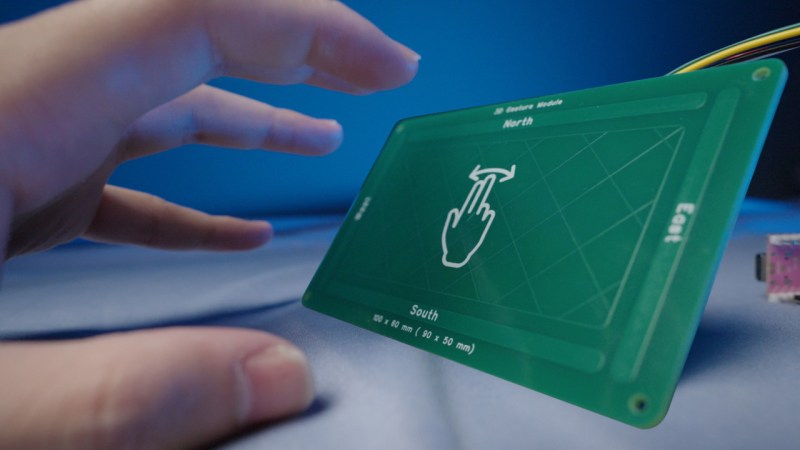
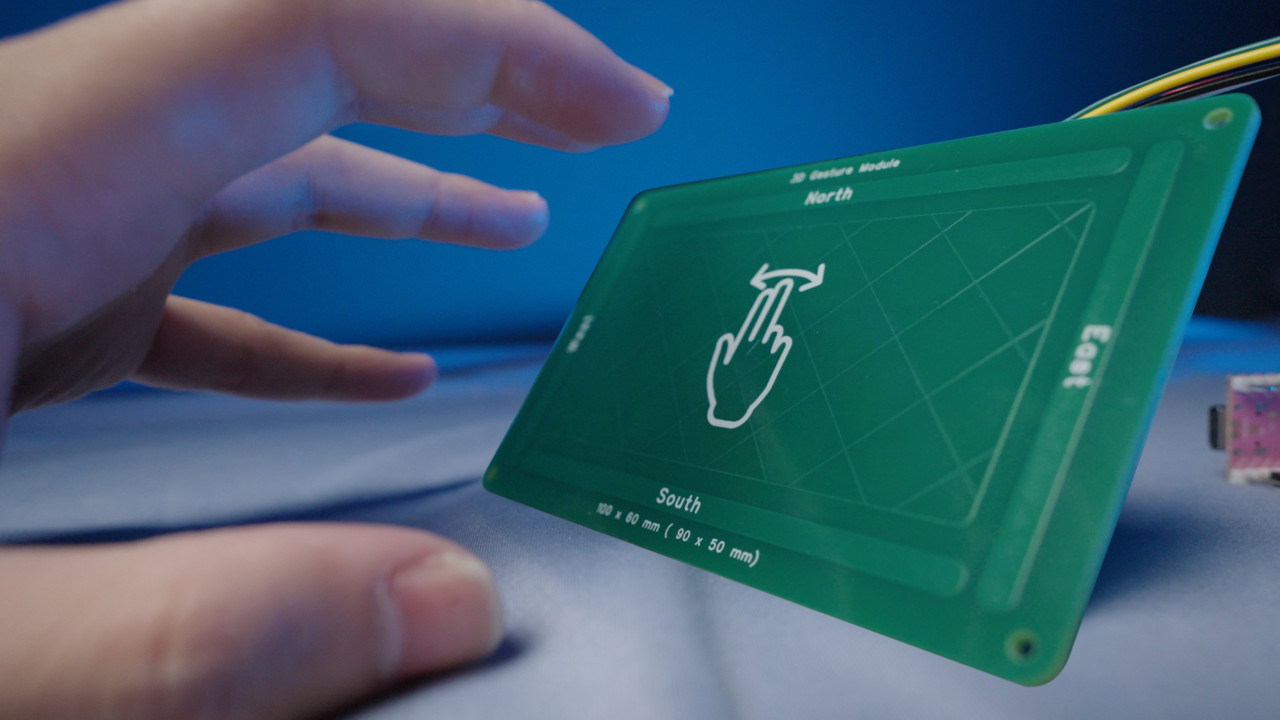
In today’s “futuristic tech you can get for $5”, [RealCorebb] shows us a gesture sensor, one of the sci-fi kind. He was doing a desktop clock build, and wanted to add gesture control to it – without any holes that a typical optical sensor needs. After some searching, he’s found Microchip’s MGC3130, a gesture sensing chip that works with “E-fields”, more precise than the usual ones, almost as cheap, and with a lovely twist.
The coolest part about this chip is that it needs no case openings. The 3130 can work even behind obstructions like a 3D-printed case. You do need a PCB the size of a laptop touchpad, however — unlike the optical sensors easy to find from the usual online marketplaces. Still, if you have a spot, this is a perfect gesture-sensing solution. [RealCorebb] shows it off to us in the demo video.
This PCB design is available as gerbers+bom+schematic PDF. You can still order one from the files in the repo. Also, you need to use Microchip’s tools to program your preferred gestures into the chip. Still, it pays off, thanks to the chip’s reasonably low price and on-chip gesture processing. And, [RealCorebb] provides all the explanations you could need, has Arduino examples for us, links all the software, and even provides some Python scripts! Touch-sensitive technology has been getting more and more steam in hacker circles – for instance, check out this open-source 3D-printed trackpad.
Humanoid Robots Are Starting to Work Human Warehouse Jobs

We may now be nearing the point where humanoid robots are no longer just clumsy curiosities, but genuine candidates — if not outright replacements — for human jobs.
As the Wall Street Journal reports, two bipedal helpers, built by Agility Robotics, are currently moving bins around in a busy warehouse in Georgia. Dropped right into an environment designed for humans, the robots bend over to pick up the containers, then amble over to a nearby conveyor belt to drop them off. Rinse and repeat.
Of course, there's still considerable work to be done; only two of these "Digit" robots are being used at the warehouse, operated by GXO Logistics, and are trusted only with simple tasks. But the industry argues that the robots are spearheading an imminent paradigm shift in automation: because of their human shape and function, such machines have the potential to be far more versatile than the purpose-built bots that have already automated some human jobs, able to slot into existing workplaces.
"Humanoid robots are the first category of robots that can be doing completely different tasks based on the needs of the business or the time of the shift," Adrian Stoch, chief automation officer of GXO, told WSJ. "In the future, we could have Digit unloading a trailer in the morning, picking goods in the afternoon, and loading trucks in the evening."
Companies like Amazon have been experimenting with roaming robotic arms and automated inventory management systems at its numerous warehouses. But these are purpose-built bots, performing only a single type of task, often requiring a more tailor-made environment to work in.
In theory, a versatile humanoid wouldn't be deterred by having to navigate stairs, or to grab stuff from a low or high shelf, or to sort through a box. And once they finish their job, the bots could be put to work elsewhere, ensuring that not a single second is wasted. That productivity boost could help offset the daunting costs of adopting the experimental technology — costs that the over a dozen humanoid robotics companies around the world are keeping under wraps, according to the WSJ.
"The challenge for robotics has always been the economics," Jeff Cardenas, CEO of the humanoid robotics startup Apptronik, told the newspaper.
Accelerating the timeline towards laboring humanoids, the robotics push has dovetailed serendipitously with the AI boom, bringing advances in the "brains" that power the machines. This, to AI leaders like Nvidia, is a ripe opportunity to double dip.
"We believe the enabling technology for autonomous robots is the same technology that's behind all the things we're doing with AI and with large language models," Rev Lebaredian, head of Nvidia Omniverse, the chipmaker's real-world simulation platform, told the WSJ.
More on robotics: You Are Completely Unprepared for What This Humanoid Servant Robot Looks Like
The post Humanoid Robots Are Starting to Work Human Warehouse Jobs appeared first on Futurism.
Scientists Propose Injecting Astronauts With Tardigrade RNA After Finding It Prevents Radiation Damage

Scientists have discovered a wild treatment that they say could protect astronauts from the copious amounts of space radiation they'd be exposed to during trips into deep space.
In an effort to find new ways to protect cancer patients from the many side effects of radiation therapy, a group of researchers found that a protein from tardigrades — tiny, practically indestructible "water bears" that have been known to survive the hostile vacuum of space — may be the answer.
The protein was previously identified as helping tardigrades survive some of the most extreme conditions on Earth — and yes, even space.
Now, a team led by Harvard Medical School instructor and MIT visiting scientist Ameya Kirtane used messenger RNA encoding to inject the protein into mice. As detailed in a paper published this week in the journal Nature Biomedical Engineering, the team found that their technique generated sufficient protein to protect the mice's DNA from radiation-induced damage.
The same method, they hope, could eventually be used in human cancer patients.
"Radiation can be very helpful for many tumors, but we also recognize that the side effects can be limiting," MIT associate professor of mechanical engineering Giovanni Traverso in a statement. "There’s an unmet need with respect to helping patients mitigate the risk of damaging adjacent tissue."
The side effects of radiation treatment can be brutal, from mouth sores to rectal bleeding. Scientists have come up with drugs that reduce this damage, but only to a degree.
In search for a better option, the researchers drew inspiration from tardigrades and their incredible survival ability. A suppressor protein, dubbed Dsup, helps to protect the tardigrades' DNA from radiation-induced damage by binding to it.
According to MIT, this protein allows the tiny creatures to survive doses 2,000 to 3,000 times higher than what humans can tolerate.
By delivering this protein through messenger RNA encoding, the team found that the Dsup protein was expressed successfully in the colon and mouth tissues in mice, two areas that are susceptible to radiation-induced damage in human cancer patients.
"One of the strengths of our approach is that we are using a messenger RNA, which just temporarily expresses the protein, so it’s considered far safer than something like DNA, which may be incorporated into the cells’ genome," Kirtane explained.
Apart from helping cancer patients during radiation therapy, the researchers suggest it could also help patients receiving chemotherapy.
It could even help astronauts from suffering radiation damage, since long voyages through space, such as a trip to Mars, would expose future space travelers to dangerous levels of cosmic radiation.
"Another possible application would be to help prevent radiation damage in astronauts in space," MIT enthused in the statement.
More on tardigrades: Scientists Propose Sending Small Creatures to Neighboring Star Systems
The post Scientists Propose Injecting Astronauts With Tardigrade RNA After Finding It Prevents Radiation Damage appeared first on Futurism.
DARPA Requests Plans for "Large Bio-Mechanical Space Structures"

The Defense Advanced Research Projects Agency (DARPA) — which has been known to fund the development of sci-fi-sounding ideas like flying aircraft carriers or massive streetlights on the Moon — is now seeking public input on its plans to construct massive "bio-mechanical space structures."
As spotted by Gizmodo, the agency filed a Request for Information this week for the eyebrow-raising concept. And while we're still not 100 percent sure exactly what they're going after, it sounds rad as hell.
According to a description of the request, DARPA is looking into the "feasibility" of creating "useful space structures" over 1,600 feet in length that could "disrupt the current state-of-the-art and position biology as a complimentary component of the in-space assembly infrastructure."
Possibilities, according to the document, include "tethers for a space elevator, grid-nets for orbital debris remediation, kilometer-scale interferometers for radio science, new self-assembled wings of a commercial space station for hosting additional payloads, or on-demand production of patch materials to adhere and repair micrometeorite damage."
What DARPA wants to specifically look into are new methods and "technical insights" to create these "large, self-assembled, mechanically stable biological growths in space."
There are plenty of advantages to having larger structures be constructed in space. For one, it's a whole lot cheaper than launching large components and other building materials from the Earth's surface. And beyond welding pieces of metal together, DARPA is peering much further into the future by wanting to harness biological engineering to exploit its "rapid growth properties" — which could one day be done with minimal human intervention.
The agency used a tent as an analogy.
"Given the structural material of the tent poles, biological growth mechanisms are envisioned to be the 'cover' of the tent," the document reads.
In short, it's hard not to see DARPA's vision as a terrifying blob of space gloop — or "filler" — encompassing the necessary "electronics or structural materials." Is the agency trying to leapfrog a near future filled with conventionally built space stations by jumping straight to a hard sci-fi paradigm where space structures are grown through biological means, not built?
It's certainly a pretty out-there concept, as we haven't even reached such a stage on Earth, where we've only started exploring concepts like using mycelium as living building materials.
And how long scientists have to work on the idea remains unclear at best. Elon Musk's so-called Department of Government Efficiency is set to plow through the Department of Defense, which could bring about mass layoffs amid other budget cuts.
How lifesaving research into HIV/AIDS vaccines and Ebola, which recently landed on DOGE's chopping block, stack up to the importance of DARPA's grand visions of growing structures in space remains to be seen.
In the meantime, DARPA is planning to hold a "sponsored workshop" in April to discuss relevant "future research."
More on DARPA: DARPA Funding Plan to Build Huge Streetlight on the Moon
The post DARPA Requests Plans for "Large Bio-Mechanical Space Structures" appeared first on Futurism.
Cheap Fiber Optic Wand Toy Becomes Tiny Weird Display
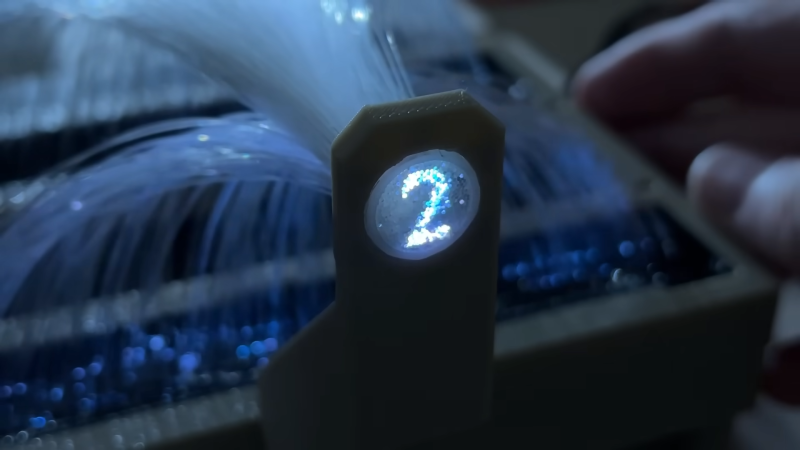
If you’ve ever seen those cheap LED fiber optic wands at the dollar store, you’ve probably just thought of them as a simple novelty. However, as [Ancient] shows us, you can turn them into a surprisingly nifty little display if you’re so inclined.
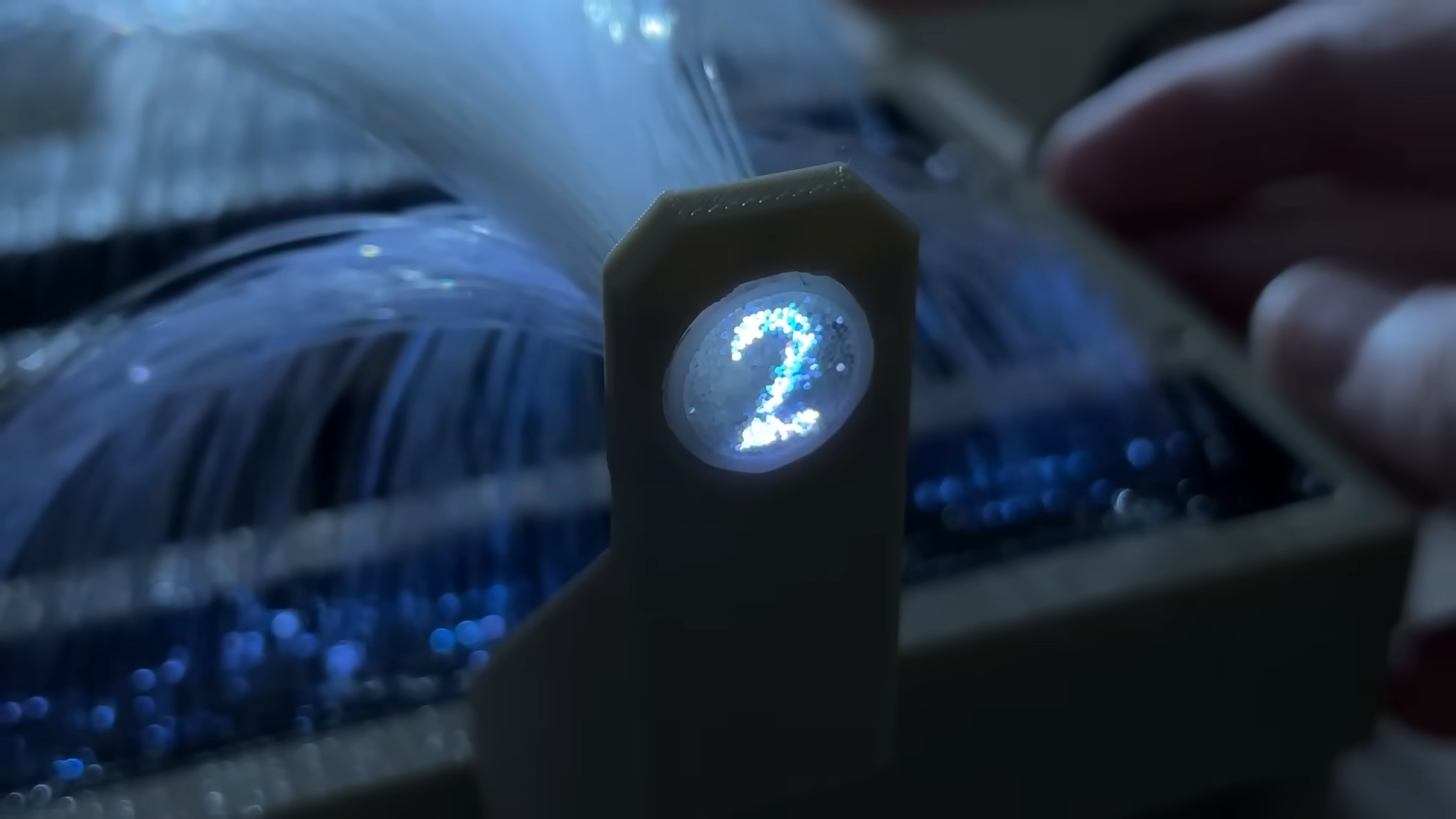
The build starts by removing the fiber optic bundle from the wand. One end is left as a round bundle. At the other end, the strands are then fed into plastic frames to separate them out individually. After plenty of tedious sorting, the fibers are glued in place in a larger rectangular 3D-printed frame, which holds the fibers in place over a matrix of LEDs. The individual LEDs of the matrix light individual fibers, which carry the light to the round end of the bundle. The result is a tiny little round display driven by a much larger one at the other end.
[Ancient] had hoped to use the set up for a volumetric display build, but found it too fragile to be fit for purpose. Still, it’s interesting to look at nonetheless, and a good demonstration of how fiber optics work in practice. As this display shows, you can have two glass fibers carrying completely different wavelengths of light right next to each other without issue.
We’ve featured some other great fiber optic hacks over the years, like this guide on making your own fiber couplings. Video after the break.
[Thanks to Zane and Darryl and Ash for the tip! This one was all over the tipsline!]
ESP32-S3 infrared thermal imaging camera module offers 80×62 resolution, 45° and 90° wide angle versions
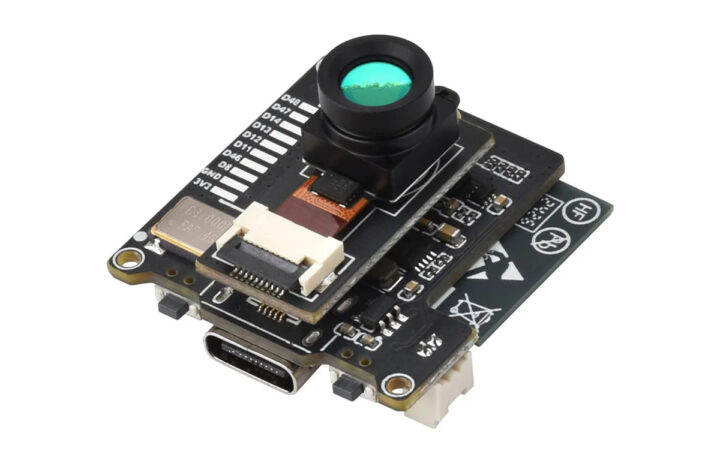
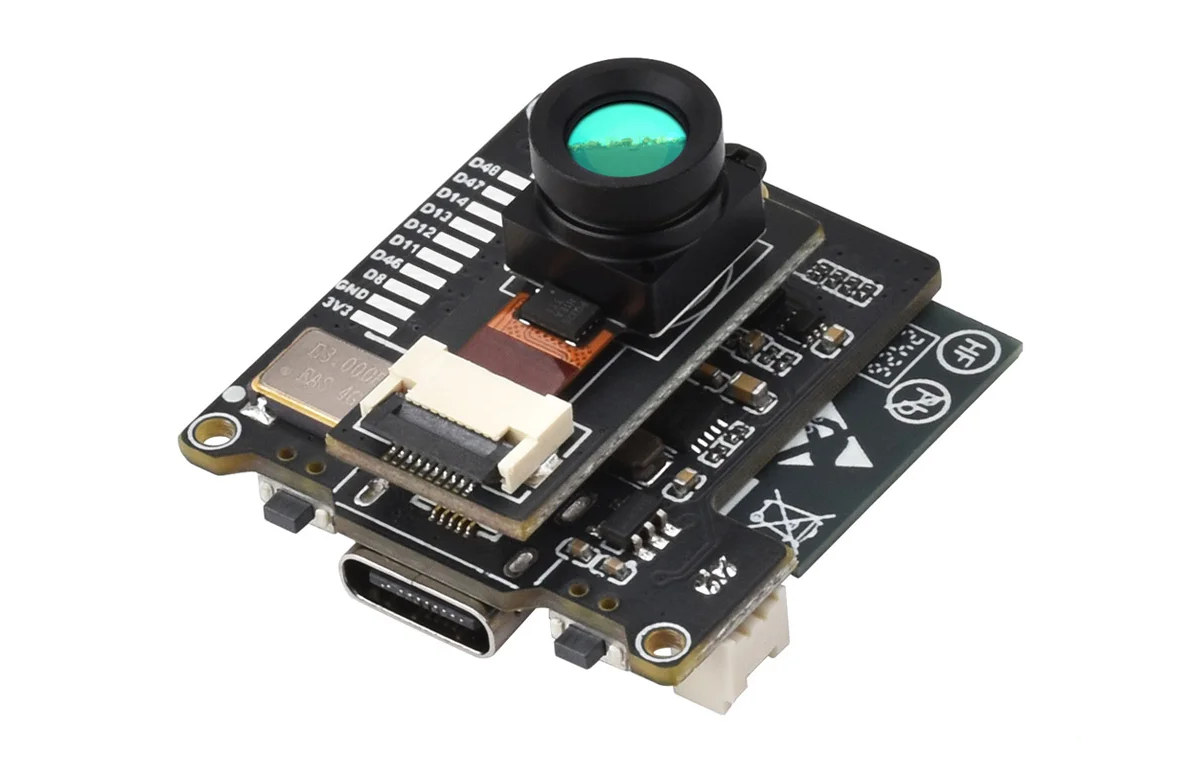
Waveshare has launched an ESP32-S3-based thermal imaging camera module based on the same 80 x 62 infrared camera found in its Thermal-45/90 camera Raspberry Pi HAT and Thermal-45/90 USB camera.
The thermal camera module is offered with two field of views, namely 45° for the basic version and 90° for the wide angle variant, twenty solder pads with GPIOs, UART, and I2C for expansion, a USB-C port for power and programming, and a 2-pin header to connect a battery if required.
Waveshare “ESP32-S3 IR thermal imaging camera module” specifications:
- Wireless Module ESP32-S3-WROOM-1
- MCU – ESP32-S3 dual-core Tensilica LX7 up to 240 MHz with 512KB SRAM, up to 8MB PSRAM
- Storage – 16MB flash
- Wireless – WiFi 4 and Bluetooth LE 5
- Thermal Camera – Meridian Innovation MI0802
- Resolution – 80 × 62
- Field of View (FOV)
- 56°(D) x 45°(H) x 34°(V) (Baisc version)
- 122°(D) x 90°(H) x 67°(V) (Wide angle version)
- Temperature Range – -40°C to +400°C
- Accuracy – ±2°C
- Refresh Rate – Up to 25 FPS; Note: due to the influence of WiFi signals, there may be errors in the actual frame rate
- Interface – Connected to ESP32-S3 module via SPI
- USB – USB Type-C port for power and programming
- Expansion – 2x 10 solder pads with 14x GPIO, 1x I2C, and 1x UART
- Misc
- RGB LED for real-time status monitoring
- Reset and BOOT buttons
- Power Supply
- 5V via USB-C port
- 2-pin battery connector for 3.7V Lithium battery
- Dimensions – 29 x 29 mm
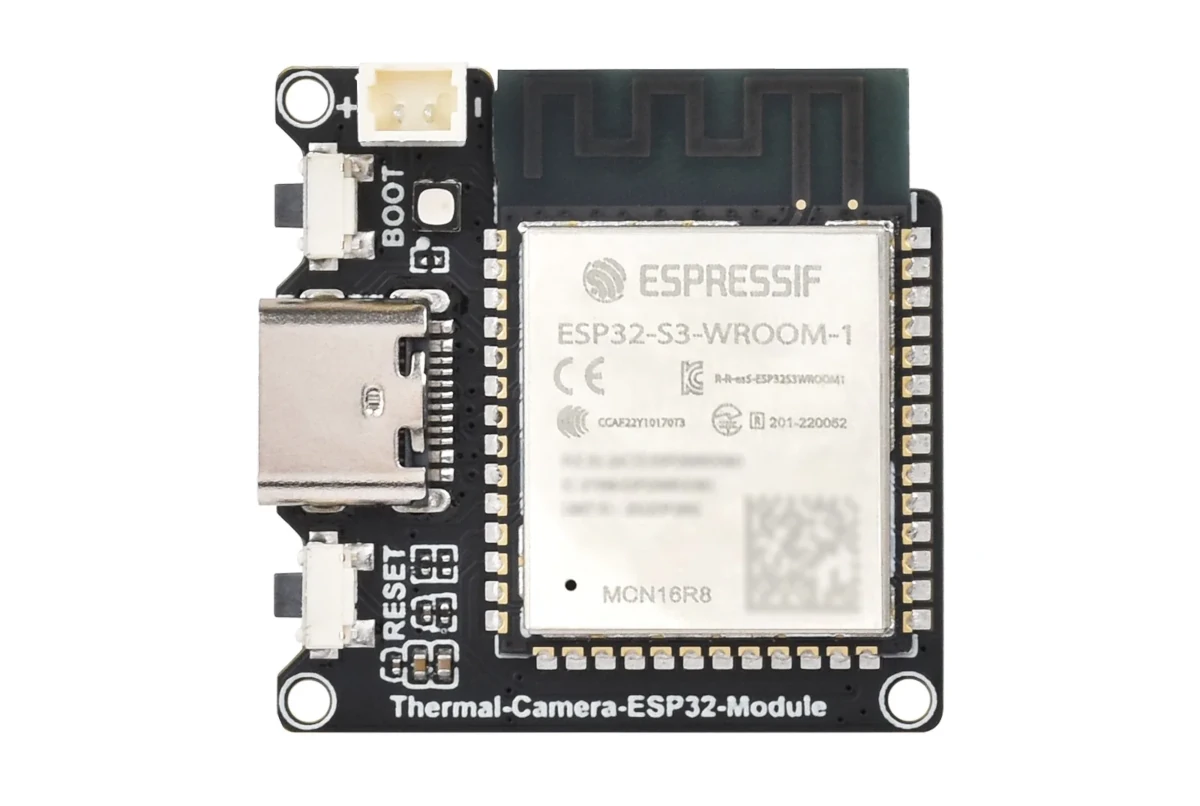
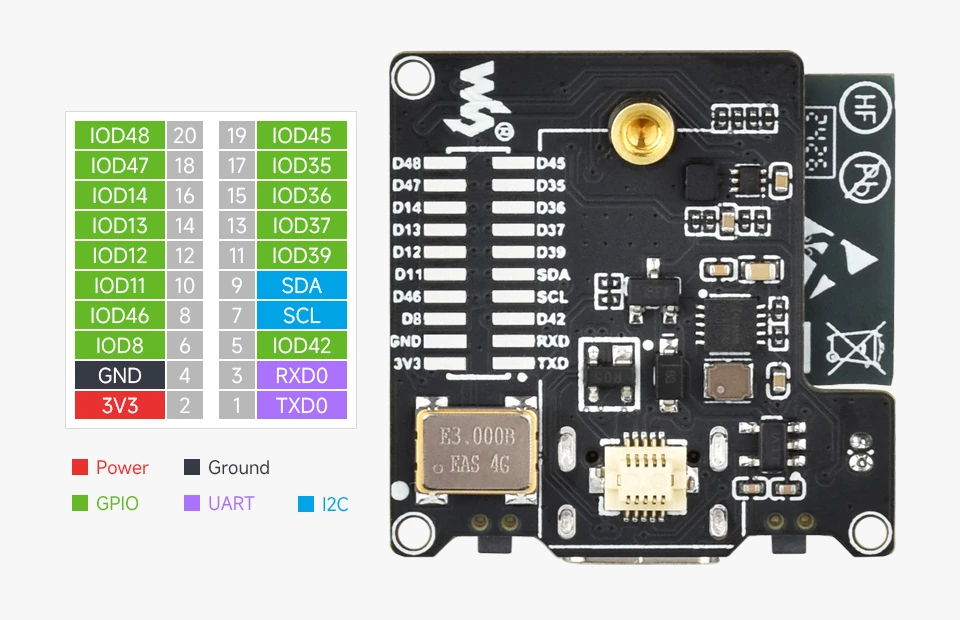
The ESP32-S3 module is preloaded with the “senxorESP32S3” firmware that relies on Bluetooth to configure the WiFi parameters through the BlueFi Android app. After configuration, it can be accessed through 192.168.4.1:3333 (AP mode) or <IP_Address>:3333 (Client mode) using the SenXorView program for Windows. That means you need both an Android smartphone and a Windows computer to use the camera with the default firmware unless the module defaults to AP mode if we don’t use the BlueFi app. However, Waveshare did not make that clear…
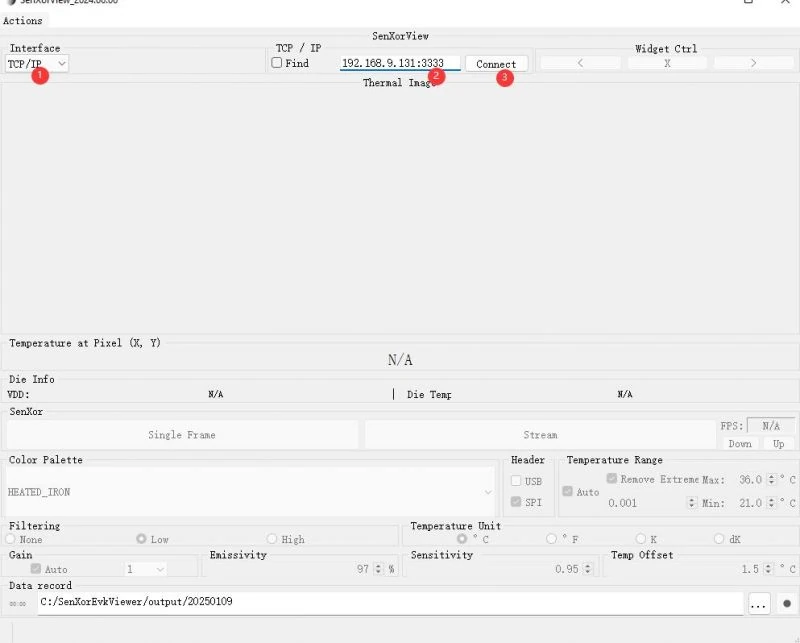
Waveshare did not provide another screenshot or a video demo, but we can see the program supports single frame or video stream mode, and allows for the adjustment of various parameters. You’ll find the firmware (binary and source code), BlueFi Android app, and SenXorView Windows program on the wiki, where instructions to build the firmware with VS Code and the ESP-IDF framework are also provided.
It’s not the first ESP32 infrared camera module we’ve covered, as other examples include the M5Stack Thermal Camera 2 Unit and tCam-Mini IR thermal camera board with respectively 32×24 and 160×120 thermal imagers. The Waveshare model is based on ESP32-S3 instead, whose vector extension could potentially be used for AI-accelerated computer vision, and offers a different resolution (80×62) between those two.
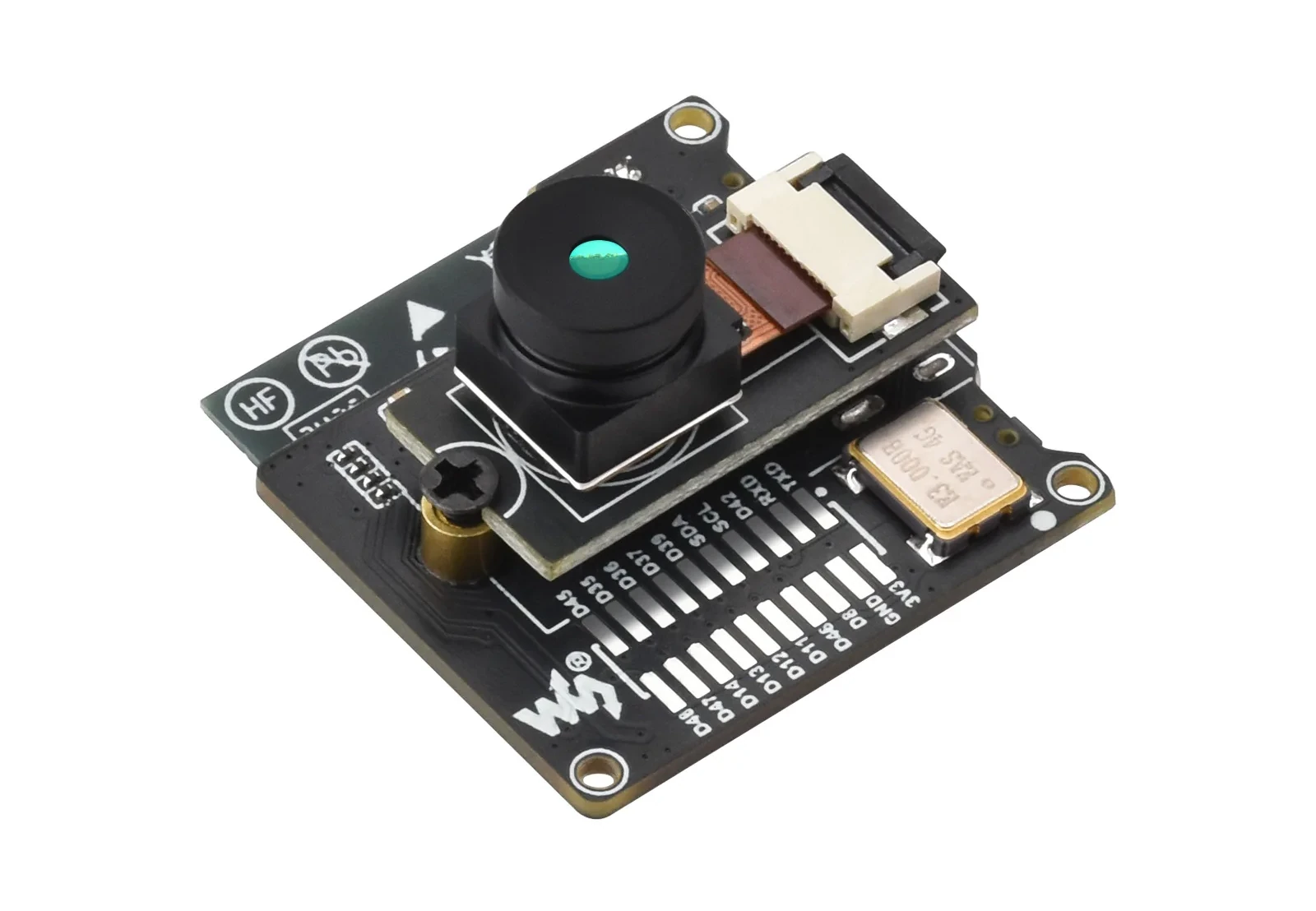
Waveshare’s ESP32-S3 IR thermal imaging camera module can be purchased on AliExpress for $92.69 plus shipping, Amazon for $106.99 (basic version or wide angle version), or the Waveshare shop.
The post ESP32-S3 infrared thermal imaging camera module offers 80×62 resolution, 45° and 90° wide angle versions appeared first on CNX Software - Embedded Systems News.
Actualité : Découverte d'un trou noir ultramassif : 35 milliards de fois la masse du Soleil !

Test Anycubic Kobra S1 Combo : La révolution de l’impression 3D multicouleur à portée de main (et du porte monnaie !)
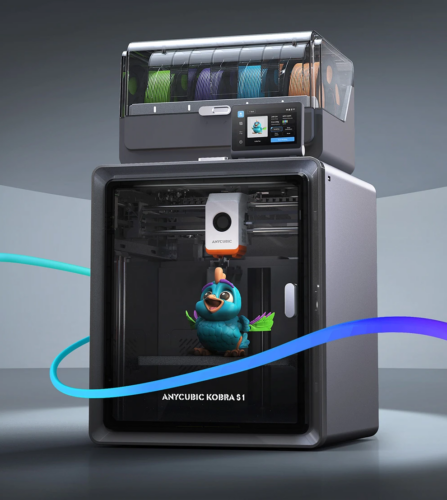 Découvrez l'Anycubic Kobra S1 Combo, une imprimante 3D core XY fermée qui combine performance, facilité d'utilisation et impression multicouleur dans un seul appareil. Son système ACE Pro innovant permet même de sécher le filament pendant l'impression !
🎤 L'IA au service des avocats (Pierre Hoffman, Bâtonnier de Paris)
L'intelligence artificielle bouleverse de nombreux secteurs, et le monde du droit ne fait pas exception. Maître Pierre Hoffman, bâtonnier du Barreau de Paris, explique comment l'IA arrive dans la profession d'avocat.
Depuis octobre, 6 000 avocats parisiens utilisent un outil d'IA juridique, fruit d'un partenariat entre le Barreau de Paris et un éditeur privé. Pourquoi cette initiative ? Comment l'IA change-t-elle la pratique du droit ? Quels sont les risques, notamment en termes de fiabilité des résultats et d'hallucinations ? Pierre Hoffman partage les premiers retours d'expérience, l'accueil de cette technologie par la profession et les enjeux d'adaptation face à des clients de plus en plus informés.
Au programme :
- Une IA juridique au service des avocats du Barreau de Paris
- Les premiers retours des avocats sur son utilisation
- Les limites et responsabilités de l'avocat face à l'IA
- L'évolution du rôle de l'avocat à l'ère de l'intelligence artificielle
- L'impact sur la relation client et la facturation
Mots-clés : intelligence artificielle, avocats, Barreau de Paris, Pierre Hoffman, IA juridique, droit et technologie, chatbot juridique, automatisation, hallucinations IA, avenir de la profession juridique, innovation judiciaire
-----------
🎧 L'Hebdo Premium : https://m.audiomeans.fr/s/S-xylotlSe
🌍 Web : https://mondenumerique.info
🗞️ Newsletter : https://mondenumerique.substack.com
📹 YouTube : https://www.youtube.com/@mondenumerique
♥️ Soutien : https://donorbox.org/monde-numerique
Distribué par Audiomeans. Visitez audiomeans.fr/politique-de-confidentialite pour plus d'informations.
Les LLM sonnent-ils le glas de StackOverflow ?
De nouvelles données révèlent une chute dramatique du nombre de questions posées sur StackOverflow, revenant au niveau de 2009. Cette baisse significative suggère que ChatGPT et les autres modèles de langage (LLM) ont réussi à ébranler le modèle économique de la plateforme en seulement deux ans, questionnant l’avenir des sites d’entraide pour développeur·se·s.

Commentaires
L'article Les LLM sonnent-ils le glas de StackOverflow ? a été posté dans la catégorie IA de Human Coders News