Jean-Philippe Encausse
Shared posts
Des super-Terres partout dans l'Univers, et c'est une surprise ! 🌍

Watch SpaceX blast Starship engines ahead of 9th test flight

Watch Tesla’s humanoid robot pull some snappy dance moves

Robot that keeps food hot or cold could change up food delivery
Apple Vision Pro Will Be Able To Magnify, Describe, Find, Or Read Anything In View
Apple Vision Pro is getting the ability to magnify passthrough, as well as to describe, find, or read anything in your view using on-device AI.
These accessibility features, which Apple says are designed for people who are blind or have low vision, are set to arrive in a visionOS update later this year.
Last year Apple announced accessibility features a month in advance of revealing visionOS 2 at WWDC24, so these features might be seen in visionOS 3 at WWDC25 next month.
Passthrough Zoom & Live Recognition
The improved magnification functionality will arrive as an update to the Zoom accessibility feature, which currently only magnifies virtual content. With the update, it will also magnify the real world.
The enhanced Zoom accessibility coming to visionOS later this year.
Meanwhile, the ability to describe, find, or read anything in view will be an extension of VoiceOver, which currently functions as a screen reader. Called Live Recognition, Apple says the feature will process the passthrough view using on-device machine learning to "describe surroundings, find objects, read documents, and more".
Passthrough API For Accessibility
Apple also says it will offer a new API for "accessibility developers" in "approved apps" to access the passthrough view "to provide live, person-to-person assistance for visual interpretation", starting with Be My Eyes.
While the Meta Horizon OS of Quest headsets now lets all apps access the passthrough cameras if the user grants permission, and Google's Android XR will too at launch, visionOS currently only allows this for non-public enterprise apps "for use in a business setting only", and getting this access requires a special license from Apple.
 UploadVRDavid Heaney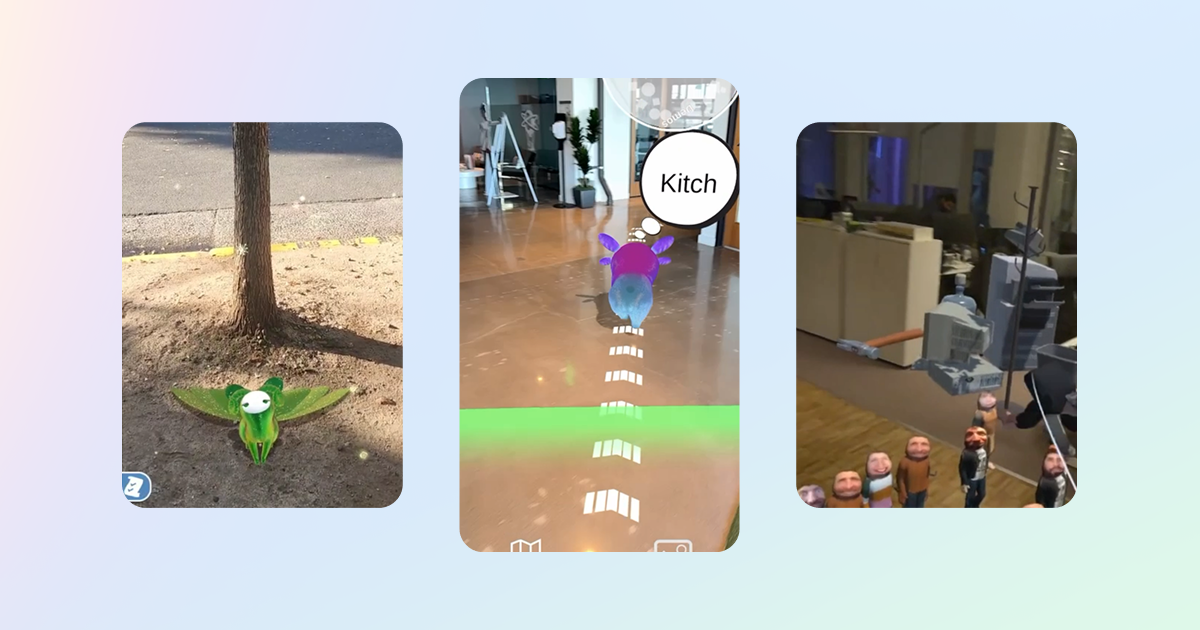
Apple's wording in announcing wider passthrough camera access suggests that it will only be for accessibility apps after a specific approval process. But given the stance of Horizon OS and Android XR, we'll keep an eye out for any further announcements around passthrough camera access at WWDC25.

Dutch scientists built a brainless soft robot that runs on air
Most robots rely on complex control systems, AI-powered or otherwise, that govern their movement. These centralized electronic brains need time to react to changes in their environment and produce movements that are often awkwardly, well, robotic.
It doesn’t have to be that way. A team of Dutch scientists at the FOM Institute for Molecular and Atomic Physics (AMOLF) in Amsterdam built a new kind of robot that can run, go over obstacles, and even swim, all driven only by the flow of air. And it does all that with no brain at all.

Quantum Computing Race Isn’t Run ‘In a Vacuum’

This story was originally published on The Daily Upside. To receive cutting-edge insights into technology trends impacting CIOs and IT leaders, subscribe to our free CIO Upside newsletter.
Scalable quantum technology isn’t going to be here tomorrow … or the next day. But that doesn’t mean we should pump the brakes.
Last week, experts in the quantum field made the case before the House Science Committee for expanding the US government’s coordinated effort to advance the technology. As the quantum race heats up, the US may not be able to afford to be complacent if it wants to be first in the market, said Dr. Celia Merzbacher, executive director of the Quantum Economic Development Consortium, who testified at the hearing.
“It’s a classic technology that can have a lot of commercial benefits and public good, and it also can be used for defense and national security and military purposes,” said Merzbacher. “But it is a technology that is emerging worldwide. It’s not something that’s being done in a vacuum.”
READ ALSO: AI May Never Completely Conquer Hallucination, Bias and Combating Cyber-Espionage Requires Enterprises to Keep Their Eyes on the Endgame
The post Quantum Computing Race Isn’t Run ‘In a Vacuum’ appeared first on The Daily Upside.
Print PLA in PLA with A Giant Molecular Model Kit
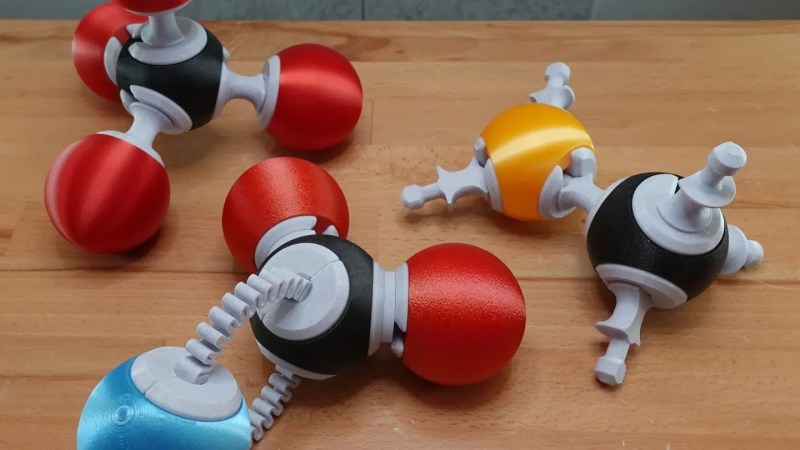
It isn’t too often we post a hack that’s just a pure 3D print with no other components, but for this Giant Molecular Model kit by [3D Printy], we’ll make an exception. After all, even if you print with PLA every day, how often do you get to play with its molecular bonds? (If you want to see that molecule, check out the video after the break.)
There are multiple sizes of bonds to represent bond lengths, and two styles: flexible and firm. Flexible bonds are great for multiple covalent bonds, like carbon-carbon bonds in organic molecules. The bonds clip to caps that screw in to the atoms; alternately a bond-cap can screw the atoms together directly. A plethora of atoms is available, in valence values from one to four. The two-bond atom has 180 and 120-degree variations for greater accuracy. In terms of the chemistry this kit could represent, you’re only limited by your imagination and how long you are willing to spend printing atoms and bonds.
[3D Printy] was kind enough to release the whole lot as CC0 Public Domain, so we might be seeing these at craft fairs, as there’s nothing to keep you from selling the prints. Honestly, we can only hope; from an educational standpoint, this is a much better use of plastic than endless flexy dragons.
If you’d prefer your chemistry toys help you do chemistry, try this fidget spinner centrifuge. Perhaps you’d rather be teaching electronics instead?
Une simulation quantique révèle l'effondrement physique de notre Univers 💥

L'Homme n'a observé que 0,001% des fonds marins 🌊

La lumière remplace l'électricité, la prochaine révolution en Intelligence Artificielle 🧠

Yves Audo : "La Chine est déjà l'usine du monde, ne la laissons pas être le magasin du monde"

Comment Cursor indexe rapidement les bases de code grâce aux arbres de Merkle
Découvrez comment l’IDE Cursor utilise les arbres de Merkle, une structure de données cryptographique, pour indexer efficacement les bases de code. Un exemple concret d’utilisation de cette structure de données habituellement associée à la blockchain, appliquée ici à l’amélioration des performances des outils de développement.

Commentaires
L'article Comment Cursor indexe rapidement les bases de code grâce aux arbres de Merkle a été posté dans la catégorie Développement de Human Coders News
Meta Hypernova and Google AR/AI Glasses – Lumus & Avegant Inside, Both Using LCOS MicroDisplays
Introduction
Two recent LinkedIn articles by Axel Wong inspired this article. The first, Decoding the Optical Architecture of Meta’s Next-Gen AR Glasses: Possibly Reflective Waveguide—And Why It Has to Cost Over $1,000, discussed the use of reflective/geometric (Lumus, or a Lumus Clone) Waveguides using an LCOS display in Meta’s Hypernova AR/AI glasses. Axel’s article was partially based on information from an article by Bloomberg’s Mark Gurman and on information he gleaned from a supplier in China. Axel’s second article, Google’s New AR Glasses: Optical Design, Microdisplay Choices, and Supplier Insights, said that the Google AR glasses were shown in a recent TED Talk by Shahram Izadi, which likely used a diffractive waveguide by Applied Materials.
Shahram Izadi, of Google, held up an optical engine in the video that he said was full color. Axel’s article on the Google AI/AR glasses speculated that it uses either LCOS or an X-Cube MicroLED engine, but seemed to favor it being LCOS. Axel also wrote that the waveguide was likely from Applied Materials. As will be discussed, I think that it is highly likely that Google’s AR glasses are using Avegant’s 20-degree LCOS optical engine that they presented at SPIE’s AR/VR/MR 2025.
The Meta and Google AR/AI glasses have some major similarities: they are both monocular (single display for the right eye), use a Full Color LCOS MicroDisplay, and use waveguides. It has been reported that Meta is putting the display in the lower right corner of the user’s view, whereas it appears from Google’s TED talk that the display is roughly in the center vertically. Perhaps the biggest difference is that Meta is likely using a Lumus reflective waveguide, perhaps with a 30° FOV, whereas Google is using a diffractive waveguide with likely a 20° FOV.

This blog has a tradition of identifying technology inside Google’s AR glasses. Back in February 2013, I correctly identified a Himax LCOS device in the original Google Glass. Stock market analyst Mark Gomes wrote an article on Seeking Alpha based on my findings, causing Himax’s stock to jump by $223 M. See my 2013 article Google Glass and Himax Whirlwind.
SID Display Week This Week
I’m off to SID Display Week this week. If you have a product or concept or want to discuss a topic from this blog at Display Week 2025, please email me at meet@kgontech.com. I’m planning on being there every day of the exhibits (May 13-15), but my calendar is getting pretty full. I may also have time to meet before the exhibition on Monday, May 12th. I’ve partnered with SID to share my insights from Display Week (DW) — past, present, and future. If you’re planning to attend Display Week, SID has provided the code DW25KARL for a free exhibit hall pass.
Disclaimers
While I contacted Lumus and Avegant in preparation for this article, neither company said they could not comment. Therefore, this article is based on the available public evidence, including that provided in Axel Wong’s articles and Bloomberg’s Mark Gurman’s article on Meta Hypernova, plus other sources and my experience. While I think I am correct, I’m not 100% sure.
I should also note that while Meta’s Hypernova is expected to be a product for sale in 2025, it is unclear whether the Google AR glasses are anything more than a lab prototype or perhaps a reference design and developer platform for their Android XR partners.
I should also point out that I have not had a chance to evaluate either Meta’s Hypernova or Google’s XR Glasses. Having followed Lumus’s and Avegant’s developments, I have some idea of what the images may look like, but I have not seen the complete designs.
Both Meta and Google AR Glasses Monocular and LCOS
Meta and Google’s devices are strikingly similar in that they are both Monocular (single-eyed) and likely use LCOS as the display device.
The Case For Monocular
The most obvious reasons to go monocular are to save on cost and weight. Another advantage is that there is no need for IPD adjustment. Mark Gurman has further written that the display is in the “lower right corner of the right lens.”
Long-time AR glasses user, researcher, and Google advisor Thad Starner has advocated for a monocular display on the lower outside (discussed in AWE 2024 Panel: The Current State and Future Direction of AR Glasses), exactly what Meta Hypernova appears to be doing. The advantage of the lower outside corner for the virtual image is that it keeps it out of the way of the user’s forward vision. Thad makes the point that you don’t want a message popping up and blocking your vision at a critical time. From a human factors point of view, if the display is not going to be centered horizontally, then it is best to have it below center, as humans can look down much more easily than look up.
Having biocular displays pretty much forces them to be in the center, but they could be in the lower half if there is a worry of blocking forward vision. Still, if they are not in the center of the forward view, it will be uncomfortable to use for long periods, and the wearer will obviously be looking down. So I would expect that if, as Gurman’s article stated, Meta was planning on a biocular Hypernova 2, they would center the virtual image in the user’s forward view.
LCOS – Why not MicroLEDs?
With all the discussion about MicroLEDs for AR glasses today, it may seem strange that both Meta and Google use LCOS. There are many sound technical reasons for choosing LCOS, particularly for a full-color display, including:
- Cost and availability—MicroLEDs today are much more expensive, and supplies are very limited and likely to remain so for at least the next few years.
- Efficiency—As I discussed in SID Display Week 2024 – LCOS, LCOS has a major endurance advantage that makes it much more efficient with waveguides (diffractive or reflective).
- For a full white screen, LCOS displays illuminated by LEDs are very roughly 10x more power efficient than MicroLED with waveguides. MicroLEDs have the advantage that their power consumption is roughly proportional to the average pixel value (AVP), so if there is “sparse content” like text and simple symbols only on a clear/black background, then the AVP is low and their power can be low.
- Red MicroLEDs are very inefficient, and Blue MicroLEDs, while necessary for color balance, provide almost no “nits.” Thus, a full-color MicroLED display takes well more than 2x the power of a green-only display for the same output to the eye “white nits.” Color compounds the problem with etendue efficiency and is particularly bad with spatial color (side by side R,G,B) where the emission area is larger.
- Viewfinder, Web Browsing, and Picture-based Applications give LCOS a huge power advantage. If the glasses are to support any content, including white screens or looking at bright scenes, they have to be designed for the worst-case conditions, including mostly white/bright images. While most of the content might be between 5% and 20% AVP, if glasses are to work in all cases, they have to be designed for 100% AVP if they are going to support any possible content.
- As I often say, “In AR headsets, Amateurs worry about battery life, pros worry about power dissipation.” Supporting the worst-case power consumption in AR glasses is a massive issue, as there is very little in the way of surfaces that can dissipate heat.
- Useable in daylight—AR glasses should output 2,000 or more nits to the eye in daylight to be usable outdoors. Once again, this favors LCOS unless the content is very sparse.
- “Bright mode” LCOS illumination: Some companies have the option to sacrifice color accuracy or switch to black-and-white mode to boost brightness.
For many of the reasons above, while LCOS does not get the media attention and corporate investment of MicroLEDs, it is likely to remain the best option for full-color AR headsets for some time (perhaps a long time).
Meta’s and Google’s Roadmaps for LCOS versus MicroLED or LBS
The chart below on the left was presented by Meta’s Hartlove at Display Week 2024 and SID AR/VR/MR 2025. Their chart shows LCOS as the “Ready Technology,” MicroLEDs as the “Anticipated Technology,” and Laser Scanning as the “Final Solution” (with a question mark). Below right is a 2023-04-27 SPIE AR/VR/MR fireside chat slide interviewing Trilite, presented by Bernard Kress of Google, that contrasts very dramatically. Kress’s slide shows power efficiency versus Average Pixel Lit (same as AVP); similar to my comment above, Kress shows the MicroLED/LCOS power crossover at ~12% AVP (not true today for full color, maybe in the future), but then he shows that with “MiniLED local dimming” the crossover could move out dramatically. It’s also notable that Kress, when he was a technical leader on Microsoft HoloLens, worked with laser scanning on the HoloLens 2.


Thus, we seem to have highly contrasting views on the future of AR display technology. A cynical person might suggest that Hartlove’s roadmap may be meant to entice Meta’s management to invest in their R&D programs, more than it is tied to business reality. Kress’s (Google) chart may reflect the scars from his work on HoloLens 2.
Meta’s Hypernova Optics – Likely a Lumus Z-Lens Variant
I used some information published by Axel on Reddit in October 2024 in my article, Meta Orion AR Glasses (Pt. 1 Waveguides). In that same Reddit article, Axel wrote (with my bold highlighting):
There were rumors before that Meta would launch new glasses with a 2D reflective (array) waveguide optical solution and LCoS optical engine in 2024-2025. With the announcement of Orion, I personally think this possibility has not disappeared and still exists. After all, Orion will not and cannot be sold to ordinary consumers. Meta may launch another reduced-spec version of reflective waveguide AR glasses for sale, which is still an early adopter version for developers or geeks, but it is speculated that this reflective waveguide version is also likely to be a transition, and will eventually return to surface relief grating (SRG) diffraction waveguides.
It seems to be a bit of an open secret, at least in China, that Meta is likely using a Lumus reflective waveguide in a prototype, if not a final product. I have seen several Chinese companies try to copy Lumus’s reflective waveguides over the years, and the image quality has not been very good compared to Lumus’s. Furthermore, I can’t see why Meta would risk a patent challenge from Lumus if they went with a copy (these points are also made in Axel’s LinkedIn article).
I have been following Lumus’s progress since before I started this blog in 2011. In January at SPIE AR/VR/MR 2025, I met with Lumus to see their newly announced Z30 30° FOV Z-Lens at SPIE AR/VR/MR. They were using a 720 x 720 pixel LCOS microdisplay.
I should note that the Z30 waveguide I have seen had the display centered vertically and was part of a binocular design. The image was not below center or off to the right, as Bloomberg’s Mark Gurman’s Hypernova article reported. And thus, it was not exactly the Z30, but a customized version.
Shown below, left is the 30° Z30 waveguide with the attached projector engine with its older Maximus and Z50 50° waveguides. While the Maximus and Z50 are further away, you should be able to tell that the Z30 projector engine is much smaller. Lumus, in their January announcement, said the Z30 prototype outputs to the eye are>3,000 Nits/WattLED, and Lumus told me that they expect to more than double this efficiency with design improvements. [See my Caution on Using Nits/WattLED in the Appendix, as they are not comparable between companies]


Above right is a quick handheld picture I took through the Z30; I doubt I had the camera aligned well (I was holding the glasses in one hand and the camera in the other), and the background was not solid black (the background is causing uniformity variation). Still, the color uniformity is much better than that of the typical diffractive waveguide.
High transparency and very little eye glow
I missed getting a picture of myself wearing the Z30-based glasses, which have smaller projectors and frames. The picture below is of me wearing the Z50 (50-degree) prototypes. The Z50 and Z30 have only very slight “eye glow” and are about 90% transparent. The very slight eye glow that is seen in the pic is for a nearly full white bright image, and not a typical image.


Lumus Waveguide With Prescription Correction
A key issue for any consumer AR glasses is to incorporate prescription correction. Lumus’s Z-Lens waveguides propagate TIR light in the waveguide at a shallower angle than diffractive waveguides, which enables not only the use of significantly lower index of reaction glass, but also the direct bonding of push-pull lenses to change the virtual image focus distance and prescription correction.
Due to surface features and to maintain TIR, diffraction-type waveguides require an air gap. This adds complexity and makes the combination of lenses and waveguides thicker. Having surfaces with an air gap means there are additional surfaces that can cause ghosts and require anti-reflective coatings to reduce them. There is not enough information available to determine whether the Google XR Glasses with diffraction waveguides will address prescription correction.
Lumus has partnered with AddOptics to provide the push-pull lenses that incorporate prescription correction. Lumus demonstrated the combination to me at AWE 2024.
Lumus Wide (70°) FOV in Glass (Versus Silicon Carbide)

Meta’s Orion AR Glasses demonstration in late 2024 used very expensive/hard-to-manufacture Silicon Carbide (SiC) Waveguides. As discussed in Meta Orion AR Glasses (Pt. 1 Waveguides), they used SiC because of its high index of refraction, which is required to support a 70-degree FoV with diffractive waveguides. At AR/VR/MR 2025, Lumus was claiming that, due to the shallower TIR angle of the Z-Lens, they can support a 70° with their glass waveguides.
What about the rumored $1,000-$1400 Price?
I’ve seen many negative comments about Meta’s Hypernoval’s rumored price range of $1,000 to $1,400. As I wrote about the Apple Vision Pro, People Who Say the AVP’s $3,499 price is too high lack historical perspective. I’m not as worried about the price as I am about the functionality and usefulness. If the product is useful and finds a market, there is no reason that the cost should not be reduced significantly. The price reflects that Hypernova is testing the waters more than a full-blown consumer product.

Google XR Prototype (At Ted Talk)
Alex Wong’s LinkedIn article on the Google XR TED talk strongly suggested that Google is using waveguides from both Applied Materials (AMAT) and “one based in Shanghai, China.” In his article, Alex was unsure about the optical engine. As will be discussed, I believe Avegant designed the optical engine based on its size and shape (to be discussed below), and due to the recent partnership between AMAT and Avegant.
In their respective presentations at AR/VR/MR 2025, both Avegant and AMAT discussed their new partnership. Avegant presented several slides discussing their new 20° FOV monocular LCOS engine in a development kit jointly developed with AMAT.
Below are the Avegant/AMAT development kit X-ray diagram (top) and a still frame (bottom) from Google’s video showing an exploded view of their XR glasses. They are remarkably similar. I have also added an inset of just the optical engine part of Avegant’s development kit near Google’s optical engine. While the projector portion may look bent in the Google exploded view, this may be simple due to the arrangement of the electrical components around the optics to fit Google’s frames better.

On both diagrams above, the projector is on the side of the right eye (left side of the diagram). Avegant’s diagram shows microphones on the side of the left eye, whereas Google’s diagram has a hole for a camera. I’m a big believer that a camera is going to be essential for any “AR with AI” glasses. The location of the image on one side and the camera on the opposite side of the frames, while it makes sense in terms of fitting them into the frame, is poor in terms of using the display as a camera viewfinder due to parallax.
I have added labels pointing to some of the components in Google’s design. They appear to have a set of push-pull lenses on either side of the waveguide, but I don’t know if they have or will support prescription correction. All in all, it looks like Google took the Avegant and AMAT development kit and then modified it slightly to fit their needs.
I have taken information from two slides with some specs presented by Avegant at AR/VR/MR 2025 below. As I will caution in the appendix, you can’t objectively directly compare the Nits/WattLED numbers between Avegant and Lumus shown earlier. Lumus’s Z30 has ~2.25x the FOV area (30/20-squared) plus many other factors. What you can see is that the Nits/WattLED falls off dramatically with brightness. For 600Nits/23mWLED = 25,000 Nits/WattLED, whereas 3000 Nits/226mW = 11,272 Nits/WattLED or less than half the efficiency.

These efficiency numbers on the surface seem very good/high for a diffractive waveguide, even with the comparatively small FOV. Avegant makes a point that they have made significant efforts to make their optical engine very efficient.
Avegant has devised clever ways to reduce the size of its LCOS projector engines. It seems that every year at AR/VR/MR, Avegant presents an ever-smaller engine. The optical path (taken from Avegant’s website) from their newer projectors is shown below. A key trick is how they use a dichroic combiner/”waveguide” to route light down the projector lens to avoid needing a polarizing beam splitter in traditional LCOS projector engines.

Meta Hypernova and Google XR — Are they products, developer systems, or prototypes?
We are seeing many product concepts in AR glasses, such as Meta’s Orion, developer devices such as Snap Spectacles 5, and products from many companies.
Meta’s Hypernova appears to be a high-end, limited-volume consumer product to test the market. Based on how Hypernova is received, Meta could either focus on driving volume to reduce cost or focus on the (rumored) biocular Hypernova 2. Meta is highly unlikely to bring Orion’s Silicon Carbide to the mainstream market in the next several years. Still, Meta is clearly serious about AR glasses and plans to spend about $20B this year on AR and VR, with the bulk of the investment going into AR.
Google’s intention for its AR glasses is much less clear. Google has developed a reputation for entering and exiting markets, particularly when it comes to hardware. It’s not clear whether Google will build a hardware product itself or leave it to one of its Android XR partners; in this case, the Google AR glasses shown in the TED Talk might be a reference design for their partners.
Conclusions
One thing is for sure: the glasses form factor space is heating up, with the giants Meta and Google starting to show products that are likely to be sold to consumers in the next six months to a year. Rumors of Apple entering the Optical See-Through AR fray are also starting to heat up again.
LCOS still has major physics advantages over MicroLEDs with waveguides when displaying full-color images, such as those from camera viewfinders, photographs, or web browsing. This is particularly true when trying to achieve the 1,000 to 3,000 nits to the eye necessary for practical use in daylight. While MicroLEDs seem to garner most of the attention, and while there are drawbacks to LCOS due to field sequential color breakup and less contrast, LCOS is likely to be the most practical display technology for full-color or higher resolution for at least the next few years and perhaps for many years.
One thing I don’t understand is why Lumus and Avegant are still independent companies, given the numerous acquisitions of companies in the AR space over the last ten years. I have seen massive spending and acquisitions in the area of MicroLED displays by Meta, Google, and Apple. Yet, almost nothing has happened beyond Snap buying the struggling Compound Photonics in LCOS.
Appendix: Caution on comparing nits/WattLED with different Waveguides
Both Lumus and Avegant have given Nits/WattLED specs for their projector and waveguide combinations. I want to caution everyone that while the numbers give some idea of the efficiency of the projector and optics, there are so many other variables that they are likely not comparable.
While “nits/WattLED” may sound like an objective number, many factors make it impossible to compare numbers that sound the same from different companies. Unfortunately, every company measures differently. These factors include:
- The Field of View—To a first approximation, the Nits/WattLED should vary at least proportionally with the square of the FOV as the light is spread out over an area.
- Eye Box Size and Eye Relief—A larger eye box and longer eye relief mean that light will be spread over a larger area, making the Nits/WattLED value lower (or higher for a smaller eye box or eye relief).
- Measuring peak value versus average or worst case—Typically, most companies will pick the “peak value” (near the center). Different waveguides have different fall-off toward the periphery. A set of optics that concentrates light in the center will have a higher “peak value,” while being dark in the periphery. In my experience, reflective waveguides are more uniform than diffractive waveguides from the center to the outside. Thus, a “peak” measurement typically favors diffractive waveguides even if both specify the peak value.
- Many factors are non-linear. For example, as the total light output increases due to brightness, a bigger FOV, or an eye-box, the efficiency decreases as the LEDs heat up. This makes it impossible to compare fairly different headsets with different FOV or brightness.
- Full Color versus Green Only—As discussed earlier, nits measure human eye response, and with a color balanced “white,” red and blue contribute relatively few nits while consuming power. Thus, full-color nits are going to be less efficient with the same technology. In the same technology, the full color nits/WattLED could be significantly less than one-fourth that of the green-only nits.
- Engineering Trade-off—Depending on the technology, various engineering trade-offs can help or hinder Nits/WattLED. For example, diffractive waveguides might reduce efficiency in improving color uniformity or reducing eye glow.
- Marketing “Fudge” and measuring “cherry-picked” units—Since there are no “marketing police” with testing facilities that will report on measure values over the whole FOV, companies are prone to fudge numbers or use cherry-picked units.
I would not say the numbers are meaningless, and I am still happy that some companies report their Nits/WattLED. It at least gives some idea as to whether the AR glasses might work outdoors. The values are probably more comparable within products from the same company than they are between two very different designs.
Learn 15 Print-in-Place Mechanisms in 15 Minutes

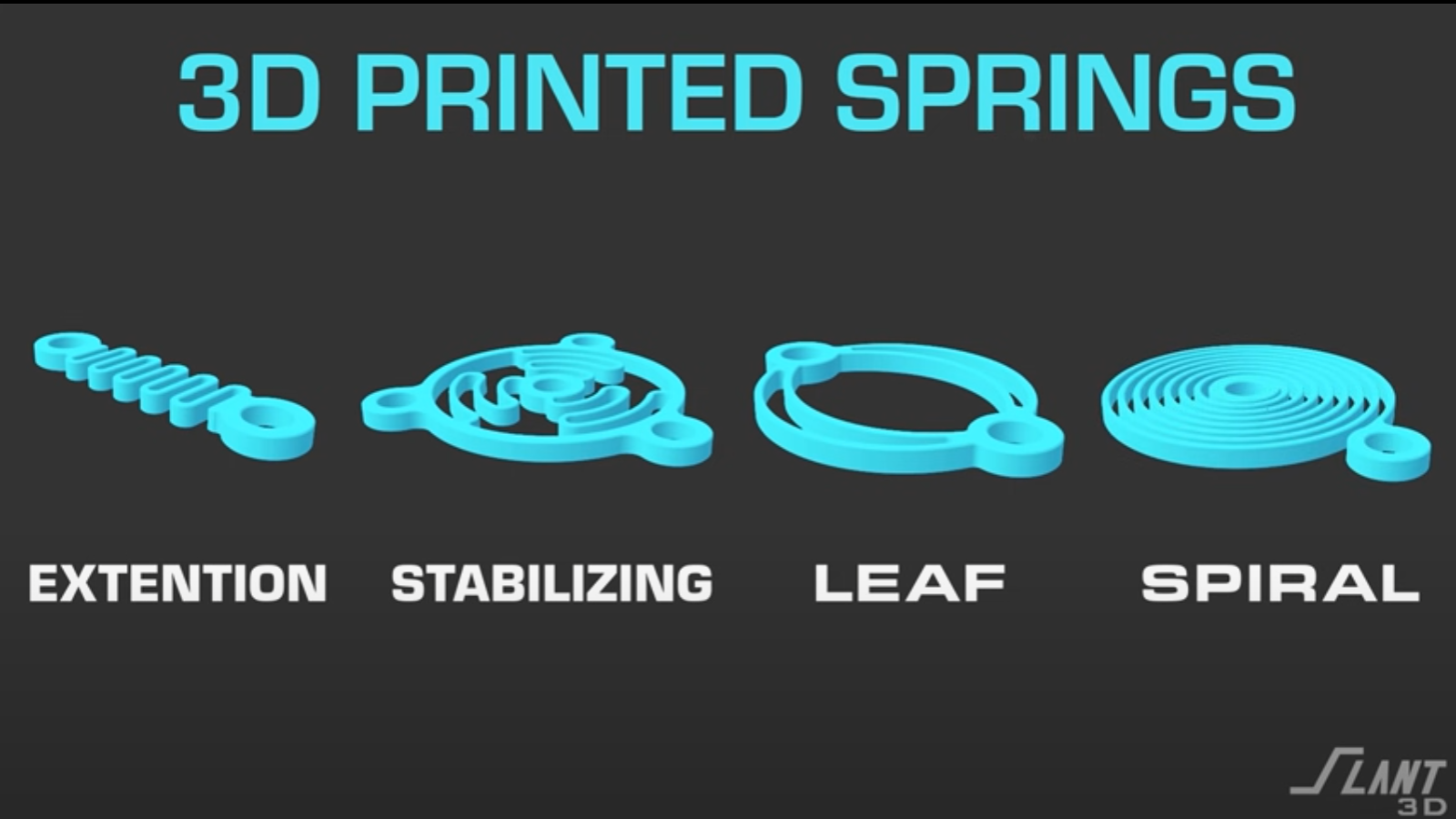
3D printed in-place mechanisms and flexures, such as living hinges, are really neat when you can get them to print correctly. But how do you actually do that? YouTuber [Slant 3D] is here with a helpful video demonstrating the different kinds of springs and hinges (Video, embedded below) that can be printed reliably, and discusses some common pitfalls and areas to concentrate upon.
Living hinges are everywhere and have been used at least as long as humans have been around. The principle is simple enough; join two sections to move with a thinned section of material that, in small sections, is flexible enough to distort a few times without breaking off. The key section is “a few times”, as all materials will eventually fail due to overworking. However, if this thing is just a cheap plastic case around a low-cost product, that may not be a huge concern. The video shows a few ways to extend flexibility, such as spreading the bending load across multiple flexure elements to reduce the wear of individual parts, but that comes at the cost of compactness.
Moving on from springs, the second part of the video describes a few strategies for print-in-place hinges, describing how they fail, and what to do to mitigate. Again, robustness comes at a cost, in this case, increased bulk, but with 3D printing, you get what you pay for. Overall, it’s a nice, concise guide to the topic and well worth a mere seventeen minutes of your time, we reckon.
We see 3D printed flexure mechanisms a lot ’round here, like this for example. But how precise are they? Finally, we think this 3D printed spherical flexure joystick is cool, but must have been a bit tricky to model!
Thanks to [Hari Wiguna] for the tip!
Europe launches program to lure scientists away from the US
The European Commission has launched a new initiative to attract researchers and scientists to the European Union—especially those from the United States. The Choose Europe for Science program, backed with more than half a billion dollars, is designed to offer an alternative to researchers who have been forced to seek new opportunities following cuts in scientific funding imposed by President Donald Trump’s administration.
The program will invest €500 million ($568 million) between 2025 and 2027 to recruit specialists in various fields of knowledge to come and work in Europe. The initiative also includes a target for member states to allocate 3 percent of their GDP to R&D projects by 2030.
“The role of science in today’s world is questioned,” warned Ursula von der Leyen, president of the European Commission, in a statement on Tuesday. “What a gigantic miscalculation. I believe that science holds the key to our future here in Europe. Without it, we simply cannot address today’s global challenges—from health to new tech, from climate to oceans.”

Niantic Spatial’s Adorable Pet Sim ‘Hello, Dot’ Leaves Early Access on Quest 3


Niantic Spatial has launched its mixed reality pet game Hello, Dot on Quest 3, bringing it out of early access and packing in a heap of new features.
Hello, Dot is what the studio calls a “mixed reality showcase” from its host of AR experiences, which the studio kicked off on mobile with Peridot in 2023.
In addition to Hello, Dot for Quest 3, Niantic Spatial’s other XR experiences include Peridot Beyond for Snap Spectacles, Pause with Peridot and Snap-a-Dot for Web AR, and SunnyTune for Apple Vision Pro.
Now, fresh out of early access on Quest 3, the studio has included a number of new features to Hello, Dot including:
- Dots with a richer personality and new playful antics
- A whimsical arcade machine with dot play dates
- Gen AI-powered customization via voice prompts
- Minigames like Dotball and Eating Contests
- A nod to the future and the possibilities of Peridot agentic AI guide
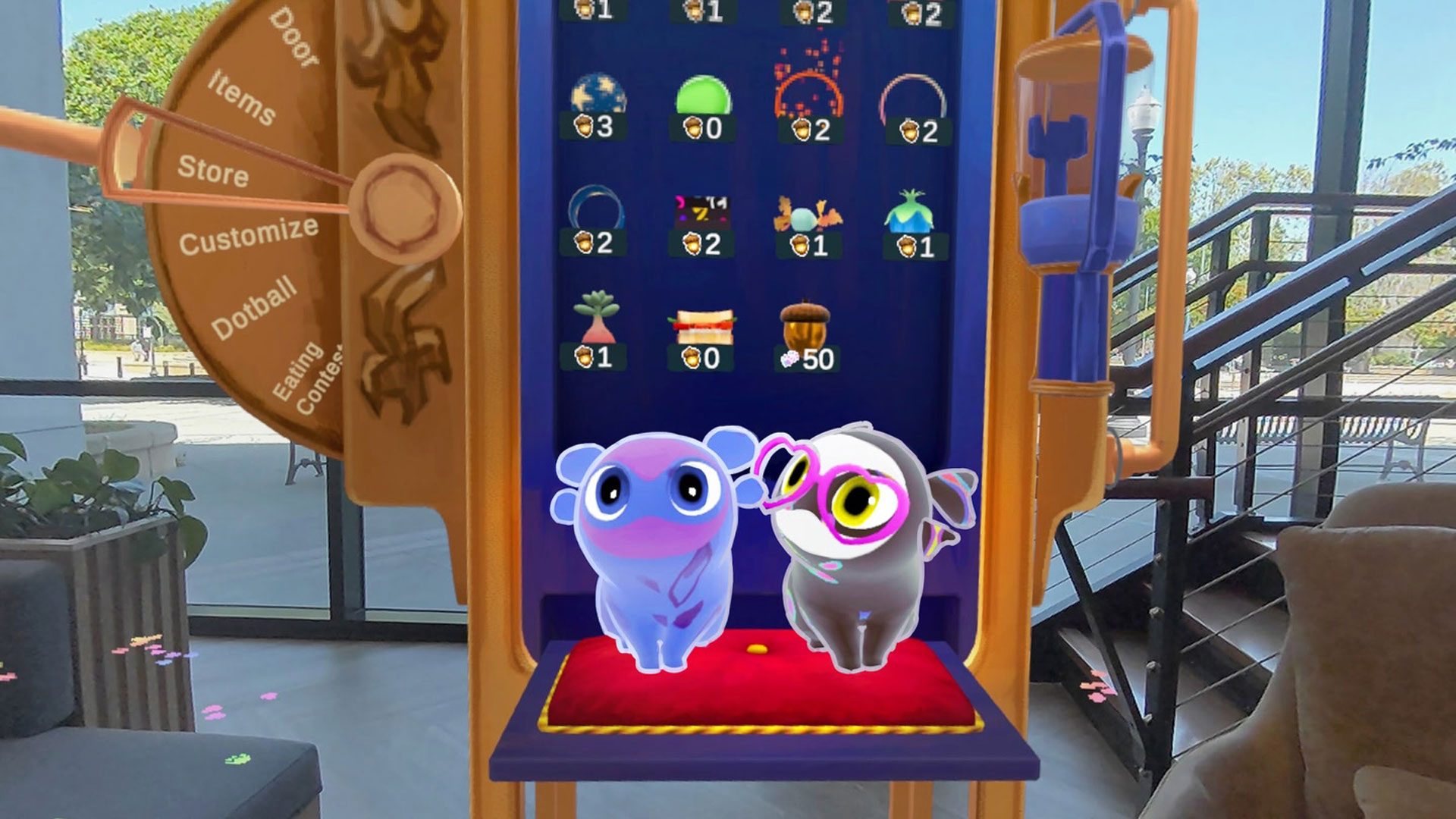
The new arcade machine lets you cycle through various activities, such as new mini-games to play, which include Play Dates, Dotball (i.e. dodgeball), or an Eating Contest with you Dot. By participating in these mini-games, you can earn in-game currency, which you can then trade in at the shop for accessories for your Dot, such as outfits and playful items.
“With this major evolution of Hello, Dot, we’re not just adding new gameplay; we’re pushing deeper into the magic of true mixed reality interaction,” said Asim Ahmed, Global Product Marketing Lead, who further noted the app is “exploring how digital life can enhance our physical spaces, fuels our passion as we build towards a future where technology seamlessly weaves wonder into the fabric of our everyday reality.”
Hello, Dot now also includes a new Gen AI-powered Dot customizer, letting you grab a virtual microphone and describe the look you want you Dot to have, and dunk them into a magical paint bucket for the desired effect.
You can find Hello, Dot over on the Horizon Store for free, which exclusively supports Quest 3 and 3S.
The post Niantic Spatial’s Adorable Pet Sim ‘Hello, Dot’ Leaves Early Access on Quest 3 appeared first on Road to VR.
Xenon : Un framework moderne en C++ pour la triche dans les jeux
Découvrez Xenon-cheats, un framework C++ moderne open source destiné au développement de cheats pour les jeux vidéo. Ce projet propose une base de code structurée pour les développeur·se·s souhaitant explorer ou comprendre les mécanismes de modification de jeux, tout en offrant une approche moderne du C++.
Commentaires
L'article Xenon : Un framework moderne en C++ pour la triche dans les jeux a été posté dans la catégorie Projets de Human Coders News
How to Instantly Feel Better
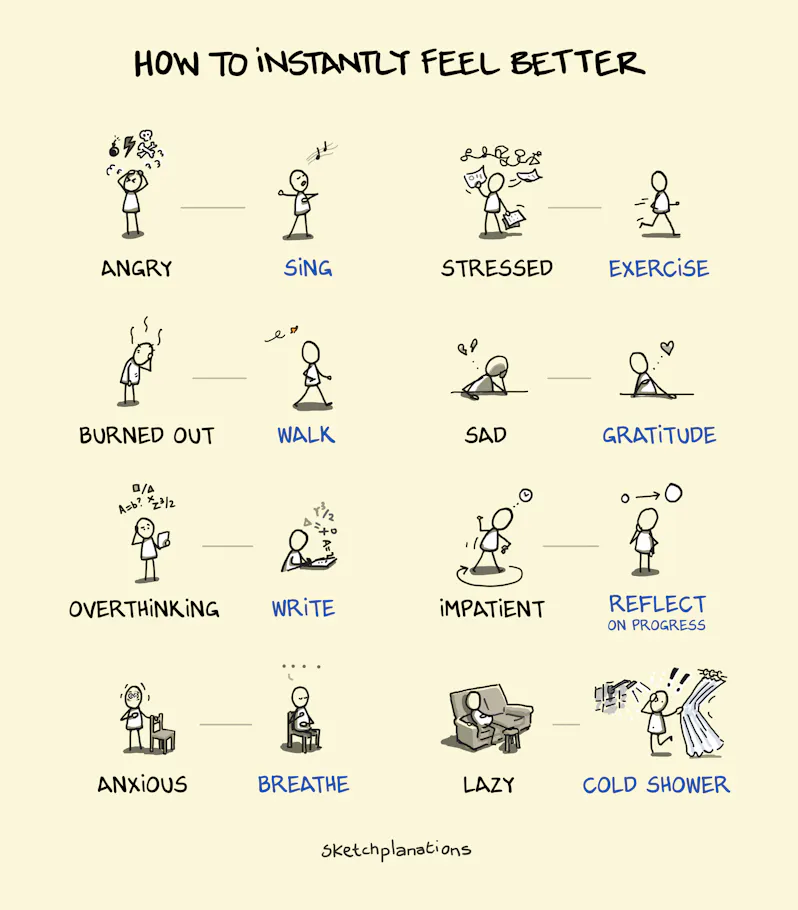
When I first saw a version of How to instantly feel better I could immediately relate. I thought it could do with a Sketchplanations version. Maybe try some of the suggestions and let me know how it goes.
If you're:
- Angry -> Sing
- Burned out -> Walk
- Overthinking -> Write
- Anxious -> Breathe
- Stressed -> Exercise
- Sad -> Gratitude
- Impatient -> Reflect on progress
- Lazy -> Cold shower
Your mileage may vary.
I can't help but think that Walk in nature, which is about as close to a miracle cure as we have, is also a good strategy for all of them.
- Angry -> Walk in nature
- Burned out -> Walk in nature
- Overthinking -> Walk in nature
- Anxious -> Walk in nature
- Stressed -> Walk in nature
- Sad -> Walk in nature
- Impatient -> Walk in nature
- Lazy -> Walk in nature
Here's a visual of this instead: How to instantly feel better - walk in nature
I recently learned the term Green Prescription for when your doctor prescribes time in nature rather than drugs. I wish I'd come up with it.
I didn't create the original graphic for How to Instantly Feel Better. I saw this one, shared by the brilliant Info is Beautiful. Many people have created versions of this. If you know—or are—the original creator, thank you! And please get in touch.
In our podcast on this sketch the Sad -> Gratitude action we thought was one of the hardest to do. So here are a few lovely quotes about gratitude in case they can help:
Gratitude is the intention to count your blessings every day, every minute, while avoiding, whenever possible, the belief that you need or deserve different circumstances.
— Timothy Miller
Gratitude unlocks the fullness of life. It turns what we have into enough, and more.
— Melody Beattie
Related Ideas to How to Instantly Feel Better
Also see:
- Forest bathing
- The 3-Day effect
- Box breathing
- 5 Ways to Wellbeing
- Snerdle
- Maze, Labyrinth
- Compliments Are Gifts
- Vorfreude — the pleasure of anticipation
- Languishing
- Notice when you're happy
- Don't compare your back of house with others' front of house
- When drinking tea, just drink tea
Prints/cards etc of How to Instantly Feel Better, and of How to Instantly Feel Better — Walk in nature
Lab-Grown Diamonds? Turns Out They’re Not De Beers’ Best Friend

This story was originally published on The Daily Upside. To receive delivering razor sharp analysis and perspective on all things finance, economics, and markets, subscribe to our free The Daily Upside newsletter.
De Beers, caught between a rock and a hard market, is dropping its lab-grown jewelry brand.
The world’s largest diamond producer on Thursday said it plans to shutter LightBox and is in discussions with potential buyers to sell off assets, including inventory.
Diamond Brand in the Rough
READ ALSO: Thinning Cattle Herds Drive US Beef Prices to Record Highs and Marc Benioff Joins Investors Valuing Influencer Agency Whalar at $400M
The post Lab-Grown Diamonds? Turns Out They’re Not De Beers’ Best Friend appeared first on The Daily Upside.
The world’s smallest SSD is almost impossibly tiny

Un ordinateur avec des neurones humains disponible en masse dès cette année 🧠

Scandale d'une expérience IA secrète sur Reddit: que s'est-il vraiment passé ? 🚨

Nouveauté LEGO IDEAS 2025 : le set 21357 Disney Pixar Luxo Jr. est en précommande sur le Shop
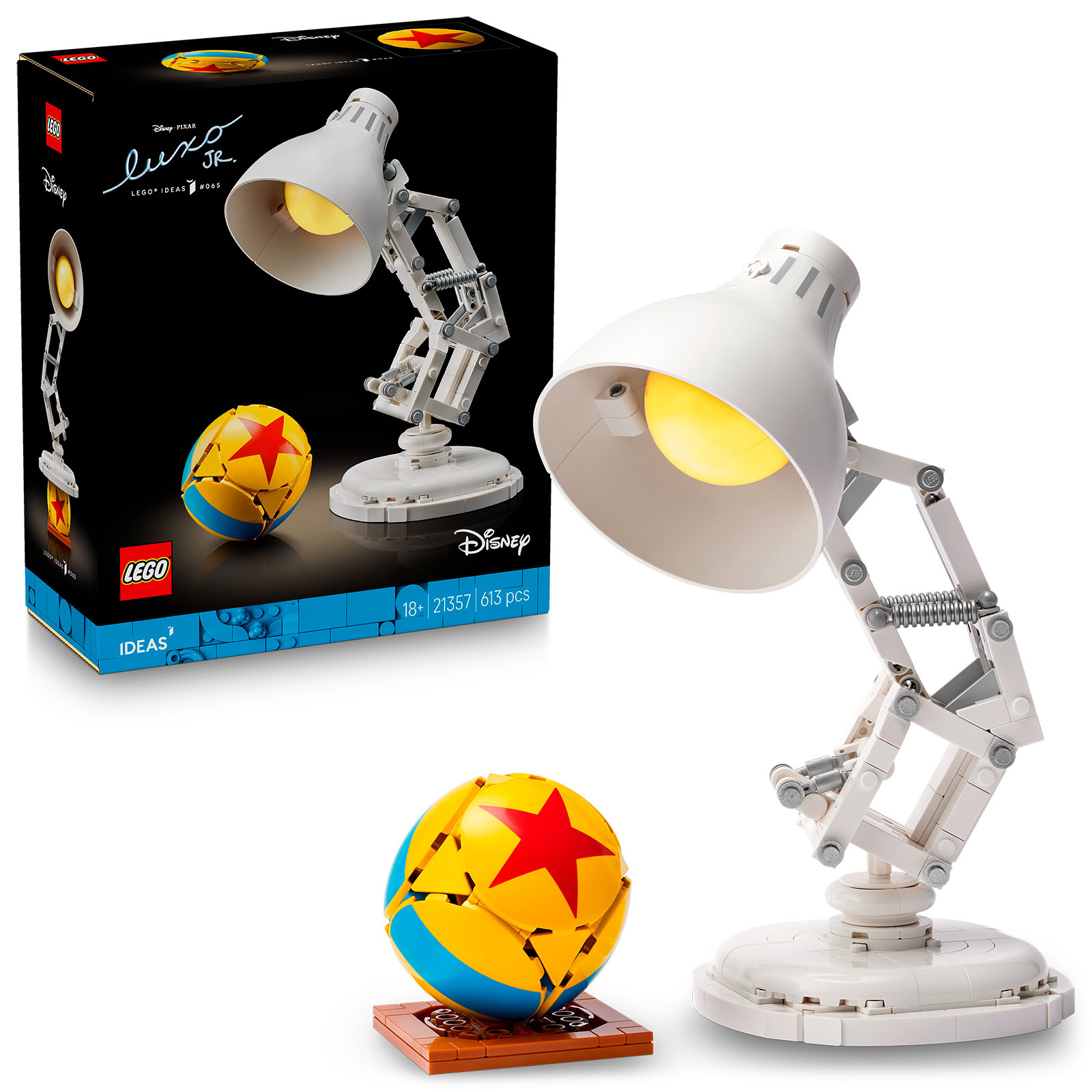
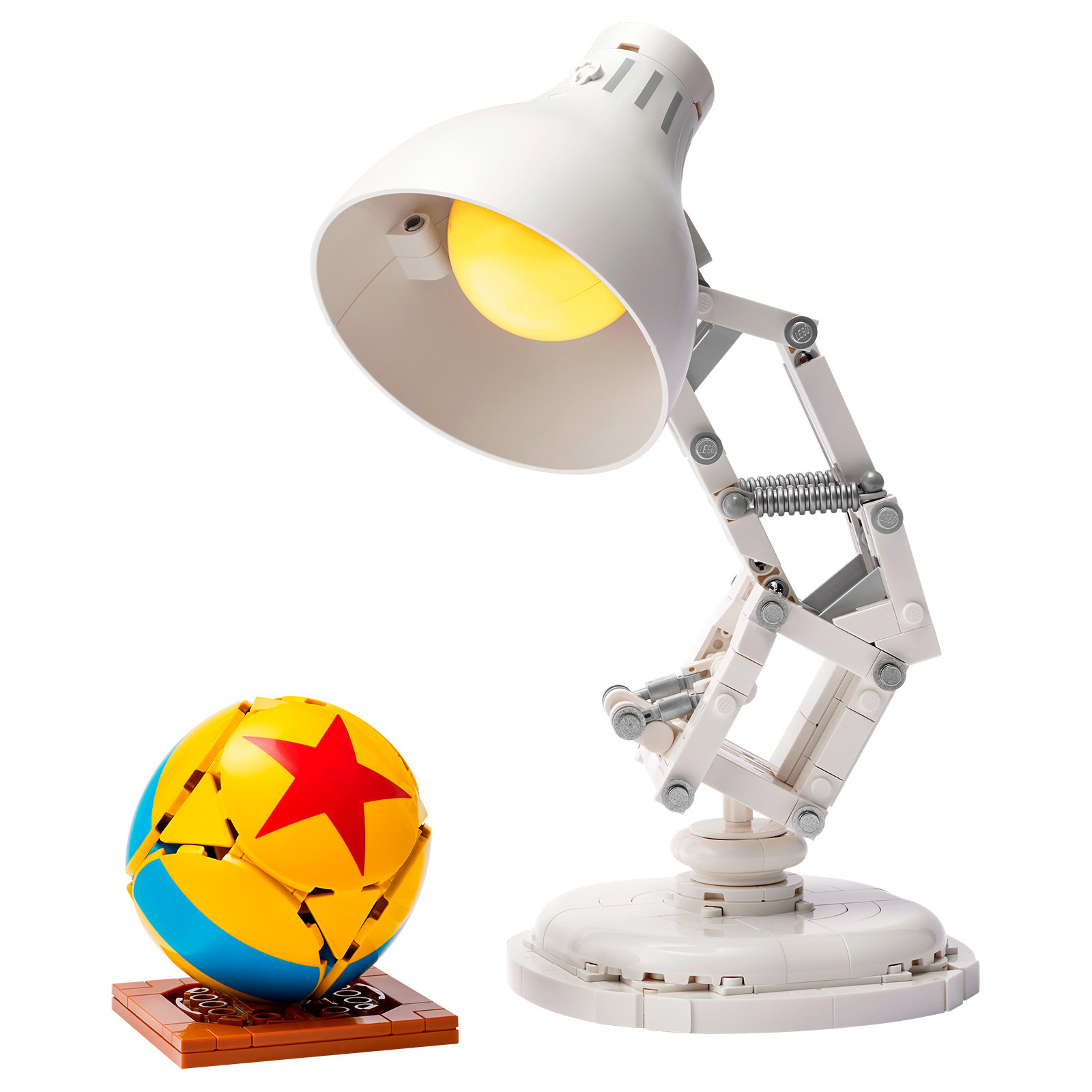
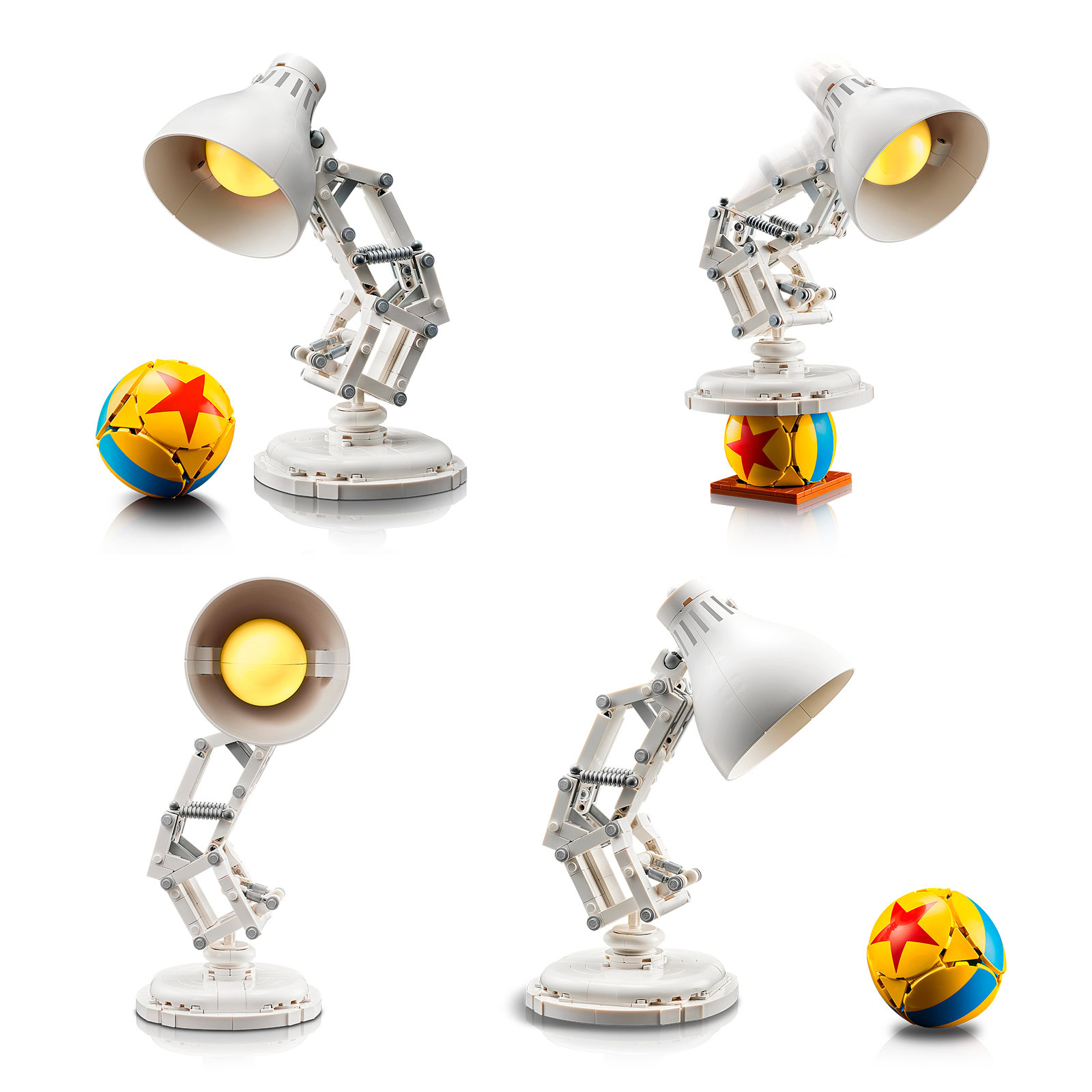
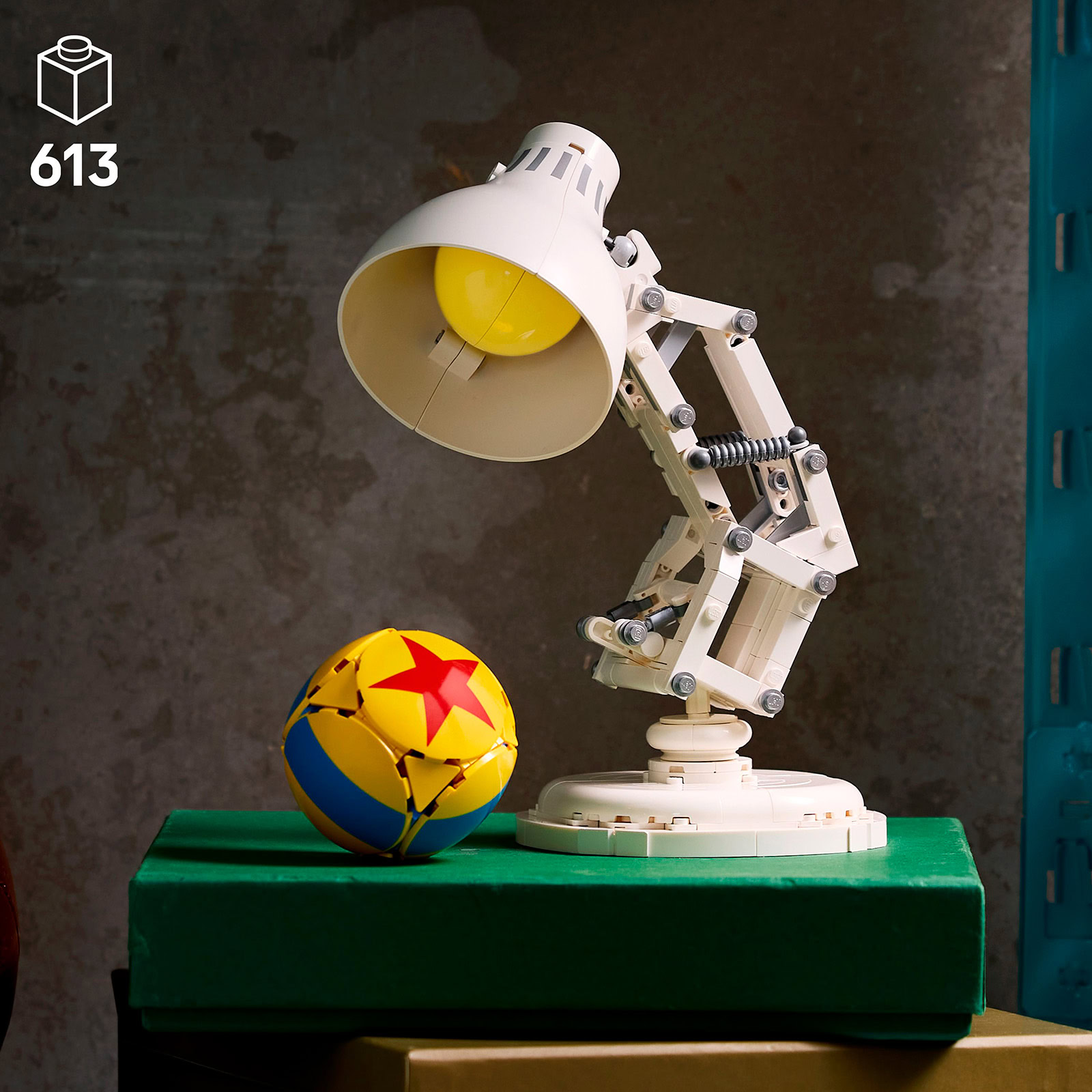
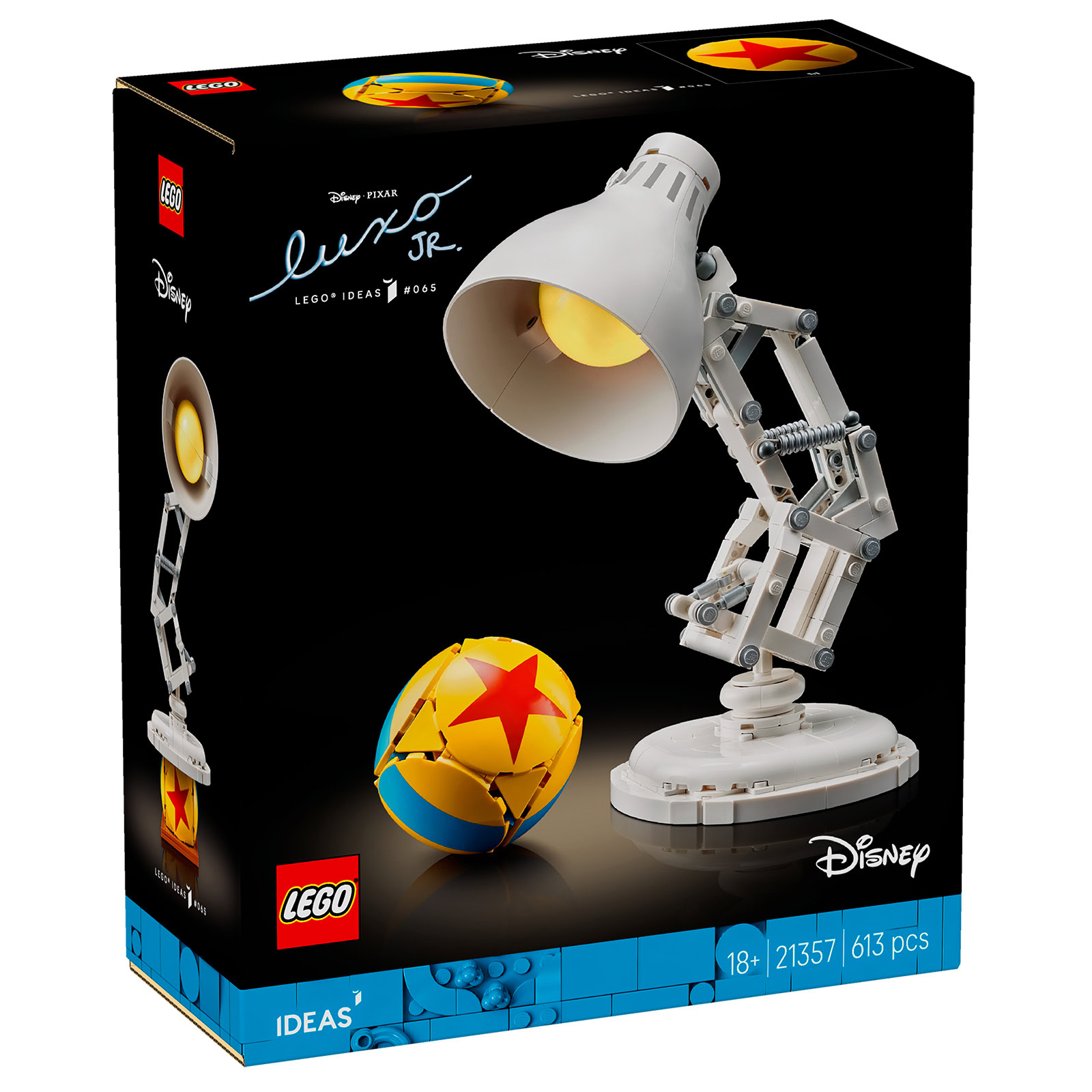
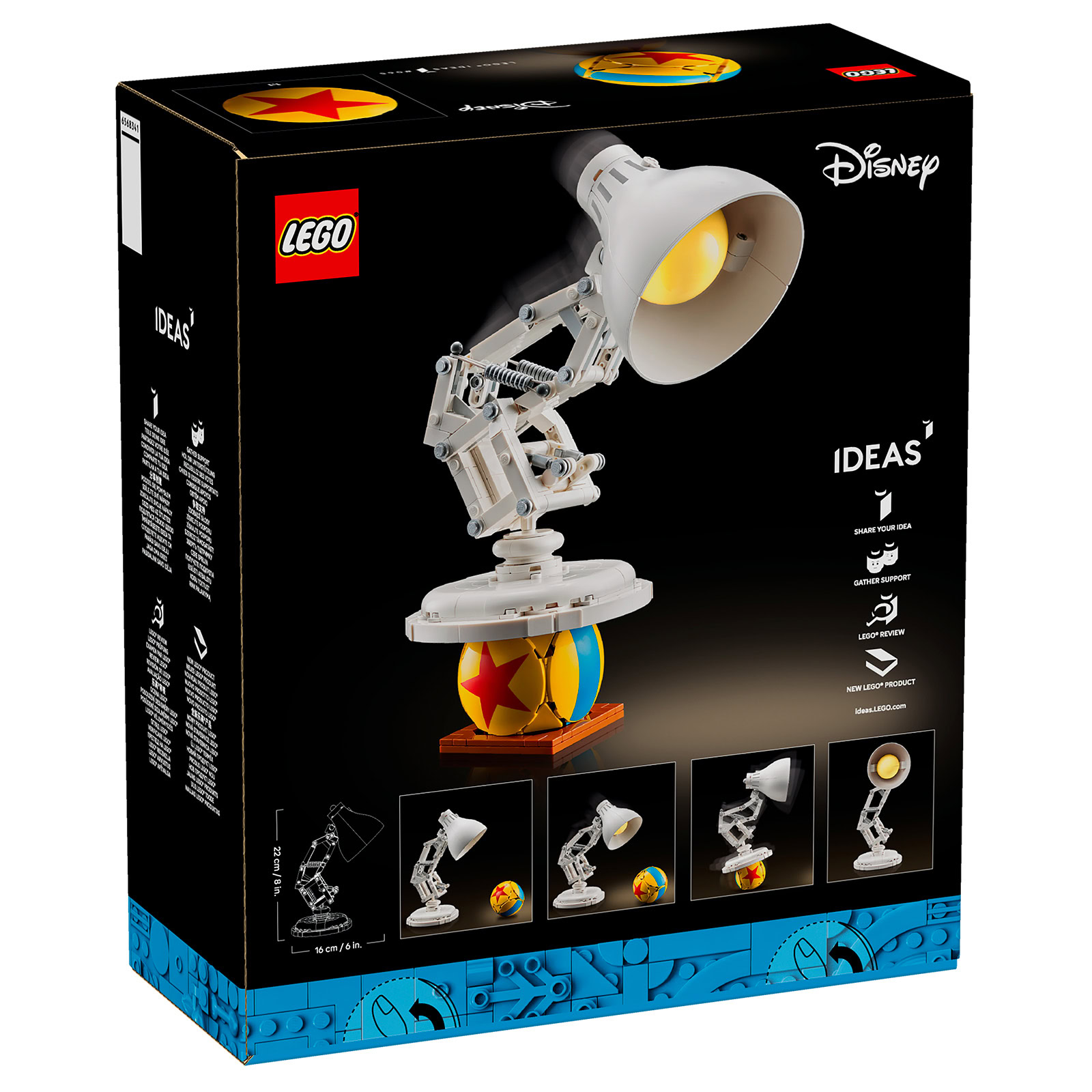
LEGO dévoile enfin la version officielle et définitive de l'idée soumise en son temps sur la plateforme LEGO IDEAS par Toby Brett : le set LEGO IDEAS 21357 Disney Pixar Luxo Jr. qui est dés aujourd'hui proposé en précommande sur la boutique officielle en ligne au prix public de 69,99 € et qui sera disponible à compter du 1er juin 2025.
Dans la boite, 613 pièces pour assembler la version revisitée par LEGO de l'idée de départ avec à l'arrivée une construction articulée de 29 cm de haut. La balle intègre des références à plusieurs films d'animation comme Up, The Incredibles, Ratatouille, Monsters, Inc. Toy Story ou encore Finding Nemo
21357 DISNEY PIXAR LUXO JR. SUR LE SHOP LEGO >>
Le produit est également en précommande chez Amazon à son prix public :
Hoth Bricks shot first. Retrouvez tout l'actu #LEGO sur HOTH BRICKS. News, concours, reviews...
Let the Wookie Win with this DIY Holochess Table
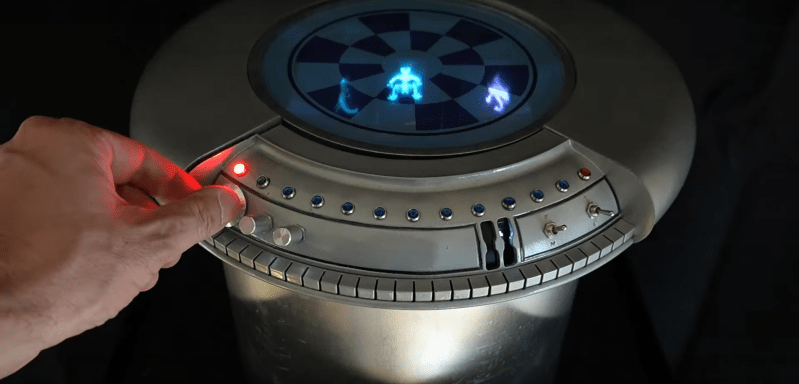
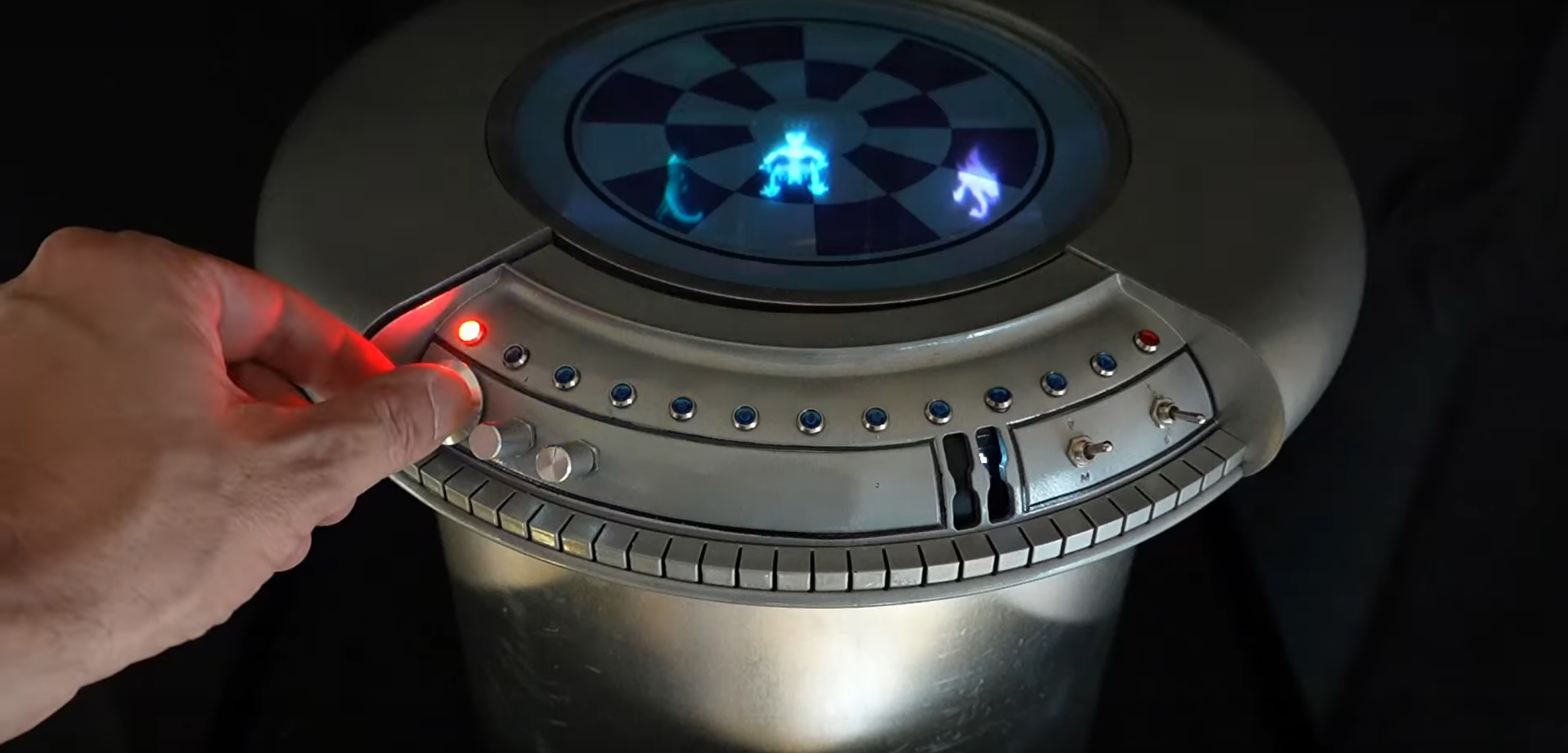
If you have seen Star Wars, you know what is being referenced here. Holochess appeared as a diversion built into the Millennium Falcon in the very first movie, way back in 1977. While not quite as iconic a use of simulated holograms as tiny Princess Leia begging for hope, it evidently struck a chord with [Maker Mac70], given the impressive effort he’s evidently gone through to re-create the game table from the film.
The key component of this unit is a plate from Japanese firm ASKA3D that scatters light from displays inside the table in just such a way that the diverging rays are focused at a point above its surface, creating the illusion of an image hovering in space. Or in this case, hovering at the surface of a acrylic chessboard. Granted, this technique only works from one viewing angle, and so is not a perfect recreation of a sci-fi holoprojector. But from the right angle, it looks really good, as you can see in the video below.
There are actually six SPI displays, driven by an Arduino GIGA, positioned and angled to project each character in the game. Placing two of the displays on 3D printed gantries allows them to move, allowing two creatures to battle in the center of the table. As [Maker Mac70] admits, this is quite a bit simpler than the Holochess game seen in the film, but it’s quite impressive for real world hardware.
If this all seems a little bit familiar, we covered an earlier floating display by [Maker Mac70] last year. This works on similar principles, but uses more common components which makes the technique more accessible. If chess isn’t your forte, why not a volumetric display that plays DOOM? If you’re interested in real holograms, not Sci-Fi, our own [Maya Posch] did a deep dive you may find interesting.
Liquid Silicone 3D Printing Is No Joke
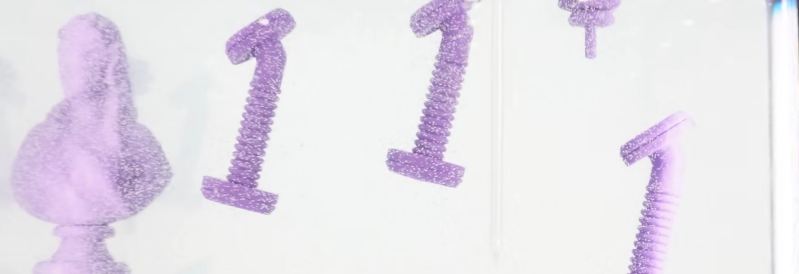
They might call it Levity, but there’s nothing funny about Rapid Liquid Print’s new silicone 3D printer. It has to be seen to be believed, and luckily [3D Printing Nerd] gives us lots of beauty shots in this short video, embedded below.

Printing a liquid, even a somewhat-viscous one like platinum-cure silicone, presents certain obvious challenges. The Levity solves them with buoyancy: the prints are deposited not onto a bed, but into a gel, meaning they are fully supported as the silicone cures. The fact that the liquid doesn’t cure instantly has a side benefit: the layers bleed into one another, which means this technique should (in theory) be much more isotropic in strength than FDM printing. We have no data to back that up, but what you can see for yourself that the layer-blending creates a very smooth appearance in the finished prints.
If you watch the video, it really looks like magic, the way prints appear in the gel. The gel is apparently a commercially-available hydrogel, which is good since the build volume looks to need ̶a̶b̶o̶u̶t̶ ̶5̶0̶0̶ ̶L̶ at least 125 L of the stuff. The two-part silicone is also industry-standard and off-the-shelf, though no doubt the exact ratios and are tweaked for purpose. There’s no magic, just a really neat technology.
If you want one, you can sign up for the waiting list at Rapid Liquid Print’s website, but be prepared to wait; units ship next year, and there’s already a list.
Alternatively, since there is no magic here, we’d love to see someone take it on themselves, the way once equally exotic SLS printers have entered the DIY world. There was a time when resin printers were new and exotic and hobbyists had to roll their own, too. None of this is to say we don’t respect the dickens out of the Rapid Liquid Print team and their achievement–it’s just that imitation is the sincerest form of flattery.

Genetically engineered bacteria break down industrial contaminants
Over the last century or more, humanity has been developing an ever-growing number of new chemicals that have never been seen before by Earth's creatures. Many of these chemicals end up being toxic contaminants that we'd love to get rid of, but we struggle to purify them from the environment or break them down once we do. And microbes haven't had much chance to evolve the ability to break them down for us.
Over the last few years, however, we've found a growing number of cases where bacteria have evolved the ability to break down such chemicals, like industrial contaminants and plastics. Unfortunately, these bacteria are all different species, target different individual contaminants, and thrive in different environments. But now, researchers have developed a new way to take the genes from all these species and place them in a single bacterial strain that can decontaminate complex waste mixtures.
Targeting contaminants
The inspiration for this work was the fact that a lot of this industrial contamination contains a mixture of toxic organic molecules that are commonly found in brackish or salty water. So, the research team, based in Shenzhen, China, started by simply testing a number of lab bacteria strains to develop one that could survive these conditions. The one that seemed to survive the best was Vibrio natriegens. These bacteria were discovered in a salt marsh, and their primary claim to fame is an impressive growth rate, with a population being able to double about every 10 minutes.

Makip 3D avatar offering allows online shoppers to virtually try on fashion items before purchase
Japan-based sizing technology specialist Makip upgrades its Unisize 3D technology to provide online shoppers with an avatar of themselves, tailored to their unique body shape.
Using Unisize 3D, online shoppers will be able to virtually try on fashion purchases and check their appearance from four angles -front, back, left and right - to see how the item will fit them before ordering.

Makip’s CEO and President, Shingo Tsukamoto
Retail Economics found in 2024 that 17 out of every 100 products sold online are returned. Return rates in the fashion industry can be as high as 30%, with incorrect sizing often blamed for a large number of these.
Unisize 3D uses information about the user’s body shape alongside the dimensions of the clothing to allow shoppers to check the fit before making a purchase. Its new 3D function allows select users to view the avatar wearing different shoes to check trouser length, while the previous 2D model always showed images barefoot.
Shingo Tsukamoto, CEO and President at Makip, says: “The average return rate for the UK fashion industry is 26%. One in every four items purchased online is returned, usually at the expense of the retailer, we feel that this cannot continue. In recent years, some retailers have taken a stand and started charging customers for returning items, however, we approach this from the view of customer experience.”
“If we can provide customers with more accurate sizing options at the time of purchase, this leads to a reduction in returns. This has been proven across our Japan-based fashion clients with the average return rate dropping by 20%.”
Last year, Makip launched FaceChange in the UK. The technology allows online shoppers to virtually try on items of clothing they want to purchase by using AI to replace the faces of the online models.
Tsukamoto adds: “In recent years, platforms like TikTok and YouTube have normalised individually tailored content, influencing all generations. Similarly, personalisation in apparel e-commerce is expected to become an essential element of the online fashion industry. We will continue to expand our services with a focus on personalisation.”
2025 RTIH INNOVATION AWARDS
3D technology will be a key focus area at the 2025 RTIH Innovation Awards.
The awards, which are now open for entries, celebrate global tech innovation in a fast moving omnichannel world.
Our 2024 hall of fame entrants were revealed during an event which took place at RIBA’s 66 Portland Place HQ in Central London on 21st November, and consisted of a drinks reception, three course meal, and awards ceremony presided over by comedian Lucy Porter.
In his welcome speech, Scott Thompson, Founder and Editor, RTIH, said: “The event is now into its sixth year and what a journey it has been. The awards started life as an online only affair during the Covid outbreak, before launching as a small scale in real life event and growing year on year to the point where we’re now selling out this fine, historic venue.”
He added: “Congratulations to all of our finalists. Many submissions did not make it through to the final stage, and getting to this point is no mean feat. Checkout-free stores, automated supply chains, immersive experiences, on-demand delivery, next generation loyalty offerings, inclusive retail, green technology. We’ve got all the cool stuff covered this evening.”
“But just importantly we’ve got lots of great examples of companies taking innovative tech and making it usable in everyday operations - resulting in more efficiency and profitability in all areas.”
Congratulations to our 2024 winners, and a big thank you to our sponsors, judging panel, the legend that is Lucy Porter, and all those who attended November's gathering.
For further information on the 2025 RTIH Innovation Awards, please fill in the below form and we will get back to you asap.
Name * First Name Last Name Email * Subject * Message *Thank you!
Adorable Robot Steals the Show
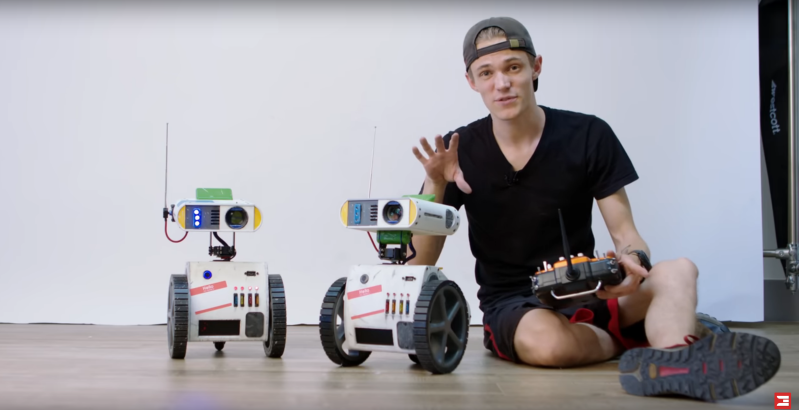
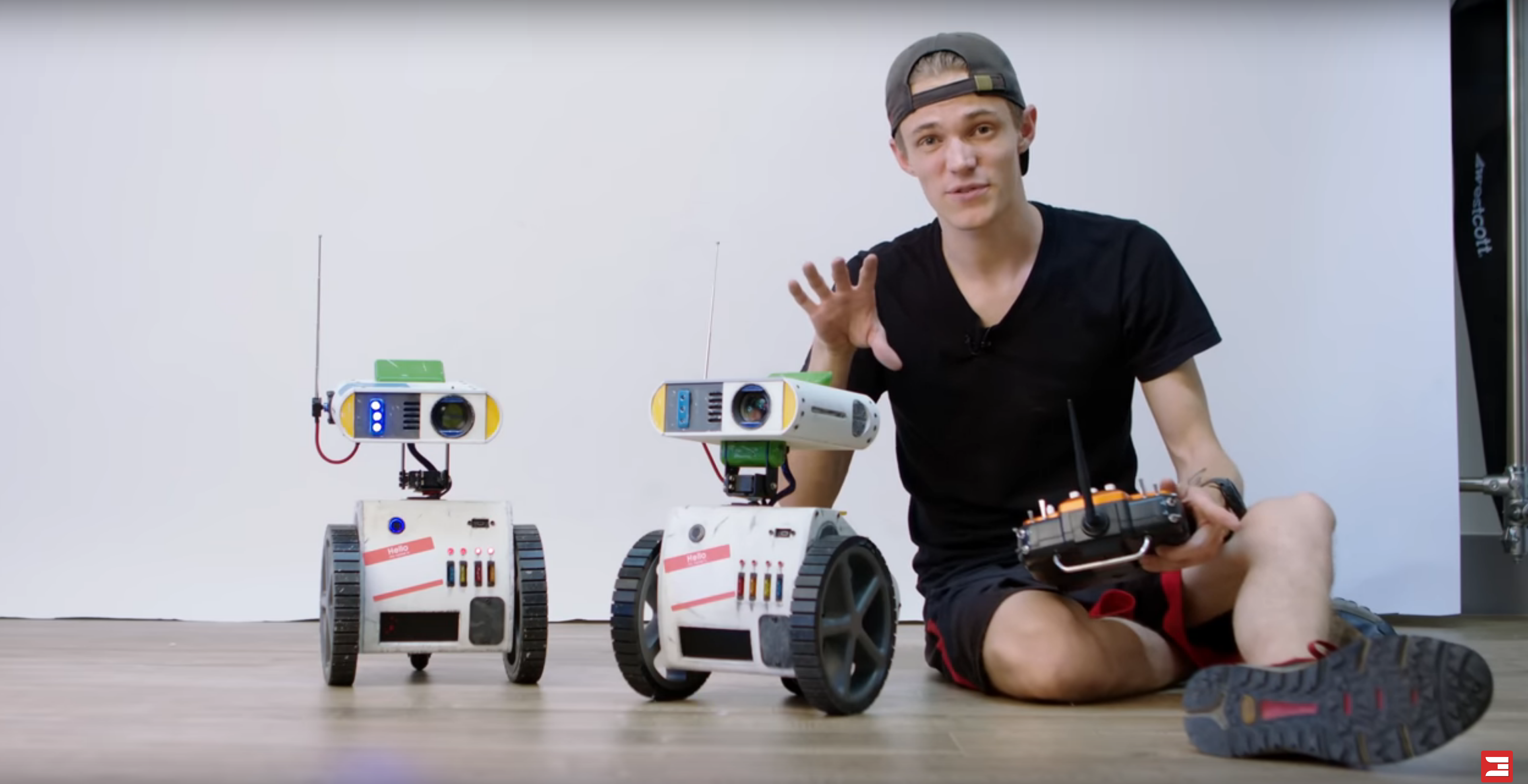
An ongoing refrain with modern movies is “Why is all of this CG?”– sometimes, it seems like practical effects are simultaneously a dying art, while at the same time modern technology lets them rise to new hights. [Davis Dewitt] proves that second statement with his RC movie star “robot” for an upcoming feature film.
The video takes us through the design process, including what it’s like to work with studio concept artists. As for the robot, it’s controlled by an Arduino Nano, lots of servos, and a COTS airplane R/C controller, all powered by li-po batteries. This is inside an artfully weathered and painted 3D printed body. Apparently weathering is important to make the character look like a well-loved ‘good guy’. (Shiny is evil, who knew?) Hats off to [Davis] for replicating that weathering for an identical ‘stunt double’.
Check out the video below for all the deets, or you can watch to see if “The Lightning Code” is coming to a theater near you. If you’re into films, this isn’t the first hack [Davis] has made for the silver screen. If you prefer “real” hacks to props, his Soviet-Era Nixie clock would look great on any desk. Thanks to [Davis] for letting us know about this project via the tips line.