LoL by: Unknown
Acfyouth
Shared posts
03 Jun 18:36
I Love You, Mom
Arwenclaythorn, Acfyouth and -1 others like this
31 May 13:53
Why It’s Important to Understand Direct vs. Mitigated Speech
by Andy Naselli
 Mitigated speech is communication that is deferential or indirect. I learned about it in Malcolm Gladwell’s Outliers. Gladwell defines mitigation as “any attempt to downplay or sugarcoat the meaning of what is being said.”
It’s important to understand direct vs. mitigated speech because problems may result (1) if you don’t understand how others are communicating with you and/or (2) if you are not communicating clearly yourself. Extreme example: plane crashes.
A more normal result is frustration and relational conflict. Extreme example: a relational plane crash.
People who communicate more directly can often come across as harsh or too forceful to people who prefer mitigated speech.
Inversely, Gladwell explains that because a hint is the most mitigated form of speech, it’s “the hardest kind of request to decode and the easiest to refuse.” People who communicate with lots of hints often don’t communicate clearly to people who communicate more directly. And the problem compounds if the former are intimidated by the latter and/or really want the latter to like them and thus try not to say anything that might cause relational tension.
Some relationships could improve significantly if the people understood direct vs. mitigated speech. Consider marriage, for example: Can you imagine what would happen if a husband and wife grew up in families that communicated very differently in this regard? What if the husband consequently tends to communicate very directly and the wife indirectly? When two people communicate so differently, sometimes they misunderstand each other, which may result in unnecessary frustration or offense.
That’s why it’s important to understand direct vs. mitigated speech.
Related:
- See especially Matt Perman, “Mitigated Speech and Plane Crashes.”
- Emotional Intelligence
- How Reliable Is Your Memory? 3 Practical Lessons
- It’s Not about the Nail: a hilarious short video (HT: Denny Burk)

Acfyouth likes this

29 May 01:41
Grumpy Ain't Afraid of No Dementors
Phil Goetz, Shel Kennon and 5 others like this
23 May 16:49


A La Carte (5/23)
by Tim
The Big Picture - The Big Picture has a gallery of photos of the devastation in Oklahoma. Also, these before and after pictures are startling and display the power of the storm.
Modern Parables 2 - I have often expressed my appreciation for the Modern Parables series of films. Well, they are now using Kickstarter to try to fund a second series of films. Check it out and consider being part of it! (And if you’ve never checked out the first series, you should.)
The Sensuous Christian - Here’s a quote from R.C. Sproul. It tells about a book he’s almost written several times.
The Case for Man/Woman Marriage - This is a great little video that gives a case for maintaining marriage as a relationship between a man and a woman. If there’s a problem with it, it’s simply that this is an issue won and lost on the emotional, not the logical, level.
King Solomon’s Commencement Address - I read yesterday that not one of the Ivy League schools has a conservative giving the commencement address this year. Well, maybe they should have asked King Solomon. Joe Carter speculates on what Solomon would tell them.
50 Common Misquotations - Here are 50 common misquotations you should stop using.
It must not content us to take our bodies to church if we leave our hearts at home. —J.C. Ryle
Acfyouth likes this
23 May 14:17
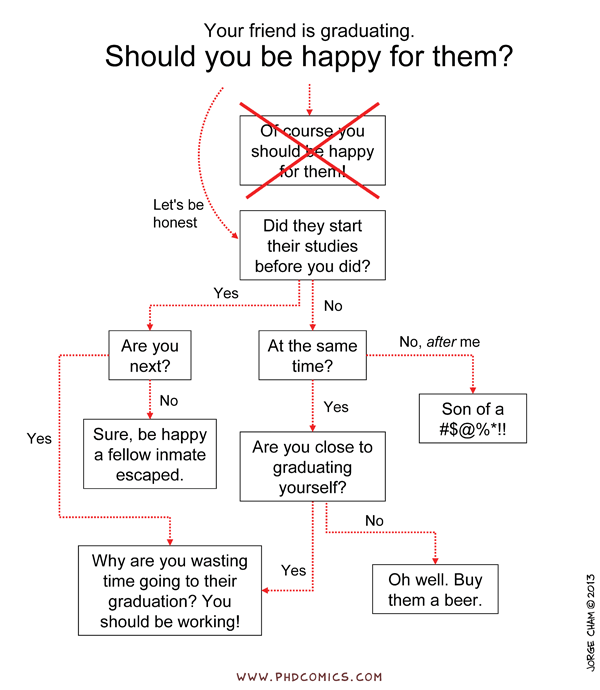
05/22/13 PHD comic: 'Happy for them?'
| Piled Higher & Deeper by Jorge Cham |
www.phdcomics.com
|
|
 |
||
|
title:
"Happy for them?" - originally published
5/22/2013
For the latest news in PHD Comics, CLICK HERE! |
||
Ilona Molotoka, Jamesthollowell and 3 others like this


20 May 20:13
 Which way is the train going? Magic from just four frames! (It's a real train station so of course there is an actual answer, but that's no fun.) (via Neatorama)


Optical illusion: train moves both ways
by David Pescovitz
Which way is the train going? Magic from just four frames! (It's a real train station so of course there is an actual answer, but that's no fun.) (via Neatorama)
    
|
Acfyouth and -1 others like this

18 May 16:33
Stop Your Strange Howling
Clockorangelj, Laura.prettyinpink and one other like this


17 May 20:43
Carl Henry: Not Just for Calvinists
by Matthew Pinson
I learned about Carl F. H. Henry at the feet of my mentor Leroy Forlines, professor of theology at Free Will Baptist Bible College (now Welch College) and author of books with titles such as The Quest for Truth and Classical Arminianism. Over the course of his career, Forlines taught his students the Henrician epistemology of God, Revelation, and Authority and the cultural mandate similar to what Henry outlined in The Uneasy Conscience of Modern Fundamentalism.
It was from my Arminian professor that I learned to love Henry, and that should be no surprise. Henry longed for vibrant faith, practice, and spirituality shared by all classic evangelicals—be they Arminian, Calvinist, Lutheran, or Anabaptist. He hoped for a transdenominational evangelical university that would bring together scholars from the various strands of confessional Protestantism.

This is the sort of program Henry modeled in the pages of Christianity Today. It's what caused Free Will Baptists like Billy Melvin, Wesleyans like Dennis Kinlaw, Lutherans like Robert Preus, Anabaptists like Edmond Hiebert, and Arminian-leaning Dispensationalists like Norman Geisler to rally behind Henry in his defense Scripture's truth claims and to sign on to the Chicago Statement on Biblical Inerrancy.
My mentor loved Henry because, though Henry was a Calvinist and he an Arminian, they could put their differences aside in championing evangelical orthodoxy against a growing secularism, Protestant liberalism, and then-fashionable neo-orthodoxy. They could agree the Christian world-and-life-view had enormous implications—not just for a personal relationship with God, but also for culture and the created order as a whole.
Rather Ironic
My own love for Henry deepened when I was a student at Yale Divinity School in the early 1990s. Now that I look back on this time, it seems rather ironic—given current evangelical stereotypes—that a Free Will Baptist boy from the Deep South would be in the hotbed of Yale postliberalism, studying with George Lindbeck by day (and loving every minute of it) and leading the Divinity School Evangelical Fellowship in discussions of God, Revelation, and Authority by night.
Yet this "Reformed Arminian" had grown to love Henry's brand of presuppositionalism and his compelling defense of the classic Protestant doctrine of biblical inspiration. I was drawn to his Reformed emphases on human depravity, penal substitionary atonement, and the imputation of Christ's righteousness in justification. I identified with his down-to-earth evangelical spirituality coupled with a broadly Reformed-Kuyperian approach to culture and the implications of the Christian world-and-life-view.
Simply put, Henry seemed to this young Arminian theological student to be a more biblically faithful model of epistemology, theology, and cultural engagement than the postliberalism and liberation theology I was encountering at Yale. Indeed, I always thought Lindbeck didn't quite understand Henry. It seemed, in casting evangelical theology as merely "cognitive propositional," Lindbeck missed the distinctiveness of Henry's Reformed, faith-seeking-understanding epistemology. He seemed to be pigeonholing Henry and the mainstream evangelical tradition in a way that didn't do them justice.
Now, 20 years later, postmodernity doesn't seem so cool (at least to me) as it once did. It seems as though the evangelical academy is one of the few places where postliberalism is still in style (though its evangelical fans like to call it "postconservatism"). That's why I recently enjoyed reading Greg Thornbury's excellent new book, Recovering Classic Evangelicalism: Applying the Wisdom and Vision of Carl F. H. Henry (Crossway, 2013). This work has the prospect of resurrecting Henry's reputation among younger evangelicals. I hope as a result that our younger colleagues will actually read Henry, rather than just skimming his work and caricaturing him like so many evangelicals of my generation have done.
Undergirding Truth
I think Henry would have liked what Thornbury is doing and would have felt well represented by his book. Thornbury highlights the fact that Henry represents a Reformational epistemology as well as a traditional understanding of the nature of truth as that which conforms to reality. This view of truth undergirds the historic Christian view that Holy Scripture is without error in all it affirms.
Thornbury rightly insists that Henry's view of scriptural truthfulness isn't the novel invention of 19th-century Cartesian foundationalists, Enlightenment modernists who had too strong a dose of rationalism and Scottish Common Sense philosophy. Instead, it's common to historic Christianity from the Fathers up through the Reformers.
This is why evangelical Thomists like R. C. Sproul and Norman Geisler could join hands with those leaning more Augustinian in their epistemology, such as Henry, Francis Schaeffer, Ronald Nash, or Cornelius Van Til. They all shared the same traditional Christian approach to the truthfulness of Scripture as rational, propositional revelation from God.
Like these other thinkers, Henry never believed that the propositional character of special revelation—as important and non-negotiable as it is—exhausts the multiform character of divine revelation, as he and they are often caricatured as believing. Thornbury wants to resurrect this noble, classic evangelical understanding of divine truth and revelation for a younger audience. It will be healthy for younger evangelicals to let the clean sea breeze of classic evangelicalism blow through their minds. I believe this will help sweep away the cobwebs of well-worn postconservative clichés and stereotypes.
I do believe Henry would have responded favorably to the nuancing of some of his constructions in the light of postmodernity. (I also suspect Henry would find fruitful—and faithful—the ways scholars like Michael Horton and Malcolm Yarnell, whom Thornbury needlessly chides, have nuanced the Reformational epistemologies they received from their evangelical forebears.) Moreover, I think Henry would respond favorably to the proposals of Calvinist Don Carson (The Gagging of God) and Arminian Grant Osborne (The Hermeneutical Spiral), both of whom attempt to assert a classic evangelical view of revelation, truth, and hermeneutics in dialogue with postmodern thought.
Was Henry a man of his time who understood and communicated to his modernist interlocutors? Yes. But was he a captive to modernism? No. My hunch is that when our evangelical descendants look back on us in 100 years, the fact Henry was using a little too much rationalistic language and categories (a 300-year-old fad) isn't going to look nearly as faddish as postmodernism, postliberalism, postconservatism, postfoundationalism, postpropositionalism, and all the other "post"-fads presently driving much of evangelical theological method.
Culture and Kingdom
But in addition to epistemic and theological considerations, Thornbury desires to resurrect Henry's approach to culture and the kingdom so eloquently stated in The Uneasy Conscience. This is much needed in today's evangelical environment, with people on the one hand calling for evangelicals to be silent for a time in the public square while those on the other hand redefining the mission of the church as much in terms of saving the whales as saving souls.
Henry's view of the in-breaking kingdom of God as "already but not yet" made him critical of social-gospel liberals, whose over-realized eschatology made them place too much salvific significance on social justice and too little on evangelism. But he also believed his fundamentalist brothers and sisters didn't sufficiently emphasize the "already" nature of the kingdom and so ignored the social and cultural implications of the gospel.
Henry's life and ministry called 20th-century evangelicals back to a full-orbed Christian world-and-life-view that emphasized the Great Commission: making disciples and teaching them to live out Christ's teachings. This is just the sort of balance we need in the current evangelical debates about the Christian's role in society and public life.
Describing Henry as the man who "invented evangelicalism," Timothy George says Henry wanted to foster a movement that was "transcontinental, interdenominational, theologically affirmative, socially aggressive, and irenic." These are still worthy goals for a compelling, vibrant, theologically orthodox evangelical movement, and I believe a fresh reading and appreciation of Henry is just what we need to help us work toward these goals he valued so highly and embodied in his life and work.
17 May 18:32
Where Christian Theology — All of It — Begins
by Scot McKnight
In the beginning was the gospel (lower case “gospel”) so that all early Christian teaching was measured by the gospel, but the gospel was known through the apostolic testimony, and the apostolic testimony was known through the writings of the apostles (once they died), leading to this: all Christian theology begins with Scripture. We can finesse [...]


Acfyouth likes this
17 May 17:01


Huge attic bee hive falls through bathroom ceiling
by Cory Doctorow

Redditor Underdog106 found a huge beehive in his attic and called for a beekeeper to help him with it. Before the keeper arrived, the hive actually fell through the attic into his bathroom below -- the previous owners had used 1/4" sheetrock for the bathroom ceiling -- and split open. The accompanying photoset documents the sad and weird business of trying to save the colony and get it packed for shipping, amid a great ooze of honey and comb spread all over the bathroom.
Jerry the bee keeper was supposed to come today at 5pm. It was a very warm day in Columbia. The bee hive was heavy and the structure detached and fell through the ceiling. It turns out the old owners of the house used 1/4 inch sheet rock for the ceiling in the bathroom. Which is absurd and ridiculous. Jerry came as soon as he could, and he drove an entire hour to get here. The hive fell 3 hours before he was supposed to come today. What are the odds? Seriously. What are the F%^$KING ODDS. But all is well.
Most of the hive fell. As you can see. But we were still able to save around 12,000 out of the estimated 30,000 bee hive.

|
|
Acfyouth and -1 others like this
17 May 17:00
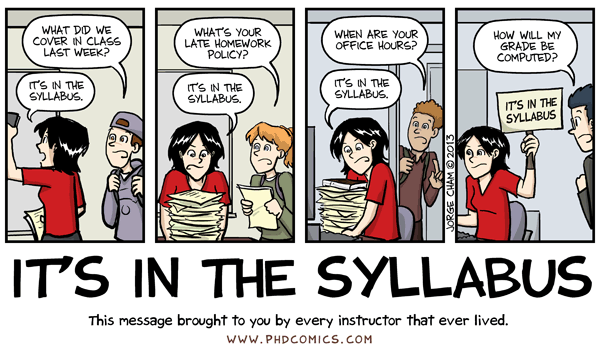
05/10/13 PHD comic: 'It's in the syllabus'
| Piled Higher & Deeper by Jorge Cham |
www.phdcomics.com
|
|
 |
||
|
title:
"It's in the syllabus" - originally published
5/10/2013
For the latest news in PHD Comics, CLICK HERE! |
||


09 May 18:35

Crazy Monster takes a break for lunch, and talks to his...
Crazy Monster takes a break for lunch, and talks to his sandwich.
Acfyouth likes this


