Shared posts

24 Aug 15:31

The Google Home Mini’s mute switch makes privacy deliberate

by Chaim Gartenberg

In today’s digital age, it sometimes feels like hardware has taken a back seat to the software that drives our devices. Button of the Month is a monthly look at what some of those buttons and switches are like on devices old and new, and it aims to appreciate how we interact with our devices on a physical, tactile level.

Smart home devices can make people uneasy, what with the “constantly listening to you” and the massive breach of privacy whereby paid human contractors turned out to be listening to recordings from Apple, Google, Amazon, Microsoft, and Facebook services without users knowing it. But I still use a Google Home Mini, and part of that is because of the physical microphone mute switch on the back that gives a kind of peace of...

Continue reading…

22 May 14:22

Logitech MK850 Performance Wireless Keyboard and Mouse Combo - $59.99 @ 48% OFF

Best darn deals on the web - yugster.com
25 Apr 12:15

BMW to pare back presence at 2019 Frankfurt Motor Show

by Sven Gustafson

Filed under: Green,Frankfurt Motor Show,BMW

BMW recently announced its intention to skip next year's North American International Auto Show in Detroit, issuing a statement about re-evaluating its trade-show strategy that amounted to the age-old "It's not you, it's me." Only this time it appears to be true: Bimmer is now planning to significantly pare back its presence at the 2019 show in Frankfurt, in its own backyard.

Continue reading BMW to pare back presence at 2019 Frankfurt Motor Show

BMW to pare back presence at 2019 Frankfurt Motor Show originally appeared on Autoblog on Mon, 23 Apr 2018 11:10:00 EDT. Please see our terms for use of feeds.

Permalink |  Email this |  Comments
27 Mar 04:07

Trident Unwrapped Sugar-Free Gum 120-Piece for $6 + free shipping

As one of its daily deals, That Daily Deal offers four Trident Unwrapped Sugar-Free Gum 30-Count Packs for $6.49 with free shipping. That's $1.62 per pack and the best deal we could find for this quantity by $12. The best by date is April 2018. Deal ends today.

Stocking up? You can alternatively get 12 30-packs for $14.97 with free shipping ($1.25/pack).
21 Jan 15:24

A Toaster Just for Bacon Will Make Every Meal So Much Better

by Andrew Liszewski

If you find your kitchen counters cluttered with food-specific gadgets and appliances, you finally have a good reason to get rid of them all. The culinary innovators at Nostalgia Electrics have created the only thing you’ll ever need: The Bacon Express, a toaster that cooks delicious slices of pork instead of bread.

Read more...

06 Oct 19:16

Reinventing the Food Cycle

by Christine Walsh

horse

Food going to waste is a problem in the US and elsewhere in the developed world. However, the High-solids Organic-waste Recycling System with Electrical Output device, or HORSE for short, developed by Impact Bioenergy, could go a long way towards alleviating this problem on the consumer side.

HORSE is not a real living being, but it could be called a ‘living’ machine. It can best be described as a portable anaerobic digestion system, which is capable of accepting a whole range of organic waste materials, such as kitchen scraps, yard waste and even paper, and turning it into a liquid fertilizer and even energy in the form of biogas and electricity.

The creators claim that one HORSE unit can, in a year, convert 25 tons of organic waste into roughly 5400 gallons of liquid fertilizer and up to 37 MWh of energy. So 135 lb (61.2 kg) of organic waste input into the device in a day, could have a yield of 360,000 BTU of energy and 2.5 kW per hour in electric output every day. And this output would be achieved with almost no waste.

Needless to say, placing these devices in neighborhoods around the world could have a significant impact on local waste management issues, renewable energy production, and reduced transportation emissions. Together with other recycling and waste-reduction programs, it could, conceivably eliminate the need for organic waste pickup, and remove all the carbon emissions of this activity.

Impact energy is currently raising funds to start building a containerized production model. They are doing so via a Kickstarter campaign and have not yet reached their $43,300 goal, but the campaign still has about a week to go, so hopefully they will get there.

26 Dec 18:46

Intel Mica Hands-On: A Fancy, High-Fashion Beeper For $500

by Ashley Feinberg

Intel Mica Hands-On: A Fancy, High-Fashion Beeper For $500

Early this fall, Intel announced its first "luxury smart bracelet" built in conjunction with Opening Ceremony and aimed specifically at the ladiez. Today, we finally got to spend some time with the device and can say with total confidence: Yep, that is one pretty... beeper?

Read more...

27 Aug 16:41

Video: Which is more fuel efficient, driving with a pickup's tailgate up or down?

by Greg Migliore

Filed under: Truck, Etc., Videos, Ford, Design/Style

2015 Ford F-150

Thanks to the smoke wand in the wind tunnel, you can actually see the difference in our video.

Should you drive with your pickup truck's tailgate up or down? It's an age-old controversy that's divided drivers for decades. Traditionalists will swear you should leave the tailgate down. Makes sense, right? It would seem to let the air flow more cleanly over the body and through the bed. But there's also a school of thought that argues trucks are designed to look and operate in a specific manner, and modern design techniques can help channel the airflow properly. So don't mess with all of that: Leave the tailgate up.

Which is true?

To solve this tailgate debate, we went inside the wind tunnel at Ford to test the aerodynamics of the 2015 Ford F-150. The model's exterior design manager Brad Richards explained that the new truck was designed with purposeful edges and shapes that look imposing, yet still allow the F-150 to maintain strong aerodynamics. "We think this is the toughest F-150 by far, but also the most efficient," Richards said.

All of this matters, as loyal Ford truck buyers expect the F-150 to look a certain way, but the Blue Oval is also projecting fuel economy gains thanks to the new truck's use of lightweight aluminum. And no matter how light the truck is, fuel-economy gains could be wiped out with poor aerodynamics. With that in mind, Ford styled the truck to maintain its beefy look, but also beat its predecessor in the wind tunnel. Ford paid close attention to a new, lower air dam, mirrors that were redesigned "a dozen times" and a small lip on the rear tailgate. Acting as a spoiler, the lip allows air to cleanly detach from the body. Thanks to the smoke wand in the wind tunnel, you can actually see the difference tailgate up versus tailgate down in our video.

Ford remains tight-lipped about the F-150's fuel economy numbers, but it admits dropping the tailgate would increase drag by about eight percent - and sandbag fuel economy. Even for older models without the fancy spoiler, you're hurting efficiency and lowering your gas mileage when driving with the tailgate down, argues Richards.

So there's your verdict, straight from the wind tunnel: Leave the tailgate up.

Continue reading Which is more fuel efficient, driving with a pickup's tailgate up or down?

Which is more fuel efficient, driving with a pickup's tailgate up or down? originally appeared on Autoblog on Tue, 26 Aug 2014 19:57:00 EST. Please see our terms for use of feeds.

Permalink | Email this | Comments
09 Jun 16:34

Florida Company Designs and Builds Shipping Container Homes

by Christine Walsh

porch

The Lakeland, Florida-based company, New Generation Builders, uses recycled 8 by 20-foot shipping containers, and transforms them into tiny homes or offices. They specialize in providing sustainable, fully functional homes, though they also take orders for custom builds. Their designs are aimed primarily at customers who are looking for a cabin or beach house to use as a weekend getaway, or a guesthouse to put in the back yard. However, these houses could easily also be used as a permanent residence for a single person or a couple.

According to Steven Sawyer, the owner of New Generation Builders, he uses shipping containers to create homes because they are very versatile and very strong. As he put it, “Once I tie them [shipping containers] down with architectural piling on the four container feet, they are hurricane proof. The architects and engineers tell me they’re even tornado proof. They will not move.”

The tiny home they built for a couple from North Carolina is made from a single 8 by 20 shipping container, which was fitted with a full kitchen, and a bathroom with an indoor and outdoor shower and toilet. The bathroom is housed at one end of the shipping container and separated from the main living area by a 30-inch pocket door. The rest of the shipping container houses the main living area and kitchen, which is equipped with a fridge, sink and cook top, as well as ample storage space.

bathroom

The living room doubles as a bedroom and features a sofa that transforms into a bed. The container is heated and cooled by a Mitsubishi 9000 BTU wall mounted HVAC unit, while the container home also contains a small fireplace. The living area features a 6-foot sliding glass door that also serves as the main entrance into the house. The couple that commissioned it is living inside this shipping container home full time as they wait for their main residence to be designed and built.

cargo-home-interior-2-0506

building

kitchen

floor

Apart from shipping container homes, New Generation Builders, also build offices, security shacks and storage areas out of shipping containers.

03 Jun 22:25

Spain Gets Its First Shipping Container Ship Terminal

by Christine Walsh

ext

The Spain-based architectural firms Hombre De Piedra and Buró4 recently designed and completed a cruise ship terminal in Seville, Spain that was constructed entirely out of repurposed shipping containers. They used 23 previously used shipping containers and repurposed or upcycled them into a 508 square meter (5,468 square feet) terminal. Before being repurposed the containers made about 29 trips around the world.

fromdistance

The shipping containers were precut off-site, before they were transported to the dock where the terminal now stands. The new terminal is suitable to be a multipurpose space, while it can also easily be expanded or moved should the need arise. The builders also only had 15 days to construct it, which is the maximum interval between cruise ships docking at the port. Due to the ease and speed of the construction process when working with shipping containers, they succeeded.

The 23 shipping containers were stacked into a 2-story structure, while most of the sides were cut away so as to maximize the interior space. They were placed in parallel arrangement and are separated from one another by a distance of one container width. In the areas where two containers were stacked atop each other, the bottom container features a double height ceiling. The designers didn’t try to hide the fact that the terminal is built out of shipping containers, instead deciding to celebrate the industrial past of their chosen building blocks.

doors

The biggest problem faced by the new terminal will likely be solar heat gain, since the area is well known for high temperatures during the summer months. To alleviate this problem the designers painted the containers using a white paint, which according to them, contains special ceramic microspheres that can reflect up to 90% of solar radiation and therefore keep the interiors cool. How well this cooling method works will have to be tested in practice this summer. They also cut large windows into the containers, which will allow the occupants to create a cross breeze that will also cool the interior.

int

intside

Apart from being the docking area for cruise ships, the space will also be used to host various exhibitions and shows.

sidenight

29 May 16:08

Official: Google unveils fully autonomous, hands-free car prototype [w/videos]

by Brandon Turkus

Filed under: Technology, Videos, Hatchback, Specialty

Google Self-Driving Car

Welcome to the future, friends. Google has unveiled its first self-driving car. This isn't like past attempts, though. It's not a Toyota Prius or Lexus RX with a bunch of bulky computer equipment, but Google's very own car, built from scratch. That'd be a big enough deal in and of itself, but this car is exciting for another reason - there are no manual controls. No brake pedal, gas pedal, gear shift or steering wheel. It's completely and totally autonomous, requiring nothing more than an address.

"On the inside, we've designed for learning, not luxury." - Chris Urmson

As is the case with most autonomous cars, Google's latest effort depends on a series of cameras and sensors to let the computer know what's happening around it. We've already detailed Google's most recent advances in this regard.

The car, which was unveiled by CEO Sergey Brin yesterday, is limited to 25 miles per hour. The interior is as basic as the car's top speed, with little more than a set of seats. Interior trim is limited - the roof, for example, looks like bare sheetmetal with an integrated roll cage.

"On the inside, we've designed for learning, not luxury, so we're light on creature comforts, but we'll have two seats (with seat belts), a space for passengers' belongings, buttons to start and stop and a screen that shows the route-and that's about it," wrote the director for Google's self-driving car project, Chris Urmson, in a blog post.

According to Urmson, Google will build about 100 prototypes, with testing set to begin later this summer. As for public use, the tech giant is aiming to launch a California-based pilot program "in the next few years."

Of course, we'll be sure to follow up on this project as it progresses. In the meantime, scroll down for a short video from Google, which shows the first impressions of some of the car's very first public drivers.

Continue reading Google unveils fully autonomous, hands-free car prototype [w/videos]

Google unveils fully autonomous, hands-free car prototype [w/videos] originally appeared on Autoblog on Wed, 28 May 2014 09:30:00 EST. Please see our terms for use of feeds.

Permalink | Email this | Comments
11 Apr 19:27

Upcycle House Built From Used Shipping Containers

by Christine Walsh

ext

The Danish architecture firm Lendager Arkitekter recently completed the experimental Upcycle House in Nyborg, Denmark. The goal with Upcycle House was seeing if carbon emissions of a home can be reduced through the use of recycled and upcycled building materials during the construction process. The end result was the reduction of CO2 emissions by 86% compared to a benchmark house. Upcycling is a sort of a next step in the recycling process, namely using recycled products and turning them into new materials or products of higher quality and greater value. In the case of Upcycle House, this reduced the need for new production and therefore reduced the CO2 emissions.

Upcycle House is constructed from two repurposed shipping containers, which yielded a living area of 129 square meters (1390 square feet). The work on the house started offsite, where the holes for windows and doors were cut into the sides of the containers. The containers were also fitted with plumbing and wiring for the bathroom and kitchen before they were transported to the building site.

containers

The house was placed on a foundation of helical piles, which require no excavation to install. They can also be removed from the ground if the house is torn down. The two shipping containers were well insulated on the outside, while the team used no plastic foams, instead opting for Technopor, a rigid insulation made from recycled glass bottles.

The interior of the home features a large living room and kitchen, a master bedroom, three smaller rooms, a bathroom, a utility room and a passive cooling chamber. There is also a greenhouse adjacent to the kitchen, as well as a large south-facing terrace.

int1

int2

deck

The roof and the façade were constructed from recycled aluminum cans. For the exterior panels, the architects used post-consumer recycled granulated paper that was pressed together and heat-treated. They used discarded champagne corks as tiling in the kitchen, while the bathroom tiles are made from recycled glass.

The walls and the floor of the house were covered with OSB-panels made from wood-chips discarded as waste by-products by production sites. These were pressed together without glue to form the panels. Since one of the goals of the design team was to make Upcycle House look just like any other modern house, the recycled materials used in the construction process were kept as invisible as possible. They also focused on passive sustainability, by taking into account orientation, temperature zones, daylight optimization, shading and natural ventilation.

diagram

18 Mar 20:43

Tiny House and the Building Code

by Kent Griswold

by Darren Hannabass

Every once in a while I notice on your blog that people have a notion that the tiny houses they build, especially on wheels are exempt from the building code.

This is a misnomer, at least in Virginia. I submit that in most jurisdictions there is a building code that pertains to “manufactured housing.” Example: Appendix E of the 2006 of the International Residential Code (IRC), addresses manufactured housing with regard to construction, alteration, and addition to “manufactured housing” used as a single dwelling unit.

Dee Williams tiny house

While the code only addresses single dwelling units that are on non-rental lots, the code does reference the National Manufactured Housing Construction and Safety Act which has been around since 1974. This act may not apply to stick built housing on a rolling chassis, but I recommend that anyone building things like the Tiny House blog suggests not ignore regulations like these because there are a lot of people out there that will take unnecessary shortcuts and provide unsafe housing. Even if these regulations are not applicable this does not necessarily mean each state doesn’t regulate mobile homes because they can and they have the legal authority to do so.

leafhouse

To propagate the idea that codes do not apply, to promote the idea of a “Tiny House” and give the false impression that constructing said house to the uniformed home owner that they can build these things easily and cheaply without some standard to construction is a question for concern. While I am not an attorney by any means there is a term in the law that refers to the care by which something is constructed safely and is known by building professionals as the ‘standard of care.’

Granted I have seen some architect designed tiny houses on your blog that are truly inspiring and they are role models for those that want to build an inexpensive house, but to generically state that “yes!, you too can build a Tiny House without worrying about the building code” is setting yourself up for a liability.

colin's house

One of the concerns I have as a design professional is I have been reading this blog for a couple of years now. Many of the Tiny House installations that have been installed do not secure the structures in the event of high wind. The code regulates mobile homes to protect them from being leveled during a hurricane or tornado. I submit this should be a concern on your blog, but I have not seen any discussion about this and I recommend you consider that if you want to be of service to the home owner that you might consider having a discussion like this. Otherwise you open yourself to liability.

meg and joes house

I would recommend stating whenever a question like this comes up that if a person wants to build a Tiny House that they should first check the localities they intend on having this house be parked in to make sure they are not setting themselves up for legal grief later. All it takes is educating the public a little and by the home owner taking responsibility to plan a ahead there will be no question they will have a successful building project. By not encouraging the homeowner to take this important responsibility in the design and planning process, which is my impression from the blog, the homeowner is setup for a catastrophe that the community at large that may have to deal with later. I don’t think this is the right thing to be doing because I shouldn’t have to tell you, but what might seem to be something that is unregulated now, as more failures occur the government will step in and regulate it more and I don’t think you or homeowners want that.

tall man's house

I don’t want additional regulation as we have enough to deal with now! So I suggest that you might consider conveying to the homeowners and builders that existing codes were enacted for a reason and with some professional conduct they work well without the addition of more codes. The construction industry has suffered from human error in the past as it is and to add to it will only raise the cost of construction more which goes against the very thing you’re trying to achieve.

Sincerely,

Darren Hannabass
Architect
Design Consulting Services, PLLC

18 Mar 17:49

The Debunker: Do We Use Only 10 Percent of Our Brains?

Did you know that the second week of March is Brain Awareness Week around the globe? You didn’t? You weren’t aware of your brain? Conscious of your consciousness? Well, get with the program. March is perhaps the brainiest month of the year—it’s also when we celebrate the 1879 birthday of famous smarty-pants Albert Einstein, and the 1946 beginning of Mensa intelligence testing. But it turns out people will believe just about anything they hear about what’s going up between their ears. We’ve asked Ken Jennings to fact-check some particularly lame-brained misconceptions about gray matter.

The Debunker: Do We Use Only 10 Percent of Our Brains?

Harvard psychologist William James used to claim that people “use only a small part of our mental and physical resources.” This is hard to argue with: of course, humans are born with an abundance of time and talent and possibility and sadly, most of us spend a lot of it on dumb stuff like Facebook or fantasy football. But in 1936, Professor James’s soundbite suddenly went viral. Journalist Lowell Thomas misquoted James to say that “the average person develops only 10 percent of his latent mental ability”—and then added the now very scientific-sounding claim to his introduction to Dale Carnegie’s How to Win Friends and Influence People. The book, with Thomas’s information attached, because the biggest bestseller of its time.

thunk

As a result, this is now the received wisdom that has launched a thousand self-help books: we all have amazing, untapped potential in our noggins. Only laziness and bad technique are keeping us from Professor X-style superpowers! But today we have the MRI scans to test James’s platitude, and the science doesn’t back him up. As you go through your day—even if you’re just ordering a sandwich and not calculating the entropy of a black hole—almost all of your brain is active almost all of the time. You could be sound asleep and the neurons would still be firing on all cylinders. Even the most severe injuries, the kind that can knock out whole areas of the brain, don’t get you down anywhere near to Lowell Thomas’s 10 percent figure.

We also know that brain cells atrophy fairly quickly when they’re not used, and the fact that evolution gave you a giant brain and that 90 percent of it isn’t melting away right now are signs that (luckily!) those neurons are still in use. So there’s no need to feel guilty, like you could be accomplishing ten times more with your life if only you had read The Secret or something. There are certainly things we can all improve on mentally—for example, I have no idea where my car keys are at the moment—but that has nothing to do with brain anatomy.

Quick Quiz: Your brain may not be 90% useless, but it is composed of 73% what, by weight?

Ken Jennings is the author of Because I Said So!, Brainiac, Ken Jennings's Trivia Almanac, and Maphead. He's also the proud owner of an underwhelming Bag o' Crap. Follow him at ken-jennings.com or on Twitter as @KenJennings.

14 Mar 17:47

40% Off Sitewide, Stacks w/ Sale Items

Gap takes 40% off sitewide, including sale items, with Coupon Code: SAVE40
Shipping adds $7.00, or get free shipping on orders over $50.00

07 Jan 22:48

The Debunker: Do Lemmings Commit Mass Suicide?

It’s now 2014, a full decade since Jeopardy! made Ken Jennings mildly famous, but he’s still waging his tireless war against misinformation in our weekly “Debunker” column. Did you know that January 21 is Squirrel Appreciation Day? Or that David Seville of “The Chipmunks” fame was born on January 27? By the end of this month, of course, the most famous rodent-related day on the calendar, Groundhog Day, will be just hours away. In honor of our small woodland friends, most of whom are probably hibernating right now, Ken will spend the month of January gnawing away at all the rodent-related facts you only thought you knew.
The Debunker: Do Lemmings Commit Mass Suicide?

Chances are you know only one thing about the tiny rodents called lemmings: that they jump off cliffs to their watery deaths during migrations. This behavior is the only reason video games get made about lemmings. It’s their only cultural relevance whatsoever. They’re lucky, I suppose. Most of their cousins, like voles and marmots, have no metaphorical function in modern discourse whatsoever.

lemming

Unfortunately for you (but fortunately for the lemmings), the one thing you know about them is wrong. The myth about lemming suicide plunges is over sixty years old, but it’s bogus. The State of Alaska has a whole website on the subject (okay…) in which a zoologist blames the myth on the lemmings’ migratory behavior. The tiny mammals do move in large groups, and when the group reaches a natural barrier, like an icy river, a few lead lemmings may be inadvertently swept into the current by the rest of the pack. But that’s not the kind of kamikaze behavior we think of as classically “lemming-like.” It’s a tragic accident. In rock star terms: a “Brian Jones” rather than a “Kurt Cobain.”

A whole generation of nature buffs got its lemming knowledge from a 1958 Disney documentary called White Wilderness, which did indeed depict a pack of lemmings running across the Canadian snow and then leaping to their deaths in the ocean. “Over they go,” laments the narrator, “casting themselves out bodily into space!” In fact, a 1983 investigation by a Canadian TV producer revealed that the scenes (shot in landlocked Alberta!) had been faked. The lemmings in a “migrating” frenzy were actually being spun on a snowy turntable. And the ones seen “jumping” had actually been thrown off a cliff by a documentary crew! Wow. Say what you want about the manipulations of modern reality TV, but at least The Bachelor never threw dozens of women off a helicopter to their deaths.

Quick Quiz: DMA Design, the company that sold 20 million Lemmings video games in the 1990s, has had even more success since 1997, the year that it created what other game franchise?

Ken Jennings is the author of Because I Said So!, Brainiac, Ken Jennings's Trivia Almanac, and Maphead. He's also the proud owner of an underwhelming Bag o' Crap. Follow him at ken-jennings.com or on Twitter as @KenJennings.

06 Dec 22:45

Jeff’s Greenhouse Guest Cabin

by Kent Griswold

by Jeff Turner

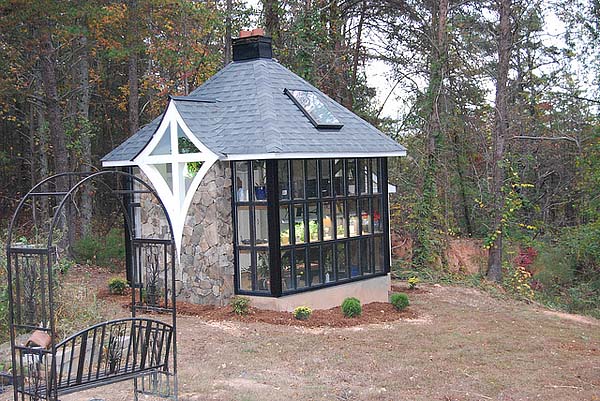
A few years back we were camping in a two man tent every weekend while building a home in the mountains. Having to set the tent up and take it down every week was beginning to wear on us. Especially since the location we were building in was considered a temperate rain forest. This usually meant we had to reset it up again in the garage later to dry out, as well as take it down. I figured a more permanent structure would be in our best interest, so we set out to build a tiny house to replace our tent. We affectionately refer to it as our “Shanty in the woods.” Even though we have finished our house it continues to sleep the occasional visitor when all beds and sofas have been exhausted.

cabin in the snow

At our home in the city 2 hours away we were in need of additional storage and I had been thinking of building a storage building. Our garage, out of necessity for my work, had been turned into a shop. The amount of dust I generated was not good for our camping gear, lawnmowers, bikes, etc.

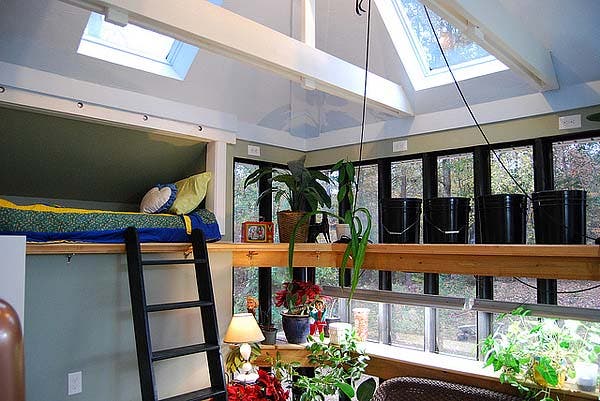
On a trip to the recycle center one afternoon I noticed 3 large pallets of commercial windows. I inquired about them and was told they were headed for the crusher. I asked if I could maybe buy about 10 as I had been thinking about building a solar water heater. He allowed me to take two of them home to see if the size would be right for me and said he would ask his boss about a price. When he told me $5 each I was interested. We had taken 4th place in Mother Earth News “backyard garden” contest the year before. Ever since then, I had always wished I could have a small greenhouse and at $5 a window, that could be a reality.

loft and window

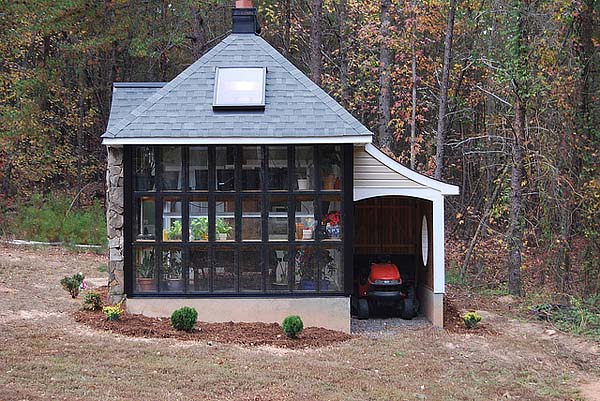
I thought about combining my storage shed with a greenhouse which could also serve as a “Tiny guest house”. In the end I was able to purchase 66 windows for $200 or $3 each.

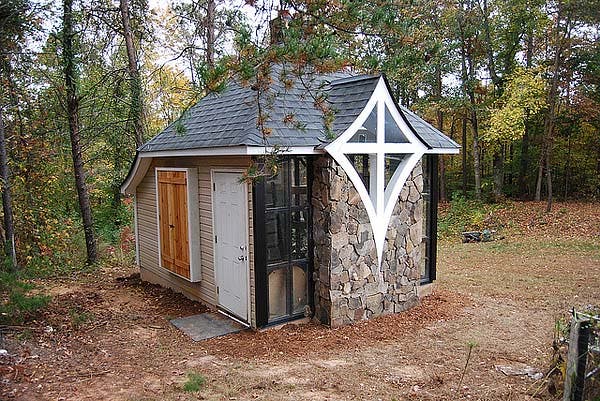
Our municipality allows a 12’ x 12’ structure without a permit. With the exception of a shed roof for the lawnmower I was able to do it.

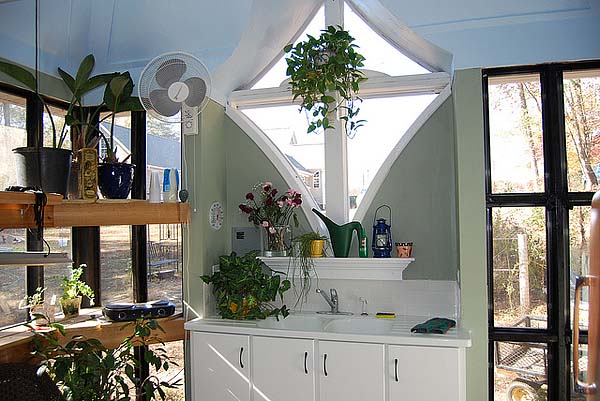
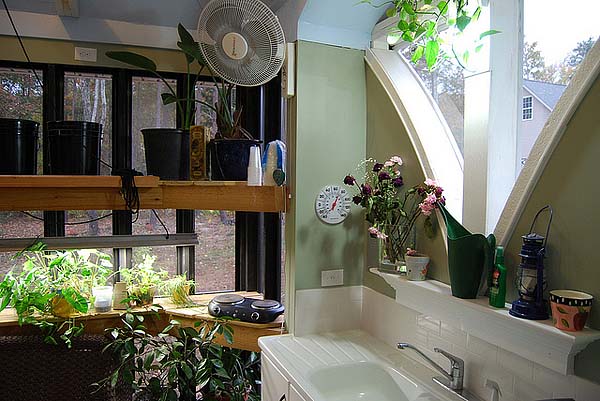
micro kitchen

As a tiny house it incorporates everything that one would need. It has a toilet, sleeping loft, cable, running water, electricity, and heat. The south facing glass is a great source of free heat. Lately, night time temperatures have been in the low 30’s, although the inside temperature has stayed above 50 with no supplemental heat needed.

unique window

greenhouse

exterior view and door

window and greenhouse

front view